
At its meeting of December 7, 2023, the TTC Board received a staff presentation on its bus electrification plan.
The City of Toronto has a goal to move to a zero-emission fleet across all departments by 2040 with interim goals of 20% in 2025 and 50% in 2030. TTC’s electrification plans fit within that timeframe.
Of the TTC’s greenhouse gas (GHG) emissions, in 2019 80% of these came from the diesel bus fleet.
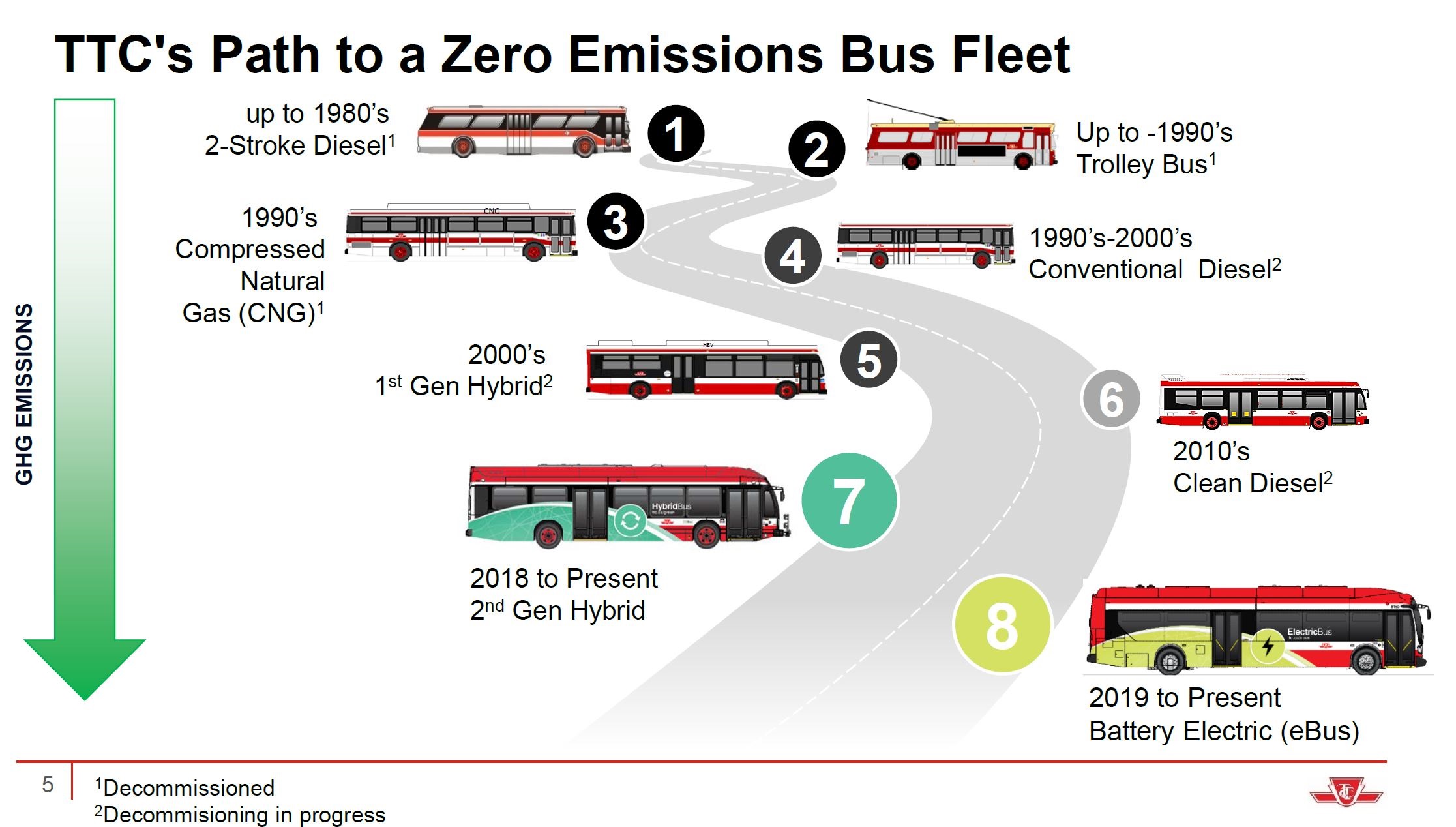
The history of a move to an all-electric fleet is shown in the TTC drawing below. Three decades ago, the TTC was seduced into “greening” its fleet by the replacement of electric Trolley Buses by CNG-powered buses. This was the result of an alliance between TTC management who wanted rid of the TBs, the gas industry which has a surplus of product, Ontario Bus Industries who wanted an untendered contract, and the new technology arm of the Ministry of Transportation who were desperate to show some sort of progress. (This was not the first, nor the last time provincial boffins would meddle in transit technology choices.)
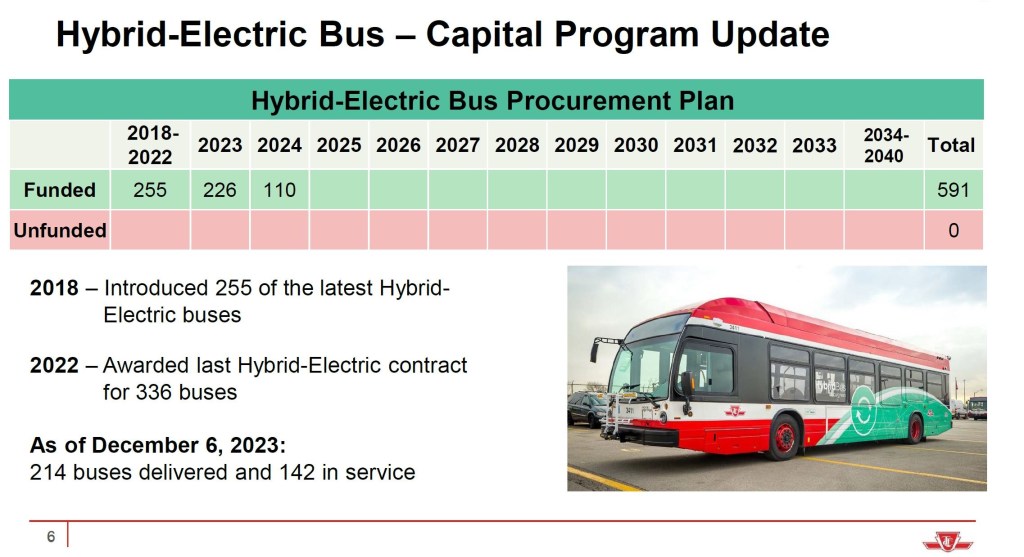
TTC is now taking delivery of its final order of Hybrid buses, and the last of these will be in Toronto by mid-2024.
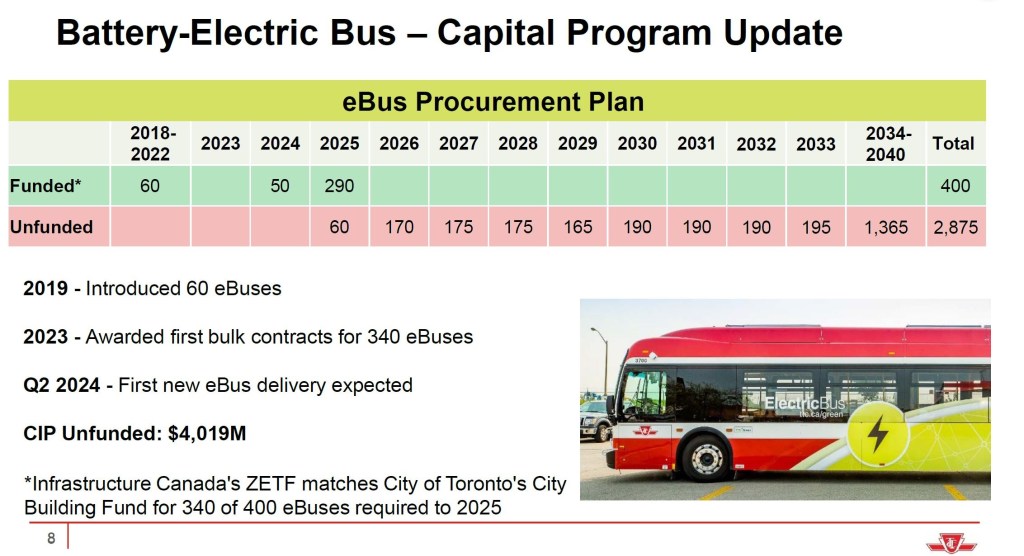
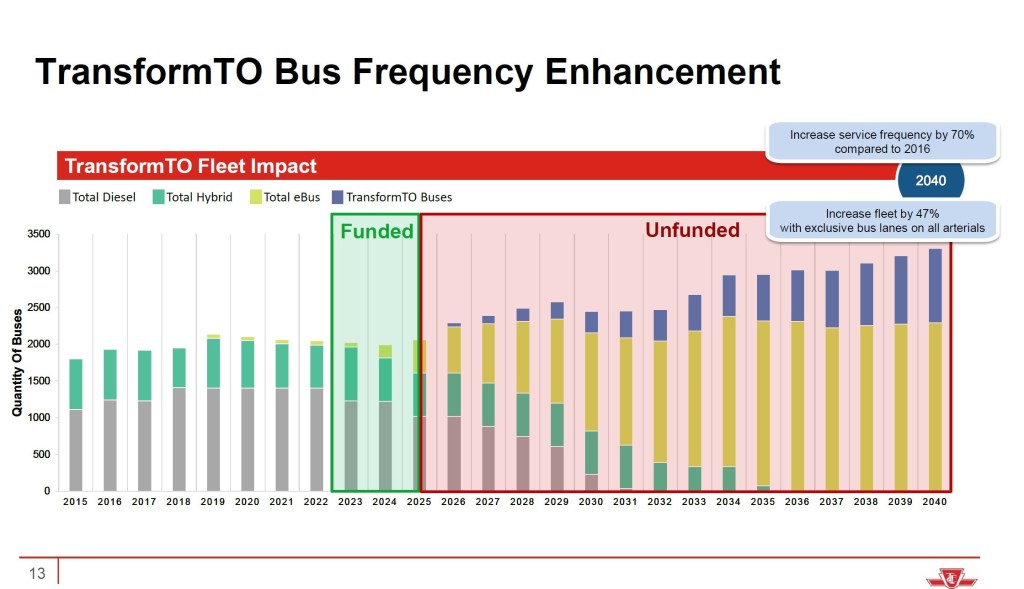
TTC also has a large order for Battery-electric buses (BEBs). The bulk of the order will be delivered from two vendors (New Flyer and NovaBus) in 2025. Where the challenge lies is that the bus procurement program is not funded beyond that point.
Some of the 60-bus experimental fleet will likely remain in service, but the future for Proterra (now bankrupt) and BYD (unreliable) vehicles is dim.
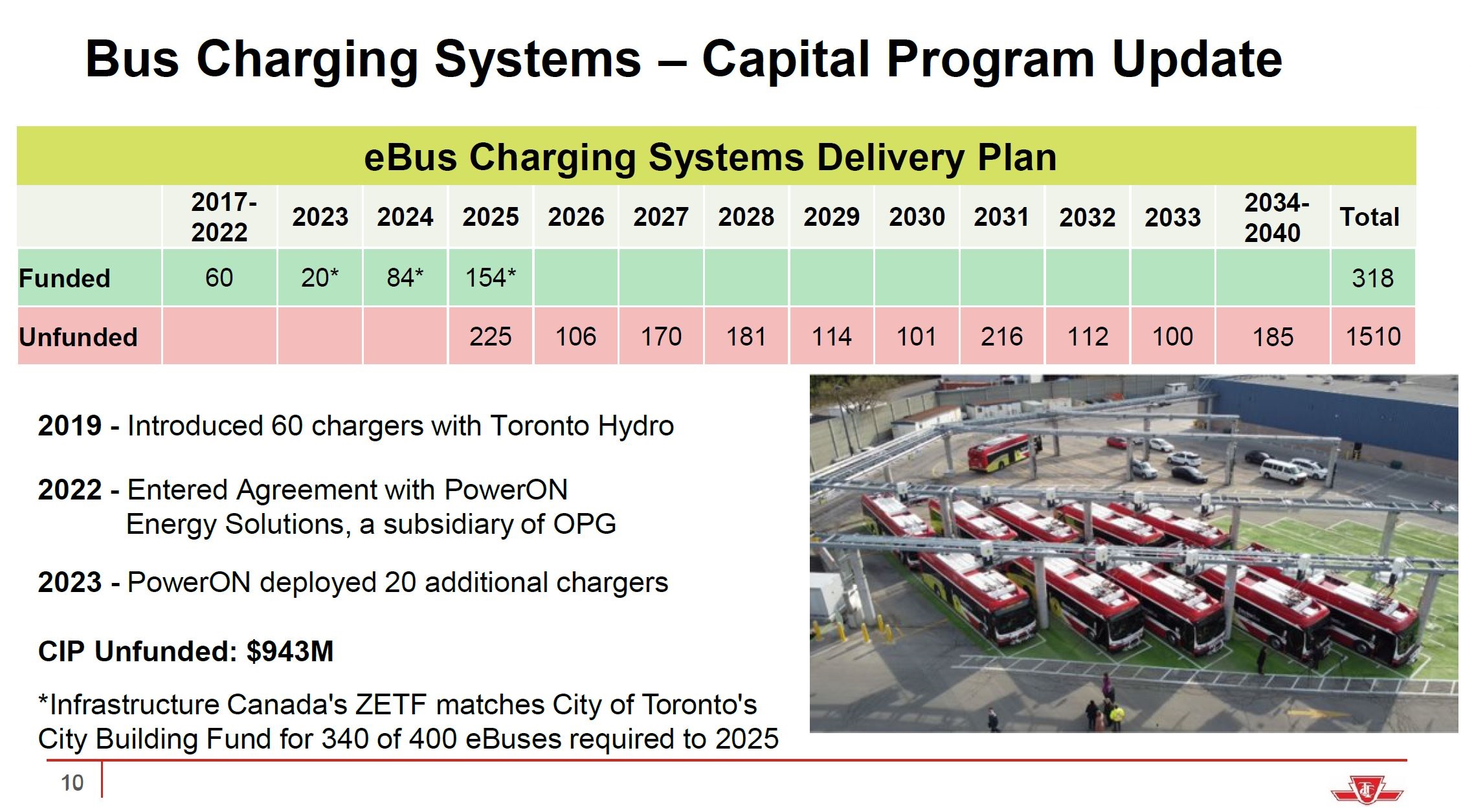
A related problem is that all of the existing bus garages must be retrofitted with substations, power storage and charging apparatus. This work is also largely unfunded.
The rate of bus purchases levels out at close to 200/year by 2030. This results from two factors:
- The projected fleet size of roughly 2,400 buses.
- The decision some years back to shift from an 18-year to a 12-year life cycle for buses.
It is too early in the evolution of BEBs to know whether a lifespan beyond 12 years will be possible, and at what cost compared to simply replacing vehicles. Streetcars and subway trains are built for a 30-year lifespan, and the old Trolley Buses lasted far longer than 12 years. The TBs acquired in the late 1940s lasted almost a quarter century, and their electrical gear was recycled into new bus bodies that ran into the early 1990s.
With the rate of technological change, and transit systems’ love for capital purchases to refresh fleets rather than overhauls, the new BEBs are unlikely to match their predecessors’ longevity.
All of those buses and infrastructure are among many large-scale projects overhanging TTC budget planning. According to the December 2023 Major Projects Update, 73% or almost $3 billion for this project is unfunded through to 2036 when the fleet would be all-electric. A further $560 million is unfunded for charging systems.
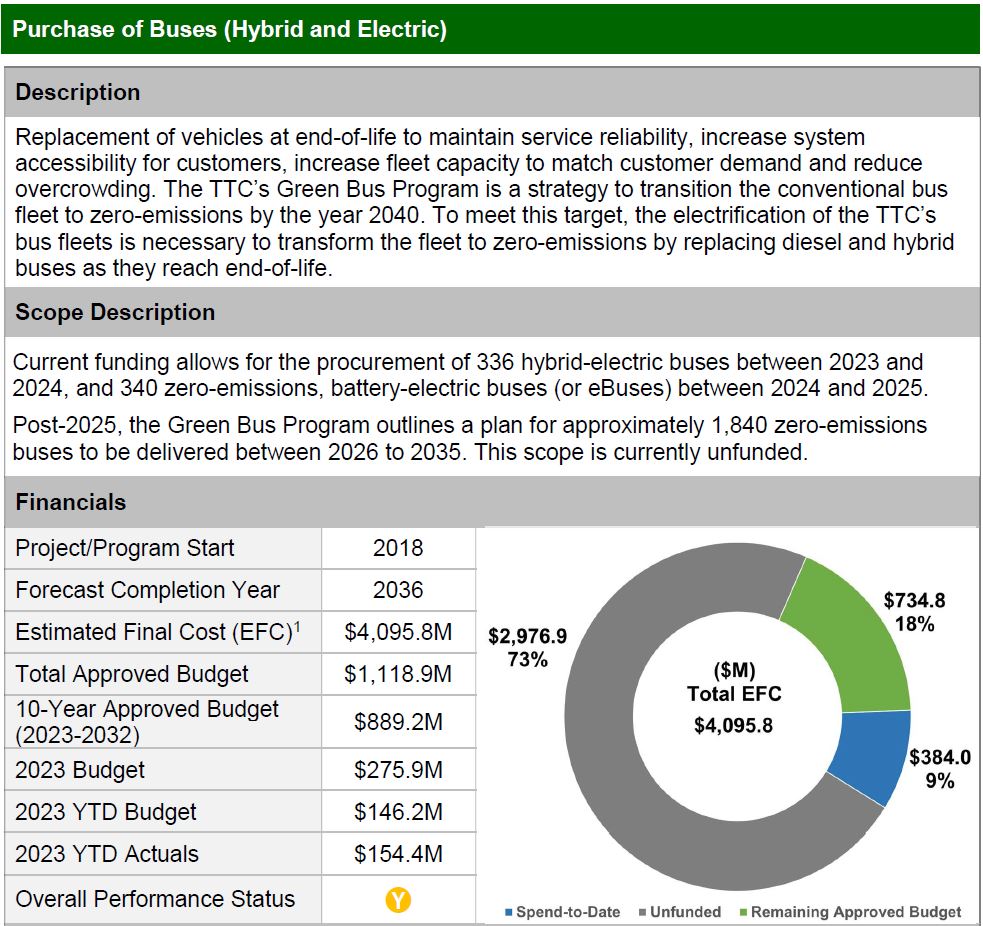
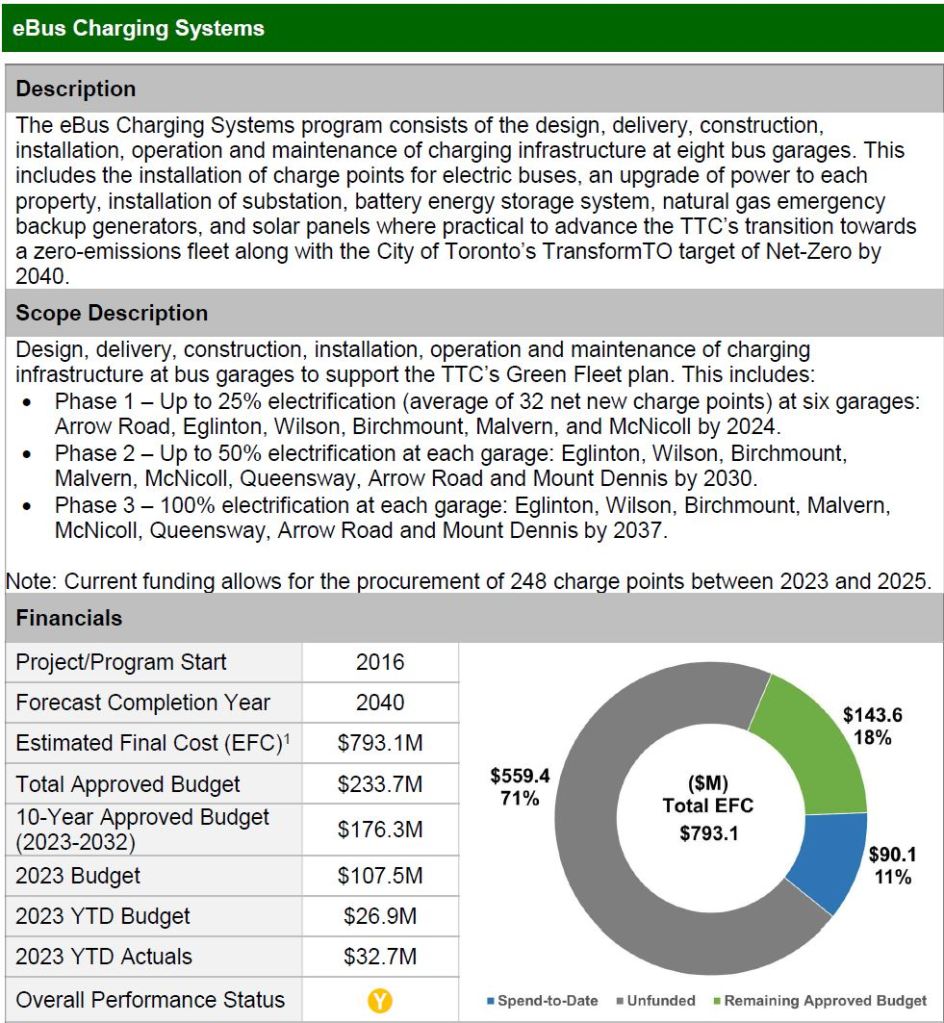
The fleet transition is shown below together with the effect on fleet emissions.
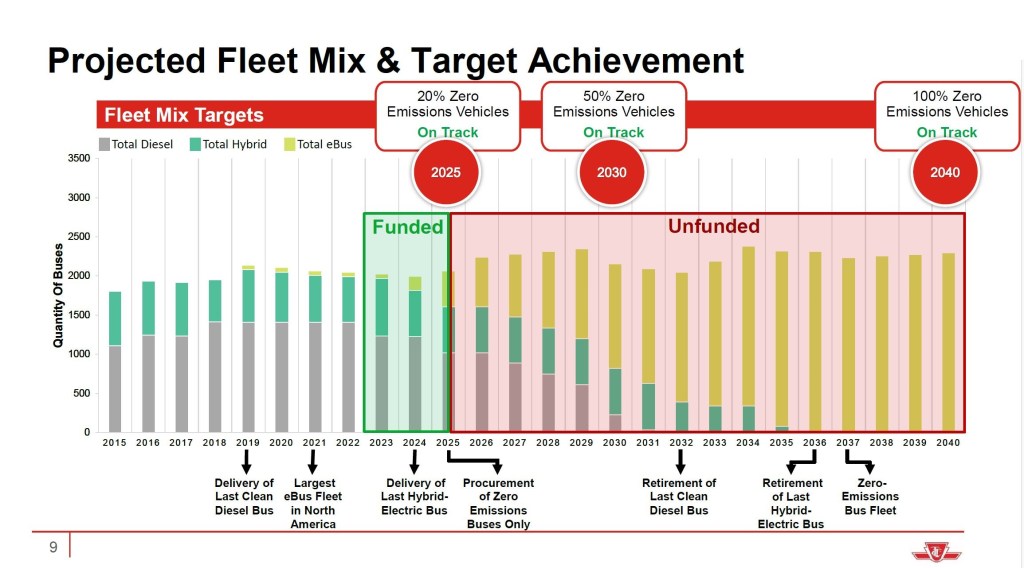
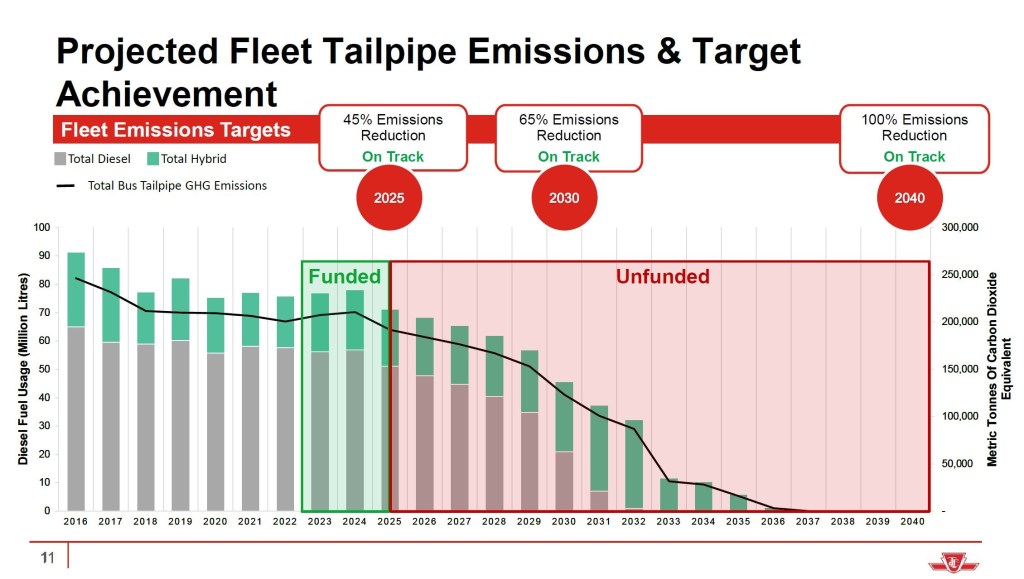
These charts presume a minimal level of ridership and service growth, along with the effect of LRT and subway projects coming on line that will replace buses (Eglinton, Finch, Eglinton West, Yonge North, Scarborough, and Ontario lines are already in some stage of construction).
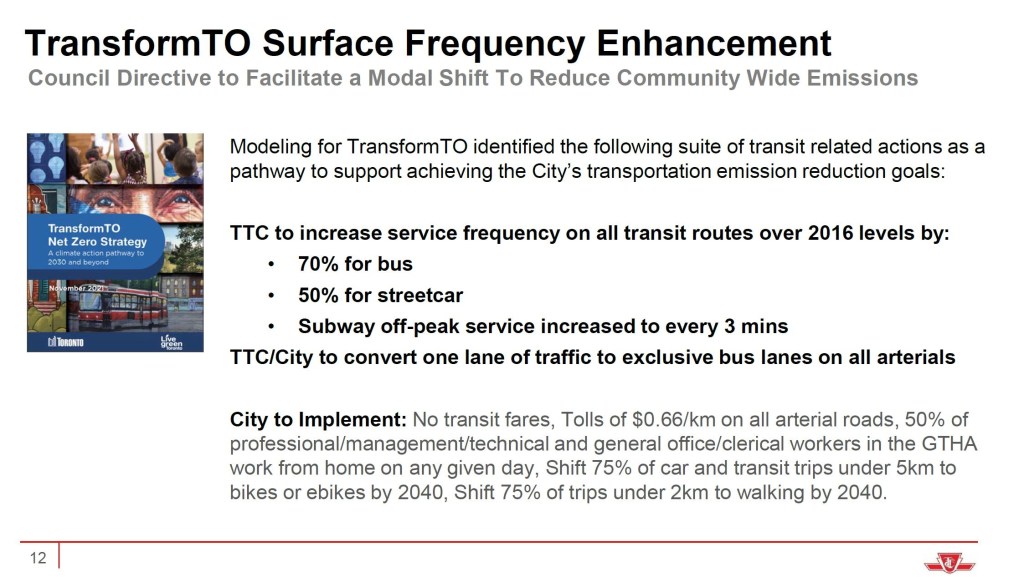
The TransformTO has two levels of targets, of which Council has approved only the first. If there is to be a substantial reduction in emissions and energy demand generally, it is not enough to simply replace diesel buses with electrics, but trips must be diverted to transit. This is a big challenge especially for trips that are not downtown-oriented or lie along rapid transit corridors.
An eventual goal, modelled for 2040 but not part of Council’s approved targets, includes free transit, a substantial increase in surface transit frequency, and reserved bus lanes on all major streets. This has a substantial effect on the number of buses and garages required to achieve the higher service level.
Almost a fifty percent increase in the size of the bus fleet would require four new bus garages and associated charging facilities. The proposed increased streetcar service level can be handled with the planned 264-car fleet including 60 new cars now in delivery. The subway change is off-peak only, and does not require additional trains.
None of the fleet projections include an allowance for a possibly improved spare ratio through reliability and maintenance savings. In any event, this could be offset by limits on vehicle range and the need to recharge BEBs more often than refuelling diesels or hybrids.
The premises here about funding, changes in work-from-home behaviour and shifts to active transportation are rather optimistic. If anything, they may understate the scale of change needed in the transit system by assuming that trips that might otherwise be on transit will not occur (e.g. Work From Home shifts) or will be possible with active transportation because of their short distance.
Toronto is in a very difficult state regarding the future of its transit system for both operating and capital funding. Any talk of a green future must occur in the wider context of all possible emission reductions in all sectors, not just transit.
 Steve Munro
With a 12-year lifespan for the diesel buses, the latest and newest whatever appear on the brand new buses that showed up as soon as they appeared on the market.
With 30-year lifespan of “electric” vehicles, new additions don’t appear at all. The CLRV streetcars kept their linens, even though the buses had electronic screens showing up soon after the CLRV’s arrived. The TTC didn’t replace the linens on the CLRV’s, but kept the linens instead.
Does anyone know what new and improved whatevers will be on the newer 60 Flexity Outlooks, that the older streetcars will not get?
Steve: I asked the TTC about this, and other than fixes that have already been implemented on the existing fleet, there are no changes.
LikeLike
Electric buses seem so much more civilized than diesel. I remember demonstrating to keep the trolleys, in some ancient era. I can’t even imagine why they’re holding back, except for capital expenses. I can see that beefing up the electric supply to the maintenance areas would be expensive, but surely dragging cables over to the buses wouldn’t add that much.
Steve: “Plug in” buses really are not the way to go for reasons of safety and simplicity. The overhead charging via a pantograph system is much simpler and allows the electrical distribution to be isolated from the shop floor. It is also much simpler to install and use outdoors where charging stations and cables would limit mobility in yards. TTC is using this now at Birchmount, and I hope that they have the good sense to adopt this as a standard.
Change of subject. I’d like to ask a couple of questions about street cars. There is an old romance to them that I could relate to, but don’t feel very strongly. Buses seem so much more flexible, more ready to deal with immediate problems with traffic etc. Street cars can take a larger load it seems, but the new double length. Street cars seem like a huge imposition on the streets. I mostly ride a bicycle, and I still find them awkward to deal with when I’m going faster than them and need to pass. When I am driving, it can be impossible to pass on the right lane because of parked cars blocking much of the access and the length of the streetcars making it difficult to pass when there is space. Are they so short of drivers that they need these behemoths?
Steve: This is a difficult question because it is also bound up in the way that TTC operates its streetcar system. Yes, the large vehicles are a challenge for other road users, and from a service point of view, they mean that the scheduled gap between cars is larger than it would be with shorter vehicles. The flip side is that fewer operators are needed. TTC degrades its operation with a raft of “safety” rules that have evolved over the years partly due to track maintenance issues and partly due to an abundance of caution that does not apply to their bus network. There is also an issue with traffic management and transit priority without which streetcars can be bogged down needlessly. Recent experience on King Street shows a worst case example of what happens when you make no effort to give transit true priority.
There is an issue with loading times in part because riders have to walk out into the street to board, and partly because of slow door operation on the new cars. Buses have their challenges too with single-door loading on most routes, although this could be addressed with vehicle design and a shift to all-door boarding.
There is also, of course, the difference between streetcars on streets like King, and on Spadina or St. Clair where they have their own right-of-way, although there are implementation issues that give transit less priority than it should have, notably at signals. It’s not as if Toronto’s is the only streetcar system in the world, although we have more mixed traffic operation than many cities.
LikeLike
Consider trolley buses again.
LikeLike
They had electric buses in the 70s on Bay St but scrapped them.
LikeLike
If TTC needs 4 new bus garages for Ebuses, they could have used Old Eglinton, Lansdowne and Danforth. The residents shouldn’t complaining because their all electric, little to no noise, and no fumes to deal with. Plus reduce deadhead cost significantly and save on operational cost. Those property is already owned by TTC, so no need to look elsewhere by using existing property.
Sure that was a far-fetched fantasy idea, but it’s still fairly possible to pull off.
And not to go too much off topic, but I recall a report where it mentioned the closing of both Danforth and Old Eglinton cost TTC an extra $2 million or more a year in extra cost. Any idea where that report is? I believe the report came out a year after the closing of both divisions in 2003.
Steve: The extra cost is in longer dead-head trips to/from garages that are further away from routes that the inner city garages (former carhouses) once served.
As for recycling the property, Eglinton is only a shadow of its former self, and is no longer a garage with maintenance facilities. Some of the property will be redeveloped once residual bus operations shift to a new terminal to be built roughly where the old one was (it has been a Crosslinx staging site for years). Lansdowne Garage will be redeveloped for housing. Danforth Garage already has new buildings on part of the property, and further development is in the works.
The proposed expansion of the TB system was based on the then-existing network with further expansion on routes that were in striking distance of Lansdowne Garage such as Dufferin. That particular route ran into troubles because of restrictions on building overhead on Wilson south of Downsview airport, but the more general problem was a lack of interest from TTC management. If one were designing a new network, it would probably be a hybrid battery/electric network with overhead on the main routes and battery operation on outer branches. Charging would mainly be done while buses were under wire. I very much doubt we will see a move to his technology as there is no industry lobby group behind TB expansion, as opposed to BEBs.
LikeLike
There has to be some reason why trolley’s haven’t been looked at again. I know in 2009 David Miller had a study to look at the feasibility of bringing them back. Obviously with Rob Ford in as mayor, it was cancelled. But with Olivia Chow as mayor , this is good timing to push for trolley buses again. And considering the company that made our last trolley are still around, Flyer, I can only imagine the updates in technology they would have. Only problem should be a facility to store them.
LikeLike
Regarding the Eglinton Station bus terminal: “Some of the property will be redeveloped once residual bus operations shift to a new terminal to be built roughly where the old one was (it has been a Crosslinx staging site for years).”
This is the first I’m hearing of this. Do you happen to know if any plans for the new terminal have been released so far?
Steve: The new terminal is outlined in the plans for the new development on the SW corner of Yonge-Eglinton. It will be an island platform at ground level serving fewer routes than the existing one because the ECLRT replaces several that now serve this station. It will be located roughly where the old surface terminal was on the south side of Eglinton, but will be inside the building podium. See the architectural drawings on the City’s development application site. (Open “supporting documentation” and download the first set of architectural plans. You can see the new terminal on pages 5 and 6 of the pdf.)
LikeLike
What will the TTC do with the 10 BYD’s that are at Eglinton division? Ride them out or sell them off?
Steve: That assumes there is even a market for them for anything other than spare parts. Given that most of them are not even in active service, “riding them out” is really not an option.
LikeLike
Edmonton has 60 electric buses that have been nothing but trouble. Half the drivers don’t fit in the drivers seat, the buses have a far shorter range, they’re far more expensive and far less reliable. Two thirds of the electric fleet is currently in maintenance and unusable. To make matters worse, the manufacturer is in bankruptcy.
Steve: For the benefit of readers, the Edmonton fleet is from Proterra which does not have a sterling record. CBC wrote about this recently.
LikeLike
I’m not thrilled at the 12 year lifespan on an electric vehicle. The life cycle costs of manufacturing them are not insignificant, and every effort should be made to extend their lifespan as much as possible.
LikeLike
The TTC does have alternatives here, which are:
* rescind the electric only purchase policy until 2028, and purchase a proportion of hybrids to get more axles per $m spend
* rescind the 12 year span for the hybrids, and life extend the best performing vehicles to 18 years
Either or both of these would facilitate a more gradual rollout including meeting at least some growth/TransformTO demand. Would that mean more diesel usage by the TTC over that period? Yes. But this would hopefully be offset by more mode shift than an under strength surface network can drive, and in any event the capital expense of chargers would also be defrayed over a longer timeframe.
Steve: This is one of those situations akin to the point we lost the trolley buses where a confluence of factors: government interest in looking “green”, an industry looking to push new product, management wanting to get new buses provided someone else pays for them while making their “innovation” look good. It’s hard to untangle a knot like that.
Far too much emphasis is placed on replacing diesel fuel for a bus fleet that’s a small fraction of the City’s total, and not enough on the benefits that more transit can bring.
And that’s before we get to a vendor’s sweetheart deal with a former Commissioner in an attempt to get a contract without competition.
LikeLike
I very much agree with those who wish to see the return of trolley buses to Toronto. From what I have seen in Europe, TB’s are absolutely the best solution to an electrified bus fleet. While they are connected to overhead power, their batteries are being recharged. But unlike before, they can run at will disconnected from overhead, off-route or around obstacles. Buses can come in articulated format. The manufacturers, such as Škoda, are well-known for many decades of reliable service, and they are most familiar with cold climate such as northern Europe. Most important, this is tried-and-true technology decades old.
From an article on CBC News 2018-04-13: ‘The future of public transit’: Edmonton on board to buy 40 electric buses.
What happened was that Edmonton eventually bought 60 buses from Proterra of California (Steve provided a link in answer to Vincent W., see above). The poorly-designed & poorly-built buses need to be recharged at the garage, and cannot handle Edmonton winters (what can you expect from California!!) Proterra is bankrupt and cannot supply spare parts. Only a very few of the buses remain roadworthy. It has cost Edmonton $millions in losses. Ironic that they scrapped the trolleys to cut costs!
Not just transit management but the political overlords with taxpayers’ money to dole out are guilty of not searching out best practices from around the world.
LikeLiked by 1 person
Proterra went bankrupt and has since then been bought by the Chinese owned Volvo.
LikeLike
Check your facts next time. Volvo Cars is majority owned by Geely, while Volvo Buses which is completely separate from Volvo Cars is not Chinese-owned.
LikeLike
TTC had ok trolley buses and got rid of them in their fine wisdom. I can’t get onboard with the new e-bus. It could have phased over to high tech. Small batteries would have helped [for] temporary reroutes and complex junctions etc. But no. Here we are more expensive and less solution and more pollution.
LikeLike
There’s zero chance of trolley busses returning to Toronto. Nobody would like to see them come back more than I would, but battery power is the final nail in the coffin for trolley busses. Technology is headed heading in the direction where overhead wires will be completely and totally obsolete.
LikeLike
Regarding trolley buses… a lot of people are remembering them with fond memories. But I have memory of actually riding on them not long before they were retired. And my experience was they were rough riding, noisy rattle boxes with no A/C that operators had to drive slowly to avoid issues with poles getting disconnected – particularly in intersections.
The pole connection issue combined with battery electric buses now being vaiable strongly suggests to me that the traditional trolley bus isn’t coming back.
On top of that, having all those extra overhead wires those trolley buses needed did not look pretty.
The closest thing we will have to the traditional trolley bus is battery electric buses that can charge overhead on sections of their routes… negating the need for them to go back to the shop to recharge.
And that’s something I think the TTC should do as it would greatly increase their in-service time and they would only need to go to the shop for maintenance, repairs and cleaning.
Steve: Re the ride quality of the old TBs, that was a product of the electrics of that generation which were recycled into new bodies from TBs of the late 40s. Similarly, the lack of AC was common on all buses of the era. New TBs have had solid state controls and AC for decades. As for dewirement, part of that was thanks to the TTC’s poor overhead maintenance toward the end of life of the system, and partly due to intersection design. Years ago, I remember first seeing Vancouver’s system and watching as TBs drove at speed effortlessly through intersections. Off wire capability for unusual turns or bypassing obstacles has also been around for decades. Intersections can be simpler because only regularly used curves are installed. TTC adopted none of this because management wanted rid of the mode so that they could buy natural gas buses. We all know how well that worked.
Definitely, modern systems can us a combination of batteries with higher capacity and under-wire charging. Not only does this eliminate trips back to a charging depot, it reduces the size and weight of the batteries as the bus does not have to carry around a full day’s charge. From remarks at the recent Board meeting, the TTC seems to be looking at sprinkling charging locations around the city, but is still studying this as an option.
LikeLike
I saw yesterday on a TR subway train info screen the claim that the TTC has “The largest electric bus fleet in North America”. Ironically, whatever battery bus is shown, has its pantos up for overhead charging. (So I assume they are NOT counting hybrid buses as “electric”.)
Steve: The TTC has a hard time remembering that trolleybuses still exist, and there are much larger fleets of these electric buses in Vancouver, Seattle and San Francisco than our paltry eBus fleet in Toronto. TTC is all about self-promotion, rather like Metrolinx, and let the facts be damned. Some of their claims now include a qualifier about battery-electric buses to make the distinction.
LikeLike