
On December 5, 2023, Toronto’s Executive Committee will receive an update on the Eglinton East LRT project. Readers with long memories will recall that there was a time when a “peace in our time” solution to the Scarborough Subway debate would have seen both an extended subway and at least part of the EELRT built with the monies already earmarked for the Scarborough projects. This claim was a work of creative fiction, but it got the subway extension’s approval through Council.
We are still waiting for the LRT, and Scarborough will be lucky to see it until the late 2030s at best.
This set of reports keeps the ball rolling on the EELRT, albeit slowly. Until the Provincial aims for extension of Line 4 Sheppard are clear, the degree of conflict with the LRT plans and the scope of the LRT will not be known.
The most recent proposal has a U-shaped line running from Kennedy Station east and north to the University of Toronto’s Scarborough Campus (UTSC), and then north and west to Sheppard and McCowan with a branch to Malvern Centre. These shadow the original Transit City proposals for a Scarborough-Malvern line and a Sheppard East line, although the latter would have run west to Don Mills Station.
The cost estimate for the full EELRT project sits at $4.65 billion based on construction in the 2027-2034 period. This is a class 3/4 estimate with a potential range of -20% to +30%. This excludes key items including: property, procurement, vehicles, lifecycle maintenance, and future operations and maintenance.
With Ontario studying potential expansion of the Sheppard subway west to Downsview and east to at least McCowan, any Sheppard branch of the LRT has an uncertain status.
The map on the left shows the City’s version of the EELRT while the one on the right shows how the Metrolinx study area extends to Meadowvale road.


Metrolinx claims to be reviewing a range of technologies including subway, “light metro” and LRT, but it does not take a genius to figure out that any true extension of Line 4 Sheppard would use subway technology just as extensions to Lines 1 Yonge and 2 Bloor-Danforth already do. This would be especially important for a westward connection to Downsview which would not make any sense as a short, free-standing route.
Maintenance and Storage Facility
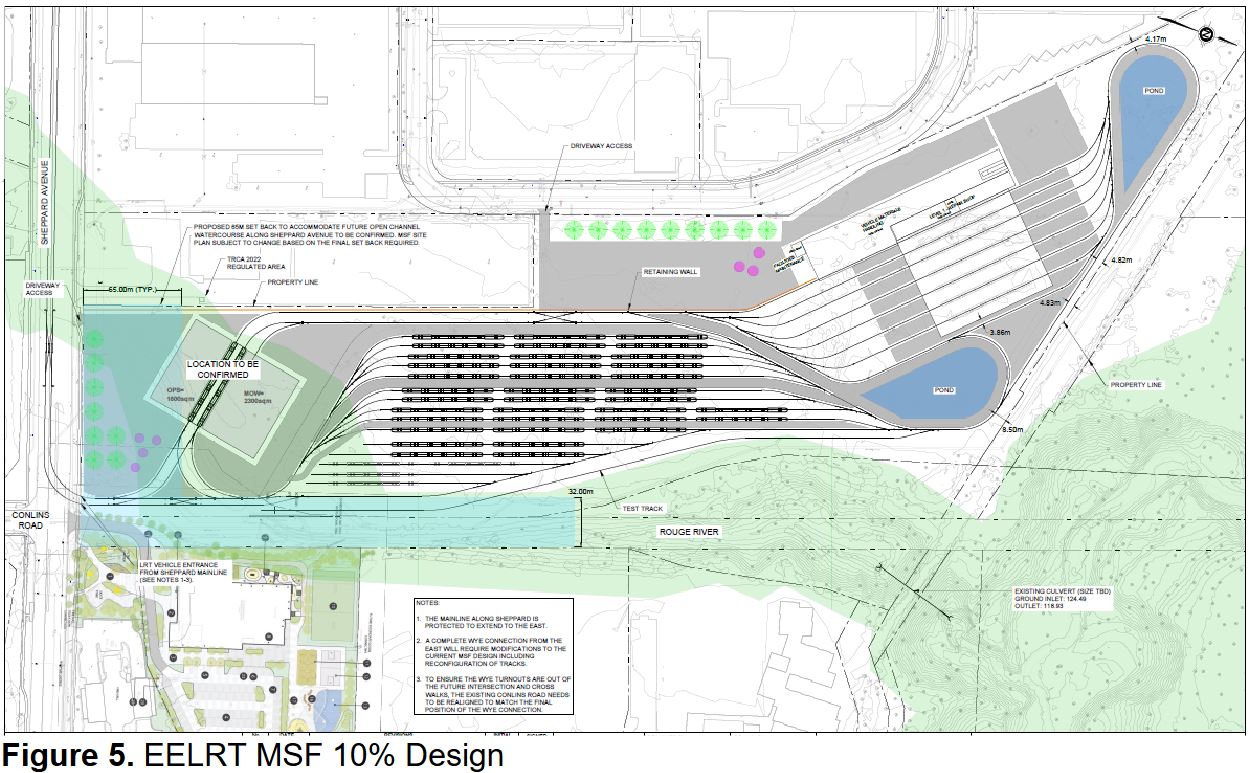
Originally, the City planned to build a Sheppard East maintenance facility on provincial land at Conlins Road, and an agreement for this has been in place since 2010. Now, Metrolinx wishes to keep open the possibility that this would be a yard for their own line, and the City might be forced to look elsewhere. At one point, property near UTSC was considered, but this was dropped because of conflicts with the University’s plans.
As a subway yard, this could be challenging given the watercourse crossing the site and the access route that would necessarily be below grade. As an LRT yard, some provision for the Rouge River was already made during early works on the cancelled Sheppard LRT.
Based on preliminary review, early enabling works appear to have been completed for this site to prepare it as an MSF, including the installation of an underground culvert across the south portion of the property to realign a tributary of the Rouge River. TRCA has advised that, according to 2022 mapping, a drainage feature through the southern portion of the property has been classified as a regulated watercourse and provision for a watercourse corridor along the southern limit has been incorporated into the MSF 10% design site plan to address TRCA’s advice.
A related question is the level of demand projected on the eastern part of Sheppard, and just how much subway tunnel Metrolinx is prepared to build simply to reach a yard site. Conversely, a shorter extension would likely be served from existing subway yards, leaving the Conlins site to be funded and built as part of the EELRT project.
The Metrolinx study on options for Sheppard is expected to conclude in late 2024.
Terminal Stations
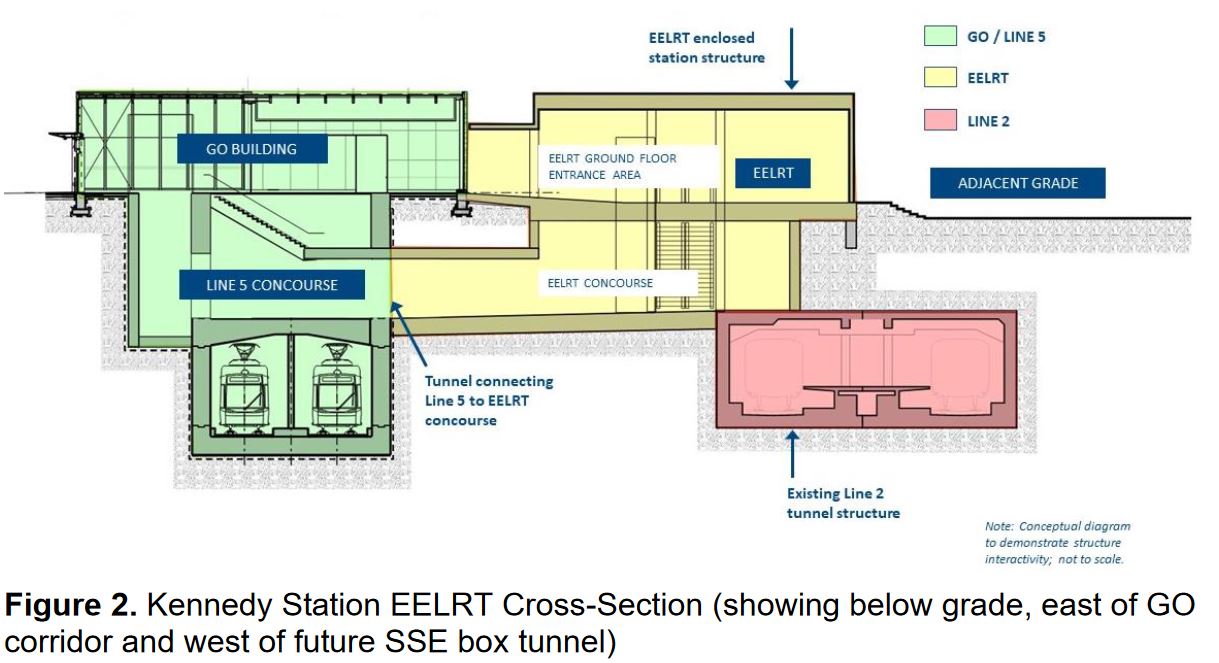
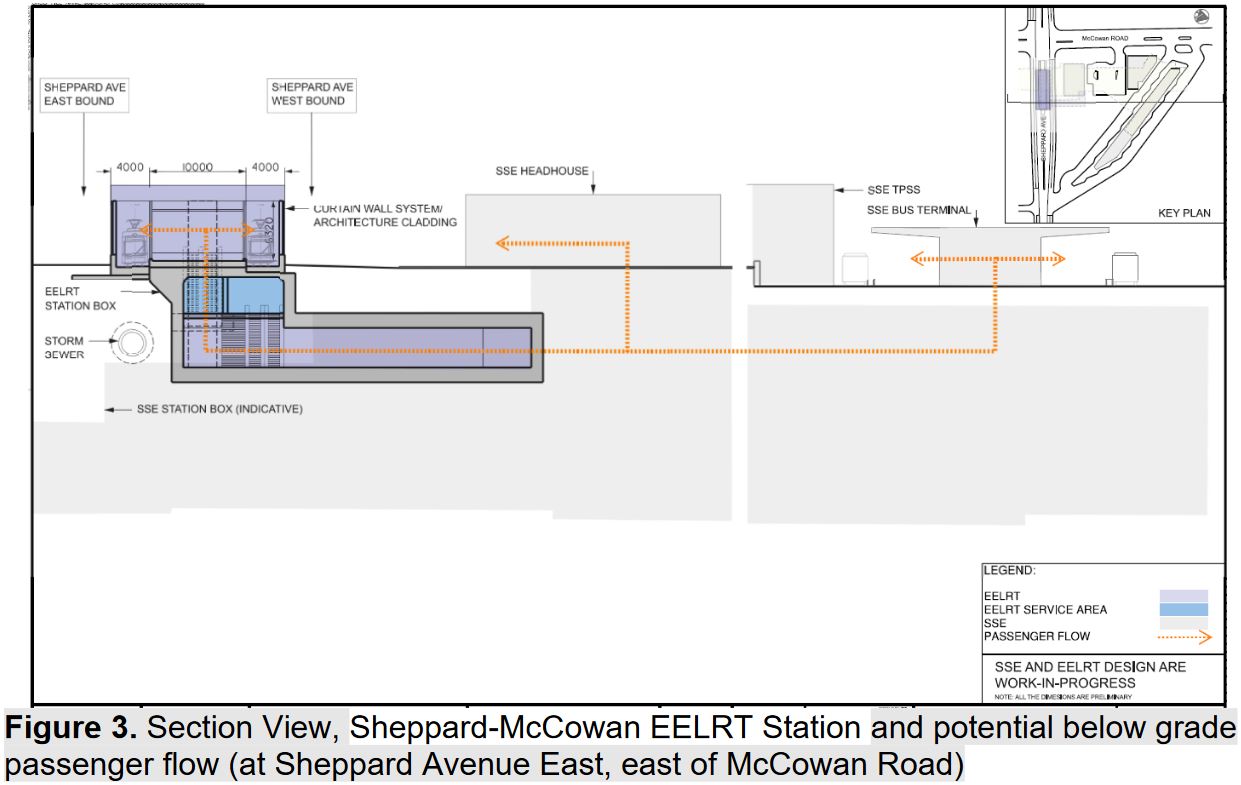
At the two termini of the EELRT, the stations will be built for relatively easy passenger transfers to/from the subway lines.
At Kennedy Station, the LRT platform is threaded between existing and planned structures such as the Line 2 subway, Line 5 Eglinton Crosstown and GO Transit. The view below is a cutaway looking east. The new LRT station would be built in what is now the parking area of the Community Centre east of the GO corridor and south of Eglinton.
At Sheppard & McCowan, the LRT station would be in the middle of Sheppard Avenue with an underground link north to the future subway station and bus loop beyond. The view here looks west on Sheppard.
Stop Locations
The proposal has been modified by the removal of five stops on Sheppard Avenue to increase the stop spacing. Stop removals on Eglinton, Kingston Road and Neilson were also studied, but these were rejected because of effects on walking distance and the need for parallel bus service to maintain access.

Durham-Scarborough BRT
The short section on Ellesmere overlaps the Durham-Scarborough Bus Rapid Transit project, and the report claims that share operation would not be possible.
It would not be possible for buses to use the centre median LRT guideway without a costly comprehensive communications system compatible with the EELRT. Additionally, allowing buses in the same guideway as the LRT would reduce operational flexibility for trains to run on either track in either direction.
This is a rather odd statement on two counts. First, it assumes that there would be some type of control system managing the trains rather than having them driven manually as is typical for operations on street, even with a private right-of-way. Any traffic signalling system should be agnostic as to the transit modes operating in the corridor.
As for bi-directional, single track operation, that is a rarity and one might argue that for such a short overlap, provision for this is not worth the effort. Far more to the point is the future volume of bus traffic and whether the combined operation of BRT and LRT can be accommodated, especially at stops.
Road Configuration
The road configuration would typically have two through traffic lanes on major roads plus a left turn lane on either side of the LRT corridor, a layout familiar from other projects.
On some streets, only one through traffic lane would be provided plus a right turn lane at intersections:
- Morningside Avenue from Kingston to Ellesmere Road (existing RapidTO lane layout);
- New Military Trail through the UTSC campus; and,
- Neilson Road between Sheppard Avenue East and McLevin Avenue.
Bike lanes, sidewalks and a landscape/amenity zone would be included wherever possible (the report’s term) with cycling separated from the traffic lanes.
Recommendations
The report seeks various Council actions:
- Approve the alignment as set out in the report.
- Authorize the Deputy City Manager, Infrastructure Services to negotiate and enter into agreements with Metrolinx related to structural and utility provisions for the EELRT in the Metrolinx subway extension work at Kennedy and Sheppard-McCowan stations.
- Direct that the Executive Director, Transit Expansion, identify an alternative site for the location of the EELRT MSF while working with Metrolinx to acquire access to the preferred Conlins Road site.
- Authorize the Executive Director, Transit Expansion, to modify the EELRT alignmentshould provincial plans for the subway extension overlap with the LRT.
- Approve $9.5 million in 2024 funding for continued work on the project.
- Authorize various senior officials to continue with design refinements to accommodate the Durham-Scarborough BRT.
- Direct City staff to report to Council in 2024 with updated cost estimates, the status of any Provincial proposal for Line 4, the results of further public consultation, and the status of the Conlins Road property or an alternative.
 Steve Munro
Is it feasible to plan for beginning construction at least to UTSC, or this not really possible without knowing where the yard will end up?
Steve: Without a yard location, it would be challenging. That said, construction at and east of Kennedy Station cannot get underway until the SSE project gets out of the way, and so there are a few years to muddle through the problems while finishing the design.
I notice that a traffic-free separated transfer between streetcar and Ontario Line/GO is not included in plans and renderings of East Harbour. At least in Scarborough it’s being planned well.
Steve: East Harbour has been a mess of Metrolinx planning ever since the scheme for across-the-platform transfers between GO and the OL which proved impractical, but which Metrolinx trumpeted right up to the point they acknowledeged it would not work. I never thought a transfer-free Broadview streetcar to OL/GO would be possible just looking at the geometry and space constraints.
Arg! It’s not like there’s worldwide examples of same-roadway LRT and bus operations for convenient and safe transfers.
LikeLike
At that point, would it make sense for the Eglinton Line to be split into two:
The LRT line would connect to enough higher order rapid transit lines that most customers wouldn’t miss the thru-running to Mt Dennis, no?
Steve: Except for the basic problems that the ability to run through from the Crosstown to the Eglinton East Line was removed at Kennedy by Metrolinx. What you want is physically impossible. Also, I doubt that Science Centre Station could be adapted to be a terminal for two separate services.
LikeLike
I don’t understand the references to a BRT and LRT not being able to share a ROW. It happens lots of other places, clearly it’s possible, even in Toronto.
I’m sure that the station names aren’t final, but “Sheppard East” strikes me as a weird choice. It’s strictly in reference to stations on other lines. It connotes the EELRT intersecting with Sheppard, but that doesn’t happen there – the line is running along Sheppard. “McCowan North” might be better, similar to “Markham North”.
I dislike the X-Y naming scheme, although it has the virtue of never being wrong. Or so I thought. “Morningside-Sheppard” station, given that it’s the only “Morningside-Y” station, should instead be “Sheppard-Morningside”.
Steve: I am sure that an entire Metrolinx Board meeting could be consumed in deciding what contributor to the Tory party deserves getting the name instead of a place people would actually recognize.
LikeLike
It looks like there isn’t much of a distance past the Sheppard East LRT MSF and Port Union/Kingston Rd. Adding to this, the EELRT line can have an extension past Morningside continuing up Kingston Rd. and loop back along the extended Sheppard East LRT noted in the first sentence. I remember years ago, that part of the waterfront LRT proposal (1999? 2000?) was to one day have a full LRT line running along the length of Kingston Rd., and tie into the Queen Street streetcar line, hence having a single line from Long Branch up to Port Union (and potentially points further beyond in Durham region) – a true cross-town LRT in the fullest sense. There are technical issues such as TTC gauge vs. standard gauge that the new LRT lines use, and other kinks that have to be worked out, but it is an idea worth exploring.
Steve: There is absolutely no point in having one continuous line from Long Branch to eastern Scarborough considering that one already exists called GO Transit, and it’s a lot faster than any LRT via downtown will ever be.
LikeLike
1 km is too far between stations for surface LRT. On Sheppard, there should probably be stations at Progress and Murison. The stations otherwise appear to have the right spacing and locations.
LikeLike
I know this ship sailed long ago, but the route up Morningside and to Malvern Town Centre (MTC) always struck me as inelegant.
Rather than turning up Morningside, if the route followed Kingston to Military Trail, then Military Trail to Nielsen, then Nielsen to MTC, that would have a few advantages:
– only one routing, no split routes and reduced frequency at the ends
– for only 1.5km more track, pushes the furthest-west station 2km closer to the Port Union community,
– better serves some Megan Park, Highland Creek, Morningside neighbourhoods, Scarborough Centenary hospital
– can put a station at the centre of UTSC, as well as one of the the more peripheral station planned.
It would need an MSF a little closer (e.g. the land between Morningside and Conlins S of 401). Communities along Sheppard would be left to be served by the Sheppard RT service, whatever it may be.
LikeLike
A vaguely hopeful idea I had to get things going on this line is to use the funding the city has set aside and start building the line from east of where the Scarborough Subway construction on Eglinton is taking place to as far east as the funding will allow, Morningside maybe, and run express buses on the ROW until funding for the rest of the route, vehicles and yard becomes available and the full route is completed.
I’d rather full approval and funding come in one shot, but this may be better than just kicking the whole line down the road for another 20 years.
Steve: Actually, the western end of the line cannot be built immediately because it will sit on top of the Scarborough subway, and can only be built once the subway work is out of the way. There are already red lanes in this area, and so building the LRT right-of-way will not change much for the existing service.
LikeLike
Would it not make more sense to extend Sheppard past Downsview Park and go one more stop to Finch West? This would remove double transfers from those using the Finch LRT and give the city a robust northern east-west transit corridor
LikeLike
The current Metrolinx “plan” is to study a Sheppard subway extension to Sheppard West station (formerly Downsview station, at Sheppard Avenue and Allen Road).
Finch West is two stations away. The station in between is Downsview Park, which would be silly to leave out considering GO is intending to run every-15-minutes service offering a fast trip to Union. So we’d be at a point of duplicating Line 1 for about 3.5 km and two stations, in an area with a park on one side and industrial on the other.
LikeLike
Where the heck did they come up with BRT-LRT joint op not being possible? Or is it rather than the planned frequency would be too much (Metrolinx mentions an end state frequency of buses every 5 minutes in peak) but in Toronto it may be up to every 2 minutes in peak according to TTC.
EELRT seems to be proposing 5 minute headways at buildout state.
The platforms would have to allow for double berthing of an up to 50m LRV and I believe DSBRT wants 40m platforms, giving a whopping 90m platform to fit both.
Given that the frequencies preclude LRT/BRT coexistence, how do they propose routing the LRT along Ellesmere through UTSC as shown — grade separating the LRT there (is that why it’s so expensive) or a massive four lane arrangement on Ellesmere where it is two LRT tracks and platform plus two BRT lanes and platforms (one per direction). Can that even fit while maintaining one lane of general traffic per direction? Why not keep the LRT on Morningside and avoid the detour on Military Train through the middle of UTSC?
As we all know, buses and LRVs share rights of way with no problem on St Clair West (512 streetcar with 126 and 90 buses out of St Clair West Station). But the 512 is never more often than every 5 minutes and the 90 is the most frequent bus route there at only like every 15 (correct me if I’m wrong)? I wonder at what frequency would sharing of right of way by buses and LRVs break down.
Honestly, I doubt a 2 min headway at peak periods on the DSBRT, because that is close to the upper limits for BRT and seems excessive.
Steve: I think a lot depends on where stops are physically located and whether stops are shared between the LRT and BRT or not. The whole point of the dogleg through UTSC is to provide service to the campus. If the amount of shared right-of-way were longer, then definitely there would be concerns, but I have a suspicion this can be designed around.The greater challenge for the LRT (and by implication anything sharing its right-of-way) will be the efficacy of transit priority signals at the turns through the campus so that the trains don’t wait forever waiting for autos to have “their turn”.
LikeLike
Jarek wrote:
Not if the Stubway/Line4 trains avoid Sheppard West station and instead interline just north of Sheppard West station.
If I recall correctly, half the YUS trains turn back at Sheppard West, and only half go on the new TYSSE, so it likely has the capacity to support interlining. Shorter trains shouldn’t be much of an issue, but there may be other reasons that preclude interlining.
Steve: The tracks and tunnels at Sheppard West are not aligned for a Line 4 junction that turns north. A very long time ago, there was a design decision to aim for a turn south that would merge south of Sheppard West Station.
Also, all of the service is currently running through to Vaughan with no short turns. When that practice was in effect (before covid service cuts), the turnback was at Glencairn, but only in the AM peak. Long range plans will see more frequent service on Line 1, and even with the capabilities of ATC, there will not be track time available for a Line 4 service to merge in.
LikeLike
Is there gonna be portals similar to what the crosstown will have so that the trains go under busy intersections such as the Morningside/Kingston/Lawrence triangle and Morningside/Sheppard to avoid being stuck at traffic for long periods of time. The stops wouldn’t even have to necessarily be underground but I’m not too sure.
Steve: You can see the current design proposed for the EELRT in the May public presentation deck. There are no planned underground structures.
LikeLike
Steve wrote:
It is interesting that Line 1 north of Glencairn during morning rush might be one of the only places on the system where scheduled service is better post pandemic (3m 10s) then it was before pandemic (4m 42s).
LikeLike
Seems to me like building the LRT to a new stop of the SSE at Brimley/McCowan would be more sensible long-term than forcing such a long transfer at Kennedy. What commuter wants to have to walk so far every day just to transfer? It’s especially ironic given one of the justifications for the SSE was the lack of any transfers. So instead we’re going to make commuters along Eglinton do it.
Steve: Except that there won’t be an SSE stop at Brimley/McCowan.
LikeLike