
The TTC is conducting its final round of consultation about its five year service plan covering the period from 2024 to 2028. This is a longer view of what the TTC might focus on over multiple years, a related but separate process from the Annual Service Plan for 2024 that will come to the TTC Board’s November 22 meeting. Although the range begins in 2024, in practice, 2025 will be the first budget year informed by the five year plan.
There is an online survey covering many topics, and I will review that it more detail later in this article.
Of particular interest as background to this process is the result of the third consultation round conducted in late summer. The TTC’s overview of the action plan and consultation includes detailed notes of feedback from various groups: online survey respondents, stakeholders (community groups and advocates), employees, riders, and youth ambassadors. There is a common thread through all of them about problems with information and communications, service quality and management. What remains to be seen will be whether the TTC has any appetite for addressing these issues rather than making superficial changes that sound good but achieve little.
I recommend reading those consultation summaries both to transit riders who might think they are lonely voices crying into the wind for better service, and to politicians who have only a tenuous grasp of what riders really want and need. Open the overview page for the service plan, and scroll down to Consultation Documents, Round Three.
Of course any major change depends on funding if more service is involved, but it also requires an organizational recognition that every transit problem cannot be blamed on uncontrollable, external forces. The issue of communications is entangled with the TTC’s organizational structure and the fractured responsibility for various aspects of getting the message out to riders.
The service plan itself echoes these limitations in that it talks about what might be done in general, but it is silent on basic matters such as how much service the TTC can physically provide (fleet size and availability, staffing limitations), and the magnitude of costs involved in changing service levels. Some issues, such as better management of service frequency and reliability require recognition that simplistic definitions for “on time” have little meaning in the real world faced by riders and operators.
The time is long overdue to stop the kudos for achieving “key performance indicators” that misrepresent the actual quality of operations. Lest this seem a rather broad indictment without background, I refer readers to the many articles I have written both on the content of the CEO’s Report and detailed reviews of day-to-day operations.
A review of the fourth round online survey follows below together with notes on information from this round of stakeholder meetings.
Structure of the Plan
In previous consultations, there were two separate elements: a service plan and a customer experience plan. They were produced and presented by separate groups, and did not always have the same aims. “Customer experience” in some circles means things like creature comforts enroute when the most important aspect of a rider’s experience is that their bus shows up reliably, has room for them to board, and gets to their destination in roughly the same length of time every day.
That is the single most important “marketing” issue for transit, and if that part is missing, there is little point in anything else. Sadly, too many decision makers focus on everything except service, in part because service is hard. Service costs money and it takes effort to make it work. Why run reliable service when you can trumpet a new web app, or talk about upgraded facilities at major stops?
The plan now appears to be a single, unified piece, with an overall emphasis on service. It is organized into “seven pillars of opportunity”, thirty actions, and multiple initiatives. Yes, it’s management-speak at work.
The pillars show the broad areas of the plan:
- Foster a customer-centric mindset
- Enhance the transit network
- Improve service reliability
- Prioritize surface transit
- Accelerate integration with other transit agencies and complementary modes of transit
- Enhance safety and comfort at stop, stations and in vehicles
- Streamline information services
Items 1 and 7 are net new in the 2024-28 plan, and item 6 has been expanded from safety at stops to include stations and vehicles. There is a rather unwieldy table to summarize all of this, and I have left this for the end of the article for those who are interested.
The devil, as they say, is in the details and just what any reader might infer from those topics. For example, “streamline” could mean “simplify and clarify” or it could mean “reduce staff count”.
The Online Survey
A Customer-Centric Mindset
This begins, like each pillar, with a description of what has already been achieved. These sections reveal what the TTC thinks constitutes an achievement.
The TTC claims that it has
“Revised the monthly CEO’s Report to ensure it effectively address [sic] the needs of the Board, the public, and our organization.”
The CEO’s Report is an exercise in providing simplistic reviews of overall operations without the level of detail needed to provide management oversight, or to reassure the public that what they experience day-to-day is reflected in what management considers to be important.
There are two proposed actions including the reinforcement of “the organizational commitment to customer service” and elevation of “the importance of ongoing public engagement”. Within each of these are subsidiary points, but only one voting tab. It is not possible to rank individual proposals. Here is the pillar one page.
The reference to the “customer panel” is rather amusing considering that this group as existed as something of a secret for many years, at least in theory, but it did not meet publicly and there is no record of its activities. Unlike ACAT, the Advisory Committee for Accessible Transit, it reports (or reported) to management, not to the Board. There is no equivalent at the TTC of a riders’ forum that reports publicly.
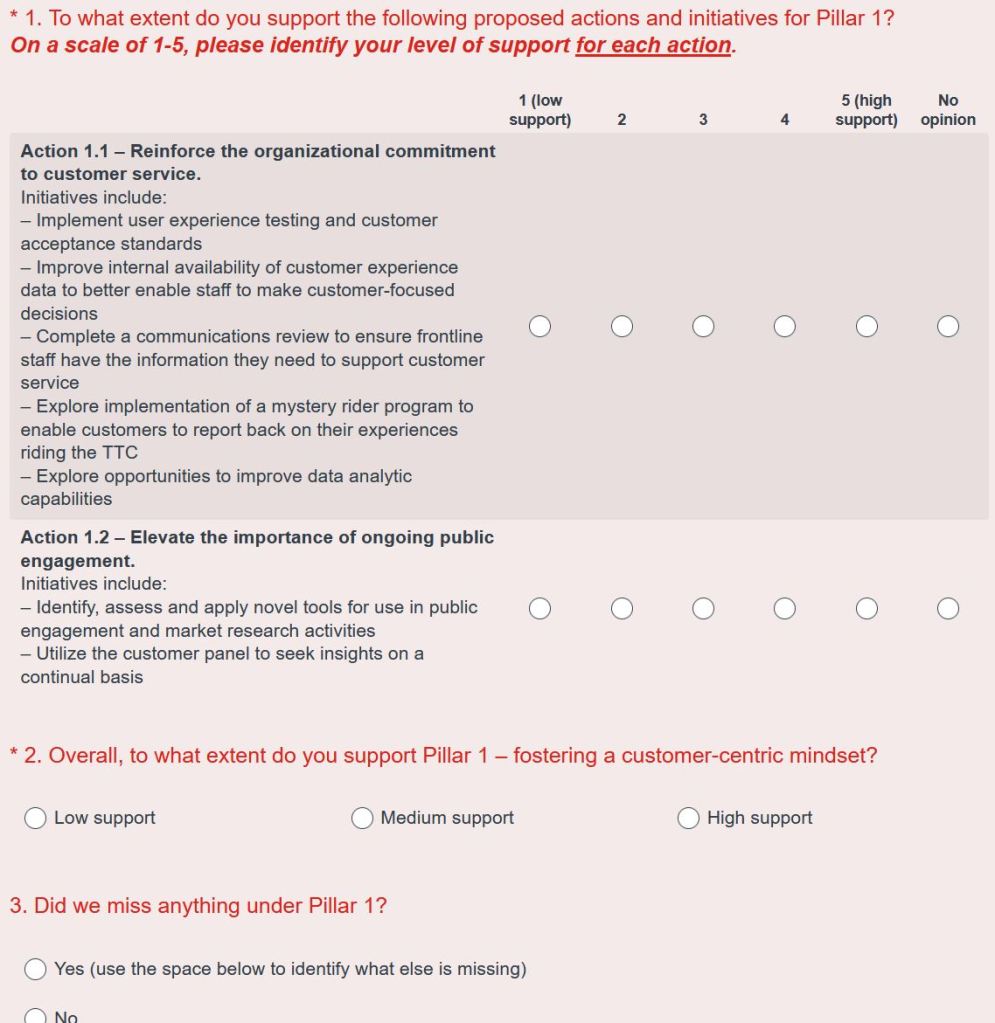
The problem, as we work through the survey, is that ideas that will be very attractive to some participants are bundled with others that might be left on the shelf, and “high support” might be selective, but with no way beyond using the “did we miss anything” box to express dissent or relative priorities on specific items.
Enhance the Transit Network
This is by far the largest part of the survey and it covers many topics including:
- Accommodation of population and job growth, including relief of peak and off-peak crowding.
- New services to address changing travel patterns.
- Suburb-to-suburb, off peak, and regional travel are not as well served as core-oriented trips.
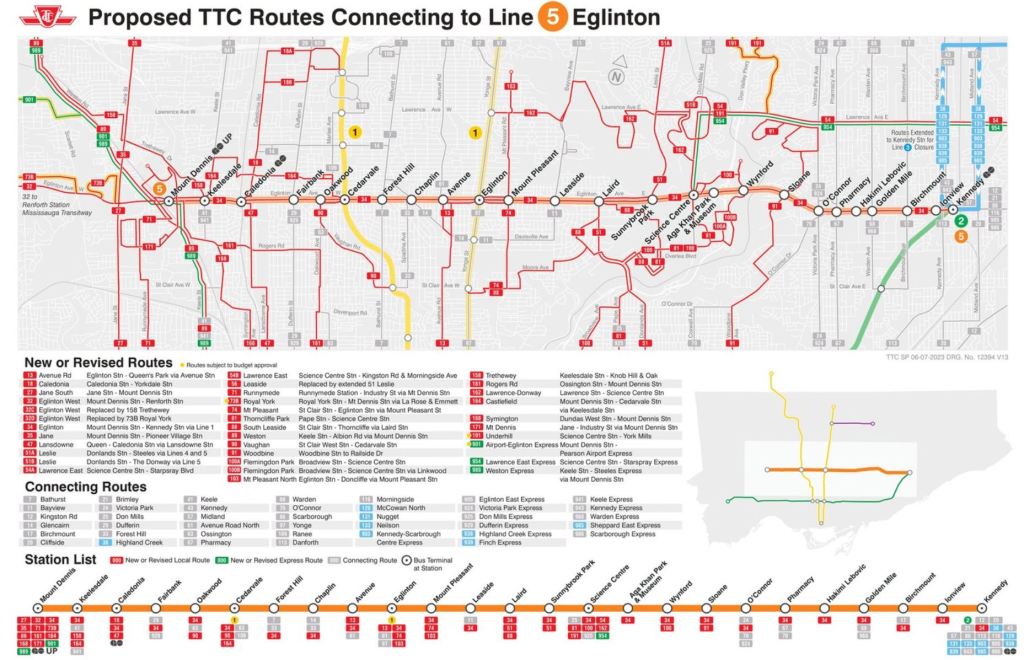
- Open Line 5 Eglinton with a reorganized bus network.
- Open Line 6 Finch with a reorganized bus network.
- Implement Line 3 Busway in the former SRT corridor: design and construction.
- Review and expand the Express Bus network including:
- Modified service standards such as stop spacing and target travel time savings
- Restoration of service frequency on existing routes
- Expanded hours on existing routes
- Enhance the Frequent Network:
- Expand the routes included in the 10 Minute Network
- Review a possible 15 Minute Network
- Expand and improve the Blue Night Network
- Improved connections
- New routes (Kipling South, Weston, Markham Road)
- 20 minute service
- Add early morning Sunday service to many routes.
- Sunday riding is > pre-covid now.
- Improve minimum service standard from 30 to 20 minutes.
- Note that the last of the maps below, many routes are shown as affected, but they often have 20 minute service or better during some operating periods.
- Enhance the streetcar network.
- Implement a 6 Minute Network
- Enhance service planning’s equity lens to focus on areas of transit need.
The point about crowding directly contradicts the management claims about existing service adequacy. Service reliability is indirectly part of this issue because poorly-spaced service will have uneven vehicle loads. An unresolved issue is whether the change in off-peak service standards implemented in the 2023 budget will be reversed. This is part of a much-needed discussion of new service standards and reporting mechanisms.
A six minute maximum streetcar headway sounds attractive, but it will not be possible until most of the 60 new cars arrive.
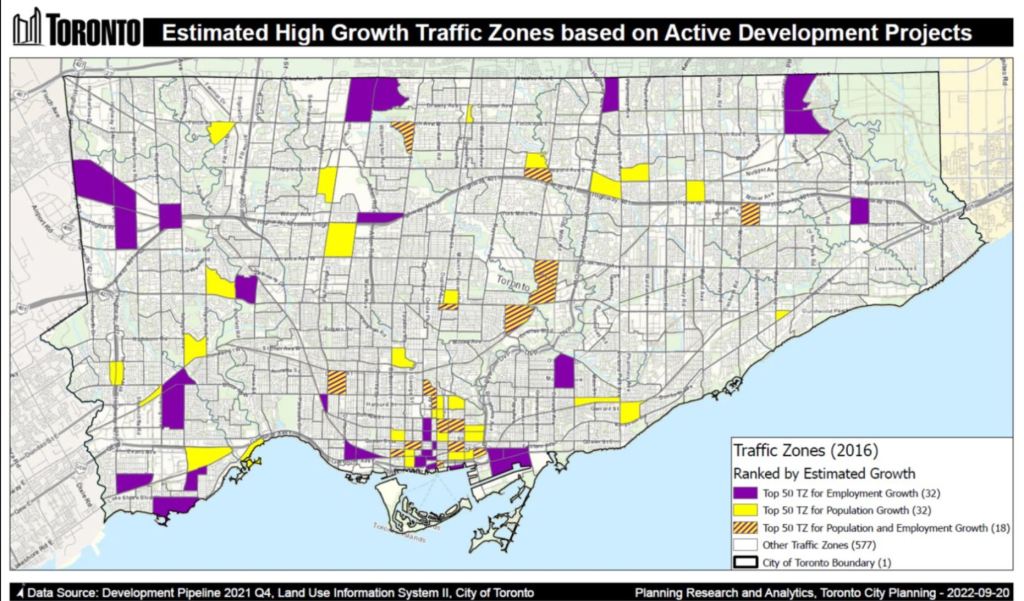
Several maps form part of this section, and they are collected together here for reference.
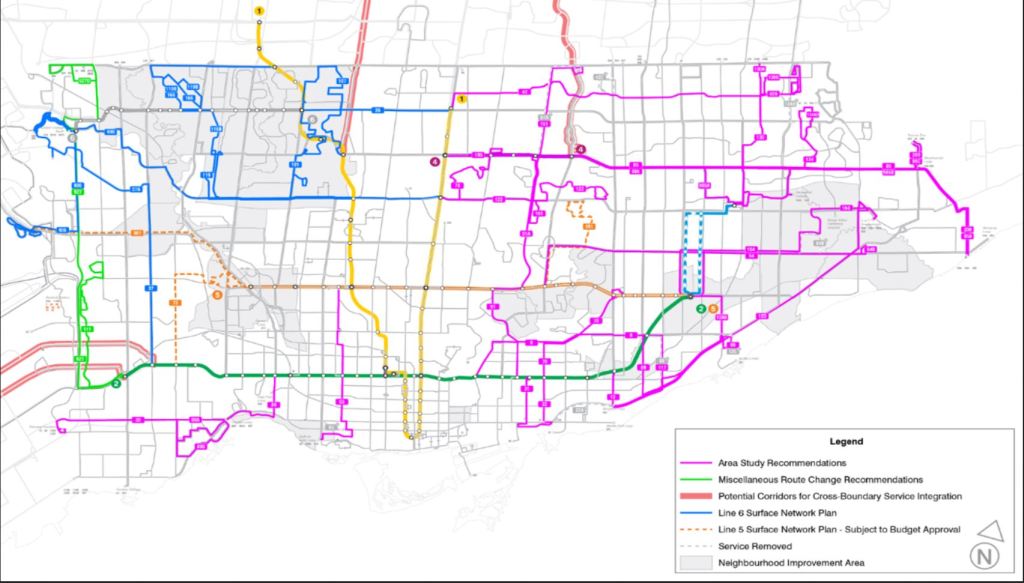
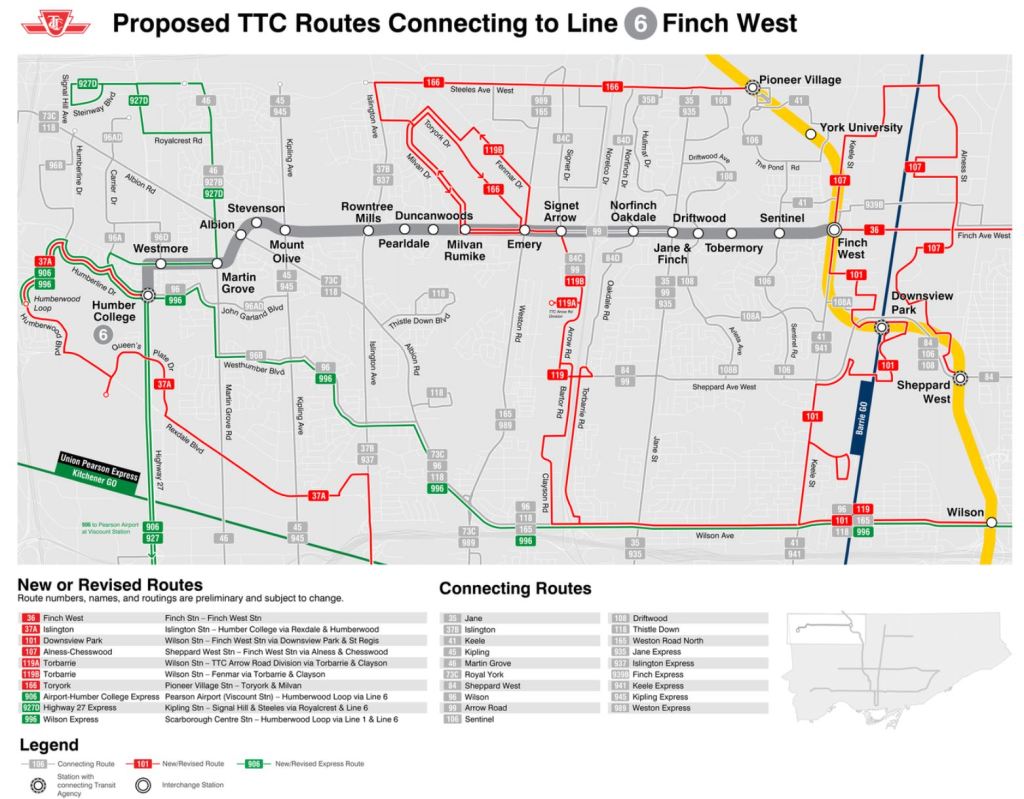
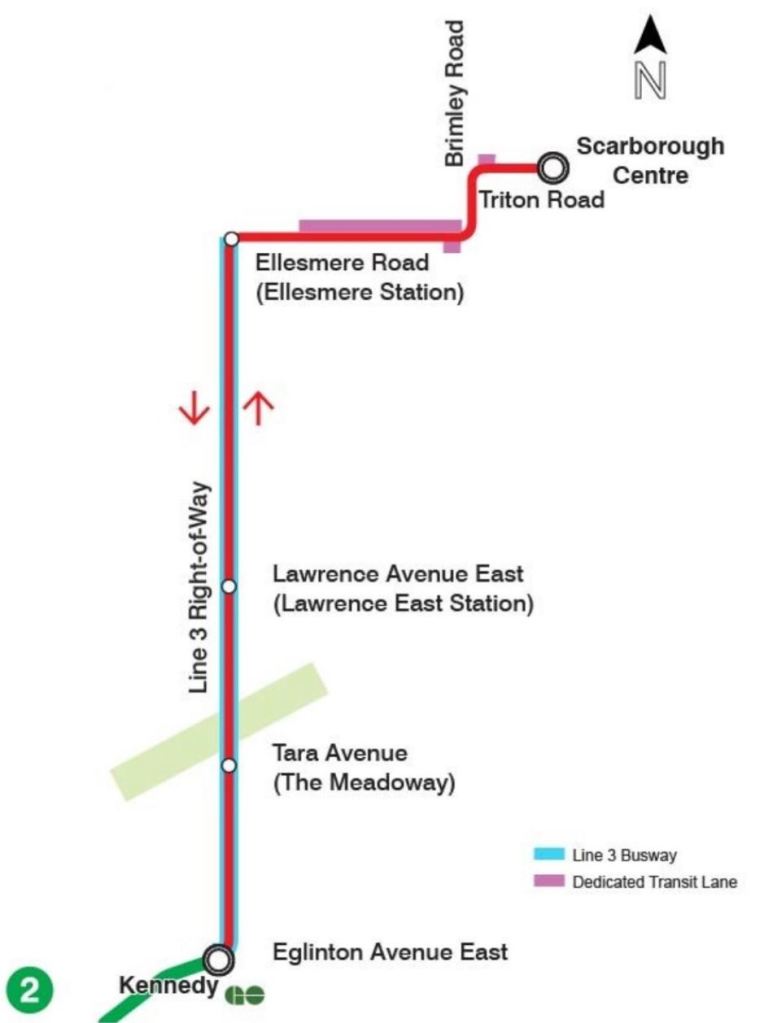
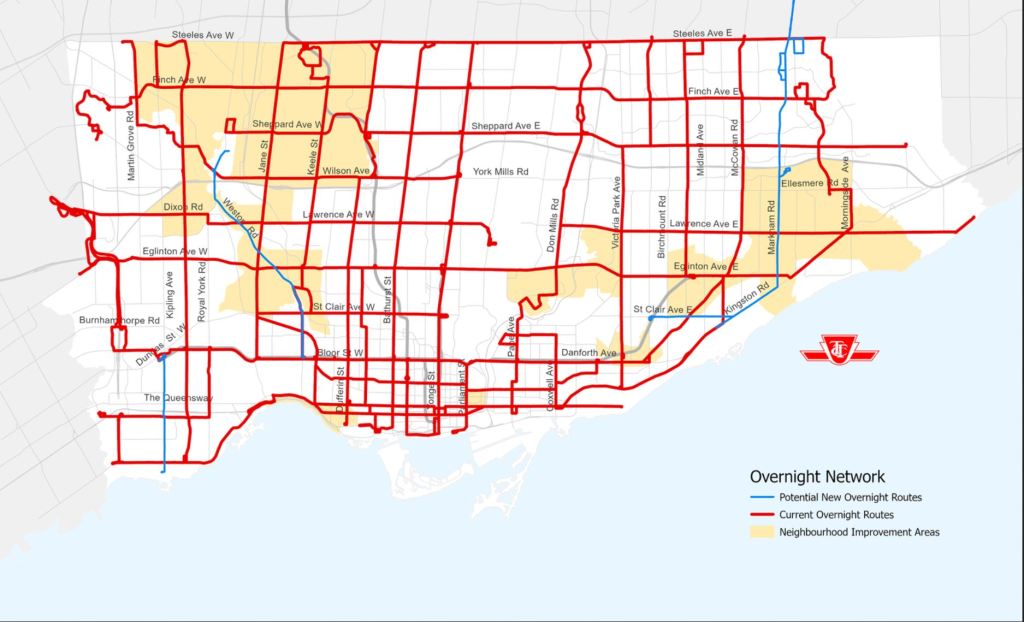
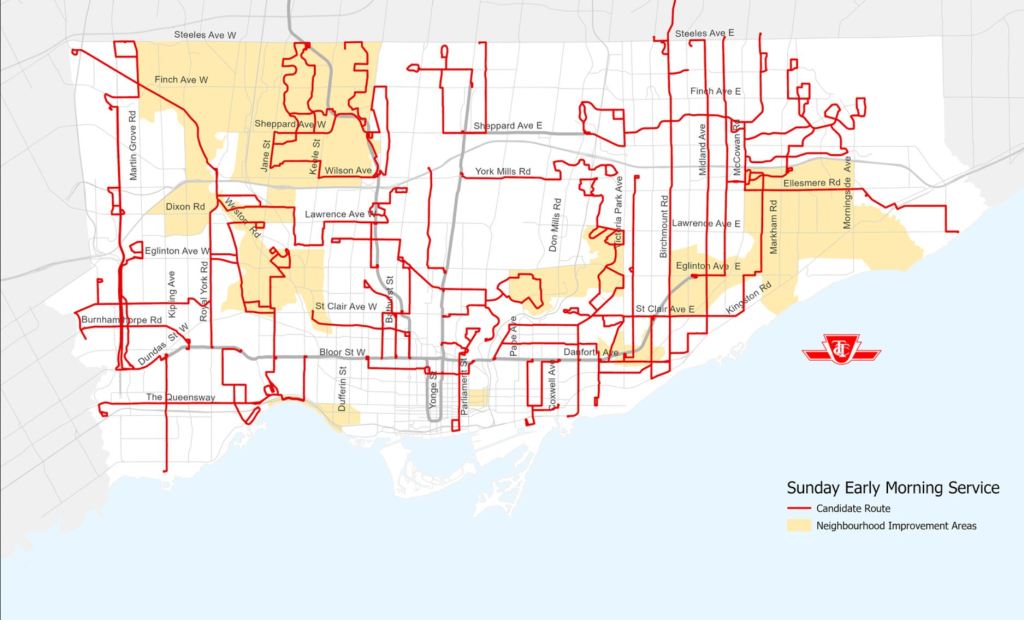
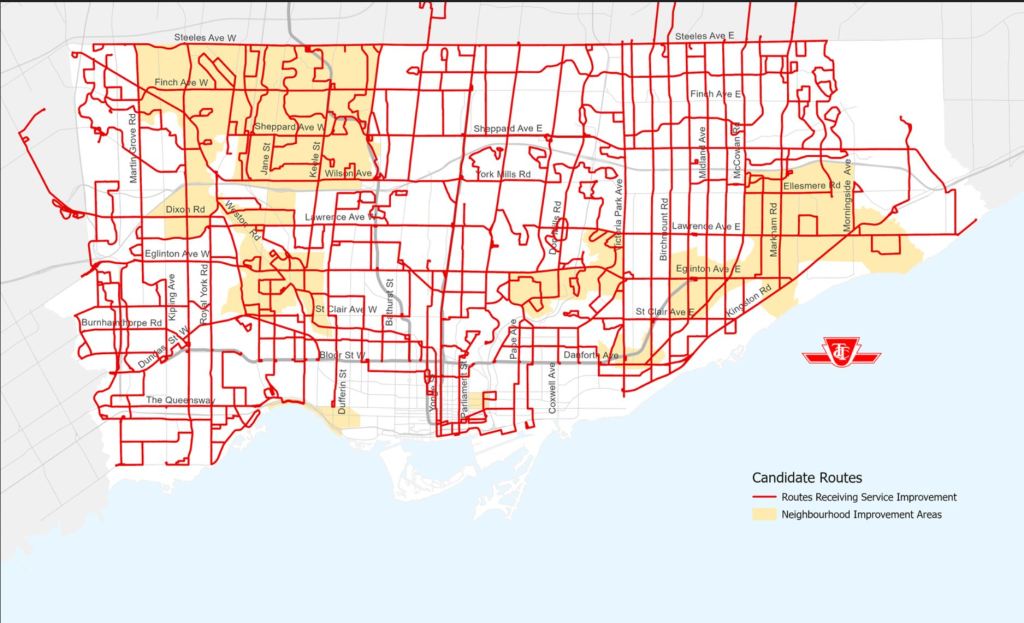
The final map about a 20 minute network needs to be refined because it implies that effectively the entire network does not meet a 20 minute standard today. In fact, many routes have 20 minute or better service during most periods of operation, and some streets have the combined service of multiple routes yielding better service than implied by the map. To be meaningful, this map needs to be subdivided by time of day and by route segment.
For example, the entire 36 Finch West route is shown, but the only portion of it with an existing headway longer than 20 minutes is the PM peak service on the 36D/F Milvan branches which each run every 25 minutes.
The TTC’s claims of achievements to date in this area are rather limited:
- Automatic Train Control on Line 1 YUS
- Neighbourhood Improvement Area service improvements
- Targeted engagement with under-represented groups such as women and youth
Of these, the last is most important because it broadens the range of feedback on how transit is perceived and used.
Improve Service Reliability
One might think that service reliability is at the heart of TTC operations. Over the years, there have been many schedule adjustments to correct problems with poorly timed routes, but this went overboard in some cases providing so much travel time that vehicles would never be “late” and have to be short turned. This affects travel speed on some routes with a conflict between being “on time” and moving at a speed that is attractive to riders, and can produce congestion of transit vehicles laying over at terminals.
Despite the TTC’s claims of schedule improvements which over past years have touched most routes in the system, erratic service is common in the network. Review of detailed tracking data shows that bunching is common, and is not reliably addressed by service management. In the worst cases, many vehicles on a route can be found running together. This simply should not occur if anyone is actually paying attention to operations.
The TTC has no metric to flag service reliability problems beyond a very generous standard for on time performance at terminals, and much service does not even achieve that standard.
Regular, detailed reports of service quality are badly needed. Key factors include routes with chronic bunching and wide gaps, extended travel times caused by congestion, and crowding on a trip, not average, basis.
This is a complex issue, and I will turn to it in a separate article.
Prioritize Surface Transit
This section includes four groups of actions:
- Implement RapidTO lanes on Jane, Dufferin and Finch East
- Targeted regulatory transit priority measures such as turn restrictions
- Continue roll out of signal priority
- Design and build more queue jump lanes
The TTC has a large number of possible RapidTO routes, but progress on implementation has been slow. The first rollout on Eglinton-Kingston-Morningside was comparatively easy to implement, but the situation on other streets is more challenging. It is not clear how quickly RapidTO will actually progress given the physical and political challenges on many corridors.
While RapidTO lanes are important, they have two key problems:
- An all-or-nothing approach to implementation could limit the success in getting acceptance. There are locations where taking road space for transit will have a significant effect on other road users and on adjacent properties that now use the curb lane. This is particularly an issue where the target roads are less than six lanes wide.
- There has been a tendency to talk about RapidTO as a “magic bullet” to solve transit problems when it will not affect many routes in the network, and will take decades to implement on the proposed scale. Slow-moving plans are no replacement for addressing network problems as they exist today.
Transit priority is badly needed, but this needs to truly be transit priority, not simply a mechanism to keep transit out of motorists’ way. In the congested downtown area, priority must be an integral part of plans for road changes and service diversions so that these are delayed as little as possible. Recent experience on King Street shows how a street can become completely gridlocked because transit movements, especially turns at intersections, do not have the priority needed to get through other traffic.
Queue jump lanes have appeared regularly in TTC plans, but few are built. While they can be useful, they address a few hot spots in the network, not overall problems.
Regional Integration and Complementary Transportation Modes
This section includes:
- Regional fare and service integration
- Enhance cycling integration
- Enhance pedestrian pathways
- Improve microtransit support
Fare integration is coming to the TTC and its neighbouring systems in February 2024. This, plus a GO Transit co-fare long enjoyed by riders in the 905, will make cross-border transit travel more attractive, but cheaper fares are of little use without better service.
This includes both service frequency and coverage throughout the day and across the region, as well as through routes or good transfer connections between systems.
Microtransit in the plan refers to small scale privately-run shuttles typically feeding into subway stations where facilities for easy connections should be available.
Listed as a past accomplishment is a pilot automated shuttle bus in Rouge Hill. This never actually carried passengers and the pilot proved, if anything, that the technology is not ready for prime time.
Enhance Safety at Stops, Stations and in Vehicles
This scope of this section has evolved from simply looking at surface stops to including stations and vehicles. In the process, there is a danger that the focus may be pulled to areas under the TTC’s direct control (stations and vehicles) and away from the far more numerous surface stops across the city.
A particular problem will be the issue of private sector funding for transit facilities like shelters, and the degree to which improvements will have to be funded by the City/TTC. One challenge will be to not just install new facilities, but to ensure that they continue to work. The text-based Next Vehicle Arrival System signs in some shelters have failed on and off over the years, and some do not display information about routes actually serving the stops where they are located.
The major points include:
- Improve accessibility and amenities at transit shelters including real-time information on service.
- Improve comfort and convenience in stations including expanded retailing
- Prioritize safety and security
The idea of expanded retailing goes back to the pre-covid era when this was seen as a revenue-generating tool. The challenge lies in the type of outlet that will attract customers, the space and physical facilities they will require to operate, and the amount of traffic actually available.
Experience with attempts to fill unused newsstand spaces shows that some stations simply do not have enough business passing by to make a shop viable, and underused spaces will not necessarily generate any revenue.
The safety bullet includes a pilot for automatic enforcement of the ban on passing open doors on streetcars.
Streamline Information and Services
This area includes three sets of actions:
- Improve customer service and loyalty
- Improve customer education and awareness
- Provide customers with accurate, accessible and timely information
The first and third of these speak to problems of simply knowing what is going on during one’s journey, and the back-end support of information availability and currency, not to mention adequate staffing. There is a clear recognition that the TTC could do better, but current experience with diversion notices and route changes has left much to be desired.
One major problem is that TTC staff themselves are not fully informed on system changes, and they cannot be counted on for reliable advice. They try, but in cases it is clear that information does not always reach them. This is a particular challenge for operators who find themselves driving in locations far from their home garage on temporary replacement services.
“Run as directed” buses are routinely touted as another of the TTC’s magic bullets for service problems. However, they are only just now visible to tracking apps because provision for “extras” was not included in the original design of the vehicle tracking system.
Moreover, the actual number of RAD buses in service at any one time is considerably smaller, looked at on the scale of the entire system, than some TTC hype might imply. There is always a challenge of having a RAD bus in the right location when it is needed and the lag time between a problem arising and the TTC’s ability to supplement the scheduled service. This is a fact of life of transit operations.
The reference to “customer education and awareness” includes advertising campaigns re safety, courtesy and route planning, as well as the “Travel Training” program for groups unfamiliar with the system.
Additional Information
Maps in the following sections are taken from a Stakeholder consultation deck and they do not appear in the online survey. I have included them here because they provide additional context for the issues of how the system should grow to serve existing and future demand.
The maps below end at the 416-905 boundary. Many problems with transit’s attractiveness lie in cross-border travel that will only increase in coming years. Traditionally, the focus has been on getting people from the 905 to downtown Toronto, but this ignores travel between homes, jobs and schools in suburban Toronto and the region beyond.
Growth Forecasts
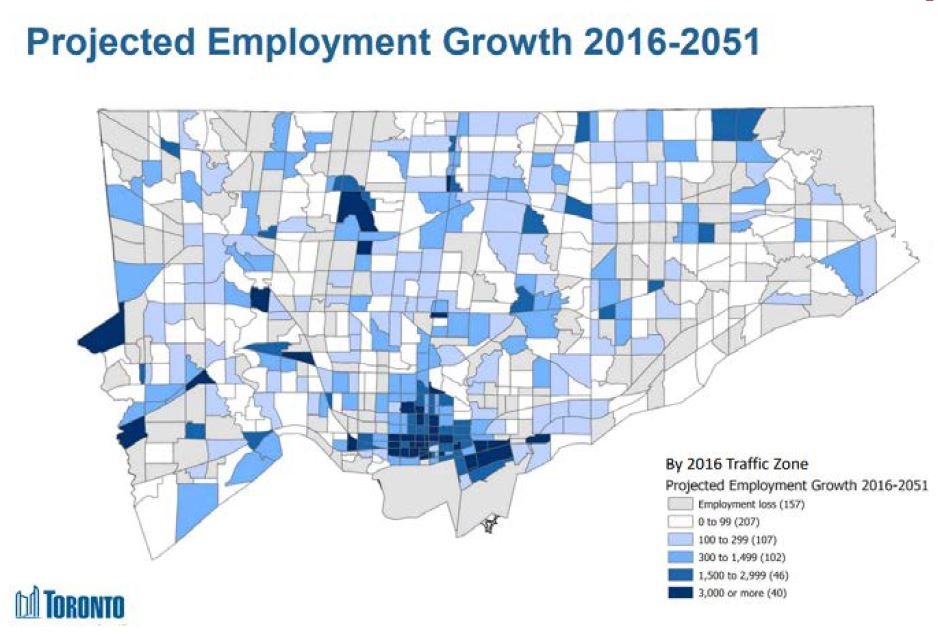
The growth in jobs and population will not occur to the same degree across the city, and there is considerable variation in some projections depending on assumptions.
Growth in either factor does not necessarily translate to transit ridership depending on where it happens, what the origin-destination patterns look like, and whether the new trips are well-served by transit.
The employment map is intriguing because of the number of areas where employment is predicted to decline or remain the same.
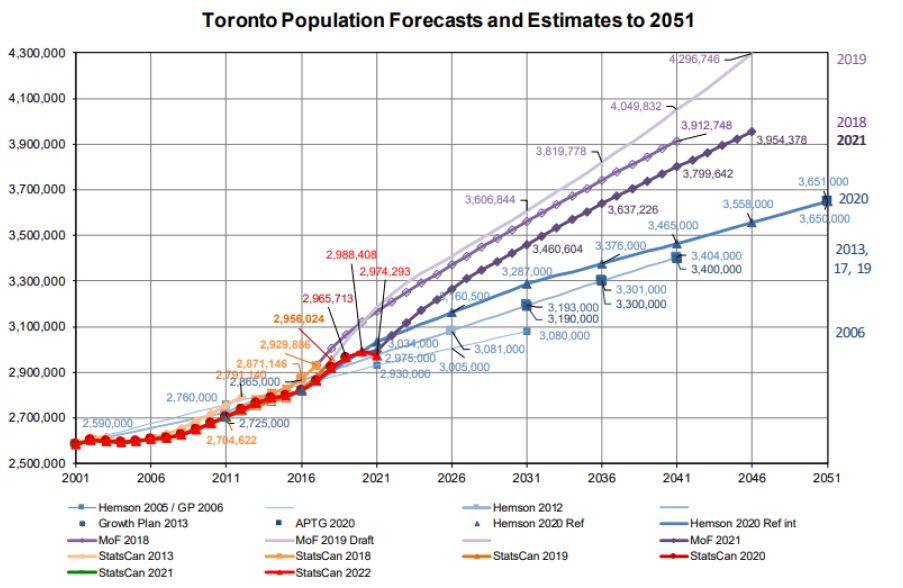
Transit Access
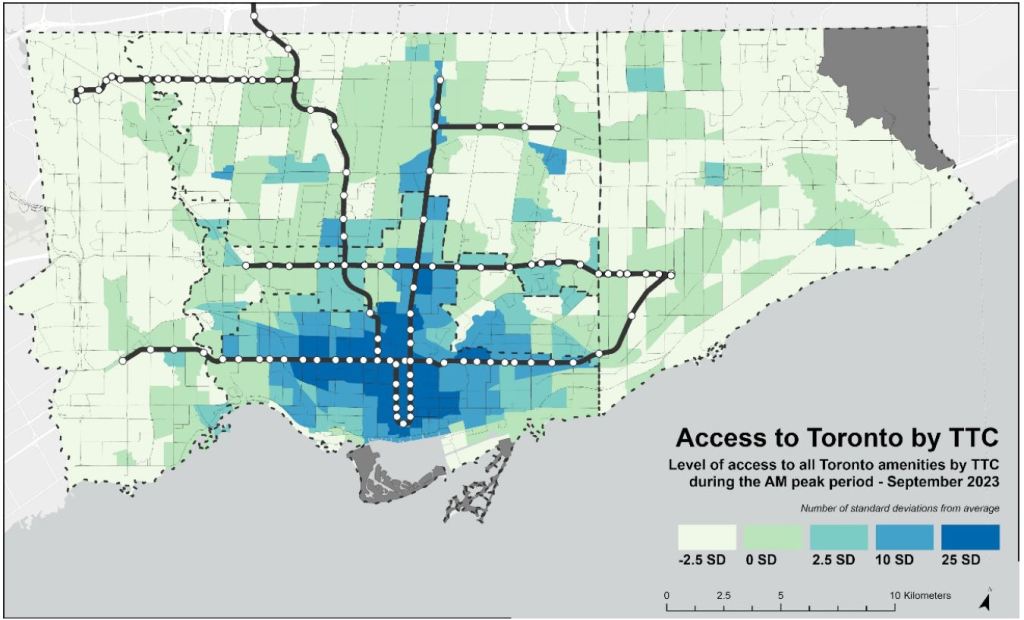
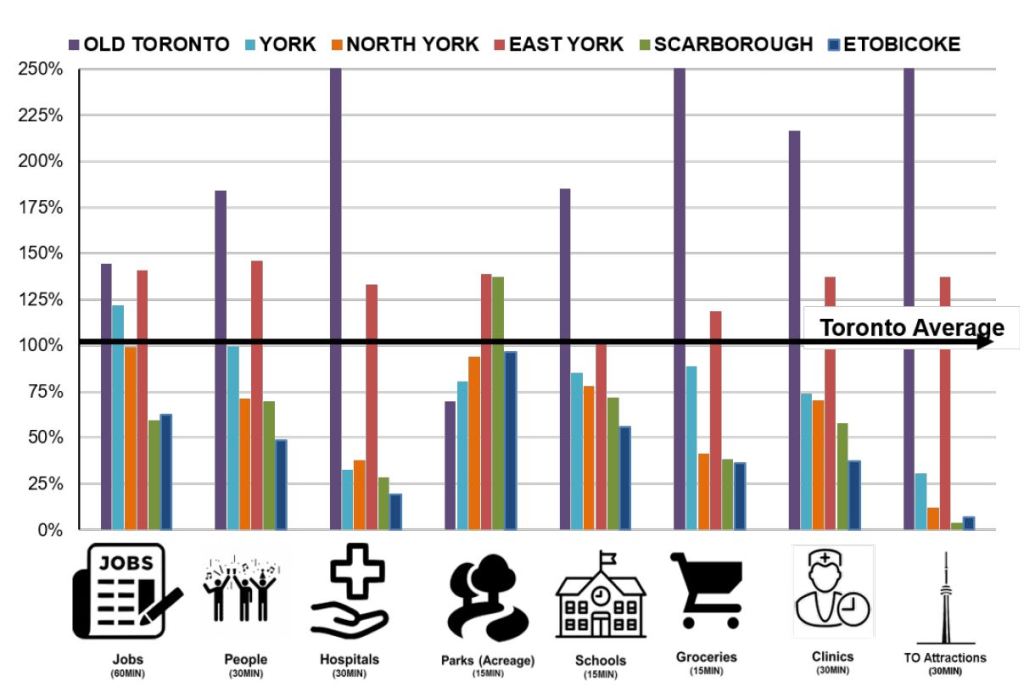
The inequity in transit service and access to various types of destination is shown in the two maps below. On the left is a map of ease of access which to no surprise shows better figures in the central area with declining numbers, to the point of falling below the city-wide mean (light green) primarily in Scarborough, eastern North York and Etobicoke.
The chart on the right subdivides this by type of destination and geographic area. It should be noted that in some cases these values reflect the historical distribution of destinations across the City. For example, the “attractions” group is concentrated in the core area and therefore far from the outer parts of the City.
Note that this is based on AM peak service levels, but many trips fall outside of that period. A map showing off-peak values would better illustrate the problems of access for trips outside of conventional work or school commutes.
These charts almost certainly reflect TTC-only travel, and they would be interesting to see if GO Transit with improved service and a co-fare arrangement were also included to show how and where this will change travel options.
The Consolidated Five Year Plan
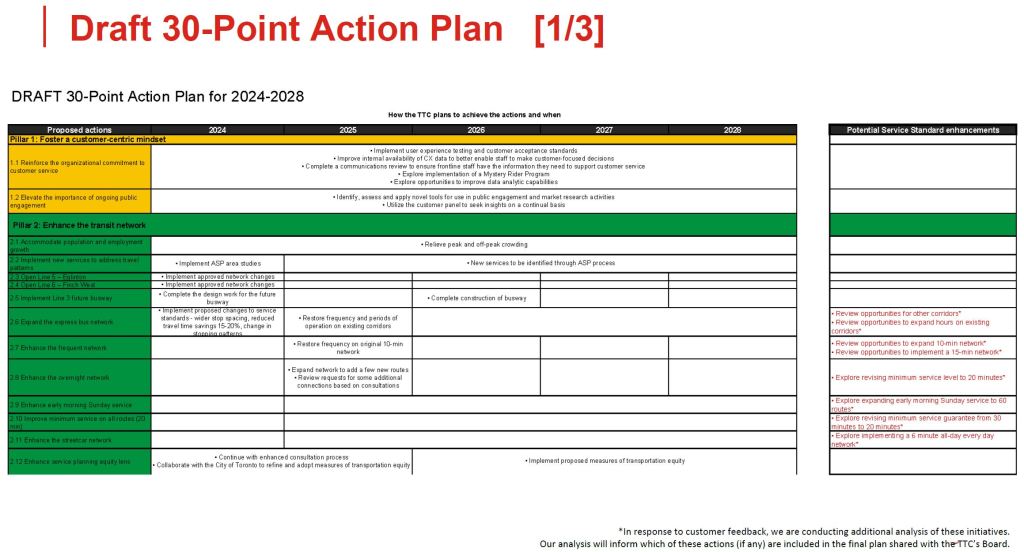
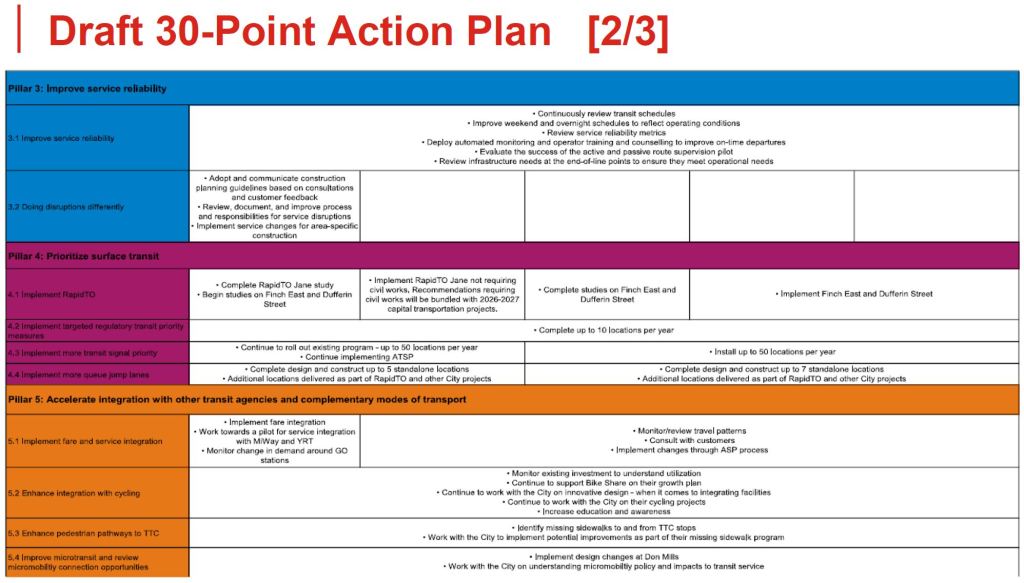
The many actions within the Five Year Plan are summarized in the table below. Click to expand the images in a gallery.
The plan includes proposals for Service Standard changes to expand and improve services, but there is no mention of improved service management, reliability and reporting.
Any plan on this scale is a lot to digest, and I salute readers who have come this far. There will always be a challenge to look beyond the immediate situation (this year’s financial issues, problems on “my” route) to a broader view of what should and can be implemented. “Can be” should not constrain the debate by precluding discussion of options, and request for what “should be” must not be filtered out on the premise that “we can’t afford it”.

 Steve Munro
Great summary of a rather long and, as you say, not terribly specific Survey! You note “The safety bullet includes a pilot for automatic enforcement of the ban on passing open doors on streetcars.” The City asked the Province to allow this several years ago and, I think, it was approved by changes to the Highway Traffic Act Regulations. Has the TTC actually DONE anything like adding a few cameras to streetcars or is this another example of them making excuses that ‘we can’t do anything’ long after they can?
Steve: I think that they are finally getting around to it.
LikeLike
First, I want to join David in extending my thanks Steve. Your reporting was comprehensive, and on point, as always.
Second, I wanted to note for David that the streetcar cameras are a proposed ‘pilot’ in the survey to which Steve has linked.
Finally, I will say, I took the time to fill out the survey, and as I am inclined to do filled in the boxes with lots of added comments. I appreciate Steve pointing that out.
I will say, excluding the over emphasis on KPIs etc. I think there are more promising ideas mentioned than I’ve seen in a while.
But I did think there were a few things missing, including insufficient understanding of loading/crowding and impact on dwell times, no mention of all-door boarding, and too much emphasis on bigger studies/projects (see Rapid TO) where basic actions (adding an advanced left turn, or actively managing surface would suffice) and I said as much.
LikeLiked by 1 person
As far as I know, the “Act in respect of various road safety matters” that allowed cameras to be used by streetcars came into effect in early June 2021. Since it was the TTC and the City who requested this change, I find it all too typical that it has taken the TTC over 2.5 years to reach the stage of proposing a pilot. It is a pity (but not a surprise) that there really seems to be no sense of urgency at the TTC about implementing a safety improvement they themselves asked for!
LikeLiked by 1 person
Should Blue Night routes use the 400-series of highway, bypassing residents not accessible by walking to the night bus? The 300 Bloor-Danforth Night Bus passes such residents.
The 300B loops back at Burnhamthorpe looping at the top of The West Mall before returning back at The East Mall. The 300A runs past residents using 427 to Dixon Road, before continuing to Pearson Airport.
To access more residents, at least have the 300B loop back at Rathburn.
LikeLike