
The 2024 Service Plan was presented and approved at the November 22, 2023 TTC Board meeting.
- Presentation Deck from the meeting
- My original article: TTC 2024 Annual Service Plan
Construction Plans for 2024
The presentation includes a chart showing major construction plans in 2024. The overhead projects are for the completion of migration to pantograph-only overhead. (It is hard to believe that they would take Queens Quay and Fleet out of service during the CNE in Q3, but I’m not planning the City’s infrastructure projects.)
The overhead projects raise the question of whether they will actually occur on time. Past work has been scheduled, diversions implemented, and then nothing happened. Riders should not have to put up with disorganized project scheduling.

The only major track project (beyond completion of St. Clair West Station and the 501 Queen via Adelaide connection) is on King West from Dufferin to Shaw. In the Service Plan report, one set of diversion routes was shown for the 504 King, 29/929 Dufferin and 63 Ossington routes. This has been revised, and there are now two options under consideration, both different from the one in the report.
Here is the original plan which has two phases with the second being for the duration of the intersection replacement at Dufferin planned for June/July 2024. Note the removal of service on King west of Dufferin in this version.

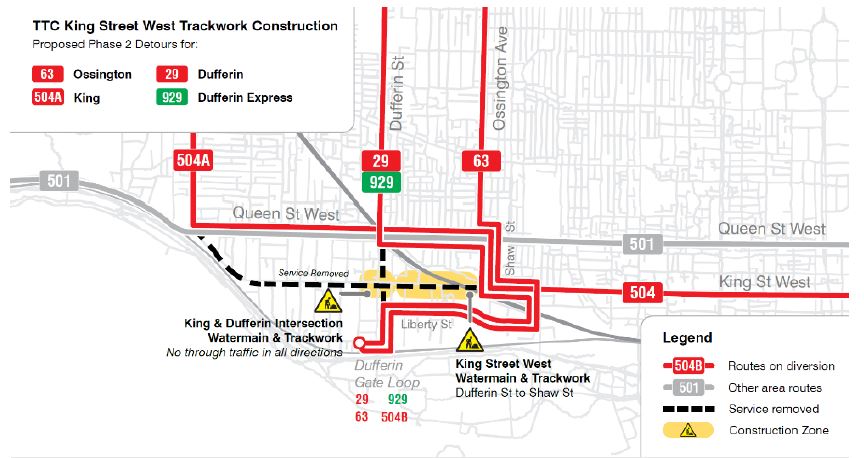
For phase 1 (mid-February to late June, August to late October) there are two new options which preserve service on King between Dufferin and Roncesvalles by extending 63 Ossington buses west to Sunnyside Loop. In both options, the 504 King service diverts north via Shaw to Queen, but the difference lies in what happens at Dufferin Street.
In option 1 (left below), the 501A Queen cars divert south to Dufferin Loop. Service on Queen west of Dufferin is provided by the 504 King cars with the 504B service running to Humber Loop until late evening. Late evening service through to Long Branch will be provided by the 501C as it is today.
In option 2 (right below), the 501 Queen cars stay on Queen Street, and the 504B diverts south to Dufferin Loop.
508 Lake Shore cars operate via Queen and Shaw in both options.
The 29/929 Dufferin bus service only diverts for the period that the King/Dufferin intersection is closed (not shown here).


The TTC is conducting a survey to determine which of these is preferable to riders.
Their King West project page is here.
Service Reliability
Service reliability will be addressed on various fronts. The phrase “expanding beyond on-time performance and adding emphasis on consistent, well-spaced, and completed service” is very gratifying. If the TTC actually pulls off this change in focus, it should repair many long-standing issues that the simplistic terminal departure metrics completely ignore.
With the change in ridership patterns, there are new periods requiring better service. Even with the system as a whole running at less that 100% of pre-covid ridership, there are routes and time periods that are over 100%. This is compounded by traffic congestion that is, in some places, worse than in 2019.

Budget Directions
The chart below shows two possible futures for TTC service. On the left is at best a stand pat scenario where service is trimmed to reduce the call on City subsidy and savings, if any, might go to reduce deficits, not to support operations. On the right is a scenario for improvement with better funding and service quality.
The 2024 budget will likely appear at the TTC Board in December, but the final choice will be up to Council and, indirectly, to other governments and their support for municipal spending.

 Steve Munro