
The 2024 Annual Service Plan will be presented by TTC management at the November 22, 2023 meeting of the TTC Board. It is a 219 page long document, and I have boiled down the highlights here.
This report really should have been subdivided into digestible parts because it simply will not be absorbed by even the most dedicated transit nerd, let alone by the Board and Council responsible for setting policy. In particular, there is no discussion of the budgetary implications and option of proposals in this plan, and therefore no basis for discussion in the pre-budget consultations now underway.
This plan’s origins go back a few years, and its size is partly due to being a compendium of past years’ proposals. Two large groups are associated with the opening of Lines 5 Eglinton and 6 Finch which were expected to occur earlier than 2024. Another large group arises from area studies in various parts of the city. Still others come from the analysis of poorly-performing routes, a process that has been on hold during the covid years.
Despite implementation delays, consultation continued with a variety of online and in person sessions going back to 2022, some in support of the upcoming Five Year Plan for 2024-28 (which I will review in a separate article).
Through many sessions, TTC heard a message loud and clear about what riders and their own staff want to see:
The key priorities include:
2024 Annual Service Plan at p 5
- Service reliability – on-time service when expected and predictable travel times.
- Frequency – vehicles come more often and reduced crowding and wait times on routes.
- Safety – physical safety when travelling at night or during quiet periods.
- Communication – accurate and clear communications, especially during service disruptions.
Poor communications are repeatedly flagged in surveys and Service Plan consultations, but reorganization and improvement of TTC’s various information channels lies outside of the plan’s scope even though it is badly needed.
Both riders and operators flagged crowding as a problem. There is an issue with the reporting of ridership that masks crowding by looking only at rolled up weekly or annual statistics, and routes as a whole rather than trips.
TTC reports its ridership recovery relative to pre-pandemic times on a weekly basis, and for budgetary purposes, on an annualized basis. This brings two problems:
- Weekly numbers do not account for day-to-day variations. Midweek days are known to be busier than Mondays and Fridays due to work-from-home patterns, and weekends are already reported with stronger recovery. With two lighter days in the mix, the recovery will not be uniformly distributed, and crowding will be a greater problem on the busy midweek days.
- In a recovery scenario, ridership growth over a year will mean that the revenue versus historic data will be an average from the start to the end of the year. This will understate the situation “now” in the fourth quarter, let alone the needs going into a new budget year.
The Service Plan report includes more detail:
For September 2023, ridership averages approximately 78% and revenue averages approximately 77% of pre-pandemic levels. In comparison to budget, ridership was expected at 75% and revenue at 74% of pre-pandemic levels.
Similar to pre-COVID experience and in line with seasonality, weekly ridership increased in September. However, September ridership increased more than expected, averaging ~5% above budgeted levels for the Period, with ridership likely to remain at these levels for the balance of year. During Period 9, 2023, up to 97% of unique PRESTO riders used the system each week. While riders have returned to the system, the travel frequency of the riders has dropped. For example, the number of unique riders classified as “commuters” (i.e. ride four of five weekdays per week) are at 65% of March 2020 levels, whereas riders who use transit less frequently (ride less than four weekdays per week) are at 121% of March 2020 levels.
Day-of-week use is highest and consistent across Tuesday to Thursday, averaging approximately 76% of pre-COVID levels for Tuesday through Thursday during Period 9. Weekend recovery is at approximately 90% of pre-COVID levels, consistently stronger than weekday recovery.
2024 Service Plan at p 22
Emerging travel patterns from changes to work patterns – downtown office occupancy has averaged at approximately over 50% through the first half of 2023, representing between 2 and 3 days of in-office work per week. Peak day office occupancy has averaged at almost approximately 70%. This creates variability in travel demand by day-of-week and resulting challenges in scheduling the right capacity.
2024 Service Plan at p 23
Too many politicians, budget hawks especially, look at the average numbers without recognizing the difference between these and the current day-to-day requirements.
The preliminary projections for budget show a range of ridership and revenue figures through 2024. Note that this shows a modest ridership increase, year-over-year, of only 2%. That affects both the available fare revenue (from a budgetary point of view) and the mindset behind service improvements, if any.

The Service Plan echoes a familiar refrain from the Ford and Tory eras: service improvements will only come if they can be offset by savings elsewhere. Overall, planning is a zero-sum game and key changes such as rapid transit expansion can elbow aside other deserving services. Ridership growth brings more revenue, but not enough to offset the cost of more service. Unless Council allocates more money for subsidies, transit service remains mired in small-scale tweaks with little hope for network wide change.
Even worse, a decision to withhold funding at budget time echoes throughout the year. All the fine words about a return to service and the importance of transit ring hollow when the phrase “subject to budget availability” clouds every proposal. In 2023, the TTC had an unexpected budgetary nest egg with the unused headroom for Line 5 opening. That will not be repeated in 2024 and beyond
The report has an intriguing note about the Service Standards changes that came in with the 2023 Budget. This was a controversial action not just taken unilaterally by management before Board approval, but followed by stonewalling about what effects the new standards would have on service. It should not have required an FOI request to pry this information loose from management’s grip. Quite clearly, someone in this town did not want the effects of budgetary limitations to be known. “Transparency” was not a priority.
The 2024 Plan states:
In spring 2023, as the pandemic impacts on customer demand were expected to have stabilized, we realigned our transit services to pre-pandemic peak service standards with confidence that service levels will be appropriate for the customer demand. A temporary adjustment to the TTC Board-approved Service Standards was approved through the 2023 Budget. The realigned service plan protected periods of service and network coverage on all routes. As part of the ongoing service reliability program, schedules were adjusted to reflect actual operating conditions throughout the year.
This resulted in changes to 47 routes to match capacity to customer demand and to modify schedules to reflect current operating conditions and congestion. These changes represented a better calibration of scheduled service to today’s context. Demand-responsive service was also operated to protect for unforeseen changes to customer demand, travel patterns, and construction.
2024 Service Plan at p 14
What is not clear is when, or if, there is any plan to reverse this “temporary” change which saw off-peak standards revert to a level predating the ridership growth initiatives of Mayor Miller’s era. The 2024 plan talks about a review and update of the Service Standards as part of the Five Year Plan, but there has been no mention of this in the consultation sessions for that plan.
Meanwhile, the TTC acknowledges that it fails to achieve its current standards. Note that there are five daily periods from the AM peak through late evening, and a few hundred routes making a total of roughly 1,000 “periods” for comparison. A 92% figure may not sound bad, but much depends on the times and locations of that 8% (roughly 80 periods) that don’t make the grade. Beyond that 8% on average, a portion of trips on “acceptable” routes will be crowded thanks to uneven loads, gaps and bunching. This illustrates the danger of reporting averages rather than specifics.
It should also be noted that the “temporary” 2023 standards set off-peak crowding levels only slightly below peak levels as against earlier standards of a seated load, or seated plus 10%, that used to apply. This is a particular problem due to the extra space needed for baby carriages, shopping carts and mobility devices all of which tend to be seen more at off peak in anticipation of less crowding. The Service Standards make no provision for this type of demand and space usage.

The 2024 plan explicitly states that the standards adopted in early 2023 will continue to be applied.
Service adjustments will continue to be consistent with TTC Service Standards, which were applied to the system-wide realignment exercise to match service to ridership demand in the spring of 2023.
2024 Service Plan at p 27
This puts Mayor Chow’s desire to restore full service in question, and shows how TTC management continues to resist proposing a more aggressive service policy.
Review of Past Achievements
The Five Year Plan contains “pillars” and “actions” (yes, management speak at its finest) and reports on what has been achieved. Rather than dwelling these here, I will leave that to my article on the new Five Year plan that has revised and added to the current list. Let’s just say that there are many “actions” that are still in progress, not “implemented”.
Line 5 Network Changes
The revisions to the surface network for Line 5 have been through previous consultation rounds. Based on this, some proposals originally in the 2022 Plan in anticipation of a 2023 opening date have been modified. These proposals are not final, and are subject to “further assessment and review” before implementation.
- 18 Caledonia will use Sanderstead Avenue northbound from Eglinton due to problems with left turns east to north at Caledonia. This is a temporary arrangement.
- 73B Royal York to La Rose Avenue will be extended to Mount Dennis Station incorporating the previously proposed 170 Emmett bus. This service will operate during all periods except overnight.
- 90 Vaughan will be modified to operate via Vaughan to Dufferin without the dogleg on Jesmond Avenue. A proposed restoration of the 90B branch via Northcliffe Avenue has been dropped.
- Service on the north end of 91 Woodbine will be split off into a new 191 Underhill route operating to the Science Centre Station at Don Mills & Eglinton.
- 901 Airport-Eglinton Express is a new route from Mount Dennis Station to the Airport via Dixon Road. There will be stops along the route on Dixon and on Weston Road, but the details are not included in the plan.
Click on any map to open the gallery.
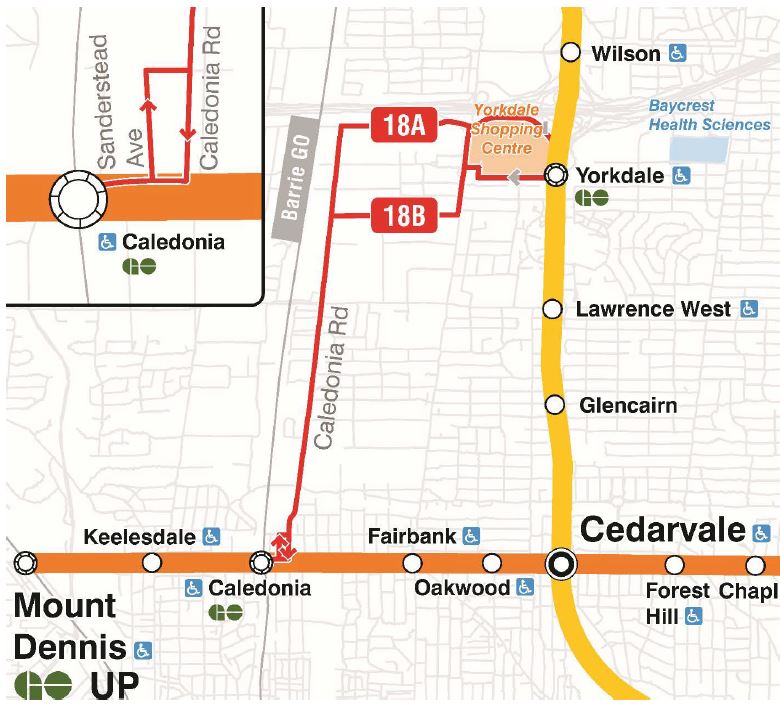
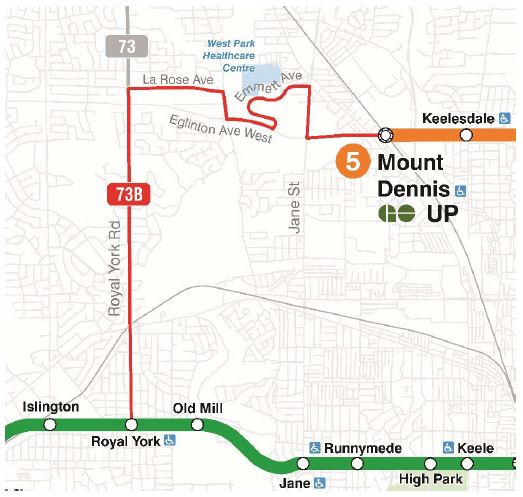
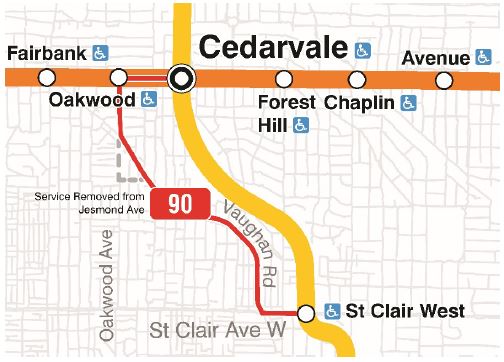
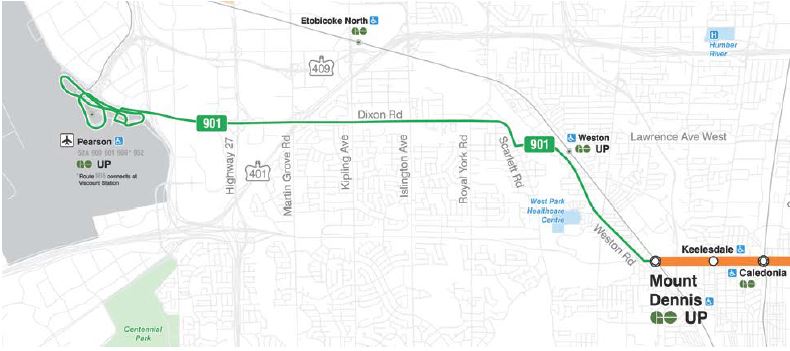
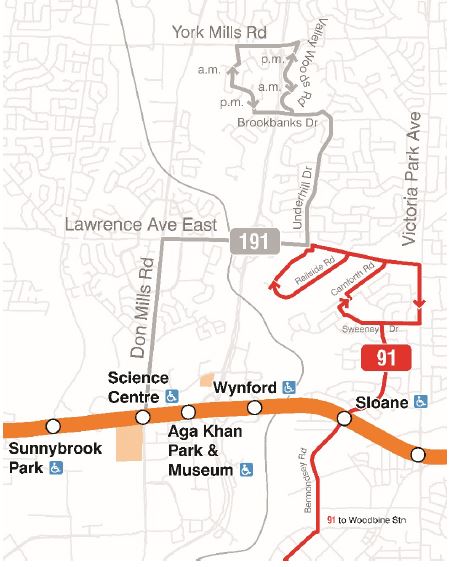
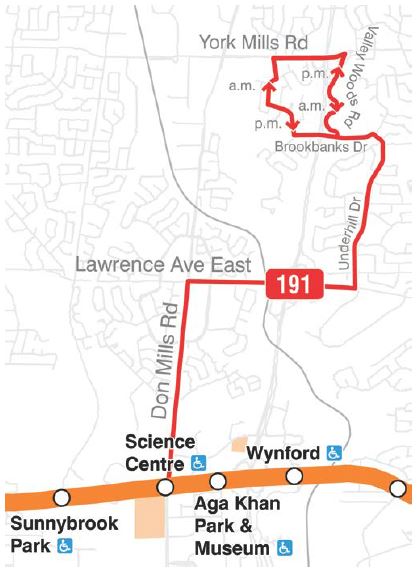
Click the map below to open a larger version.

Line 6 Network Changes
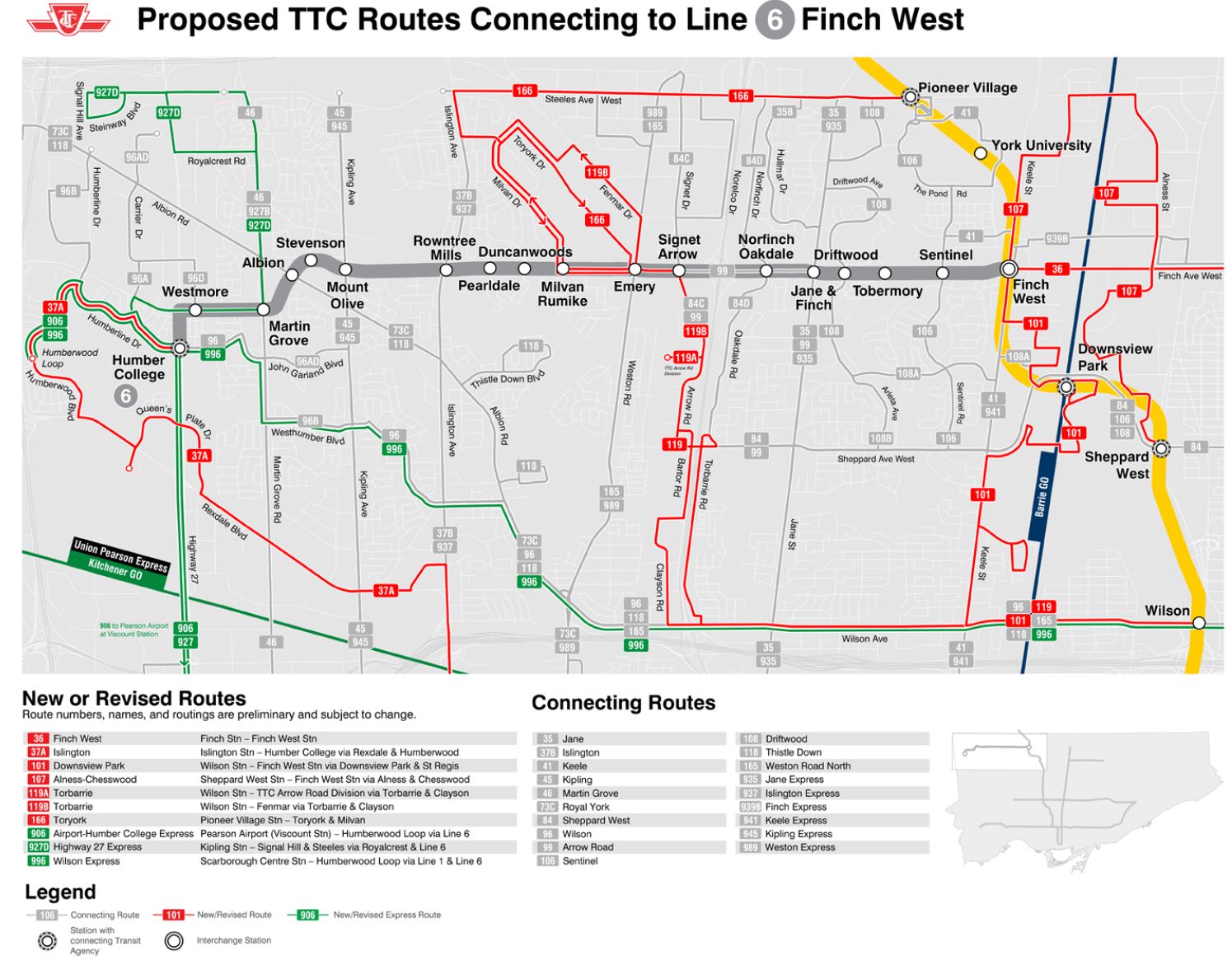
As with Line 5 Eglinton, the Line 6 Finch network changes have been in the mill for some time awaiting an opening date for the service. Based on feedback from consultations, some changes have been made to earlier plans. As with the Line 5 changes, they are subject to “further assessment and review” before implementation.
- The 36 Finch bus will remain as a service between Finch and Finch West Stations. Portions of the service west of Keele will be replaced.
- The west end of 36B to Humberwood will be taken over by:
- The extended 37A Islington route from Humberwood Loop to Humber College Station.
- The extended 996 Wilson Express from Humber College to Humberwood Loop.
- The peak period 36D to Weston & Milvan and 36F to Weston & Milvan via Fenmar) will be replaced by 119B Torbarrie and 166 Toryork.
- 101 Downsview Park route will connect with 6 Finch at Finch West Station, and it will replace 128 Stanley Greene and part of 107 York University Heights. Service will operate weekdays from 6am to 10pm, and weekends from 9am to 10pm.
- 107 Alness-Chesswood will replace 107 York University Heights.
- 119A Torbarrie will be extended to Arrow Road Division to improve access to this site for TTC staff.
- A new 906 Airport-Humber College Express will operate to Humberwood Loop via Humber College Station. The western terminus will be Viscount Station, not the main terminals 1 and 3, to serve the employment area around the airport. Passengers can connect from that station to the terminals via the airport’s internal Link Train. The locations of stops enroute are not included in the Service Plan.
- 927D Kipling Station to Steeles via Royalcrest will be extended to Signal Hill to avoid safety problems with buses laying over on Royalcrest.
- 384 Sheppard West Night Bus will be extended via Weston and Steeles to Islington.
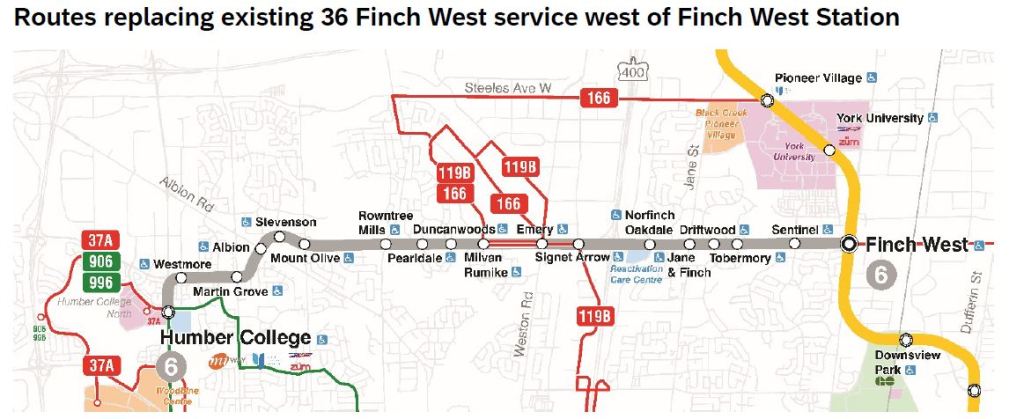
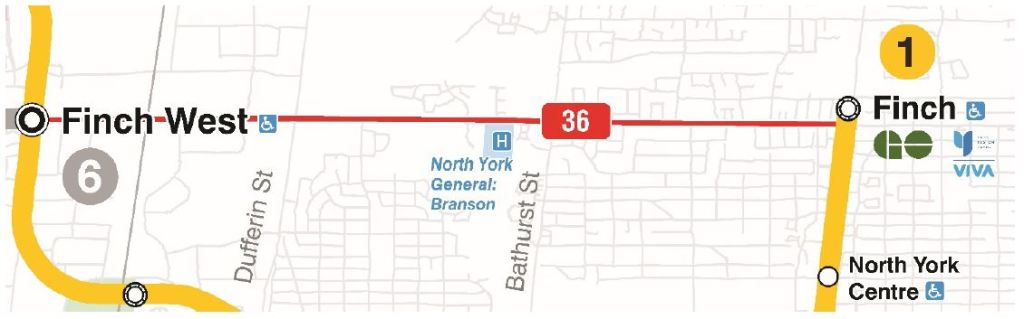
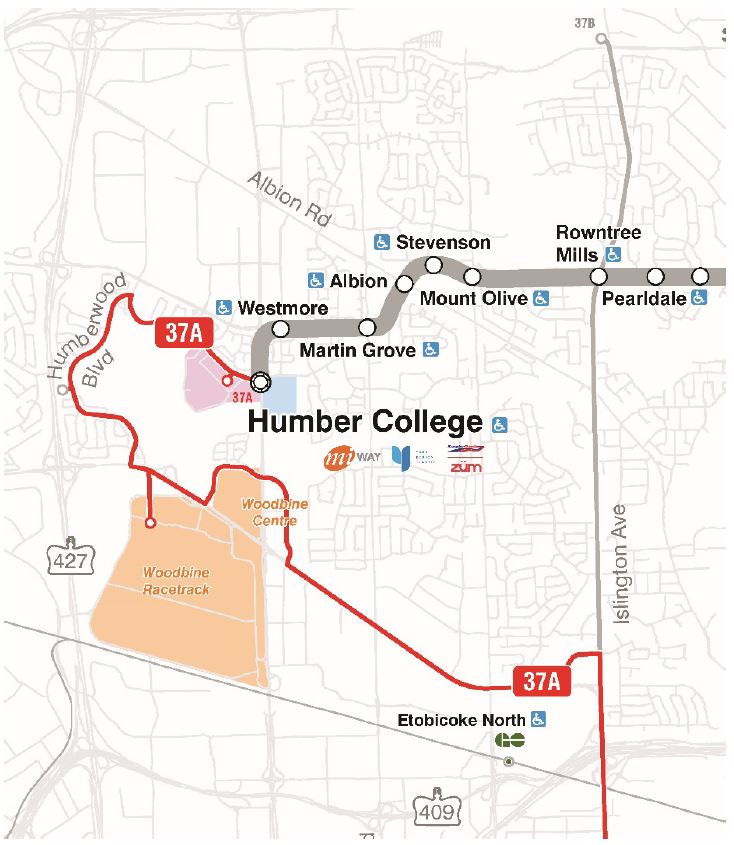
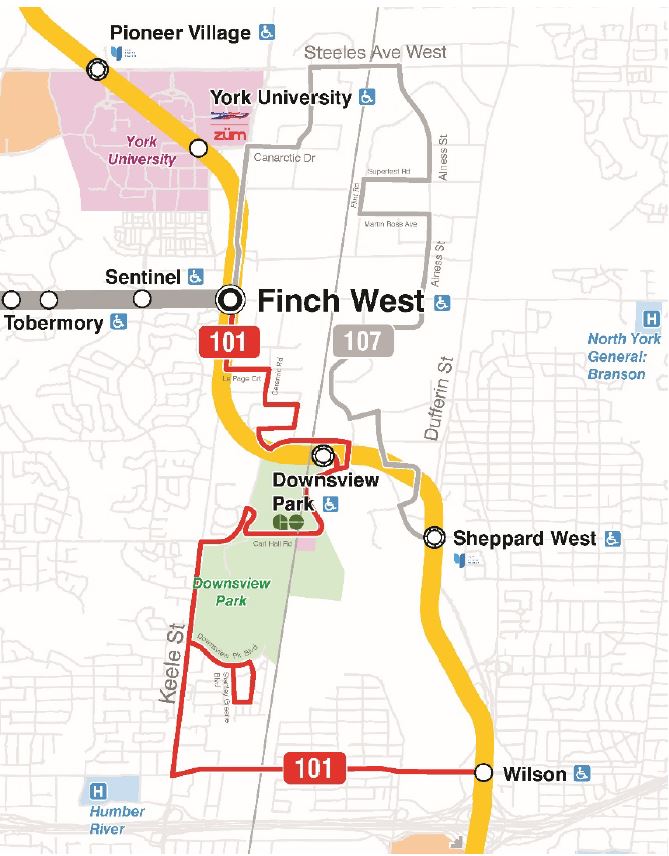
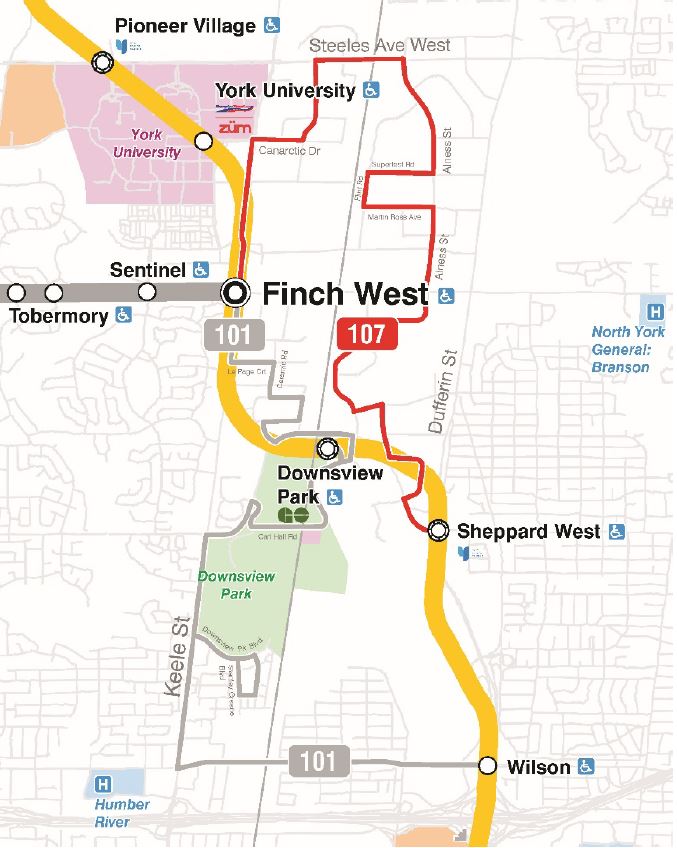
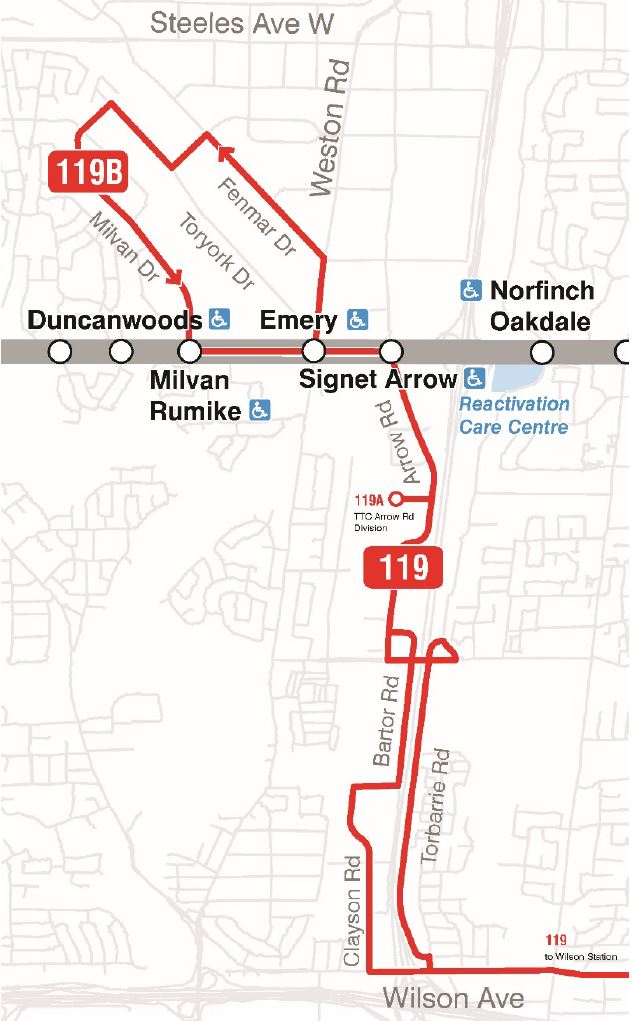
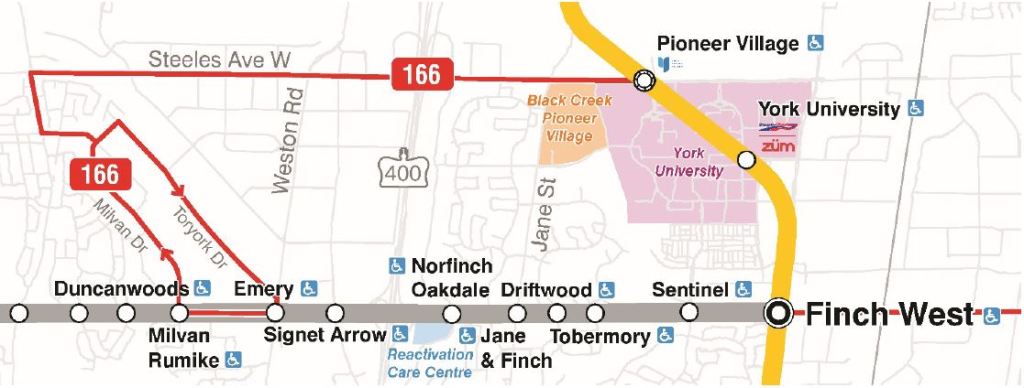
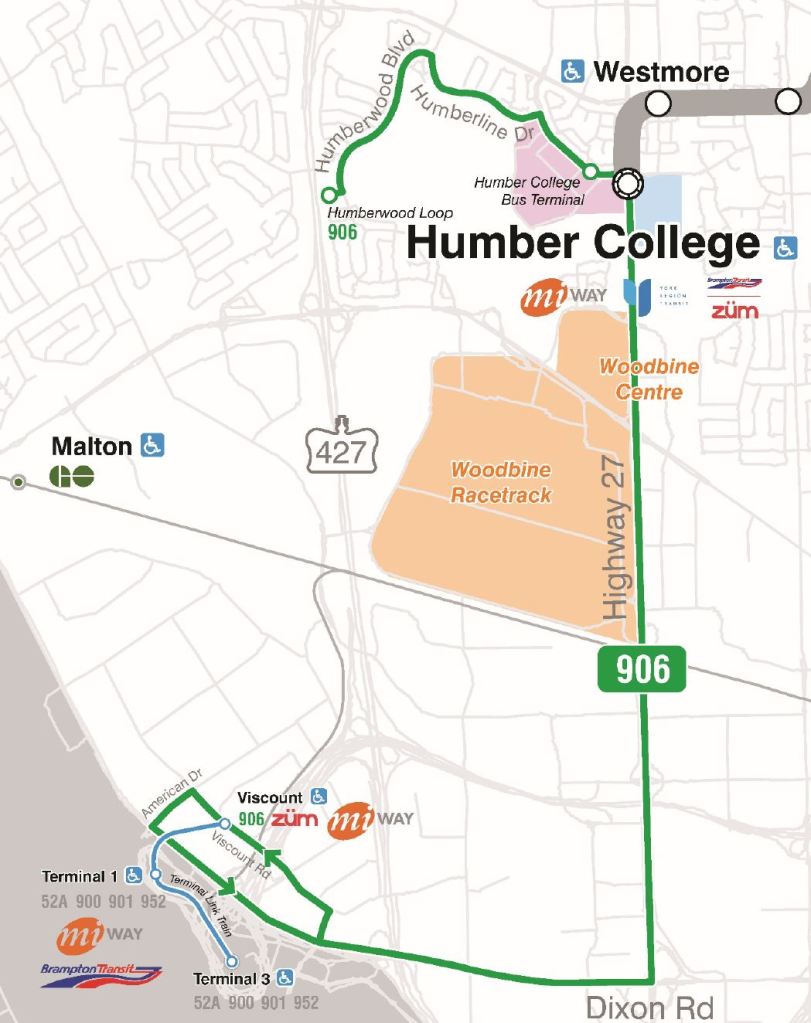
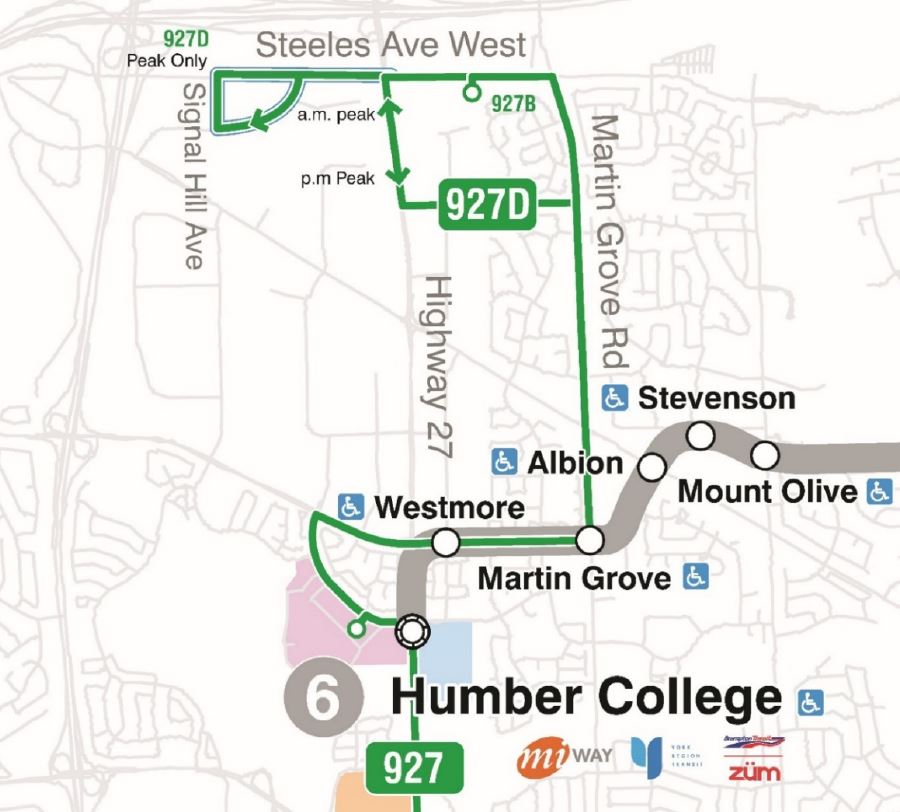
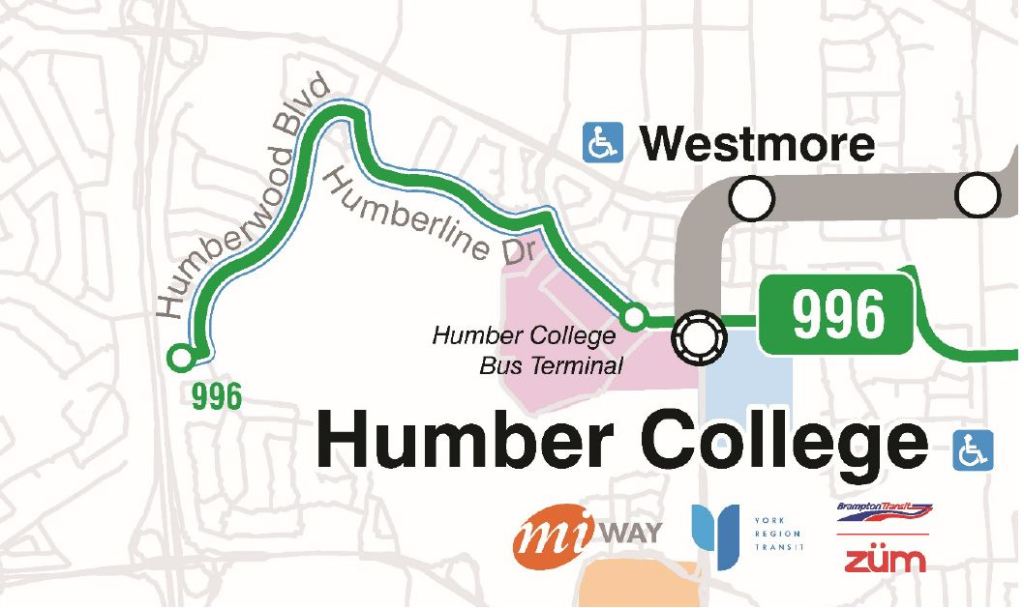
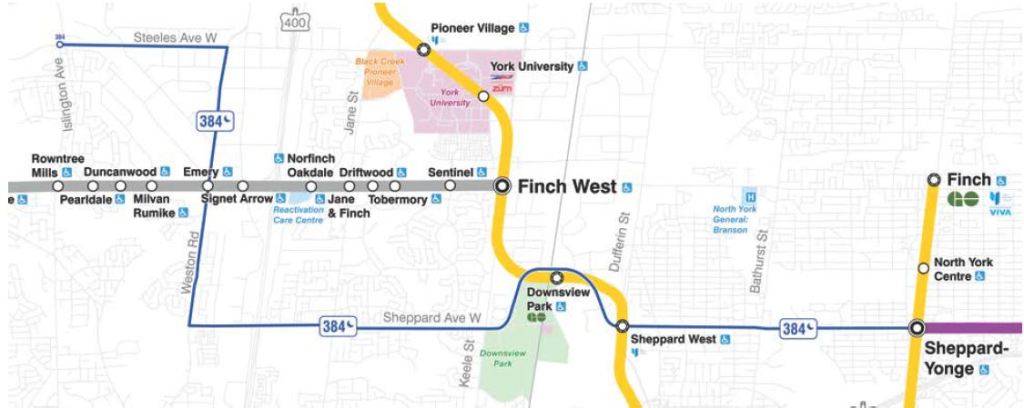
Click on the map to open a larger version.
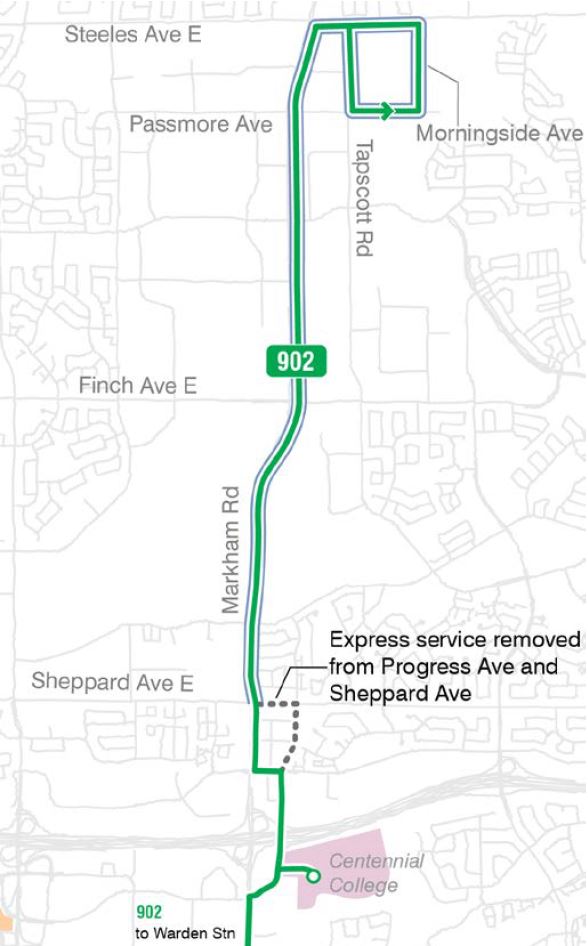
Scarborough RT Replacement
Changes are proposed for two routes affected by the Scarborough RT replacement network.
- 902 Markham Road Express: The route will be changed near Sheppard Avenue to operate via Milner and Markham Road rather than via Progress and Sheppard.
- 985A Sheppard East Express:
- The 985A branch from Don Mills Station to Kennedy Station will be rebranded as 904 Sheppard-Kennedy with a similar service level.
- The 985B branch to Meadowvale will gain weekday midday service in addition to the existing peak service.
- A new branch 985C will operate north from Sheppard via Neilson Road as a local service following the same route as 133 Neilson.
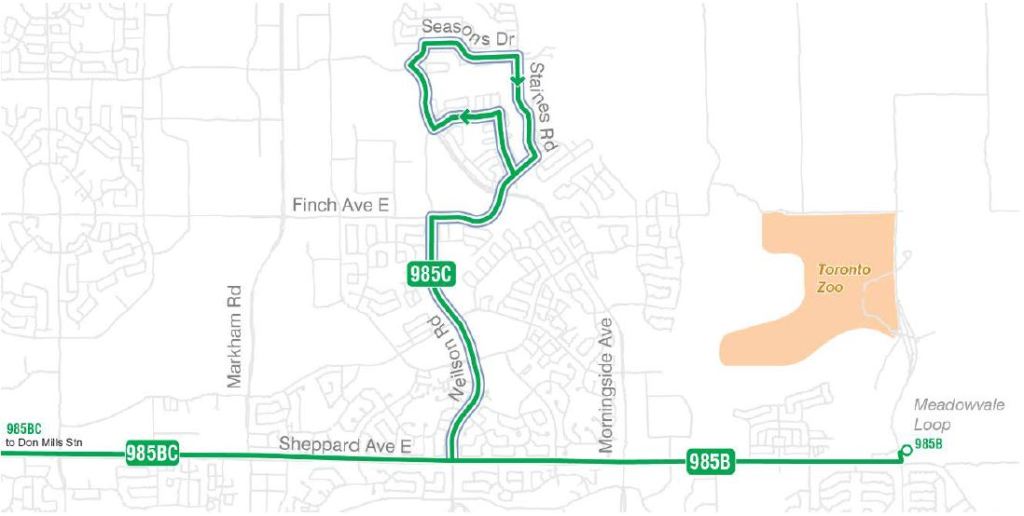
On 953 Steeles East Express, stops have been added both ways at Milliken GO Station.
Area Studies
These studies go back a few years, but their outcome was put on hold due to the pandemic.
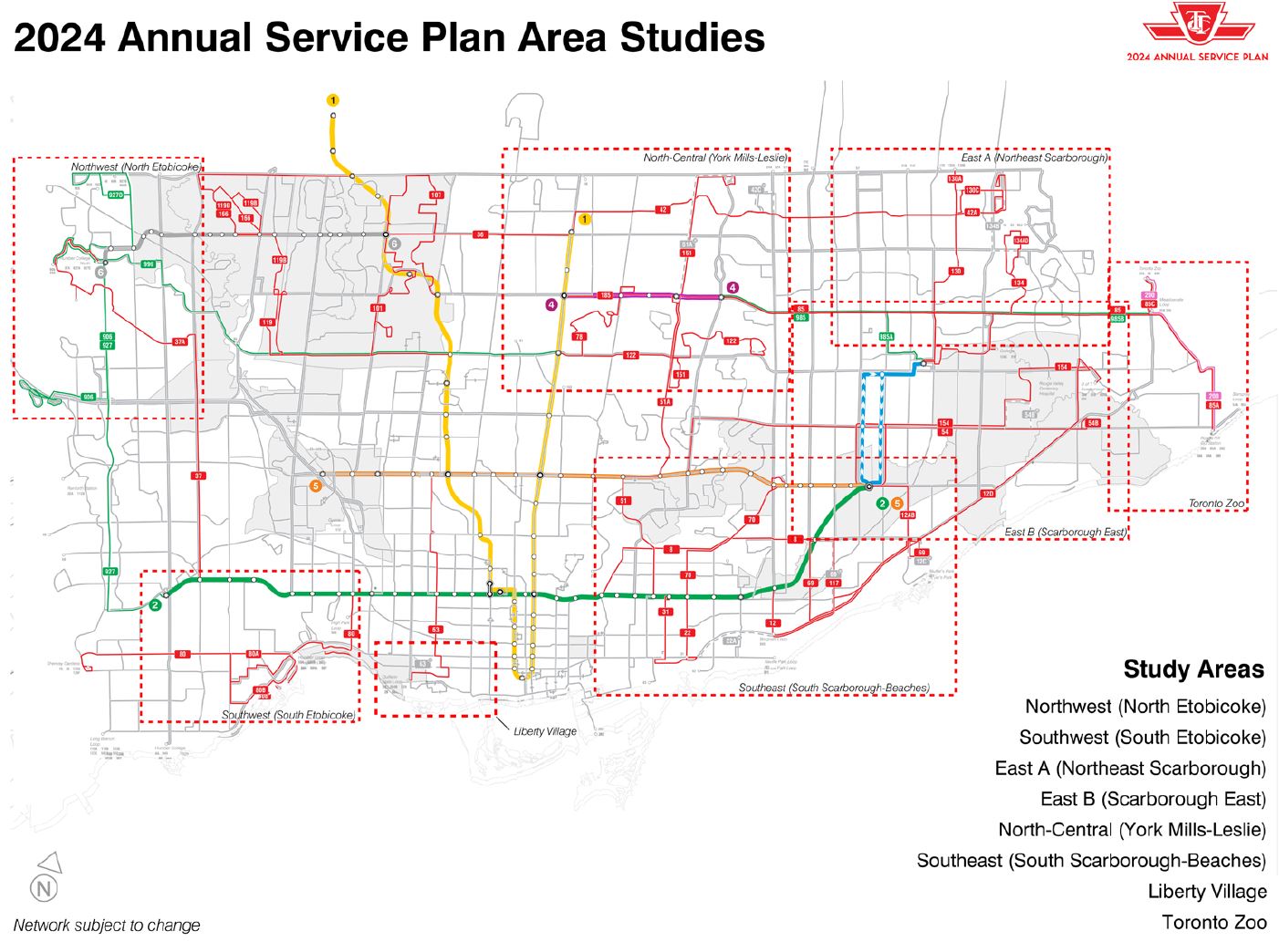
Northeast Scarborough Area Study
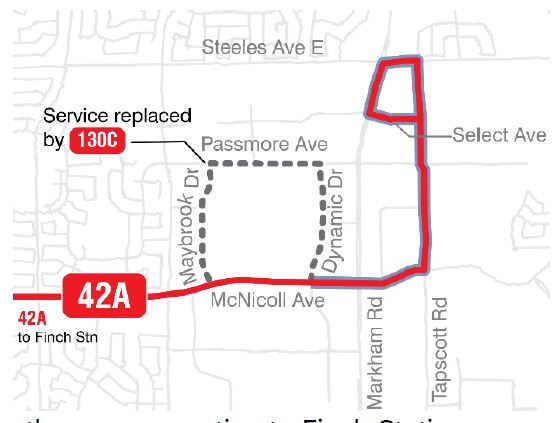
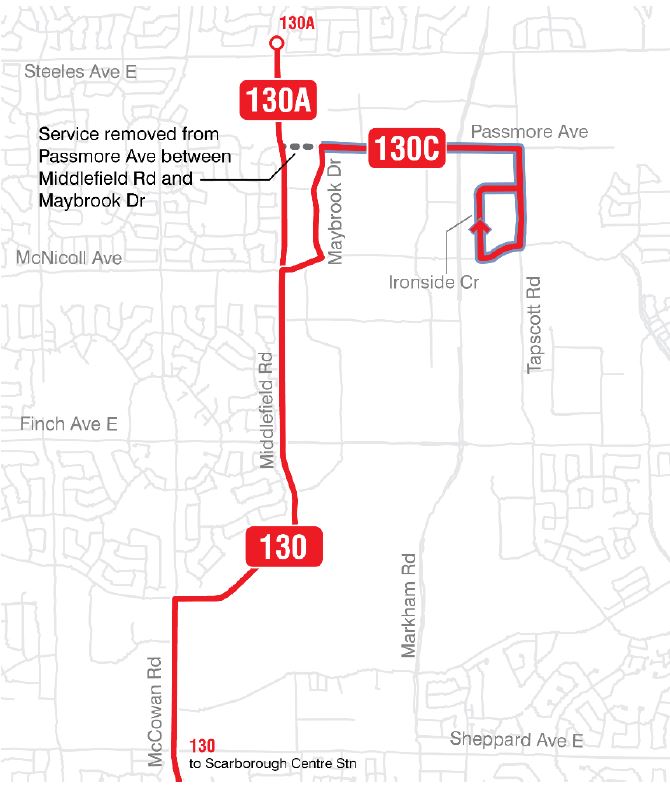
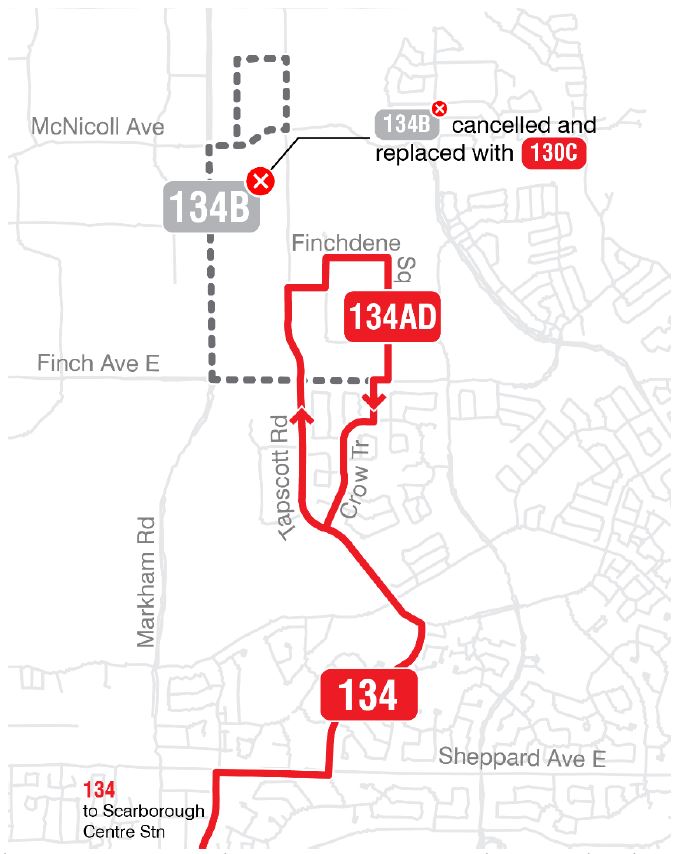
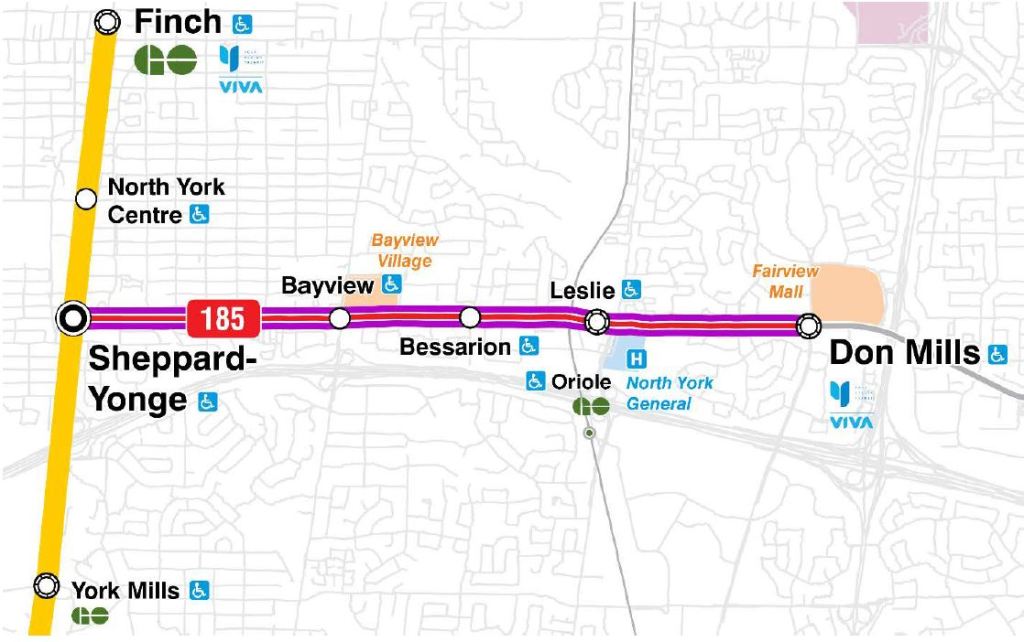
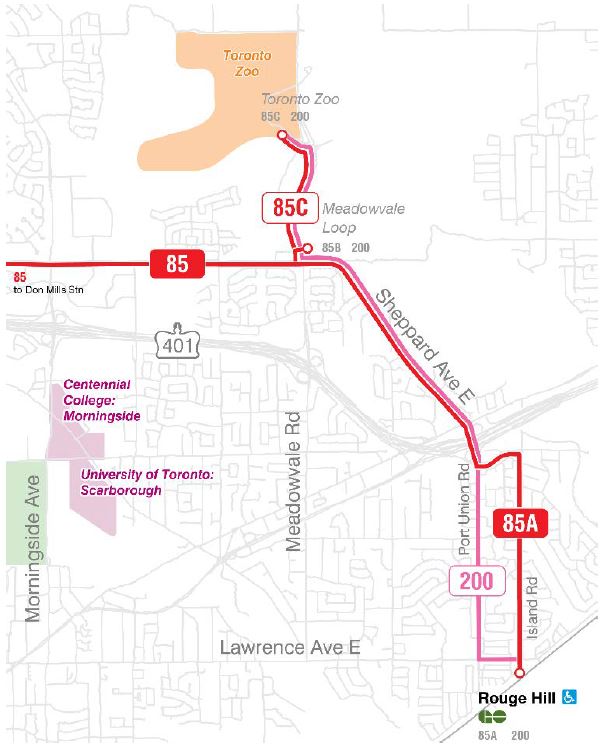
Several routes in northeast Scarborough will be restructured to simplify the network where they overlap. Services on Sheppard will also be restructured to simplify the service design, and to distinguish the routes east and west of Don Mills from each other.
- 42 Cummer: Extended east and north via Tapscott to Steeles. Service on the Passmore/Dynamic loop replaced by 130C.
- 130 Middlefield: 130C Passmore branch extended east to Tapscott Road via Maybrook and Passmore.
- 134 Progress: 134B branch to McNicoll replaced by 130C extension.
- 85 Sheppard: Branch designations clarified for Rouge Hill, Meadowvale and Zoo services.
- 185 Sheppard Central: Existing service between Yonge-Sheppard and Don Mills stations rebranded.
East Scarborough Area Study
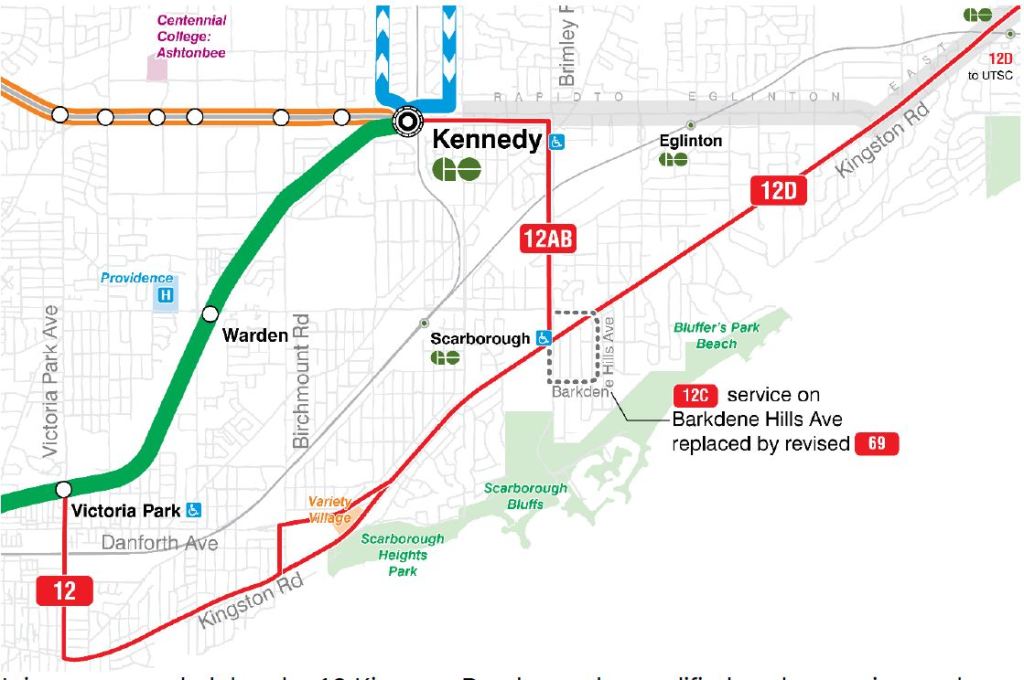
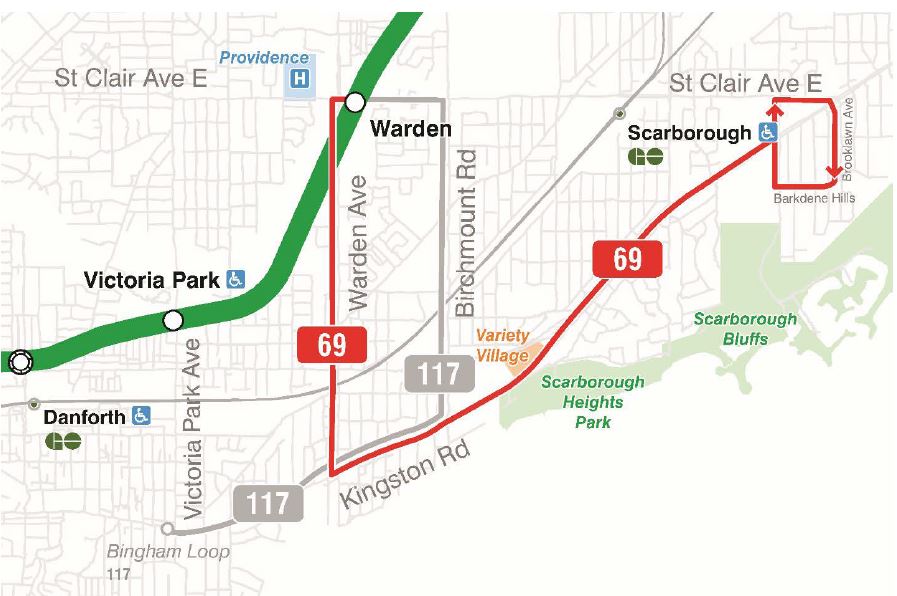
- 12 Kingston Road: The 12C Barkdene Hills loop would be replaced by an extended 69 Warden South bus. The 12D UTSC branch will gain weekday midday and early evening service.
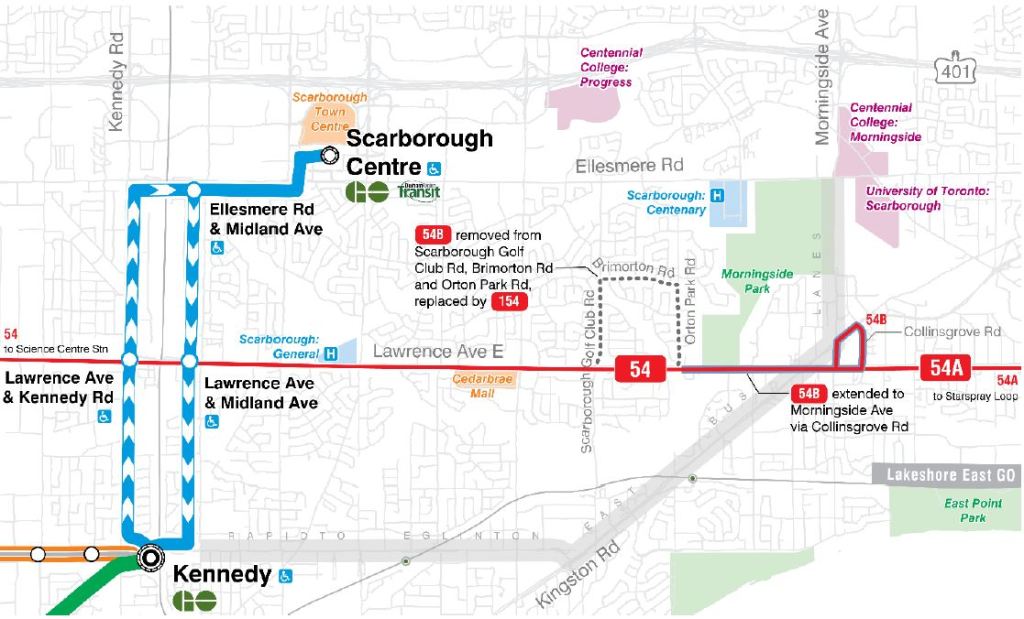
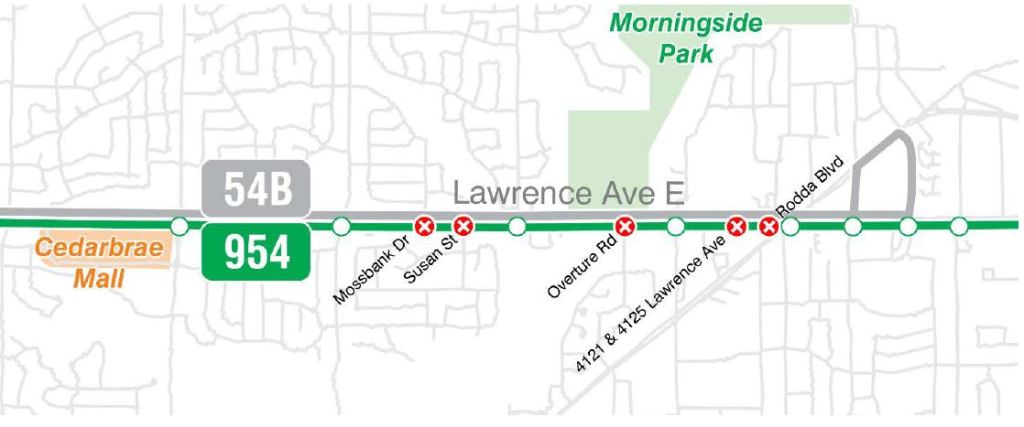
- 54 Lawrence East: The 54B service to Orton Park will be extended to Morningside, and service on the Orton Park loop will be replaced by 154 Curran Hall.
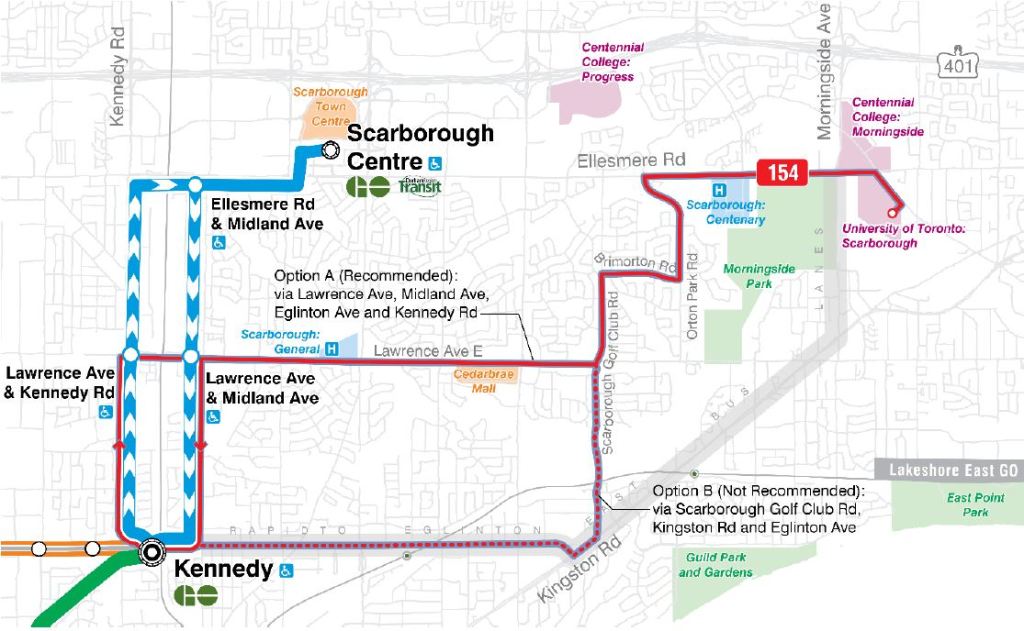
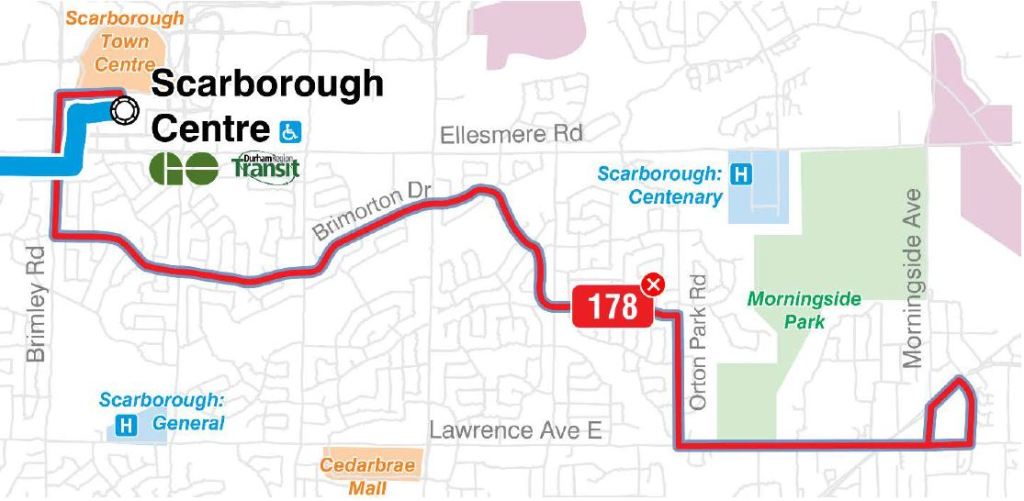
- 154 Curran Hall: A new service will operate from Kennedy Station to UTSC by way of the existing 54B Orton Park route and Ellesmere Road. (A proposed alternate route via Eglinton and Scarborough Golf Club Road was rejected for safety reasons.)
- 954 Lawrence East Express: With the extension of the 54B service to Morningside improving local service, five express stops will be removed to speed up the express service.
- 178 Brimorton: This route was proposed earlier in the area study, but has been rejected based on low projected demand.
Liberty Village Area Study
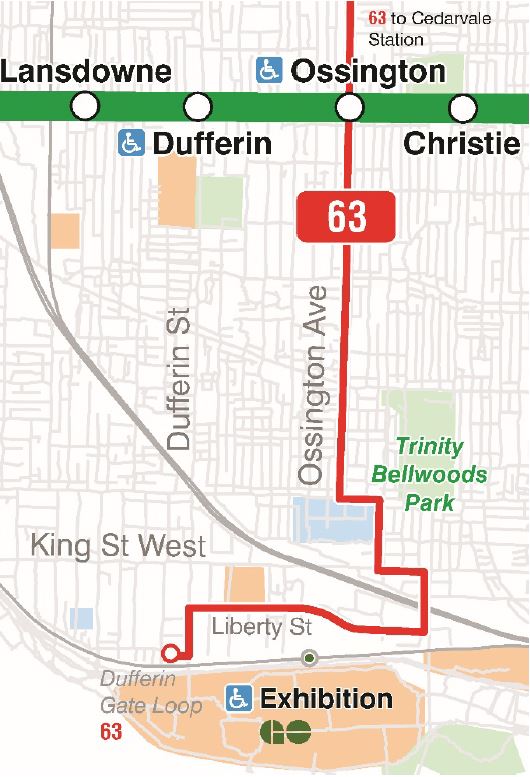
The 63 Ossington will be extended via Liberty Avenue to Dufferin Loop. The original proposal to send the route to connect to the Exhibition Loop and GO Station was dropped due to neighbourhood input which valued service along Liberty more highly.
This change will remove service from the loop via Atlantic Avenue and King Street.
The area will be affected during planned road, water and track work on King as discussed later in this article.
North-Central – York Mills-Leslie Area Study
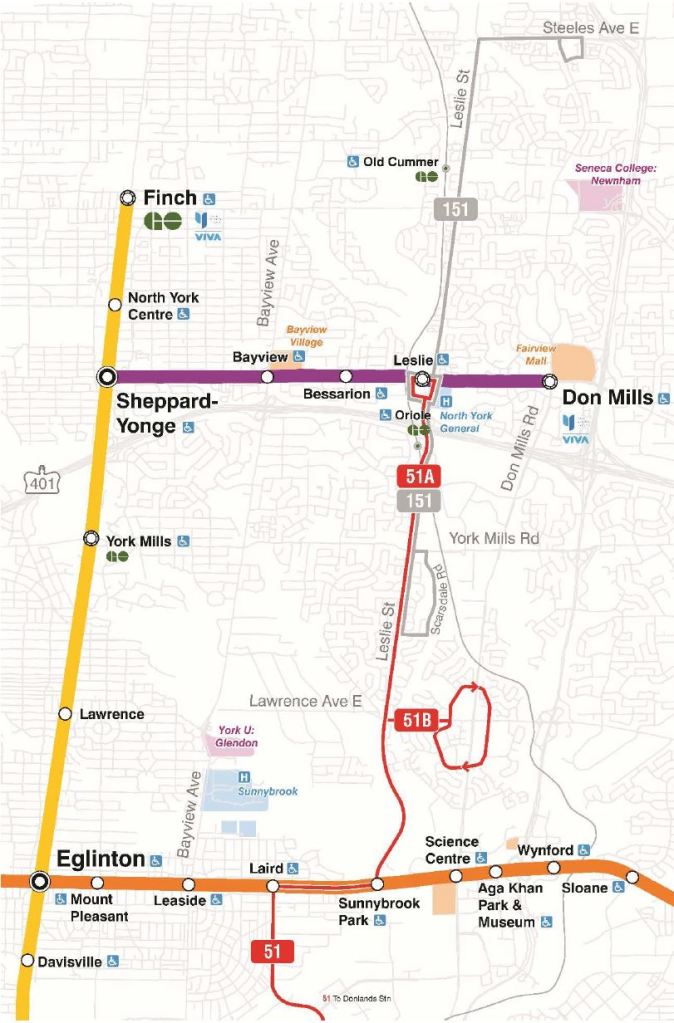
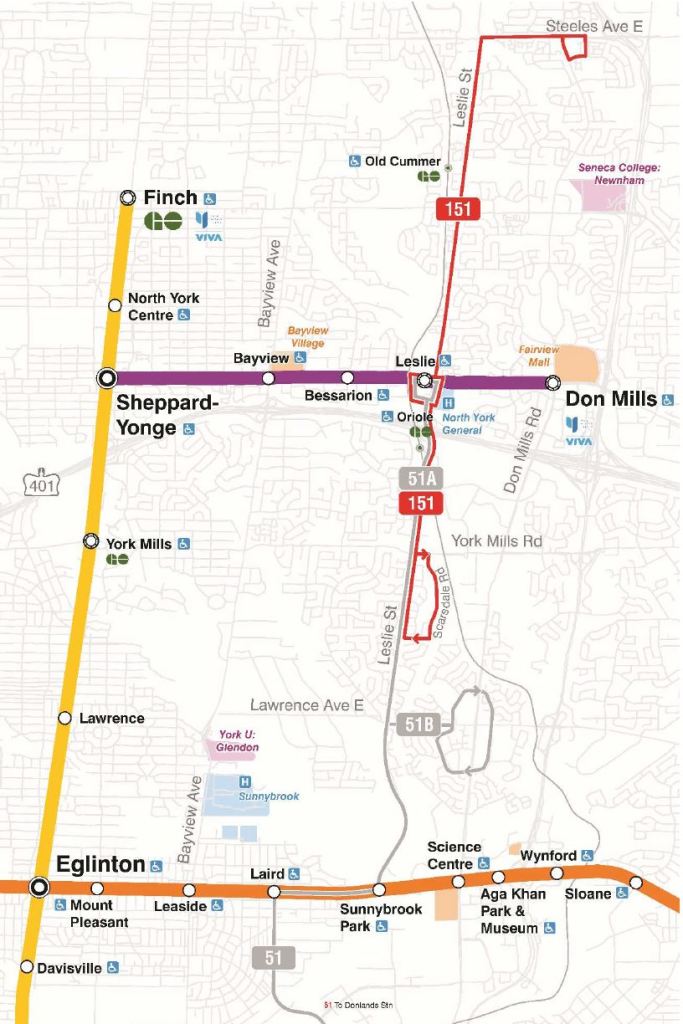
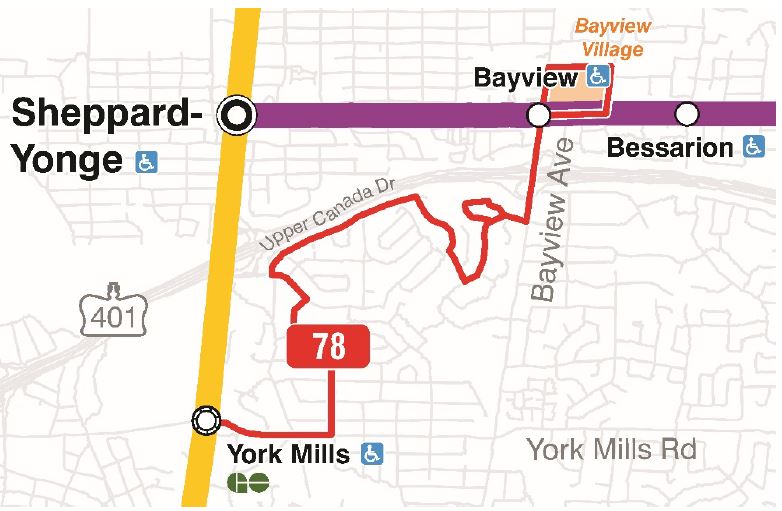
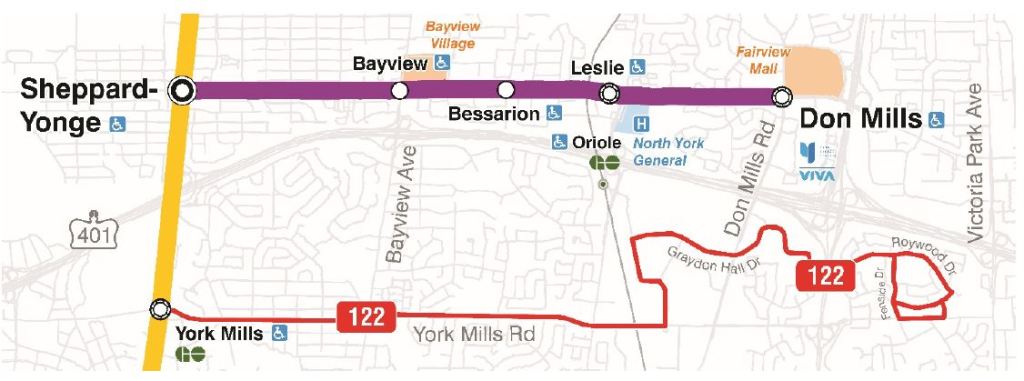
This area will see one route split and two route modifications.
- 51 Leslie and 151 Leslie North
- 51 Leslie will broken into two overlapping routes. The southern one will operate from Donlands Station (post Line 5 implementation) to Leslie Station. At the south end, it will take over the route now operated by 56 Leaside. There will be a short turn 51B service at Lawrence looping via The Donway.
- The northern 151 route will operate from Scarsdale Road to Steeles.
- 78 St. Andrew’s will be extended north to Bayview Station and Bayview Village shopping centre.
- 122 Graydon Hall will have a revised east end loop to provide better service to the Parkwood Village area.
South Scarborough – Beaches Area Study
The following routes have already been modified. The 2024 plan confirms the changes as permanent.
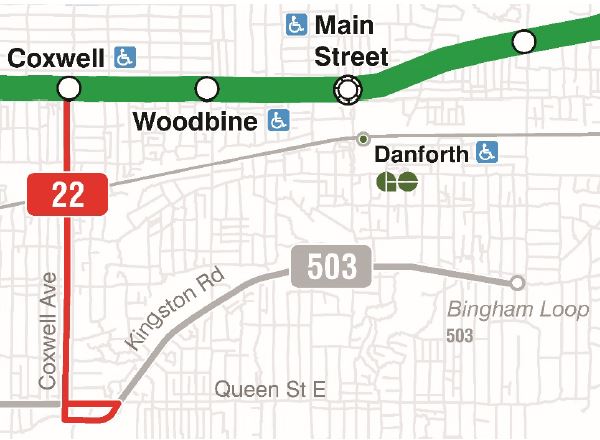
- 22 Coxwell: All service operates between Coxwell Station and Queen Street. Service on Kingston Road is now provided by all day 503 streetcars.
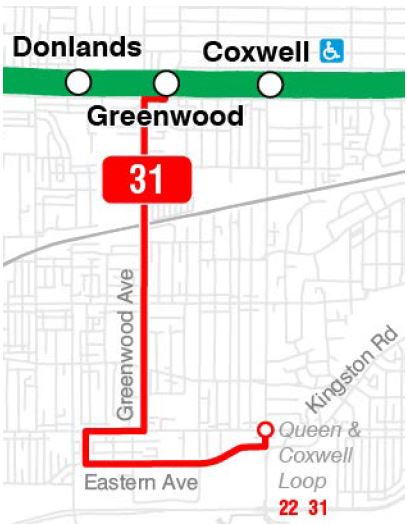
- 31 Greenwood: The loop via Queen, Hiltz and Dorothy has been discontinued, and all service runs via Eastern, Coxwell and Queen to Kingston Road.
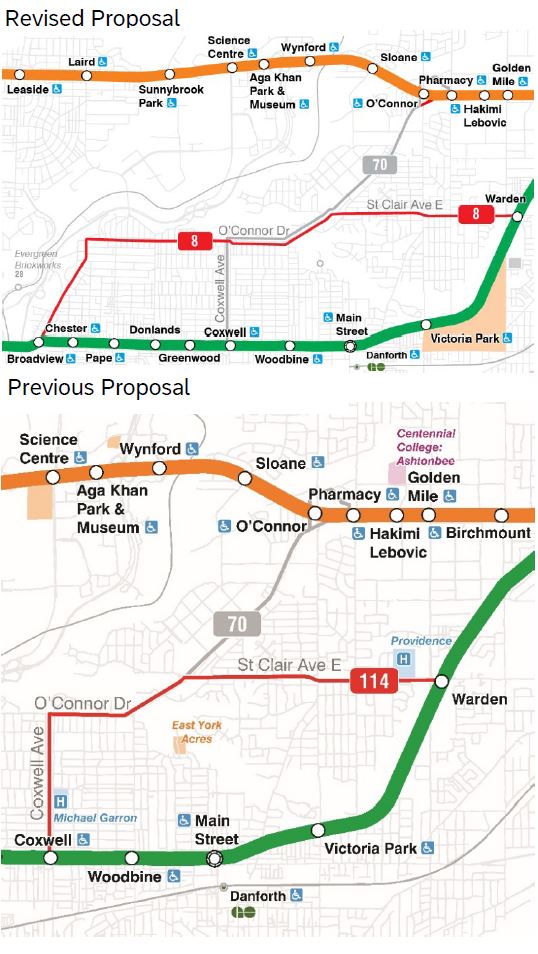
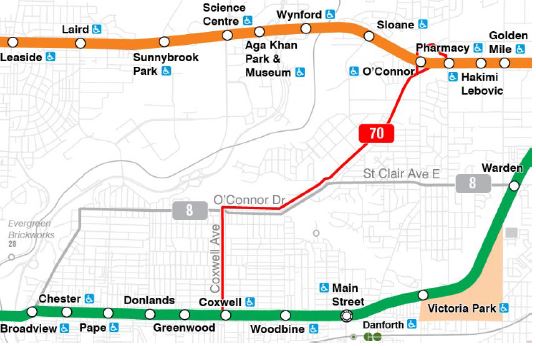
- 70 O’Connor: The Warden Station branch has been replaced by 8 Broadview.
- 8 Broadview: Service extended to Warden Station.
- The proposal to send 8 Broadview to Coxwell Station and to replace the O’Connor service with a new St. Clair East bus has been dropped.
- 503 Kingston Road: Service to Bingham Loop runs during all regular operating hours. Night service continues to be provided by the 322 Coxwell Night Bus.
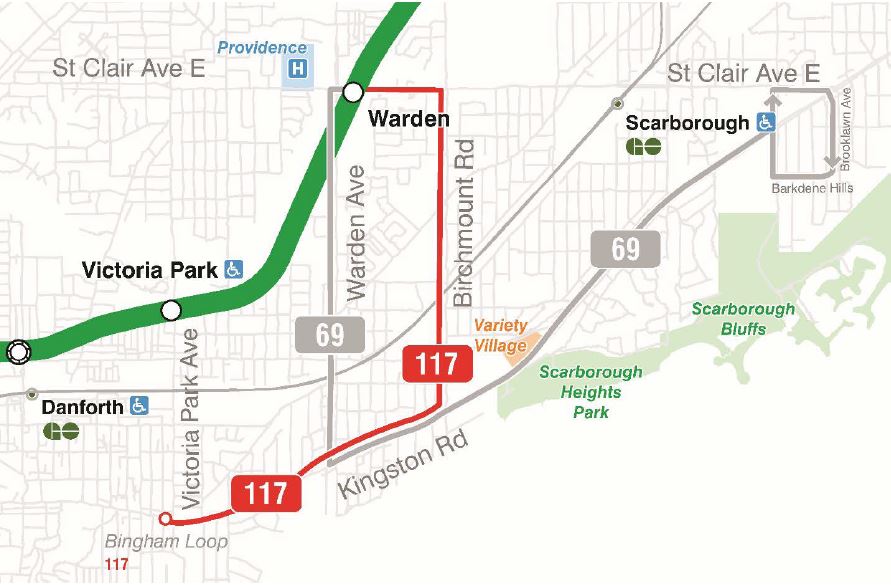
The following changes modify service south of Line 2 and along Kingston Road in southwest Scarborough. Currently, there is one route 69 Warden South which operates in a loop via both Warden and Birchmount. This will be split with both services extended along Kingston Road. The routes will interline at Warden Station so that riders can ride through from one branch to the other as they do today.
- 69 Warden South: Extended east to Barkdene Hills replacing the 12C Kingston Road service.
- 117 Birchmount South: Extended west to Bingham Loop.
Southwest Etobicoke Area Study
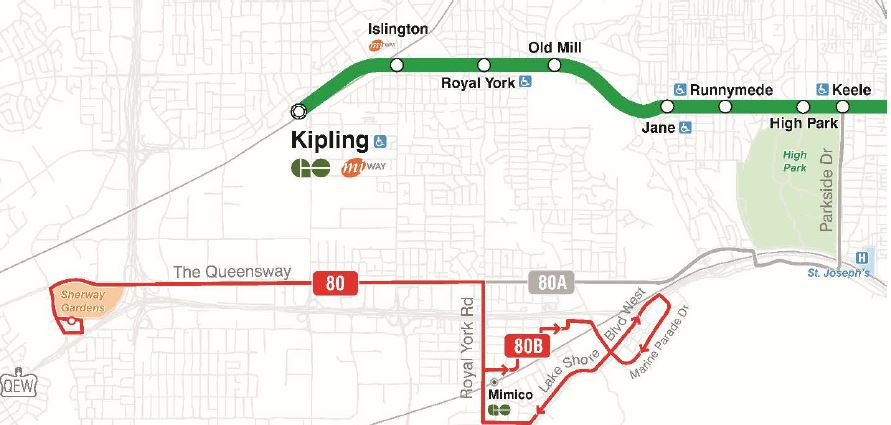
The 80 Queensway will gain a new peak period branch 80B linking Sherway Gardens, Mimico GO and the Humber Bay Shores neighbourhood. This replaces the 176 Mimico GO shuttle. The regular 80A Queensway service to Keele Station will remain.
“Doing Disruptions Differently”
Recent years have seen complete chaos in the effect of long-running, complex construction projects affecting roads, tracks, utilities and pedestrian access to transit service. Some readers may recall the satiric “spaghetti” route maps for construction diversions.
Recognizing the need to improve how we plan, operate, and communicate changes to service during construction, the 2024 ASP includes a construction service framework that will be developed further in the coming years. This is alongside internal improvements to planning, operations, and accountability. We will continue to collaborate with City and external partners to improve the coordination process.
[…]
The draft construction and service disruptions framework, including feedback received through the consultation process, is included in Appendix 4.
2024 Service Plan at p 36
The draft framework, contrary to the text above, is nowhere to be found in Appendix 4.
The main report contains three examples of major projects that will require temporary restructuring of the network to allow for closed roadways and for congestion from construction projects. The challenge is for planned changes to actually occur when and how they are advertised to the public. There have been severe issues with last-minute changes, unexpected site conditions, poor contractor performance, and less-than-cooperative performance from other agencies who value their own priorities.
To these should be added the impression that any affected route is beyond proper attention and management, and that “construction” is a catch-all excuse for poor service. That is certainly the attitude evident in TTC customer relations responses through social media.
Based on 2022-2023 experience and rider feedback, the TTC developed the following construction planning guidelines.
2024 Service Plan at p 37
- Keeping accessibility and minimizing barriers as a primary consideration when planning and communicating diversions and alternative services.
- Consistency in construction phasing and planned detours operated during the construction period.
- Flexibility to adjust service plans in the occasion that consistency is not feasible.
- Maximizing connections to subway to avoid unnecessary transfers for customers.
- Frequent service on nearby/parallel corridors to minimize travel time for customers.
- Maintaining service coverage where possible to ensure that pedestrian access and accessibility are maintained during diversions.
The discussion of major diversion plans shows how routes would be modified, but is silent on other major issues including preservation of service quality, transit priority on roads especially where vehicles must turn, and, of course, on communication of service changes to riders.
Moreover, it is not clear whether this is an exhaustive list of planned projects, or merely a sampling.
Pape Station Construction
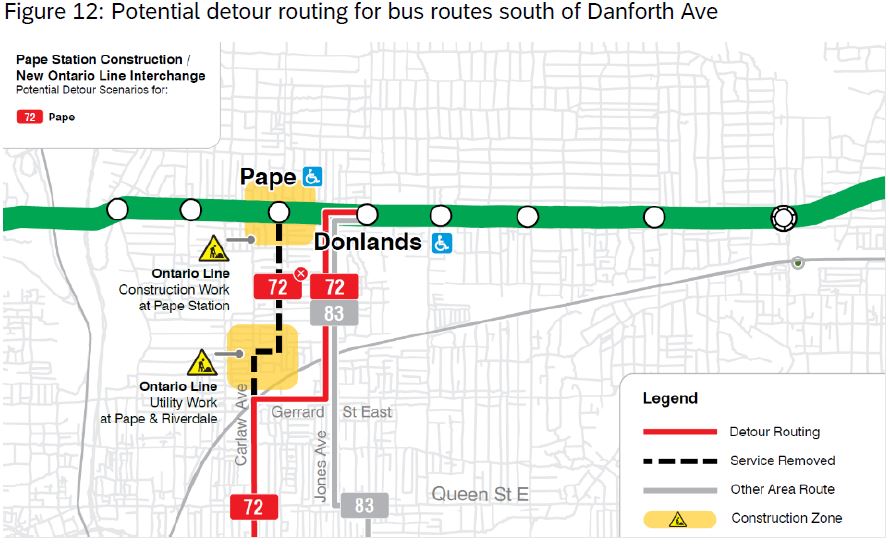
Ontario Line construction will have a major effect on Pape Station and surrounding roads requiring surface routes to divert to other stations. The configuration of these routes has not yet been settled, but the options under consideration are shown in the maps below.
Routes affected are not just those serving Pape Station, but at other locations that will have to absorb extra traffic. Recent experience at Pape with service diverted from Broadview shows what can happen.
Given the likely timing of work at Pape, the map should reflect the post-Line 5 opening route configuration.

King West Road, Utility and Track Construction
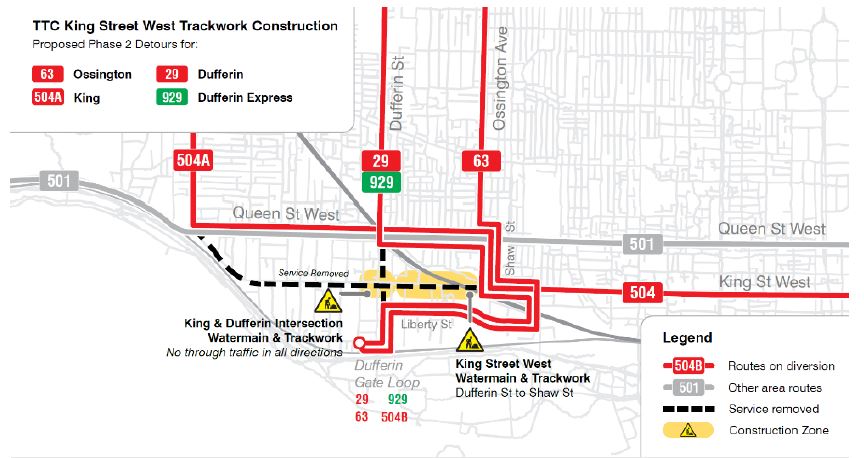
The City, TTC and Toronto Water plan major work on King Street West between Dufferin and Shaw in 2024. Two stages will be involved of which the second includes the closure of the King/Dufferin intersection for replacement of all track. The construction notice on the City’s website shows the planned staging of the work which will extend from February through October, assuming all goes well. Similar information is on the TTC’s King West Track Renewal page. Note that service will be completely removed from King between Shaw and Roncesvalles with no shuttle bus service.
The work at King and Dufferin is planned for June/July and this will be the period when the Phase 2 map (right below) is in effect. There is likely to be severe congestion with the diversion of transit service off of Dufferin, and transit priority will be required. Whether it is actually implemented, or done effectively, is quite another matter. Experience in 2023 on King Street suggests that it will be, at most, an afterthought.
Planned diversions can look good on a map, but actual operations can be hobbled by congestion, failure to enforce the most basic traffic management and restrictions, and short turns that create large gaps, or even complete absence of service where it is advertised.

Yonge and Steeles
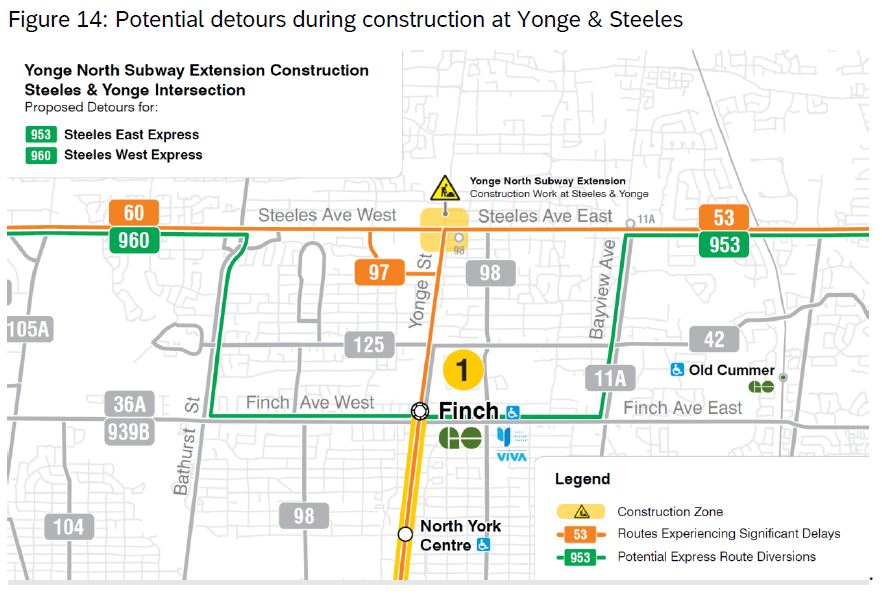
Anticipated construction at Yonge and Steeles for the Richmond Hill subway extension will restrict intersection capacity. The TTC proposes to divert the 953 and 960 express services to avoid this location enroute to Finch Station, but to leave the local services in place. What this will do to service quality on the 53 and 60 Steeles buses, not to mention the already-infrequent 97 Yonge, remains to be seen.
It is not clear why the maximum amount of service is not diverted off of Yonge leaving a residual shuttle operation for local demand.
Increased Night Service on Streetcar Routes
As it did some years back when the CLRV and Flexity fleets were competing for storage space, the TTC will face a temporary shortage of storage for its expanding streetcar fleet. Two new cars, 4604 and 4605, have arrived in Toronto and 58 more are to follow by the end of 2025. Reconstruction of Russell Carhouse will take some of its capacity offline, and the project to convert part of Harvey Shops at Hillcrest to a small operating carhouse is still in the design phase.
In the meantime, the TTC contemplates expanding all night service to, in effect, store streetcars on the road providing improved service. Note also the rebranding of these routes from the 300 series to the “N” branch of the daytime route numbers. In the body of the report, they are still styled as 300s (p 43).
The net additions are on St. Clair, Bathurst and Kingston Road (replacing bus services), and on Dundas (new). Also proposed is an improvement to 20 minute headways on Queen, King, Carlton and Spadina. The west end of 306/506N Carlton would be shifted from Dundas West to High Park Loop, although this will probably encounter local objections. The 506 daytime service runs to Dundas West after 1am.

Service Performance Reviews
There are two aspects to the performance reviews. One looks at past changes to determine whether they actually worked to the benefit of the network, and the other looks at poorly-performing routes to determine whether they should be changed or eliminated.
There is a difference in the evaluation criteria applied to these two groups of routes.
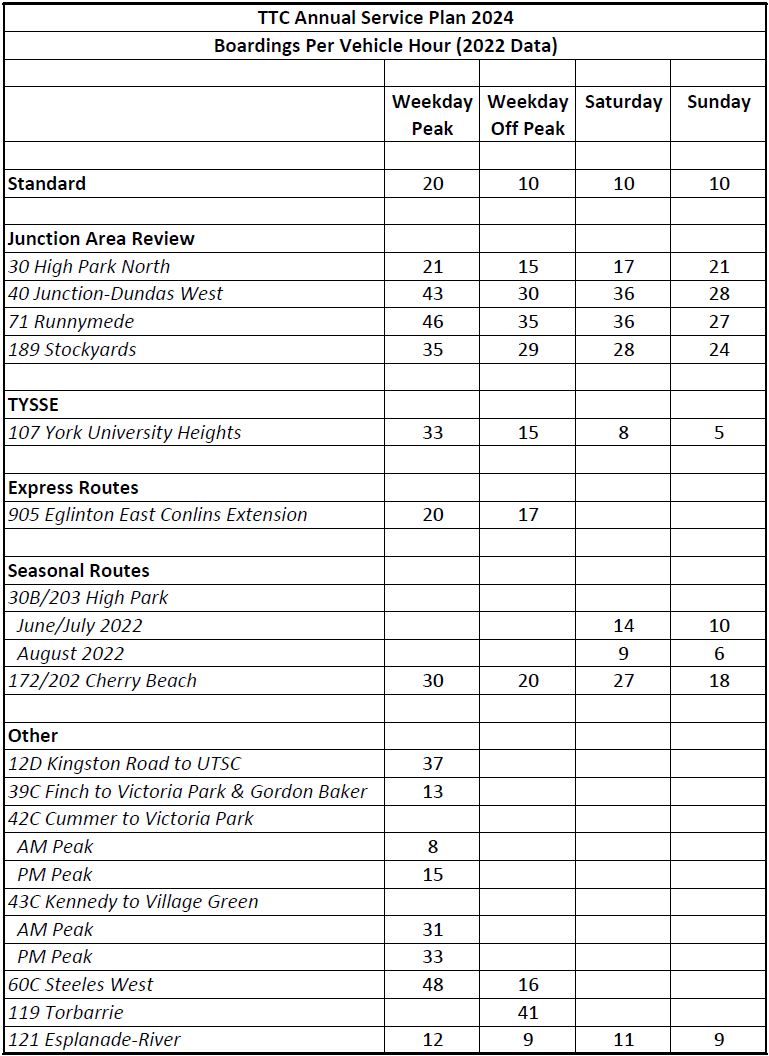
- Post-implementation changes (as well as proposals for new services) are evaluated against the number of boardings per vehicle hour. This measure is clearly tied to usage, and is not affected by inflation.
- Existing routes are ranked by cost per passenger. This is affected by factors such as vehicle speed, trip length and, of course, inflation in operating costs. In earlier versions of the service standards, this was measured against a cutoff level of “N” fares’ worth of revenue, but that part of the formula can be affected by non-inflationary factors such as the political love for fare freezes.
The TTC should adopt a common metric, preferably the boardings per vehicle hour value, which is clearly understood and tied directly to rider counts and service operated.
Network Modification Reviews
Junction Area Study
Routes in the Junction (Dundas-Keele) were reviewed in 2017 in an attempt to rationalize service in an area with geographic constraints. Route changes were implemented in 2018 and 2019 including:
- 80 Queensway extended from Humber Loop to Keele Station via Parkside Drive
- 30 High Park replaced 30 Lambton on High Park Avenue
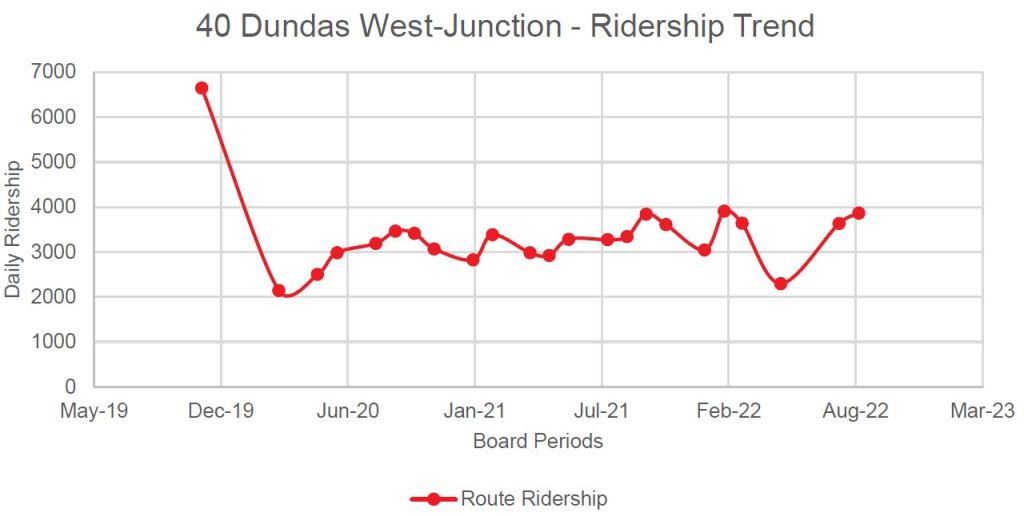
- 40 Junction-Dundas West consolidated the former 30 Lambton and 40 Junction routes between Dundas West and Kipling Stations.
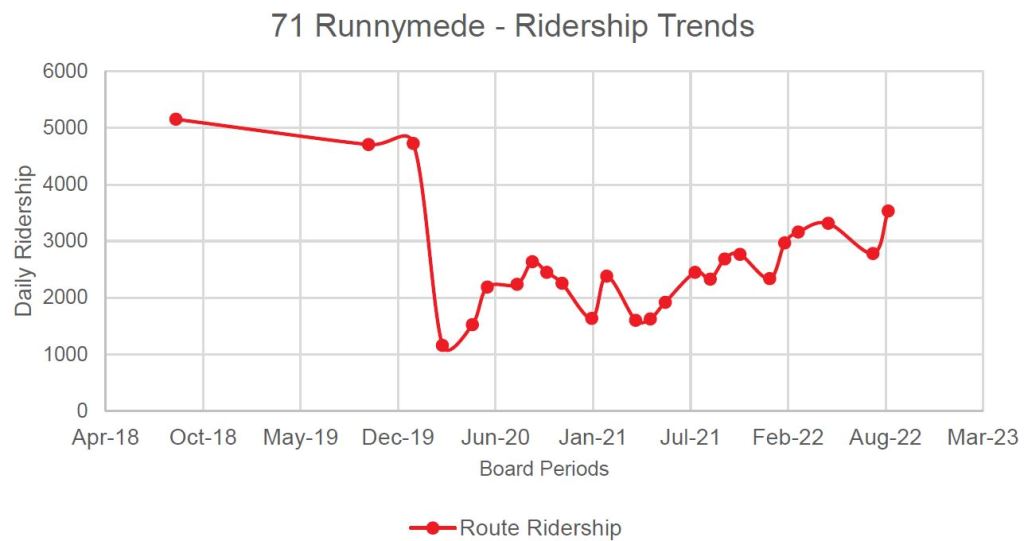
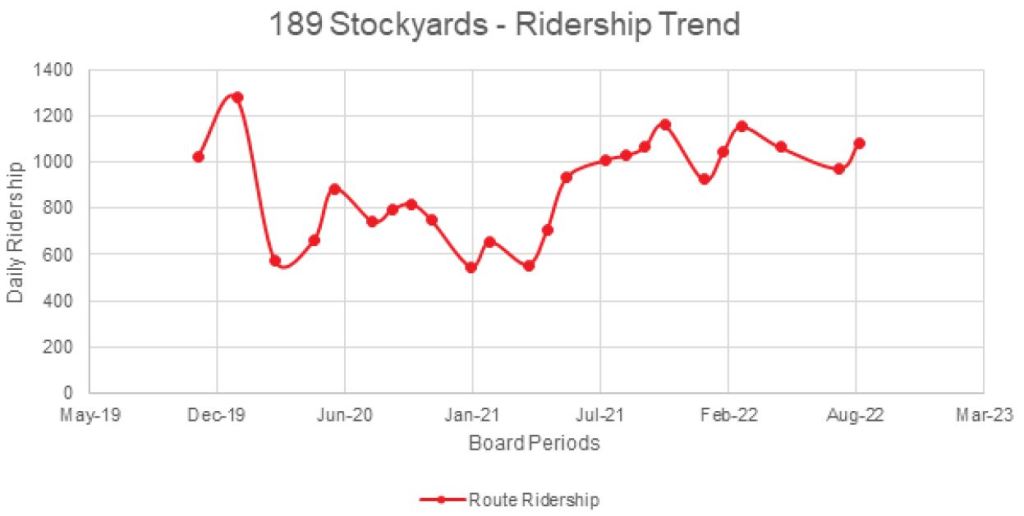
- 71 Runnymede was modified to route all service via Industry and Rockcliffe, with the branch on St. Clair to Gunn’s Loop replaced by the new 189 Stockyards route.
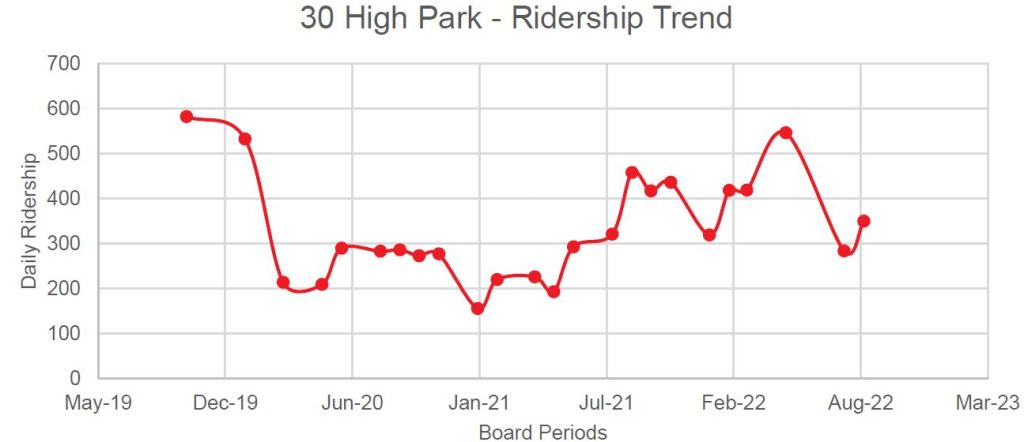
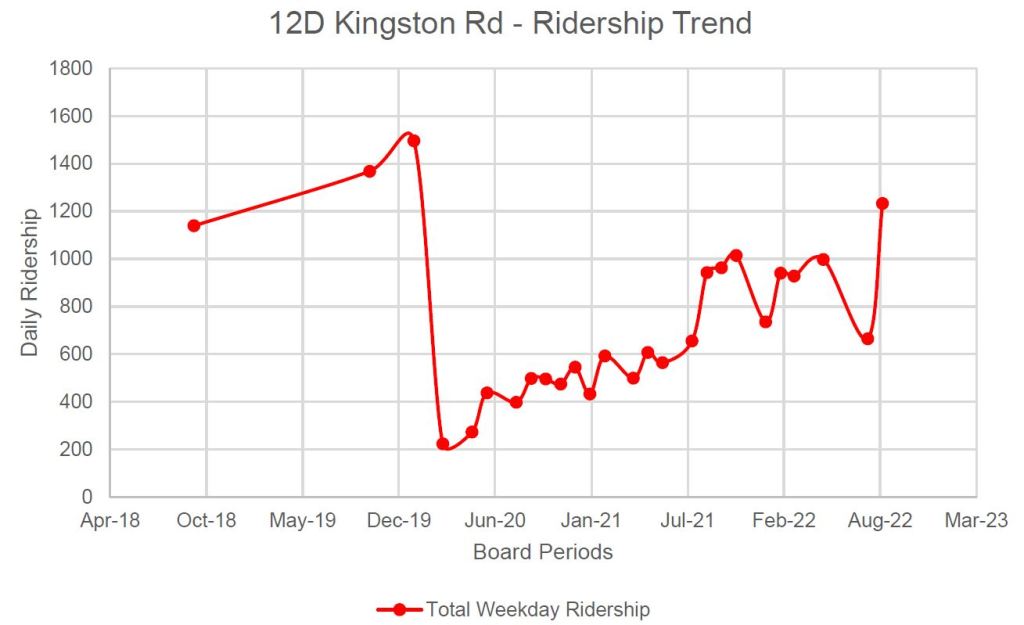
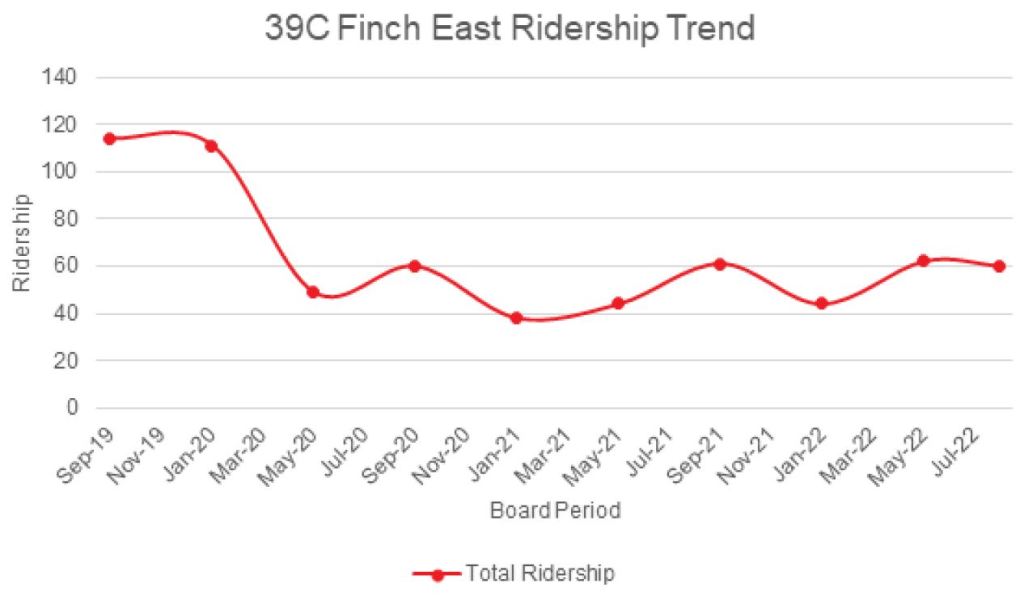
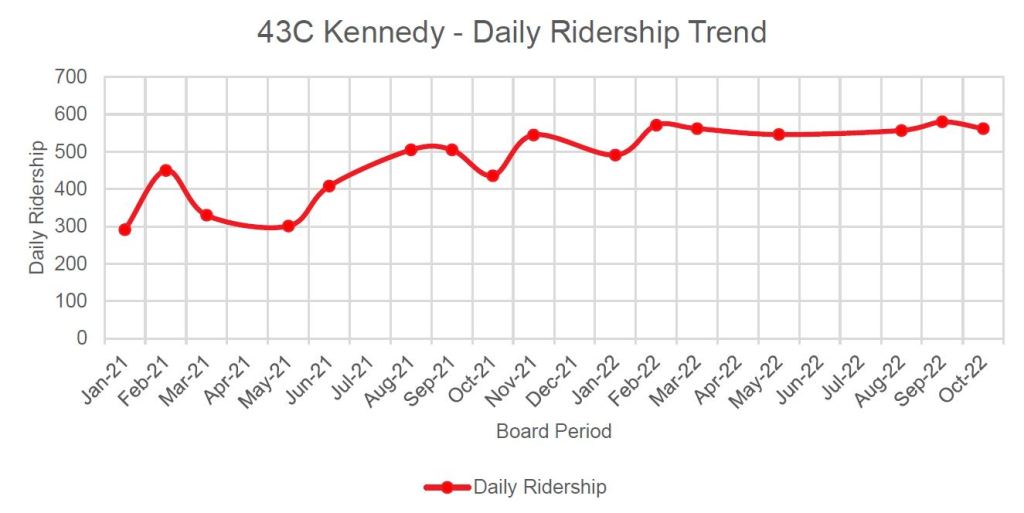
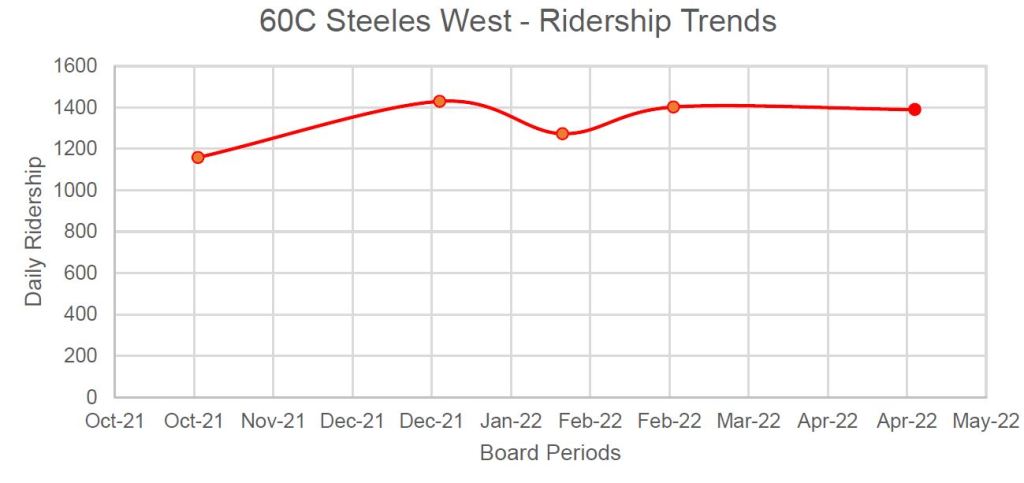
Ridership trends for the revised routes are shown below, although the series do not come right up to fall 2023. All of them show the big drop in early 2020 and the subsequent recovery from the pandemic era, although this varies from route to route.
The boardings per hour, consolidated into weekday peak, off-peak, Saturdays and Sundays are listed for all routes in a table at the end of this section.
Even though it meets the standard on an averaged basis, the plan has caveats about 30 High Park North:
Based on the ridership data, some periods of operation do not consistently meet the TTC’s service standards for customer boards per service hour. In particular, the weekday AM peak period and late evening periods on all days are below standard as of the most recent ridership count, though observed ridership fluctuates by month. The service change was introduced five months before the COVID-19 pandemic – while ridership on the route dropped significantly in March 2020, the route has recovered at a similar rate to the system-wide average of 75%.
2024 Service Plan at p 173 of the PDF
The problem with selective evaluation is that it can cause a fragmented view of the route when a basic premise of TTC service design is that service runs all of the time, everywhere.
If the TTC wants the standard to apply to each period of operation individually with potential gaps in service, then it should set the Standards appropriately, not cherry pick situations where it suits them. This is a “Catch 22” situation because there are a few routes in industrial areas where some periods see high demand and others next to nothing. Running all day service can rack up hours with no demand thereby diluting the average.
TYSSE
The only route in this section is 107 York University Heights. This was originally 107 St. Regis and 117 Alness-Chesswood, and these routes were not very successful. In May and September 2021, the routes were consolidated and modified in an attempt to boost ridership. Weekday service meets the target, but weekend service does not except for Saturday afternoons. Some of the route changes cut service and drove away riding rather than boosting productivity.
The area will be affected by the opening of 6 Finch West, and this might improve performance. However, service changes, if done strictly for “efficiency” could again be counterproductive. The route will be revisited in the 2025 Service Plan.
Downtown Express Routes
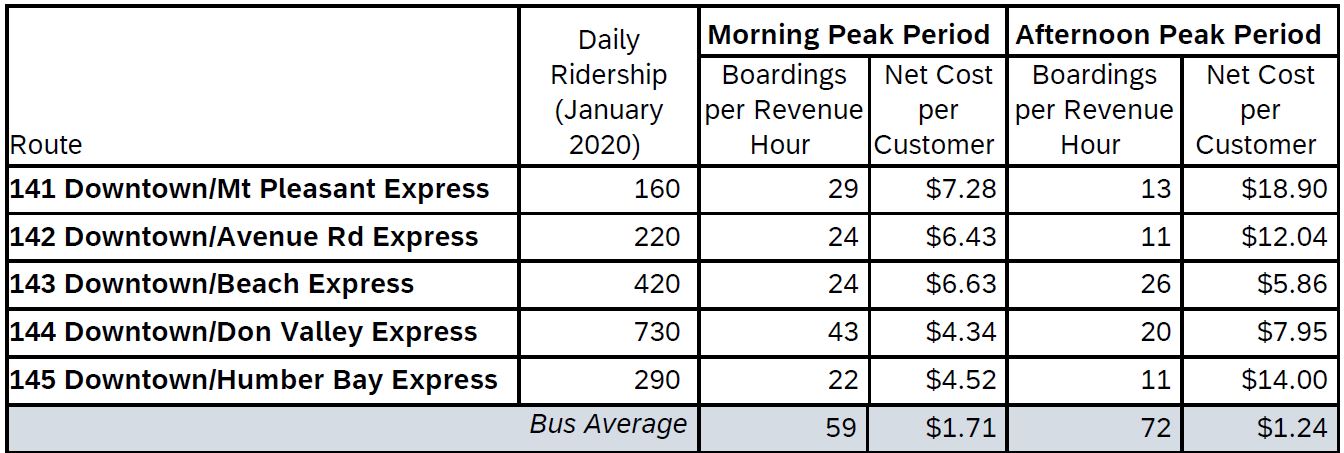
The five Downtown Express routes operated with a double fare due to their high cost and poor utilization (one way trips), and were intended as subway relief back in the days when this was an issue. On that basis alone, never mind financially, they were an abject failure. The TTC shows their results in the table below, although there are a few caveats about the figures.
- The boardings per revenue hour for all routes are lower than the “bus average” value quoted at the bottom of the column. It is numerically impossible to have an average that is greater than all of the component data.
- The net cost per rider similarly is much lower for the “bus average” than for any individual route. This does not make sense. (Note that these values are net of the double fare charged to riders on these routes.)
Some of the cost/rider values are well above the level at which the TTC would cancel the service without a second thought. The challenge has been that most of these routes had political sponsors, many of whom were TTC Board members when the routes were created. Some of them were even budget hawks who would complain about unproductive service, but not in their own territories.
The TTC proposes to permanently drop these routes from the network, but there will be various semi-replacements (note that these explanations/justifications are paraphases of the TTC’s position, not my own):
- 191 Underhill (described earlier) will connect the north end of the 144 Don Valley Express to Don Mills & Eglinton at Science Centre Station.
- 150 Eastern Avenue (approved in the 2022 Plan but not yet implemented) will follow a similar route to the 143 Beach Express, but will run local on Eastern Avenue.
- 503 Kingston Road provides all-day service from the Upper Beach to downtown.
- The new 80B Queensway service (described earlier) serves a catchment area somewhat like 145 Humber Bay Express, but with a focus on the Mimico GO station which will be more attractive once regional fare integration kicks in.
Express Network
The Express bus network was heavily affected by the pandemic period with many services cancelled. Although TTC spoke of fairly small service reductions to the overall network, there were cases where the suspended express service had accounted for a sizeable portion of corridor capacity. This was not factored into the official story about percentage reductions in service.
In the 2021 Service Plan, four routes were recommended for additional service. Many of these were short-lived because of pandemic cutbacks, but all were restored in May 2022 except for off-peak service on 953 Steeles East. These changes are now having their post-implementation review.
Note that the analyses here are based on old 2021 and 2022 data, and further review will be required to update this information. It is not clear why the 2024 Service Plan does not include more recent information to inform its recommendations.
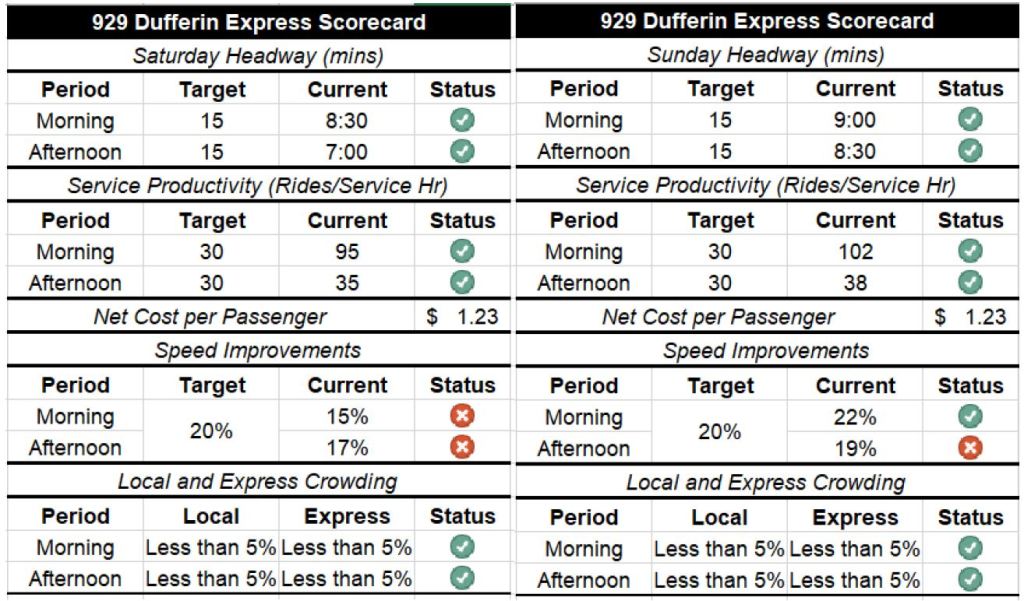
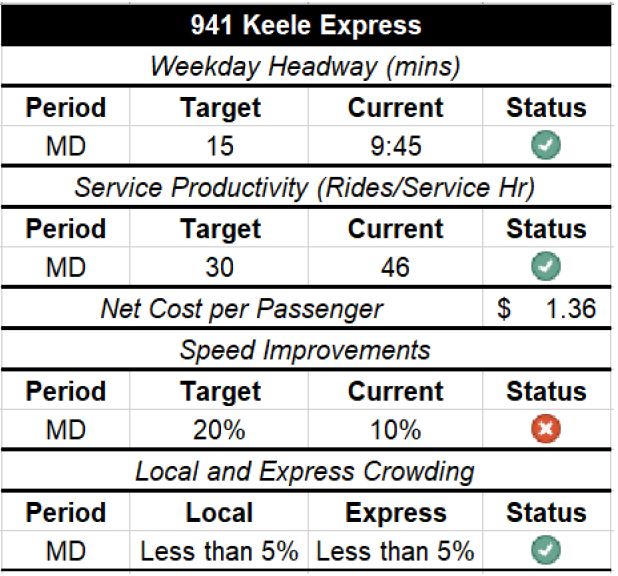
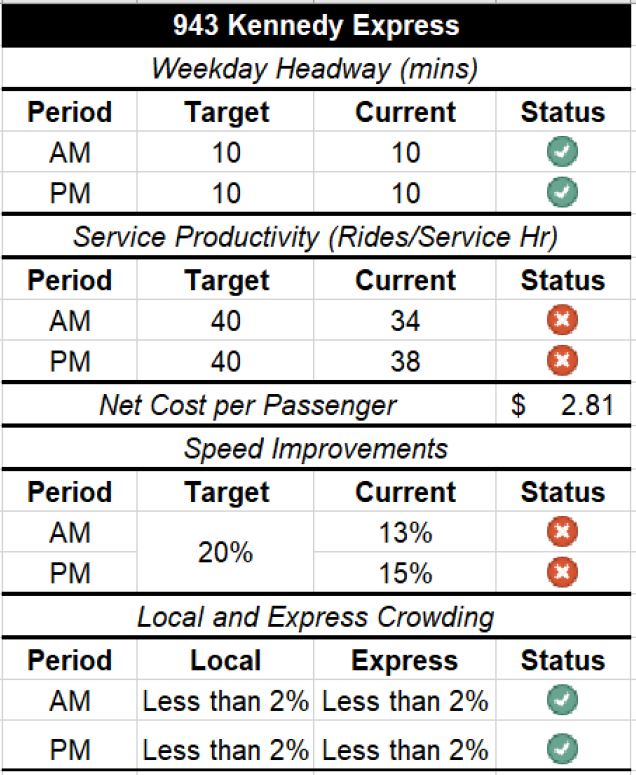
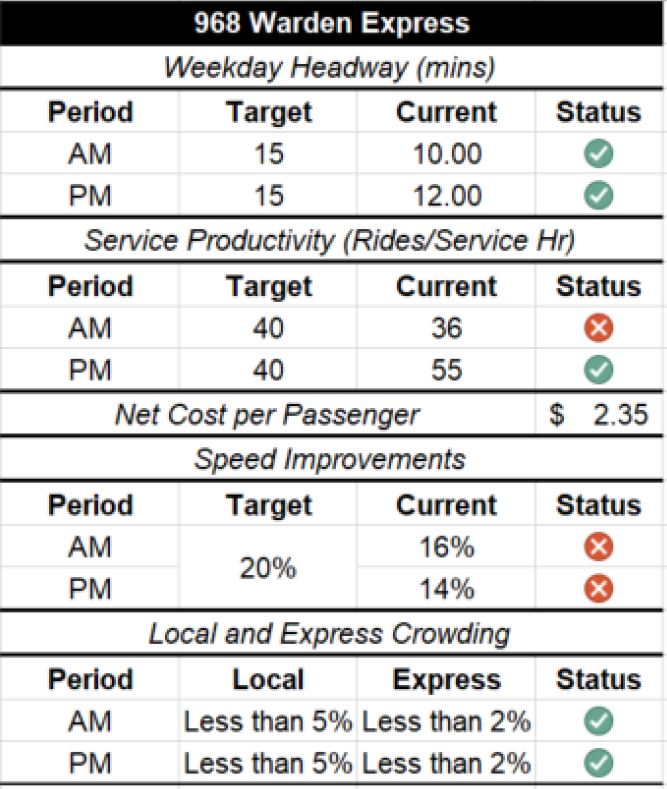
The evaluation matrix for express services is more extensive and includes maximum headways (time between buses), boardings/hour, net cost/rider, speed improvements and crowding levels relative to local service.
- 929 Dufferin weekend service: This meets most of the standards and will be retained.
- 941 Keele weekday midday service: This meets most of the standards but only marginally. It will continue operation with further study to improve operations.
- 943 Kennedy peak period service: This route remains suspended due to poor performance.
- 960 Steeles West off-peak and weekend service: This meets some but not all of the standards. It will continue to operate, but be monitored for possible changes. This is related to the planned 166 Toryork bus which would provide local service in the area west of Pioneer Village Station now served by 960 “express” buses running local. There is a possibility of running the 166 beyond its planned peak periods and removing stops now served by the 960 making it an express service in the common area. This option will be reviewed in a future service plan.
- 968 Warden peak period service: This route does not achieve all of the express standards, and it will be monitored for future changes.
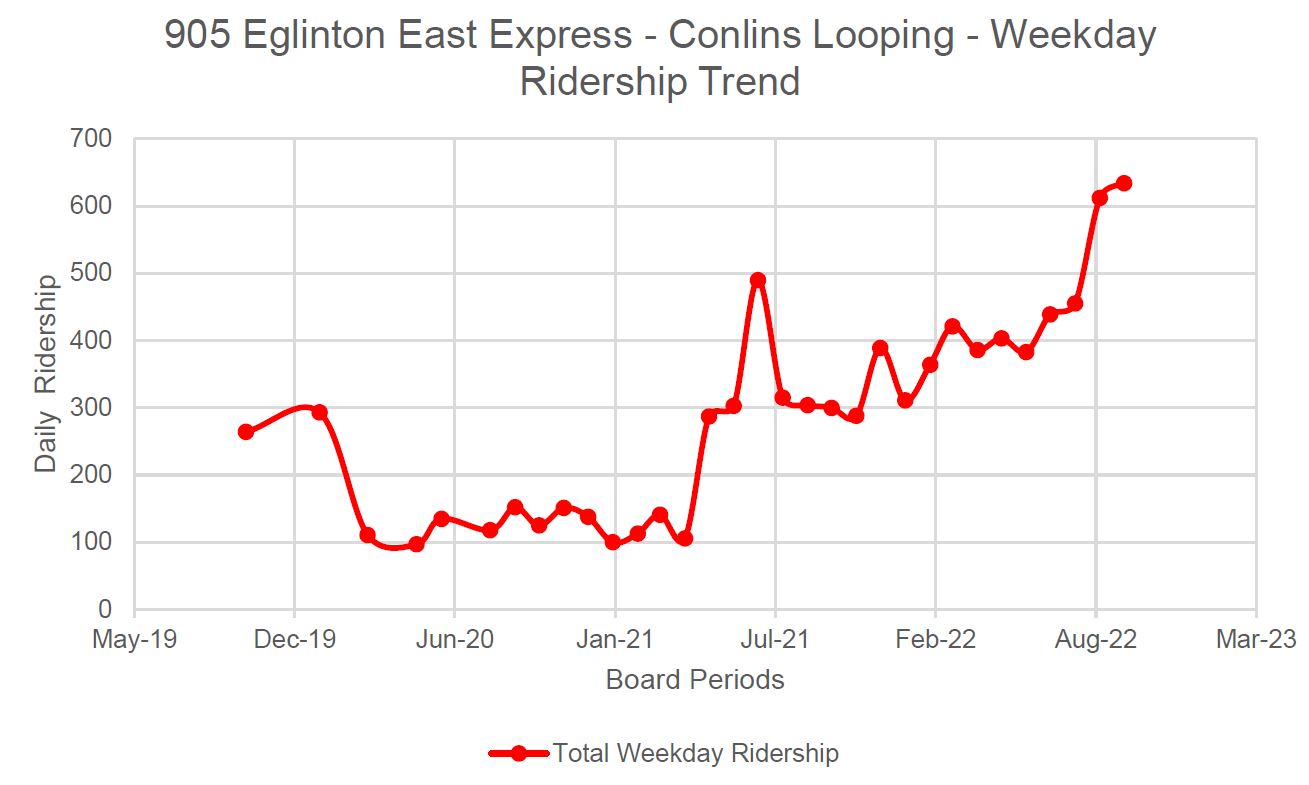
- 905 Eglinton East Conlins Extension: Separate from the added periods of service on express routes discussed above is a review of the 905 Eglinton East extension to Conlins Road. The extension operates weekdays from the AM peak through to the early evening, and the route loops at its original UTSC terminus at other times. Ridership has been growing, and the extension meets the boardings/hour standards. It will formally be retained.
Seasonal Routes
Seasonal routes have been rebranded into the 200 range, although some of the analytical work in the plan predates this change and refers to the old route numbers.
- 201/175 Bluffer’s Park: This route’s weekend operations are part of the regular network, but weekday service implemented in 2023 will have a post-implementation review in the 2025 plan.
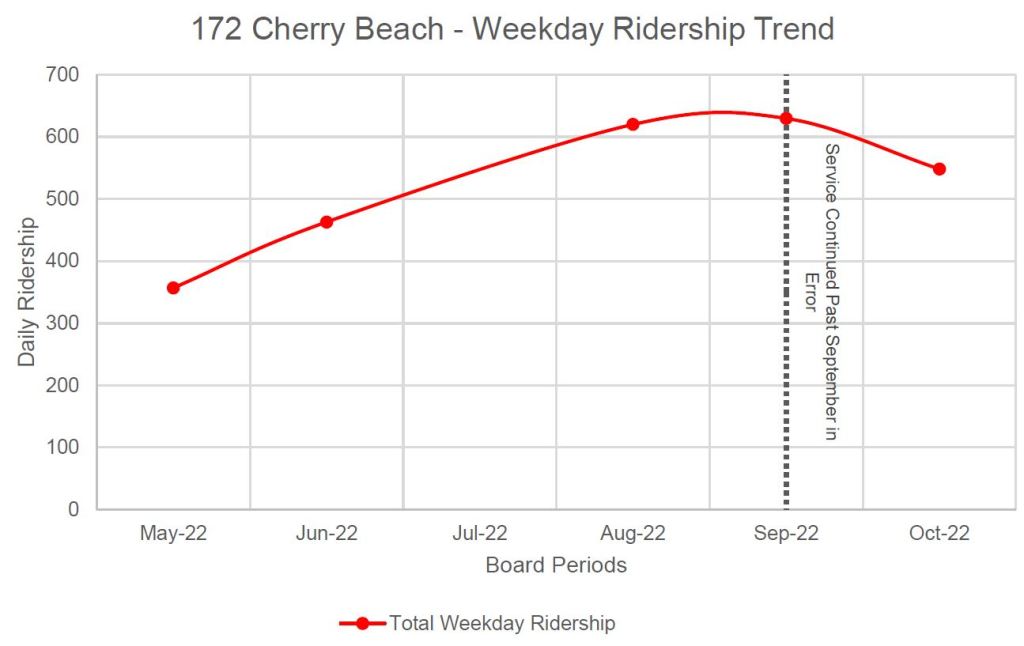
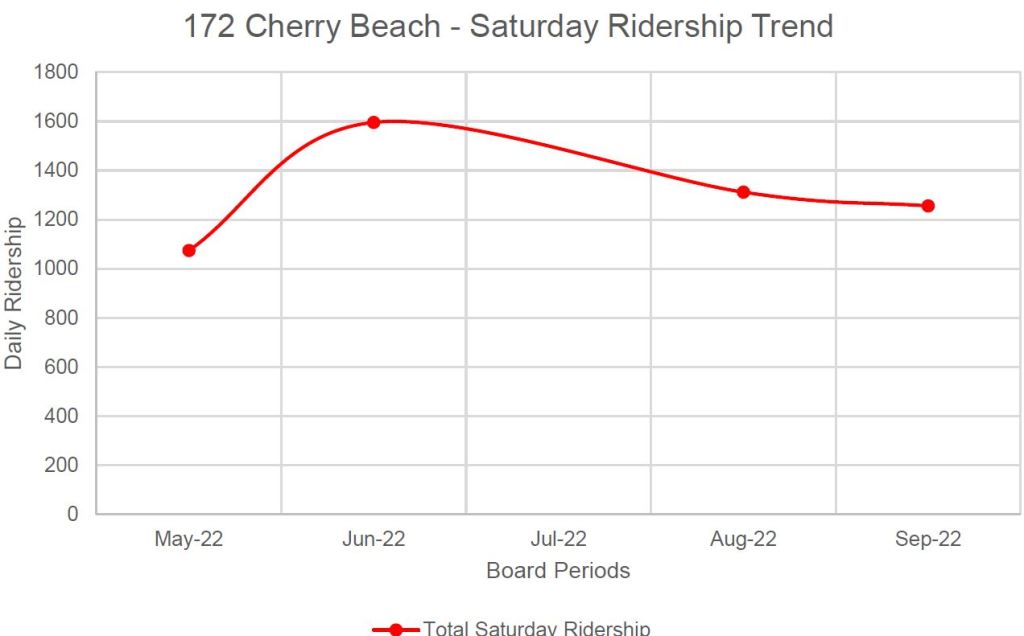
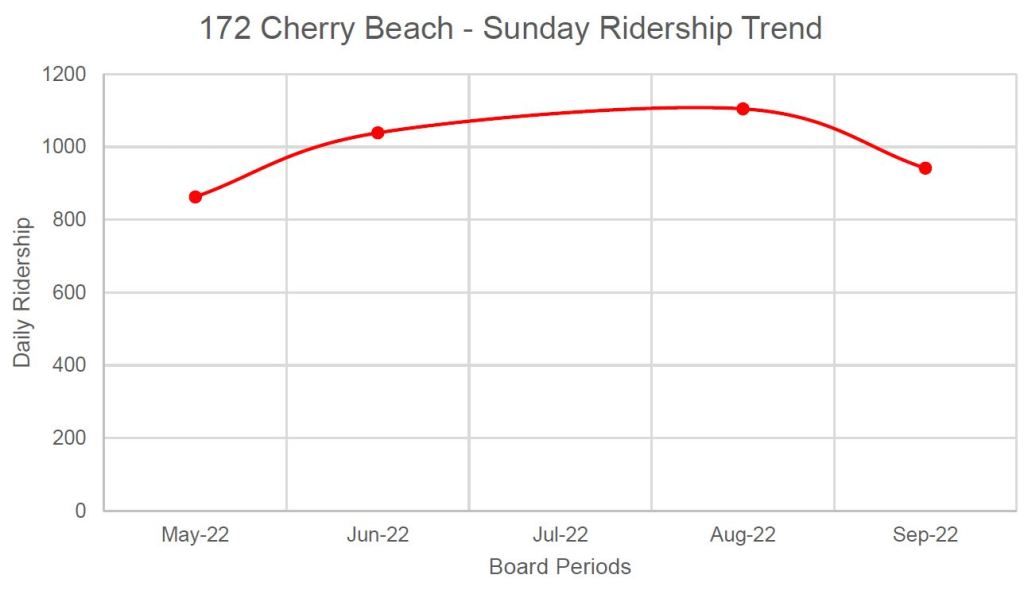
- 202/172 Cherry Beach: This route has been disrupted by construction in the Port Lands, and its intended route serving the Distillery District has not been possible due to the closure of Cherry Street (only recently reopened). The service will continue on a trial basis into 2024 to determine its performance as the road network changes. It will also be part of a wider review of service to the eastern waterfront pending construction of the Waterfront East LRT.
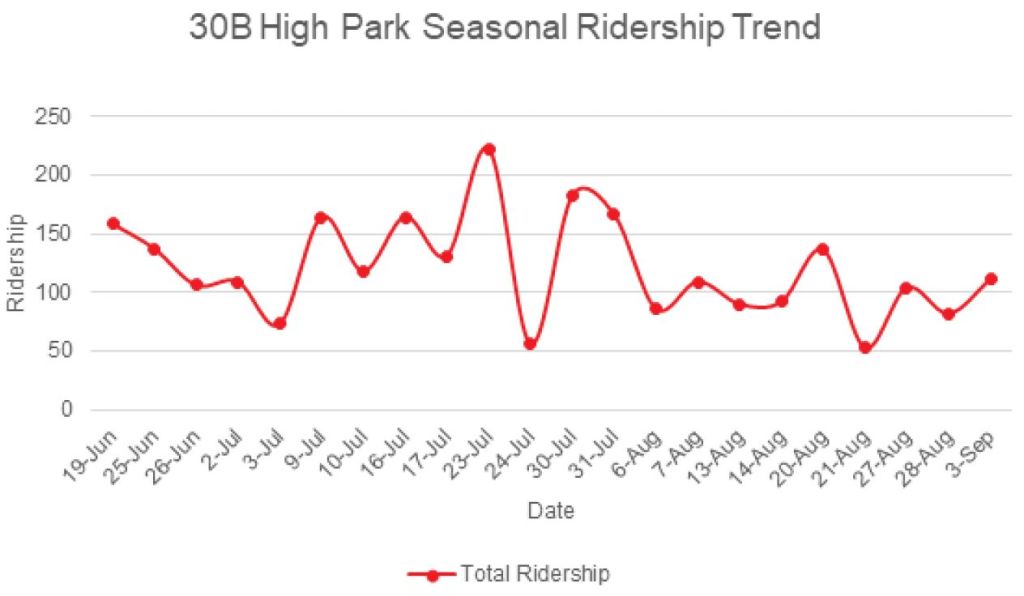
- 203/30B High Park: This route operates south from High Park Station into the park, but it performed poorly. It will not be included in the 2024 service.
- 174 Ontario Place: This shuttle replaced the western end of the former 121 Fort York-Esplanade route. It carried very few riders and was often disrupted by events within Exhibition Place. It has not operated since 2022, and the plan recommends that it not be reinstated unless a dedicated route can be provided.
Other Routes
- 12D Kingston Road: The peak period service to UTSC has performed well, and the plan recommends this be a permanent route. Weekday midday and early evening service be added with a performance review to follow.
- 39C Finch East to Victoria Park & Gordon Baker / 42C Cummer to Victoria Park: Both of these routes serve the Gordon Baker/McNicoll area. Neither of them alone meets the standards for boardings/hour, but this is thought to be due to competition between them. The plan recommends that the 39C be made permanent and the 42C be discontinued with buses reallocated to the through service.
- 43C Kennedy to Village Green: Although this branch meets the standards for boardings/hour most riders do not board on the unique segment of the route, and demand simply shifted from the primary 43A service onto the 43C buses serving the same corridor. Continued operation is not recommended, but this is also related to the use of resources in the Kennedy corridor generally including the 943 express service. Analysis and consolidated recommendations will come in a future service plan.
- 60C Steeles West: Service west of Pioneer Village Station to Kipling was added in November 2021, and it meets the boarding standard. Notwithstanding this success, removal of the service is planned as part of the Line 6 service changes when 166 Toryork will provide peak period service to Islington. Further analysis is required to determine the needs for service on Steeles West, by various overlapping local and express routes, and this will be part of the 2025 plan.
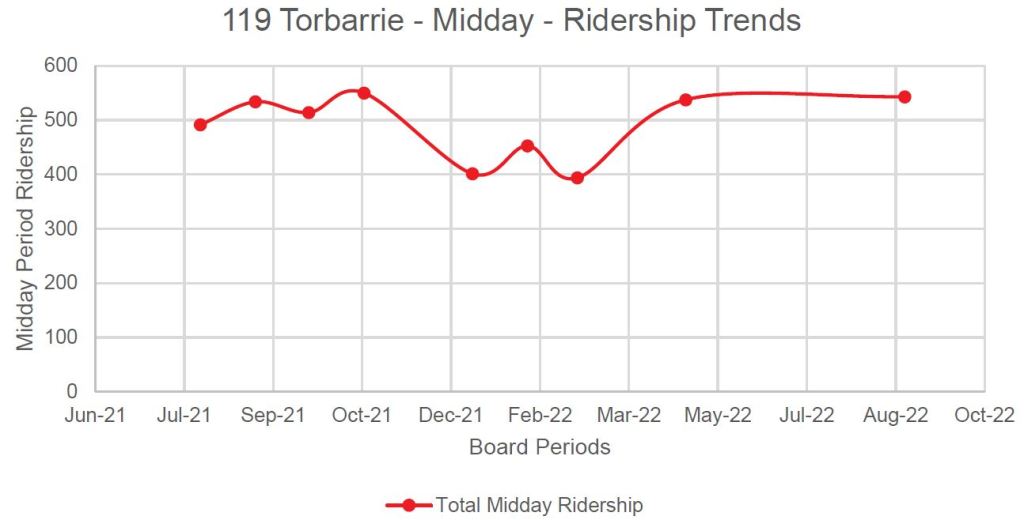
- 119 Torbarrie: Midday service was added to this route in May 2021, and it meets the boarding standards. It will be retained.
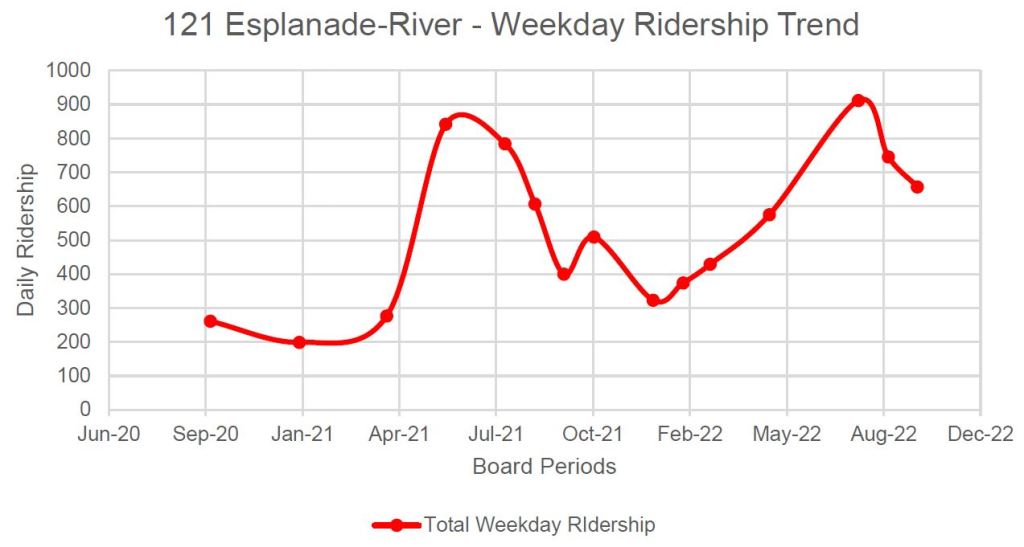
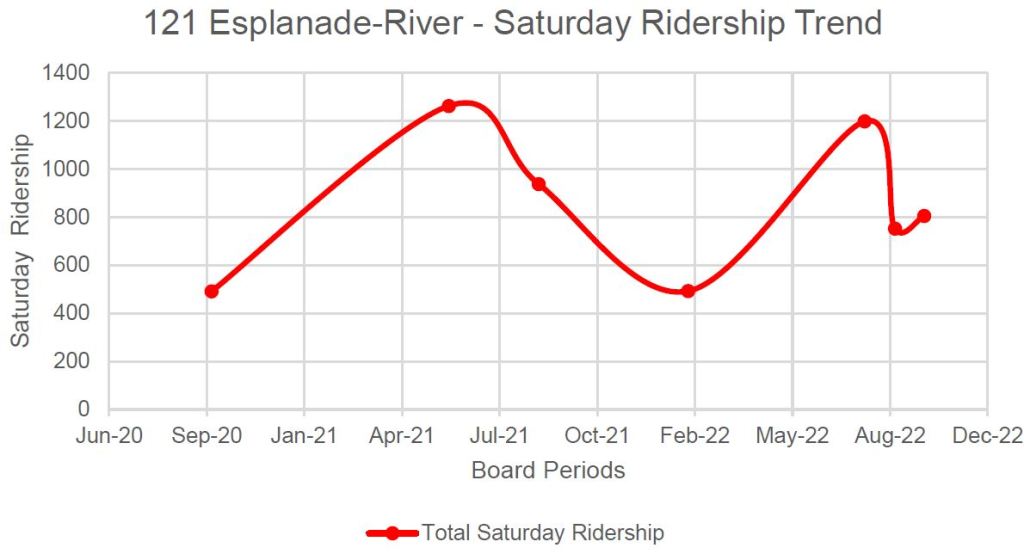
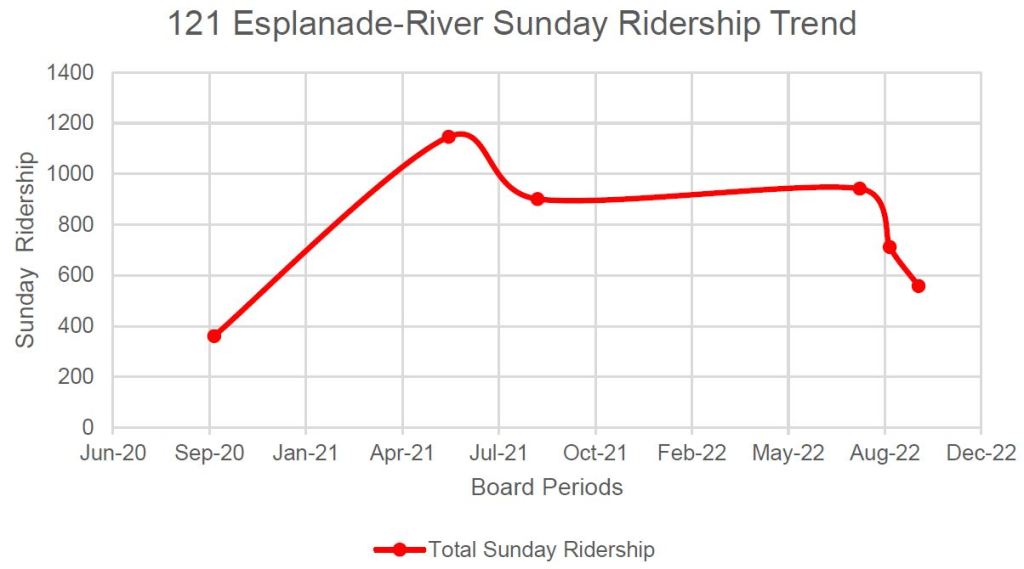
- 121 Esplanade-River: This route was adapted from 121 Fort-York Esplanade in October 2021 to improve performance. Although this did happen, the route still does not meet boarding targets. Whether this is due to the River Street extension or to the route overall is not examined in the plan. Development continues to occur along the eastern part of the route, and the plan recommends the addition of new stops (unspecified). The route will be reviewed in the 2025 plan.
Boardings Per Vehicle Hour
The table below shows the boardings/hour data reported for various routes in the analysis. Note that these are 2022 figures, and that they include an “equity bonus” for routes serving Neighbourhood Improvement Areas. The exact effect of this bonus is not shown in the Plan.
Poorly Performing Routes
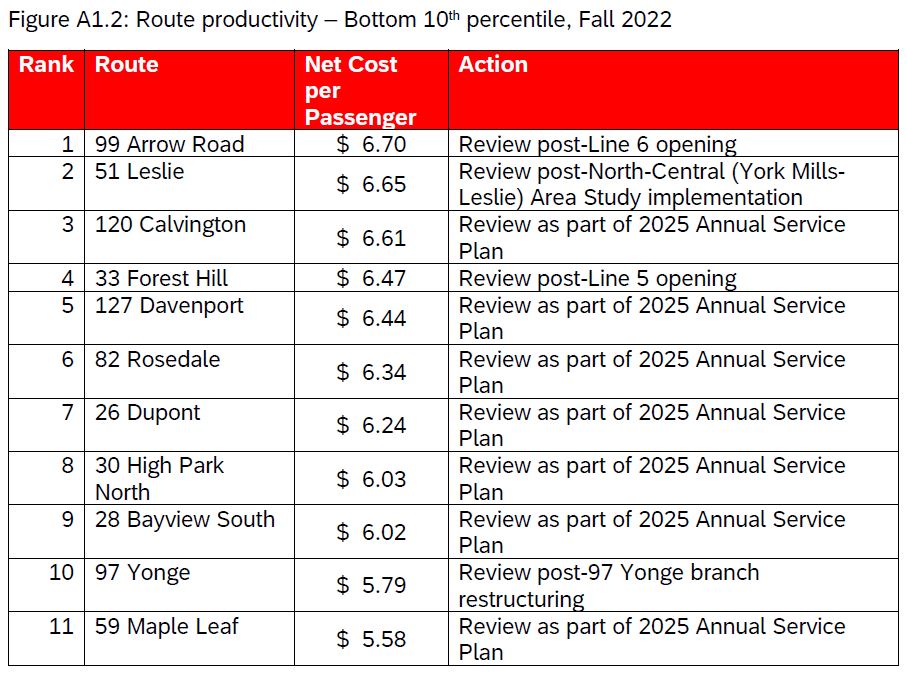
On the basis of cost per passenger, the following routes lie in the bottom 10th percentile of the network. Note that the data in this table are based on 2022 operations and do not reflect the current level of demand. No changes in service are planned for 2024, but there would be a further review in the 2025 plan with recent ridership data.
One oddity here is that the bottom 10th percentile contains only 11 routes even though there are more than 110 routes in the network.
A common factor in these routes is that they run infrequently, and not necessarily reliably, two factors that do not encourage ridership growth.
 Steve Munro
It will be interesting to see how long it takes the TTC to remove the Bus Stop signage for the (to be discontinued) Downtown Express Routes. They have still, after 2+ years, not removed the southbound stop for the (re-routed) 65 bus on Princess @ The Esplanade. They did scratch off the route number but the uninitiated will probably continue to assume a bus stop sign means a bus, of come kind, will arrive sometime! I realise that the TTC are not really in charge of removing (or adding) transit shelters, but they ARE fully responsible for stop signage. It took them most of the summer to change the signage for the (new) 202 route from the old 172 route! Clearly the route planning silo does not talk to the stop signage silo!
LikeLiked by 1 person
Emmett Avenue borders West Park Healthcare Centre. The centre helps patients get their lives back by providing specialized rehabilitative and complex care after a life‐altering illness or injury such as lung disease, amputation, stroke, and traumatic musculoskeletal injuries. (Terry Fox stopped off there during his Marathon of Hope.)
Currently, the 32D Eglinton West bus loops clockwise, one way. With the 73B Royal York, the bus would run both ways. Clockwise to get to Mt. Dennis Station, and counterclockwise to get to Royal York Station.
Since out-patients, staff, visitors, and in-house patients use the neighbourhood to get around, Emmett Avenue (and Buttonwood Avenue) need to incorporate more Vision Zero infrastructure to make it more pedestrian friendly than automobile friendly. Would like to see “raised intersections” or “raised pedestrian crossings” at the bus stops to start, to force motorists to slow down.
LikeLike
Among the “Poorly Performing Routes” is the 97 Yonge bus. I would expect that a year after Line 5 opens for business, the 34 Eglinton bus (Mt. Dennis Station to Kennedy Station) will join the list of poorly performing routes.
Increasing frequency for all the poorly performing routes needs to be considered… if the TTC were better funded for operations. People will not use the routes if the buses don’t come more often. Missing a bus could mean walking ending up to be faster than waiting for the next bus.
LikeLike
I don’t say this often enough but thank you so much for this comprehensive summary of this report. It is a lot to take in, but it is fascinating, and I say kudos to you for making it digestible.
Steve: You’re very welcome!
LikeLiked by 5 people
Steve, in your analysis of the proposed changes for the Yonge/Steeles construction you say that maybe proposed changes aren’t enough and more service should be diverted away from the intersection.
How would you propose to run the service? Have all 53/60 service run via Bathurst and Bayview, create new 97 branch running frequent service between Finch and Centerpoint and create a shuttle bus running lets say between Bayview and Bathurst along Steeles? Currently there is quite a lot of boardings at Centerpoint for the 60 (westbound) as well as Hilda and Tangreen Cr. (To/from Subway and at certain times from the high school on Hilda).
The large scale plans to redevelop Centerpoint mall (as well as strip malls on the north side of Steeles) also don’t help matters as they will interfere with traffic and transit travel patterns. Although that redevelopment might not happen until subway is actually built.
Steve: My main concern is that service on Steeles that extends well beyond Bathurst and Bayview may be severely disrupted just as the fragmented streetcar routes have been downtown. If running all of the local service through Yonge and Steeles requires the addition of buses just to maintain service thanks to congestion, could those buses be better used on a dedicated service? I don’t have the OD info, but the TTC should and it would be interesting to know what the demand patterns are in that area.
LikeLike
Interesting to see that the 82 Rosedale is in the lowest percentile but I guess it makes sense. Whenever I used the route pre-covid and even a bit post covid, it was never a fully empty bus… it feels like an essential route to the enclave-like neighbourhood.
Steve: This is an example of the way that the two measurement methods produce different results. Rosedale ranks low on a net cost/passenger, but in 2022 (before recovery was really underway) it carried 617 riders a day on one bus that racked up 19 service hours. That’s almost 32.5 boardings/hour, well above the target of 20 for peak periods and 10 for off peak. The TTC does not publish its formula for calculating operating costs, but the $6.34 net cost cited in the report implies gross costs of about $7.50/ride. This gives an allocated cost of about $4,600 ($7.50 times 617 riders), well above 19 hours of driver wages.
Methodology: Each boarding is worth about half an average fare. Taking that as about $2.50, a boarding is worth $1.25. Added to the $6.34 net cost gives $7.59 which I have rounded down to $7.50. This does not include special pandemic support subsidies that would drive the estimated cost of operation even higher, further from a reasonable level for the amount of service operated.
I have never trusted TTC calculations of net cost on routes, and the methodology has built-in biases.
LikeLike
One other point: 507N, running from Bingham Loop to Long Branch, via King, no less! That makes it longer than that infamous once-a-week run by a QUEEN car from Bingham in 1967, when it transformed into a night car and went all the way to Long Branch. That makes this branch the longest streetcar route in the TTC’s history, right?
Steve: I think so, provided that we don’t count the radials. Also, don’t get out the brass plaque too soon – it’s not running yet.
LikeLiked by 1 person
Your in-depth, detailed breakdown of service plans and changes are always appreciated Steve.
As someone in North East Scarborough who takes the TTC regularly to and from work, the whole 85 Sheppard East desperately needs improvement.
The 985B I was hoping would extend to Rouge Hill GO to make up for the 20-min plus gaps at times waiting for a bus during peak afternoon, evening rush hour. Run express to Meadowvale and continue local to Rouge Hill GO to cut that dreadful wait gap, which oftens includes drivers pulling up to a ditch near the station and sitting there while passengers in not-so-great weather wait at the stop until they’re ready to go back in service.
The 132 Milner is another route, where visually it appears the ridership has grown, but the TTC has scaled back on the frequency during morning and afternoon-evening peak hours. The bus went from every 10-12 mins to now, in-person, 18-20 min gaps. Which is inexcusable for a route that doesn’t deal with construction chaos or heavy traffic. It also suffers from bunching and “ghost” buses often.
If neither improves in my specific situation, I’ll have to buy a car.
LikeLiked by 1 person
Renaming the night streetcars with N feels like typical management actionism. The night network is decently served with the 3xx route numbers, they’re consistent, it’s fine, it works as an analogy to 9xx being the express network, and now they want to change it for no reason.
I half bet it’s because the 507 is the new hotness for a manager, but route number 307 is taken.
LikeLike
Well I guess I shouldn’t be surprised, as we were warned that bus route changes associated with opening Line 5 were not final and were subject to change:
I walked by the bus terminal at Science Centre station yesterday and I saw they have the overhead bus route signs up for each of the bus bays. All were as expected except for one: there was no sign for Route 81 Thorncliffe which is supposed to terminate there. Instead there is a sign for Route 72 Pape!!! Up at Don Mills and Eglinton!!!
I hadn’t heard of the 72 being extended all the way north to Science Centre Stn. Then I got thinking; maybe this is related to the Ontario Line construction at Pape Station and the “possible” re-routing of Pape 72 to Donlands Station as well as potentially re-routing the Thorncliffe 81 to Donlands as well.
Is the TTC maybe interlining routes 81 and 72 to try and prevent bus chaos at the small Donlands bus terminal? Even if that’s the case, why rename the whole route Pape 72?
There’s no mention of this that I saw in the ASP and the re-routings I mention above are only “proposals” supposedly. But the way-finding looks pretty permanent at the Science Centre bus terminal. Odd, but not really surprising I guess.
Steve, any comments or intel you can share re: this?
Thanks for all your work as always.
Steve: It would not surprise me at all that the Service Plan and the signage are out of sync. The TTC cannot even keep its own signage up to date. Until we get an actual opening date and a final, final version of the map, I will expect changes. That said, it would make sense to interline 72 Pape and 81 Thorncliffe Park at Donlands, possibly changing route numbers on the fly as the 72/100 interline did until recently.
LikeLike
I’m not sure I understand how 13 AVENUE RD. SOUTH can serve the LRT station running in both directions on Avenue Rd, AND Oriole Parkway….
Steve: Yes, that is a rather neat trick!
LikeLike
Steve thank you as always for excellent analysis and commentary. Two small queries.
1. Is there really a need for an express bus between Eglinton & The Airport, via Weston & Dixon? The UP express is at Lawrence & Weston and the 952 is there as well. Perhaps an increase to the 989 and the 952 would provide the same result?
2. How does the TTC define express service? I overheard drivers at Pioneer bemoan the Steeles West Express that isn’t really express. Wondering if they have a definition that they work off of or is it just a loosey goosey term.
Thanks for all your work. You are a gem of this city!
Steve: The TTC advertises the 901 as a single fare way to reach the airport from Line 5, by analogy to the service from Kipling Station, although unlike the Kipling Station service it will make stops along the way. From the Service Plan:
I expect the UPX will stop at Eglinton in the new scheme of things, but not with a free transfer to/from TTC.
There is a definition of Express service in the Service Standards, although some routes do not meet it (see p23-24). The most common problem seems to be achieving the target speed improvement, and this can be due both to traffic congestion and to too-frequent stops. The plan has a proposal to have 166 Torbarrie take over some of the local load and reduce the number of express stops on Steeles West, but this depends on funding to operate the 166 outside of peak periods.
There is a general problem that there is pressure to add stops because people want to go there (surprise!), and the OD patterns of some routes do not neatly fall into a block of trips that only go between a handful of stops.
And you’re very welcome!
LikeLike
I’m pretty nerdy about this stuff and, granted, it’d be easier if my connection to TO was stronger than just “my sister lives there”, but even I hummed through a lot of it. And this is the “written by someone not trying to bury stuff” version!
Thanks for this but it’s still a slog.
Steve: I think that the plan would have worked better had it been subdivided. There might still be the same total volume, but organized in a way that a more casual reader could get the sense of actually finishing each piece. Some of this stuff goes back to 2021, and some material has not been updated since mid-2022. This means that readers have to keep track of which era and part of the system they are reading about.
LikeLike
I believe that this blog has effected change. Over the years, comments in this blog would note how we had experienced being late because of an unreasonably long delay in service yet the TTC was reporting 98% on time service. Over this time, Steve provided detailed service performance reports showing that the actual user experience was not reflected in the TTC reports. TTC management produced performance reports that lined their pockets.
I sense there has been a change. “the TTC acknowledges that it fails to achieve its current standards.” For so long, this would have been unheard of.
Riders knew it, but the “board” relied on those “reports”. Steve consistently pointed out how the “standards” used to measure service were skewed with plenty of padding. But his work using the TTC’s own data demonstated relevant performance factors. The TTC could improve service with disciplined timing of departures from terminals and stopping rogue operators from bunching up. Both measures reduce the wait gap between buses.
I still experience unreasonable delays. Before, it felt so helpless, the TTC didn’t know about the screw up and nothing would be done about it. Steve’s work could document my experience and show the whole story of where each bus was for the whole day. He could easily show that 4 buses were bunched and the route supervisor didn’t do anything about it. Now, the TTC knows they can’t hide.
We owe this progress to Steve’s dedication.
Steve: Many thanks for the endorsement.
LikeLiked by 1 person
Is there a platform for the UPX at Mount Dennis station?
Steve: UPX is supposed to stop there.
LikeLike
Wait a minute! I thought the Ontario Science Centre will be moving to Ontario Place. So shouldn’t they be changing the station name NOW from “Science Centre” to “Rob Ford Memorial Station” or something? 🤣😹
Unless Doug Ford gives in and changes his mind.
LikeLike
When the line 2 extension is complete, 113 Danforth (optimally) could be extended along Danforth road to the Lawrence-McCowan Stn, with the proposed 117 Birchmount South route taking on the Kennedy Rd service south of Eglinton (Service on St Clair west of Birchmount would be eliminated). Since you already have 20 Cliffside operating from Main to Kennedy, this seems like the optimal move. Has the TTC looked into what they’ll do with South Scarborough post Line 2 extension?
Steve: Considering that the earliest that extension will open is 2030, probably later, it’s not high on their priority list.
LikeLike
The new Dixon-Mount Dennis express got me thinking a bit. If the TTC is doing that with express service, why not do it with local Dixon service too? Re-split the 52 Dixon branches into their own route (58 Dixon Road?) with all branches going south on Weston to Mount Dennis. I know the old Malton used to terminate at Weston and Lawrence. To me, this split would simplify the 52 route and help improve service on Lawrence, while also connecting Dixon passengers to rapid transit faster compared to a long journey along Lawrence to the Allen. And the 952 could still run express between Pearson and Lawrence Station. Was this ever considered, and would it even work from a ridership perspective? Curious for your take Steve. Thanks so much for all your work.
Steve: It has been a few years since the discussions on the route structure post Line 5, but I don’t remember this option coming up. At this point I suspect everything is frozen. It will be interesting to see how well the 901 is used from Mount Dennis to access stops on Dixon Road as compared to the branches of the 52. Of course this will also depend on service frequency. New express routes tend to not run very often and so the 52 Lawrence service might still win out.
Remember that the 952 is peak only, and so there would be no service from Lawrence to the airport at other times if all of the 52 service was cut from Dixon Road. Also, how much through riding there is from Lawrence to Dixon that would now be forced to transfer between the Lawrence and Dixon Road services?
There is a more general issue with very long east-west routes, how well they can maintain service and whether breaking them into segments provides a tradeoff in reliability versus the added transfers.
LikeLike
I am hoping that our TTC committee someday changes the Underhill bus route 91 or 191 to head north to Don Mills Subway. It takes 30 minutes and 3 buses to travel 5 km from Underhill and Cassandra to Fairview Mall. I like the change to the 191 ending at The Science Centre Station but really don’t understand why it cannot join two subway stations in our neighbourhood with infrequent transit.
LikeLike
It will be curious to evaluate ridership on the Leslie route adjustments – especially the new south end on street loop for the 151 Leslie North.
Anecdotally there is better ridership north of Leslie Station. If the new Scarsdale area service proves unfavourable – particularly in the evenings…. I’d suggest service planning consider an alternate routing for Leslie North to serve the Silver Hills area. Ideally that could be supplemental service after 10:00pm when Silver Hills does not currently run. Or knowing the TTC penny pinching they could save mileage on the 115 after rush hour and run that Leslie North service in place of the 115 and free up a bus to use elsewhere.
Neil
LikeLike
Steve, I know the realignment of routes for Finch and Crosstown LRTs will take place as they open. The Broadview extension has already been implemented. And the Ossington will essentially take place when the King west track replacement is in effect. As for the other routes mentioned, have any dates been mentioned for implementation?
Steve: No.
LikeLike
This comment has been moved so that it shows up in the main thread, not attached to a specific image. It is from Amar Lad.
Do you think it’s likely that the westbound service from Mount Dennis would see the route follow the existing 32D alignment? As in west from Mount Dennis, past Jane, right onto Emmett, eventually take a southbound right back onto Jane and right back onto Eglinton towards Scarlett? Would be a mini loop, but help maintain service to existing stop infrastructure along the south side of Emmett Ave.
Also wondering, is there any info about service frequency for Emmett?
Steve: The TTC seems to be amalgamating two infrequent services, the Royal York La Rose branch and the Eglinton West Emmett branch. The original plans for the route network in this area after Line 5 opens would have seen the existing Emmett branch broken off as its own route 170, but still separate from the 73B. There is no info on service levels although one would hope that as a Line 5 feeder, TTC would operate more service on the combined route.
A more general problem with the overall “recovery” of service is that the aim is at pre-pandemic levels, not for improvements except where absolutely necessary, and even those would be offset by routes that stayed below 100%.
LikeLike