
The TTC Board received a presentation at its September 26, 2023, meeting updating the information in the report published with the agenda. The first part deals with plans for the Line 3 bus replacement service and gives additional details beyond those previously announced.
The shift to using all of the Red Lanes on Ellesmere, Midland and Kennedy is planned for November 19.
The travel time today is considerably higher than when the RT was operating (second bar in the chart on the right below). This will be reduced with the elimination of transfers at STC between feeder routes and the 903 shuttle service together with the full transit priority implementation in mid-November. Further saving is expected when buses shift to a busway in the SRT corridor.


On November 19, eight routes will be extended to Kennedy Station to eliminate the need to transfer to the 903 shuttle.

The most disappointing part of the presentation is the timeline overview which shows the opening date for the busway in the SRT corridor as 2026. Design work is underway to be completed in 2024 with construction in 2025 aiming at a mid-2026 opening date.
Derailment Review
The full report on the SRT derailment has not yet been published, but an overview of the cause was included in the Board presentation. More details emerged in the verbal presentation than are in the slide deck. The presentation begins at about 5:50 into the YouTube video.
The propulsion system on SRT cars consists of two elements: the motor winding on the underside of the trucks (shown in red in the first illustration below) and the reaction rail (yellow) which is mounted on the guideway. The spacing between these two elements is critical because the efficiency of the motor depends on having a narrow air gap between the winding and the reaction rail.
The reaction rail has an aluminum cap which is installed in sections (see upper right illustration). The reaction rail assembly is held in place by anchor bolts mounted into the concrete base of the guideway. There is an upward force on these bolts because of he electromagnetic attraction between the motor coils on the trains and the reaction rail on the guideway.
The originally installed rods were cast in the concrete, but over time some of them failed and were epoxied back in place. The failure rate went up in 2016, and a new style fastener was installed on some sections of rail. The area where the derailment happened used the new style fastener.
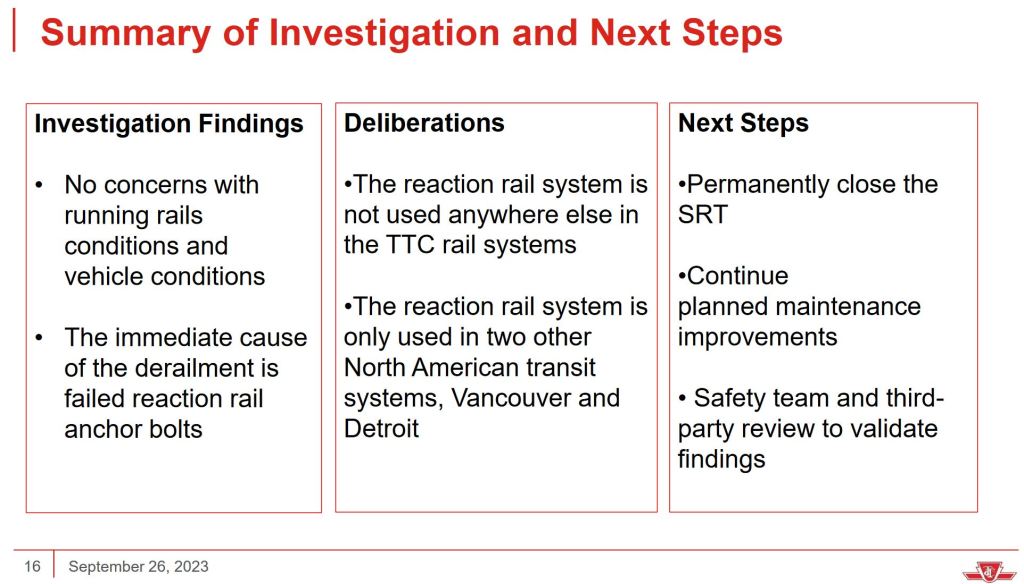
The new anchors used an expanding bolt to hold the rods in the concrete, but over time, some had pulled free, and some broke from metal fatigue. The normal clearance between the LIM coil on the trains and the reaction rail is 11mm, and so only a small movement would be needed for the two to come into contact. Experimental work in the investigation revealed that if three adjacent sets of anchors were loose or broken then the reaction rail could lift sufficiently to contact a train.
The train preceding the one that derailed also suffered damage, as did other parts of the derailed train (red boxes shown in the top middle diagram below).
The reaction rail caught the last car of the train causing it to break away from the lead cars. As the rail folded under the car, it lifted the truck off of the rails causing that car to derail.

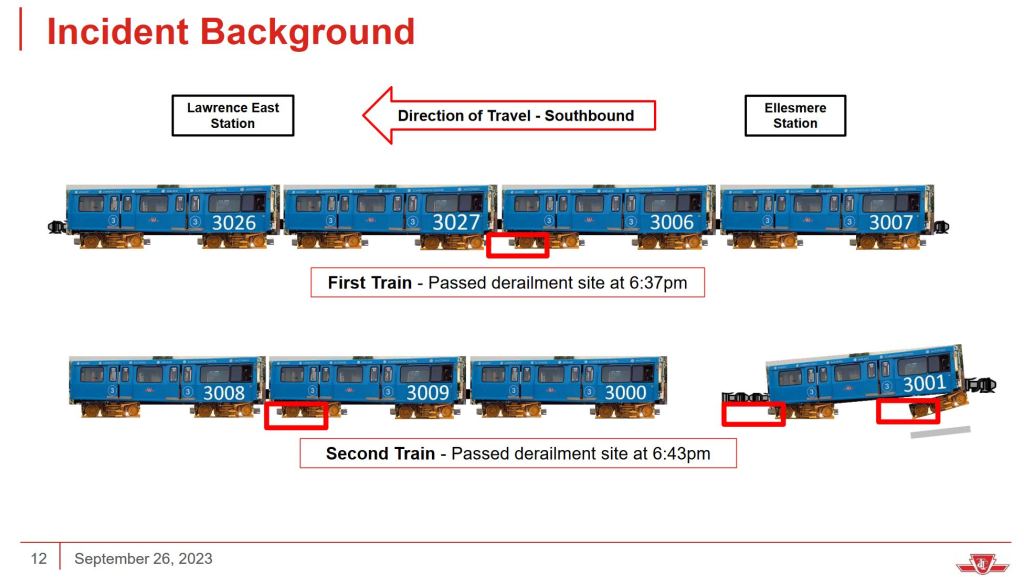


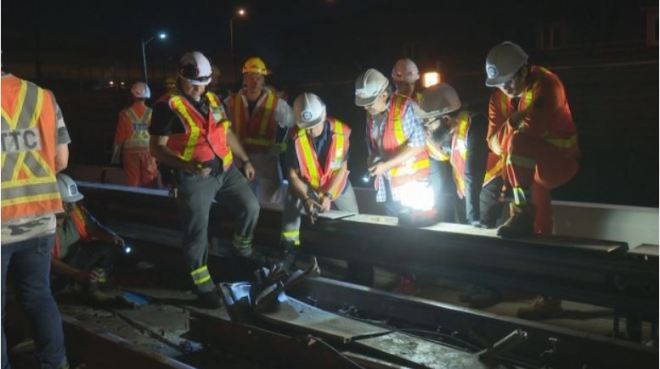
At the time, there was much media coverage of the derailment, and a list of articles is in a previous article on this site. A photo from CP24’s article shows the damaged reaction rail.
Although the TTC notes that the Linear Induction Motor and Reaction Rail is unique to the SRT and the technology has no parallel on other lines, there is an uncomfortable echo of the Russell Hill crash decades ago. At the time, one important contributing factor was loose bolts holding an automatic train stop, and other similar problems were found with subway infrastructure.
The TTC argues that inspection of the reaction rail anchors is difficult because they are hidden under the rail. This begs the question of how Vancouver, with a much larger installation of this technology, conducts their inspections and repairs.
The full report on the derailment will be issued in a few weeks.
TTC management report that one outcome of this investigation will be changes in TTC maintenance practices. Insuring the integrity of transit infrastructure is a key task both for rider safety and confidence would-be riders will have in the system. Experience in other cities has shown what happens when systems decay, and the effort needed to restore proper operation and maintenance. That is not a path Toronto should follow, and the SRT derailment should be a wakeup call for future budget planning.
In November, management will report to the Board on the scope and potential effects of the unfunded projects within the Capital Plan.
 Steve Munro
I unfortunately was unable to make a deputation today. I do hope they address the issue of the slow RAD buses used on 903. On many buses I’ve been on, they drive extremely slow like 20-30 km/h meanwhile the local 43/57 are driving faster. Some have even stopped locally! I approached a supervisor at Kennedy last week who said to me “the Ops may not know” to which I replied “how do they not know as an express route they aren’t supposed to stop locally -the route is very simple”. The supervisor responded “they are human and make mistakes”. I emailed TTC because what is the point of the bus lane if operators are purposely driving super slow and picking local stops up. Even with a crammed bus load at 8:15 am. In addition, the Progress northbound routing is a mess with all of the traffic near Kennedy Commons/401. I don’t get why they can’t just make the northbound bus go on Ellesmere to Midland then turn left on Midland back north to Progress. I get that they have to avoid Brimley/Ellesmere right now as they build the queue jump lane so this would be a viable solution. They should avoid Kennedy/Progress as it unnecessarily adds extra time. TTC is not doing a good job winning back riders!
LikeLike
Variations of the proverb “for want of a nail” (about unforseen consequences…or consequences foreseen but ignored) go back to the 17th century.
LikeLike
Good to see the TTC has extended the 996 to STC. Wish it could happen sooner though it would be really useful for me.
Steve: I believe that this extension will not take effect until the November schedules.
LikeLike
Further to what Austin J said, I too have seen the 903 stop locally.
I was taking the bus from the STC to Kennedy and it stopped just south of Lawrence to let someone off. This was when the service first rolled out.
When it was a Line 3 shuttle, they took a wrong turn at Lawrence. The OP made the right onto Lawrence from Midland and went to Kennedy Road. This was when service only operated on Midland at the start.
There needs to be better route management.
LikeLike
I agree with Austin. The 903 operators drive extremely slow (and I’ve been noticing this more and more across the entire bus system, across all routes). It’s not just RAD drivers, even scheduled drivers are usually going 10 under the limit, waiting for lights to turn red making “micro-layovers” at intersections, etc. I don’t know if it is something that has to do with all these new operators that the TTC has hired who are scared to push the bus to its operating speeds, or if it’s something that comes from the direction of management…
LikeLiked by 1 person
Man…this is not a good look. As Steve so wisely noted, Vancouver has run this *exact* technology in what I would argue is an order of magnitude greater level of overall service…with zero issue or fault. None of the problems the SRT has had – noisy, unreliable, derailing, etc – have ever occurred there. Granted, the climate here is much harsher…and so maybe the reaction rail ripping free of it’s anchors has something to do with the freeze / thaw cycles our concrete experiences compared to Vancouver.
But it’s very tough to defend the TTC when another city in the same country, with the same trains, running the same tracks and reaction rails, using the same technology, built by the same company…has done it flawlessly, without issue, for decades – all while providing notably more and better service.
If this *is* an indication of the real hidden SOGR going on (and the comments about the Russel Hill incident make me shudder), I am deeply concerned for the next decade or more of transit service. At least the buses don’t need infrastructure, and the streetcar network seems to be so permanently under construction that they’ve surely refreshed the majority of the network somewhat recently.
I want to believe, I really do…but this really gives one pause.
LikeLiked by 1 person
The red lanes are a total waste of money. The marking today is adequate. As reported by ttc adherance has been fine. Building a busway within lrt corridor a further waste of money. Subway is planned for 2030.
LikeLike
I am happy TTC is taking steps to improve the bus services via Kennedy Station.
LikeLike
My concern is that Kennedy Station will become too congested with the shuttle busses and already existing routes at Kennedy Station. Why not redirect some routes to Warden Station and some to Don Mills Station?
LikeLiked by 1 person
Does this mean that a critical safety inspection is difficult so the TTC did not do it? So that becomes the true root cause of the crash: failure to perform a critical safety inspection because it was difficult to do?
LikeLiked by 1 person
Note, a secondary terminal has been constructed at kennedy to service the new extensions.
LikeLike
And if you believe that the subway will open in 2030, the Metrolinx CEO has a presentation for you…
LikeLiked by 3 people
That final slide titled “Summary of Investigation and Next Steps” explains where the media coverage came up with the fact that only other systems in North America that have LIM reaction rail are Detroit and Vancouver and completely overlooked the JFK Airtrain. So much for completeness.
Has the Scarborough RT replacement bus actually been ramped up to a usable service level? I gave up on that a few weeks ago and used the Kennedy bus instead. The only times I ever saw a bus signed for Scarborough RT replacement service was on layover at Kennedy station.
LikeLike
I don’t know why they can’t just convert it to take streetcar rolling stock and deploy streetcars up there. Honestly how hard could that be? They can make the turns, the power distribution is there – just put up poles and line. Your stations are there.
Everything you need is there. It’s a matter of replacing the running rail that is it. And you save the hassle of this bus set up. All the money they will waste with buses could be spent to make this relatively simple change. And than Scarborough won’t be stuck with buses for 20 years.
Is there any reason why this cant be done? We have surplus streetcars, the structure, the power, the stations, unless there is some factor that I’m not seeing like height clearance some place. But even if it only runs for a few stops it’s better than the buses. This is so dumb, in the meeting Mattlow goes on about how he wants this done faster. Well here is the solution.
Steve: Well, no, that is not the solution for many, many reasons.
First, the track is standard gauge and the line would either have to be rebuilt as TTC gauge (which is not as easy at it sounds given the need to shift the rail mounts but only slightly), or the cars would have to be changed to standard gauge. Easier to borrow cars that are not running on Eglinton.
Second, the power supply for the SRT is completely different than for either the TTC’s “legacy” streetcar system or for the Crosstown. It’s not just a matter of converting from third/fourth rail to overhead, the voltage is diffenert too.
Third, the cars would not fit through the tunnel at Ellesmere. The TTC was forced to make it small when the RT was built so that they could not easily revert to the originally proposed LRT ioeration.
Fourth, the legacy cars are low floor, and the SRT stations are high platform. Also, the SRT cars are narrower, and so there would have to be changes to the width of the platforms. That is not easy in some cases because of how the platforms and station structures integrate.
Fifth, the carhouse at McCowan is totally inappropriate for maintaining LRVs. It was designed around the ICTS cars.
Sixth, there is no loop at McCowan and that would be a problem for legacy cars even without other challenges.
Is that enough reasons for you?
LikeLike
Okay but hear me out here. yes those are all legitimate points, which i may have overlooked or not even thought of. fair enough, BUT… and here is the big BUT. Is such a proposal really any more outlandish than expecting people to suffer with buses for years to come? I mean how much more money are we talking here to make the changes to see this happen. Lets say we use the Eglinton cars so no track conversion needed you don’t even need to get rid of the reaction rail since it does not come higher than the tracks, so it would clear the bottom of the car.
– Second, the power supply for the SRT is completely different than for either the TTC’s “legacy” streetcar system or for the Crosstown. It’s not just a matter of converting from third/fourth rail to overhead, the voltage is different too.
Okay, but there is a power system, incompatible as it might be retrofitting it would not be unreasonable. the conduits, and cables could probably be reused and you would need to swap out the transformers and remove the old ones. maybe some other things here and there. Not impossible or prohibitively expensive.
– Third, the cars would not fit through the tunnel at Ellesmere. The TTC was forced to make it small when the RT was built so that they could not easily revert to the originally proposed LRT.
Did anyone really ride the thing past Ellesmere to begin with? would we really be losing much here? how hard would it be to make the tunnel larger.
And i know, how would you service the yard….. well you could build a track to connect to Eglinton Ave. and use that facility. (give it a chance here, maybe not as crazy as it sounds)
– Fourth, the legacy cars are low floor, and the SRT stations are high platform. Also, the SRT cars are narrower, and so there would have to be changes to the width of the platforms. That is not easy in some cases because of how the platforms and station structures integrate.
You got me here, not sure how you would fix this…. maybe cut the roof off the stations and raise the track? or lower the platforms? again not impossible. the original line was going to be low floor so maybe its possible to convert the stations. But again not impossible… presa.
And the last two points…. the yard is redundant if we build a connection to Eglinton, and we could just use the loop in the yard. Bada boom Bada bingo Bango you got yourself a new LRT line at a fraction of the cost.
This cant be that unreasonable. i mean the alternative seems just as crazy, would you not agree?
.Well i’ll just see myself out…. *slowly backs out of room*
Steve: There is so much wishful thinking here, to be kind, I am not going to reply.
I will simply observe that your remark that “nobody rode the thing past Ellesmere” shows how little you know about the ridership pattern on the SRT. It’s all between STC and Kennedy.
BTW originally there was going to be a track connection to the Eglinton line for the SLRT but of course that was engineered out.
LikeLike
John you goof, “past Ellesmere” is where all the SRT demand and trips go 🤡
LikeLike
@Johnny…
Oh is there some sort of attraction of some kind past Ellesmere…. I had no idea, I’m sure people could walk from there along the right of way./s Admittedly I’ve only ever been in that part of the city twice in my 37 years of being a Torontonian.
Steve: I hate to say this, but this comment is almost a parody of what some critics from Scarborough hate about those who make utterly uninformed remarks about their transit. “I had no idea” is not the way to establish your credibility, and asking people to walk along the right of way ignores (a) the volumes involved and (b) the fact it is an elevated guideway. Great for walks in any kind of hot, or cold, or wet, or snowy weather.
For the record, I have been on the RT many, many times and was based at Scarborough City Hall for about eight years.
LikeLike
All the above, of course, reminds me that Scarborough has been royally screwed, transit wise, for decades. What is wrong with Toronto and Ontario politicians in that city that prevents any concerted movement to reverse this trend [in a half century or so]?
I know that the causes are many and varied, but, at any point in time; someone with courage could at least have started the ball rolling.
LikeLiked by 1 person
Minor off-topic – any word on service changes starting new board period 08 OCT ? Nothing on the website yet – not that it is surprising… getting information requires a crowbar lately.
Steve: I expect to receive the details later this week. The updated GTFS schedules have been issued on the Open Data page and there are relatively few routes with updates. 503 goes back to streetcar with Charlotte Loop as its western terminus, and Queen east (Church to Neville) also goes to streetcar. Carlton goes back to High Park. Lawrence East Express is rerouted to Kennedy Station. I’m waiting for the official memo before publishing because sometimes there is a last minute change after the GTFS versions go out.
LikeLike
Have you received the memo for the October 8th service changes yet?
Steve: No.
However, the TTC has a page with an overview of the service changes.
LikeLiked by 1 person
I wonder how well the Arrow Rd. operators are going to take the 996 extension to STC. They hate the route for its distance already…
LikeLike
I hope you know Steve I was only trying to be funny. Poking fun at the absolutely situation we’re in now. When we could have had a line up and running 10 years ago. Had it not been for complete ignorance and incompetence. I was somewhat serious about conversion to LRT. I’d like to think there has to be another answer to this problem. It seems so egregious that we are going to tell these poor people that the best we can do is a bus. But alas if the technical challenges are as insurmountable as you say they are. I guess its a bus. Sad really.
LikeLiked by 1 person
In partial answer to Darryl C Preston above, politicians – and, as a corollary, many of their constituents- are fascinated, and easily distracted by shiny objects. “New” this-or-that is *much* more exciting than yesterday’s “whatever-it-was.”
Meanwhile, electric motors (like those in streetcars) have been working just fine for over a century, powering transit in cities around the world, with occasional upgrades to the “packaging” to increase carrying capacity to move people around.
But in Toronto, Form (and Ford – both Rob-Bob and Dougie) trumps Function and it’s easier to sell a “classy” subway versus a trundling old streetcar even though Scarberians could have been zipping along on their Provincially-funded LRT line years ago. Instead, they and other GTA commuters are wasting their lives – and taxpayer money – in an ironically slower-moving and never-ending parade of buses without considering construction delays from the yet-to-be-built Subway-Subway-Subway(TM).
Other countries are funding and building wonderful, functional transit networks and then funding them again – you know, those forgotten ongoing operational costs. Ontario and Toronto need to be told by voters and those with a professional voice to stop reinventing the wheel. Heck, just get on Google for an hour and research what works elsewhere. And then get out into the city to see what commuters deal with every day and open your eyes to help you empathize.
Politicians need to lose their “Vote for Me Again!” egos. Period. (Yeah, I know: Good Luck!) Designers need to speak truth to power with the most appropriate solutions and accentuate Function over Form to actually *serve* the commuting public rather than create a useless “artistic masterpiece” and kowtow to elected idiots who may not even use transit or understand transit user needs and who should therefore shut up. Transit users and empathetic citizens need to keep shouting that they don’t need something shiny and new; they need something built by those who know and they need to keep shouting “NO!!!” until it’s built and running.
Steve: I would say only one thing about some professionals who might be expected to speak truth to power: there is a lot of money to be made by being the King’s Consultant, feeding off the gray train of fees that need not show up on the Sunshine List, and which are “commercially confidential”. It doesn’t matter if what you propose is crap, only that the billings keep going out and the rewards flow back in.
LikeLiked by 3 people
I’m ngl [not gonna lie] Steve, what you said there was cold as fff 😮💨😮💨🔥🔥
LikeLike
The funniest* thing, sadly – “funniest” meaning “most ironically stupid” – is that City Council and the TTC both knew that this moment of “No More SRT” would come yet there is now this mad scramble for Bus-Replacement Lane design and implementation, with “…design work underway completed in 2024 with a mid-2026 opening date.”
“People” in the know knew – or had to have known – that this work had to be done at some point in the future back when King Subway-Subway-Subway(TM) Rob-Bob Ford was still running the show and bro Dougie only visited the Pink Palace (Queen’s Park) as a tourist. A brave Mayor and City Council could have started the actual process of Red-lane designation and implementation with the proviso that “Well, folks – Transit Users AND car drivers, as well as bus drivers – this is gonna be the reality for the next bit, so get used to it. At least those buses (or, Steve, were there actually enough?!?) could have supplemented the still-running SRT and maybe even made the commute faster for some straphangers….
As usual, with City Council and the TTC Board:
That’s how to run a World-Class City(TM). 《SIGH!》
Steve: There have always been enough buses to operate the SRT shuttle. In early versions of the proposal, the TTC actually tried to include an additional, unnecessary bus purchase to slip some bus capital costs into the SRT replacement project. Now that money is tight, they will use the existing fleet which has many spares.
It took a lot of external activism to get TTC to talk about converting the SRT right-of-way as a bus roadway, but eventually they embraced the idea.
LikeLike