
The TTC Board will meet at Scarborough Council Chambers at 10:00 am on September 26, 2023. This will be the first meeting of the reconstituted Board under Mayor Chow’s administration. Among the reports on the agenda are:
- CEO’s Report for September 2023
- Line 3 Bus Replacement Update
- Easier Access Phase III – Project Status Update September 2023
- Financial and Major Projects Update
- Notice of Motion – A Step Towards Free Transit for Middle and High School Students
- Appointments to TTC Committees
- The Sustainable City of Toronto Fleets Plan
The agenda also includes a report Update on TTC’s Partnership Approach to Community Safety, Security and Well-Being on Public Transit. I will address this in a separate article.
CEO’s Report
Ridership
Although many of the stats reported in the monthly report take us only to the end of July, the introductory text updates ridership recovery figures.
For the week ending September 1, the TTC’s average weekday boardings stand at nearly 79 per cent of pre-COVID levels, or 2.25 million, with weekend ridership now being higher than in the summer of 2019. Boardings by mode continue to be highest on the bus network at 85 per cent of pre-COVID levels, while streetcar and subway boardings were 75 per cent. Wheel-Trans ridership is at 74 per cent of pre-COVID.
CEO’s Report, p. 4
This is a substantial jump particularly for the streetcar and subway networks. The chart below shows how the recovery rates have changed since March 2022 when the city was feeling the effects of the Omicron covid wave. Note that these percentages are for weekday ridership.

The chart tracking boardings shows the data up to the end of July 2023.

Although the TTC does not break down the recovery at a granular level by route and time of day, they do note that although midweek ridership stands at 75% of pre-covid levels overall, the weekends are at 85%, and some routes have crested 100%. The real challenge is the loss of the weekday commuters who represent a large revenue source at comparatively low cost. Downtown office workers are commuting, on average, only 2.5 days per week as of July.
Presto riders travelling four or five days per week are at 55% of historic levels, but less frequent riders are at 118%. In other words, people are still using the TTC, but that key demographic, commuters, is not travelling as much. Wooing them back is not just a case of better service and more capacity (or WiFi on board or any of the other proposed temptations like large, heated bus shelters). They will return when in-person work becomes the overwhelming norm.
This is not to say we should just give up trying to get riders. Areas outside of the core have been historically under-served by a core-oriented network and a lack of attention to the more diverse suburban travel patterns. Simply restoring service to prepandemic status will not be enough because the 2020 network’s shortcomings will still exist compounded by changes in travel and traffic patterns over intervening years.
Customer Satisfaction
The long-term slide in customer satisfaction ratings continues into summer 2023. We are now in striking distance of a point where more than half of TTC riders are not proud of the TTC, and almost a third are not satisfied. This is the context in which Toronto hopes to lure riders back to transit. Although there are regular upturns in the rankings, they are almost inevitably followed by a drop to a lower level than before.
The “Net Promoter Score” fell to zero. This is a combination of scores for the three modes. Breakdowns are not included, but the text explains where the shifts came. Streetcar services have been badly disrupted by construction projects, but the TTC must take some of the blame themselves for poor communication of changes and erratic operation of the service.
NPS increased by four points for bus and decreased two points for subway and 10 points for streetcar from June to July among all users indicating that the streetcar customers contributed to the change in NPS.
CEO’s Report, p. 13
Moreover, as I have shown in many articles, there are severe problems with service reliability on bus routes, including on streetcar replacements. This problem cannot be simply blamed on the vehicle mode.

Customer complaints about service are also on the rise. Note that this metric is stated per million boardings. In an era of ridership recovery, growth dilutes the rise because more complaints are partly offset by more riders. The CEO’s Report erroneous claims that complaints are actually falling. It is numerically impossible for both the number of boardings and the complaint rate per million boardings to go up, but for the absolute number of complaints to fall.
TTC management are spinning these metrics at a time when they should be deeply concerned about the credibility of the service they claim to offer.
On-Time Performance
The TTC continues to publish subway on-time performance numbers that are meaningless to the average rider’s experience. I have explored this problem in other articles and will not repeat the detailed commentary here. In brief, service is defined as “on-time” if the headway (spacing measured in time) of a trains is within 1.5 times the scheduled value. The fundamental problem is that for a service planned to run every 4 minutes, this allows gaps of up to 6 minutes with no penalty, and there is no adjustment to reflect whether all of the service actually operated. Moreover, most delays do not occur at terminals. (See pp. 15-16).
Capacity operated during peak periods is reported in the Appendix (see p. 32) when it should be an integral part of the review of rider experience. The TTC’s concentration on “on-time” performance with flawed metrics hides shortcomings in actual delivery of service reliability and capacity.
A further problem is that the metric is averaged across all operating hours for an entire month. Major delays can be swamped in longer periods of relatively stable service. The text describing delays on all four lines notes substantial variation in type and severity, and yet this has little effect on the OTP numbers.
Surface route metrics use a different basis for “on-time” stats. A bus or streetcar is considered “on-time” if it leaves its terminal within a six-minute window from 1 minute early to 5 minutes late. For many routes, this allows pairs of vehicles to operate followed by a wide gap but still be counted as “on-time”. This is nonsense. The stats are reported with all routes, all days and all hours of operation combined so that individual variations are buried in the averages. The bus network is cited for 83% OTP, while the streetcars fare worse at 57%.
The TTC’s own Service Standards observe that riders do no care if a bus or streetcar on a “frequent” route is on time, but rather that it arrives regularly. The OTP metric looks at service from a viewpoint that does not match rider experience. The TTC’s assumption for many years is that if service is “on time” at terminals, the rest will look after itself. This is a short-sighted, self-serving approach.
Some of these data are broken down in a “Hot Topics” section of the report.
Only 40 of 160 bus routes (25%) achieved the 90% on time target in June, while 64 are slightly below or “On the cusp” as described by the TTC at 80-90%. Over one quarter of the bus routes are affected by construction, and their OTP values are not shown. However, the report does note that OTP for routes not under construction was 86% overall implying that the 47 affected routes are much worse.
None of the streetcar routes achieved the 90% target in May or June, and only two were “on the cusp”.
The report notes operational problems at Union Station Loop where the 510 Spadina and 509 Harbourfront share the terminal, and layovers by one route to leave on time are difficult or impossible without affecting service on the other. This is related to problems at Spadina Station with severe queuing of streetcars on the approach, the topic of a previous article.


Open Payments Dashboard
With the arrival of Open Payments on Presto, the TTC has created a dashboard to show the types of media used to pay fares. Presto cards remain the overwhelming majority, over 80% of fare payments with just under 5% of payments via credit and debit cards. Within that, almost half are Interac payments (debit cards).
The timing of fare payments corresponds to the traditional peak periods suggesting that there may be some shift back to conventional riding patterns, although this could also reflect the type of rider who chooses to OP over some other type of payment. Note that OP only provides an undiscounted adult fare, and so the time profile of OP rides could also reflect the nature of occasional rather than regular demand. The daily counts have grown since inception with the periodic drops corresponding to weekends.

Financial and Major Projects Update
Operating Budget
A common practice in TTC operating budgets has been to run under budget through the year, particularly at year-end, thereby reducing the call on City subsidy. This is mistakenly referred to as a “surplus” when in practice it is a reduction in net expenses. From an accounting point of view this often includes a reserve draw in the budget that turns out not to be required, and the money stays in the City’s hands.
This process is described in the report:
All 2023 costs will be funded by a draw from the TTC Stabilization Reserve that was authorized by the TTC Board on February 28, 2023 and by City Council on March 30, 2023. Year-end under-spending may also be leveraged as an alternative to a stabilization reserve draw, should under-expenditures be available upon finalization of year-end results.
Financial and Major Projects Update, p. 6
This has an effect on future budgets in that the starting point, the current budget, is higher than what is actually spent, and so the incremental cost of the next year appears to be lower than it really would be on an “as spent” or “actual-to-actual” basis. For current budgets, the effect can be that planned service improvements do not occur, and the starting point for the next budget year is lower than it would have been otherwise.
In 2023, things will be different from usual because there are two calls on current year monies:
- The premature shutdown of the SRT triggered the need for a bus service which is more expensive, net, than the rapid transit line it replaced.
- With the change in City administration and spending focus, there is a pressure to increase service, not to restrain or cut it.
These is offset by the delayed opening of Line 5 Eglinton Crosstown and Line 6 Finch West which produces budget headroom, at least within 2023. More operators are available than expected, and the TTC has a surplus of vehicles. This makes new and replacement services possible within the approved budget without an in-year amendment by Council.
[…] Operator availability for bus and subway services are above budgeted levels, due to the return of staff with the elimination of the mandatory vaccine policy, lower absence rates and the deferral of Line 5 Operator training. This Operator availability is being leveraged to operate bus shuttle service associated with the early closure of Line 3 and to improve service reliability. Actions to improve service reliability include the operation of additional Run-as-Directed buses and the restoration of service on routes with highest demand to reduce crowding and customer wait times. Overall, regular conventional service levels increased from the planned 91% of pre-pandemic service hours to 93% in the summer to maintain service reliability due to increased congestion. In the fall of 2023, service will increase further to approximately 95% of pre-pandemic service hours to meet service requirements on routes experiencing higher-than-average rates of ridership recovery.
Financial and Major Projects Update, p. 3
In spite of the publicity for service improvements and increased safety-related staffing, the dollar values involved are very small relative to the overall budget, and the TTC will still come in under budget for the year. This is only possible because of the headroom from delayed operation of Lines 5 and 6.
The operating forecast for 2023 projects a $26.3 million underspend relative to budget. This would offset about two-thirds of the planned reserve draw leaving money available to address 2024 funding, albeit on a small scale relative to the overall budget.

Covid effects are primarily due to lower-than-usual riding and fare revenue with a smaller contribution from ancillary revenue (advertising, parking) and covid-related expenses. An important budgetary question is the point at which the provincial and federal governments will treat this as a “new normal” and expect Toronto to absorb any shortfall itself. The roughly $360 million in forecast covid relief has not yet been committed to the City.

The recently announce Safety and Cleanliness program will add $6.1 million to projected 2023 expenses relative to budget. Some allocation was already in place for this, but not at the scale planned for later in 2023 and into 2024.

Overtime is a favourite topic for politicians who do not understand the fundamentals of transit staffing. Driving a bus is not a 9-to-5 job. Crews have varying lengths and are subject to various rules about how they are paid. It is much simpler and cheaper to schedule a modest amount of work at overtime rates rather than to hire extra staff to deal with the odd bits and, in effect, pay a premium for work done by employees who do not have a full 40-hour scheduled week. Many benefits such as insurance and vacation time have a fixed cost, and so the marginal increase for “overtime” with existing employees is lower than the percentage increase in hourly pay.
The chart below shows the variation in overtime from prepandemic times (2019) through mid 2023. The combination of the Omicron wave and the vaccine mandate reduced the number of operators available, and drove up overtime costs. This has fallen through 2023 and is tracking roughly at the budgeted level. Note that the dark blue band (“Transportation” or operating staff) varies the most over the period reflecting the shortage of operators through 2022.

Capital Budget
Capital spending at the TTC is presented in three separate formats, depending on the scope of the discussion:
- The current year budget and projected spending
- The 10-year capital plan
- The 15-year capital plan
For many years, the 10-year capital plan understated the TTC’s actual funding needs because it was based on the approved level of funding from the City of Toronto (including capital subsidies from other governments flowing through the City to the TTC). Many projects were “below the line”, identified but not funded, and many more simply did not appear. This substantially understated future TTC needs and, by implication, the financial challenge transit capital spending represented to the City. This changed with the publication of the 15-year plan, and even that does not contain every item because there is always something new to include.
The capital budget update addresses the current year. Some of the large capital programs are discussed in more detail in the Major Projects Update (following below). The 15-year plan will next be updated as part of the 2024 budget cycle.
The report recommends some reallocations of spending authority within the 2023 budget. This is a normal part of in-year adjustments, and the proposed changes do not affect the total budgeted spending.
Even with the relatively high spend rate (percentage spent versus budget), there are problems within some projects. On a summary basis, some anticipated cost increases are offset by projected underspending within 2023. This way of looking at the budget is primarily for current year cash flow and borrowing management, not for line item project control.

Issues with specific projects include:
- Infrastructure Projects
- Automatic Train Control: Early works for this project have been delayed because the workforce has been needed for other State of Good Repair work.
- Fire Ventilation, Second Exits, Easier Access III and Station Redevelopment: These projects have been delayed by site constraints and unforeseen conditions, labour availability and work disruptions.
- Service Planning: Red lane (RapidTO) projects have been delayed on Dufferin and Jane to 2024. Transit priority signalling is running late in part due to technical issues with compatibility to the Vision vehicle tracking system.
- Vehicle Projects
- Purchase of Hybrid Buses: Supply chain constraints have delayed both New Flyer and Nova bus deliveries, and this project will be underspent by about 17% in 2023.
- Purchase of Wheel-Trans Buses: Supply chain constraints will delay vehicle deliveries into 2024 and the project will be underspent by about 21%.
- Subway car overhaul: This project will be underspent by about 18% due to “ongoing review and refinement of technical requirements”.
- Transit Expansion
- TYSSE: Yes, the Vaughan extension is still an active project in the budget due to outstanding issues with closing some contracts.
Common threads here are labour availability, supply chain issues and unforeseen conditions at construction sites. This has implications for the pace and cost of capital work that can be undertaken in future years.
Major Projects Update
The Major Projects update is a long section of this report (49 pages beginning at page 31 of the PDF), and I will not recount all of the details here. Readers should peruse the report for sections of interest. The chart below shows the breakdown of major components.
Note that a substantial portion of this budget is consumed by State of Good Repair (SOGR) projects as opposed to line items with a specific scope and time frame. This is a major issue for capital planning because SOGR can be squeezed out for politically attractive projects. However, with the major rapid transit projects now on the provincial books, these are not directly competing for funding at the City level.

In the sections that follow, an important distinction is between the approved budget and the estimated final cost (EFC). Some of the EFC lies beyond the 10-year budget, and some is not yet funded. For example the purchase of new subway trains has been delayed because neither the provincial nor federal governments has come to the table on this critical issue. Similarly, the Line 1 Capacity Enhancement Program requires major new funding.
Subway

- Line 1 Capacity Enhancement: Changes needed to achieve 100 second headways including added capacity at 11 stations, traction power updates (more power for more frequent trains), fire ventilation upgrades, guideway changes (a new siding north of Bloor Station), and a new 34-train maintenance facility. (Note that pre-covid the minimum headway scheduled was 140 seconds.)
- Line 1 ATC: This project is substantially complete.
- New subway trains (replace T1s on Line 2 plus growth for Line 1): This project is on hold for lack of funding. A separate report to the Board is planned to discuss options.
- Line 2 Capacity Enhancement: This project includes changes at Greenwood Yard to accommodate a new Line 2 fleet, as well as other changes to allow operation at a 120 second headway. (Note that pre-covid the minimum headway scheduled was 140 seconds.) This project also includes expansion of the streetcar platform at Spadina Station.
- Line 2 ATC: This project would replace the existing block signals dating from the 1960s between Kennedy and Kipling Station with Automatic Train Control. An integral part of this change is the provision of a new fleet because the existing T1s cannot be converted to use ATC without a very large cost that would have a limited lifespan given the cars’ age.
- Bloor-Yonge Capacity: This project will provide a separate eastbound platform at Yonge station in a manner similar to the new platform at Union. There will also be substantial modification and expansion of the concourse and entrance to the station. This project is almost fully funded, and preliminary works are underway.
- Easier Access Phase III: This program is running late in part because too many of the complex sites were left until late in the window before mandated accessibility in 2025. This project is discussed in more detail later in this article.
- Fire Ventilation and Second Exits: This is an ongoing program to bring stations up to Fire Code both for emergency egress and for ventilation in case of a fire. For details of affected sites, refer to the report.
- Stations Transformation: This is a relatively small project that is part of the TTC’s move to use station staff for passenger assistance beyond the collectors’ booths, and to make other improvements such as camera monitoring and an improved public address system.
Bus & Wheel Trans

- The Purchase of Buses is a long-running project extending to 2036 consisting primarily of the purchase of battery electric buses to replace the existing fleet. The funded scope includes 336 hybrid electric buses in 2023-24 and 340 eBuses in 2024-25. A further 1,840 eBuses are planned for 2026-35, but these are not yet funded. Note that this corresponds to an average rate of 184/year or 2,208 (slightly larger than the existing fleet) over the 12-year replacement cycle for buses.
- The eBus charging systems are a companion to the procurement of eBuses. This would proceed in stages at all garages so that eBuses could be distributed around the city. The first stage would provide “Up to 25% electrification (average of 32 net new charge points) at six garages: Arrow Road, Eglinton, Wilson, Birchmount, Malvern, and McNicoll by 2024.”
- There is no mention of a new bus garage nor of an increase in the fleet beyond modest growth. These would be required if the City adopts a more aggressive stance on attracting riders to transit as part of a green, net-zero plan.
- A Wheel-Trans project to replace the fleet is forecast to end in 2025. However, the unfunded portion of this project extends well beyond 2025 and involves the procurement of zero emission buses for the next generation of WT vehicles. The TTC does not yet have an acceptable vehicle, but will issue an RFP for 10 ZE WT vehicles by the end of 2023 for contract award in 2024.
- The WT Transformation Program includes a variety of sub-projects in support of the shift to the “Family of Services” model for WT service.
- The SRT Bus Replacement project is, as discussed elsewhere, intended to provide additional terminal capacity at STC and Kennedy Stations for the replacement bus service, and to convert he existing corridor from Ellesmere to Kennedy to a busway.
Streetcar

- Purchase of 60 Streetcars: The first new car, 4604, is currently undergoing acceptance tests. The order is to be complete in 2026.
- Hillcrest Facility: This project began as a plan for storage of 25 streetcars at a revamped Harvey Shops, but design work scope has expanded to examine options for 50 and for the maximum that Hillcrest could hold.
- Russell Carhouse: The work here includes replacement of all tracks in a concrete foundation, conversion of the overhead for pantograph operation, and expansion of the carhouse westward to include a bay for maintaining the low-floor cars. The work is similar to the renovation of Roncesvalles Carhouse.
Network Wide

- Presto: Metrolinx has still not delivered all of its contracted functionality to the TTC, and some of this may be sidelined including the use of cash and support for machine readable transfers.
Line 3 (SRT) Bus Replacement Update
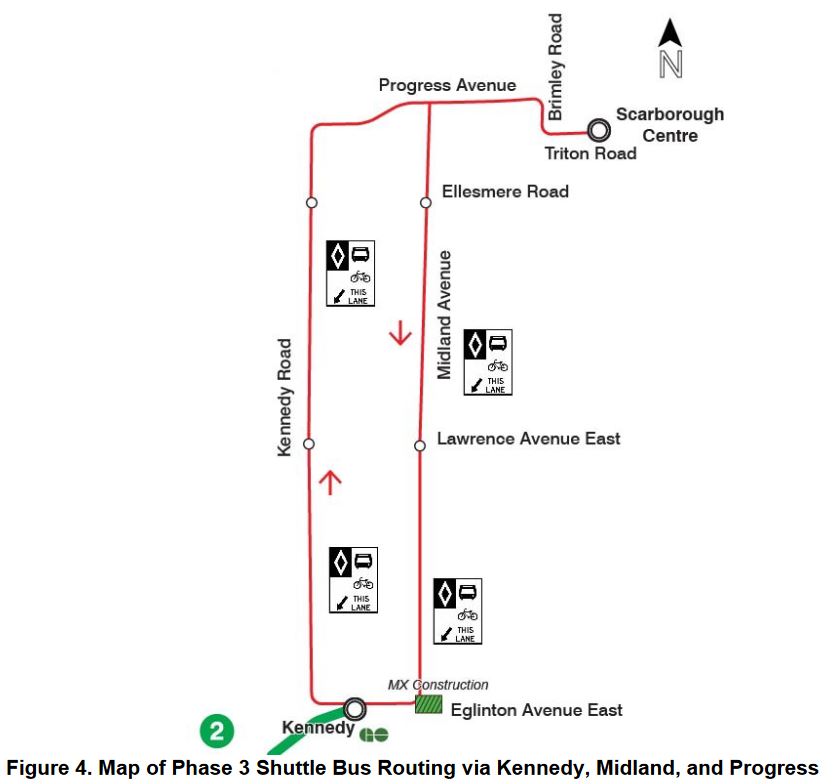
Since July 24, 2023, service on the Line 3 corridor has been replaced with a bus shuttle between Scarborough Centre and Kennedy Stations due to a derailment near Ellesmere Station. The investigation into that event has not yet published its findings.
The initial shuttle service operated about 30 buses/hour, and this was increased in September to about 45/hour. This operation is funded in part by lower-than-planned expenses in overall operations, and the TTC’s operator pool is larger than expected.
Cost of the shuttle bus service for the period up to November 19, net of savings from the SRT no longer operating, is estimated at $5 million and will be accommodated within the approved 2023 Operating Budget, based on anticipated under expenditures in other areas of the TTC’s Operating Budget.
As previously indicated in the Financial and Major Projects Update report for the Period Ended April 29, 2023, considered by the TTC Board at its June 12, 2023 meeting, Operator labour costs were forecasted to be higher than budgeted for the year based on additional Operator availability due to the elimination of the vaccine mandate and lower-than-anticipated construction shuttle service requirements. A portion of these additional available Operators are now being utilized to operate the SRT bus shuttle service.
Line 3 Bus Replacement Update, p. 2
The cash flow in the 2023 Capital Budget includes money for terminal reconfigurations at STC and Kennedy Stations as well as transit priority changes on affected roads. The conversion of the existing SRT corridor to a busway is shown as an unfunded figure. Note that this line extends beyond 2025 reflecting the originally planned rate of reconstruction. This is likely to change with the recent political emphasis on getting the busway in operation as soon as possible. Funding is available to complete the design, although that will not be completed until mid-2024.

This implies that actual construction will not start until, at best, fall 2024. It is not clear whether the TTC has considered advancing work to remove the existing SRT infrastrucure as soon as possible to get this work out of the way. Funding would be required, but a good argument could and should be made to accelerate any part of the work.
At its May 10, 2023 meeting, City Council requested the TTC Board to direct the TTC to complete the design for the dedicated busway and report back on the updated design, estimated cost, and any progress on funding discussions with the Province in Q4 2023. The TTC will be re-engaging with the local community and stakeholders as part of this report back. Design work has restarted and will be sufficiently progressed to provide an updated cost estimate in Q4 2023 with the final design to be completed by Q2 2024.
Line 3 Bus Replacement Update, p. 10
The new 903 Scarborough route, replacing Line 3 SRT, will take various forms over coming months. Routing via Ellesmere awaits completion of a queue jump lane in Brimley at Ellesmere.
Other changes planned for mid-November are the extension of several routes that now terminate at STC through to Kennedy Station to eliminate transfers between buses at STC.



Easier Access Phase III Program Update
The Easier Access Program involves the construction of elevators to make all stations accessible. This work has been underway for many years, and it is now clear that it will not be complete by the legislated deadline of January 1, 2025.
Both the main report and detailed information in the appendices talk about a variety of reasons for delay including labour shortages, unforeseen utility relocations, stations with “as built” drawings that did not match what was found on site, delays in obtaining various permits and property, and the need for service or partial station shutdowns to enable work to proceed. Across the board, it is not a pretty sight.
At the end of the main report, there is a comment about a project review undertaken for the TTC by Ernst & Young. Although key information is in a confidential attachment, the remark about strengthening the TTC’s project management process implies that the delays are not all due to external factors.
Under this review, EY analyzed key documents and interviewed internal stakeholders. This review builds on the prior assurance reviews conducted in 2021, 2022 by EY which resulted in a series of recommendations reported to the Board as part of prior program updates. The summary report, which is included in the confidential attachment, outlines the results of the latest independent assessment including perspective on remaining risks to the program.
TTC Senior Management and the Project team has accepted the key findings in the report. The Senior Management is closely working with the project team in implementing mitigation strategies to accelerate work. The findings from this review will also help TTC strengthen its project management processes.
Easy Access Phase III Program Update, p. 10
I leave it to interested readers to peruse the report for details of each station’s progress and problems.
Knowing that they will not hit the Jan. 1, 2025, the TTC plans to operate supplementary services to shuttle riders who cannot use stations that will still be under construction to other nearby accessible locations. The TTC acknowledges that this will be an ongoing requirement because at any time there will be some elevators out of service for major overhaul. The report is silent on the question of escalator outages.

Free Transit for Middle and High School Students
Board member Councillor Dianne Saxe, seconded by Councillor Paul Ainslie, has given a Notice of Motion that TTC staff report on two options to reduce the cost of student travel:
- That travel for field trips by students during the off-peak period be free, and
- That the TTC would provide free youth transit passes to registered charities for distribution to underprivileged youth as an incentive for high school attendance.
Saxe presents this as a first step to making transit free for students once new revenues from the proposed commercial parking levy come on stream in 2025, assuming approval by Council and no veto from Queen’s Park.
Getting reports on the cost of options is certainly preferable to just showing up with a proposed change to the TTC’s overall tariff. We are in a period where new Board members will try to make their mark, but this could lead to scattershot proposals rather than an overall review of options the TTC and Council might embrace.
Fares are a perennial target, and there is always some worthy group that does not yet have a discount or free travel. However, still to come are both the 2024 Operating Budget and the Five Year Service Plan that could examine options for service growth. Those have to be on the table for a unified discussion of the TTC’s future revenue, service and subsidy needs.
Appointments to TTC Committees
The report in the agenda is a standard procedural step for a new Board to re-populate standing committees including the Audit & Risk Management Committee and the TTC-Metrolinx PRESTO Joint Advisory Group.
Not mentioned is the possibility of creating, or re-establishing, committees to deal with important specific topics including a Budget Committee (moribund and eventually abandoned under previous Boards). Another possibility is a committee to review Board policies about service levels and quality including the implications of raising existing Service Standards to undo recent changes.
With a new Chair who is on the record as wanting a more engaged Board, it will be interesting to see what additional committees might be struck at the meeting, or if the Board continues to abandon important policy areas to management.
The Sustainable City of Toronto Fleets Plan
There is a presentation yet to be posted on the agenda page about the TTC’s plans to achieve the City’s net zero emission fleet targets, and the associated costs. The City’s goals are:
The Sustainable City of Toronto Fleets Plan has set the following goals and objectives:
a. transition City Fleets to sustainable, resilient, net zero operations by 2040, including 45 percent emissions reduction by 2025, and 65 percent by 2030;
b. transition 20 percent of City-owned fleet to zero-emission vehicles by 2025, and
50 percent by 2030;
c. achieve resilient fleet assets and operations by 2040; and
d. achieve net zero procurement by 2040.
An important caveat about the City’s plan is that there were two levels proposed. One was a switch of existing fleets to zero-emission, and the other was to substantially increase transit service to divert travel from autos to transit. Only the first of these has been approved by Council, although there was a lot of publicity at the time about the second.
Moving to a ZE fleet will substantially increase capital costs over what would otherwise have been needed for a less ambitious program, although the premium for battery buses is expected to decline over time. There will also be offsetting maintenance savings if vehicle reliability can match or better that of the older technologies.
If the City were to embrace the more-aggressive goal of widespread transit service improvement, this would require a substantial increase in the bus fleet including several new garages, an increase in the streetcar fleet (garaging requirements unknown), and embrace of much more frequent subway service with the knock-on effects for signalling, power, station capacity, fleet size and maintenance facilities, not to mention ongoing costs.
At this point, it is not clear whether TTC staff will address only the lower target approved by Council, or will also address the implications were Council to embrace a higher target.
 Steve Munro
A new siding north of Bloor Stn? How long has that been thought of? How would it even be configured? I assume of course that would be located in the open cut section.
LikeLiked by 1 person
The semi-dormant Danforth garage would be a good candidate for a smaller battery bus garage (i.e. no fumes or engine noise from the buses). A new addition, perhaps with housing built on top in some creative fashion, would reduce the need for the enormous dead-head mileage currently incurred by some buses serving downtown routes and the streetcar shuttles and add some housing. Buses would be stored all indoors and some creative thinking would add some housing to the site.
But alas, some politicians had their egos satisfied 22 years ago and instead buses travel half-way across the city to serve these routes (e.g. Broadview shuttles operating from Mt. Dennis a couple of years ago or the 503 operating from Malvern currently, the Bay bus coming from Birchmount). The same could be true for the old Davenport garage, but it seems that building was left to languish and now needs major repairs. One can hope, but I suspect there will be another garage built on the periphery of the city instead because big garages servicing 300 buses are the norm now.
Steve: Danforth Garage will be the site of a new police station and housing. Property for the next bus garage, still years away, has already been purchased on Kipling. Davenport Garage is a very small site even if the building were not in disrepair.
LikeLiked by 1 person
Have they not approved the ebus contract with New Flyer and Nova? I heard one of the ebus contract was awarded but not finalized? Any clarity on that.
Steve: According to the Major Projects Update, both contracts have been awarded and “Pre-production meetings have commenced with deliveries expected to start in Q2 2024.”
I notice that all garages was mentioned for Ebus chargers with the exception of Queensway garage. I thought Queensway was going to be finally retrofitted to accommodate Ebuses. I guess not.
Steve: Queensway is not in phase 1, but is in phases 2 and 3.
They should cancel the new police divsion at Danforth garage, and make it a bus garage again. Same with old Eglinton garage. Police don’t need a new division. But TTC definitely needs a new garage, especially if it’s on existing TTC property. And the building for the most part is still intact. Cancel the police station and make it a ebus garage. Old Eglinton same thing: make it an ebus garage and build housing on top. TTC will also save on operations cost.
Steve: If either site were recycled for a new garage, there would also be a new building. Danforth Carhouse dates to 1915, before the TTC’s creation. Eglinton Garage is in rough shape, and only a small part of the “garage” still exists on the west side of the site. The east side, the original TTC carhouse, was demolished when the area was converted to the bus loop for Eglinton Station. Major redevelopment of the entire site is already in the works.
LikeLike
Why would it take so long to install RapidTO bus lanes on Jane and Dufferin and other corridors? All major east-west bus corridors should have them installed, Finch, Wilson, York Mills, Ellesmere (I know they’re getting them), Steeles, Lawrence. Add queue jump lanes were possible. And you have a BRT lite.
Steve: The delays lie in opposition to the project from businesses and residents on both streets.
LikeLiked by 1 person
Would be nice to at least have some transparency as to why the provincial/federal government consistently refused to provide funding despite being asked numerous times. Looking forward to hearing about the report to the board on this matter when it comes out.
LikeLiked by 1 person
Excellent summary!
They keep talking of how weekday ridership is reduced from pre-Covid (at 79% now).
Though it’s well know, and supported by the open payment hourly data in the report, that Tuesday through Thursday ridership is higher than Monday and Friday.
But how does Tuesday to Thursday ridership compared to pre-Covid Tuesday to Thursday ridership?
(it may even be possible to estimate this from the hourly graph, if one assumes that pre-Covid ridership didn’t vary over the week)
LikeLike
Why is it that someone always asks about making transit free for certain groups?
Have they not learned anything from cutting fares for people under 12?
If we keep making transit free, we will have less and less revenue coming in which in turn puts pressure on the TTC who will cry poor.
If anything, they should be eliminating discount passes and free transit for kids until the TTC budget situation is back under control.
LikeLike
Great piece, Steve. However, what makes you think in-person work would overwhelmingly become the norm anytime soon? From what I understand, a far greater proportion of workers prefer hybrid or fully remote work settings and it’s something employers need to account for in the foreseeable future to recruit and retain talent.
Steve: I don’t think WFH is going to disappear. The only question is what proportion it will be of the overall “commuting” load. Longer term, there is the question of how the underused office space will be repurposed either with a higher worker density (more concentration of jobs in existing buildings), or if this will be undermined by the attractiveness (or not) of working downtown and housing issues. There is also the possibility of conversion of space for other uses. It will take years for the compound effect of these factors to evolve. Meanwhile, the TTC’s ability to attract riders will affect decisions on how and where people want to work and commute, and if they’re not careful, the TTC could cede ground by being “the not better way”.
LikeLike
Only subway lines 1 & 2 appear to have an automated train system budget. What about the other subway lines?
I am also very concerned with this system as there is nothing that I have read, that is reliable, mechanically, that can and will operate a train under any and all adverse conditions.
Then, there are streetcars. Has any discussion taken place relating to automated streetcar control?
Steve: The only other line is Line 4 Sheppard as Line 3 SRT, which did run under ATC, is now permanently shut down. Line 4 trains have ATC capability so that they can operate over Line 1 to reach Davisville Carhouse, but Line 4 itself, a short route with infrequent service, is still operated manually with block signals.
ATC technology has been used for decades all over the world and is at least as reliable as manual operation with block signals, if not moreso because there are fewer mechanical components to fail.
The streetcars operate in mixed traffic and do not need nor could they use ATC. New cars for Line 5 Eglinton Crosstown will run under ATC in the tunnel section, but not on the street trackage.
LikeLike
I sometimes wonder whether the TTC is becoming too big and complicated to be managed properly any more (or, at least, managed properly by the level of talent and oversight available to the city). It sometimes feels like a lot of details are always being forgotten or mishandled or late. Maybe it’s time for the TTC to be broken up. Maybe trains should be put in a separate org from buses. Or maybe the TTC should be divided regionally with suburbs in one and the core+trains in another.
Steve: The problem is that the TTC is in many ways the author of its own mismanagement. It’s not size, but the absence of skill and attention. It is the same size it was a decade ago before things turned bad with the pandemic and an unpopular CEO who drove out the team Andy Byford built. The last thing we need is separate organizations (beyond the already existing divisions between operating groups) with even more barriers to co-ordination.
Whenever someone proposes restructuring and governance as “solutions” to a dysfunctional organization, I fear that this does not address the underlying problems. Shuffling deck chairs on the Titanic, etc.
LikeLike