
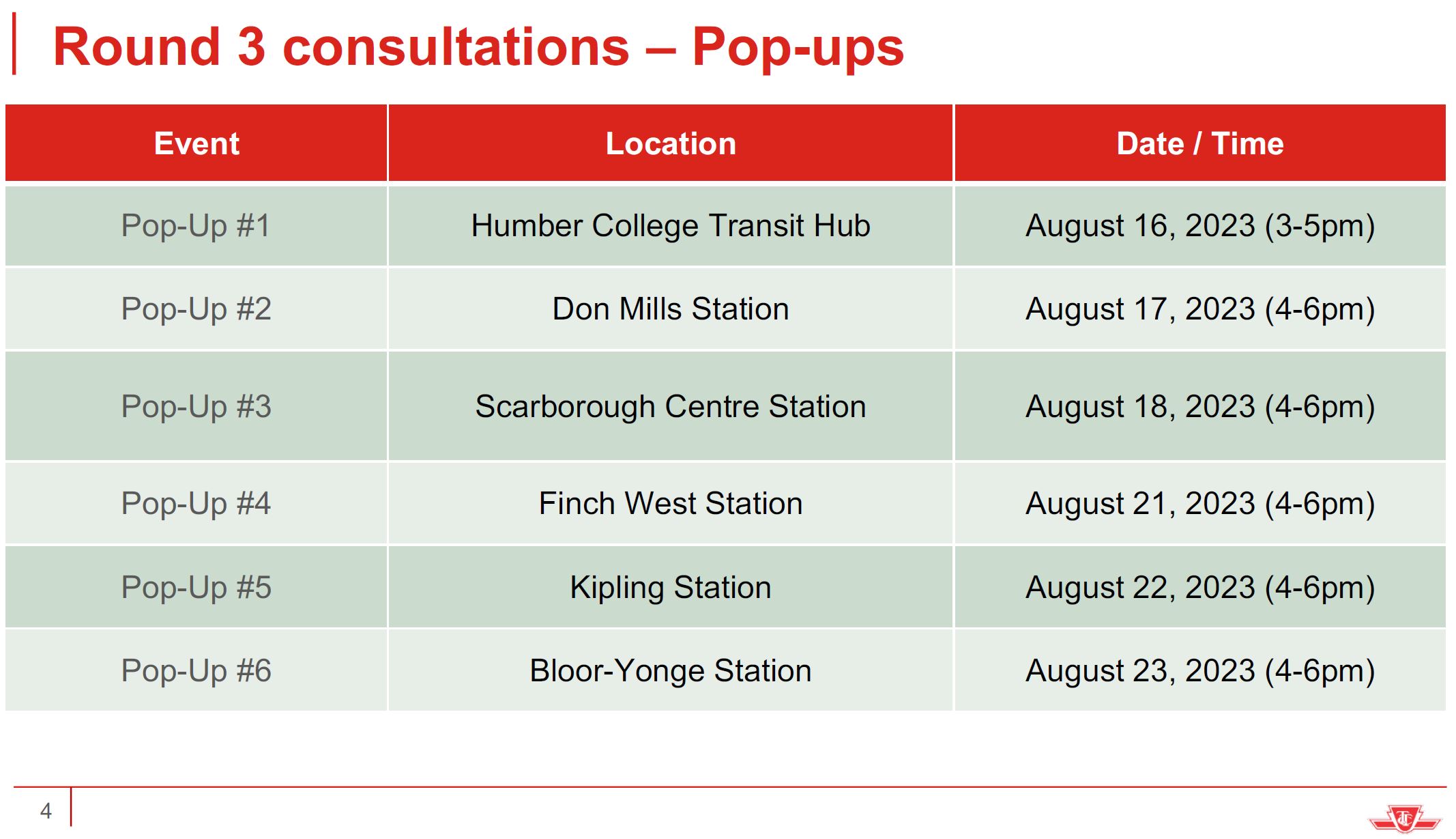
The TTC continues its consultation on a five-year plan for service combined with a “customer experience action plan” with a series of pop-ups in mid-August, meetings with various stakeholder groups, and an online survey available until August 27.
With the election of a new Mayor and a shifted political balance of the TTC Board, the context for these plans has changed quite substantially. After years where “less is more” might have been a fitting logo, the TTC now faces key questions about its future. What should transit be? How deep are it shortfalls? How high should we aim for improvement?
For information about previous rounds, see:
Current plans are to take the Annual Service Plan for 2024 to the TTC Board in Fall 2023. There will be a final, fourth round on the Five-Year Plans in November 2023 and they will go to the Board in early 2024. It is not clear how the Five-Year Plan will interact with the 2024 budget process which will already be substantially complete. This timing is a remnant of the Tory era at City Hall when the budget was a “done deal” at the Mayor’s bidding and debate on future options simply was not tolerated.
An important part of the Five-Year Plan is the TTC’s claimed “vision” for its future:
Focus on improvements that enhance TTC’s core-competency: mass transit – moving large volumes of customers safely, reliably, and swiftly across Toronto
In all of the talk about transit and various improvement schemes, staying focused on moving people must be a top priority. The attractiveness of transit for that function – getting from “A” to “B” and back again – must not be lost in flirtations with marginal technologies, ancillary services or “improvements” that will not touch most riders’ daily experience.
The original 2020-2024 plan had five pillars and these will carry over into the new version.
- Enhance the transit network
- Enhance customer experience at key surface transit stop areas
- Improve service reliability
- Prioritize surface transit
- Accelerate integration with regional transit partners and complementary modes of transport
The pandemic intervened, but even allowing for that, the TTC cannot be said to have achieved a lot especially on the issue of service reliability. Overall, an important question is “did the improvements achieve their aims”?
The early consultation round asked what the TTC should concentrate on depending on the available funding. A clear result across three scenarios is that riders want more service, and a substantial minority, 40%, wants this even if funding declines. That says something about Toronto’s perceived service quality.

For this round, the TTC asks about attitudes to the express bus network and that perennial topic “regional integration”.
There is a separate consultation process for the RapidTO Project and its “red lane” transit priority scheme. That process cannot be described as “speedy” and it is unlikely that more than a handful of corridors will receive a priority treatment in the next decade. An equally important issue, however, is whether widespread improvements across the system will benefit more riders and make transit more attractive than a handful of RapidTO lanes. Indeed, RapidTO should not be used as a catch-all response when riders complain about service and speed because most routes and riders will never see this treatment.
The TTC regularly cites the overall ridership recovery which reached about 70% compared to pre-pandemic demand as of mid-June 2023. This is an overall average, and it is weighed down by the effect of work-from-home on demand for subway and streetcar routes. Buses overall sit at 81% and many routes are close to or above early 2020 levels. Growth is not just a matter of recovery on these routes but of continued expansion to maintain an attractive service.
There are no ridership projections in this round of consultation, but these will be included in round 4 in the Fall. An important issue, especially in light of the political and budgetary situation, will be a sense of options for business-as-usual or service growth to attract riders. Possibly we will see something akin to the Miller-era Ridership Growth Strategy with a menu of options for selective improvements as and when Toronto opts to fund them.
Equally important will be a recognition that service quality affects ridership, and current operations need substantial improvement. Within the TTC, it is difficult for a planning document to criticize, much less prescribe, operating practices. Riders don’t care about departmental rivalries. The TTC’s obsession with performance metrics that hide service quality problems have the combined effect of misrepresenting riders’ experience and shunting aside an examination of organizational drags on quality.
The Express Bus Network
The TTC’s network of 900-series routes had its origin in a TTC Board dictate “build us an express network”. What actually happened, at least initially, was that the many existing (usually) “E” branches of various routes morphed into their 9xx equivalents with almost no actual change in service. Shazam! We have an express network, but this was more about marketing than new service. Over the years, some routes have been added and some hours of service were added. There was a pandemic lull when many express routes vanished and some were not replaced by added local service. Most of the service has been restored, but a clear question is “what now”?
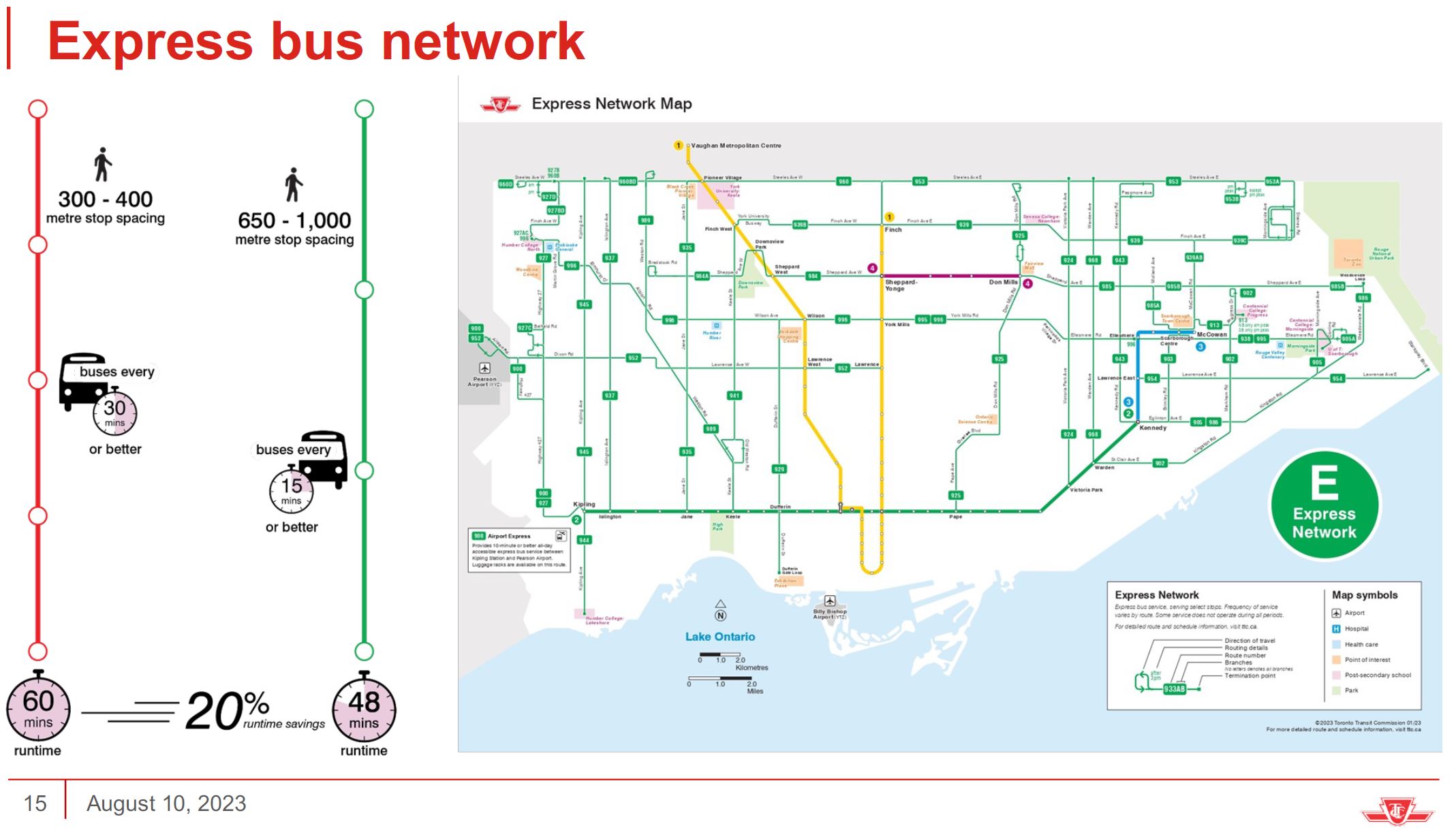
Guidelines for the express routes call for a 20% travel time saving over the route with service every 15 minutes or better. Stop spacing can range from 650 to 1,000 metres. There are problems with this model.
The 20% saving is not achieved by all routes, and a further issue is that this saving comes at the expense of wait times for local service. Indeed even the express services can suffer from the need to split resources between local and express operations with longer waits for everyone. Service irregularity, including missing buses, compounds this.
Travel time savings vary by route, direction and time of day and the benefit might not be as great for all potential trips as a best case, peak period.
Riders travel between many stops, and if either their origin or destination is at a local stop, the express service is no use to them. When the local service is frequent, the penalty to wait for a bus is low, but an era of service cuts has widened headways across the network at the same time as service became less reliable.
The TTC seeks input on what might be done with the Express network:
- Maintain existing services
- Remove some express services and convert all service to local
- Maintain existing stop spacing
- Remove low usage stops to increase travel speed
The changes would be appropriate to each route, not a “one size fits all” fix. Missing in the presented information are actual details of the express routes such as comparative speeds and demand on the local and express services.
Of particular concern with any adjustment or consolidation is the TTC’s love for reducing the resources needed for a route so that the consolidated service saves money without providing as much service improvement as might otherwise be possible.
As for stop spacing, we already know that the improvement cited for the Scarborough RapidTO lanes was in part due to stop removal, not to the red painted bus lanes.
Notable by its absence is any discussion of adding to the express network.
Regional Integration
“Integration” means different things depending on who is talking. There is a real danger that a lot of effort will be spent without really improving travel between Toronto and surrounding regions.
For some, integration means having buses of many colours plying the streets able to pick up and drop off passengers wherever they want. This has been touted as a way to save money on service duplication, but not necessarily as a way to improve service. An early poster child for this was service on Burnhamthorpe provided by MiWay and TTC, but with only TTC able to pick up passengers. The 50 Burnhamthorpe is not exactly the most frequent route in the system, and the potential saving would be small.
More generally, although there are many potential cross-boundary operations, it is far from clear that simply opening up the territory so that either the TTC or 905 operators could expand service would result in useful, frequent additions to the network. Every new service run anywhere increases operating deficits, and that is without even considering the effect of fare sharing.
Similarly, fare integration with GO Transit where a “local” fare would include a leg on GO at little or no premium begs the question of who will pay, and whether the existing GO service, station locations and links to local routes will be attractive “as is”. Should TTC routes be distorted to link with GO especially if the regional service is infrequent?
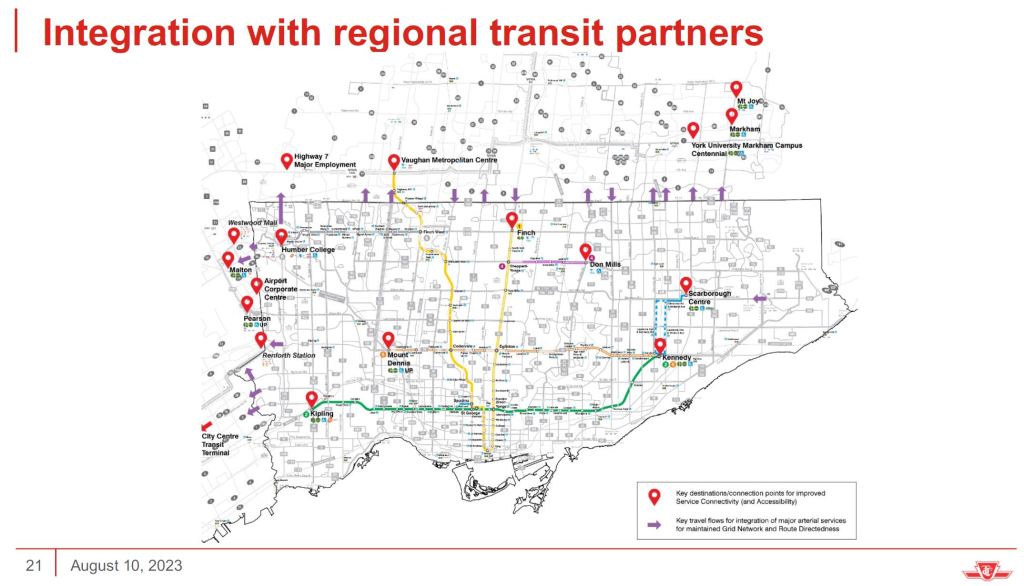
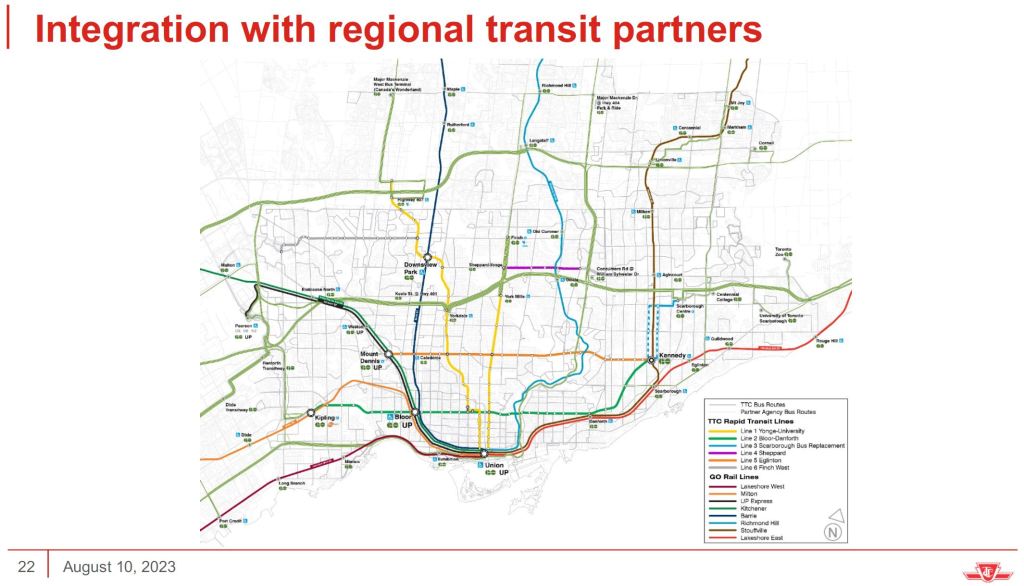
In brief, integration is more than drawing lines on maps and putting circles around potential “hubs” as interchange points. Indeed, if networks are restructured to feed trips into GO, this could undo the usefulness of local services for local trips.
Too much of the discussion on regional integration concentrates on fares, legal and operational issues without addressing how the network would “work” both for riders and for individual agency budgets.
Without question, making the 416-905 boundary disappear is important for riders, but they are still a minority of the total travel demand especially on the TTC. How much would Toronto be expected to contribute to fare reductions and service improvements on a regional basis? How would this compete with resources for the existing network?
The Service Plan does not address these issues because this is a planning document, and the policy issues are left for solutions elsewhere.
The maps below do not give the full context for potential integration as they do not show the existing local routes and potential, such as there might be, for joint services. This should also indicate service levels to give a sense of just what it is that Toronto would “integrate” with.
Customer Experience Action Plan
In a recap of earlier consultation, the section on Customer Experience tells us which issues are important to riders. Safety sits at the top of the list, but it is closely followed by communications issues.
An important point here is that “communication” refers to information riders need while making a journey, not for advanced trip planning which appears to have an undue priority in some TTC plans. It is worthless to have a trip planner, be it Triplinx or Google, that cannot tell a rider what is happening now and why their route is not behaving as expected. Indeed, the phrase “as expected” should not include the need to add half an hour to any journey to deal with foul-ups enroute.

Notable from its absence on this list is improving the reliability of service. The TTC seems incapable of including this as an area for improvement when it presents options for surveys, concentrating instead on factors that have nothing to do with reliability. If anything, the options presented in the survey speak to what the TTC thinks is important, not to the most basic issue: service.

Customer satisfaction ratings have fallen substantially in recent years. This should be a wake-up call that transit is not serving its riders. The relative ranking of “key drivers” has a few oddities such as a high rating for trip comfort, but a low one for crowding. Similarly wait times rank below other factors even though, thanks to the combined effect of service cuts and erratic headways, they can be a substantial and annoying portion of journeys.
Frequency and reliability are constantly cited in rider surveys, and they come up in every consultation summary published as part of TTC plans. Somehow they have not made it to the top of the TTC’s list. Indeed in the chart below, they are not even on the TTC’s list.
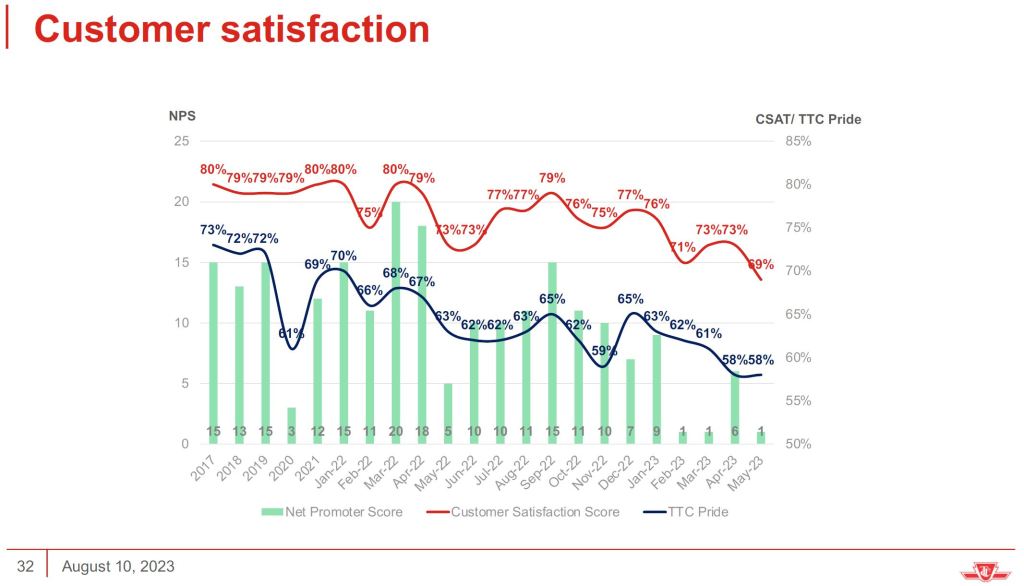
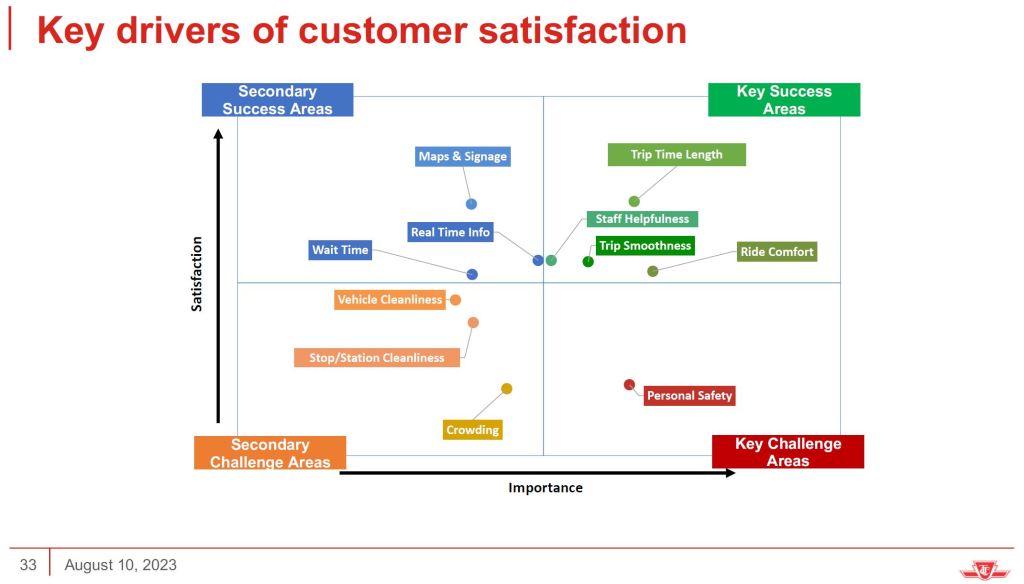
One component of real time information is next vehicle arrival times at stops. Bizarrely, the TTC regards its system to display this info as a test, a pilot that will be allowed to die on the vine, at precisely the time their own “customer experience” team has flagged its importance.
The survey asks for feedback on six areas. Notable by its absence is service reliability, frequency and comfort.
- Safety
- Trip Planning
- Real Time Information
- Stop amenities
- Station amenities
- Cleanliness
The plan talks about “re-imagining” a rider’s experience, but the context is rather odd, and suggests that whoever drafted this chart is out of touch with the real world.
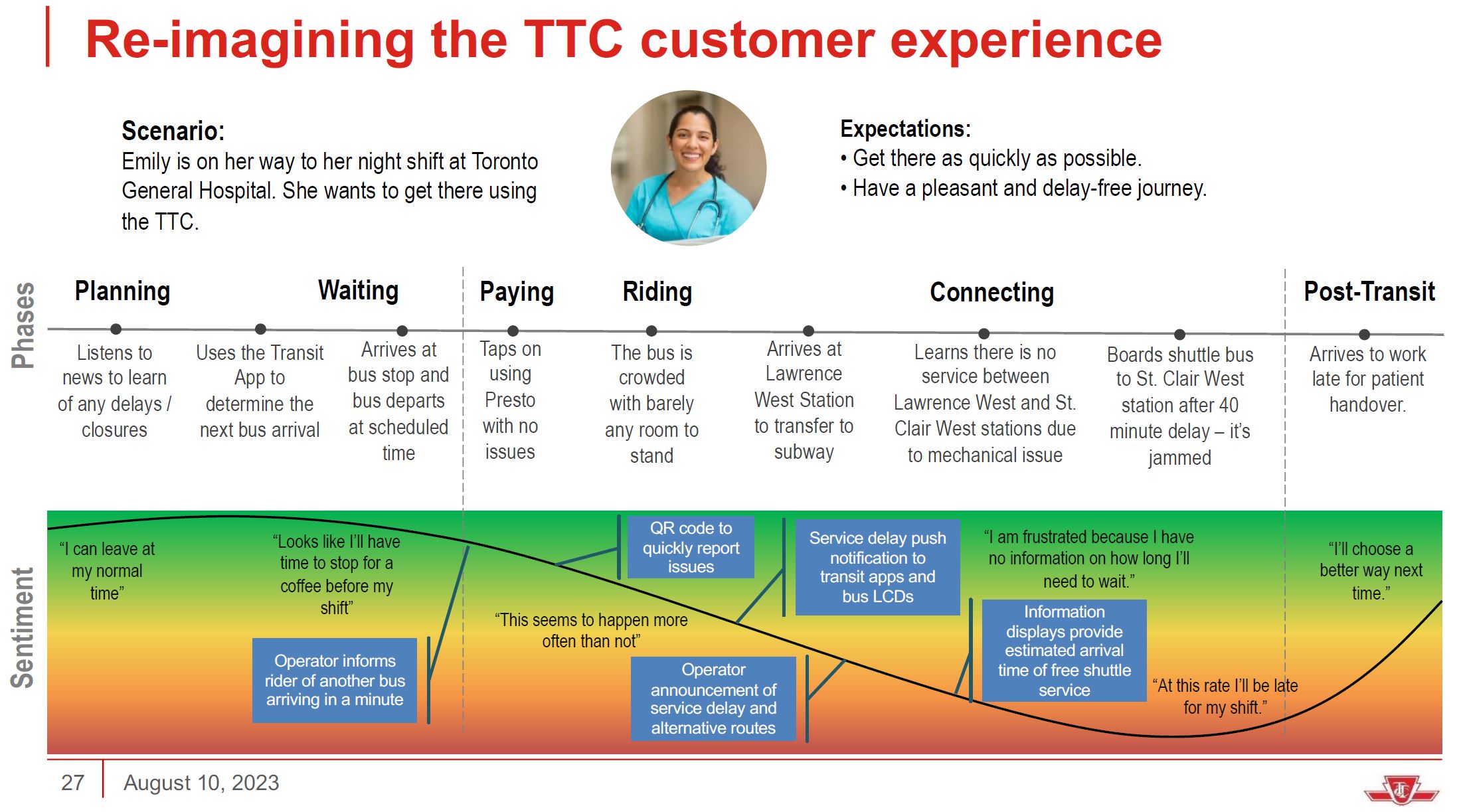
The sample trip appears to begin on Lawrence West as the journey will take us to Lawrence West Station. Someone on their way to a night shift is unlikely to hear of service disruptions on the news because there is little or no such coverage except in peak periods. Next bus arrivals are fairly frequent, assuming no disruptions, and the need to schedule arrival at a stop is meaningless. If there is another bus arriving in a minute, it might slip in under the service standards for headway reliability and be “on time”, although the TTC only measures this at terminals.
Whether an operator knows what is actually happening on the route is dubious, and my experience is that ops know next to nothing about overall route status. This is especially true in the evening when there is less central supervision. Moreover, the operator should concentrate on driving their bus, not on following TTC service alerts. In any event, the Lawrence bus might be running just fine, and the subway delay is yet to occur.
The bus is crowded with barely any room. This should not occur off peak. Assuming the rider has hands free, owns a smart phone, and happens to be standing in the right location, they might use a QR code to access a site and report a problem. This is not an ideal way to submit a gripe about service, and in any case the TTC should already know about service spacing from vehicle tracking and automatic passenger counters.
At the subway there is a delay and after a long wait and crowded shuttle bus journey, our rider makes it all the way to St. Clair West, still not her final destination. And, yes, assuming she can afford an alternative, she won’t care about a response to her complaint, if one ever arrives, because she will have changed travel mode.
This is the sorry state of TTC service provision, that it natters around the edges of the transit experience without addressing the most basic function of transit service.
 Steve Munro
The ridership numbers are bogus. Fact checking required. If riders want better service then let them pay increased fares to cover the cost.
LikeLike
Having a bus (or streetcar) appear 10 to 15 minutes on a NON-10-minute route is “advertising”. “Advertising” that there is a bus service available when anyone needs it. Want more riders, you “advertise” it by showing a bus is there, even if you are not using it at that moment.
LikeLike
“Out of touch with the real world” is on the bingo card of every job role at the TTC from planner to CEO.
LikeLiked by 1 person
One thing I’ve noticed about the 900 express service is that it improves reliability because while the buses still clump up, the express and local clumps don’t stick together. With two clumps of buses travel the route instead of one there’s double the service!
LikeLike
I want to thank you for the hard work that you put into these articles. They are essentially the Coles Notes of TTC for the public and Councillors. There is no doubt that the TTC distorts and hides a lot with their reports.
All these surveys make me wonder if the TTC cocks up these so called public survey results. I mean look at some of the times that the TTC lists for public info access.
LikeLiked by 1 person
Waste of money doing this nonsense. Only one that benefits is whomever gets paid to do it.
What is needed is “boots on the ground.” Someone to see first hand what is going wrong at any given time.
Are those station manager jobs still around? How many? I recall there were to be a few as a pilot and they would cover a few stations together. Maybe they need to get out of the tunnel and see what the buses up top are doing (or not doing) Might be more useful.
LikeLike
It’s a joke how much TTC loses on fare evasion and do nothing about it. Many thousands of people do not pay their fare and just walk into stations through bus entrances or through the gate and even through rear doors. Honest people are suffering from fare increases and decrease in services. TTC allows customers do whatever they want. Especially students who just walk onto transit without paying and making the bus full so they can’t pickup actual paying customers.
LikeLike
First Rule of TTC Service Reliability is: You Do Not Talk About TTC Service Reliability.
LikeLike
An unfortunate but timely example on communication – Toronto Fire reported a 2 alarm fire in the subway at 1:15pm today (Saturday). An hour later, all the TTC has mentioned is that there’s brief delays at King station, and that the Bay bus is diverting.
In emergency situations like this, clear communication is even more important, and the lack of any information is troubling to say the least.
Steve: I am not sure it was in the subway. According to CityTV, it was in a building under construction nearby.
LikeLike
Steve – you’re right. It looks like in this case it was Toronto Fire that misreported* and the TTC was, to their credit, not at fault.
*I was doing errands downtown and saw the fire, and when I Googled the “toronto fire active incidents”, it was listed as “subway fire”. It’s hard to express how glad I am that it wasn’t – that would have been absolutely devastating.
LikeLike