
The TTC Board met on July 12 with a variety of items on their agenda. I have already addressed the presentation of pending service changes as well as a discussion of short turns in previous articles.
Topics discussed here include:
- The CEO’s Report for July 2023
- Elevator and Escalator Overhauls
- Wheel-Trans Transformation 2023 Program Update
CEO’s Report for July 2023
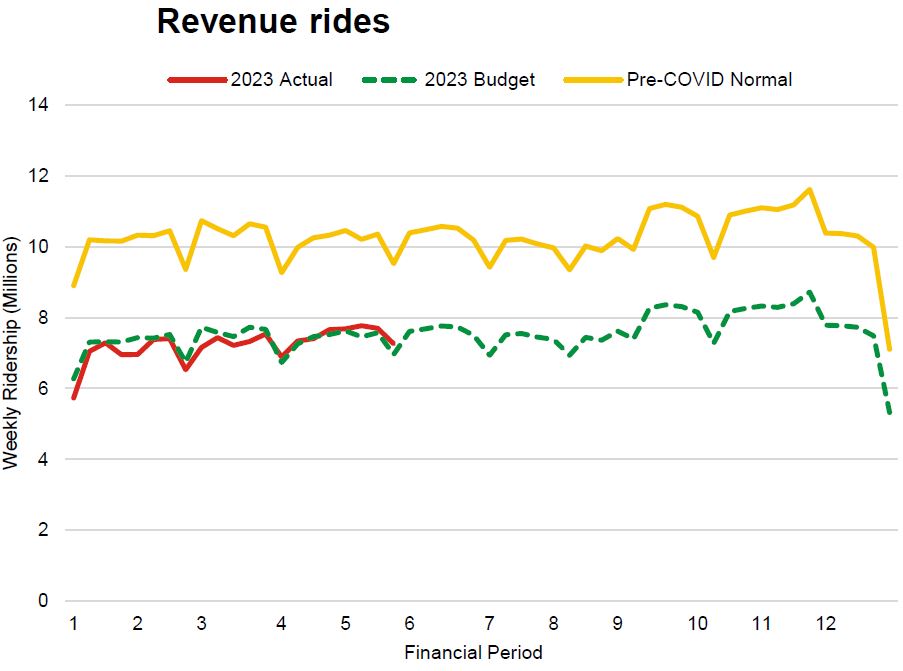
Ridership continues to track budget projections, and ran 2% higher than expected in May at 75% of the pre-covid. Overall ridership for the year is down from projections because of poor winter weather, and the full year is expected to come in at 75%.
This illustrates a problem with the timeframe when ridership and budgets are quoted. More riders are expected in the fall as shown in the full year projection below, but the low first quarter numbers are a drag on full-year performance and can delay service improvements later in the year. At the end of May, the TTC’s fare revenue is $7.2 million below budget for the year.
A common problem with TTC service for many years has been restraint in the Fall that produces a “surplus” the TTC contribute to the City’s overall funding. Whether this will occur again in 2023 with a new pro-transit Mayor remains to be seen, but the TTC has an ingrained habit of underspending after years of budget limitations.
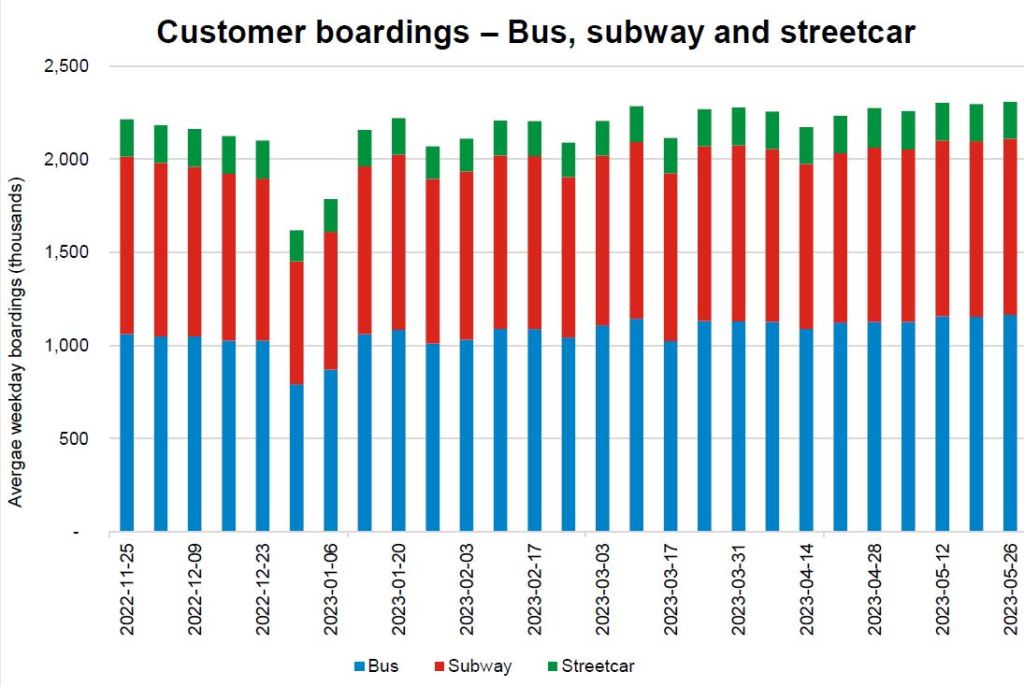
Ridership by mode continues to be strongest on the bus network at 84% while the streetcar and subway networks carry 56% and 60% of pre-covid levels. The streetcar system has been hit with the effects of construction projects and diversions, and risks a downward spiral through a combination of service cuts and erratic quality of what remains. Although year-over-year growth on the bus and subway networks is at 31% and 28% respectively, on streetcars it is only 5%.
Work-from-home continues to affect office commuting patterns. Although the in-office days per week continues to rise, it is only at 2.5, and this makes for a very different demand pattern and an underutilization of the highest capacity infrastructure. Presto card usage (unique cards) stands at 92% of the pre-covid level, but rides per card is down reflecting the lower commuting rate.
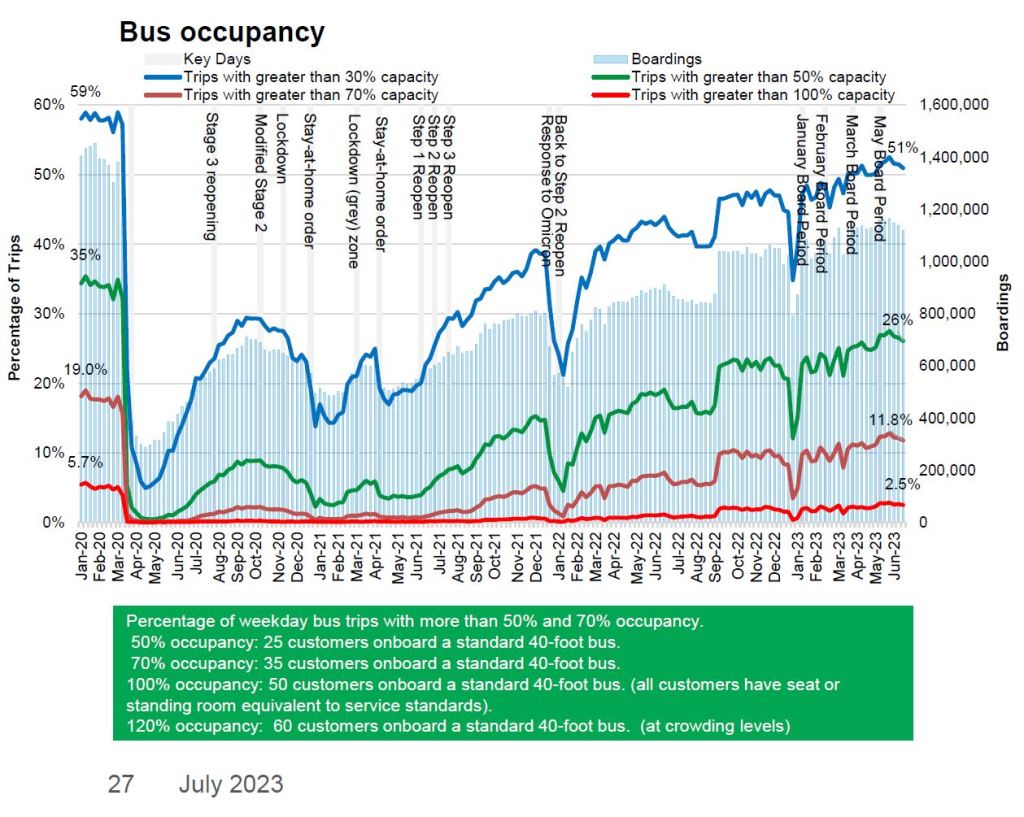
Bus occupancy rates continue to grow including the percentage of busy trips. An important issue with these stats is that they are averaged over all routes, all day, with counterpeak and offpeak trips diluting the percentages represented by crowded ones. Even pre-covid, relatively uncrowded trips (less than 30% of capacity) accounted for over 40% of the total. What we do not have, although the TTC has produced them in the past, are “heat maps” showing portions of the network where crowding is a problem.
A related issue is with service bunching that causes uneven distribution of loads between buses. The TTC still does not make vehicle-level crowding data available beyond summary values in the real time tracking feed. This produces a mismatch between reported averages and rider experience because more riders are on full buses than on empty ones.
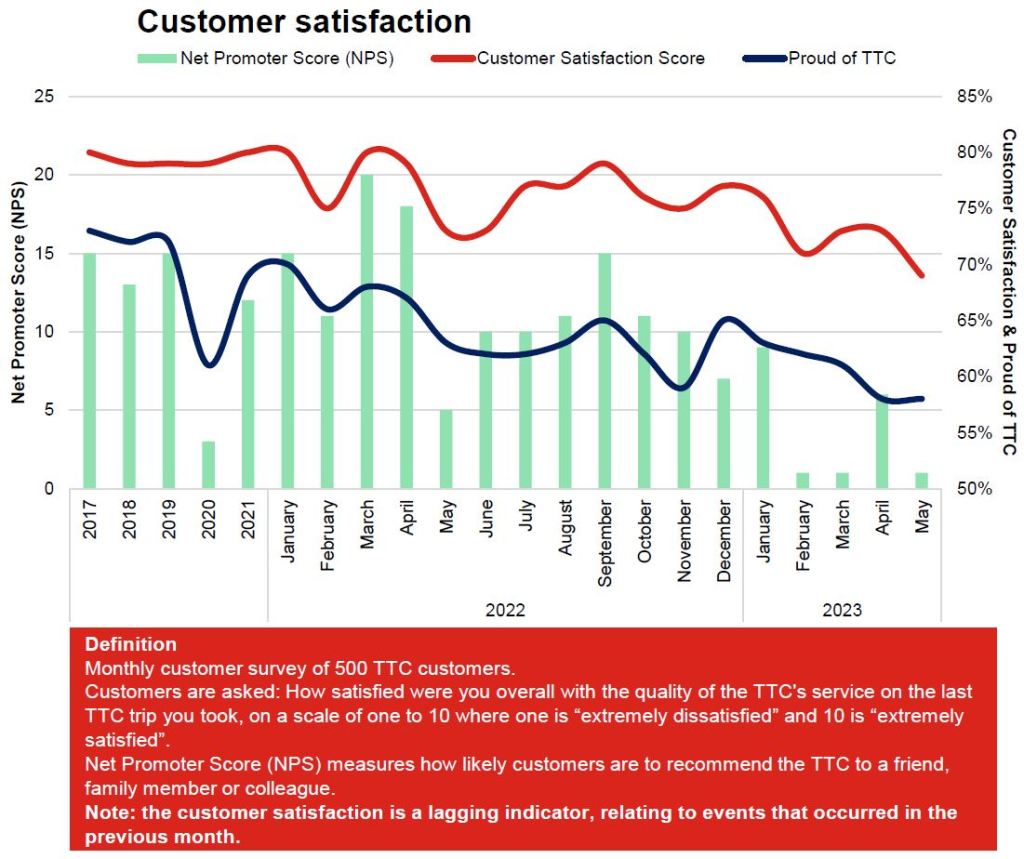
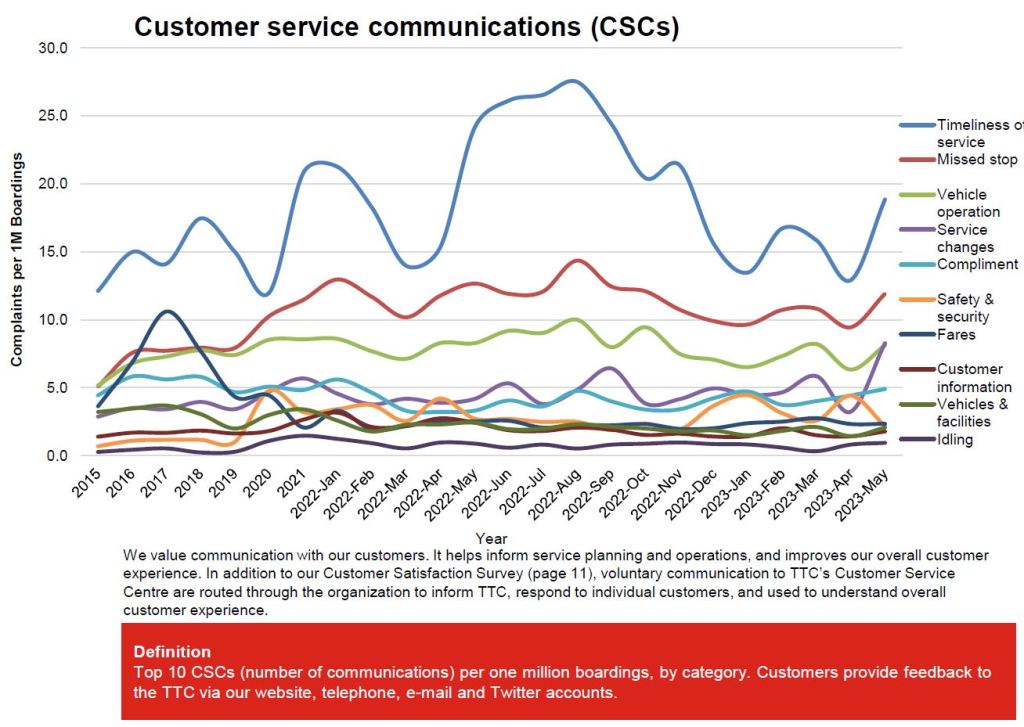
Customer satisfaction continues to decline, and a particularly troubling stat is that the “net promoter score” of riders who would recommend the TTC to others has fallen to almost zero. Meanwhile, four key measures of complaints are on the rise: service timeliness, missed stops, vehicle operation and service changes. Both of these trends show a transit system that is becoming less popular, and which riders are less inclined to forgive.
Quite bluntly, anyone who thinks that riders can be wooed back to the system with glossy advertising, but with little attempt to improve the real product – service – does not understand what makes transit attractive.
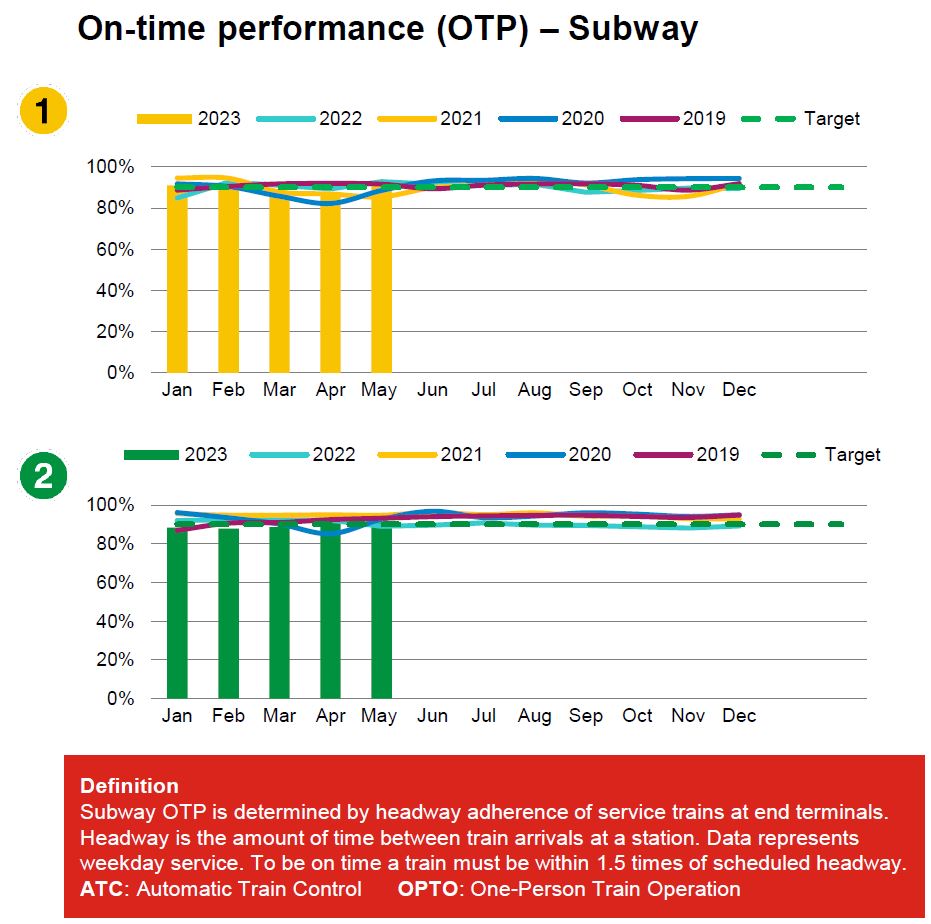
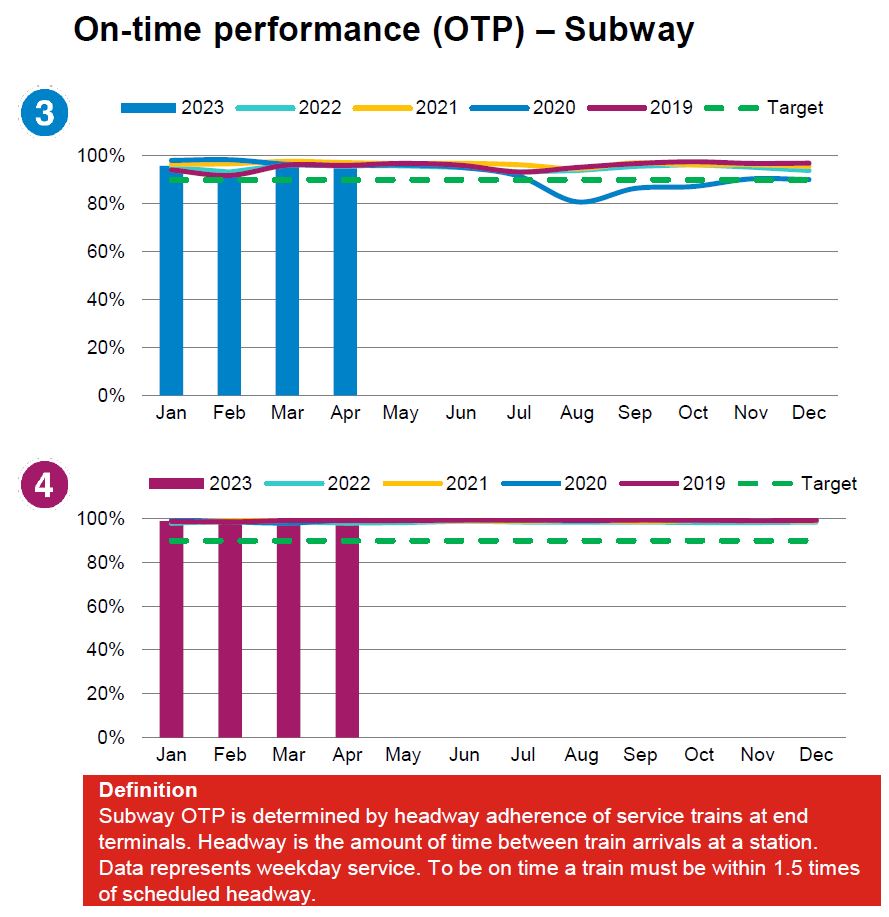
Rapid transit on-time performance continues to be high, but this is partly due to how service is measured. A train is considered to be “on time” if the headway (gap between trains) leaving a terminus is no more than 50% greater than scheduled. This means that service can operate with effectively two thirds of scheduled capacity without affecting reported performance. A gap train that is supposed to be four minutes behind its leader could be six minutes back and still be on time for the stats. With wider scheduled headways of up to 8 minutes, up to a 12 minute gap could be counted as “on time”.
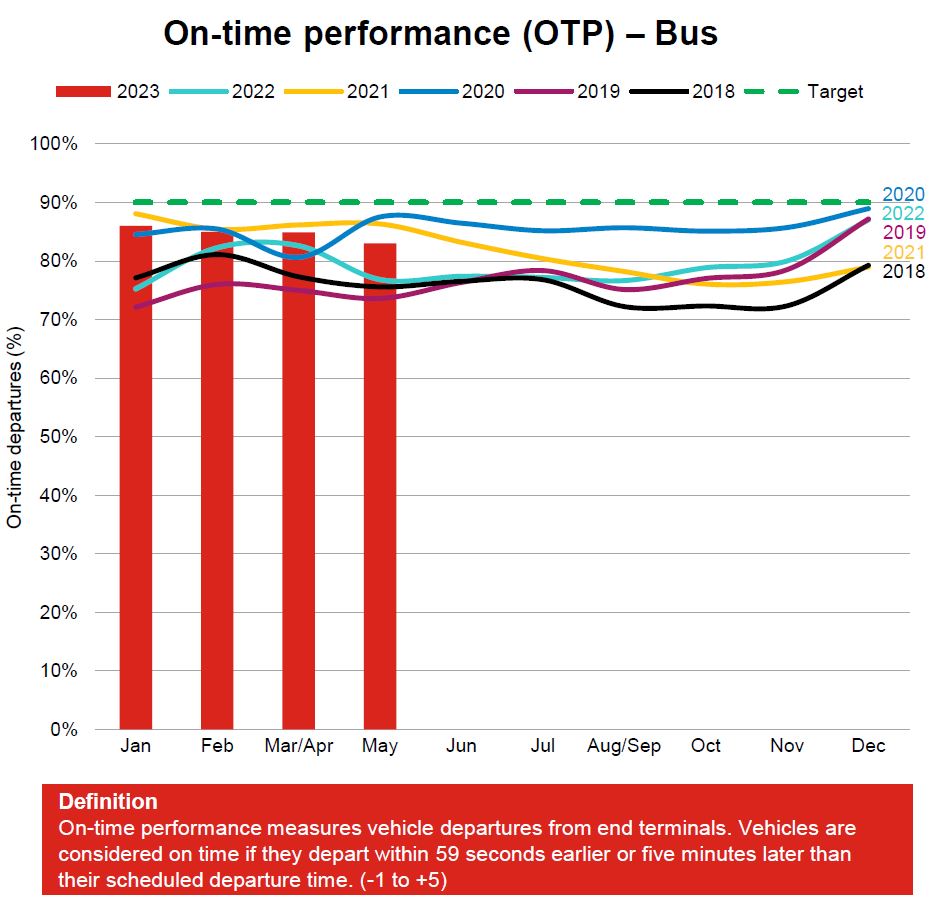
For surface modes, the metric is terminal departure times versus schedule with a six minute window to be “on time”. This allows service on all but the infrequent routes to leave terminals with bunches and gaps. Even so, the TTC does not achieve its target for service reliability.
One ongoing problem in the pandemic era has been with missing vehicles, runs that do not operate because of a shortage of operators. This causes gaps in the service that does operate, but there is no reporting of the pervasiveness of this problem. A related issue is that if service is adjusted to compensate for missing vehicles, it will not be “on time” to the schedule. Even though riders might experience more reliable service, the stat that counts,”on time”, would not look good.
As with many other stats, these values are reported as averages, and in this case represent an entire month’s operation. There is no indication of the variation by day or by time-of-day at the granularity that riders actually experience the service.
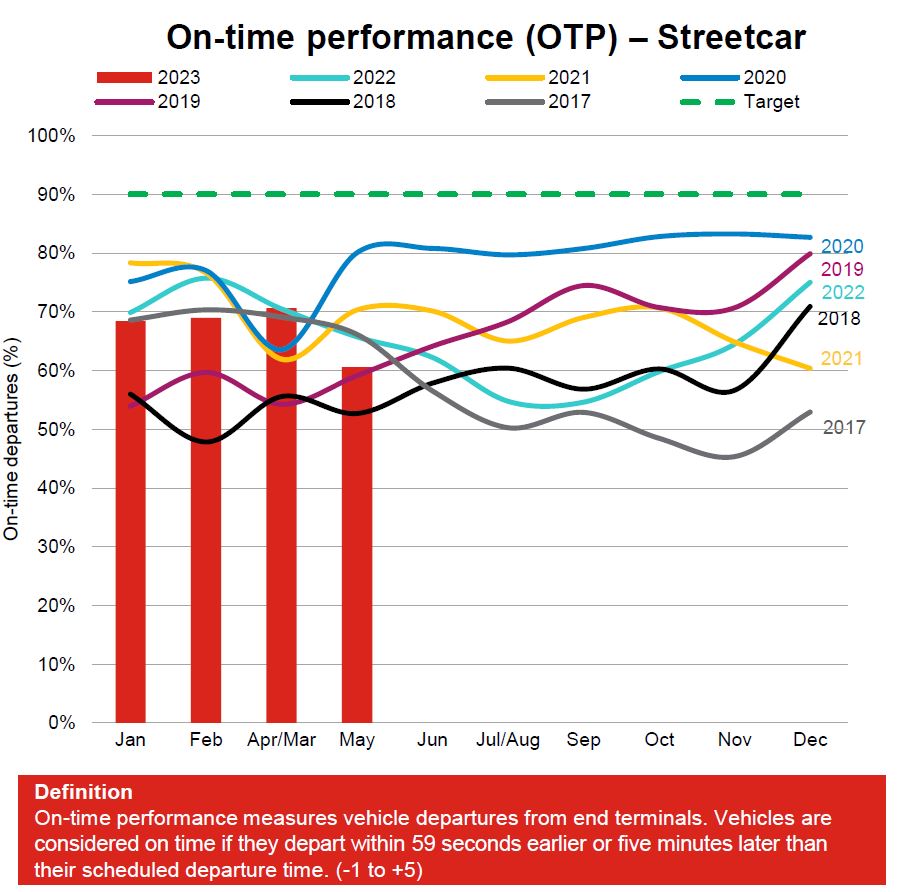
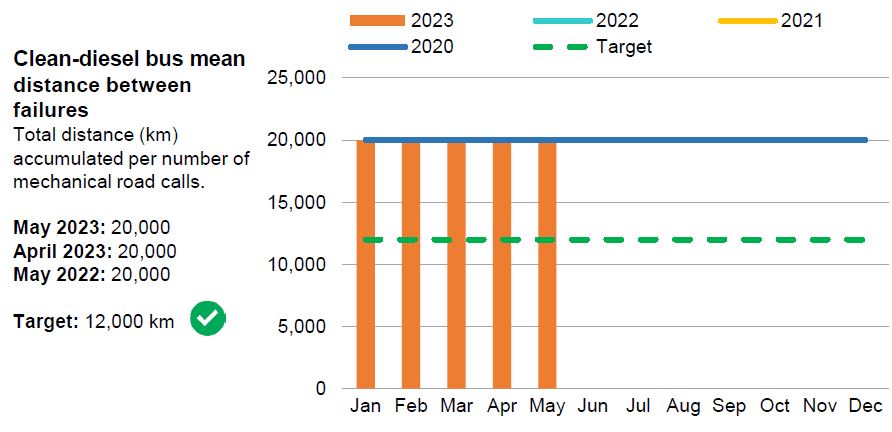
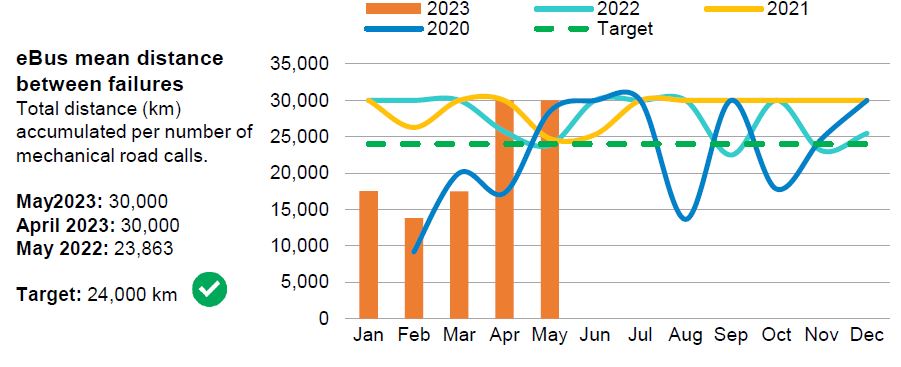
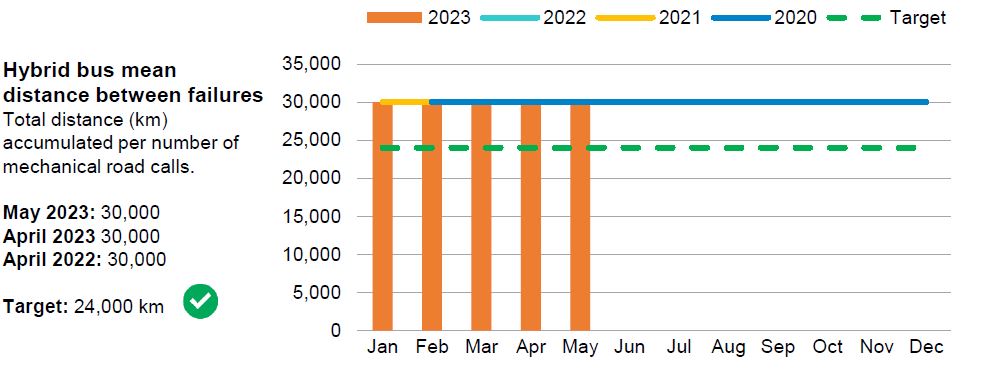
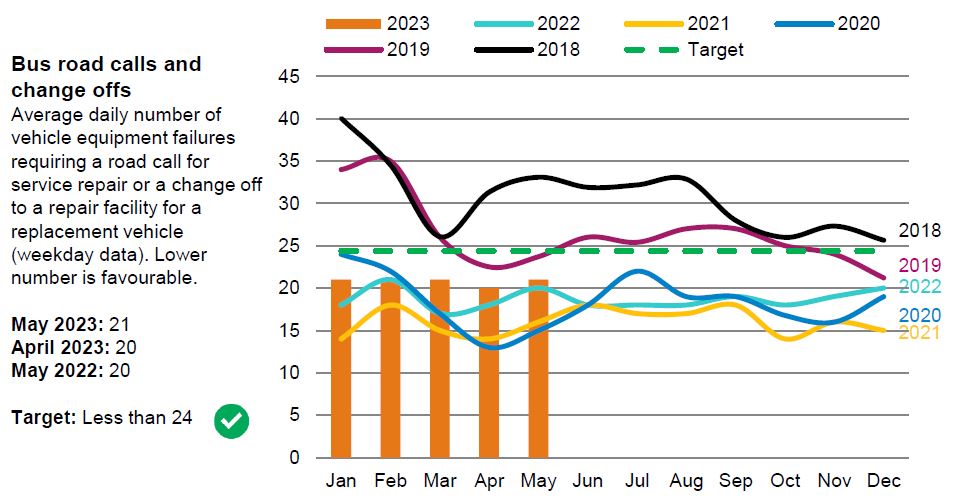
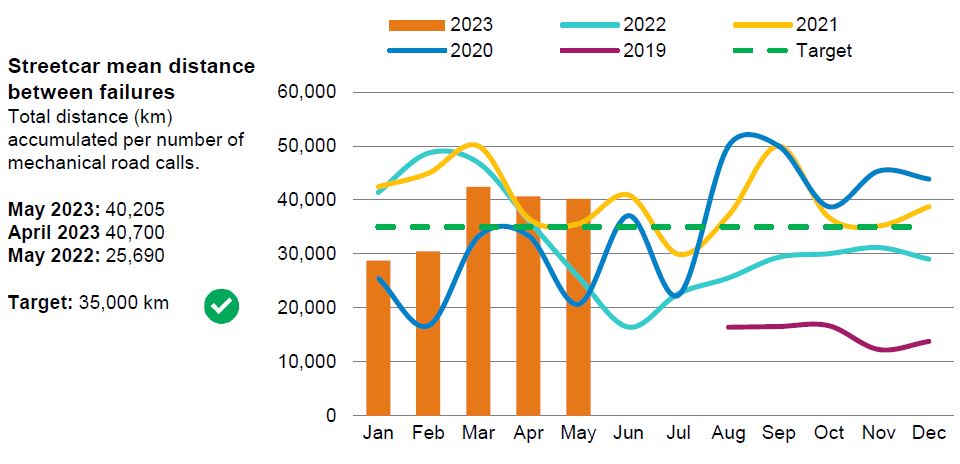
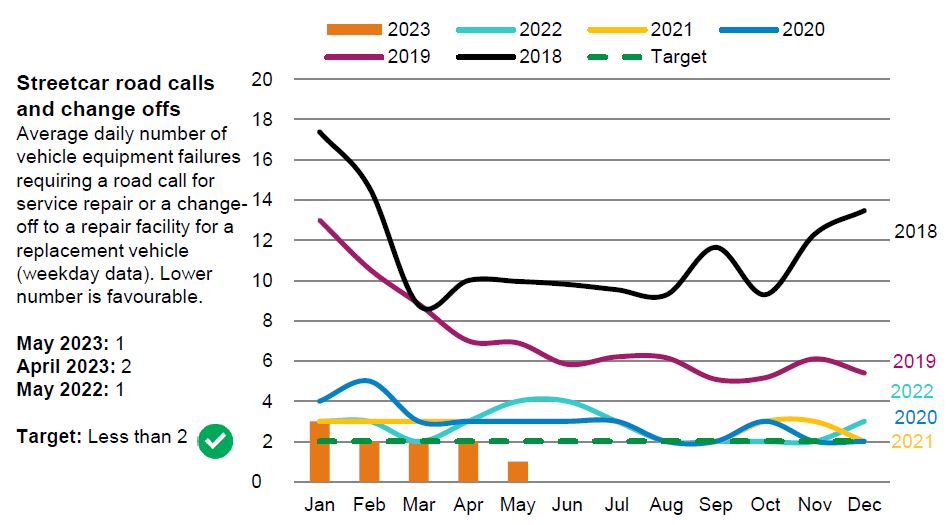
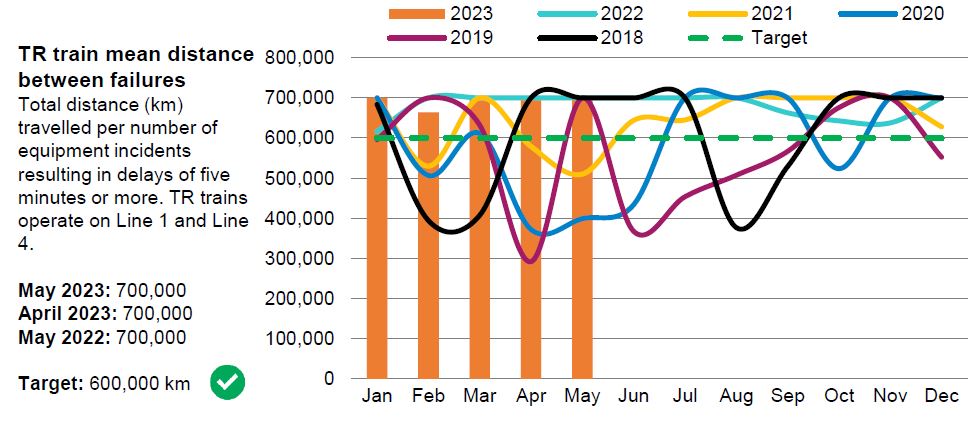
Vehicle reliability is reported in a rather strange way by the TTC with the mean distance between failure (MDBF) values shown at capped values for diesel and hybrid buses (20k and 30k km respectively). There is no indication of the degree to which they actually exceed this level, and therefore no basis of comparison. Most other modes report actual values.
The values for past years do not appear as wavy lines because the values all sit at a fixed level going back to 2020. This tactic misrepresents the comparative reliability of different types of buses, and could be hiding the reliability and service implications of failure rates for different technologies.
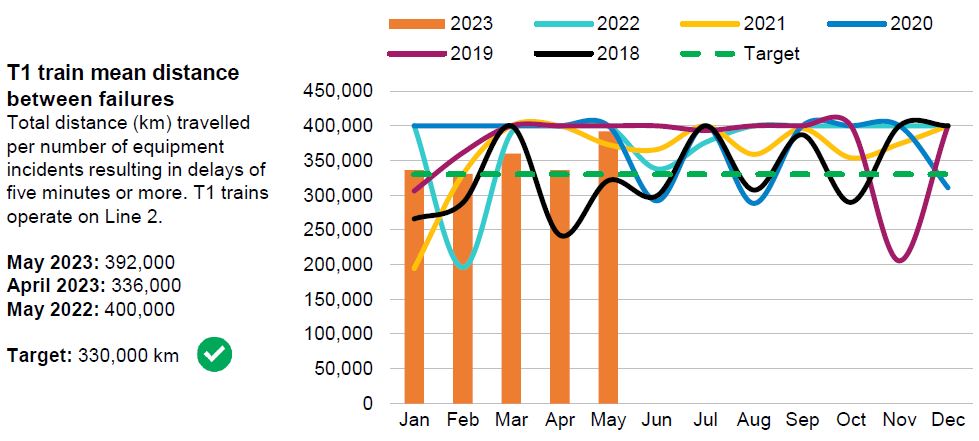
The same problem exists with reported subway car reliability numbers that have been capped at 400k and 700k km for T1 and TR trains respectively.
A further problem with reported failure rates is that all fleets have been underutilized during the covid era allowing “problem” equipment to be sidelined with only the most reliable vehicles actually running in service. This begs the question of how much service the TTC could actually field and how reliable that service would be.
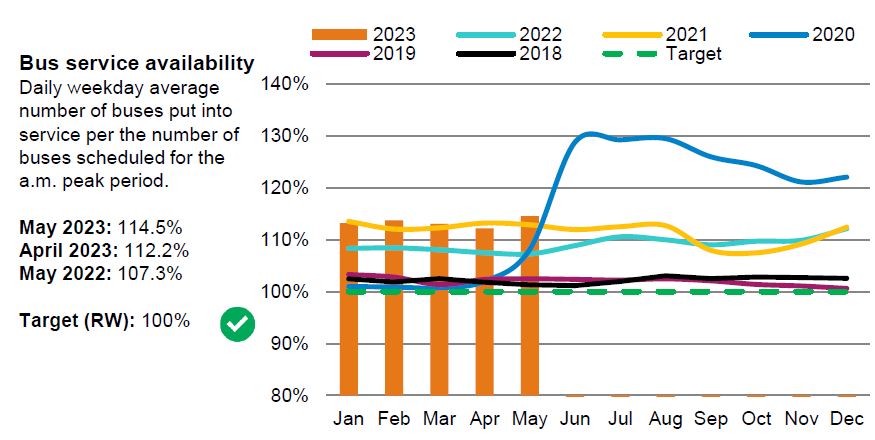
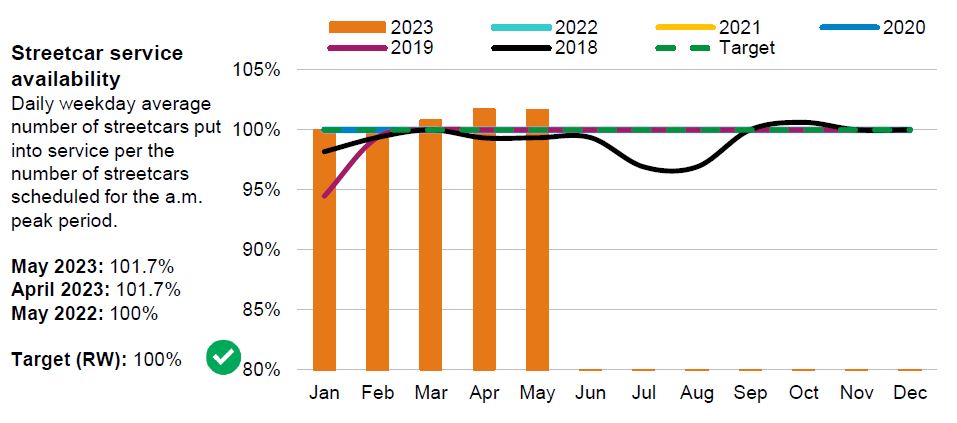
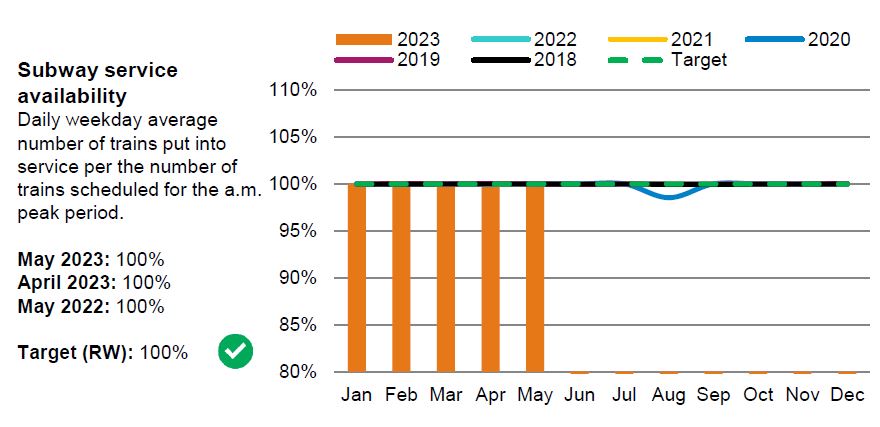
The availability metric shows the ratio of vehicles actually operated to the scheduled service. On the bus system this shows the amount of extra service provided by unscheduled vehicles. During 2020, the proportion of “run as directed” service was high, but this fell back in 2021.
This metric does not show how many vehicles could be available for service if there were budget headroom to operate them. See How Many Buses Does The TTC Use?
Elevator and Escalator Overhauls and Additions
The 2023 Accessibility Plan Update includes a critical warning about future maintenance of elevators.
Installing elevators in every subway station will enable the TTC to meet AODA requirements. However, TTC’s strategy will then focus on maintaining elevators in a state of good repair to provide safe and reliable service to its customers. Service levels cannot be maintained through regular maintenance for elevators that have reached the end of their designed life. At that point, they must be overhauled. Starting in 2024-2025 the TTC will have an average of eight elevators that will have reached the end of their designed life annually, however, funding for the Elevator Overhaul Program currently ends in 2025.
Additional funding will need to be secured in future capital budget processes in order to continue the Elevator Overhaul Program and maintain accessible service for customers.
2023 Accessibility Plan Update, p. 7
This is a classic issue with the introduction of a net new technology to the system. In the short term, the focus is on construction and commissioning of new equipment. Ribbon cuttings and photo ops abound.
Many stations have elevator projects underway, and within a few years, all stations will be “accessible” with an elevator path from platform to street. Ten stations are under study for additional elevators and a business case will follow in a future capital plan (the next one will appear as part of the 2024 budget cycle).
However, the elevators we now take more or less for granted are starting to wear out, but major overhauls are not in the long-term budget even though these will be a continuing cost.
Far more pervasive, and much older than the elevators, is the TTC’s fleet of over 330 escalators, the largest in Canada. That statistic will probably be a surprise to many riders who ask “why isn’t there an escalator here” or “why is there only an escalator running up, but not down”. Some escalators did not exist when their stations were built, and have oddities such as a few steps at their base caused by structural limits of a retrofit location. (My home station, Broadview, has one of those.)
Like the elevators, escalators wear out and require overhaul and replacement.
The TTC now plans to replace four escalators at Yorkdale and King stations to improve reliability and reduce unplanned outages for its customers who rely on these devices. Completion of the replacement of two escalators at Spadina and one escalator at Broadview was deferred from the original 2023 target due to the longer-than-expected duration to finalize the design and procurement process. Replacement of these three escalators is now expected to start in 2023 and is anticipated to be completed in 2025. The TTC also continues to overhaul approximately five-to-seven escalators per year to maintain reliable service for our customers.
2023 Accessibility Plan Update, p. 8
The text above is slightly out of date in that the work at Yorkdale is underway and a new escalator at King was scheduled to recently entered service, but this has been delayed (again) until September 2023. Escalator overhauls are performed by TTC workers, but replacements will be contracted out to escalator suppliers.
Escalators at Spadina, built by Hitachi, date from 1978, and replacement parts are no longer available.
Seven overhauls per year represents a cycle of over 45 years, but as the fleet ages the rate will likely grow. The “demographics” of the fleet are “lumpy” because escalators were installed in groups as part of subway expansion projects.
Escalator and elevator overhauls are time consuming, and when any of them is out of service this affects the accessibility of a station. The TTC may achieve 100% compliance with accessibility legislation for its installed base of devices, but some units will always be under repair causing accessibility gaps in the network for extended periods.
Wheel-Trans Transformation 2023 Program Update
Reports:
The Wheel-Trans service accounts for almost $143-million in the TTC’s 2023 Operating Budget, of which less than $6.5-million is expected to be recovered from fares. The remaining $136-million will be covered by the City of Toronto, and there is no subsidy from other governments except, possibly, a small contribution under the vestiges of the covid relief programs.
Since 2017, the TTC’s Wheel-Trans Transformation Program sought to contain cost growth due to two related factors: an aging population plus legislated changes in eligibility would increase the proportion of TTC’s riders requiring accessible service. This would be achieved by shifting as much demand as possible away from the van and taxi based services to trips that could be partly completed on the regular TTC network. This model is called the “Family of Services” or FOS.
There is little doubt that the primary objective was financial and a chart in the presentation deck for this report shows the savings claimed for FOS.
Based on long-term continued growing demand for accessible transit services, the WTTP has been essential in avoiding significant operating costs, estimated at $24.4 million in 2022 and a cumulative total of $89.7 million. This estimate is based on Family of Services rides which used a combination of Wheel-Trans and accessible-conventional services for a rider to reach their destination as well as an estimate of rides taken entirely on the conventional system by Wheel-Trans registrants.
Wheel-Trans Transformation 2023 Update (p. 2)
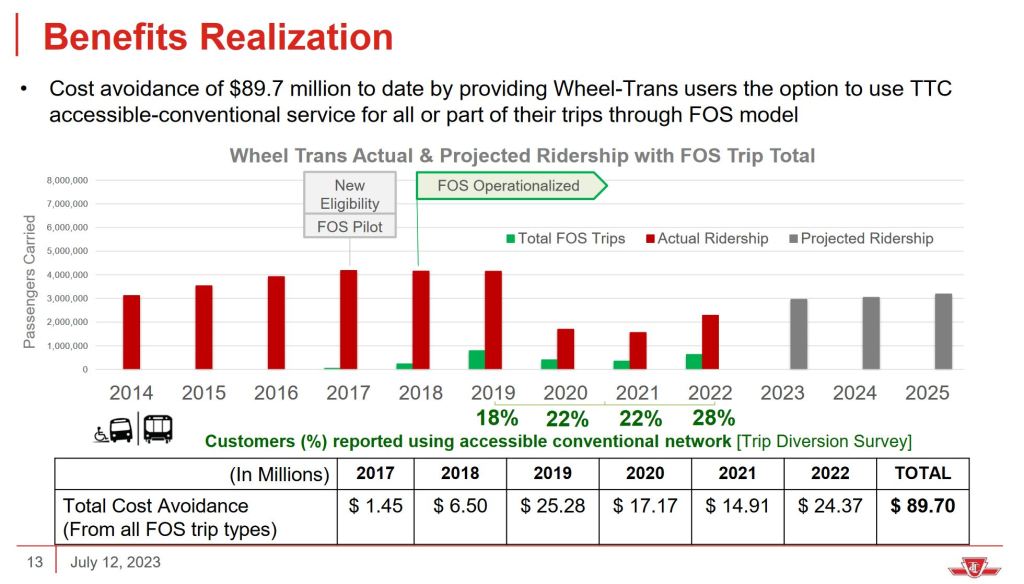
Some of the overall cost reduction since 2017 is due to lower demand in the pandemic era, but as the chart above shows, the TTC does not project a return to pre-covid WT demand even by 2025. This runs counter to demographics and a policy environment that should generate more demand.
To put this in context, the 2016 WT Operating budget was $123.7-million, and it was projected to jump in 2017 to $151.2-million based on strong ridership growth. In the budget process, the City proposed no growth in subsidy from the 2016 level of $116-million, and clearly the planned figure would not be attainable. City funding constraints also threatened the regular system’s operating budget.
In the end, the budgeted City subsidy did rise in 2017 to $142.7-million. However, the TTC actually underspent in 2017 and $17-million of the budgeted WT subsidy was not required.
The same problem appeared going into the 2018 budget with less than $1-million in planned additional subsidy. In 2018, the TTC underspent on WT by $11.5-million compared to the budgeted level.
This is not uncommon: an agency will budget for a service and funding level, but will not actually deliver due to pressure from the City to help with a year-end budget problem. When reviewing spending, it is vital to look at actual spending from the financial statements, not at budgets. These statements show what the TTC actually did, not inflated plans that were not achieved.

At the risk of hammering home the obvious, the City subsidy, which effectively dictates the scope of WT operations, is only now, in 2023, higher than it was in 2017. A good deal of the “saving” is due to the cost avoidance of the FOS program. This was not a case of bringing an efficiency which could allow more service to be provided to more riders, but of capping and reducing the WT call on City resources.
TTC management speaks of a “sustainable” WT service, but this refers to the level of financial demand on the City. They note the substantial growth in FOS trips in 2022 (about 350K to 603K), but neglect to state this relative to substantial demand growth as pandemic effects lessened. It is not clear what part of this growth represents uptake of FOS as a travel concept, versus overall growth in travel by various modes.
The TTC plans a trial in summer 2023 where 50 volunteer riders will travel at least partly via FOS for their regular travel to provide feedback and “lessons learned” looking ahead to a wider roll-out. One might wonder about the thousands of riders already using FOS (willingly or not) and why the TTC is only now conducting a trial for formal feedback. After this pilot, the TTC claims it will move to automatically scheduling FOS trips.
The TTC presents the FOS model in the context of provincial legislation:
Every specialized transportation service provider shall have three categories of eligibility to qualify for specialized transportation services:
(a) unconditional eligibility;
(b) temporary eligibility; and
(c) conditional eligibility. O. Reg. 191/11, s. 63 (1)[…]
A specialized transportation service provider may deny requests for specialized transportation services to persons who are categorized as having temporary eligibility or conditional eligibility if the conventional transportation service is accessible to the person and the person has the ability to use it. – O. Reg. 191/11, s. 63 (3).
A key phrase here is “may deny requests”. Although the TTC might present their quandary as “the devil made me do it”, this is a matter of local option, not one imposed by the Province.
TTC management says that in future years trips will be “automatically scheduled according to a customer’s specific eligibility and conditions”. However, a point raised repeatedly over the years is that a rider’s condition can change, and an evaluation “today” might not be valid “tomorrow” or even later the same day.
Van based trips are expensive, taxis less so, but both considerably exceed the cost of moving a rider on the conventional system. To the degree that WT trips can be shifted to the regular network, this saves money for the TTC and hence for the City. One could argue that this saving could translate into more service, but the clear aim is to save money. None of the reports discusses additional trips that were funded because some WT users travelled by regular transit leaving resources for others.
Ever since the FOS scheme began, there have been many complaints about how effective it really was, and whether riders were forced to use a less accessible and less convenient service. This is compounded by the need for all new WT registrants to prove that they have unconditional eligibility, and for existing users to re-establish their status. That is not a straightforward process.
A further problem is that the conventional system now suffers from service cuts, irregular vehicle spacing and crowding. The underlying premise of FOS is that the system has capacity, especially off peak, to handle additional trips by part-time WT riders. However, with the service standards implemented by management in the 2023 budget, there is less surplus space for off-peak riding on busy routes. Riders with canes or walkers cannot just squeeze on.
“FOS travel remains completely voluntary at this time.” That line was something of a mantra to TTC management, but at one point Cameron Penman, the head of Wheel-Trans tipped their hand with a remark that “It is our intention at some point to make FOS travel mandatory, but at this time there is no date for that”. CEO Rick Leary jumped in to emphasize that he would never force WT users onto the FOS model, and that it would be a Board policy decision. He stressed that 28% of WT registrants are already using FOS, but it does not follow that this will apply to all who have only “conditional” status.
Management was clearly headed down the same path that brought a change to Service Standards to the 2023 Budget with no consultation nor reference to the Board for policy direction. Penman stated that “we are doing everything we can right now to ensure that we are ready” for full FOS implementation.
Councillor/Commissioner Moise asked if the three category scheme was a cost saving measure, and Penman replied that, no, it comes from AODA requirements. This directly contradicts the statement on page 2 quoted above where Wheel-Trans Transformation, of which FOS is a key part, is described as “essential in avoiding significant operating costs”.
They really should get their story straight.
Moise observed that as the population ages, the TTC will have to be nimble in reacting to changing needs. The lack of, or missed, communications is a common problem with TTC. He gets a lot of messages and emails, and winds up clarifying a lot of things for people. Engaging with riders is important, Moise commented, and the service is for them, not for us.
Notes From the Deputations
Anyone wishing to view the full deputations, staff presentation and questions from the Board can do so on YouTube. The link here picks up with the regular report from the Advisory Committee on Accessible Transit (ACAT) and then continues into the FOS issues.
Erica Tanny, Vice-Chair of ACAT raised several issues:
- There is a problem with a mismatch between riders’ actual experiences and TTC claims of action.
- On Line 2, the emergency notification system is still out of reach for riders in chairs.
- There is a malaise among the disabled and seniors who feel that they are vulnerable.
- There are issues with the re-registration of WT users, and legacy riders feel they are being placed in a more restrictive category.
- Transit construction projects and diversions have issues with accessibility including messaging and signage, as well as inaudible announcements.
- Projects like the Ontario Line are causing disruptions even for work that is not scheduled until 2025. These disruptions should not be unduly broad.
- ACAT continues to be excluded from providing input on TTC/Metrolinx projects. On the Scarborough project they have serious concerns and rejected parts of the design. ACAT has not yet seen any plans for wayfinding, and there is generally unnecessary secrecy and a lack of engagement at the beginning of projects when designs are still open to change.
Deputations by others reported a variety of problems related to the FOS program:
- One rider started their application process in January, waited two months for their doctor’s response, mailed it to the TTC on March 28, and on May 8 received a response dated April 12 with 30 days to appeal from that date.
- TTC staff later confirmed that the appeal period has been extended to 90 days, but this does not explain the lag between the date of a notice and its receipt by the applicant.
- The same rider noted that there was an override for the FOS option at the bottom of the booking screen assuming someone scrolled down that far, and wondered if this option would be removed.
- FOS is a major concern for riders and trips take twice what a door-to-door service would provide. There are problems with WT timeliness and the time added to make connections.
- People feel that they do not have a choice, that they should accept FOS without question and do what they are told. FOS might work for some riders, but not necessarily for all.
- There should be all day surface buses paralleling the Line 1 and 2 subway routes for people who are uncomfortable going underground.
- Elevator buttons cannot be reached by all riders.
- A rider was twice stranded making a connection to the subway: once because service was suspended, and once because they were taken to a non-accessible entrance.
- Benches may not be available at locations where riders are dropped off for connections.
- Some WT drivers do not know how to get into subway stations for transfer connections.
- Depending on day-to-day conditions, a WT user may be walking without a cane, and might be challenged for their eligibility. The category of a rider and the type of service they might need can change from time to time even during a trip.
- FOS is primarily designed as a cost-cutting measure in the face of increased eligibility in 2025, and the TTC has an internal target of 50% diversion of WT rides to FOS trips.
- The reassessment process is convoluted with a difficult appeal process. Decisions about the type of service a rider needs should not be taken out of their hands.


Exactly the message that needs to be delivered to Metrolinx and far too many other public transportation systems across North America, Steve. Enough with the self-inflated press releases that fool no one!
LikeLiked by 2 people
Huh? No mention of service cuts?
Steve: The shortfall in riding is in the early months when weather was a factor and before the service cuts were implemented.
LikeLike
Maybe I’m overthinking this. But the last board meeting, Rick Leary looked like he was defending himself more than usual. Especially when there was talk of family of services , with the mix of wheel trans and conventional trips to get to a destination. He also had a mentor and friend talk about him and the work he’s done. And the work needed for minorities in transit. The tune definitely changed. He also didn’t elaborate on the conversation he had with Olivia Chow. Just that they had a conversation. Again , I’m probably over thinking this. But I think Rick Leary knows his time is coming to an end. And I expect there to be a new set of ppl on the TTC board very soon.
When is Rick Leary contract finished? And how realistic can he be replaced by the end of this year? Based on past history , GM/CEOs last about 5 years. And I believe this past June was Rick Learys 5th year. I’m sure his contract is up, and there should be no financial penalty to get rid of him. I doubt Olivia wants a Webster repeat on her watch. I guess the bigger question is, do they have an idea of who they want as CEO or are will they openly look for a replacement? And I believe this should be the next biggest focus point for TTC and Olivia, and in time for next year’s budget is crucial. Olivia only has 3 years, she can’t waste time on this.
Steve: Yes, Leary seems to be polishing his reputation in advance of a new regime.
LikeLiked by 1 person
Given, as stated elsewhere, that many streetcars don’t have automated passenger counters, and that streetcars will have a lot of short-distance on/off riding, I wonder how accurate the streetcar loading counts really are.
Additionally, I would assume they factor in loading on the replacement buses, else they’d have to pro-rate the shrunken operated-by-streetcar streetcar routes. But some of the replacement buses kind of replace other routes as well, so that’s another source of, basically random numbers posing as statistics.
Steve: They use Presto taps as a surrogate for passenger counts factored up by an assumed no-tap rate. Of course this has big problems at locations with free transfers – subway stations – where there are no taps, and some of the bus to streetcar transfers that happen simply by opening the doors and letting everyone on. And, yes, there is the problem that counts on buses need to be properly allocated, but as they are supposed to be tracking at the route level, this should pick up the scheduled buses. As for the unscheduled ones, well, that’s a problem.
LikeLike
Have you received the memo for the july 30 board period changes yet?
Steve: No.
LikeLike
This, almost for sure, not the right place to post this. And I have to sincerely apologize to Steve (no need to post this comment if you don’t feel it’s relevant!) that my interaction of late has mostly been complaints about the TTC.
But on the 1% chance that the board actually reads this…*come on*.
Some background – I swear, I love the TTC. I really do. My friends make fun of me for it. I’ll espouse how they’re the highest revenue generating transit agency in North America. How the Yonge line carries more passengers than any other single subway line in North America (Lexington carries more combined, but across three routes – the 4, 5, and 6 – compared to just one on Yonge). How our bus network is lauded as one of the best networks west of the Atlantic. In short, my friends joke that I’m a TTC fanboy.
Which brings me to tonight. Every single possible thing that could have gone wrong, did. And I am struggling, much as I’d like, to keep defending the TTC. Since my wife and I moved out to the east end of town (we used to be right at the CN tower) at the start of the pandemic, our transit usage has plummeted, as we now live in a walkable neighborhood very close to work. But whenever we go downtown, or to the airport, or to the doctors, we try to take the TTC. The thing is – and we’ve been keeping track – nearly *half* of the trips we’ve taken have either not made it, or have made it but with sincere discomfort or risk. I’ve walked home from Broadview to Woodbine multiple times, as already documented here. That’s an HOUR walk without service. We’ve had subway trains decommissioned without shuttles coming home from the airport twice, leaving downtown at rush hour, and trying to visit a friend. Multiple drunks have harassed us for change or my wife for more. People with mental health issues have assaulted drivers or passengers or just screamed in front of people. The experience has gone from something I used to relish and love, to something I’ve found myself trying to justify.
Tonight, for me, was the final straw. I saw a movie at Scotiabank with a friend. We had a late dinner after. We walked to Yonge and King together – they live close by, and I was going to subway home since the 501 is no longer the best option home given the various diversions.
We made it to Dundas. The doors stayed open. I asked the driver politely, and they were – as most TTC employees are – exceptionally polite and helpful, to the best of their ability. “There was a fight on the platform, we’re just holding until the police clear, it should be over soon”.
Then the train got evacuated to the platform. Then the platform got evacuated with explicit orders to avoid the south end of the platform and the police. Keep in mind this is at Dundas station, where the only exit is the south end of the platform…and the police are trying to conceal the disturbing amount of blood on the platform and doors.
Then we get told that trains will take us northbound, from the southbound platform. The entire evacuated trainload therefore makes their way to the southbound platform. As it turns out, most of the speakers are broken in the station, and the ones that work are so quiet you can barely hear them – so almost everyone misses the announcement that they are now actually evacuating the station entirely, and trains *aren’t’* stopping for northbound – directly in contradiction to TTC staff and twitter notices. As the first, and then second train roll through without stopping, people get anxious and upset. FINALLY staff realize no one knows what’s happening, and direct them to evacuate the station…
…only to be told by more TTC staff on the street that everyone needs to clear Dundas square back into the station, as the police are conducting an investigation in Dundas square, and trains will take us north from the station! I politely informed them that actually, TTC staff in the station were telling us to evacuate for the exact same reason, and that trains are *not* stopping. It took photographic evidence, which they wanted to take pictures of off my phone, to convince them.
In short – my main route is no longer operating properly. My diversion onto the subway resulted in horrific violence, a complete lack of communication, broken infrastructure exacerbating the problem, and after nearly 90 minutes with no solution I finally had to take an Uber home. To those who care about the TTC – I am *desperately* trying to keep the faith. But I can’t be this unlucky. When nearly half the trips I take either result in violence, discomfort, or cancellation…it is no longer a viable option 😥
LikeLike
All routes are messed up to some degree. I would have said to take the 503 eastbound to Woodbine but I waited at Yonge for an eastbounder a few evenings ago. Thirty minutes later and nothing came.
Still though, heading down to King would give you a chance to catch streetcars making carhouse moves to Russell or Leslie. Those actually seem to be a more common sight than 501’s or 503’s.
I can’t wait for July 30th when these vehicles are no longer invisible and become trackable and I can confirm what I already know about hour long gaps being common on a route that is allegedly a part of the 10 minute network.
Steve: It is really appalling that the TTC only this year, with so many changes to routes, has begun to acknowledge the problems this causes for riders looking for service. There is no projected date for when this will be fixed. It was a long-standing problem with the original tracking system called CIS, and it was not corrected as part of the spec for the more recent Vision software.
LikeLike