
At the TTC Board meeting on July 12, 2023, there was a brief discussion of the problem of short turns on streetcar lines. The information provided by management was, shall we say, less than a full accounting of what is actually going on.
This issue flared up many years ago particularly with short turns of service in The Beach among other areas, and in general a problem with erratic, gap-filled service on the outer ends of routes. TTC management committed to reducing or eliminating this problem, and to that end there was a “no short turns” policy that everybody seemed to know about at the operational level, but which was officially denied.
The stats did go down, but looking under the covers showed that not all was well:
- Short turns are a bona fide service management tactic for dealing with delays to restore even spacing of service. There is nothing wrong with a short turn of some cars in a parade because this will restore service sooner than if every car trundles to the terminal and they return in a pack.
- The official count of short turns fell to almost zero. However, this was due in part to selective reporting that was clear to (a) anyone actually riding the system and (b) anyone looking at vehicle tracking data.
Rick Leary got the equivalent of a gold star from the Board who frankly did not know any better, but occasionally wondered why claims of improved service did not align with complaints from constituents. The standard excuses for occasional upsets due to congestion and construction were regularly trotted out even though service could be erratic at times and locations when these were clearly impossible.
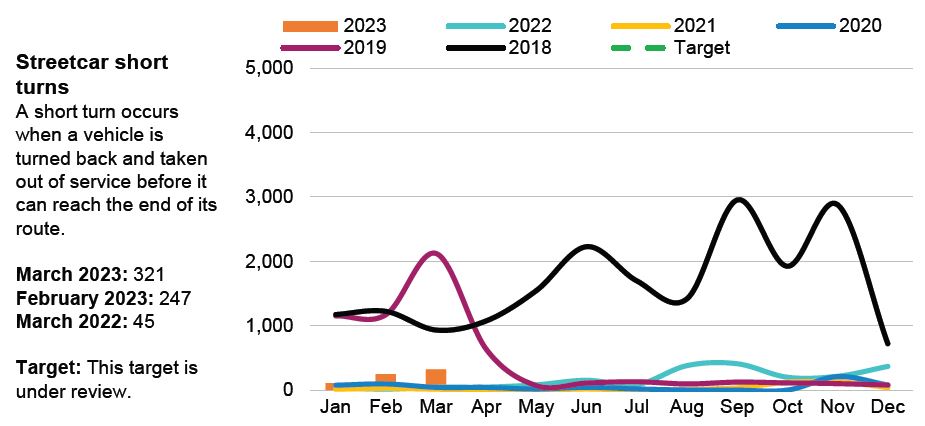
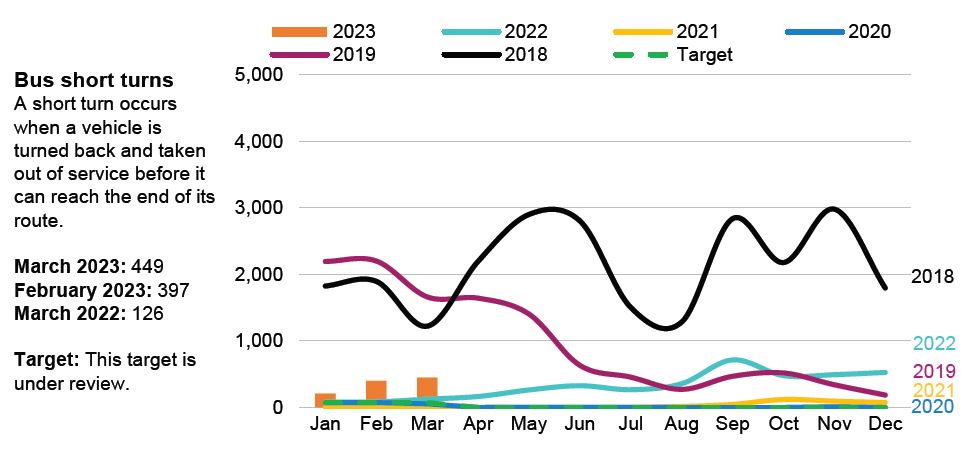
The charts below from the July 2023 CEO’s Report show the official count of short turns on the streetcar and bus network. An important factor in comparing the two is that the buses overall have many routes where congestion and construction do not affect most, if any, trips. The figures are not broken out by route to flag the “bad actors”. Moreover, the values are presented as a percentage of all trips so that time-of-day effects are hidden.
The “no short turns” policy implementation is quite clear in the data from Fall 2018 through Spring 2019. In reviewing actual short turn counts from tracking data, I have found that the values are consistently under-reported, and they do not represent actual conditions. For example, the proportion of service outbound on 501 Queen from downtown (as counted at Woodbine vs Greenwood) reaching Neville Park ranges from 100% to below 50% in January to June 2023.
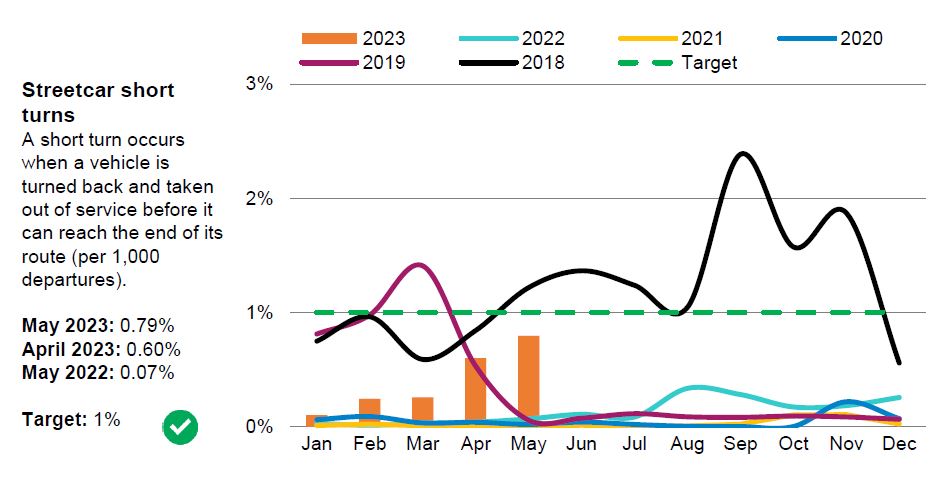
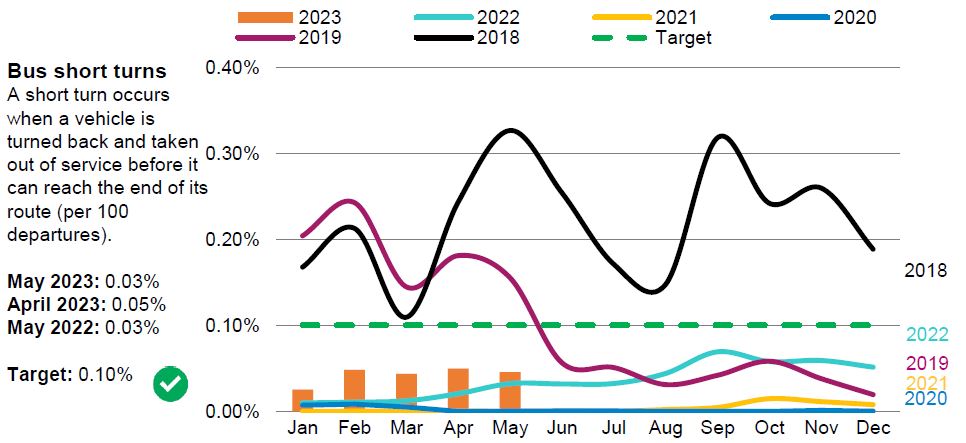
Updated July 15, 2023: In June 2023, the TTC changed its reporting of short turns from an absolute number to a percentage. The scale of these charts does not make sense because the streetcar chart claims it is per 1000 departures, but cites a percentage (per 100). For comparison, the May 2023 charts are below.
I have written many times on this site about service quality and there are many factors at play including:
- Unreasonably short or long scheduled travel times. This may sound like an odd pairing, but both can produce erratic service.
- Too short times lead to short turns to keep operators on time especially for crew changes.
- Too long times lead to extended layovers at terminals.
- Lack of headway discipline at terminals and along routes.
- Lack of headway management for vehicles re-entering service from a short turn to “split” a gap rather than simply running behind a through vehicle and carrying few passengers.
There are, of course, ad hoc situations where accidents, short-term construction or special events produce conditions that are not “standard”. These are normal and have to be managed to the degree possible. One side effect of the overall reduction in service on streetcar lines to a 10 minute level on many routes is that there is no spare capacity when delays occur, and wider headways make the effect on riders of any missing vehicle (either not in service or short-turned) greater.
This is not the first time the system encountered that problem, and tuning out surplus capacity has been a generic issue across the network any time budget “efficiency” takes precedence over service. The phrase “adjusting service to meet demand” goes back over four decades.
Service standards that allow for some empty space on vehicles are important because they guarantee some flexibility to absorb small problems without service collapsing. An analogy for motorists is that a highway totally jammed with cars does not move traffic at all well, and some empty space is necessary to ensure the road is usable. On transit, empty space is viewed as waste while on our roads no congestion is a holy grail.
The remainder of this article reviews the short-turning situation on most streetcar routes and the underlying causes.
Continue reading Steve Munro