
In today’s Toronto Star, Tess Kalinowski writes about recently released Metrolinx reports concerning the Union Pearson Express (UPX).
The items of interest are down at the bottom of the Reports & Information page and they include ridership forecasts from December 2011 and May 2013. The latter report was cited as background to the Auditor General’s 2012 Report on Metrolinx [beginning on p. 6 of the pdf].
Given that the projection is almost two years old, one might be tempted to say “maybe things have improved”, but that’s a tad hard to believe in the absence of any newer studies from Metrolinx.
There are great hopes, and even greater hype, for the UPX, and getting some basic information on the table is certainly worthwhile.
Commercial Confidentiality
Sections of the forecasts have been redacted by Metrolinx “to protect economic and other interests”, and the missing data appear to be entirely concerned with revenue projections and fare levels. How exactly this is applicable is quite a mystery considering that Metrolinx is a public agency and we are not dealing here with a privately operated UPX or a 3P, the very model that was abandoned because the “private partner” didn’t think the line could make money.
Metrolinx and, through them, Queen’s Park are hiding behind confidentiality provisions to save themselves from criticism over fares and costs, but we can get at that by other ways, notably in the Provincial Auditor’s Report (discussed at the end of this article).
Metrolinx owes the public a clear statement of just what “economic and other interests” are being protected other than the threadbare reputation of politicians who have staked much on this project.
December 2011 Forecasts
The first step in estimating ridership is to look at the overall projected use of the airport. The chart below starts with projected demand in 2020 and then carves away travellers who are not in the potential market for UPX services.
Of the projected 40.8-million airport users, 10.9m are captive to the airport because they are changing between flights. A small number, 1.8m, will be arriving or leaving during hours the UPX is not running. The next large block, 14.9m (36.5%) originate from or travel to locations the UPX does not serve. Another small block, 1.3m, use private shuttles such as links to hotels. This leaves 11.8m (28.9%) of airport users as potential UPX passengers. Of these, the overwhelming majority now use taxis or drop offs/pick ups for transport to/from the airport. This is the market UPX seeks to tap in its aim of reducing road congestion and associated problems such as pollution.
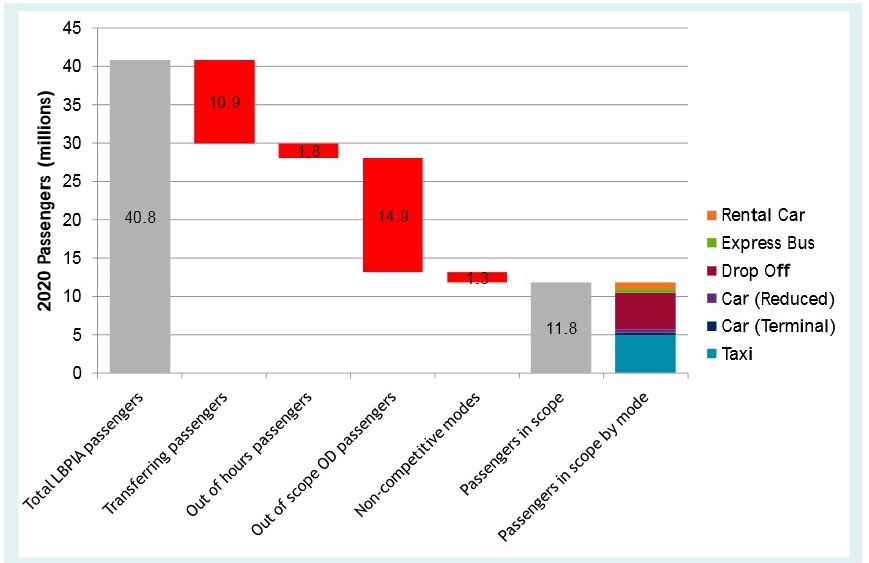
Based on surveys of travellers in 2009, the passengers were reassigned by mode to show the effect of the UPX.
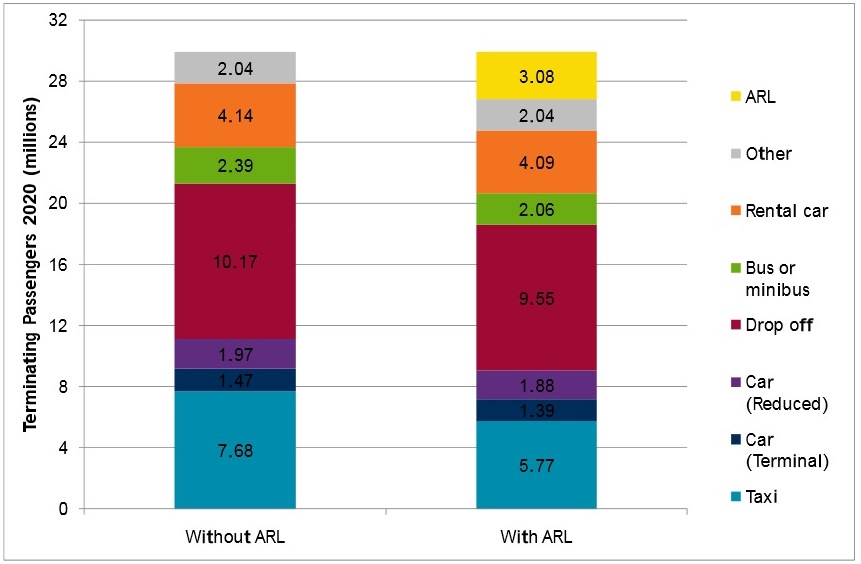
This chart considers all of 29.86m passengers who are not transferring at the airport, and predicts that the ARL would capture 3.08m trips. What the chart does not tell us is the distribution of trips within and outside of the potential scope for UPX riders (the 11.8m above). Note that the thickness of the bands in the first chart (in scope trips) is different from the bands in the “without ARL” column in the second chart (all trips). “Rental car” is a noticeably thinner slice for in scope riders than for airport trips in general. This probably reflects the comparative difficulty of reaching locations that are not downtown and the need for personal transportation once someone gets there.
In any event, UPX (labelled “ARL” above from its original name “Air Rail Link”) manages to pick up 3.08m trips which is 26% of its in scope market, or 10.3% of all trips to/from the airport. Most of these are to/from downtown, and so these can reasonably be assumed to be auto/taxi journeys diverted from the 427/QEW/Gardiner route.
The report estimates that the UPX riders have been diverted from other modes: 62% from taxis, 11% from an express bus and 27% from a car (rentals, drop-offs, parking).
Ridership on UPX is projected to begin at 1.35m for the 2015 partial year (April 5 to December 31), and ramp up to a “mature” level of 2.97m annually in 2018. Thereafter, growth at 1.4% per annum is projected (based on experience with other similar systems worldwide) to a 2031 value of 3.57m.
A much more generous view of ridership was assumed in the Neptis Foundation report authored by Michael Schabas. In that report, which included quite rosy projections for the financial health of UPX, Schabas begins with a presumed 2015 ridership of 3m (annualized basis) with ridership doubling by 2023 and doubling again by 2033. This is vastly more riders than projected by Steer Davies Gleave in the Metrolinx study.
Part of the black art of ridership estimates is a projection of the “capture rate” for airport trips from various parts of the city. If there would be 100 trips to the airport from an area, how many of these would likely be picked up by UPX?
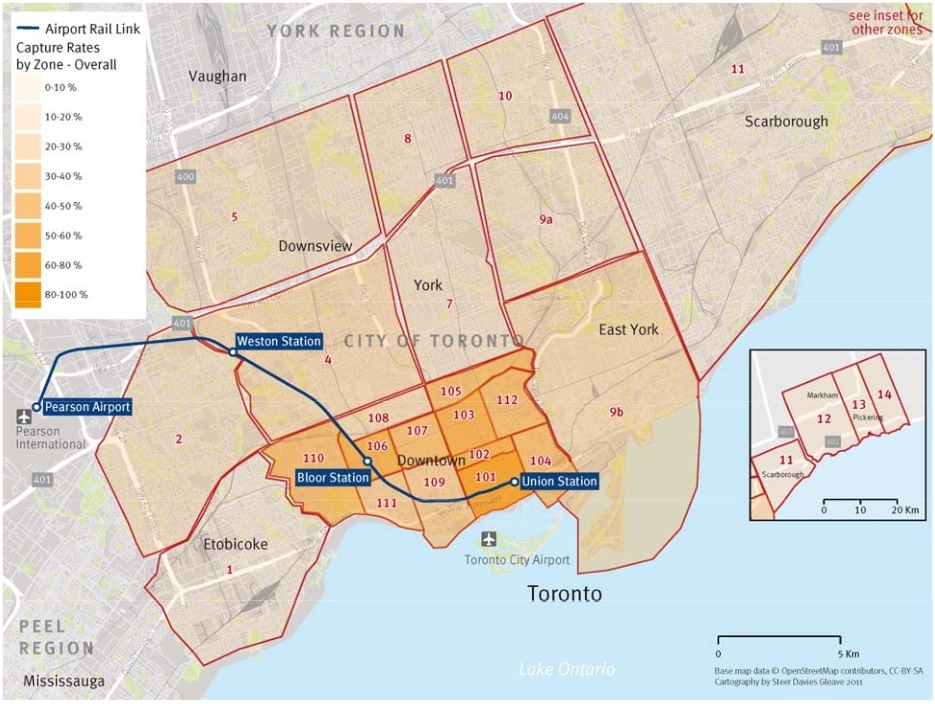
A high capture rate is predicted for downtown at 68% (note that although the chart includes a legend for 80-100%, no zone actually achieves this level). In other words, for every 100 trips to the airport from to/downtown, 68 are expected to use UPX. The proportion at Bloor Station is high too:
… capture rates are high at 53% reflecting the highly competitive nature of the ARL compared to other competing modes for those travelling to or from this area. [p. 18]
This is certainly wishful thinking because unlike a businessman downtown who would probably walk to Union Station, riders along the Bloor subway corridor are far more likely to get on the subway and, having done so, simply continue west to Kipling and the TTC’s 192 Rocket service. A related problem here is that there is no direct connection from Dundas West Station to the UPX platform. Metrolinx has even proposed a scheme to rejig (one might say “gerrymander”) Dundas West Station simply to improve the surface link between the subway and the GO/UPX station. It is worth noting that SDG explicitly states:
The ARL station at Bloor will be easy to access and have a good interchange with other transit modes. [p. 20]
They presume that in the absence of a good connection at Bloor UPX station, riders would backtrack to Union rather than simply taking the subway plus the 192. This is a rather blinkered view and clearly does not allow for the substantially added access time just to reach Union. (The effect of a longer trip is clear in the sensitivity analysis later in the report.)
Hourly demands over the day are projected from the known travel patterns at the airport (hourly volumes, trip times adjusted relative to flight times to allow for security clearance and baggage handling, variation in proportion of trips types by time of day) to produce a projected demand level for UPX in its first year.
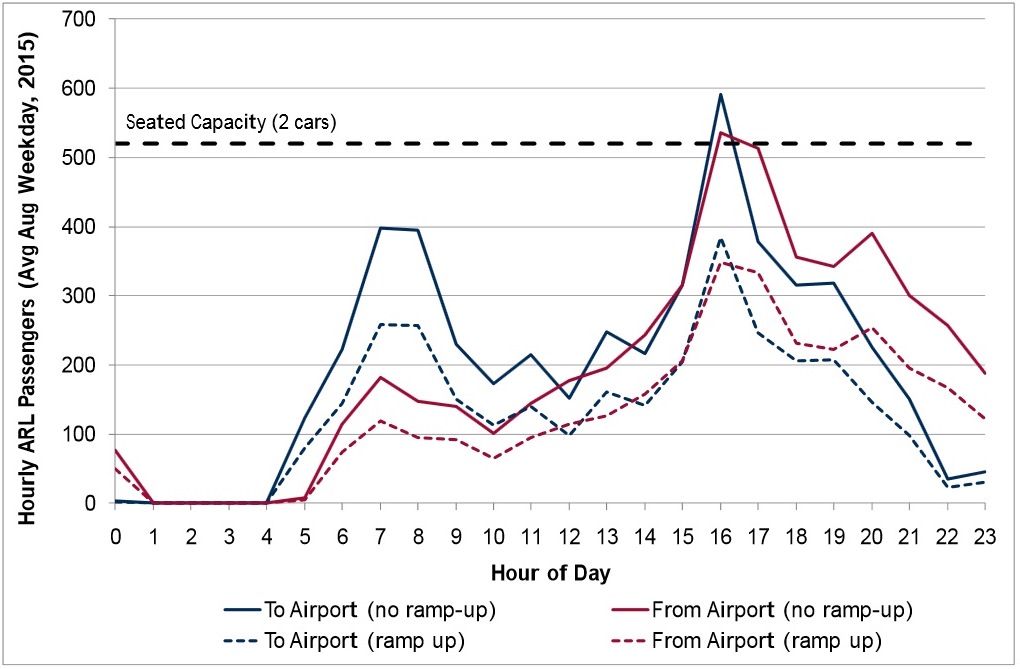
The first chart shows projected demand on a typical day for traffic to and from the airport. This is well within the capacity of two-car trains. (The “ramp-up” scenario below presumes that traffic does not build immediately to the full projected level. Given that much of the traffic will be to/from downtown, this chart is also a good indication of the number of trips that will be removed from the road network by time of day.
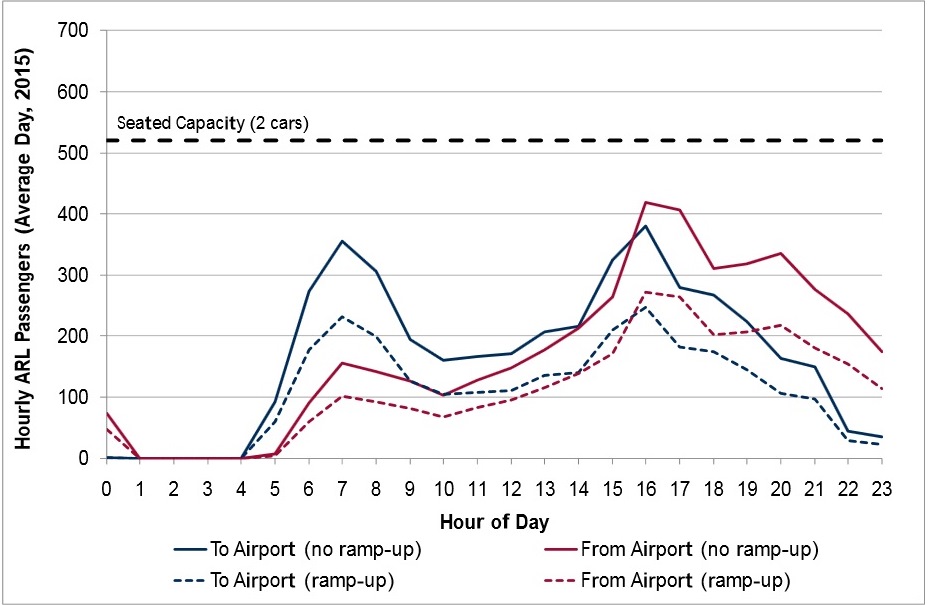
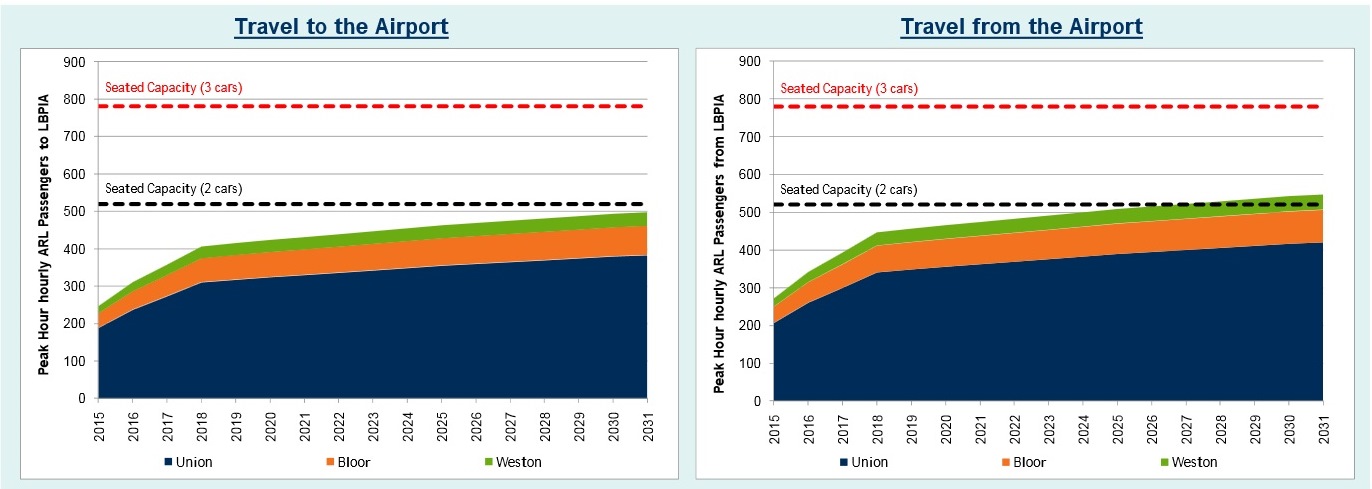
August is a heavy travel month, and the projected peak demand for it is shown below. This would take UPX either into standees (hardly a “premium” service) or a need for three-car trains.
Usage by station shows a very heavy skew to Union as the primary origin and destination.
Finally, the report considers the effect of altering assumptions in the model.
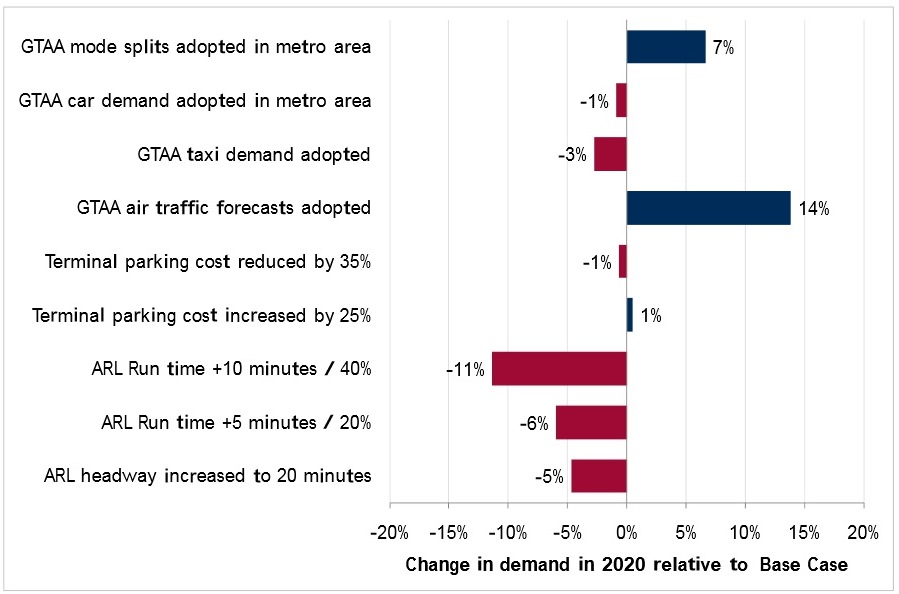
It is intriguing to note that the Greater Toronto Airport Authority (GTAA) who run Pearson Airport have different assumptions in their model of airport traffic compared to the Metrolinx study. Notably they have a higher assumed mode share for downtown and they project a higher growth in air travel.
Adopting the GTAA air traffic forecasts leads to a 14% increase in the forecast ridership of the ARL. This is directly related to the fact that the GTAA air traffic forecasts are greater than the ones that have been developed by us for this study.
Use of other GTAA data to change the demand composition of the in-scope market has a number of small impacts, the biggest being the impact of the GTAA mode shares for the downtown metro area of Toronto which increases ridership forecasts by 7%. [p. 24]
Increasing the travel time has a negative impact on projected ridership. This is worth noting in the context of a proposed connection at Bloor/Dundas West where the existing transfer route would add substantially to trip time and also endure the penalty that transferring and waiting rank far higher than on board time as a deterrent to ridership.
May 2013 Forecasts
By 2013, air travel had grown faster than predicted in the 2011 study, and so future passenger volumes were updated. However, the charts showing projected travel at the airport suggests that this effect is quite small, and for some years the projections are actually lower. [Compare p. 8 of 2011 report with p. 9 of 2013 report]
- 2015: 36.5m in both the 2011 and 2013 projections
- 2020: 40.8m in the 2011 projection, but only 40.6 in 2013
- 2025: 45.0m in the 2011 projection, 45.1m in 2013
- 2030: 48.6m in 2011, 48.9m in 2013
- 2035: 51.3m in 2011, 51.7m in 2013
Some of the change is attributed to the effect of the Island Airport diverting traffic from Pearson.
Some of the competing modes fell in price (allowing for inflation) and this made the proposed (and secret) UPX fares less competitive affecting projected demand. Express buses from downtown were still part of the mix, although these are no longer in the market in 2015.
The chart illustrating the “in scope” demand is almost unchanged in 2013 from 2011. Instead of 11.8m in scope passengers per year, the number is now 11.9m. However, the projected annual demand on the UPX has fallen by 2013 from 3.08m t0 2.46m. about 20%. Much of the UPX loss shows up in the auto categories:
- Drop offs were 9.55m in 2011, but are now 9.73m.
- Taxi trips were 5.77m in 2011, but are now 6.08m.
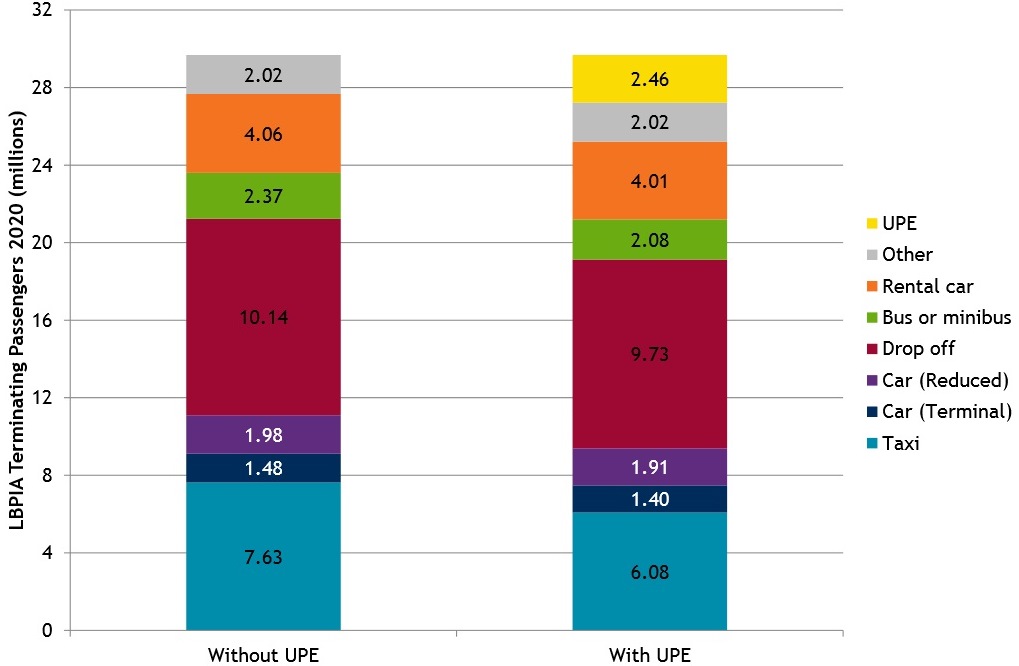
Because the revenue projections are redacted, we do not know how much of an effect the proposed UPX fares have on these numbers, or, indeed, what fare was included in the model, or whether a sensitivity test related to fares was included.
The forecast ridership in 2031 is lower in the 2013 report (2.94m) than the 2020 ridership projected in 2011 (3.08m).
The projected sources of UPX riding (taxis, express bus, auto) are estimated to make roughly the same proportionate contribution in the 2013 report as in 2011.
The projected reduction in car trips is 1.98m per year in 2020 rising to 2.36m in 2031. This may sound like a lot, but it is still under 10% of total traffic to the airport showing how important the provision of much-improve transit access via other routes will be.
In the 2013 study, the capture rate for the market for downtown has been reduced from 68% to 60%. Even so, 73% of demand is expected to come from this area.
Forecast annual ridership is expected to be split between the three stations with 79% at Union, 14% at Bloor and 7% at Weston. This is little changed from the 2011 report.
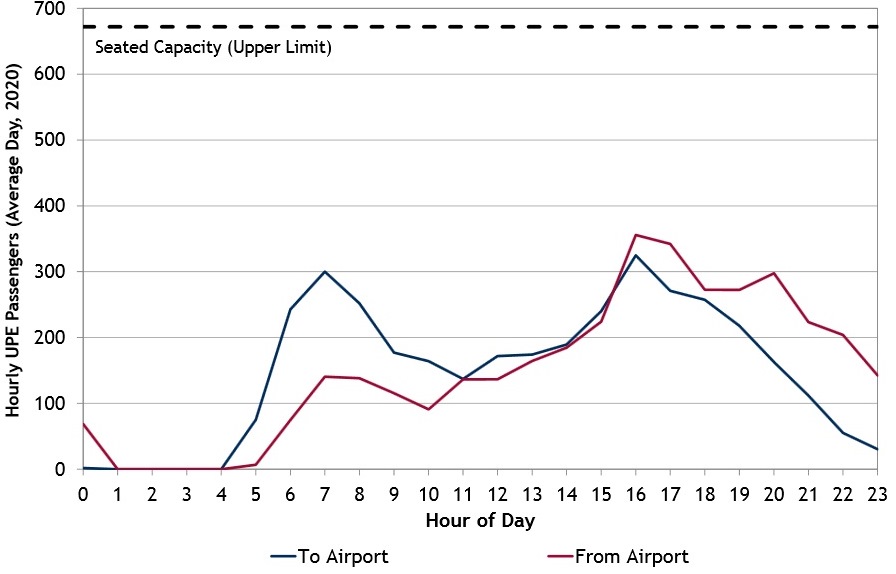
The hourly ridership numbers come nowhere near the seated capacity which is now based on a mix of 2 and 3-car trains.
We have been advised by Metrolinx that the hourly seated capacity will be between 576 and 672, depending on the mix of 2 and 3-car consists. Both are well above forecast hourly demand. [p. 24]
What is even more startling, however, is to compare this chart from the 2013 report with the one in 2011 that showed demand for the opening year, 2015. The projected demand in 2020 is now lower than the originally projected demand in 2015.
Finally, in a look at airports around the world, the 2013 report gives the following comparison for Toronto. In this chart 2020 Toronto projections are compared to recent data from other cities. In other words, Toronto’s numbers are goosed by the inclusion of at least 7 years of ridership and demand growth relative to other cities.
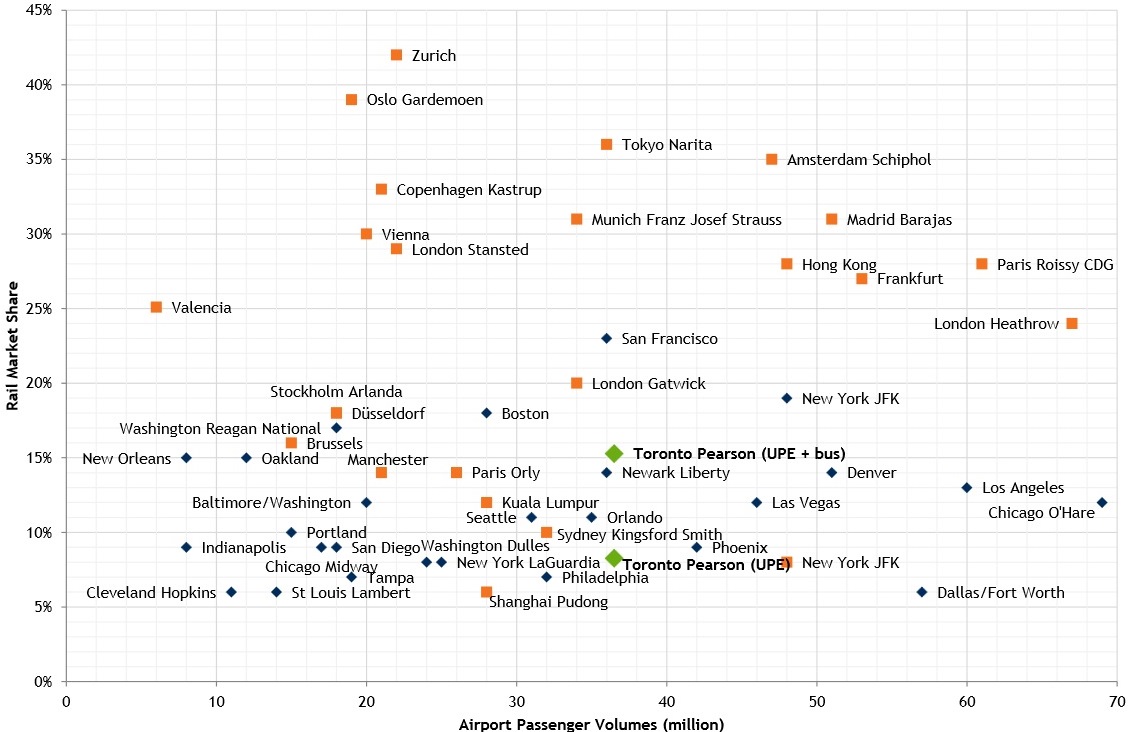
It is rather amusing that a combination of UPX with bus service is included here to show Toronto in a better light for overall transit access. The bus passengers (those who have not been poached away by UPX) were already on transit and do not represent any reduction in road demand or congestion.
This chart is described in unwarranted glowing terms:
With a forecast market share of 8.3% and passenger volumes of 2.5 million in 2020, the UPE in Toronto is comparable with other North American cities such as:
■ Vancouver, served by the Canada Line rapid transit service: 10% rail market share;
■ Chicago Midway, served by Chicago Transit Authority “L” trains: 6% rail and 9% transit overall;
■ Seattle, served by the Link light rail service: overall transit market share of 11%; and
■ Baltimore/Washington, served by a large number of rail services (Amtrak, MARC and a light rail system): 12% transit market share.
We will just ignore the fact that Toronto in 2020 with UPX will be well below Boston’s Logan airport served directly by the local transit system (the Blue Line), and the much better known (and used) Chicago O’Hare airport (also on the Chicago El).
In the conclusion, the report states:
The UPE is forecast to carry 8.3% of the surface access market. This is well within the range of other airports in the world, and in particular North American rail links such as Vancouver and Chicago. [p. 29]
The reader is not supposed to notice that the comparison is actually to Chicago’s minor airport, Midway, not to its primary airport, O’Hare, nor that many other North American airports already outdo the Pearson/UPX combination’s 2020 projections.
The Provincial Auditor’s Report
The Provincial Auditor reviewed, among other things, the question of cost recovery for the UPX operation and capital costs.
At the time of our audit, the province had not specifically required that Metrolinx recover the cost of operating the ARL from revenues that the service generates. The Ministry of Transportation (Ministry) informed us that Metrolinx would set the ARL’s fare in consultation with the province.
If operating the ARL on a break-even basis is indeed the objective, this may prove to be a challenge for Metrolinx. In 2003, Transport Canada announced a private-sector group as the successful Public–Private Partnership (P3) proponent that would design, build and operate the ARL. However, the group was unable to secure financing for the venture because its lenders did not feel that they had sufficient protection from “no market” risk (that is, from a situation where, despite all reasonable efforts to attract riders, the service does not generate enough revenues to be a viable business). They perceived this project to be riskier than other infrastructure projects because there was no “pre-existing demonstrated revenue stream.” The group proposed that the province assume the lenders’ risk by purchasing ARL assets if the “no market” scenario arose. The province rejected this proposal, so the group walked away from the project. In 2010, the government decided that the province, through Metrolinx, would build and operate the ARL itself. [pp. 210-211]
Yes, there are times when a partnership with the private sector just doesn’t work out, especially when the government won’t agree to bail out a losing proposition.
Metrolinx’s preliminary estimate of the ARL’s annual operating cost is approximately $30 million. However, according to Metrolinx, the cost could well be higher, because the service’s exact nature has not been finalized, so some relevant costs may not have been identified yet. For example, the estimate does not include the annual access fee of approximately $5 million that GO Transit was going to charge the private-sector group for using the GO-owned Georgetown South rail corridor. As well, if the fare was to recover the capital cost of the pro-ject over time, we estimate this would approximate $20 million annually over a period of 20 years. If that amount is included as part of the ARL’s operating cost, the total cost to be recovered from fares each year would rise to about $50 million. [p. 212]
Obviously, if UPX is part of Metrolinx, there would not be an internal charge of $5m for the use of GO Transit facilities unless UPX was treated as a cash cow by GO Transit. However, if there were any idea of farming UPX out to a private owner at some point, the question of track usage and other shared costs would be very much an issue.
If we take the annual ridership projections in 2020 of 2.46-3.08m, the cost per trip is on the order of $10 based on that starting cost of $30m. We do not know what additional costs Metrolinx might face that have led them to a standard fare of $27.50 and a Presto-based fare of $19. Metrolinx finances, especially at the detailed level of this one route, are a mystery. Will UPX riders actually be paying the full cost of their service? Will subsidy funds that might have gone to general improvements in GO Transit be diverted to prop up UPX?
The Auditor estimates that a fare of $28 would be required to break even on operations plus capital amortization, and qualifies even that number with concerns about UPX’s ability to achieve market share at a high ticket price.
This does not include the UPX’s share of electrification costs which are still unknown, at least to the public.
Conclusion
The Union Pearson Express was a vanity project for the former Chretien government in Ottawa together with their “partner” SNC Lavalin who were originally to build and operate the line. It then turned into a provincial project under Dalton McGuinty and is now in the hands of the Wynne government. There will be much hoopla, many photo ops, and possibly even some riders. Much effort has been spent over a very long time for a project that should have been delivered as a basic part of the transit system, at most as a branch offering within the GO Transit network.
Much more openness and transparency are required from Metrolinx about this and all of its projects so that informed decisions can be made, up front, about transit investments, subsidies, fares and services. The sham of “commercial confidentiality” must be stripped from these debates.
Part of me wants any transit project to succeed. The worst possible environment for a transit advocate is to spend time explaining that some new line, some new network won’t be like whatever recent debacle happens to preoccupy media and politicians. The projections for UPX are not encouraging.
 Steve Munro
Steve, my concerns with the UPX are the cost (which is at least better for those of us with a PRESTO card) and the time it’s taking to get it up and running. It is now “Spring 2015” and there the service is supposed to be up and running.
The idea of an express service from downtown to the airport works in other cities, and Toronto should have just copied those services from what I can see. If the idea works, why do your own thing – which seems to be what Metrolinx is doing.
However, there is nothing wrong with the service running downtown as a semi express – they do this in other cities like London very successfully.
Steve: Some cities have had stations near airports since before I was born. However, they are no different from any other major node. They should be served, and at a reasonable price, to serve as many as possible. UPX addresses only a small portion of the regional travel demand to the airport at considerable cost while we are told that there is no money for anything else. If this had been a regional rapid transit line serving the west side of Toronto and out to Brampton, I would have no problem with it at all.
LikeLike
All GO Transit/Metrolinx had to do was build a small spur from Malton Station into Pearson and run smaller GO trains – that wouldn’t be rocket science, and would be more respectful and less disruptive to the communities who have had to put up with the construction of the Georgetown South Project. The fact this is even entering service is laughable and disrespectful to the residents of the GTA who need better transit. Not to sound like a certain politician who shall remain nameless, but this really is transit for downtown – most folks are probably going to access it from Union. Some may access from Bloor. Almost none will access it from Weston. I sincerely hope this fails and a year from now is converted to local GO service, and Metrolinx smartens up and extends the Crosstown to Pearson.
LikeLike
Is there any chance they are thinking of pulling a 407 here? It seems like everything possible is being done to keep this a separate piece of infrastructure…and keeping things secret for as long as possible will potentially keep it un-tarnished as far as bad press goes…
Steve: Given the amount of shared infrastructure and the fact that even their own projections don’t show an economic viability to the project, I suspect that if anything we may be seeing vestigial evidence of a previous, but now abandoned scheme.
LikeLike
Steve, thank you for pointing out all the dubious economics in this yet another project of the provincial Liberals. Under the circumstances, would you join me in calling for a police investigation into the project? And no, I don’t mean the OPP controlled by the Wynne government to investigate the Wynne government (we saw how it went with the gas plant scandal investigation by the OPP where Wynne repeatedly refused to meet OPP officers and only after much refusal did she eventually meet with OPP officers over the Sudbury by-election bribery scandal) but I think that the RCMP should look into UPX as should they look into countless other misdeeds of the Ontario Liberals. If you don’t want police investigation into this, then perhaps you should stop complaining about the “Dubious Economics” of the project.
Steve: There is a difference between a project being poorly thought out and mismanaged, and one that is corrupt and requires police investigation. The original blunder was for McGuinty to buy into the idea that UPX was a viable provincial project even after SNC Lavalin walked away from it. Ego got in the way, and Ontario was going to show the world what we’re made of, if only it is a shelf of awards from a self-serving “industry association” of air rail link companies.
I can complain about wasted tax money and misdirected priorities without needing a police investigation.
While you’re railing against the Wynne Liberals, you might pause to give thought to the Conservative gang in Ottawa.
LikeLike
It remains to be seen, but time and reliability also play a huge role. As a fairly frequent flyer, if the train is punctual (and I hope with all the upgrades on the Malton line it is) and the constant switch problems GO seems to have in inclemet weather are avoided, I can not wonder if I have to leave an extra hour early for my flight “just in case” the Gardner is jammed and then spend 1-2 hours passing time away at Pearson’s terrible bars. I’ll be able to leave much closer to departure time. This is the same benefit for same day “in-out” business travellers who like to cut it close as they don’t have to check in luggage.
I also wonder how strong the argument for people switching at Bloor West really is. “Having already paid” for the subway and then being crammed on the currently overcrowded airport bus may be enough to get people into the train and shave off the half hour of TTC travel. Adding $20 to a several hundred dollar plane trip is not all that much of a disincentive, connection problems aside at the station aside.
All that being said, this does seem like it’ll never break even. Weston station seems like a Bessarion station all over again for the UPX platform (does it have its own separate from GO?). It’d have been far more useful to have had the Eglinton crosstown meet with a UPX station.
LikeLike
Ok I’m confused. How is it that Dallas, in a state where car is dominant because of oil and gas, figured it out to build proper rapid transit (in their case, an LRT) from downtown to DFW airport and with reasonable prices where both rich, middle, and poor people can afford.
But in Toronto where transit is more heavily used, Metrolinx insists that UPX is best used by the business “elites,” hence the expensive ticket prices and not to mention missed opportunities for a short or medium term solution for a western relief line from Bloor GO to Union.
Nothing wrong with [commuter trains, LRTs, BRTs, and subways] (express or not) that reach airports but the prices must be reasonable.
Steve: It’s also interesting to look at how the DART Orange Line fits into the overall network, and the running times and frequencies of service to DFW Station.
LikeLike
Steve, I think that question that really needs to be asked in the entire issue, is the opportunity cost. What is the alternate best use for the space in the corridor? What were the alternate uses for this space?
It is really a question of what will it costs in terms of the congestion, and lost development because of lost opportunity. When there is a requirement for a rapid transit corridor to the northwest, what will it cost to provide rapid frequent service?
LikeLike
Why would anyone use UP Express? If you are coming from anywhere on Yonge on or north of Bloor it takes about the same amount of time to take the subway and bus route 192. The Eglinton LRT would be quite a bit faster if you are coming from near Eglinton or further north. If you are coming from anywhere other than right near Union Station it saves no time to use this thing and I would only use it if Line 2 is shut down or if the 427 has severe traffic congestion because paying close to 10x the cost of the TTC for this thing is far too expensive. I suspect that the vast majority of people who use this will be tourists because they don’t know that the 192 exists and it is somewhat faster than taking the TTC when going directly to Union. I suppose it might make sense to use this when transferring from VIA Rail or GO Transit at Union as well. The UP Express platform at Union is rather inconveniently located and far from GO Trains and the subway. I think that Metrolinx will soon be forced to waste a lot of money rebuilding the airport spur for regular GO trains as part of their “Regional Express Rail” program.
LikeLike
My opinion is that Weston station will end up a drain on the Union Pearson express. Not only does it increase capital costs and operating costs (and add 3 minutes to trip time) but customer numbers are not going to be low enough to justify the addition. I don’t think there is any great opportunity for redevelopment of the lands around Weston station that will bring more passengers to UP EX.
Now factor in a potential Mount Dennis station adding additional costs and another 3 minutes of time to the trip in 2021 when the Crosstown opens. If the Union Pearson express is still operating as planned at that time, it will perhaps have to reconsider it’s service model.
If the potential Woodbine Station that Metrolinx CEO McQuaig talked about protecting for (along with Mount Dennis) is also built, trip time will likely increase by another 4-5 minutes (rather than 3 as with Bloor) because of the need to build up power to climb the spur (though with electrification it becomes somewhat easier).
But if the trip is now over 30 minutes, one wonders if it would make more sense (in service and financial terms) to offer a 20 minute non-stop Union-Pearson service with another 35 minute service stopping at intermediate stations.
Of course this is all up in the air for now. We’ll have to see what happens over the next few years.
Cheers, Moaz
LikeLiked by 1 person
Commuter rail is also coming to DFW. Trinity Rail Express (traditional railway) has a satellite station and a new train with a dedicated airport station and UPX-like DMUs.
LikeLike
Unless you’re coming from Sarnia/London in which case you stop at oh-so close Malton station.
LikeLike
Steve, I was under the impression you were against extending the crosstown to the airport, but I haven’t seen you pipe up in response to the various comments suggesting it so I may be miss-remembering.
Either way, I think my main issue with the UPX is really the timing – it’s a premium express service that really only makes sense for business travelers from the core. As an international city of business, Toronto should have this – but not until it’s got other transit connections to the airport (Rocket aside, and it’s actually not bad … if you time it right).
Most cities I can think of that have direct rail links to the airport do so an extension of their subway/LRT network – New York’s subway, Vancouver’s Skytrain, Chicago’s “L”, DC’s metro, San Fran’s BART, etc all connect. Somewhat crucially in my mind, the line(s) that serves each city’s airport(s) all go through the core. Crosstown does not do this, which might be a bit of an issue. It’s just not as convenient for the average downtown-bound traveler as the A/E/J/Z, Canada Line, Blue/Orange lines, Blue/Yellow/Silver (soon), SFO line, etc all are (respectively to the above cities).
For me, it makes more sense to just extend the Crosstown to ultimately meetup with the Mississauga BRT line, and have a transfer with the UPX. And the UPX should be run more frequently, with somewhat more local service, at a drastically reduced fare. I like what Vancouver does, flat rate but with a surcharge to get to the actual airport, and just the actual airport. So TTC fare from Weston – Union, an extra 10$ flat to get to the airport, or 10$ total (i.e. free transfers to/from TTC) if you’re on Presto. Stops at Hwy 27 for the Humber Rocket, Etobicoke North station, Weston, Mt Dennis, Keele/St Clair, Bloor, Dufferin, Strachan, and Spadina. This is nearing subway spacing, especially closer to downtown, and at this point I’m pretty much stealing ST from Tory. But this makes the most sense to me – we get a new subway line to the airport, the first half of smart track, there’s still an “express” connection via the GO (which would still only stop at Etobicoke North, Weston, Bloor), and the line actually benefits more people than the core / gets some decent ridership. Costs are mostly stations and rolling stock, but if this is approved there’s little need to snake the crosstown from Eglinton/Renforth any further north to meet the airport, which would save a lot of money that can be spent on the stations/rolling stock instead.
Steve: No, you are in error. I have always supported sending the Crosstown to the airport, and have been rather annoyed at how UPX and more recently SmartTrack have eclipsed this. The Crosstown would be accessible as an airport route to a much larger portion of people living in the city, but would also have a function as a local transit route, not just as an airport connector to Union. I have written at length already about the problems with the SmartTrack Eglinton route and won’t repeat myself here.
As for Vancouver, do you know that the “airport surcharge” can be bypassed, and only the hapless tourists who don’t know any better actually pay it.
LikeLike
Much of the problem with the layout of the Metrolinx spur has its origins back to when Malton was originally built. Historically, the federal government regulated and funded airports and railways while provinces funded roads. In addition to this the Feds built the airport and the province was responsible for access to the airport. As a result the province built a road to the airport and the Feds never realigned the rail tracks when there was little development to serve the airport at ground level. Had this been done CN’s passenger trains and subsequently Via Rail’s could have stopped there also providing direct service to Guelph, Kitchener, Stratford and London. This probably would have prevented the demise of Via service. When Go Transit was started to Georgetown it would have allowed service to Pearson at no additional cost. The current 15 minute frequency could have been implemented with only limited additional cost. To add access from the west would be difficult now because of space constraints. This is a classic case of not planning for the future and dumping all your eggs in one or two modal baskets.
Steve: This comment has been moved from its original location as it was attached to the wrong article.
LikeLike
According to GO’s website, a theoretical bus running between Union Station and Pearson Airport would cost $7.20 cash and $6.48 with Presto. While standard GO buses and trains are not as “luxurious” as this train, they still are some of the finest transit vehicles in the GTA.
For those of us who want a direct connection between downtown Toronto and Pearson Airport (a novel concept, since there are express buses which connect directly to these GTA growth centres: Richmond Hill, Brampton, Mississauga, Etobicoke, and arguably North York and midtown with a quick 1-2 stop subway ride) but don’t feel it is worth about 5 times the cost to get there compared to the places mentioned above, perhaps such a route can be implemented?
Let the 1% have their 25 minute train, but give the rest of us something better than a 60 minute bus plus two subway transfers.
BONUS: Taking a VIA train to Brampton, which is arguably just as luxurious as this train is – perhaps more so since the ride is non-stop, can be had for as low as $28.25
LikeLike
Although the new subway maps currently being installed on B-D actually show the 192 route from Kipling up to the loop around the airport. I’ve already heard a few people commenting while on the subway that they didn’t know about the service, so the new map seems to be doing the job of getting the word out.
LikeLike
Sending a man to the moon is rocket science. Putting a fourth track between Malton Station and Halwest Junction is harder, if you care at all about being respectful and non-disruptive to adjacent communities.
Steve: There are a few other issues here. First is the tangle of roads to be navigated enroute to the airport. Next is the fact that when originally designed, electrification wasn’t in the cards, and so an aboveground route was the only option. Underground was possible, but difficult, and required electrification. The confusion of alternate services including LRT lines added to the mix.
Yes, the UPX platform is separate, but adjacent to the GO platform as the UPX vehicles have a much higher entry point.
The largest part of the answer is resources and density. Texas is an oil rich state and can afford to build what is needed. Dallas-Fort Worth is a large dual cored city with many low density strips. Thus, they can afford to subsidize the operating and capital costs while having space to build a service that actually serves their needs. The GTA is much more diverse and financially constrained.
Generally, the issue is capacity at Union Station. It seems unlikely that we’d have gone to 14-car consists, so there isn’t a loss of platform capacity. Trackage wise, Milton is restricted by what CP will allow, the corridor south of Parkdale has been built to handle RER and UPX. Possible there is an impact to the level of VIA trains, but unless they bypass Union, there isn’t much space for them.
TTC + luggage is a pain and a half. Personally, when I travel I have 2 23kg suitcases plus a 15kg carry-on bag. Comparing the price of Presto to the TTC cash fare, it’s only 6.3x as expensive, but no turnstiles and less transfers makes it a plausible option, especially if I am going to be downtown for a meeting anyway. Probably not, but it’d at least be a consideration.
Steve: Much depends on how much luggage one has and where one is going within Toronto. That turnstile-free path isn’t much use if your downtown meeting is at Bloor and Yonge. UPX is aimed at people who don’t have much luggage.
This would be throwing good money after bad.
LikeLiked by 1 person
Bloor station is very interesting as it can capture some transfer traffic which is not listed in the report. American Eagle has discontinue its services from Chicago O’Hare to Waterloo International Airport. Similarly, United has discontinue its services from Newark to London International Airport. For residents in Waterloo and London, the only international service left is United’s O’Hare to London. The other alternative is driving to Detroit Metro, but that is a Skyteam hub. For Star Alliance and One World fliers, they have to use Toronto Pearson.
With GO’s service to Kitchener (with tram connection to Waterloo) and high speed rail to London, The Kitchener line will stop at Bloor station. A quick transfer to the UPX will get those fliers to Pearson quickly. This is much better than driving to Detroit. I am sure that GO will time the trains to stop at the right platforms at the right time, so people will simply walk across to the platform to catch the UPX train.
Another potential catchment area is Kingston (YGK). Right now there are many Beechcraft flights a day. However, this is not ideal as there is no food service on those planes. For Air Canada, Beechcrafts cannot offer a seamless experience from a F or J class product. Putting passengers on the UPX and then a ride on Via1 is actually much a better experience.
There are talks going on right now with the airlines. Many airlines want to comp the UPX tickets for their F and J passengers. This happens in many parts of the world. Airlines are in the business of providing stress free travel. Having passengers stuck in traffic on the 409 or 427 is not ideal.
LikeLike
To be honest, I think in terms of the potential of this corridor, in terms of even short trains serving on a very frequent basis in to Brampton. Eventually this service would likely have to be removed from USRC and Union to make it work, as soon as trains longer than 3 cars were required. However, using the ROW space for an airport exclusive concerns me, in that it makes it more expensive to offer future service. If the service can be offered as a mix with this one, fine. However, my knee jerk would be it should really be to a mobility hub for the airport area, which would then serve the airport, and the surrounding employment center. There should really be a connector from the airport to a couple of points where the transit services would join, this would hopefully include Crosstown LRT along with service in the UPX Row, and the Mississauga busway. This will clearly need to wait for another day.
LikeLike
Because the forecasts were prepared by a private for-profit company, who don’t want their methods made public, where they can be copied by their competitors.
Now, Metrolinx will have been able to ask any and all question about those methods (and hopefully did).
Separately, I would assume that the forecasts weren’t updated in the last two years because it was already under construction, and nothing had happened that would significantly affect things.
Steve: No, the only redacted parts have to do with revenue projections, and those follow directly from the debate on fares which at the time the reports were written was a very hot topic. This is a political decision, not a commercial one.
If a consultant prepared this type of report for the City of Toronto, it would be entirely public as a matter of course.
LikeLike
Since GO is low platform and UPX is high platform it is not an across the platform connection, but even so it is only a short walk, if you choose the right car, connection from one to the other. Hopefully the Kitchener line will also stop at Weston which also will be, for a while at least, a stop on UPX and Kitchener GO.
I hate to tell you this but the VIA trains also stop in Malton so Toronto Brampton is not non stop. I find the term “as low as $28.25” for a trip from Toronto to Brampton to be an oxymoron. Earth to Ben, $28.25 is not low. Go operates one a. m. trip from Brampton to Union with only one stop at Bramalea for $8.55. This is $19.70 cheaper than VIA.
LikeLike
Well almost directly. There’s a short, free shuttle to the terminal from “Airport” station. That more people may be willing to choose this combo over UPX is telling.
Steve: It’s pretty much impossible to serve every location in an airport given how spread out they are. Newark has a people mover linking to the nearby rail corridor that is an analogy for the situation at Pearson. We still don’t know what the “mobility hub” at the airport will look like and how the many other services might provide access not just to the airport itself but the extended commercial and industrial area around it.
LikeLike
To my mind that is really what the service to the airport should be designed around – meeting a really well considered (cross) airport people mover that extends beyond the edge of the current airport grounds, in a well thought out mobility hubs. These hubs bringing together the various rapid transit links – GO, UPX & Finch West LRT (yes I know hard to do from Humber) on the one side and Crosstown & Mississauga BRT and current airport bus on the other. The mobility hubs could act as a collection area for services for the entire airport employment area as well as the airport proper.
LikeLike
It is a regrettable squandering of a rare corridor and a few hundred million, sigh. Some of us did try to get it more as a sub-regional route with plenty of stops at the time of its doing/planning, but fixes were in, and who’s paying? Not the folks promulgating, just as the Scarborough waste in the subway extension will be paid for by taxpayers and the rest of the system, and not the few politicians approving it absent expert and any planning support, nor by the large companies that do the work, (though it will be work, not saying that it won’t be).
Aaah, Moronto (an upgrade perhaps from friend Pat’s term “Caronto” now more displayable)
LikeLike
I think the Weston stop will be moved to Eglinton. The existing Weston would probably be converted to a GO RER (SmartTrack?) station especially if it is decided that GO RER Kitchener uses high platform trains. The UPX stop will be moved to Eglinton, when (1) UPX electricifies, (2) GO RER (SmartTrack?) gets constructed. Crosstown isn’t going to be done for a long while yet, so it falls within a 2020s planning window, and the role of UPX-Eglinton will capture more traffic (than the 7% predicted at Weston today).
London’s Heathrow Express has 15,000 people per day using it at $45 fare. Metrolinx’s projections seems to calculate to about half that (despite also having much cheaper transit options faster than TTC’s Airport Rocket!). And it is priced at less than half the fare price (still an expensive $19), so it’s not inconceivable that UPX may actually exceed Metrolinx projections. It may still be a costly uneconomical service, but it may still surprise in passenger throughput. My bet is that projections are exceeded slightly, at least at first, to give the air of justification.
Steve: The kind of figures I would like to see for other Air Rail Links such as Heathrow’s is the degree to which demand for trips to the airport actually originates in the catchment area of the express service. UPX has a big problem with being very downtown centric. It may get a high proportion of those trips, but I suspect that estimates from anywhere that isn’t close to Union Station are overstated, particularly with the difficult connection at Bloor/Dundas West.
We cannot compare raw ridership numbers without also considering what the total daily market for travel is, and what portion of that market is served by each link to the airport.
LikeLike
It’s not correct that Georgetown South was only for UPX. Georgetown South did the following, approximately:
– Expand the 3-rail-wide corridor section to 8-rail-wide (before Milton fork)
– Expand the 2-rail-wide corridor section to 6-rail-wide (before Barrie fork)
– Expand the 1-rail-wide corridor section to 4-rail-wide (after Barrie fork)
It permits massive expansion of GO service, to make possible all-day two-way GO service on all GO lines. Not all tracks are currently installed in the newly-freed-up corridor space, but a massive expansion that roughly triples trackage room is far more than just for UPX. People are being totally silly when they claim that the Georgetown South Project was only for UPX.
In addition, full grade separation was accomplished in the corridor, paves the way for eventual introduction of high speed rail service (to Kitchener-London), and will permit timetable improvements to GO service once the final corridor work is complete around ~2017. The economic merits can be debated, but the Georgetown South Project wasn’t just for UPX.
Steve: I agree. One side effect of all those new tracks, however, is that space for new stations is limited particularly toward the south end of the corridor where SmartTrack (and others) would like to plunk a “Liberty Village” station. Once upon a time there was a station at Parkdale, but space that was once platforms is now filled with new tracks. (I used this station a few times in my distant youth.) There are photos of the construction of the “Queen Street Subway” (the underpass between Gladstone and Dufferin) in a 2013 BlogTO article including one from 1899 showing the tracks predating the construction of the “new” Parkdale Station.
It’s worth noting that the Georgetown South project had a separate budget from the UPX. Any estimates of the cost of servicing capital debt from UPX construction is based only on costs actually charged to that project, not the full corridor rebuild which, as you note, has many other benefits.
LikeLike
I’m not 100% sure it is a squandering. After all, the Georgetown Project expanded some sections from 3 tracks to expansion room for 8 tracks. Also, if we upgrade with efficient automatic train control systems, the trackage used for UPX can be used for other trains (e.g. GO RER express trains). Paris and London have run heavy track commuter trains with 3-minute headways, so in theory, only 20% of track capacity of only 33-50% of the added tracks, are “wasted” by UPX. That’s, of course, in theory — real world would probably come at less efficient than that. However, it’s definitely not a “regrettable squandering”, IMHO.
Steve: I think that the debate turns on the question of whether the UPX trackage can be “recycled” into better, higher capacity uses as you describe, or whether a service specifically for an expensive airport connector has gobbled up a goodly chunk of the corridor that might be put to other uses. We have a long-standing debate about whether the GTHA will ever see operating rules that will allow much more capacity on the rail corridors, or if we are stuck forever operating to century-old concepts of railway management.
LikeLike
Yes, and some of us really hope that at the very least we can take some of that very large space in the corridor, and isolate a single pair, for the type of use Mark suggests. The issue of course is that it needs under the current rules to be completely isolated.
LikeLike
Steve (et. al), what are your thoughts and gut instinct regarding a change in the Federal regulations that govern passenger rail corridors? (if wrong place, please move).
If my understanding is correct, one of the issues of the corridors is the spacing required between trains and limitations of at least 10+ minutes to switch directions at Union, or 6+ minutes for through service. Ignoring the platform access for the moment (i.e. passenger side movement to load/unload that quickly), how much extra capacity can we add within the existing regs.?
Do you think it’s unlikely they’ll relax this given the recent disasters up north and in Quebec?
I guess I want to understand what the first limiting factor is for frequent GO-RER and ST service.
Steve: My gut instinct is that nothing will change quickly. The railways have not had the best safety record lately and this is a problem which mainly affects Toronto because we want to push the envelope on the use of rail corridors. Also, frankly, Metrolinx is nowhere near actually needing the added capacity new rules would bring, nor have they made solid commitments to actually operate that level of service. At this point, it’s very much a hypothetical discussion. I cannot see the federal government, no matter what party, rushing to make changes.
LikeLike
The corridor widths were already there, though they may not have been built to the numbers that you quote. If I remember correctly from my days of riding the GO train from Brampton to Toronto there were 4 tracks from the West Toronto Diamond (Milton Fork) to the USRC, 2 on CP and 2 on CN. Since the Barrie line splits off south of Bloor Street your corridor widths do not make sense. There used to be lead tracks to industries beside the main line tracks along the corridor but they disappeared with the industries.
To summarize:
– The corridor has not been widened. Actually one track width was removed from the north east side for the West Toronto Railpath along side the corridor. There is barely room for 4 tracks and 2 platforms at Bloor Station.
– Before the construction there were 4 tracks from USRC to the West Toronto diamond though I believe that 1 track was removed from both the CP and CN lines during construction. There was also an industrial track on the south side of the CP line and the north side of the CN line. Both are gone.
– Since Metrolinx owns the CN and CP tracks south of the diamond they can change the configuration to allow all 4 tracks to feed up the Weston corridor if they wish as long as the leave the ability for CP to divert in emergencies.
– South of Bloor street there is probably enough width to run 6 to 8 tracks but for what purpose. South of the split of the Barrie line, the Newmarket Sub extra tracks could be used for the Barrie train.
The problem is that Union Station cannot handle a massive expansion of GO service and there is a choke point at Bloor Street. There is only room for 4 tracks, 2 for the Milton service and 2 for the Georgetown and UPX service. It does not matter how many tracks there are elsewhere this is a choke point. UPX is using up 4 time slots per hour per direction through there and this will make service improvements difficult without the expenditure of a lot more money. So yes, the massive expenditure is mainly for the benefit of the UPX service at the cost of better service on the Georgetown Kitchener line. I want to see what more changes and expenditures need to be made for the RER or SmartTrack service.
LikeLike
Hey Steve, thanks for your clarification. That makes a lot more sense and I agree completely – smart track on Eglinton is ridiculous. By avoiding the add-fare in Vancouver, do you mean by having a pass (compass card, day pass, or in my time there u-pass)? I’m fairly certain those are all exempt but anyone paying a cash fare for a one way ride, even the locals, have to fork over the add fare (if not…boy do I feel silly 😦 )
Steve: Yes, some passholders do not pay the surcharge although some of the loopholes for this were closed last year.
I think it’s funny that, as you say, UP is likely aimed at those with little or no luggage … but the luggage racks are being touted as a big feature. I think, as some others have mentioned, that there is no real benefit over the TTC for the simple reason that any non-downtown bound trip will require the TTC’s luggage hassle anyways!
I’m not sure it will break even, ever. I’m very worried (and I remember thinking this before so apologies if this is a repeat sentiment) that this will have negative effects for transit planning and funding in the near future – it will be fantastic flack for anti-transit politicians and general naysayers. “Just look at the UPX disaster! We don’t need more tax payers’ money going to waste! We need more endless drivel about what we need, in the hope I’ll get re-elected, instead of ever actually doing anything!”
That being said, I suspect Georgetown South went through a lot easier with the weight of UPX behind it – and it is certainly worth it.
P.S. @Mark Rejhon, when quoting the GTS expansions, I think you’ve got the Milton and Barrie forks mixed up – Leaving union, it’s 8 tracks to the Barrie fork, 6 to the Milton fork, and then 4 past the Milton fork if I’m not mistaken (I know for sure Barrie forks first) … someone please correct me if I’m wrong!
P.P.S. How do you reply with a quote? I’m embarrassed to admit it but I can’t figure it out.
Steve: Cut and paste.
LikeLike
Boston is in fact served by a shuttle to the Blue subway line (as another commenter pointed out). But it is also served by the Silver Line express bus, which is free (!!) for trips inbound from the airport, and fast. That might explain the higher usage.
As a frequent traveler I’m looking forward to UPX, and I think you’re on the wrong side of this, Steve. There absolutely needs to be an express connection between the region’s two dominant mobility hubs, as the majority of other cities around the world have realized. Comparing it to regular transit is apples-to-oranges and shortsighted.
Steve: If the idea is to link the region’s two dominant hubs, this is not achieved by a premium fare service running every 15 minutes with 2 or 3 car trains. Your planning rationale is correct, but you embrace the wrong “solution”.
As a hub, there are far more than air travellers there. It would be like describing the Union hub as only a rail terminal while ignoring the office buildings all around it. If we are serving a “hub”, then serve all of its demand, not simply the cherry-picked riders willing to pay a lot to get downtown.
LikeLike
What you say is likely currently true, however, there is enough room for six tracks and platforms at Bloor, when reconfigured and with new overpasses over Bloor (to west of railpath). I read somewhere within Metrolinx text that this is eventual, but I cannot find it at the moment. Re-verifying with Satellite view shows there is corridor room through Bloor for six tracks plus platforms with some reconfiguration.
Many tracks (I counted at least four) at Union are currently out of service right now due to the work going on. Also, the resignalling of USRC will increase service.
Also, you might want to note that all GO lines have frequent service during peak period right now. Offpeak is very underutilized, so offpeak will become as busy as onpeak if they do frequent all day service. Plus the reactivation of the dormant tracks/resignalling, will enable 15 minute service on at least several of the lines. Then 2031 onwards is the talk of the four-track underground corridor.
I may have gotten Milton and Barrie forks reversed, thanks for correcting me!
LikeLike
“not simply the cherry-picked riders willing to pay a lot to get downtown.”
Again, the “downtown” jibe ignores that Union is a mobility hub. I bet if you lived in Ajax, or Oshawa, or Hamilton, or St. Catharines, you would be pretty happy about a GO-UPX connection at Union.
I would be happy if the fare was low (or even free, like Boston’s.) But I have never understood this anger about a premium fare on UPX. Passengers who use this link have already paid several hundred to several thousand dollars for an air ticket, so I don’t see why it’s horrible or wrong to expect a $19-27 one-way fare. And because they are going **to the airport**, they can’t do anything else other than take a plane — where is the other demand that you are talking about?
Steve: Many more people work at and around the airport than travel on the planes. If you are going to talk mobility hubs, you need to include them just as you count airport users from Ajax as part of “Union”.
LikeLike
The intermediate step of 2-to-3-car diesel trains is a hasty step considering it should have been electric right from the start (and in an ideal world, ideally with automatic train control right from the outset, to more easily share with interspersed, cheaper commuter services). At least, the stations are all 4-car-train ready and the route is electricification-friendly (including blank placeholder pads for the catenary poles on the UPX bridge/viaduct at the airport). The economics of a 4-car EMU can be debatable but at least we’re not stuck with 2-to-3-car forever.
I must say, even though I have mixed feelings about UPX and its economics (and we need people like Steve to debate the merits), I might as well use it due to its customer appeal. I work downtown and it’s a lot more appealing than catching a cab in rush hour or wrangling with airport park-and-rides and shuttles — at least if you’re anywhere within a 15 minute walk of Union.
As a customer I can still love the UPX but still dislike its economics. Predictable schedule and a lot more comfortable than a taxi. I agree $19 on Presto (or $55 group fare of 2 adult/3 kids) is a bit rich, but preferable over a taxi for many downtowners and business commuters, if UPX is there. My general impression is that it will be well-utilized enough to probably have an announcement of “surpassed projections and accelerated electrification to 4-car trains” regardless of economics/questionable priority as a transit project relative to GO RER.
LikeLike
I’m glad to have sparked some further informed commenting about this UPX and relative waste of the opportunity. My interests have been far more for internal-to-Toronto options for transit, and that includes surface relief for King/Queen streetcars possibly by allowing them or some TTC service to go along the north side of the railtracks from Queen/Dufferin to the Front St. and Bathurst area, and then along Front St. to Union area. Another key demand improvement is from the NW into the core, and it is a set of trade-offs yes, between speed of travel and having stops, and these stops obviously take up space, which may or may not exist. The diagonal route of these tracks through much of NW TO make them well-suited for transit, and that’s the aspect of UPX that makes me think it’s far more of a travesty than a success, even before we know how much money it’s going to be losing.
LikeLike
I hereby dispel this myth.
I spent a moment to research this, and write some text. Current research indicates there is room to have 2x peak traffic expansion and 3x offpeak traffic expansion at Union.
TABLE OF CONTENTS
(1) There is already frequent peak service (8min, 15min) today on several GO routes
(2) Completed reconstruction at Union will release a large number of bottlenecks
___________________
(1) There is already frequent peak service (8min, 15min) today on several GO routes
Here are current average peak service intervals at Union, as of April 8th, 2015, for the 4:45pm to 5:45pm time period:
Lakeshore West: ~7.5min service (4:43, 4:47, 5:00, 5:10, 5:18, 5:25, 5:37, 5:43)
Lakeshore East: ~10min service (4:53, 5:05, 5:10, 5:20, 5:35, 5:53)
Milton: ~15min service (4:50, 5:05, 5:20, 5:40)
Barrie: ~30min service (4:40, 5:05, 5:35)
Richmond Hill: ~30min service (4:30, 5:00, 5:30)
Stoufville: ~35min service (4:48, 5:20, 6:00)
Kitchener: ~20min service (4:45, 5:00, 5:15, 5:45)
And they are pulling this (relatively) frequent peak GO service off TODAY, with 4 tracks out of service at Union, AND with the current bottlenecks TODAY on all corridors, and without Georgetown Project being fully tracked out (~2017+), and without the planned resignalling of the Union Station Rail Corridor (USRC).
Offpeak service is heavily underutilized, but using peak capacity at Union as a guideline, there is plenty of room for a massive off-peak expansion.
___________________
(2) Completed reconstruction at Union will release a large number of bottlenecks
The construction nightmare at Union heavily constrains capacity, but there is major bottleneck relief coming by the end of this decade.
(a) Massive Union expansion for GO concourse
See diagram:
(i) They are tripling the square footage of the GO concourse, with a much more logical less-labyrinthine layout. Soon, the York concourse will open and the old Bay concouse will be shut down. York this spring will also be a preview of what the Bay concourse will become. [New York concourse Spring 2015, and new Bay concourse late 2016/early 2017]
(ii) Observe the mammoth Urban Eatery sized high-end massive food court. I have received information it also includes several sit-down restaurants and market restaurants (e.g. La Marche / Richtree). The concessions/food will now be located to the bottom, freeing up space of the GO concourse (food court not fully utilized/open till ~2017, I think). Also, the former York offices are now all GO concourse. The new York concourse is almost double the size of the current old Bay concourse, and will be opening later Spring 2015.
(iii) Much Faster to reach GO from TTC.
The congested Union subway connection will become stairless and much wider (wider Union entrance between TTC/Union) when it connects to the newly constructed lower level of Union in late ~2016/early ~2017. A massive wide hallway between TTC to GO, with 2-storey-high atrium with six staircases will connect both the lower and upper concourses. And that’s only the new 2017 Bay concourse alone, not even mentioning the York concourse. Example concept diagram.
As you can see, the whole footprint of Union will have a brand new basement containing a lower concourse will be a massive, attractive, Urban Eatery sized high-end massive food court completely separate of commuter traffic, plus several sit-down restaurants, plus a number of stores, and the square footage of completely walkable (no concessions), better layout, GO concourse to the railway platforms, will be TRIPLE what it is today — permitting 2x-3x the passenger traffic per hour during peak period. This is essentially a near-100-business whole shopping mall being dug below Union, unbeknownst to most Torontoians, as seen by the diagrams and color-coding of food establishments.
Tracing the path from TTC Union to GO platforms, the layout is much wider and more logical than it is today, permitting ~2x passenger volume to walk between PATH/Union during peak.
(b) Closed tracks will be opened up.
Several tracks (near Platform 20ish and Platform 3) will be reopened over the coming years. Currently, at least 4 tracks are closed to train traffic today at Union.
(c) Union corridor has not yet been resignalled.
This is already funded. The resignalling work begins around this year, which will allow higher throughput through Union even during peak period. Even without automatic train control, the resignalling improves reliability and shortens headways between trains with finer-granularity track monitoring and a brand new train traffic control centre as part of this.
(d) Offpeak is currently heavily underutilized.
With Union being more of an attractive destination station (massive luxury food court basement) and less interference with commuter flows, offpeak will become more popular, especially as with frequent all day service, people no longer need to hurry to the next train (and be more willing to miss one train and catch the next train). They can only increase peak period traffic a bit more (about 2x) but there can be a massive expansion of offpeak. Most routes can get 15min service after all the upgrades are done by the end of the decade, and with full utilization of the Georgetown corridor plus the current planned track-adding in Stoufville/Barrie corridors later this decade.
Metrolinx already did studies that show that it is possible to double peak train traffic and triple offpeak train traffic. Tracksharing between VIA/GO (dynamic assignment via videoboards) is already part of the plan, as there are now going to be some new stairs in the GO concourses that accesses several of the VIA tracks. Also, double-berthing is also possible on a few tracks (west of York, mainly VIA), allowing two opposite East/West services to terminate at Union simultaneously on the same track — there is room for about 25-30 traincars/locomotives to fit, when shifting the east berth positions slightly further east (by about 1-3 cars approx) to free up a 12-car berth west of the existing berth in some of the central/VIA tracks. Double-berthing is already mentioned in the “Metrolinx 2031” plan.
Even so, it will still be challenging to sustain 15-min service on all routes, at least until a 4-track underground corridor gets built (also mentioned in the “Metrolinx 2031” plan.
“Tracing the path from TTC Union to GO platforms, the layout is much wider and more logical than it is today, permitting ~2x passenger volume to walk between PATH/Union during peak.”
Here is a close up of the massively widened, straighter, clutter-free, store-free, coffeelineup-free route between TTC and GO (observe no stairs at the Union entrance anymore!). They have designed this to double the number of peak-hour pedestrian throughput from TTC/PATH.
This, thusly dispels the myth that Union cannot handle a massive GO expansion.
Steve: Actually, concerns about Union’s eventual capacity come from Metrolinx, and they are worried that faster than expected growth will consume the “surplus” created by the current reconstruction sooner than expected. The underground tunnel has pretty much fallen off of the table due to cost and complexity, and I have not heard a recent update on the proposed satellite station in what is now Bathurst North Yard (west of Spadina). All of this is supposed to be under consideration as part of the RER/ST/DRL studies now in progress.
LikeLike
It is perhaps true that eventual capacity may be hit more quickly than Metrolinx wants, and delays/postpnements in capacity improvements can occur (tunnel off the table for now).
Though it isn’t the same thing as “Union cannot do a massive GO expansion” (relative to today) – which is what I was responding to.
LikeLike
How is this going to be affected when the airport moves to Pickering?
My father was promised this when he moved to the northwest corner of Metro, under the flightpath, in 1959, and he died still hoping it would happen.
Steve: The airport isn’t going anywhere, and if Pickering Airport is built, it will create its own set of transportation demands including a link across the GTA to Pearson Airport.
LikeLike
I believe the issue however, is that by making the UPX as exclusive service choice, it will be harder to undo in the future. It would have been better to make it run with or as part of another service. The cars could still make a reasonable allowance in the seat spacing etc for the airport run, without being dedicated cars.
Also I think many of us would argue this should be one good way to get to the airport by rapid transit, not the only one. Since the airport is so large, there is a reasonable chance that one you are at the airport you will be using the airport people mover anyway, why not have it meet the train at a spot in the rail corridor. The other issue of course is access from the other side in the rail corridor. I believe we should also be supporting access to the airport from the Kitchener side, which would include Brampton, and in a post LRT world – Mississauga.
It is not that there is no room for additional services in Union from the current number of trains, it is that the forecasts are such that all those slots will be consumed, and well. If we can create an essentially isolated route into Union, why use it for 4 trains per hour that go only to the airport?
LikeLike
From reading various documents of very long term planning, access to the airport from the west, would be handled by a theoretical new Woodbine Racetrack station which can interchange between a future London-Kitchener-Pearson-Toronto HSR (as well as GO services, UPX, etc). This is sufficiently close to the UPX spur to interchange with it. This isn’t an ideal solution, but this idea is already pencilled in. I suppose this makes UPX less of an express service, but in the future they can run two levels of UPX quality-of-service (a nonstop express and an allstop), maybe the allstop service as part of a modified SmartTrack plan (that goes to Brampton instead of down an Eglinton spur).
LikeLike