
Updated September 5, 2014 at 3:00 pm:The Nextbus site now displays wheelchair symbols on route tags for the Flexities running on the 510 Spadina line.
Updated September 2, 2014 at 12:45 pm: Thanks to Darwin O’Connor for the URL that takes us to a page on his website showing where the new cars are located in real time.
Original article from August 31, 2014:
August 31, 2014 marked the reopening of the 511 (oops!) 510 Spadina streetcar between Bloor and Queens Quay, and the introduction of the first two of Toronto’s new fleet of Bombardier Flexity streetcars.
Regular service had been operating since 5:00 am, but the official ceremony took place at Spadina Station at 10:00 with the usual speechifying by sundry officials and politicians. Particularly gratifying were remarks by TTC CEO Andy Byford praising the people who had designed and built the new cars. Politicians show up for the ribbon cutting, but it’s the folks who have spent years to bring us these new cars who did the real work.
The countdown begins: After the last regular service car (for a while anyhow) ran through the loop, workers mounted a banner showing a PCC southbound on Broadview at Riverdale Park.
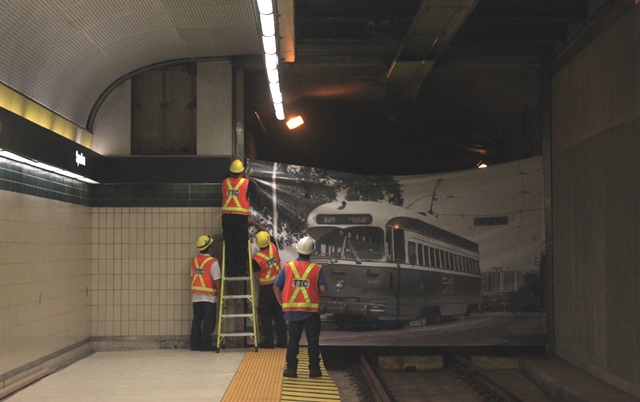
With suitably dramatic music, car 4403 breaks through the banner and enters Spadina Station.

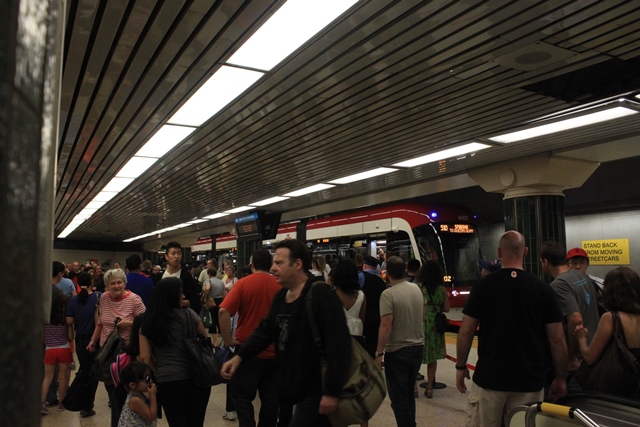
I rode the first round trip to Queens Quay and back, a rather leisurely affair complete with “media opportunities” (a.k.a. “photo stops”). When we returned, the platform was awash with folks watching the new cars, lining up to have a ride in one, and, amazingly enough, a bunch of passengers who just wanted to go somewhere on Spadina.
This is a busy route on Sunday morning with a 2’00” headway (at least on paper).
Below, car 4400 (the first of three prototypes, but now retrofitted with “production” updates) unloads at the platform.
Car 4403 northbound at Nassau followed by PCC 4549 that was out on a charter timed to greet the new cars.

For the purists, car 4549 by itself. The destination “Lansdowne Harbord” is valid for the car and location. It’s good to see the PCC with proper roll signs again after years with a fixed destination for 509 Harbourfront.

Northbound at Nassau Street showing the warning light strips on doors for motorists.
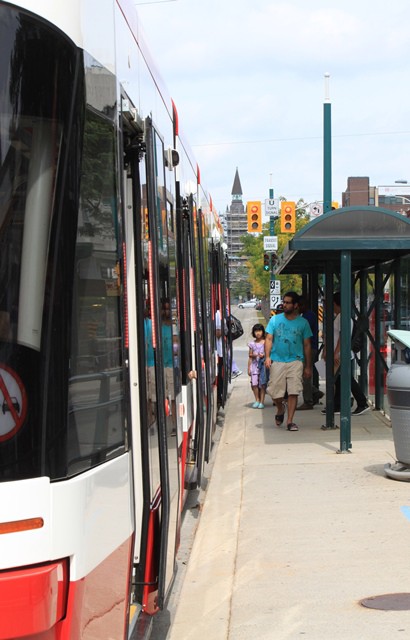
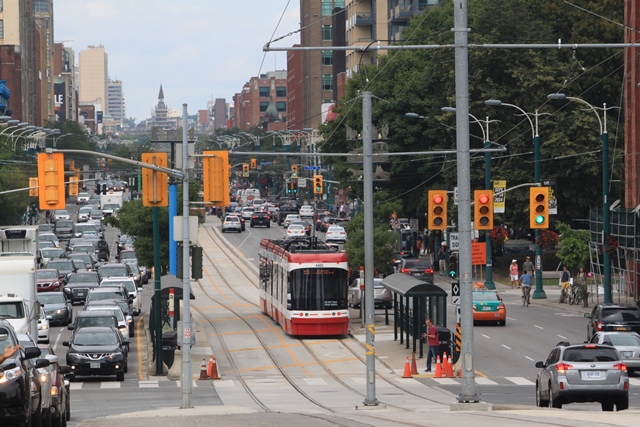
Car 4400 northbound at St. Andrew Street which, just to confuse those familiar with subway stations on University, is north of Dundas Street, not King.
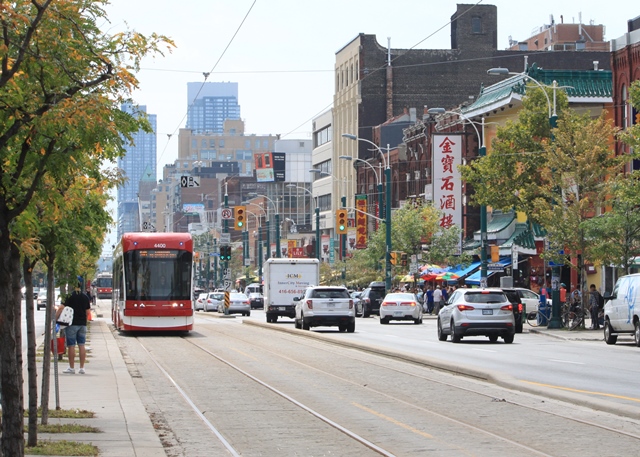
Car 4403 southbound at Richmond Street.
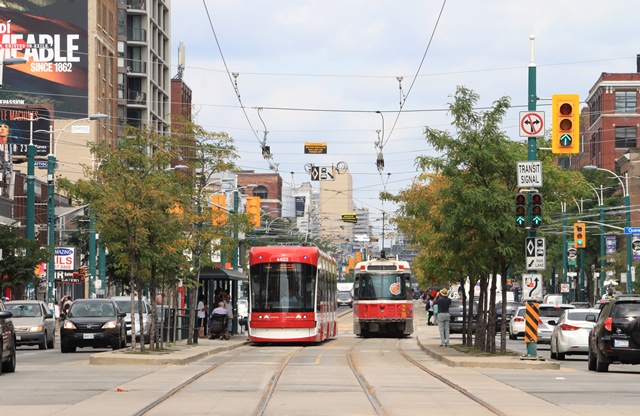
Car 4403 southbound at King. The new cars tended to run in fairly large gaps because so many riders would wait for one to show up, and they would spend an inordinate amount of time at each stop.
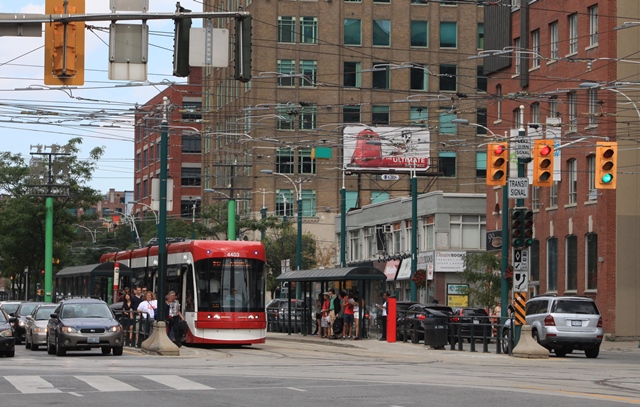
Car 4400 south of King. The overhead wiring partly visible here is compatible with pantograph and trolley pole. Two of Toronto’s three grand unions have been refitted with this type of overhead (the other is at Spadina & Queen). Much work remains to make the rest of the system pantograph compliant (notably at Roncesvalles Carhouse and its complex nearby intersection), and the new cars will operate with poles until the territory they will normally use has been completely converted.
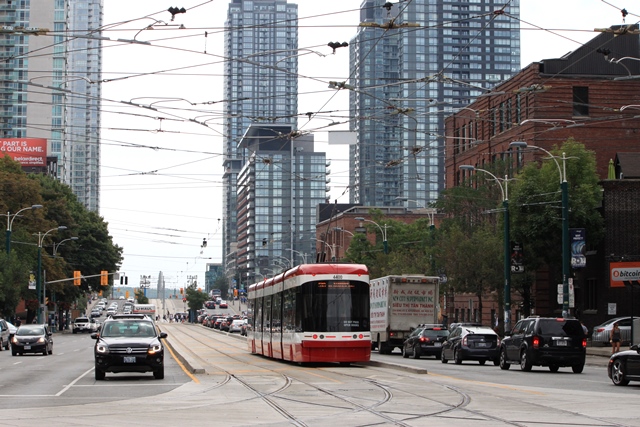
Car 4400 northbound from the Bremner Boulevard stop. Although not visible in this photo, the traffic at this time was chaotic thanks to a baseball game at the nearby stadium, and the complete absence of any traffic cops to ensure motorists did not block busy intersections. Spadina streetcars spent an inordinate amount of time at the south end of the line thanks to traffic delays across their supposed “right-of-way”.
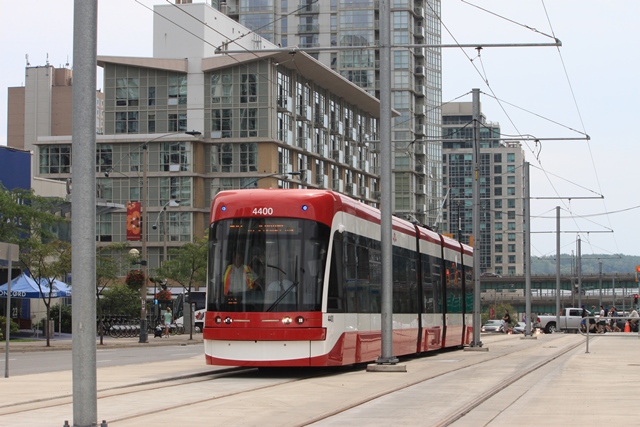
Car 4400 northbound from Front Street.
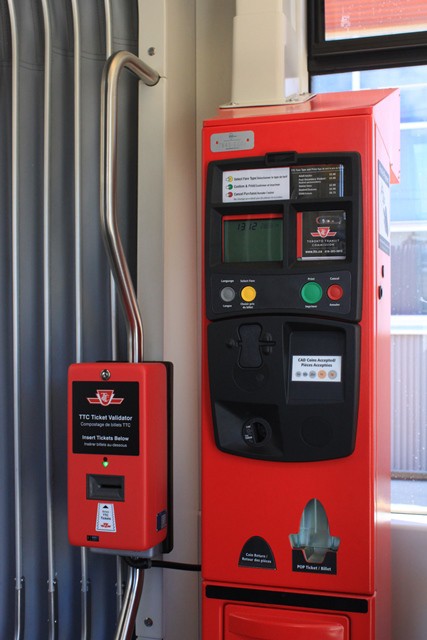
The Spadina route now uses Proof of Payment fare collection. Ticket machines are provided onboard for users of tokens, cash and tickets. To pay by token or cash, a rider buys a fare from the vending machine on the right. To use a ticket (seniors, students, children), they use the ticket canceller on the left. Either way, the rider gets a fare receipt.
Fare machines are also installed on platforms at major stops so that riders can conduct the transaction while awaiting a car.
An interesting side-effect of the move to POP is that riders transferring from the subway who previously simply stepped onto a waiting streetcar must now be sure to have a fare receipt (typically a transfer) in case they are inspected enroute on Spadina.
The provincial Presto system will be added to the mix in November, although the proposed method is rather cumbersome with first a Presto validation against a standard Presto reader, following by a tap onto a TTC fare machine to get a fare receipt that can be used as a transfer to non-Presto routes.
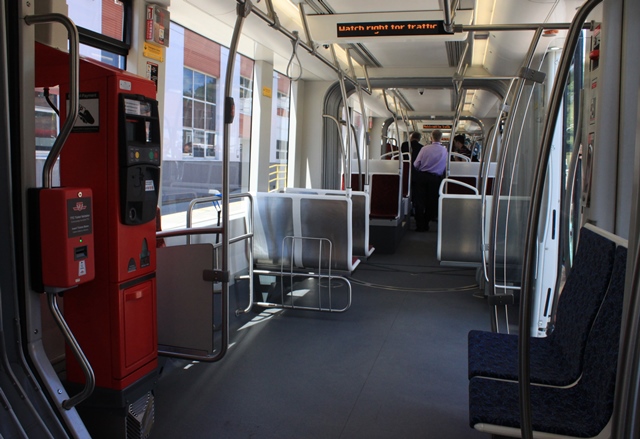
This is the vestibule at the third set of doors to the area intended for cyclists. Each vestibule includes blue-coloured seats indicating preferred access for those with mobility problems.
The wheelchair ramp in its fully-extended position as it would be used to load from the roadway rather than at a platform.

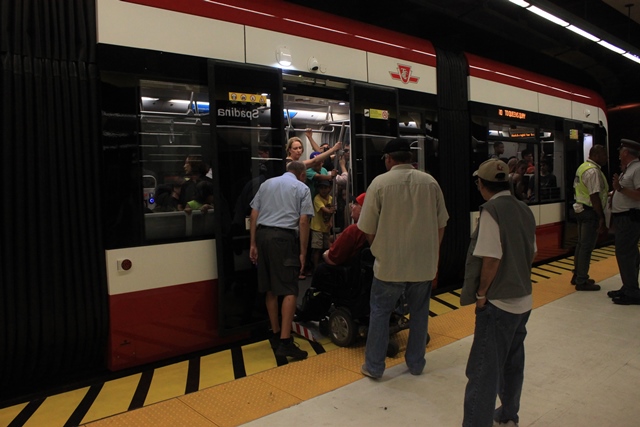
A wheelchair user boards 4400 at Spadina Station using the ramp which is extended in its platform height position, the mode that will be used at all stops on 510 Spadina.
 Steve Munro
In their defence, a lot of the bunching on Sunday – at least until the early afternoon – was due to a TTC track crew doing some last-minute “adjustments” to the trackwork in Spadina Loop. Cars were being let out in bunches of three and four, to wait on the ROW north of Lakeshore – not that they all did that, of course.
LikeLike
The new cars are beautiful, but they suffer from the same issue as the TRs, namely that they use a synthesized “robot” voice for stop announcements instead of a properly recorded human voice like the old streetcars, buses, and T1s. I can’t understand why the TTC insists on using the synthesized voice when they already have recordings for all the stops. The human voice is so much clearer and the pronunciation so much better, and it projects the image of a transit agency that cares about the details. I tried to bother Brad Ross about this issue on Twitter a while ago but he never responded. Have they provided any technical justification for the switch to synthesized stop announcements?
Steve: No. And, yes, I do prefer the “human” voice, but the TTC appears to be in love with the less-than-seductive tones of the robot.
LikeLike
When I was on the 510 streetcar, Brad Ross was also aboard. I spoke to him about the awkward fare collection system and he gave me the impression that only major stops will have a fare machine, not the lesser used ones. And you’re right – the design of these cars is not conducive to ‘flow thru’ movement of people aboard. As Mr. Ross stated, it will take time and some education for travellers to figure the system out.
LikeLike
Riding one of the new streetcars down Spadina yesterday, I’d recommend increasing the volume of the audio stop announcements.
LikeLike
I sent an email to opendata@toronto.ca asking for them to put up a list of the current transit priority intersections (along with details of the type, whether it’s active, times it’s working etc. etc.) and they forwarded me to OpenDataTripPlanner@ttc.ca – which basically said that because Google doesn’t support including this in the dataset they generate every 6 weeks at the current time they can’t do it…so now I’m back today to emailing opendata@toronto.ca asking if they can put it up in excel…
This seems like a really simple list that the transportation department should be able to provide…if anyone has any ideas on how to get it…
LikeLike
Curious as to why the platform at Spadina station, as well as the newly rebuilt platforms along Spadina aren’t at the same height as the new low floor streetcars?
Seems to me as if the ramp could only be used at non-island stops in mixed traffic, and have a completely step-free experience by just bumping the island / platform height up a couple of inches. In this instance, a streetcar would be level with the platform similar to the subway car floor relationship with the platform.
Thoughts?
Steve: Yours is the third comment about this and I have already replied. The new cars do not have automatic levellers to (in theory) line them up with the platforms for level boarding. On that subject, you may know that the newest subway cars are supposed to work this way, but the height of the subway platform above the rail is not uniform from station to station, and also depends on rail and wheel wear. In any event, most of the TTC stops are not at platforms and the ramp is necessary for them.
Oddly enough, the big issue on Spadina was that the platforms were too high, and the ramp would have hit them as it extended from the car (also by implication that the platform would have been higher than the car floor). That’s why sections of most stops were rebuilt to make them lower. This sounds like an easy issue, but it’s not. It will be amusing to see how well Metrolinx fares on that count when they start operating their fleet which will have levellers.
LikeLike
Is there anywhere that I can see what is being done to make the OH pantograph friendly? And are there pictures of the frogs where pole lines cross pantograph lines?
I remember when the Edmonton system was new and the pantos has to cross the trolley bus lines, but that was at an acute angle.
Steve: You can see some of the overhead in my recent photos of the Spadina line, notably at King Street. It has frogs that will handle a 90 degree crossing.
LikeLike
These new streetcars I think will give the TTC streetcar network a whole new revived image, and residents will find their love for streetcars again. The ticket vending pop system will take time for riders to get familiar with, but is no different than riding a bus or tram in Europe.
The signal priority really needs to be turned on.
LikeLike
And so? Why could they not have been free to ride on the first day. At worst it would have meant throwing everyone off at the last northbound stop prior to Spadina (they did that a few years ago with the PCCs when they used them to reopen the St. Clair line.)
Steve: Because until they are accepted for service, they are still officially Bombardier’s property and liability in case anything goes wrong. Also, they don’t have the retrofit making the sill at the ramp truly accessible.
LikeLike
Someone showed me that information, complete with detailed signal timings of every intersection. However, the person who showed it to me said that the city does not want this information to be shared with the general public.
I don’t know the reason for this. Anyone else know?
More thoughts on the new streetcars:
1) I feel that the new streetcars have a higher acceleration. It’s a real whoosh-feeling when the streetcar barrels to almost-full speed after a far-side stop. Maybe it’s because we’re closer to the ground, so it looks like we’re travelling across the ground faster. I’ve also felt a few acceleration jerks when the drivers of the new streetcars decide to suddenly change speed by simply adjusting the position of the hand control. I’ve never felt that on a CLRV, possibly because it’s harder to do with foot pedals.
2) Going into a curve, the first module on the streetcar felt really smooth – in fact, I felt a tad bit dizzy, but there was never a sudden jerk-turning sensation. The new streetcars seemed to be taking the curves faster than before.
3) I predict that we’ll have to direct cash/token/ticket paying customers to use the double-doors only, and not the single doors. It’s hard to walk along a significant length of the streetcar on the inside. Besides, if we restrict access to the handicap to the double doors, we should be able to do the same to non-pass customers.
LikeLike
RE: ramps on streetcars
Steve, since modern LRT systems have almost exclusively island stops, are ramps a rare thing to be found on modern LRV’s? Is this something else that makes our new streetcars unique?
Steve: Yes.
LikeLike
Moaz: I suppose this is a place where TTC can take a page from GO. At the stops that have their own platforms, place signs on the railing and paint signs on the ground indicating which module has space for bicycles, which one accomodates wheelchairs and which ones have ticket vending machines. Then passengers can board the module that meets their needs.
Match it with a “Rider Efficiency Guide for new Streetcars” (handout piece of paper, online info, maybe a basic app) and maybe put signs at stop platform entrances.
I suppose that, if TTC doesn’t want to pay for railing signs and painted signs etc. then they can just put signs up at the entrances.
The nice thing is that TTC doesn’t have to do this until the Spadina route is mostly/completely converted to LFLRVs. That could take a while with the strike at the Bombardier plant … so they have time to do it right.
Cheers, Moaz
Steve: Don’t forget that most stops in the system are on street, and there will be no “alignment” between specific locations and the functionality available inside. Moreover, once the fare system converts to Presto, most of the existing fare types (tickets, tokens) requiring access to a ticket machine will disappear.
LikeLike
So Steve.. given your disdain for techno voice, have you ever considered voicing stop announcements?
I hear aging, crotchety transit advocate is in this year 🙂
Steve: I will have to practice my countertenor range. Female voices are used because their frequency range makes them more understandable to people with hearing problems.
LikeLike
Based on opening day, do you think that the new cars can hope to address the capacity issues on Spadina and King?
Also will the presence of these larger cars, possibly help re-open or highlight the importance of what needs to be done in order to allow transit to move more smoothly on surface routes?
I cannot help but think if there was a serious focus on what is required to move transit on surface, capacity would get a moderate additional boost, and the desire to ride would get a substantial one.
Steve: Opening day was atypical both because many people waited explicitly for one of the two Flexities, and nobody was used to the fare collection system. All I can say is that if these cars work all over Europe, and they can’t work here, something is desperately wrong.
LikeLike
Ah, universal access – all the more reason to preference communicating by blog, eh? (You certainly don’t seem to have any problem with ‘clarity’ and ‘volume’ at the keyboard!)
LikeLike
4403 was missing from service on the 510 today. I was trying to take another ride on them and only 4400 was operating, per the nextbus data both on an app I have and that link from Darwin O’Connor. I wonder why they decided to leave it out of service today? Given that they only have two I’d really hope they try a bit harder to keep both running.
LikeLike
I really enjoyed the day, and was most impressed by the streetcars. They’re so quiet, and I really love the large windows. They let in so much light and that really makes a lot of difference.
The best seats in the house, incidentally, are the back seats in the rear vestibule. Ample leg room, quick access to the door, and lots of windows to look out of.
I do have to say that these cars are a challenge to photograph. They’re so long, I had to really adjust where I snapped the pictures from. I couldn’t get the whole car in the shot, and I often had poles or street furniture in the way. Also, the laminator signs are really odd to me. Why do they flicker so? It’s almost impossible to get a clear shot of them in daylight on my iPhone. It’s only in low light conditions that the shutter is open long enough to get a clear picture from the sign. This isn’t an issue for the laminator signs on the buses. What gives?
Steve: The signs are actually scanned (like TV in the old days) rather than having all of the LEDs powered at once. I suspect this reduces power consumption and heat, and increases lifespan. I have found that you have to go down to 1/100th of a second exposure or lower to avoid getting partial signs. (Compare my “breakthrough” shot taken in Spadina Station with some of the on street shots.)
LikeLike
What happened to streetcars 4401 and 4402?
Steve: They are still in prototype stage and require retrofits to bring them to production status. With the strike at Bombardier it’s hard to say just when we will get more cars, including the updated versions of those two.
LikeLike
Steve, the capacity of these cars is given as 250 passengers. Does this mean at crush loads or what?
Could these cars be easily retrofitted with mu capability should the need ever arise?
Steve: 250 is a crush load number, and for planning purposes, the TTC will design service on an average peak load of about 160. I think that may be generous, but better to find out what a realistic number is before aiming too high and running too little service. I believe they are MU capable but don’t know what the retrofit would involve. The Transit City cars definitely will run in trains.
LikeLike
Spadina station definitely isn’t long enough for 2 new streetcars. It looks like the platform is about long enough for one new streetcar and one CLRV. I can’t see how Spadina could ever be retrofitted for multiple unit operation. The new streetcar was ridiculously crowded when I rode it yesterday. We need to build more subway lines downtown.
LikeLike
According to @ttchelps 4403 had a problem on Wednesday and it went back to the carhouse. It was there at 9AM and back by 5PM.
LikeLike
After today, I would say that the DRL might finally get going somewhere now that the myth about Rob Ford being a fiscal conservative has been shattered with his “free subways everywhere!” plan of desperation.
I now just hope that Tory can be brought down to earth with his Smart Track plan in terms of realizing that it’s a phase 0 DRL at best and fixing the problems it has to make it something beneficial to transit riders.
LikeLike
Yes, I would expect there to be extra chaos, however, given actual loads of passengers per car, compared to normal loads, will they be able to take up the latent demand that exists on these routes.
Also the one concern I would have comparing this to most European trams, is that from what I recall riding trams in Europe, they seemed to flow more smoothly than the streetcars in Toronto, frankly because I suspect that the importance of transit is seen to be greater.
LikeLike
Question becomes, what it will be like when every car running is a LFRV, and they are running at the current CLRV headways. I think that before the city looks at a subway here, a serious look at implementing transit signal priority with more advanced systems, and a more advanced version of the vehicle tracking system are needed. If the tracking system were fully integrated with the signal control system, it would know where the car was, and could come much closer to anticipating when the car would need a green (perhaps leaving a very short lag), thereby allowing the cars to move better on Spadina at least.
The city could discourage the use of certain critical streets/transit routes for auto through trips, better control of parking, turns etc, all of which would allow the surface transit to work better. Yes the city needs more subways, but, I don’t think replacing Spadina with a subway makes as much sense as actually working to implement a really good version of transit signal priority. Yes there is a subway required, that being the Don Mills and City line as Moaz likes to refer to it. But before others are built, the other options need to be looked at in a serious way, in which the alternatives are not either disabled or undermined.
Transit vehicles should be given priority based on the people that are riding or will board, not based on a vehicle count basis. Keep transit moving smoothly, and quickly (especially visibly more so than cars) and not too crowded, and the ratio of people that choose to drive should drop.
LikeLike
Moaz: yes that’s true. I was only thinking about doing this for lines with ROW and stops with platforms anyways. Just looking at Spadina, St. Clair, Bathurst and QQ, plus terminals at Dundas West, Bathurst, Exhibition, Spadina Loop, Union, Broadview & Main Street that would be enough for a few years work … and help passengers become familiar with the system. The accessibility module and bike module are going to be important features of the system now and I suppose that there will always be passengers paying cash.
Oh btw I’m seeing tweets of the new streetcars on Queen, Carlton etc. I suppose that those must be 4401 & 4402.
Cheers, Moaz
LikeLike
Anything known about how operators like these cars? For some strange reason, the coming of these cars takes me back to a ride I took way back in 1986 and a conversation I had with a female operator who told me that she was not looking forward to the coming of the ALRVs.
LikeLike
Rode 4403 today. Due to TIFF road blockages the traffic on Queen west of University and on Spadina in the area was absolutely awful. The lights at Spadina/Queen were switched to four-way flashing red and cops were instead directing traffic. The 504 was diverting through here and the TTC had a point-man present. The diversion didn’t seem to be as stated online and it also suddenly extended westward on Queen rendering the pointman redundant. My Queen car went out of service here because one of the motors failed and then it limped off westbound. With the traffic it probably could have gotten along fine with only one motor! It is clear that road closures for events should be avoided at all costs, particularly on weekdays.
Steve: According to an article in the Post, the traffic lights were not working for a period today, probably when you were there.
The new streetcar was running rather slowly because the driver was still getting used to it and was being watched over by a supervisor in the cab. Even at slow speed the front section is hunting in the turns and this will be a permanent defect in the design as I had warned. Operators are going to end up tip-toeing through turns to avoid this.
People don’t have a clue yet about the fare system. Even with Transit Ambassadors giving advance instructions on every platform, many still got on the front and promptly blocked the line entering while trying to figure out where to stick their fare. Some even attempted to jam their fare into the handle of the cab door. The sliding door operation is slower than necessary because it now has a warning chime before it starts closing. At least years from now when everyone finally understands all-door boarding this delay may end up being offset.
I saw the “Willcock Street” destination typo previously mentioned. The exterior verbal destination message sounds ‘Spadeena’ rather than ‘Spadiina’ and it should start reading it the moment the doors start opening rather than delaying until after. In Spadina Station the platform changes haven’t been finished leaving much of it blocked-off by fencing. This means that while two CLRVs can occupy the platform simultaneously, one LFLRV monopolizes all available space until the work is done. It’s really screwing with vehicle and passenger flow as it stands. Hopefully this will be rectified shortly.
LikeLike
I’ve been hearing complaints about how slow the red ticket machines are. Do you know why the red subway transfer machines print things much faster? And what’s preventing the technology to instantly print proofs-of-payment from being realised?
Steve: I don’t know the details, but I suspect we are dealing with technology that has not been optimized for high volume, fast operation.
LikeLike
A couple other things I forgot to mention:
– The fleet number on the front of the “production” cars has been changed from black to a properly contrasting white to improve visibility of the number. The choice of black originally is something I’d noted prior that should be changed. I’m glad to see they are nit-picking even details this small.
– On 4403 the bolster or whatever metal mating surface is between the truck and the carbody (in other words where the body supports slide against the truck) was creaking a lot while in motion. A number of the H6 and some T1 subway cars also made this noise but it would be isolated to one specific truck. It is an indicator that something is wrong but I’m not sure exactly what the problem stems from. Under normal circumstances there should be none of this noise. I also noticed in general that the wheel-rail thunks and other interactions are getting through the dampening in the suspension and being felt by the rider more than I’m used to on the C/ALRVs. The propulsion may be virtually silent but the rest of this is quite obvious.
LikeLike
Lflrv was being used on Queen St at around midnight wb to Humber loop due to a delay on Queen at Spadina. Everyone on the eb car was commenting on how they wanted to be going west.
LikeLike
It does reduce power consumption and increase lifespan, but the scanning is a requirement when connections are shared to reduce the pin count on the display device and output requirements from the driving circuit.
Think of an alarm clock with an LED display. It has four seven-segment digits (plus the two dots of the colon). That makes for 30 LEDs which have 60 connections in total. The display device will likely only have 12 pins by sharing connections. Seven pins are for one connection (anode or cathode, depending on device configuration) of each of the seven segments of all four digits. That is, one pin connects to all four “A” segments (the top horizontal line) and so on for each digit. One pin is connected to the same connection on the two dots of the colon. The remaining four pins connect to the other connection of each digit. The connection for the second digit also connects to the other connection of one of the colon dots, and the connection for the third digit also connects to the other connection of the other colon dot.
In order to display a time, each digit is enabled for no more than 25% of the time using one of the last four connections, while the first eight connections are used to determine the character displayed (and the colon dot for the second and third digit). If the display can be dimmed, then its on-time is reduced to a lower percentage of the time.
This shows how a simple four-digit digital clock uses only 12 pins (connected to 12 outputs from a microcontroller) instead of 60. Just imagine the pin reduction for a longer alpha-numeric display.
Why are some easier to photograph than others? It all comes down to how fast they are scanned. Think of what the four digit clock would look like if each digit’s 25% of the time was a one-second interval? Your eyes would have trouble reading it! If the total cycle time to scan each digit is 10 ms, then a camera shutter must be open at least 1/100 of a second in order to not have part of the display blanked. Also note, if the shutter speed is 150% of the cycle time, then the whole display will be photographed, but part of it will be brighter than the rest. You have to have a shutter speed that is either the same as the scan time, or long enough to capture several scans (if part of the display is scanned 9 times while the shutter is open, and part is scanned 10, then the difference may not be so noticeable).
LikeLike
One of the innovations on the new SUBWAY cars is the anti-microbial coatings on the poles etc. Bombardier says this:
I note that the new STREETCARS do not have this. Are streetcar riders seen as cleaner and more germ-free than subway ones or simply have better immune systems, no doubt due to the fresh air!
Steve: That special coating on the subway cars was a bit of a PR job. At best, the effect lasts for a year after which the coating has to be replaced. This is a very labour intensive procedure, an extra operating cost the TTC chose not to bear.
LikeLike
The correct pronunciation actually is “Spadeena”, so I’m glad to see it announced correctly.
LikeLike
Wait, you mean a subway on Spadina? Is the University Line so overcrowded that people can’t walk a couple blocks east?
Steve: (a) Spadina Station isn’t finished yet (and the TTC needs to explain why it takes over a month to accomplish something on this scale), and (b) some people will never be satisfied until there is a subway everywhere. Unless, of course, they are half way between the once per 2km stations.
LikeLike
I have ridden Flexities and similar trams in Europe and they did not hunt in curves and some operators took these, not switches, at quite a speed. On the cars with double front doors there is a much longer overhang in front of the truck and you learned to hang on to something when the car entered the curve because the sudden turn at the distance from truck was like being at the end of a whip. If the TTC finally gets all its track work, especially switches, in good working order I doubt that they will hunt in curves. This is a tried and tested design and hunting would have been noted elsewhere.
LikeLike
Thanks, Steve, and Calvin, for the explanations. Fascinating stuff! I’ll just note that, if you’re taking pictures on the iPhone, you can really see the thing flickering when you look at the phone display in daylight. It was the oddest thing looking at it: look at the streetcar sign directly, and it looks phone. Look at it on the iPhone, and its squiggle-squiggle-squiggle. Clearly, it’s a mixture of how fast the iPhone camera is scanning, and how fast the streetcar sign is scanning. I’ll see what I can do about exposure times.
LikeLike
There is actually 3 deployment phases for the ramp: bridge, half extension, and full extension. There are currently not any locations to use the bridge phase. There will be one more version (being final) for the ramp. Currently they are using the second version.
LikeLike
Given the numerous errors in destination spelling and pronunciation throughout the rest of the system I find it ironic that the TTC should now be in the position of correcting the public’s habit for once. (I’m aware of the correct pronunciation, but who says it that way anyway?)
I was first introduced to this ‘phenomenon’ riding the generation-1 Siemens Combino cars in Amsterdam. It was shockingly bad and seemed like it could potentially cause ‘sea-sickness’ for the operator. The original design led to numerous derailments and severe premature fatigue damage in the body structure. Siemens eventually took the extraordinary step of publicly admitting their mistake and that they had learned from it. (Just try prying anything of this sort out of Bombardier, no matter what product is involved.)
Those Siemens cars have the shortest front overhang of pretty much any modern design. Much of the root of the problem was the solid mounting of the trucks which is what led Bombardier to develop the independent bogie on theirs. The aim was specifically to minimize the hunting, bouncing and oscillation of those motions. It was seen and promoted as an innovation but was actually a fascinating step backwards to a proven technology.
Clearly the Bombardier design is an improvement but there are limits to how much these effects can be eliminated without making the car too stiff or elastic at the articulations. Elasticity seems to be the worst side-effect of the dampening system. A CLRV will wander a little bit side-to-side while driving on straight trackage but it will never ‘snap back’ from one motion so it doesn’t set up a cycle of this action. The only thing I can liken it to on the CLRV is behaviour during stops where the brakes can grab too hard and cause the whole body to heave nose-down and back up repeatedly in a cycle as the soft suspension tries to even out the sudden weight shift.
Readers here may recall that I caught a sharp elastic oscillation in the first video of the prototype exiting Hillcrest. I know you are aware that most turns on the TTC use easements into and out of them. The car shook a little bit entering the switch, understandably, but the moment it encountered the sharper part of the turn it started to shake side-to-side quickly, swiveling around the pivot point of the truck. It was easier to see because the operator stopped immediately for reasons unclear. You can actually hear the sound of the shaking on the audio.
If you’d like to experience what I did on Spadina be sure to ride around the ‘circle’ north of College and pay particular attention to the ‘S’-transition at the northbound exit. The operator at the time actually let off the accelerator when he felt the transitional snap. It’s not super-bad but it is an unavoidable part of the design – more an annoyance likely than damaging in the long-term. On the up-side for some of the older crowd it’s the next best thing to the experience of riding a single-truck car. ‘Back to the future,’ you might say.
LikeLike
The worst snap I encountered was in Rotterdam with their long overhangs. The operators there seemed to relish going into the curves as fast as possible to maximize the snap effect. Regular passengers hung on for dear life while the tourist bounced around the car. My thought was that this was just like riding a single truck car.
The Rotterdam trams were Citadis 302s built by Alstom. They are also found all over France but the Rotterdam operators seemed to own the championship for “snapping the whip.”
LikeLike
Out of curiosity, is it theoretically possible to build a 4-lane LRT? For example, is it theoretically possible to take all the lanes on a street such as Queen and convert all of the to LRT use? If so, what would be the capacity of a system like that, roughly speaking?
Steve: The short answer is no. The biggest problem is that, assuming the inner tracks would be for “express” trips, there would not be room for a separate platform, and passengers would have to board by crossing the “local” tracks. Second, presuming that your goal is very high capacity on a surface route running in a street setting, there will be problems with pedestrian congestion at major stops. Third, Toronto’s curves are tight by international standards as things are, and it would not be possible to build curves from the curb lane tracks, although I suppose an arrangement with crossovers from curb to centre near intersections could be used. Then there is the tiny matter of other uses of the street such as deliveries.
The real question here is what are you trying to achieve? Our streetcar lines are, for the most part, nowhere near the capacity they handled before 1980 and the long slow decline of service cuts. Where headways are already quite frequent (King), there remains the addition of capacity through larger cars.
Nobody should pretend that a streetcar is ever going to be speedy, but reliability and frequency are also vital. When the wait for a vehicle to show up and have room on it to board is a major part of your trip, the problem that needs fixing first is service quality, not speed.
For an historical overview of service levels, please see my article from December 2006 “Always A Car In Sight”.
LikeLike