
Updated September 5, 2014 at 3:00 pm:The Nextbus site now displays wheelchair symbols on route tags for the Flexities running on the 510 Spadina line.
Updated September 2, 2014 at 12:45 pm: Thanks to Darwin O’Connor for the URL that takes us to a page on his website showing where the new cars are located in real time.
Original article from August 31, 2014:
August 31, 2014 marked the reopening of the 511 (oops!) 510 Spadina streetcar between Bloor and Queens Quay, and the introduction of the first two of Toronto’s new fleet of Bombardier Flexity streetcars.
Regular service had been operating since 5:00 am, but the official ceremony took place at Spadina Station at 10:00 with the usual speechifying by sundry officials and politicians. Particularly gratifying were remarks by TTC CEO Andy Byford praising the people who had designed and built the new cars. Politicians show up for the ribbon cutting, but it’s the folks who have spent years to bring us these new cars who did the real work.
The countdown begins: After the last regular service car (for a while anyhow) ran through the loop, workers mounted a banner showing a PCC southbound on Broadview at Riverdale Park.
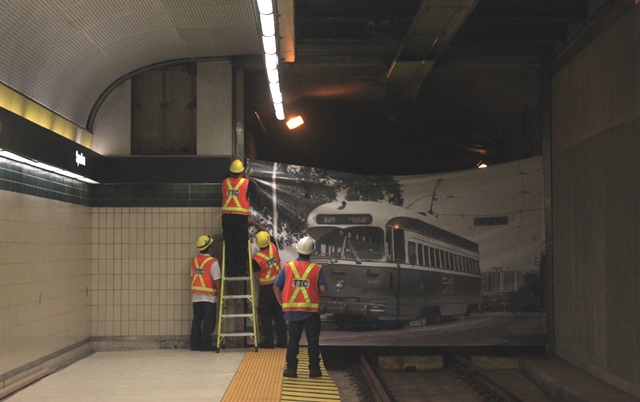
With suitably dramatic music, car 4403 breaks through the banner and enters Spadina Station.

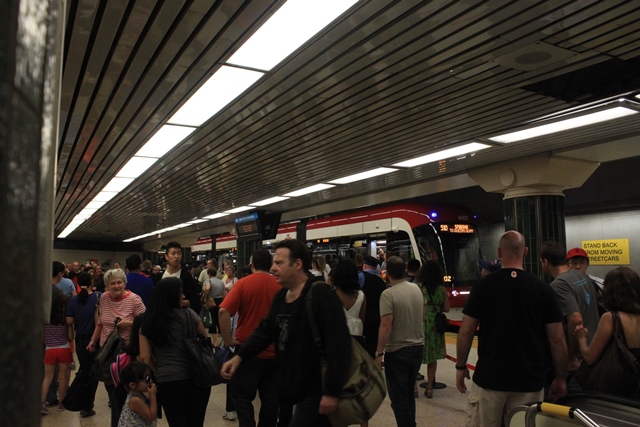
I rode the first round trip to Queens Quay and back, a rather leisurely affair complete with “media opportunities” (a.k.a. “photo stops”). When we returned, the platform was awash with folks watching the new cars, lining up to have a ride in one, and, amazingly enough, a bunch of passengers who just wanted to go somewhere on Spadina.
This is a busy route on Sunday morning with a 2’00” headway (at least on paper).
Below, car 4400 (the first of three prototypes, but now retrofitted with “production” updates) unloads at the platform.
Car 4403 northbound at Nassau followed by PCC 4549 that was out on a charter timed to greet the new cars.

For the purists, car 4549 by itself. The destination “Lansdowne Harbord” is valid for the car and location. It’s good to see the PCC with proper roll signs again after years with a fixed destination for 509 Harbourfront.

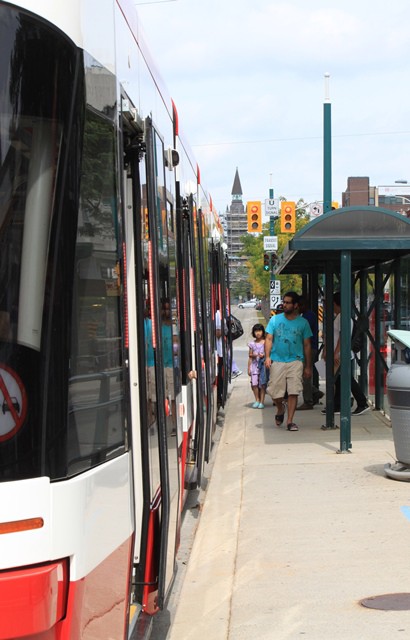
Northbound at Nassau Street showing the warning light strips on doors for motorists.
Car 4400 northbound at St. Andrew Street which, just to confuse those familiar with subway stations on University, is north of Dundas Street, not King.
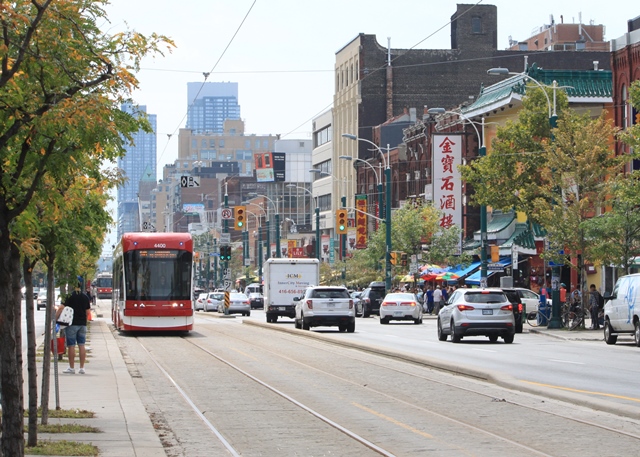
Car 4403 southbound at Richmond Street.
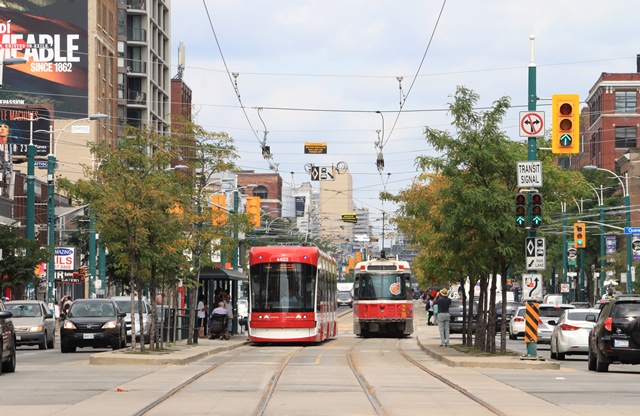
Car 4403 southbound at King. The new cars tended to run in fairly large gaps because so many riders would wait for one to show up, and they would spend an inordinate amount of time at each stop.
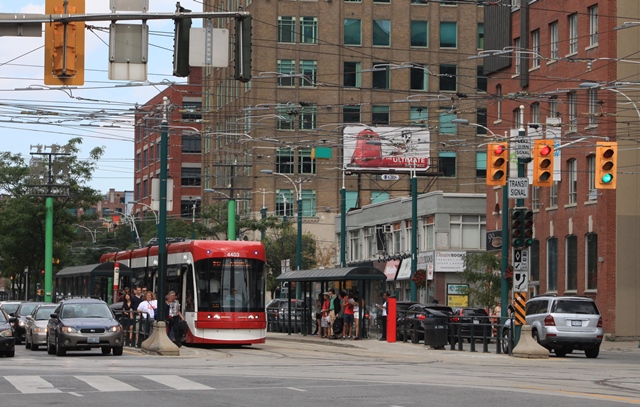
Car 4400 south of King. The overhead wiring partly visible here is compatible with pantograph and trolley pole. Two of Toronto’s three grand unions have been refitted with this type of overhead (the other is at Spadina & Queen). Much work remains to make the rest of the system pantograph compliant (notably at Roncesvalles Carhouse and its complex nearby intersection), and the new cars will operate with poles until the territory they will normally use has been completely converted.
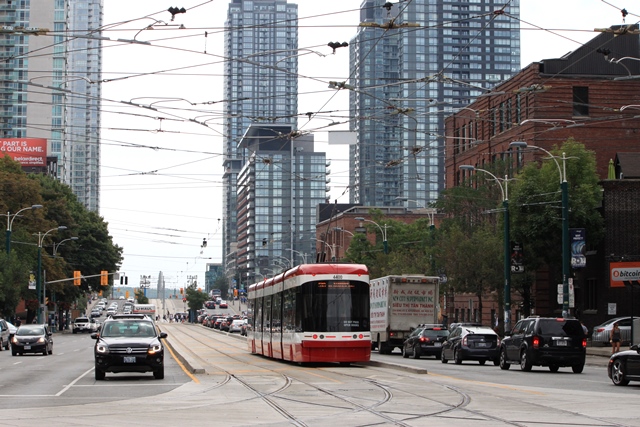
Car 4400 northbound from the Bremner Boulevard stop. Although not visible in this photo, the traffic at this time was chaotic thanks to a baseball game at the nearby stadium, and the complete absence of any traffic cops to ensure motorists did not block busy intersections. Spadina streetcars spent an inordinate amount of time at the south end of the line thanks to traffic delays across their supposed “right-of-way”.
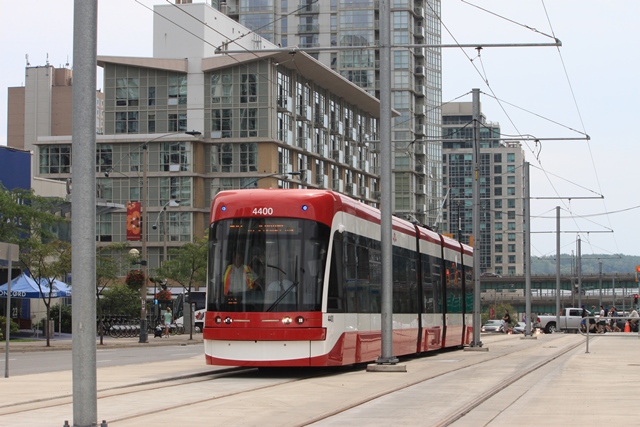
Car 4400 northbound from Front Street.
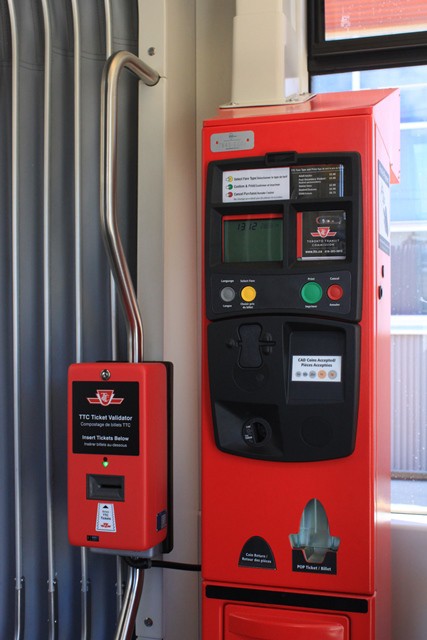
The Spadina route now uses Proof of Payment fare collection. Ticket machines are provided onboard for users of tokens, cash and tickets. To pay by token or cash, a rider buys a fare from the vending machine on the right. To use a ticket (seniors, students, children), they use the ticket canceller on the left. Either way, the rider gets a fare receipt.
Fare machines are also installed on platforms at major stops so that riders can conduct the transaction while awaiting a car.
An interesting side-effect of the move to POP is that riders transferring from the subway who previously simply stepped onto a waiting streetcar must now be sure to have a fare receipt (typically a transfer) in case they are inspected enroute on Spadina.
The provincial Presto system will be added to the mix in November, although the proposed method is rather cumbersome with first a Presto validation against a standard Presto reader, following by a tap onto a TTC fare machine to get a fare receipt that can be used as a transfer to non-Presto routes.
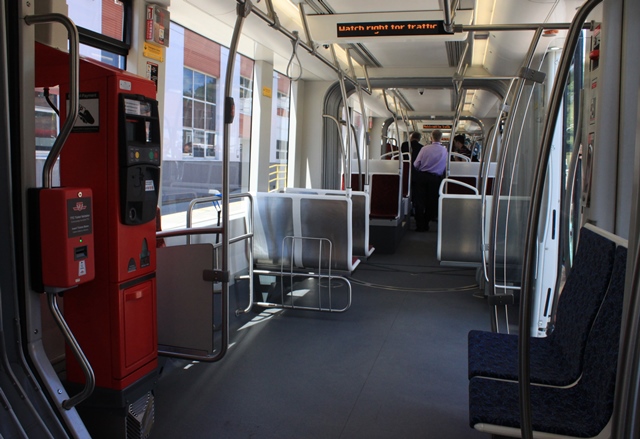
This is the vestibule at the third set of doors to the area intended for cyclists. Each vestibule includes blue-coloured seats indicating preferred access for those with mobility problems.
The wheelchair ramp in its fully-extended position as it would be used to load from the roadway rather than at a platform.

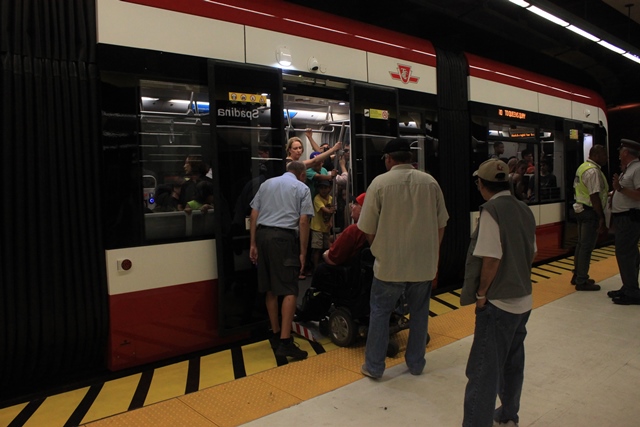
A wheelchair user boards 4400 at Spadina Station using the ramp which is extended in its platform height position, the mode that will be used at all stops on 510 Spadina.
 Steve Munro
Good to see you earlier Steve, always a pleasure.
It was an interesting ride on the new car, though I was on it once before as you are well aware. One interesting thing I noticed was bunching at the center of the car.
Not sure what lead to this but I would hate to see it be a common thing. Perhaps it had to do with the stanchion placement at Spadina Station. I was standing down by the wheelchair vestibule and it was crush loaded.. I looked down at the ends of the car and less so.
The cookies were a nice touch… not very edible but a nice touch. Little bit unnerving to be shadowed by a service truck though.. I would hate to be stuck on a crush loaded Flexity with no way off.
Steve: Until we see Spadina running in “normal” mode with passengers queueing properly at Spadina Station (rather than the conditions in place for several hours today), we won’t have a sense of how the crowds build up on the car. However, the fact that the first and fourth doors are singles will always mean that more people get on the middle of the car.
LikeLike
Shortage of manpower due to too many on paid duty guarding a hole in the ground.
LikeLike
From my impressions, I hope the crowds today are not what we would expect during normal peak periods or else a door redesign might be in order.
LikeLike
510, surely?!
Steve: It was a long day. Thanks for catching this!
LikeLike
… so what’s to stop someone from getting a free ride by getting on the 510 Spadina northbound at Sussex Avenue and transferring after one stop (with a very low risk of being inspected) to the subway (from whence one can ride the TTC to the farthest reaches of Scarborough with no risk of a fare inspection)?
Steve: Today, nothing, but it is likely that there will be blitzes at the station where everyone getting off a car will be checked for a valid fare.
LikeLike
Where are the pantographs?
Steve: On top of the cars (middle section), just not in use yet except for testing.
LikeLike
I wish I could have been there. Thanks for the great photos. We’ll have to make a point of visiting in the near future.
Question about the wheelchair ramps: will the Transit City LRVs also need wheelchair ramps? I thought it was more usual for vehicles of this sort to meet a platform closely enough that wheelchairs can enter directly, just like on the subway. I had assumed the wheelchair ramps were only for street loading and that locations with platforms would not need them (and I have read some previous articles so I’ve known for a while, I’m just now getting around to asking).
Steve: Yes, the Transit City routes are designed for platforms that will provide level loading onto the cars without a ramp. This is possible because there is no “streetcar” type running without platforms at stops. Also, the Transit City cars will have levellers like the subway to keep cars at a reliable height above track level regardless of load.
LikeLike
These things are great! Can’t wait to see them all over the city.
I noticed the next-stop sign in the new car I was riding said “Willcock Street” instead of “Willcocks Street”. I’m kind of curious how a typo like that would happen. I guess somebody had to manually retype all the stop names or something?
Steve: The TTC’s attention to detail with stop announcements leaves something to be desired.
LikeLike
With the advent of POP riders boarding at Spadina station will need a transfer. Will they be able to use a Spadina station transfer? Under the old transfer rules you can’t use a transfer from the current station to board a bus/streetcar. It has to be from the point of fare payment. Is this changing?
Steve: Considering that it would be valid to enter the station and pay a fare at street level, then go down to the streetcar, yes, someone can get a “POP” receipt simply by visiting the transfer machine. Until the conversion to POP is complete and transfers are obsolete, there will be numerous situations like this, I’m sure.
LikeLike
By the time I made it downtown, the two new streetcars were so crowded that they were packed in like sardines, literally. I noticed that on most, if not all, the islands stops that there is a red machine, similar to the one onboard the streetcars for paying fares.
Steve: Yes, the idea is to have as many passengers boarding with fare receipts as possible to avoid congestion at the onboard machines.
Also, the TTC has at least four of the new streetcars that I know of (numbers 4000-4003) and could certainly have used all four, at least on this day, for people. I just missed #4003 when I arrived at Spadina Station and had to wait a long time for #4000 to arrive.
Steve: Cars 4401 and 4402 are still in prototype status and have not yet been formally accepted for service. Retrofits are pending on these cars.
And thanks for posting these wonderful pictures, Steve.
Steve: You’re welcome!
LikeLike
Do you know if one of the new streetcars today was built/finished by Bombardier management? Do you feel that this would affect safety and performance?
I’m wondering if I’m even imagining the situation at Thunder Bay correctly: Bombardier office workers in their suits/dresses wrench it out in the factory.
Steve: The two cars on hand were shipped from Thunder Bay before the strike began.
LikeLike
Hi Steve,
I took a pic (HTC One Phone Camera) of the “roof” of 4403 as it entered Bloor portal. You can see the equipment. People are free to share and use the picture as they wish.
Steve: Your link takes me to the flickr home page, not to your photo.
LikeLike
Thank you for the photos, Steve. I did not have my camera with me.
I rode 4400 from Spadina Station to Harbourfront at about 5 pm. Here are some of my observations:
Lots of people, myself included, waited for a LFLRV. Lots of people took snapshots at Spadina Station and all along the route.
I boarded at the front doors with a day pass. Besides the driver, of course, there was an usher on the station platform and an affable conductor with “Instructor” on his uniform. Along the way, many people tried to pay their fares at the front, and he directed them towards the “red machine in the middle of the car”. He fielded all sorts of questions and comments from passengers, allowing the driver to concentrate on driving.
4400 still had that “new car smell”!
There were the usual older men transit buffs (me included) among the passengers, but lots of regular folks. Particularly, I was in conversation with a young lady who knew pretty well everything there is to know about streetcars! And the car was teeming with lots of kids riding without their parents, asking a million questions from the Instructor; they are the next generation of streetcar aficionados. Watch out, Mr. Ford!
At about 10 pm, I boarded an Orion bus on Bay Street at Queens Quay. Due to the total rebuilding of Queens Quay, vehicular traffic is westbound only. The bus zig-zagged all over due to the construction. I was the only passenger, and told the driver that I was going to Spadina loop. “Argh”, he said, “they should throw all the streetcars into the lake!” Hmmm.
At Spadina loop, one CLRV streetcar was leaving and I caught the next one already there, and again I was the sole passenger (not for long). I had an interesting chat with the driver. He was new with the TTC, and said that he enjoyed driving streetcars. He was based out of Roncesvalles Yard, and he told me that he gets a different route each night, as the roster gets filled.
Steve: The replacement 509 Harbourfront buses come from suburban divisions, and some of the poor dears are not used to downtown. Others get along just fine.
It’s always annoying that on temporary services like this, especially on weekends, we get operators who don’t have a clue about the downtown routes (or even how all of the diversions work), and they give out wildly inaccurate info to riders.
LikeLike
I loved the new car (4400) that I rode on Sunday. It seems a little churlish to dwell on shortcomings when the overall experience was so good. However, I did notice a couple of things. I didn’t see a fare machine on the platform at Dundas SB and of course there was only one on the car. With the crowds on the car it would have been extremely difficult if a significant number of the riders were non MetroPass/transfer users. (I think on Sunday the crowds were largely enthusiasts and the MetroPass concentration may have been higher than usual.)
Steve: Er, there are supposed to be two fare machines on every car, one at each of the two double-door vestibules.
Also, as a result of the fact the this was an “event” rather than a normal transit ride, the crowd background noise may have been louder than normal. In any case, on Sunday at least, I had great difficulty hearing the announcements. A little more volume – or variable volume depending on the background noise – may be necessary.
Otherwise it was a great day. I look forward to additional deliveries with anticipation.
LikeLike
Noticed the lack of a “clothesline” for passengers to request a stop. They have to use the stop request button on a stanchion to do so. May result in some people actually having to get vacate their seat to do so.
Also noticed that convex advertisement space available, as opposed to the concave advertisement space currently used on other vehicles. Will take some getting used to.
Like the extra-wide seat available, especially reserved for Rob Ford to use… not.
LikeLike
I’ll try to catch a ride next weekend – just too chaotic with the Ex, the air show, and the Blue Jays game this weekend.
I take it Rob Ford was there for the photo op?
Steve: Ford was at the ball game.
LikeLike
Until Presto is fully implemented across the TTC, allowing people to tap on the fare vending machine after having tapped on a standard Presto reader to get a paper receipt makes sense. But you really have to tap on both devices? I’d be surprised that if you simply tapped only on the fare vending machine, that you’d have to have first tapped on the standard reader.
LikeLike
Since the TTC didn’t see fit to put a real PCC out there other than a black & white picture on the banner, the TTS (Toronto Transportation Society) made up for it. The PCC got a loud round of cheers and lots of photos when it ran through the packed Spadina Station.
LikeLike
Now, now, Steve! Torontonians of any repute would know that St. Andrew Stn. is named after the church, not the street way aways from the church. (Same said people would also know the connection between Ian Fleming and St. James-Bond United Church, but I digress….)
Steve: And there is also St. Patrick’s church at Dundas Street. The names are left over from old parish/ward names.
LikeLike
I rode it (unintentionally) on Sunday – people were VERY confused about POP and there was no one on our section (middle, near the wheelchair area) to explain.
Also, couldn’t hear the announcements.
And people were dismayed at no “clothesline” stop-request – they could not see where the buttons were or (in the crowd) how to get to them when needed.
Lucky for them, we stopped at Every Single Stop (urg) so it was never a problem. What was the problem was people leaning on the doors and the wheelchair stop-request buttons so that the ramp deployed when it didn’t need to, slowing us down even more. (It took almost 40 minutes to get from Sussex to Front. Is that a normal runtime?) (what about transit priority signals? We didn’t notice any…)
Steve: The scheduled running time is 40 minutes for a round trip on Sunday afternoon according to the current scheduled service summary.
As for transit priority signals, they only provide for turns, not for through movements.
LikeLike
Last week they were testing them again on the loop between Dundas West Station and the Roncy yard. Any idea when they go live on the 504 and 505 lines?
Steve: Dundas is currently looking like late 2015 at best as we still need to get enough cars to convert Spadina, Harbourfront and Bathurst. King is probably off in 2017.
LikeLike
Rob from North York wants to know where the “Pantos” are on the new cars.
Answer is a bit more complicated than “in the middle of the car….! Yes, that’s where it is, but…..
Pantos will not be in use until the Spadina line overhead infrastructure is fully “Panto” friendly…
Through “no” fault of the TTC the line is not yet 100% complete and ready for the Pantos to be used on these cars.
Many sections of the city overhead have been upgraded and are ready for Pantos, but again, the whole system is not completely ready as this is a costly and major project to be completed by the TTC. I’m not able or willing to go into any technical explanations here, but the job will be done A.S.A.P. by the crews involved on this city wide upgrade.
Steve: And, actually, because of the delay in arrival of the new cars, the system is much further ahead relative to the fleet than it was expected to be.
LikeLike
Would it not have been possible, when they were rebuilding the track/stop platforms on Spadina, to build the platform height level with the doors so that wheelchairs could roll right in without a ramp?
Are they doing that on the rebuilt Queens Quay?
Steve: I believe that the final platform at Spadina Station may be a tad higher than the temporary one that is there now, but in any event there will always be a problem with the gap between the platform and the cars (as on the subway). The cars do not automatically level to the platform based on load, and so the short ramp will probably always be needed.
LikeLike
Thanks for the information. A follow-up question: what is it about the presence of the ramp (for no-platform locations) that prevents designing the car and platform (where platforms exist, e.g., on Spadina) to require no ramp deployment? That is, I previously assumed the ramp would deploy only on the street, and not at all at platforms; but instead it half-deploys at platforms, even though Transit City LRVs won’t require a ramp for platforms.
Also, do I understand correctly that the operator will manually control whether the deployment is half or full? The button just tells the operator the ramp is required, and they will perform the appropriate deployment based on the situation.
Steve: The operator controls the extent of the deployment. As I explained in a previous reply, the Metrolinx cars will have load levellers so that they can adjust to current vehicle loads, whereas the TTC cars do not.
LikeLike
This link worked for me.
I must say, I’ve never seen a vehicle top like this; everything I’ve ever seen, whether bus, subway, or streetcar, has always been mostly a smooth surface, possibly with specific equipment such as pantograph or air conditioner. I hope the new vehicles are Winter-proof.
Steve: This is a standard Bombardier design that has been used in many cities, and has spent time in the test chamber at the National Research Council in Ottawa having all sorts of fake weather thrown at it. The TTC had the cars out in the dead of winter including storms during testing and they did not fail.
LikeLike
The ramp on the new streetcars has 2 lengths, a short length if the stop has a platform, and a longer ramp if there is no platform in order to reach the street surface. For the longer ramp, the operator must leave the cab in order to assist the boarding passenger. However, I thought I saw the shorter length ramp deployed at a platform without the operator present. Could pressing the blue button at a platform cause the short ramp to deploy without operator assistance?
The TTC video on the new streetcars did not describe how the short ramp is deployed.
Steve: I suspect that it’s an operating practice, namely that operator assistance is only needed for the longer ramp, and given the crush on Spadina, the operator could just launch the deployment from the cab to save time. See also a previous comment about accidental pressing of the blue button by passengers.
LikeLike
Where are the pantographs?
I see them on the top of the LRV’s.
When the pantographs are extended or in operation then the LRV’s are are for real.
Steve: Sorry, but there have been “LRT” lines running in North America with trolley-pole equipped cars for a century. Pantographs do not make an “LRT”.
LikeLike
Given that the Ontarians with Disabilities Act requires full accessibility by 2025, why have the CLRV’s retired by 2019 and not 6 years later?
Steve: Because by 2019 they will be 40 years old, for starters, and because pushing full accessibility out to the last possible date is not exactly the mark of good will on behalf of the transit system.
LikeLike
Exactly what will be retrofitted in these cars? I do know that these cars will not have foot pedals retrofitted to them. Since these cars have electronic destination signs is there any chance at all that we might see route names on streetcar lines again? As much as I’ve always liked the CLRVs and the ALRVs, my one beef with them was that the ends of those cars were tapers so as to make their sign boxes too short for route names.
Steve: Er .. have you been looking at the photos I published? The second one in the article clearly shows the sign displaying “510 Spadina”.
LikeLike
Thanks for the photos and the update Steve.
I’m looking forward to riding one of these streetcars when I’m in Toronto this week.
One Twitter it was mentioned that the new streetcars are identified on transit tracking apps using the wheelchair icon. What about the countdown timer at Spadina Station? Will customers be able to know how long they will have to wait for a low-floor LRV? It wouldn’t make much difference now but as the fleet builds up I’m sure that less mobile customers (and those with strollers) would be ok waiting for 1-2 streetcars to pass by so they could board a low floor LRV.
Steve: As of 7:15 am September 2, Nextbus is still not showing the accessibility symbol for the low floor cars, although you can see the fleet numbers by clicking on the icons on map. By the way, the “new” Nextbus maps don’t work on older Blackberries because the Google Maps presentation is too complex for them.
According to Brad Ross at the TTC, Nextbus is working on a fix.
When Kuala Lumpur introduced 4 car LRT trains (1/3 of the fleet … 2/3 were the 2 cars trains) they indicated whether the next train was a 2 or 4 car train … so I would usually wait for the 4 car train. There was so much more room in the 4 car trains it was definitely worth the wait.
Cheers, Moaz
LikeLike
While I realize that the TTC does not have control over the Transit Priority situation, do you know whethere the city has ever looked at the “connected vehicle” concept, in establishing priority, so the signals would be aware of the status of the bus, both load and position to schedule/headway.
This is likely hard to do in the current political environment, however, it seems an interesting concept. I think there should be transit priority on Spadina for through vehicles as well.
I was reading this paper Transit Signal Priority With Connected Vehicle Technology, and found the approach interesting. I am personally of the opinion that I would give more than just rider numbers based priority to a vehicle behind headway, as
1. This is a city vehicle and a public investment, and minimizing the cost to maintain service is crucial.
2. You want to encourage people to use transit, and they are minimising their impact on those around them, and therefore should rewarded with a faster smoother ride. In so doing you will encourage more ridership in the future, and hence less congestion.
The current city approach to transit priority seems to be wasteful, and encourage increasing issues with congestion, as if people have to wait regardess, many will feel better to do it in the comfort of their own car. The current approach does not appear to have any regard to the number of people that must wait.
Steve: I know that the City is looking at different TSP schemes, although whether we will see something like what the paper describes, I’m not sure. Part of the problem we face in the short term is that the existing AVL system on the TTC does not provide all of the data the proposed model requites, and the polling interval is 20 seconds. This is adequate for routine vehicle tracking, but not for intersection operations where 20 seconds is a goodly chunk of a typical 80 second cycle time downtown.
I am also not convinced by an algorithm that weighs the people on the bus against the traffic on the street to decide who gets priority. The flaw in this scheme is that the bus will, later in its trip, be serving more riders and keeping service in good shape heading into the busiest part of the route is important. Those downstream riders have “priority” even though they are not yet on the vehicle.
Downstream effects are also important for dealing with “future” delays. For example, one part of a route may be unusually congested and require extra running time. Vehicles approaching this section should be advanced if possible to give them some extra time for the congested section.
Headway management is another problem because this requires knowledge of factors beyond an interaction between single vehicles and single traffic signals. There are times when a convoy of vehicles arrives and the last thing one wants to do is to forcibly space them apart. Other times, this convoy may contain a mix of vehicles from more than one route, for example, that cannot be considered as one “stream” for service management purposes.
What is often frustrating about discussions of TSP is that some of the most basic management techniques (aka “algorithms”) used decades ago by knowledgeable route supervisors standing out on the street have been lost, and some TSP proposals address a more simplistic view of a transit route than we find on large systems. Partly that’s a constraint of then-current technology, but those constraints can become part of the problem if old limitations set the model for how we think about solutions.
LikeLike
Alas the church is no more. Fleming allegedly was at the old Canadian Defence College across Avenue Rd. It became a Catholic high school.
It is good to finally see these cars running.
LikeLike
I agree, although if the vehicles themselves were aware of their own headway condition (require sophisticated 2 way communication with an overall control system) the vehicle in the gap or behind headway could get priority, while the following vehicles may not. While it would not forcefully separate them, it would allow a gap to build.
As for multiple services, this again may require a very sophisticated approach by the designer of the algorithms. Hard, but likely worthy of a good look see. The passengers ahead issue, which they sort of refer, is another reason to possibly give still higher priority to transit, and another factor in considering target headway, and clearly part of an overall IT project for route management.
The basic notion of it having to be part of a larger IT project, is part of what caught my eye, as route management is clearly an issue in Toronto, and this may be something to consider integrating. The nature of the routes described in the paper itself seem to apply better to the suburban routes, but, I thought the approach was interesting.
LikeLike
TransSee shows the vehicle type for predictions. It can also show you the current location of the new streetcars.
Steve: Thanks for putting up this link. I was planning to do this myself, but you got there first!
I will add it to the main article.
LikeLike
For a round-trip, e.g. from Spadina to QQ *and back again*? Or just one way? This trip on Sunday was almost 40 minutes Sussex to Front. (And the reason we ended up on the new car is because the two older cars ahead of it were a) PACKED and b) short-turning.)
Steve: Round trip.
LikeLike
Those yellow strips on the streetcar walls are not stop request strips. They are for an emergency response. While taking a ride on the new streetcars on Labour Day (during the parade), someone pressed the emergency strip. An inspector, who was riding in the driver cab, came out to check on what was the “problem”. No “problem” and the inspector returned to the cab.
Use the stop request buttons only.
LikeLike
Also Steve with a sufficiently advanced system control system, could you not actually request the 2 vehicles swap, or have the trailing vehicle collect at stops, while the vehicle behind headway, only stopped at existing passenger request. The the TSP system could alter timing to treat the trailing vehicle as though it were behind headway, and likely stay close to the leading one.
LikeLike
It is such a shame that those cars with 250 people on have to stop for single occupant cars making left turns or blocking intersections…
Steve, to provide unconditional priority for all revenue cars, over turning and crossing traffic do the signals need to be reprogrammed or its firmware upgraded? Or this is just a matter of turning this functionality on? I am asking from the technical standpoint, assuming there is political will to fight the Transportation Services folks.
Steve: Probably technically possible, but there are basic limits on just how much priority the streetcars can get. Also, I would not be surprised to find that the pavement detectors, where they exist, don’t work because the system has been off for so long. Absolute streetcar-arrives-and-gets-green-signal is not going to happen because (a) there are so many of them and (b) there is a minimum time required for east-west green at those very wide intersections, especially for pedestrians.
LikeLike
I figured that problem would arise with the emergency strips and no stop request chord on the new Flexitys. The TTC should make more of an effort to make it clear that the strip is not for requesting stops. For example, printing “emergencies only” in black, bold text along the strip and possibly adding more stop request buttons.
By the way Steve, how much more work is needed before the TTC can start using pantographs along Spadina?
Steve: On Spadina itself not much, but the route to/from the carhouse is quite another matter. None of the intersections from Bathurst to Roncesvalles has been converted yet, and of course there’s Ronces Carhouse itself.
LikeLike
Rode the new 510 car today. Boarded at Willcocks (3 stops before Spadina stn.) with token. No fare vending machine at front for tokens, located at 2nd and 4th double doors. Was told to make my way down crowded aisle to deposit token. Narrower aisle makes this next to impossible without forcing people aside to get there. Four of us boarded at Willcocks, all with tokens/tix. No one paid.
Steve: The whole fare collection scheme is a bit wonky because the cars are not designed for people to flow through them. Imagine if a subway train required that you make your way to a handful of fare machines sprinkled along its length. Whether Willcocks will rate a fare machine on the platform I don’t know, and I think there will be a lot of foot-dragging about adding more machines in advance of a much wider availability and usability of Presto across the system.
BTW it is amusing to see many variations in spellings for “Willcocks Street” including the absence of an “s” on the TTC’s stop announcement system. One might think that if it was already correct on the CLRVs, they would just port the data over to the new cars.
LikeLike