
Correction July 1, 2014: In the original version of this article, I attributed a comment to Metrolinx Chair Rob Prichard regarding the sharing of information between bidders on rapid transit projects, and expresssed my surprise that this did not match the process I was familiar with from my own public sector experience. In fact, the remark was with regard to sharing information about questions to Metrolinx from candidates in the municipal election.
The procurement process does include sharing of information via addenda to Requests for Information issued to all bidders as mentioned in the Rapid Transit Quarterly Report. I regret this error and frankly cannot understand how I scrambled two very different topics together.
However, the process for dealing with candidate questions at Metrolinx is completely different from that followed by the City of Toronto. Where Metrolinx preserves confidentiality about questions a campaign might ask, the City posts responses to any query online so that no candidate has the advantage of professional advice not available to others. The basic premise is that the staff works for Council, not for an individual member or candidate.
As a public agency, Metrolinx should be providing information to everyone. The discussion (which starts at about 21:10 of the meeting video) emphasizes that Metrolinx has no part in the election, and yet the confidentiality of information exchanges could offer an advantage to a campaign that is unknown to other candidates.
Original Article from June 29, 2014:
The Metrolinx Board met on Thursday, June 26 in a quite celebratory air. With the provincial election out of the way and the return of a pro-transit Liberal majority to Queen’s Park, Metrolinx sees a rosy future for transit expansion. They wasted no time telling anyone who would listen about the great work now at hand.
Among the items of interest were reports on:
- Flooding problems in the Don Valley
- The Regional Express Rail (RER) Project
- The Yonge Relief Network Study
- Legislated review of The Big Move
- Rapid Transit Quarterly Report
- Economic Analysis and Investment Strategy
Another burning question about the recently announced funding is just how much money is on the table, especially how much is new money as opposed to funds earmarked for specific projects like RER or previously announced/expected for projects in the “Next Wave” of Metrolinx undertakings. It didn’t take the assembled media long to notice that the GO RER scheme would gobble up much of the $15b earmarked for transit in the GTHA. I will return to this in a separate article.
Flooding in the Don Valley
A heavy rainfall over the central part of Toronto on June 25 caused extensive flooding in the Don River that closed the Don Valley Parkway, the Bayview Extension and the GO Richmond Hill trackage. “What is GO doing about this” was a hot topic even before the meeting was underway.
GO President Greg Percy talked about short term and long term fixes needed to make the line immune to floods. In the long term, the “big fix” will require that the line be regraded so that the track is higher than expected floodwater levels, and that the foundation is impervious to washouts. Such a project would not be cheap, and would likely be bundled with any upgrades required for the proposed Regional Express Rail service on this route.
In the short term, GO is working at specific locations where tracks were undermined by water in the July 2013 floods including:
- Embankment stabilization project at mile 3.2 on the Bala Sub.
- Embankment failure monitoring as a pilot project at mile 10 on the Oakville and Bala subdivisions.
- Installation and re-sizing of various culverts near mile 10 on the Bala.
For those who don’t know the railway nomenclature, the Bala Sub is the Richmond Hill line, and the Oakville sub is the Lake Shore West line. Mileages are measured from near Union Station where these branch off from the Union Station Rail Corridor.
(All railway distances are quoted in miles because that’s how they were originally surveyed, and all locations along the routes is specified by these mileages. Similarly, the subway is measured in “engineer’s chains” which are 100 feet long as opposed to the 66 foot chains used in land surveying.)
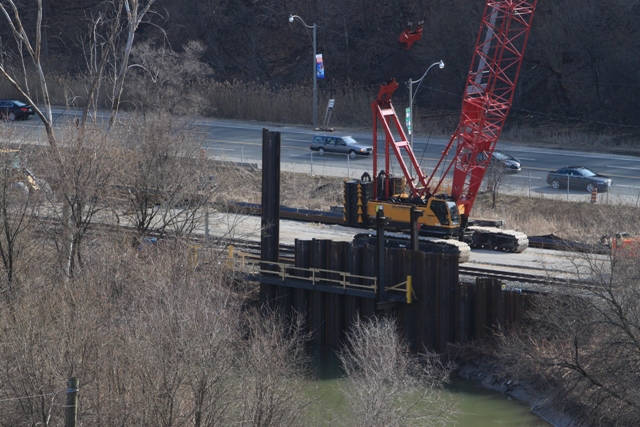
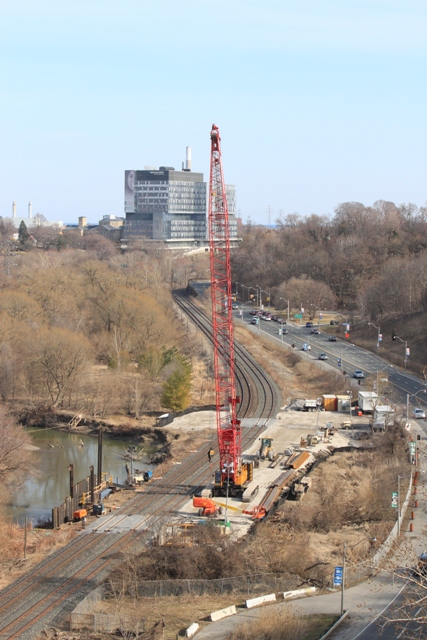
Here are photos of the embankment work on the Bala Sub just south of Bloor Street (mile 3.2) in its early states on April 17. The work is now nearly complete, and a substantial rock wall has been built behind the piles here. Also visible is the degree of erosion from river flow. The location where a GO train was stranded on flooded tracks in July 2013 is not far north of this point.
The GO Transit Quarterly Report talks of both the difficult winter operations for 2013-14 and also of the move to half-hourly service on the Lake Shore corridor, but gives no information about ridership effects of either of these events.
Regional Express Rail
Anyone who participated in the Electrification Study workshops will know that GO and Metrolinx were certainly not leaping at the opportunity to transform their services. Although frequent, all-day GO service was an essential part of The Big Move, the work needed to implement it was not proceeding quickly beyond the Lake Shore and Georgetown (now KW) corridors where shorter-term goals drove the need for improvements.
The original study reported in 2010 on the options and economics of electrification, and concluded that the best candidates were the those two corridors based on the service levels likely to operate in them. The lines with less planned service would, of course, have fewer trains and trips that would benefit from a change in technology, and the implementation cost would not be recovered in savings and operational benefits as quickly if at all. In 2010, the cost of full network electrification was estimated at $4b in then-current dollars.
The implementation plan for a full network conversion stretched over nearly 30 years for various reasons including the rate of capital spending, the staging plan for migration to a new GO fleet, and the desire to concentrate on the primary corridors. Even then, a project just to convert Lake Shore and Georgetown would stretch over two decades, and work on the Barrie, Stouffville and Richmond Hill corridors would not even begin until years 22, 29 and 32 respectively. This schedule was met with wild laughter when it was published, but it has until quite recently remained the only official pronouncement on timing for a full electrification.
Now, Metrolinx claims it can complete the network in ten years. They admit it will be a challenge, but say it can be done. What we now require is a detailed plan that is driven by a desire to achieve change on the GO network rather than delaying it for so long as to be meaningless.
An important change in the outlook for RER is the recognition that electric and diesel operations can co-exist with diesels handling the outlying parts of the network with infrequent service. Metrolinx also acknowledges that a mix of equipment is needed to serve different types of demand and service.
The presentation speaks of “RER” as a successful mode and shows examples from Paris and Stockholm which are only two of the many cities with this type of network. I cannot help thinking that Metrolinx has “discovered” regional electric rail service in much the same way that LRT was “discovered” after a long period when provincial policy refused to acknowledge its existence. The two modes are not that far apart technically, although obviously LRT is aimed more to local, in-town services right down to near streetcar implementations. In both cases, there are alternatives to “the way we always do things”.
As usual, Metrolinx will filter their plans through a Business Case analysis. This could prove illuminating depending on the mechanics of such an analysis (see the report on Economic Analysis later in this article). One fundamental question with transit expansion is not just “how much will it cost”, but “what are the implications if we don’t build it”. Another is to examine how groups of projects can be more than the sum of the parts, but also that building every line on the map could waste scarce funding on pieces that contribute little to the overall plan.
Fares are mentioned here only in the context that increased ridership will bring more revenue, but this will not necessarily offset additional costs of the GO operations, not to mention local transit services to feed GO routes. This topic does come up, however, in the Yonge Relief Network Study. Any business case analysis must look not only at fares as they now exist, but at how they will change in a truly integrated regional operation where attracting riders may take precedence over maximizing fare revenue.
The total cost is a matter of some debate. In the staff presentation, GO President Greg Percy quoted $15b, but CEO Bruce McCuaig said that it could be in the $11-12b range. Chair Rob Prichard, during the post-meeting media scrum, thought it could be whittled down even further, maybe to $9b. The idea of local municipal contributions also floated by but without specifics. Considering the paltry amount Queen’s Park gives to local transit today and the extra costs providing service to an expanded GO will entail, expecting the municipal sector to pay toward that expansion is remarkably arrogant.
Metrolinx really needs to get its act together because both the amount and source of the funding must be clearly understood. (I cannot help remembering how the Miller/Giambrone administration was pilloried for the uncertain cost estimates on Transit City. Why should Metrolinx be immune from such scrutiny?)
One important issue related to cost will be the degree to which GO operations must meet current US Federal Railroad Administration (FRA) standards. According to Greg Percy, GO is talking to Ottawa about relaxation of these standards for commuter operations, but this is entangled with the debate over dangerous goods movement.
The scope of work is daunting and more extensive than the Electrification Study complicated because the new infrastructure must not only deal with co-existence of electric infrastructure with railway operations (including freight on lines GO does not own) but also with substantially higher service levels (frequent, all day). It is one thing to make room for a one-way peak period service every half hour, and quite another to accommodate 15 minute headways both ways seven days a week.
Among the necessary “success factors” is a commitment by Queen’s Park to ongoing funding. This is not a project that can be turned on and off to suit the whims of a Premier more interested in this week’s polls than in long-term network building.
Corridors that remain under ownership by the freight railways, CN and CP, will have to meet their requirements, and past discussions have not been particularly welcoming according to GO officials.
The list also includes Union Station for “capacity, clearance and grounding, and heritage approvals”. This is troubling because the work now underway at Union was supposed to have taken the requirements for electrification into account.
Some infrastructure for service improvements is already in place with Lake Shore now operating at 30 minute off-peak headways, and off-peak service planned for Kitchener-Waterloo in 2015. That, however, is only a start for a much larger project and service buildup. A very rough project chart shows planning, engineering and design occurring in the first three years with construction and service rollout through years 9 and 10. [Presentation at page 13]
This is a huge collapse of what was shown as a three decades plus implementation only a few years ago. To put this in context, we will see a complete transformation of GO Transit at or before the timing of proposed subway lines in Toronto (Scarborough 2023, Richmond Hill sometime in the 2020s at best, DRL further off again). It is amazing what can be achieved, at least on paper, when a government is committed to a project.
Needless to say, the RER scheme was discussed in the context of proposals floating through the Toronto mayoral campaign, notably John Tory’s “Smart Track”. With great tact, both CEO Bruce McCuaig and Chair Rob Prichard emphasized that Metrolinx is looking at all proposals, but that it would be inappropriate to comment on them.
Staff will report back to the Metrolinx Board in September 2014 with more details.
Will Ontario see this through, or will RER, like Transit City, be stillborn thanks to changes in policy, fear of the total cost, and impatience for results that support election campaigns?
Yonge Network Relief Study
Metrolinx together with the City of Toronto, the TTC and York Region, are reviewing a wide range of options for “relief” of the demand crunch on the Yonge Subway and Bloor-Yonge Station. This report is an update on the study’s current status.
Everyone has an idea of how “relief” should be provided, indeed of what the word even means.
The situation is hardly new. Back in the late 1980s, the subway was bursting with riders long before growth in the 905 started to funnel them by the thousands into subway terminals. Two things happened: building downtown rapid transit proved unpopular both for downtown and suburban politicians, and the recession of the early 90s lopped 20% off of the TTC’s annual ridership. The problem solved itself, at least for a time, although the nature of the demand is more complex today than it was 25 years ago.
Relief isn’t just about the central subway system, but of the regional road network that cannot handle all of the trips it should be serving. When we talk about “relief”, competing interests want to ensure that they get a slice of the spending pie, and the one-project-to-solve-all-problems approach simply cannot succeed.
Since late 2013, the study has conducted various public sessions to explain its work and to collect a long list of suggestions. This list contains just about every scheme that anyone has ever floated and we have now reached the point where it must be trimmed. Everyone’s pet project cannot survive into the final evaluation. Through the summer, the study team will winnow down the list into “scenarios”, groups of complementary proposals, for detailed review and public feedback.
The April 2014 public responses are not surprising, and the public is actually ahead of the transit professionals and government on many issues, notably:
- Speed up the process
- Governments and agencies should work together
- A network approach is preferable
- TTC, GO and other local agencies should be one network
- Balance short and medium term “fixes” with long term solutions
- Funding must be reliable
- Political influence on planning is a concern
- The relationship to both the City of Toronto’s Relief Line study and the review of The Big Move should be clarified
What was originally planned to be a multi stage process boiling down the long list of ideas, through a medium list and then a short list and finally bundles of short list ideas will be compressed. Now, the culling of higher performing ideas will happen quickly, and these will be bundled into the “scenarios”.
Of course, the original plan was structured both to defer significant decisions beyond the elections and to avoid annoying people by dropping too many pet projects from the list too early. Now, the provincial mandate is to get things moving, and languid, inoffensive consultation just doesn’t fit the mood of the day.
The over 150 ideas proposed by various parties will be divided into four groups:
- The idea fits into a possible relief scenario.
- The idea is worth doing in its own right and should be done no matter what scenario is chosen.
- The idea is good but does not address the relief problem; it would go into the hopper for other studies including the Big Move update. Examples include the Transit City LRT lines that are not yet part of the first or next wave of Metrolinx projects.
- The idea is not feasible for construction or operation. At this point, this category includes all of the schemes for building new capacity parallel to or along the Yonge corridor including a Bay Street subway or additional tracks/tunnels for the Yonge line. The study has been generous in the options left on the table including schemes to use the “Leaside Spur” which is now a bike path, not a rail corridor.
The types of issues to be reviewed include:
- Increased TTC/GO service integration
- Revised GO operations including new stations
- Relief line options
- Frequent GO services within Toronto including shuttles to Danforth or Kennedy and new stations
- Rapid transit parallel to or on the Richmond Hill corridor including use of the Leaside Spur and Don Branch
- Bus infrastructure and priority
The complete list of “higher performers” is on pages 22-24 of the presentation. Several of these will fall off the table once someone actually considers the implications of their implementation.
An important part of the study is that the schemes will be evaluated for alternate future land use scenarios as well as various transit network implementations. Unlike The Big Move, we will see the behaviour of different subsets of ideas to gauge how well these perform relative to each other.
Other areas to be considered include fare policy, travel demand management, active transportation and transit oriented development. It will be interesting to see whether these are presented with a clear-eyed view of the possibilities for each option and the recognition that each of these behaves differently for different parts of the travel market.
Public participation will initially be online starting, according to the report, in “late June” although I suspect they have missed that date already. More detailed work, short listing and final consultation will come in the fall.
The first question in debate on the report came from Chair Rob Prichard who asked whether a relief subway line will be needed in addition to the RER network. When will Metrolinx have a position on the need for a DRL?
Leslie Woo, Metrolinx VP of Planning and Innovation, replied that the RER concept was always in The Big Move, but the big change this time around is the commitment to deliver it quickly. This affects evaluation of a relief subway line, although the change may only be a question of when it is required, not if. How much effect will the RER have in 10 years on demand pressures that drive the need for a DRL.
There are lots of myths about what the DRL or other lines will achieve, and this is the first consolidated review of all options. The study will complete in early spring 2015.
Prichard noted that the TTC’s Andy Byford says that a DRL is his top priority. Woo replied that in the absence of anything else, something must be done soon to address capacity problems. Both medium and long term fixes are needed.
Newly minted board member Anne Golden (formerly head of the Transit Revenue Panel struck by Premier Wynne in 2013) said that she is told “by people who know about transit” that the DRL is not needed. There are times my respect for board members falls through the floor when they prejudge the outcome of studies and, in the process, hint at what those studies should conclude. Any need, or not, for the DRL is context specific and depends on what else might or might not be done.
It is impossible to know today whether “the fix is in” for one outcome over another, but definitely the RER scheme changes the landscape in which all rapid transit proposals would be evaluated including various subway extensions near and dear to various political hearts. As both the Metrolinx and City studies progress, we will see whether the assumptions and tradeoffs represent well-considered planning, or the machinations of politicians with too many crayons in their desk drawers.
Legislated Review of The Big Move
The Metrolinx Act requires that the regional plan, aka The Big Move, be reviewed every ten years counting from 2006. Work has begun on a new iteration of that plan with 2016 as the goal for completion.
The new plan’s development process will differ substantially from the first iteration:
- The starting point will be an existing plan plus works already in progress or completed, not a grab bag of wish lists from every municipality in the GTHA.
- Improved accountability and transparency (hardly a Metrolinx watchword) will, it is claimed, flow from Queen’s Park’s “Open Government Initiative”.
Those two bullets interact because any new plan must be seen to be developed with open provision of information, analysis and consultation, not by Ministerial press conference or election announcement. Many important issues of process, let alone content, must be addressed:
- Financing cannot be ignored, and the viability of a plan must include a clear statement of how it will be paid for both in capital and operating budgets.
- The role of municipal transit in provision of feeder/distributor services to the network must be an integral part of the plan.
- Service and fare integration are essential to getting the best benefit from the entire network. Continued pride in a high farebox recovery rate may come at the expense of a network attractive enough to make a real difference in transportation behaviour.
- The limitations of transit to relieve congestion must be clearly acknowledged. The vast majority of transit proposals (measured by potential ridership) deal with commuter trips to Toronto’s core, and this does little for people whose journeys are not served by that network. A few buses an hour on a reserved busway do not make much of a dent in auto traffic.
- The plan cannot be presented as an all-or-nothing proposal with no sense of which components contribute the most, the soonest to a better network.
- The almost total absence of freight traffic from Metrolinx discussions must be addressed including questions about just how much highway capacity is actually available for a variety of road users. This is analogous to discussions now underway about the appropriate allocation of road space within the City of Toronto.
- The concept of “mobility hubs” must shift from a scattershot review of every transit intersection with a Metrolinx logo on it. The focus should be on integration with land use plans so that growth at the most important hubs is nurtured. Equally, there must be a recognition that just because two routes intersect, the location is not necessarily appropriate for development as a hub.
- Pearson airport must be more than a destination for a premium fare service from downtown. The polite fiction is that the UPX is a worthwhile investment, a position disputed even by the Provincial Auditor. In fact, UPX is a legacy of a long-gone Ottawa scheme inherited by a former Premier who didn’t have the sense to kill or restructure it when he had a chance. If Metrolinx is serious about changing modal splits in the region, then they must treat Pearson as a major transit node not just for businessmen but for everyday riders including the huge workday population in the airport’s vicinity.
To Metrolinx’ credit, some of these issues already appear in their report, albeit with less aggressive wording than I use here. The promise of Metrolinx and The Big Move has been throttled by timidity, by an unwillingness to commit to large-scale spending or to the revenue tools needed to make this possible.
Public input to the process begins in fall 2014 and runs into 2015 with “Draft vision, goals and objectives” followed by a “Strategic framework”. Somehow, Metrolinx must avoid this following the path of so many EAs in which those who wish to contribute to the process are bored to tears defining process, but never getting a chance to talk about content. Whether the many “stakeholders”, interested parties of all stripes, will be content to wait until mid 2015 to sink their teeth into substantive policy and draft networks remains to be seen.
The worst possible situation, one all too common with “public participation” would be for the push for study completion to overtake the opportunity for meaningful input. From sessions I have attended and from feedback I have heard from others, the last thing people want to do is to waste their time commenting on a plan whose content was decided long before they were asked.
Indeed, if the Wynne government expects to have any credibility for its transportation platform in the 2018 election, then real progress and real attention to the needs of the GTHA are required.
Rapid Transit Quarterly Report
In the Rapid Transit Quarterly Report we learn some of the complexity associated with farming out a large portion of the Eglinton Crosstown line:
The Request for Proposal (RFP) for the Design-Build-Finance-Maintain contract for the Eglinton Crosstown Light Rail Transit (LRT) project was released on December 20, 2013 to the two pre-qualified consortia: Crosslinx Transit Solutions and Crosstown Transit Partners. During the 42-week in-market period, there will be approximately 45 design and topic meetings to provide feedback to the Proponents to assist in the preparation of their submissions, which are to be submitted in October 2014. These two proponents have submitted over 100 Requests for Information (RFIs) to date and six post-tender addenda have been issued in response. The purpose of these interactions with proponents is to ensure fully compliant bid submissions in the fall of this year. [Pages 1-2]
What is unclear is how much of this process would not exist in a conventional procurement, and what extra costs the project will bear to support the rhetoric that PPPs are good for us. What we do know from previous descriptions of the process is that it adds about one year’s work to an already immense project.
[Text originally in the article has been deleted here.]
Elsewhere in the report, we learn that the Finch and Sheppard LRT projects still have some life in them:
After a competitive selection process the Technical Advisors for the Finch West and Sheppard East LRT projects were awarded on February 15, 2014 to AECOM. The project management team for the Finch West and Sheppard East LRT projects commenced mobilization in early March and is proceeding to review documentation and identify critical activities. Metrolinx are working on next steps for the Finch West LRT procurement as a Design Build Finance Maintain contract utilizing Infrastructure Ontario. [Page 2]
When I spoke with former Transportation & Infrastructure Minister Glen Murray [our paths crossed at a social occasion] before the new Cabinet had been announced, he assured me that the LRT lines were still alive. It is intriguing to note that two Metrolinx web pages contain reference to them as current projects, and one even mentions the SRT to LRT conversion.
Toronto Light Rail Transit Project
The Toronto Light Rail Transit Plan is funded and underway. The Plan features a network of 52 kilometres of light rail transit lines running underground and at street level that will connect Toronto with comfort, convenience, reliability and speed. The Eglinton Crosstown LRT will run from Jane/Black Creek Drive to Kennedy Station, with 10 kilometres tunneled underground from Mount Dennis to Don Mills. The Finch West LRT will run from the new Finch West Station on the York-Spadina Subway extension to Humber College. The Sheppard East LRT will operate from Don Mills Station to Morningside Avenue. The Scarborough RT will be rebuilt and extended to Sheppard Avenue, and connect with the Sheppard East LRT. [From the Progress in Toronto page]
… and …
Toronto Transit Projects
The Government of Ontario is moving forward on its commitment to deliver the largest rapid transit expansion in the history of Toronto.
The Government of Ontario has committed $8.4 billion in support of new transit for Toronto.
- The Eglinton Crosstown LRT will add 19 kilometres of new transit from Mount Dennis (Weston Road) to Kennedy Station.
- The Sheppard East LRT will add 13 kilometres of new transit along Sheppard Avenue from Don Mills subway station to east of Morningside Avenue.
- The Finch West LRT will add 11 kilometres of new transit along Finch Avenue from the planned Finch West subway station at Keele Street to Humber College.
- A $1.48 billion investment to replace the current Scarborough RT.
[Edited text from the Metrolinx Transit Expansion page]
Recent statements by Premier Wynne have been taken in some quarters as emphasizing that plans as they now stand should not be messed with by local Councils, but others sense that her government would be open to rethinking the Scarborough situation.
One obvious conflict (which has been mentioned already elsewhere on this site) is that the proposed frequent service on the Stouffville corridor would directly compete for passengers with the Scarborough subway and render the business case for that subway untenable.
The wild card throughout any such discussion is the Scarborough Liberal Caucus which notably includes the new Minister of Infrastructure, Brad Duguid. Will a surface network including major GO improvements plus LRT sway Scarborough’s support away from a subway extension to a more varied and extensive set of both local and regional projects?
The Annual Report for the year ended March 31, 2014 includes an Account Receiveable for the work done to date on the Scarborough LRT project in the amount of $78,963,000.
Economic Analysis and Investment Strategy
Metrolinx is quite proud of its planning process including the use of benefits/business cases analyses and “evidence based” planning. These are fine words, but when one looks under the covers, actual practice has left much to be desired.
Although I did not agree with everything in the critique of Metrolinx from the Neptis Foundation, we agreed on two points. The first was that the promise of The Big Move for what we now call “RER” was left unfulfilled right up to 2013 and has only now become a major plank in Metrolinx and government policy. The second was that the analyses purporting to establish the case for various projects were inconsistent in their assumptions, scope and methodology.
A near-fatal flaw in the implementation of The Big Move and analysis of its components is that project-specific reviews look at schemes in isolation. Whether the required investment (not to mention the bite taken out of overall available funding) is the best of competing schemes for the network is ignored. This is not just a question of which route or technology option might be chosen in one corridor, but of the relative benefit of spending on one project versus other parts of the network.
What Metrolinx hopes to build is a unified method for its analyses taking into account many components and doing so on a consistent basis.
Two additional components are worth mention.
Land Value Capture
Regular readers here will know that I consider the imputed value of future tax revenue thanks to transit investment to be just short of dishonest. Whatever one might call it (TIF or Tax Increment Financing is a common term), the premise that transit investment will create value that can be “captured” (for which read “taxed”) to recoup part of the investment is often founded on dubious premises.
Worst of these are the assumptions about the speed and scale of any new development that is truly transit-related, and the degree to which the market will absorb a tithe intended to recoup transit costs. This is a particular challenge if the land in question is not already on a prime site where location trumps price.
Another problem is that the benefit of a new line may touch a much wider region and set of properties than simply those where new development eventually occurs. How much more could or would existing landowners pay in taxes for the imputed increase in their land or buildings?
Which types of land use would be subject to the tax, and would it apply only to future value when and if the current use and ownership end? What other capital or operating budgets equally have a claim to the value of new development such as utility construction or schools? Too often, LVC/TIF for transit is discussed as if nobody else is at the table.
One of the more outrageous examples of this type of calculation was included in Markham Councillor Jim Jones’ plan for an Urban Rail line in the Stouffville to Union corridor. He presumed that a swath a few kilometres wide along the entire corridor (including much of the Toronto Port Lands) would contribute new tax revenue to pay for his scheme as if it were the only one that might benefit affected properties, or was even physically close enough to them to have an effect on their value.
Mayoral candidate John Tory hopes to raise $2.6b for a municipal contribution to his “Smart Track” scheme (an even longer version of Jones’ plan) through TIF revenues in the core area along the route. This is the same area where developers take every opportunity to reduce their tax exposure, not contribute to the imputed value of a new transit route on their properties.
In both cases, a pet project scoops the presumed uplift in value as if each project were the only one needing and deserving of funding from that source.
If nothing else, the Metrolinx study should establish a base line for estimating just how much this revenue stream is worth and what assumptions must be validated for it to be applicable to any new project.
Benefits Analysis
The second group of values that should be codified are the alleged benefits of an investment. Soft dollars such as imputed time savings and the value of road space released by trips diverted to transit should be counted on a consistent basis and reported separately in any analysis. Far too often these are used to produce a positive benefit:cost ratio when much of the “benefit” either cannot be captured through a tax or fee, or represents a transfer of investment to riders through subsidization of lower-cost travel. Getting people out of their cars has clear benefits as a planning strategy not to mention environmental benefits and the city’s ability to support higher-density development, but it is important that these benefits do not flow back directly, if at all, to the agency that funds the investment.
The values assigned to these soft benefits can skew an analysis by selective use of different values from one study to another. Codification of this process will ensure that at least the same scheme is used to compare all proposals rather than ad hoc methodologies for each project. There may still be disputes about the overall methodology, but at least we will be addressing the same issues in each study.
(One notable example is the compounding effect of the speed of a transit service. Demand models assign trips to faster segments, and so express routes get more riders than local ones. This increased ridership contributes to the imputed value of saved travel time and to the value of road space released by converted auto riders and to the value of saved travel time for remaining motorists. None of these benefits can be captured to offset the investment.)
Work to standardize benefits analysis is underway jointly with the Montreal and Vancouver regional authorities. Although working versions have been discussed at industry meetings, it is unclear when or if the methodology will be made public.
Its first application will be the analysis of the RER proposal, although given that the government has decreed that this will be built, the exact role of the analysis remains to be seen. Perish the thought that the centrepiece of an election campaign might be found wanting, and yet it will be essential to show the analysis, warts and all, to establish credibility.
Finally, I must say a word about “evidence based” analysis, a phrase we hear commonly around Metrolinx, but without much real sense of what this means. The effect of a transit investment may not be easy to measure especially if other factors at play complicate any cause-and-effect analysis. It is a trivial exercise to find new transit routes that had immediate economic effects and others that took decades to bear fruit.
Often, acknowledgement that different circumstances lead to different results is difficult to obtain because projects are sold on the promise of what will follow. “My new subway” will always show the benefit of the Yonge line downtown while “yours” will be doomed to mimic the sluggish development on Sheppard or at the outer ends of the Bloor-Danforth line.
In other words, the “evidence” to be considered must include the wider context in which an investment is made, not simply the desire to make a Minister’s line on a map look like the best government project of the century. Politicized analytical tools have no place in good planning.
 Steve Munro
So it appears that the government has finally clued in that GO train improvements are the #1 priority. It baffles my mind that this was not obvious to David Miller who pushed a badly designed and extremely unpopular light rail scheme that was basically the reason that Rob Ford was elected in 2010. If David Miller had pushed GO expansion in 2007 then some of the lines would probably have electrified service by now, and it would have eaten up the entire Transit City budget. Above ground commuter rail service seems to be widespread in pretty every major city outside North America because subways cost too much to build, partially underground LRT costs too much to build and surface LRT is inferior.
Given the very high cost of the GO expansion it seems to me that pretty much every other proposal will either be cancelled or delayed extremely far in the future due to lack of funds. The downtown relief line seems to have little chance of getting built right now because it would cost almost as much as the entire GO expansion for a much shorter line, and the same is true with other subway proposals. Perhaps the Scarborough subway could be replaced with a much cheaper spur off the Stouffville line? Unfortunately GO train expansion probably will do little to relieve the Yonge line north of Bloor, because of the indirect route that the Richmond Hill uses, so the east part of the DRL between Eglinton or further north and Union is still needed. The west part of the DRL can more easily be replaced with GO service. Also my suspicion is that (particularly if John Tory is elected) all the non-Eglinton LRT projects will be cancelled due to both lack of funds and politics. The provincial government doesn’t seem to revive the transit tax idea despite having a majority (probably because of the pension proposal), so without serious improvement in the Ontario economy it will be starved of cash.
Steve: Begging your pardon, but at the time Transit City was proposed, the idea of massive GO expansion was simply not happening. GO had little interest in off peak service, and electrification wasn’t even on the table. Moreover, the areas GO would have served had little to do with the purpose of Transit City. Rob Ford was not elected because of Transit City, but because of a concerted effort to paint the Miller crew as being out of touch on many issues. The garbage strike was really the killer blow that set the stage for Miller’s departure, and nobody who tried to inherit his title came close to attracting enough support.
LikeLike
Steve, it sounds like this was a huge meeting with a lot of implications for transit projects.
Steve: It was shorter than the article might imply because there was more material in the printed reports than in the actual discussions. That said, it still ran well over an hour which my Metrolinx standards is an epic meeting.
It is amazing that the timeline for electrification has suddenly collapsed down to 10 years … and at the same time it’s amazing that someone like Anne Golden would make commemts regarding the DRL on her first meeting without naming her so-called expert.
Sometimes it feels like politics and patronage and the personal feelings of powerful people are really what direct our transit policy and project priorities, not evidence or business cases. Ironically that leaves me wondering why the Premier hasn’t spoken up in favour of both building the DRL *and* extending it across the Don Valley into Leaside. If ever there were a project that had great benefits and needed a powerful political champion, this would be it.
Moaz: If Metrolinx was really interested in mobility hubs beyond logos on a map they would have started making changes where they could, like at Bloor-Dundas West, Kennedy, and Oriole-Leslie.
Steve: What is quite ridiculous is that Metrolinx seems to be perfectly happy to have a substandard connection with Dundas West Station, even in their mobility hub scheme, because they won’t take on the owner of the Crossways to expropriate an easement through the parking garage into the subway. Instead, there will be a walking transfer, and a new traffic signal will be installed at Dundas and Edna. This is for the prestige, premier service, don’t forget.
With Oriole-Leslie I still don’t understand why the platform cannot simply be extended northwards and a ticket vending machine and PRESTO reader be placed in a little hut or under a shelter somewhere … that way GO parkers can have their parking lot under the 401 and pedestrians and TTC users can get access from the north side.
Speaking of Mobility Hubs … nothing is happening at the Renforth Gateway either. If Metrolinx were really committed they would at least put up a sign to tell people that this is the location of the hub. That indifference (look at the silent secretive discussions about Kipling) is costing them a lot of opportunities to get public support for these investments.
I personally think that “Pearson Airport” is actually 3 hubs … the Airport itself (served by municipal transit, GO Buses and UPEx), the Airport Corporate Centre (served by the Renforth Hub, Eglinton Crosstown west phase and the Mississauga BRT/transitway) and the industrial lands along the 409 and Highway 27 (served by the Etobicoke North hub, an extension of the Finch West LRT … and Sheppard if things had been done differently*).
Mobility Hubs and Gateways should be about more than dropping a logo where convenient … but there is also a challenge when services are adjusted to serve a “hub” that isn’t in the best interest of passengers. What happens in Mississauga at Square One is a good example of how services are forced out of the way because that’s where the hub is.
Cheers, Moaz
*if the Sheppard subway had been built as an LRT (even with an underground section from Bathurst to Bayview) it could potentially have run as far west as Keele. A future extension to Weston Road (where Sheppard ends) could be connected to the lands east of Pearson Airport via Weston, the 401 and Bellefield Rd.) … if we were building a Transit City.
LikeLike
It’s amazing how the focus for GTA transit has changed from building LRT lines to Subways and now to RER in a space of less than 10 years. Each technology has its merits but I’m really wondering if Metrolinx can do an honest appraisal and choose the best technology for differing transit needs. There’s too much fad-chasing and political pressure being exerted on them these days.
If I may speculate on what I think will happen from reading the latest tea leaves:
1) The Scarborough subway extension will not be built and will be superseded by double-tracking and enhanced all-day service on the Stouffville RER line.
2) The SRT will be replaced by shuttle buses – permanently.
3) The DRL will be delayed until after 2050.
Steve: Don’t forget that when Doug Ford becomes Premier (*cough* *gasp*), he will cancel the whole thing.
LikeLike
Flooding in the Don Valley: Is any consideration being given to replacing the Diesels on this line with steam locomotives? They don’t have the problem of traction motors down at axle level.
Is Metro Hall being used for anything? I propose a Museum/Archive of Transit Proposals — I think it may be big enough.
I thought of a similar project to share the space but can’t remember it now.
Steve: Casa Loma, that fantasy on the hill, might be more appropriate!
LikeLike
More seriously, what would it take to put 2 trains on an all-day shuttle to Kitchener? They should be able to do a 2 hour service with current equipment and it might help prod demand.
LikeLike
Boy I have mixed feeling about this. This sounds like a apocalyptic world. Even if you can solve some of the issues with GO improvements, a new GO will perforce be very core oriented, and is certainly not fine grained. One really hopes that Toronto can achieve a mixed and balanced network.
LikeLike
In fairness, Metrolinx has a study underway examining Pearson Airport and the surrounding employment area, which will identify how to increase non-auto mode share to this area. Keep an eye out for the results from it!
However, I would argue that most of the employment lands around Pearson Airport (particularly those not in Toronto) would be ill-served by a transit hub at the airport terminals, because the rest of the airport is in the way.
However, there are 10,000+ people employed at the airport itself, who would benefit from a decent transit hub. The Eglinton LRT didn’t originally run to the airport to benefit only passengers.
—–
Creating a standard process for business cases sounds appealing, but it risks creating an process that’s set in stone and cannot change. Metrolinx’s business cases have gotten more complex/thorough over the years. The UK has set of standards/guidelines for assessing transport projects, but they are change/updated regularly.
It’s also well and good saying “we should have a set of standard assumptions”, but the world changes.
Example: you might include fuel price to assess the user’s cost or benefit of switching from car to transit. That price will inevitably change, so why should this year’s business cases use the same number as last year’s?
Example 2: when forecasting demand in 2030, you have to include assumptions about the transit and road network in 2030. That will change every year up to 2030 itself.
Steve: I agree that parameters in the model must be updated, but whatever proposals are in the hopper at the same time should be judged by the same standards, not by whatever each study thinks is appropriate. And, yes, I also worry that once a “standard” methodology is adopted, dislodging faulty assumptions in it could be rather difficult. This is the sort of thing where “experts” lecture we amateurs about how things should be done as if we were junior schoolboys daring to question a masterwork of the ages.
—–
More generally, you seem unhappy that benefit cases include things such as travel time savings, because they cannot be captured and offset against the financial investment. However, they doesn’t mean those benefits don’t exists and have a real monetary value to people – just not one that can be taxed.
Steve: I don’t object to calculating travel time savings and other similar benefits, but it is important to distinguish between hard and soft costs and savings. If we justify an expensive capital project because it produces supposedly large soft benefits, what we are really doing is investing a lot of money to support travel by a specific group of users who will benefit. This may not serve the interests of the network overall.
The whole process flows from the neoconservative attitude that everything must pay its way, but as transit rarely does, we look further and further afield to find and quantify supposed “benefits” of the investment. What is particularly galling is that some benefits are double and triple counted, and this skews what is considered a “good” project. The goal is to produce a positive benefit:cost ratio even though one may largely consist of soft dollars. Indeed, the scheme could mask the unprofitability of a line with imputed future non-monetary benefits, and politicians rarely look beyond the simplistic numerics of a “positive” ratio.
This is even more troublesome when each project is studied individually rather than in comparison with other possible investments.
One aspect that is rewarded in the Metrolinx methodology is spending a lot of money because of the economic effect this produces. The metric does not even take into account the different proportion of local and offshore spending that each project might produce, let along recognize that spending $2 billion on one project might not be as beneficial as spending $500m on four of them.
LikeLike
Steve, I just had to share this gem from the former Federal Liberal transport minister.
I’ve heard lots of calls for privatization of portions of the TTC but this one might just be the looniest.
Cheers, Moaz
Steve: Considering that Collonette is responsible for the stupidity that became UPX in his time as Minister, he is hardly one to talk about sensible solutions to anything. What rock did he crawl out from under anyhow?
LikeLike
I see that the Richmond Hill line is on the map for RER service. This makes it very disturbing that there is a plan to open a new GO station for it at York Mills, but no plan to move the Oriole station to co-locate it with the Leslie subway station.
This would result in two GO stations being about 1.6 km apart, and still a horrible non-connection to transfer from Leslie subway station to GO. Madness!
I wonder if those would be the two closest stations on the same GO line in the whole GO rail network.
LikeLike
So Steve, do you still have hope for Metrolinx?
Steve: Not in its current configuration. There are (at least) two basic problems.
First is the governance which sees a board of almost entirely non-transit people who also have little to no connection with the politics and development issues in the municipalities Metrolinx serves. The board meets infrequently, and there is little indication they exert meaningful direction over the organization based on the level of debate and knowledge evidenced at public meetings. Real policy is set by Queen’s Park as shown by the organization’s about face on the role of GO Transit.
Second is an unhealthy focus on success stories when (a) the number of people served is a tiny fraction of total travel demand in the region and (b) growth almost falls in their lap simply by running more service. This is reminiscent of the much larger TTC during the era of suburban expansion when riding growth came effortlessly thanks to the rapid expansion of suburban Toronto.
Metrolinx is “an agency of the province of Ontario”, and suffers from the lack of vision, the indecisiveness, the politicization of planning, the short-term priorities this brings. The problem lies with provincial bureaucratic and political culture. Whether this will change with a new Premier and her mandate remains to be seen. With McGuinty, we went through an arc where transit was the big issue, but he soon tired of lack of instant fixes and the big dollars needed to make a real difference. If Wynne stays the course (and is around long enough to see this through), Metrolinx culture could change, but it is too early to sense what may happen.
LikeLike
Steve, operating subsidies should be zero. While fares would be somewhat higher, taxes would be lower (helping the poor).
Steve: Fares would be 50% higher than they are today. This would still not deal with the much larger hole in the capital budget.
LikeLike
Engineer’s chains: Well, you learn something new every day.
‘Revenue Tools’. Can we skip the euphemisms? That one is so taxing.
LikeLike
Thank you, as always, for an enlightening report. I am cautiously optimistic about the future, but it looks like the public has some work to do if this isn’t going to slip through our fingers yet again. If it’s not too much trouble for you, I for one would be very interested in hearing in advance about public consultations and events that we should be participating in. (I usually only hear about them after the fact, and rarely know which ones are actually important.)
It’s very sad that finishing Eglinton seems to have fallen off the map.
I hadn’t realized just how averse you are to the UPX. (Not that I disagree; for me, I believe that it would only be approximately twenty minutes quicker than the Airport Rocket, and with a fare five or six times higher.) Is it the entire basis of the project that you find untenable, or, given that we’re stuck with it, could it be fixed merely with integration into the TTC fare and perhaps electrification?
Steve: My objection to the UPX is that it completely bypassed the planning principles Metrolinx claims to support for its projects. Moreover, UPX does little to address the larger needs for transportation to and from the airport from the GTHA, not just from downtown Toronto, while consuming track capacity in the Weston corridor. Metrolinx has created a separate division with its own President to implement this shuttle service, and the whole project has an aura of self-congratulatory, self-justifying PR. In other words, this is not simply a case of making the best out of a dubious inherited project, but of creating a cheerleading context to avoid, for the present at least, this turning into another major spending scandal.
LikeLike
“Over our dead bodies” is the attitude of CN and CP when it comes to electrification, as they proved when they turned thumbs down on the AMT/Hydro Quebec plan of a few years back. Metrolinx has much to resolve with both railways before their plan can move forward. The Kitchener Line between Bramalea (Halwest) and Georgetown (Silver), the Lakeshore West Line from Burlington to both Hamilton terminals and the Milton Line from West Toronto to Milton are all going to be extreme problems because of freight railway ownership and heavy use.
As admirable as the electrification plan may be, it’s disturbing to hear three different cost estimates coming from Metrolinx. In short, they really don’t know how much it will cost or how long it will take. At least they admit they’re going to have to bring in experienced outside help to make any of this fly.
LikeLike
Request for public input for the EA for the Finch West LRT maintenance and storage facility was posted in one of last week’s Metro newspapers. Nice to see that is moving along. Out of curiosity, for the Sheppard MSF, do you know if they were planning on having heavy maintenance at the Black Creek MSF with storage and minor maintenance at Sheppard? If so, the lack of connecting link under the new subway proposal would necessitate fairly substantial changes to the design of whichever facility was not intended for heavy maintenance. The relative discontinuity of all these lines will necessitate a bit more substantial overhead for maintenance and fleet planning when compared with the downtown streetcar network with all the car barns connected.
Steve: At this point, I am not sure that Metrolinx really knows what will be at the Sheppard facility because of uncertainty about what it would support. Even Finch has the problem of being disconnected from the network because there is no Jane line.
LikeLike
To expand your point, I’m not even sure how anyone can start to think that GO Expansion is a substitute for rapid transit on suburban avenues. Other than Lawrence East and Ellesmere stations, I’m hard-pressed to think of any overlap of where the 4 funded Transit City lines would be relieved by GO services. Perhaps a few less passengers at Mount Dennis station, Caledonia station, and the Agincourt stop on the Sheppard East LRT (or will that simply be compensated by those travelling to get on the LRT lines at these stops).
Similarly, I don’t see that a frequent GO service from Kennedy to Agincourt is going to reduce demand much for services from Kennedy to Scarborough Centre. Are these the same passengers (other than those using currently Lawrence East and Ellesmere stations).
Nor do I see how any of these proposed services would provide much relief at Bloor-Yonge station. It assumes that the destination of people travelling on the Danforth line is at Union Station, 400 metres south of King Street. As far as I understand it, the downtown subway station south of Bloor with the most arrivals in AM peak is Dundas. I’m not sure that someone travelling from Kennedy to King is going to have much incentive to transfer to GO, if it means more walking. Let alone Pape to Dundas or Warden to Queen!
What’s consistent with all these comments is that it’s time to pull out the transit demand model, and seriously test many scenarios, with a careful examination at the underlying assumptions and sensitivities.
On a separate note, there seems to be some surprise that the LRT lines are still moving forward. I’m surprised at this, given the public tenders that Aecom responded to, and the Infrastructure Ontario back in April noting that the RFQ for the Finch LRT was scheduled to be issued this spring, with the RFP going out this Fall (presumably the schedule has slipped some with the election … and because such bureaucratic schedules always slip).
LikeLike
To me this is a question of what should really be built anyway. Eglinton and Finch both need to be connected, via building both out into the airport area, with a real mobility hub at the point they meet.
Will not this need be largely dependent on how the RER is tied back to the balance of the TTC network (and of course fares). Also whether there is meaningful service in the CP corridor and the on the Don Sub? If it does not redirect some of the within 416 trips bus loads currently destined to the Yonge line will it not still be required?
Steve: I really don’t believe that many of the people who draw various lines on maps understand how the riders actually flow around the system today. Too often, there is a monomania about “congestion” and dealing with riders from the 905 while the local demand within Toronto isn’t recognized for what it is or could be.
Here I have to say Steve, you are being really nice!
To make this assessment, would you not already have needed to have a very complete idea of what the future traffic and network would look like?
If the decisions have been made with regards extra station on RER, linking BRT, LRT and additional bus routes, that transform the network, then let us in please. Otherwise do you not need a little information? A transit expert would require knowing what the city was going to look like, how loads were going to be diverted etc. I agree that you may be able create a network where a subway between Eglinton and Don Mills to Wellington is not required, however, this needs to be laid out.
LikeLike
@Malcolm N and Steve
My problem with Metrolinx is that they are out of step with the needs of the region. The electrification of GO is the first good idea they have had. Not finishing Eglinton, waffling on Scarborough and the continuing pushback of the Finch are just some of the examples. As for the TTC, I blame them for not building the DRL, not Metrolinx. The TTC is always trying to delay or put off construction of the DRL when it is needed. Another point, all the proposed DRL lines are too short. I feel it should at the very least terminate at Eglinton on both ends.
As for UPX, here’s the thing. If building are a service to Pearson, why make it premium and expensive? UPX will have low ridership and I will bet fares will be cut within five years of introduction. The Eglinton West LRT extension, while slower admittedly, should be built as well.
LikeLike
I’m not clear on why using the Leaside Spur isn’t a viable option. Is this because money has been put in to it as a bike trail and the city might be reluctant in changing it back? The only documentation about the sale shows that, should GO Transit want to turn it back into a railway, they need to maintain “park land” (ie, the relatively disconnected bike path) next to it. This doesn’t seem like a hard thing to fit in – I only see a bottleneck at the ancient bridge at Bond Park, which should get torn down and replaced anyway.
Personally, I think Metrolinx publicly looking at options like the Leaside spur and the Don branch is great. It at least gives the appearance that someone there isn’t stuck in the same old mindset of using the same old corridors. Then again, as you note, there isn’t a lot of transparency and significant amount of political meddling within the organization.
Adam
Steve: The Leaside Spur runs through a residential neighbourhood and will require a significant grade separation just east of Lawrence and Leslie where the spur/trail crosses Lawrence about 150m away from the intersection. Fitting a double track railway plus some sort of bike path in parts of this will be difficult. Taking the road under the railway would be challenging because Leslie is so close by, but taking the railway under the road would almost certainly require difficult grades and a scale of construction that would be invasive to the neighbourhood.
The next problem lies between the junction of the Leaside Spur with the CPR mainline north of Eglinton, and the point where the Don Branch splits off west of the former Leaside Station just east of Bayview. This is a very busy piece of CPR trackage which any service between the Don Sub and the Bala Sub via Leaside would have to cross.
It is ironic that Metrolinx recognizes the difficulty of using the CPR’s main tracks both on the Milton line where electrification will be difficult, and on the line running into northeastern Scarborough — they keep leaving it off of short term plans because CPR basically tells them to get lost whenever they think of using it. The line is on the Metrolinx 25 year map, but this has always been considered as a long shot for future service. It would make a beautiful connection from northeastern Toronto to downtown which, together with service on the Uxbridge Sub would demolish any justification for a Scarborough subway.
I do not understand why Metrolinx persists in treating the Leaside Spur as a viable option other than, possibly, that someone in a position of influence doesn’t know any better about the issues involved in making this work.
LikeLike
As an old fashioned, small c-conservative, with an economics background, I too find this galling. I believe in small government, but it has its place, and it needs to be seen as such. Previous comment was made with regards to transit fares being raised and helping the poor otherwise. I appreciate (and generally agree) with sentiment, however, in the case of transit there are too many “externalities”. If you make a rider pay the full cost of his ride, you must also make the road users pay the full cost of road use, including their impact on the trips of others.
For those who are all poorly served trips, really need those on better served trips to be not using the same limited roadway. We cannot now reasonably remove the car entirely from the mix, many (even most) families need them as part of their transportation mix.
However, we can do our darndest to make [sure] this most expensive form of transportation is not the most favoured for most trips. The goal is to move people from A to B at peak times. What option will provide the largest benefit to existing and new users, and open the most other capacity. Looking for a project to pay for itself entirely from a tax take increase, or user fees etc, creates a painful and ridiculous process that is even less transparent than load projections and time savings.
LikeLike
Metrolinx touts this as progress: “Yonge Subway Extension EA Addendum (2014) ”
Steve: why don’t you condemn this study as a waste of money on a subway that is going to make overcrowding on the Yonge Line worse and yet it is listed on the Yonge Relief Network Study Update? Richmond Hill is far less density and far less jobs than Scarborough and this extension will make the overcrowding on the Yonge Line much worse. Why is that study being done this year? Why such a rush to build a completely unnecessary subway? You have repeatedly attacked any and all underground transit for Scarborough whether it be Bloor Danforth subway extension, Sheppard East subway extension, or the Eglinton Crosstown that McGuinty had falsely promised to bury just before the 2011 elections he won as a result.
You have always in comments stated that you have never supported a Richmond Hill subway but those one liners are mentioned only in response to Scarborough residents questioning your (implicit) support for a completely unnecessary Richmond Hill subway yet you repeatedly attack Scarborough subway and not just in response to your readers but you begin the attack yourself. I am from Scarborough and I am not complaining about your attack on all high quality transit in Scarborough but just your turning a blind eye to an even more unnecessary subway in Richmond Hill. Steve, I was just wondering what attachments / connections /memories (if any) do you have to Richmond Hill and/or Thornhill just to the south thereof? I am hoping that you will join me in condemning the Richmond Hill subway and that your criticism will be at least as much as we have seen your criticism of the Scarborough subway since Richmond Hill subway is even less warranted than that in Scarborough.
Steve: Whether or not I write about the waste of time and money on studying Richmond Hill (or Vaughan or any other part of the 905) that does not change or invalidate my position on Scarborough. The situation there is the current problem, and that’s what I write about. As for the Metrolinx list of accomplishments and options for network relief, my gut feeling is that they are trying not to offend too many people by saying “not now” and “not ever” to people who still cherish some of the schemes on their list. If nothing else, the ones that don’t work need to be examined in enough detail to show that they don’t work, not dismissed out of hand.
I have no attachments to any place north of Steeles, or much north of Eglinton for that matter. By implying that I am soft on Richmond Hill because I have some memories or ties to that part of the world you undermine your own credibility. As for Scarborough, I have no sentimental attachments to it either, but was perfectly happy to see it get a network of LRT lines plus GO transit upgrades. But, no, only a subway will do.
LikeLike
Again, from my perspective, why are we encouraging people onto the roads by having a premium fare? It should have been integrated it with the balance of the transit network, even if this involves a couple of extra stops.
Perhaps it could have been integrated as part of the Kitchener line service, so that people could get to the airport from both directions, and built this service up as part of a greatly improved go service to Kitchener, or at least Brampton. Local airport transport (Airport railway or LRT to a Kitchener line stop). If the idea of electrified GO had been on the table could not this have been a good fit? Does not the idea of Kitchener (and Brampton) GO to the airport make some sense as well downtown Toronto? Have 15 minute all day 2 way service to the airport on GO and spend the money once.
Steve: The premium fare was the only way that the line could hope to make money when it was a PPP. When Ontario took over the project from the Feds and SNC Lavalin, they didn’t want to put more money in it, and so the whole thing is priced as if it is going to pay its way. This is the worst kind of creative accounting, and the Wynne government should be ashamed it is still going on.
LikeLike
Moaz: At the launching of Metrolinx’s take on the revenue tools mix in May of last year, the Chair talked about redesigning the Metrolinx board to include more political representation. My view has been that the board should include one representative from each region around the GTHA … the Regional Chair (or representative) from York, Durham, Peel and Halton Regions, and the City Manager (or representative) from Toronto and Hamilton. Beyond this there would be representatives from Queen’s Park, some “public citizens” (the Anne Goldens and Gordon Chongs etc depending on who is available) and the CEOs of Metrolinx, plus someone from GO Transit and the TTC (yes … and a Metrolinx representative should sit on the TTC board too).
One challenge is in including other areas that GO Transit serves but Metrolinx doesn’t have any presence … Niagara, Waterloo Region, Wellington, Simcoe and Dufferin counties, Peterborough … even Brant County is possible).
Another question worth asking is whether Metrolinx would be more effective if it stopped being an agency and became an independent provincial corporation instead.
Cheers, Moaz
Steve: The fundamental problem with having every municipality in southern Ontario with a seat on the board is that Metrolinx would lose sight of the fact that, at its heart, it primarily serves Toronto and the portions of the 905 immediately around it. We already have an agency with that sort of reach: it is called the Ontario Government.
LikeLike
Steve has done me the service of pointing out some particularly troubling information with regards to this particular extension on previous threads. What I do not understand is how people from Scarborough or Richmond Hill cannot be avid supporters of the DRL if they want subway service themselves. If these loads are on subway (either) the need for the DRL and even relief well north of Eglinton in the case of Richmond Hill is quite evident, and little should need be said.
LikeLike
Steve has always been against Richmond Hill. You are right that’s it’s a waste of money. That’s why they only plan to do up to Steeles right now. But the thing is so is Scarborough. Because the riders are just simply not there. Did you know they planned to run trains at only 10 minute intervals past Kennedy? I would only support a Sheppard East Subway, a Bloor Danforth Extension, and the crosstown being converted to a conventional subway if those areas were rezoned for high density.
Agreed. 100 percent. But that would take foresight and vision. Plus actually looking at travel patterns.
Of course, and then as a result we all pay 22 dollars while it will still be cheaper to drive. Lack of vision by all here.
LikeLike
Sounds like the meeting was quite a surprise after years of talking about short public/long private meetings and secrecy. And thank you for such a thorough account.
At some point we need to see some quick actions to improve downtown’s congestion or the downtown economy will suffer. There really are too many cars on downtown streets, and besides the long term plans we need some quick actions – the low hanging fruit so to speak. One obvious improvement is to discourage through traffic on King/Queen, and thereby improve speed and reliability, and in turn productivity, of the streetcars.
It seems very late in the day to identify a need for electrification expertise. One wonders what other basic capabilities are lacking. We are also told much is yet to be sorted out with the freight railways – we might well have hoped this was sketched out years ago, called long term planning. More encouraging is mention that discussions with TC are underway regarding rules changes, which can translate quickly to capacity improvements. But missing in the presentations is any mention of Union Station capacity issues.
Big projects take decades, and the 15 minute/7 lines/10 year electrification plan is I think pipe dreaming! Missing though is the role of incremental improvements leading to that goal. What capability does Metrolinx have to do limited earthworks, drainage, track slewing and quickly lay a passing loop, and thereby facilitate first a reverse commute service, and later an all day service. TTR did all the switch change outs in USRC; perhaps they could be equipped to do work on non CN/CP lines.
GO has equipped itself with over 400 bi-level (actually tri-level) passenger cars, seating about 130, to provide their very substantial commuter service. Some of those cars are months old, and any notion replacing them is remis. Instead seek out new compatible bilevel cars powered by diesel engines and electric transmissions, and arranged in DMU’s of say two powered and two trailer vehicles. Ditto with electric EMU’s. The danger here is to move away from bilevels to single levels since most DMU vehicles elsewhere have underfloor engines, as do the airport vehicles. We need a compatible bilevel with the engine in the toilet space if need be.
A two hourly all day service to KW might be an excellent way to get started. The same applies to other routes also.
The more direct RH line using Don Branch/Leaside Spur would pass under the CP mainline with no connection between the two (there would be no possibility of maintaining a 15 minute schedule when mixing with 9000’ freight trains). New GO tracks would run beside and east of the CP tracks, and descending, between Millwood and Eglinton, a grade separation at Wicksteed (road bridge over), new viaduct approaching Eglinton, new bridge over Eglinton and then under CP at its curve toward the NE. It is a big job, but offers big time savings. An interchange with Crosstown is appropriate, and it might still be possible to more favorably site the Leslie Crosstown station.
Steve: I agree that the lack of expertise and planning is troubling, and this reflects the lack of enthusiasm for electrification, significant service improvements and a new focus on using GO for travel within the 416 as a complement to the subway network. To be fair to GO/Metrolinx, the Queen’s Park has only recently “discovered” this as an option, although the outrageously long implementation times of the electrification study report show that Metrolinx was not exactly pushing for a quick implementation. The two situations are, no doubt, linked: GO doesn’t advocate for electrification and frequent all day service everywhere, and Queen’s Park is more than happy to avoid the expense of capital improvements and better service. It is easier to announce one or two new trains every year or so to someplace like KW or Barrie than to face head-on the shift of GO to a regional rapid transit service.
The split between the CPR mainline and the Leaside Spur occurs north of Eglinton, and the existing bridge crosses Eglinton just east of the planned location of the platform for Leslie Station. Any new GO bridge would be west of the CPR bridge to set up for the split onto the Leaside Spur and would, therefore, be even better located relative to Leslie/Eglinton Station.
The real challenge for this spur lies on what is now a bike path through a residential neighbourhood (do they really want 8 trains/hour running through their back yards), plus the crossing at Lawrence which is very close to the Leslie intersection.
This is one of those proposals that looks good on a map, but is not so straightforward out in the field.
LikeLike
I wonder how long it will take Metrolinx to cut the outrageous fare on the UP Yours Express in order to generate enough ridership so as to not embarrass all the provincial Liberals who made this relatively unimportant project their crown jewel. Incidentally, has anyone asked the Metrolinx bigwigs just how much progress is being made on the DMUs? Rumours within the supply industry are that Sumitomo-Nippon Sharyo is running far behind schedule.
Steve: The first trainset is supposed to be enroute to Toronto and will be used for crew training. According to the UPX update in the meeting agenda:
LikeLike
The NIMBY’s would go absolutely nuts!
Steve: Don’t forget that we are talking about replacing a fairly narrow, quiet bike route in a residential neighbourhood with a double track railway with 15 minute service both ways (or better) 18 hours a day, 7 days a week. This is most definitely not a question of “the trains were always there, so suck it up”, and the “Nimby’s” would have every reason to complain.
LikeLike
The key issue with this is what is CP’s long term plans for the Leaside yard. In recent years, activity there has fallen like a stone and as a result, it does raise the possibility that CP could be convinced to give it up for building a new junction with the Don Sub on the north side of their mainline. Of course, it becomes a question of how steep the grade would be from a new Don Sub underpass to the bridge over Millwood.
Steve: Yet another reason for electrification as the line could be engineered for steeper grades. This affects not just the immediate area but the entire run northward. Any place that the track is changed from a climb today to a level section (or even an underpass) tomorrow requires grades elsewhere to be adjusted as well. This is a consideration for many locations where GO has examined the effect of grade separations with the trains changing their elevation.
LikeLike
Steve has any real progress been made on the front of running GO in the CP corridor, or this is being avoided due to the intensity of CP’s current use?
Assuming that ultimately CP gives a hard no, has there been much exploration for alternatives? Has there been a study of traffic for a BRT in the Gatineau corridor? Would Hydro entertain this, or have they already been approached and they strongly rebuffed the idea? For me I find this corridor extremely hard to ignore because of the various underserved areas it cuts through. I realize any service in this corridor would essentially virtually by definition have to be express, but frankly that may be its appeal.
Steve: I don’t think CP is too enthusiastic about this, and in some locations there are right-of-way constraints that would make adding tracks a challenge.
As for Hydro, they are not too happy about a major transit route in their corridors these days and have actively opposed this. BRT they might support because it would not interfere with access to their infrastructure, but I have never seen a proposal got thr Gatineau on any map. GO’s president, Greg Percy, is ex-CP and is quite familiar with their constraints. When Metrolinx designed The Big Move, they simply drew lines on maps with no understanding of what this might physically require.
LikeLike
The Yonge subway should be extended to at least Newmarket – the capital of York Region, Ontario’s Rising Star. Just think of the thousands of VIVA, YRT, GO, and TTC buses it will remove off of the roads every single day plus tens of thousands of cars will also be removed which will ease gridlock. As to the need for a Downtown Relief Line, just remove the seats and there you have a DRL and now that you have the DRL, the extension of the Yonge subway should be Canada’s next priority.
Steve: Why stop at Newmarket when Barrie backons?
LikeLike
I would only support a DRL subway through low density Pape/Broadview if that area is rezoned for high density.
Steve: Maybe you have not noticed that there is already some high density housing near Broadview Station (I live in one such building), not to mention further north mainly along Cosburn in East York. Then of course there is all of the high density in Thorncliffe and Flemingdon parks.
LikeLike
Steve: Maybe you have not noticed that there is already some high density housing near Broadview Station (I live in one such building), not to mention further north mainly along Cosburn in East York. Then of course there is all of the high density in Thorncliffe and Flemingdon parks.
May be you have not noticed but DRL subway is not going to Cosburn, Thorncliffe, or Flemingdon Park. The DRL subway is only going to be constructed as far north as the Bloor-Danforth Line and the last I checked is that it is going through low density Pape. Rezone that area as high density and then you can count on my support for the DRL.
Steve: And if you have been reading this blog for any length of time, you would know that I have always advocated that the DRL go to Don Mills & Eglinton rather than stopping at Danforth. FYI there are two major properties on the likely route of a DRL south of Danforth that will see major development. One has already been announced: the former Unilever site just east of the Don River. The other is the land now occupied by Gerrard Square. Both of these are likely station sites.
Forty years ago when the “DRL” was called the Queen Subway, it went to Eglinton in the plans.
Queen is now too far north given the southerly shift of the downtown financial district, but the alignment of the eastern part is one that I have supported for a long time.
The Metrolinx “Relief Line” project includes an option to head north to Eglinton. It is the TTC which has been dragging its feet on this.
LikeLike
I would suggest to you that perhaps the difference between Pape and Broadview, and Sheppard, is that at Pape and Broadview, load has already had a long chance to build, and the reason the Quiet Guy from Oakville, is suggesting that Sheppard needs to be rezoned to justify subway, is that without this it is hard to see how traffic will build in order to support a subway. Of course, even if it were, and the balance of a Sheppard subway were built, Yonge could not carry the load.
This is in my mind one of the strong arguments against extending Sheppard, before a DRL is built. The OMB may look at the local transit and agree to many high density projects that the local link has no problem with, but that swamp the network. Also I would note that most of the area North of Danforth in that area is already moderately dense with a good number of mid rise building. This area being south of the valley, north of the valley there are a good number of quite large buildings.
LikeLike
The entire Pape-Don Mills corridor from Eastern Avenue to Eglinton is already a high density corridor.
It is much more densely populated than Sheppard, McCowan, and Danforth Road. There are maps online (based on census data) which proves this.
It may look low density because there aren’t many high rises but it isn’t. There’s not nearly the amount of wasted space as there is in North York and Scarborough.
LikeLike
Barrie wants subway, subway, subway!!
Then why not keep it going, Huntsville next? Algonquin Park? North Bay? A subway in every city!
Steve: Winnipeg?
LikeLike
Steve, my suggestion re using the Spur was that a new GO trackage would be entirely separate, though beside CP. The two would need to cross, one under the other, and for this I suggested the GO route passing under CP at the point of the old divergence.
Steve: This could introduce gradient problems, but without knowing the elevations in detail I cannot say for sure.
The Spur right of way is about 100 ft wide, much more than needed for two tracks; plenty in fact for two bike-ways, shrubbery, and possibly noise walls as well. Of course there will be complaints from adjacent property owners, but these could be managed with payments corresponding to property valuation decreases. And yes, the line would need to go over Lawrence close to Leslie.
It is so difficult to add heavy rail corridors into a developed city, let’s not give up too easily on the few opportunities that do exist!
Steve: Going over Lawrence would introduce very difficult grades, not to mention the associated structure, and I don’t think it is technically feasible. Taking Lawrence under the tracks would also be tricky because the crossing is so close to Leslie Street. As for the neighbours, all I can say is “good luck” to any attempt to introduce frequent train service to an area that never had it. This line was always an emergency link between the CN and CP, not one used for ongoing service.
If you compare the new underpass at Agincourt Station, you will see that the approach ramp is roughly the same length as the distance from immediately east of Leslie to the point where the trail crosses Lawrence. It will fit, but only barely, and it’s a bad intersection design as a result.
LikeLike
Nah. A world class city like Toronto deserves transcontinental TTC subway service to Vancouver! Can you imagine the development potential along a subway line that provides transfer free service to the west coast of Canada? Developers would be pounding on the door to the mayor’s office to offer to build it at no cost to the taxpayer!
Steve: I clearly do not have your foresight and vision, although there will be a problem with trains short turning at Saskatoon.
LikeLike
There are many problems with expanding any of GO’s services and they almost all relate back to the fact that the trains need to follow FRA TC rules that require:
1) Buff loading strength approaching 1,000,000 pounds on the ends of the cars.
2) Block lengths approaching 6 miles because mainline freights require an unbelievable time to stop. The air brakes signal travels at just over 900 feet/second so on a 12,000 foot long train it takes 15 seconds before the rear end of the rain starts braking. The standard for railway air brakes says they must start to apply within 1.5 seconds of receiving the brake signal. At 60 mph, 88 ft/s, the train will travel over 1300 feet before the rear end starts to slow down. The braking rate for trains is about 1/4 that for trucks because of the lower coefficient of friction between steels wheels and rails versus rubber and asphalt.
3) A train engineer requires 2 years of service with the railway before he or she can start to train as an engineer. With GO this basically means as a customer service ambassador or in the yards. If GO wanted to double its service it would take over 2 years to qualify enough crews.
4) As Greg Gormick said CN and CP will not allow more service along the main freight lines with out a lot of upgrades paid for by Metrolinx but owned by the railways.
If the RER network is going to be built, then Metrolinx needs to get working on TC to modify their rules for lines that won’t see more than a couple of freights a week, the lines that Metrolinx owns. These lines need to be built as “rapid transit”, not main line rail lines even if they run electrified MU cars that look exactly like GO’s current cars. The only way they will get block lengths short enough to run more frequent service is to get out from under main line rules. This means that the RER can run on the entire length of the Barrie and Stouffville service, along Lake Shore from Burlington to Oshawa (but the Ford plant in Oakville might cause problems) and on the line through Weston to Bramalea but no farther.
Anything that runs on CN or CP main lines will still be diesel hauled at current headways or slightly better. These trains should be equipped with electro-pneumatic brakes to decrease the time required for the brakes to activate so that they could run on the same lines as the RER trains. Streamlined passenger cars in the 30s had EP brakes so it is not something new.
The use of transit instead of TC rules would allow for more rapid training of train crews. Unfortunately the crews for the outer services would still need to meet mainline requirements. If the province decides to legislate a bad contract onto the train engineers, what are they going to do if they all resign. It will take 2 years to train new crews. The feds have left the rail operators in a difficult position.
Do not worry about what to do with all those double deck coaches GO has. Electric service will probably be in 4 car sets of new cab motor, old coach, old coach and new cab motor. With AC motors only half the equipment needs to be powered though the coaches would need some modification to their braking system. Anything they do not need they could probably sell to other operators.
As for the Leaside Spur forget it. The spur is not wide enough for two tracks that meet TC regulations and it goes nowhere useful. The Richmond Hill line will not be part of the RER north of the CN Toronto by-pass and south of there it is really on a useless alignment. CP will not let any significant number of GO trains across the bridge south of Eglinton to Leaside and the alignment, like that of CN’s in the valley is essentially useless. It may look nice on a map but it serves no useful purpose.
The Yonge Subway should never be extended north of Steeles but to Steeles makes a lot of sense. Have you ever watched all the buses go down Yonge Street from Steeles to Finch? The number is mind boggling. Get all of them out of Toronto and let York region do what it wants north of Steeles as long as it does not involve extending the subway. There is no capacity to absorb the extra riders. I am sorry York, but you are not part of Toronto and do not deserve to displace Toronto riders from the Toronto Subway. Talk to Metrolinx about an improved regional line.
If it makes sense to extend the Spadina line to Vaughan, then it MUST make sense to extend the DRL to Markham, just let York pay for all of it. Perhaps we can connect it to the UP YOURS Express and they could get a one seat ride to the airport, via Union Station but what’s a little detour if you can have a one seat ride.
People who cry for a one seat ride know nothing about transit planning. The jurisdictions with the highest per capita ridership tend to have the highest number of transfers. It is a by-product of the grid system.
LikeLike
How feasible is Stoufville line for RER (15 min all way two day electric GO service)?
Between Sheppard & Finch just north of Agincourt station, it seems to also be very close to backyards and is quite narrow & single tracked.
Would you say that Lakeshore & Georgetown are the most feasible lines for RER?
Thanks Steve
Steve: They are certainly the easiest, but Barrie is also probably an easy conversion with the added benefit that Metrolinx owns the whole thing. As for the Stouffville line, yes there is a pinch point around Finch, but at least it is a short one. There is an EA already underway for double tracking this corridor. They don’t seem to have flagged the section near Finch as a problem.
LikeLike