
Updated December 22, 2013 at 11:20 am:
Due to the winter storm and the shutdown of the streetcar system due to icing of overhead wires, the PCC shuttle today on Kingston Road has been cancelled.
Updated December 19, 2013 at 5:35 pm:
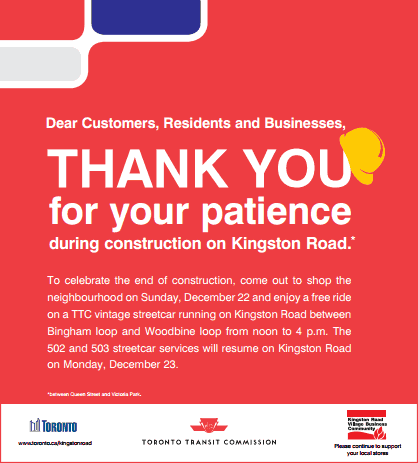
To celebrate the return of streetcar service on Kingston Road on December 23, there will be a PCC shuttle on the line on Sunday, December 22 from noon until 4:00 pm.
Updated December 6, 2013 at 11:20 pm:
Service on the 22A Coxwell bus to Bingham Loop will return to bidirectional operation on Kingston Road effective Monday, December 9. Night bus service on 322 Coxwell will return to its standard routing on the morning of Tuesday, December 10.
Streetcar service will return to Kingston Road at the next schedule change, and the extra service added to north-south bus routes during the construction period will be removed. This will be effective Sunday, December 22 (buses) and December 23 (streetcars).
A side-effect of these changes is that riders in The Beach will no longer have Coxwell buses filling in the common gaps on the Queen car, and the 502/503 cars won’t be available for extended trips east from Woodbine Loop.
Updated November 14, 2013 at 6:15 pm:
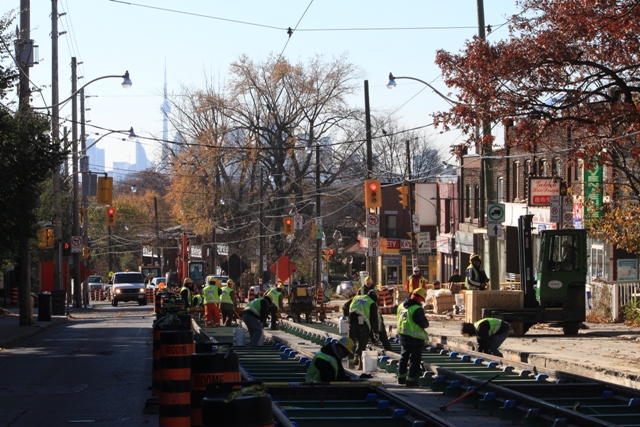
The final stretch of new track is being installed this week on Kingston Road between Lee and Waverley. Once the trackwork has been completed, all that will remain will be road and sidewalk repairs in this area, and completion of roadwork in the section between Dundas Street and Woodbine Loop.
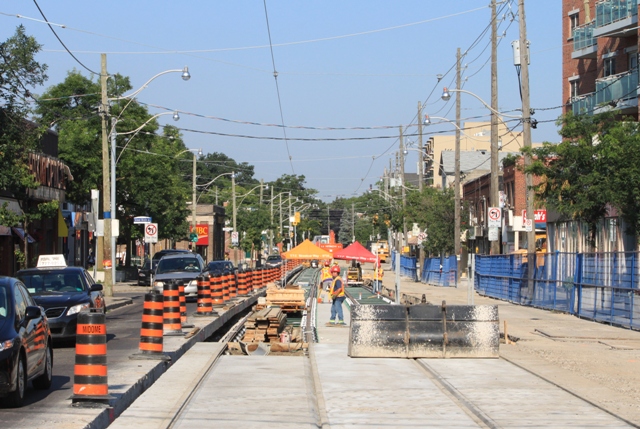
Looking west toward Waverley Road on November 13.
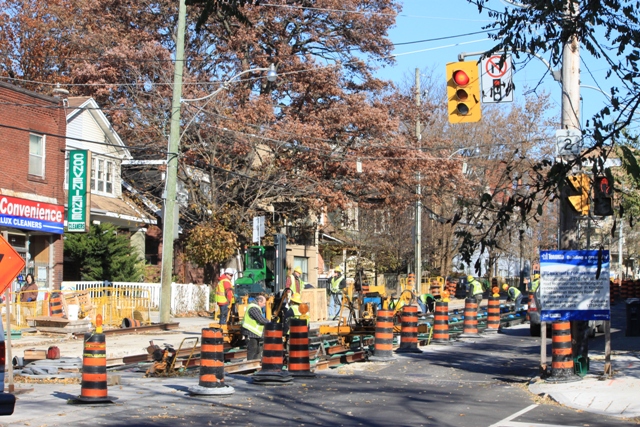
Looking east at Waverley Road. The crew is cutting the new rails to match up with the track that was installed in an earlier phase of the project.
Streetcar service is scheduled to return on Monday, December 23. With the amount of roadwork remaining, it is likely that Kingston Road will reopen to bidirectional traffic over its full length before that date, and the 22A Coxwell service may revert to its standard routing bothways to Bingham Loop at some point before the streetcars return.
Updated November 3, 2013 at 10:30 pm:
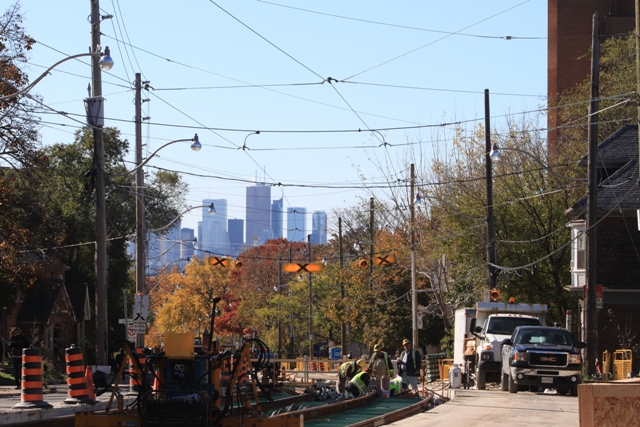
New track assembly is in progress from west of Main to Lee Avenue, and roadbed demolition is in progress from there to east of Waverley. Sidewalk repairs and road repaving continues in the section from Main to Woodbine Loop.
Looking west from Glen Stewart to Lee Avenue with the welding crew.
Updated October 26, 2013 at 4:45 pm:
The only track remaining to be replaced is in the section from west of Main Street to east of Waverley Road. Demolition of the old track structure began earlier this week.
West of Waverley Road to Woodbine Loop, road and sidewalk reconstruction is in various stages of completion, as is the section east of Main Street to Beech Avenue. From Beech to Victoria Park has been completed.
Updated October 11, 2013 at 9:45 am:
On the western segment of the project, concrete work was almost complete on the track west to Woodbine Loop. Within the loop itself, the track was realigned and laid in concrete in late August, and now the long-disused tail track has been removed. The only remnant is its trailing point switch preserved in the new concrete.
Formwork in place for the new concrete on August 23. This is one of the rare instances in recent years of track work proceeding while in active use.
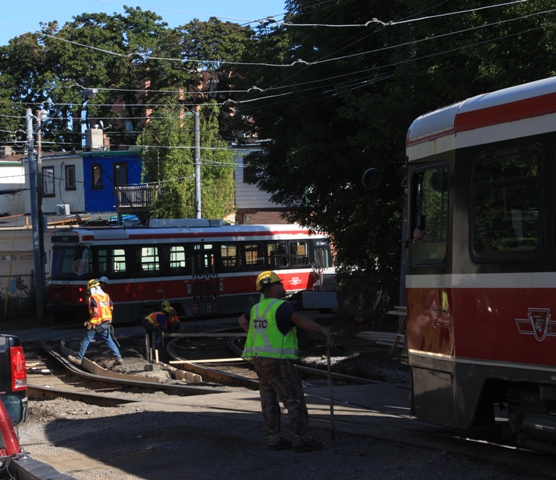
The remains of the tail track on October 10.
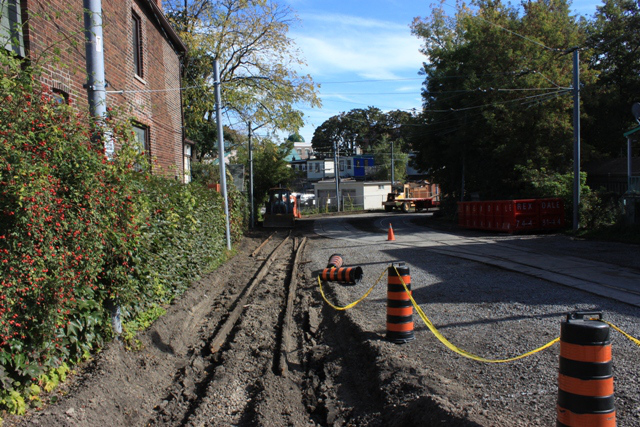
On the eastern part of the project, no track work has started in the last section from Main to Waverley because the intersection at Main is undergoing major reconstruction. Road and sidewalk work is in various stages of completion over the length of the project from Victoria Park to Queen on the north/westbound half of the street. The south/eastbound half will follow the completion of trackwork in the area from Queen north and east to Beech.
The TTC schedule changes for December 22 include the restoration of streetcar service on Kingston Road and the removal of all extra bus service added on north-south routes to compensate for the absence of two-way streetcar service.
Updated September 27, 2013 at 4:20 pm:
On the western segment of the project, track construction is in various stages of completion all the way to just east of Woodbine Loop, the limit of the project.
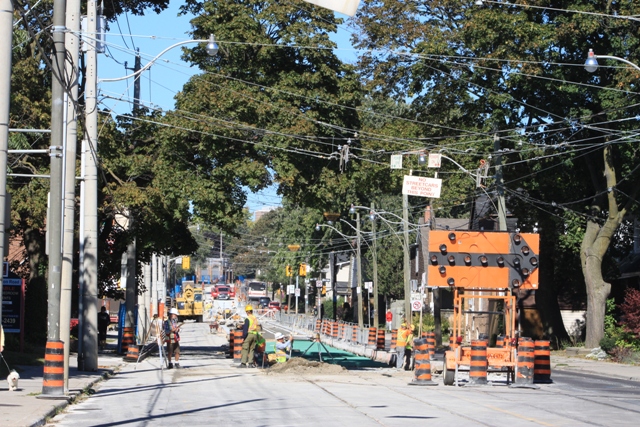
On the eastern segment, track is completed to Main Street and reconstruction of curb lanes and sidewalks is in progress between Main and Beech (the limits of the Phase II of this work). What remains is reconstruction from west of Main to east of Waverley.
Updated September 14, 2013 at 4:40 pm: On the western segment of the project, construction has crossed Dundas Street and is nearing the west end of its scope. On the eastern segment, Phase II of the track work is nearing completion with the reconstruction of the intersection at Main now underway. Sidewalk and road paving work in this segment will be completed once buses can be shifted onto the streetcar lanes.
Updated September 5, 2013 at 9:45 am: On the western segment of the project, demolition of the Waverley intersection at the east end of previous construction was underway on September 4. Paving of the westbound curb lane is in progress between Waverley and Woodbine. The intersection at Woodbine was rebuilt over the Labour Day weekend. Track construction is at varying stages west from Rainsford around the corner toward Dundas Street.
On the eastern segment, Phase II (Beech to Main) is well underway with demolition in progress to just east of Main Street. New track is in various stages from Beech west to Glen Manor.
Updated August 26, 2013 at 9:25 am: On the western segment of the project, right-of-way preparation has reached Columbine. The intersection of Woodbine and Kingston Road will be rebuilt over Labour Day weekend.
The eastern segment is completed from Victoria Park to Pickering, and construction is underway on the second phase (Pickering to west of Main) to Hanniford. Sidewalk reconstruction is already finished on the north side to Main, and on the south side for about half way back to Pickering/Beech.
Updated August 16, 2013 at 4:30 pm: On the western segment of the project, track assembly is in various stages of completion to Rainsford, and the excavation is complete to the west end of St. John’s Norway Cemetery. This appears to be a point where work will pause before continuing west and south to Queen, although some of the sidewalk work has already been completed notably at Dundas Street.
The eastern segment has almost completed its first phase west from Victoria Park to Beech Avenue with final paving of the curb lanes in progress today. Some sidewalk work has begun on the north side west from Beech for the second phase of the project.
Updated August 10, 2013 at 1:45 pm: On the western segment of the project track assembly continues west to Woodbine. The foundation slab has been poured west to Rainsford, and the street excavation is completed to almost the west end of St. John’s Norway Cemetery. On the eastern segment, Kingston Road has reopened at Victoria Park. Paving of the curb lanes is in progress west to Beech/Pickering, the limit of the first stage of work.
Updated August 3, 2013 at 11:20 pm: On the western segment of the project, track assembly is underway between Waverley and Woodbine. On the eastern segment, the intersection at Victoria Park is closed for reconstruction and a new east-to-north curve is being installed.
Updated July 30, 2013 at 3:15 pm: On the western segment of the project, the foundation slab is in place west from Waverley Road to Woodbine Avenue. Demolition of the trackbed is in progress from Woodbine west to Rainsford Road. No track has been laid in this section yet. Reconstruction of the north/west sidewalk is well underway including the reconfiguration of the westbound stop at Dundas.
On the eastern segment of the project, new track is complete from Victoria Park to just west of Balsam Avenue. The exit curves from Bingham to Kingston Road are being installed, and the curves at Victoria Park are scheduled for work at that intersection beginning August 2. Buses are now running on the completed streetcar lanes while the curb lanes are repaved, and both the north and south sidewalks are in various stages of reconstruction.
Photos of work in progress have been added.
Updated July 17, 2013 at 11:30 pm: Photos of work in progress on Kingston Road have been added.
Updated July 3, 2013 at 11:55 pm: John F. Bromley, whose comments about Bingham Loop and the West Hill radial were included in Update 1, has now supplied a detailed track map for the 1928 configuration. This info has been added to the section with his earlier remarks.
Updated July 2, 2013 at 5:35 pm: In the comment thread, there was a mention of the changes to the intersection at Dundas and Kingston Road, westbound, where the safety island (which is too small for accessibility needs) will be removed and the sidewalk extended to continue the street at a standard width. An illustration of this has been added to the article.
Updated July 1, 2013 at 1:15 pm: In the original article, the south-to-east curve at Bingham and Kingston Road was described as a route for outbound radial cars turning back from Victoria Park. John F. Bromley advised by email (included at the end of the article) that this was not the case, and that the cars reversed in a different manner for their eastbound trips.
The reconstruction of Kingston Road from Queen Street to Victoria Park will bring the final piece of “main line” streetcar trackage in Toronto up to a new construction standard begun twenty years ago. Work started early in June 2013 with delivery of track and pre-welding into long “strings” to speed installation.
Updated September 14, 2013
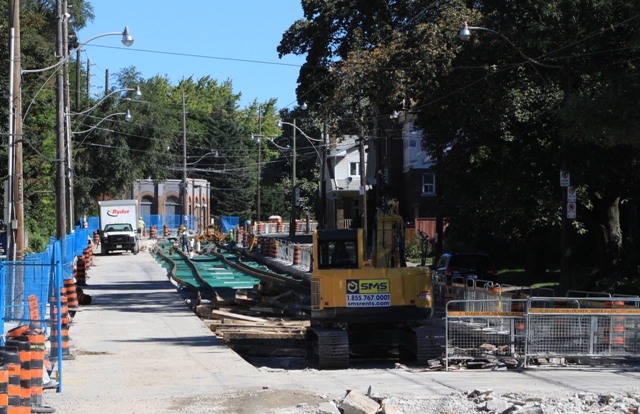
Looking west across the intersection at Dundas toward Queen. The foundation slab is in place from Dundas to Lark.
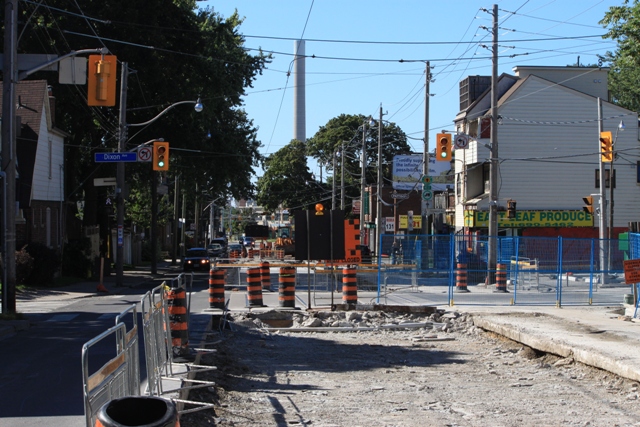
Looking east from Dundas & Kingston Road toward Columbine.
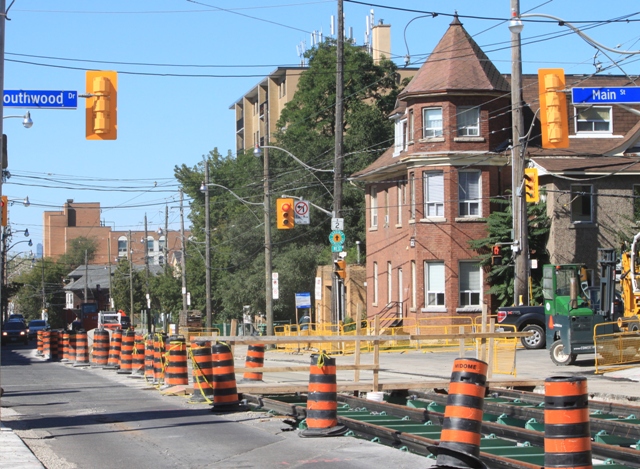
Looking west across the intersection at Main/Southwood.
Updated September 5, 2013
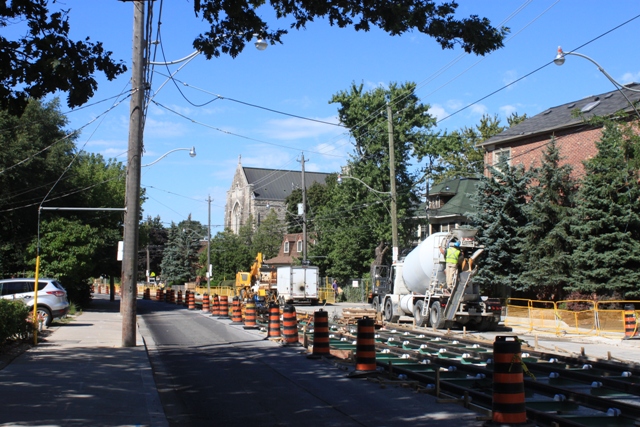
Looking west at Malvern Avenue.
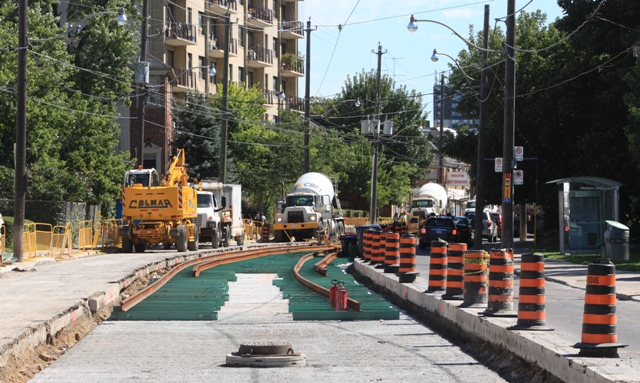
Looking east to Malvern Avenue.
Updated August 16, 2013
Two views looking east at Rainsford Road.

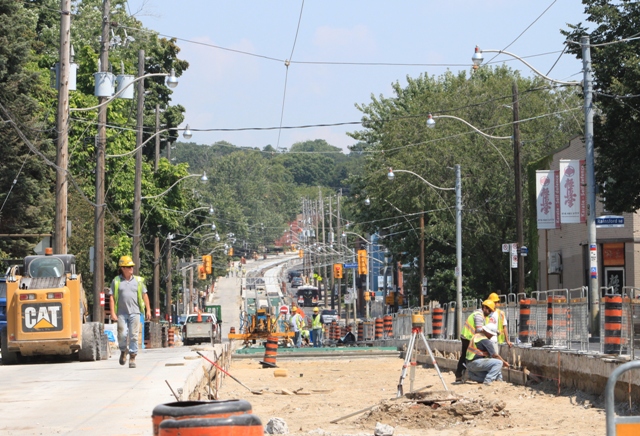
Updated August 10, 2013
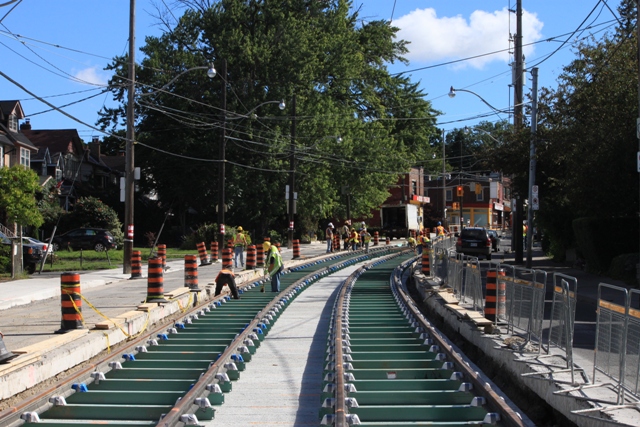
These photos show the same scenes as a week earlier, but with much of the track assembly completed. (Before anyone sends snotty comments about how long it takes the TTC to assemble track, please remember that there are several concurrent track projects, and crews move among them.)
Looking west from Elmer toward Woodbine.
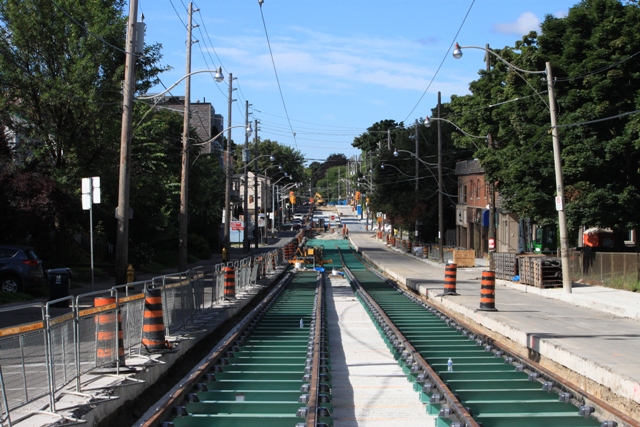
Looking east toward Waverley from Elmer.
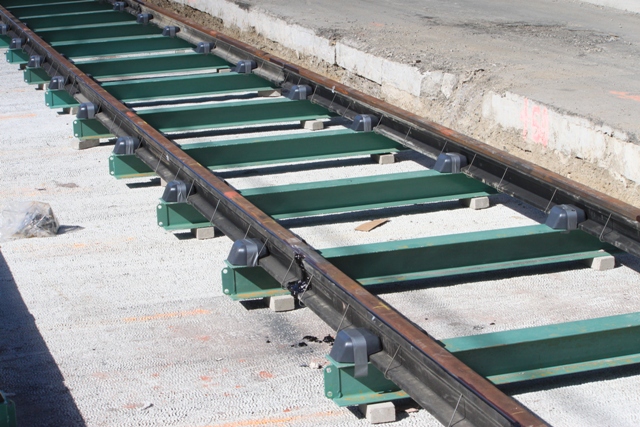
An example of the assembled track, ties and foundation before the upper two layers of concrete have been poured.
Updated August 3, 2013
Looking west from Elmer and Kingston Road toward Woodbine Avenue.
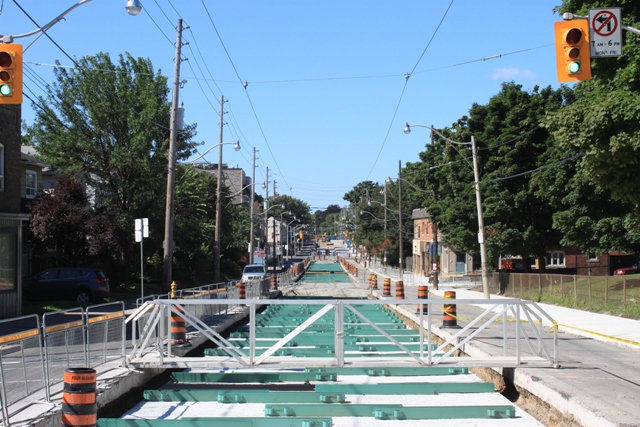
Looking east toward Waverley Road.
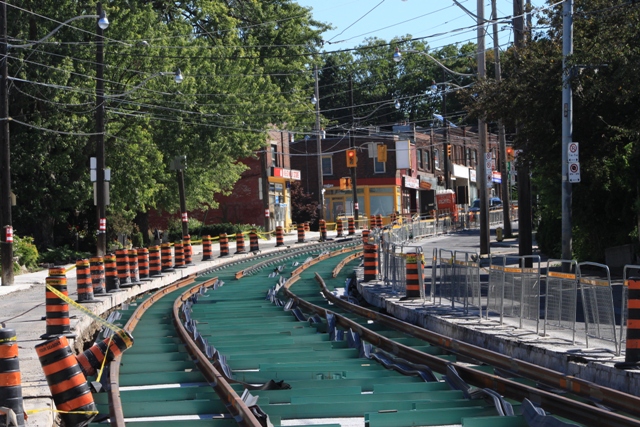
Preparing for the new east-to-north curve at Victoria Park.
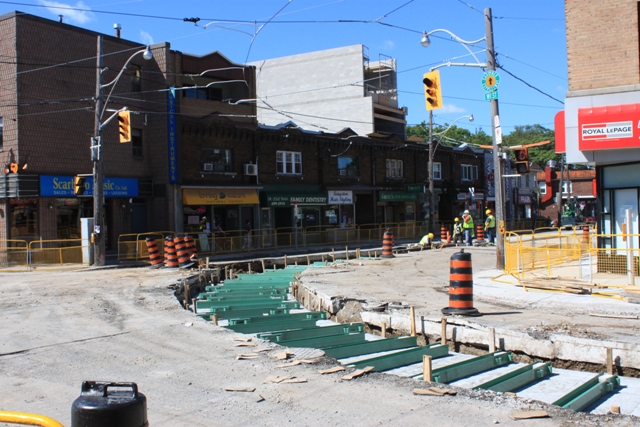
Updated July 30, 2013
The new curve south to west at Bingham and Kingston Road.
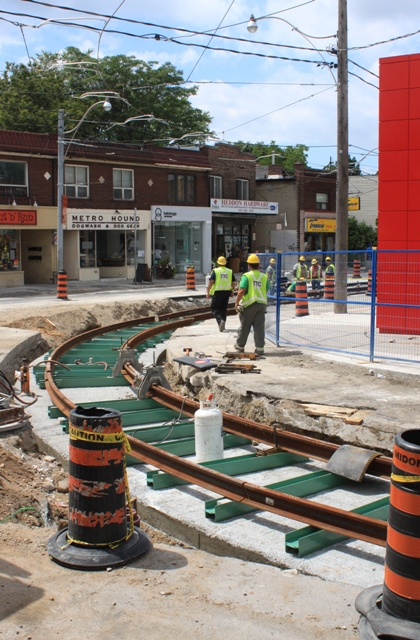
Looking east from Woodbine Avenue on Kingston Road up the hill to Waverley Road.
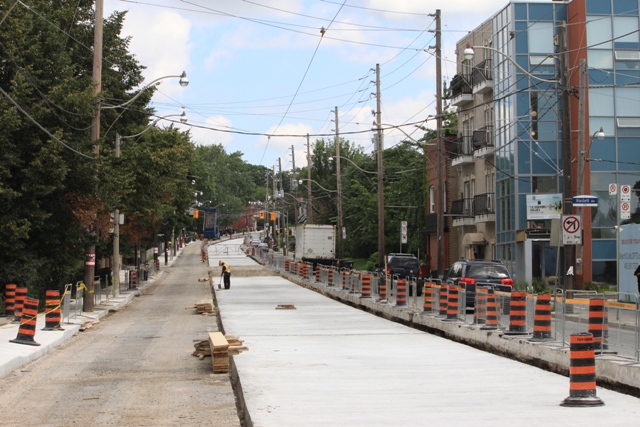
Looking west from Woodbine on Kingston Road. Track across this intersection will be replaced in a weekend shutdown at a date yet to be announced.
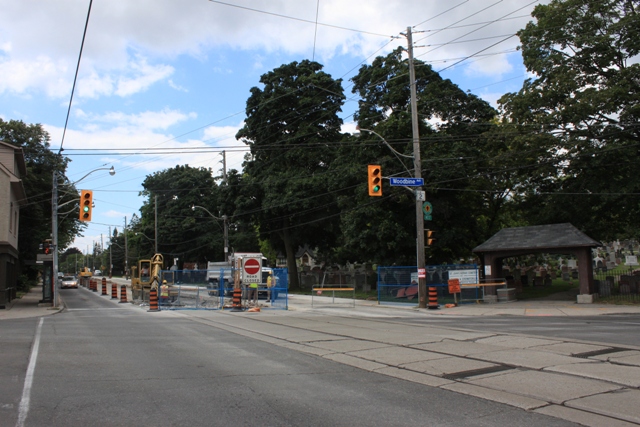
Updated July 17, 2013
Construction on both contracts for Kingston Road is underway. The north sidewalks have been rebuilt for some distance west of the starting points (Victoria Park and Waverley respectively), with track construction following behind.
Looking west from Waverley and Kingston Road, south side. This type of small convenience store in an otherwise residential building is a common feature of Toronto streets.
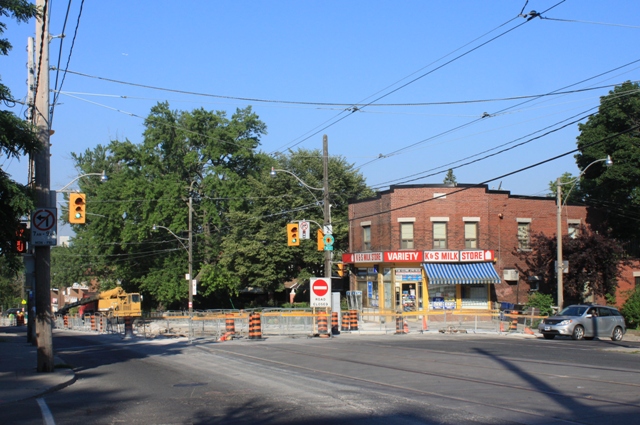
Looking west from Waverley on the north side. Demolition of the old track extends some distance, and not far beyond the point where debris is being removed, the roadbed is already prepared to receive the foundation layer of concrete.
The existing track does not have rubber sleeves, and was set in concrete which has been badly broken in places by vibration.
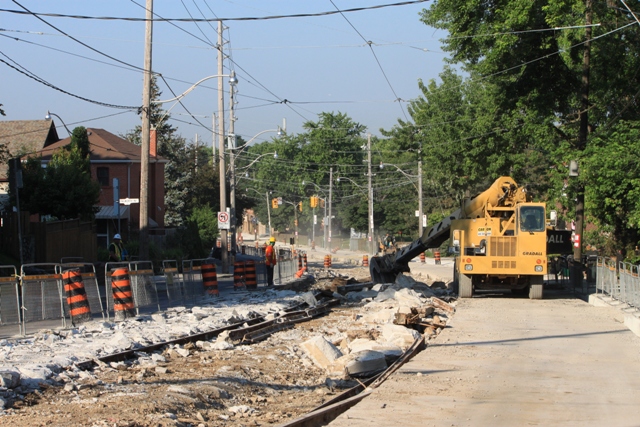
On the eastern contract, new rail is in place west to Balsam Ave. with most of the concrete completed to Silver Birch Ave. The curves for Bingham Loop from Kingston Road have not yet been placed. According to the Construction Notice, this will be done on the August 3-5 long weekend.
Original Article from June 29, 2013
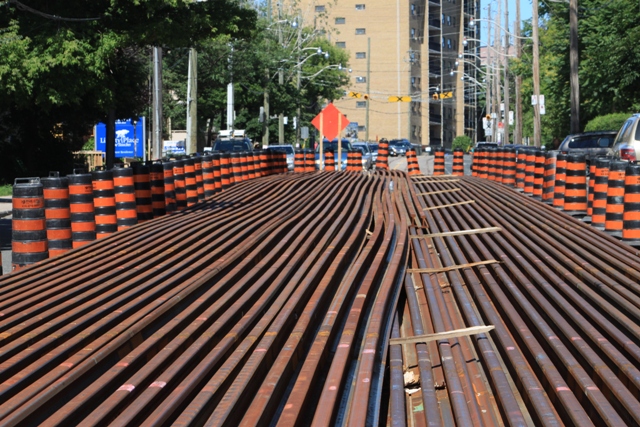
Two inventories now occupy the centre of Kingston Road, one between Woodbine Loop and Dundas Street, and the other just east of Waverley Road (below).
Project details including route changes are on the TTC’s website and on the city’s Kingston Road project website. The display boards from the public open house give a more detailed view of work plans and some of the changes coming to the street including the creation of a new parkette at Dundas. The westbound safety island at that location (the only one on this section of the network) will be removed.
Because of the length of work involved (3km), the project has been broken into two segments with Waverley Road as the dividing line. As of June 30, there is no construction activity yet on the west segment.
In the eastern half, work began at Victoria Park and will progress westward. Bingham Loop will be altered by the removal of the tail track east of the intersection (the only remnant of streetcars in Scarborough) and the runaround track.
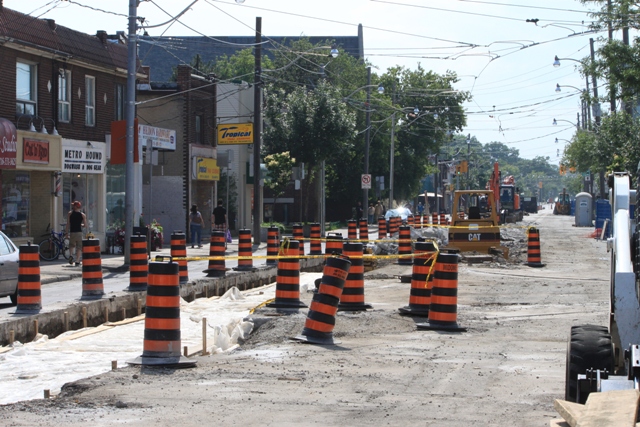
Looking west to Bingham Ave. The foundation slab for the eastbound track is already in place, and demolition of the old track has progressed to Kingswood Road.
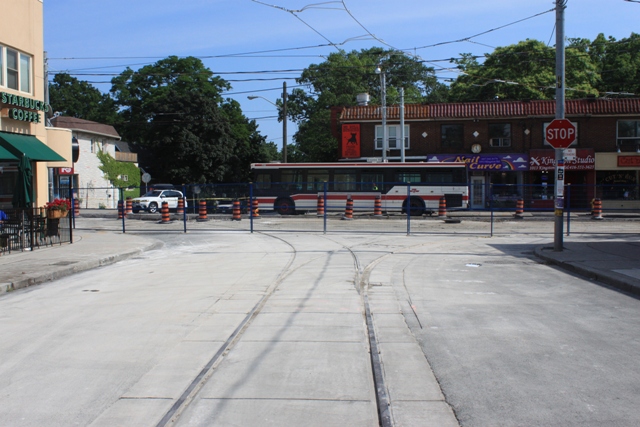
Looking south on Bingham to Kingston Road. The Coxwell 22A bus provides one-way service here during construction, and operates south to Queen via Blantyre where streetcars brought summer visitors to “Victoria Park” (where the water works now stands) in the early days of this line.
The turn to the left (east) is the loop’s runaround track, originally for the radial cars running east from Bingham Loop. In recent years, the curve was rarely used except by charter trips and it will be removed. The new pantograph-compliant overhead includes only the south-to-west curve.
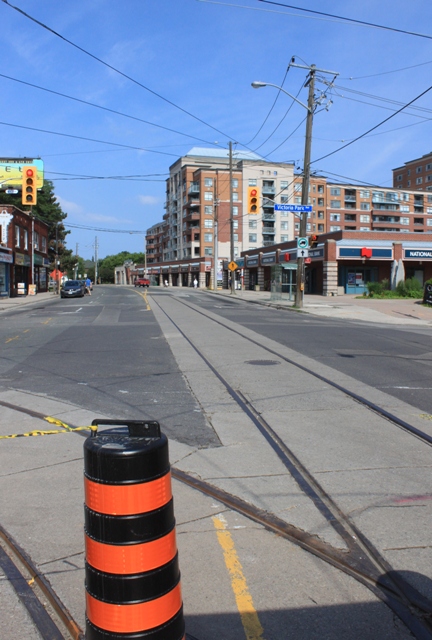
Looking east across the Victoria Park intersection showing the tail track into Scarborough. In the distance, to the right of the end of the tail track, is an historic plaque on the corner of the National Bank branch. Once the tail track disappears, the relevance of the plaque’s location will be a mystery to future visitors.
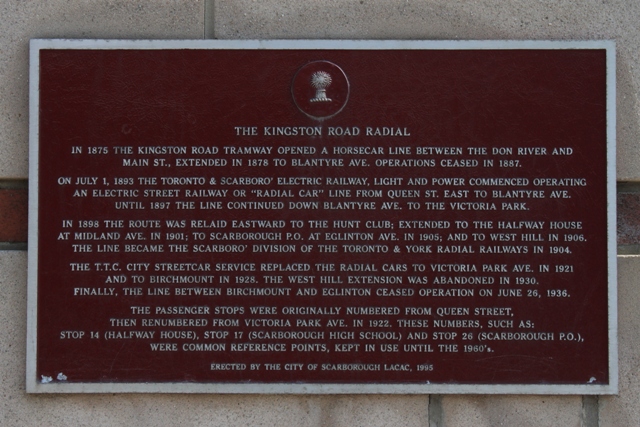
This plaque provides details of the evolution and eventual removal of streetcar service from Kingston Road in Scarborough. It does not include the cutback of streetcar service from Birchmount Loop to Bingham Loop on July 1, 1954 (to the boundary of the City of Toronto, also the end of fare zone 1). The track to Birchmount Loop was paved under in 1955, but will no doubt emerge again during a separate road construction project east of Victoria Park this year.
Updated: The following information was provided by John F. Bromley.
Radial cars did not reverse using Bingham loop. TTC operation began January 12 1927 and SCARBORO operated from the new off-street Victoria park Terminal, completed on January 25, 1927 just east of Victoria Park and parallel to it (previously reversed on the street on the east side of Victoria park). For carhouse runs, the new terminal was accessed/de-accessed as follows.
Cars entering service from Russell Carhouse operated via Kingston Rd and Victoria Park to a point just north of a newly-laid Victoria Park Terminal access track located a bit south of Meadow Av and briefly parallel to it, then reversing into the terminal, loaded, and then ran east over the normal route. Cars leaving service operated west on the access track, north on Victoria Park into and through Bingham Loop, turning west again on Kingston Rd.
During the construction of the extension to Birchmount, access to Victoria Park Terminal was cut off once the new TTC rails were laid. During that period, SCARBORO cars used the north (westbound) new rails in both directions, with a temporary connection at Birchmount. With this change, the route was accessed from Russell via Kingston Rd, Victoria Park, through Bingham Loop, south on Bingham and west (briefly) on Kingston Rd, then reversing east across Bingham via Kingston Rd using the new westbound trackage, then boarded passengers on the street on the east side of Victoria Park outside the old Victoria Park Terminal.
Earlier historians had thought SCARBORO used the south (eastbound) track during the construction, but the north (westbound) track was later found to have been laid first during an exhaustive search by Ray Corley when he was updating his Scarborough Township historical material.
Update 3 July 3, 2013
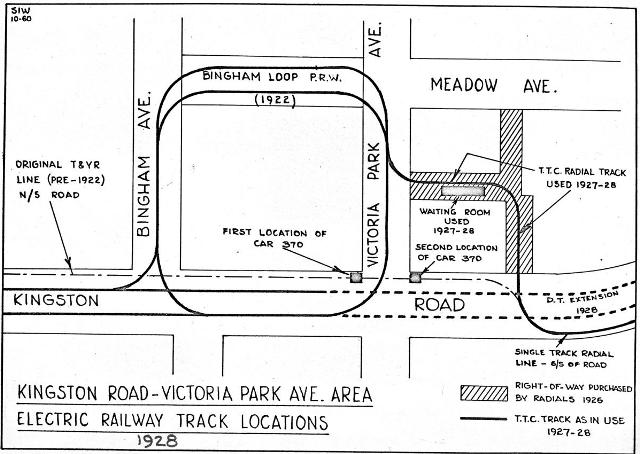
John F. Bromley has provided further information about the arrangement at Victoria Park and Kingston Road where cars from the TTC system met the radial line to West Hill.
SCARBORO transferred to the westbound extension track when it was completed to Bingham so that work could be finished on the eastbound track. The map was drawn by Stu Westland in 1960 for Ray Corley, based on Corley research.
The waiting shelter built from the body of TRC 370 was the original end of the line prior to the opening of Victoria Park Terminal. Stu showed the body right on the car tracks but of course it wasn’t, being at the curb instead.
Update 2 July 2, 2013
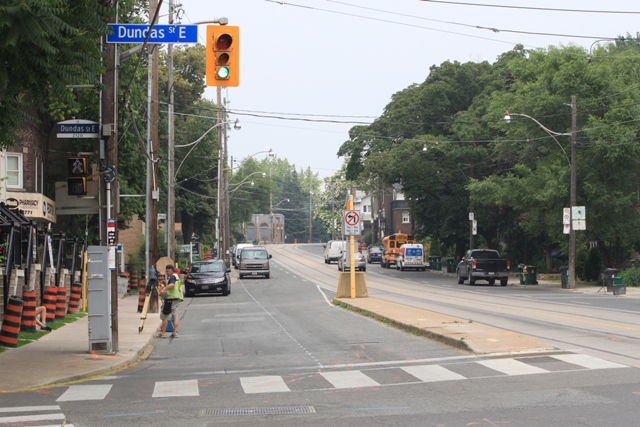
Westbound at Dundas is the only safety island on this branch of the network. It is too narrow for accessibility and, rather than widening it, the TTC will remove the island. The sidewalk will be extended to match the nearby street line so that this stop has the same configuration as all others on Kingston Road.
In the photo below, the thin dotted line on the pavement shows the new curb location.
 Steve Munro
The switch that is needed is wb on Kingston Rd into the loop at Queen. With this they could run a 10 minute shuttle on Kingston Rd with 2 cars.
Steve: There already is such a curve, as well as the curve from Queen westbound to Kingston Road. As to a 10-minute shuttle, traffic can be bad at times, and there is the small matter of terminal time. I suspect a two car service would make up its own schedule as it went along rather as the Rogers Road cars did when there were three of them, nominally on a 10 minute headway.
LikeLike
The 502 & 503 are just a couple of examples of TTC routes that continue to use the old borders of the old City of Toronto as terminals. It’s too bad that they didn’t extend the tracks up to the Victoria Park Station (and up to the Coxwell Station as a bonus).
Steve: Victoria Park is too narrow for streetcar operations from Kingston Road to Gerrard. The old bus terminal at Vic Park Station would have been a challenge, but the new one could handle a streetcar loop. As for Coxwell Station, it’s a very tight loop, and I doubt that the structure was built to carry streetcars given that the policy at the time was gradual abandonment of the system.
LikeLike
I for one am glad to see the tracks being rebuilt.. who knows one day they may try to run streetcars to Warden Station. Speaking of Warden Station I hear it is showing its inner Gardiner.. one of the bays there was just closed due to falling concrete. It has since reopened but the facts are the facts and no doubt the TTC is starting to look at the same way they looked at Eglinton and VP given that the concrete is falling from what is the underside of the mezzanine.
Anyway it will be good to see streetcars there again. I find one of the most scenic routes in the city to be the 502 along Kingston.
LikeLike
Are there any thoughts as to why the WB safety island at Dundas is being removed? Are they replacing it?
Steve: It is too narrow for accessibility standards. In one of the project bulletins, there is talk of a wider sidewalk, but I don’t know by how much. This will wind up being a stop like any other on Kingston Road, I suspect.
LikeLike
The Transit Toronto site has a 1926 and 1927 streetcar system map showing the Scarboro radial terminal and Bingham loop.
There is also a 1945 map showing the Bingham and Birchmount loops.
Steve: Note to readers: These are extremely large PDFs (41m and 14m respectively).
LikeLike
re: the WB safety island at Dundas: a guide line for the new curb has been marked on the existing pavement. Basically, the curb north of the island will simply continue straight along the same alignment rather than tapering to the west.
There are a couple of other intersections at local streets where it looks like the corner radius is being reduced a little (i.e., a sharper corner).
LikeLike
I really wish the safety island was being replaced. In my mind, there should be an active program to install safety islands where possible (and there are many locations), especially when a roadway or track is due for replacement anyway. I can’t see it being a huge expense, especially, if they plan on bringing out the curb so far instead, same amount of concrete, maybe less.
But maybe I’m just dreaming of a day when the whole network has safety islands, bump-outs, and streetcar/bike/pedestrian malls…
LikeLike
If you’d ever have had to wait on one of those “safety” islands with a toddler for a streetcar, you’ll be glad to get rid of them! They are terrifying!
LikeLike
Steve regarding your 501 route comments, either here or on twitter, I believe the large gaps are in major part because the SAC service of changing drivers at Russell has been suspended, at least for the summer if not the entire length of the KR tack construction.
Since this happened service at Neville is twice as bad as it ever was. Maybe you could check with your sources but mine says that the SAC’s were shelved in part to save money. 92 service and 64 service is increased at all times of the day also until the construction is complete and planing felt that because of the 22 buses now running WB on Queen they could cut back. We have returned to the major short turns at the carhouse and KR again so not many vehicles actually reach Neville.
And yes, it is faster to take a 22 bus WB rather than wait for streetcar but that applies to WB only. Long wait for EB at all times.
The 92 has buses doubled up at both terminals just waiting, and at times the 64 also. The 92 is well used at RH and especially weekends but during the day 2 buses with 12min service is more than enough. Now we have 5-6 or so buses giving us 2-3minute service, so of course every 2nd bus is empty. That seems like a huge waste.
What I do not understand is that there are some very senior talented planners at TTC. Why were they told to just blanket increase service on these bus routes? Its the easy way out but I’m sure these guys would take on the challenge of scheduling and crewing to fill the need. These guys are expert at that, why not use them? I’ve heard Bob Dorosch’s name all over the world giving seminars on run cutting. Why not use these guys?
Steve: I suspect that we have a case of Operations saying “just do it this way” and Service Planning being stuck with that configuration. There is no mention of dropping the Service Assistance Crews in the memo regarding the schedule changes for June, but this wouldn’t surprise me.
The fundamental problem here and at King/Spadina is that designing service that will “serve the customer” seems to be the last thing anyone cared about, notwithstanding Andy Byford’s fine words.
LikeLike
The SAC program was never cancelled, it’s still in full operation. Extra cars and time was not added with the diversion. Another cock up. The 502/503’s got reduced time but they’re sometimes extended to Neville Loop to cover gaps.
Steve: I had info from a “usually reliable source” that the SAC crews were discontinued, but it turns out this is not correct.
LikeLike
Yes, I finally saw some of the ‘regular” SAC drivers. Still running but ever since the KR diversion began, service to Neville has been cut drastically. Maybe a lot of the cars are not making it EB to Russell? In addition to the 502’s turning there are an awful lot of WB 501’s suddenly short-turning at KR now. Also these observations were before the Broadview-Gerrard cock-up etc. Insp at Russell a nice guy, he just throws his arms in the air, says none of his cars are on their regular route!
BTW what else is being done on KR that means no streetcar service until November?
The track guys seem to be moving really fast. At their current pace, even with special work, it seems they will not need another 3-months to finish, or is it water, or sidewalks going to hold things up?
Steve:
Toronto Water has to do their work once the track and sidewalk work is out of the way.Correction: Toronto Water’s work was done in 2012. This may work to the favour of the road reconstruction’s progress.I would not be surprised to see the road at least partly open before November, but with the advance planning needed for work signups, the TTC is probably leaving room for screwups.
Toronto Water is often a bit tardy getting out of worksites, although some of this can be blamed on the unexpected conditions found once they start digging.LikeLike
The issue with the SAC crewing during the current closure at Queen & York, is that the cars are already so late by the time they arrive eastbound at Russell, that even with a SAC crew in place, there is sometimes not enough time to put the original operator back on time for his/her return trip westbound. Hence the need for additional short turns at Kingston Road. To compensate, there are many short turns westbound at Bathurst/Wolseley loop, Roncesvalles and even Shaw.
LikeLike
What work does Toronto Water still have outstanding in this area? With freshly reconstructed track and sidewalks, it seems a bit backwards to be doing any more underground infrastructure work.
Steve: Yes, I should correct that. It appears that the Toronto Water work was done in 2012, and now that they are out of the way, the road is bring repaved.
That said, the section from Victoria Park to Balsam will not be completed until early August at best, and that is about 1/3 of the eastern segment of the project. Presuming no severe weather delays, that would put completion to Waverley Road in mid-to-late October. The track will probably be finished sooner, but not necessarily the road beside it. That’s too close for the TTC to aim at the October schedule period for restoration of streetcar service which is now planned for mid-November.
LikeLike
With the elimination of the runaround track at Bingham loop, the only remaining dead end runaround track (not located at a subway station) is at Dufferin loop. Steve, you previously had put together some photo albums of the tail tracks (while they still were accessible) and at that time there was some discussion on their function. Are runaround tracks used at all these days in day to day operation (at any locations where present) or can we expect the next iteration of Dufferin loop will do away with the runaround track as well? Somewhat similarly, when Kingston Road isn’t under construction, does the loop track to turn southbound Kingston Road cars back around north ever actually get used, or was this more or less a provisional item which never sees use?
Steve: There is a runaround track at Earlscourt Loop, and Oakwood Loop can be accessed from either direction (and is used to set up a shuttle service on the west end of St. Clair from time to time). Nothing much except the odd charter uses Woodbine Loop’s tracks to return eastbound up Kingston Road. Fleet Loop could be said to have a runaround track although this is used to move cars from Exhibition Loop into the storage track. There is also College Loop which necessarily allows cars to circle because it serves two routes. If and when the TTC builds the proposed loop at Queen and Broadview (on the parking lot, east side, north of Queen), I suspect it will be a bidirectional loop for use by Dundas cars (or even Carlton cars once the north-to-west is added at Gerrard), as well as Queen and King cars.
As and when Dufferin Loop is rebuilt, yes, I expect the runaround track to disappear.
LikeLike
Steve:
I may not have read it correctly, but the just-released Beach Metro celebrates the fact that trackwork and sidewalks are progressing nicely and Kingston Rd will re-open August 18th, and Councillor MMM is hosting a street party, yes they are closing the stretch between Scarboro Rd and Pickering for the party.
I would assume it’s just that bit that will open or does she know something that we do not?
Steve: The east end of the route from Balsam/Pickering to Victoria Park, is all being done at once. The track is nearly finished, the north side sidewalks are well in hand, the south side sidewalks are under construction, and the road was on the verge of getting new pavement when I last visited. It appears that at least this section of the route is being done as one unit to get it finished (a good idea), and that’s what is being celebrated. I suspect that two remaining sections will be from Balsam to Main, and from Main to Waverley. From Waverley to Woodbine Loop is a separate contract that will likely have its own completion date and party.
LikeLike
Will the wiring and shabby wooden hydro poles be getting cleaning up as part of the streetscape improvements or will the Bangladeshi slum aesthetic that is the norm for Toronto be in place for another 30 years?
Steve: That’s a problem for Toronto Hydro, not for the TTC. There as been a long-running program to update wiring from the old open box style (still visible on Queen East in The Beach) to a new standard with bundled cables. This conversion also involves the transition to a higher distribution voltage and the consolidation of substations. The high voltage distribution cables must be further off of the ground than the cables that feed power to buildings at regular “household” voltages, hence the high poles for the primary distribution lines.
In some locations the wooden poles have vanished, but in others they survive, albeit with fewer wires on them. Hydro seems to prefer them for locations where they need very high poles, although you will see mixtures of wood and concrete. In some cases, existing wooden poles that had open box wiring were simply repurposed for the updated plant (Broadview between Danforth and Gerrard, or Kingston Road west of Victoria Park for example).
LikeLike
I also slid by there today. I noticed that the tail tracks east of VP are still in place on Kingston though. I thought the TTC might have got rid of them? They chopped them out east of the curve to the edge of the east crosswalk of the intersection by the pizza joint. There is still 20 or 30 feet remaining. Are these rails going to stay there Steve, or is the City planning to get rid of them at a later date?
Steve: There is a separate paving and water project working its way westward from Birchmount to Victoria Park, and I suspect the remaining rails will vanish as part of that job.
LikeLike
Steve, I’m sure others have asked this same question – why is “girder rail” not used in Toronto, especially on curves, where it could help guide the wheel flanges as well as prevent the pavement from crowding against the inside edge of the rail, causing the streetcar wheels’ flanges from riding up on it?
I see in your photo of that rarely-used and soon-to-be-removed curve to the left there is “girder rail” – when did the TTC stop using it, and why?
Steve: Girder rail is used on the “inside” rail of a curve because this is the side that guides the wheel flange. You can see this on the new south to west curve at Bingham which is being installed in this photo. Many years ago, it became difficult to buy girder rail in Canada, and the TTC shifted to “T” rail for its tangent track and the outside of curves such as the one at Bingham. On a turn, the “outside” wheel flanges bear on the main part of the rail, whether it is T or girder.
With the track being set in concrete, there is no need for a flangeway in the rail itself. The pavement crowds the rail when it is badly worn, notably at carstops, and this problem would exist even with girder rail because the running surface would be lower than the surrounding pavement.
LikeLike
So just wondering as they are doing all this work and doing in new sidewalks. Are they also putting in wheelchair ramps at the streetcars stop ready for new streetcars? Or will they have to come back and cut the sidewalk later for that?
Steve: Yes, the ramps are being put in as part of the sidewalk reconstruction.
LikeLike
re: the sidewalk ramps, I wonder if there are still some design details being ironed out. On KR the sidewalks are being poured with a gap where the ramps will go, which is being temporarily filled with asphalt. On Upper Gerrard there was some substantial sidewalk replacement this summer, and it did not include any ramps, so those sections will need to be re-done at some point in the next few years.
LikeLike
I always thought that it’s more difficult to give signalling priority for more frequent service. I wonder if Viva will find it easier to have better signalling priority implemented if the frequency is, say, at least 5 minutes.
And “10 minutes or less” is considered frequent service according to the TTC paper schedules.
Steve: “or less” is the important part. Most major TTC routes run at under 10 minutes most of the time. That’s why implementing a “10 minute network” under the Transit City Bus Plan is so cheap — we’re almost there already.
LikeLike
The intersection at Kingston Road and Woodbine is complete. Gone are those nasty rim-buster bumps where the rails had sunk beneath the concrete pads. Nice and smooth now.
LikeLike
You mention “Woodbine Loop”. Why the hell are the new streetcars not bi-directional? It would improve streetcar service by increasing the probability that they run on time and it would also make streetcars more acceptable to drivers as they would then hinder them less. Look at any city with good infrastructure like Berlin, etc and their streetcars are all bi-directional. Do you think that the new uni-directional streetcars are a mistake?
Steve: The city streetcar system is designed for unidirectional cars, and changing this for bi-directional operation would involve a massive redesign of terminals to no significant benefit. The cars for the Metrolinx lines like Eglinton and Sheppard will be bi-directional, and those lines are designed for that type of operation.
Taking Woodbine Loop as an example, even if we had double-ended streetcars, you would still need some place for them to reverse direction and lay over. This is not just a case of coming to a crossover and immediately going back whence they came. Even larger problems would exist at major subway terminals.
LikeLike
Bi directional cars require 2 control cabs, twice as many doors and a lot fewer seats. Amsterdam, Rotterdam and Den Haage all have single ended trams. Many people consider their tram systems to be excellent examples of LRT. The last street car crossovers, trailing point only, that I remember were on Spadina at Bloor, Spadina at Front (out of service for a long time but track still there), Spadina and King and Dufferin north of King. They hadn’t been used since 1949 but they were handy for reversing the sweepers so the brushes at both end could be used. Toronto track does not allow itself to reversing in street.
Steve: The crossover (actually a merge point between double and single track) on Connaught was only removed last year.
In a rather amusing left hand, right hand incident, the crossovers from King & Spadina and King & Dufferin were mined for a temporary single track operation at Humber Loop during reconstruction of the QEW overpass. When the work finished, the TTC put the crossover back into Dufferin Street even though no vehicle in their fleet could use it.
LikeLike
Where reversing is not possible, bi-directional streetcars can use loops as they are perfectly capable of doing so. Plus doors on both sides is also a plus (allows for a platform in between or both sides for boarding on one side and disembarking on the other (speeds it up) and not that these exist for the streetcars in Toronto at this time but forward thinking helps and this would have also made the streetcars more sellable when Toronto decides to eventually sell them (better than sending them to landfills)). Doesn’t the contract have an option for bi-directional ones? If yes, then I hope that the city uses whatever uni-directional ones have been made already but changes the option to bi-directional for the ones not yet constructed.
Steve: In case you have not noticed, Toronto streets are almost all only 4 lanes wide. Double-sided loading is possible only with a shared centre platform meaning that the streetcar line takes up 3 of 4 street lanes. That’s not going to happen.
You seem to be concentrating on the idea that we need a market to sell these vehicles before they wear out. If your real intention is the demolition of the streetcar system, then say so. Many systems use single-ended, single-sided cars, and there is no reason for us to re-engineer our new fleet or network. The Metrolinx LRT lines will use double-sided cars if they ever get built.
You are inventing an argument for no purpose, and I will not promote further comments in this vein.
LikeLike
Mark, you are quite incorrect when stating that Berlin’s streetcars are all bidirectional. In fact, only about half of the new Bombardier cars (‘Flexity Berlin’) are bidirectional, the rest are unidirectional, and so are all of the older models still in service, notably the Tatras KT4D.
To my knowledge, the only ‘traditional’ (i.e. non-LRT) systems that use exclusively bidirectional cars are Budapest and Melbourne. There are very large tram systems such as Moscow or Vienna, that use almost exclusively single-ended cars (excluding special routes such as the Vienna – Baden interurban line).
Having said that, some bidirectional cars could certainly have been handy in Toronto, too, especially for track work projects, whereby temporary termini could be set up, reducing the extent of various diversions. This is for example standard practice in Prague, where they keep some bidirectional vehicles (the KT8D5 Tatras) that come handy during construction disruptions. Examples and pictures here
LikeLike
Timur Urakov mentioned the use of bidirectional vehicles to reduce the extent of diversions due to track repairs/replacement. But there is one other solution.
Cities in Europe use a portable, temporary crossover called a California switch to allow trams to bypass a track construction site along a double track line. (In French, the temporary crossover is called “aiguillage californien”; in German, it is called “Kletterweiche” which literally and very descriptively means “climbing switch”.)
The California switch allows a tram running on a double track line to climb over the devil’s strip to the other track so that one track can be taken out of service for track maintenance without affecting service on the other. For tram lines with bidirectional vehicles, a California switch can also be used to create a temporary terminal. The California switch can be used on street trackage where the rails are in the pavement.
At 12:50 on a video from Graz, Autria, you will see a single-ended tram (with doors on one side only) bypass a work site on the left-hand track using a California switch. If you skip to 16:34, you will see a tram again going through a California switch.
At the 1:20 point of a video from Mannheim, Germany, you will see one tram then another going in opposite directions past a construction zone using 2 California switches. At 2:56 you will see the left-hand track completely torn up while the right-hand track handles bidirectional traffic.
Here is a Youtube video that shows a California switch being used in Budapest, Hungary to create a temporary terminal for bidirectional cars.
The link provided by Timur Urakov shows photos of California switches.
I suspect that the California switch may not be useful during the replacement of older trackwork since the street needs to be rebuilt. But for the next rail replacement in 25 years …
Steve: The TTC tried this out on Coxwell many years ago, and it was not very successful. The problem in part was the frequency of service and also the comparatively short piece of track (between Upper and Lower Gerrard). Given the upheaval this requires in traffic anyhow, it’s simpler just to dig up both lanes and get the process over as quickly as possible. It will be interesting to see how major replacements go when some of the “new” track comes up to its 25-year mark and we see how quickly that top layer can be removed. All the same, I suspect it will be more easily done with complete occupancy of the track and street, not just one direction.
Don’t show these videos to the subway fans. They won’t believe the size of the vehicles/trains running on streets or reservations. Of course, these must be third world cities who cannot afford subways, and the people riding those lines must think themselves horribly hard done by.
LikeLike
A couple of other developments.
1) At many, if not all stops, the lowered sidewalks have been constructed (this is the curb cut to provide accessibility to the new LFLRVs). About 2 m long (plus the length to transition to full curb); a pair of side-by-side 2’x3′ tactile plates for the visually impaired (similar to “D” in the Shuter/Victoria pilot, except straight rather than curved).
2) A mystery! There are at least three locations where there are aluminum tubes sticking out of the new concrete. West and east sides of Dundas; west side of Woodbine. In all three cases, there are a pair of 1″-diameter tubes sticking about 12″ out of the concrete, about 6″ on either side of the outer rail on the near side of the intersection. They are hollow with the top (open) end covered in duct tape to avoid being filled with water or miscellaneous debris. Any idea?
Steve: I will have to go and look at these to get a better sense of what they might be for. Electrical connections of some kind, but for what?
LikeLike
Occasionally, conduits are embedded which pass under the rails. These are to accommodate traffic loop detector wires which must past under the outer rail to get to the signal cabinet from the driving lane. It is unlikely that they are aluminum, more likely PVC or galvanized steel. Aluminum conduits embedded in concrete are notorious for corroding at accelerated rates when the concrete is damp. Loop detector wires are most often installed in sawcuts. After wire installation, hot tar is poured on top to seal them in. The conduit ends will then get cut flush and sealed along with the wires.
LikeLike
I’m not familiar with this neighbourhood, but wasn’t this streetcar route once upon a time meant to be converted to ROW operation like Spadina? Whatever happened to that plan?
Steve: Not this section. It is a largely residential 4-lane street where there is simply no room for a transit right-of-way, not to mention nowhere near the service level to justify taking the space. There was talk of an LRT further east on Kingston Road, and there is still a piece of it on the books as part of the Scarborough Malvern line, but I’m not holding my breath to see it built.
LikeLike
I suppose the loop to turn cars around back north again at Queen will see some use with the PCC; probably the most it has seen for some time.
Steve: Yes they will use Woodbine Loop. The curves used for this are rarely used, mainly by charters.
LikeLike
Having one of the Flexitys in service along with the PCC, would be nice.
Just curious, anyone know if the TTC have plans to have the Flexitys out testing during winter weather?
Steve: The Flexitys have not been accepted for service yet, and so they can’t be run for Sunday’s celebrations. I am sure we will see the cars out during the winter, although we should be close to seeing more cars, early from the “production” run soon, and so testing would be for further verification of the technology in bad weather (they have already been in the climate lab at the NRC in Ottawa to simulate storms and temperature extremes).
LikeLike
Today, December 22, would be a GREAT day to test out the Flexity Outlook streetcar.
Steve: With the overhead iced up, not likely. Try tomorrow when the system is cleaned up.
LikeLike
Isn’t there something the TTC could do to remedy the icing problem, rather than shutdown the entire streetcar network? I know that streetcar and light rail systems elsewhere have had some from of ice cutting for overhead wires. Way back almost 50 years ago, what are now the Blue and Greens lines in Cleveand got shut down due to an ice storm as a result of the use of malleable iron trolley shoes. Wire came down in at least one place knocking the entire system out for a day. If in Toronto it were a matter of enough wire coming down, I could see shutting down the entire sysem but there is such a thing as ice cutters the the TTC could use and keep the system open.
Steve: The TTC has ice cutters and had been running, or trying to run, storm cars. The thickness of the ice isn’t trivial, and I’m wondering whether the problem got ahead of them overnight. Without talking to folks at TTC, I don’t know when the storm cars went out. Now, at 7 pm Sunday, the temperature is above freezing and there is a lot of melting, although things are far from clear. The challenge will be to get the system working again for Monday.
LikeLike
W. K. Lis said:
To which Steve replied:
Actually, if there was enough pan-friendly overhead, this would be a very great test.
Pantographs, when set correctly, can apply more pressure on the overhead that can break through ice in many circumstances. I’m not saying that would be the case with the storm we have just had, but if it were, it would make an excellent showcase for the vehicles.
When the new LRVs arrived in Pittsburgh, they set the pantograph pressure to the minimum required because the manual said so. The first winter after their arrival, an ice storm prevented all operation at the start of day. At some point, some one got the bright idea to set the pressure a little higher and they could break through the ice and operate once again.
LikeLike
I recall the comment from the Director of Streetcar Operations of Riga Transit, in Latvia, yes they have such a position, after a particularly heavy snowstorm last winter, that (paraphrasing)
Fyi, Riga runs various type of cars ranging from Bombardier Flexity’s to PCC-type Škodas, on a track gauge like Toronto’s. Time to call in the army!
Steve: The issue here was not snow, but ice combined with widespread power outages that affected the rapid transit system in areas where emergency power sufficient for extended outages was not available for station lighting, signals and other communication systems.
LikeLike
My comment:
The Bombardier Flexity’s have been in service in various countries around the world for a couple of years or more. Some have been in service in cities that regularly see climate worse than Toronto. That is so typically Canadian, to be so risk-adverse.
The TTC ought to just press each Flexity into service upon arrival, and rotate them along all the routes. I am sure that the travelling public will be pleased as punch to be able to try one out, bugs and all.
As well, the Presto version 2 roll-out ought not to impact otherwise regular TTC operations.
Steve: One important issue is the question of insurance and liability for cars that have not yet been accepted by the TTC. If anything happens to them, they are still on Bombardier’s account. Once production deliveries begin, the lag time from arrival to acceptance will be shorter.
LikeLike
Streetcars had been using sliders attached to the trolley pole harp all weekend but couldn’t keep up with the icing. Cutters are not normally used as they cause damage to the trolley wire, and I do not know if they were deployed. Kingston Rd is going to a 3 bus operation between Bingham Loop and Eastern/Coxwell temporarily as there is a downed tree on a feeder line. No eta from the city as to when it ill be cleared. 502/503 turning back at Woodbine Loop.
LikeLike
Too bad there isn’t a mechanism to resistively heat the lines to just melt the ice off. Power requirements would be huge, but could simply be done with AC and a floating neutral above the 600VDC line potential.
Steve: Bronze doesn’t have very much resistance. There would also be the problem of having the current flow from somewhere to somewhere else. The system is designed for the streetcars to complete the circuit, not the overhead wires.
LikeLike
If I remember correctly from my university days that is how power companies keep the ice off of their high voltage transmission lines. They put an intentional overload on each line in turn to melt the ice off. Of course it does not help with ice on the transmission towers as was discovered in the last great ice storm that hit Eastern Ontario and Quebec.
Merry Christmas and a Happy New Year
Steve: Streetcar overhead also has a multiplicity of paths considering intersections, and it is fed from taps every fifth span wire or so. This is very different from a transmission line which has unique “in” and “out” points, a topology that lends itself to adding a load that will be “felt” all along the line.
LikeLike