
Today the TTC took the media on a short excursion with its new streetcar, 4401, from Hillcrest Yard to Bathurst Station and return. I spent a good deal of the trip being interviewed by others, and so my photo coverage is limited. However, over on the Torontoist site, there are lots.
Our journey was done at a leisurely pace. This was the first daylight voyage for one of the new cars, and it attracted a lot of attention. We seemed to arrive at Bathurst Station in almost no time, and this was in part due to the extremely smooth ride. I made a point of sitting directly above one of the trucks (the point of where the carbody has the least ability to move independently), and even going through special work, the vibration was not annoying.
The curve into Bathurst Station from the north was more notable for the fun of seeing both ends of the five-section car at the same time (the turn is over 120 degrees) than for any sense of difficulty making the turn.
Air conditioning was quite pleasant onboard, and the car maintained a comfortable temperature even with the doors open at Hillcrest Yard. The generously sized windows give a good view of the passing street, although it will remain until night operation to see just how much the tinted glass cuts external visibility.
Daytime test runs will become more common now that the TTC knows the vehicles work and won’t be the source of massive service tie-ups.
What I really look forward to is seeing and riding these cars in service. How will loading times be improved? Will the accessibility features work and be accepted as designed? How easily will passengers adapt to the new fare collection scheme as it gradually rolls out across the system? How long will it take for operators to drive these cars through Toronto streets with the same confidence and speed as they do with the CLRVs?
Car 4400 is about to move to Ottawa for climate testing at the National Research Council. From there, it will return to Thunder Bay to be retrofitted with improvements developed during the test phase. 4401 and 4402 are still on the property, but they too will go back to Thunder Bay for retrofits. The TTC is holding off giving the green light to the production vehicle run to get the greatest benefit from the testing that remains, but shipments will begin in fall 2013 for a spring 2014 rollout.

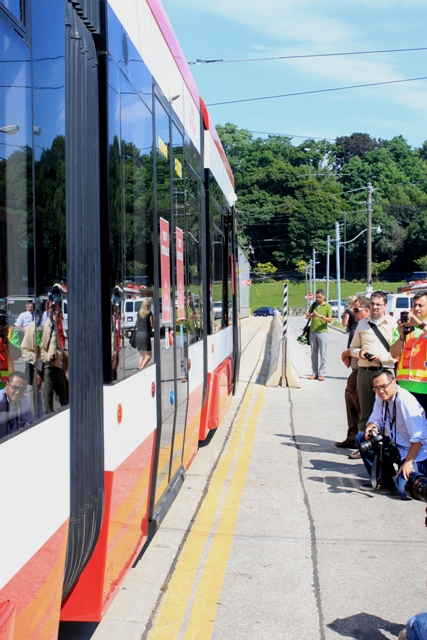
Sitting in the loop at Bathurst Station, there was (as operators of railfan charters would know it) a “brief photo stop”. The media went crazy of course with everyone getting in each other’s shot.
No, there is nothing wrong with the destination sign. The LEDs in the sign are not all lit at once, but the image “scans”. We don’t see this effect (just as we don’t see flicker on a TV screen or computer monitor). It will be almost impossible, except with a long exposure, to get a picture of these cars with all of the text in the signs readable.
A related issue is that during the daytime, glare on the side windows can make the signs above the doors difficult to read (in the photo below, the sign is in the shade). The transit industry solved the problem of brightly-lit signs a long time ago, and I don’t understand why the TTC has taken a step back here.
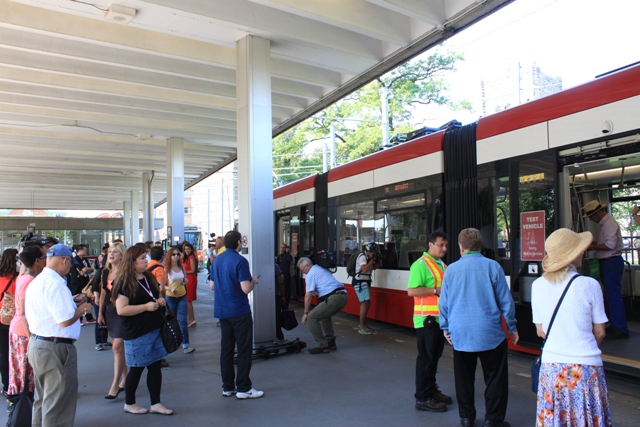
More media at Bathurst Station with a few real customers mixed in. We managed to create a minor gap in the 511 Bathurst service.
On board, everyone was interviewing everyone else, and there was a lot of jostling of camera crews. This work amazingly well thanks both to the stability of the ride and the space available in the vestibules. The view below looks through one of the articulations where, on the right, Mike Filey (one of the original Streetcars for Toronto Committee members) chats to with the Sun, while Metro Morning’s Matt Galloway sits across the aisle.

The view below looks from the rear of the car forward with most of the passengers off of the vehicle. The rearmost door opens just to the right of this area.

The cars have four sets of doors. At the front and rear are single-width doors, while the two middle sets are double width. There is only one step up into the car from the pavement. When cars are at safety islands or station platforms, the height difference will be considerably less.
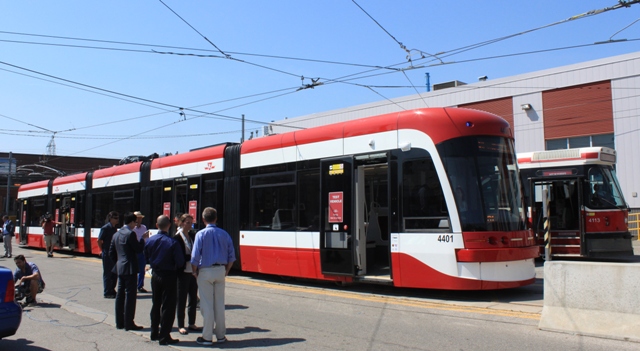
This is the second set of double doors (the third entrance counting from the front). It opens onto the vestibule intended for cyclists, although both central vestibules will no doubt accumulate their share of shopping buggies and baby carriages. Seats in these areas flip up (like the seats in the wheelchair section of the TR subway cars) so that, by default, they are out of the way and passengers are encouraged to sit elsewhere if possible.
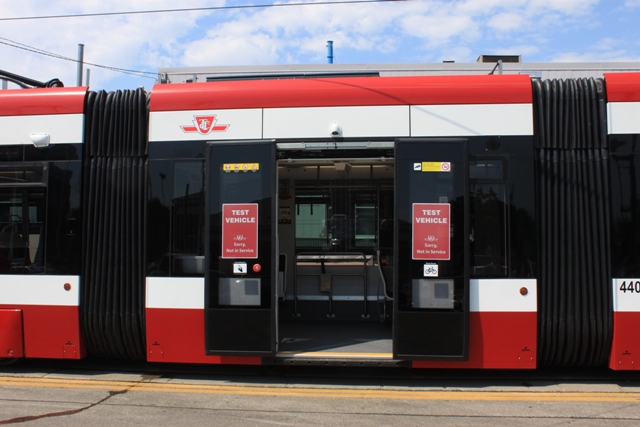
The rear edge of each set of doors contains an LED strip that flashes to warn motorists.

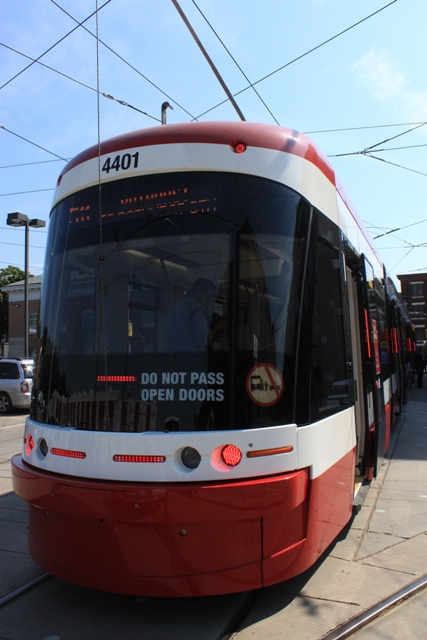
There is also a flashing warning message on the rear of the cars.
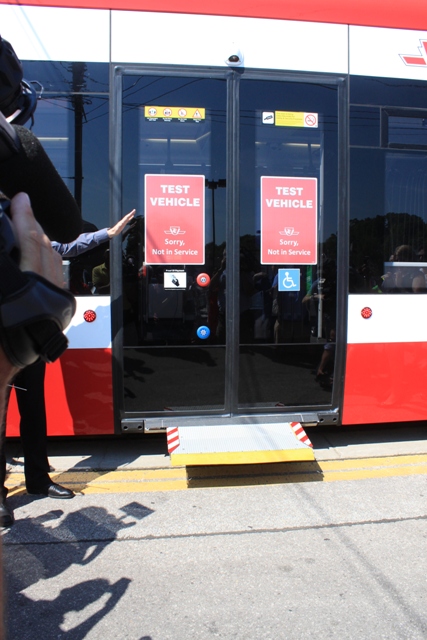
The second set of doors includes the ramp for accessibility devices. In the view below, cameras await the ramp’s deployment.
When the operator has a ramp request, the doors will remain closed until the ramp is ready. The ramp is in two sections, and only the outer one would be used at stops with platforms. This has been the subject of some discussion because it turns out that the TTC has platforms of varying heights and some were too high for this ramp. They are being modified.
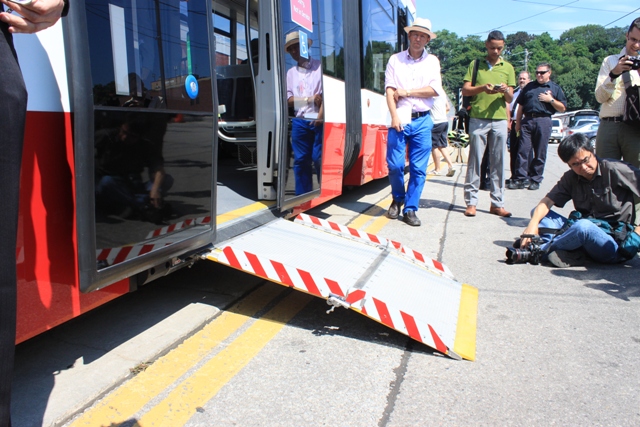
In the second stage, another ramp segment appears, and this allows the outer one to fold down to ground level, wherever that may be. In the example here, there is a slight crown on the pavement around the streetcar tracks, and so the bottom of the ramp is actually lower than “street level” at a typical stop. Note that the doors are still closed even though the ramp is fully extended.

Side panels flip up on the ramp, and the doors open to match the width of the ramp. This ensures that someone leaving the car does not pilot their scooter or chair off the edge of the ramp.

From the side, the ramp at full deployment, with, yes, more media including the National Post’s Peter Kuitenbrouwer artfully reflected in the car door. The blue button on the door panel is used by riders to request a ramp deployment from the street. A matching button is found inside (see later photo).
The request panel from inside the car is at seat height so that a passenger on a wheelchair or scooter does not have to stand to talk to the operator.

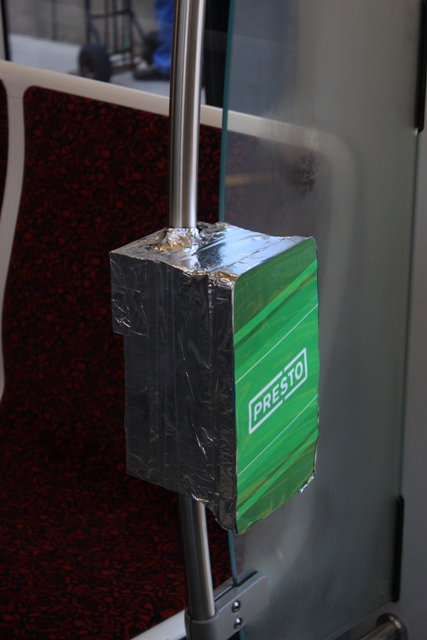
In the two central vestibules there will be Presto card readers. Here, a mocked up box with duct tape stands in for the final product to give a sense of size and placement. During the transitional period to full Presto use on the TTC, these machines will issue a fare receipt to that riders can transfer to other non-Presto routes. Riders with other fare media will use machines at major stops or onboard to pay their fare and get a receipt. Metropass holders will simply board and show their passes if challenged by a roving fare inspector.
In a previous thread, some readers have asked about the provision for trolley poles and pantographs to co-exist on the system. This is accomplished by installing “sliders” alongside the frogs so that pantographs will ride down and under the junction without snagging on it.
To date, only frogs where lines join have seen these adaptation, and the TTC is finalizing the design for crossings. As described to me, the trolley part of the new crossing frogs will have a downward bow so that the crossing itself is the lowest point, but the approaches slope upward. The sliders will bring the pantograph down, and then the frog will descend to meet it, with the process reversed on the outgoing side.
Here is a frog in Hillcrest with the pole of 4401 seen from the rear …

… and from the side.

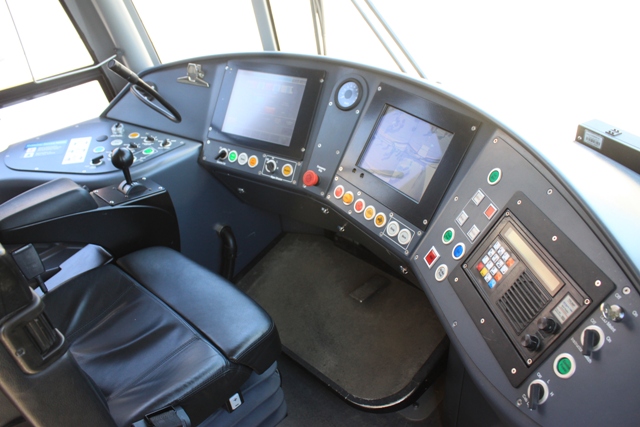
Here is the operator’s console. The controller handle is on the left of the seat, and the dashboard beyond contains switches for functions that would not be engaged while the car is in motion (emergency cutouts, for example). Two video screens show system status (left) and the video monitors from various points inside and outside of the car. The right hand panel includes all of the passenger-related functions. The two white buttons activate the gong (synthetic) and the horn (very loud).
There is a smaller version with basic controls at the rear of the car under a locked panel for backup manoeuvres.
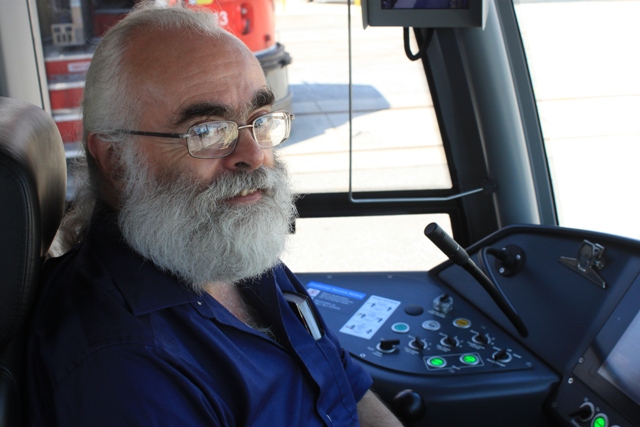
And finally, your intrepid correspondent. The seat is very comfortable although some of the controls are a bit of a reach for someone with short arms. I did not make off with the 4401 as my preference is for a business car with a built-in kitchen, bar, easy chairs and lots of stained glass.
 Steve Munro
Looks like the Combinos I used to ride in Budapest on the inside. Either way I am excited to see these on the streets in Toronto eventually as they seem to be much more comfortable to ride in. Were there any noted issues coming down Bathurst i.e. what is left of the hill south of Hillcrest?
Steve: We only ran south from the shops, and the only grade was the dip under the CP rail corridor. The car seemed to have no problem with the vertical curve here. I do know that they have been testing on St. Clair because it is 100% pantograph compliant, and so the hill at Davenport is not a problem.
LikeLike
I hope that over the years, improvements and alterations will be made, such as the LED signs (smaller pixels, multi-colour, HD, etc.) you mentioned.
Now if only there kept the old PCC arm and foot rests.
LikeLike
Is the minimum turning radius the same for these cars as the older ones?
How does the turning radius for these cars compare to the proposed LRT cars?
Steve: These cars are designed to handle the same curves the older cars use, and the prototypes have been all over the system testing this. The new LRT cars for the Metrolinx lines are “standard” Flexities and could not run on the “legacy” streetcar system.
LikeLike
It seemed to me, when I was on the mockup that the floor over the truck was a step up which seemed to invite tripping. Did I imagine this?
Also, how will the floors match with stops where there is a platform e.g. along Spadina, St. Clair or Roncesvalles? Will the car floor be even with the platform as is the case on the subway?
Steve: I think you may be remembering the mockup of the Minneapolis car that was based on a partial low-floor design. The new cars are 100% low floor with a small rise and fall over the trucks.
As for platforms, well, the subway trains don’t line up with them either. The new streetcars will be a few inches above the typical island platform.
LikeLike
It looks very nice in the daylight.
Karen Stintz was tweeting today about photo enforcement of lanes restrictions on King St. It will be a while until any LFLRVs get to King, but did you see any place in the control cabin that might be a good spot for a ‘dash-cam’ to be set up?
Cheers, Moaz
Steve: Not sure, but what’s also needed is recording of the external video monitors showing vehicles dashing past open doors. I worry that too much emphasis is placed on video monitoring of work that could be done simply by walking along the sidewalk and tagging violators with immediate followup from a fleet of nearby tow trucks.
LikeLike
Hi Steve, do you know how many more improvements are expected? And perhaps I missed this in previous posts, but is the livery finalized? I find the current design is a little ‘blah’.
Thanks!
Steve: How many more improvements, no I don’t know. This is the final livery. The design panel I sat on tweaked the original a bit, but we were not allowed to do much. The interior is plainer than we wanted, but we got some improvements on the exterior.
LikeLike
I will miss the very high vantage point that the currently provide. When stuck in traffic, we currently enjoy the pleasure of seeing out over all but the highest vehicles (particularly when we are standing up). One of the great pleasures of taking the streetcar is the ability to see all of the storefronts along Queen and all of the activity on the sidewalks. We are all going to miss that with the new low floors.
LikeLike
To operate the wheel-chair ramp, does the operator have to leave the cab? Or does he monitor from the cab using mirrors and cameras? Do you recall how long it took to deploy the ramp? I believe buses have an alarm when the ramp is deploying or folding. Do the new streetcars have the same?
I hope I will be lucky to see a daytime test run on the street.
Steve: The operator deploys the ramp from the cab. There is a video monitor. A pre-recorded announcement was made. I wasn’t paying attention to whether there was also the usual “beeping” warning. The ramp deployed fairly quickly — the photos I took are all timestamped within one minute, and the process didn’t take 60 seconds. More was consumed just getting the media out of the way to start the process. That will be an issue out on the street too.
I would like to see this cycle with real passengers out on the street to get a better sense of how it will all work, but I understand that the ACAT folks (the accessibility advisory committee) are quite happy.
You can see videos of the ramp deployment on the Globe and Star websites, among others.
LikeLike
Can you comment on if the ramp deployment might cause issues for those with mobile disabilities especially in cases where there is significant crowding?
I can imagine situations where someone in a chair has to go up to the door, press the button, back-up (hopefully there’s space behind them to do so at this point) to not be hit by the ramp. I know of people with mobile disabilities that makes it difficult for them to walk backwards. Do you imagine that in most cases the driver will notice the person needing a ramp and deploy it preemptively as is the case now?
Does the driver have an adequate view to notice if the ramp is going to hit someone or if they’re far enough away that it’s safe to deploy?
It seems very counter-intuitive to me to place the request button directly in the path where the ramp is deploying. This is why most powered doors have the buttons to the side or at posts away from the swing-radius of the door.
Steve: Yes, the process is rather roundabout in that there’s a good chance someone who needs the ramp won’t reach the door until it is already open, and will then require a separate cycle to close, deploy and re-open the door. The operator has a video monitor and can see the situation right around the door, but I suspect it will take a while for regular riders to get used to the whole process. People in chairs or scooters are more obvious from afar, and the operator can pre-emptively deploy for them. People who can’t make the one step into the car are another matter because they will probably look just like someone with a cane, but not a disability with any step up/down.
LikeLike
Regarding wire crossings, the one at St. Clair and Lansdowne has additional hardware installed on it. The gaps between the wires are all filled with metal plate material making the whole assembly look much like a dish. This probably only applies to shallow angled crossings. Anything 90 degrees or similar may simply require the sloped crossing fitting without additional sliders or guards.
Steve: Thanks — I will go to visit this as it may well be a prototype.
LikeLike
Is it the final final livery? They can’t change the fleet number above the front windshield to white on red like the current fleet? They should!
LikeLike
Finally! It is long overdue. One brief public look and back to the barn? The TTC does a poor job of promoting itself. They should immediately take the new car over to Broadview station and run shuttles up and down Broadview to Queen between rush hours giving people a free ride!
Steve: The overhead on Broadview isn’t converted yet and there is no loop at Queen (although one is planned).
LikeLike
I hope that eventually more cars can be ordered to prevent the kind of vehicle gaps you have talked about. Now that Toronto has got a firm direction on the future of the streetcar fleet, hopefully extra cars can be ordered later this decade or in the 2020s, just as additional T-1 trains were ordered back in 1998 for a good price since the T-1 assembly line at the time was well underway. 🙂
Steve: The TTC has provision for 60 more cars both in storage capacity of the three carhouses and in plans for their long-term budget.
LikeLike
How is the TTC going to ensure that we don’t die from the crazy Toronto motorists as we get off these? Certainly the stop signs on the doors of the current streetcars don’t deter motorists from speeding up as the streetcar slows down and endangering passengers’ lives. What good is a flashing LED going to do?
LikeLike
I hate to make a big thing of this but I thing it’s a dirty shame that these cars won’t be using foot pedals, rather than that hand control. I would think that they’s have retained that, if only to avoid having to retrain operators. I’ve always had the idea that the big reason cities like Toronto, Philadelphia and Pittsburgh stuck with foot pedal controls for that very reason. The place that really surprised me in using foot controls was St. Louis because there it wasn’t like there was the continuity between PCCs and LRVs. Ironically enough, way back when St. Louis had PCCs, they had some non-standard where the right foot controlled the braking and the left foot controlled the acceleration with the deadman feature controlled by heel pedals built into the brake and power pedals.
LikeLike
How does the step from a non-platform stop onto a LFLRV compare to the first step onto a CLRV/ALRV?
Steve: It is slightly higher, but it’s the only step.
LikeLike
I think we all know that what these LRVs really need in order to fight through the madness of downtown Toronto traffic is an operator-controlled retractable spike belt.[/facetious]
LikeLike
A long time ago, someone asked whether there are any other streetcar systems with curves as tight as Toronto’s. The only other city I can think of that might have curves as low as 10 metres is Philadelphia. Their tracks follow North American street geometry much like in Toronto, including 90 degree corners at intersections. Their vehicles are also direct descendants of PCC’s.
Looks like Bombardier has got a market beyond Toronto.
Steve, did you sit in the 1st, 3rd, or 5th module? If you sat in the 1st module, how smoothly does the car enter curves, given the near-“fixed-truck” configuration?
Steve: I was in the 3rd and 5th module at various times as the front of the car was packed with camera crews. Where I sat, the entry to curves was smooth.
LikeLike
Bombardier supplies these LRV systems all over the world.
These minor tweets/ changes / upgrades are in some ways minimal.
TTC has to send their LRV drivers out to negotiate the routes to build up confidence and experience.
LikeLike
Steve, do you know how many bikes can fit into the bike vestibule?
The current front mounted bus bike racks are a major, major deterrent to bicycle use since they only take two bikes. So if two people get on before, you are out of luck.
This really only works where there is two-minute bus service, such as at Finch. Even there, I have noticed an equilibrium developing with stable queues of 6-8 people. This is, of course, an indication of pent up demand. There would be more people using the service if they did not have to wait 6-10 minutes.
Steve: Two. As a pedestrian commuter, I have a problem with making room on transit vehicles for large numbers of cyclists who take up much more space than most riders.
LikeLike
How long is it going to take before a car trying to sneak by a new streetcar crashes into a ramp extended from one of the doors?
LikeLike
Bob Transit said:
How much lower are the bogie-seats with respect to the street? I would have thought that they would be just a tiny bit lower than the seats on the current high-floor vehicles, since the bottom of those bogie-seats also have to be at least above the diameter of the wheels (plus clearance). The only difference would be that the wheels are smaller.
Steve: They are closer to the floor than on the high floor vehicles. Because the trucks do not pivot (much) relative to the car section sitting on them, clearance is not required right across the car floor. There is a bit of a rise, but not much. Look at the interior photos I took especially the one from the vestibule right at the back of the car.
LikeLike
I’ve been asking for this for years!
Or a crossing gate like at railway crossings.
Steve: My personal preference is for Ben Hur chariot wheels with spikes. At the very least, we should ruin their paint job and mark them indelibly as someone who has tangled with Big Red.
LikeLike
Do you know if the TTC will be painting indicators on platforms to show where the second sets of doors will stop and the ramps be deployed? It would be a helpful indicator of where to wait for those who need them, and a way to encourage others not to stand in the area needed for ramp deployment.
As far as bike storage goes, I was surprised to see the approach they’ve taken. In other cities (I’m specifically thinking Phoenix), bike storage is in the form of wall/ceiling-mounted racks where the front wheel is hooked into a slot and the bike hangs vertically. As a quick estimate, such an approach would seem to allow 4-6 bikes to be stored in the same amount of space as the TTC’s 2 floor racks, at the expense of more difficult insertion and removal on a crowded train.
Steve: Not sure about the platform markings although they would be helpful. There will also need to be a “stop bar” for operators to correctly position their vehicles.
LikeLike
While awkward, and a cause of delays, having the bike racks on the front of the vehicle makes more sense than trying to bring a bike into a most probably crowded vehicle. I would not want to be the cyclist who has to ask someone to give up their seat so I can secure my bike inside the streetcar.
LikeLike
Nice to see they are finally out on daylight runs. My first and only experience riding a low-floor LRV was in Strasbourg in 1999. At the time they had just the one line but I could see construction of another line that would intersect it. I do recall the ride was very smooth and quiet and the cars seemed quite roomy.
I did see something last night on City’s evening news, including sign and signals to warn motorist not to pass open doors but I’ve thought that something more definitive should be employed such as a pop-out “Stop” sign along the side as with school buses. Perhaps with further daylight testing the TTC might see how well the current signage and flashing door lights work. As for winter testing, my wife did bring up the usual concern regarding the low-floor vehicles – how well will they handle snow? I suspect no worse than the current fleet.
BTW – were there any of our “illustrious” politicians out for this first daylight trip?
Phil
Steve: The TTC doesn’t want a “pop out” sign as mechanical devices like this are prone to failure. The under-car clearance is the same as with existing equipment. Although the floor may be higher on a CLRV, there is a lot of equipment hanging under the car. Also, the clearance between the bottom of the truck and the pavement is the closest spot, and this has not changed.
No politicians, illustrious or otherwise. Rob Ford scheduled his “red curb” presser directly opposite this event showing his deep concern for public transit.
LikeLike
It’s kind of interesting that the mayor is taking action on this day to help reduce the number of cars parked on our streets.
That’s interesting because one of the big complaints about streetcars is that they pose such a challenge to other vehicles that are trying to pass. This challenge will only increase with the new streetcars because of the increased length of the vehicle.
What is worth noting here is that the REAL challenge that vehicles face when passing streetcars is the fact that our streets — the curb lane — is too often occupied by vehicles illegally stopped, standing — or just plain-old legally parked — on the street.
Many of those who complain about how difficult it is to pass a streetcar should instead be questioning the fact that our streets are de facto parking lots.
Our streets are too valuable to allow them to be eaten up by a few parked cars.
LikeLike
From the TTC’s Stephen Lam:
What gives, Steve? Is the TTC a beta for Bombardier’s product? Why are these new Legacy cars not already tested and delivered to these standards? I cannot believe that the TTC is paying for this transhipment to Ottawa.
Steve: This is not an off-the-shelf car, especially the ramp system that was specifically developed for Toronto. If these cars just showed up without extensive testing, and then failed, we would hear no end of complaints about how streetcars cannot handle snow, or rain, or whatever. These are prototypes, and Bombardier and TTC are testing them extensively.
LikeLike
Was chatting with one of the reporters who went for the ride, and they said the stop request buttons were few and far between.
Can we assume that the days of pulling a string are over? or will a rope be added when they come back from their trip to T-Bay?
Steve: No rope, but likely more buttons.
LikeLike
Steve; What is the single floor pedal for? Is it a “deadman” safety interlock? If so, why wasn’t the safety interlock built into the power control handle as is now done on subway trains?
Steve: If it’s the one I think you mean, it is a release for the floor plate to adjust its height to suit the operator’s legs.
LikeLike
The red curbs will end up costing “the taxpayers” far more money to implement and maintain than the ticket charges Ford complained about. I am glad to see something like this tried finally though.
If we’re going to install chariot wheels on the LRVs then there should also be a healthy supply of swords on board so that we may slay the four-wheeled smoke-puffing beasts!
LikeLike
J. Routh asked:
I won’t make any predictions about how long, but I would be willing to bet the ramp will make a nice mess of the front of the vehicle. The newer and more expensive the car will be, the more of a mess it will make, and the more of a smile I will have on my face. 😉
LikeLike
Perhaps paintball guns…
LikeLike
It’s really a shame that we have to wait to 2014 Election for Real Change for Transit. (Unless Ford Wins Again). I am still waiting for a PLAN for Transit, not a series of projects or temporary solutions that only creates additional problems in the long-term.
The new streetcars is amazing to witness and quite bittersweet at the same time. To see this take very long to get modern-day transit is quite embarrassing for a City of Toronto population size.
Lastly, too much focus is on the end cause “Subways or LRT”, rather than a detailed plan that looks the City as one transit unit. I agree that Transit City had some holes in it, but it at least it was a forward looking plan. Waterfront Toronto has done a great job in my opinion to show a entire plan and its phases. If there is no funding or it is too expensive, then just keep it on hold and re-evaluate it. Right now there is no plan and the only transit excitement we have is new Streetcars that are basically the streetcars of yesterday once they are fully implemented in 2018.
LikeLike
That was the best part of it!
LikeLike
John D. referred to the Phoenix LRT bicycle carrying system. Here is a recent description of someone using this.
The user reports difficulties hoisting his bike up onto the overhead hook. I know him, and he is a reasonably robust, strong person. This means that this system fails because it is simply not usable by a child or elderly person. Could my 75-year-old mother use it? Undoubtedly not.
So this method does not seem appropriate for use in Toronto. The way the storage area on 4401 was described sounds good. It seems that there just needs to be a larger cleared area to satisfy demand.
LikeLike
Build it and they will come: Yes, there is a slight difference between the minimum turning radii of the CLRV/ALRV fleet and that of the new streetcars. The CLRVs and ALRVs were built for 10.8 m radii. The Bombardier cars were designed for 10.97 m curves. However, the difference is irrelevant, because the tightest loop on the system has a radius of 11.2 m (Queen & Woodbine loop). Some curves inside Roncy and Russell carhouses are 11.3 – 11.4 m. This is a non-issue.
LikeLike
For comparison, Yarra Trams recently took delivery of the first Flexity 2 of their 50 car E class order.
LikeLike
When will we see the pantographs?
Steve: The TTC has already been testing with pantographs on St. Clair, the only route with fully converted overhead. Seeing them elsewhere depends on the progress of system conversion route by route.
LikeLike
I can’t see very clearly, but the bike location on the LFLRVs sort of looks like what is available on the LRVs in Minneapolis. Here is a clearer view of the instruction sign.
LikeLike