
Updated May 15, 2013 at 1:30 pm:
TTC CEO Andy Byford spoke at a meeting of the York Quay Neighbourhood Association yesterday evening and the status of transit service to Queens Quay was a major topic. There appears to be some confusion among and within agencies about the date when service will return to Queens Quay on the 510 as a through route and as a streetcar.
The TTC Service Planning memo for the schedule period beginning June 23 says that the current operation is expected to last until the end of that period (late July). However, Waterfront Toronto and Andy Byford himself speak of November or even December dates. The TTC website has given June 2013 as a date for service resumption for quite some time, although this is to be corrected, presuming someone knows what the information should be.
Part of the confusion may arise from the fact that streetcar service will be suspended for reconstruction of the intersections at King and at Dundas and this will require bus replacement on the route. Those buses will be able to run through to Queen’s Quay replacing the shuttle and so there will be “through” service, just not with streetcars.
I have asked the TTC for definitive information on the date for resumption of streetcar service to Queens Quay.
The Service Planning memo also notes that a planned shutdown for reconstruction of the platform at Spadina Station Loop has been deferred to 2014. One can only hope that this will include changes to allow two LFLRVs to serve the platform simultaneously for unloading and loading.
Updated May 8, 2013 at 11:45 pm:
Service on 510 Spadina streetcars will not return to Queens Quay until late fall, likely with the late November schedule changes.
Two intersection rebuilds (at King and at Dundas) are planned for this summer, and buses will once again replace streetcars while these are in progress.
Demolition on Queens Quay had reached the west side of Spadina today, but had not yet moved into Queens Quay loop as originally planned.
Updated May 7, 2013 at 8:30 am
Demolition of the Queens Quay Loop is planned to begin today. The Spadina shuttle bus will be rerouted to loop via west on Queens Quay from Spadina to Dan Leckie, north to Lake Shore, east to Rees, north to Bremner and west to Spadina.
Southbound buses will stop at Spadina and Queens Quay on the northwest corner. Northbound buses will stop at Lake Shore and Spadina on the southwest corner at the same location as the eastbound 509 Harbourfront service.
Tentatively, TTC plans to resume streetcar service south of King to a rebuilt Queens Quay loop in July, but this has not yet been confirmed.
Updated April 5, 2013 at 3:15 pm
Waterfront Toronto’s construction notice for the week of April 8 includes the following change in the overall construction staging plan:
TTC Demolition West of Peter Slip: Crews are expected to begin work on the demolition of the TTC corridor west of the Peter Slip Bridge – including the Spadina Loop (located around 410 Queens Quay). The demolition and rebuild of the Spadina Loop, which begins later this month, will enable the 510 Spadina streetcar to resume service to Queens Quay in late fall 2013.
Given the delay in getting the track over the railway corridor back in service thanks to non-TTC problems in that area, it makes sense to finish the entire Spadina route rather than restoring service for a brief period and then removing it again.
I wrote to Waterfront Toronto and to the TTC to clarify two issues:
- What is meant by “late fall”?
- Will the TTC install temporary track on Queens Quay to allow restoration of 509 Harbourfront service in July as planned, or is this too delayed until the fall?
Here is Waterfront Toronto’s reply:
At our Queens Quay CLC yesterday, we provided stakeholders with information about our summer construction plans. At that meeting, we let stakeholders know that our streetcar corridor rebuild is delayed due to some issues with hydro work and our own storm and sanitary construction. This means that we won’t be able to resume streetcar service for July and August as we had planned to do. Instead, we are going to work on the rebuild through the summer and advance work on the demo/rebuild of the Spadina Loop. (As you may recall, our initial construction staging was to run the 509 for July and August and then take it down again to rebuild the Spadina loop from September to early 2013). Advancing the Spadina loop means that we’ll have all of our rebuild work complete by November 2013 instead. TTC is currently working on its service plan for when our rebuild is complete.
We’re going to have a public meeting on May 8 to discuss our summer schedule and how it relates to TTC service.
In the text above, “early 2013” should obviously read “early 2014”.
This begs an obvious question: Why will the reconstruction of the loop and nearby streets take so long?
Updated March 24, 2013 at 11:30 am
The intersection of King and Spadina is scheduled for reconstruction during the month of August 2013. A preliminary notice has been posted by the City of Toronto.
Updated March 6, 2013 at 5:15 pm
The track work planned for February was delayed by extremely bad weather, but was completed on the weekend of March 2/3. New track is now installed to the north side of the eastbound lanes on Lake Shore Blvd. Crossing further south involved the exit switch from Queen’s Quay Loop, and this portion will be done when the loop is rebuilt.
Recently, I received an email passing on a rumour about a “stop work” order on the Spadina bridge and a delay of the planned resumption of streetcar service south of King to Queen’s Quay. I checked with the City of Toronto, and here is their reply:
The current Spadina project has not been put on hold. The Contractor is continuing to proceed with work in a progressive manner. We experienced a few issues that have led to extra work being required in order to complete the contract. The extra work related to conditions that were unknown at the time of design and related mainly to the need to relocate the existing track drains, removal of styrofoam insulation and reinforced concrete encountered in the subgrade and the reconstruction of the south approach slab. Some of which required additional designs to be prepared and approved prior to material being ordered and work completed. This extra work has unfortunately delayed the completion of this component in the planned work.
The original scope did not account for any extensive winter work; however, with the unanticipated extra work being added to the project, it has forced a significant portion of the bridge work to be completed under cold weather conditions. Cold weather conditions also lead to delays, as we expect approximately 30-40% reduction in performance depending on the severity of the weather. We have also experienced higher than normal levels of precipitation for the first months of 2013.
We had anticipated resuming streetcar service for the May 12th board period; however, the delays due to the extra work and the weather have extended the expected completion date to the first or second week of June. Transit resumption will be determined after the completion of the project.
The Contractor is continuing to work on the project and has added additional crews to mitigate any delays. The work in the next two months will be mainly confined to the bridge and the mezzanine work.
Stephen Adams, PMP, P.Eng.
Updated February 6, 2013 at 1:00 pm
Planned road, water and track work at Lake Shore and Spadina beginning Thursday, February 7, 2013 will close parts of the intersection over the coming weekend. This work will complete the new track south from the railway overpass to the north side of Queens Quay Loop which will be rebuilt later in 2013.
There is still no track from Front Street south to just north of Bremner Blvd., but work in the area appears to focus on putting things back together rather than finding yet more holes to dig.
The TTC is currently planning to resume streetcar service south of King in May 2013.
Updated November 29, 2012 at 12:00 nn
The date for restoration of streetcar service south of King has been pushed back to March 30, 2013 because construction south to Lakeshore may not be completed before winter weather sets in.
New track has been laid between Bremner and Lakeshore although as of November 28 it was not yet set in concrete. The section north from Bremner across the bridge to Front has not yet reached the point of tracklaying because other work on the bridge is still underway.
The scheduled service for the holiday period presumed that streetcars would run south to Queen’s Quay, and these will now short-turn at King. With all of the extra running time this will provide, it will be interesting to see how the layovers (already difficult due to bunching and physical limits on capacity at each terminal) will be handled. There may be a lot of very slow operation on this “rapid transit” line.
For January and February 2013 the schedules now in effect will be used.
Updated November 18, 2012 at 9:30 am
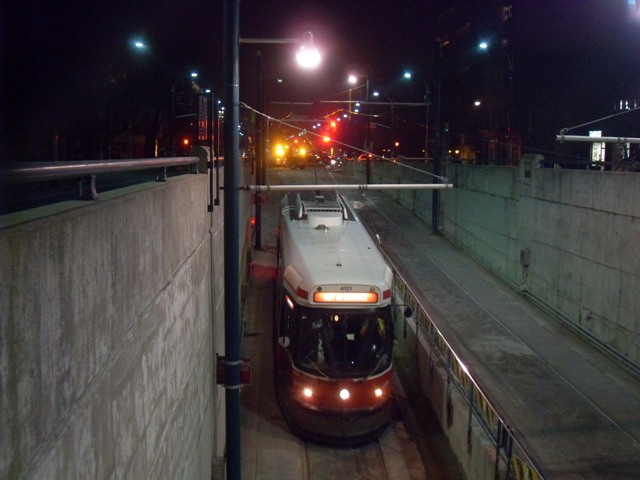
Service resumed on the 510 Spadina car from Bloor to King this morning.
Car 4121 made a test run in the early hours. (Photo courtesy of Will Oxford)
Southbound approaching Spadina Circle
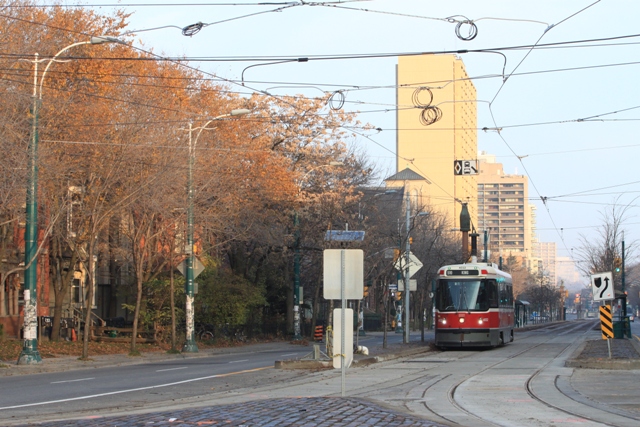
Northbound at Spadina Circle
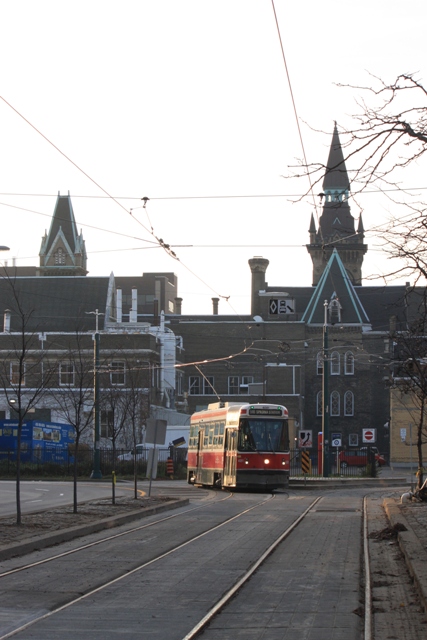
Northbound at Adelaide
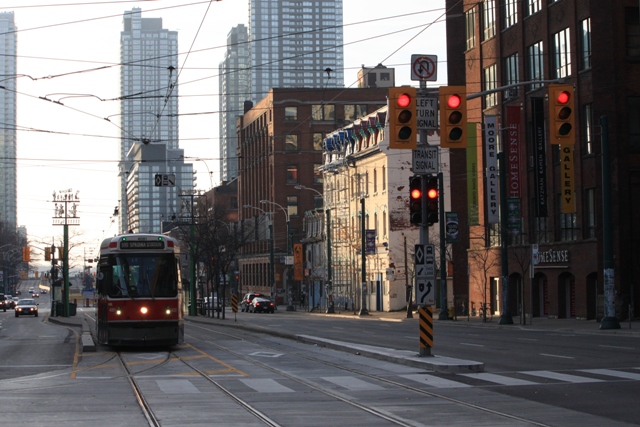
Note that the new concrete on Spadina has not been stamped to give the impression of cobblestones, but simply brushed as any other concrete such as sidewalks would be. This leaves two generations of finishes on the route.
Updated November 15, 2012 at 7:20 am
As of the afternoon of November 14:
At the south end of Spadina, placement of the foundation slab for the track on the south approach to the bridge over the rail corridor (Lakeshore to Bremner) is in progress. Various construction activities are in progress from Bremner to Front. New track is in place across the Bremner/Spadina intersection, and from the south side of Front north to King.
North from King, cleanup crews are touching up paint on the shelters at stops. Between College and Bloor, the last of concrete work mainly for stop rail replacements is in progress. New overhead contact wire has been hung, but is not yet attached to supports. Installation of the new standard trough overhead (already in use at the Atlantic Avenue underpass on King and the Dufferin underpass on Queen) is underway at Spadina Station Loop.
Streetcar service returns to the 510 Spadina route on Sunday, November 18.
Updated October 25, 2012 at 5:10 pm
Demolition of the trackbed over the bridge south of Front has begun and the section between the bridge and Lakeshore is now being graded to prepare for the new foundation slab. The intersection at Bremner will be closed over the weekend of November 2 to 5.
The section south of Lake Shore including Queen’s Quay Loop will not be rebuilt until 2013.
Updated October 21, 2012 at 12:30 pm
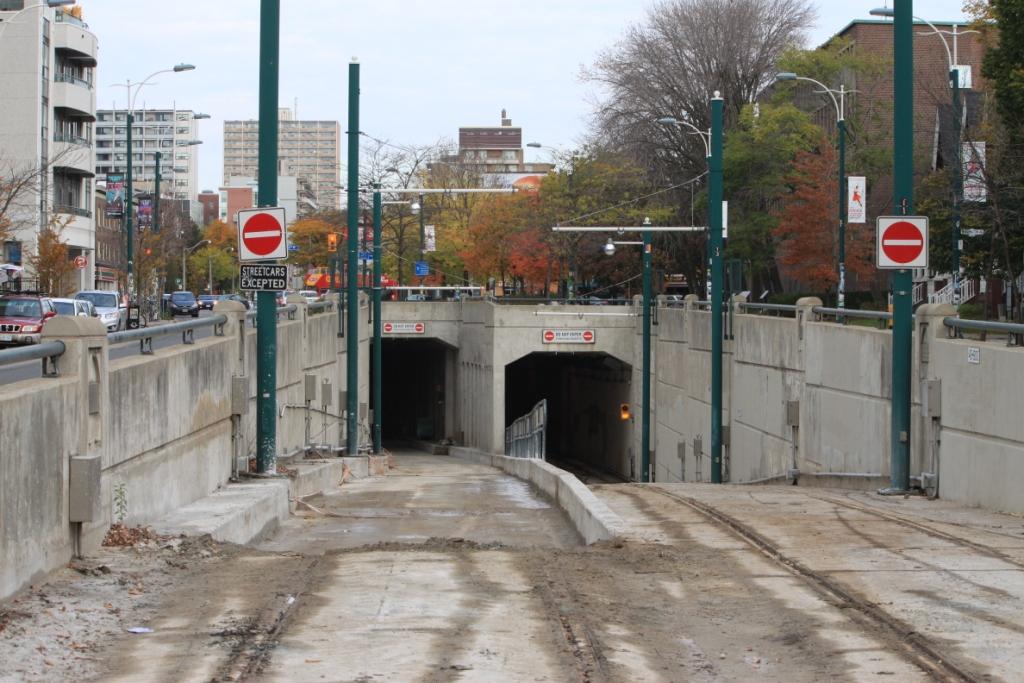
Work has begun on the portal at Spadina Station with the demolition of the southbound track between the tunnel entrance and Sussex Ave. Construction equipment is poised to attack the northbound track, and a weekend closure is planned for replacement of the track across the Sussex intersection.
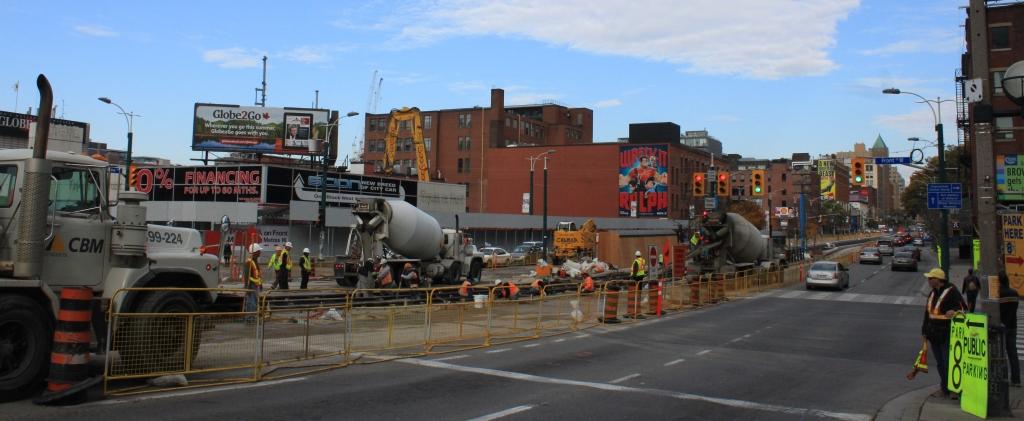
South of King, new track has been placed to just north of Front, and the intersection itself is being rebuilt from October 20-23.
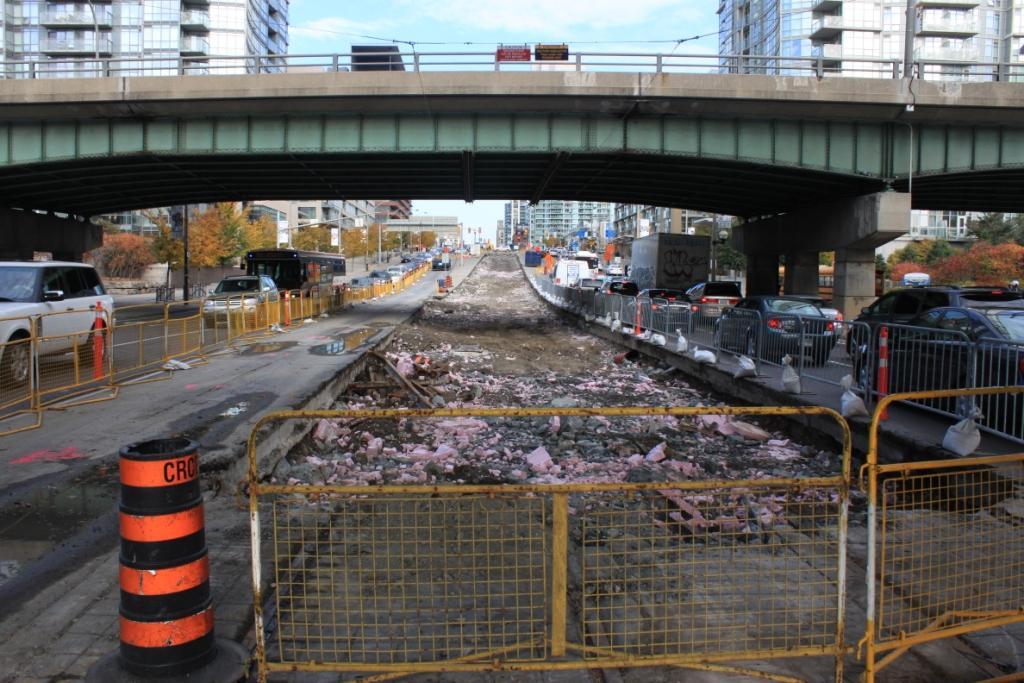
From Bremner south to Lake Shore, the trackbed excavation is complete. Visible in the debris are the remnants of styrofoam bats that had been placed as an anti-vibration measure when this track was built over two decades ago. This may have isolated the track from the bridge deck, but it did nothing to isolate the rails from the track slab and the resulting roar from track corrugation.
Updated October 16, 2012 at 12:55 pm
Concrete work is almost completed for the section of track around Spadina Circle and the nearby stop at Willcocks northbound. No work has begun yet at Spadina Station Loop or its approach ramp.
South of King, the new foundation is in place to just north of Front. A short distance on either side of Front has been excavated in anticipation of rebuilding the intersection itself.
Excavation of the old track and roadbed is underway from Bremner south to Lake Shore. No work has taken place yet on the bridge over the rail corridor.
Updated September 29, 2012 at 10:40 pm
Work began on the section south from King to Lake Shore in the week of September 24.
Looking south on Spadina from King.
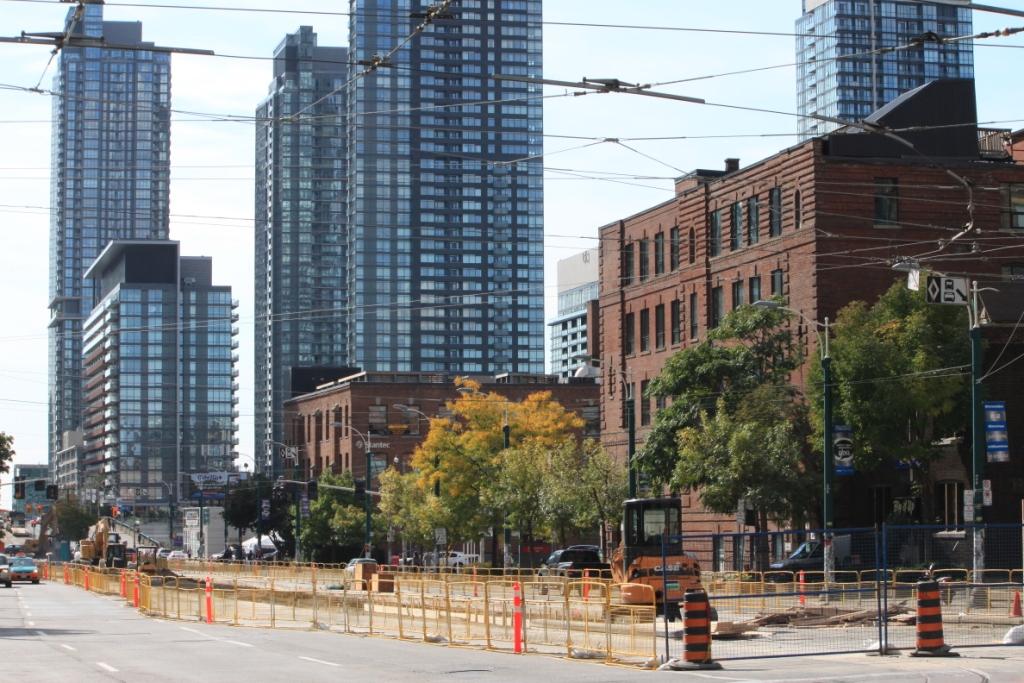
Looking north on Spadina from Clarence Square.
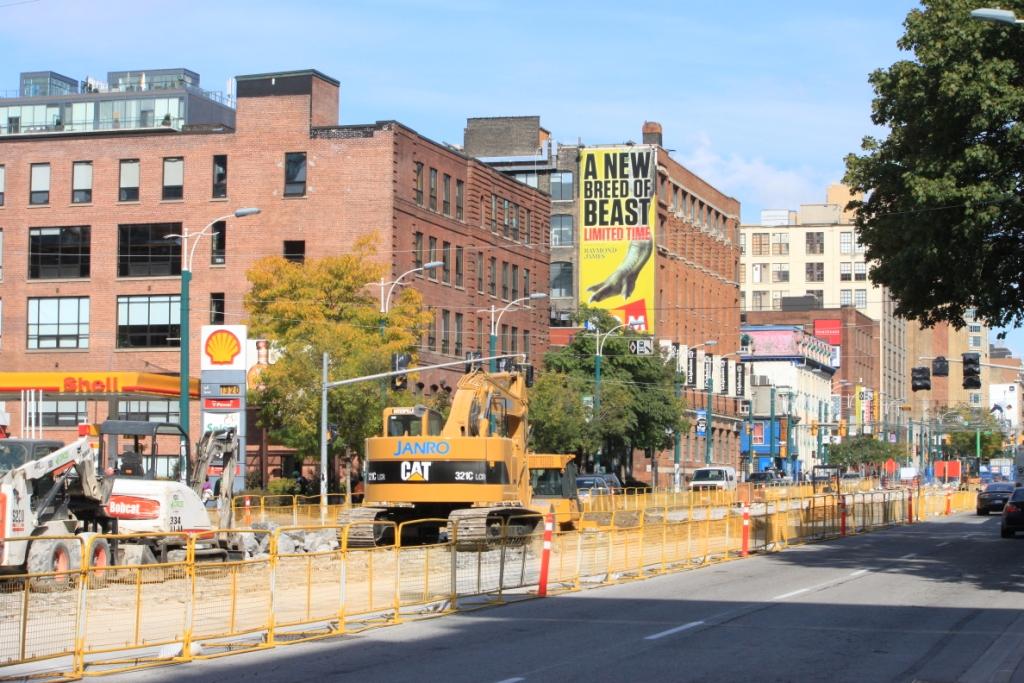
Reconstruction of the track around Spadina Circle began in mid September. Unlike intersections and tangent (straight) sections, the rails on the curves are welded on site (the process is the same as shown for McCaul Street near McCaul Loop in another article).
Work on the east side is now completed to the point that only the top layer of concrete remains to be placed. On the west side, the track is in place in the excavated right-of-way and welding is progressing around the curve from south to north.
The following photos were taken on September 19. Here, the track on the east side of Spadina at the north end of the circle is being assembled.
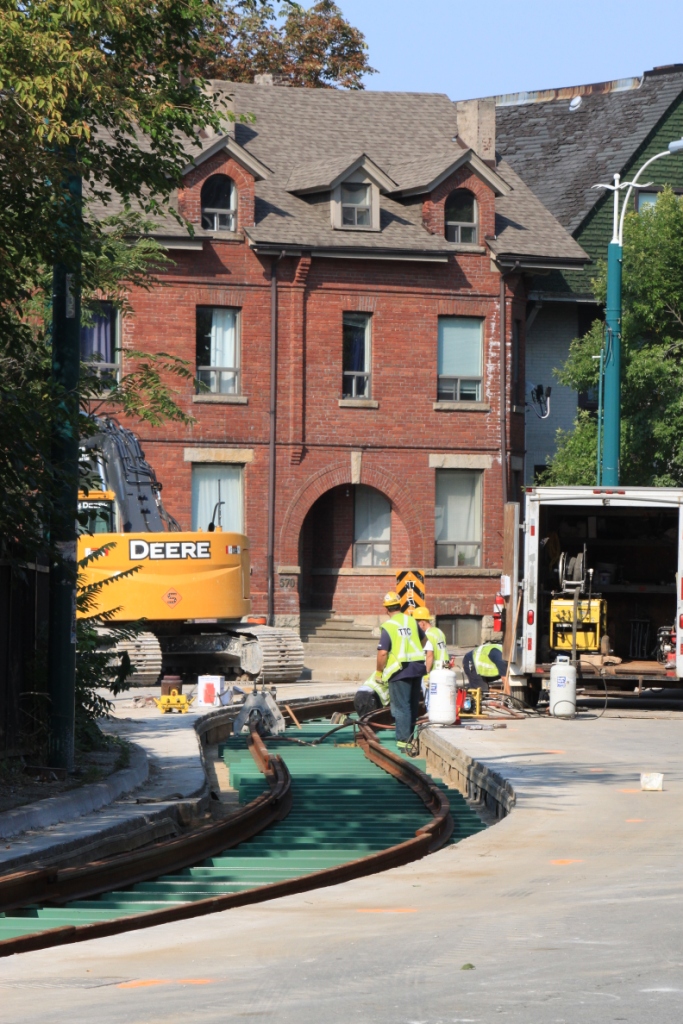
The east side of Spadina Circle looking north.
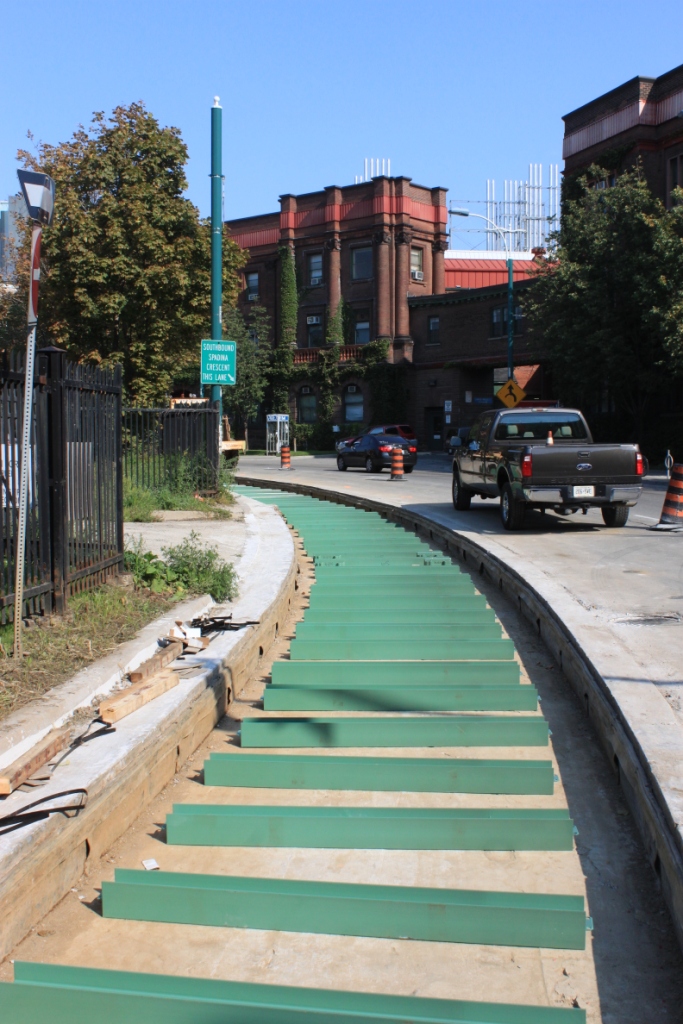
Looking south on Spadina toward College Street.
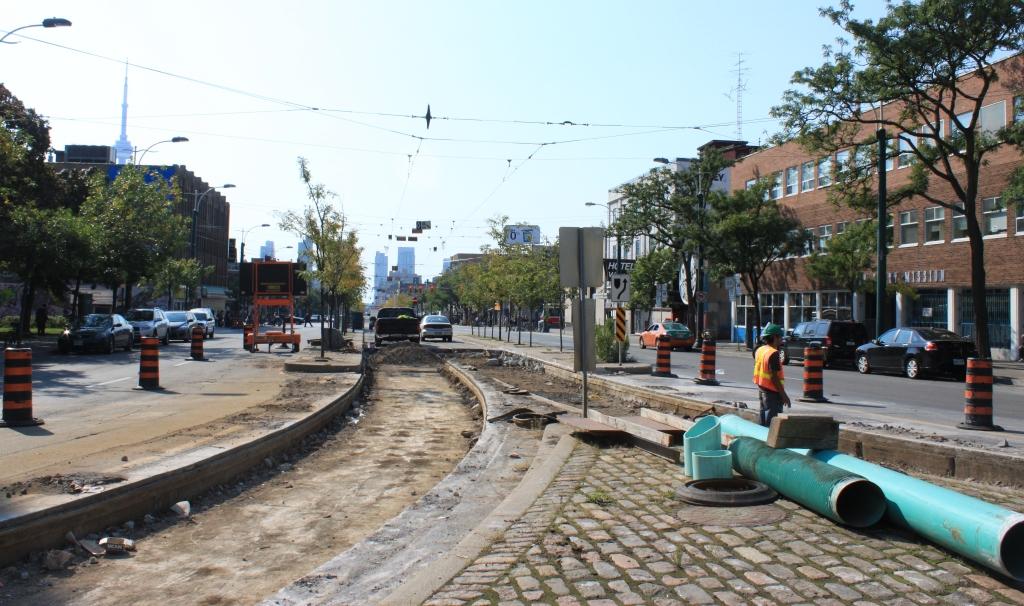
The west side of Spadina Circle looking south.
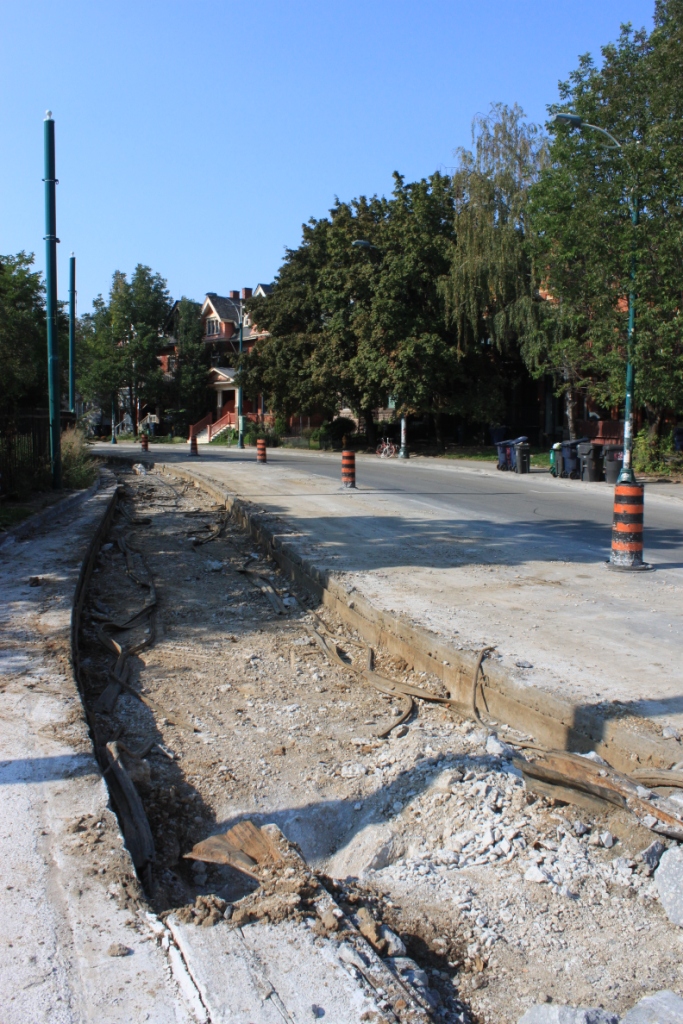
No work has been done yet at the north end of the line from Sussex into the tunnel portal at Spadina Station.
Updated August 22, 2012 at 9:20 am
Reconstruction of the intersection at Adelaide & Spadina is almost completed with curb lane and sidewalk work remaining.
The City of Toronto has announced the next major stage in trackwork from King south to Lake Shore including reconstruction of the streetcar track as well as the platforms at Front and at Bremner. Watermain work at Lake Shore and structural repairs on the bridge over the rail corridor will be co-ordinated with this project.
Work at the portal north of Sussex and around Spadina circle is already scheduled for the period from September through early November.
Streetcar service will return as far south as King (via Charlotte Loop) on November 18, 2012, and to Queen’s Quay Loop on December 23, 2012.
View looking west on Adelaide across Spadina. The church spire in the background is at Bathurst.
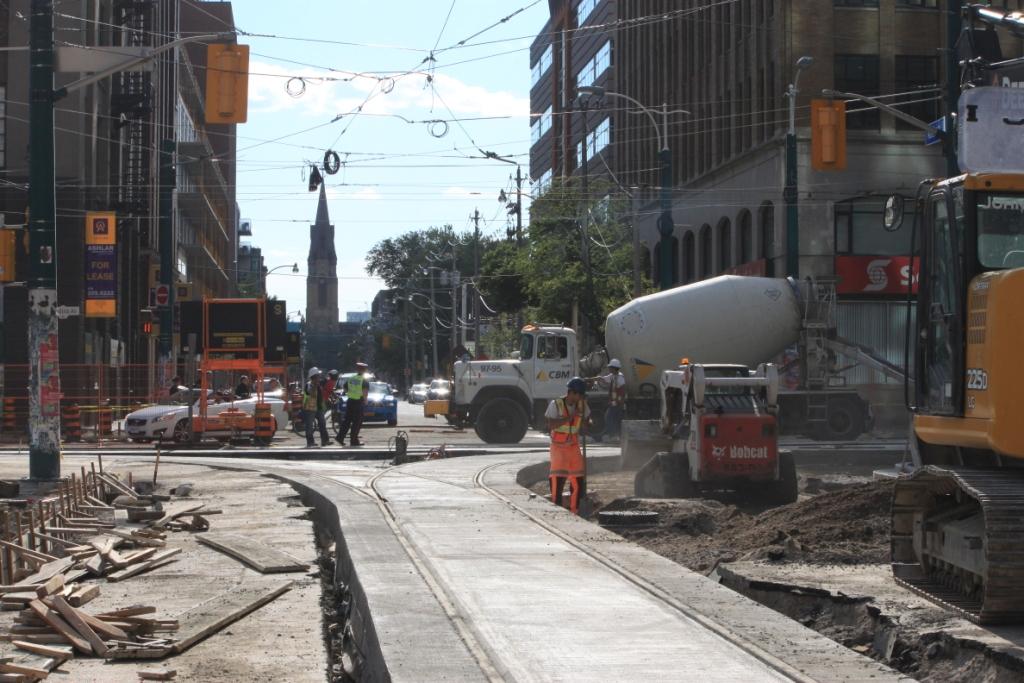
Updated July 18, 2012 at 11:00pm
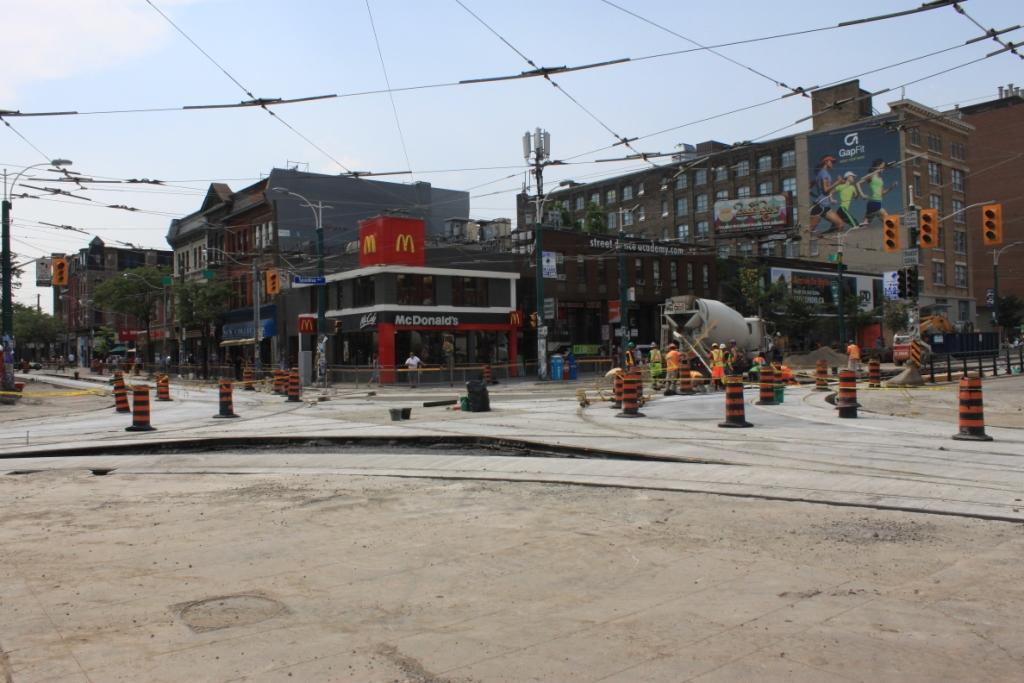
Most of the concrete has been placed for the main part of the intersection at Queen & Spadina, and work is in progress to complete the four approaches and stops. This view is taken from the southeast corner.
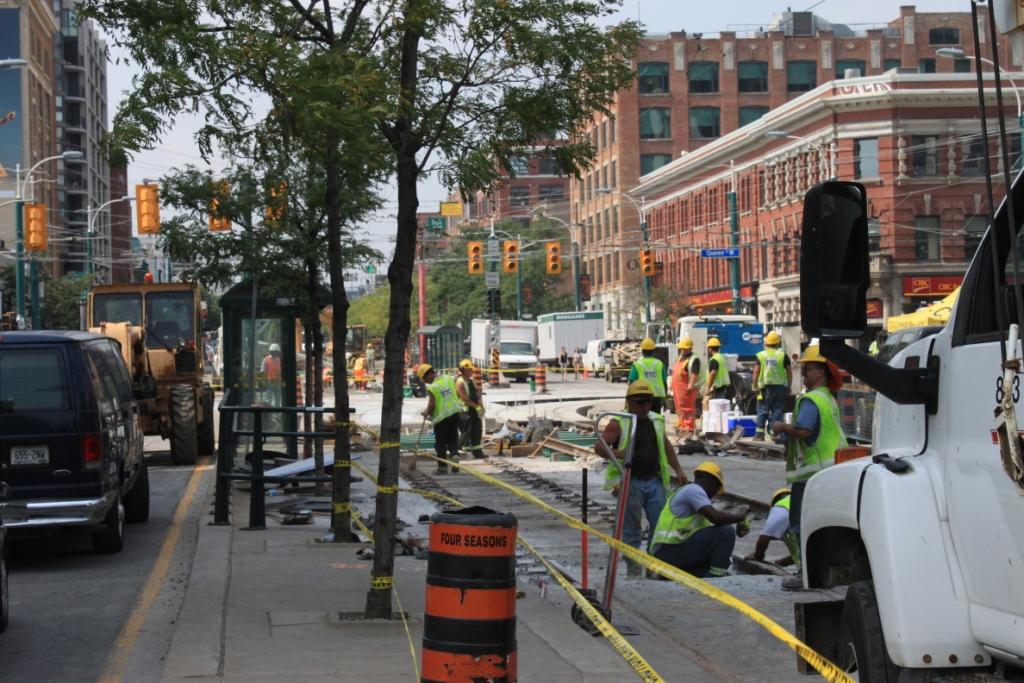
In this view, new track is being installed for the south approach and the southbound stop. Note the area where the stop has been excavated only down one level leaving the attachment points for the metal ties that were part of the original installation. This is an example of how the new style of track construction will avoid the need to completely rebuild track when it comes up for replacement.

Meanwhile, a few blocks away on McCaul Street, Toronto Water is working underneath the streetcar lanes. The track, including the McCaul Loop which is inside the building on the east side (left), will be replaced once Toronto Water is out of the way. This isn’t part of the Spadina project itself, but having McCaul closed at the same time adds to the fun of navigating downtown as a transit user or motorist. 501 McCaul cars are currently running to York and Richmond, and they will resume running to Wolseley Loop at Bathurst Street next week when Queen reopens for streetcar traffic.
Updated July 14, 2012 at 7:00pm
The full intersection was almost complete when I visited this afternoon with only one small piece missing from the south-to-east curve. Here is the view from the SW corner which you can compare with the July 13 shot to see the day’s progress. Less obvious is welding that was taking place and the connection of grounding cables to the track.
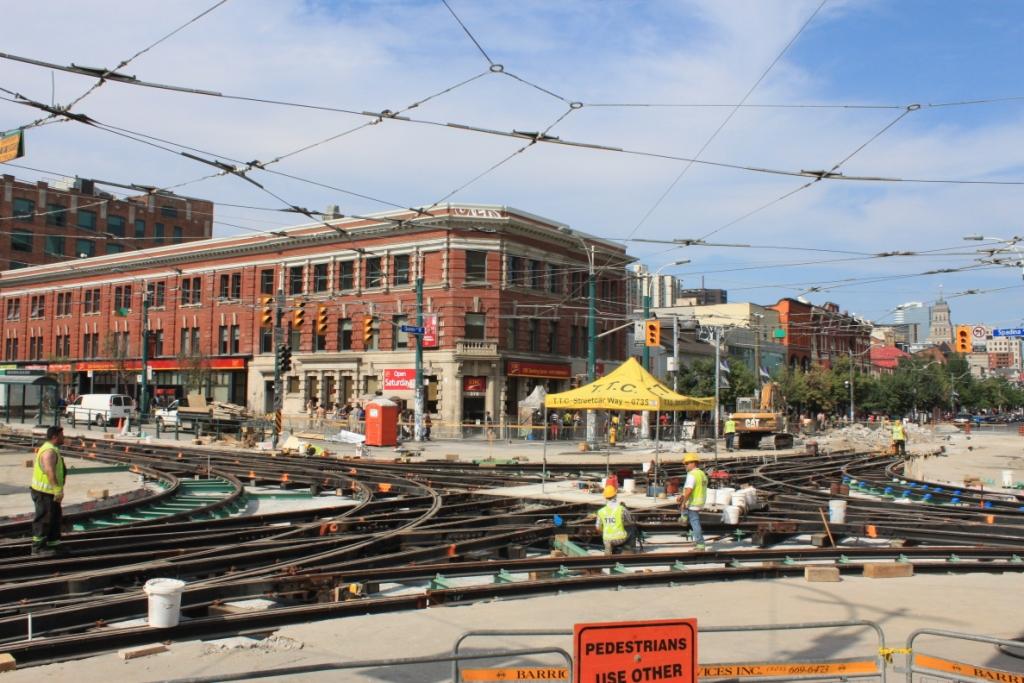
Looking south on Spadina across the north quadrant, the last to be installed.
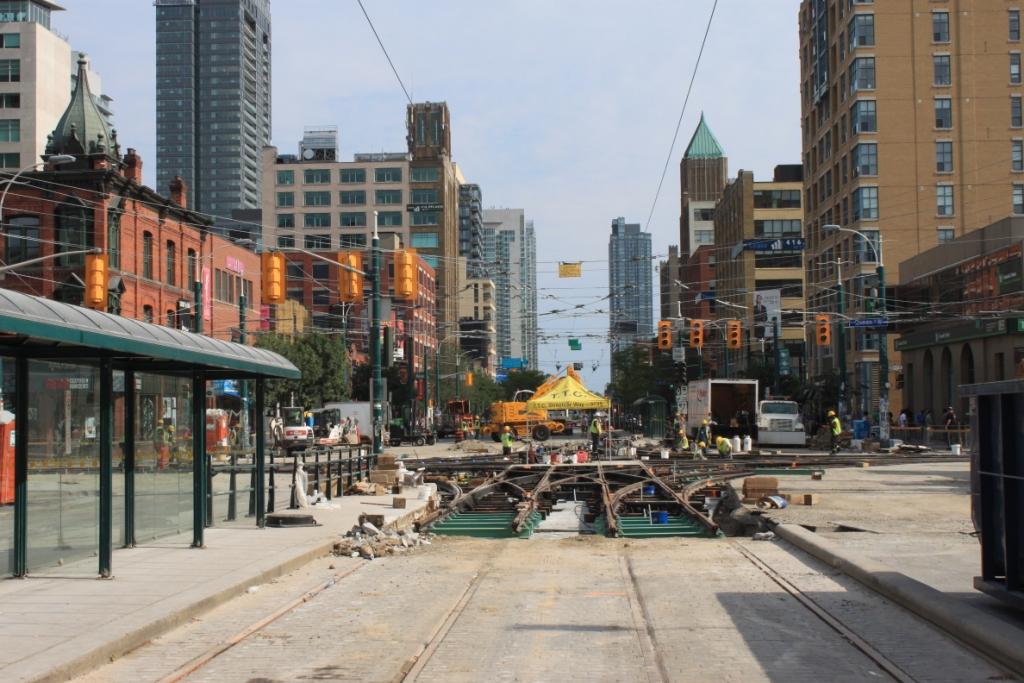
Looking west to the intersection showing the area where the new westbound stop and enlarged island will be built.
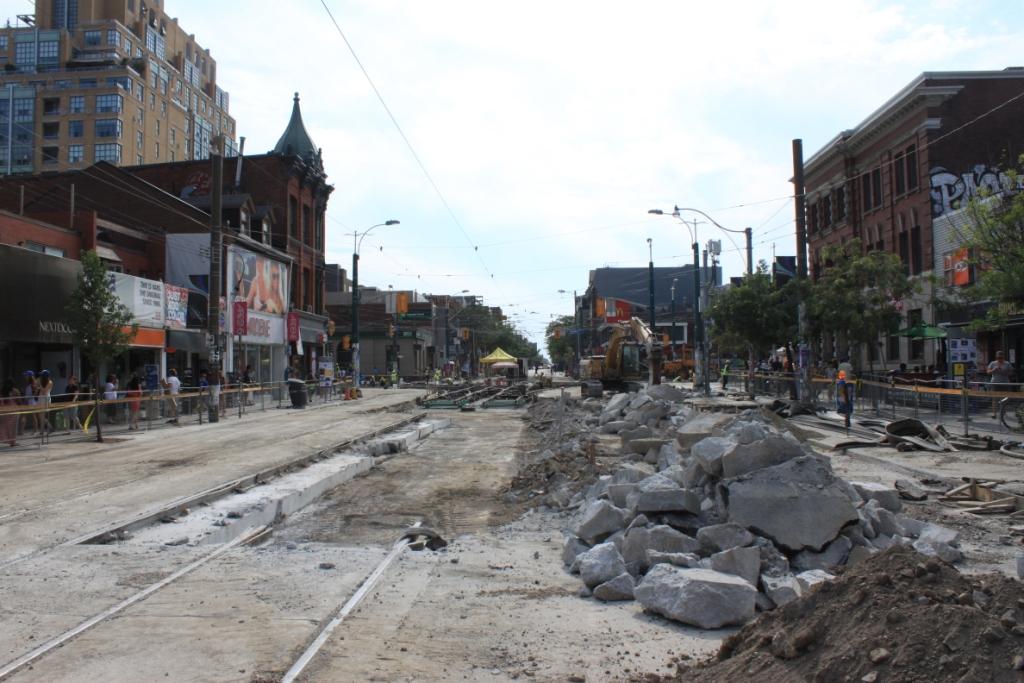
Updated July 13, 2012 at 10:30pm
The Globe and Mail has an article about road construction projects by Carys Mills including a photo taken from the northwest corner of the intersection around 1pm judging by the shadows. The curve segments linking up the four corners are starting to go in, and they were not there when I took the photos below at about 9am. This job is moving very quickly.
Updated July 13, 2012 at 1:55 pm
Morning of Friday, July 13
The west quadrant’s installation is well advanced.
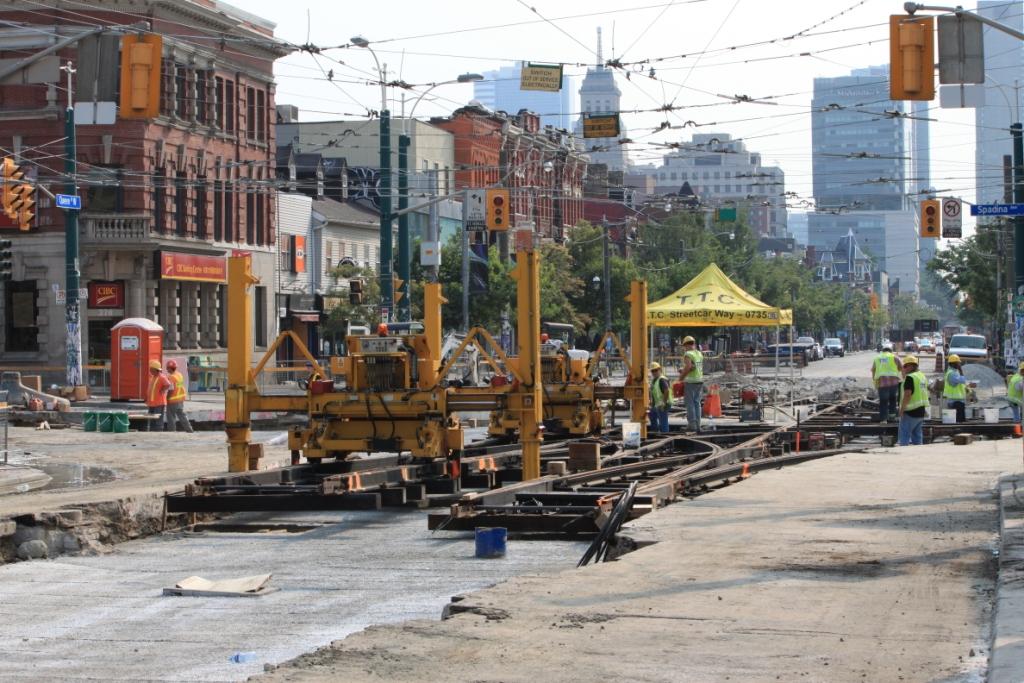
For the moment, the TTC’s tent is perched centre stage on the diamond.
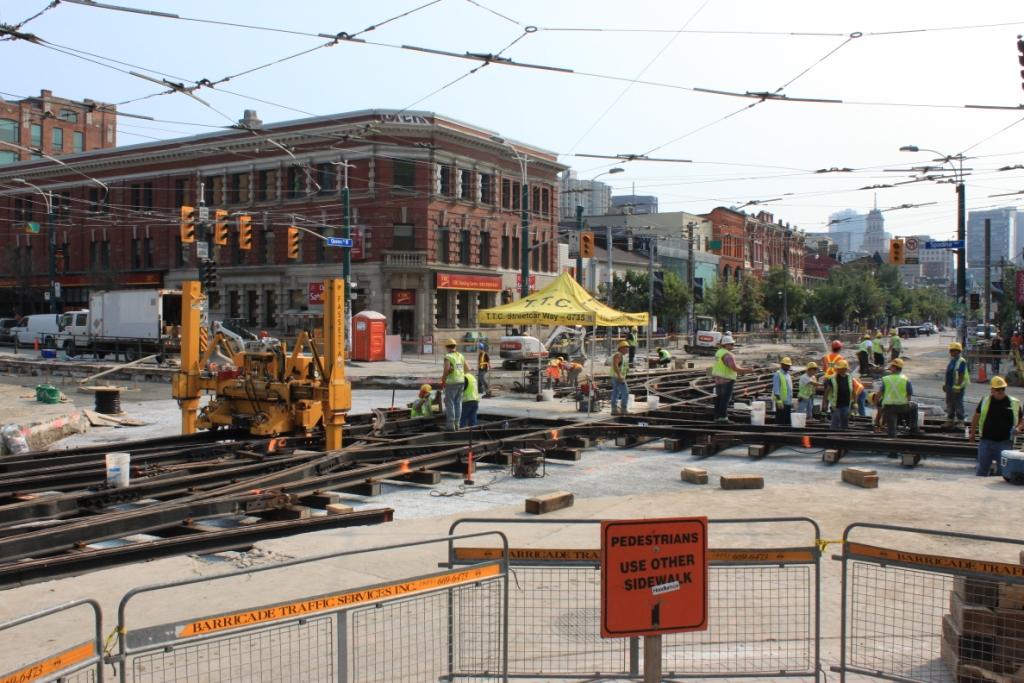
Demolition of the east approach and safety island are complete.
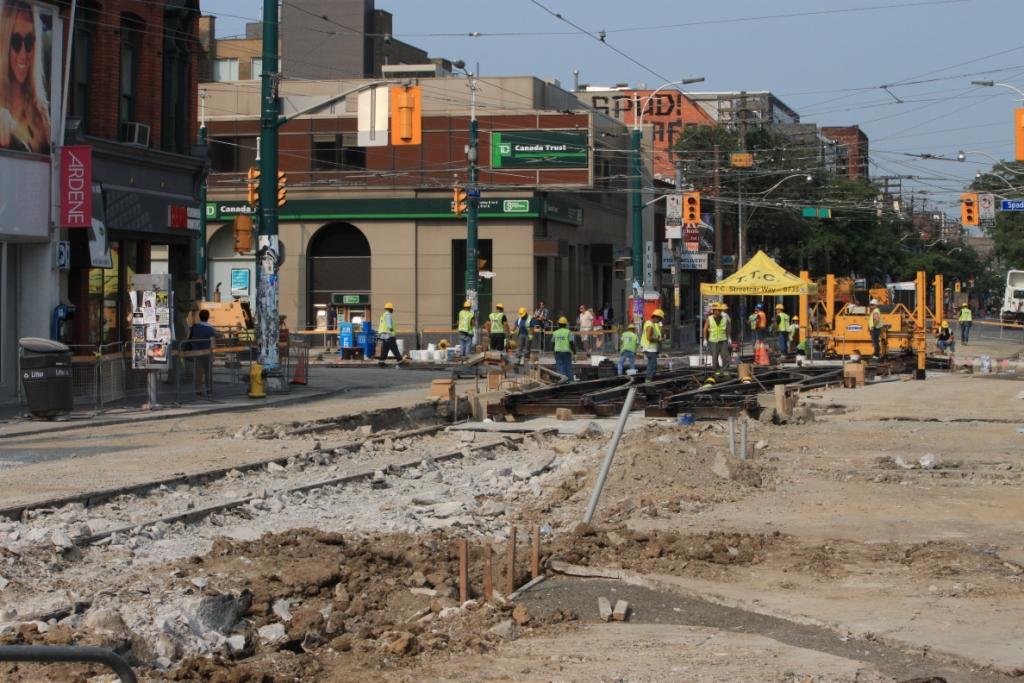
Thursday, July 12
The first piece of the south quadrant goes into place. [H. McMann photo]
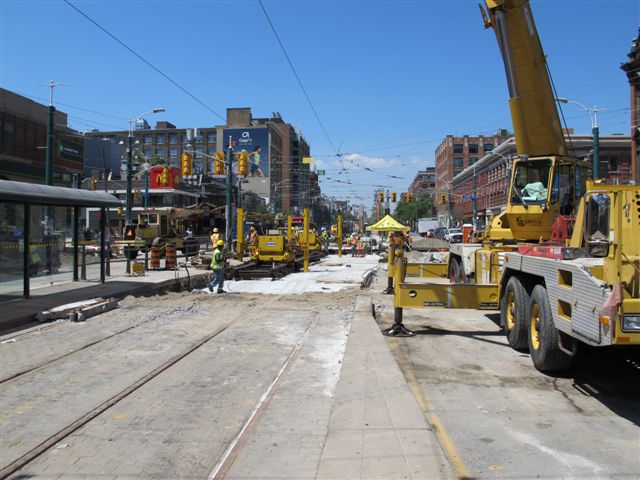
Later in the day, looking east along Queen. The eastern quadrant is in place while excavation of the approach are continues. The concrete pour for the north quadrant’s base is in progress.
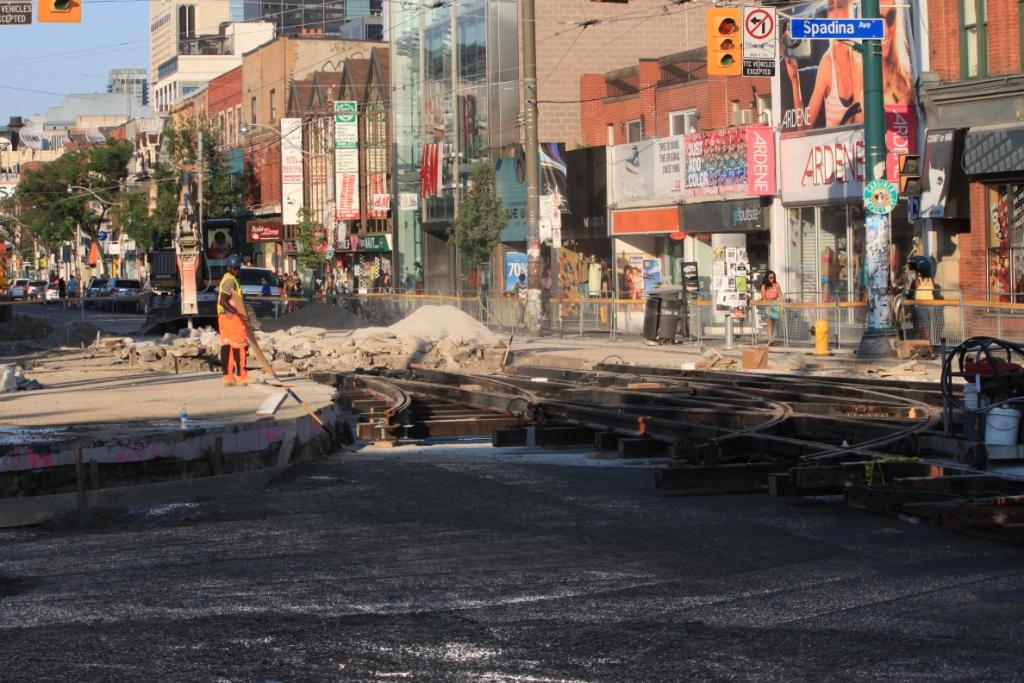
Looking southwest to work still in progress on the south quadrant.
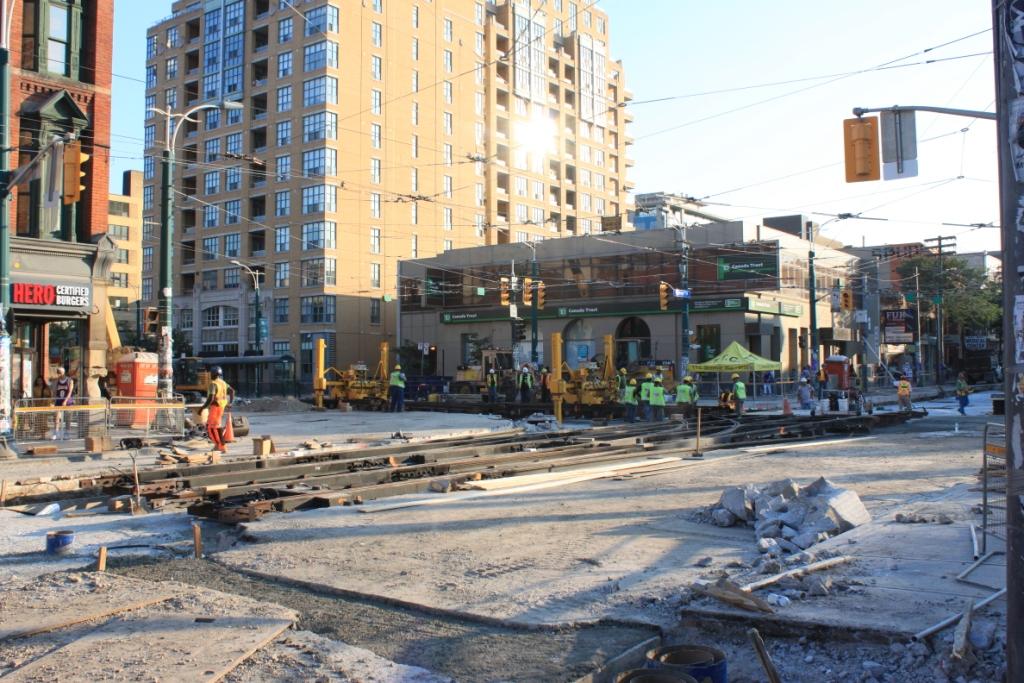
Wednesday, July 11
The concrete foundation has been poured for the central part of the intersection while excavation continues around the margins. [Photo by Harold McMann, with thanks]
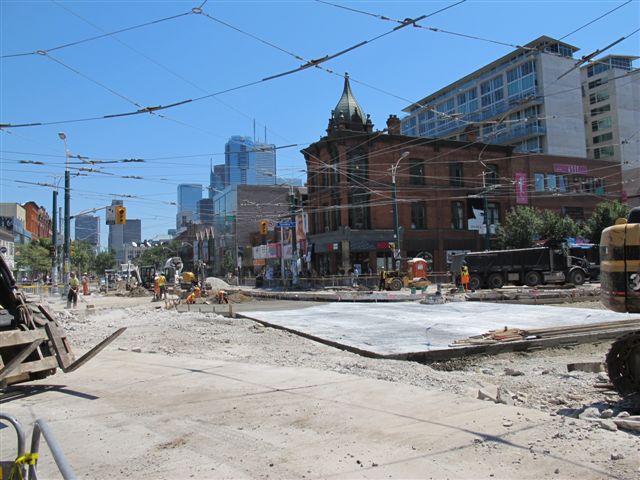
Lifting the pre-assembled central diamond off of a trailer. [H. McMann photo]
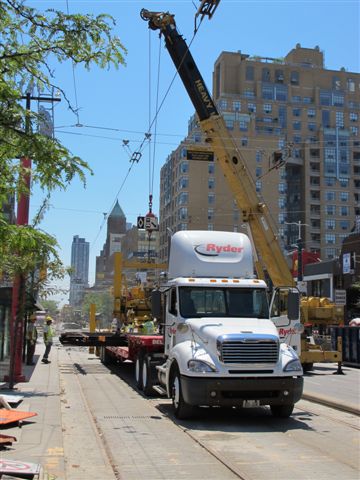
The diamond placed in the centre of the intersection. [H. McMann photo]
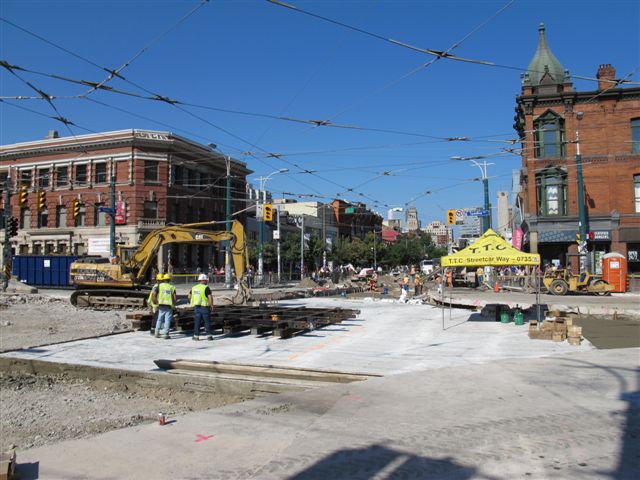
Monday, July 9
Demolition begins on the south side of the intersection. All of the concrete, old rails and ties must be broken up and removed before the new foundation can be poured. This work continued through the week with the last of the old intersection coming out on July 12.
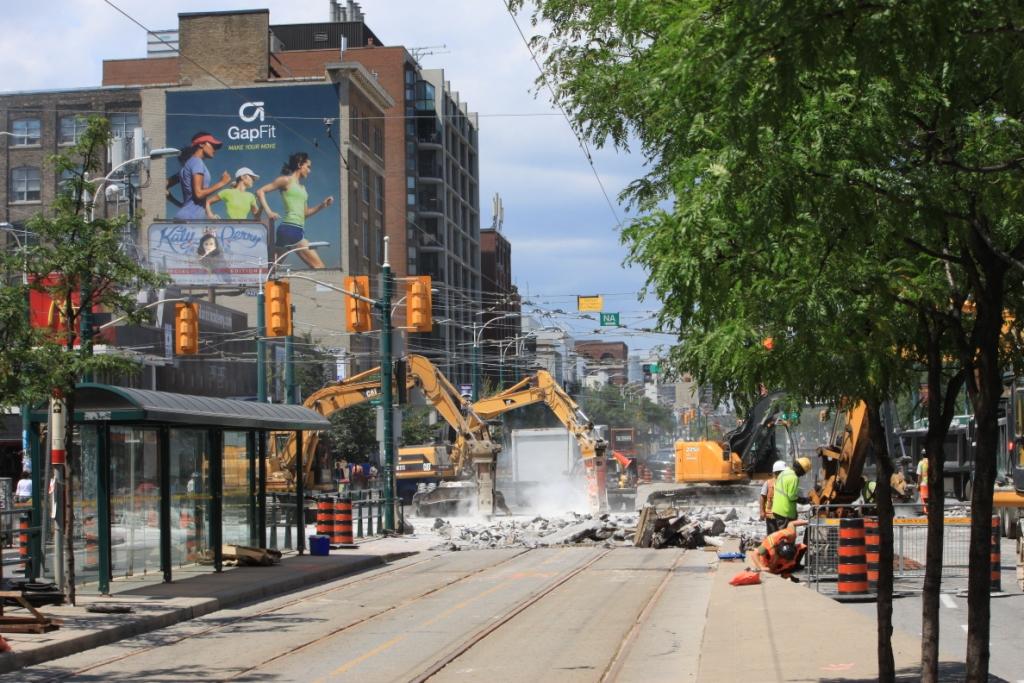
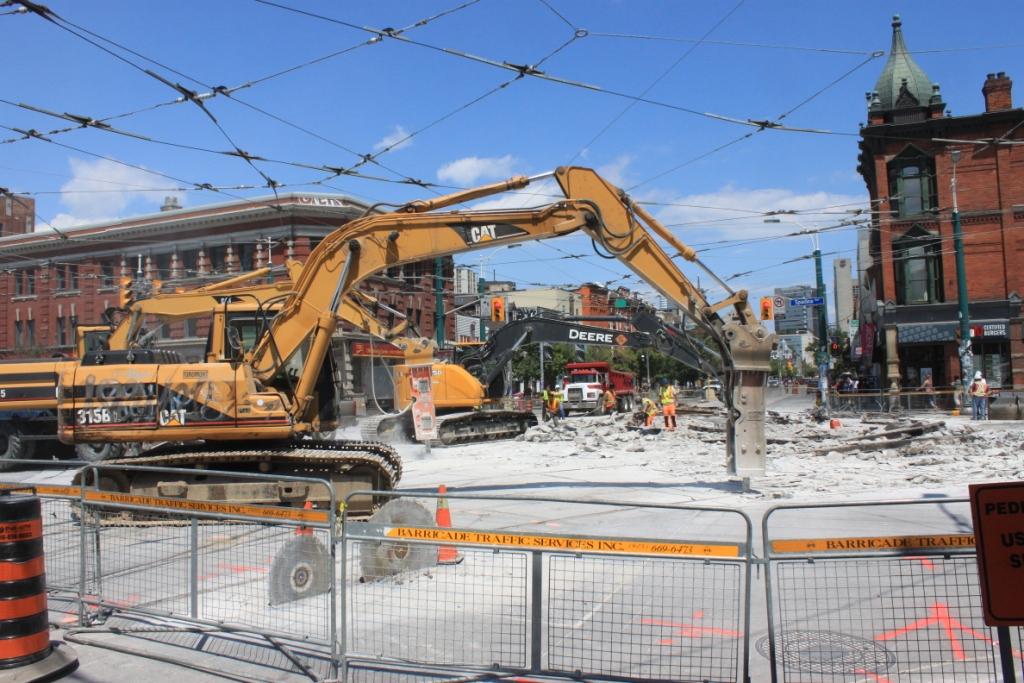
Updated July 5, 2012 at 4:30 pm
Construction work to modify platforms at various stops along Spadina is now underway. The affected stops are fenced off as current or future worksites.
Broken concrete around special work on Spadina at College has been repaired.
Although not included in the original list of track replacement projects, the section from King south to Lake Shore will be done in this construction season. The TTC has confirmed that this part will begin in September. The work will be co-ordinated with bridge repairs by the City of Toronto.
The intersection at King will be rebuilt in 2013.
The Spadina and Queen routes will divert around their intersection starting on July 9 for replacement of the track, one of our three “grand unions” where it is possible to make turns in all eight possible ways.
510 Spadina
- Southbound to Queen’s Quay: via Dundas, Bathurst and Adelaide to Spadina
- Northbound from Queen’s Quay: via Adelaide, Peter, Queen, Beverley and Dundas to Spadina
- Queen short-turn service (replaces 510 to King service): same diversion as above without operating south of Adelaide
501 Queen
- Humber and Long Branch services including 301 night car: both ways via Shaw, King and Church
- Bathurst short turn service: loops downtown via Church, Richmond and York to Queen (these are, effectively, 502 Downtowner cars in disguise as 501s).
- 301 night buses will use the same loop via Richmond and York as the 501s. This will mean that some of the night service will be provided on Queen and some on King, and that some stops will only have service from the night bus.
- No replacement service on Queen from Shaw to Church except for the infrequent, and weekday daytime only “501 York” cars. No replacement service on Queen from Church to York evenings and weekends.
Shuffle Demons Return to Spadina Bus
Today, the TTC brought GMC fishbowl 2252 out of retirement as an extra on 510 Spadina. The occasion was an onboard performance by The Shuffle Demons who were promoting the launch of a new CD with music including their 1986 tune Spadina Bus.
This will probably be the last time (for now at least) we see a New Look bus in revenue, albeit supplementary, service. Many of the buildings in these photos did not exist when fishbowls plied Spadina. The bus itself is about 30 years old.
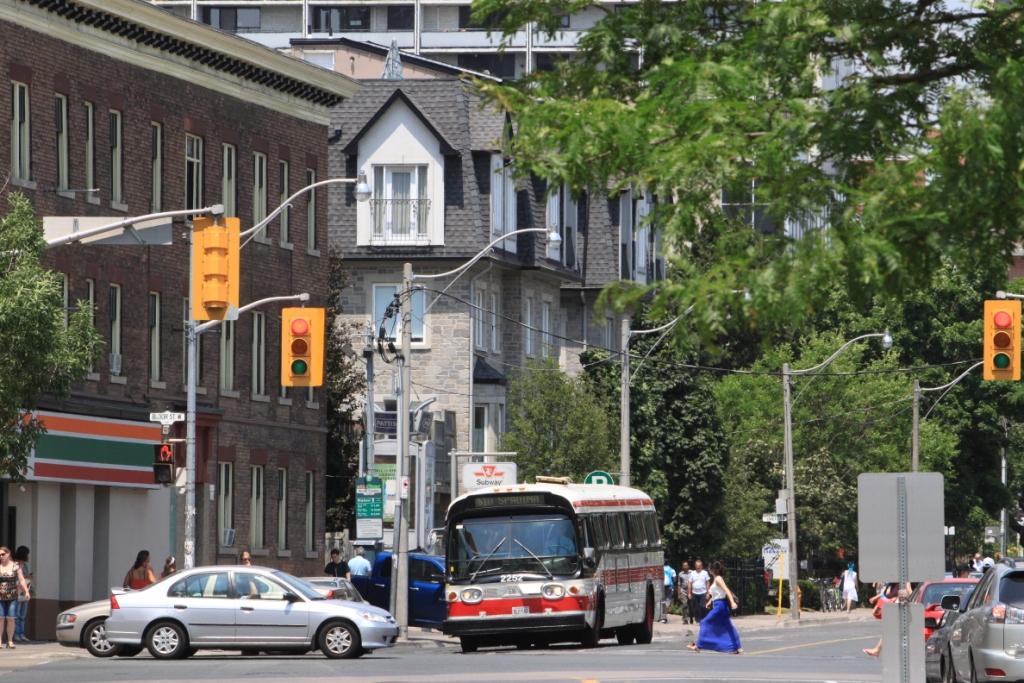
Southbound at Bloor Street.
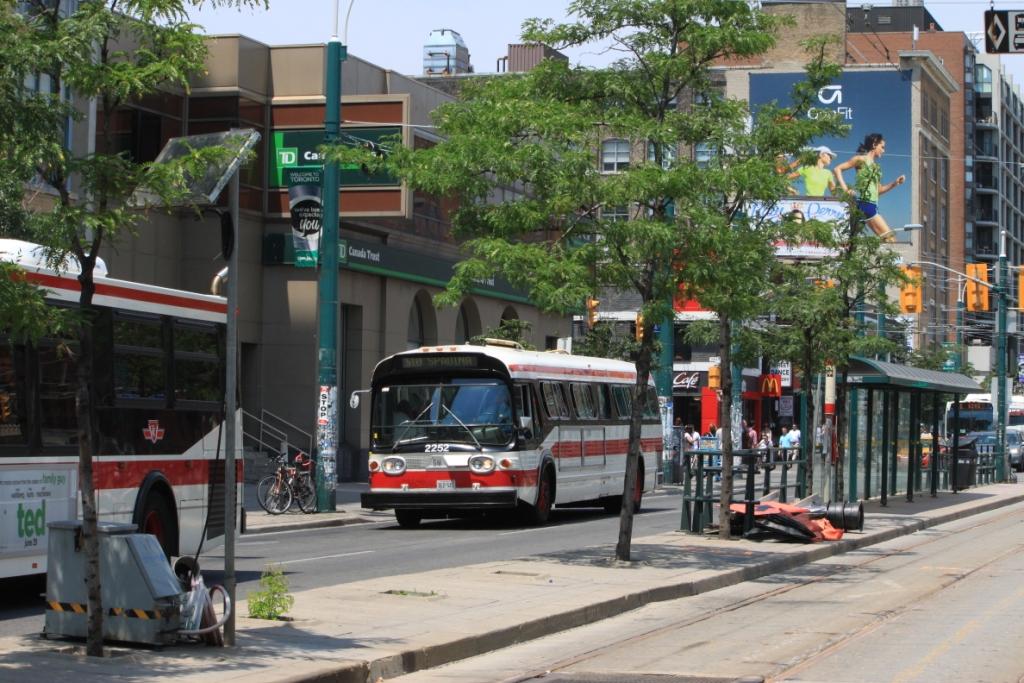
Between Queen and Richmond.
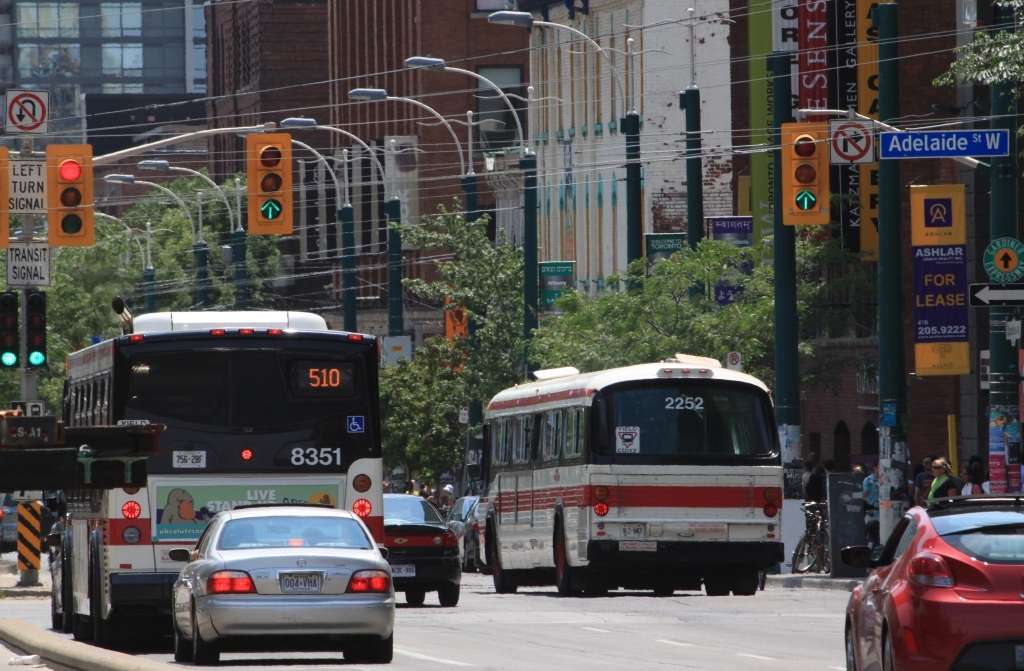
Southbound crossing Adelaide with a 510-King short turn bus waiting to turn east.

Northbound approaching Front with the usual parade.
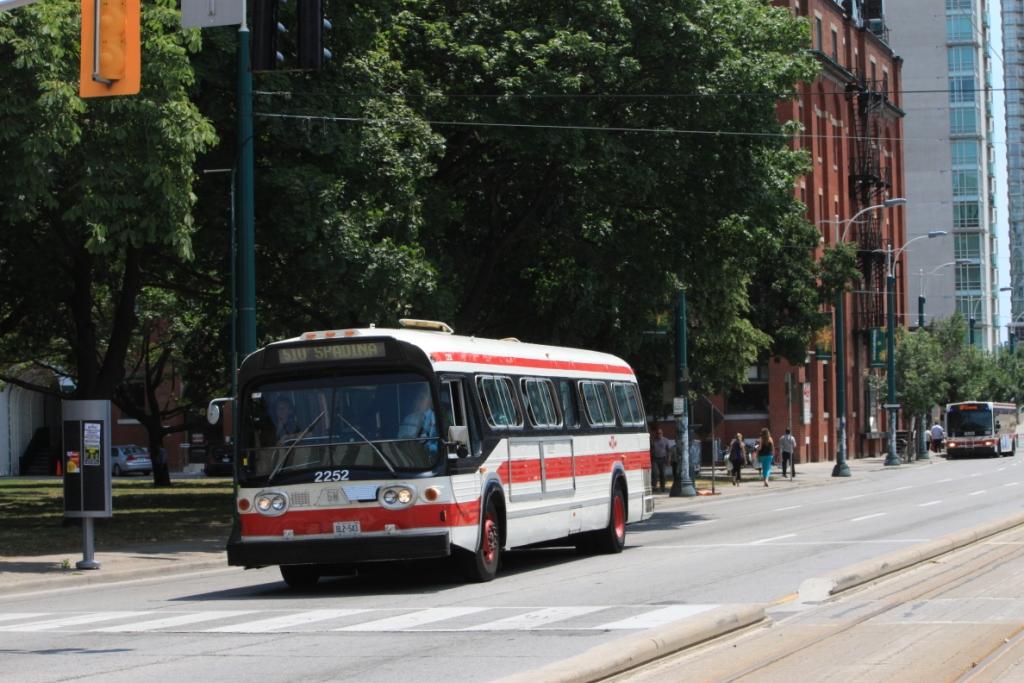
Northbound at Clarence Square, the former southern terminus for most runs on the 77 Spadina bus.
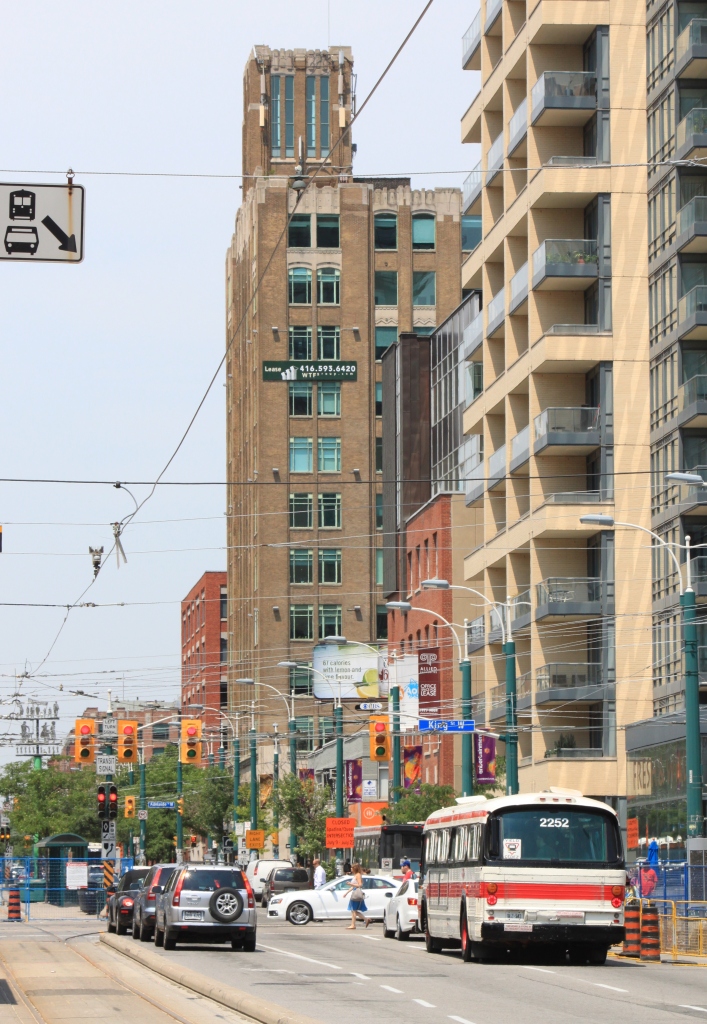
Northbound at King.
For views inside the bus, see The Torontoist’s article.
For a video, see The Grid.
Original June 21 post:
The TTC has various pages with info on this project:
According to the track reconstruction page, the dates of the intersection projects originally listed in the recent CEO’s report have been changed.
Queen & Spadina will be completely closed for two weeks starting Monday, July 9. It will re-open partly on Monday, July 23, and the project will be completed by Friday, August 3. Queen cars will divert around the site until the east-west track is available for service. The diversion routing has not been announced, but given available trackage will likely be between Church and Shaw. As for the Spadina bus, I can only imagine how little time it will actually spend on Spadina below Dundas.
Adelaide & Spadina will be closed northbound from Monday, August 14 to Friday, August 24, and some restrictions will remain in place to Sunday, August 26.
Track reconstruction north from College to Sussex (in two separate sections) will begin after Labour Day.
Bus service is expected to continue on Spadina until Sunday, November 18.
 Steve Munro
It is nice to see that they are going to rebuild the tracks. Do you think the contractors can work on the right-of-way and not block the roadway with their dump trucks and machineries?
Hopefully they’ll keep the trees on the side unharmed.
LikeLike
Steve,
I see than 14/25 platforms will be getting the lengthening on Spadina (under this contract).
Are you aware of whether the others are:
a) already suitable
b) to be worked on under another contract
c) may some stops be eliminated under this process
Thanks for any info.
Steve: The TTC notice says that it’s “b”, another contract. This may be part of planned track work for next year.
LikeLike
Any idea when they will start on the (postponed from 2011) project to rebuild the track on Spadina south of Adelaide Street? The projects you note seems to be only the track etc north of Adelaide.
Steve: No, I don’t know. I suspect next year given that Queen’s Quay Loop is also part of the 2013 plan for the Queen’s Quay makeover.
LikeLike
Hi Steve.
I am wondering why the TTC is relaying all of the rail on Spadina. In most places It seems to be in reasonable shape. (The intersections are another matter.) Is this a case of doing the work while the opportunity presents itself?
Thanks,
Ian
Steve: The sections to be rebuilt (Spadina circle, portal to south of Sussex) are in bad shape. See the construction notice now included in the links from the main article for maps of the affected areas.
LikeLike
I await a Sunday radio missive about how Spadina is now a disaster and how subways last longer etc. etc. etc.
LikeLike
I didn’t notice it in the announcement, but is there any word on whether the platform island work will also include fare dispensing equipment similar to what’s in use at Viva stops; either in terms of actually installing it or just laying the groundwork for their installation in the future?
Steve: Yes, provision will be made for fare machines, although the actual equipment is not yet selected.
LikeLike
24 trees are slated to be removed from Spadina. Is that the result of platform lengthening alone, or is the right-of-way configuration going to change?
Steve: I think this is due to platforms getting longer.
LikeLike
What exactly are the reasons for lengthening the platforms? I didn’t think the new vehicles were too long for them. If anything they should have been wider.
Steve: I believe that this is related to changing the platform heights which, in turn, affects the length of the access ramp.
LikeLike
How did the tracks from Spadina Circle to Sussex get to be in such bad shape? I know the ride on this section is not as smooth as the other parts of the line (excluding the part south of king).
Steve: Not sure, but the tangent track north of the circle is not being touched according to the construction maps. It’s the part right at the portal that is in bad shape, and judging from how it fell apart over the years, it was not very well put together in the first place (rather like the “old” track with no welds, etc).
LikeLike
Hi Steve,
Has any thought ever been given to using Spadina Crescent as a loop? This would be more for the use of short turning College cars rather than Spadina cars.
Thanks.
Steve: This was discussed when the line was being designed. The UofT has a science building with some very delicate equipment nearby, and they were worried about the vibration that would come from special work on the circle. Hence, no loop track.
LikeLike
OgtheDim wrote,
Fortunately, you will have to wait at least until September. It was announced this week that last week’s missive was the final one before a summer break.
LikeLike
I was on Spadina earlier and I quite literally had to ask for confirmation on my information on my transportation to Spadina station.
It was very well organized in terms of buses and service levels which is good. I did notice that they were starting to demolish the platforms north of dundas. They are making quick work of it.
All in all it’s very well organized and I think the experiences the ttc had with the 77 made things go a lot smoother here. It’s not the 77B but I guess it will be ok.
LikeLike
Any hope of the NA switches along Spadina finally being energized or repaired as required during this project?
Steve: There is a long-standing project to replace the switch electronics, but this never quite seems to get started. I will inquire about this.
LikeLike
It’s not just the Spadina switches. The relatively recent one at King/Parliament is heavily used, creating streetcar and vehicular back-ups, and they change the switch manually. And there are several others on the system, some having failed and not been repaired. I assume there will be someone posted at the corner of Gerrard/Broadview at the SE corner, with all the 501, 504, 505 running up Broadview in August.
LikeLike
Is 2251 the New Look the TTC plans to keep as an historic vehicle, or am I hoping for too much?
Steve: Brad Ross advises that the TTC held back two New Looks, and this bus received an MTO inspection allowing it to operate for this run on Spadina.
LikeLike
The TTC allowed — even arranged for — the Shuffle Demons to play two-handed musical instruments while standing in a moving bus?! They had no way of holding on. They had mouthpieces that could have caused serious injuries in a fall. They weren’t using earphones.
Does this stunning outbreak of common sense mean we might live to see the return of “walk left stand right” stickers on escalators?
LikeLike
I realise that some of the switches are (supposedly) automated but what does NA stand for?
I agree with nfitz that the switch at King and Parliament REALLY needs to be automated or repaired as the streetcars parked while the operator resets them are quite a problem. The one at King and Church finally appears to be OK, after not working for several years – at least I have not seen a person stationed there to manually change the switch for several months.
Steve: The TTC claims that they will be choosing a replacement system for their automated switches soon, but have not done so yet. The fact that the switches have been allowed to fall into disrepair over such a long time tells me something about the TTC’s attitude to streetcars, to the convenience of streetcar operation, and to the safety of operators who must throw and reset switches at times under less than ideal weather and traffic conditions.
“NA” stands for “Necessity Action”, as opposed to “SR” for “Self Restoring”. The TTC invented the original NA switch that was operated through a separate circuit on the trolley pole that brushed against a contactor. The operator controlled this circuit via a foot treadle on the Witts and other hand-operated cars, and by a dashboard button on the PCCs. NA switches required the operator to take an action to open the switch to the “unsafe” position. SR switches would always restore to the safe position, and would have to be opened again by hand.
With the arrival of the ALRVs, a basic requirement of the NA setup — that the distance from the end of the pole to the front of the car be more or less constant — was impossible. At that point, a new system using radio loops in the pavement was installed. This system suffers from problems with inconsistent reception by the loops, and from electronics/software failures in the switch controllers.
Rail systems all over the world have automated switching, but somehow this technology has not yet penetrated Toronto.
LikeLike
I’m surprised the TTC isn’t embarrassed that manual switches on the streetcar network still exist, never mind the ones that are electric and don’t work. We should run the subway with manual switching at the terminals and see how long it takes for chaos to erupt.
Even back in the dark ages, there used to be GRS train routing “transponders” and wayside instrument readers up and down the lines. These units would read and submit route preselection requests (for the next 4 trains) to certain facing junctions so that the switches would be automatically set before the trains even arrived.
The new streetcar system should operate like this. I take it the planned LRT system’s “terminal crossovers” will be automated with signals and switches that will autoroute vehicles in and out, just as the subway does.
Steve: Yes, the new LRT lines will have automated switching. The situation on the streetcar network, as I commented above, has lasted far too long.
LikeLike
I’m almost afraid to ask, but I’m assuming they will not be installing a signal priority system; or at least retaining what ever system is there, but not activated, where the tracks are getting replaced?
Steve: The only signal priority for intersections on Spadina is related to the electric switches. When they are open, the signals give a white bar call-on to streetcars. Of course with half of the switches out of service electrically, the signal priority does not work in those directions.
LikeLike
Can you comment on the way the TTC is scheduling the work on this project and whether productivity is ever compared to other, similar efforts? I know street track work is unique. Years of watching reconstruction at subway stations (Runnymede comes to mind) gave this layman the impression work is prolonged inexplicably.
Steve: The most recent job of this nature was King and Bathurst and it took almost two weeks (over the same period in July 2011). Depending on whether they work overnight, or stop at some point to give the locals some peace and quiet, they won’t have finished demolishing and removing the existing intersection until Wednesday or so. Then they must build a new base and let it cure at least enough so that track can be placed on it. They will start with the central diamond and work outward. The eight sets of switches are already assembled in panels, some of which are on site now. These have to be positioned after their foundations are ready, and when everything is welded together, the whole thing is set in concrete. That concrete must be allowed to cure properly without traffic on it otherwise the whole thing falls apart much sooner than the design life (that’s one problem with the older intersections in Toronto). Somewhere along the way it may rain. Two weeks is a reasonable length of time to “do it right”, and it is possible that we could see partial re-opening sooner if they make good time and the weather co-operates.
The next time this job comes up, it should not take as long because there will be a full foundation that can be reused.
LikeLike
The downtown non-service trackage between King & Queen, Church to York had a variety of movements plus the expected Church Street diversion. Some 501-York short turns went via Church, Richmond and York, at least one carrying passengers back eastbound from Yonge on Queen. One such short-turn went via Victoria and presumably Richmond and York allowing passengers to disembark 1 short block from Queen subway. There was a 501-Long Branch that went King, Church, Richmond, Victoria, Queen and back to King. There was a 504 car looping from King via Church and probably Victoria and Adelaide. There was also a PCC coming from Dundas on Church looping via Richmond, York and Queen back to Church. This happened about 3:30 PM today.
Steve: The 501 service via Richmond to York is scheduled. These are the cars that normally go to Bathurst. The fact that one of them short turned at Victoria is typical of the 502 Downtowner’s operation (which these cars replaced) where cars short turn before they reach the subway. It may be fine that it’s a short walk west to Yonge for people arriving at Victoria westbound, but for someone waiting eastbound at Yonge, this is just a gap in service.
The traffic congestion caused by the combination of many concurrent construction jobs and the total absence of any traffic police to manage intersections shows how Toronto would prefer to just let traffic snarl and blame the streetcars for the problem.
LikeLike
I remember being very excited with the work being done on Spadina back in the mid 1990s. Back then I had to scrape my allowance money to pay for film and processing to take pictures of the work then being done, now I own a relatively affordable DSLR camera and can take all the photos/HD video I wish.
Sometimes I wonder what it would have been like if Metro council had gone ahead and purchased the low floor LRVs that were planned to run on on the then named Spadina LRT, all I am sure that was less urgent as the CLRV/ALRVs were still fairly new. Of course the fleet is worn out now so its more urgent. As far as I know the running track uses the floating track multi layered trackbed technique with only the intersections not having it, so the work on the intersections will fix that (and as I know when the floating track is replaced it does not take as long to replace the second time compared to the first).
Given that since the 1980s, Metro Toronto / Toronto have only given priority to building new streetcar right of way / LRT lines, I wonder when the time will come that the city will start to give other downtown streetcar lines their own right of way similar to a transit mall. I imagine there are those who would take a hostile reaction to being denied the ability to drive on say King St if that street were to ever become a transit mall, but I can only image the great upsurge in passenger flow if that were to ever happen. The automobile will always have it’s place where the density and traffic flow is low enough but there are many places in this city where the car and bus have failed, and where LRT is the best option over costly heavy rail rapid transit expansion. The news was very exciting back in the late 2000s with the Transit City announcement and planning but more recently I’ve been trying to avoid the news… : (
Steve: The TTC has a plan for a King Street transit mall that has been around for years, but it received very negative reception. One big problem the TTC has is that the image of streetcar service is very poor. TTC refuses to address the question of the adequacy of service on the street and the management of that service, preferring to blame all the problems of service quality on the absence of a right of way. As we have seen on St. Clair and Spadina, even having a right of way does not guarantee gap-free service and this is not primarily the result of autos straying onto the tracks.
More generally, the City has to decide whether streets are for storing cars or moving them. There has been a “transit lane” on King for years, but it is never enforced because that is impossible given the vehicles parked or standing in the curb lane much of the time.
LikeLike
Speaking of trackwork, what’s the point of the east-to-south curve at St Clair and Lansdowne? It can’t be a short turn for eastbound cars, because there’s no north-to-west curve.
Steve: It’s a runaround track, one of the few left on the system. I would not be surprised to see it disappear the next time this loop is rebuilt, but that’s a good 20 years or more away.
LikeLike
Interesting that you mention the lack of paid-duty officers to direct traffic through the downtown construction areas. I have had opportunity to travel west on Lawrence from the Yonge subway during the PM peak a couple of times over the past few weeks, and both times there has been a paid-duty officer stopping traffic on Lawrence to let buses out (the Lawrence West buses are having to turn left into and out of the bus terminal while one of the bus platforms is out of service for construction, instead of right in and out as is usually the case).
LikeLike
Does the five-month time-frame for the full Spadina project raise any flags for you? Does it seem an appropriate schedule for the work required?
And considering how critical you have been of some bus replacement service in the past, is there any sense this is being handled better, as Richard mentions above?
Steve: The timeframe does seem long for the project overall, and I have to wonder why, for example, the north end around Spadina Crescent and at the station entrance is not being done concurrently with the work at the south. I will answer my own question, in part, by noting that we have an unusually large amount of trackwork in progress this year thanks to the interference by Rob Ford with the 2011 program. Queen Street East should have been done already, and this is now compounded with other works in progress. The south end of the line (King to Lake Shore) will be done after Labour Day, and this work is co-ordinated with City bridge repairs. I don’t want to think what the traffic will look like, but it won’t in the main, be the TTC’s problem.
As for the bus service, I have already commented on the absence of paid duty officers to deal with congestion caused by unusually high volumes where traffic lights are still set up for “ordinary” demands (e.g. the queue of buses northbound on Beverley to Dundas where only one can make the turn per cycle, at best, and lineups half a dozen deep are common. I might also wonder about the wisdom of trying to preserve some semblance of the 510 route across the construction zone rather than just maintaining service north from Dundas and designing something completely different for the south end of the line.
It gets even worse at the end of July when the Harbourfront service becomes a bus.
LikeLike
Is the runaround track still used these days? If not, why don’t they just plug the switch permanently, so that streetcars don’t have to pause heading eastbound?
Steve: Plugging the switch won’t work. The operating rule is stop and proceed at ANY facing switch. There was a time when the switch had been installed for the two platforms at Broadview Station, but the lead to the inner (King) platform had not been installed yet as the elevator construction blocked the path. The switch was plugged. Cars did a stop and proceed anyhow.
LikeLike
It’s heartening to see a few regular people, as opposed to the usual railfans, pause for a few minutes to observe and appreciate the construction. Also, the random piano makes an excellent addition to the scene.
Also, there’s a clear stretch of Queen Street east of Spadina that has no motorised traffic. It’s too bad we can’t have a random festival there, since I take it that project-related vehicles still need access.
LikeLike
Yeah, but, when’s the underground lavatory coming back? Are they going to put one of those pay toilets at one of the corners, instead?
Sorry, couldn’t resist.
LikeLike
I don’t know how many millions this rebuilding is costing, but likely a chunk, and I’m sure, given the heat, most of the guys doing the work are earning the money. But these tracks are not even 20 years old – why have they deteriorated so quickly, and shouldn’t this be an issue?
Steve: This intersection, as with others on Spadina, was not built to the same standards as are used today with prewelded sections of track and mechanical isolation of track from the concrete. Combine that with the fact that two very frequent routes cross here and you have a recipe for an intersection that quickly falls apart. The previous installation is about 16 years old, and the new one should last for 25. The TTC is still improving on the techniques for intersection construction and has been building much improved junctions for about 5 years now (King and Dufferin was the first major one). Tangent track has been built to new standards since the early 90s and is lasting much longer than the stuff it replaced.
This was a case of penny wise, pound foolish in TTC track construction after the decision to retain streetcars. David Gunn complained to me years ago that he had two generations of track wearing out at the same time — one that was at the expected 30 year life, and another that was barely 15. This accelerated collapse of the streetcar infrastructure might, in different times, have led to the system’s demise, but we were lucky in Toronto. Very little of the old junk is left (Harbourfront and south Spadina is one last major piece), and the TTC has turned its attention to the diversion tracks now. It will take years for the inventory of intersections to roll over to new standards, but gradually the system as a whole is coming into first class shape.
An important change, too, is the fact that the concrete is poured in three distinct layers of which only the topmost must be removed for future repairs. The middle layer holds the ties and the bottom layer is the foundation. Some older track was not built anywhere near this well (Roncesvalles was a good example).
And if it’s a ten million job – to pick a figure (maybe it’s just five) – why can’t we splurge on rebuilding the curbs of this street to give us the width for proper bike lanes as it was truly cariminal that on such a wide street Metro couldn’t figure out how to provide the width for real bike lanes from Bloor to the Lake.
Steve: It’s not a $10m job, although it’s into the millions. As for rebuilding curbs, that’s a city issue, not a TTC issue, and changing the width of lanes and sidewalks would have required a detailed study to determine the tradeoffs. Complain to Adam Vaughan, not to the TTC.
Are any of those Metrocrats responsible still employed with the City? I suspect so, as the Bloor reconstruction in Yorkvile proceeded with avoiding bike safety too, despite the width and a 20 year old report saying Bloor was best for east-west biking. Better biking parallel to subway will help the transit odds are – too bad that the Fordists did in the signed contract study of a bikeway for a half-million – did they know how much Mr. Webster’s severance was going to be?
And speaking of bikes and streetcars, it s really quite wrong that the College westbound bike lane is going to be blocked and made dangerous for many more months when this track is destined for McCaul. I made a mistake in recently giving praise to the TTC for being bike-friendly – wrong, wrong!
Steve: I agree that the choice of College for the track storage was a poor one, but the track had to go somewhere that would not impede access to cross streets or driveways. There are not many comparable places, and I suspect that many of them would have either interfered with local parking or with driveways (e.g. McCaul itself).
LikeLike
Steve, do you know how many of the switches on Toronto’s streetcar network are automated? Can automated switches be controlled from the cabs of the Flexity Outlook only, or also the existing CLRVs and ALRVs?
I was talking with one of the TTC workers at the Spadina/Queen grand union construction, and according to him all of the switches being installed at Spadina/Queen are indeed automated, where the electronics are in a green box suspended from the cables, and the drivers have buttons in the cars (at least in the forthcoming new LRVs) to remotely control this.
Steve: There are switch machines (or at least boxes for them) on the new switches and on many others throughout the city (I don’t have an exact count). However, many switches that should operate automatically do not because of either failed electronics in the controls or antennae in the pavement that don’t work any more. Some switches have provision for machines to operate them, but nothing actually installed in the box in the ground. For example, when Queen and Parliament was rebuilt a few years ago, all switches had provision for electrification, but many were never automated.
All cars can control switches that work — the problem is that many don’t. There has been a project to replace the existing equipment on the books for years (it dates back to the introduction of the ALRVs, and has never worked well), and according to the TTC, this may finally get underway soon.
LikeLike
It will be interesting to see how many more accidents there will be with the supposedly fully operational switches before the electronics upgrades are completed. Frankly I’m surprised they can still afford insurance coverage.
Steve: The TTC is self-insured except for very expensive accidents.
LikeLike
Steve – do you suppose there is any chance the opening of the reconstructed line could somehow be bureaucratically leveraged by the TTC & it’s city hall allies to proverbially beat the Traffic Department into actually activating signal priority for the Spadina Car?
(not holding my breath, obviously… but one can dream, RIGHT???!)
Steve: There are supposed to be improvements coming on Queen’s Quay next year, but I’m less hopeful for Spadina. The basic argument there is that the service is so frequent that “priority” would steal too much green time from the east-west streets. We also need to see how the line behaves in a few years with less frequent, longer cars.
LikeLike
Toronto uses wooden ties (using treated wood, as you say) to hold switch and crossing pieces in place.
I came across a picture of special work in Vienna that uses cylindrical metal bars to hold special work together.
I wonder which would be more durable: the wooden ties or the metal bars.
Steve: Properly treated ties (which the TTC is now using) will last a long time, but probably not as long as metal. Having said that, the TTC has been experimenting with metal ties with adjustable attachment points for some of its intersection track. It’s interesting that the layer that in Toronto would be the ties is actually going to be reinforced concrete, and the spacing is handled in part by the cross-braces at the track layer.
The Vienna pieces appear to be cast in larger sections rather than being assembled and welded. This could explain the lack of need for gauging at the “tie” level because the entire set of curves and diamonds is cast as one piece already in the correct gauge.
I notice that the rubber sleeve is only around the foot of the rail. Whether more is needed would depend on what the surface pavement is made of.
Thanks for the link to this photo as it makes an interesting contrast in construction techniques.
LikeLike
Steve, I notice that at most of the stops along Spadina a gouge is being dug out of the platforms about eight feet in length and the full depth of the platform. What is the purpose of this?
Also, is the platform in Spadina Station itself going to be raised? At present it slopes to the same level as the top of the railhead.
Steve: The changes now in progress at some stops will be replicated at all of them by the end of 2013. I believe that a short raised portion is going to be installed that will line up with the wheelchair door on the new LRVs, although I have not been able to get a straight answer on this out of the TTC. As for Spadina Station, I don’t know what they will do as there is another, bigger problem with the length of the new cars and the available space on the platform.
LikeLike
I travelled along Spadina today from King to Bloor and noticed a number of things:
1) There appear to be some very large drains being installed that are about a meter long and extending between the 2 outside rails.
2) There appear to be new switch machine boxes being installed that are much larger than the old ones.
3) The TTC has ripped out the track and the sub road bed north of College up to and around Spadina circle.
4) There are a lot of green metal “ties” sitting near the right of way north of College.
5) A TTC truck dropped of a load of “green metal ties” on the right of way just south of Harbord.
It appears that the TTC is doing a complete rebuild of the track down to the sub sub road bed from just north of College at least as far as Harbord. Is this the case?
Steve: I will inquire. Further south for the carstops they only went down one level.
The Spadina bus did not have too much difficulty once it made the turn from King to Spadina. This intersection is really screwing up the King Car as well as the Spadina bus. There seemed to be a number of buses that went east on Adelaide, then north somehow to Richmond and then back to Spadina. This kept the bus service on Spadina relatively frequent.
Steve: North on Peter is the most likely.
A thought that I had is that if there is a major accident on Gerrard that causes the police to close it down for a number of hours then nothing can get into or out of Russell.
LikeLike
Too bad Toronto does not have the weather like in some northern European countries which is warm enough to install grass (real or artificial) between the tracks in the right-of-way.
LikeLike
I went down to the UofT campus twice last week and spent some time walking along Spadina … seeing the track construction at Spadina Circle made me wonder again about the possibility of building a through loop at Spadina Circle.
I know that Steve has said (repeatedly) that the possibility of streetcar vibrations affecting the U of T Earth Science laboratories are the reason why there is no loop … but I wonder if the TTC has tried to revisit this with the U of T (since it is now years later and track technology is much improved)?
Perhaps the loop is not really a TTC priority and therefore not worth the attention?
Cheers, Moaz
Steve: More to the point, the construction has passed the point where a loop track could be easily added.
LikeLike
W. K. Lis wrote
Unfortunately, we just don’t have their advantage of the Gulf Stream to keep things warm enough to avoid salt usage.
On the other hand, the way the jet stream has been working recently, perhaps we’ll have the warm winters in future years, and they’ll be forced to kill their grass, cars, and groundwater with salt.
Steve: They would also tell their emergency services folks to get stuffed if they demanded paved transit lanes. If a fire truck has to drive on the grass, then a repair crew can relay it. Cheaper than concrete.
LikeLike
Questions I haven’t been able to discern or get answers to from staff:
1. The green rail ties are installed sitting on top of what looks like chunks of concrete. Is this just to seat them properly?
Steve: What locations? Those I have seen were installed on a good foundation, and if this is not being done, it’s a concern that someone is cutting corners.
2. The ROW platforms have had triangular areas removed and rebuilt. This is presumably where one set of doors will be when the streetcar stops? And implies that the old platforms were a few centimetres too tall, since these dip down a bit in the middle? Finally, in these areas the shelter supports have been removed. All this implies this is for an explicit accessible area – is this right?
Steve: The areas in question are for the wheelchair ramp which, it would appear, cannot deal with the platforms at the height they were built to.
LikeLike
Regarding the sections of platforms being lowered to accommodate the wheelchair ramp, I’m assuming that it is not practical to have platforms that are level with the floor so no ramp would be required as with subway stations and as I believe will be the case with the new LRT lines? Seems odd to still need a ramp if there is a platform.
And I’m almost afraid to ask, but can you guess if the platforms on St. Clair will require such modifications?
Steve: I suspect that the platforms were too high. When they were built (1996 or so), I think the reference point was the bottom step of a CLRV. The platform has to be low enough that the bridge plate can extend out over it. I think the ones on St. Clair are a bit lower, but I will have to actually look at them (maybe with a tape measure) to be sure.
LikeLike