
Update 4 October 21, 2012 at 8:30 pm:
It’s intriguing to look back at coverage of the DRL the last time this was a major issue. Mike Filey passed along a clipping from the Star from December 2, 1982 that makes interesting reading. My comments are at the end in Postscript 2.
Update 3 October 20, 2012 at 3:20 pm:
A postscript has been added discussing the various demand simulations as a group rather than individually. Charts of total demand southbound from Bloor Station as well as pedestrian activity at Bloor-Yonge are provided to consolidate information from several exhibits in the background paper.
Update 2 October 19, 2012 at 11:00 am:
This article has been reformatted to merge additional information from the background study as well as illustrations into the text.
At its meeting on October 24, 2012, the TTC will consider a report on the Downtown Rapid Transit Expansion Study. The full background paper is also available on the TTC’s website.
A study by the City of Toronto and TTC, including consultations with Metrolinx, concludes that transit demand to the core by 2031 will grow at a rate that exceeds the capacity of all of the current and planned transit facilities. Ridership will be 51% higher than today. The residential population south of College from Bathurst to Parliament will grow by 83%, and employment by 28%.
Capacity is an issue today as Table A-1 in the background paper shows. Several corridors into downtown are already operating over their design capacity. This is particularly the case on GO where the target is to have few standees, and there is more room for additional passengers in the design capacity than on the TTC subway services.
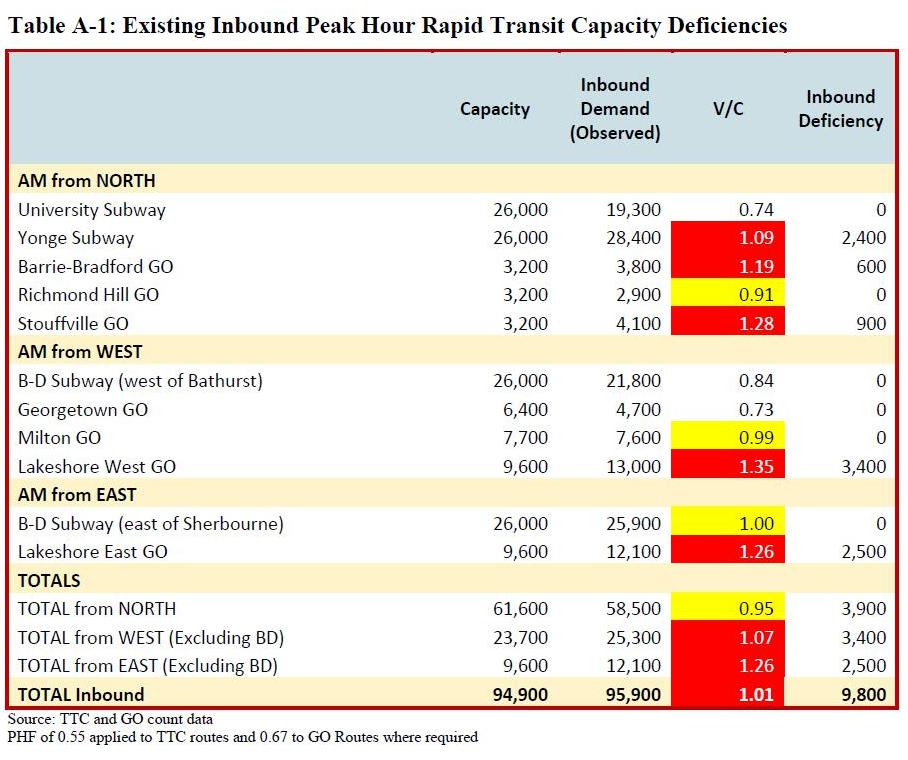
Table A-2 shows the projections for 2031. All of the shortfalls are on GO, but the TTC lines are close to saturation. This presumes a considerable increase in the capacity of various lines. For example, the YUS goes from a design capacity of 26,000 to 38,000 passengers per hour (pphpd), an increase of 46% which may not actually be achievable. Similarly, the BD line goes to 33,000 pphpd, an increase of 27%.
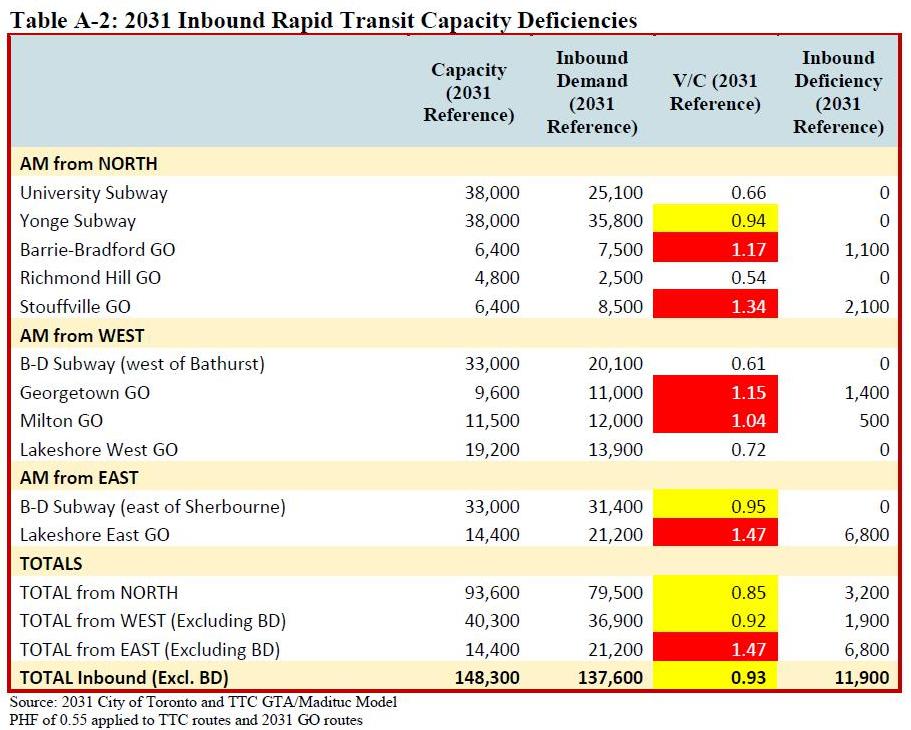
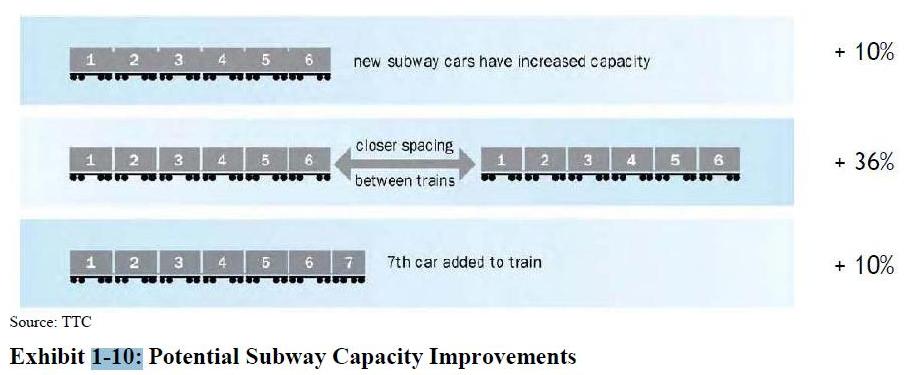
Exhibit 1-10 shows the components of projected capacity increase including 36% from running trains closer together. As discussed at some length on this site previously, the constraints on headways arise at terminal stations. A 36% increase in trains/hour implies a headway of about 100 seconds as compared with 140 today. This cannot be achieved with existing terminal track geometry, not to mention the leisurely crew practices at terminals.
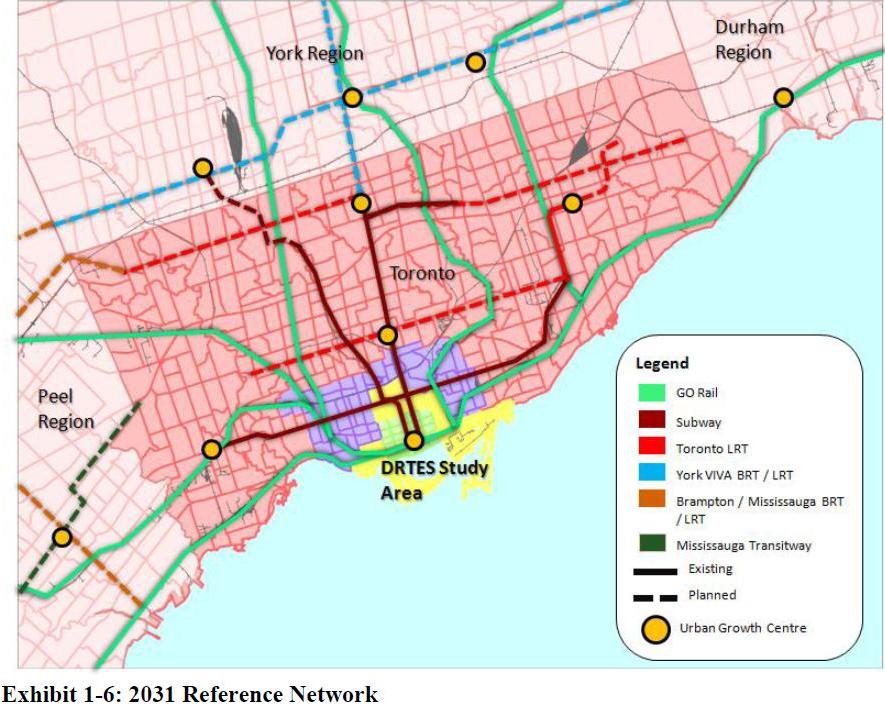
On the GO lines, the projected capacity on Lakeshore West doubles, and smaller increases are seen on other routes. It is worth noting that the projected capacity of the north-south corridors to Stouffville, Richmond Hill and Barrie are nowhere near the level of service implied by The Big Move, probably because these lines are not targets for early electrification. This contributes to the capacity shortfall in the northern sector. Recommendation 1 of the study includes encouragement that Metrolinx review the possibility of increased capacity in those three corridors.
The full list of lines included in the modelled network can be found in the background study at section 1.2.1.
The streetcar system (plus sidewalks and bike lanes) will absorb the growth in short-distance travel to and from the core. This has implications for the future of the streetcar fleet once the new LFLRVs come into service — the immediate retirement of older equipment may have to wait while the backlog of growing demand is addressed. Cycling, pedestrians and transit will require dedication of an increased amount of road space including transit priorities and aggressive controls on abuse by motorists and delivery vehicles. With growth numbers like those, the idea that people will breeze through a congestion-free downtown by car is laughable.
Exhibit 1-8 in the background study gives a revealing breakdown of trips arriving in the core area during the AM peak. GO has 88% of the trips from Peel Region, 95% of the trips from Durham (on a much smaller base than Peel), but only 55% of the trips from York Region. This shows the degree to which GO has not picked up demand from the north, and this demand is now filling up the Toronto subway system.
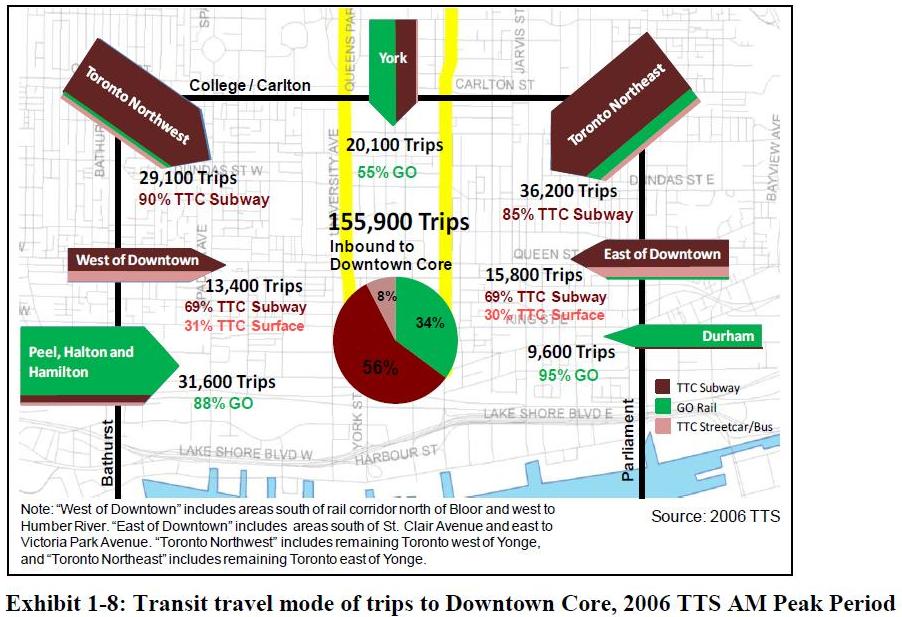
This problem persists in the 2031 projections in Exhibit 1-9. The TTC’s share of trips from York Region to downtown falls only from 45% to 41%. GO may be adding capacity, but only slightly faster than what is needed to handle greater demand, not as an incentive to shift riding from the TTC network.

Also revealing is the breakdown of trips within the 416. Of the trips from east and west of downtown entering the core, the surface routes carry about 30%. The outside-416 trips swamp the local 416 trips, and surface trips only make up 8% of the overall total. However, the surface system is an important part of local travel within the city, and this role should increase as the population south of Bloor rises.
Exhibit 1-9 implies a fall in the absolute number of trips handled by the surface network outside the core area boundaries. The percentage share for surface routes falls from 30% to 23% while the total number of trips does not rise much. This implies a diversion of trips to other modes without the addition of any east-west subway capacity other than better service on the BD line. I am not sure whether this represents a real shift or if it is an artifact of the modelling process.
Table 1-5 gives comparative streetcar capacity figures for the downtown routes with three sets of figures: existing, the effect of a 1-for-1 replacement by new LFLRVs, and the capacity of a nominal 3-minute headway. What is not shown is any indication of the latent demand on streetcar routes whose service has been frozen for years, nor of the effect of current and planned development that will increase demand along the streetcar lines.

Elsewhere in the report, the TTC claims that 2,600 is the practical capacity of a streetcar line based on a 3-minute headway of LFLRVs. This statement must be challenged on two counts. First, it is already agreed that more road space and time must be given to transit, not less. Second, if we presume that 2,600 is the upper bound for a surface line in mixed traffic, we face huge costs for demands that are far below those where subway operation is affordable.
The subway network’s function will be to handle medium-distance trips, although “medium” is a bit of a stretch when the subway will eventually extend into territory once the preserve of GO transit’s rail and bus network. Indeed, one reason for crowding on the subway is the limited growth of GO thanks to constraints at Queen’s Park. Metrolinx talks a good game, but it’s always “subject to funding”, and little of that materializes.
Other recommendations in the background study include:
- Do not proceed with the Yonge Subway Extension in advance of the provision of additional rapid transit capacity into the downtown.
- TTC and the City of Toronto undertake the studies and actions needed to protect for a possible future expansion of Bloor-Yonge station and develop a plan for improvements that will be needed in the future.
- City of Toronto continue to study means of reducing congestion in the downtown area via the optimization of existing infrastructure in its ongoing “Downtown Transportation Operations Study.”
- Maintain, and where possible enhance policies in the City’s Official Plan that will help to minimise the need for future investments in rapid transit facilities.
- TTC conduct further investigation into the future demands and transfers expected at subway stations in the downtown and identify those stations that should be given priority in TTC’s station modernization program. King Station in particular will see high passenger demand and operational issues regardless of the presence of a DRL.
These recommendations emphasize that the DRL is not something about which decisions can be made in a vacuum. It is a pre-requisite for expansion of the existing Yonge line, and other parts of the network, both transit and roads, will have to adapt to provide greater capacity in the system. This is not a matter of drawing one line on a map, finding some money, and building it.
Two families of network improvements are included in the TTC study:
- The Downtown Relief Line (DRL) and variations
- A Lakeshore Subway (or equivalent) in the GO corridor
Because more pressure on network capacity lies east of Yonge, each group of options includes an “east only” version as well as an “east + west” option. The DRL options include versions ending at Pape Station or extending north to Don Mills and Eglinton. This gives six configurations.
[Note: The TTC study shows the DRL going under King and up Roncesvalles, but the alignment is only for the purpose of illustration. Commenters should note that I will not entertain yet another battle among competing alignments here. We have done this issue to death already. What is clear is that a “DRL” cannot hit everyone’s pet project on its way across downtown, and Toronto needs to decide just what function that line would provide.]
An east-only DRL ending at Pape Station or at Eglinton:
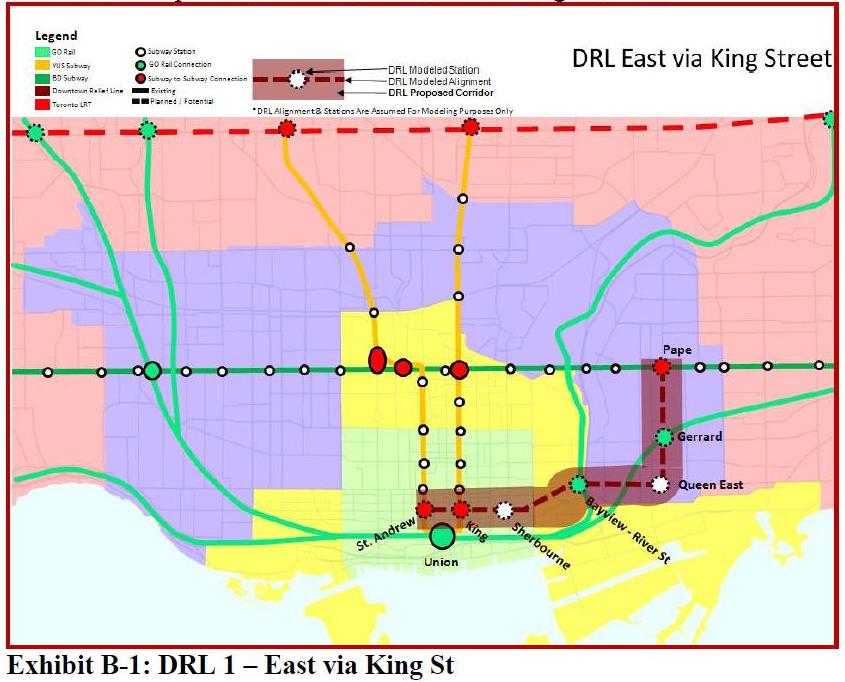

An east-west DRL from Dundas West Station to Pape Station or to Eglinton:


A east Lakeshore line from Union to Rouge Hill

An east-west Lakeshore line from Long Branch to Rouge Hill

Leaving aside the choice of inside-416 stations for the termini of a Lakeshore route, the basic problem it has is that it competes with the Bloor-Danforth line but does not shift much riding off of Yonge-University. Attention, therefore, focuses on the DRL options.
The TTC notes that some benefits could be obtained by improvements to GO’s north-south services, but these are outside the scope of their study. Some work has already been done looking at a network adapted from the one used in the electrification study. This is precisely the sort of detail that should be made public to inform discussion of options rather than remaining hidden within Metrolinx. Any debate about future funding streams needs to know what is possible and how soon we might see it.
What we are now seeing is the cumulative effect of decades of deferred investment in transit across the region at a time when transit demand is taking off. A few more trains here or there, and a subway extension every few decades, and piles of glossy reports just are not enough.
The background study contains a short history of the evolution of downtown rapid transit plans (section 1.1). This includes an odd remark about the retention of streetcars, now celebrating its 40th anniversary:
a citizen’s group in support of streetcars lobbied to retain the streetcar lines in favour of a new subway, [the Queen line]
Well, no, actually. What was happening was that the TTC planned to gradually eliminate streetcars and replace them with inferior service, and with no guarantee that a Queen subway (which would not have served large areas of the streetcar network anyhow) would ever be built. A tiny bit of revisionist history.
The paragraph goes on to note that the Queen subway was cancelled to concentrate efforts in the suburbs.
Band-aid efforts on the existing network are not enough either, although the demand projections include the high end of the TTC’s projected capacity range on YUS. Only one month ago, in its 2013 Capital Budget report, the TTC downplayed the need for an additional rapid transit line into downtown to relieve the Yonge-University subway:
… all of these projects could conceivably improve carry capacity on that line by 40% or more over time. Funding and completing them could put off the need for the $10 billion or so Downtown Relief Subway Line by 10 or 20 years at a fraction of the cost.
The projects in question include:
- Automatic Train Control
- Fleet expansion to allow ATC
- A shift to 500-foot long trains (essentially replacing the TRs which have not all been delivered yet so that they, in turn, would replace the T1s in the Bloor-Danforth line) together with carhouse and storage expansion for the larger fleet (in length and numbers of trains)
- Installation of platform doors (not funded, and described in private conversation by Andy Byford as not necessarily a viable solution)
- Capacity expansion at Bloor-Yonge Station
The TTC has not provided a consolidated costing of these improvements nor have they indicated which of them might not be required if a DRL were implemented. Almost all of the list above is not funded, and cost estimates, such as they exist, are scattered through multiple projects in the Capital Budget. The comment cited above uses a DRL cost ($10b) which is larger than the price quoted even for a full DRL from Dundas West to Eglinton ($8.3b). At this point, the TTC is only talking about a $3.2b route from downtown to Pape Station. One wonders just how deliberately misleading the anti-DRL statements from TTC management are and have been for past decades.
A further problem is that the TTC mixes improvements that actually provide net new capacity with those intended to improve reliability. If, for example, there are fewer track fires because of platform doors, this improves reliability, but it does not increase capacity unless we assume that such fires are so common that they will always interrupt peak service. Fires and suicides are not the only source of service delays, and an external review of the TTC has already reported that until they can get their reliability in much better shape, achieving much higher capacity is impossible.
Pape is not the place to stop, and the line should go north to Eglinton. This will intercept more traffic and will eliminate some of the need for passenger transfer capacity at Pape and Danforth. Such a line would provide much improved transit to major neighbourhoods at Thorncliffe and Flemingdon Parks, and would be more than a diversionary route for traffic on the Danforth subway.
Exhibit 1-11 gives an overview of existing and projected transfer movements at Bloor-Yonge. These will increase substantially by 2031, and the station as now configured cannot handle the added pedestrian activity. The TTC has a separate study underway of capacity at Bloor-Yonge, but this has not yet been published. The question then will be whether the proposed improvement to station capacity is physically possible, affordable and acceptable to nearby landowners who may be affected. If we cannot handle more transfer movements at Bloor-Yonge, a discussion of increase line capacity runs aground fairly quickly.

Detailed projections for the DRL show that it will have considerable effects in reducing demand at Bloor-Yonge. When this is combined with the possible benefit of increase north-south capacity on GO, heroic work at Bloor-Yonge to accommodate new transfer capacity may not be required. The TTC, however, seems to have the attitude that it is needed no matter what. The validity of this position should be challenged as the relative benefit, costs and effects of various combinations of options are reviewed.
Exhibits 1-12 and 1-13 examine projected increase in station demands on the downtown “U” and shows very large changes in passengers entering the subway from Queen Street south. Most affected is Union where boardings would triple from 5,700 to 17,300. Other stations have comparable ratios (3X) but many fewer passengers. The effect of higher subway ridership shows up in all stations’ departure numbers. The combined effect of these changes shows the need for more station capacity along the Yonge-University line, not just at the two key stations.


The diagrams below are only those showing overall changes in demand flow for each option. Many more details are available in section 4 of the background paper.
DRL east to Danforth: The projected peak demand westbound to Yonge is 11,700 although fewer riders are diverted from the Danforth (5,600), Yonge (4,700) and University (1,000) subways. The model presumes a GO connection at Gerrard that would attract about 3,000 transferees per hour at peak. The number of boardings at Pape is 9,400, considerably larger than the number of trips diverted from the Danforth subway, and this likely shows the volume of traffic attracted from the north (something the study’s authors appear to have missed). This option also reduces the west-to-south transfer demand at Bloor-Yonge to below 2001 levels.

DRL from Dundas West to Danforth: When the western leg of the DRL is added, demand at the peak point east of Yonge goes up to 13,600 because destinations west of University have been added as options for riders using the DRL. Anyone who has seen the substantial counterpeak demand on the King car going to offices west of downtown will understand this pattern. The biggest change, understandably, is on the Bloor line west of St. George from which traffic would divert to the DRL west, and on the University line. Projected peak demand on the DRL west is 12,900, but this depends on substantial transfer traffic at Queen and Dufferin.

DRL with Eglinton Option: The Eglinton option does not have much effect on the peak point projected demand for the DRL east or for transfer traffic at Bloor-Yonge as compared with a line ending at Pape Station. This implies that the model is not finding much “new” demand to assign to the corridor with a faster trip between Eglinton and Danforth than on the existing bus routes.


The Lakeshore options primarily affect the BD subway by diverting east-west trips away from it. The effect on the Yonge line and on Bloor-Yonge station is considerably less than with the DRL options. A Lakeshore service also adds even more demand to Union Station which will be straining to handle growth in GO Transit and waterfront-based trips.


As a general observation, the demand model appears to be “force feeding” the DRL by assumed GO-to-DRL transfers that require additional stops in locations where they may not be physically or operationally practical as well as the station capacity to handle the passenger movements. Whether riders would actually make these transfer moves requires more detailed analysis. This behaviour may be particularly hard to obtain in the PM peak where passengers would be trying to get on outbound GO trains already packed with riders from Union Station.
This report begs a much more complex question — there is a pressing need for a detailed analysis of the transit system, all of it, not just the parts each agency cherry-picks for its own purposes. GO Transit must stop treating travel inside the 416 as something that is not its job. Transit studies need to look at surface route growth, not just at subways. The whole debate about LRT will remain a sideshow while the Ford brothers have influence in Toronto, but the larger problem of surface capacity on bus and streetcar routes will not go away.
Some bus routes logically will transform to LRT, some to BRT, some to simply a mix of local and express buses. Road space for auto users will come under attack, and subways cannot possibly fulfill the needs in every corridor. All of our transit lines will need more money for fleet growth, garaging, operations and maintenance. In the 905, we need to know the implications of greatly improved GO service on local transit networks, especially for off peak and counterpeak travel.
With this report, the TTC has seized the initiative in the political debate about transit expansion and could leave Metrolinx in the dust thanks to that agency’s dependence on Queen’s Park to make policy. The focus is on a subway line, something that will keep the Fords happy, but the continued importance of the streetcar system for “in town” trips is part of the overall plan.
At long last, we have the TTC openly talking about the need for much-increased rapid transit capacity downtown, a debate that was sidelined decades ago when a proposed DRL was dumped in favour of the Sheppard Subway.
Postscript (October 20, 2012)
A comment on this article sent me looking at the information from the many simulations in the background study to see how the component flows changed, or not, for each configuration of the network. The information is much more easily digested in this consolidated format rather than flipping back between many pages in the source document.
Charts of Demand at Bloor Yonge
Table of Demand At Bloor Yonge
The “charts” file linked above contains three pages. The first shows the modelled demand at Bloor-Yonge under various scenarios. Note that “walk in” traffic at Bloor-Yonge is not included in the published data, and this may be important as we will see later.
- The leftmost column shows the current demand and its source from the three legs of the subway.
- The next two columns show the projected demand in 2031 without and with the Yonge Subway Extension to Richmond Hill.
- The next six columns show the projected demand in 2031 with the YSE and with each of the six alternatives studied as a “relief” line.
The most notable aspect of this chart is that the demand from the north in 2031 with the YSE added in equals all of the existing demand. Growth and new ridership attracted by the extension completely replace the capacity now used by transfer traffic from the BD subway.
Various relief schemes reduce the BD transfer demand, but the total travel south from Bloor remains well above current levels in all cases.
The second chart shows the various forms of activity on the Bloor southbound platform. This includes passengers leaving the station from southbound trains, transfers from southbound trains to each direction of the BD line, and transfers from the BD line onto the southbound service. There is a very substantial rise in total activity for 2031, but this arises from various sources:
- There are many more transfers from the eastern leg of the subway to southbound service, and a smaller increase from the western leg.
- There are many more transfers from the northern leg of the subway to westbound service.
- There are many more passengers arriving from the north and leaving the station.
A “relief” line will only address the first of these three groups. The effect can be seen in the lower platform activity for various configurations notably those with a full DRL from Dundas West that intercepts traffic from both directions, not just from the east.
The “walk out” traffic is interesting because of the big jump compared to current figures. This is shown on the third chart where the projected number of passengers for whom Bloor-Yonge is a destination (i.e. where they will leave the system) will more than triple by 2031. This begs two questions.
First, where are they going? New construction at Bloor-Yonge is overwhelmingly residential, not commercial, and yet a massive rise in “walk out” traffic implies a growth in destinations like offices or schools. Is the land-use information in the demand model valid?
Second, if these numbers are accurate, the pedestrian flows through the station exits will also increase substantially. Can the station actually handle this level of activity?
The published figures do not include “walk ins”, something that should grow substantially given the amount of residential construction planned for the Yonge-Bloor area.
The crucial missing part of the study is the “out of scope” examination of how much demand from the north can be diverted onto GO Transit. Considering the cost of handling the much higher demand on Yonge south, the absence of this information is a glaring omission, and shows the problem inherent with the TTC studying only the “inside 416” effects. It would be nice to say this should be Metrolinx’ job, but that agency is notorious for doing very little in public where the work can be examined and debated.
When we are looking at multi-billion dollar options for subway expansion we need to be sure we are not ignoring possible alternatives. For decades, the TTC has downplayed the importance of the DRL as a potential relief valve or the Yonge-University subway. The possible contribution of GO should not be ignored as part of an integrated, dare I say, regional solution.
Postscript 2 (October 21, 2012)
Back on December 2, 1982, the Star ran an article by Rick Brennan. I am not reproducing it in total in respect of copyright, but here are the main points.
TTC Chief General Manager warned that downtown could grind to a halt in as little as seven years without a DRL. “With the office development that is coming online in seven to ten years, we can’t service it, period,” Savage said. “We can’t do it with the existing system”
The forecast for new jobs in the core was 40,000 in the the decade to come, and as many as 90,000 by the year 2000. As we know, the world did not end. What happened?
First, the lion’s share of the growth was handled not by in-town trips on the subway, but by the expansion of GO Transit and the rise of commuting from what would become the “905”. Also, actual growth over the two decades did not match predictions due to a severe recession in the early 90s. Ridership fell by 20%, and the TTC obtained unexpected “relief” for its capacity problems. Toronto has now passed its old record ridership set before that crash, but the subway’s capacity has not grown to match.
In 1982, the line would have run from Donlands to Union and was predicted to cost $400-million, rather less than the $3.2-billion foreseen for a line from Pape to St. Andrew.
Savage noted that surface transit options could not help the problem because of traffic downtown. Nothing much has changed on that count, but more to the point, this is not just a question of drawing lines on a map. If riders are not originating where a surface line can help them, then they won’t divert from their current travel pattern.
Another important difference over the two decades is that “downtown” and the residential community serving it are “fatter” than they used to be. At one time, a Queen West subway would have primarily served residential areas to the north and feeder routes from the west. Only a small pocket of high-density development around King and Jameson was well south of the Queen Street corridor. Similarly, a subway to the east would not even consider development south of Queen to the lake.
Today, development is pushing south into former industrial lands both east and west of downtown, and the dense area which will be too far for convenient subway service is becoming much “wider”, further away for walking access. At the same time, the job market downtown is spreading away from the core at Bay and King both to the south, and east-west. No new rapid transit line can serve all of the growth areas, especially those south of the rail corridor.
As they are today, Bloor-Yonge and Wellesley Stations were the hot spots of problems for the subway in 1982. Savage the “relief” subway as a decade at most away, but as the Star noted:
“Ironically, the biggest opponent to the relief line has been the City of Toronto.”
This was the “old” pre-amalgamation City which was attempting to throttle development downtown by choking off expanded transportation routes. Politically, this put Toronto in the odd position of supporting new subways that would replace pressure on downtown with suburban job growth. Little new suburban rapid transit was built, and the sprawl of homes and jobs through the outer 416 and 905 developed around auto travel.
There is an important lesson here for the Official Plan review now in progress. Whatever form we hope to see Toronto take, we must be prepared to see it through with a transportation system that will support the plan rather than sabotage it. Decades of inaction leave us with the need to simultaneously catch up with growth we ignored and to build for growth happening now and in the future. This will not be cheap, and we won’t be able to afford everything we might like to see. The missing DRL is a reminder of what happens when planning ideology trumps actual experience on the ground.
 Steve Munro
Lakeshore GO train expansion (which for obvious reasons, needs to cover the entire Hamilton-Oshawa distance, not end at the Rouge River and Etobicoke Creek) is a more cost-effective option than a downtown relief line.
Steve: “Cost effective” is a relative term. Improvements on the lakeshore will do nothing to relieve the YUS and much of the BD line. The missing capacity is north-south, not east-west. We already have lots of experience with “cost effective” lines built in the wrong place. Lakeshore needs better service, but that doesn’t eliminate the need for north-south relief.
LikeLike
Until we see the DRL proposals compared directly and side-by-side with any possible GO transit improvements, and a detailed explanation why specifically the DRL is the best possible and most cost-effective alternative, I would not expect many GTA politicians to accept the DRL as a serious priority.
Steve: So much of our planning has been compromised by agencies looking at the small picture, and that goes for Metrolinx too.
LikeLike
I said “…any possible GO transit improvements…”
That includes any possible improvements or additions to complement Union Station.
LikeLike
Also, does the TTC foresee capacity problems with commuters coming from the west or northwest? If not, I don’t understand why the DRL west should even be considered.
Also, it’s unclear whether GO transit improvements on the westside could totally substitute for a DRL west.
Steve: Precisely. I suspect a DRL west is a non-starter, especially if GO does the sort of job it can with all its new tracks.
LikeLike
Steve, if the goal is to really take pressure off the Yonge line, why not bring the DRL all the way up to Don Mills Subway Station and the Sheppard Line? It’s one of the busiest stations in the the subway system (I think it’s in the top four or five), and with the bus routes going into it, it’s commuter parking lot, and proximity to the 401/404/DVP, the TTC can promote it to get people who are going to the downtown core, rather than all of the stop in between.
Plus the 25 Don Mills bus is one of the busiest bus routes in the city. Add it all up … would the ridership be there to justify it?
North of Eglinton, it might just stop at major intersections along Don Mills. Eglinton (to meet the LRT and Science Center, and Flemingdon Park), Lawrence (lots of apartment buildings, busy bus routes, and the Shops at Don Mills development, along with new condos coming), York Mills (admittedly, a bit of a ghost town), maybe Graydon Hall (lots of apartments), and then Don Mills. Maybe you take it up to Don Mills and Finch, and curve it a bit to get it to the Seneca College campus.
Anyways, you know the numbers better than I. Why not take the DRL all the way to Don Mills and Sheppard (outside of the cost)?
Steve: Only the cost. The TTC foresees the possibility of going further north, but let’s get it built at least that far for starters. There is lots of land at Eglinton for a proper high-capacity interchange unlike Pape and Danforth.
LikeLike
More of a thinking our loud type deal, but considering the DRL is going to a full, grade-separated, “World-Class City” (gasp) subway, are Ford et al. salivating at the idea of this? Is Tim Hudak going to ask the Lieutenant Governor to summon the legislature so all parties just to get this paid for and built?
But seriously, from Network 2011 to now, where do we stand on the DRL? Are the EAs done, and if so, are they still valid today? Under what has been proposed, will the dig all the way down under the Don Valley to get to Thorncliffe/Flemingdon Park, or will a bridge be more likely (even if it makes noise — the Prince Edward Viaduct doesn’t seem all that loud). For that matter, is it possible to anchor/connect it to Leaside or Don Mills Road bridges? What would it take to get this built before 2020?
Steve: There has never been an EA for the DRL because it has never been treated as a serious option by the TTC to the point that an EA would be necessary. I think a bridge is the only way to cross the valley between O’Connor and Thorncliffe Park. This isn’t a radical idea considering that the north Yonge subway to Richmond Hill will cross the Don River on a bridge. Going under is simply not an option as the TTC/Metrolinx already found out looking at taking the Eglinton line under the river. The bedrock is very close to the surface and they would have to tunnel through rock.
As for the bridge, the extra strength in the Leaside bridge originally provided for a streetcar line was consumed by the bridge widening from 4 to 6 lanes. Also, there are big problems with tight curves to get onto and off of the Leaside bridge at each end for an LRT line, never mind a subway.
LikeLike
@Chris Rodney
Depends on how high the ridership would be north of Eglinton. If it won’t approach that magic threshold of 10,000 pphpd, then we can forget about it.
Also, when the TTC mentions that the Barrie and Stouffville GO lines and their slated improvements won’t be adequate, I’m assuming this means that those GO lines would face capacity problems in the future, and the DRL will also serve to relieve those lines as well. If the segments of the GO lines with capacity problems extends north (of, say, Eglinton), there might be a case for a DRL extension north of Eglinton.
LikeLike
Frankly, as much as I see the need for the DRL to go as far as Eglinton or, better yet, Sheppard, I’ll just be happy to see the portion south of Bloor get built. I really don’t want to get anything started as far as alignment is concerned but I do hope that whatever alignment is chosen isn’t too horrifically flawed. I suppose that no matter which one gets the nod, there will most likely be some flaw to it at least in some people’s eyes.
Steve: I think a lot will depend on the degree to which the DRL is seen as having a local as well as a relief function. If only the latter, then it doesn’t matter where it goes except for a few key stops. If there is to be a local function, we still have to chose which one as the favoured locations of many who commented on this in the past do not all lie on one reasonably straight line.
LikeLike
“500”-foot trains? That’s gonna make ritually marching up and down the catwalk of the Toronto Rocket (you know you do it) something of a hike.
Steve: I am not quite sure what happened to the idea of simply inserting a 50-foot car into a 450-foot long TR. We may be seeing a scheme to accelerate the production of even more subway cars to keep Thunder Bay humming along.
LikeLike
Chris Rodney asked:
Not only is that a wonderful question, but it would also provide a great opportunity for hoisting some politicians on their own ‘policy’ statements.
Imagine if the DRL was presented as an extension of the Sheppard line south from Don Mills … instead of a completely new line. I wonder how fast those non-Scarborough, subway-loving politicians who claim “we need subways” and “Scarborough is being left behind/ignored” would change their tune if there was a “Sheppard subway extension” that also turned out to be a “Don Mills” subway running through their ward (like Wards 26, 33 & 34)?
Of course, the downtown segment will have to be built first to keep the costs low. Then, at the “last minute” because of the need for cost cutting (due to ‘unanticipated’ cost overruns, the DRL is only built up to Eglinton, with a promise for a future extension to Sheppard and “interlining” at Sheppard & Don Mills. Eventually, (again, because of additional cost-cutting) that ‘interlining’ will be downgraded to an interchange instead.
Cheers, Moaz
Steve: Except for one vital point: Don Mills Station is not in Scarborough. You need to swing east up a hydro or rail corridor, hit STC, and then swing back. Then the Scarborough boosters might feel like we’re not ignoring them.
LikeLike
I wonder if having Don Mills/Eglinton as a “proper high-capacity interchange” contradicts the current Eglinton LRT/SRT philosophy. I think the current plan (it has changed a fair bit in the past year) is for Eglinton LRT and the SRT to not be connected and to have the SRT portion with double the service since it is grade-separated. So at Kennedy, we are encouraging all riders to switch to the B-D line, but then we provide the proper interchange at Eglinton/DM and not at Pape. As currently planned, I worry that even after extension to Eglinton, the DRL may not provide enough relief to the Yonge line.
LikeLike
Steve,
It`s interesting to see Councillor Pasternak banging the drum for the Sheppard Line in the Star’s version of the story – not that it makes any sense to increase the crush on Yonge or the University-Spadina line.
But humour me for a second here Steve. Imagine if Sheppard was done from STC to Downsview as a full subway. Now imagine that the line is made fully compatible with Presto as each station was opened. Now imagine that people could use their Presto smart card technology and take any Go Train from Union and get off at Downsview, Oriole and Agincourt Go Stations and then tap on to the Sheppard subway as part of a free transfer. It is already being done in other regions (as part of a co-fare program). It just seems like there is a great opportunity there. The same type of arrangement could even be used for Bloor station.
Would that not accomplish the same goals of relieving the Yonge line where it matters most? An express trip from Union to any of the GO Train stops on a fully Sheppard line is, in essence, an express subway line and gets people out of the downtown core quickly and re-integrates them onto the network at other points that have less congestion.
Apart from needing electrification in order to increase frequency of the Go Trains (which is still a stated goal of Metrolinx), do you believe we will see an integrated network any time soon?
With the inevitable integration of Presto on the TTC, do you believe a time based fare or a zone based fare would be the best way to move forward?
Thanks!
Steve: First off, your assumption of a co-fare arrangement with the TTC is something GO has fought against for ages, let alone using their trains simply as a bridge to get people from Union to Sheppard. They want to preserve capacity for trips originating further north. Also, the transfer connections you propose would add substantially to a trip out of downtown and I don’t think they would be very attractive.
LikeLike
GO has significant amount of assets in Toronto, but they are not using it. It is like building a new hotel for occupancies only on Monday, Wednesday and Saturdays. Another problem is the limited amount of amenties at the stations. Aside from Union Station, none of them have restaurants, dry cleaning, ATMs and lotteries. Waiting for a bus is bad, waiting for a bus with nothing to do is even worst. Even a low use airport in Gander NFLD has restaurant on premise. The connection to TTC is poor. Walking from Dundas West station to the GO station exposes riders to the elements, the same with Leslie Station.
If GO ran even Brad Rail Cars every 10 to 30 minutes from 5AM to 11PM, the downtown relief line may not need to happen so soon. With Presto, it should be a seamless process even without fare integration. Even in Hong Kong, one would pay for the MTR leg of their journey seperate from their journey on the bus operated by Kowloon Bus Company. Perhaps one day with code sharing, one can buy a ticket at Pearson Airport and use it to reach let say U fo T Scarborough. (ARL, Lakeshore GO and then the 38 bus)
If the downtown relief line has to be built, we should not wait for some government(s) to fund it. The metro line should be tolled until the contruction cost has been paid off. So, 40000 riders a day with a $5 surcharge per ride nets $200000 per day. With Presto, one can even set it up so the surcharge rates varies. For example, $5 surchage for rush hour and $2 surcharge for off peak hours.
LikeLike
Why do we need a Lakeshore subway? I can understand a Queen streetcar, but I don’t see a subway all the way to Long Branch. The BD line ends at Kipling now, if the TTC wanted a subway in Etobicoke, run the BD line south through Sherway, but even with a Lakeshore subway, I’d still use GO to get downtown.
GO service in the 905 could have its problems on single line routes.
Steve: I tend to chuckle about a subway to Long Branch and think of it as the latest incarnation of the Waterfront West LRT.
LikeLike
What would it take to turn the Air Rail Link into a downtown relief line? That’d provide a route from Dundas West to Union, and we’re already building it. We just need to have the will to NOT make it a gold-plated $40-per-ride service like it’s currently becoming.
Steve: McGuinty’s retirement is a start. A lot of the fights about the ARL have turned on the fact that The Premier has his reputation tied up in the line, and provincial staff refuse to discuss alternatives. With him gone, repurposing the track and capacity is somewhat more likely. However, don’t expect anything until he’s out of office, and if the Tories get in, well, the ARL will be the least of our problems.
LikeLike
I agree completely than the Lakeshore corridor cannot provide any significant relief to the Yonge line, not least because the orientation is wrong.
Also, the notion of an LRT line paralleling the Lakeshore corridor seems silly when the current signalling system allows trains every 5 minutes (on each track), and the underlying technology allows trains every 2-3 minutes. If the line was electrified, then 4-car EMUs every five minutes could provide the capacity of LRT and more.
LikeLike
Given that the idea is to offer relief at Bloor/Yonge I think it makes sense to build this as quickly as possible … and then ramp up service on it over time. Perhaps even initially just build it as an express line from Pape to King, and have a 5$ surcharge. Then over time lower the surcharge, build the expensive bit to St. Andrew and build the other interim stations along the line. This allows you to get the same amount of money as you would from the start and defer all the expensive station building until it’s needed to alleviate pressure on Yonge.
Steve: If the line has a $5 surcharge, nobody will ride it. Oddly enough, it would cost billions to add capacity to the Yonge line as an alternative to a DRL, but we don’t ask riders on that corridor to pay more.
LikeLike
I always wonder about these reports … done by faceless multinational consultants and nameless bureaucrats with some research by an unknown professor from some university in Europe … glad to see that they put their names on this one! Having read through it, it seems to be fairly well put together and unlike some reports I’ve seen has at least passed a “no glaringly obvious inaccuracies” test. It would be nice if the city would make all these reports available more than five days before they go to council … for a few reasons
1 – reports should be fact checked by the community before they are sent to council – in fact there should be a public comment period, followed by a public statement from the authors about the public comments (and any updates to the original document required)
2 – there is no way most of the councillors are going to read this in five days (let alone the public who may want to comment)
Steve: Fortunately, the only action at this point is for the TTC board to receive the report and send it on as part of the ongoing review of Toronto’s Official Plan. The report, to its great credit, is quite clear that it is descriptive — talking about a very general alignment simply for the purpose of driving a demand model — rather than prescriptive. Too often, proposals arrive in nearly-set concrete with explicit alignments, station locations and assumptions about the exact role of a new line, not to mention rooms full of planners and engineers who will not tolerate any debate on the perfection of their scheme.
LikeLike
Steve, I remember a few years ago reading your blog when you were vehemently against a DRL subway. Perhaps this is the source of the allegation? “lobbied to retain the streetcar lines in favour of a new subway, [the Queen line]”
Steve: I have been a supporter of the DRL for much longer than it has been a favoured topic of various transit websites. There are specifics of proposals some have made that I have criticized — alignments that are impractical, arguments that a DRL would completely replace the streetcar system — but the DRL has always been an essential part of plans I support.
Back in March 2006, I published “A Grand Design”, a paper outlining my overall view of what should happen with transit in Toronto. It includes a Don Mills LRT line from downtown to Finch. The title is a deliberate satire on the scale and pretense of many transit proposals.
Over time, my view of the DRL’s technology changed to subway based on likely demand levels south of Danforth and the fact that the southern part would have to be completely grade separated. The TTC relentlessly tried to keep the Don Mills Transit City line on the surface, a totally impractical scheme, through East York. My view of the DRL evolved into a subway as far north as Eglinton with LRT as the technology north from there.
It suits some critics’ agendas to claim that I always oppose subways, but that’s not true. I oppose subways as an automatic choice without looking at alternatives that could provide higher capacity transit service than buses without the huge cost of a full subway. Among my concluding recommendations was this:
“Don’t focus on one mode, be it subways, bus rapid transit or even LRT as a magic solution. Each has its place in an overall plan.”
LikeLike
Hi Steve:
Quick thought, if this line gets built, I can see bus route realignment in the Don Mills, Flemingdon Park, Thorncliffe Park, Leaside and maybe East York neighbourhoods. Unless I missed it, I don’t see any bus platforms between Pape Station to Don Mills/Eglinton being planned. I can only see two locations feasible [one at Don Mills/Eglinton area (not sure where they would put it) and the other in the Thorncliffe Park/Overlea area at the old Coca-Cola building].
If these stations have one, this can shed some buses off a handful of bus routes.
Steve: There is already a bus terminal planned on the north-east corner of Don Mills & Eglinton as part of the Eglinton LRT project.
LikeLike
I was just about to ask the same question. I remember you mentioned some time ago that there was a good chance a proposal to have the T1 cars retired early over the lack of an inexpensive ATO retrofit for the Yonge line would come up. Maybe we’re seen the start of a business case being made for more new cars between the cost effectiveness of ATO installation on the T1s and the fact that the Toronto Rockets are only 450 feet long instead of 500.
Of course, building 50 foot car inserts for the Toronto Rockets would also throw some business to Thunder Bay too. It’s not like inserting an extra car into an existing trainset is unprecedented either given that Andy Byford should be familiar with the example of London Underground splicing a seventh car into the existing 96 stock trains on the Jubilee line a few years ago. The Jubilee line ATO system had to be tweaked for longer train length and all the platform edge doors at the JLE stations that have them needed to be modified to accommodate it though, so if TTC wants to go down the insert-a-car road, they’d probably want to get all that figured out before boxing themselves in too much with their Yonge line ATO project and platform door projects otherwise they’ll end up backtracking and reworking both like London Underground had to.
LikeLike
Electrification has nothing to do with capacity. If you take the existing lines and electrify them, you won’t be able to get any more trains per hour passing through. Capacity on GO lines is constrained by the signalling. Now, the 2031 deficiency is an extra 3 trains/hour on the LSE, and 1 trains/hour on the other lines. This implies to me that the issue isn’t the corridors, but Union.
Steve: Yes and no. Yes, the signalling is an existing constraint, however as headways get very close, quicker start/stop capability with electrification has a benefit. An “electrification” project would include new signalling. It’s a question of which changes GO has assumed will occur concurrently, and the effect of those assumptions on the configuration of the modelled network.
The bit about GO’s mode share for trips to downtown from north, south and east is very interesting. However, I think GO’s mode share is proportional to the distance from the subway to the region. Kennedy station is not near Durham, and has little parking, so hardly anyone from Durham uses it for a commute to downtown. On the other hand, there is a major P&R facility at Finch, close to the border with York, so TTC attracts more trips from there. In other words, TTC gets more trips when it is more useful. Further, the Lakeshore lines have much higher speed limits (80+mph) than the Richmond Hill and Barrie lines, so GO has even more of time advantage over subway. That said, GO should certainly be able to pick up far more trips from York to downtown.
LikeLike
Although the alignments are “descriptive” I note that there is no “Union West” in this proposal as opposed to the one Metrolinx floated. I thought a pressing concern for them was capactiy issues with trains coming from the west into Union and wanted a subsidary station were Bathurst Yard is, and required a subway connection to get people into the core.
All the DRL East options seem to dead head at St. Andrew. Is this a case of the TTC implying “you want, you pay for”?
Steve: The “Union West” does show up in the background study in a review of various transportation options that have been on the table over time. However, the test networks do not include it, probably because this would require them to address the thorny problem of how to get from King down to Front, and then what alignment would be used for the DRL West.
LikeLike
Regarding the DRL West and ARL, would it be possible to run a premium airport express train and a local “DRL” service on the same sets of tracks? The connection to the YUS at union station is a drawback of running DRL West on the GO Georgetown South Tracks. What about building the DRL East using standard rail gauge, and then have the DRL interline with the GO Georgetown South corridor, connecting around Wellington & Strachan?
Steve: There are major issues with interlining urban rapid transit cars on mainline rail trackage. This is one of those “it is possible, but …” situations. Frankly, I think any attempt to interline would complicate the whole project to a level of guaranteed failure. Also, I am not convinced that one through line is the only “solution”. A subway-based DRL could serve the east side, while a “GO” based DRL using the ARL trackage could serve the west side. It is important to note that a good chunk of the modelled demand on a DRL West comes from transfer traffic off of GO as an artifact of the DRL providing direct access to places where GO does not stop. A DRL West on the rail corridor would behave differently from the one modelled by the TTC study.
LikeLike
I can see one obvious reason why only 55% of trips from York Region are handled by GO is because GO takes you into Union Station and then people would have to travel north again – this isn’t always the best option. From the east or west, it isn’t necessarily too much of an issue, but it is from the north.
Steve: That works on two counts — not only having to double back, but having to pay a TTC fare as well. If you’re going to do that, you might as well make the trip on the TTC. It’s interesting that the models show considerable transfer traffic from new GO stations to the DRL, but this obviously includes no penalty for the extra cost that could discourage riders.
From an origin-destination point of view, your comment also points out that the TTC really needs to understand movements to locations outside of the core like Yonge/Eglinton and the limitations of Union-focussed routes like GO to handle growth. This is also important for potential new employment areas near downtown but beyond walking distance of Union or a subway station nearby.
LikeLike
Steve, my point was that certain people would change their tune (and drop their “support” for a Sheppard extension to Scarborough) if they were presented with a proposal for a Sheppard subway extension that went south through Don Mills.
It does seem like OneCity 2.0 is starting to appear from the mists of Toronto Transit planning.
Cheers, Moaz
Steve: Scarborough councillors appear to have a boundless desire to make their constituents feel like the rest of Toronto is ignoring them. I suspect they won’t be too happy about the population and jobs projections for downtown. The private sector is obviously not doing its part for the suburbs.
LikeLike
Maybe the province could drive the development of some new technology like they did with the SRT, and simply build quantum tracks to all locations at once. As long as we didn’t observe them, the trains could be in both Scarborough and East York simultaneously.
Steve: This technology is closely related to the teleportation scheme I have mentioned. The problem, of course, is to step off the train at just the right moment. You think you’re getting off at STC, but you actually emerge on Queen West. Heisenberg’s uncertainty principle applied to transit — looking out the window changes the view.
LikeLike
According to the DRL report, “by 2031 transit ridership into the downtown is expected to grow by 51%”. That alone shows that the DRL MUST be built. The report also says that the DRL should be built BEFORE the Yonge extension.
However, Rob Ford’s “no tax increases” means he will be against it. He’ll want “private” money to build it, which is not going to happen. Unless, that is, city council sees the light.
BTW. The report says that it should be “subway”, which means underground electric railway. However, it does not say if it should be a heavy rail subway or a light rail subway. Could the capacity numbers for the DRL be handled by a five car light rail train or less?
Steve: I think there will be a lot of debate about the technology, and about the degree, if any, of transfer facilities to/from GO that will be included. Long trains make for long, expensive and hard to site stations. Connections to GO inflate, at least according to the model, the projected demand on the DRL. These factors need to be teased apart so that we don’t overbuild the DRL while keeping it attractive enough to divert trips from the YUS line.
LikeLike
One of the unfortunate things about the diagrams in the Commission report is that the DRL is shown in a purely local context and Lakeshore RT in a regional one. One hopes that doesn’t play too directly into the hands of those who like to play municipalities off each other. However were the objections of the CP to be overcome to a service from the east, that line passes just 550m north of Eglinton/Don Mills – a possible station for Jim Flaherty’s Whitby constituents or even the Del Mastro TGV from Peterborough.
The provision of not one but two rapid transit lines (and the outside chance of a heavy rail commuter service) at that intersection should also allow the Ontario Science Centre to downsize and perhaps redevelop their massive parking at on the southwest corner. A view of the overhead shows many such outsize parking lots, which hopefully will become more and more redundant as transit options are improved (but not simply by driving out commercial/industrial and replacing with residential or big box retail.)
LikeLike
Steve,
While not directly related to the subject at hand, I’ve been meaning to ask you whether interlining on YUS and BD could be brought back from the grave as a way to alleviate congestion at the interchanges (particularly Yonge/Bloor).
Doubtlessly, interlining has significant challenges both from an operational and rider perspective; but is it a total non-starter? Or will there come a time when Yonge/Bloor becomes so packed that it becomes a viable option? But then I suppose some sort of barrier system there would be easier and cheaper.
Curious as to your thoughts!
-Chris
Steve: The short answer is, “no”. Because Yonge would have three “branches” (east, west, Spadina) and each leg of Bloor only two (through or downtown), the arithmetic doesn’t work out for blending headways at a frequency needed on each of the four branches of the network. There are other issues I won’t go into involving signalling and ATO. The fundamental need is to remove people from the junctions by diverting them onto other routes into the core, and that requires a new line.
LikeLike
I could be wrong on this thought but maybe this will help the congestion on the YUS line by taking a bunch of the articulated buses that are coming and using them to build 2 or 3 BRT style routes. We can take some bus service from Don Mills station run it express to Pape with only a few stops along the way then run it into downtown. The other idea is to cancel the 502/503 and run a bus service from Victoria Park station down to Kingston rd and then run local down Kingston then express along Queen street and then down king street or keep it running on queen to McCaul street. By running rapid transit along the queen corridor it could allow the 501 to run more efficient and allow for less short turns. Another option would be something more favorable and one I have supported and that would be to run a modified 505 and take the portion from Broadview to Church out and replace it with an articulated bus that has a few less stops running from Spadina station to Broadview. It can pick up people at Spadina station and then the next stop could be Dundas and Spadina then Dundas and University and then have stops at Bay, Yonge, Church, and then running local from Parliament to Broadview station. By taking some of the Artics and creating some modified express routes into downtown then it would free up a few streetcars and buses and allow them to be used in other areas maybe even creating a few more express portions of certain routes within the city. After a few years then maybe shovels can begin the task of building Subways as a DRT.
At least this is a start and it gets some transit flow in the city. Steve maybe you can give an opinion on this and tell me if my idea is half baked like the counsellor’s little agendas.
Steve: A few points about express routes. First, they have to run on streets where they have some hope of actually being “express” services. Doing this along four-lane streets that will still have frequent streetcar service on them (there are local riders, you know) will pretty much force the buses to operate at speeds comparable to the local service. For all that I don’t agree with fixing the Queen service to the Beach by running express buses, at least they come into downtown via Eastern and Richmond.
Second, presuming a design load of 75 (that includes standees) for an artic, a two-minute headway would carry just over 2,000 per hour. That’s a lot of buses, and a lot of passengers to wrangle both at whatever station is the subway-to-bus transfer and at the destination downtown.
Third, the benefit will be most achieved by diverting longer trips. Leaving aside congestion problems, starting a bus at Broadview or Spadina stations will incur all the overhead of a transfer for a relatively small saving, if any, in travel time. Have you looked at either of those locations, by the way, to see the congestion in the immediate vicinity? There is no room for more service at Broadview. Another problem with a close-to-Yonge transfer point is that for the outbound pm peak trip, you would expect riders to try to board the subway where it is still quite busy.
Your scheme for replacing part of the 505 Dundas car ignores the fact that there are local riders on this route, and demand will increase as the street is redeveloped (and not just in Regent Park).
LikeLike
A note to Grzegorz: A DRL to Eglinton via Pape and Overlea would actually need 3 separate bridges. One on the lower Don, one at Millwood, and likely one on Overlea as it approaches Don Mills.
Once the Commission takes in this report, let’s hope the EA gets started as soon as possible. (EA funding is already approved?)
Commentators on the G&M and other newspaper trolling forums are already complaining about the cost of the study but it’s best to have the numbers there if we’re going to go fishing for funding. The alternative would be planning by gut, which seems to be the favoured method of our part-time mayor.
Steve: No, there is no funding for an EA yet.
LikeLike
This afternoon’s very squishy trip from Queen to Broadview stations tells me that YUS is over-capacity now. I suggest that the TTC do a Proof of Concept for the DRL by implementing “emergency measures” with its existing infrastructure:
The Dundas and King streetcar routes both resemble the DRL route. Make one of them a high-capacity Express. Run a streetcar (preferably a new one) as frequently as possible (1 minute?). Make fewer stops. Restrict moving and parked cars from the route, with draconian measures at rush hour. Use advertising, intersection signal priority, all-door boarding, Presto cards, TTC supervisors, traffic cops, tow trucks, whatever it takes to make the trip as fast as the subway yet more pleasant.
Car drivers won’t like the restrictions. As soon as they’re willing to pay for subways via tolls and taxes, the annoyance will stop, right?
Steve: In common with a proposal in an earlier comment, you seem prepared to sacrifice the considerable local demand on the 504 or 505 to the greater purpose of running an express LRT. Have you been to Broadview Station and seen the traffic jam of buses and streetcars? The amount of service there today is considerable, and there is little room for more demand to flow through this busy transfer point.
I agree that Toronto should be much more aggressive with clearing roads, but Council has never been willing to really tackle this problem. Between scofflaws and allowed uses, we dedicated a great deal of road capacity to storing cars, not to moving them. This issue is raised by the DRL report and its observation that growing demand (from growing population) on the streetcar lines will require better transit priority. But I’m not holding my breath.
LikeLike
The Danforth GO / Main Street Subway node has great potential if only it did not require riders to hike 100m outside between the stations. My radical proposal is to move the Main station south so that is immediately adjacent to the Danforth GO, thus facilitating an easy connection. Also, build a downtown relief LRT from the new Danforth GO/Main Subway to Union along the GO corridor, stopping at Gerard Square, Queen/DeGrassi, Cherry St, the St. Lawrence Market, and finally Union Station (not King Station!) An outdoor LRT will be far cheaper than a subway. Is there space for 2 LRT tracks along this stretch of the GO corridor?
Steve: I look forward to your appearance at a local meeting to explain why we must demolish a good chunk of the neighbourhood to accommodate a rerouted subway (grin). No, there is not room on the GO corridor for what you propose.
LikeLike
Steve, a few numbers
I noticed that the Volume on Yonge (south of Bloor) is now 28,400. This will increase by 7,400 (to 35,800 in table 1-7) by 2031 in the base case. With the DRL (case 3) the volume will be 33,100 (table 4-7), or a drop of 2,700 from the base case. The Yonge Extension adds 3,600 new riders.
If you look at the capacity side, it is currently 26,000. This will increase by about 3,000 (10%) with new train cars and 9,000 due to higher frequencies (and another 3,000 for the addition of another car, which was not allowed for in this report). The higher train frequencies are projected using ATC and station improvements at Y-B to reduce dwell time. However, even with the DRL, the number of riders using the Yonge South Bound platform will increase by about 25% from today (calculated from exhibit 4-12, but not stated in the report). If the station is not improved, the extra crowding on the platform would increase the dwell time by more than ATC could improve it.
The bottom line is that (according to the report) station improvements at Y-B has a 9,000 pphpd improvement (at a cost of $1B according to OneCity), while the DRL has an improvement of only 2,700 (at a much higher cost). That is why the TTC has been saying that station improvements are more important than the DRL. The conclusion could just as well have been that the DRL does little to improve the Yonge capacity ratio compared to other strategies.
According to these numbers, the DRL must further reduce the number of transfers at Y-B (by encouraging central Scarborough to take Eglinton LRT to the top of DRL instead of taking B-D to a crowded Pape transfer – which they will avoid and go to Yonge), or remove riders from Yonge (by extending the DRL further north to intercept northern Scarborough before they reach Yonge).
Steve: Your comment triggered my postscript to the article in which I review the effect of various network configurations on the situation at Bloor-Yonge. It is important to distinguish between the volume of riders on trains, and those who use the platform. If transfer traffic can be diverted to the DRL, this affects the need for platform capacity even while train capacity is dominated by growth in riding from the north. Still missing is any information on what would be possible if more service were provided on GO’s northern routes. How much can be shaved from the peak demand from the Yonge Subway Extension by running more trains in parallel corridors?
LikeLike
Nice report … now on to the shelf you go (along with the others).
With respect to the report’s reference to the old Queen line, it depends on who you ask. While the streetcar abandonment policy was initially married to the Queen subway proposal (priced at only $400M in 1973 dollars), there were earlier reports similar to this one that rejected it no matter what (based on insufficient demand).
It’s hard to say what would have happened, but my hunch is that Queen would have gone ahead by the late 70s. Buses simply couldn’t handle what King and Queen carried in those days, and the opening of the Bloor-Danforth subway did not reduce demand on King. So, it’s all Steve’s fault … 🙂
The new lower limit on streetcar service is probably an indicator of increased traffic congestion these days. Bloor-Danforth was able to achieve much higher than that on the street with the equivalent of one CLRV every 45 seconds, so I agree that 3000ish figure does seem kinda low.
As for the interlining question above, I think I explained this in another post recently. With tight headways, it causes a very gradual “schedule drift” as the day progresses. When it used to run, the whole system was often 30 minutes behind the printed timetable by the PM rush. At that point, additional PM peak service coming in from the Greenwood wye exacerbated the problem, because mid-day trains were not in their properly scheduled places along the line at 3pm. It did work flawlessly in the AM rush though, but it’s just not feasible anymore because Spadina uses up almost all of the possible track time south of St. George.
LikeLike
Curious about the idea of building a “one way” rush hour DRL instead of a “two way” DRL. Given that essentially the goal is to alleviate rush hour traffic in only one direction (and then in the opposite direction in the evening)…this could be built faster/cheaper (one tbm, simpler stations). Have every third car from kennedy go down pape, with a few extra empties stored north of pape in some tail tracks. Then build some tail tracks past St. Andrew and store an hour or two worth of cars that come down in the morning on some tail tracks for use in the evening.
Once the first run with the TBM is done, if it makes sense to complete the rest, a second dig could be done for the other direction. This would get the DRL up and running fairly quickly, and the tail tracks would essentially just be the beginnings of digs to Dundas and Eglington. Saves buying a TBM, a bunch of power/substations, 1/2 the track, digging, work, trains, maintenance and operators (maybe even less if only run during rush-hour) and simpler stations initially. It would essentially be a reversible express lane.
Steve: This is a complete non-starter for a few basic reasons. First off, “an hour or two worth of trains” is a lot of equipment, and this won’t fit on just a few tail tracks. Also, with the comparatively short trip from downtown to Danforth (or Eglinton), one trainset needs to be able to make multiple trips, but could not because you only provide one track. Second, you can’t build “half a station” or “half a power supply” or “half a signal system”.
LikeLike
There will always be a nagging voice in my head that tells me we can save $billions if only we’d have the guts to seize some city streets, ban cars on them, and run 6-car LRV trains on them at 3 minute headways. Motorists be damned.
Steve: I would be happy with 2-car trains.
LikeLike
Steve I wanted to verify that I am reading the detailed analysis of the options correctly. Are they actually saying that with a full DRL that EB 504 headways of 15 minutes are more than sufficient for local trips? If so I find that absolutely insane, given the proposed station spacing. I think the 9 minute headway they speak of, stupid as well. Is this an inkling of what we have to look forward to with the new cars as well?
When it comes to surface route capacity, I don’t understand how they can say 2600 is the max and then list the current ridership on, say King with a straight face.
Steve: Yes, some of the comments in the report about the surface routes are quite laughable and are one of its weakest points. Despite the fact that they use King Street only for purposes of illustration, they proceed to model streetcar route demand on the assumption there is a frequent subway service under King and Roncesvalles specifically. If the DRL West were in the rail corridor, the numbers would be completely different.
Your comments about not serving latent demand, really hit home for my wife and I.
We’re living at Woodbine and Gerrard now, and the irregularities on the 506 are making me weep. More often than not, I’m kicked off at Coxwell, or I miss the parade of three cars that left the station together and wait forever for the next one. My wife has started taking the subway instead, even though its less convenient and round about … contributing to congestion at Yonge and Bloor.
Steve: The TTC still has a lot to answer for on line management. Mind you, with larger cars we could reach a point of no return when service is reduced to a single vehicle, and it is always short turned. They have still not sorted out the issue of managing to a schedule, or managing to a headway, as the metric for “good” service. Moreover, the metrics they do use understate the real severity of the problem.
LikeLike
All this talk about the DRL is a start in the right direction, but what about the present time? Let’s remember that Torontonians pay for both the GO Transit and TTC. This bunker mentality between these two government organizations is not right. Both the TTC and GO Transit cannot solely bring a passenger from beginning to end. Imagine a passenger wanting to travel from MNL (Manila) to YYZ (Toronto), no Star Alliance member can carry this passenger using one airline. Do the airlines just sit around and blame each other?
Businessman think of a solution to utilize their assets to fill the need. Air Canada will sell a ticket with a codeshare flight with ANA. Revenues are split between the two airlines. For someone originating from Leslie Station heading to Queen Station, why does the TTC has the only right to carry this passenger? This same person can take a GO train at Oriole Station and switched to the metro at Union Station.
Whether it is a GO bilevel car or a T35A08 car, it is a pubic asset. We should be thinking for the best way to utilize what we have. A GO bilevel sitting at Willowbrook Yard while a T35A08 car is filled to the brim is not using public resource efficiently. Can the TTC and GO not work out a way to split the revenues? The ticket price does not have to be the same since GO is a premium service. It just has to better than the current GO fare plus TTC fare. By the way, if I purchased a codeshare YYZ to MNL ticket, it is only $1500. If I purchase a YYZ to NRT on Air Canada, it will cost $1400. Another ticket from NRT to MNL on ANA will cost another $700 for a total of $2100.
Finally, there is no anti monopoly legislation to worry about since these are public monopolies. Right now, there is a joint venture between Air Canada and Lufthansa. Any flight between Frankfurt and Canada, regardless of who’s metal, the passenger revenues are shared. If private companies and enter into joint ventures, why can’t two public monopolies who has the same goal to transport passengers cannot work together?
Steve: The problem is not the public monopolies themself, it is the governments that subsidize them. Queen’s Park does not want to give TTC riders a co-fare on GO, and Toronto does not want to lose revenue either. We also have to get away from thinking of GO as a “premium” service with fares to match as this will only deter riders from including a GO leg on their journey. GO fares are prejudiced against people who make short trips, and this even applies to trips originating in the 905.
LikeLike