
Updated Friday, September 21
The TTC has announced that the 501 Queen service will revert to its normal routing between Broadview and Coxwell effective Monday, September 24. Service on Kingston Road will continue to be provided by buses for the remainder of the current schedule period.
Plans called for the 502 Downtowner to operate from Bingham Loop to Wolseley Loop at Bathurst Street, and the 503 Kingston Road will operate from Bingham to York & Wellington effective Tuesday, October 9 (the first weekday of the new schedule period).
For the next two weeks, we should see amazingly good service on the outer ends of the 501 Queen route because cars will have the extra running time for a diversion they are not taking. This will be an interesting point of comparison once the normal running times return with the October 7 schedules.
Updated Tuesday, August 28
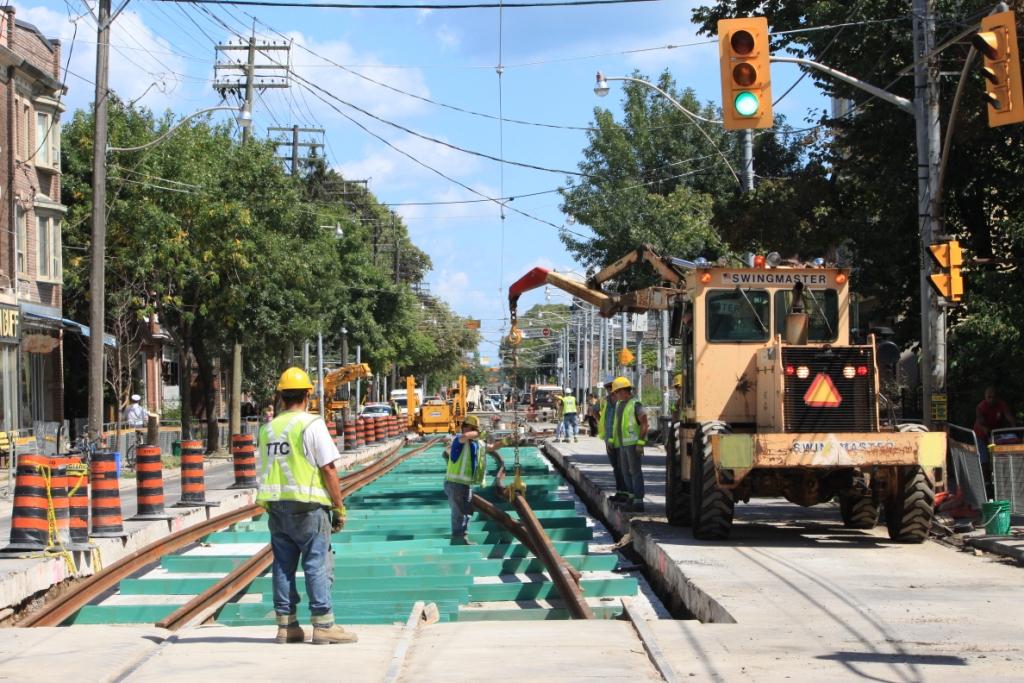
Rail installation is now in progress east from Greenwood to the west gate at Russell Carhouse.
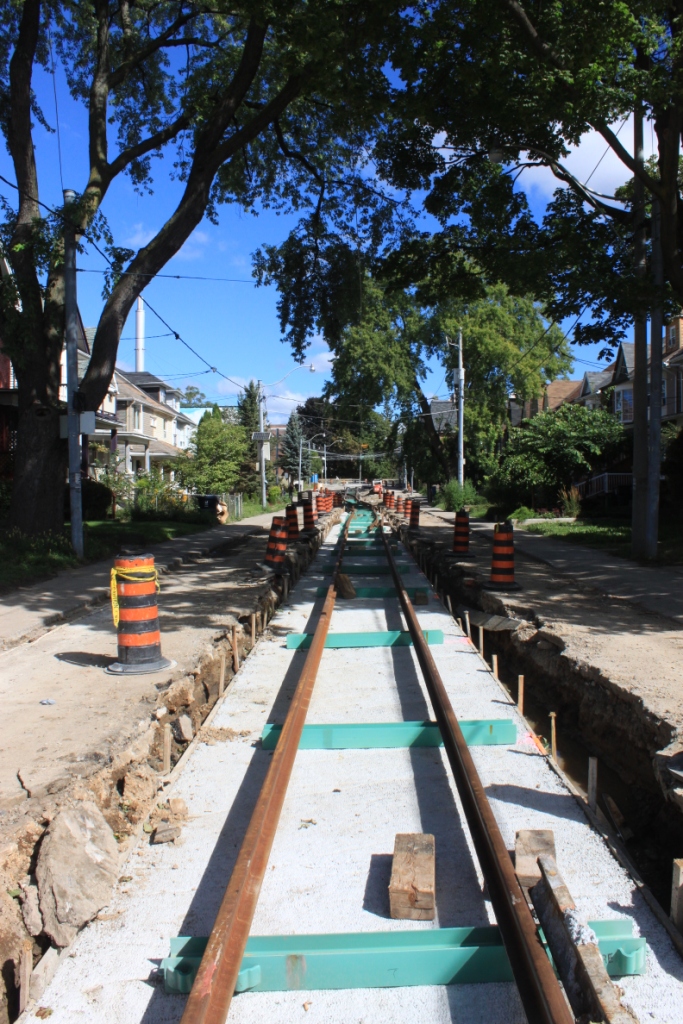
Looking east on Queen from Greenwood. The strings of new rail have just been pulled into the worksite and are being positioned for installation on the ties below.
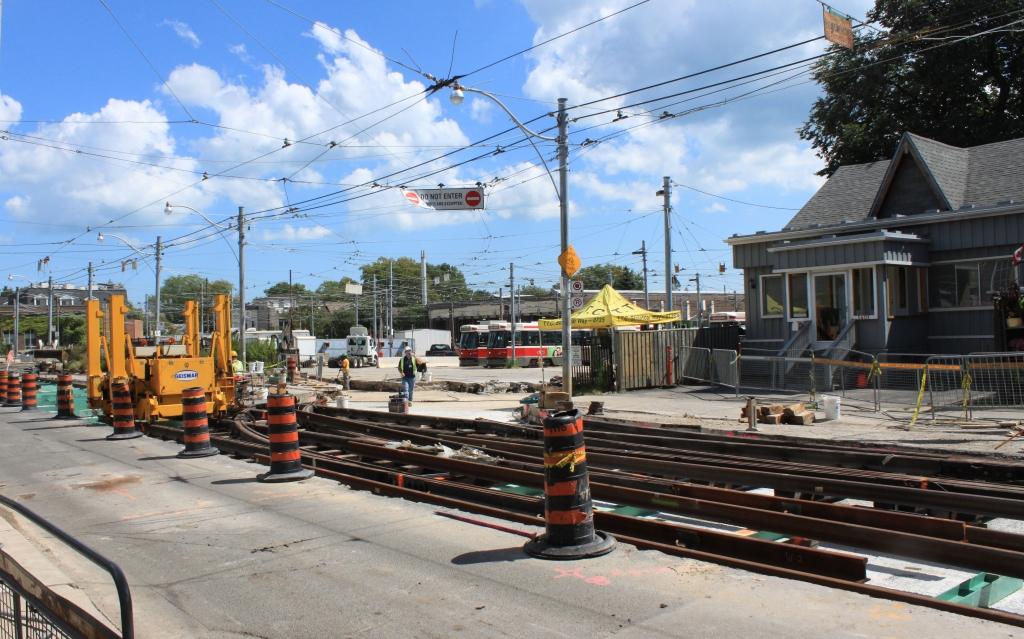
The special work at the west gate is in place but not yet connected to the surrounding track which must be cut to size.
Updated Saturday, August 25
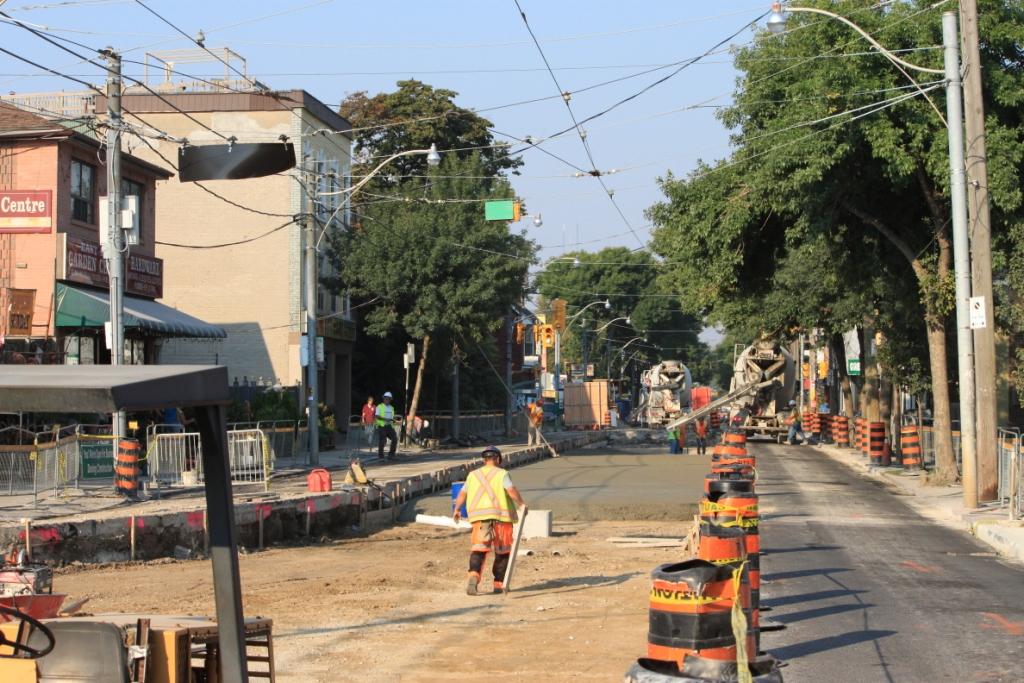
Excavation from the west gate at Russell Carhouse west to Greenwood is complete, and the foundation layer of concrete is being poured this morning (see photo below).
The Greenwood bus diversion information has been corrected by the TTC and the stops are now signed to indicate where the bus is actually running.
The Queen shuttle bus route now operates only to River Street (signed “501 Broadview”) because the link from Queen to King has finally reopened after construction. Buses loop west on Queen, south on River and return east on King to the Don Bridge.
Updated Thursday, August 23
This week, carhouse access at Russell switched from the west gate to the recently completed track at the east gate at Connaught.
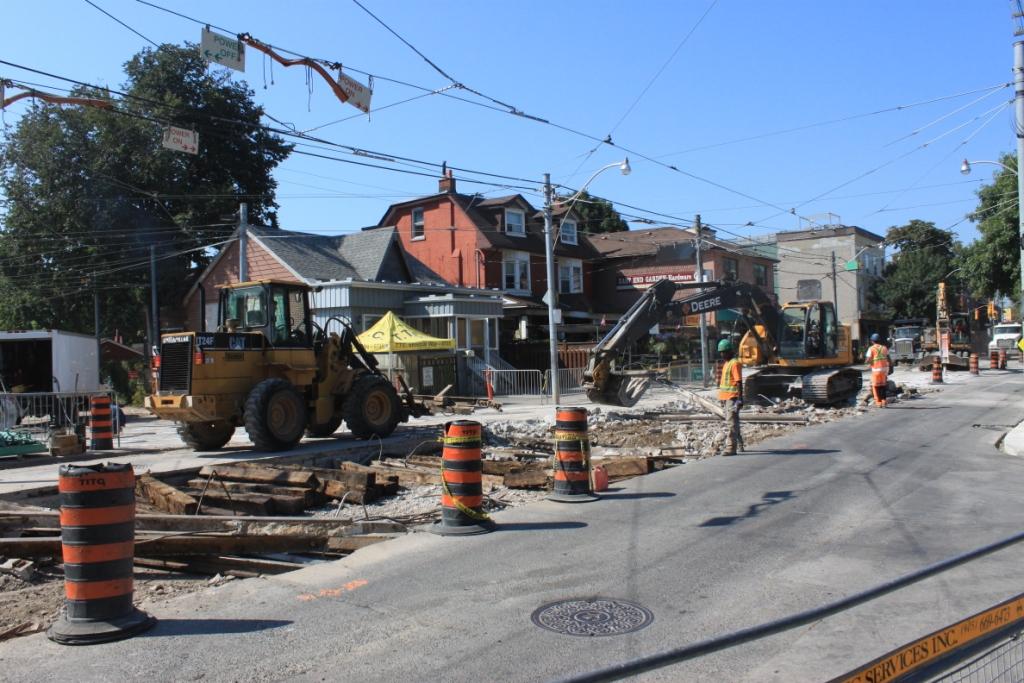
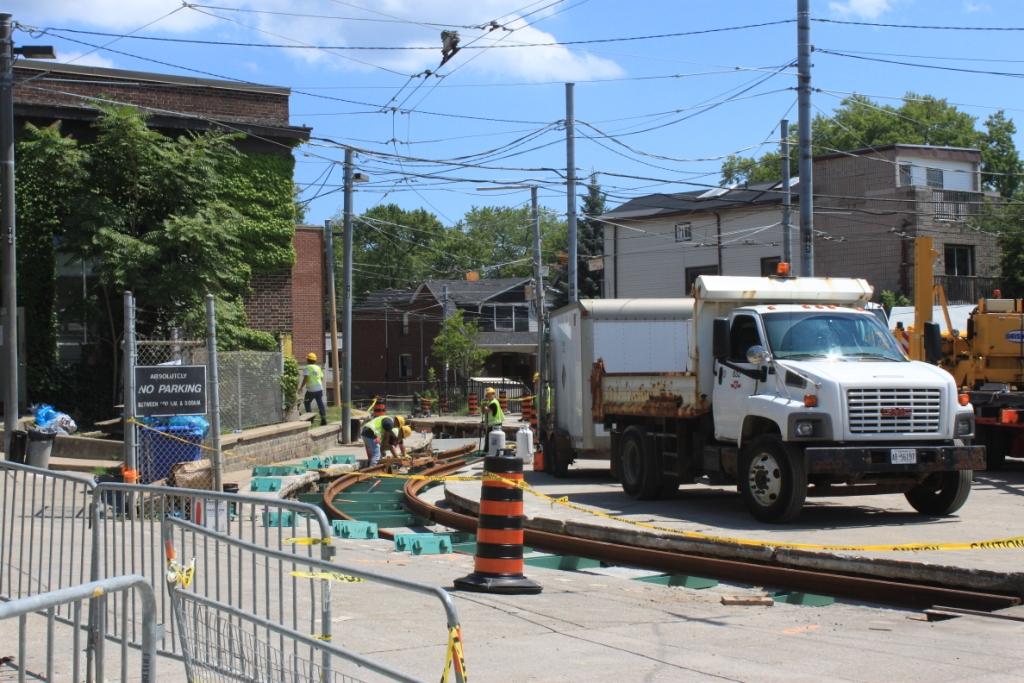
Demolition of the existing trackwork between the west gate and Greenwood is in progress today (see photo below), and a diversion notice for the Greenwood bus has been posted giving dates of August 23 to 31.
This notice makes interesting reading because it claims that the 31B service to Eastern Avenue will divert east via Queen and south on Coxwell even though this is physically impossible with the construction now underway. Meanwhile, on a visit to the site this morning, I noticed that there were few announcements of the diversion posted, notably at stops with no service, and that only one of the Greenwood buses then operating actually took the diversionary route.
The TTC is now aware of the problem.
Excavation and removal of the special work at the west gate of Russell Yard.
Updated Monday, August 6
Toronto’s streetcar system once had many quaint corners, but over the years these disappeared to track replacement and paving work around the city. Connaught Avenue remains an anomaly, a well-used piece of single track on an otherwise quiet residential street. This track provides the main access to Russell Carhouse and its ladder track on Eastern Avenue.
Reconstruction has now progressed to the point where Connaught’s track is wide open, probably for the last time many of us will see such an event.
Looking south on Connaught from Queen we see the exit tracks from the east gate. The northbound lead from the single-track section has not been replaced as it is no longer required. (See the last photo for July 20 below for a “before” view including this track.)
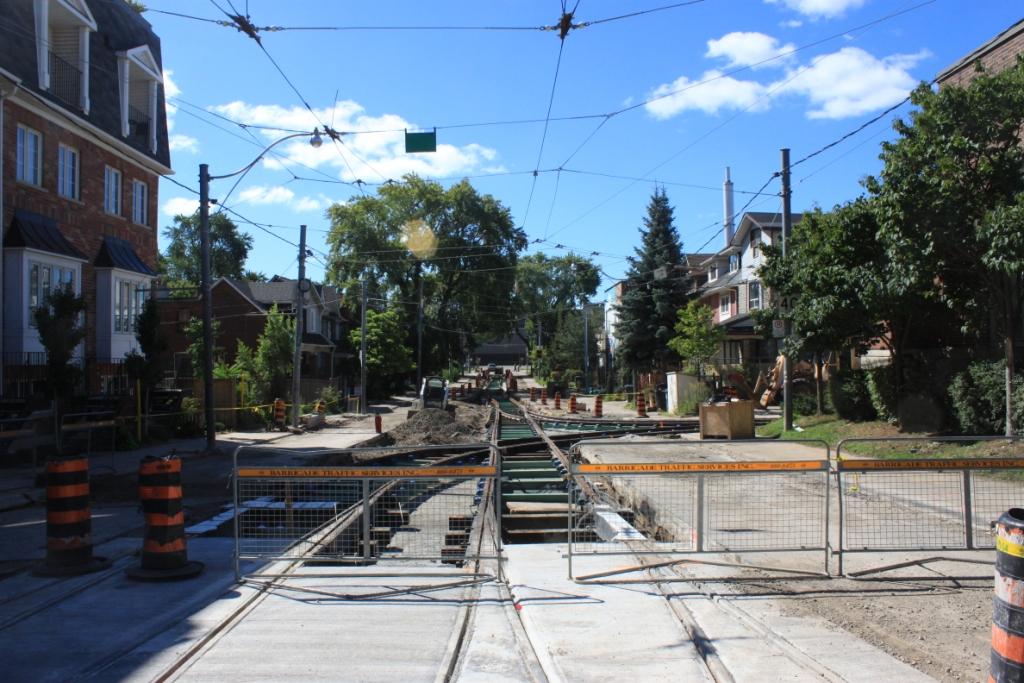
Looking north on Connaught from the point where the north and southbound tracks used to join. The jig bolted around the track in the foreground is used to hold rails in position for welding. Previously completed welds are visible further back, and these have not yet been smoothed off. This is an odd, short section of track where, unlike the main tangent track on Queen itself, much of the rail is not pre-welded in strings.
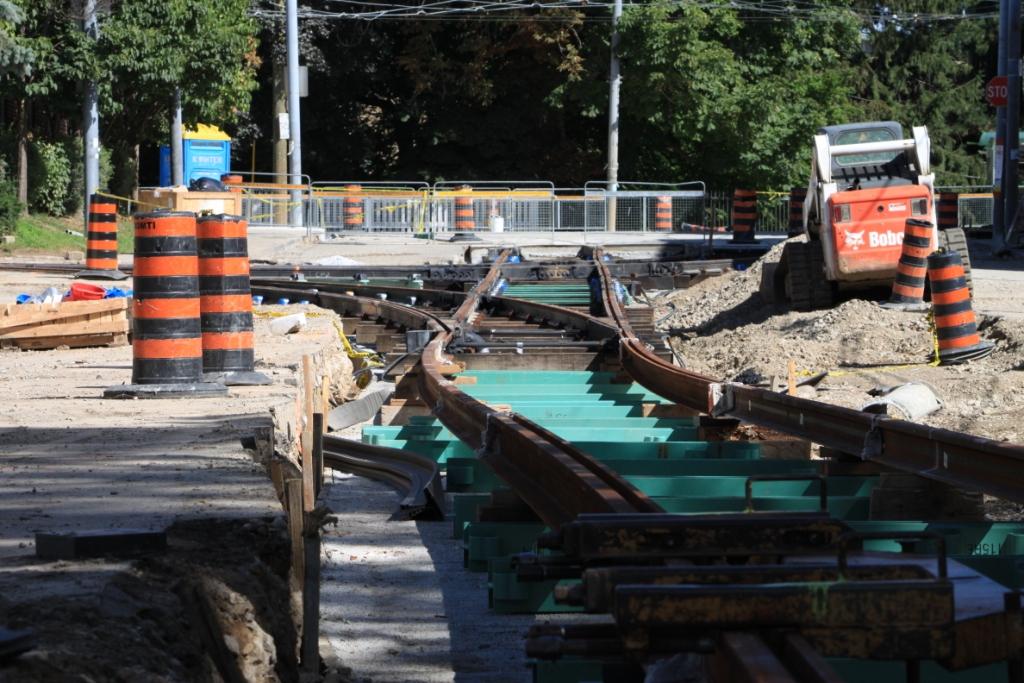
Looking north on Connaught.
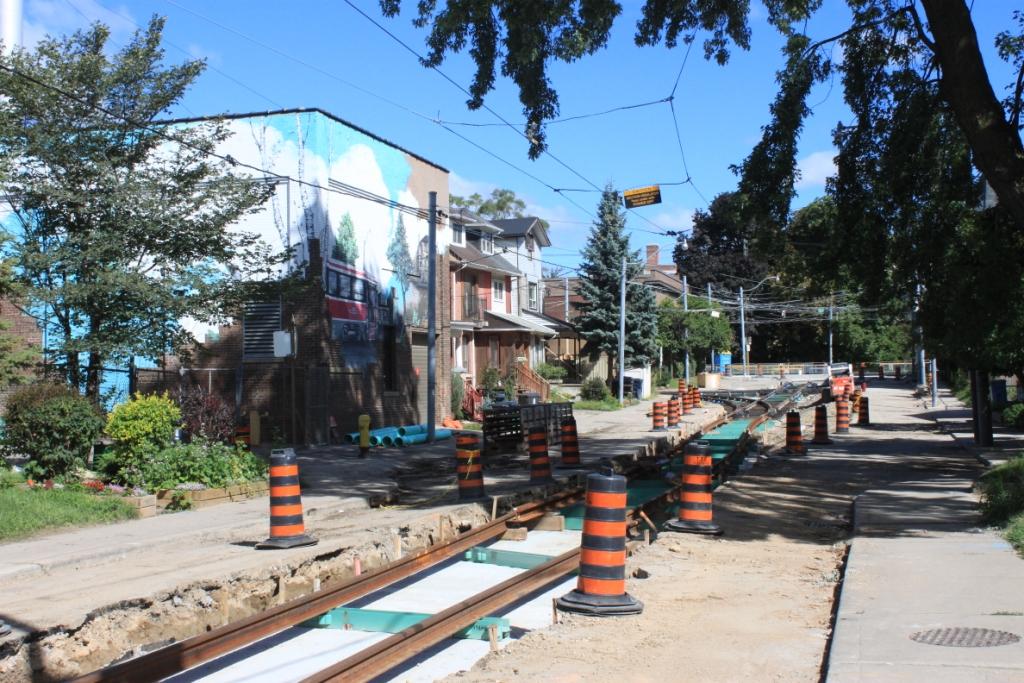
Looking south on Connaught where the single track passes between houses on this narrow side-street where, normally, parking is allowed.
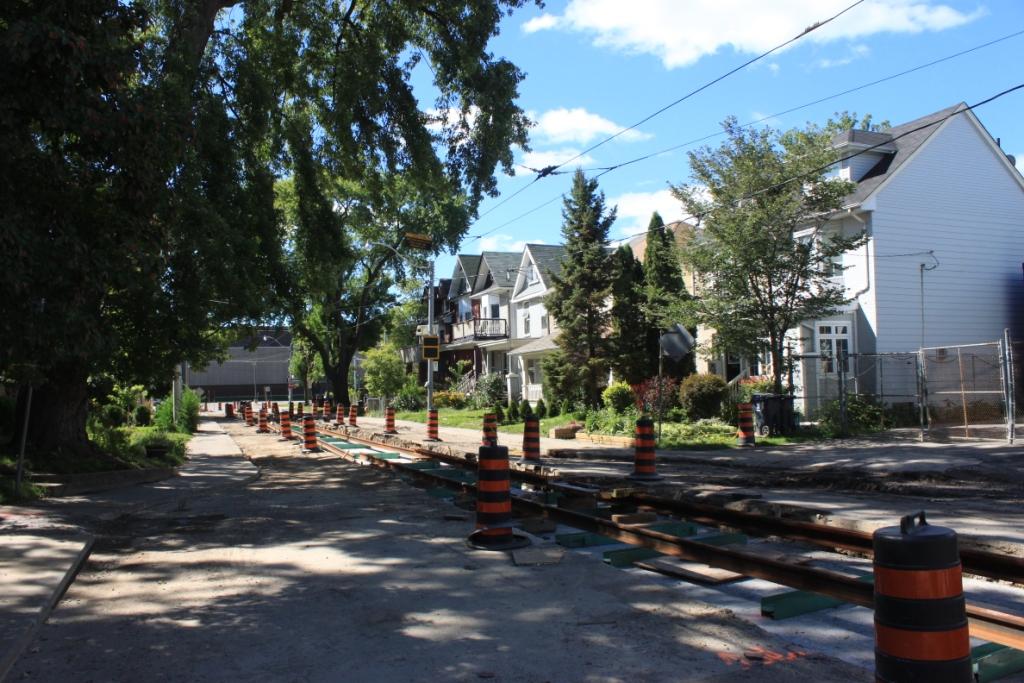
Looking north on Connaught from Eastern. Behind me is the curve onto Eastern which, together with the ladder track and approaches to the carhouse and yard, will be rebuilt next year. At that point, the streetcar lane will become a reserved area and Eastern Avenue will be narrowed to include one traffic lane and a sidewalk beside the new ladder track.
The next major work at Russell Carhouse will be the replacement of the special work at the west gate (east of Greenwood). This is scheduled for September. During that work, all carhouse access will switch to the east side via Connaught and the recently completed new track east to Coxwell.
Updated Wednesday, August 1
Track installation and paving is mostly complete in the block from Kent Road west to Connaught Avenue, and work is concentrating on the east gate of Russell Carhouse.
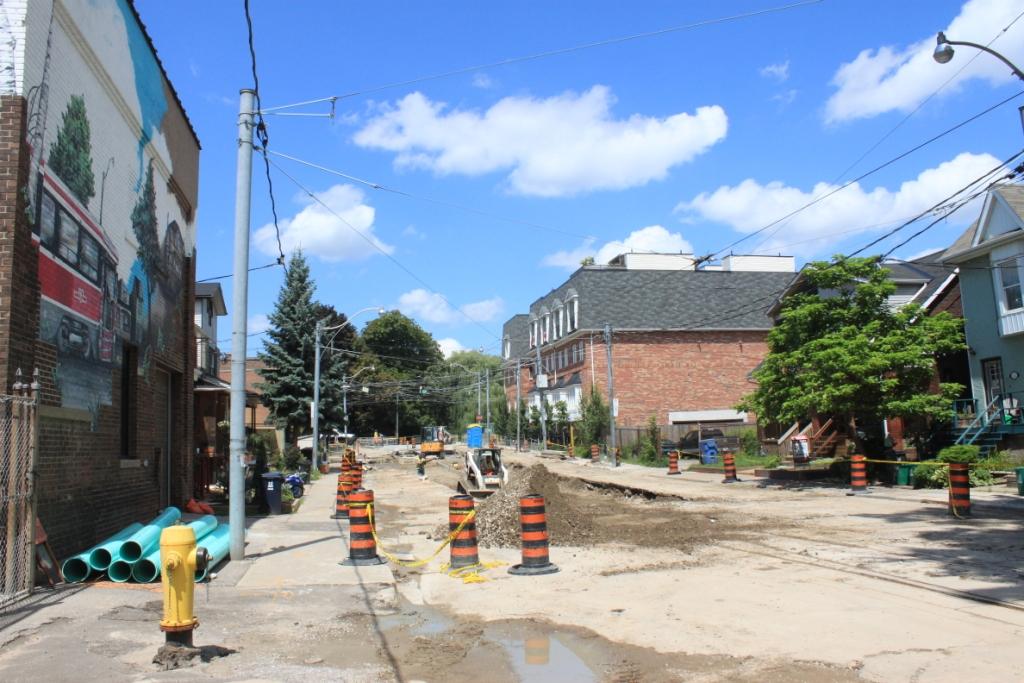
Looking north on Connaught. The painted wall on the left of the photo is the east wall of Russell Carhouse.
Looking west through the eastern gate of Russell. The track panel for the trailing switch that will link the track from the trailer yard with the ladder from the carhouse is sitting on a float in the background ready to be installed.
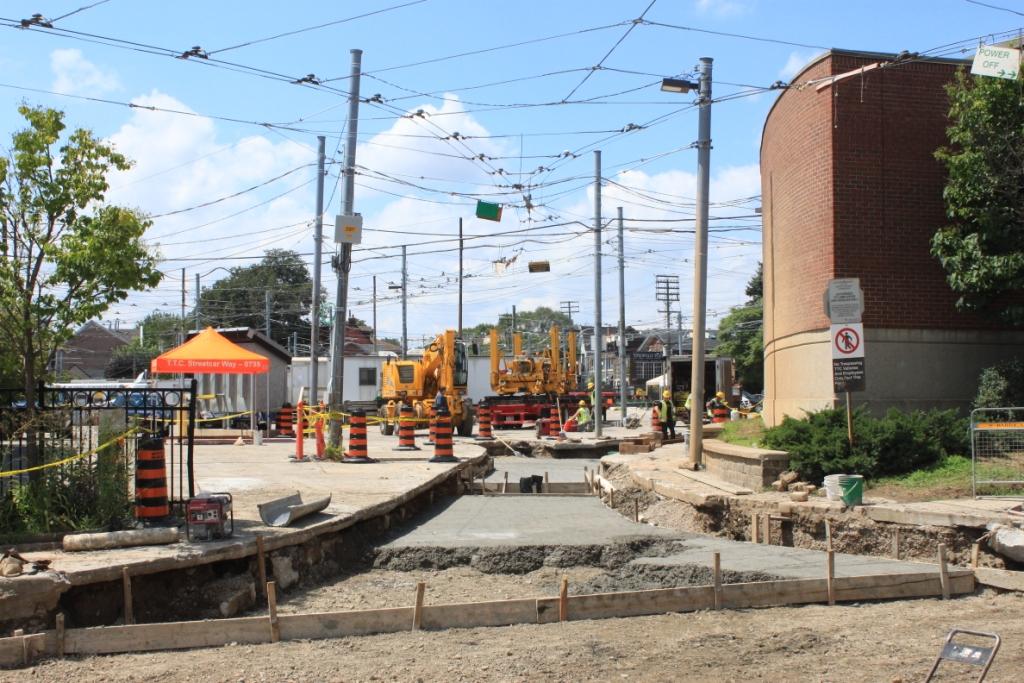
Looking east from the trailer yard toward the east gate.
Updated Wednesday, July 25
The TTC has issued a notice about streetcars queuing eastbound to Russell Carhouse starting Monday, July 30. Because the Connaught Avenue trackage will be under construction, all cars returning to the carhouse must be backed onto their tracks and this will create a queue of streetcars waiting to get into the yard.
The original start date for the Connaught Avenue work appears to have been pushed back from July 26 (tomorrow) when 501 Queen cars would still be attempting to operate to Russell Carhouse until next week when they will all divert via Gerrard.
Meanwhile, the TTC’s diversion notice states that the Gerrard diversion will operate until October 2 when the track project on Queen will be complete. 503 Kingston Road service will also resume at that time, but the 502 Downtowner route will remain as a bus shuttle until mid November due to ongoing water main and track work at McCaul Loop.
Updated Saturday, July 21
By mid-afternoon, most of the intersection of Queen and Connaught was assembled on street. This view looks east on Queen across the newly installed special work.
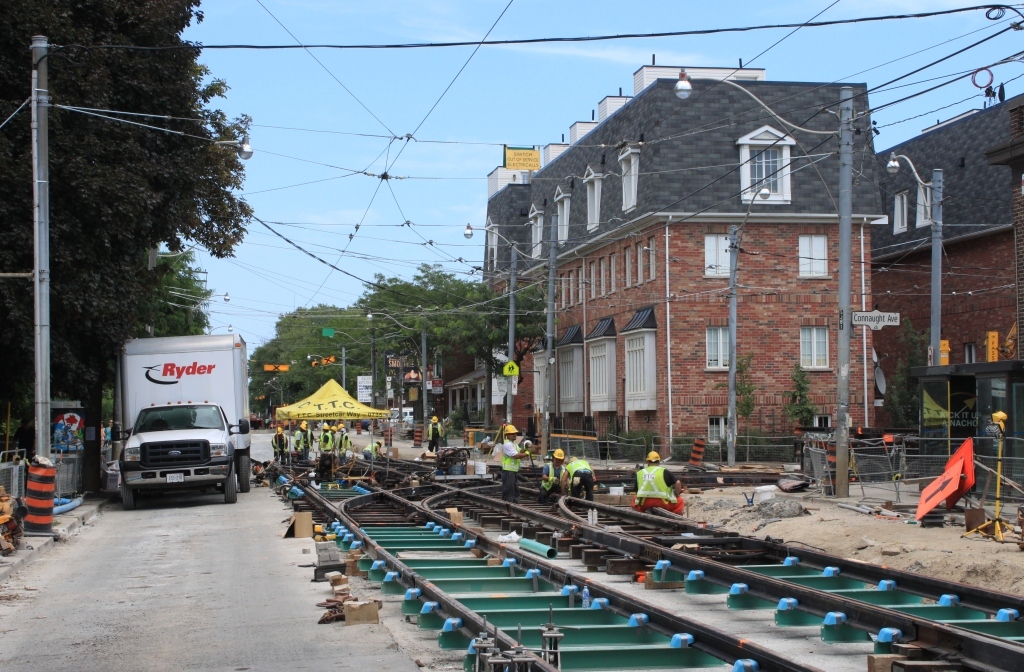
Looking south on Connaught from Queen.
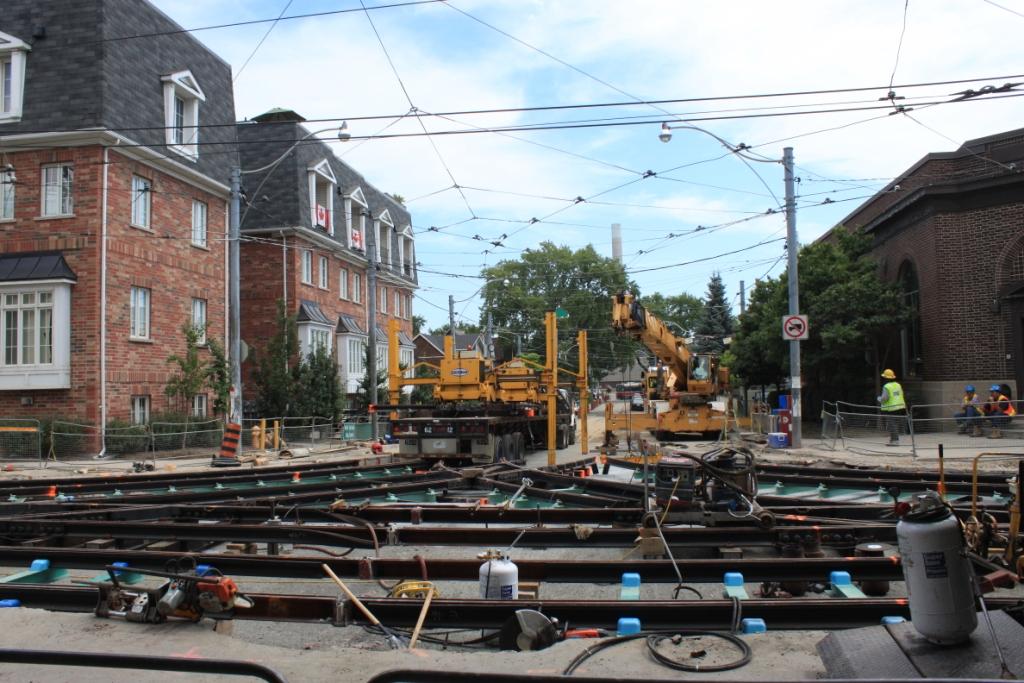
Looking west on Queen toward Connaught.
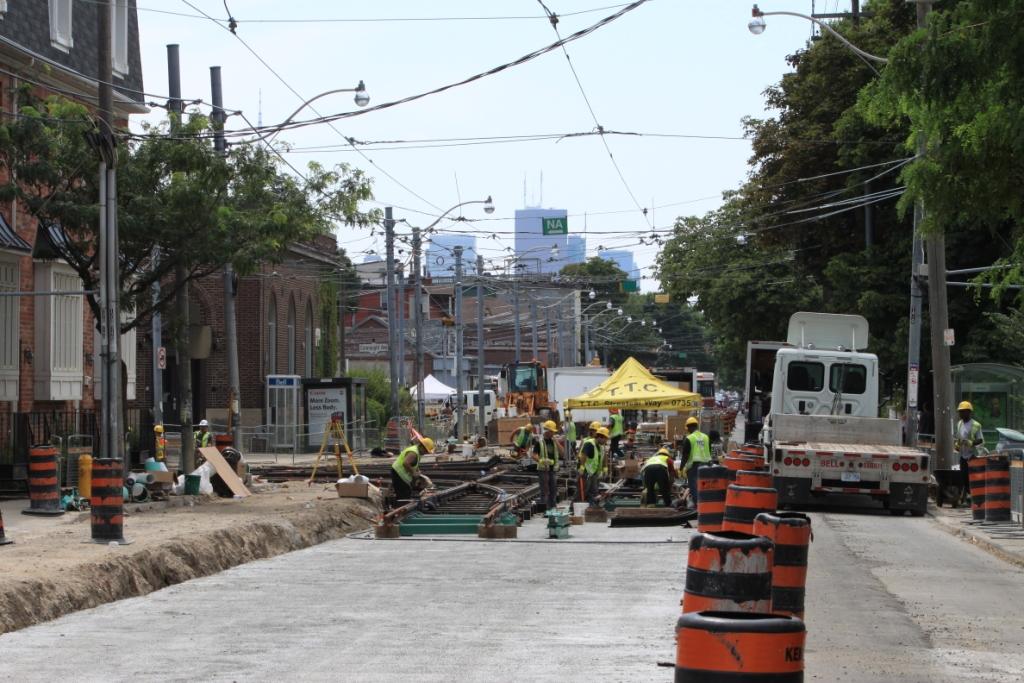
Updated Friday, July 20
The foundation concrete is in place from Kent Road to west of Connaught, and excavation of Connaught south from Queen to the east gate is in progress. Track panels for the replacement intersection are spotted along Queen Street and Eastern Avenue.
The view below looks west across the intersection from roughly the same viewpoint as the photo in the July 12 update. The new slab is in place up to the point where work left off with the eastern exit from the Trailer Yard.
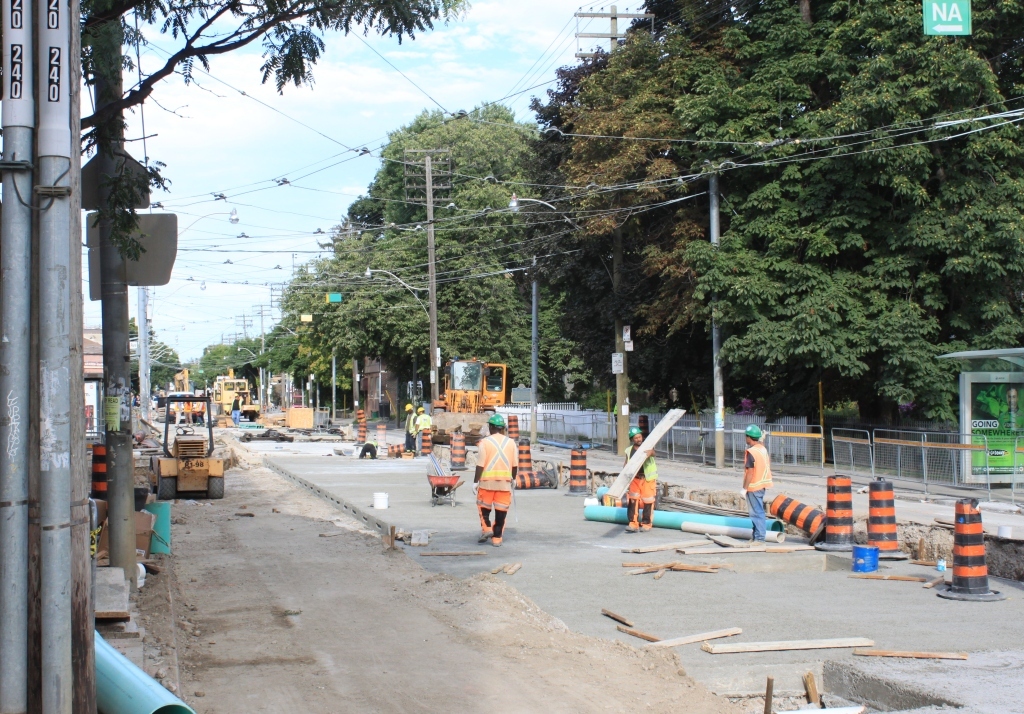
Looking east across the intersection. The new slab extends to Kent Road where previous work westward from Coxwell left off.
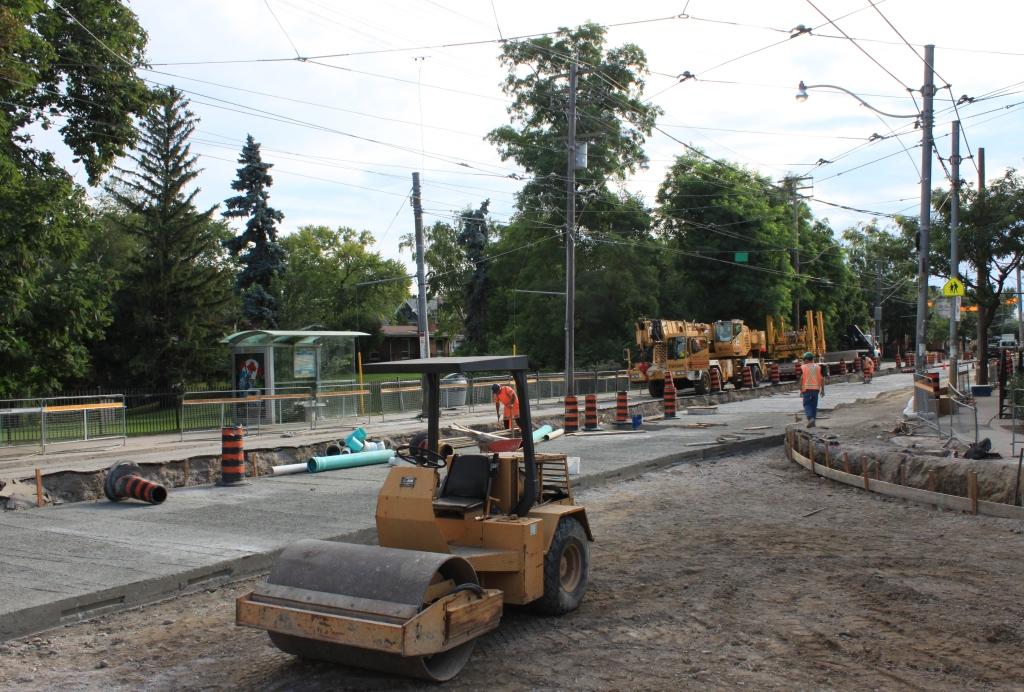
Looking north on Connaught to Queen. This shows the point where the double track on Connaught merges to single track. The northbound rail beyond the switch up to the yard exit will be removed when this section is rebuilt in the next phase of work. During that period, access to the yard and carhouse will be handled by reversing cars from the ladder tracks in the north end of the yard.
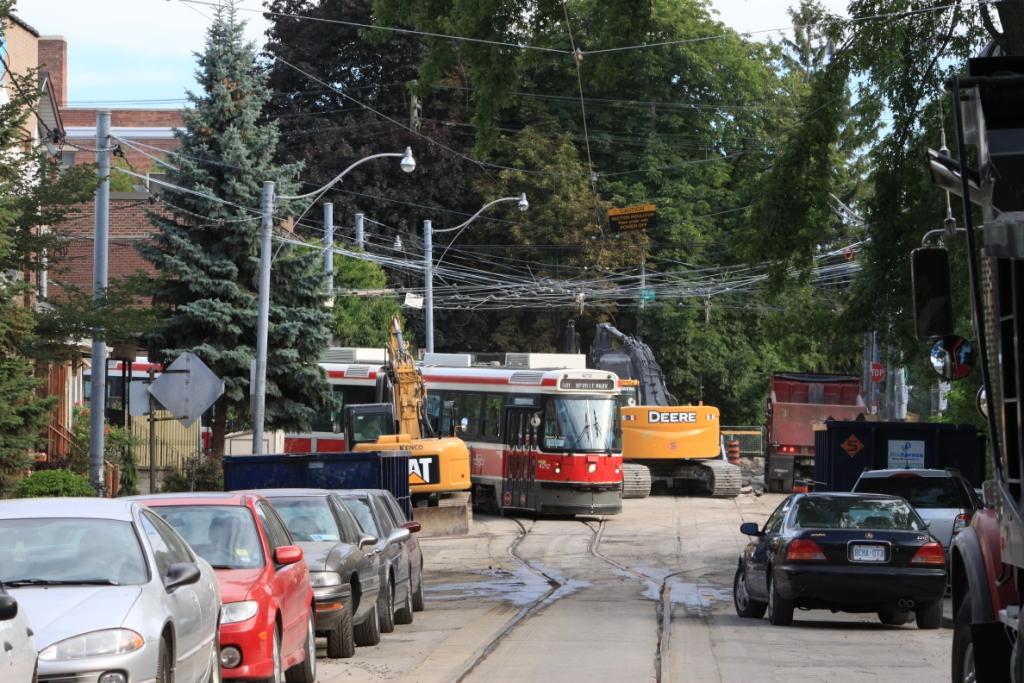
Updated Thursday, July 12
The construction notice for the next phase of work on Queen East has been posted on the City’s website.
Work begins today west from Kent Road toward Connaught to finish off the link east to Coxwell from Russell Carhouse.
The intersection of Queen & Connaught will be rebuilt starting on July 19. Track here was already partly removed for work by Toronto Water.
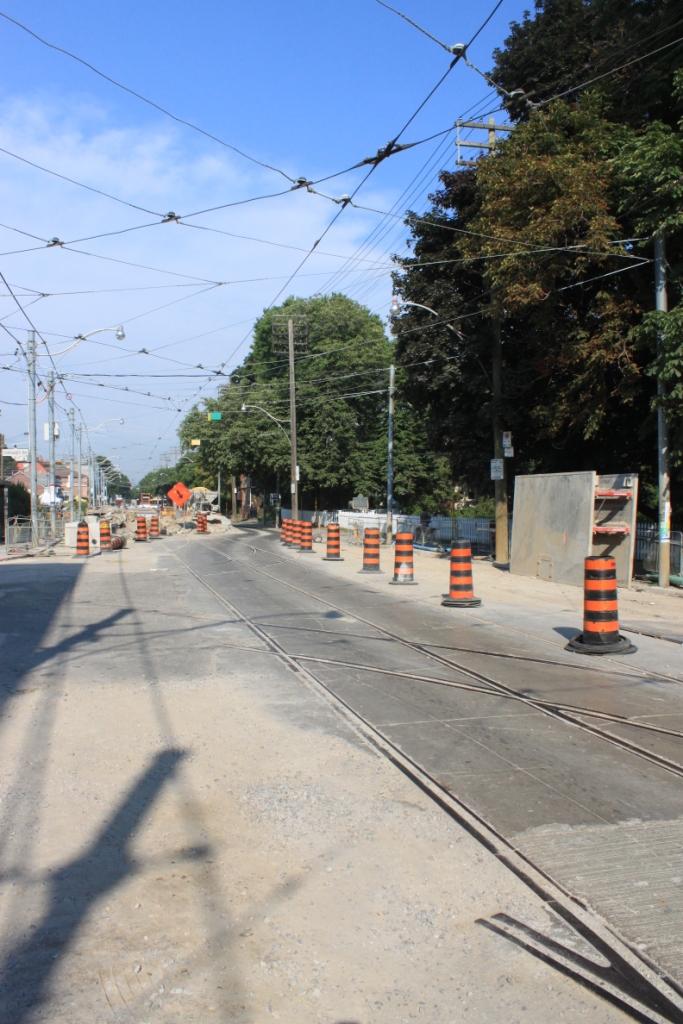
Over two weeks have been reserved for this work although it is considerably simpler than the full intersection replacement at Spadina & Queen.
Replacement of the east exit from the yard onto Connaught is scheduled for July 26 to August 3. Operations at the yard will be constrained while access to the runaround track is suspended. When I have further information about arrangements for this period, I will update this article.
When Connaught Avenue has been rebuilt, the last remaining on-street crossover will be removed from the system, and it will no longer be possible to reverse cars so that they face south in Russell Yard.
Work on reconstruction of the Eastern Avenue ladder track has not yet been scheduled. This will include raising the level of the track to reduce the grade on the curves into the south end of Russell Carhouse.
Updated Wednesday, June 20
Construction of track is now in progress west from Coxwell. In the view below (June 15), the foundation is being laid down from Coxwell to Ashdale. (The streetcar in the distance which appears to be in the curb lane is a Carlton car short-turning at Coxwell-Queen Loop.)
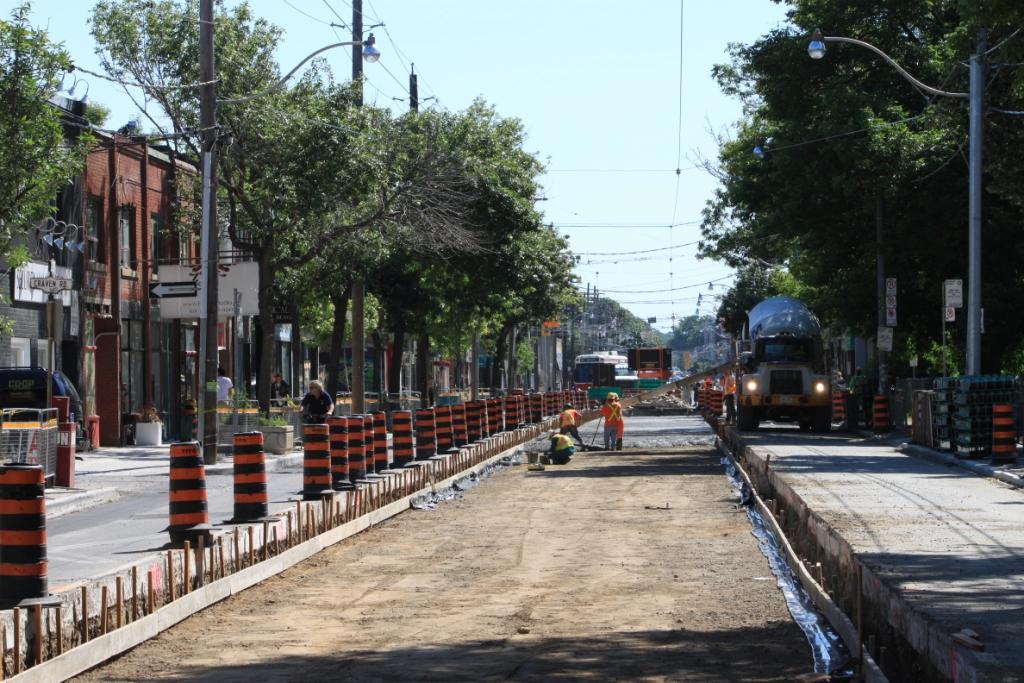
Five days later, June 20, the track is in place.
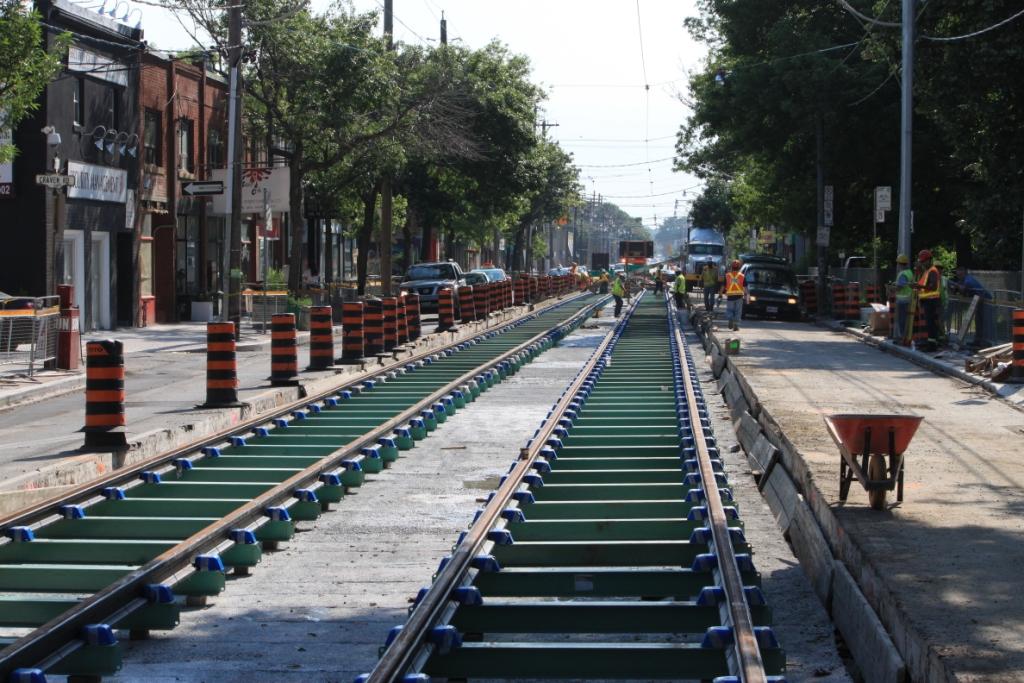
Looking west from the same point shows the track assembly in progress from Ashdale west to Woodfield.
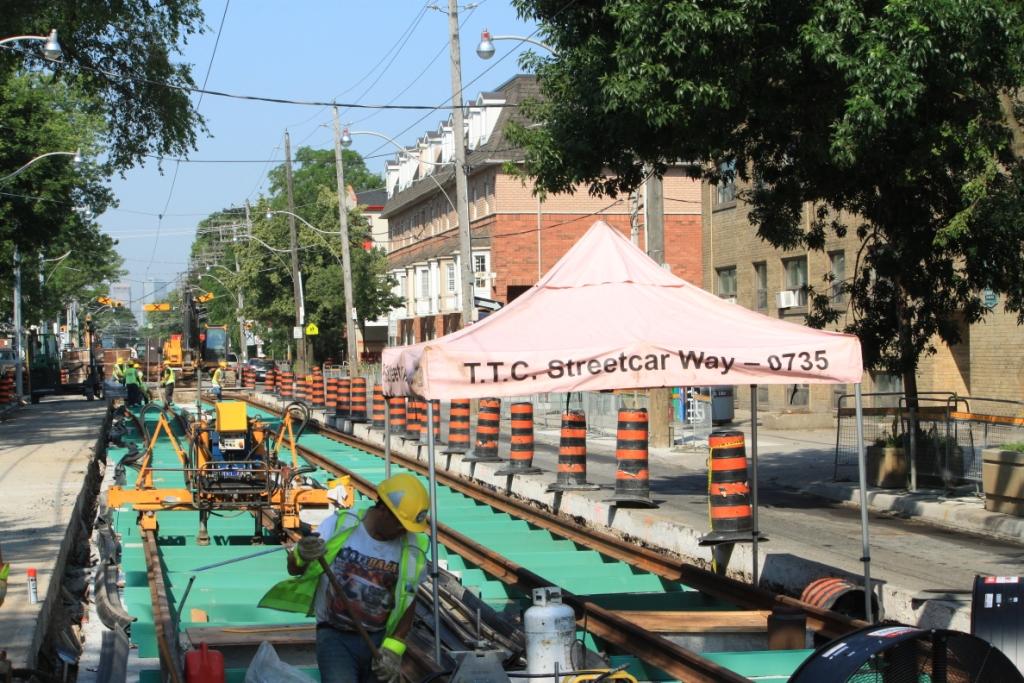
The bits and pieces await assembly.
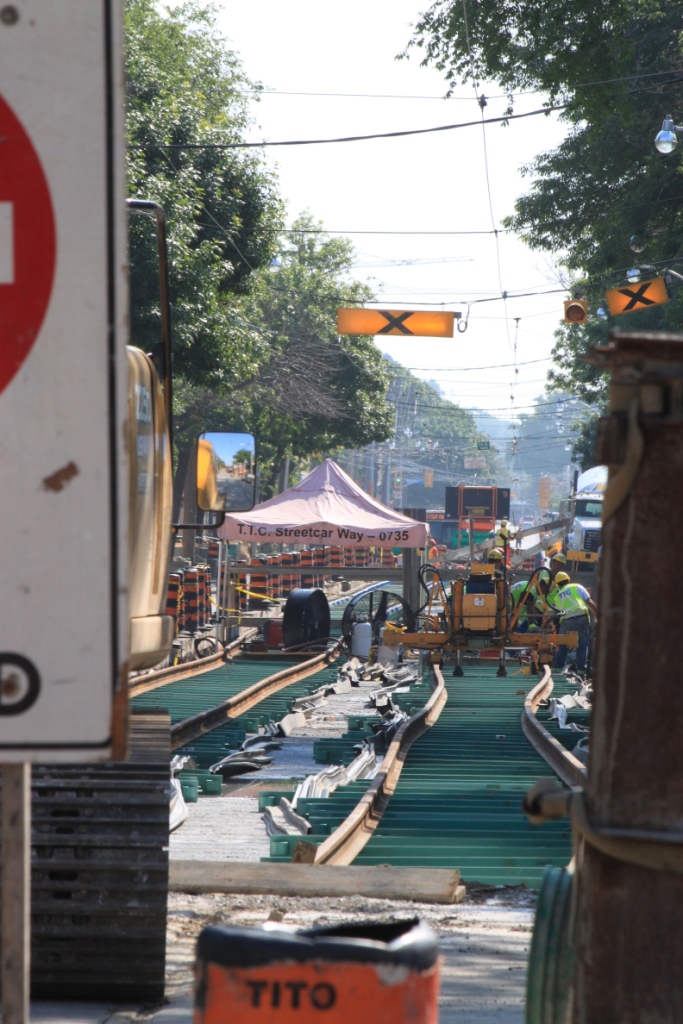
Schedule changes planned for the end of July (to be reported in detail in a separate article) will see carhouse access revert to the east side of Russell while the track at the west gate is rebuilt. Streetcars will operate through to Neville with a diversion via Broadview, Gerrard and Coxwell.
Updated Friday, June 8
Track excavation has begun westward from Coxwell. At Connaught, part of the intersection has been removed for water main construction across the south side of the intersection.
Updated Friday, June 1
Local watermain work is underway on Connaught Avenue and will continue on Queen east of Connaught. This needs to finish before the larger work of track replacement can get underway.
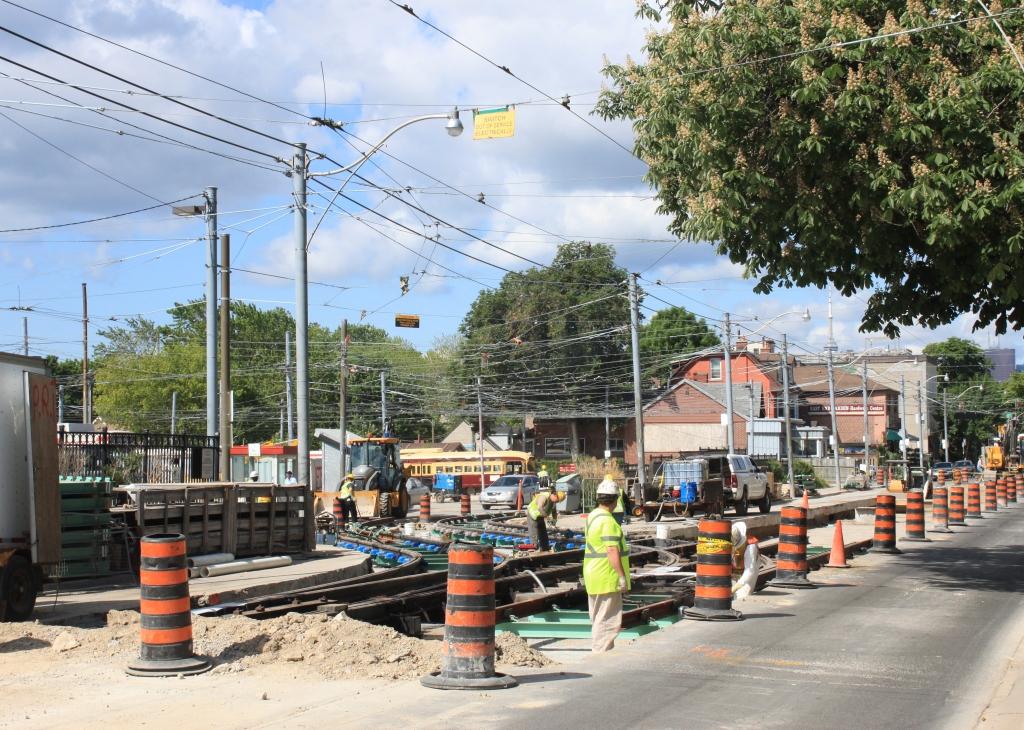
The special work installation at the eastern entrance to Russell Trailer Yard is underway as seen in this photo from May 31.
Updated Friday, May 25
New sidewalk construction is almost complete from Woodfield Road east to Coxwell on the south side of Queen. Little else seems to be happening in this area probably because work is concentrated in front of the carhouse.
From west of Connaught to Vancouver (a small, dead-end street near the west gate of Russell Yard) Queen is excavated for track replacement. This will include the special work at the east gate to the “trailer yard” (so called because streetcars once picked up their trailers by pulling into the north end of the yard) and the tangent rails up to but not including the west gate. The work has not yet progressed to the point of pouring the concrete base slab, let alone any track installation.
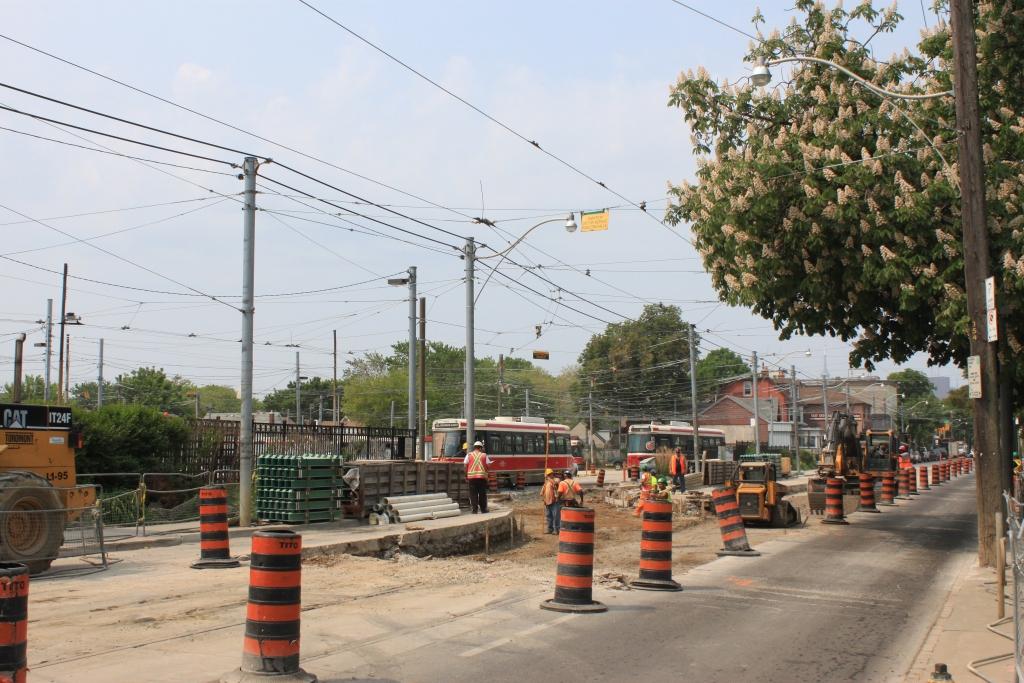
Looking west on Queen at the east gate of Russell’s “trailer yard”.
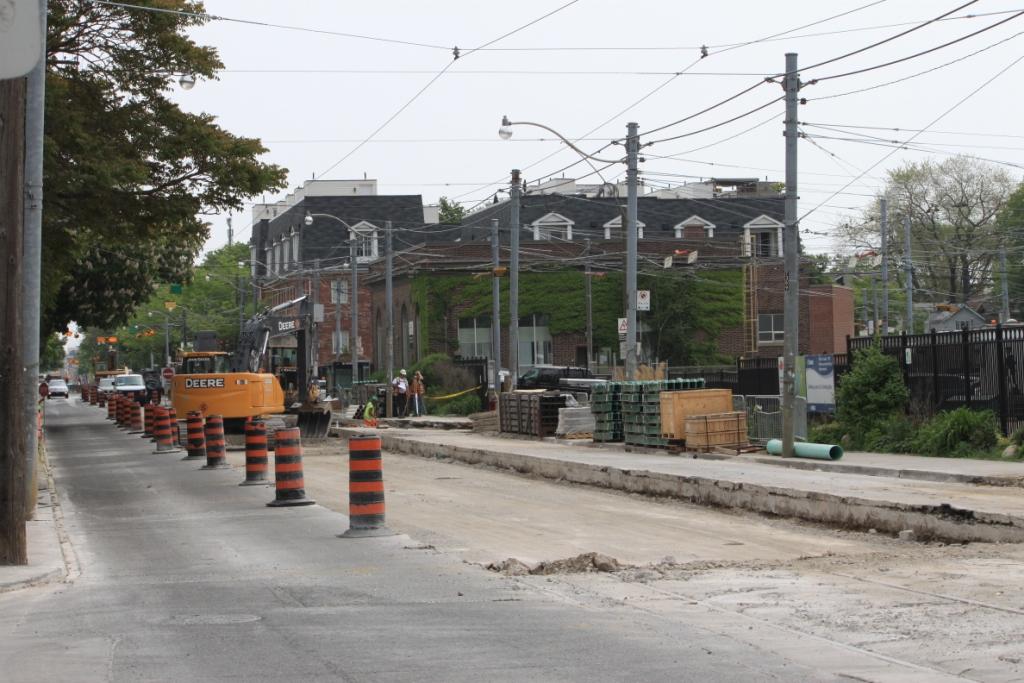
Looking west from the foot of Vancouver Street. This portion of the excavation is ready to receive its base slab.
Queen remains open for through traffic westbound from Coxwell to Greenwood. Eastbound, the street is closed at Greenwood except to local traffic (this allows the gardening store west of the carhouse to stay open during a very busy season). Many motorists erroneously drive east only to discover that they have to make a U turn (or some other creative manoeuvre) to go back west.
The Phase 2 Construction Notice gives more details of the planned schedule for upcoming work.
Updated Friday, May 18
The closure east of Greenwood beginning after the Victoria Day weekend will allow replacement of the tangent rail on Queen between the two north entrances of Russell Yard. Replacement of the special work will follow at a later date.
The track replacement will generally move west to east following behind the watermain, road and sidewalk repairs.
Updated Tuesday, May 15
The eastbound traffic diversion will remain at Connaught until May 21 when the road closure will shift west to Greenwood. A one-week closure of the Queen/Connaught intersection is planned.
Monday, May 14 observations
New sidewalk construction is underway on the south side east from Woodfield and has progressed almost one block to Woodward. Sidewalks in this stretch are generally in bad shape from past years’ construction projects.
The track from west of Connaught to west of Coxwell has been cut into sections in the roadway to simplify digging up the trackbed.
The rate of work does not appear to give any sense of urgency.
Some riders report that buses signed “Parliament” are actually kicking off passengers westbound at Broadview. Many Queen cars are short-turning at Broadview making the overlap between services less than originally planned. A Queen car that short turns does not serve the westbound stop where buses drop their passengers.
Tuesday, May 8 observations
Overhead power cut from the east gate of the “trailer yard” at Russell to just west of Coxwell. Cars can access the carhouse only by running through the yard from the northwest entrance and then turning south on Connaught.
Congestion may occur on Connaught when there are many streetcars as well as diverting road traffic using Connaught to reach (and turn left at) Eastern Avenue.
Streetcar and bus service is erratic. Buses are looping west via Parliament rather than via River as originally planned because Carroll Street, originally conceived as the southbound leg of the loop, has been closed for one block for a new park. This was approved by Council some time ago.
 Steve Munro
Have you taken some time to deal with the diversion & shuttles being operated from the beach(es) to downtown?
I have never seen such a disastrous attempt at trying to move people around.
Buses say Broadview – however drive all the way to Parliament to loop – and don’t let you ride along…and the closest Queen car..is usually trapped somewhere at Greenwood still.
Combined with the fact that some buses have been going out of service at Jones when coming west and the fact that there are now too many people at B-view trying to transfer…the commute is brutal!
Any reason why they won’t or can’t extend the shuttle closer to the core – like the 301 shuttle?
Steve: I am planning to start an article about this project and the massive cock-up of managing the alternate service. Last week, I saw a big lineup of streetcars and autos southbound on Connaught because the same street is used for the streetcar loop and the traffic diversion. Then some idiot parked foul of the exit from Russell Carhouse onto Connaught and everything stopped. Did they get towed? Did the TTC simply pick up their car and move it? No. Everyone waited for a parking officer who arrived just in time for the owner to show up and drive off with no ticket.
When I think of the places we waste money on paid duty officers at construction sites, I am amazed that nobody was directing traffic at this one.
As for the buses, yes that Parliament destination is annoying. Originally they were going to loop via River and Carroll until someone noticed that Carroll Street does not exist as a continuous road from Dundas to Queen any more. Of course by then, the schedules were already made up based on the shorter route.
LikeLike
On the topic of the Queen diversions and replacement buses, I received the following last week in Councillor McMahon’s e-mail newsletter:
The online schedules show the shuttle bus trips at eastbound stops, and westbound for the 301 service (but not for 501?). From this it appears that there’s an attempt (or an intent) to schedule trips at less busy (lower headway) times so that an eastbound shuttle bus arrives two to four minutes after a streetcar, and vice versa westbound. I wonder how successful this actually is in practice.
There seems like a lot of duplication of service between Broadview and Russell. Could they not run the replacement buses via Queen, Coxwell, Dundas, Greenwood, Queen and Leslie, with a loop via Eastern and Mosely? (502s would use Dundas as the connection to Kingston Road and avoid dipping down to Queen.) Use some of the duplicate resources instead by having extended layovers on Mosely (and, for streetcar operators, in Russell) so that there is always a shuttle bus ready to dispatch whenever an eastbound streetcar is approaching (and vice versa for westbound buses connecting to streetcars). Let the supervisors monitor on NextBus or TransSee so that they know when to dispatch in order to make the transfer as short and painless as possible.
Steve: I have noticed that the information given out by operators varies considerably from car to car, and riders are confused by the fact that the streetcar goes to Greenwood, but Leslie is the last stop to make a transfer connection.
Sending the buses over to Broadview gives a reasonable guarantee that the two services will actually meet given that the Queen cars short turn a lot. If the buses only operated as you suggest, then they would not connect with any of the streetcars turning at Broadview.
Regarding the memo above, I don’t understand how routing 501 cars to loop via Broadview, Dundas and Parliament can address the “502 issues”. The complaint is about the level of service and connections for the replacement 502 (and 503) bus/streetcar. If the 501 “Parliament” cars wait and make a guaranteed connection with westbound buses, this would help. However, as another comment has noted, some bus operators are offloading westbound at Broadview, and this completely misses any connection with a westbound 501 car.
I get the impression that there is a lot of ad hoc line management going on, and much depends on who is running the show (if anyone) on any particular day.
LikeLike
One would think that basic street information like “this street is going to close permanently as of …” would be handed to somebody at the TTC.
All those high paid engineers and none of them knows how to communicate … it’s like watching RIM, only with trains.
Steve: To be fair to the engineers, I suspect the original plan was made by someone at a much lower level. However in the interest of full disclosure, I must reveal that a significant person in my life is an engineer (who does not work for the TTC or any other transport-related entity), and so I may be biased.
LikeLike
Why don’t they just run a bus from the Beaches to downtown, using Lake Shore E, Woodbine and Queen? This ought to be made permanent, because this is almost always much faster than the slow and horribly unreliable Queen streetcar. Even with some intermediate stops on Lake Shore, the bus could probably get from downtown to the Beaches in 15-20 minutes depending on traffic.
LikeLike
Point taken Steve … my Dad was an engineer.
I’m more likely biased because I went to Waterloo and saw first hand the attitude that has permeated both RIM and the TTC.
We do great and important work.
People will love what we do because it is great and important work.
Our great and important work speaks for itself.
You question something of ours? Do you do what we do? No? Well of course! We do great and important work. Unless you do what we do, you can not possibly understand.
To be fair, the TTC is getting better. But, sometimes … I just shake my head.
LikeLike
I walked my wife to Greenwood this morning because she hates using the buses. Also when the streetcars emerge out of the yard they are empty and there is a good chance for a seat. As I walked back, I waited at the yard to see how the streetcars get back out to Queen. Again it’s from the northwest corner by a circuitous route through the year. I waited a good fifteen minutes before not one but two ALRV came out together. Someone needs to think about scheduling!
LikeLike
Frankly this isn’t just limited to the engineers at this point, it permeates the TTC as an organization (though yes, engineers in general are sickeningly prone to it). If we could break this down it would in my view go a long way to at least making the TTC’s problems solvable.
LikeLike
What duplication of service? At least between Greenwood and Leslie (admittedly only 3 stops) the service has at least been halved if not worse. Tons of WB buses and streetcars flagged “Parliament” stream past but to go downtown that’s not a viable option as you’ll be kicked off and still have to wait for the streetcar. Better to stay put and wait…and wait…and wait for a streetcar from the Russell yards and head west: as mentioned at least you’ll get a seat. So far it seems to take a minimum 10 minutes from when the EB car enters the yard and its eventual return heading west.
LikeLike
Toronto Star Transportation reporter Tess Kalinowski writes of the service problem that TTC’s Chris Upfold says It’s too much work to be covered by overtime and too short a period to justify hiring more operators.
Great planning!
How many more drivers do they need? How about some recently retired TTC operators working for the duration of shortage? How about poaching a few drivers from MiWay? Or some other ATU property? These too could be volunteer overtime or part time for the shortage. Already a trained bus driver so minimal training would be needed. One day crash course ought to do it.
Steve: Well, if the local Councillor (and the Mayor, not mentioned in the article) had not asked for the Queen project to be deferred in 2011, there would not be so much trackwork all happening this summer requiring so many buses. One thing I have asked about, but not yet received a clear answer, is the timing of the replacement of the special work on Queen at Connaught and at the two yard entrances. Once Connaught is out of the way, cars can loop back without having to circle the yard and save a lot of time (not that they seem to be rushing to get out of the yard anyhow). Although Byford talks about more line management, I am waiting to see actual evidence that this is happening.
As for total buses in service, the AM peak count today is 1476. In the previous schedules, it was 1451.
LikeLike
Hi Steve:-
Just was down on Queen East (May 21) for supper and saw the pile of rail in front of the movie theatre east of Kingston Road.
Too, it appears that overhead renewal is in progress with much of the EB done and the WB hanging by rope.
Dennis
LikeLike
Having a quick look at the service changes for July Queen is going to get interesting. A Broadview/Gerrard/Diversion with some cars going from Wolseley Loop to Broadview Station. I can see a lot of interference with the King cars.
Steve: Yes. Broadview Station is often over-full with cars waiting for their departure time because they are early, particularly in the AM Peak.
LikeLike
With the track reconstruction at Connaught, will any steps be taken to reduce the squeal of turning streetcars? Many other turning areas have running water in the track (I presume to help with noise).
Steve: The TTC now uses wheel greasers for this sort of problem, but the effect is the same (however this works better than water in the winter). The challenge may be the number of curves. I will inquire about this.
LikeLike
It seems that 501 cars will not be diverting via Gerrard to reach Neville Park, unlike last year. Why is that?
Steve: Takes too long. The service gets really strung out and much of it never gets to Neville. At least with a dedicated east end service (provided it is properly managed) people east of Coxwell see a transit vehicle now and then.
LikeLike
They do run this type of service. 143 Downtown/Beach Express. Despite the extra fare it has pretty good ridership. Every time I’ve seen or rode one it has had a standing load.
LikeLike
I remember that there was a time that the streetcars continued to run through track construction. At a slow crawling rate, but still they ran. Sometimes even putting in temporary track to bypass a critical work zone. We can still find photographs of PCC or Peter Witt streetcar with the tracks under construction. Not so with the CLRVs or ALRVs. Are they too delicate or too heavy?
Of course, that was before “roads are for cars” became the rule instead of a guideline.
Steve: The reason for the change is that now that the roads are built of concrete, they have to cure properly after the concrete pour. Running service through the construction site works against this. Also, as you can see from the photos, this reconstruction involves the complete replacement of the roadbed, not simply scraping out the top level and installing new tracks. That kind of work requires a multi-week street closing.
LikeLike
Steve, I just read through this post and the various comments. Raymond Kennedy raises the question of bring in outside drivers. I offer two responses to his question:
1) There is still the question of lack of equipment. At the moment, the bus divisions are barely able to meet service. There is a growing number of older Orion VII buses out of service due to major repairs being required for such things as blown engines,etc. The TTC had deferred an engine rebuilt program due to the budget cuts.
2)
a) Once you have signed your retirement papers with TTC, you cannot return to do work (double-dipping). This is part of the agreement between TTC and ATU113 under the pension rules.
b) Outside workers doing this work would be an extreme violation of the CBA (non bargaining unit workers performing bargaining unit work). You could be sure that this would result in job action by ATU113 (although there would be no strike because of Bill 150; a work to rule is still legal), as well as a major grievance filed under the ORLA against the TTC. Although our CBA is currently in arbitration, all of the terms and conditions of the expired CBA remain in effect until the arbitrator makes his ruling. The TTC does not employ part timers (this was one of the main reasons for the 1989 41 day work to rule campaign), under a written agreement with ATU113.
Steve: An important part of the budget constraints, not just in the past “Ford” years but for a long time before, is that the TTC was always very tight with information about the actual effect of budget cuts on the system’s ability to respond to unexpected situations (or even a reasonable estimate of growth). What some people regard as “fat” in the organization is the very thing it needs to be able to respond to service needs on short notice. Just hiring drivers isn’t enough, even presuming that this did not trigger labour relations issues — if you don’t have the vehicles, and you don’t have the budget headroom to run the fleet you have as much as you could, then just having more drivers won’t solve the problem.
LikeLike
@Gord Regards my suggestions re: drivers (operators). It was stated by the TTC in regards service shortcomings that the work was “too much to be covered by overtime and too short to allow for hiring more operators”. Nothing was said about shortage of buses.
I took this to mean one of two things: Either it would be too costly to pay out that much overtime or there simply were not enough operators available to work said overtime. It is for the latter reason I suggest using recently retired operators (who would still be considered qualified) or bringing in experienced drivers for other transit systems represented by ATU.
This is a situation where the ATU Local 113 needs to show some leadership in finding a quick solution to an expected situation. There is no reason the Local could not quickly approve a short term temporary modification of the Collective Agreement. If the members declined to vote in favour of this that would be their prerogative. Failure to even attempt to find a way to do this will only further harm their public image.
LikeLike
@Raymond Kennedy. With regard to your last comment re: ATU113 needing to show leadership in this situation. At great risk of turning this topic thread into a pro- union/anti-union discussion (note to Steve: I will not be offended if you chose not to publish my comment), I will respond to Raymond.
There really is no such thing as “a short term temporary modification of the collective agreement”. Our CBA is currently in arbitration because the Commission wants to modify the language to allow the Commission to contract out thousands of positions currently held by full-time unionized employees (and thus eliminate their wages and benefits). What you are proposing is actually a form of contracting out. As a full time unionized employee, I would not support this at all. This is a situation of “once the door is opened a crack, it cannot be closed, but rather will continue to open”. You have realize that your proposal goes against the interest of the MEMBERS of the union local. If contracting out starts with the 501 Replacement Bus, where will it end? Does this open the door for the TTC to hire part time workers to cover the extra vehicles on the road during rush hours (one of the primary reasons for the 1989 41 day work to rule)? ATU113 is showing leadership: protecting its membership from job loss due to contracting out. The fact that our CBA is currently in arbitration due to the fact that the Commission wanted to “gut” it of our benefits, and our job security clauses in a bad faith bargaining manner gives me and my fellow union brothers and sisters all the incentive to oppose your proposal.
I also hope that you understand that bringing back recent retirees is a non starter due to the pension rules and bylaws. This would cause a great outcry about “double-dipping” like it has with retired teachers coming back to work as substitute teachers.
Steve: My understanding of the situation is that it is a shortage of vehicles, not operators, that is responsible for this situation, notwithstanding statements made by the TTC.
For the March board period, the maximum AM peak count was 1461 according to the scheduled service summary. For May, the number was 1476. It will drop to 1387 in mid-June, at which point there should be lots of free vehicles to devote to various upcoming shuttles including Harbourfront and Spadina.
For the system as a whole, there are about 1,520 buses with all garages full. In practice, the fleet is somewhat larger because of new buses coming into service before the ones they replace being retired, but overall there’s not a lot of headroom for additional bus service unless old buses are pressed into service. How the TTC plans to handle service increases for higher demand I do not know, but this shows how the folly of penny=pinching on the capital budget can have long-term effects. A related problem with fleet planning is that if the LRT lines had opened when they were originally scheduled to, bus requirements would have dropped because major lines would have converted to LRT.
LikeLike
I’m really surprised over the lack of discussion about the need for a new bus garage. That discussion should have come around a year ago. With the AFP-associated delays to LRT implementation, the problem is exacerbated in the short term.
A new bus garage built originally for TTC somewhere near Steeles (north or south of) for short-term needs could be put in place for the near-term and then, after the LRT lines are in operation and bus resource requirements fall, the facility and vehicles could be sold to York Region Transit (possibly shared with Züm?) as those systems grow and expand. This kind of resource management is the kind of thing Metrolinx could be the facilitator for enabling, since they facilitated bulk bus purchasing a while back to lower unit costs of various municipalities’ bus orders.
Steve: The service cuts on the TTC supposedly made the larger fleet unnecessary, and therefore reduced the planned increase in the fleet and provision to store and maintain it. This was all part of the hall of mirrors budgeting we went through when Ford’s cronies were calling the shots. It will be interesting to see if Stintz and Byford push for more honesty in the 2013 budget, or if we will continue to pretend that we don’t have to spend more money. As for post LRT openings, if the growth continues at 3% compounded in the peak, by the time most of the lines are open, a new bus garage will be soaked up on the TTC never mind YRT. TTC has consistently used a rate of 1-1.5% in its projections, and it has almost always been low. However, it makes the future budgets and subsidy requirements look better for Council.
LikeLike
How many buses would be freed up if TTC was to give notice of termination of their contracted routes with YRT?
Steve:
Looking through the service summary info, about two dozen buses are dedicated to am peak service north of Steeles Avenue. If these were “repatriated” to service inside the 416, the TTC would lose the revenue from the contracted service, but would reclaim use of both the vehicles and the operators. There would be an offsetting cost to YRT who, I must assume, find their arrangement with the TTC preferable to buying buses and running their own service. There is an additional advantage with through service that a TTC bus can serve stops inside Toronto whereas a YRT bus could not, and this gives riders more choice in where they connect to the TTC/YRT routes. Yes, we can argue that this does not make sense in a regional system, but until we have a regional fare and service strategy, that’s how things are, and will be part of the historic background to these services.
LikeLike
I was just by the area on the weekend and have noticed they’ve installed eastbound track exiting the yard onto the street. I’ve also noticed that car’s seem to be ignoring the plethora of ‘road closed’ signs and are driving past greenwood to the blockage – causing a nightmare for the streetcars right where they need to turn into the yard.
LikeLike
Steve wrote,
This is probably the case, not just for operating costs, but also for capital costs of the fleet. To the best of my knowledge, there are only two cases of TTC contracted routes that YRT has taken over, both having to do with extending operation. I suspect this is because the cost that the TTC would charge may not have been so economical.
The first is not exactly a take-over, but originally a weekend addition. The Victoria North 224D route north of Steeles was introduced as a weekend service operated by YRT (Miller) as route 224B. YRT mostly reserves route number in the 200s for GO station shuttles, but this route used the number to be the same as the corresponding TTC contracted route. More recently, 224B operates weekdays on a 60-minute headway between 7 am and 9 pm to complement the 5:30 am to 7:30 pm service of TTC route 224D.
The other route was the replacement of TTC’s Don Mills 25D with YRT’s Lelsie 90B. When this was introduced, the route was extended close to a kilometre into the industrial park north of 16th Avenue. I suspect that the cost for the TTC to do this would have been to add one or two buses and that made it more economical for YRT to take over the route.
Steve wrote,
To clarify, a YRT bus can serve stops within Toronto with limitations. They are permitted to drop off passengers on inbound trips and permitted to only pick up passengers on outbound trips. There are a number of people who work near Leslie and Highway 7 and live near Don Mills between Steeles and Sheppard who make use of this. Unlike the Don Mills 25D, they get to commute for only the YRT fare and do not have to pay both the YRT and TTC fares.
Steve: In many cases, the YRT service fits into the regular headway of TTC services south of Steeles. If the bus cannot pick up TTC riders, then the TTC would have to provide its own service. Not very bright, but that’s how it works for now.
LikeLike
I walked past there this morning. I thought the new standard for trackage was to be on metal ties set in concrete, but some of the special work coming out of the yard is on wooden ties set into the concrete? Why is this?
Steve: Special work is still on wooden ties in many cases, but at least they’re treated so they don’t rot unlike some of the junk built 20 years ago.
LikeLike
I had thought the wooden ties helped absorb the additional vibrations generated by the special work and also that it was far more efficient and cost-effective than making up so many customized metal ones. The wood also allows tie-plate holes to be drilled on site where necessary when final adjustments are made to the rails and joints. Isn’t the TTC themselves responsible for making up all the specific wooden ties for these projects which they pre-assemble at Hillcrest, having ordered only the more complicated rail casting elements? Don’t they also use their own rail bending machine to create all the curved rails?
Steve: Some parts of special work installations, typically curved rails between the frogs and switches, use metal ties where the link between the rail and the tie is in a slot and can be adjusted for the geometry. As you note it would not be practical to make metal ties for the castings because of the need to tailor each one. Wood has its advantages in some cases. Yes, the TTC does its own rail bending.
LikeLike
It’s interesting to note that they will be returning to a Broadview, Gerrard, Coxwell>Neville (and reverse) routing in spite of the previous mention of headway management being the reason for the buses. I suspect that the true reason for the buses is the rewiring work which took place east of Coxwell, and that future obstructions to the route (Leslie street specialwork installation) will involve streetcars going ‘the long way’ to Neville, rather than the bus disaster.
On the subject of trackwork, has there been any more mention of reconstruction of the eastbound Adelaide track between Spadina and Church? It makes sense that they would have put it off for watermain reconstruction and for other building construction occupying the curb lanes, but once that is all clear, it would seem logical to restore it.
Steve: The Leslie Street intersection project is nowhere near ready to go this year. As for Adelaide, no I have heard no discussion about it, but do note that new overhead poles are going in west of York Street and there are survey markings for more.
LikeLike
The TTC needs more diversion track east of Broadview Avenue but you can bet on not seeing anything in our lifetimes. How quickly could a $15 million north-south connector between Queen and Gerrard be paid back in savings? Don’t ask the TTC, they probably wouldn’t know.
It’s really a shame that they couldn’t plan ahead well enough to put in the intersection now while that part of the line is under construction. I’m looking forward to another two week (or longer) disruption in the future when they finally do put the new tracks into place.
LikeLike
Jacob Louy says:
May 25, 2012 at 4:36 pm
Steve:
[later …]
It seems that they now can keep the service running or were they screwing it up even more with the dedicated bus service than with the previous street car diversions?
Steve: Probably the most important point is that the schedules going into effect at the end of July have considerably more running time than the regular ones.
Neville to Long Branch AM Peak:
March 2012 – 186; July/August 2012 – 210.
Neville to Humber:
March 2012 – 135; July/August 2012 – 158.
Some previous diversions were not for a full board period and attempted to make the trip with no allowance for additional running time. The addition of 24 minutes or so is rather generous considering how little extra mileage is involved. I will publish a detailed comparison of the service plans when I write up the July changes.
LikeLike
I wouldn’t read anything into the TTC replacing their poles. The TTC still owns poles in places where there hasn’t been streetcars (or trolley buses) for years, but they still own and maintain them.
Steve: Many of the old TTC poles have been transferred to Hydro’s ownership and some (e.g. Eglinton east of Yonge) are finally being replaced.
LikeLike
I would suspect that new poles fabricated to TTC spec would only be installed for TTC overhead; I believe Hydro has their own pole spec which is typically wood or prestressed concrete (Rather than galvanized steel). I was down in the area today and went for a walk: the new TTC poles are marked north on Victoria as far as Queen and west on Adelaide as far as Charlotte, and the new pole markings seem to be limited to being adjacent to existing TTC poles (none next to hydro). Largest number I saw was in the 80’s, so it certainly appears as if they are planning to plant many more still. Some new overhead feeder work has been done as well (new silicone-composite insulators for the primary feeder cable) have been installed in places on the existing Adelaide feeder. It would strike me as odd to keep the existing trackwork in place unless it is being used as a precedent placeholder for a future installation. It has heaved horribly in at least 2 locations, and I’d think in any place where future replacement wasn’t a consideration, would have been ripped up years ago.
LikeLike
Hi Steve, I know this is not a relevant thread, but since it deals with streetcar track reconstruction I thought I’d share the unpleasant, than pleasant surprise my wife and I had at 7 this morning. I live at Old Weston and Davenport and they are digging up the old Dovercourt/Harbord trackage right now. Very interesting, wooden ties with completely intact cobblestones underneath the asphalt. I didn’t grow up in Toronto so I’ve never actually seen what old trackage looked like. I took a number of photos with the iphone, which perturbed the police constable somewhat.
It looks like the trackage goes all the way along the street. Didn’t this section of Harbord cease operating in 57? I can’t believe it took 55 years to remove!
Steve: There are old tracks buried under asphalt all over the city. They turn up from time to time, occasionally surprising paving contractors who were not expecting to remove this type of material. On the bright side, there’s a market for the old cobblestones.
LikeLike
@Jamie
Very interesting! I wonder if there’s a map showing all existing buried trackage in Toronto (as opposed to trackage that have been outright removed).
LikeLike
Would it be wrong to leave the middle of the road unpaved, giving streetcars their own lane?
Steve: This depends on the road. For Queen Street, the road is only two lanes wide each way, and taking one for streetcars leaves nothing for parking, passing or utility construction. Also, the emergency services like to have paving on the streetcar tracks even if the lanes are reserved so that they can use the rights-of-way to bypass other traffic.
The Queensway is unpaved on the streetcar right-of-way, but if it were being built new today, I am sure this would not be the case. The Transit City lines’ lanes will be paved, as will be the rebuilt Queen’s Quay (the Fire Department didn’t like the idea of grassed lanes).
LikeLike
I figure I’d ask on behalf of curious streetcar-enthusiasts who’d like to see the street railway network restored:
Does burying streetcar tracks under asphalt damage the tracks from being used again, or preserve it (in a condition where it may be usable once more without major repairs)?
Steve: The question is not so much of reactivating the old track, but that the quality of the road construction for the older stuff is not up to current standards. Any new service would require complete reconstruction from the base slab up as well as modern vibration isolation. Also, I don’t think motorists would enjoy driving over the old cobblestones! Even if the old track had a bit of life in it (and a lot of the abandoned stuff was in rather rough shape at the end), it would have to go through a complete rebuilt in the fairly near future.
LikeLike
You’d be amazed – there is still track under Keele Street just north of Dundas from the Weston line. Have fun with this link. Amazing photos.
LikeLike
There is, but it is internal to staff at the City of Toronto.
LikeLike
Entirely fed up with the poor service to the Beach/Kingston Road to Bingham loop. I have lived in several neighbourhoods in Toronto and the Beachers who live near Kingston Road are poorly serviced! With the removal of route 503 and short-turning of 502 this is an huge headache for those commuters! Please view or sign my petition to see what others have experienced.
Steve: Equally ridiculous is the fact that when the 502/503 do run their full routes, the level of service during weekdays is lower than on evenings and weekends when the 22A Coxwell serves Kingston Road. It is fairly common for 502s to be short turned so that either they miss downtown (by turning back east from Church) or don’t serve Kingston Road (by turning back west at Woodbine Loop).
LikeLike
Anybody wanting to see old track just head to Danforth & Carlaw today while city is doing some water main work, old tracks are there about a 1/2 meter down as they dig a trench across Danforth.
LikeLike
Danforth seems to be a good place to see buried track. A lot of bits and pieces are visible in different places around loops and side streets.
Also in the same area, I have noticed Toronto Hydro has put up new poles along the old Harbord route (Pape) and it looks like the metal poles will be gone shortly (or maybe they’ll co-exist for the next 20 years.) I do not think there are buried tracks at this location however.
The next chance to see more buried track might be at Adelaide and Bay when the reconstruction of Adelaide takes place. There was plenty visible when King and Bay was torn up 10 years ago. If I’m not mistaken, most of the original Bay Street tracks are still there.
While this discussion is being side-tracked (haha), does anyone know if Parliament loop tracks were taken up when the car dealership parking lot was built?
Steve: Yes, they’re gone.
LikeLike
[Many motorists erroneously drive east only to discover that they have to make a U turn] Or cars that follow the streetcars into the trailer yard then stalled for 5 minutes until the streetcar moved again. Or the shuttle bus that missed his turn and ended up in the trailer yard. The attendant shot him south on an empty yard track.
LikeLike
Queen Street west of Yonge is eerily free of cars — and streetcars — for 4:30 PM on a Friday.
That being said, an eastbound 501 from York just picked up a good load — I’d say 20+ people — at Yonge. I wonder if these people know about the York short-turns, or just stand around waiting for a streetcar until one shows up.
Steve: I was at Queen and Yonge myself this morning, and many people were waiting for a streetcar. I don’t think they knew about the diversion, and the headway the 501-York service is running on is not unlike typical gaps in the regular 501. Nobody would notice the difference, including the total absence of westbound service.
On a related note, the TTC has not fully updated the GPS description of the 501 route, and so NextBus does not show vehicles on the diversions or provide predictions for their arrival. The stops on Queen from Shaw to Church are missing from the list, but they are not replaced by stops on King.
LikeLike