
Tracking the costs of Metrolinx projects with publicly available data is not an easy task. They are a secretive organization, and present ongoing costs in a way that hides the eventual total cost of construction and operations. When anyone talks about “on budget”, there is no way to verify the claim because no overall budget figure is given for any project.
Instead, what we see are the cumulative value of contracts that have been awarded as well as spending to date. The rest, assuming that there even is a “budget”, is hidden on the grounds that telling would-be bidders how much money might be on the table will only encourage them to bid to that level. This is nonsense because, except for a few huge P3s, most projects are broken into many smaller contracts and knowing that there are billions available across a project’s allocation gives no hint of how much is earmarked for each component.
The situation is even more opaque in the case of contracts that mix design and construction (a finite capital cost) with operations and maintenance (an ongoing operating cost) over an extended period. Comparison with projects elsewhere is difficult because the components are not segregated.
With the Eglinton and Finch projects now shifting from construction to operation, there is a chance to see what the split would be with the building largely complete. There will be some ongoing capital costs for project cleanup, but costs to date should largely represent the amount spent on the construction phase.
Many other projects are also in flight and there is no way to know if all of their components have been awarded and the values included in the “baseline” cost shown in financial reports.
This article consolidates the reported budgets, later renamed as “baselines”, as well as actual spending in the quarterly Metrolinx Capital Projects reports.
Some projects actually had projected in-service dates, at least in the early years, but these vanished long ago. Metrolinx promised big things once upon a time, but has been much slower to deliver, and at much greater cost than anticipated.
GO Corridor 2017-2019
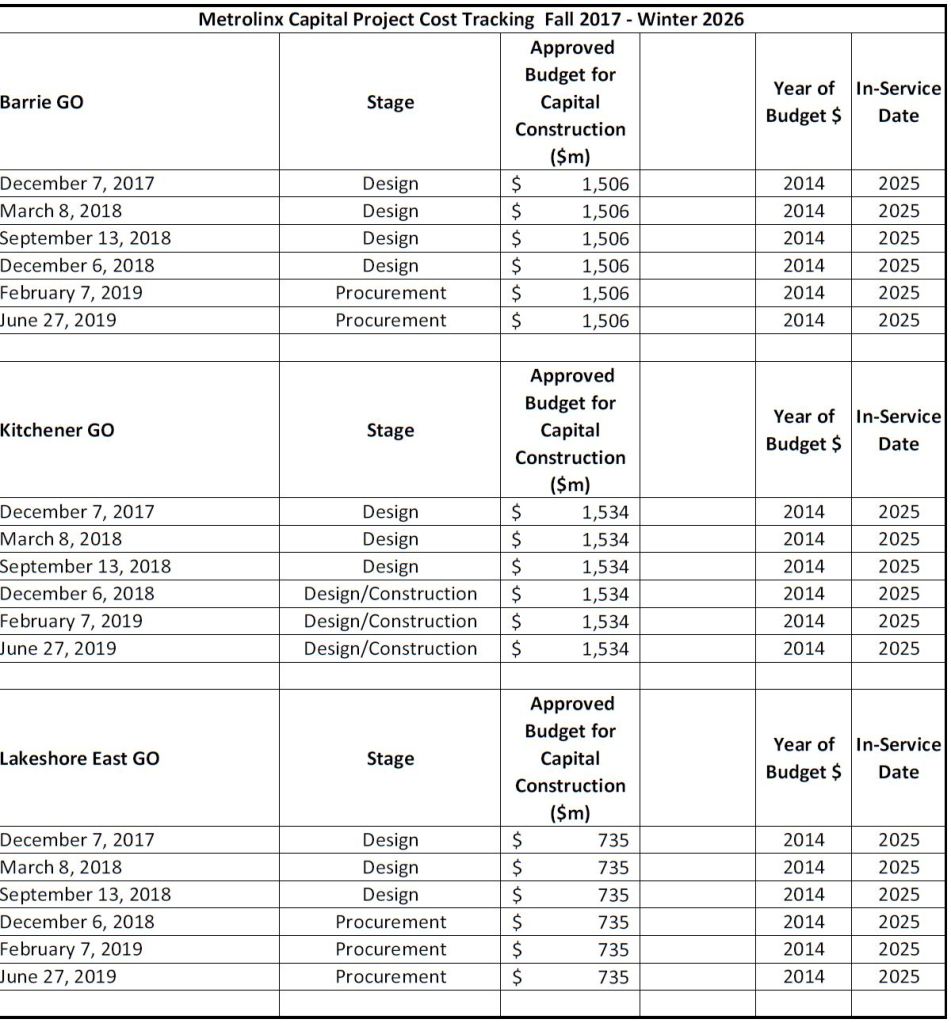
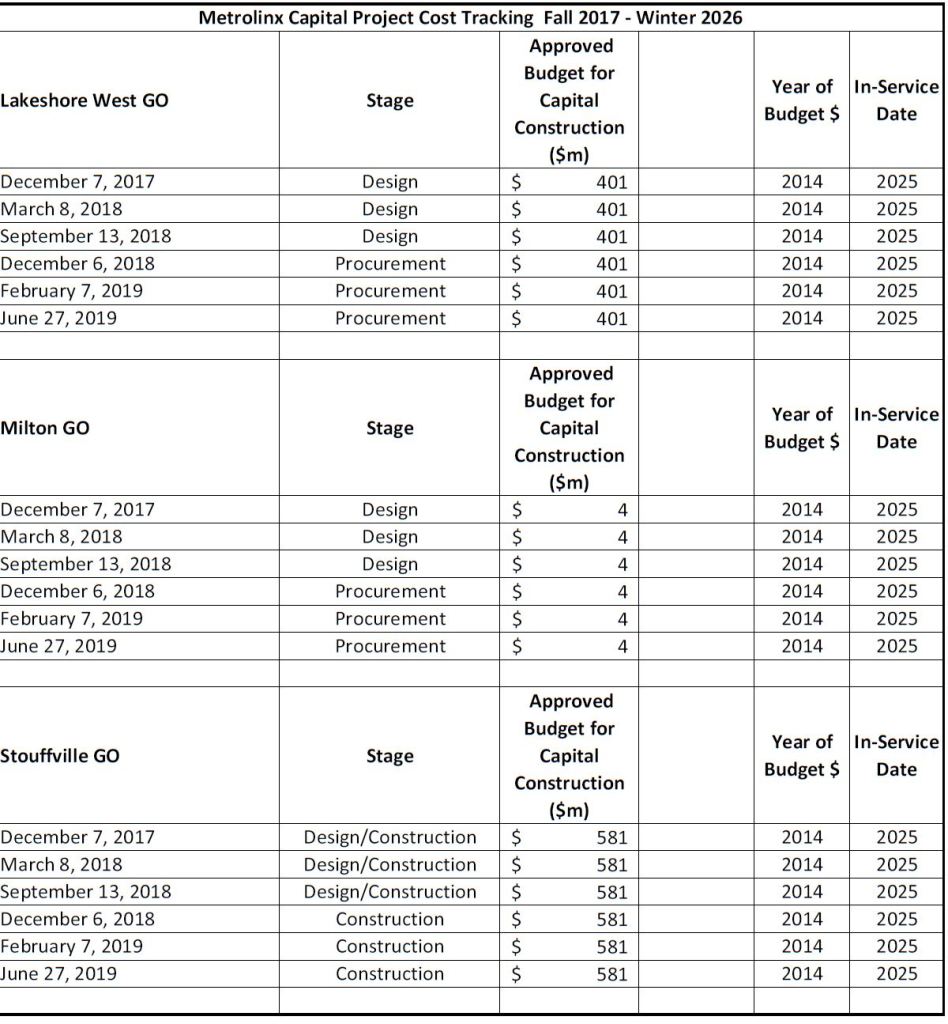
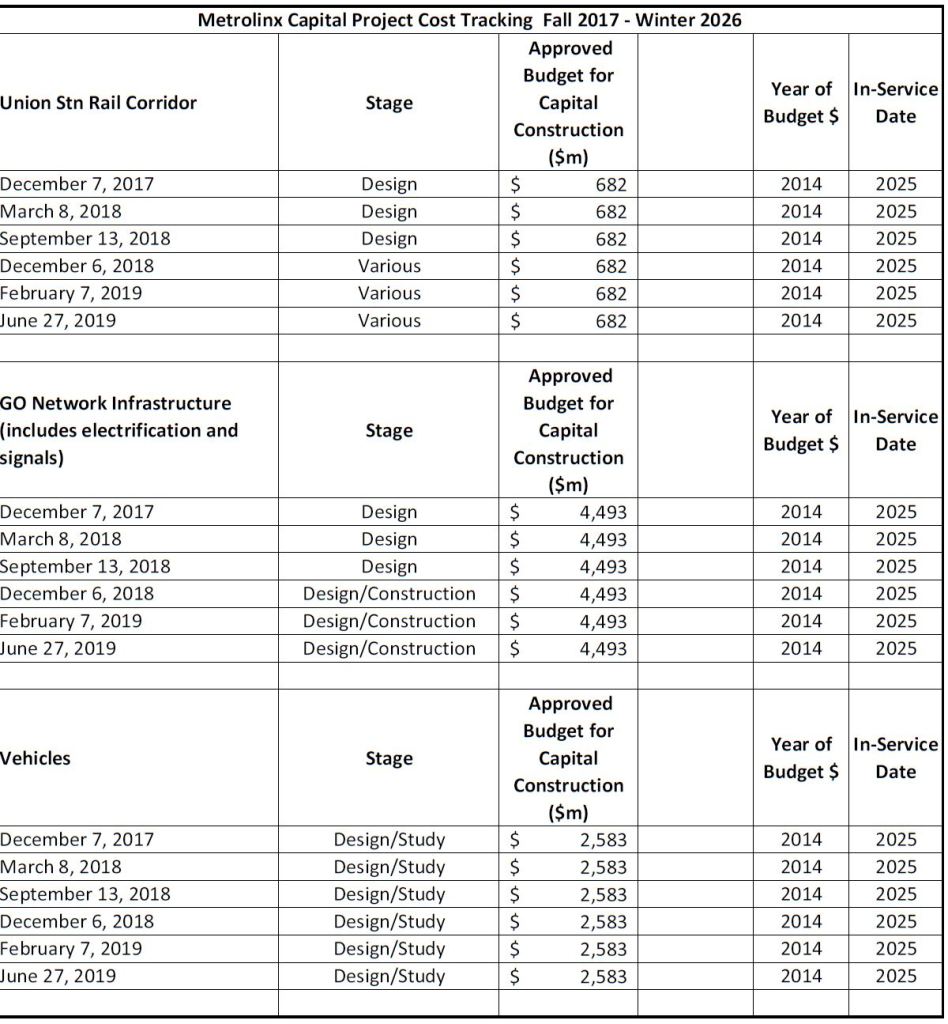
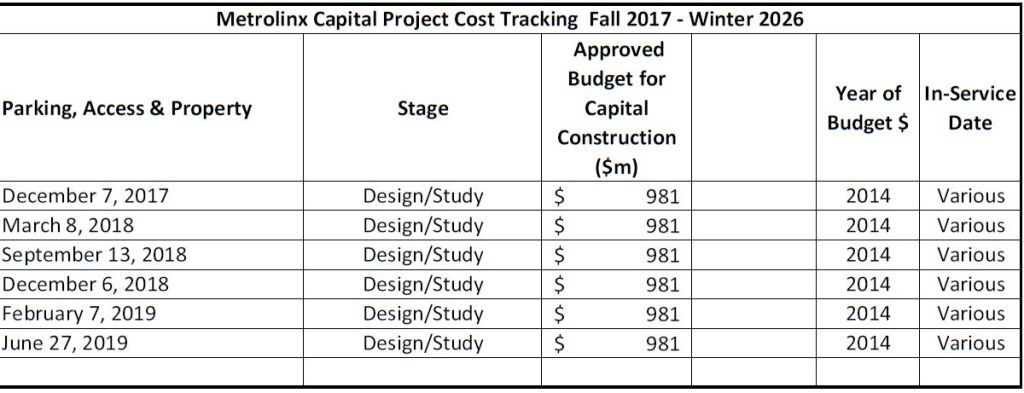
For the first few years that Metrolinx published their quarterly updates, the reports included project status, the approved capital construction budget, and an expected in-service date. The tables below show the various corridor projects which mostly had an in-service date of 2025 and a total approved budget of $13.446-billion that did not change over this period. The amounts are quoted in 2014 dollars meaning that the actual spending can be much higher given the decade-long period to actually deliver the project.
These project reporting lines were consolidated in mid-2019 when the reporting format changed and the “OnCorr” moniker became the overall brand for this work.
The dates in the tables below are the dates of Board meetings at which the reports were presented.
GO Corridor 2019-2026
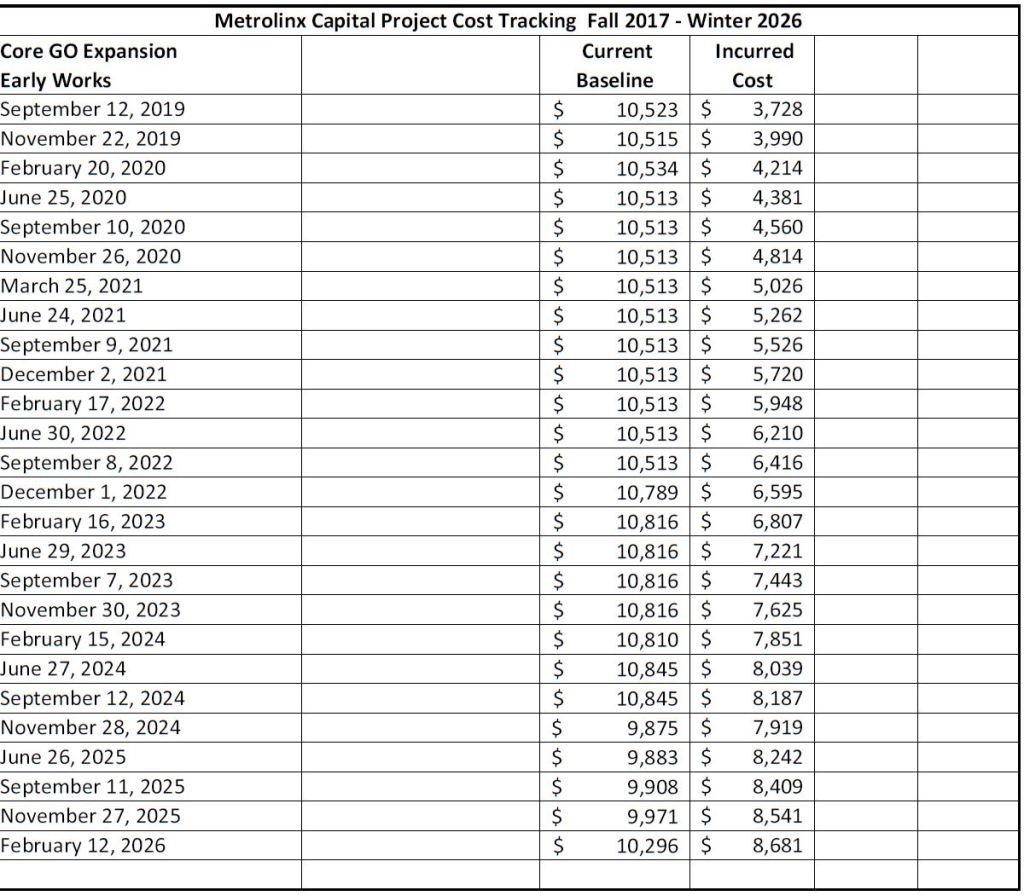
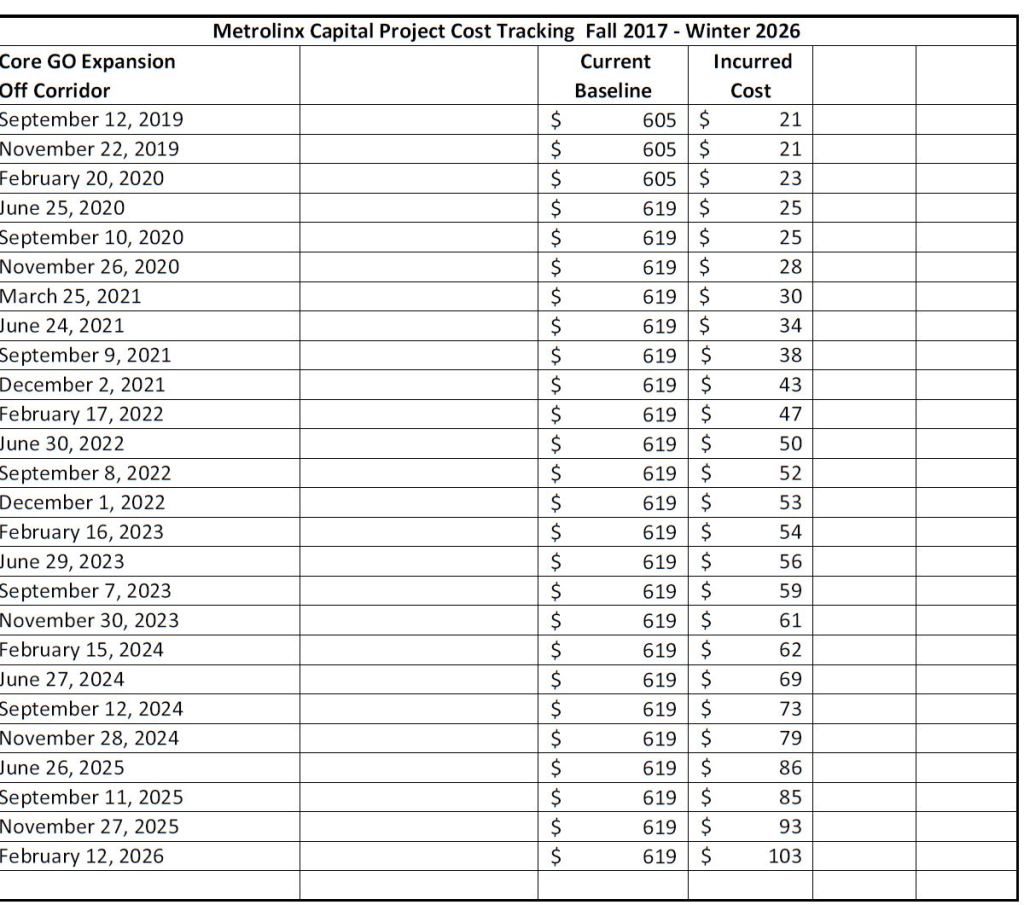
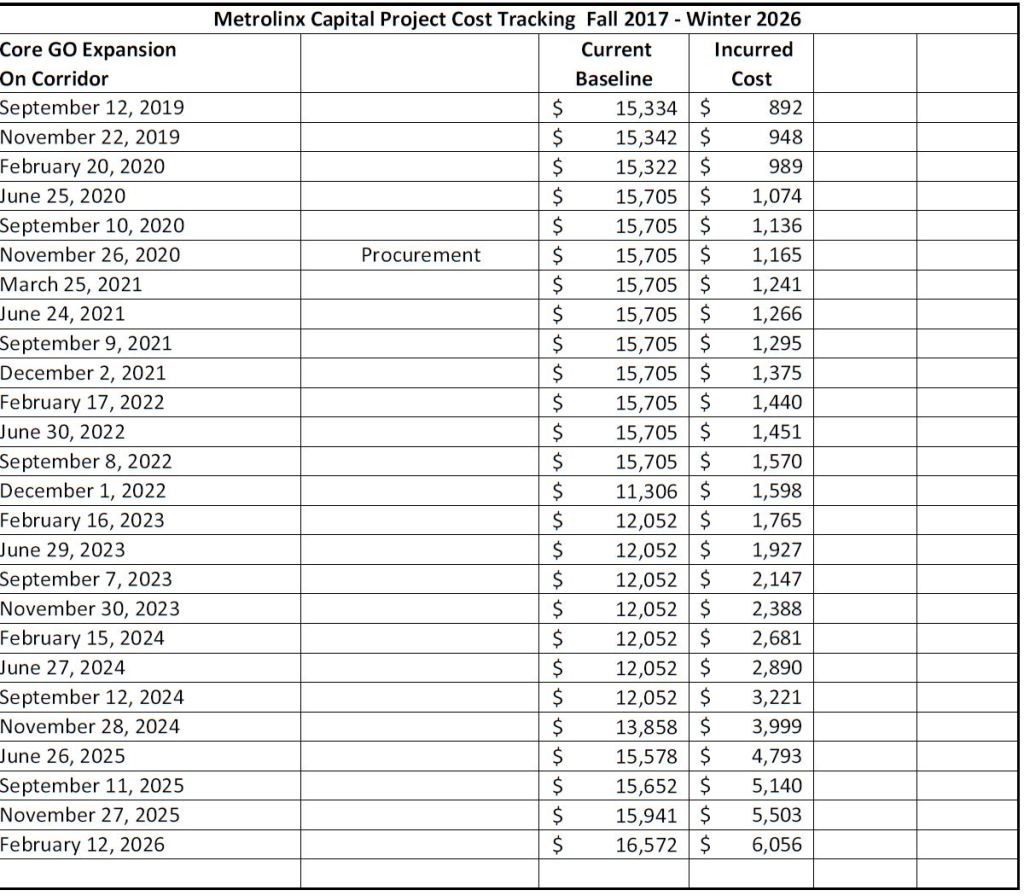
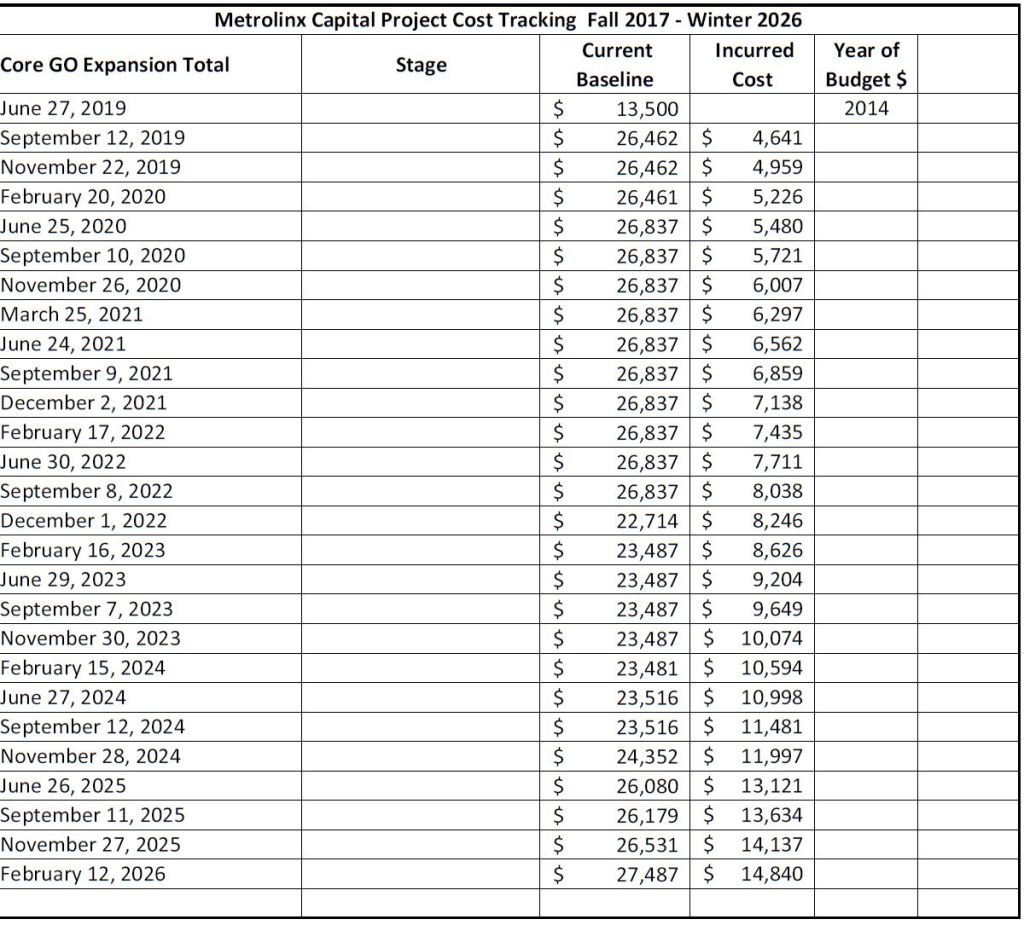
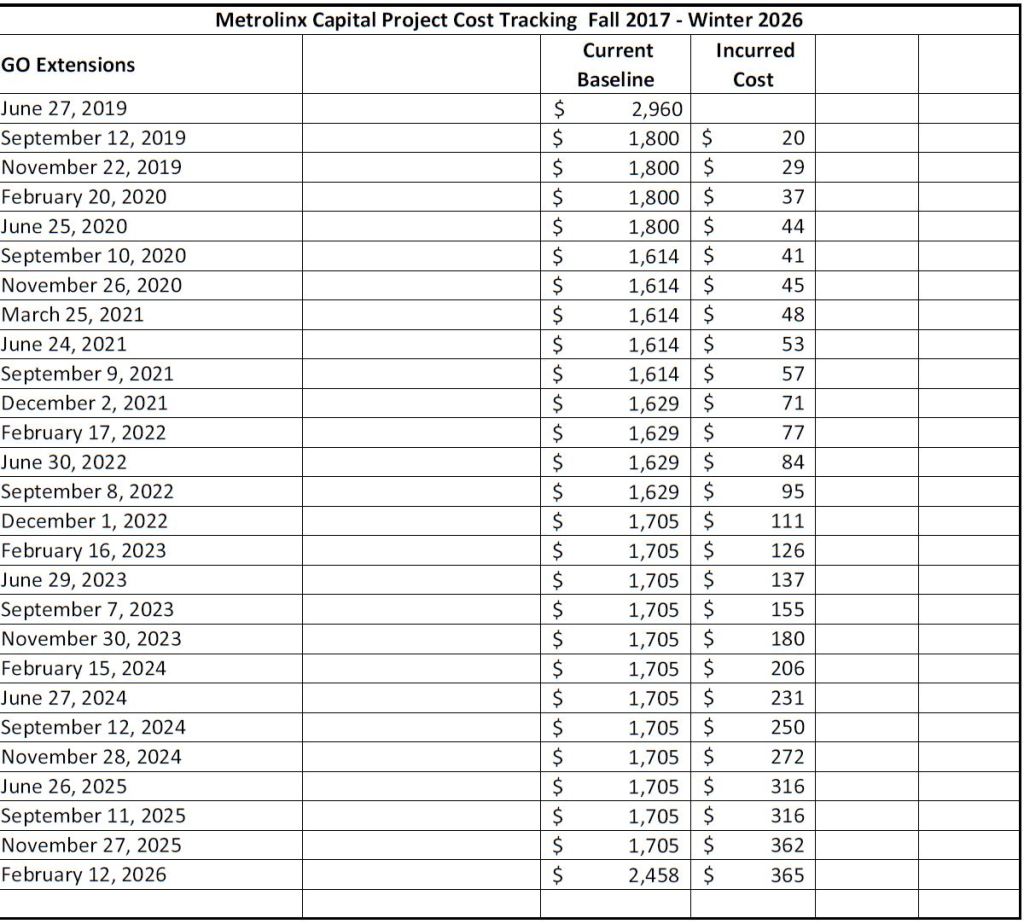
From mid-2019 onward, the GO projects were reported under three headings: Early Works, Off Corridor and On Corridor. The tables below track these three clusters as well as the total cost.
A major change here is that values are no longer presented in 2014 dollars, but instead as anticipated as-spent values. This causes a jump in the total from $13.5 to $26.5-billion as of the September 2019 report. How much of this is inflation and how much is scope creep is impossible to ferret out.
One important missing piece is electrification which affects both infrastructure and vehicles. In the overall GO Transit corridor plans presented at a recent Board meeting, electrification comes at the end of various corridor projects, and there certainly will be no construction or maintenance costs included in these numbers for that component.
The drop in the Early Works baseline in fall 2024 was attributed to the Union Station Enhancement project where the amount was adjusted to the then-approved scope of work.
Procurement was underway for the major OnCorr operating and maintenance contract in 2020, but this ran aground over disagreements between the successful bidder and Metrolinx. The baseline for the On Corridor component was changed in late 2022 to reflect work actually awarded. Through 2024-26, the baseline grew as additional works were awarded. As the overall project chart from the February Board meeting shows, there are many works that are still only in the design stage, and the totals here will continue to grow. Individual project lines are not tracked in publicly available information.
GO Expansion
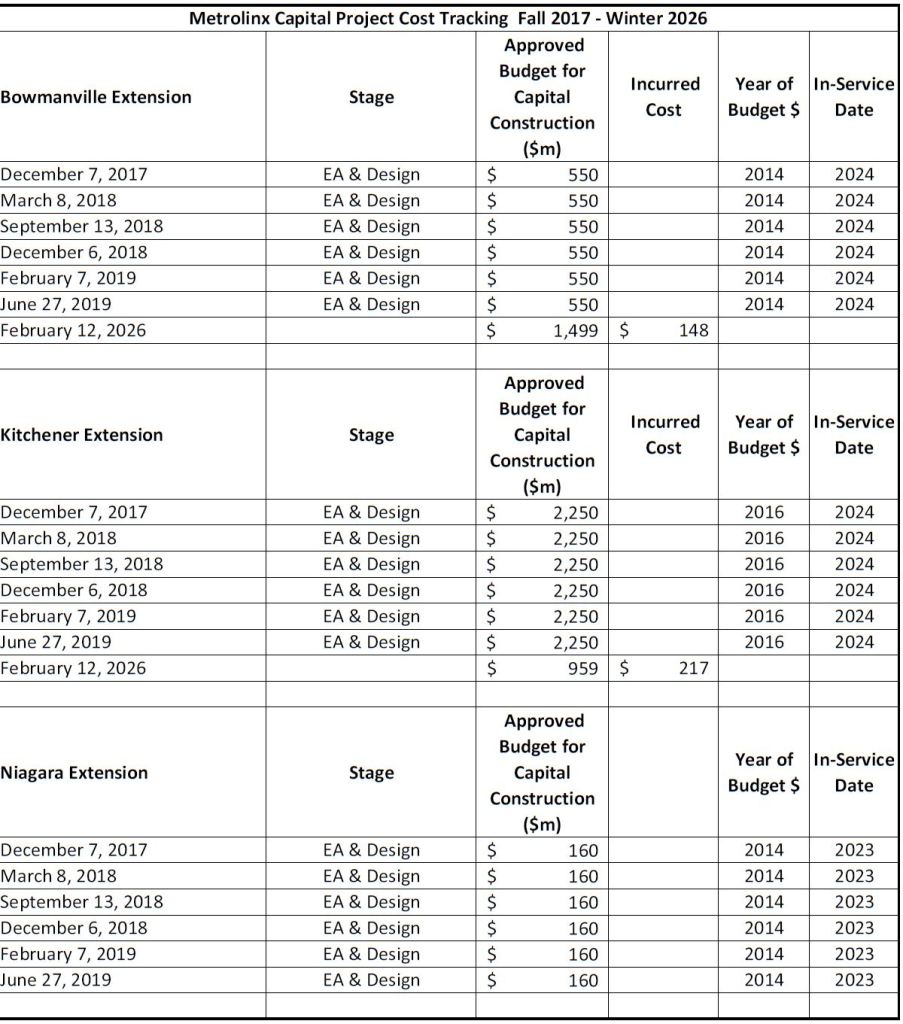
Like the base GO corridor projects, the route expansions were reported separately in 2017-2019, and then consolidated into one reporting line from 2019-2025. In February 2026, the Bowmanville and Kitchener projects reappeared as individual lines, but the Niagara Falls extension did not.
Note that the in-service dates were rather optimistic especially for Bowmanville, and that the budget for the Kitchener project dropped substantially in 2026. This change neatly keeps the total in the $2.5-billion range, but we do not know what might have been stripped out of the Kitchener project.
Smart Track
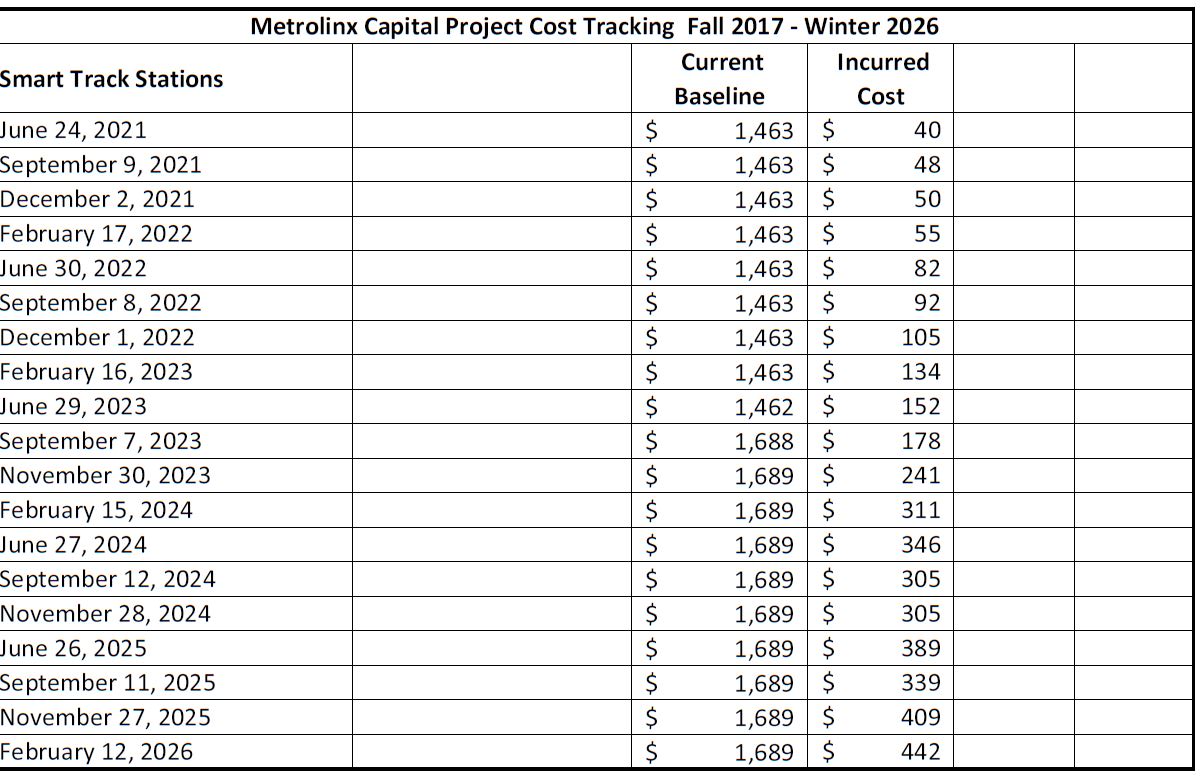
SmartTrack was a scheme concocted to give John Tory a credible transit plan. It originated with a scheme to link the growing business centres in Markham and at Pearson Airport via a U-shaped rail corridor through downtown Toronto. The purpose for its original proponents was to improve transit access to growing areas where office space growth was constrained by the inability to get commuters to and from work.
This proposal was modified to appear as a Toronto-centric line with many local stations along the Stouffville, Lake Shore and Weston rail corridors. The western leg would run along Eglinton Avenue using the right-of-way that had been set aside decades ago for the Richview Expressway and, more recently, for the western portion of the Eglinton Crosstown LRT under the Transit City plan.
Smart Track began to lose various components, notably the unbuildable Eglinton West segment, almost like leaves falling from trees in Autumn, but the project name had to be kept alive to keep Mayor Tory onside with Metrolinx plans. Eventually it gained a few stations that were not even on the original ST corridor, and Toronto agreed to pay for this as its contribution to GO’s growth. Some of the Toronto money came from the Federal government out of a pot that might otherwise have gone to local transit needs.
By late 2023, the cost estimate had grown, but Toronto was unwilling to commit more to this project. The proposed Liberty Village ST station is no longer on the map, but the project baseline has not been adjusted to reflect this. One other important change was the removal of the Ontario Line’s share of East Harbour Station. Toronto Council would like some transparency in Metrolinx accounts, but the City Auditor has no power to investigate a provincial agency.
LRT Projects
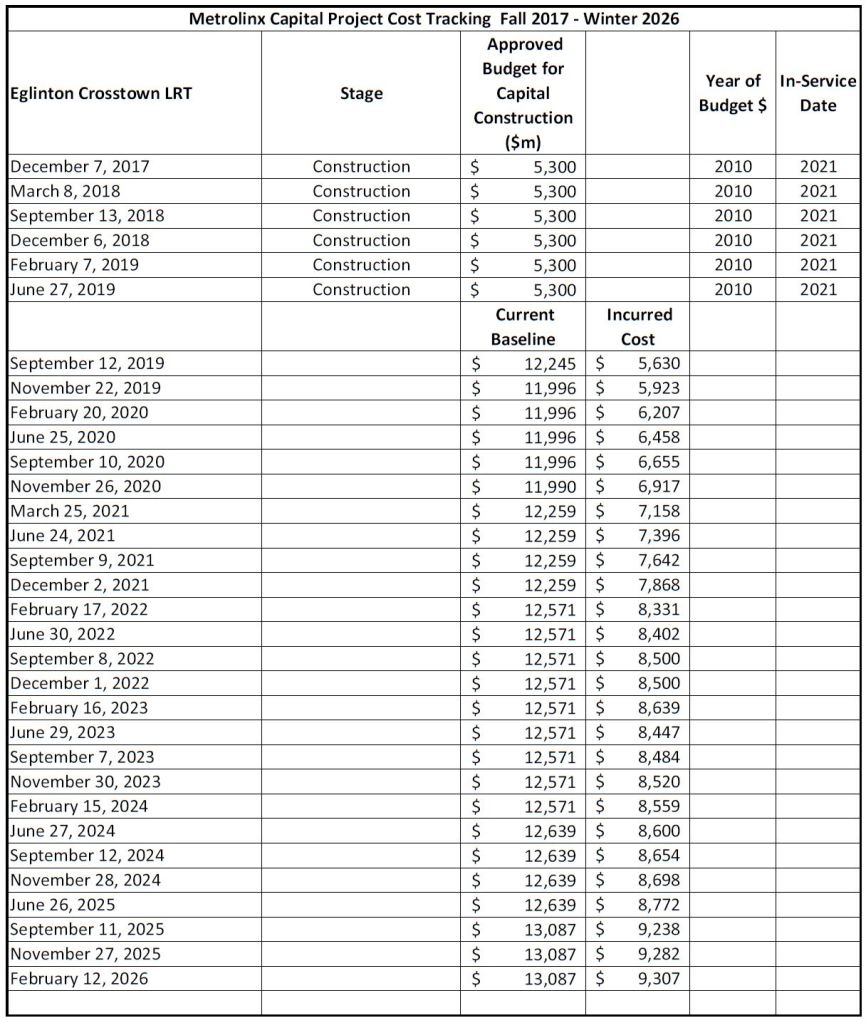
Four LRT projects were on the books back in 2016: Eglinton Crosstown, Finch West, Hurontario (later McCallion) and Hamilton with a then-approved total budget of $8.7-billion in a mixture of 2010 and 2014 dollars. Anticipated opening dates ranged from 2021 to 2024.
The Eglinton Crosstown’s baseline was reported as $12.2-billion in September 2019, and this grew to $13.1-billion by February 2026. Some of that increase is due to court-awarded payments by Metrolinx to their P3 partners. (See the $312-million jump in the baseline in February 2022.)
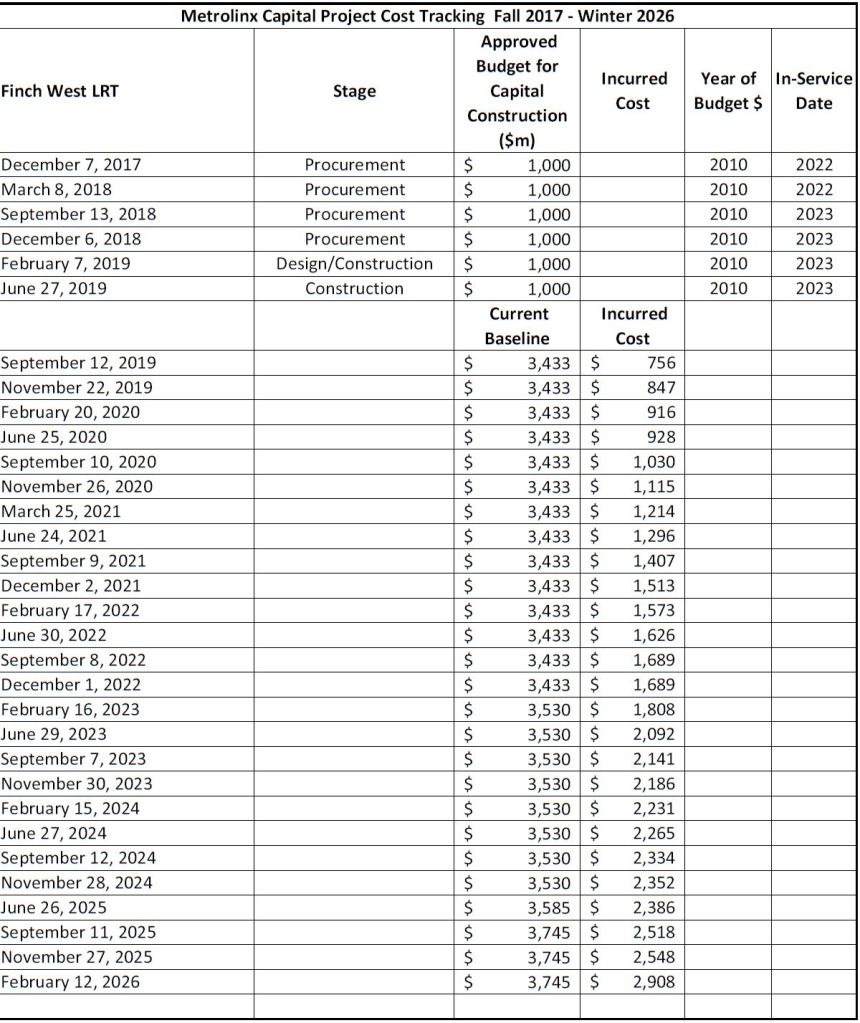
Finch West started out at $3.4-billion in 2019 rising to $3.7-billion in 2026.
In both the Crosstown and Finch projects, there is a 30-year maintenance agreement for infrastrucure and vehicles, and its value is likely much of the difference between the 2026 baseline values and the incurred cost. It is not clear where payments to the TTC for operation of these lines is coming from, or if it is even included in the Metrolinx project reporting.
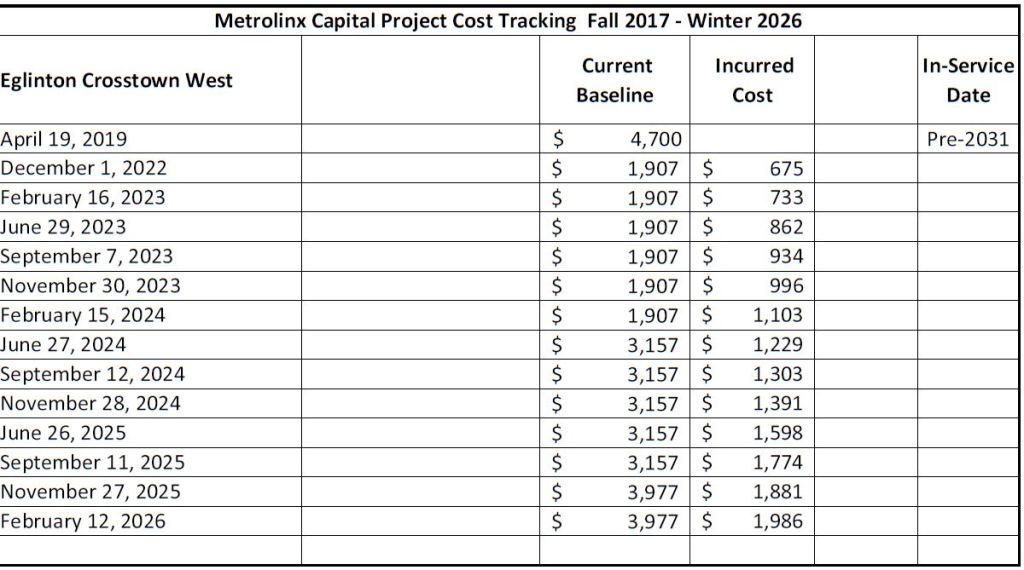
The Eglinton West extension appeared after the western branch of SmartTrack had been severed with a cost estimate of $4.7-billion in Premier Ford’s subway announcement of 2019 (covered later in this article). This quickly dropped as only the baseline value starting at $1.9-billion was reported from December 2022 onward.
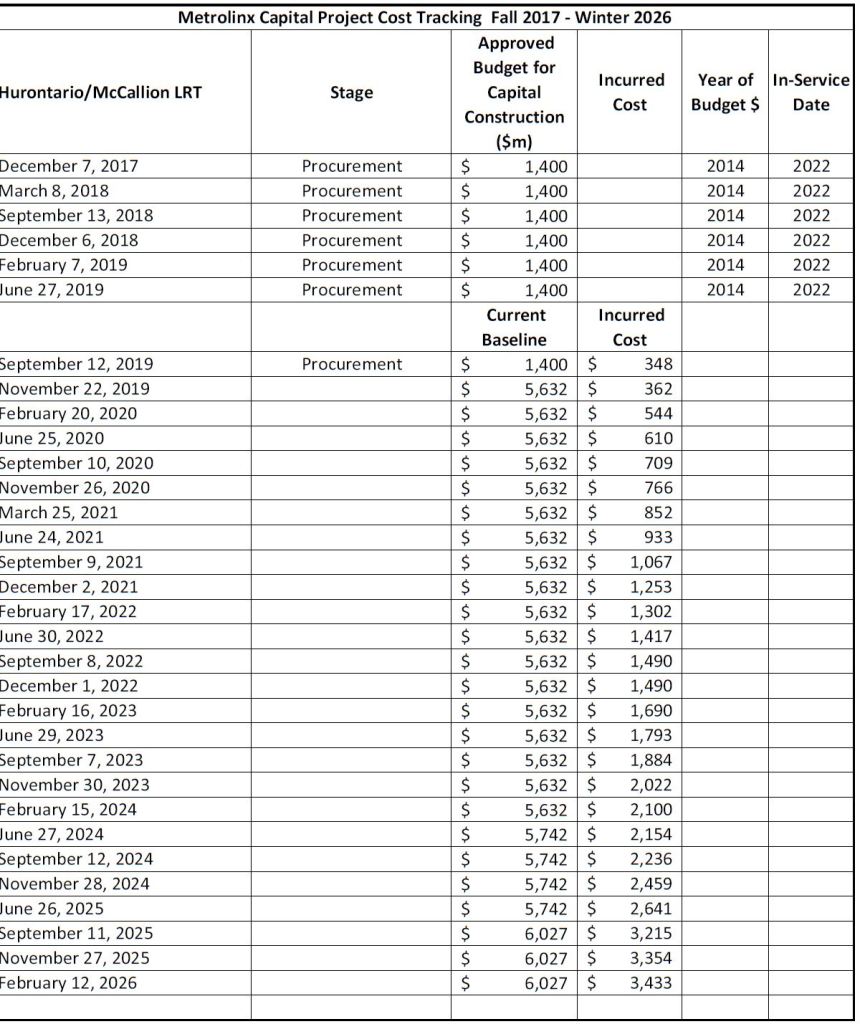
The Hurontario line is still under construction with a baseline that rose from $5.6 to $6.0-billion from 2019 to 2026.
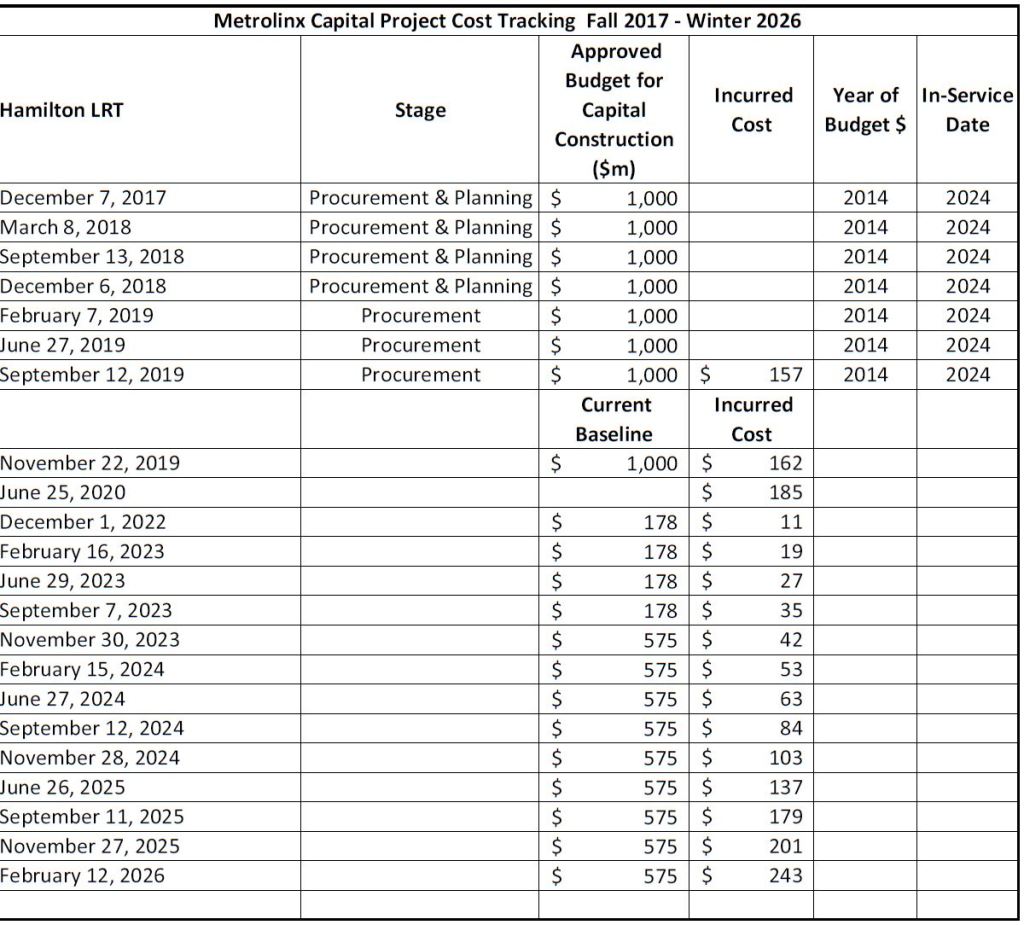
The Hamilton project was formally mothballed in 2019, but then reactivated in 2020, albeit with a small baseline.
Subway
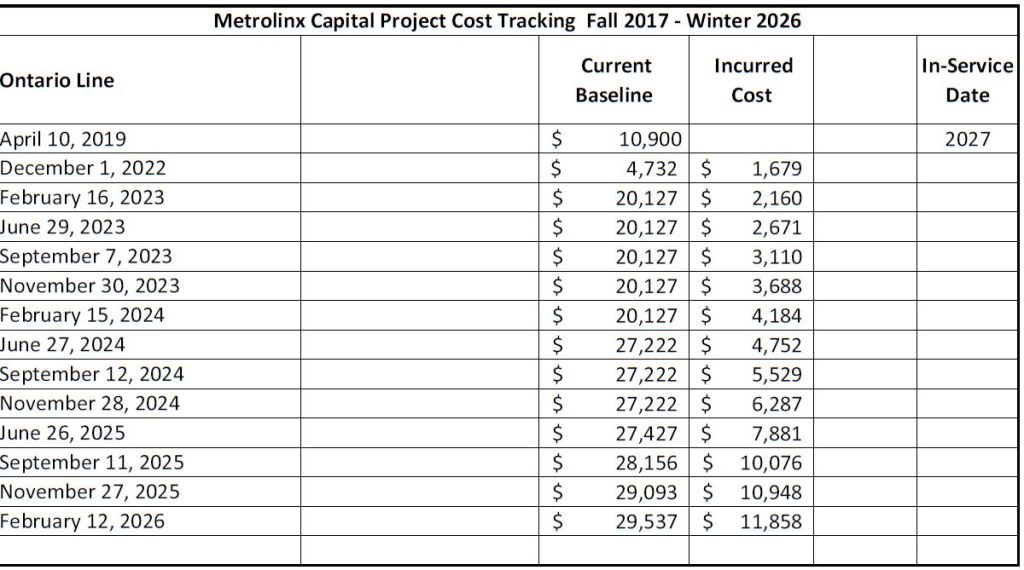
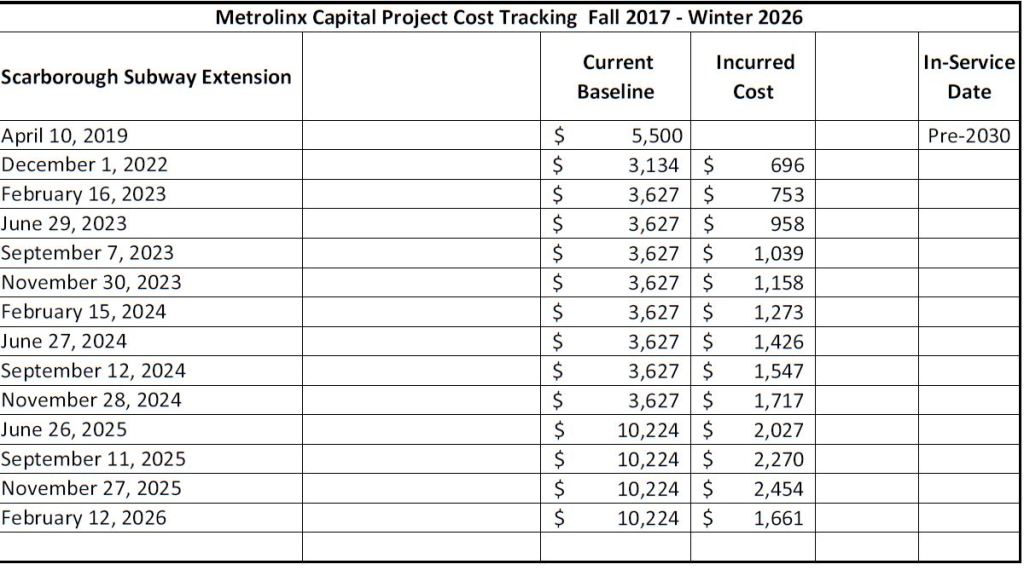
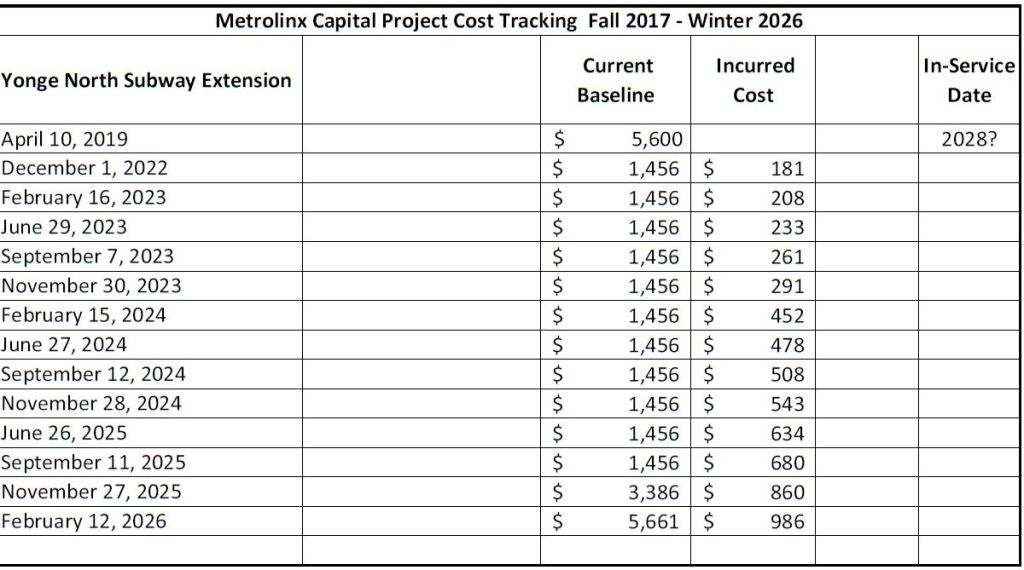
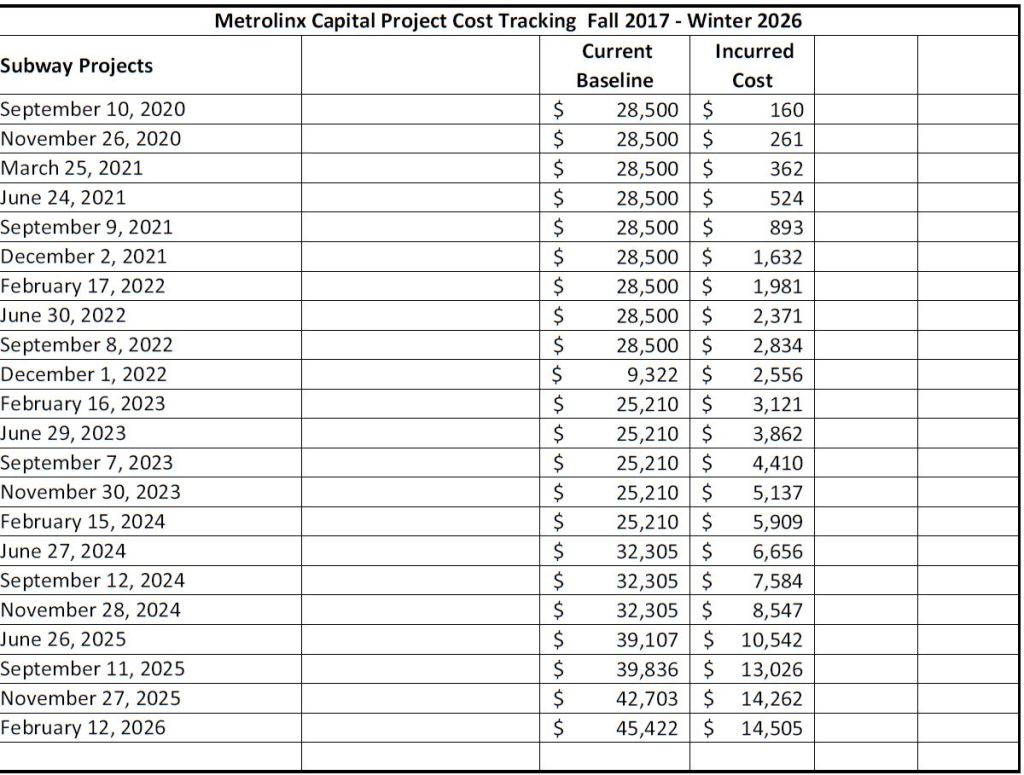
A package of four subway projects was announced by Premier Ford on April 10, 2019:
- The Ontario Line will cost $10.9 billion and will be delivered by 2027.
- The Yonge North Subway Extension will cost $5.6 billion and should be open soon after the Ontario Line.
- The Scarborough Subway Extension will cost $5.5 billion and will be delivered before 2030.
- The Eglinton Crosstown West Extension will cost $4.7 billion and will be delivered before 2031.
- The projects will require a combined $28.5 billion, of which the province has committed $11.2 billion.
Subsequently the Province assumed almost all of the cost of these projects. Needless to say, the opening dates will be missed, especially for the Ontario Line which was recently mooted for the early 2030s by Metrolinx CEO Michael Lindsay. He has recently learned that simply building something does not mean you can open for service the next day, and extensive integration of systems, vehicles and infrastructure is required, not to mention actual testing.
The Ontario Line is now up to $29.5-billion as its baseline, but this includes the 30-year operating agreement.
Although they are comparable in size, the baselines for the Scarborough and Yonge extensions are $10.2 and $5.7-billion respectively. This reflects the fact that fewer contracts have been awarded for Yonge and therefore the baseline includes less of the eventual cost. There is no operating component to these projects as they will become part of the TTC’s subway system.
Bus
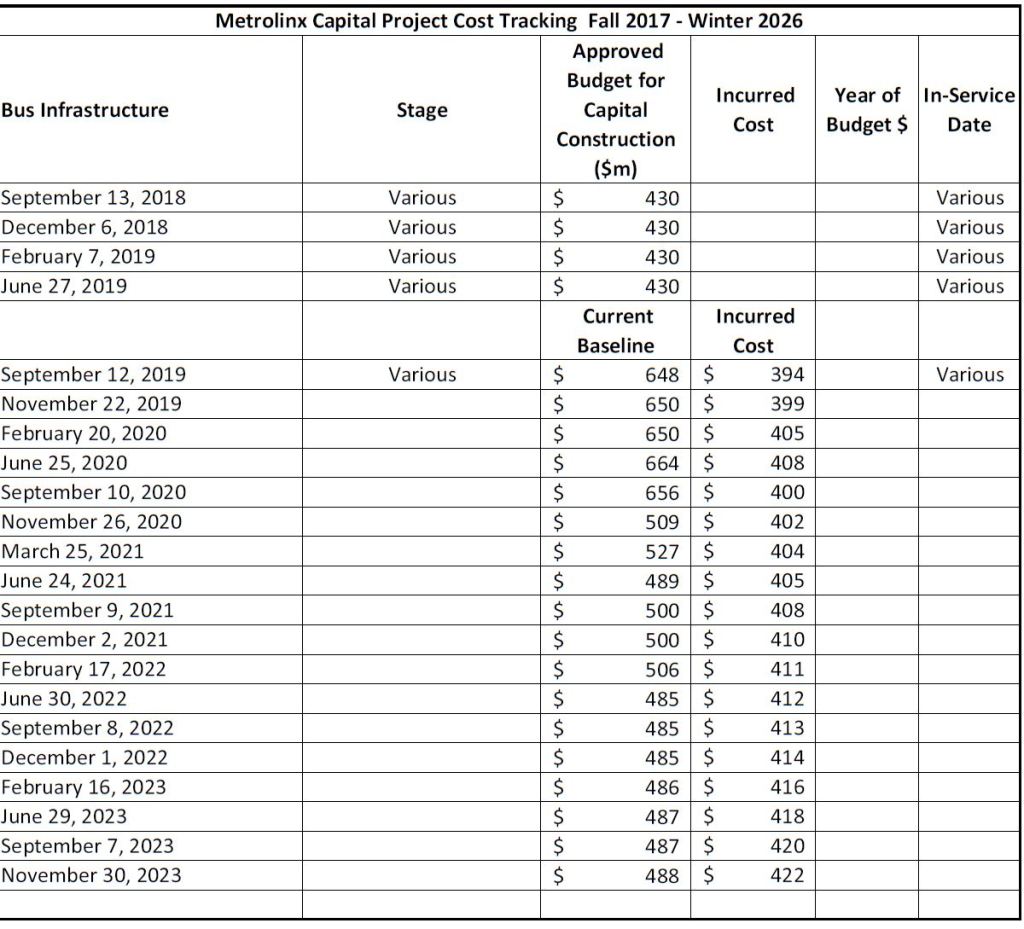
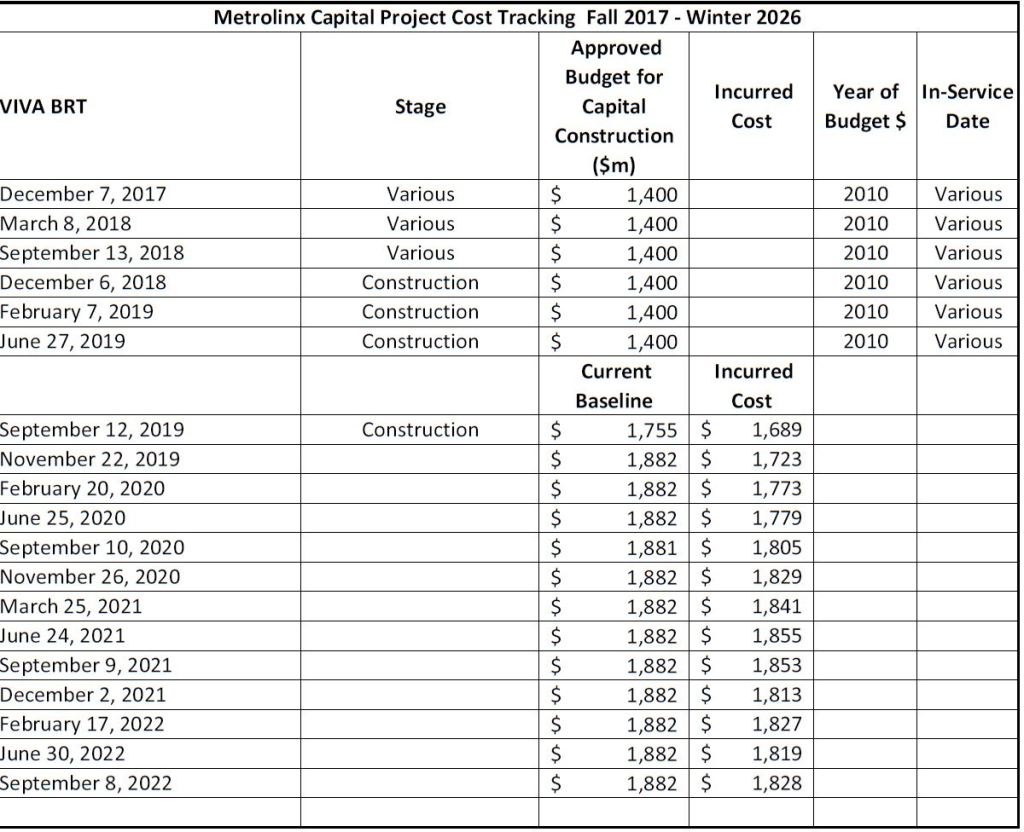
Various GO transit bus projects were reported as a separate line until late 2023. Similarly, the VIVA BRT project was shown separately, and that project is now complete.
 Steve Munro
These costs in the millions and billions calls for serious transparency. We have heard of costs overruns and how corruptions creeps in. Paying ALL these money and not getting deliverables makes the leadership suspicious.
LikeLike
This is a seriously complex and challenging set of situations to grapple with, so thank you very much Steve – Order of Canada please, as here in Contario it’s now far more the Ordure of Ontario.
Like Mr. Ming, we should be worried about the value for the billions, and I would include the Ontario Line (despite need for Relief function), but for sure the SSE and Yonge N extension, and Eglinton W didn’t/doesn’t need burying correct? (And what’s a few billion anyways, to contrast with the School Boards, so there must be something else like taxpayer-bought land).
At least the provincial Liberals are at least engaging the Auditor, tho is it more posturing than really really wanting to squeeze transit, because the majority of us have been maybe foolishly thinking Big Spending on transit is actually real value, and haven’t noted the elasticities of demand forecasting and justifications for Heavy transit in low-density areas and relative paucity of options explored beyond any type of subway as long as it’s in this corridor, and yes, surface options could have been given a better examination, and I do not trust the current system of ‘approvals’, including having one-third dollars, so even though it’s a bad project, oh well…. And will the Auditor explore the cui bono aspects of all of this, including who really owns land near or at stations and possible ties to various political parties? (Likely not the NDP, to be clear, though they tend to be all-OK for any big project for the jobs aspects, which isn’t always how we should proceed).
Steve’s use of ‘even more opaque’ in the third paragraph I hope will alarm many. Apparently that murkiness was common in Italy when corruptions were occurring, and I think it was Prof. Siematycki noted about a year ago that now Italy has really clear data about costs, and it’s available, and I think the comment is towards the end in this IMFG seminar.
Just as more than a few school boards are restricted in operations now, are we at the point that we should pause on all the projects and burying of the billions while an outside set of experts actually get in to see and understand what all is going on and not going on? There was a UITP review, and I’m not sure that was so favourable, and a German ‘partner’ with GO dissociated, so ahem, maybe some warning signs?
And if we did have the political will to pause projects, could we open up Queen St., and also, instead of doing more on something less-wise, somehow start building a lot of housing, including on all the school parking lots, which may be in Mr. Ford’s dreams for selling off, which I might partially agree with, but would like OTPP purchase/involvement for at least the parking aspects, as yes, some parking is needed, just these larger dispersed lots represent serviced urban land that has been relatively privatized, and isn’t efficient.
And with Scarborough, now that the Eglinton LRT is up/running, (and it was in the 1957 plan), how impossible would it be to have a secondary leg of this LRT diverge to the NE around the Scarborough Hospital, echoing the Davis-era plan that used the Gatineau Hydro corridor for transit, c. 1972? It wouldn’t be taking away car lanes for transit, and the diagonality of the trip is inherently faster, and this is a super-wide corridor that intersects with all of the main north-south roads of Scarborough.
And for the Yonge St line, what about straightening out the GO line a bit to somehow link it to the Eglinton LRT and perhaps the OL/Relief, either via the now-trail spur line (tho a larger development now intrudes), or by a tunnel to Eglinton, and forgo having many trains use this corridor to the core due to the flooding issues, which are quite related to the degree of asphalt and its drainage in the 905 area.
Pardon length.
Ego te absolvo!
LikeLike
If you’ll know they’re secretive why allow them to go over the timeline and budget??? If it were a personal home renovation, would you pay???
Steve: As if any of us is in a position to hold Metrolinx to account?
LikeLike
Thanks Steve.
Matt Gurney, in a Star column, wrote
So what is the borderline between a ‘soft’ and ‘hard’ corruption, though I know we’re ‘carrupt’, sigh?
And in listening to some commercial radio today, FM, quite a few short plain ads from the Province about how the big projects are going to help us all, No idea when they began – and yup, seems like propaganda.
LikeLike
A time ago, maybe three years?, there was a small story about a link from the SSE project to a Russian oligarch, and theoretically there was an embargo of sorts for having dealings/contracts. I don’t know if there was any cutting out/off of this interest, but as we get to anniversary of the war in Ukraine, maybe someone knows more? Thanks.
Steve: The link is through Strabag which is part of the SSE consortium.
LikeLike
Is there any way to compare how much maintenance of lines 5 and 6 costs through the P3 model with streetcar or subway maintenance done by the TTC?
I recall seeing estimates for the REM suggesting it will be cheaper for Montreal to pay CDPQ than operate their own metro line. But I can’t recall a comparison like that for any of Toronto’s new lines.
Steve: Metrolinx has not published any costs for their P3 partners and so there is no basis of comparison. Also, normally one would expect new lines to be in a period when the vehicles and infrastructure are new and more reliable. A mature system will have maintenance issues and costs that do not face a new one thereby making comparison difficult, unless you are trying to “prove” the P3 is cheaper.
LikeLike
In today’s Sun, p. 3, a story headlined Probe Metrolinx SmartTrack waste: CTF – and the Canadian Taxpayer’s Federation is on the case of the Smart Trick costs, which are perhaps real, but if it preserves the options for more interconnection etc. it can be seen as an investment, as we tend to build so many of our options shut ie. Celestica lands, and also ensuring a Front St. transitway RoW via Liberty village area to link Queensway car of TTC to a newer and faster TTC-based LRT, which is likely impossible now, sigh. So maybe the CTF is getting on the case, but will they have the wider vision to actually see that automobility is subsided big-time? The old stat (printed in Globe of Jan. 10/96) of each car (in B.C.) having a $2,700 per year avoided cost/subsidy isn’t really brought up by most all of our political parties and politicians – ‘caronic’ denial? Wanting the ‘votorists’ to re-elect them?
And with better value for the multi-millions to billions, maybe all that the province and Metrolinx should have been trusted with, using the $600M or whatever it is for a parking garage at the Therme spa proposal, is to build a subway from King, or likely Queen, south to Ontario Place remnants, and use some of the Ex parking lot land for train storage.
Steve: CTF is actually a handful of individuals pretending to be some great citizens’ movement. They are always pushing right wing talking points, and their call for an ST probe is at least partly from a motto that all transit projects are waste.
LikeLike
I’d been thinking that Metrolinx deserves a very short leash ie. only being able to build transit from the Ex GO Station to Ontario Place, or remnants, and use the $600M or whatever the costs of the parking garage are for this perhaps even a subway transit, and also was thinking, for real connection, going north to King, even Queen. And then I looked at a map, and saw how aligned Ossington St – which ends at Queen – and Ontario Place actually are, so while there are likely all sorts of reasons/buildings that interfere with having a higher-order transit/tunnel for buses built through CAMH and under the railtracks to the Ex/OP area, it actually makes some sense well beyond the small distances from Ex GO to OP. Because Liberty Village is still quite isolated from a fractured grid and not enough transit, and the transit to it – at least that using Ossington – zigs/zags and is circuitous and takes time from the transit users. Of course, this is most likely a new idea, but as there’s been a massive amount of property tax revenue from all of Liberty Village and some promises of transit provision, hmm, some decade soon?
Thanks!
LikeLike
There’s been a story on Global about trimming of Metrolinx consultants, often a conversion to employees, and also a nugget of there being c. 118 vice- presidents of this/that, at c. quarter-million a year. Yikes, and depressing, and angering in some ways.
Steve:
That will just give you the VPs and Exec VPs. There are other titles. Happy hunting!
LikeLike