
The TTC has now added 6 Finch to the collection of published delay data available on the City of Toronto’s Open Data site. See:
The data are in a summary format, much less detailed than the version on which I based a recent article, but they have the advantage of being in spreadsheet format that makes general analysis easier.
In the form published by the TTC, the data include:
- Date and time of the event
- Location
- Event Code
- Minutes of delay and gap
- Direction
- Vehicle number
- List of event codes
For the purpose of this article, I sorted and summarized the events by code and by the number of times it was reported. (If you want to see the full unedited list, download the file from the City’s site.)
What is immediately obvious here is that the majority of the delays are due to equipment and infrastructure failures, and that a few individual events caused extended outages. These are numbers as reported by the TTC, and do not really show the degree to which 6 Finch was effectively unavailable to riders who had to use shuttle buses instead.
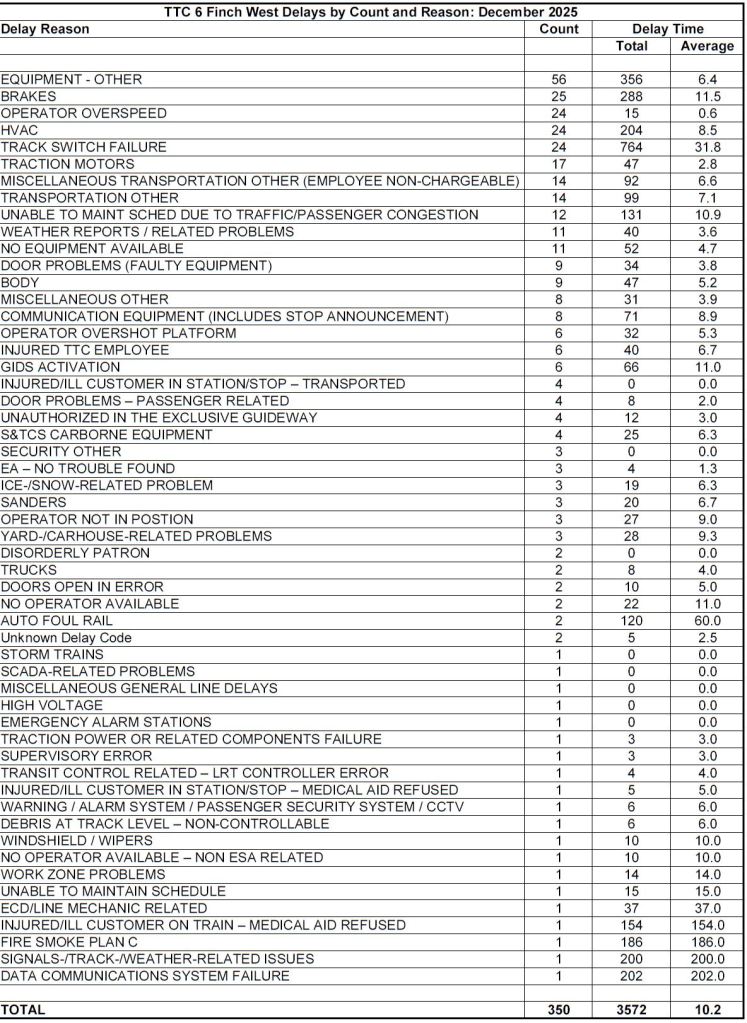
Overall, in the period from December 7-31 there were 350 events.
Updated January 21, 2026 at 10:40pm:
By comparison, the streetcar network, with many longer routes in a more challenging operating environment, had only 819 events between them. Of these, 22 were infrastructure issues (with only 2 switch issues), 74 were due to equipment issues and 113 to diversions. Common incidents were due, broadly speaking, to passenger issues: 102 ill patrons, 106 unsanitary cars, and 169 security issues (most commonly “disorderly patron”).
| 501 Queen | 160 | 509 Harbourfront | 23 |
| 504 King | 166 | 510 Spadina | 75 |
| 505 Dundas | 124 | 511 Bathurst | 59 |
| 506 Carlton | 115 | 512 St. Clair | 69 |
| 507 Long Branch | 28 |


While the data is not enough detail, I do appreciate that this is one clear and simple way for the TTC to make clear where to direct one’s ire. If enough reports like this appear, it might break through into media reporting and adjust their framing too.
Steve: It will be interesting to see if TTC/City folks get into a fight with Metrolinx about the cost of all those shuttle buses. Remember that TTC is holding off on 2026 service improvements because they are keeping buses in reserve for Finch.
LikeLike
“Operator Overspeed” sounds like a job title they need.
I can’t believe there isn’t a configuration menu option to disable the automatic shutdown on overspeed, or at least set the overspeed threshold to something more speedy.
Hopefully the 6 “Injured TTC Employee” and 6 “Injured/Ill Customer” events are at least partially data entry errors. That’s a lot for a 3 week period… although I guess it includes a lot of holiday trips and a couple of universities/colleges so maybe some of those are self-inflicted.
Steve: From the detailed logs that I already had and reported, one injury was caused by a piece of equipment falling onto the operator, one by an op getting their finger caught in a washroom door, and I believe at leaset one other is from a fall caused by an emergency stop. Although they are reported here under one code, from the detailed logs those were ill customers.
LikeLike
Fire that Other guy. He’s responsible for a *lot*. In fact, by number of incidents, Other’s Equipment is the *worst*.
EQUIPMENT – OTHER
TRANSPORTATION OTHER
SECURITY OTHER
At least they keep stats. Do they use them to improve the system?
Steve: Equipment faults are not the TTC’s to fix. What Metrolinx’ partner, Mosaic does about reducing failures I don’t know because they do not report their actions publicly.
LikeLike
I can’t stand that term “partner” – “Mosaic” is a contractor (in addition to being a very old web-browser). There is a contract covering each party’s responsibilities. Gonna assume that said contract lets the supplier off the hook for most stuff. And that TTC gets no say at all.
What a dumb way to run a railroad.
Steve: I too find “partner” distasteful, but it is a common way the three entities refer to each other.
LikeLike
Wow! Thanks Metrolinx for ordering these crappy Alstom trains which are seemingly made of glass. I’m so glad we’ve given them a rail monopoly in this province.
LikeLike
“These are numbers as reported by the TTC, and do not really show the degree to which 6 Finch was effectively unavailable to riders who had to use shuttle buses instead.”
Using TransSee alerts log I created a spreadsheet of when Line 6 was reported to be replaced by shuttle buses.
LikeLike
Amazing that Operator Overspeed can be triggered when moving slower than an average runner.
Steve: The average runner does not have to stop to pick up passengers, and may not have to wait for every traffic signal, and has no upper bound on top speed. “Overspeed” is an instantaneous condition, as opposed to the average speed of the journey.
LikeLike
I realize my previous comment was in jest but last I heard they weren’t even getting close to the allowable top speed at any point. Why is the penalty an automatic stop of the train rather than preventing further acceleration, so that the operator can just put the hammer down and let the computer sort it out?
Steve: There is a more restrictive speed limit near stations, and these are also locations where conflicts with other traffic and pedestrians are possible. The computer cannot “see” those conflicts.
LikeLike
Why they built this thing in Canada? This thing doesn’t work in winter. Thanks a lot to Steve and others for fighting to get this thing built here.
Steve: LRT works just fine in Calgary and Edmonton which have much worse winters than Toronto. You should ask how Metrolinx so cocked up the design and failed to uncover equipment reliability problems before the line opened.
LikeLike
Isn’t that why there is a human onboard? To make that decision because they can “see” the conflict? Instead we have another layer… a blind eye in the sky doing what an incompetent management team thinks is best?
LikeLike
If you are going to compare Toronto to other places, then why not compare it to places with far better transit systems than with places like Calgary and Edmonton which are hardly renowned for good transit? And why did you fight so hard to unbury the Scarborough portion of the Eglinton LRT? China and India have carved out thousands of kilometres of tunnels including in some of the harshest terrain on Earth i.e. the majestic Himalayan mountains and winter much harsher in the Himalayas than in Toronto, Calgary, or Edmonton. A rich country like Canada could have afforded to build the entire Eglinton line underground or at least grade separated and we would have gotten at least one good line but thanks to “advocates” like you, it is going to be as slow as the Finch LRT. If your “advocacy” has had any impact, then it has certainly caused more harm than good whether you accept it or not.
Steve: The comparison with Edmonton and Calgary was deliberate because they are in Canada and many people will be much more familiar with them than with overseas references.
I did not “fight so hard to unbury” the Scarborough portion of the Eglinton line. It was always designed to be on the surface, as was the SRT to LRT conversion project. I really don’t give a fuck what China and India might have done, impressive though it might be. This has no relevance in Toronto. The LRT that I advocated for would have been much faster than Finch is operating thanks to unreliable equipment, anti-transit signalling, bad design and equipment problems. If you want to believe that I actually pushed for Finch to be a complete embarrassment, that’s your opinion, but it’s miles from the truth.
This is one of the few of your comments under many different pseudonyms I have published just to take a swat back at the lies that are spread about my role and history in Toronto’s LRT plans. Remember that the TTC had an LRT plan well before I even became politically active.
LikeLike
Steve said, “The average runner does not have to stop to pick up passengers, and may not have to wait for every traffic signal, and has no upper bound on top speed. “Overspeed” is an instantaneous condition, as opposed to the average speed of the journey.”
Really???
Under no circumstances should a runner be able to even get close to out performing a modern technologically advanced well designed and implemented machine. Even if the TTC ran horse drawn carriages they should be operated in a way that a runner on foot should never get close to outperforming them.
What we have is a system riddled with internal contradictions that is vastly underperforming.
Steve: The point I made was that you cannot directly compare the average speed of a trip hampered by the need to serve passengers and hobbled by unfriendly traffic signals and the speed at any given moment. Of course the LRT speed is ridiculously low.
LikeLike
Steve says, “The point I made was that you cannot directly compare the average speed of a trip hampered by the need to serve passengers and hobbled by unfriendly traffic signals and the speed at any given moment. Of course the LRT speed is ridiculously low.”
What I want to focus on is that we need a true and accurate accounting of what is, and what is with respect to the finch lrt is a system riddled with internal contradiction that has fundamentally failed to deliver value to the people it is intended to serve. We should not in anyway skew the facts to make it look less of a failure than it is.
However, having said that, it is well within the city’s power and budget to make reasonable cost effective adjustments to the finch lrt to make it function optimally. They have a duty to deliver competitive transit options, and have done a good job building reasonable infrastructure. What is missing is that they implement the final modifications to make the system run optimally. I would strongly recommend that they stop talking, and just do it.
Steve: The City controls the traffic lights, but the infrastructure and vehicles are in Metrolinx’ territory. They designed the line, their contractor partner built it, they selected the vehicles, they’re responsible for having them work properly. Put the blame where it belongs. What Finch and the other Transit City lines were intended to be was a substantial improvement in the suburban network that would never have been built as subways, certainly not in the early 2000s. There is a lot of “we deserve a subway” ranting that ignores the fact the lines would never have been built with that technology. Even Scarborough got a subway extension, finally, as a political sop when it could have had an LRT on its own off-street right-of-way ten years ago.
LikeLike
The TTC has a policy, I have been told by semi-reliable sources, that road speed limits should not be exceeded. That includes streetcars/LRT in their own right of way but not otherwise grade-separated. This means, for example, that in theory (and in my recent experience, in practice as well) streetcars on The Queensway can’t go faster than 40 km/h as that is the speed limit from west of Humber loop all the way to Roncesvalles.
I was recently on Finch, and can confirm that the limit for road traffic, west of Weston Road to Islington at least, is 60 km/h. That’s all straight track and mostly level. Why would the speed limit on the LRT cars be set lower than that?
Steve: In 2021, Council set a special policy for Finch Avenue that the LRT speed limit is 60 km/h. This overrides lower limits for road traffic. It is entirely possible that this decision was forgotten, or that an overly conservative TTC does not take advantage of it.
LikeLike
The City has the authority to adjust the traffic signals. There might be a question of whether Mosaic was responsible for preparing the timings initially and, if so, whether the City is requiring that they adjust them, but in any case it’s something the City could take over. I think there’s a lot more constraints limiting the effectiveness of signal priority measures than people appreciate (e.g. the side street phase needs to be really long to meet the City’s standards for pedestrian timings, and I suspect many of the side streets are already running the minimum lengths with no room for red truncations). But to the extent that improvements are possible, that’s something that the City can do.
Steve: However, the City made the decision not to provide as aggressive transit priority as possible at least in part because the department responsible is not pro-transit. This happened while John Tory was still mayor, and Olivia Chow and Council are only now catching up to this. Slow operation at intersections is likely a TTC decision that also undermines transit speed by making any potential transit-first phase longer than it needs to be. This will be even more of an issue on Eglinton with longer trains.
The TTC must be behind the slow speed restrictions, given how closely they track the TTC’s speed restrictions that hamper streetcar operations. If so, it’s up to the TTC to review them and say, no, we were too conservative in our initial assumptions, we can endorse higher speeds that will allow LRVs to travel at the same speed as the buses did. (Note that the buses were subject to the same delays from signals as the LRVs are — the advance left turns affect them in exactly the same way. The difference is in the speed restrictions that the LRVs are subject to.) This doesn’t even need anything to be done, other than flip a switch. It’s strictly a policy decision.
Steve: Actually, the speed limit for the streetcars is higher than the posted road speed (60 vs 50), but this does not seem to be well understood.
And yes there are the other delays related to specific incidents that are the subject of this post, many of which may be related to Mosaic, specific design elements etc. And yes there are too many of those delays. But really the biggest gripes are about everyday operations. The annoyances that result in people thinking “this is all we get?” And those are the things that are under the City’s and the TTC’s control.
Steve: This is a “yes, but” answer. The frequency of problems with vehicles and infrastructure (Mosaic’s responsibility) compound with the City/TTC acceptance/design of a system that could not possibly meet the original promises for speed and frequency. The extended outages requiring frequent operation of shuttle buses all lie in Mosaic’s court.
LikeLike
You are probably going to delete this comment because you have lost the argument but my comment is as follows: You keep propagating this narrative about anti-transit signals as if the whole world has conspired against streetcars/LRTs to portray them in a bad light but how is it that buses manage to be many times faster with the same anti-transit signals? Even when your beloved streetcars/LRTs have their own rights of way and buses run in mixed traffic, buses manage to be many times faster in spite of the same anti-transit signals for them. Please comment on this but you won’t because you are unable to defend your position and will simply delete this comment which is fine, you have lost the argument.
Steve: A vital difference between bus and LRT operations is that the LRT stations are farside. This means that the time spent waiting for a clear signal is non-productive for the LRT whereas the buses could load and unload during the red phase. This is the same problem we see downtown on Spadina and St. Clair where a farside stop becomes a double stop for transit. A further problem is that the LRT car serving a farside stop leaves after the traffic wave has passed and has a good chance of getting caught at the next red signal. This is compounded by operation at a speed slower than adjacent traffic especially when crossing intersections. Farside stops only work well with good priority for transit, and otherwise they should have been left nearside. However that would interfere with placement of left turn lanes. The line’s design is deeply flawed because of tradeoffs that compromised the original idea.
And a minor correction on your math: the buses are roughly 1.5 times faster, not “many times”, but your point is valid as long as the deck is stacked against the LRT running as it was intended.
LikeLike
Oh, TTC policy is “special” alright.
LikeLike
There are some nasty comments in this thread!
I’m going to cautiously wade in……
While I’ll very briefly acknowledge that there are many unique failures in the delivery of the final product (whether it’s poorly thought out operating instructions, how station distance limits the acceleration possible, actual defects in the infrastructure / equipment / etc….) that are inexcusable in a project out of this, it’s not fair to blame the advocates like Steve for the city policies that ultimately determine how the tram runs.
Finch west runs the way it is largely the way it is because of car-centric policies in Toronto. Even Kitchener/Waterloo gives their LRT priority and has other vehicles stop to wait for the LRT to pass (as does Calgary, and most other LRT projects). It’s a Toronto-issue that it’s treated as last-priority, made to wait to service a farside stop, made to wait for red lights, made to wait for left turns. It’s the same on St Clair, and Spadina. It’s a Toronto problem.
It’s total nonsense to say that Steve advocated for this disaster…. he and other advocates fought for LRT as it would customarily be done in virtually any other city on earth.
Steve: Thanks for your comment. I get a lot of crappy feedback that paints me as the architect of bad transit and especially the LRT and streetcar advocacy. Some of it is not fit for public consumption and I just archive it, but occasionally I will let one through to reply to a few of the stock arguments that attempt to slur my role in the system’s evolution.
I have been deeply disappointed in what passes for transit planning in Toronto because it is so hamstrung by “professionals” with no sense of what happens elsewhere, and by pols who treat transit projects as make-work for their friends in the construction and development industries. This is deeply embedded even when nominally pro-transit people are in power. I remember back in the Bob Rae/NDP days where the idea of an LRT network was simply not in the cards because subways would produce much more work, even though it would go disproportionately to male-dominated jobs.
LikeLike
Josh Matlow just said line 5 is confirmed to open on February 8th on his Twitter page. Have you heard anything to the same? He’s a councillor so I’m assuming it will open then.
Steve: I have still not seen either the February service memo, and the online GTFS schedules have not been updated either. But, yes, all the indications are similar to what we saw before Finch opened, and February 8 is the next planned schedule change.
When I see the GTFS files, I will compare scheduled running times for Line 5 with existing bus services.
LikeLiked by 1 person
Unfortunately it seems like we will need to rely on staff leaking this data in the future…
Getting more details of delays (both human and equipment related) would be very helpful for advocating for improvements. It would likely also help the public to understand the complexities of running a large complicated system. But looks like we might just be left with “A fire has delayed you”…instead of “A fire set by a kid who snuck into the tunnel at Dundas station”…or “A fire from a 50 year old fuse box which was being leaked on by a crack in the subway wall which we have known about for 10 years”….which would be much more useful…
Steve: The published logs are set up to be summaries, not details. Even the logs I received privately do not contain retrospective info from investigations, and I made a point of stripping out any identifiable info when I consolidated them. The real question is what sort of summaries are produced for internal use identifying problem areas and generating “action items” for fixes to be tracked. Finch is a special case because many of the delays reported by TTC arose from issue that Metrolinx/Mosaic have to fix, and thre is no way to know what action, if any, they took beyond seeing improvements, or not, in future failure rates.
LikeLike
Hi Steve,
According to a CP24 about the Eglinton LRT and transit priority. There’s a comment from the TTC Spokeperson that there is a ongoing pilot project on the 510 Spadina regarding Transit Signal Priority:
Do you have any more info on this? Such as is this a new pilot project that replaced another decade old TSP project? What is this new/current project investigating? Has there been any significant changes?
It’s an interesting comment from the TTC which carries a lot of suspicion of “do nothing and lie to the public” that there’s something done to improve speed on the ROW after the failure of Finch West LRT.
Steve: I will find out where this pilot is and have a look at how it is working. I get the sense that Transportation Services is not exactly rushing on this.
LikeLike
You should also do an analysis of the delays on line 2, the line seems to grind to a halt nearly every single day lately due to signal issues (got stuck on a train in a tunnel for over 30 mins for the second time in a week). Needless to say, something urgently needs to be done about the signal system (how did it get this bad in the first place? was it not properly maintained?). And to think we have to wait until 2036 for the new signal system to go live (which, of course, does not mean the line shouldn’t be converted to 100% new fleet a few years earlier than the planned conversion to ATC).
Steve: You can thank Rick Leary. Early in his CEO tenure, he deferred the ATC project along with the new cars for Line 2. This reduced his budget deficit keeping John Tory happy, but compromising the line’s future.
LikeLike