
Corrected November 29, 2025 at 2:55pm: An error in the PDF containing the schedule information has been corrected for early Sunday service westbound.
Updated November 29, 2025 at 12:15pm: Charts comparing the scheduled travel times of the 36C Finch West Bus with the planned 6 Finch West LRT have been added.
Correction November 29, 2025 at 7:45am: As some readers have noted in the comments, the times shown at Martin Grove Station eastbound on weekdays were the same as those at Humber College. This was an editing error on my part in copying columns from a larger version of the table. This has been corrected both in the snapshot and in the PDF of the full schedule.
The TTC has published the GTFS version of the schedule for 6 Finch West. This is the electronic timetable used by trip planning apps to understand how the scheduled service is supposed to behave. From these data, it is possible to construct a schedule in a human readable format as well as to calculate travel times and speeds along the line.
The full schedule for weekdays, Saturdays and Sundays is in this PDF. [Corrected Nov. 29 at 2:55pm]
As a guide to reading this, here is the early part of weekday service eastbound.
- Trip id: The internal trip number assigned by the scheduling system
- Departure and arrival times: These are shown for selected major stops. Some trips originate eastbound from the maintenance yard, and so they first show up at Jane-Finch.
- Trip times: The difference between arrival times at Finch West Station and departure times from Humber College Station. Note that they are all 46 minute. This is not typical for TTC routes where the scheduled time varies over the course of the day. This is likely a placeholder value until the TTC finds out what the actual travel times will be.
- Headways: The interval between cars at a point where all trips are present.
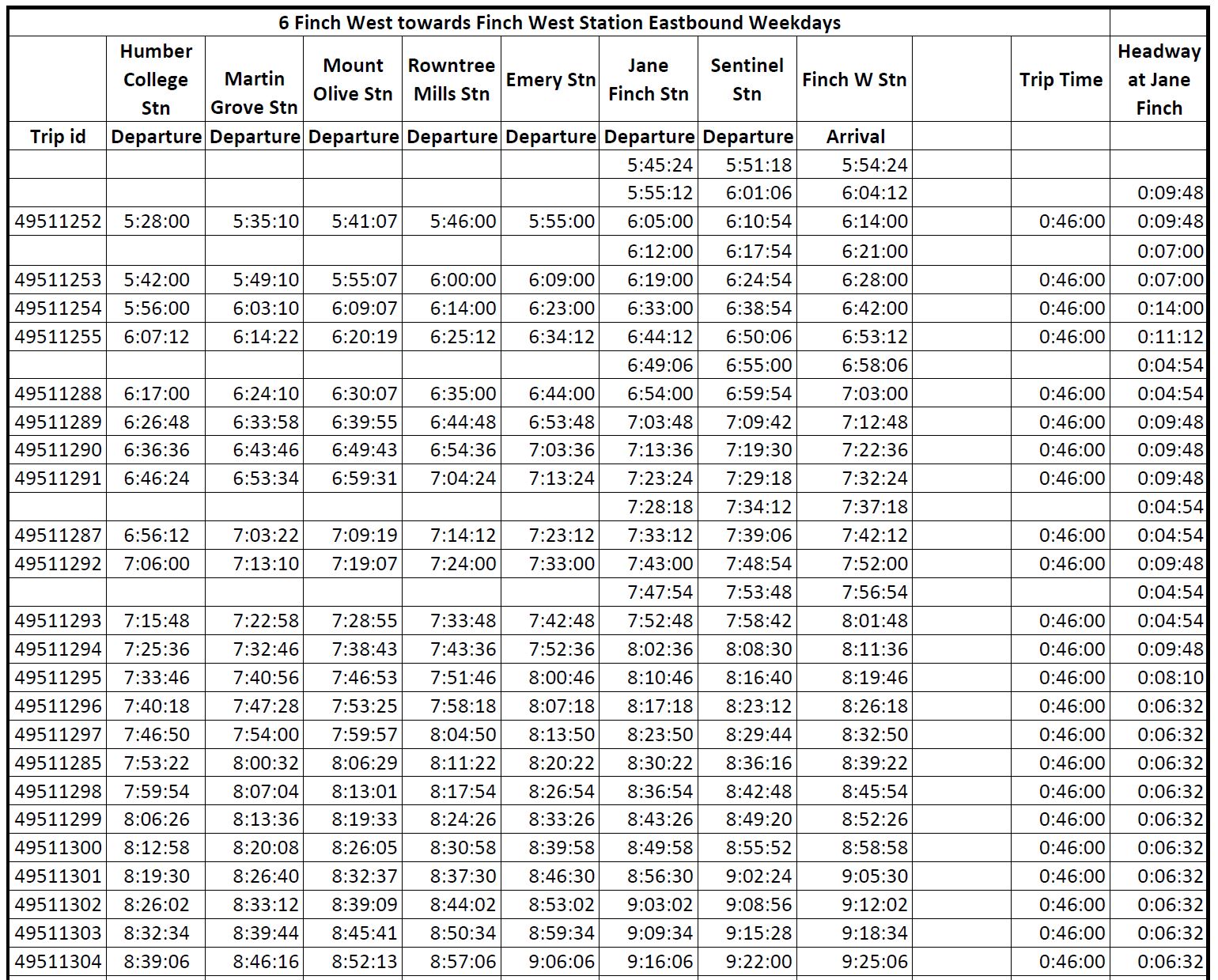
Because there is only one schedule design for a 46 minute trip time all day, the scheduled speeds are the same for all trips. An obvious question is whether the TTC will force cars to hold to this schedule even if it proves excessive thereby delaying riders needlessly. Conversely, if cars operate at whatever speed conditions will allow, there will likely be terminal congestion just as on streetcar routes with excessive scheduled travel and recovery times.
The tables in this file show the spacing between stops, the scheduled time and the speed in kilometres per hour. Speeds vary over the route, and they average 13.53 km/hr. This does not include terminal turnaround time.
There is a particularly slow section at Jane-Finch both ways implying that provision has been made for a delay on every trip. I will inquire of TTC why the slow operation (8.2 to 8.6 km/hr) applies there.
The average speed is slower than the 36 Finch bus during some periods, a rather poor showing for a rail line on its own reserved lane. In a future update, I will include more information about the stop level schedules and speeds for the 36C Finch West Bus. Here is the current scheduled service summary.

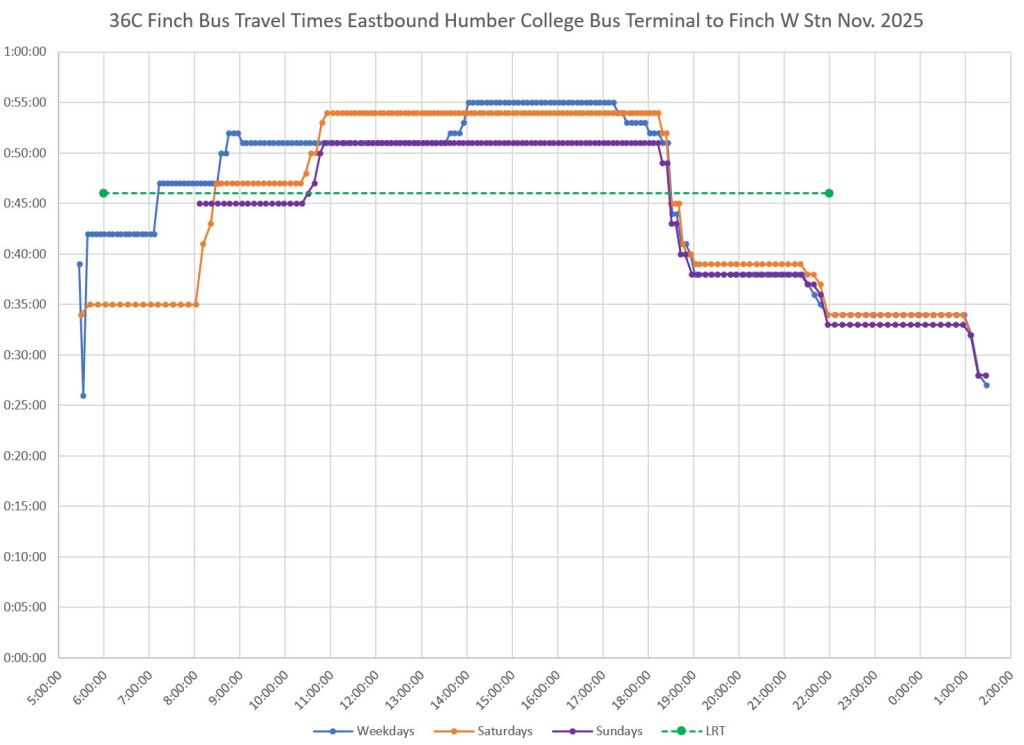
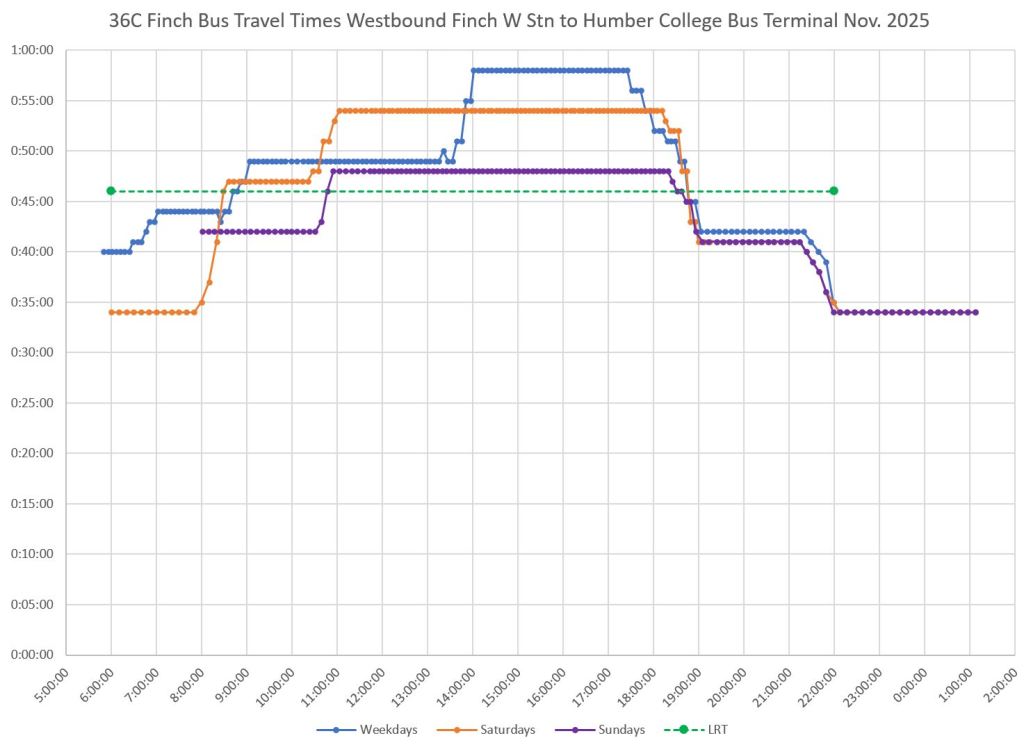
Comparative Scheduled Travel Times for 36C Finch West Bus an 6 Finch West LRT
The charts below compare the scheduled travel times between Humber College Bus terminal and Finch West Station with the planned 46-minute trip time of the LRT service. The LRT is faster than the bus notably on weekday and Saturday afternoons, but slower in the early morning and evening periods.
This post will be updated with early operating results and vehicle tracking information once they are available.
 Steve Munro
Ouch. What was in the EA? 21 km/hr? 23 km/hr?
Unbelievable. What’s the Waterloo ION speed?
Steve: Higher, but they have TSP that really works, and are not afraid to cross intersections at faster than a walking pace.
LikeLike
So let’s see… if the GTFS schedule really is accurate:
– At most times of the day, the service is slower than the local bus it’s replacing (let alone if there was an express bus on Finch West), and runs less often.
– If the Line 6 travel times really are the same all day, the travel speed in the evening will only be about 75% to 65% of the 36C that runs now.
– The local bus runs every 5-6 minutes during the afternoons on weekends… when Line 6 opens, it’ll barely be every 10.
– The 12’15” headway at night and on weekend afternoons means Finch West will no longer be be part of the frequent service network (except maybe on the remaining bus section between the two branches of the subway).
Hopefully the travel times are really as conservative as they appear, and there’s room to speed up service and use the reduced running time to increase the frequency. But presumably the scheduled travel times aren’t just invented… there’s been plenty of time during the testing period to figure out what a realistic round trip time should be…
This is a repeat of what the Flexitys did to service levels on the streetcar routes following the retirement of the CLRVs… and looks similar to what I’ve seen with the Line 5 testing in Scarborough.
LikeLike
With the 2026 municipal election season within our grasp, it is astounding that incumbents are going to allow new LRT services to come into service operated as slow, or slower, than the bus routes they are replacing.
And then there is the slow-moving Scarborough Busway project that will open in “late 2026,” likely after the election.
Somebody is going to use all of this to their political advantage, regardless of whether they are truly pro-transit or not.
Steve: It is overdue for the TTC Board to read the riot act to management (both TTC and City) on this sort of crap, but of course management can do no wrong. There will be a lot of finger-pointing between TTC, Transportation Services and Metrolinx. And the subway jocks will say “see, we told you so”.
LikeLike
There are some weird times between certain stations. No time between the Humber College terminal and Martin Grove, yet a whole 13 minutes between Martin Grove and Kipling (Mount Olive)? And another 5 minutes to go one stop to Islington (Rowntree)?
Looks like there’s far too much padding here.
LikeLike
Is that really true that the last trips in both directions are only at 9:49 pm? Late night serivce will be provided by the old reliable Finch West 36?
Steve: That’s the “soft opening” the TTC talks about in their announcement. Extra time so the maintenance people can fix things.
LikeLike
Schedule padding is the great TTC tradition. Paying drivers to drive slowly or ever better to do absolutely nothing.
My offer to the TTC board is still open. Hire me for a day and I will fire all of your incompetent managers on the spot.
LikeLike
I note that the TTC is finally using the 24-hour clock. Is this a sign of things to come or a Metrolinx influence?
Steve: Neither. This is data from the scheduling software which uses a 24-hour clock. All GTFS data takes this format because that is an industry standard. By the time you see this in a public-facing timetable, it will be in 12-hour format.
LikeLike
These might just be made up numbers that someone generated on their computer because you need to feed “something” into Google Maps for Google to be able to calculate transit directions for users.
Steve: No, I don’t think so. If they were just “made up”, there would probably not be such variation in scheduled speed along the route.
LikeLike
I have a feeling that these travel times are also a part of the “soft opening” period. Not strictly because they are necessary but for risk management as this is an almost entirely surface level LRT line launching in Winter where there may be an increased risk of automobile incursion due to snow and ice on the road. I suspect the speeds may increase and runtimes decrease once out of this “soft opening” period in the spring.
LikeLike
I wonder why there is no difference in time shown between Humber College station and Martin Grove Station?
This sucks. I’ve used Miway express bus routes that have excessive running times and it’s really annoying sitting on a bus that lays over every other stop to stay on schedule.
I hope the slow section isn’t because the TTC has imposed a slow order to cross the switches.
Steve: This was an error on my part in copying data from a larger version of the table. The times eastbound at Martin Grove on weekdays have been corrected in the snapshot and in the PDF.
LikeLiked by 1 person
It’s worse. With the Flexitys they maintain at least 10 minute scheduled frequency at all times, even on 507 Long Branch. Here it drops to 12 minutes in the evenings.
I noticed the replacement service after 10PM isn’t included in this schedule.
LikeLike
Hi Steve,
Is the first Westbound Finch West LRT leaving Finch West LRT Station at 7:30 AM to Humber College LRT Station next Sunday? When I called the TTC Customer Service and they said that the first train is leaving at 7:30 AM heading towards Humber College LRT Station from Finch West LRT Station.
Steve: This does not match the info in the published GTFS schedule. I didn’t include every stop in the timetable included in the article, but the service builds up, of course, from the carhouse.
Eastbound pull-out trips show at Jane Finch at 7:47, 8:01, 8:15, 8:26, 8:36 and 8:52. The gap between the last two is filled by the first eastbound trip from Humber College which leaves there at 8:08 and gets to Jane Finch at 8:45.
Westbound pull-out trips show at Norfinch Oakdale at 7:33, 7:47, 8:00 and 8:26. The gap after 8am is filled by the first trip westbound from Finch West at 7:59.
I will check with TTC next week to verify that the first trip from Finch West really is at 7:59, and that the 7:30 time you were given is for the first trip westbound from the carhouse. If there has been a change, I will update the article.
LikeLike
Out of curiosity, what is the relative capacity of the buses and the LRTs with this schedule? Will things still be crowded? Also curious about other aspects of the operation – have they gone with single blades for switches, are we going slow over special works, do the grass sections have any impact, do we have the same anti vehicle infrastructure as on lakeshore…how does pretapping impact the 2 hour transfer window….
Steve: The LRVs have no published capacity in the TTC Service Standards yet, but they are bigger than the Flexitys on the “legacy” system. They have a seated capacity of 120 and in theory a maximum capacity of almost 300. In practice, this level of crowding is never achieved, and service is not designed on that basis.
TTC standard sized buses have a Service Standards capacity of 35 off-peak (seated load) and 50 peak. Current service on the 36C is every 5 minutes AM peak, 6 minutes midday and PM peak, 8 minutes early evening, 10 minutes late evening. Although the LRT headways are wider, the relative size of the cars more than outweighs this change. (These are comparisons you can do yourself from information in the article.)
As for grass, there is none on the 6 Finch route, only on 5 Eglinton. Switches on both routes are double bladed. Of course you would know this if you actually visited the route.
LikeLike
I could be wrong but the slower/longer timing at Jane Finch might be because of the junction to the entrance to the carhouse and they’re allowing for possible movements in and out of there. It could also be due to dwell time for Jane buses receiving and offloading passengers – I remember there being a lot of bunch ups there when I lived there.
LikeLike
How much of this schedule is interim, and what are the chances that by February or so they’ve shaved some minutes off this.
Regarding Waterloo:
Perhaps TTC/Metrolinx should surrender and put crossing gates as well.
Though with no switches or intersecting tracks at intersections, is it really walking speed? Streetcars certainly don’t proceed at walking speed through straight intersections with no trackwork if they don’t need to stop (though invariably they do need to stop). Are they supposed to?
Steve: No. The slow order applies only to special work, but there’s a lot of that downtown, hardly any on Finch or Eglinton. Crossing gates? Even with a 6 minute headway each way, they will be down a lot of the time.
I’ve spent much time walking and driving across, and along the Eglinton section outdoors. And I had no idea what switches they use. Hard to even see – though I don’t drive a high-riding SVU. Though the grass is pretty obvious.
Steve: They are easy to see from a passing bus, and visible in Google Street View: Finch and Eglinton.
LikeLike
Steve: The average speed is slower than the 36 Finch bus during some periods, a rather poor showing for a rail line on its own reserved lane.
This is in spite of the fact that the bus runs in heavy traffic and the streetcar has its own lane. So for billions of dollars wasted on this, this is what we are getting:-
(1) Slower transit vehicles (streetcars).
(2) Longer headways.
(3) Slower traffic due to valuable lanes reserved for streetcars.
A bus rapid transit would have worked out much cheaper and better, look at York Region for example where they have heated bus stops too but for tens of billions of dollars wasted on the Finch and Eglinton streetcar lines, people will be left waiting out in the cold. Sorry to say this but streetcars won’t get people out of cars, we have wasted tens of billions of dollars only to get even worse transit.
Steve: You’re not paying attention. Some periods, not all and specifically not during the periods when traffic is a real problem.
LikeLike
I do not have direct experience managing transit systems but I do have experience with large organizations. It is very likely that the current schedule was developed a long time ago before timing information from test runs was available and there has been no pressure to update it.
That said, it also seems very likely that the off-peak trip times will be reduced fairly quickly and I believe that will automatically improve headway as long as the number of trains in use remains constant.
The fact that the current schedule is slower than buses in off-peak hours but not in peak hours suggests strongly that the issue is just that bus schedules have been updated to reflect reduced traffic during off-peak while the LRT schedules have not.
LikeLike
Hi Steve,
I’ve been poking my head around Darwin O’Connor’s Transsee, specifically around route 806 (the internal number for the Line 6 evening shuttle bus). On every round trip I could find, it appears that it’s scheduled to run like this:
(806): Finch West Station-Humber College (stopping only at the LRT adjacent bus stops)
(? – possibly 37S Islington): Humber College-Humberwood Loop
[Terminal time]
(?): Humberwood Loop-Humber College
(806): Humber College-Finch West Station
[Terminal time]
Seeing as this is based on the GTFS schedules, has anything been announced? This seems to be loaded to start every evening from Dec 7 onwards.
Steve: There has been no announcement about the late evening shuttle bus beyond noting that it will operate. I’m waiting to see what info is on the TTC’s website once they cut over the Dec 7 route descriptions.
The info for December 21 is included with the November changes, but there is nothing regarding Line 6 related updates. I have not published the info yet to avoid confusion between sets of changes on different dates, and other than the new GTFS files, TTC has not published an updated service memo either.
LikeLike
Apologies for double posting, but I’m more confused now as this was not announced with the November board. It seems like the route of Humber College-Humberwood Loop-Humber College will be part of the 37 Islington (for now?). Except for the very early mornings where I take it the 336 will cover, there’s service every 10 minutes on the 37S, with additional service coming from previously announced 37A service on its existing headways.
Don’t know if this is being run on the divisional level pending an official announcement with the December board. I don’t know what garage will provide for the daytime 37S shuttle, all of the 806/37S combo trips come off existing all day runs from Arrow Road’s routes.
For context, this is the departure board for the 37 Islington at Humber College.
Steve: The change in 37 Islington is included in my article about the November changes. Not sure what you mean about it not being announced.
LikeLike
Apologies for the confusion. You’re right Steve, the extension of the 37A Islington via Rexdale Blvd from Humberwood to Humber College was indeed announced as part of the November board. However, the 37S short turn service (which is supposed to run every 10 minutes from Humber College to Humberwood only all day and evening long, in addition to the baseline 37A via Rexdale Blvd) was, at least to my knowledge, not previously announced.
Looking at Transsee today, while the normal 37A/37B trips are trackable, the 37S trips only show up as “schedule based”.
Steve: Yes, and that interline between the 806 and 37S was not announced.
LikeLike
I was surprised by the number of doors (7) and how far back the doors are in the front cab, which feels like it will slow down egress. Similar Citadis vehicles in 45m+ configurations in Europe seem to have 8 more evenly distributed doors.
LikeLike
Thanks for the great analysis as always Steve! Do you expect the line to get faster / either with faster speeds going through intersections or otherwise as the line gets into service? Or is your sense of TTC management they won’t budge on intersection crossing speed and slow zones on Finch?
I suppose whether TSP is fully utilized is anyone’s guess.
Thanks!
Steve: I fear that only political pressure will force improvements, and there will be a lot of finger pointing between agencies about why things “can’t be changed”.
LikeLike
Regarding the previous discussion about timetable updates effective December 7 – an updated Service Summary has (surprisingly?) been posted on the TTC’s transit planning page. It reflects the changes for Line 6, as well as routes 36, 37S shuttle and “806” late evening replacement bus.
Steve: Thanks for catching this. Normally new Service Summaries take weeks (and a reminder or two) to show up online. I will do a brief update for readers about this.
Operation-wise, I think the lack of transit priority is not even the major issue on this line. The vehicles are slow moving even between stops without any apparent reason. I wouldn’t be surprised if this is the TTC’s institutional paranoia about “safety” I tried to ride the line yesterday evening- I gave up after two stops and went back.
Steve: I rode today, and my westbound trip took 55 minutes after sitting for nearly 10 on the platform at Finch West. The eastbound trip took 46 again after a generous layover at Humber College.
Sadly, unless major operational changes are implemented to speed it up, I think this line will be the death knell of LRT in this city. People are already complaining that the LRT is slower than the bus it replaced and the media has already picked up the story as well. So whatever public support there was for LRT as a viable mode of transportation, I suspect it will be crumbling pretty fast.
Steve: If the TTC and Metrolinx had set out to deliberately sabotage the LRT concept, they couldn’t have done a better job. All the BS about a “soft opening” is an excuse to ignore things that are badly planned or just don’t work. They have had months to catch all of the problems, and chose to do nothing.
LikeLike
I was there midday on opening day, and I am devastated for the community this line will ‘serve.’ It took 55 minutes per trip, both ways (longer wait period at FW Station as compared to departing HC). Aside from the segment from Islington to Kipling (which felt like flying in comparison), the crawl across the rest of the line was real. Ridership was extremely high (with plenty of people boarding / alighting at various stops), which is certainly good; but speed was abysmal. The “connection” between Finch West subway station and the LRT platform makes Spadina’s walk look purposefully planned. I do not see how Line 5 will run on time with faster tunnel travel speeds and crawling surface speeds. How will service be maintained across this line? Why is Toronto uniquely incompetent in this regard? I sincerely believe the TTC would have done a better, cheaper, faster job on its own. I believed in Transit City, but this city can’t get anything right.
LikeLike