
At the September 4 meeting of the TTC’s Strategic Planning Committee, the desire to make some system improvements at no net cost led to some Board Members musing on discontinuing unprofitable services or shifting resources from “downtown” so that Scarborough, allegedly underserved, could get more frequent buses. This came from TTC Chair Jamaal Myers who forgets at times he is in charge of the Toronto Transit Commission.
It is one thing to argue for better transit service — more frequent, more reliable, less crowded — but this should be based on facts.
A proposal that surfaces from time to time in discussion of service standards is to improve the maximum headway on TTC routes from 30 to 20 minutes. An underlying assumption is that this will primarily affect the suburbs, but this is not the case. Many routes across the city, including the old “downtown”, have periods of infrequent service that such a change would affect.
The table below shows all routes, or route segments, operating less frequently than every 20 minutes where a policy change would demand better frequent service.
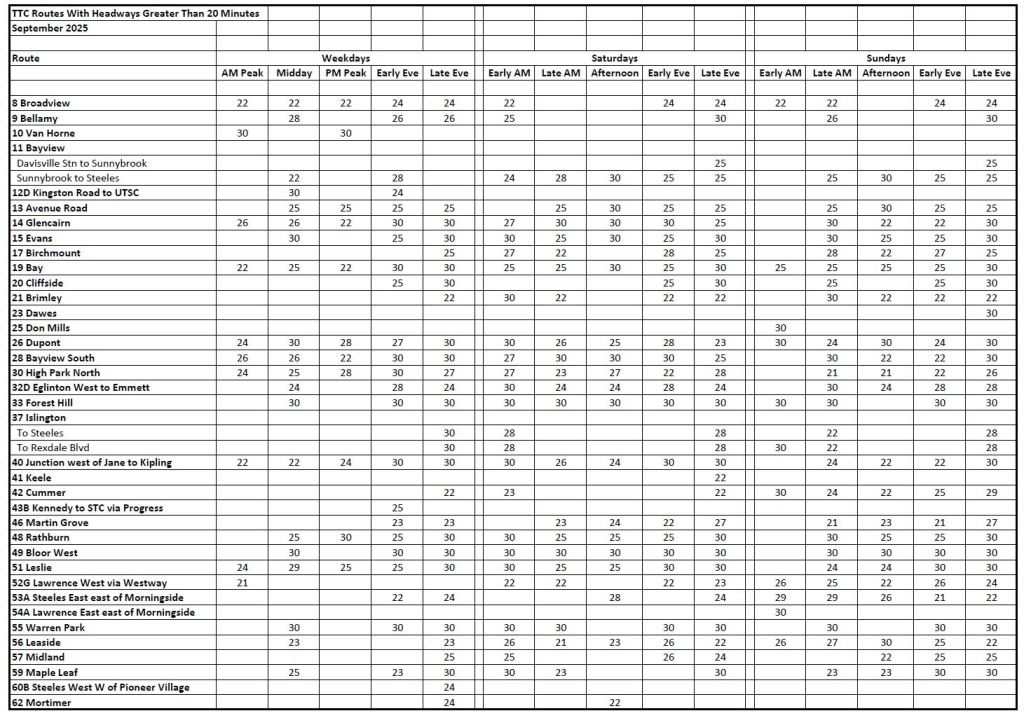
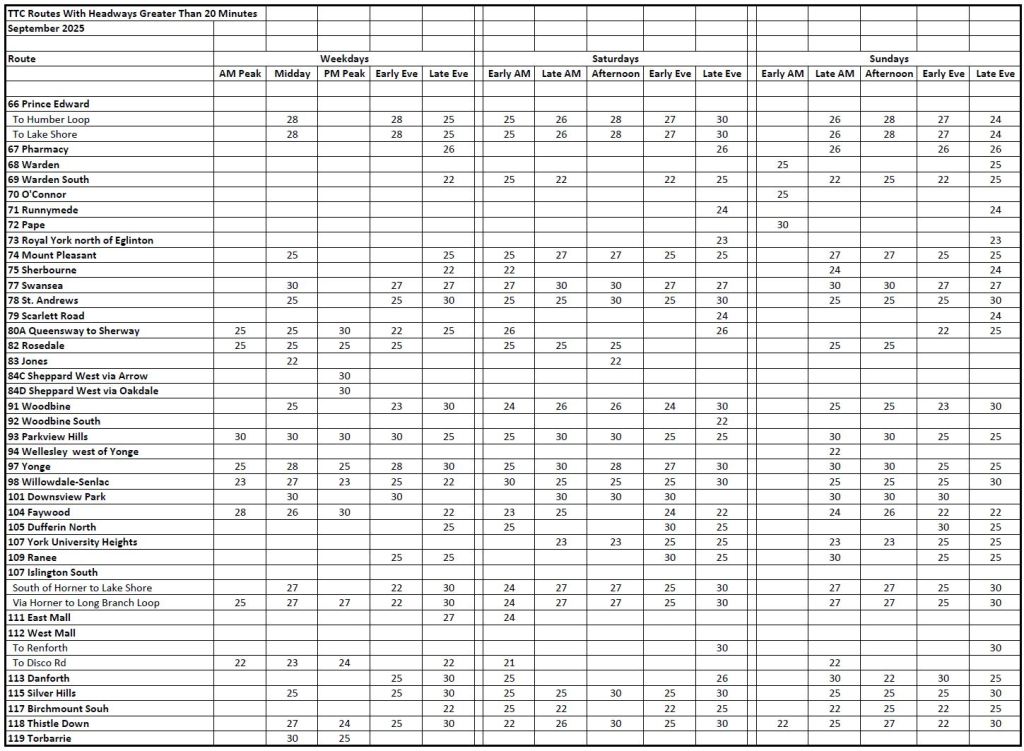
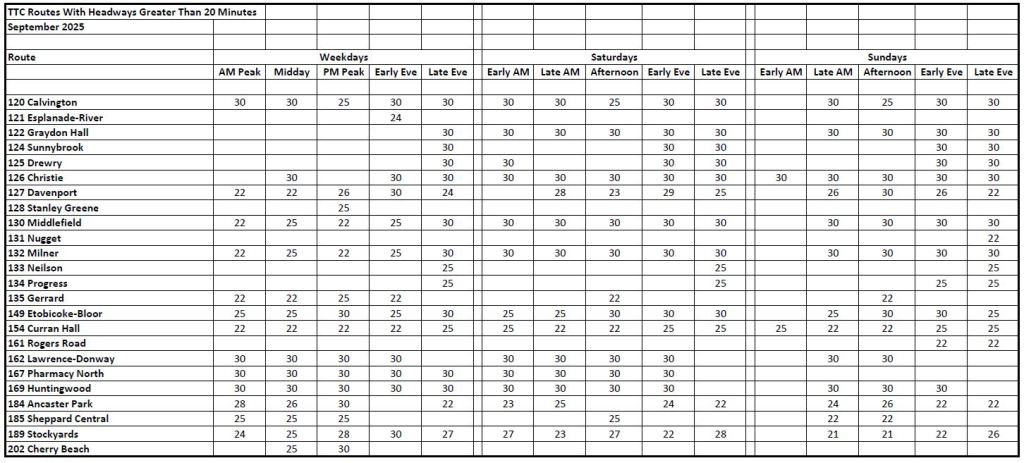
If the desire is to run more frequent service across the network, such a proposal should be balanced against the effects of any offset. For example, elimination of the 10-minute network would affect not just routes downtown but many routes in the suburbs. Is this a good policy choice, or is the real target the supposedly excess service “downtown” gets?
Pitting one part of the city against another is no way to lead an organization like the TTC, especially when the scheme is not well thought-out. There is no question that as Toronto’s network grew, the suburbs did not get their fair share of improvements. In part this was due to later development compared to the old city, and part to density, road patterns and a car-oriented philosophy. Transit has still not caught up, and needs more than a few subway lines to support stronger transit demand.
That said, the way to correct the inbalance is not to pillage the already-dense parts of the network for resources or to assume that every route in “downtown” has frequent service that can be trimmed.
 Steve Munro
The TTC needs to run parallel buses next to and following the subway lines, AT THE SAME HEADWAYS as the subway lines. This would provide accessible access whenever the single accessible elevator is inaccessible due to maintenance or mischief.
The 97 YONGE bus parallels Line 1 is a such a candidate for improvement with its headways to start with. Currently the 149 ETOBICOKE-BLOOR (running between Kipling and High Park Stations) needs to be extended across the entire length of Bloor Street and Danforth, paralleling Line 2.
LikeLike
Probably the thing that most stands out to me about the decline of Toronto bus service is the fact that the Bay bus only runs every 22 minutes ??! during rush hours. It wasn’t that long ago when it ran every 2 minutes. How is the TTC going to absorb all the employees being ordered back to the office by managers who worry that perhaps they’re not needed if people can do their work at home?
Steve: The Bay bus has been in a long decline primarily because of the traffic snarl at the south end of the line, but also due to shifts in provincial employment. The main destination for AM peak riders used to be the stops near Wellesley serving government offices, and some of those offices are now closed for renovation or demolished. When it was a trolleybus, there was a short turn north of Dundas because full service was not needed further south.
I don’t see this route as a primary way to get people to the business district, and certainly not on the current headway.
LikeLiked by 1 person
I find Chair Myers’ posturing through a zero-sum approach of surface transit to be silly. In the modern landscape of transit commutes that span across the city, it seems ridiculous to assume that your constituents’ transit needs will inherently be improved through diverted service to your local area. As one of his constituents, I hope the chair recognizes the solid service that exists in Scarborough, with a bulk of the express network within our borough’s borders. It doesn’t make sense to me to be happy that my bus at home comes 3 minutes quicker, if I have to wait 5 minutes longer for a streetcar downtown.
LikeLiked by 1 person
One way to improve low-frequency service at no net cost would be stop running services on 28 or 27-minute headways, and run them at 30-minute headways instead. Sure, average wait times would increase by as much as 90 seconds – but it means buses would come at the same times past the hour.
I’d rather know that a bus is coming at 9 and 39 minutes past the hour than have to look up the schedule to save me 90 seconds of wait time.
I know on paper, 27 minutes makes the service more “efficient” because dwell times are lower. But with the cost is the same, because you have the same number of buses and drivers operating over the same service span.
LikeLike
Ever since COVID, the dwell times at terminals have increased drastically. I understand the need for drivers to have a washroom break but by cutting this down, you can have more frequent service with the same number of vehicles.
Steve: This is not specifically a Covid change, but one that was introduced by former CEO Rick Leary in an attempt to cut down on or eliminate short turns, and improve on time performance stats. However, the padding of schedules is wasting vehicles on some routes. This is not, however, the case everywhere because I still encounter schedules that don’t have enough time in the course of my route analyses.
LikeLiked by 1 person
Serious question, Steve.. how do you improve any bus route without figuring out how to improve the gridlock first in the city of Toronto.
Steve: Many routes do not have gridlock most of the time. The TTC manages to screw up service on holidays with no traffic and no inclement weather thanks to buses and streetcars that do not maintain even spacing. They have used “congestion” as a “get out of jail free card” forever rather than addressing what is needed to manage reliable service. Of course there are routes and periods that are totally screwed up, but far from all routes all of the time. They don’t even manage to provide reliable service on the all night network.
If we wait for gridlock to be “fixed” we are ignoring the improvements possible from better route management and improved service frequency so that buses are not delayed by crowding with passengers pushing their way on and off of vehicles.
LikeLike
Scarborough is he way it is because of decisions made for decades by the government of Scarborough. Since the forced amalgamation Toronto has been forced to expend time, money, and energy on fixing the problems that Scarborough made for itself. I’ve lived there and worked there and can attest that if one is not driving, it’s rather horrible to get around. Not Mississauga horrible, but nasty. But the idea that the people who live in other parts of the city should be forced to suffer is the most miserable, idiotic, short-sighted thinking one can imagine.
And, not be to churlish, but we’re spending $8 billion on the Rob Ford Memorial Subway to Nowhere That Will Provide No Significant Bennefit to Anyone to fulfill Scarberia’s demand for Subways! Subways! Subways! It seems that it’s Scarberia that owes the rest of the city money.
LikeLiked by 1 person
Yes, the Suspect Subway Extension (Version III?) is gobbling a lot of capital at great cost vs having explored a busway spine on the Gatineau Hydro corridor, including semi-express buses to many places like UofT Scarborough and the Hospital etc. The relative sprawl of older suburbs, now with more built form further out, is costly to service, and density matters to our bottom line, though these relatively sprawled areas tend to outvote the core, including 905. Oop$, and no, we can’t go to a mall and buy a new climate.
LikeLiked by 1 person
Steve. How much would it cost to extend the Scarborough subway from Sheppard to Steeles? A subway can transform Steeles Ave East with the Milliken Go Station nearby.
Steve: Such an extension would be about 4.5km long. Depending on which number you believe, the current 8km SSE will cost anywhere from $5-$10 billion or from $600m to $1.25b/km. The higher value includes future operating costs, but the lower one does not include a lot of construction costs.
Metrolinx, as quoted by Global News, says:
The source for this info is the Metrolinx June 2025 Rapid Transit project update in the table at page 4.
FYI the “extra track” east of Kennedy is for turnback operations so that only half of the peak period service would run north of that station. The planned fleet is sized on that assumption. An extension will require further trains and associated storage.
LikeLike