
At the September 4 meeting of the TTC’s Strategic Planning Committee, the desire to make some system improvements at no net cost led to some Board Members musing on discontinuing unprofitable services or shifting resources from “downtown” so that Scarborough, allegedly underserved, could get more frequent buses. This came from TTC Chair Jamaal Myers who forgets at times he is in charge of the Toronto Transit Commission.
It is one thing to argue for better transit service — more frequent, more reliable, less crowded — but this should be based on facts.
A proposal that surfaces from time to time in discussion of service standards is to improve the maximum headway on TTC routes from 30 to 20 minutes. An underlying assumption is that this will primarily affect the suburbs, but this is not the case. Many routes across the city, including the old “downtown”, have periods of infrequent service that such a change would affect.
The table below shows all routes, or route segments, operating less frequently than every 20 minutes where a policy change would demand better frequent service.
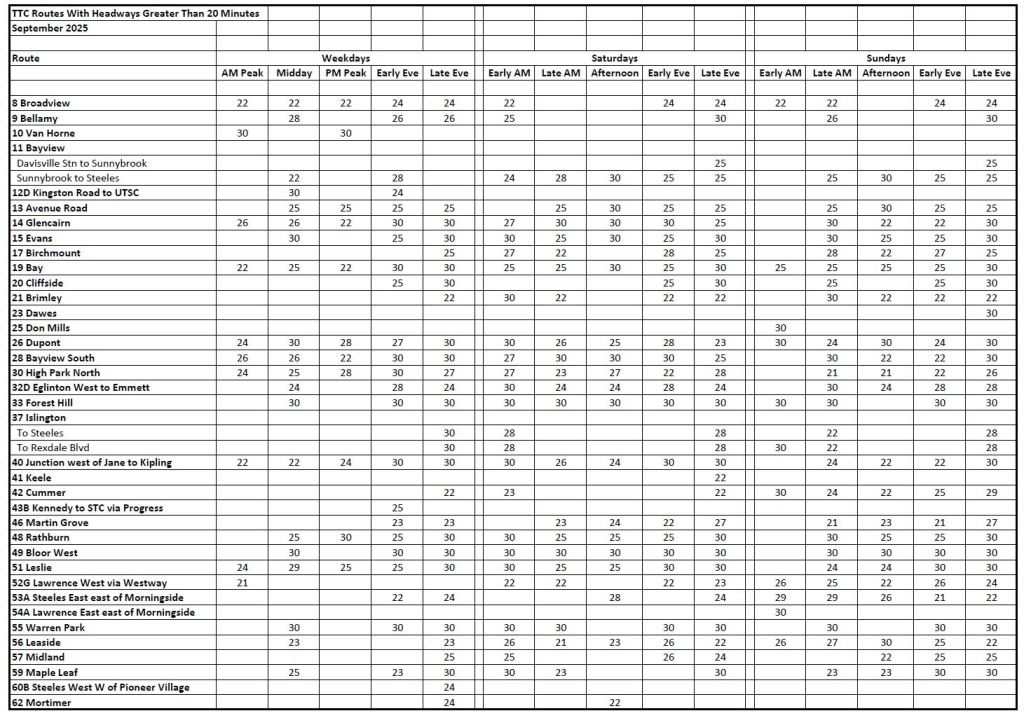
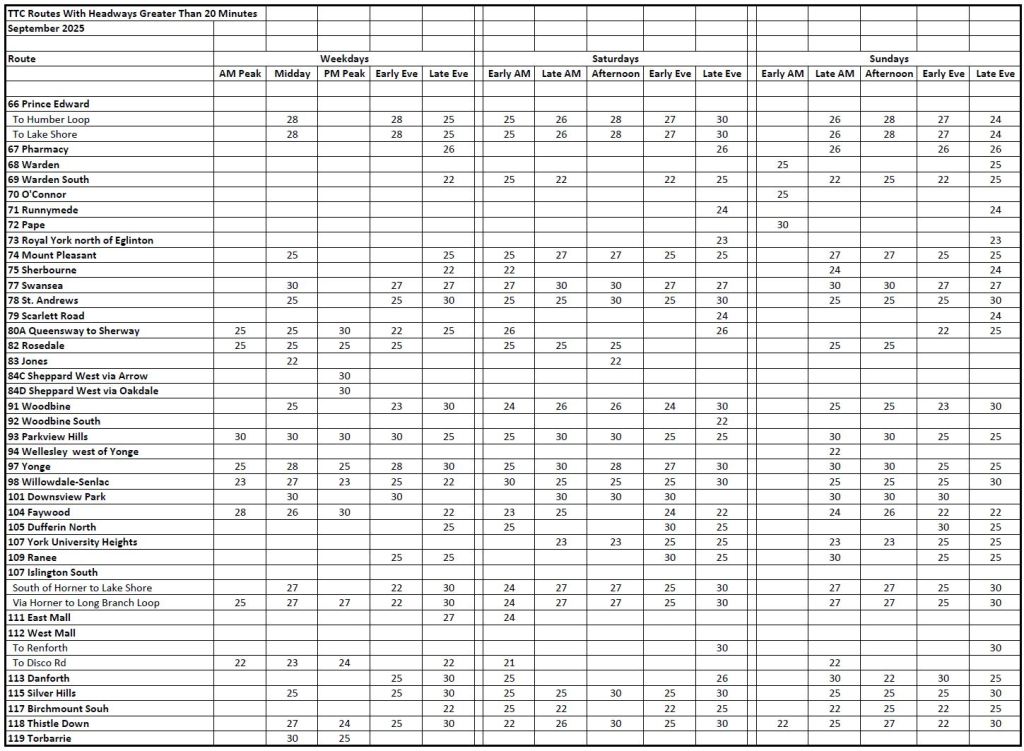
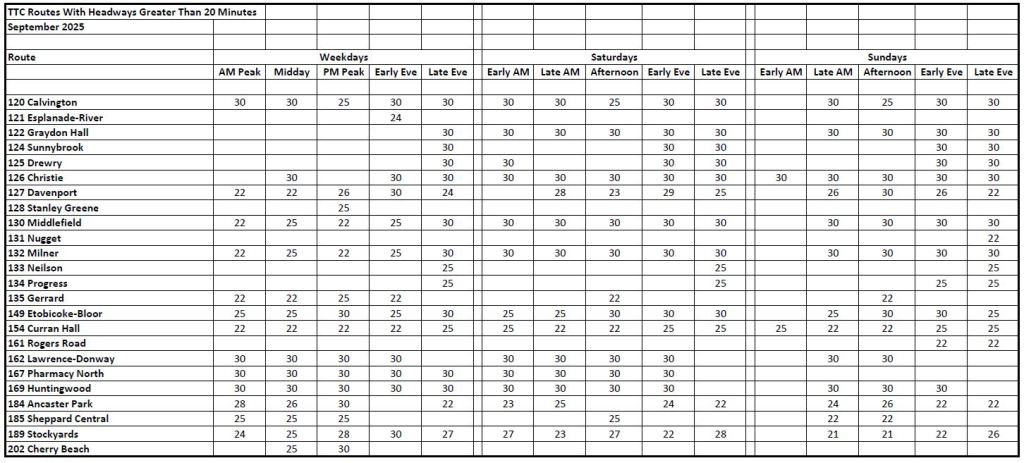
If the desire is to run more frequent service across the network, such a proposal should be balanced against the effects of any offset. For example, elimination of the 10-minute network would affect not just routes downtown but many routes in the suburbs. Is this a good policy choice, or is the real target the supposedly excess service “downtown” gets?
Pitting one part of the city against another is no way to lead an organization like the TTC, especially when the scheme is not well thought-out. There is no question that as Toronto’s network grew, the suburbs did not get their fair share of improvements. In part this was due to later development compared to the old city, and part to density, road patterns and a car-oriented philosophy. Transit has still not caught up, and needs more than a few subway lines to support stronger transit demand.
That said, the way to correct the inbalance is not to pillage the already-dense parts of the network for resources or to assume that every route in “downtown” has frequent service that can be trimmed.
 Steve Munro