
In previous articles, I have tracked the evolution of subway segments where Reduced Speed Zones (RSZs) are in place since February 2024. Recent comments in other articles suggest that readers have not been following this.
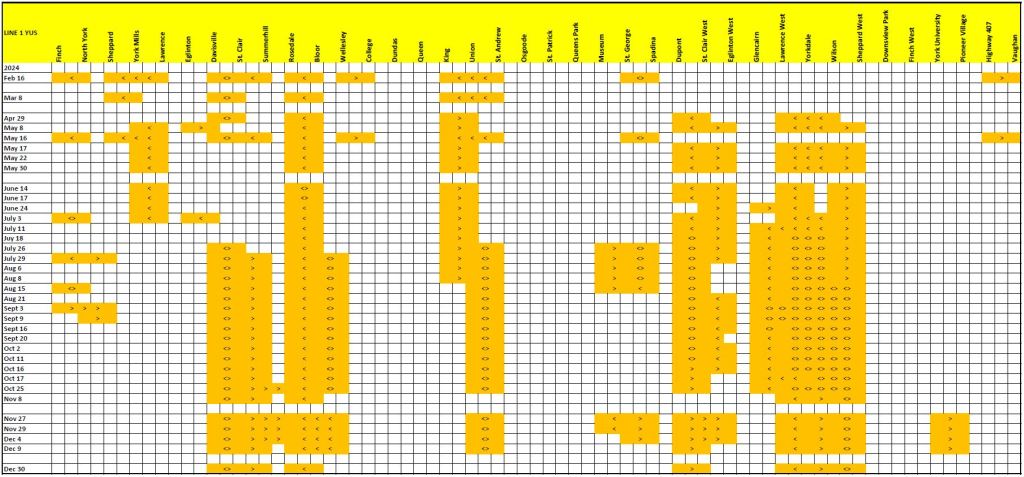
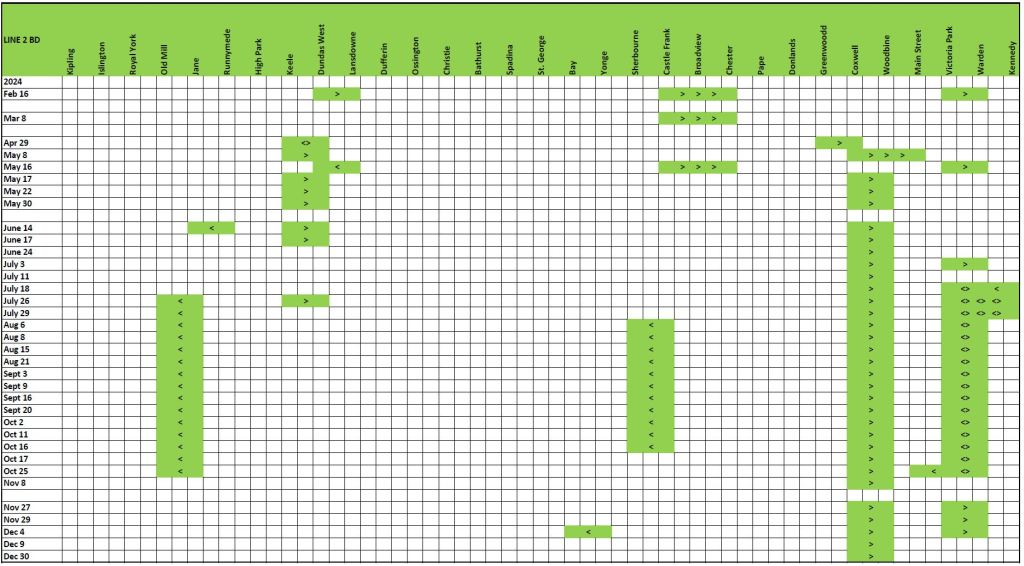
Here are updated charts showing areas where speeds are or have been restricted on Lines 1 and 2.
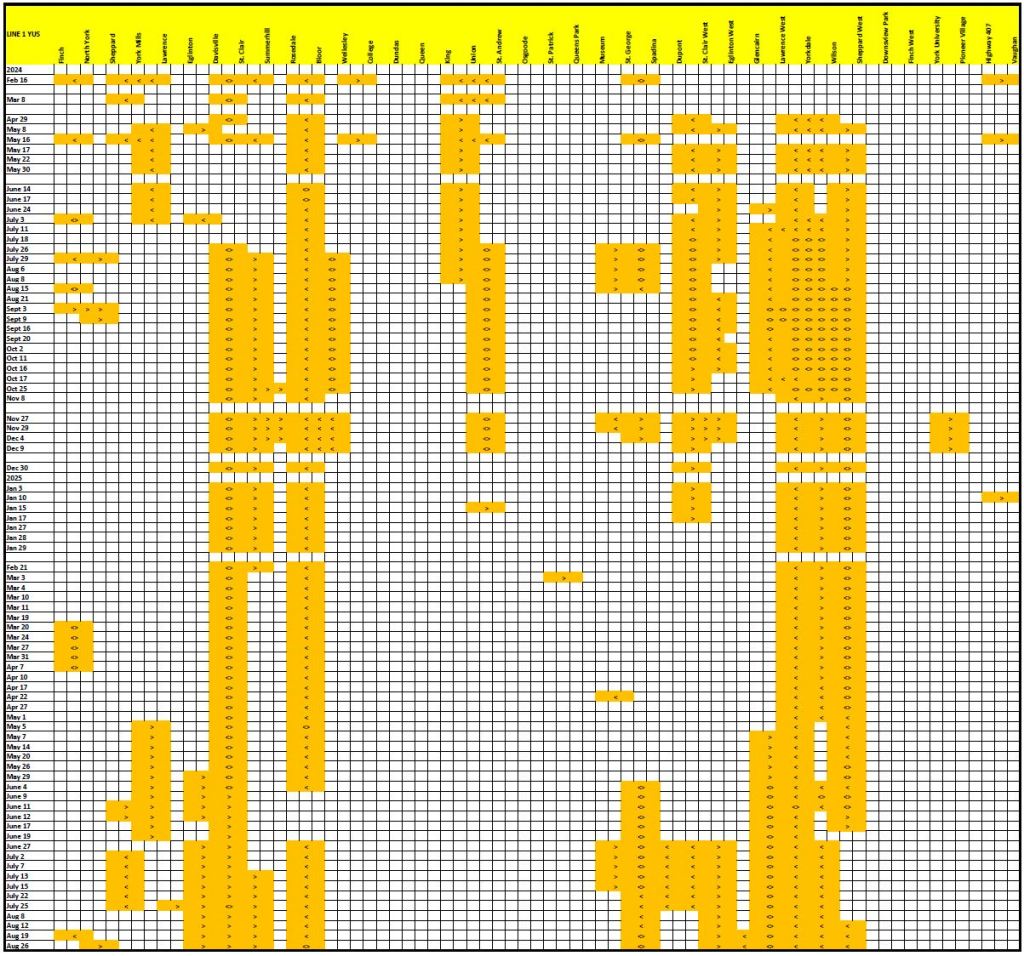
The charts on the left are for 2024, while those on the right show 2025 with a gap at the top where I did not check for about a month. The longevity of the RSZs can be clearly seen in the length of more or less continuous coloured vertical bars notably on Line 1 between Eglinton and Bloor, and north from Eglinton West to Sheppard West.
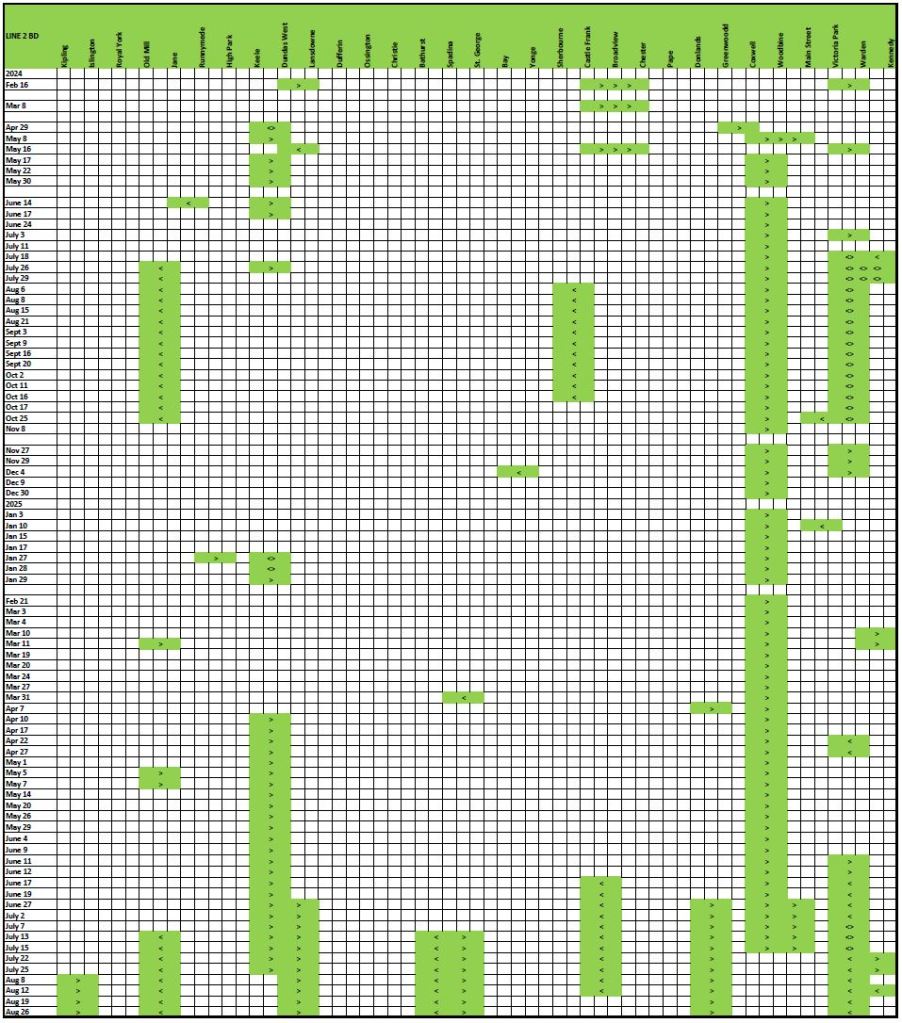
The coloured areas show where RSZs were located, and the arrows show the direction with “<>” meaning “both ways”.


Tables with location details and expected times to repair taken from the TTC’s site are below. Note that in previous versions, many of these sites were expected to be repaired in August, but the target dates have been adjusted.


At the request of a reader, here are the Line 1 and 2 charts condensed onto a single page for each line so that the year-to-year continuity of problem areas is more obvious.
 Steve Munro
Am I reading this correctly? Some slow orders have been in place since early 2024? If that’s accurate, you could make the argument that the TTC has given up on maintenance, let alone repairs. That’s nuts.
LikeLike
As someone who works in an area of the financial industry that regularly has internal and external audits, I appreciate the comments you have made in reply to comments to other recent articles about this; when you really start digging into a place where there are obvious surface issues and risks have either not been identified, or they have, but have had few if any controls to identify them, you have to dig further, and the further you dig, the more surprising and ineffective you find has the organisation been responsible about their role.
It’s almost always because the organisation has been on autopilot for a whole generation of employees, and in many cases decades behind. You are the disruptor we need here to upset this status quo and point at obvious things to yell out “this isn’t normal!”
LikeLike
Hi Steve,
Would you be willing to consider consolidating the ’24 and ’25 charts into one for each line?
Just delineate the start of the new year with a bold line or similar.
It’s hard to compare the extent of a slow zone over both years when it’s plotted over two images – important when those of importance are impatient.
Thanks for the great work!
Steve: I will have a look at this. The problem is that there are so many lines over two years that the image will be compressed, but, yes it will show the continuity.
The single page versions of the charts are now included in the article.
LikeLike
Is the one from Bloor Yonge to Rosedale and Yorkdale to Lawrence west permanent?
Steve: They are certainly showing no sign of leaving.
LikeLike
Will there ever be zero slow zones or is that impossible?
Steve: Zero might be a stretch, but the idea that a zone can exist for many months really has to end. This will probably involve some painful work of major reconstruction with shutdowns.
LikeLike
Do you have any insight into the ‘categories’ of the problems? Some are obviously on outdoor sections and weather may be a cause, some may be due to drainage problems underground and I assume these kind of ‘track base’ problems would have different solutions than those on the rails themselves at corners or at special trackwork. There was certainly discussion several years ago (under Byford) about rebuilding the rail base on the open air sections of the Yonge line – involving lengthy closures – but, as far as I remember, nothing major was ever done.
Steve: No, beyond the discussion in Byford’s era, I do not have further information. This is the sort of thing management should be providing, and the Board demanding as it represents a future risk to the ability to run service.
This is the legacy of years of low-balling the capital budget to fit within the Tory-Leary low tax increase era, coupled with diversion of millions to Tory’s pet project, SmartTrack.
LikeLike
To add salt in the wound, a slow zone that was finally lifted, is put back in again weeks/months later. The NB stretch between Wilson and Sheppard West is a good example.
If CN/CP rail can get miles of track work done I. A matter of days and lasts for years, but the TTC can’t, what does that tell you.
Some slow zones are already 8 months old and counting. This is clear neglect.
LikeLike
What’s concerning to me is the number of zones that last for several weeks, then apparently are resolved, only to be reinstated a few weeks or months later. It suggests that the remedy to whatever caused the RSZ in the first place was either temporary or inadequate. Or that another issue has arisen that wasn’t initially detected.
LikeLike
Is it normal for a slow zone to be on for almost two years and they still haven’t fixed it or unless it’s very bad that it takes them this long to fix it.
Steve: In some cases the work to repair would be complex and would require an extended shutdown. In other cases, I suspect it’s a lack of priority and, by implication, budget.
LikeLike
Is the one from Eglinton to Davisville considerd a long standing Slow zone or no.
Steve: Very long. This has been a problem area on and off going back to at least 2018.
LikeLike
How come line 2 doesn’t have any long lasting slow zones only line 1 does?
Steve: Line 2 has far less trackage out of doors. Some of the repeat locations on Line 2, notably east from Victoria Park, are in the open.
LikeLike
In your opinion which slow zone do you think impacts peoples ride the most?
Steve: The two long ones on Line 1 south of Eglinton to Bloor, and south of Sheppard West to Eglinton West.
Please stop posting single questions under different supposed userids. So far you have appeared as “Kyle, Mark, Daniel, Donald, Faraz, Unger and Alice”
LikeLike
I just returned from a vacation in Iran. The Tehran subway system is vast, super clean, and very fast. The TTC should send a delegation to Tehran to study how to operate a modern subway system.
Steve: And who pays for this system? Likely the central government, not the local taxpayers.
LikeLike
Are you the person that made the chart on the reduced speed zone that are on the network and are you the one that update it everyday?
Steve: No, the TTC does that. I extract info about once a week to build my cumulative charts.
And again, stop posting under a different name with one line questions. I will no longer answer them. You are behaving like a very badly trained bot.
LikeLike
Steve they fixed the long lasting slow zone around Davisville after more then a year.
Steve: I plan to make an “inspection tour” to compare the claimed recent changes in slow zones with actual conditions.
LikeLike
Steve the section from Bloor Yonge to Rosedale is slow but how come the ttc does not put it on the list.
Steve: I know, and have checked it a few times to verify that it was not recently fixed. I plan to ask the TTC about this tomorrow.
LikeLike
The one from Yorkdale to Lawerence west is very long lasting I wonder when they will fix it ..
LikeLike
I hate to break it to everyone but TTC has very little intention of addressing this issue soon.
There is going to be more slow zones to come.
LikeLike
Steve finally they actually fixed the slow zone from Bloor Yonge to Rosedale as of today.
Steve: Huzzah! Huzzah! Thanks for the update. I was going to check it tomorrow.
LikeLike
Any idea what the problem From Yorkdale to Lawerence West is? More then a year and a half already.
Steve: The foundation under those tracks has been in bad shape for a while, although finally the TTC is slowly addressing this. The key question will be whether this is a temporary fix and problems return, or if they’re making permanent repairs.
LikeLike
There only 11 slow zones as of today and there was like 25+ in July and August so they are definitely doing a very good job removing them fast so does that mean they can get to 0?
Steve: It is likely that slow zones will pop up now and then. The issue is fixing them as quickly as possible rather than treating them as an inevitable, chronic condition.
LikeLike