
The TTC maintains a list of reduced speed zones on its website, and this constantly changing list is tracked in a previous article here showing how long some restrictions have been in place.
The format of the TTC page has been changed to include not just a map showing where the zones are, but why they were created and, in most cases, a target date for remediation.
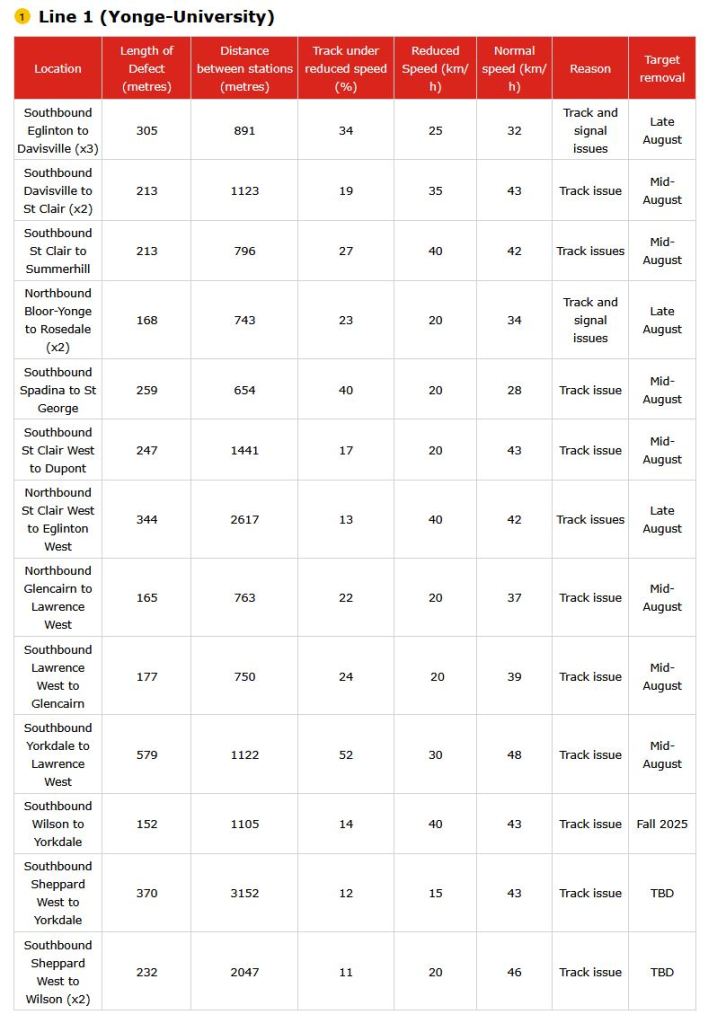
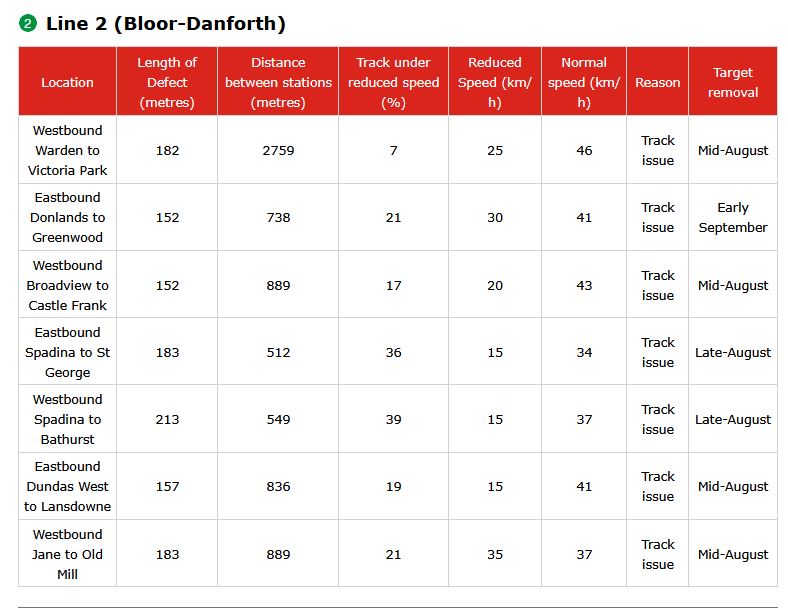
The current map and table of repair targets, as of July 31, 2025, are shown below. Note that some of the items on the map are not included in the detail (e.g. Warden to Kennedy eastbound), and the table includes entries that are not reflected on the map (e.g. Sheppard West to Wilson). This does not speak well of the TTC’s ability to communicate consistent, accurate information.
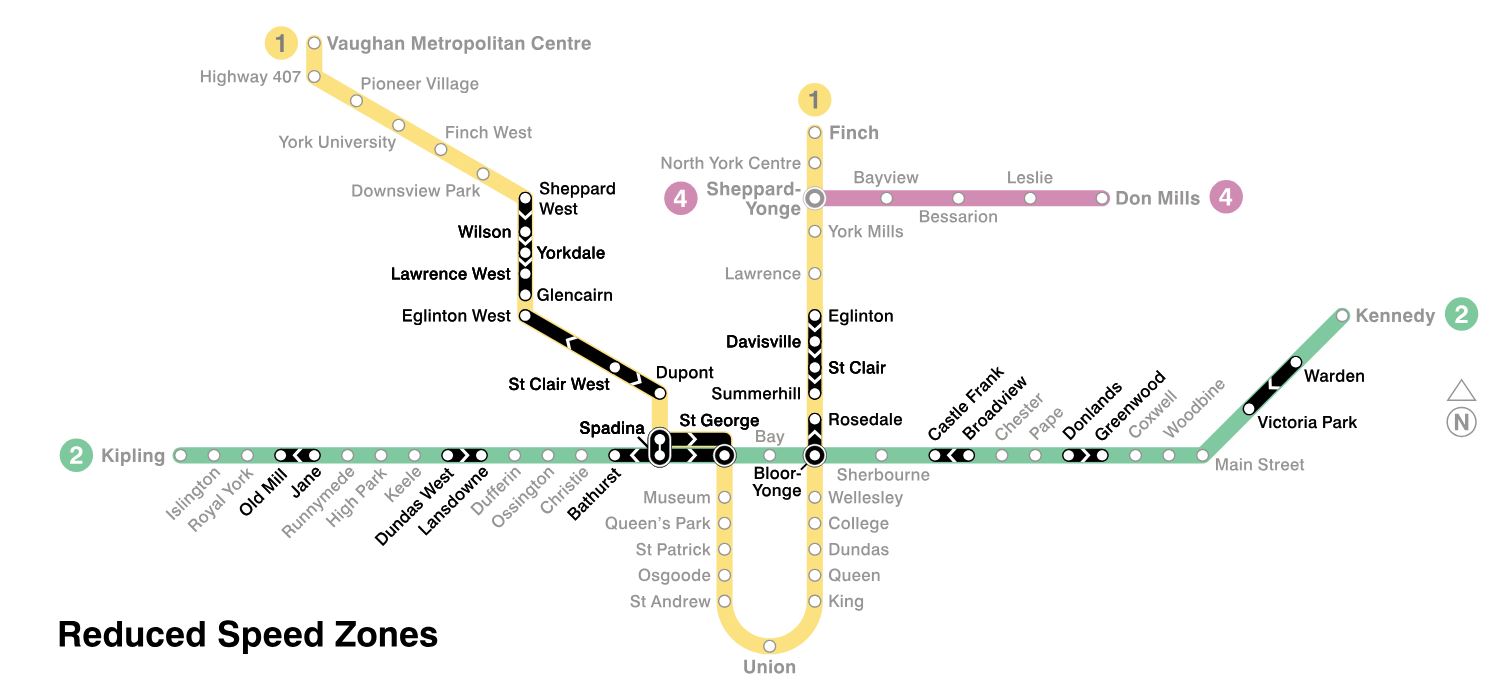
Updated August 1, 2025 at 9:10am: The TTC has updated their page so that the map and tables are now in sync with each other.
Most of the zones listed here are scheduled for removal by early September with only a few continuing into the Fall or beyond (“TBD”). This list will bear watching for additions, and for removals of cleared sections within the expected time frame.
Original July 31 versions:
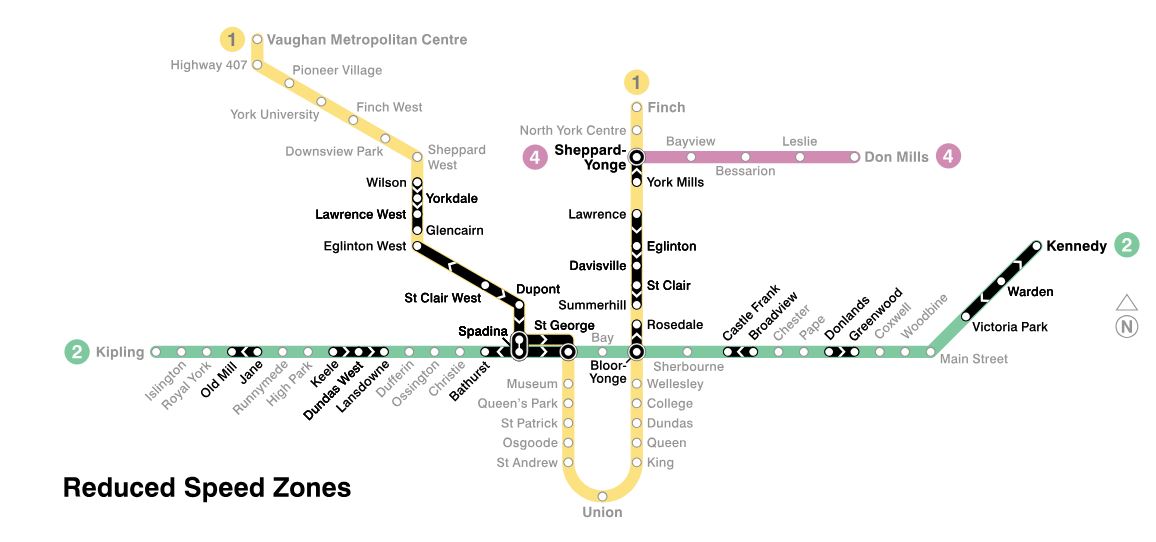
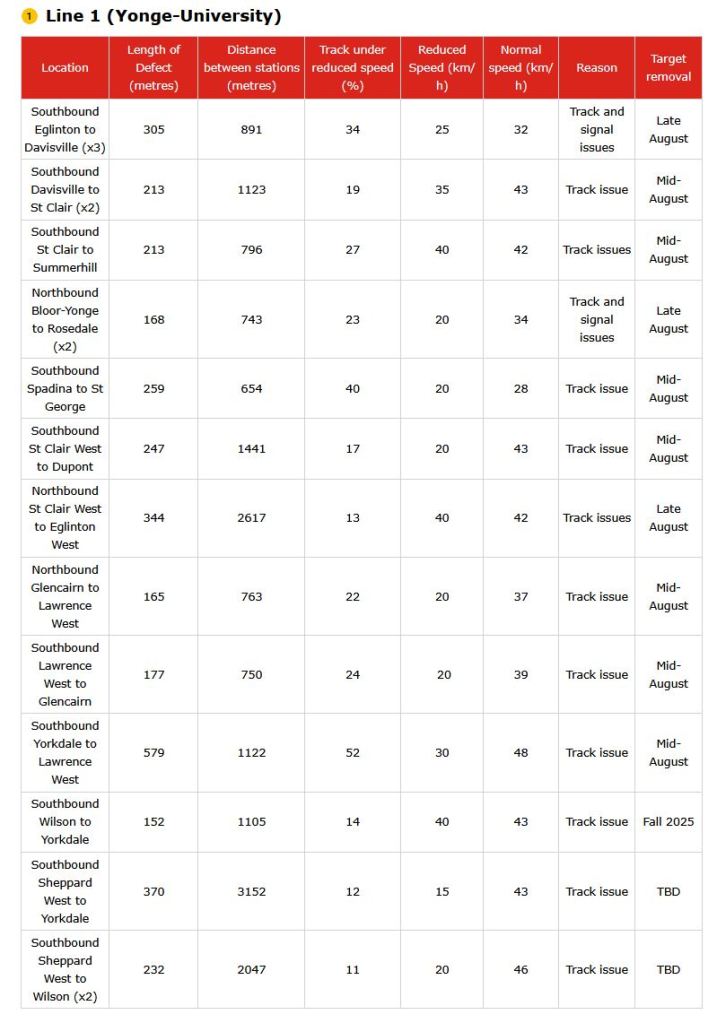
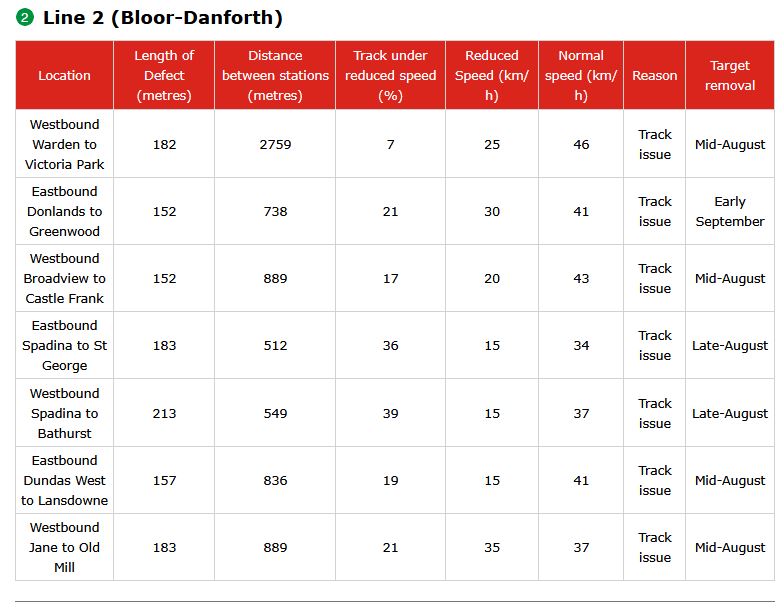
Revised versions:
 Steve Munro
You are too kind!
Steve: It is amazing how often they drop cock-ups like that in our laps and invite ridicule.
LikeLike
So for the target dates for the reduced speed zone are they accurate?
Steve: We will have to wait and see if they disappear, or the dates are extended, or the date simply pass without change.
LikeLike
I applaud the TTC for communicating about this issue (the video was pretty good).
But what caught my eye on their improved slow zone web page … not one of the go slow zones had a “normal” speed limit of 50 km/h or higher. Most had normal speed limits in the high 30s or low 40s.
This is not rapid transit. Not even close.
LikeLike
Now we need the same thing for the streetcars…
Steve: The problem is that officially there are only a few streetcar slow zones. They don’t include the standing order for junctions.
LikeLike
They don’t even want to mention the reduced speed zone of the streetcar tunnel portal section on Queen’s query… 509 and 510 have been crawling through it, and I won’t be surprised if the speed limit there is 1 km per hour…
LikeLike
There was an (inaccurate) page on the web site when I looked last week but I can’t seem to find it again. It claimed the only reduced speed zones being the Queen/Don bridge and the area on Queen around the Kingston sub.
It made no mention of the slow zone on the Gerrard/Don bridge or the many other areas besides junctions which are restricted below the street speed limits for various arbitrary reasons, such as the trailing switch at King/Parliament or portions of the 510 Spadina route.
Steve: It appears that the list of streetcar slow zones was omitted when they added the table to the subway list. Mind you, the streetcar page still points to it as if the info were there.
LikeLike
Any particular reason why the TTC has gone with this new more “detailed” approach? Is it a directive from the new CEO to be more transparent, or responding to external pressure for more clarity on resolving the reduced speed zones (from the media and people like you Steve)?
While I would normally applaud any measure for improved transparency, the “reasons” for every RSZ is only stated as either a “track issue” or a “track and signal issue”, which is incredibly vague and essentially meaningless in explaining what the problem is, or why it exists. For example, some RSZs are in place due to short-term construction projects such as crossover replacements (i.e. Sheppard-Yonge). Others involve longstanding issues like the section around Davisville, but the TTC’s “reason” provides no differentiation between these types of issues.
Steve: I think there has been enough harping from me and others, and the idea of slow zones that never end is partly addressed by the new list, assuming they they actually achieve their targets. Of course the start dates for the zones is not shown, but the info is on my site as I’ve been tracking them for over a year now. I agree that more detail than “track issue” is needed.
LikeLike
Worst transit system in North America.
LikeLike
How can there be “Signal issues” on line 1 already? I hope the TTC is making Alstom cover these “issues”.
Steve: The two areas showing signal issues have problems with track circuits as well as with the track itself. This is not a signal vendor problem, but one of good maintenance by TTC.
LikeLike
Hi Steve!
I noticed the map also changed for my browser on that day. Can you update this page please?
Steve: I have updated the article to include the new map and tables.
LikeLike
I don’t understand with all the subway closings why do we still have reduced speed zones?
Steve: The TTC let track maintenance get ahead of themselves over past years both due to budget limits and because their fleet of special cars used for this work was allowed to deteriorate. Some long standing slow orders are due to underlying structural issues with the roadbed, but many are from inadequate inspection. This has changed recently, and new inspections have revealed a lot of areas needing repairs. The question now is whether most of these disappear promptly in August-September as shown in the TTC’s table. The longer-term ones are more challenging as some repairs may require closing parts of the subway for more than a weekend.
LikeLike
For the long lasting reduced speed zone, I don’t they will be remove this August or September. For example like the one from Yorkdale to Lawerence west station it will take much longer.
LikeLike
Are you able to find out how many people are actually involved in “fixing” the reduced speed zones? How many ideally to they need, compared with how many actually working on them?
Steve: No, although the TTC cites workforce shortages as a reason for their predicament.
LikeLike
No kidding. I remember when the Scarborough RT would go 80km/h in the 90s, you could see the speedo thru the cab door inside. That was a fast trip from Kennedy to SCT.
It’s been a few years since I’ve been on the subway, working in the east end now don’t need subway, but these restrictions are abysmal.
LikeLike
How many long standing Reduced speed zones are their in the transit system?
Steve: Please see the charts in my previous article on this subject.
LikeLike
TTC subway and TTC streetcars are by far the slowest in the world. TTC streetcars cause traffic chaos everywhere they go even if you put them underground and even when they are not running.
City News: Eglinton West Intersection Design
Steve: This has nothing to do with whether there was a subway or streetcar under Eglinton, and everything to do with Metrolinx. The City, which now controls the intersection at Allen Road and Eglinton recognizes the need for change, and I can’t help wondering why this is taking so long (like so much else on Eglinton).
LikeLiked by 1 person
What would happen if a train goes normal speed on a reduced speed zone?
Steve: On Line 1, this cannot happen because the slow speed is enforced by the signal system. On Line 2, whether trains are forced to slow or not is governed by whether speed control beacons have been placed in the tunnel. These interact with the train controls to set a maximum speed. All of that said, the result of speeding through an RSZ could vary from a rough ride to a derailment depending on the condition of the track, whether the slow order was on a curve and how serious the track problem itself was.
LikeLike
All one can hope for is that all of the fixes get done in time for the World Cup.
As for the streetcars, when switch replacements are done, why not switch to dual point?
LikeLiked by 1 person
Something I notice about the RSZs is that most of them affected the direction is mostly southbound compared to northbound.
LikeLike
Out of all these reduced speed zones which one is in the worst condition?
Steve: I suspect the open cut sections of the Yonge subway, with the Spadina line a close second. These have been on the list for over a year. The Yonge line also needs some structural work on the foundation under the track for a permanent fix, but doing the work cannot be accomplished in a weekend shutdown.
LikeLike
For the slow zone from Bloor Yonge to Rosedale it says track work and signal issues. How come don’t have any yellow lights on the track or any flags that show it’s a reduced speed zone cause they usually put like yellow lights or yellow flag that show it’s a reduced speed zone.
Steve: The speed zone is enforced through the automatic train control system. They don’t need to mark it with flags or lights.
LikeLike
From Davisville to Eglinton Northbound consider a slow zone it’s not in the list but it’s slow.
Steve: Yes, I know. I was on that section yesterday. TTC’s record keeping is not always accurate.
LikeLike
Why on the chart on the some of the reduced speed zones it says “(x2)”.
Steve: I believe that this refers to two separate sections within the overall segment.
LikeLike
As of today it says there are 22 reduced speed zone but on the chart there’s only 19 reduced speed zones.
Steve: Three of the zones have two separate problem areas noted as (x2) in the table.
LikeLike
Is line 1 the only one that has long lasting reduced speed zones or does line 2 have them also?
Steve: Line 1 is the worse of the two for long-lasting zones because it has so much more open cut running with ties on ballast rather than rail mounted to the tunnel floor (or to concrete ties that sit on pads on the tunnel floor). Some of these areas have problem with drainage, and are subject to more thermal stress being outdoors. Please see my original article on RSZs which includes a discussion of problems in the area around Davisville Station which have been known for many years.
LikeLike
How come outside near Rosedale station there’s wooden ties on the side [that have] been there for more then a year now what are those for.
Steve: This is part of the ongoing, but not very quickly, process of repair to track in the area.
LikeLike
How do they fix a long lasting reduced speed zones and how long does it take compare to a reduce speed zone that’s not long lasting.
Steve: The short term ones generally involve rail that is worn or out of alignment over a short stretch, and can be repaired in at most a weekend’s work. Longer term problems can involve the track foundation which is much harder to repair without an extended shutdown. This has been discussed but rarely implemented because of the replacement service needed. Only during the pandemic were they able to close a chunk of the subway, and that had an available parallel route (the University/Yonge pair downtown). If the TTC had to attempt bus operation on a major area such as Yonge Street, (a) they would probably not have enough buses or terminal capacity to handle all ofthe riders, and (b) the City would probably have to close the street. That’s why areas such as Davisville to Bloor get patched up a bit at a time to the degree this is possible.
LikeLike
How come right when they remove a slow zone a new one comes right after like for example when they remove the slow zone from Sheppard west to Wilson southbound, then now there’s a slow zone northbound from Wilson to Sheppard west.
Steve: I suspect that in the process of fixing a slow zone and doing a new inspection of the area, they find a new defect. This could also reflect patch-work rather than permanent fixes causing slow zones to reappear.
LikeLike
How long is considered a long standing slow zone and which ones are considered long standing?
Steve: It’s entirely up to the reader, but would say that six months at the outside, allowing for the difficulty of winter repairs. Some have been in place since at least February 2024 when I started to track them.
LikeLike
Wow since February 2024 which ones have been in place since that time.
Steve: I have updated my tracking charts and you can check them out here.
LikeLike
Why the target removal date for the one from Wilson to Yorkdale says early November while all the other ones say September and this one not even a long lasting slow zone so I wonder why they put remove date all the way to November.
Steve: It would depend on the complexity of the repair needed.
LikeLike