
Updated July 21, 2025 at 11:20am:
Despite the extensive catalogue of issues with the Green Bus program, the TTC Board wasted no time in adopting the report without debate on an enthusiastic motion by Commissioner/Councillor Saxe. There was a sense that they could not wait to get this item off of the table.
However it is likely to come up again at the Strategic Planning Committee in discussions of future service improvements and the resulting fleet size, and the City Auditor’s review of the program will land on Saxe’s Audit & Risk Management Committee agenda sometime in 2026.
In the meantime, the TTC needs honest reporting of the performance of its growing eBus fleet as more buses arrive. In the short term, they can paper over range issues by using these vehicles on blocks of work that do not tax their capacity (buses that are only in service for part of the day, and on less stressful routes). The disparity between charging capacity and fleet size discussed in the report will also affect availability, and “performance” metrics should include not just how far a bus can travel, and how reliable it is from failure, but also whether it is even available for service.
Meanwhile, major systems elsewhere in North America continue to hedge their bets on eBuses with parallel orders of hybrids as Toronto is now doing.
Vancouver has the advantage of an existing trolley bus network which allows them to design around in motion charging. See Coming soon: the first of Metro Vancouver’s next-generation trolley buses.
Original Article
At its meeting on July 17, the TTC Board will receive an update on its Green Bus (eBus) program.
This is a long report, and some key information is buried down in the appendices. It reveals, among other things, that:
- Delivery of the battery-powered eBuses is running late. This is an industry-wide supply chain problem.
- The TTC plans to buy 200 more hybrid buses as an interim step to allow retirement of their oldest vehicles.
- The reliability of the eBuses is below the originally hoped-for “long range” capacity and they are only achieving about 250km per charge. That is with a new battery, and the value is expected to drop as batteries age.
- Much of the TTC’s currently scheduled service cannot be operated with standard range eBuses, and planned change-offs will be needed to cover the span of service typical on TTC. This will add to mileage and operator hours.
- Charging operations at garages are constrained by a shortage of installed charge points compounded by limitations of electrical capacity.
- The problem of shorter range and limits on charging fundamentally change how garages operate for diesel/hybrid buses where refuelling is quick and is performed as part of routine servicing as buses come out of service.
- The need to shuffle buses between charge points and storage locations will add to staffing requirements at garages.
- eBuses cannot replace hybrids on a 1:1 basis because of the charging constraints.
- There is a possibility that the TTC will have to store new buses unused because of charging limitations.
- The policy decision to deploy eBuses at all garages simultaneously requires that maintenance equipment, staffing and training must be provided everywhere at once rather than a garage by garage transition, and that concurrent support for hybrids must also exist at all sites.
- On route charging (using charge points at key locations to permit buses to “top up” their charge) was considered early in the project, but was rejected for various reasons including a desire to be up and running quickly to secure special eBus subsidies. It is now treated as a possible option, but with implementation five years away.
- The comparative performance of hybrids and eBuses in the CEO’s monthly Metrics Report artificially understates the hybrid numbers and makes the eBuses appear to perform closer to hybrid buses than is actually the case.
- The TTC does not address garage capacity issues and, indeed, speaks of shifting the need for a 10th garage off by over a decade through a “garage enhancement” project. This scheme echoes other past budget juggling to shift major infrastructure requirements and their funding needs off of the current planning calendar.
- The report contains no discussion of the implications of technical limitations for the future of bus service especially in the context of any desire to drive up ridership with significant service improvements.
Overall, the report describes a project that has finally addressed the technical realities of eBuses, something that has been glossed over for years. Some aspects of eBus migration, notably charging capacity, time and garage management issues, are presented almost as new discoveries even though they are not new to the industry. Whether this is wilful ignorance or downplaying of problems on a high-profile project, the effect is the same. As with a few other major Toronto projects, the TTC is saved from some pitfalls because schedule extensions give them more time to deal with issues that should have been foreseen.
The project began in 2017 when, shamefully, the TTC Board under then Chair Josh Colle, allowed reps from BYD to pitch their wares in the guise of a “deputation”. This was “facilitated”, to use City Hall speak, by then TTC Board member Minnan-Wong with behind the scenes support from then-Mayor Tory. The video is still available on YouTube. The original hype from BYD, who hoped for a large untendered contract, is falling away, but the implications for the future of TTC bus service are only now coming out in the open.
See also: Is A TTC Bus Technology Gerrymander In The Works? [Sept. 5, 2017]
(Those of us with long memories will recall the combined efforts of TTC management, MTO “innovative technology” staff, the gas industry and Ontario Bus Industries to replace the TTC’s trolleybus system with “clean” natural gas buses on a sole-source contract. We have been here before.)
As the 60-bus pilot project wore on, BYD was only able to supply half of the 20 buses originally allocated to them. Proterra, now out of business, got 25 and New Flyer got the other 25. At the point I write this article (July 13 at 3:00 pm, none of the BYD buses is reporting a position on the vehicle tracking system. (14 of 25 Flyers, and 8 of 25 Proterras are active.)
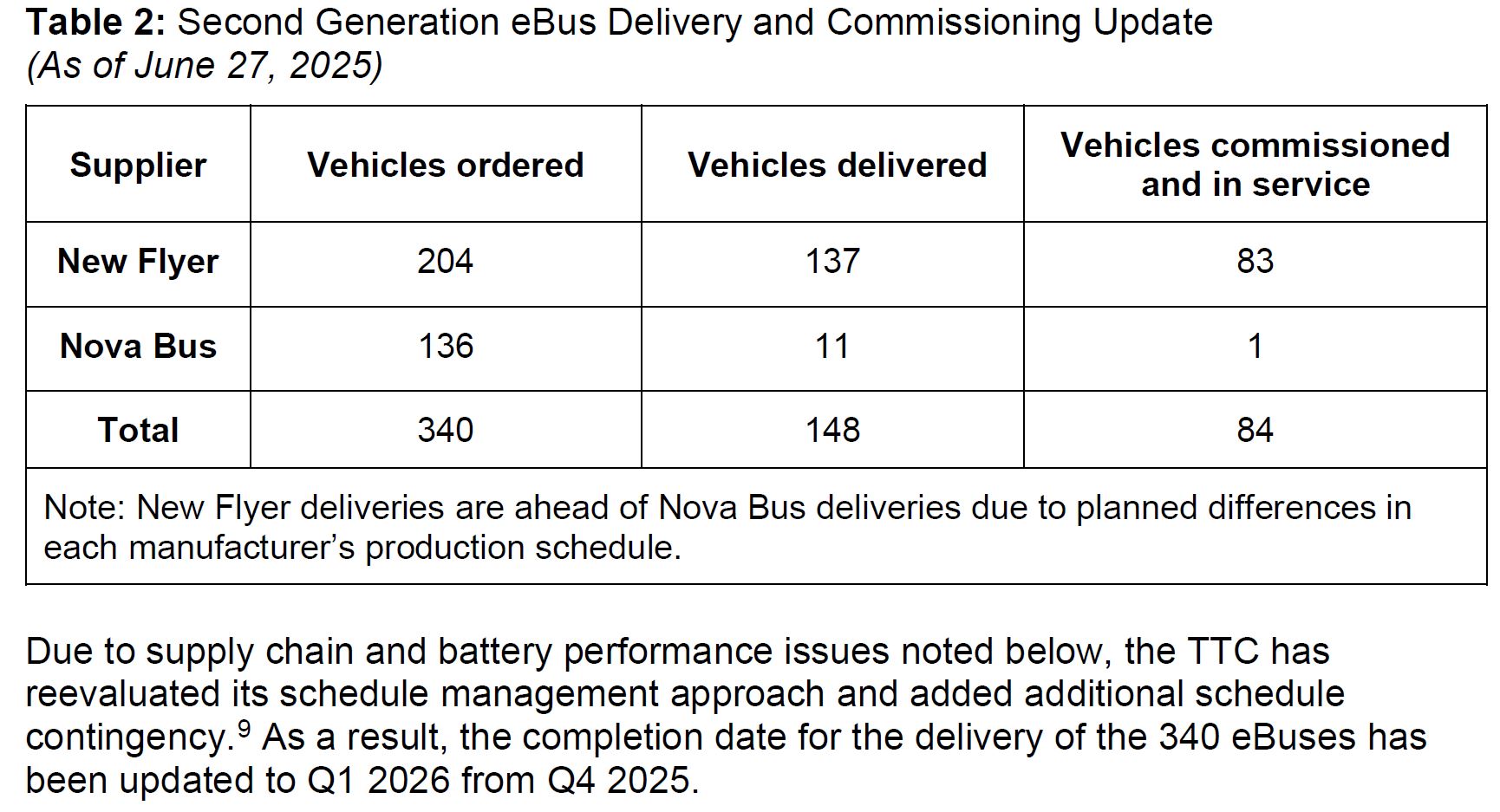
New Flyer is supplying eBuses to the TTC, and of the fleet numbers 6000-6203, the highest number reporting its location is 6141. Fewer than half of the delivered buses is reporting a location. Nova Bus deliveries on a 136 bus order are slower, and only 6 buses are reporting locations. (See Appendix E later in this article for information on delivery progress.)
An important issue when considering reliability stats is that a bus that never runs never fails, and so does not contribute to MDBF (Mean Distance Before Failure) stats. These buses do, however, count as part of the TTC’s active fleet and inflate its apparent size including chest-beating claims to the number of eBuses Toronto has. Having them and operating them are two different issues.
When there are only a few trial vehicles in the fleet, how well they work has little effect on service, especially through the pandemic era when service was not running at 100% of former levels. The situation is much different as recovery to full service, notably on the bus network, is in sight, and both City Council and some TTC Board members talk of an aggressive increase in transit service to wean motorists out of cars and accommodate population growth.
The TTC has already reached the point where it must keep elderly vehicles in service to compensate for performance issues with the new fleet, and this situation will compound as more eBuses arrive. There is even a question of where to store all of these buses if they cannot be actively, reliably used. The planned order for hybrids does not simply buy time while supply chain issues are worked out and battery technology improves. It is an admission that the electric fleet plan is not working out and that service at current levels is threatened. Major service expansion is simply not possible.
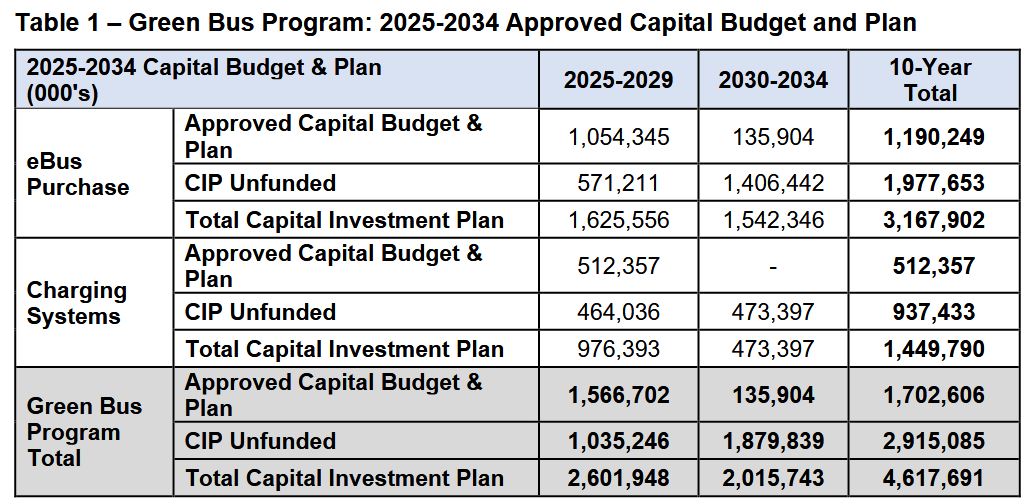
On the financial side, migration to eBuses is not cheap, and the project is funded only to about 37%. An important discussion nobody at the City or TTC seems willing to address is whether it is better to lower emissions by converting the fleet and all facilities to electric operation, or if buying and operating more buses to get riders out of their cars and improve mobility in the city should take precedence. Capital projects are seductive because they are often funded with “other people’s money”, but even the special eBus subsidies only go so far.
It is both ironic and sad that the electric streetcar system has many surplus vehicles thanks to service cuts, but also from a shortage of operators. The TTC plans to move to a six-minute service on three routes in Fall 2025, but may have to bus one line (503 Kingston Road) for want of streetcar drivers.
Peak streetcar service in July 2025 is 170 cars (on Saturday afternoons, not during the weekday peaks!), but the fleet will soon number 262 cars when the last of the new Flexitys arrives. 50 of the 60 new streetcars, 4603-4662, are actively reporting locations, and the highest of these, 4655, shows how close to complete the deliveries are.
In the rest of this article, I will explore issues with the eBus project and plans in more detail, but the last Appendix deserves to be here, “above the fold”.
A review commissioned by the TTC Board from Deloitte in 2023 flagged issues with “project management improvement in the areas of schedule, cost, scope, reporting, risks and issues, governance, and interdependencies management”. Of the 37 recommendations, 18 are closed and 19 are in progress.
An APTA (American Public Transit Association) peer review is planned to begin in September 2025, and the City’s Auditor General plans to review the eBus program.
It is quite clear reading through the report that the TTC eBus project is in trouble both because of external factors (industry conditions) and because the implications of the technology were not fully understood or appreciated. Moreover, the transition will require far more than buying some new buses and plugging them in. The TTC loves to claim that is a leader in the field, but this is likely only true in comparison with smaller systems that do not have the capacity. Within the industry, TTC is not at the front of the pack.
Appendix A: Cost Benefit & Appendix C: Program Alignment with City Mandate and TTC Corporate Plan
The main report refers to potential operational and societal benefits of the move to eBuses, and refers readers to Appendix A for more information. Unfortunately, that section is only barely over one page, and contains no specific data on future operating costs. In light of changes over the years in technical and operational constraints, it is not clear whether past estimates are still valid.
The TTC expects operating savings from eBuses, but early in this project a chunk of that reduction was earmarked to offset the cost of the lease for new charging equipment. The estimated annual saving of $4.7 million is small change relative to the total TTC budget and might not include added operational costs.
In its 2025 Budget, the TTC estimated that eBuses would result in 10-year operating savings of approximately $47 million due to reduced fuel consumption and lower maintenance expenses. [Appendix C, p. 14]
The “savings” in the budget are unclear, especially in the short term where the projected 2025-2029 saving is only $3 million over five years. The ten year $47 million saving is not detailed. [Source: TTC 2025 Operating & Capital Budget, Table 19, p. 51]
The 2022 report authorizing the long-term contract with PowerON Energy Solutions, a subsidiary of Ontario Hydro, states:
The O&M cost for eBus electrification infrastructure in 2024 is estimated at $3.4 million. These costs will scale up as the eBus fleet increases and as bus garages are retrofitted with electrification infrastructure over the following 16 years to support an all-electric fleet in 2040. Starting in 2040, and each year through to the end of the 20-year term of the TTC-PowerON Principal Agreement, O&M costs are estimated at approximately $30 million per year (includes escalation).
The annual estimated cost of electricity required to power a fleet of approximately 2470 buses in 2040 is $55 million (payments Toronto Hydro for the supply of electricity). The sum of annual O&M and electricity costs, estimated at $85 million per year, is less than the cost of diesel fuel which will result in a net overall operating budget savings.
It is not clear what a change in charging strategy to on route charging and a service design that saw fewer buses return to garages “almost empty” would have on future costs in the PowerON agreement.
In a July 2022 report, the TTC spoke of an estimated $50,000 per vehicle annual saving for eBuses, and implied that this could leverage capital funding given the shortfall in government support. It is not clear whether TTC is double-counting the saving by applying it, from one report to another, to the then-pressing need for aspects of project funding.
Emission reductions are stated relative to a 2017 diesel fleet which no longer exists, and there is no comparison of the marginal benefit of a shift from hybrid to eBus technology. The July 2022 report included a comparison between hybrids and diesels:
Reduce GHG emissions by 47% over conventional diesel buses and 25% (or 23 tonnes/bus/yr) over clean diesel buses. [Page 9]
The same report also cites very strong reliability from the hybrids, a point of contention with comparative hybrid:eBus stats routinely cited by the TTC.
Moreover, there is no discussion of the emission benefits of shifting auto trips to transit with improved service. Council has a plan with an option for much-increased transit service, but TTC management has yet to address the implications of such a future in detail.
There is a projected societal cost saving based on 5.5m tonnes of CO2 reduction from 2025 to 2050, and this translates to $8.6 billion in avoided social costs. A separate estimate appears in a recent study:
A May 2025 study by the University of Toronto found that “the positive impact of electrifying the TTC bus fleet is very dramatic,” estimating that with service returning to 100% of 2019 levels and full fleet electrification, there would be an $18-million reduction in annual carbon costs and a $253-million reduction in annual health and mortality costs. [Appendix C, p. 13]
The UofT study includes some dubious assumptions about the effect of eBuses and their ability to generate new ridership. This includes the benefit of return to full service (2019 equivalent) which would generate new ridership and trip diversion from autos, but this is not dependent on bus technology.
Moreover, the study uses the fleet mix from an era when diesel buses were still prevalent, and therefore overstates the emission savings compared to today’s fleet with a substantial number of hybrid buses.
The TTC report claims that eBuses would:
Attract New Riders, Retain Customer Loyalty: Electric buses offer a quieter, smoother ride and produce no tailpipe emissions, improving the customer experience and contributing to cleaner air. These benefits, along with improved reliability over time due to fewer mechanical components, support the TTC’s goals of delivering safe, reliable, and inclusive service. [Appendix C, p. 13]
This claim is dubious because the primary driver of new ridership is service quality. Most of the problems with service quality are not related to vehicle reliability, but to operational issues including scheduling and the absence of meaningful line management. The assumed new ridership also adds “savings” from diverted auto trips, a common tactic in many transit cost-benefit studies. Even if we trust the methodology, the assumed trip diversions have little to do with the bus technology choice.
As for societal savings, there is no way for the TTC to capture this value which is spread between direct government costs such as health care, personal costs through reduction in auto costs, and notional values such as improved lifestyle and longevity. This is not to denigrate these benefits, but to emphasize that they do no appear on the TTC’s books nor can they be used to offset any new costs.
Appendix B: Decision History
In the recitation of significant events in the journey to eBuses, it is noteworthy that this does not include the Sept. 5, 2017 board meeting and the BYD sales pitch.
Appendix D: Pilot Phase Update
In spite of BYD’s hopes to be the sole eBus supplier, the TTC undertook a head to head comparison of three vendors’ buses.
The TTC’s first eBus entered service in June 2019. The evaluation was initially scheduled to begin in the first quarter of 2019. However, due to delays in the production and delivery of BYD buses and COVID-19-related delays in commissioning, formal head-to-head testing began in October 2020.
Also
Only New Flyer had delivered at or above the required performance. In terms of key reliability and availability metrics, New Flyer achieved a Mean Distance Between Failures of 70,000 km and a fleet availability of 95%. In comparison, BYD and Proterra achieved a Mean Distance Between Failures of 35,000 km and 25,000 km, respectively, and an availability of 30% and 95%.
As of May 2025, the pilot fleet has accumulated more than five years and six million kilometres of in-service experience. Approximately 45-50% of the 60-bus pilot fleet is available for service. The BYD fleet has shown steady improvement in availability over the past 10 months. New Flyer’s pilot bus availability has dropped due to issues with the high-voltage battery enclosure, which the TTC and New Flyer are discussing options for addressing. The availability of Proterra pilot buses has fallen sharply to 30% due to traction motor defects and ongoing supply chain challenges following the company’s 2023 bankruptcy. The TTC is collaborating with third-party vendors to source parts for the repair of out-of-service Proterra buses.
Faults that occurred were mainly with body interior and exterior – how bus was built – not the propulsion system. However, number of faults and severity are not the same.
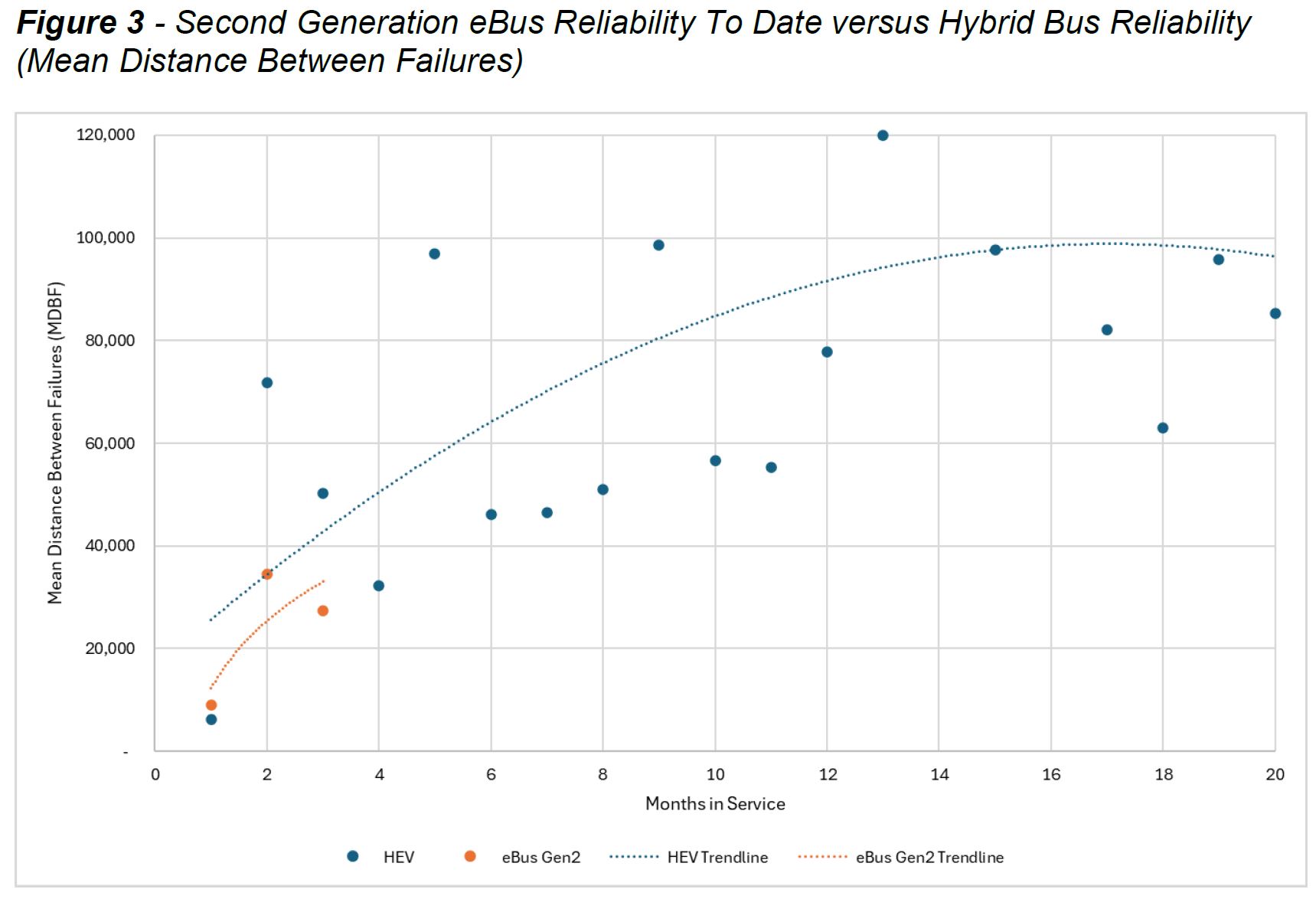
Propulsion-related faults account for only 6% of all system defects but do significantly impact pilot fleet availability, as they represent 38% of the time New Flyer and 22% of the time Proterra eBuses are out of service. The chart below compares the reliability of the newest eBus fleet versus hybrid buses. Although there is a similar trajectory over the in the early months, there is no guarantee that the eBus data will follow the same path in the future.
Any long-term planning requires life-cycle comparisons of reliability and availability, not just best case figures from a new fleet.
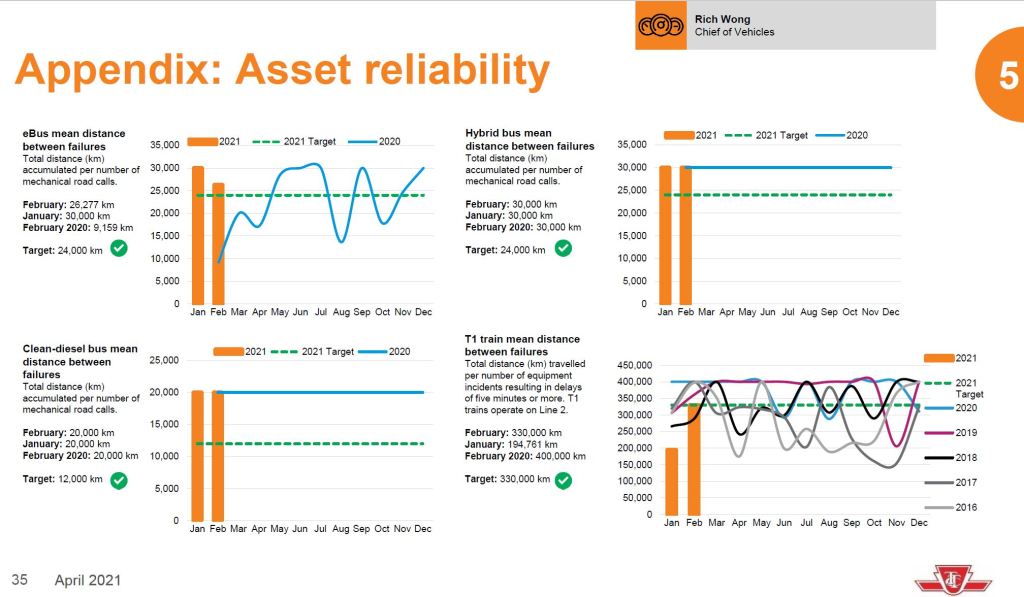
In the July 2022 Green Bus report, there is a very favourable comparison of hybrid bus performance relative to the diesels they replaced:
Reliability is more than double the Mean Distance Between Failure target of 30,000 km.
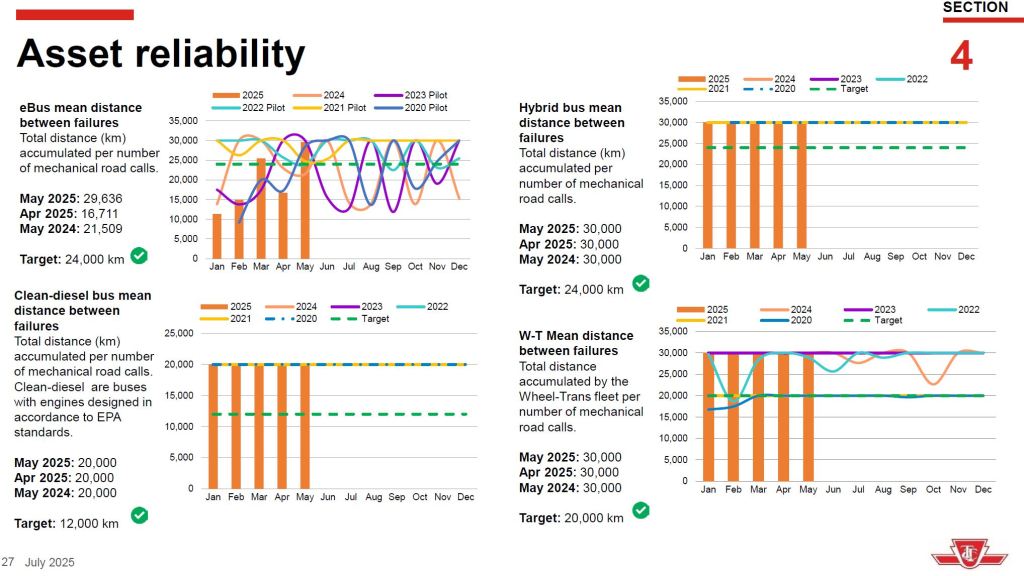
The reported performance of hybrids has been systematically understated by capping actual values (such as shown in the chart above) at the 30k target line making them appear similar to eBuses which have only inconsistently reached that level, but not exceeded it. It is ironic that hybrids, once touted as part of the Green Bus transition, are now treated as yesterday’s technology.
This presentation has been used in CEO’s Reports since 2021. It misrepresents diesel and hybrid bus performance by capping reported MDBF values at 20k and 30k kilometres respectively. These charts are dishonest and do not give a clear comparison of the technologies.
Appendix E: eBus Procurement Program Update
The TTC is well into deliveries of its 340 eBuses on order. Battery issues required a retrofit on the New Flyer vehicles, and this will be finished in the current quarter (3Q25). There are supply chain issues with the delivery of bus seat parts.
Appendix F: Charging Systems
The charging facilities for eBuses will be installed across the system in a phased rollout at all garages. The overall schedule is shown in the table below. All of the new buses now in delivery have provision for pantograph, rather than plug-in, charging. This implies a future retrofit to retire the first generation of plug-in including the BYD-specific equipment.
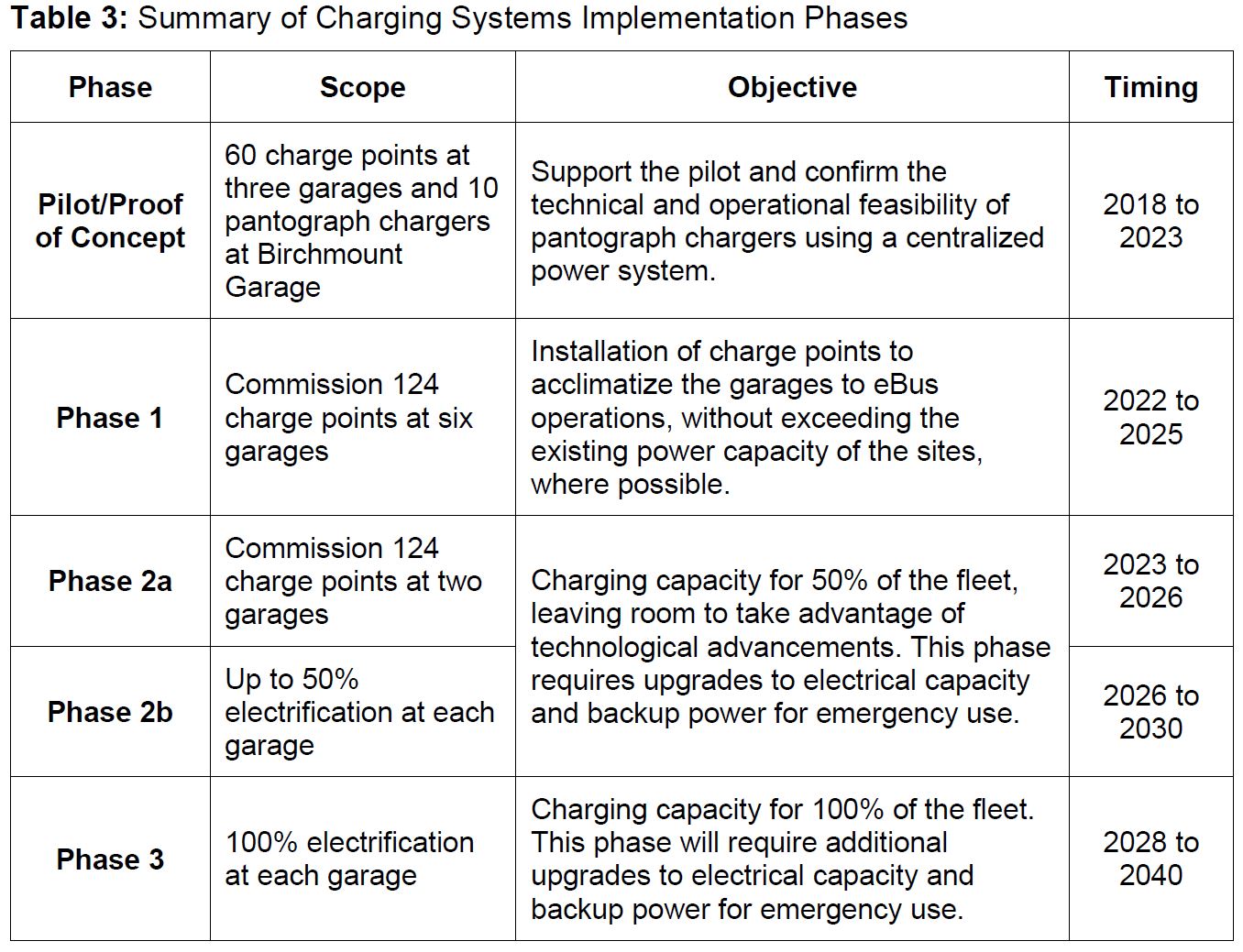
The work has proved more complex than expected, and the schedule has been pushed back for completion of Phase 2a to early 2026.
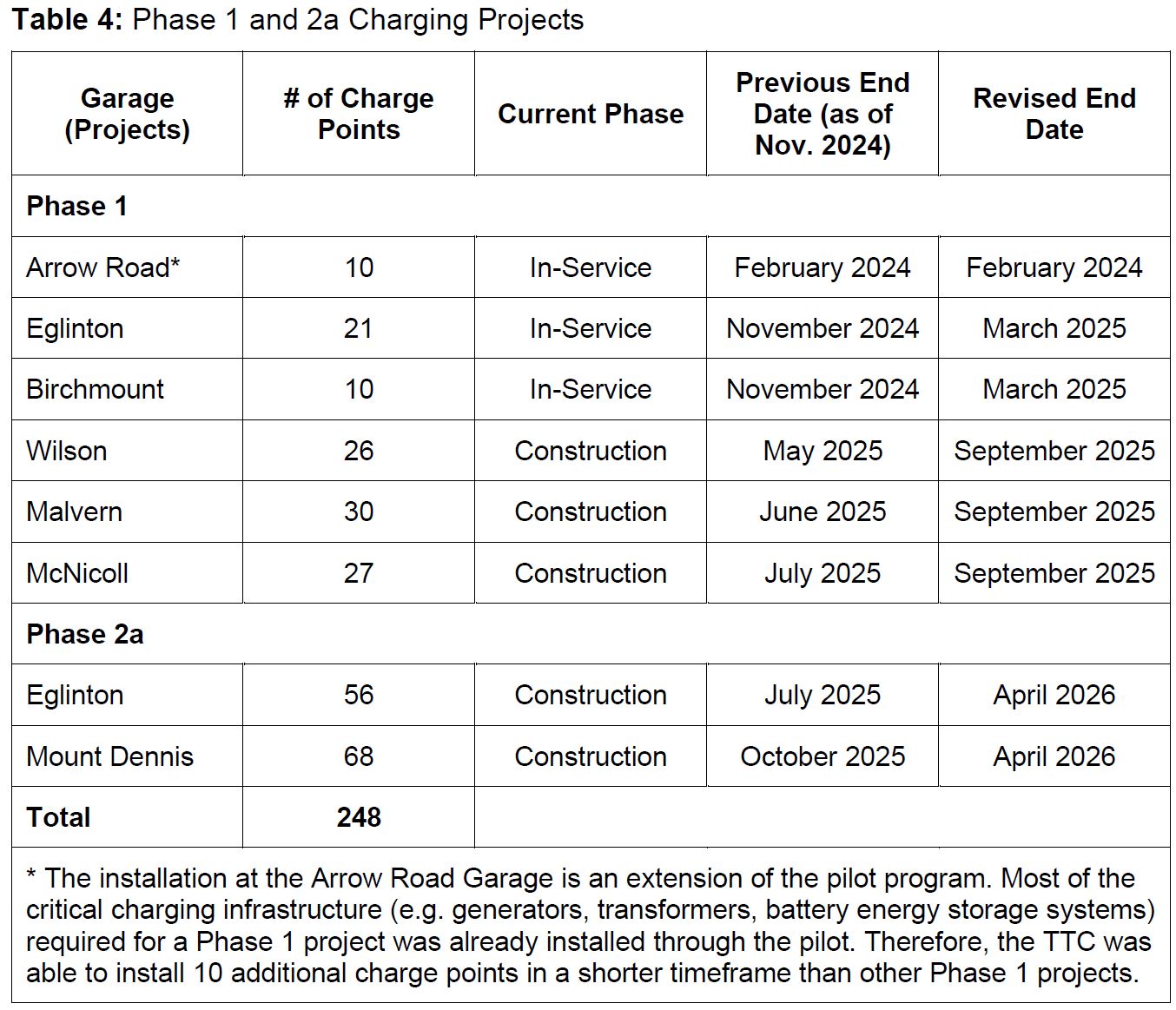
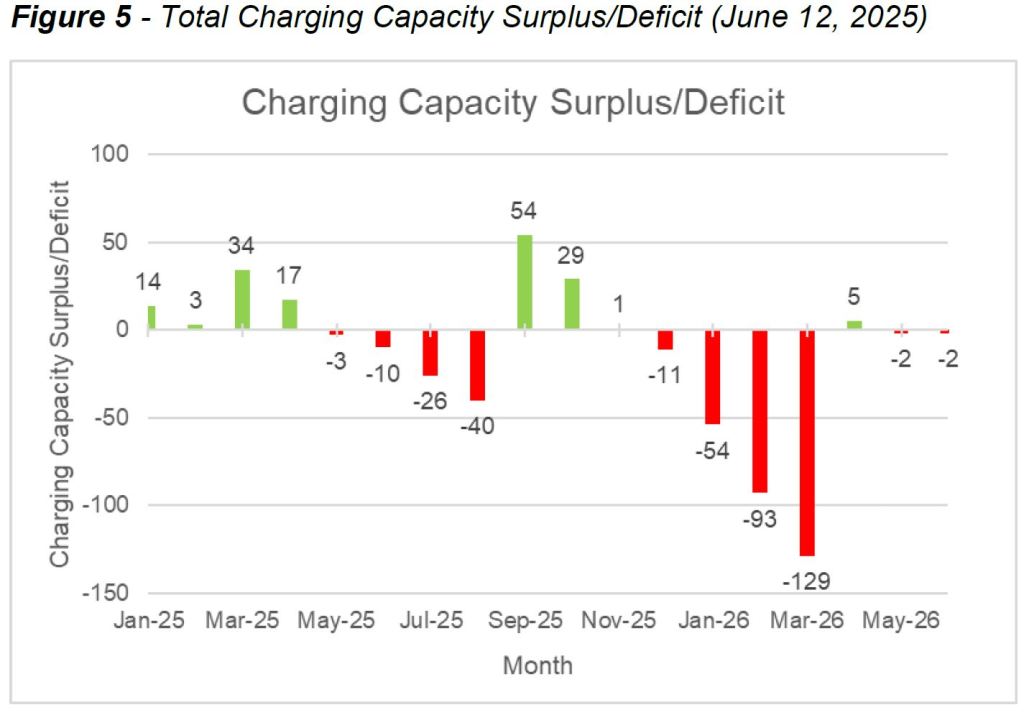
Although delays in bus deliveries reduce the shortfall in required capacity, they do not eliminate it. For a period, the TTC will have far more eBuses on property than they can charge, and buses will have to be stored until charging capacity builds up.
Based on the revised end dates, there is a risk that during time-limited periods in 2025 and 2026, the charging capacity at McNicoll, Eglinton, and Mount Dennis garages may be insufficient to accommodate the number of eBuses delivered. [Page 22]
There are further operational issues with charging thanks to limits at the garages that will make charging even more time consuming.
Charging the eBus fleet is currently planned for depot facilities, with on-route charging still under investigation and at least five years from realization. […] For Phase 1 of the Charging Systems Program […], there are facility power load constraints which result in a reduction of the maximum power availability (‘derating’) of the charging systems. This results in significant charging time variability for each vehicle (ranging from three hours up to seven hours), dependent on several changing factors, including:
- Remaining state-of-charge when an eBus returns to the garage.
- Number of eBuses connected to charge points.
- Time-of-day charging occurs.
A further problem is that buses must share charge points, and more may be required in the future. On-route charging is being evaluated “as a strategic initiative to reduce reliance on depot-based infrastructure”, and the procurement ratio for new buses may rise beyond 1:1 to compensate for lower eBus availability.
As if all this isn’t bad enough, the use of few charge points and the lengthy time to charge a bus means that vehicles must be shuttled around yards after they return from service, eventually to staging areas for their next assignment. By contrast, fuelling of hybrid buses is quick. On-route charging could reduce the time needed to “top up” buses at the garage, but implementation is years away.
With a larger fleet of buses, this dispatch process, along with charging limitations, will become increasingly complex for the maintenance staff to manage. Without a simple and effective charging process, service delivery risks include vehicle unavailability, inability to meet service requirements, and increased vehicle recovery (towing) charges. [p. 30]
Appendix G: Integrated Delivery Schedule
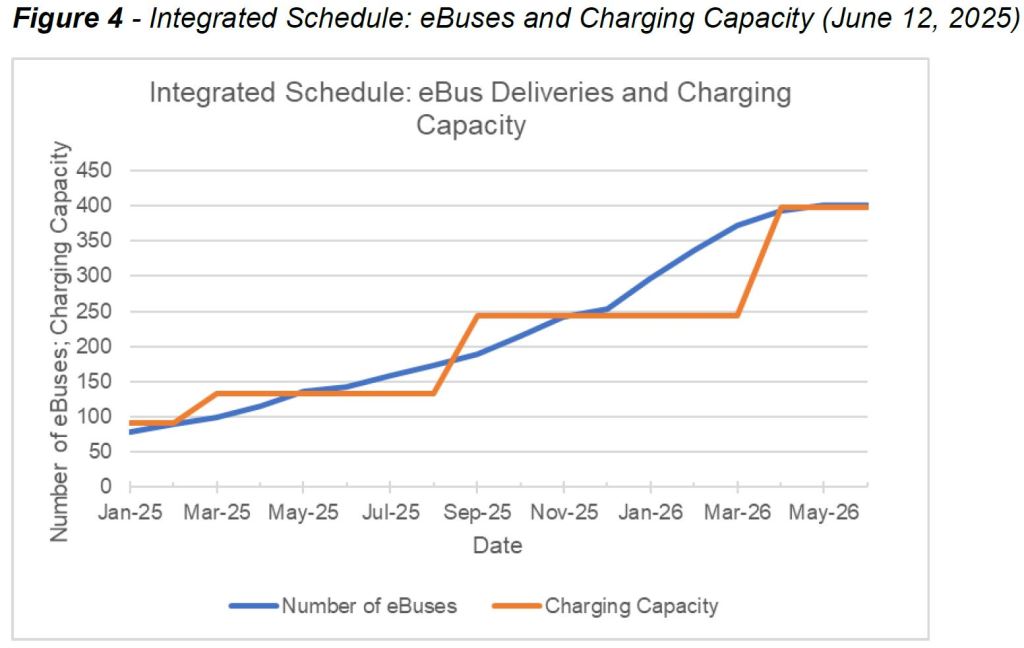
The mismatch between installed charging capacity and fleet size is shown below. Through the winter of 2026, the TTC will be short more than 100 eBuses because they will be unable to charge them.
Tactics for dealing with this include:
- Store up to five buses at each garage.
- Consider storing eBuses off-site (e.g. TTC facilities, manufacturer facilities) or delaying delivery.
- Temporarily delay bus decommissioning to maintain service levels at the garage.
| Garage | Shortfall |
|---|---|
| McNicoll | April – June 2025: 6 July 2025: 11 August 2025: 24 |
| Eglinton | January 2026: 26 February 2026: 50 March 2026: 74 |
| Mount Dennis | December 2025: 8 January 2026: 26 February 2026: 41 March 2026: 53 |
The tables below show the mismatch between deliveries and capacity in graphic form. An unexplored issue here is the future problem of installing more charging capacity for a larger fleet at sites that require major electrical upgrades. This challenge becomes even worse if the City were to consider adding to transit service beyond normal growth levels.
Appendix H: Operational Impacts
With the transition from a Pilot project to a much larger eBus implementation, “the TTC recognized the need for a more co-ordinated and strategic approach to scale up the transition”. [p. 26] In October 2024 they created the structures needed to manage the project across multiple areas including:
- Internal Communication
- Workforce Training and Development
- Risk Management
- Operational Readiness
- Service Planning and Reliability
After a period where eBuses were generally a good news, “look at us” story, the TTC is now in a more complex environment and has discovered some key lessons that were not taken into account before.
Charging practices are complex and time consuming.
The time required to charge eBuses currently varies significantly due to differences in charging technology, power limitation at existing garages, personnel practices, and operational usage patterns. This variability necessitates ongoing adjustments to scheduling and depot operations. [p. 27]
Because the eBus rollout is across all garages rather than selective sites, workers must be trained and garage operations adjusted at all locations concurrently. This is partly the result of a political desire that eBuses be available across the entire city, not just in a few “lucky” locations, during the early years of transition.
Service planning and scheduling procedures require updates to deal with eBus needs notably their limited range and need for recharging.
The TTC hopes for improvements in the long run (2040 and beyond):
- Extended vehicle range and battery performance.
- Improved charging infrastructure, including on-route charging trials.
- Future planning for targeted testing of on-route charging, particularly for 18.3-metre (60-foot) buses, to address infrastructure and range limitations and support service flexibility.
- Advanced energy and yard management systems.
- Increased automation and operational efficiency. [pp. 27-28]
2040 is a long time away. Even on-route charging is seen as an option for the 2030s, and there is no discussion of the tradeoffs possible in garage operations, vehicle design and service scheduling with a shift to on-route charging that could occur during the life of the transition to eBuses.
Range limitations have significant effects for the eBus fleet.
The 340-second-generation eBuses currently being delivered are anticipated to have a dispatch range of 241 kilometres, approximately half the operating range of the existing diesel and hybrid fleet (531 kilometres). In their current operating state, eBuses cannot be considered a 1-for-1 replacement of the hybrid and diesel fleet. [p. 28]
Blocks of service (trips schedule as the continuous work for a single vehicle) must be adjusted for the shorter range. As of the May 2025 schedules, 34% of all weekday, and 58-61% of all weekend blocks are incompatible with eBuses. This will require schedule changes including breaking blocks to provide for vehicle rotation with the cost of extra driver hours and bus mileage. As the number of eBuses at each garage grows, so does the extent of this problem.
Some types of service do not lend themselves to vehicles with limited range such as support for subway closures and unplanned diversions where buses must be available “now”. Hence “diesel and hybrid buses remain essential for ensuring service continuity in high-demand, unpredictable situations”. [p. 31]
Some variability is expected in battery performance. Schedules cannot be based on “best case” performance, and they must allow for the winter decline in eBus range.
Service range variability: The TTC’s first generation of 60 Pilot eBuses has a dispatch range of 180 kilometres, while the new, second-generation eBuses currently offer a range of 241 kilometres. As battery technology advances, each eBus procurement is anticipated to deliver improved service range. Over time, battery degradation is expected to result in an eBus fleet with varying service ranges across vehicles.
Seasonal impacts: Electric heating is a major energy draw, and eBus batteries are sensitive to temperature fluctuations. In winter, especially when snow and ice are present, battery efficiency and capacity decline, resulting in a reduced available range. While eBuses are still equipped with diesel-fired Webasto heaters to support cabin heating, overall range is still impacted by HVAC demands. To mitigate these effects, the TTC continues to monitor and explore strategies such as route planning adjustments, on-route charging, and continuous performance monitoring to maintain service reliability during colder months. [pp. 28-29]
The TTC projects an added peak requirement of 4 buses in service when Eglinton Garage operates at the 50% eBus level. The estimated annual service hours is 150, a number which is hard to believe considering that this is less than one hour/weekday. This is described as a 0.77% increase translating to $860k/year. This is an extra cost for 50% eBus operation at only one garage, and this was probably not factored into estimates of operational savings.
Work is currently progressing at Malvern Division to gain a deeper understanding of what a 50% eBus scenario would entail for a larger bus division, with the results informing possible projected costs, resource requirements, and potential further scenarios to be developed. [p. 29]
Moreover:
Although eBus technology may reduce maintenance costs due to the lack of a diesel engine, there is an increasing need to expand the Bus Maintenance workforce to support 24-hour charging and fleet processing. Additional eBus fleet processing activities include manual monitoring of charging status and physically relocating vehicles to chargers. Future technology advancements may improve range and charging capabilities, along with Energy Management System and yard management software, which will iteratively enhance operational effectiveness. [p. 30]
Appendix J: Fleet Plan
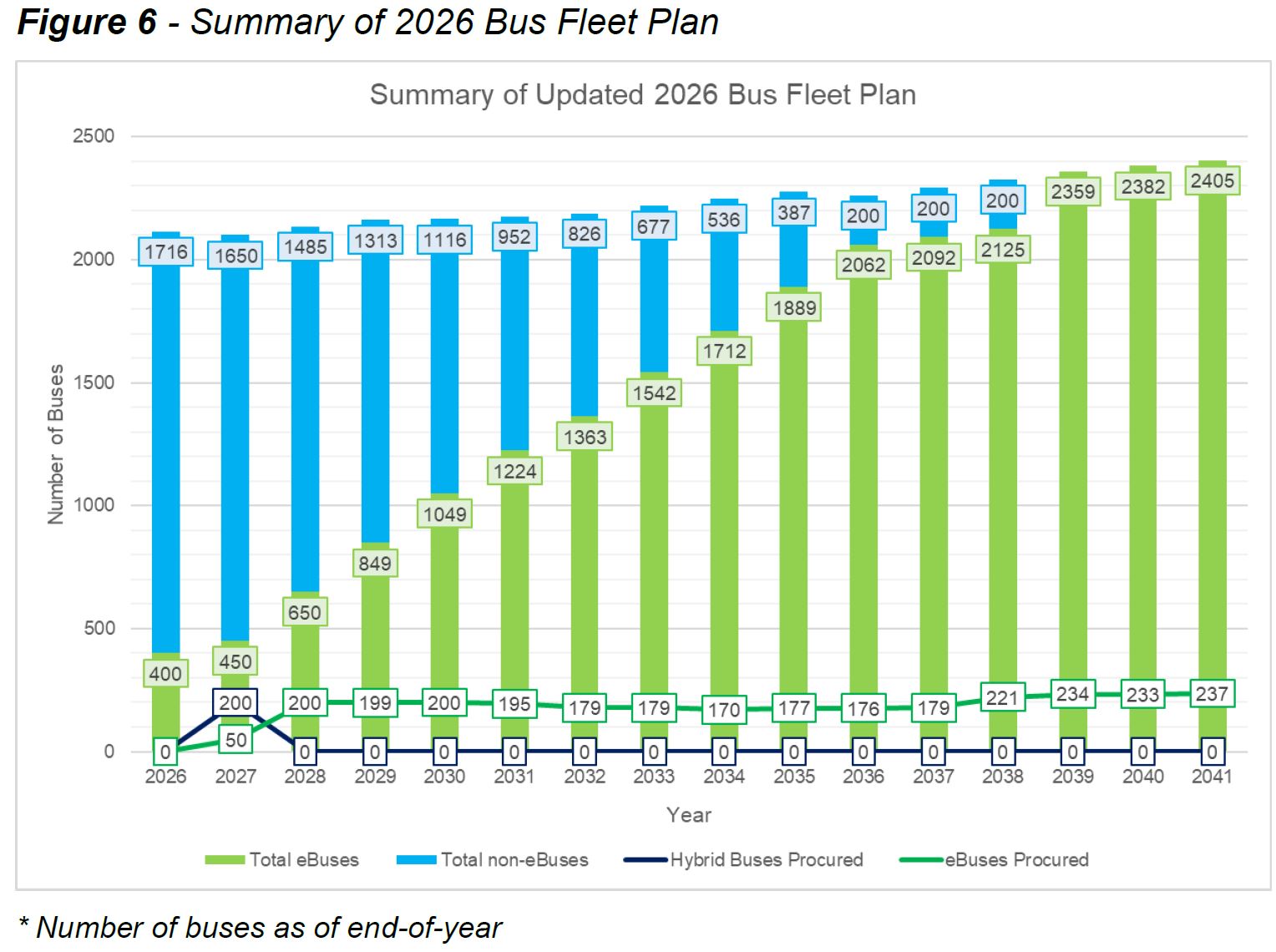
Recognizing that the continued purchase of eBuses will be hampered both by delivery issues and by available subsidy, the TTC proposes to switch back to buying hybrid buses in the short term. Toronto is not the first city down this path. The plan shows that the TTC is hedging its bets.
- 50 eBuses in 2027.
- Up to 200 hybrid buses in 2026 and 2027 (subject to market availability, and with contract language to support the procurement of up to 290 by the end of Q1 2028).
- 100% eBuses from 2028 onwards (with contract language for hybrid buses as a contingency should eBuses prove unreliable).
TTC Management presents the purchase of hybrids as strategically important, and as a way to buy time in the overall project.
The key benefit of a one-time order of hybrid buses in 2027 is insuring against service disruptions due to aging buses, stemming from the missed procurement year in 2026. The TTC would need to engage manufacturers to confirm that there is market capacity to deliver up to 200 hybrid buses in 2027. As additional insurance, the TTC would also seek to secure contract options for additional hybrid buses in 2028 and beyond, which the TTC would only exercise in the event that additional hybrid buses are required to maintain safe and reliable service.
This approach would also benefit the eBus transition by providing the TTC additional time to install charging infrastructure, continue business transformation, and assess and implement changes required for operational readiness. While the TTC would not be meeting its 2018 target to procure only zero-emission buses starting in 2025 nor its interim target of a 50% zero-emission fleet by 2030, due to the 12-year life of hybrid buses, the TTC would still be able to meet its target of a net-zero fleet by 2040. [p. 36]
A further issue here is what would happen if Toronto wanted to substantially increase transit service. How fast could this occur, and what technology would be used? More buses also trigger the need for more garages, and that has not been factored in beyond the “business as usual” growth model.
The report claims that a 10th garage will be required as early 2029, but refers to a “Garage Capacity Enhancement” that could stretch this date to 2043. There is no description of what GCE entails, nor of how this buys 14 years. Obviously, that plan would be demolished with significant service increases. TTC has been bitten before by gerrymandering its capital budget to shift needed infrastructure into the future where it ceases to demand immediate funding, and this has all the earmarks of such a foolhardy move.
Note that the bus fleet for 2026 is shown as a total of 2116 which is approximately the current fleet size including buses that do not actually operate. In March 2025, before the summer service cuts kicked in, the peak scheduled bus requirement was 1,591. The TTC has a large number of spares (or possibly dead) buses (33% above peak needs) well above industry standards (typically 20-25%).


Yes this is just what we need. More budget being funnelled into activities which don’t involve moving revenue passengers.
Steve: But I’m sure TTC management will count the extra hours as part of the “recovery” to past service levels, just as they counted extra hours due to congestion, but only recently acknowledged that this isn’t real service.
LikeLike
I gather no one is willing to acknowledge that the failed Proterra buses cannot even make it around certain corners in Toronto without extraordinary countermeasures. (One of the most troublesome turns – right onto St. Clair at Christie – requires an alternate turn starting fully in the centre lane, which comes as a surprise on the first trip of the day.)
Steve: It’s amazing how much info they did reveal in this report, but I’m sure they have not told the whole story on issues with the vehicles. The obfuscation about MDBF values shows they knew they had to hide data.
LikeLike
Steve do you have a sense for why Toronto deployment has been so difficult? China seems to be having a great time deploying 10k’s of electric buses per year.
Steve: BYD got off to a bad start with their sales pitch. They might be shipping thousands of buses in China, but could not deliver the original 20 ordered by Toronto, and this was cut back to 10. There were ongoing problems with spare parts supply. Some buses were in regular service, others were never seen, usually waiting for parts. When the TTC called for bids, they did not have a bus that could achieve the range TTC wanted. That said, it looks as if that desire was wishful thinking, and the actual range of the buses are getting is lower than hoped, and that’s without the effect of winter and aging batteries. Proterra went out of business. Flyer buses performed tolerably well, but even then the hybrids did better.
I would love to see how BYD-equipped systems in China handle the range problem, and how their garage charging systems are set up. It is no secret that Chinese systems can absorb a lot of overhead in extra costs and staffing that would not look good by comparison here.
There is no question that TTC oversold the eBus project in that they didn’t get into some of the operational complexities until fairly recently, and they have badly miscalculated on the charging issue. We’re at a odd point where the fleet is building up, but won’t get its full benefit thanks to mismanagement of charging capability.
My whole sense of this project can be described by a very early experience: Back when TTC management first proposed the “innovation” of eBuses, their pitch to the Board came out days after Vancouver had published a major study. TTC was totally unaware of the work taking place in Vancouver in spite of their claims to be an industry leader.
LikeLike
Thanks for this Steve. I saw a BYD on the 67 on Monday. I remember it because I was so shocked that one was running! It had been probably more than six months than I had seen one in service.
Steve: I see that two of them are reporting locations today (July 16). 3753 is on the Lawrence East Express, and 3759 is sitting at Eglinton Garage.
LikeLike
Perfect example of why not to be an early tech adopter!. Is there a single measure for which E-buses are superior to a hybrid aside from zero emissions? NOPE.
LikeLike
I had a dream about e-buses last night. It was crazy, of course, being a dream but it involved — and bear with me here — *not* using batteries in the buses but using long, long extension cords. The cords would be above the street and have no insulation. Rods would reach up from the bus and slide along the cords. At the end of the wires was a nuclear plant. There were no batteries in the buses, so they were lighter, and because no batteries, never needed charging since their “rods” would just reach up and touch the extension cords.
I know – don’t eat spicy stuff before bed!
Steve: I can’t imagine where you got that idea 😉
LikeLiked by 1 person
Hi Steve, You mentioned on route charging. I have seen some of these E-buses on the 168 route. Would it make sense to put a charging port on, say, Avon Loop and make 168 an exclusive route for e-buses? Given that it’s a relatively short route.
Another possible contender could be 127 with a charger at the end of its route at St Clair and Weston (Townsley loop).
I also know that Ebuses do very poorly with steep inclines, so i might not want any e-bus on say a 29/929 route given the steep incline at Dufferin and Davenport (a known choke point dutring winters).
The point is to try to keep some ‘easy’ routes e-buses only, and manage it?
Steve: The problem is that at the rate TTC is planning to buy eBuses, we will run out of “easy” routes. Dufferin is a good candidate for electric buses. When TBs were proposed here over three decades, we could not string overhead along Wilson south of thhe then Downsview Airbase. That could have been addressed with off wire operation, but, key, it’s the TTC. Now there is no runway to worry about, but also no TBs.
LikeLike
Seems the TTC is going through the same trials and tribulations we are out here in Edmonton. Minimally-operating BYD’s (for St. Albert), Proterras impacted by their bankruptcy, having to keep throwbacks of buses in service as a result (though on the latter front I think we have you all in Toronto beat, as some of our active units are from 2002!).
It feels like several transit companies were sold snake oil in the 2010’s, coupled with insufficient planning. At least there’s still a path forward with green technology?
LikeLike
Proterras with availability of 95%?! That must be a joke.
Also I am guessing that they would consider on route charging as time goes unless all buses carried huge batteries. But for now hybrid is definitely the optimal choice, at least before the politically-important year 2040 kicks in, which they have emphasised a lot and well with the new 200 hybrids in 2027 they are really doing the race with time.
LikeLike
Thank you for this deep analysis – so many in the transit industry are buying the eBus Koolaid, forced to drink it by politicians who don’t want to know the details, they just want green buses. Vancouver’s in-motion charging (IMC) trolleybuses are the way to go in my opinion, mature technology, lighter buses, significant off-wire range, much smaller batteries than eBuses. But, we can’t have wires overhead. We have streetcar wires up, but double trolleybus wires are a wire too far. The TTC has electrical sub-stations (some upgrading, and new ones, would be needed).
LikeLike
I very much remember the CNG debacle.
Next best thing my sweet tuckus. I still recall places like High Park Station where they had signs banning CNG buses.
If I recall they were also not allowed in some terminals like Lawrence due to safety.
First it was the RT, then CNG and now Electric buses.
When will the TTC learn that we are not a proving ground for experimental tech.
LikeLike
Given the improved battery over time, there would likely be a third generation electric bus down the road and so on. Each with a different range. This would be a disaster if they need to manually organize which type of bus to dispatch on which runs. Meanwhile they hope the buses are getting a full charge, or at least enough charge to complete the run without having to get a changeoff half way through the run.
This adds a lot of complication on an already stressed transit system.
LikeLike
Maybe, just maybe as plaws0 dreams, trolleys will only be the real successful way of running electric buses. You could even have trolley’s with some battery back up if they have to detour off wire. The LRT in Birmingham UK runs through Wolverhampton on battery, if that can so can trolley buses.
Steve: This type of mixed mode trolley/battery bus already exists, and the batteries recharge when under wire. Trunk portions of a network can be wired with branches, short turns and diversions run on battery.
LikeLike
This past Monday afternoon I was waiting for the Brampton Transit 41 bus to Bolton at the northwest corner of Hwy. 50 and Hwy. 7. Suddenly a non-articulated e-bus in red ZUM colours arrived, marked Not in Service, and began recharging. The bus raised a probe something like a pantograph to the L-shaped charging pole, and it took only 3 to 4 minutes to complete charging.
Then, Tuesday afternoon, at the same location, my wife witnessed the same thing except that this time the e-bus was in white & blue Brampton Transit livery, also marked Not in Service, and again it took only 3 to 4 minutes to complete charging.
Perhaps they were just practising charging that it so little time?
I am very intrigued by that new 21st century technology called in-motion charging (IMC), which makes expensive and inefficient battery-powered systems obsolete!
Steve: TTC claims this technology is five years away. ‘Nuf said.
LikeLike
If only someone would invent an electric bus that can recharge continuously while driving along its route, making range concerns moot, dramatically shrinking the size of the battery, and replacing the diesel cabin heater.
I’m assuming they would have someone bring a spare bus from the depot to a terminal equipped with a charger, then the drivers would rotate their buses onto the charger as the day goes on, that would reduce deadheading and make 150 service hours plausible.
Steve: The technology already exists, and Vancouver has a few hundred on order. I assume you are being ironic/catty about what the TTC does not know. Mind you, this is an outfit that was still talking about TBs being tethered to wires well after Vancouver had TBs with off-wire capabilities decades ago.
LikeLike
I really don’t understand why TTC is having trouble operating a minuscule electric bus fleet reliably. China is not the only country manufacturing and running electric buses. India has operated both intra/inter-city electric buses for a while now including some in highest regions in Himalayas.
Steve: In the case of the pilot fleet, one vendor went out of business, and one had major problems with reliable parts supply in spite of being one of the major players in the industry. The remaining vendor is now supplying eBuses to the TTC.
The major issues raised in the report have less to do with vehicle reliability, although that is still an issue compared to hybrids, as with the abjectly poor anticipation of the complexities of garaging and charging. When I see comments and articles about thousands of buses running in various places in Asia, nobody mentions these issues. There is also a weather advantage in many Asian cities, although not all. Comparisons between them wold be interesting.
There is no indication that a “green” bus will attract more riders than a hybrid or even a diesel. What people want is service. If this is compromised because of an overly expensive fleet, or low reliability, that works against what transit systems are supposed to be for.
LikeLike
This article may be of interest: Bus electrification: A comparison of capital costs.
Steve: Thanks for the link.
LikeLiked by 2 people
This article is a worthy read: Ottawa Citizen: OC Transpo Electric Buses
LikeLike
Yes, being cheeky here. For a system that has extensive capabilities in deploying overhead wires (they have their flaws too, but we have hundreds of kilometres of the stuff and it works) you’d think they’d have at least explored what the latest in trolley bus technology can offer. Maybe it’s not too late to change course and procure a mixed fleet, with the trolley buses going on the routes with the highest power requirements.
Steve: Alas it’s not just a case of stringing overhead, but also of building substations and feeder systems. Whichever way they do it, they have to get away from a garage charging model, and rethink having eBuses at every location..
LikeLike
The problem is that with TTC’s bus network being very strongly gridded, there aren’t actually very many portions of the network where more than one route runs on the same street. Branches and diversions probably make up less than a third of total route distance for the major TTC routes. So we’d be looking at stringing up most of the arterial streets.
This is in comparison with Vancouver’s present trolleybus lines, most of which run down a central corridor downtown on Granville and Cordova/Hastings. Operations there are quite slow, so there’s lots of time to recharge. The 20 km off-wire capability gives them a chance to tweak the network without having to string new wire, like running the 2 as a trolley, or running a local Kits-Main-downtown service to replace the 84 once its long route is obsoleted by the Broadway extension. They could use it to run the 15/50, or the 22, or string up a 1 km stretch of Cambie and recharge both 15 and 33, or…
The biggest realistic opportunity in Toronto is probably charging at/near subway stations. Most routes serve a subway station, and have some layover, and TTC already has space there. The power infrastructure would have to be upgraded, but at least it’s not starting from zero.
LikeLike
Hi Steve: I had a look at the document “Principal Agreement with PowerON Energy Solutions LP (OPG) to Decarbonize TTC Operations, Fleet, and Facilitates” and I am confused. In the Attachment 1 of this document is the “MEMORANDUM OF UNDERSTANDING”. Item 2b states
My question is – If the TTC is leasing the charging equipment, then who is providing the CO-INVESTMENT required for the equipment supply to be provided by OPG as per the design specification developed by POWERON? Is it POWERON the CO-INVESTOR? Or is there a secret investor in the mix? Perhaps I misread the documents.
What is your understanding about who is the owner of the equipment?
Steve: My understanding is that the equipment would not be owned by TTC, but the TTC would pay for it through ongoing usage charges and capital contributions. These would be funded in part by savings in operating costs of electric vehicles, although there is o budget line that actually shows either the savings nor that funding stream. OPG via POWERON would be the “co-investor”, but I need to find out what proportion would be borne by them.
However, the scale of proposed spending in the capital budget suggests something has changed, and this was an issue I have been planning to dig into. The folks at TTC who have made a career out of the “innovation” of electrification owe us an answer.
There is more info on how this agreement evolved in a report and presentation from April 2021. Effectively the TTC has outsourced responsibility for the electrification infrastructure provision and ongoing operation to OPG through its subsidiary POWERON rather than attempting to develop this expertise in house.
See also:
Toronto Transit Commission/PowerON Energy Solutions December 2024 Zero-Emission Medium and Heavy Duty Vehicle Adoption Case Study
Breaking Through Grid Constraints Without Breaking Ground
LikeLike
Thank you for your quick and detailed response. I will have a look at all the links you provided.
One more question – Have you ever considered looking into the Ontario Ferry Electrification projects. Apparently, it is easy to buy electric ferries, but very hard to build the shore infrastructure for charging.
Finally, thank you for doing all the work to put together our web site. It is very educational.
Steve: You’re welcome. I am watching the City’s electric ferry project with interest.
LikeLike
They should un-reject this idea. With electric buses, it would make a lot of sense to have buses get a top-up charge at key locations.
And if it was me, I’d start with routes that terminate at subway stations where the high-voltage power infrastructure already exists and where the buses sit for periods of time anyway.
Steve: There is supposed to be an update on the eBus program coming this Fall, and we will see whether there is a change in the charging strategy. BTW, not all subway stations have associated substations, and the available capacity and space for added equipment varies from site to site.
LikeLike