
In February-March 2025, the TTC added on-street supervisors on eleven routes in an attempt to reduce the incidence of gaps and bunching. This is described in the June 2025 CEO’s Report and the associated Metrics Report containing performance stats for the system.
Bunching and gapping of TTC service
Last March, the TTC expanded a pilot to improve service reliability on 11 key bus and streetcar routes. Working through the Transit Control Centre, uniformed Supervisors have been deployed mid-route to ensure our service frequency meets customer expectations and that we reduce the bunching and gapping of our buses and streetcars, which is a source of frustration for riders.
The pilot involves the following routes: 7 Bathurst, 24/924 Victoria Park, 25/925 Don Mills, 29/929 Dufferin, 100 Flemington Park, 165 Weston Rd North, 506 Carton, and 512 St Clair.
Starting in July, the CEO’s Report will include a Hot Topic that will provide news and updates on the progress – and challenges – related to this important issue. [CEO’s Report, p. 9]
Also:
TTC expanded a pilot to improve service reliability on key bus routes. Mid-route Field Supervisor presence on the nine priority bus routes was increased throughout the February and March Board Period, where the focus is on reducing bunching and gapping, in order to improve the reliability of service. Bunching and gapping is measured by “Headway Adherence”: the vehicle is considered on-time when the headway deviation is less than 50% of the scheduled headway. [Metrics Report, p. 15]
Mid-route Field Supervisor presence on the two priority streetcar routes continued throughout the February and March Board Period, to reduce bunching and gapping and improve the reliability of service. Bunching and gapping is measured by “Headway Adherence”: the vehicle is considered on-time when the headway deviation is less than 50% of the scheduled headway. [Metrics Report, p. 16]
Although there is a Service Standard for headway adherence, this is not measured and reported publicly, and results are never cited in ongoing service quality reports. For many years, the TTC clung to the concept that if routes were on time at terminals, the rest of the line would look after itself. However, the “on time” standard is sufficiently lax that badly bunched and gapped service can meet the target. That, combined with reporting only average results, hides the real character of service that riders experience day-to-day.
At the June 23 Board meeting, management gave the impression that they would not report on all routes in July and might have to farm some of the analytical work out.
This is a sad admission considering the years of articles I have written on service analysis showing what could be done with the hope that the TTC would develop internal tools to perform similar tasks. Sadly, however, I have been told by some at TTC they have what they need, and, in effect that I should run along and not bother them.
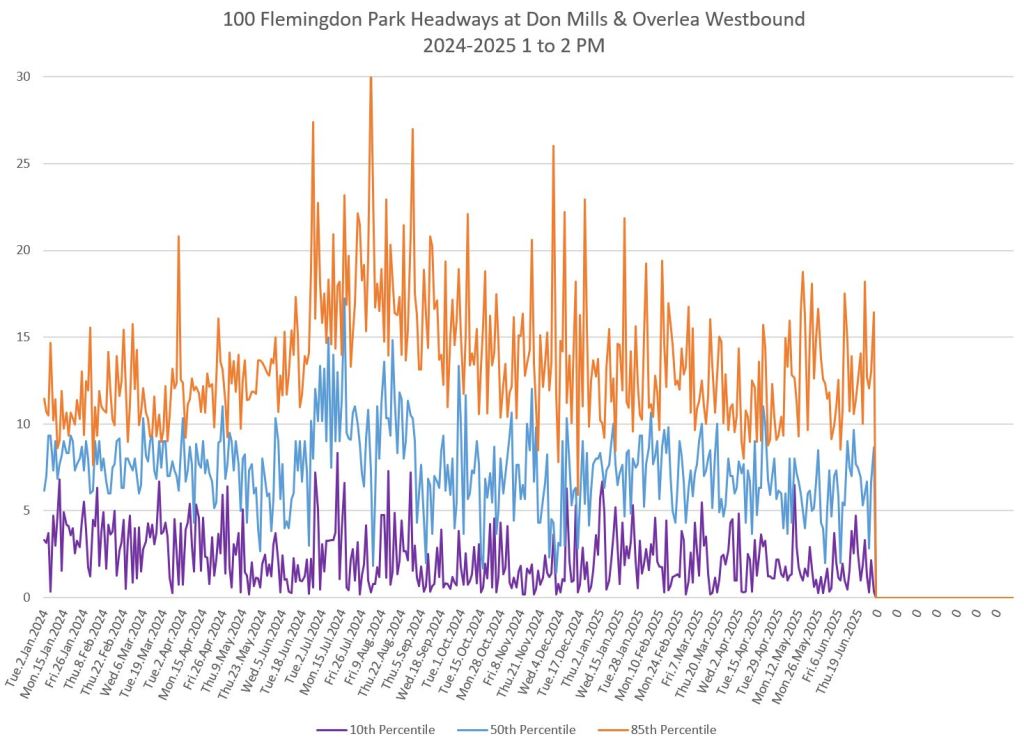
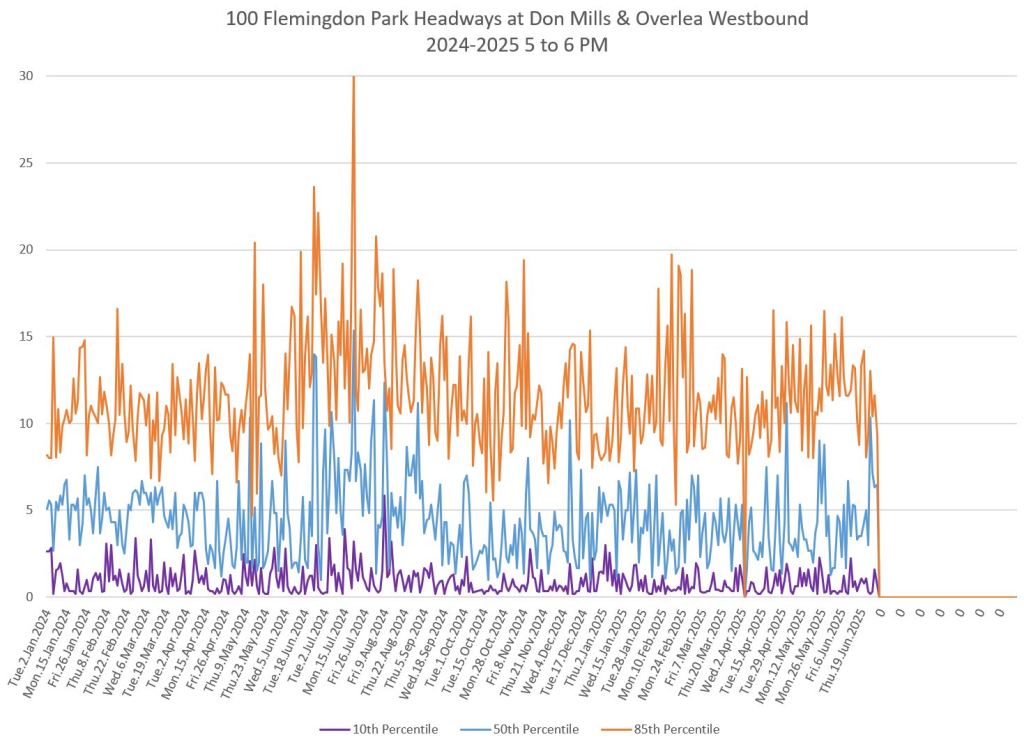
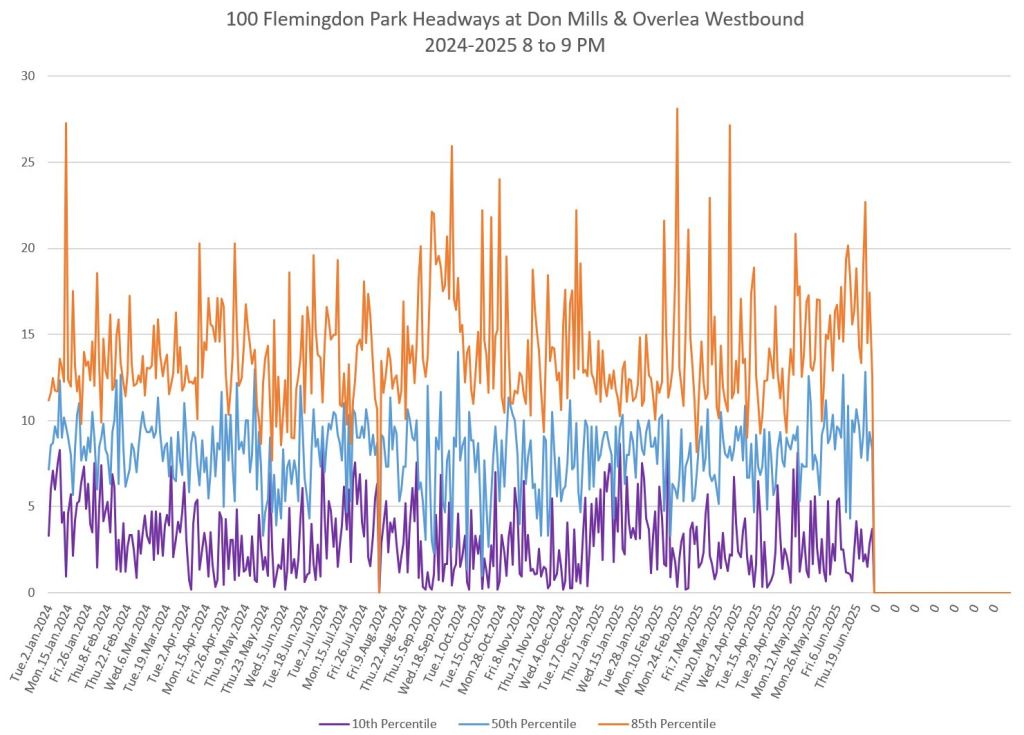
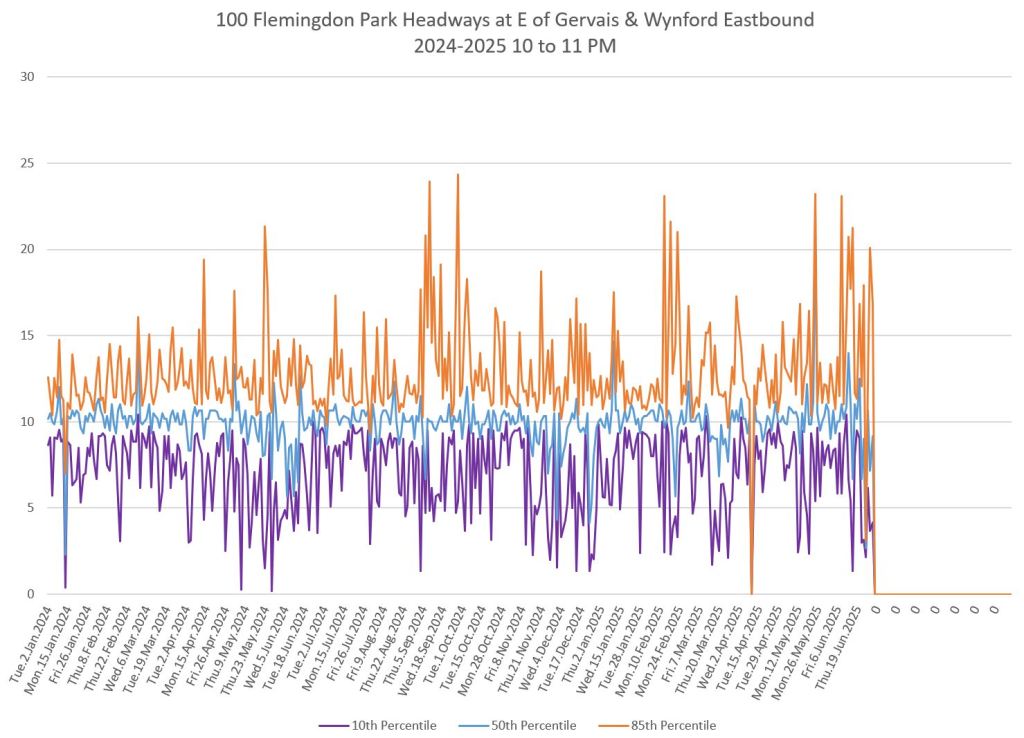
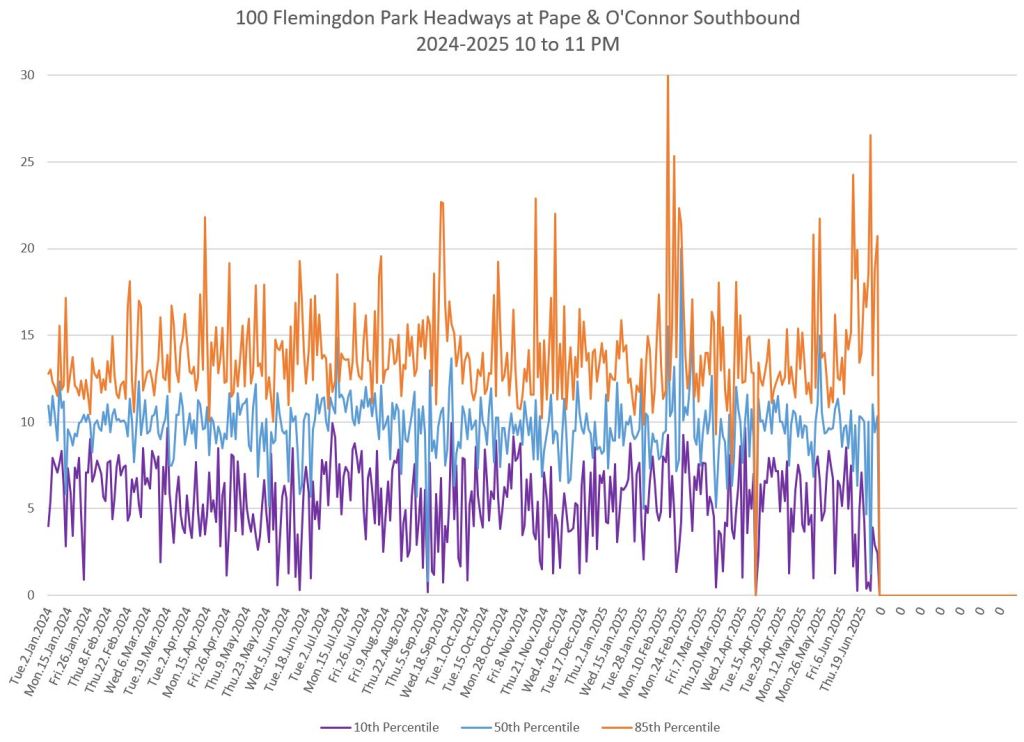
Partly to hold their feet to the fire, and to provide the type of information that should be routinely available to the Board, management and the public, this article will do the work the TTC claims they cannot. Here are headway reliability analyses for the routes involved over much or all of the period from January 1, 2024 to June 30, 2025.
In a very few cases, it is possible to see a change in service quality (measured as a smaller spread between minimum and maximum headways, or gaps between vehicles) around the beginning of March 2025. These are rare, and short-lived. February was a really bad time to try to implement any new practice as the city was digging out (or not depending on where you live) of a huge snowstorm. (The extended effect of the City’s poor snow clearing on transit routes is evident in the multi-day peaks in irregular service on some routes.)
I have presented 18 months of data to show that problems with headway reliability have existed for some time. There is more data going further back, but 18 months makes the point. Moreover, a consistent pattern is that headways might be well-behaved in the AM peak and Midday, but evening service does not fully “recover” from PM peak conditions, and erratic service is common.
Quite bluntly, service on all of these routes was poor, well beyond the TTC’s own Service Standards, for 2024 and early 2025, and showed little sign of improvement through to mid-year. It will be interesting to compare whatever stats TTC comes up with to the performance shown on charts here.
Part I of this series includes data for 7 Bathurst, 100 Flemingdon Park, 165 Weston Road North, 506 Carlton and 512 St. Clair. Part II will include 24/924 Victoria Park, 25/925 Don Mills and 29/929 Dufferin.
There are a lot of charts and this is a long read. I will put the “more” break here. Those readers interested in specific routes can soldier on. Thanks for reading!
Reading The Charts
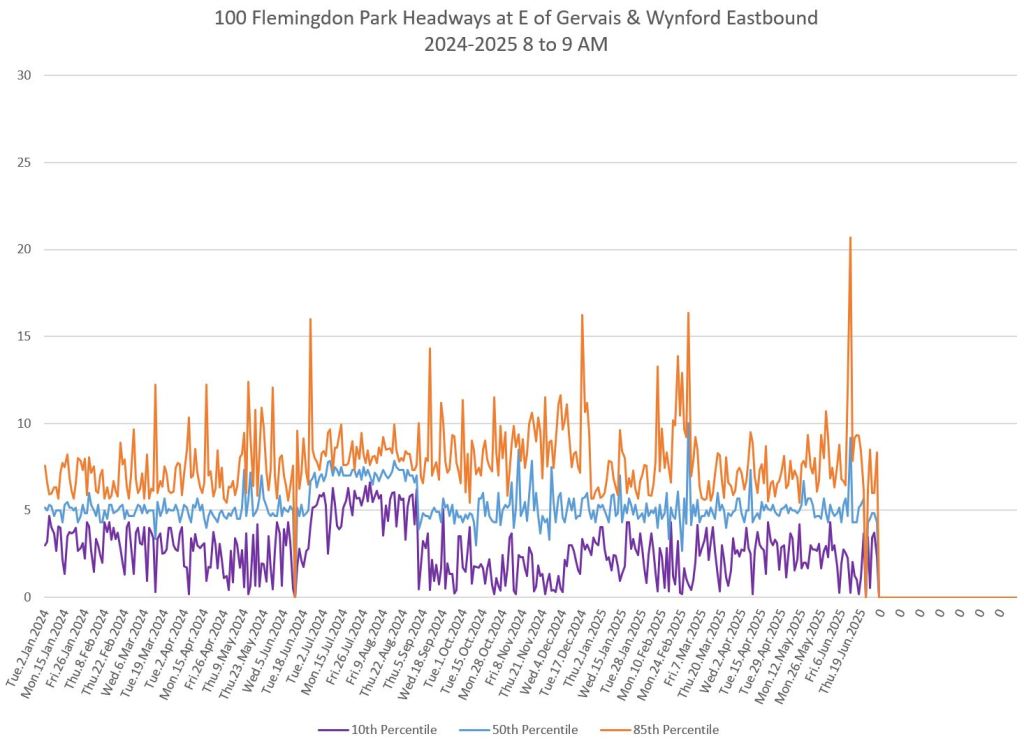
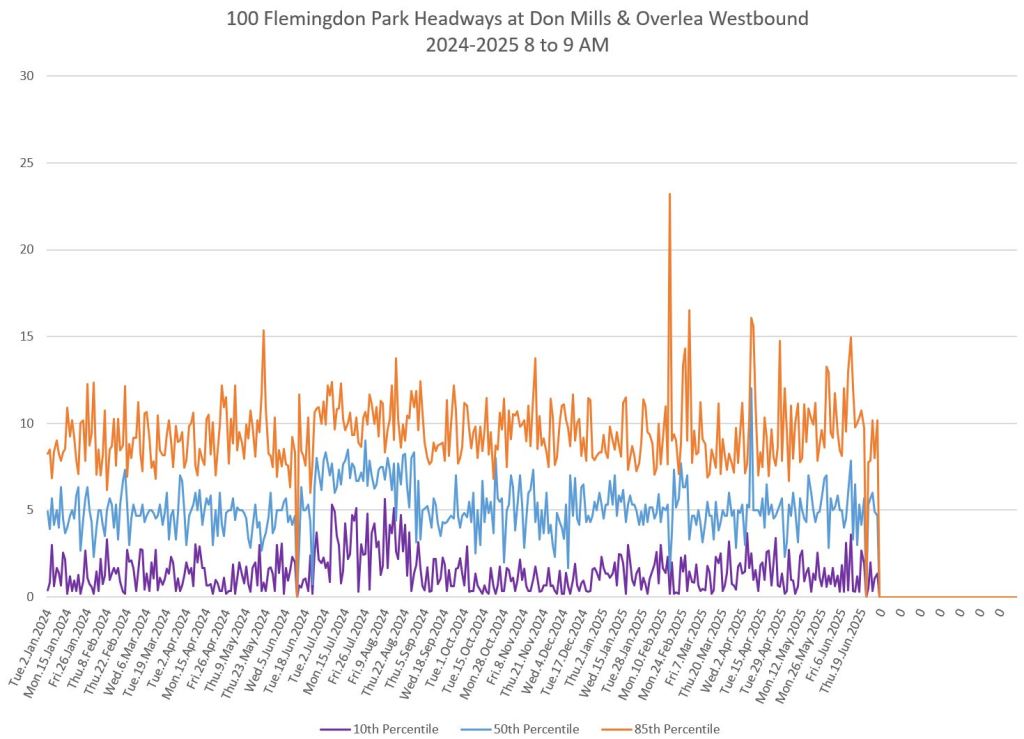
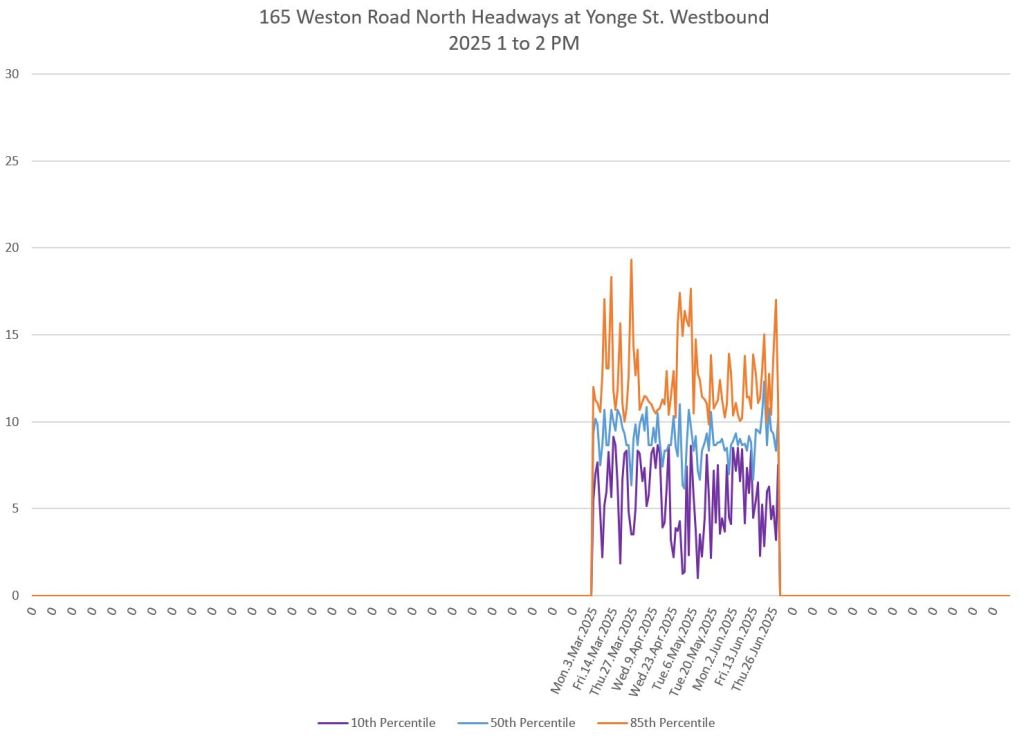
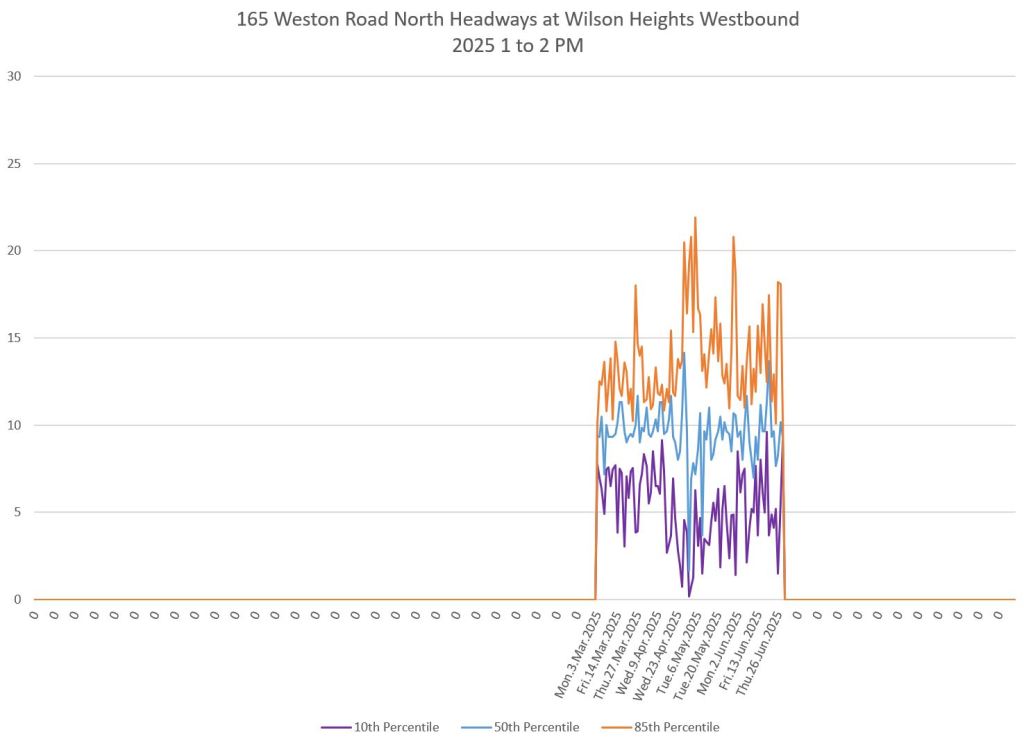
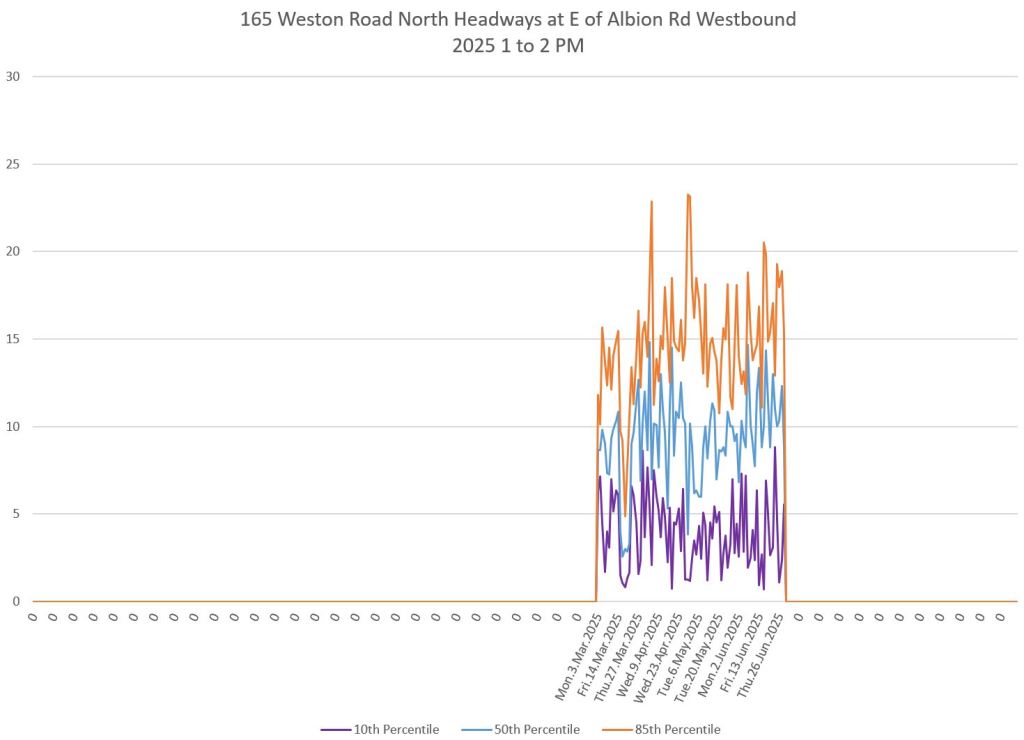
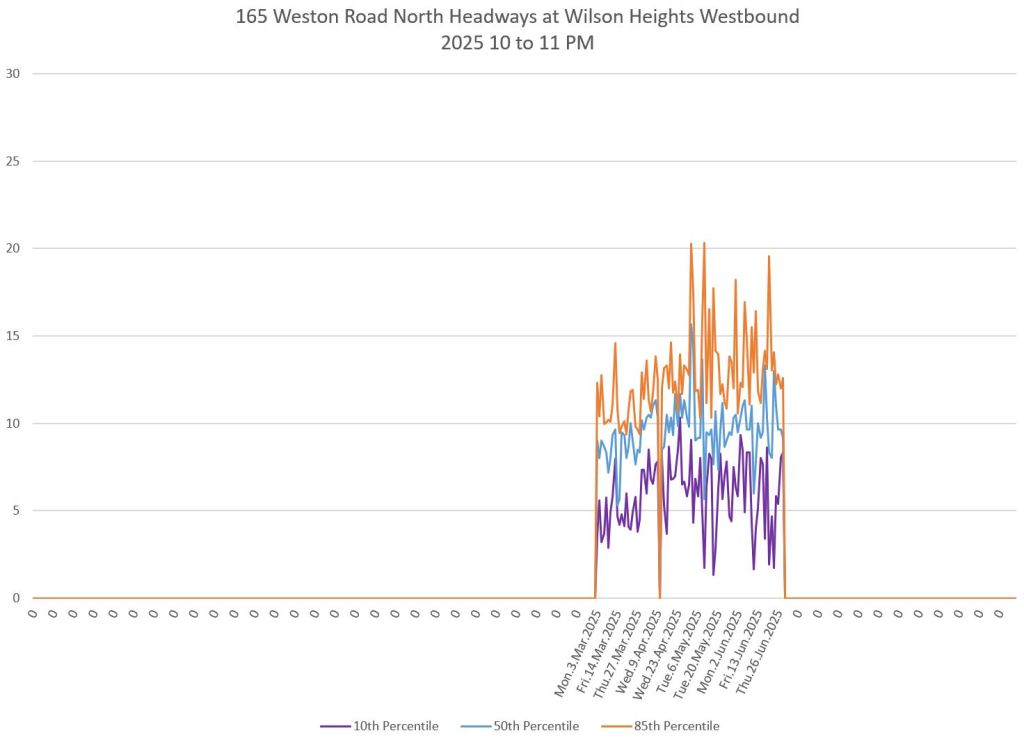
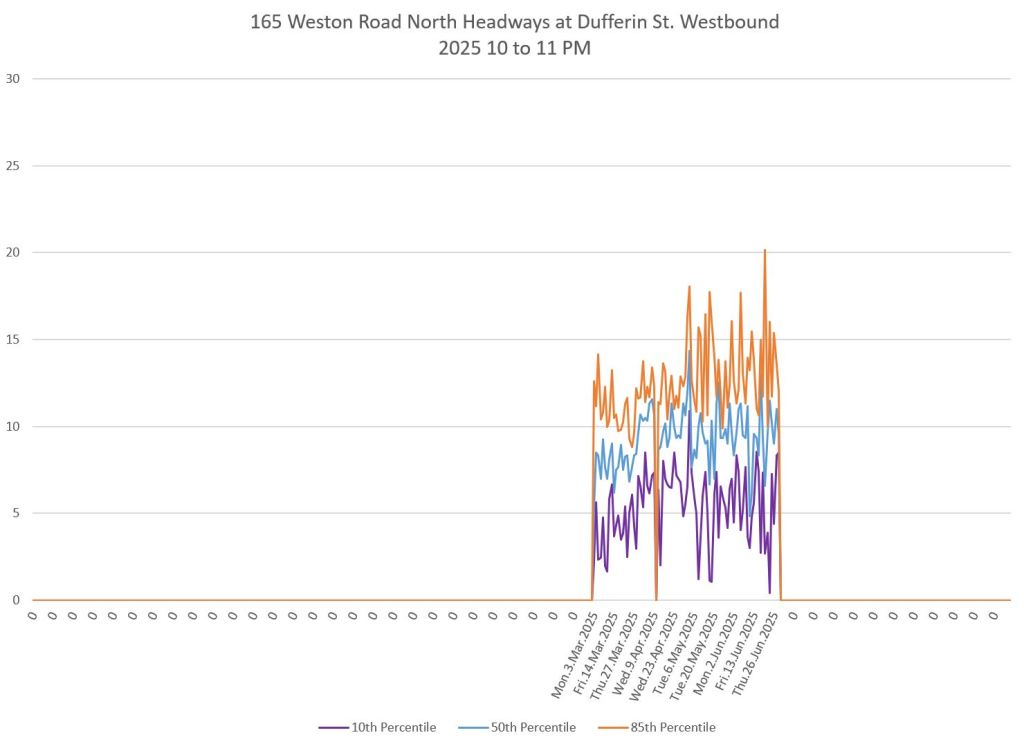
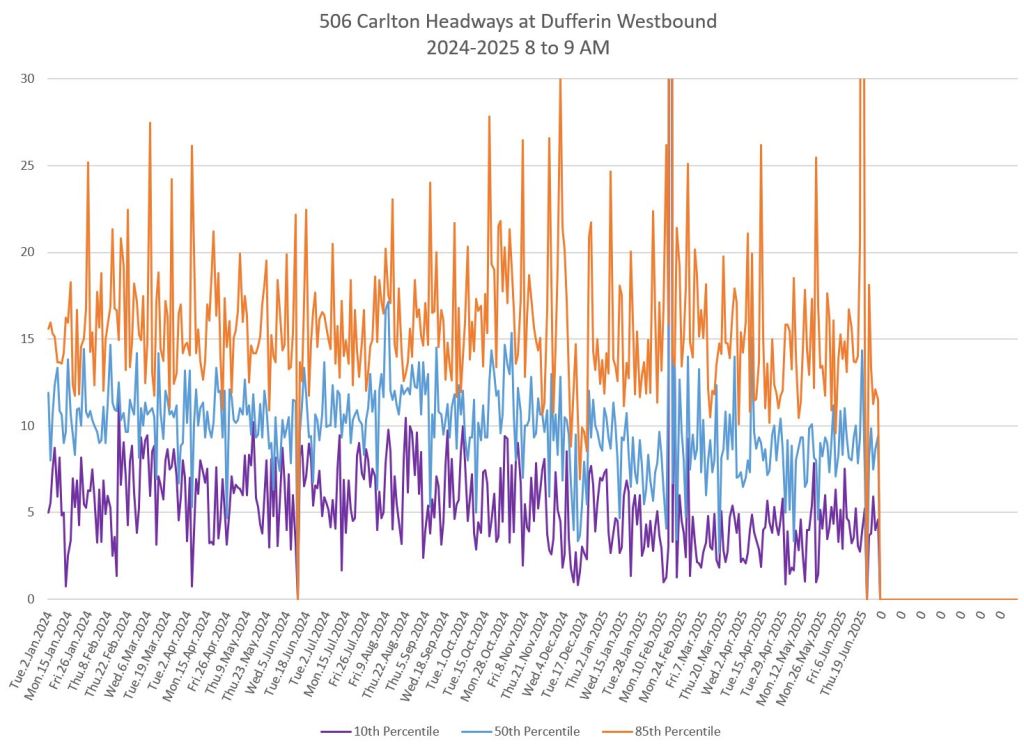
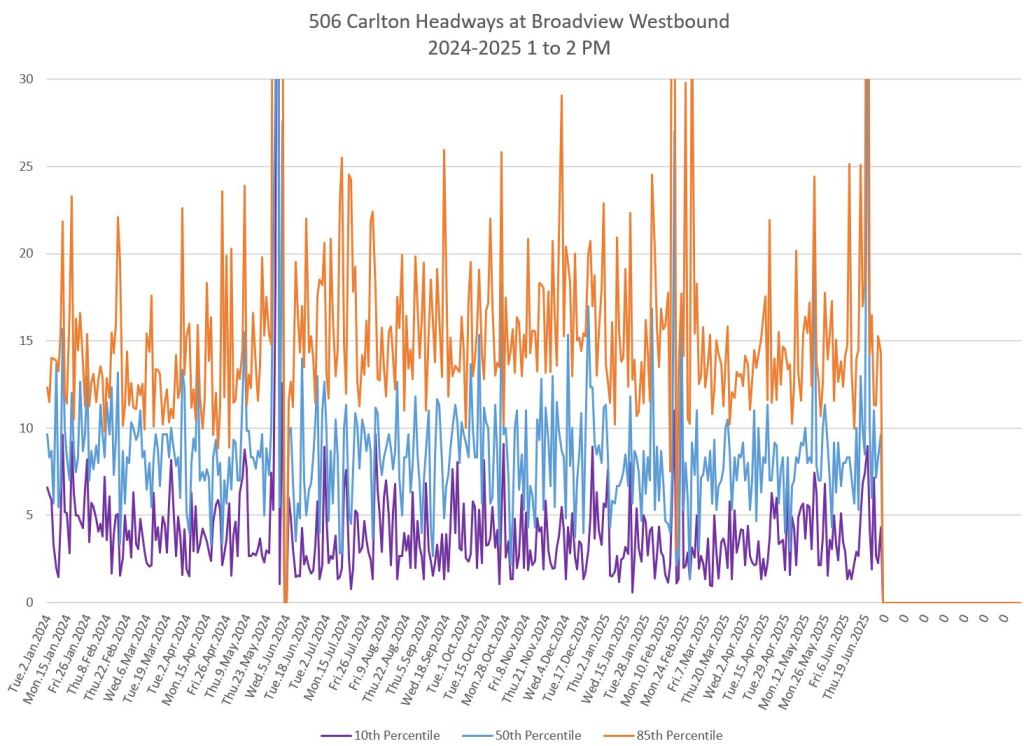
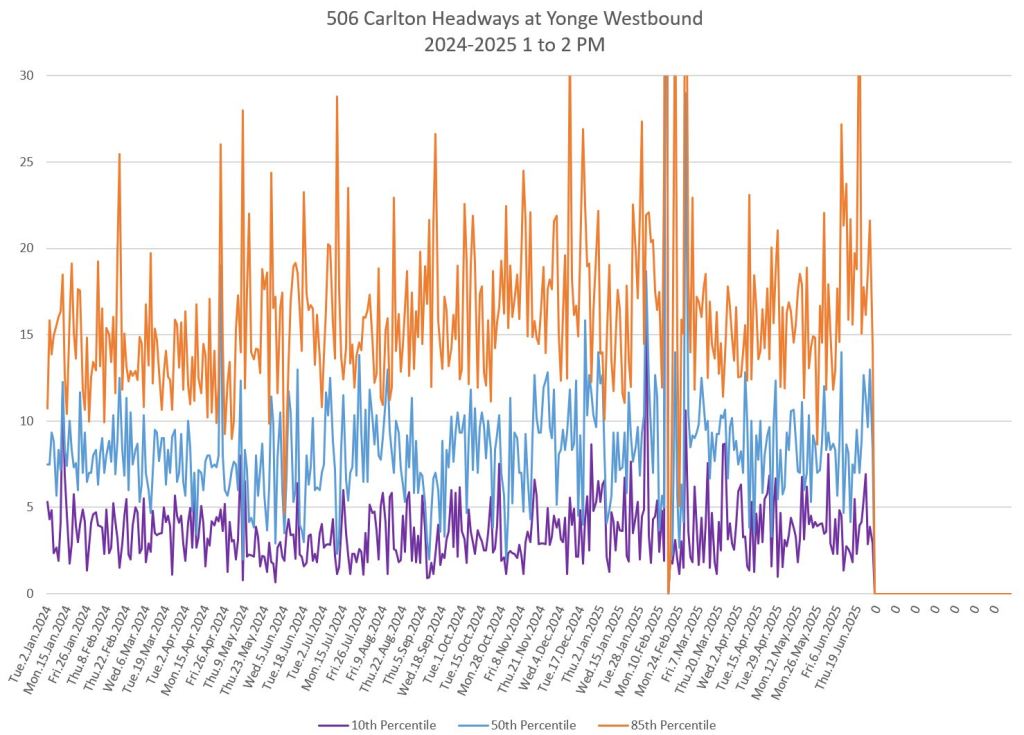
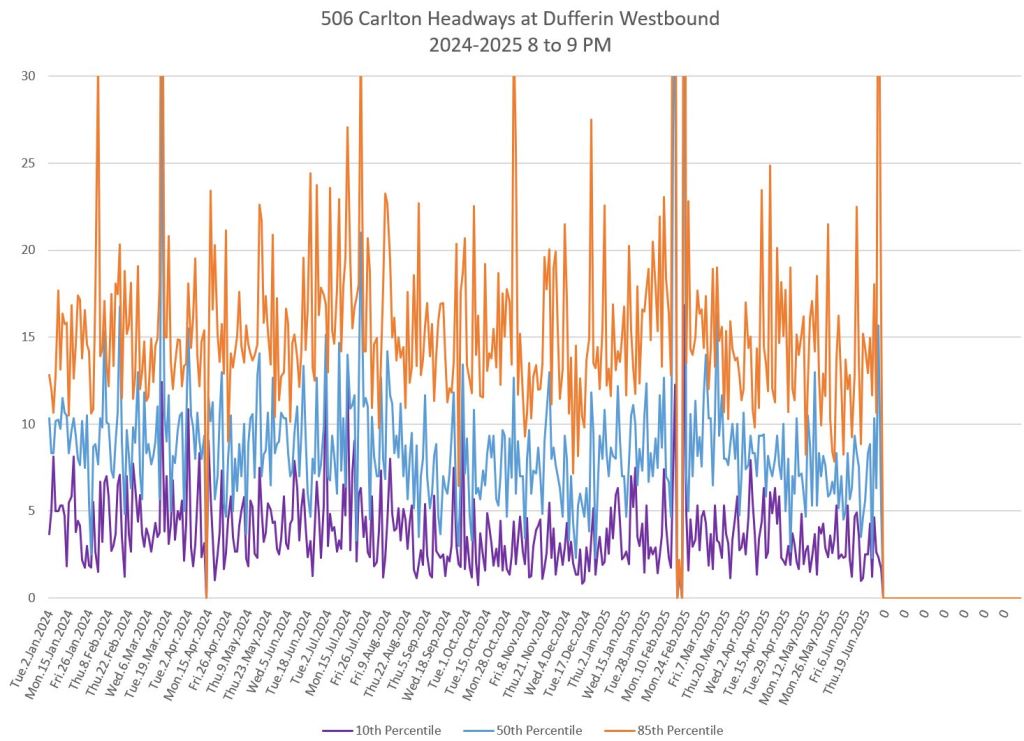
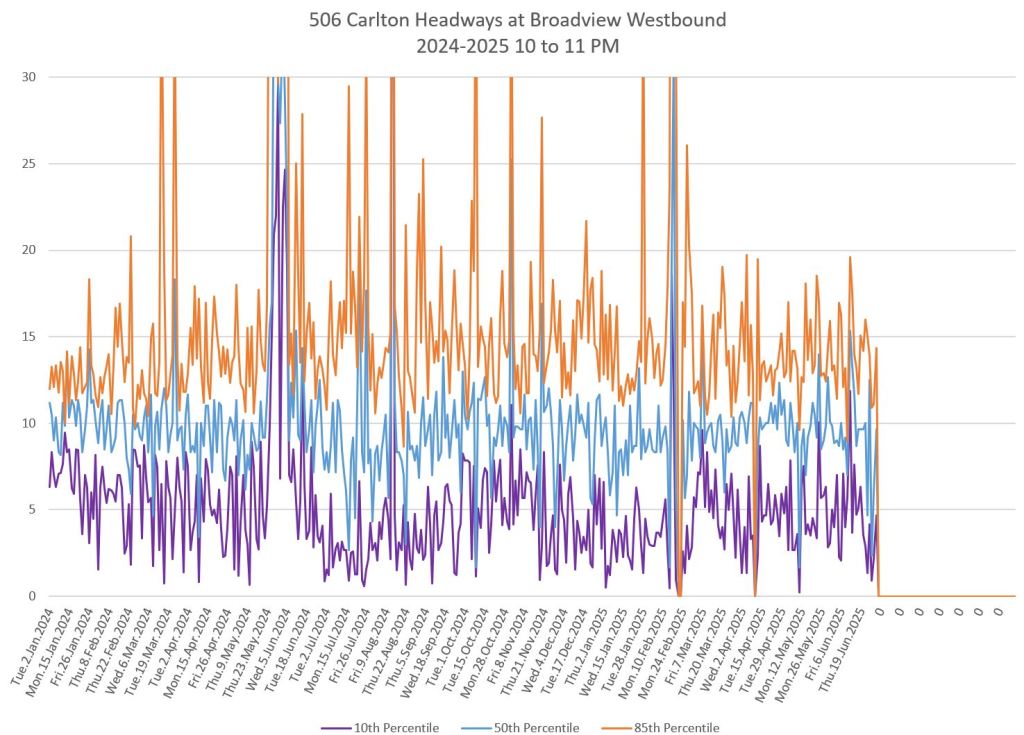
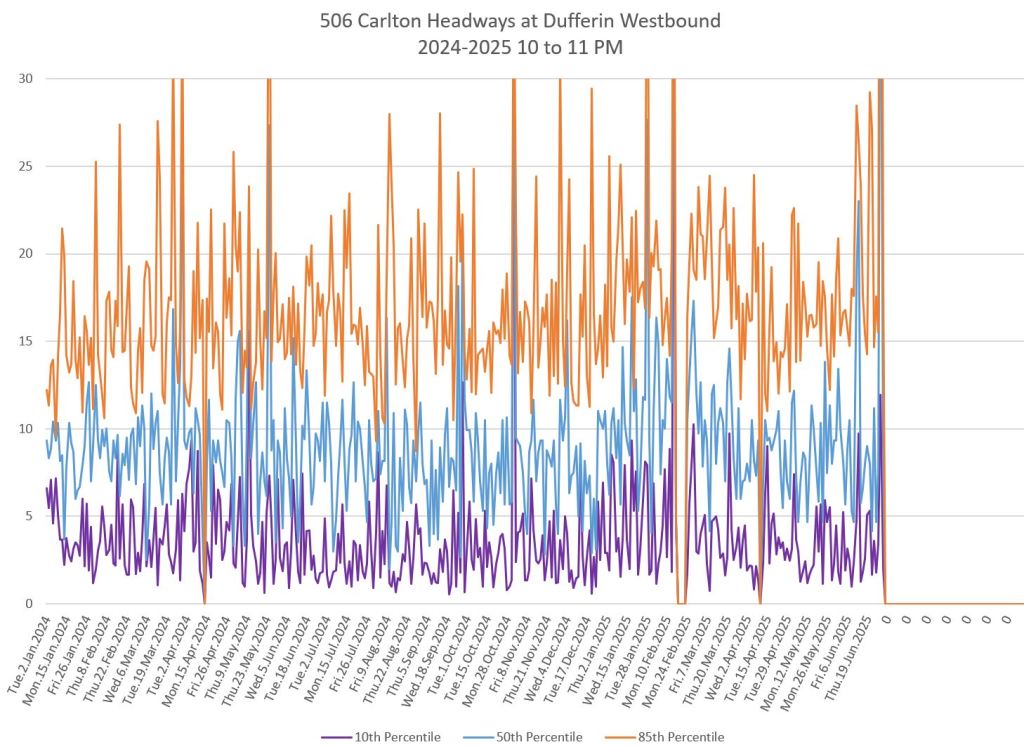
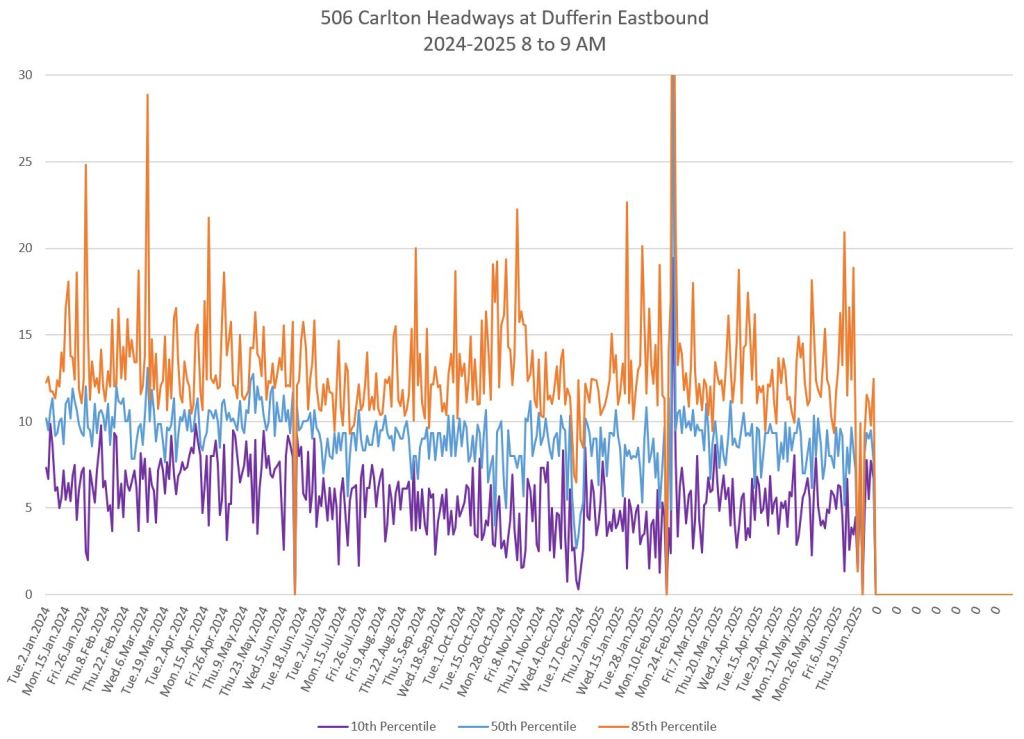
The charts in this article are in a familiar format from past analyses of headways and travel times. Those with long memories will remember their appearance as part of the King Street transit mall study. Those charts showed the 50th and 85th percentiles of travel times. Here, because we are looking at headways, I have also included the 10th percentile which shows the majority of bunching effects.
For each route, I have selected time points or screenlines where headways are measured. A common location is near the termini to measure service reliability at the start of trips, and then a few key points along the way to show how the service has been regulated, or not.
A common pattern through the charts is that service might start up fairly well organized with the 85th and 10th percentiles close to the median near the terminals, but this quickly falls apart with a wider spread at locations along the route. Some routes are already disorganized leaving their terminals, and the service gets worse from there.
Service is measured for one hour in each of the five major schedule periods on the TTC:
- 8-9am (AM peak)
- 1-2pm (midday)
- 5-6pm (PM peak)
- 8-9pm (early evening)
- 10-11pm (late evening)
On each chart there are three lines:
- Light blue: median value (50% of trips were on shorter headways, 50% were longer)
- Orange: 85th percentile to embrace all but the worst outliers of long headways (gaps)
- Dark purple: 10th percentile to embrace all but the worst outliers of short headways (bunching)
In theory, the median should lie roughly at the scheduled headway, but this does not always happen because a pattern of long-short-short headways will mean that there are more bunched buses than those in gaps, and the median will be pulled down.
Data for each weekday show the day-by-day change in route performance. This approach eliminates a key problem with all TTC stats that consolidate data for many locations, times and dates into a single “on time performance” metric that is absolutely meaningless.
For reference, the scheduled level of service for each route is included at the beginning of each section. In some cases, schedules were changed to alter travel times, recovery times or other operational details with no change in scheduled headways. These changes are not included here.
7 Bathurst
- 7 Bathurst Station to Steeles
This is a straightforward route running from Bathurst Station to an on-street loop via Carpenter, Steeles, Village Gate and Greenwin Village Road.
| Effective | AM Peak | Midday | PM Peak | Early Eve | Late Eve |
|---|---|---|---|---|---|
| 13-Feb-23 | 10′ | 10′ | 10′ | 10′ | 10′ |
Notwithstanding the unchanging 10 minute headway, it is clear that extra service was operated (probably with RAD or “Run As Directed” spare buses)in the morning from November 2024 to late March 2025. The extra buses stayed in service until early afternoon although they only show up on the 8am plot here. These trips were operated with standard sized buses while the core scheduled service uses artics (two-section buses).
The screenlines for 7 Bathurst are:
- Northbound: Barton (just north of Bathurst Station), Eglinton and Sheppard
- Southbound: South of the Steeles on-street loop, Sheppard and Eglinton
AM Peak Northbound
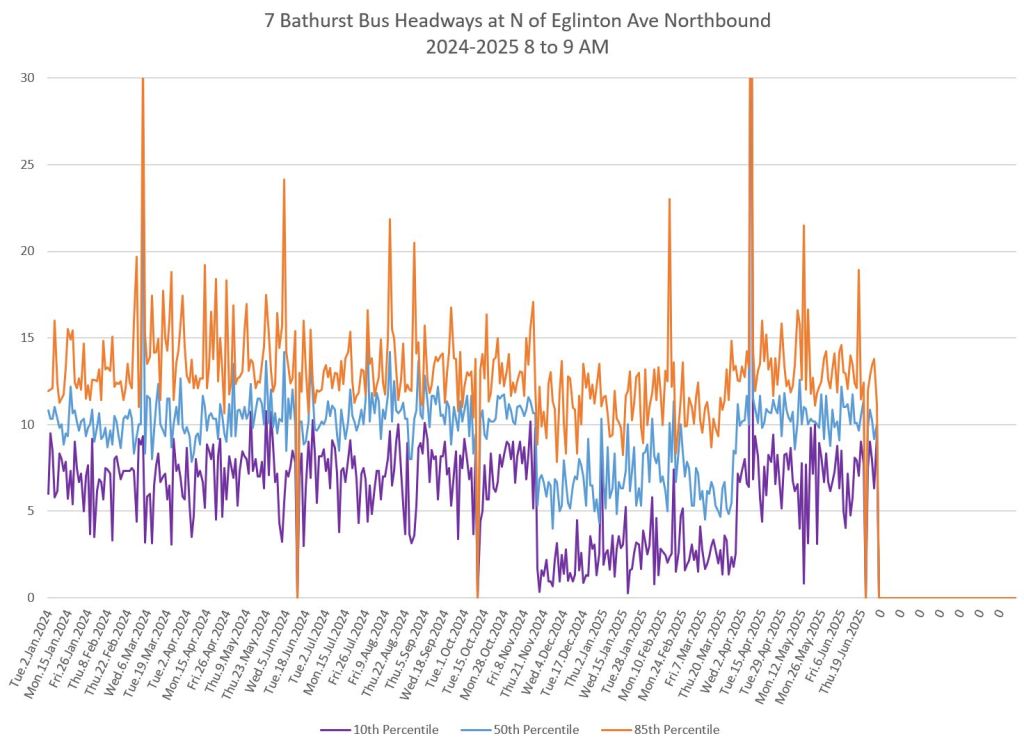
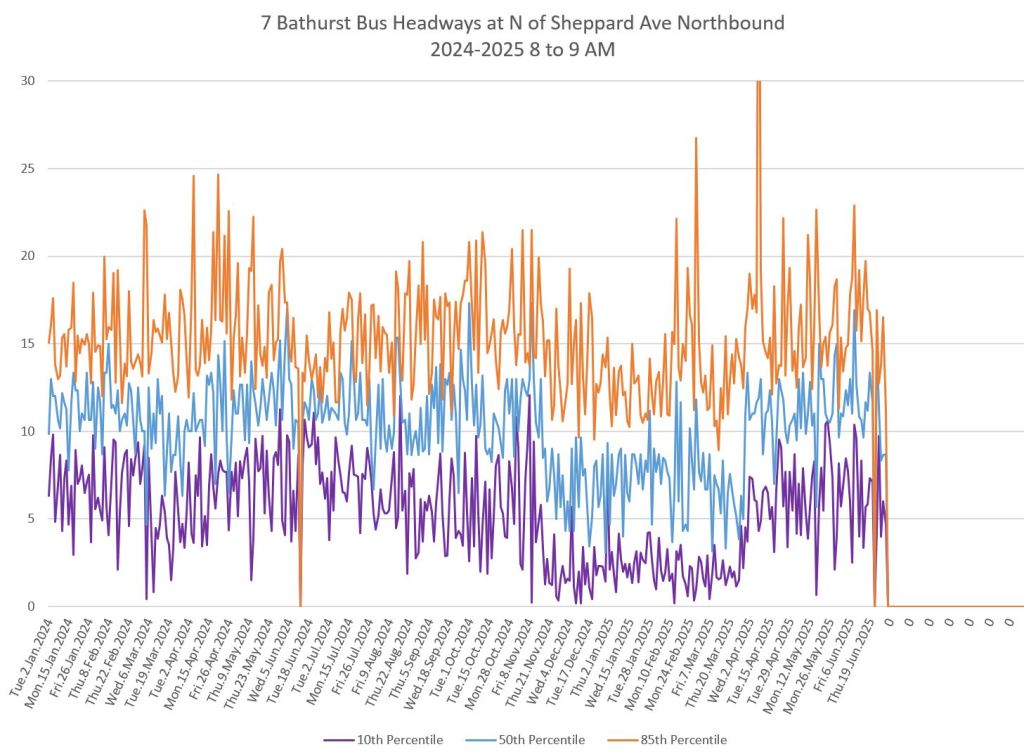
Leaving Bathurst Station in the AM peak, the spread from 10th to 85th percentile of headways is small although it becomes “spikier” through the Spring and Summer of 2024. There is a much broader range during the period when extras operated. They were fitted in at odd intervals between the basic 10-minute service making for a less regular headway and a low 10th percentile because the extras could run close ahead of or behind a scheduled run. The stats return to “normal” when the extra service disappears in April 2025.
Although the spread of headways is tight at Barton Street, it begins to spread out by Eglinton and even moreso by Sheppard.

Midday Northbound
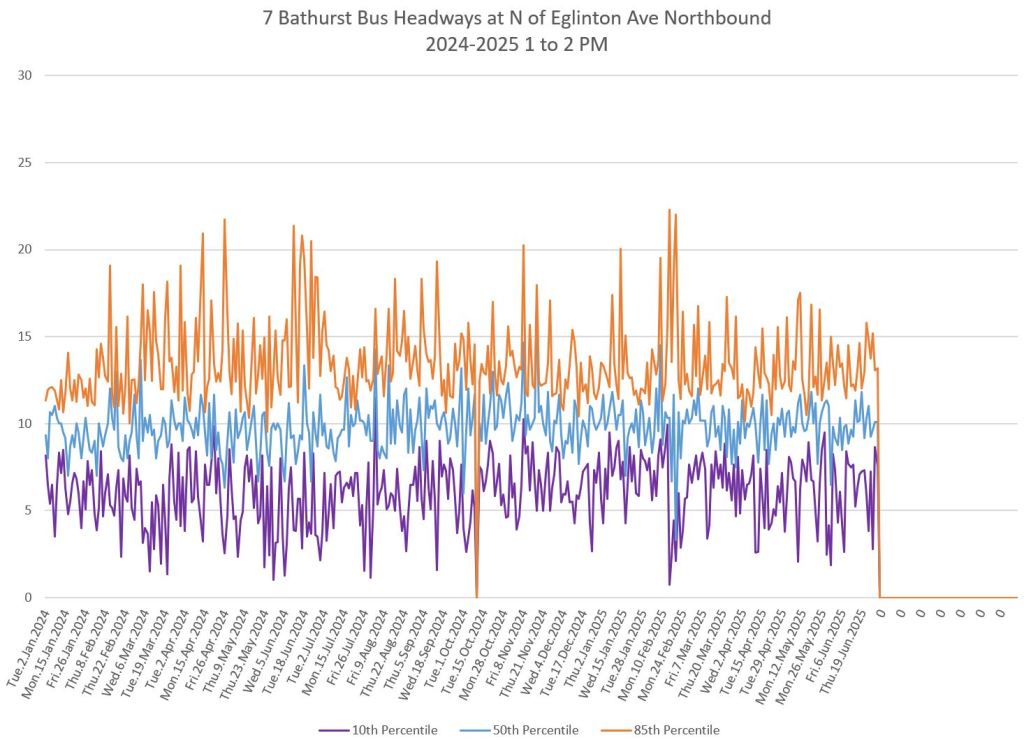
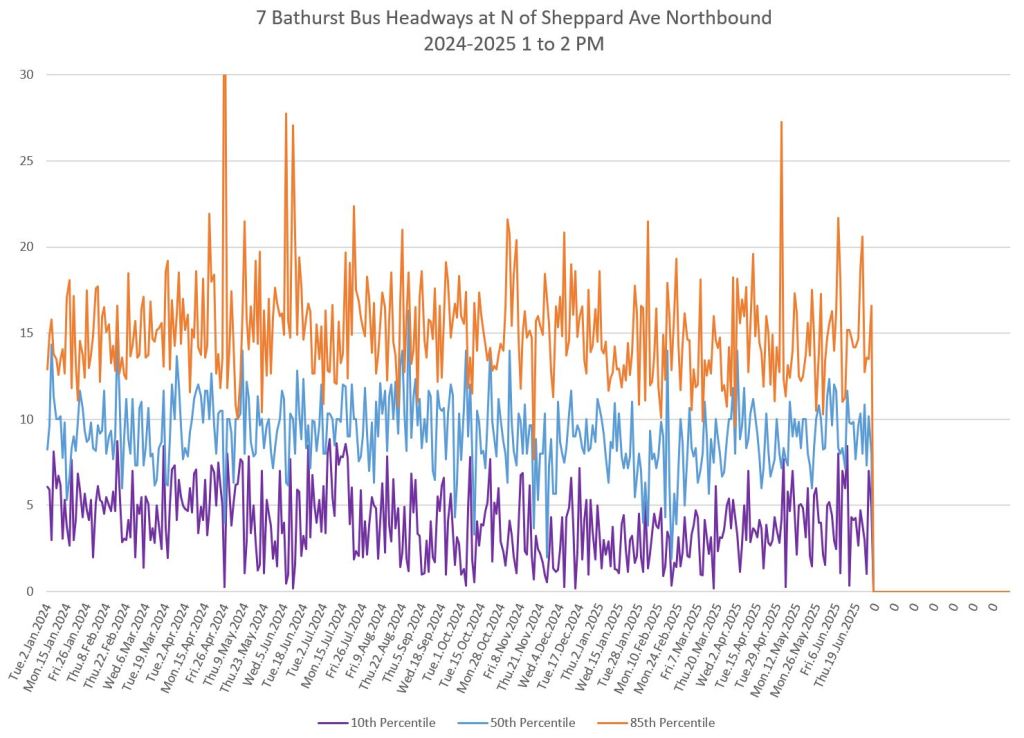
By early afternoon, headways are more spread out at Barton although this improves in September 2024. This corresponds to additional running time in the schedules in the midday and PM peak periods.

PM Peak Northbound
The PM peak service shows a reduction in headway spreads in March 2025 at the south end of the route. However, this vanishes again in April. Moreover, the 10th percentile line is at a low level as one moves north on the route indicating that bunching is common.


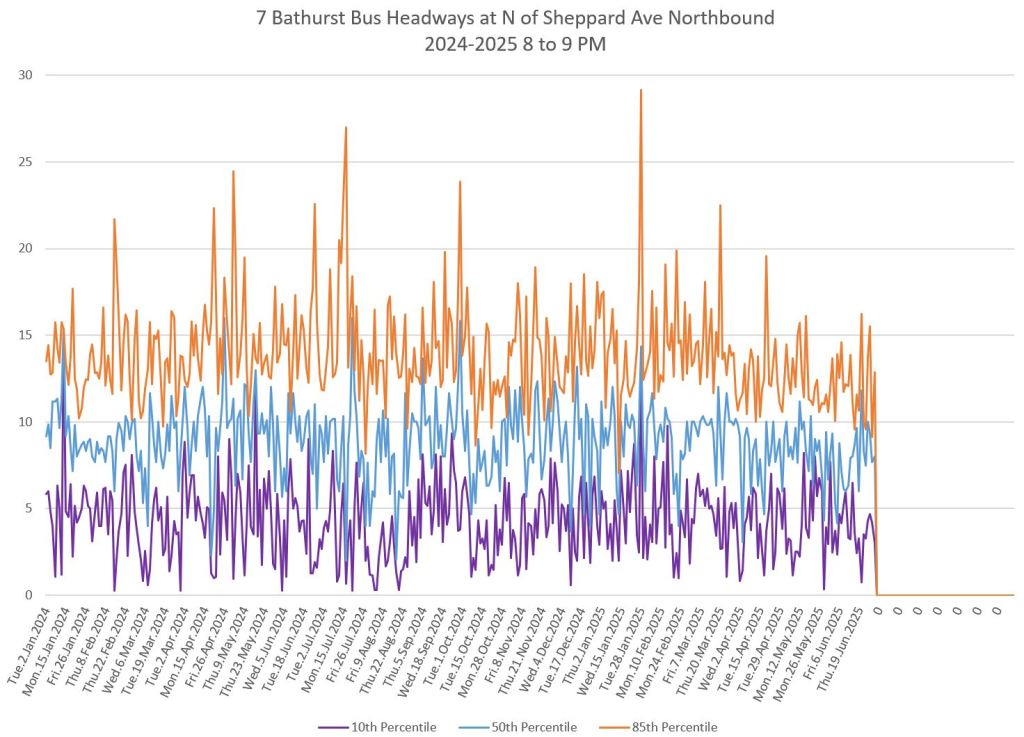
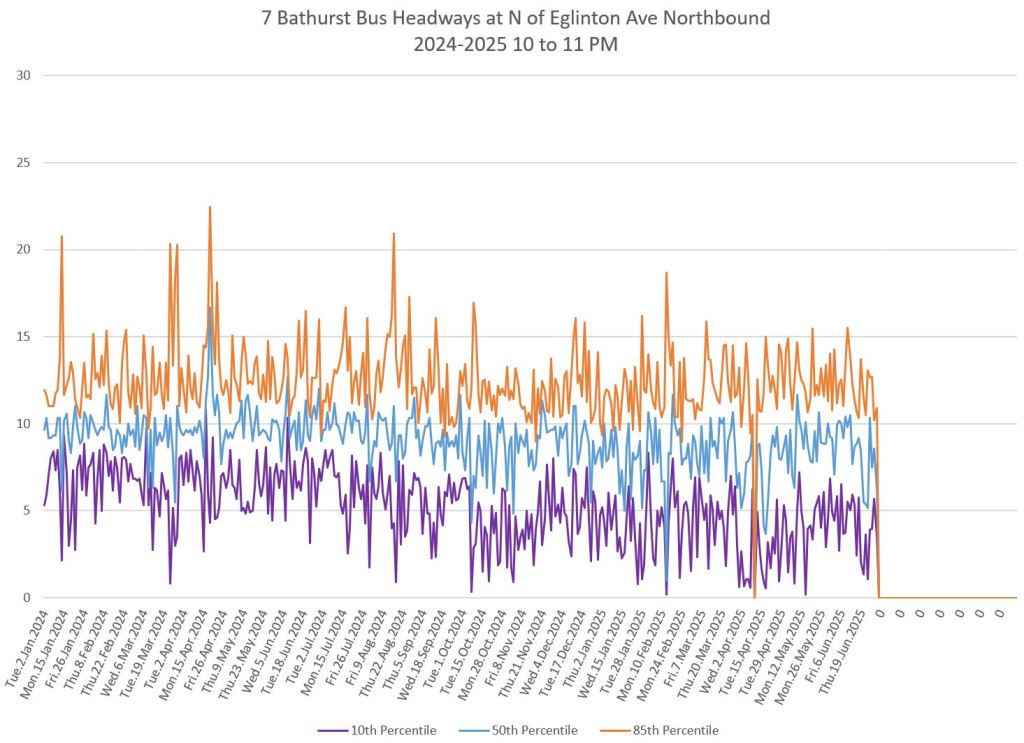
Early Evening Northbound
Evening service shows less spread in headways than the PM peak, but the problem of a greater spread and bunching particularly on the north end of the route remains.


Late Evening Northbound


AM Peak Southbound
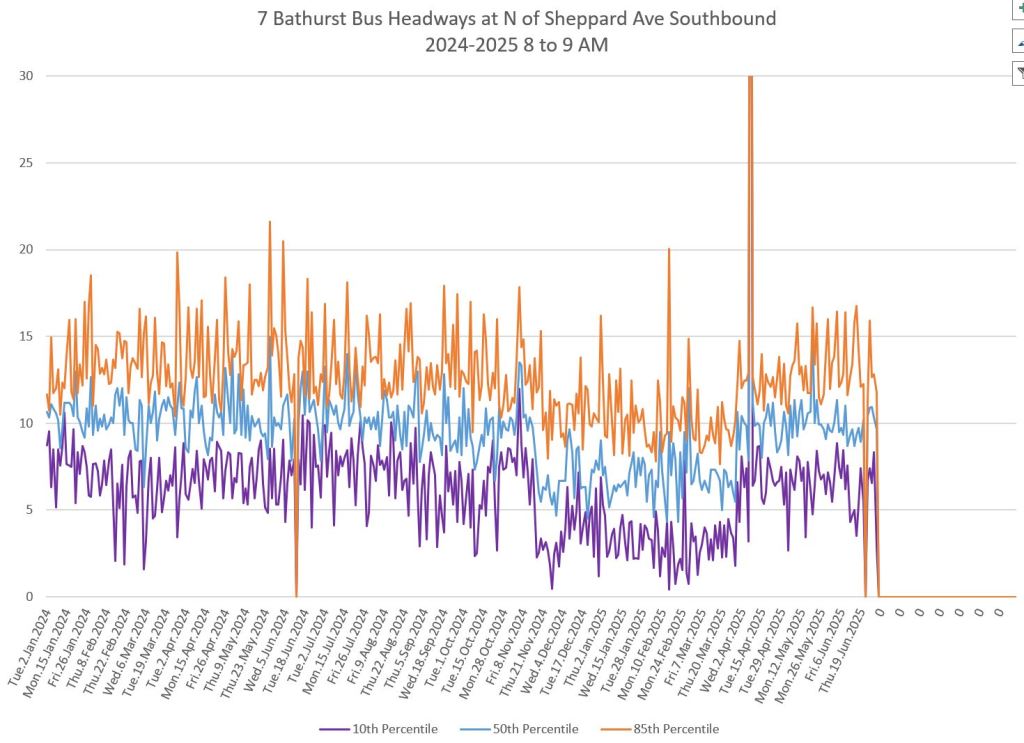
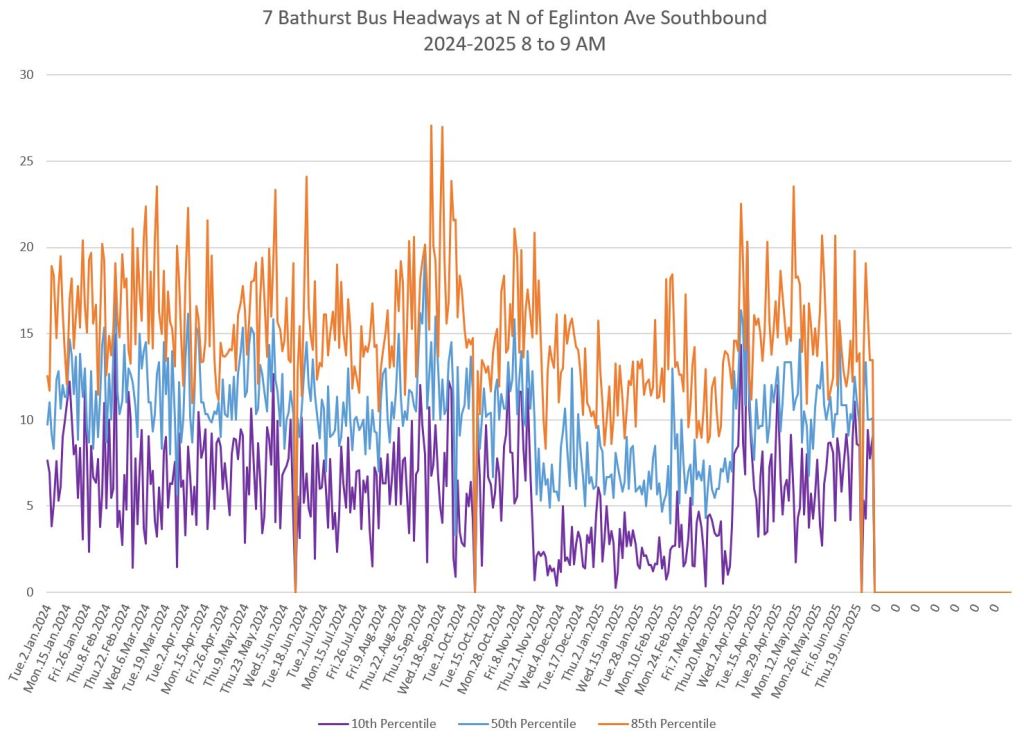
Southbound service shows a similar pattern to northbound with headways near the terminus in a relatively narrow band. This spreads out during the period when extra buses were operating giving a mix of short and long headways, but the narrower distribution resumes in April 2024.
Further south, at Sheppard and particularly at Eglinton, the range of headway values widens substantially.
Note that this occurs over the portion of Bathurst Street where a transit priority red lane is not proposed. Service south of Eglinton will be ragged if nothing is done to improve the spacing of buses arriving from the north.

Midday Southbound
By midday, headways are starting to spread out even near the terminus and the range of values at Eglinton is wider.
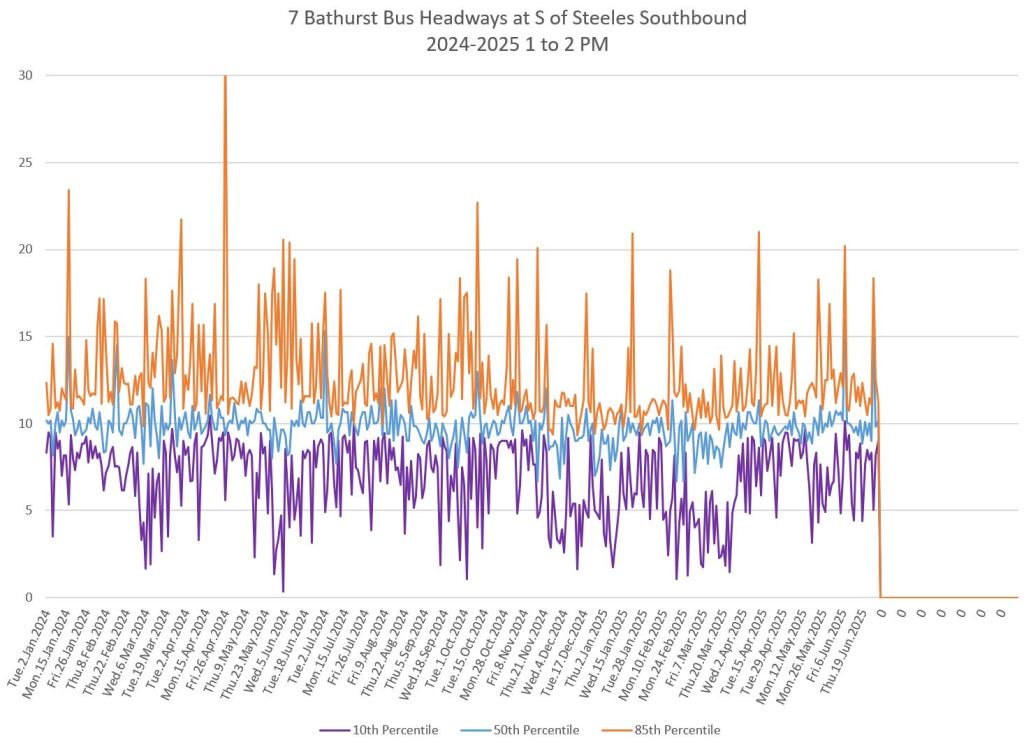


PM Peak Southbound
The PM peak shows continuing wider headways south from Steeles. The spread in values at Eglinton has grown to over 20 minutes. Note that this is for the percentile range 10-85, and another quarter of the service lies above or below these values.


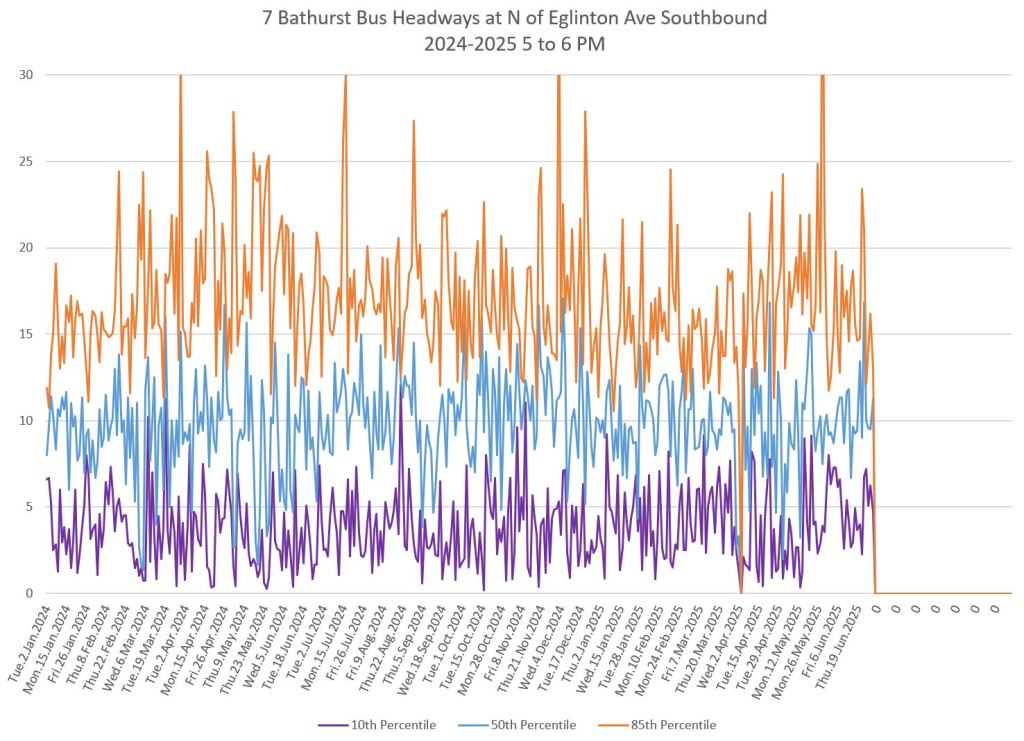
Early Evening Southbound
In the evening and late evening, the range of headways south from Steeles improves compared to the PM peak but never returns to the tight AM peak behaviour. Particularly notable is the 10th percentile line which remains well below the scheduled 10 minute headway. Bunching and gaps remain common.


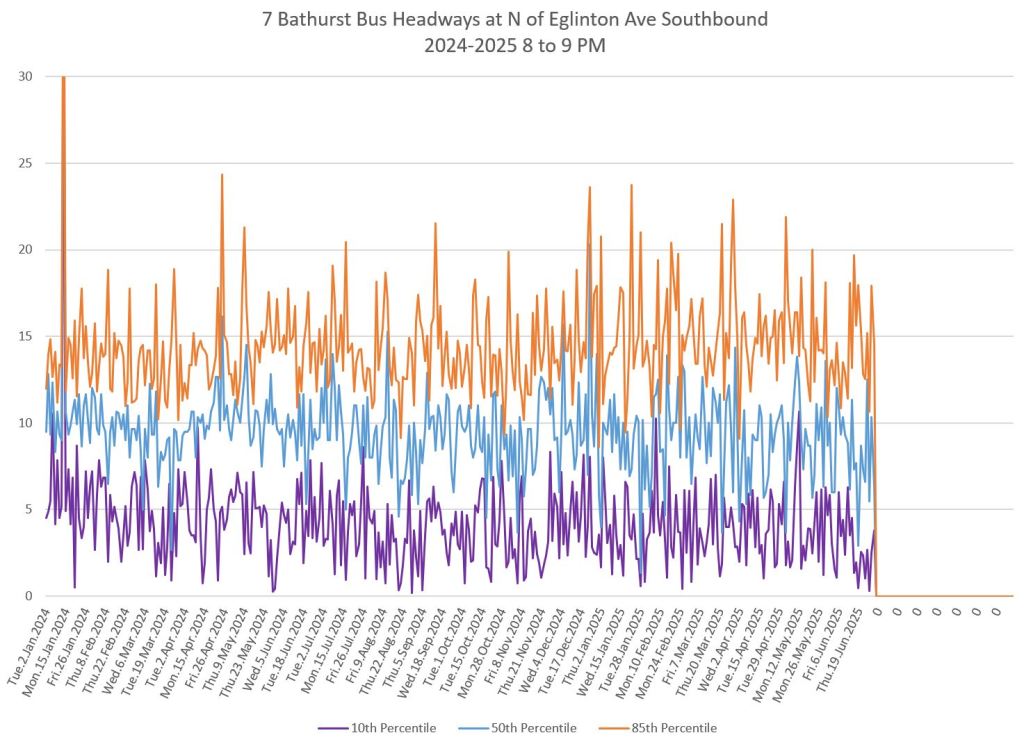
Late Evening Southbound


100 Flemingdon Park
- 100A Broadview Station to Don Mills & Wynford
| Effective | AM Peak | Midday | PM Peak | Early Eve | Late Eve |
|---|---|---|---|---|---|
| 20-Nov-23 | 5’30” | 8′ | 5’30” | 10′ | 10′ |
| 24-June-24 | 7′ | 10′ | 7′ | 10′ | 10′ |
| 03-Sept-24 | 5’30” | 8′ | 5’30” | 10′ | 10′ |
The Flemingdon Park bus originates at Broadview Station, travels north across the Leaside Bridge, through Thorncliffe Park and then winds through Flemingdon Park eventually arriving at Don Mills and Eglinton with a loop from Wynford via Gervais, Eglinton and Don Mills.
The screenlines for 100 Flemingdon Park are:
- Northbound: Pretoria (just north of Broadview Station), Pape & O’Connor, Overlea & Don Mills
- Southbound: On Wynford just east of Gervais Drive, Overlea & Don Mills, Pape & O’Connor
100 Flemingdon Park has been severely disrupted by various construction projects through 2024-25:
- Ontario Line utility relocation work on Overlea Boulevard
- Ontario Line works at Don Mills and Eglinton
- Road reconstruction and reconfiguration for bike lanes on the Leaside Bridge and on Pape
AM Peak Northbound
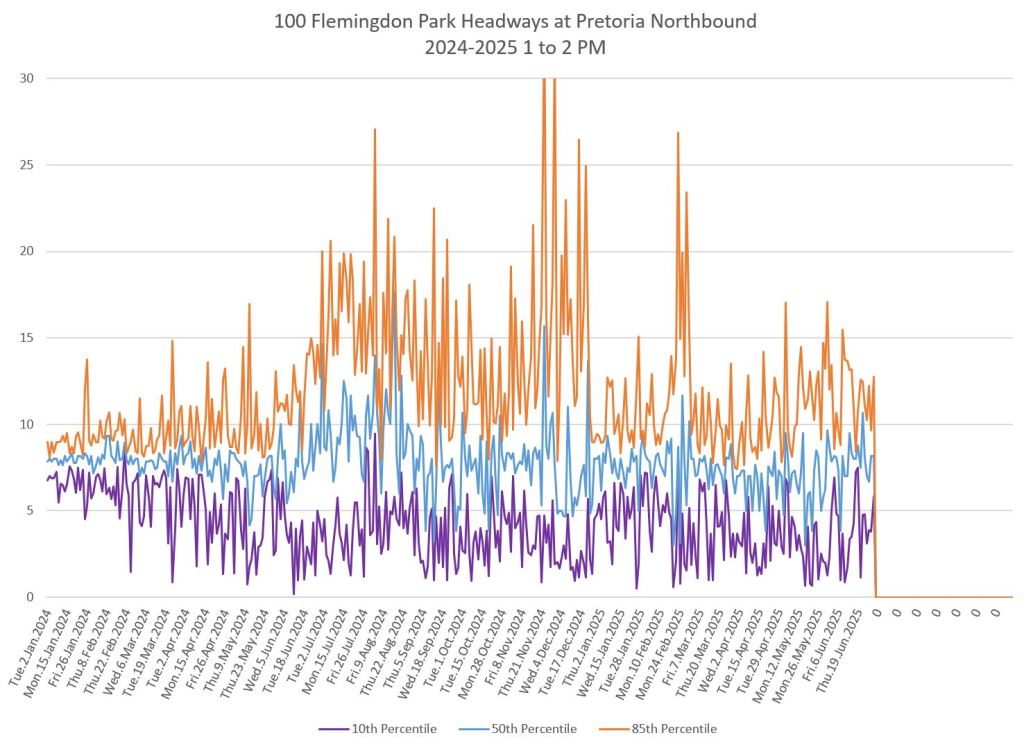
Headways northbound from Broadview Station lie in a fairly narrow band at the beginning of 2024, but the 10th percentile stays stubbornly low along the route. Bunching is common, although on a comparatively short 5’30” headway is harder to prevent. The rise in values in mid-2024 corresponds to the summer service reduction. No comparable change was made in mid-2025 and the winter schedule service levels remain in place.


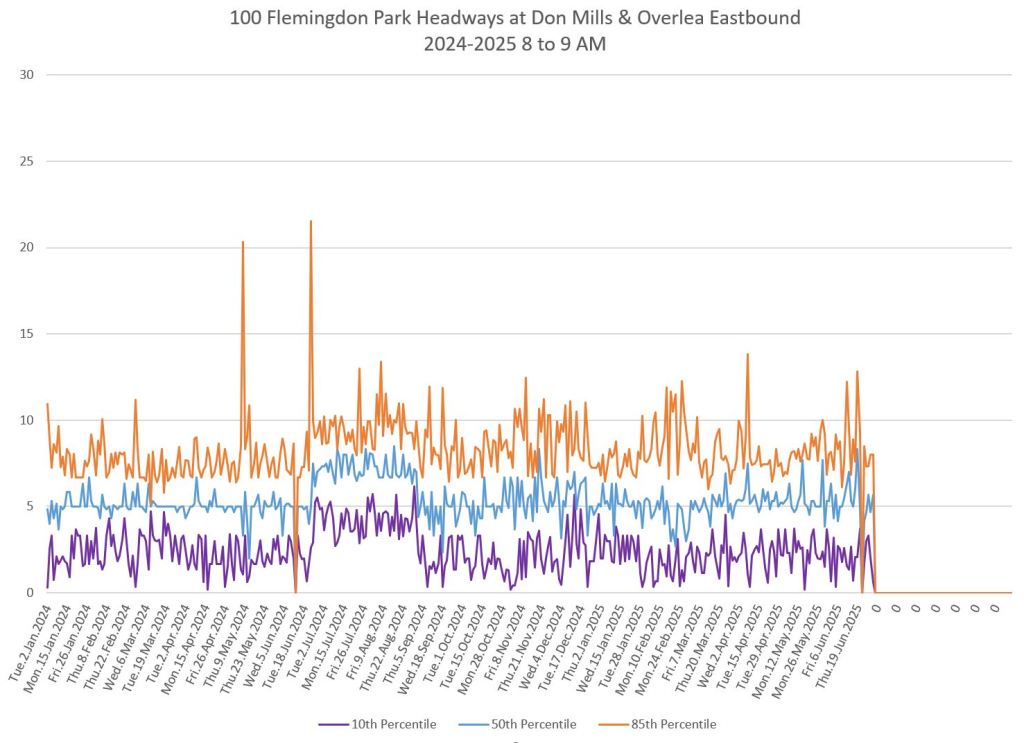
Midday Northbound
By midday, the effect of construction projects is evident with a much wider spread in headways even at Broadview Station.
An effect visible here and in charts for later periods below is the return to a less scattered headway range corresponding to the end of construction in late 2024. This is interrupted by a peak for several days in the aftermath of the major winter storm, but departures from Broadview are still nowhere as tightly grouped as in early 2024.


PM Peak Northbound
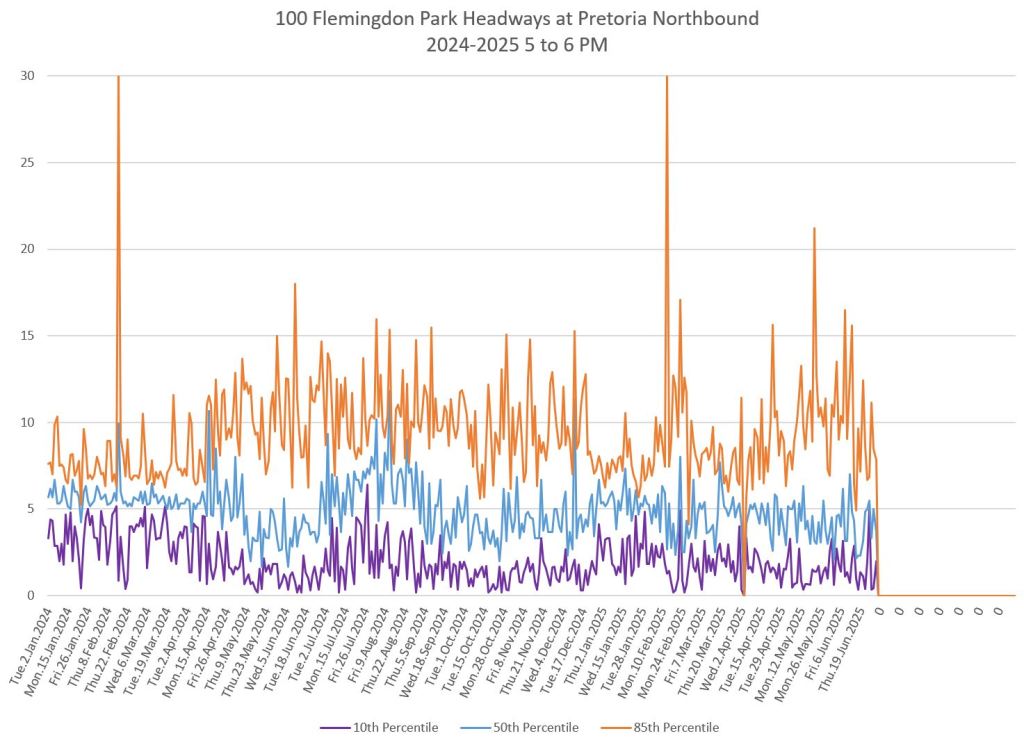
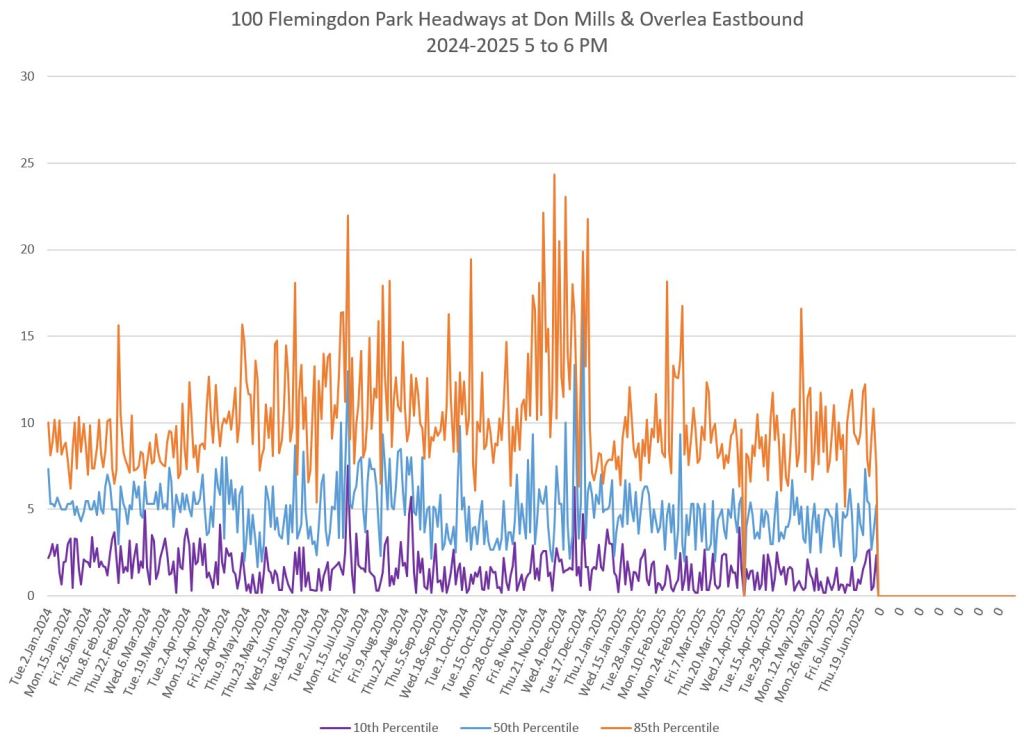
The PM peak has frequent 5’50” service except in the summer of 2024, but the 10th percentile stay consistently close to zero indicating ongoing problems with bunching.

Early Evening Northbound
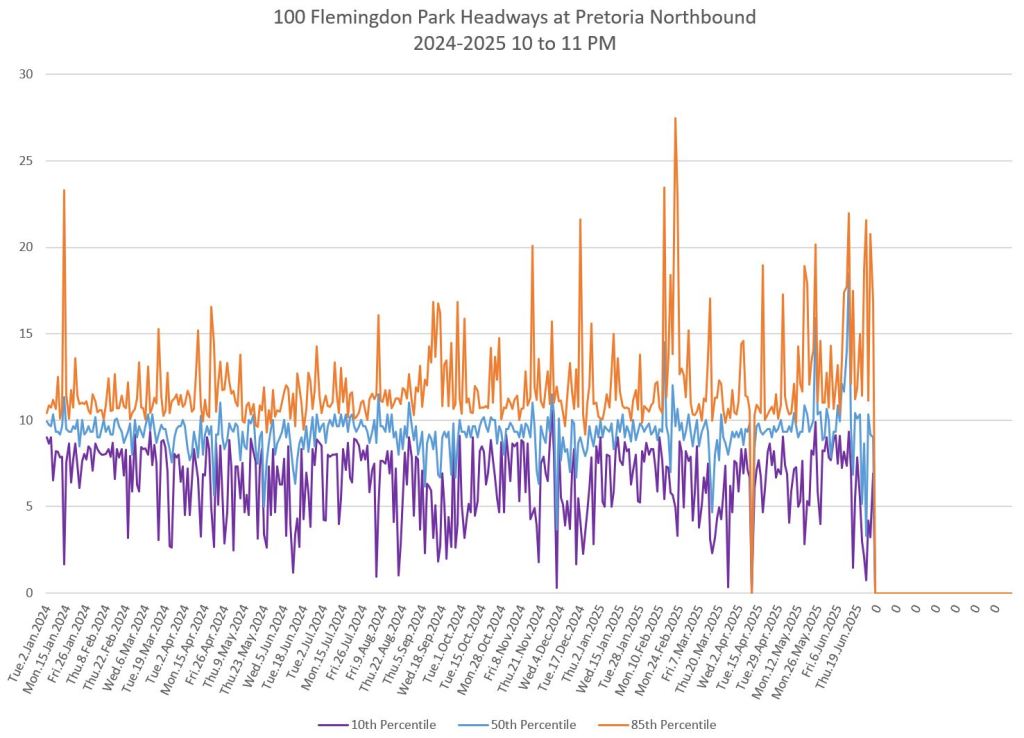
Service in the evening remains erratic, although it improves in the late evening period. “Improve” is a relative term here, and the 10-85th percentile band is not as tight to the scheduled headway value as it should be.


Late Evening Northbound
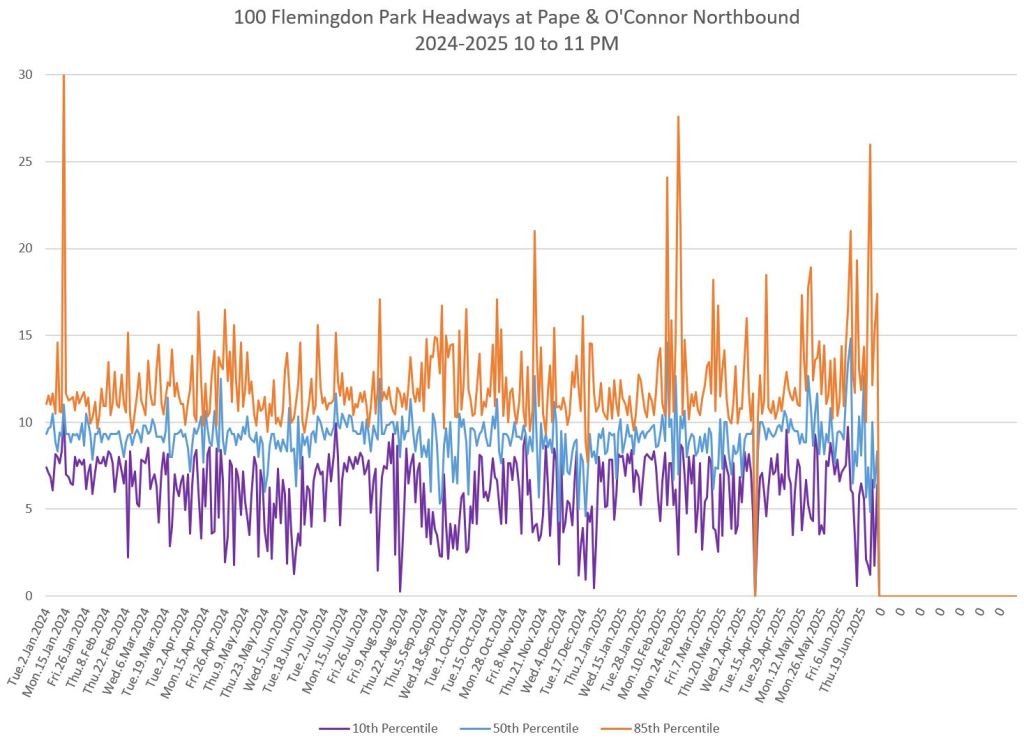
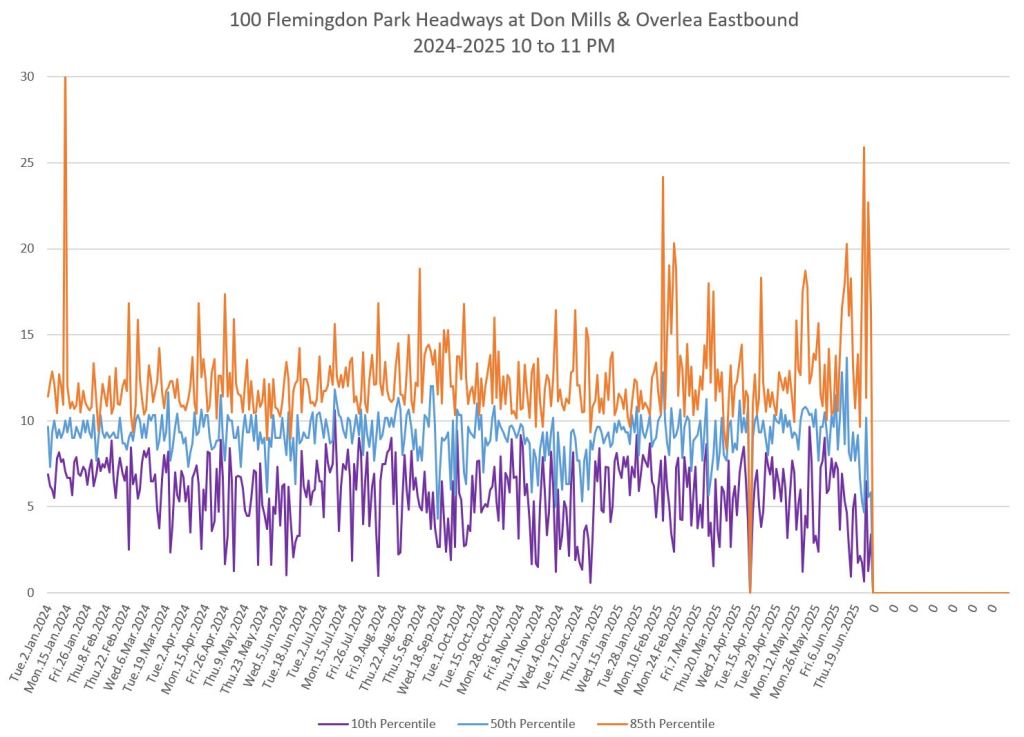
Southbound service shows a wider range of headways than northbound for each period, but otherwise follows a similar pattern.
AM Peak Southbound

Midday Southbound


PM Peak Southbound


Early Evening Southbound


Late Evening Southbound

165 Weston Road North
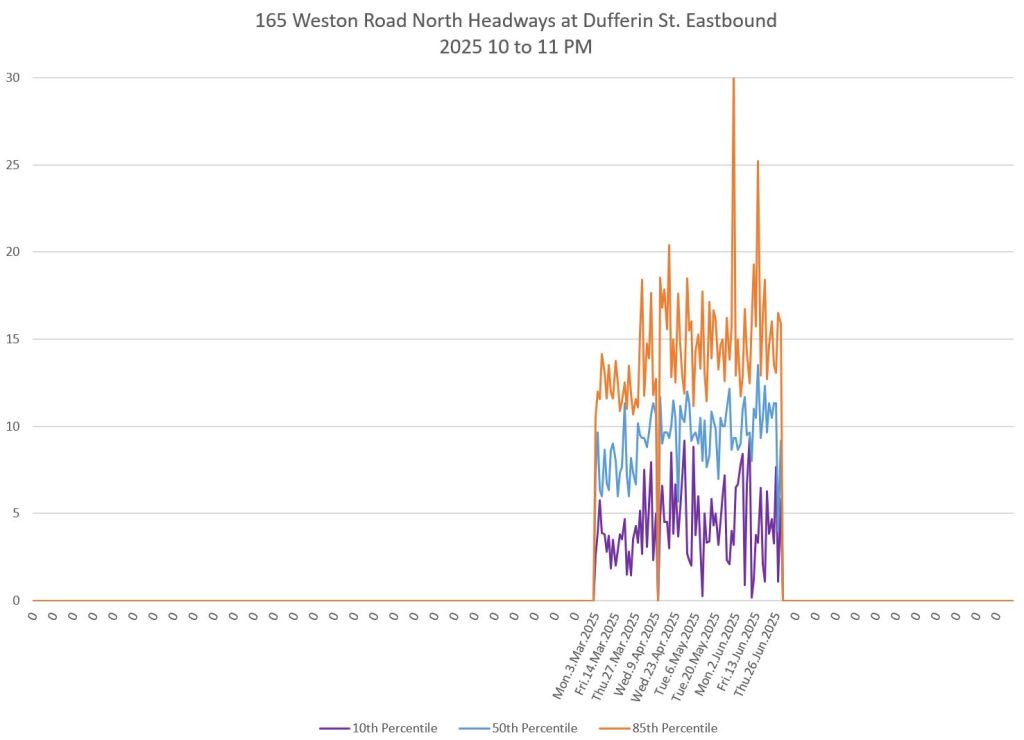
I did not begin to track the 165 Weston Road North until March 2025. Recent data are shown here.
- 165 York Mills Station to Steeles
| Effective | AM Peak | Midday | PM Peak | Early Eve | Late Eve |
|---|---|---|---|---|---|
| 9-Jan-23 | 6′ | 10′ | 7’30” | 10′ | 10′ |
| 23-June-25 | 6′ | 10′ | 10′ | 10′ | 10 |
The Weston Road Bus originates at York Mills Station and travels west via Wilson and north on Weston Road to Steeles looping through Wilson Station enroute. It was formerly a branch of 96 Wilson, but was split off as a separate service. Even with the split, schedules on the two routes are co-ordinated to blend, in theory, on their common section east of Weston Road.
Screenlines for 165 Weston Road North are at:
- Westbound: Yonge, Wilson Heights, Dufferin, East of Albion & Weston
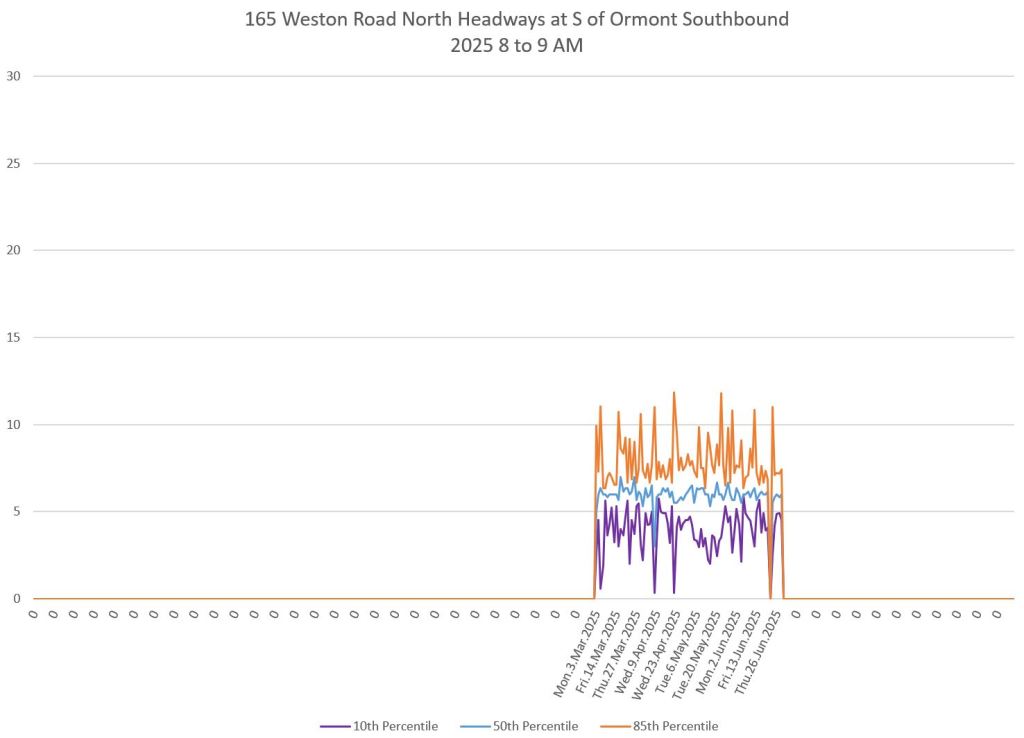
- Eastbound: Weston Rd S of Ormont (N end loop), East of Albion & Weston, Dufferin, Wilson Heights
AM Peak Westbound
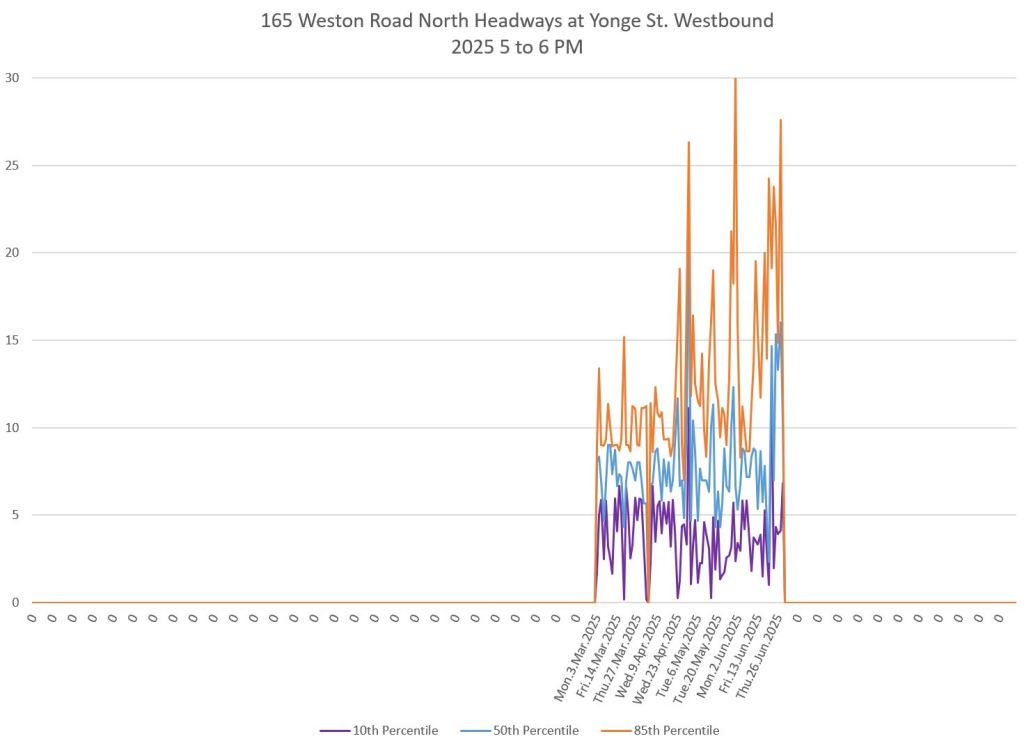
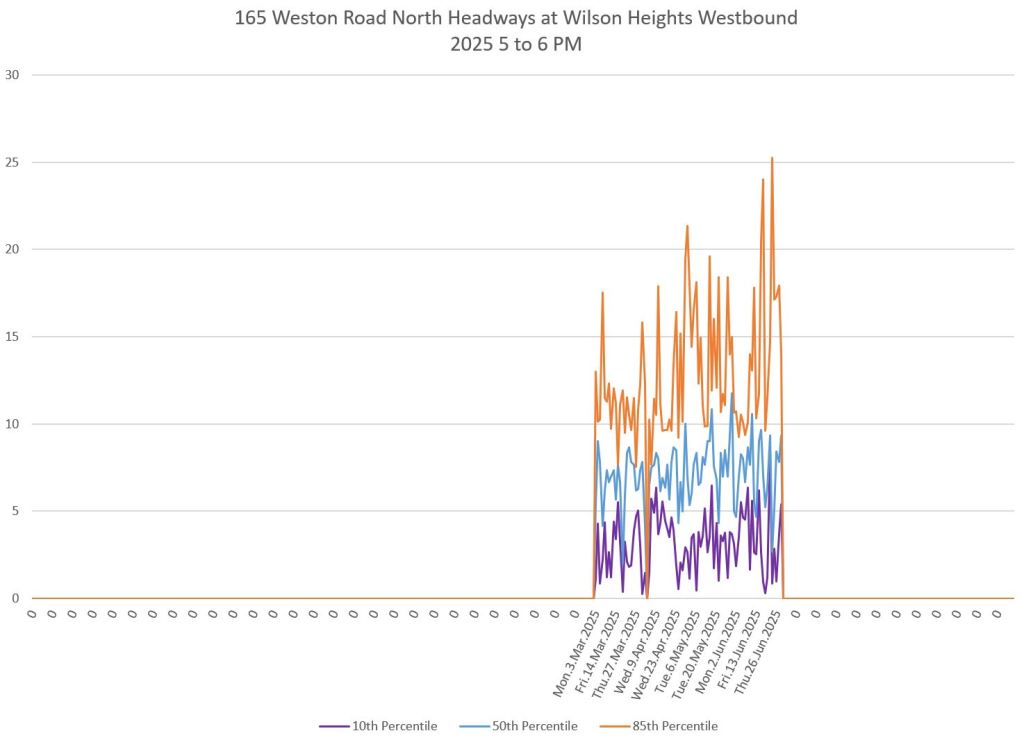
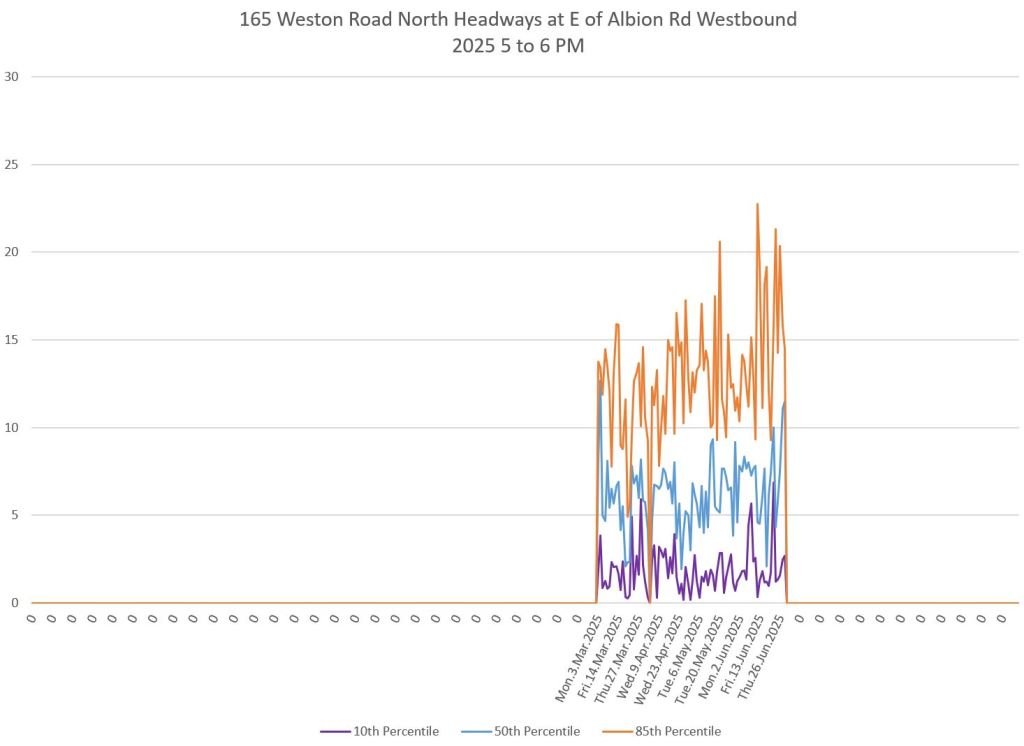
Service leaves Yonge Street westbound with headways grouped mainly 3-9 minutes. This spreads out further west on the route. Particularly notable is that there is no “reset” of vehicle spacing leaving Wilson Station, and the headways westbound at Dufferin are in a slightly wider range than at Wilson Heights east of the station. By the time service reaches Albion Road, the situation is even worse with the 10th percentile hugging the zero line and the 85th percentile consistently above 10 minutes showing that bunches and gaps are common.


Midday Westbound
Midday service is scheduled at 10 minutes, but headways from Yonge are already at the outer limit of the six-minute window of the Service Standards. This worsens as buses travel westward.

PM Peak Westbound
The spread of headways widens at Yonge notably from May onwards. The jump in late June corresponds to the summer schedule change from a 7’30” to 10′ service.

Early Evening Westbound
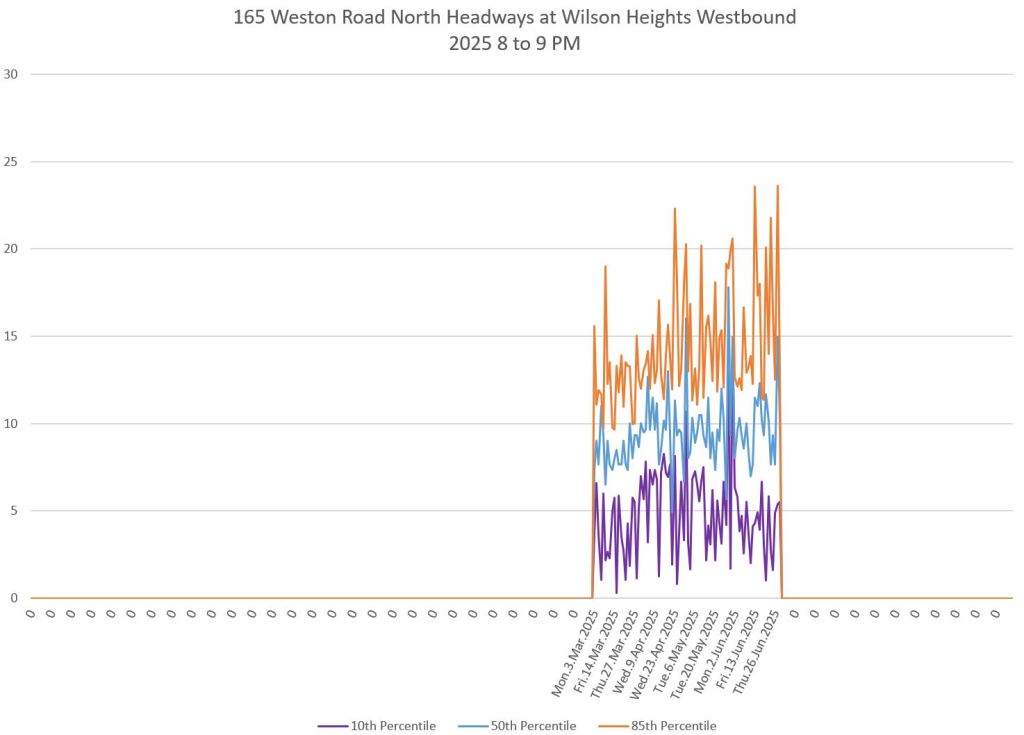
Early evening service continues the pattern from earlier in the day and does not substantially improve compared to the PM peak.

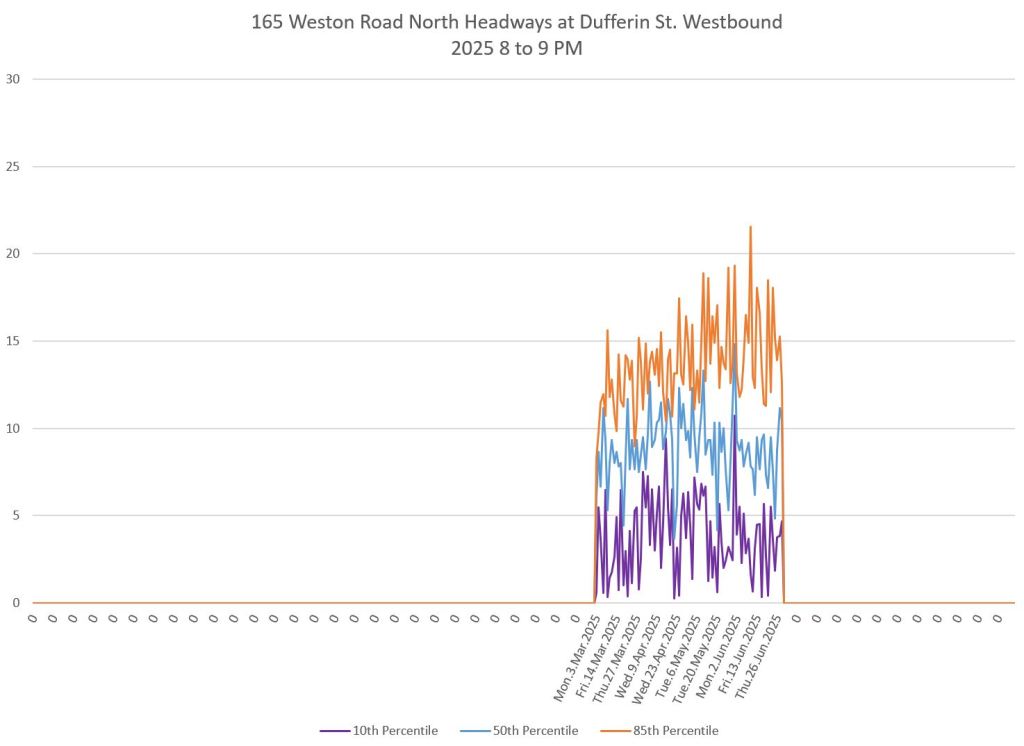
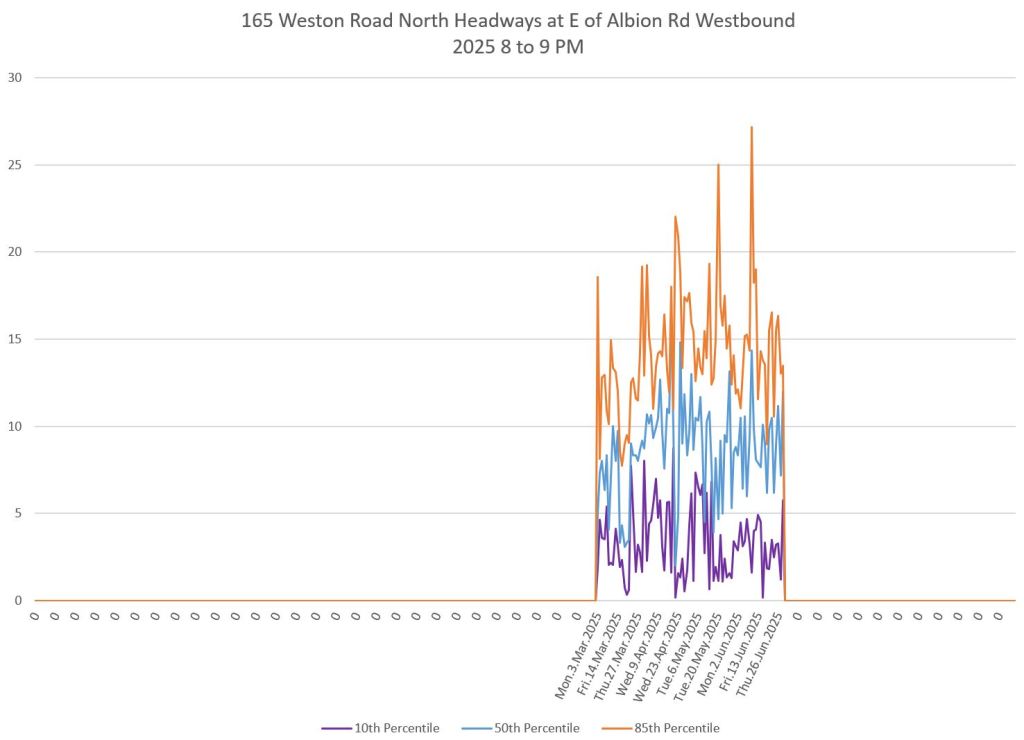
Late Evening Westbound
By late evening, headways from Yonge are in a tighter range, although this changes in late May. As in earlier periods, the spread of headway values widens as buses travel along the route.

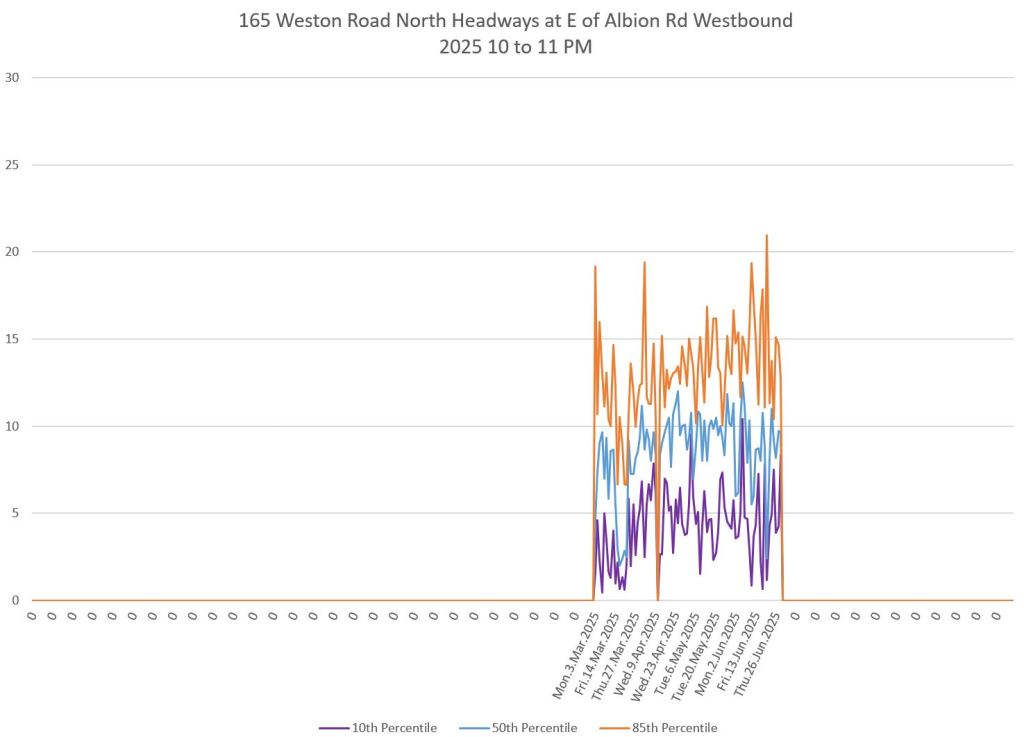
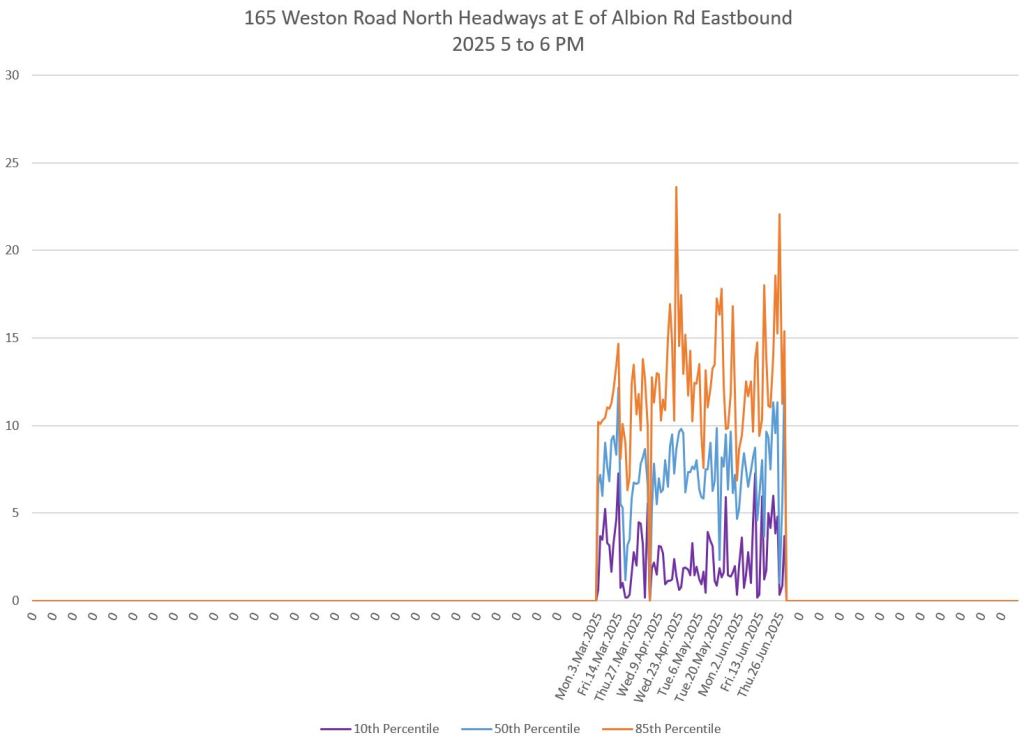
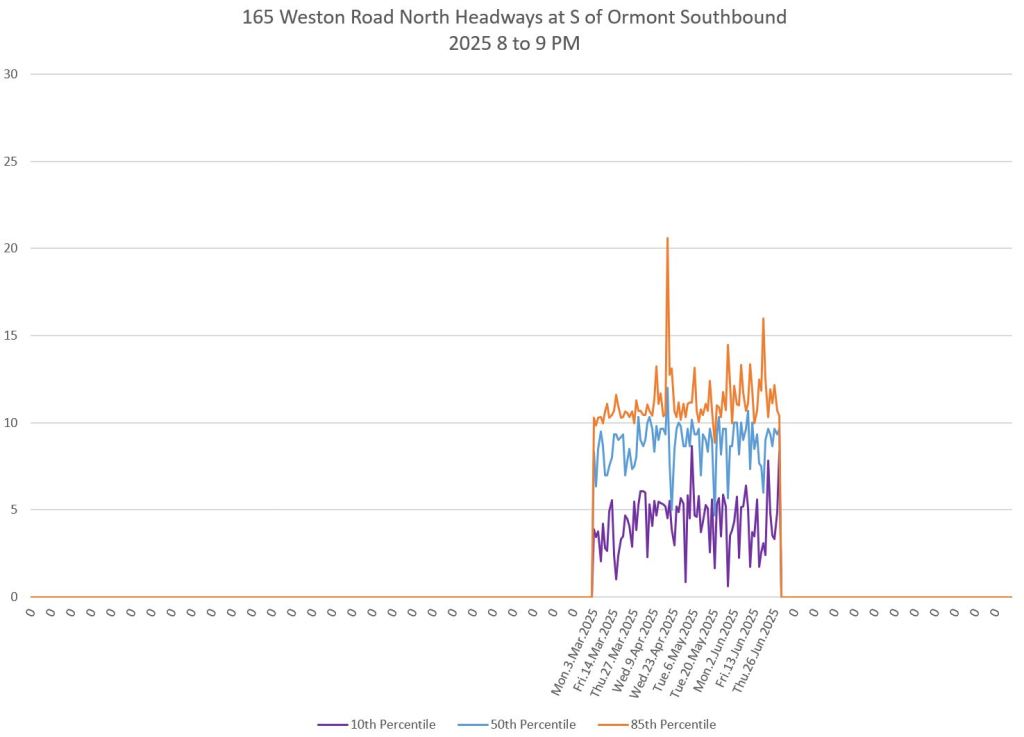
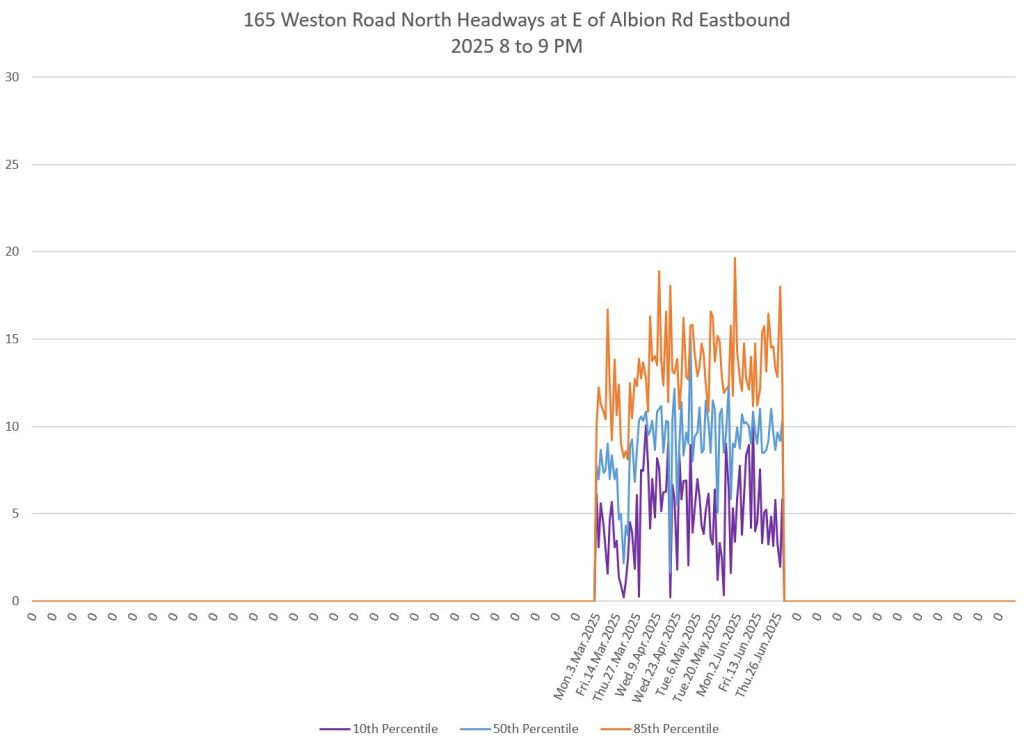
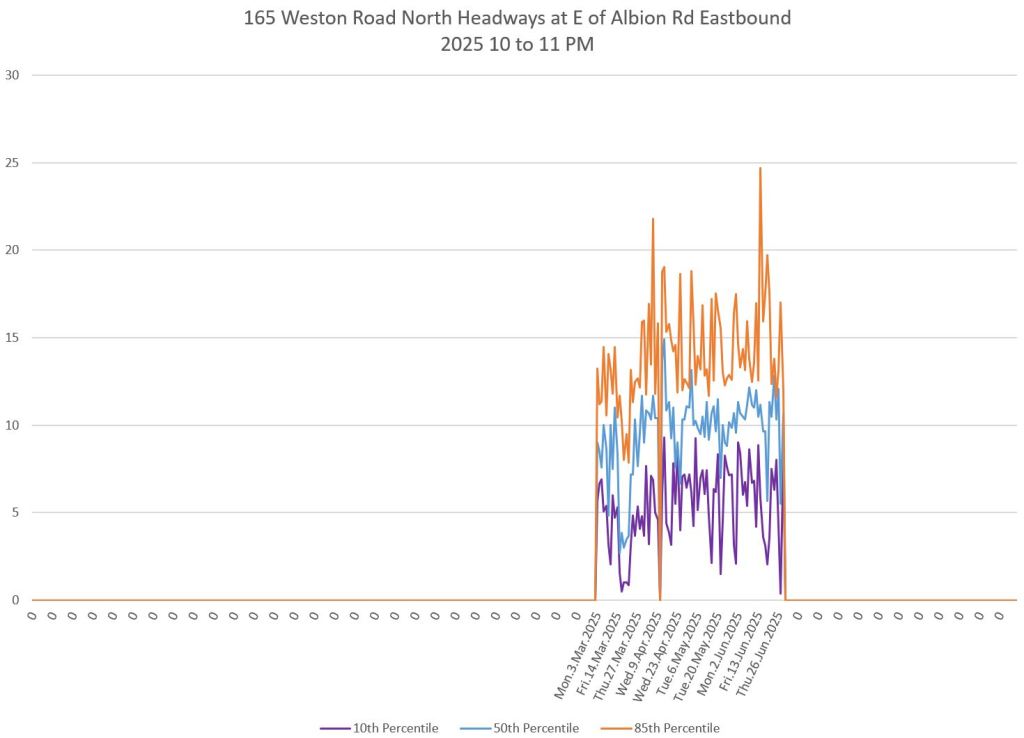
Eastbound service shows a similar pattern to westbound with headways in a narrow band leaving the northern terminus in the AM peak and Midday, but with values spreading out as buses travel east. Service at Wilson Heights east of Wilson Station is similar to that at Dufferin west of the station showing that there is no headway regulation even though buses could hold there.
AM Peak Eastbound


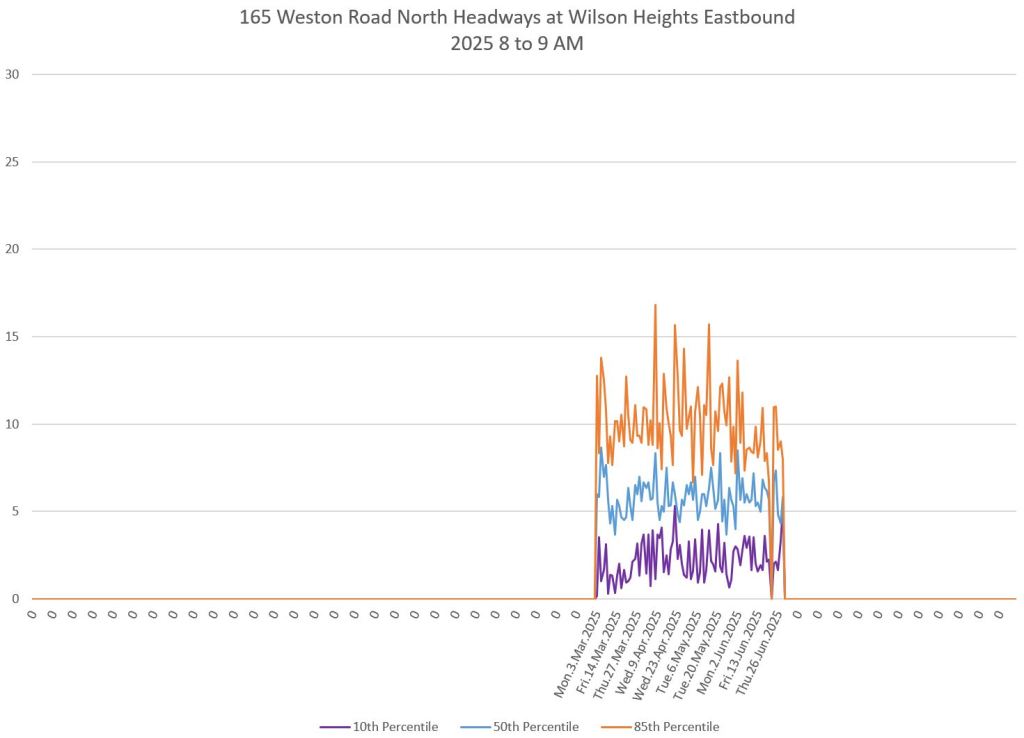
Midday Eastbound


PM Peak Eastbound
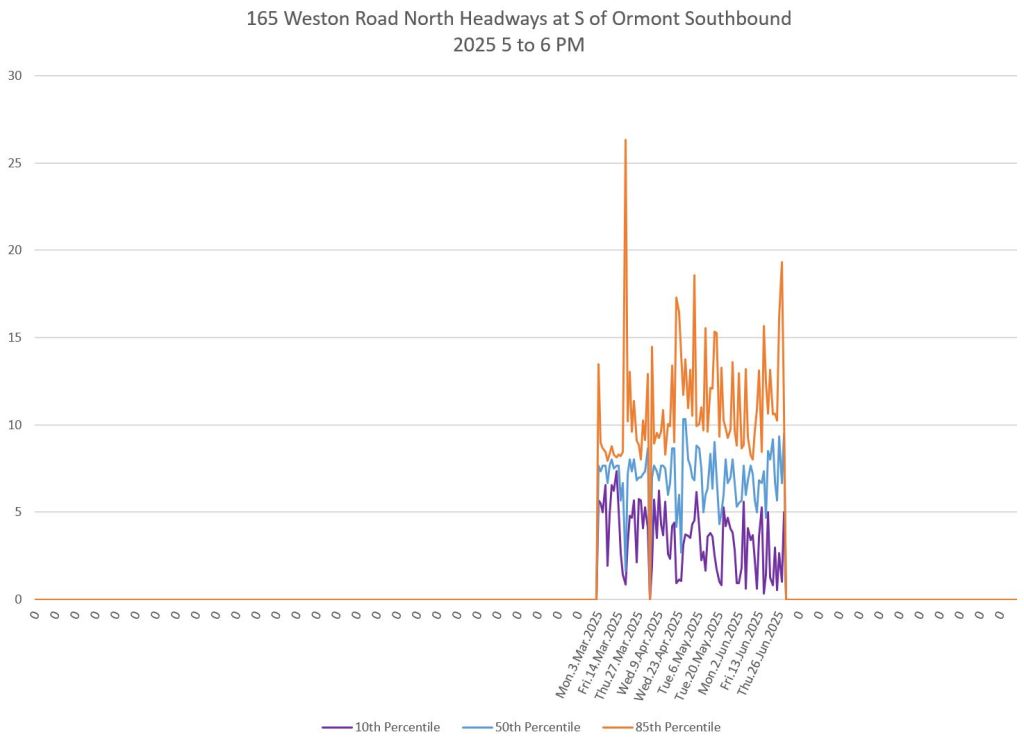


Early Evening Eastbound


Late Evening Eastbound


506 Carlton
- 506 Main Station to High Park
| Effective | AM Peak | Midday | PM Peak | Early Eve | Late Eve |
|---|---|---|---|---|---|
| 20-Nov-23 | 10′ | 9′ | 10′ | 10′ | 10′ |
| 24-June-24 | 10′ | 10′ | 10′ | 10′ | 10′ |
The screenlines for 506 Carton are:
- Westbound: South of Danforth, Broadview, Yonge, Dufferin
- Eastbound: Parkside, Dufferin, Yonge, Broadview
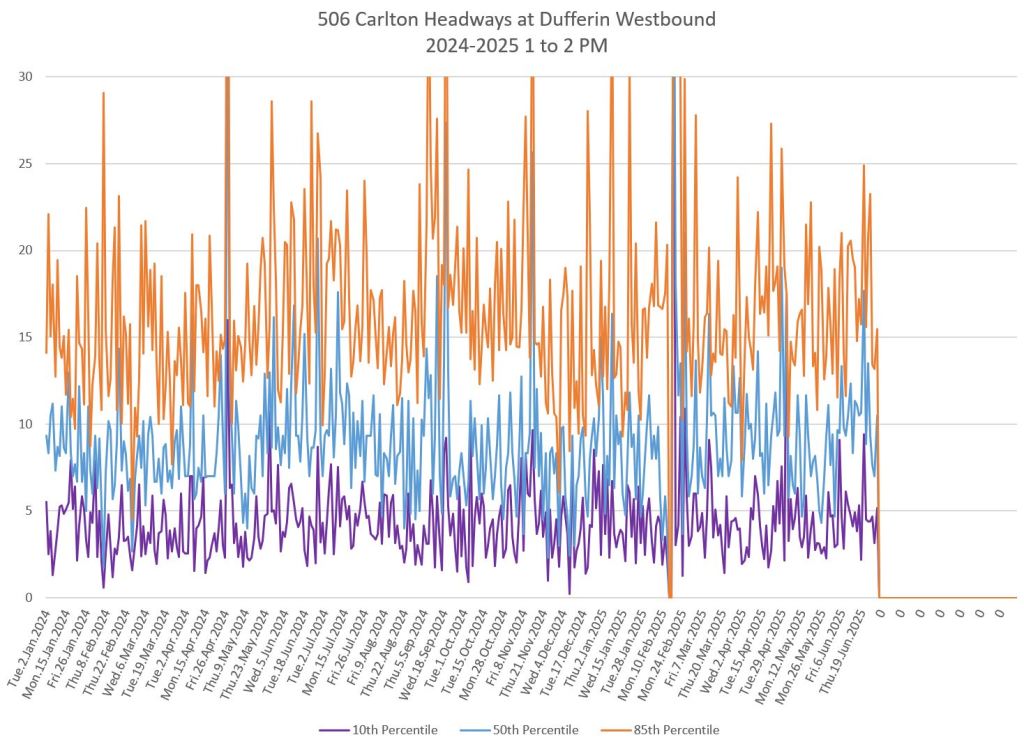
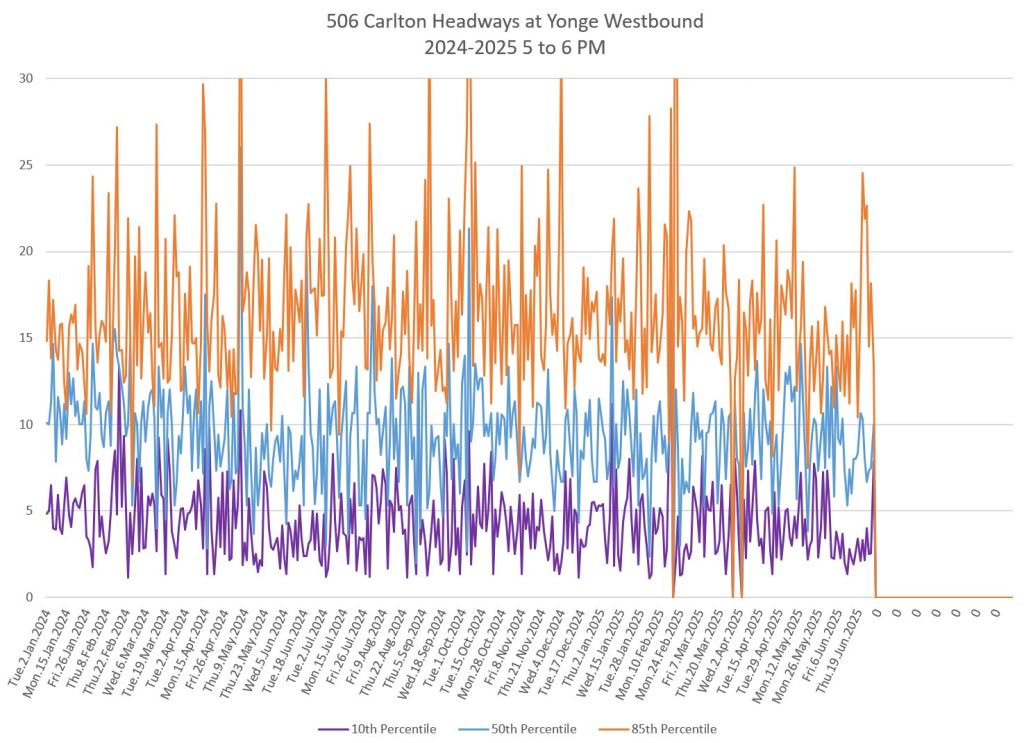
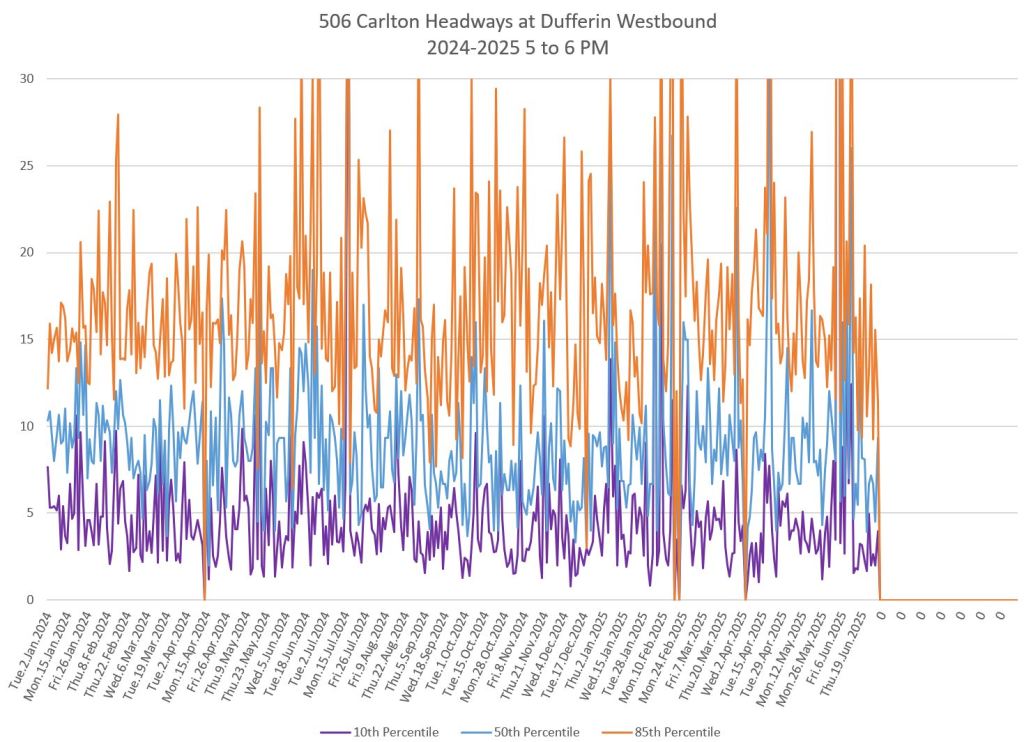
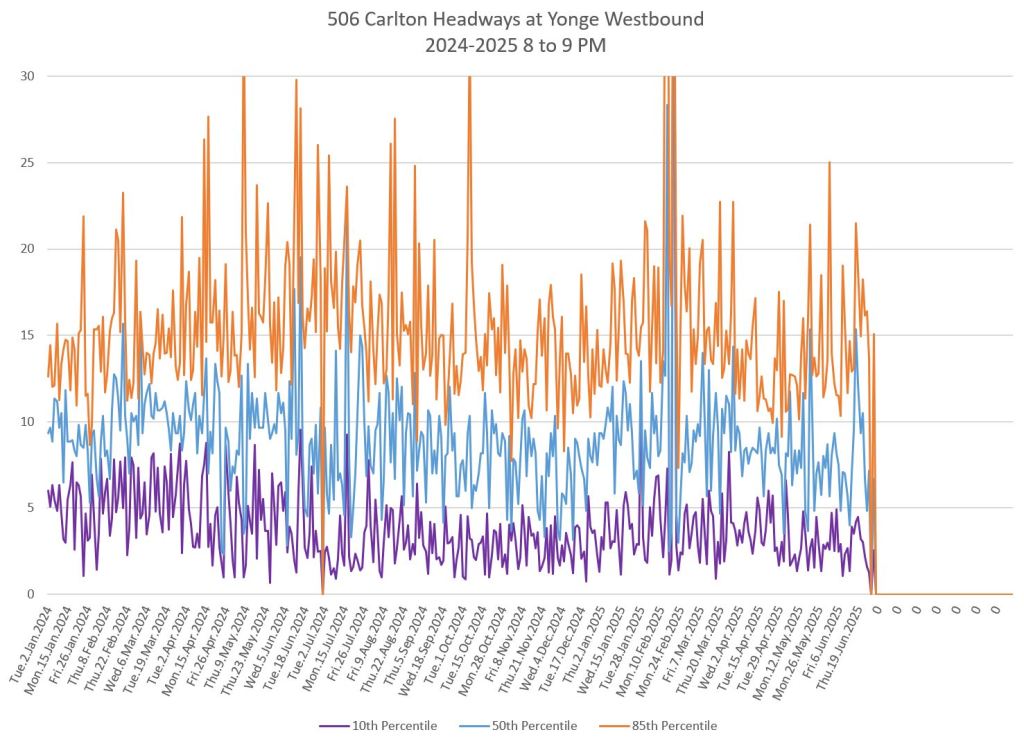
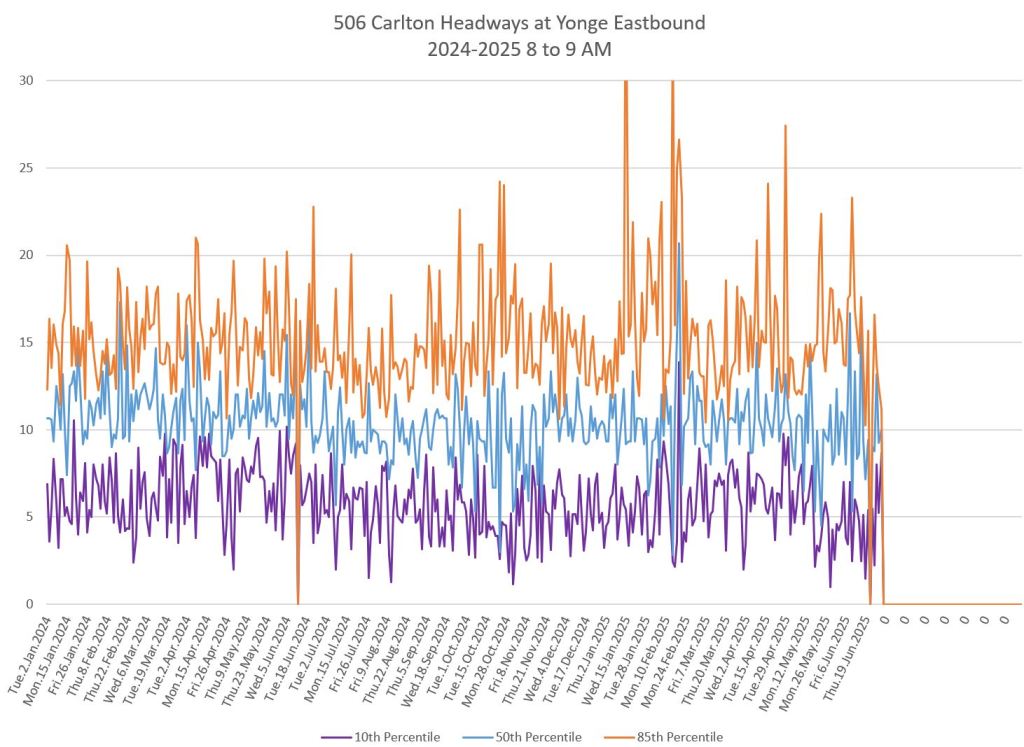
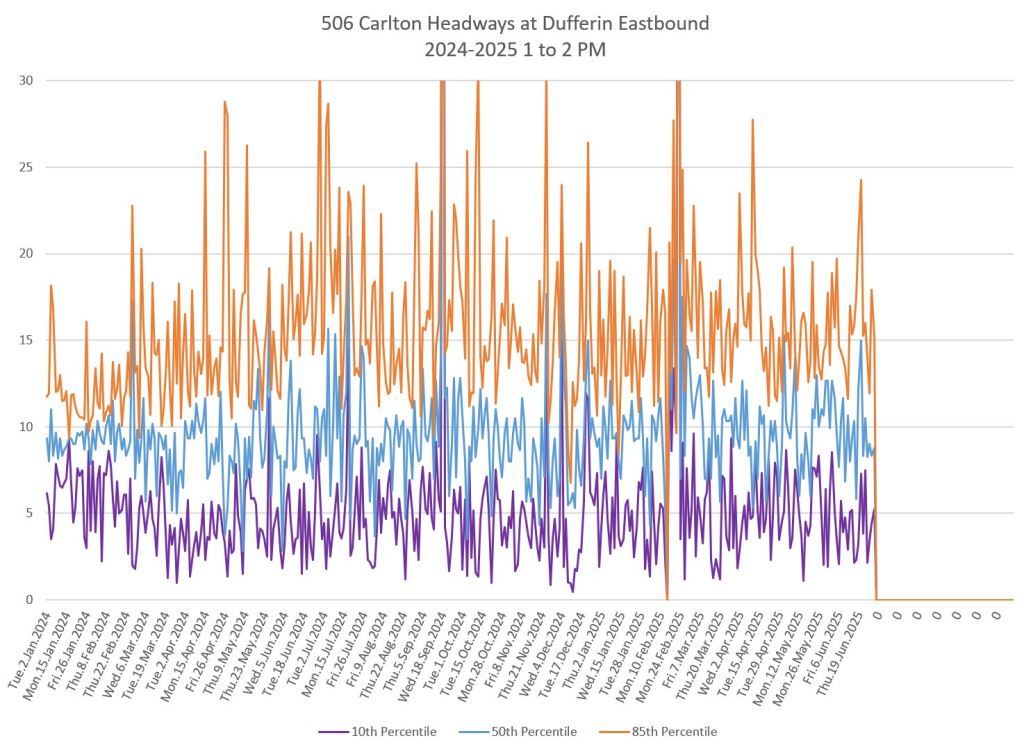
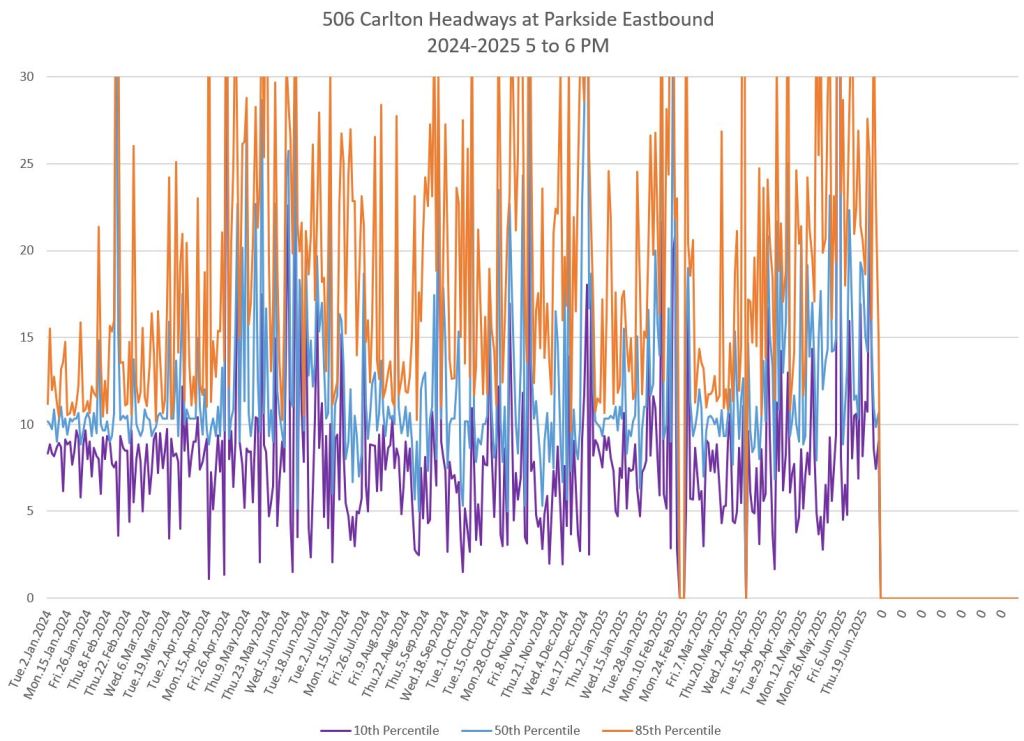
Service on 506 Carlton is severely irregular throughout the day. Even in the AM peak, departures from Main Station show a wide range of headways and this worsens as the day goes on with the 85th percentile routinely above 15 minutes for a 10 minute scheduled service. Part of this could be ascribed to short turns at Coxwell, and this can be crosschecked by comparing median values at Danforth with those at Broadview. Similarly, headways at Parkside Drive eastbound are generally wider than at Dufferin thanks to short turns at Lansdowne.
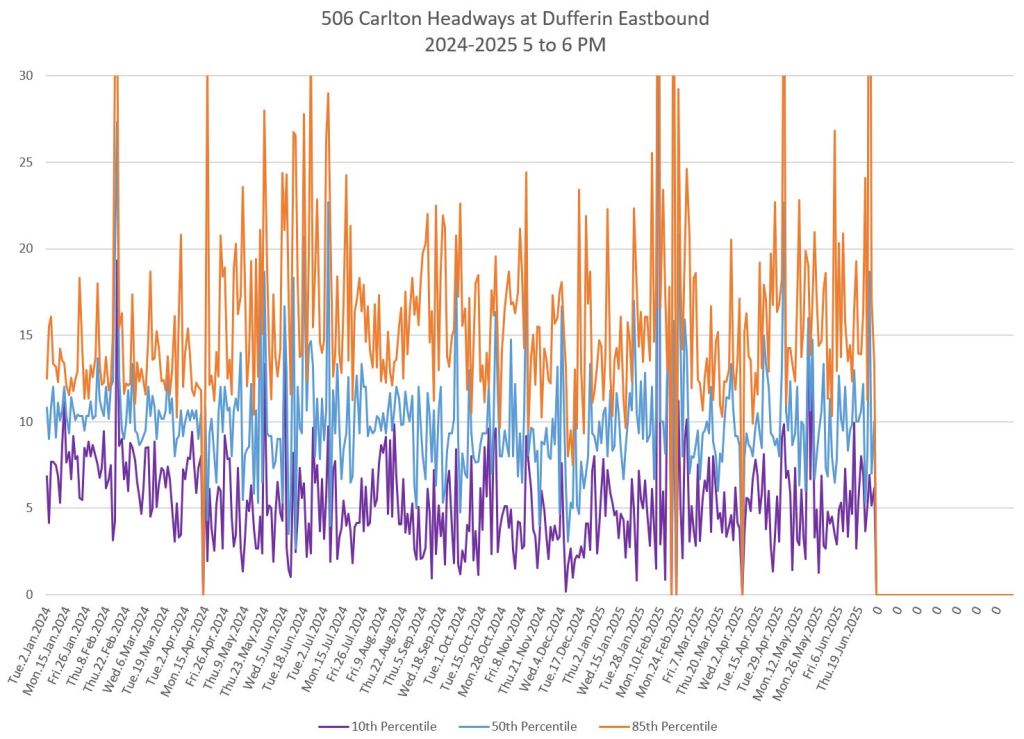
As cars work their way westward, the headways spread out as we have seen on other lines. By the PM peak, the 85th percentile often lies at 20 minutes or more while the 10th percentile lies below 5 minutes. Bunches and very wide gaps are common.
A common factor seen here is that service is already disorganized at terminals, and this sets the base for how it will worsen as long dwell times at busy stops delay gap cars.
There is some indication of attempted headway management starting in March 2025, but the effect is short-lived.
AM Peak Westbound


Midday Westbound

PM Peak Westbound


Early Evening Westbound


Late Evening Westbound


Eastbound service is relatively reliable from High Park Loop in the AM Peak, although headways do widen out as service moves eastward. By Yonge Street, the 10-85th percentile band has widened to about 10 minutes and this continues at Broadview.
AM Peak Eastbound


Midday Eastbound
From Midday onward, short turns at Lansdowne are a major problem and many cars never reach High Park. This is easy to see comparing headway data at Parkside Drive and at Dufferin.
From Dufferin eastward, headways lie in a wide band worsening as service moves eastward.



PM Peak Eastbound
PM Peak service is poor with the 85th percentile regularly above 15 minutes and often spiking into the 20-30 minute range. Bunching is common with a 10th percentile often below 5 minutes.

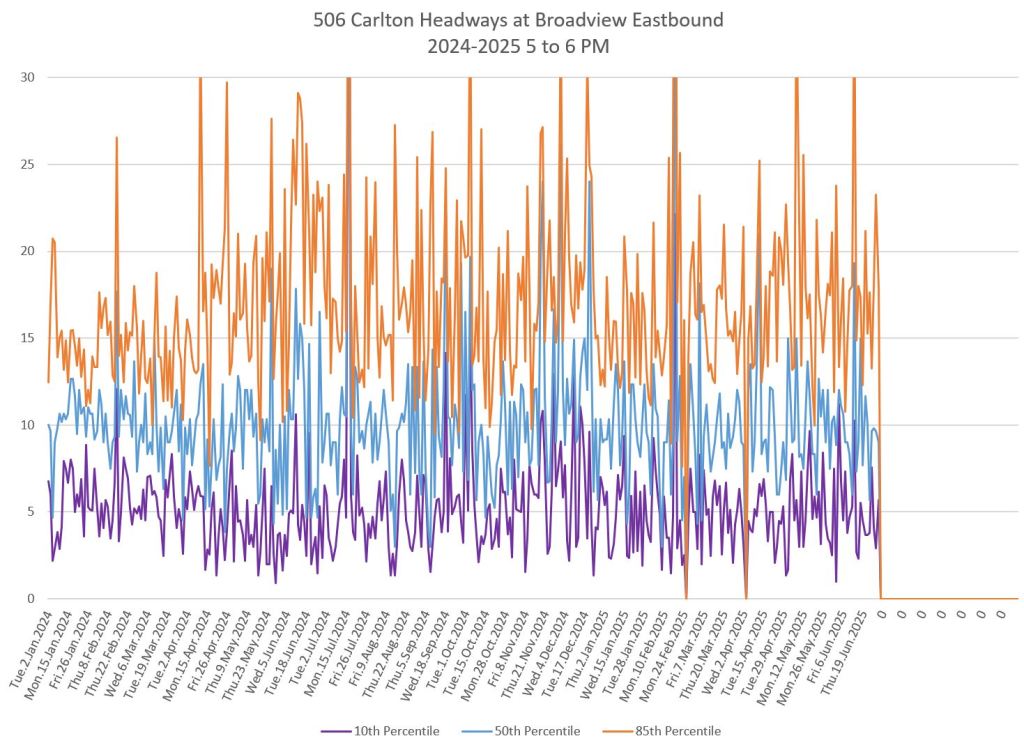
Early Evening Eastbound
Service improves slightly in the evening from the peak period, but remains irregular through to the late evening.


Late Evening Eastbound
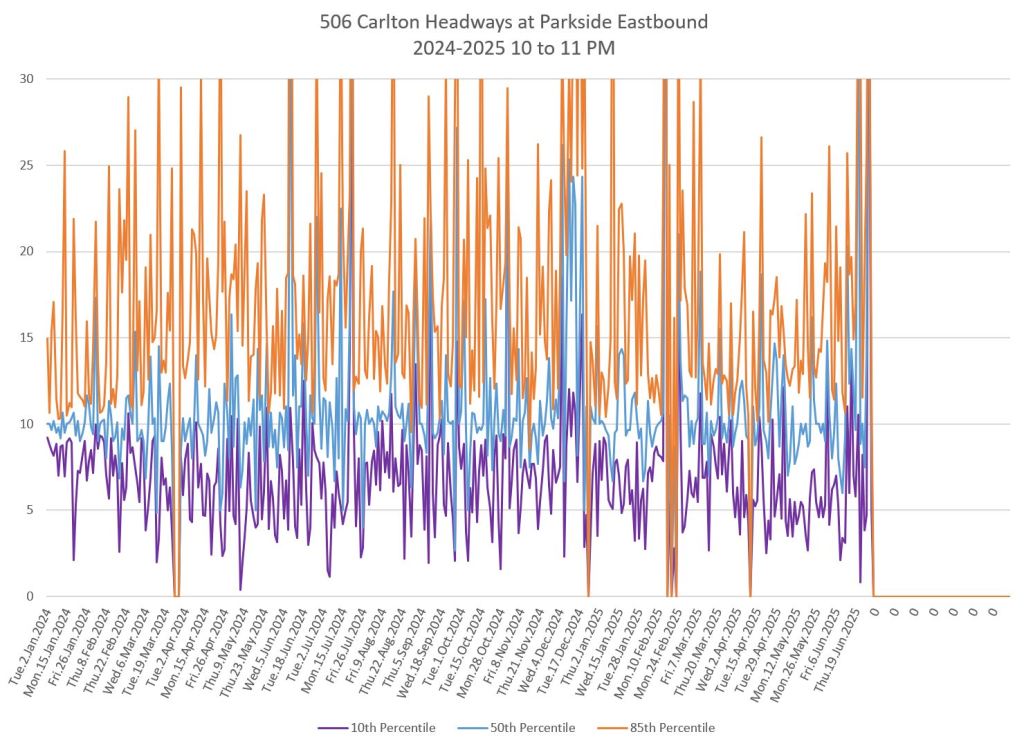
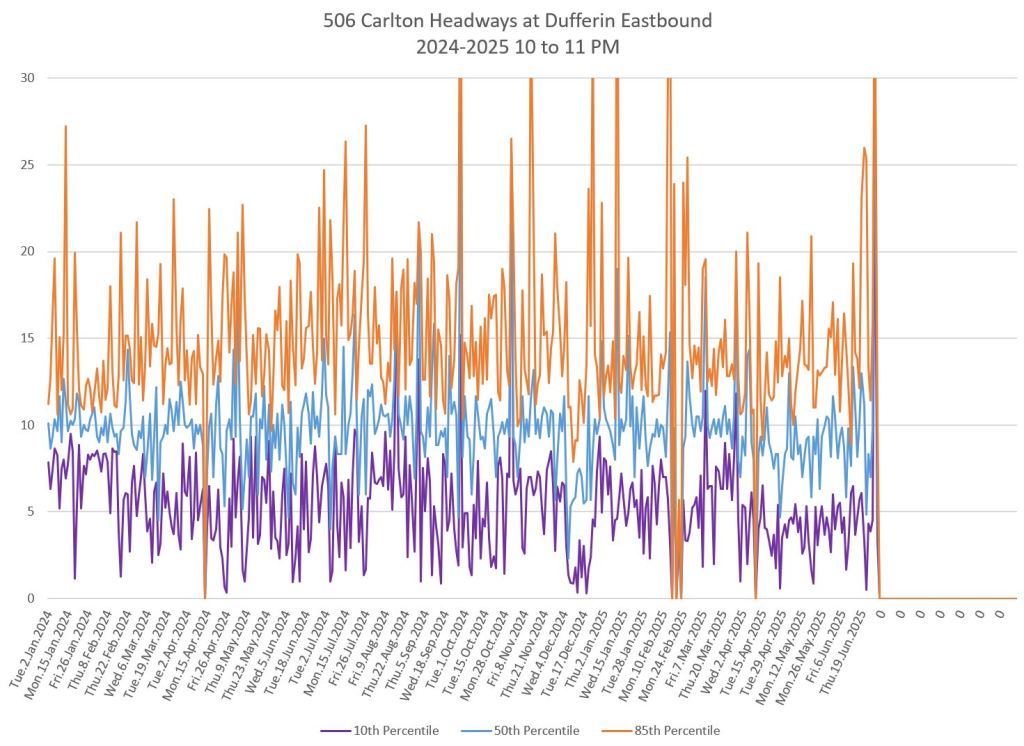

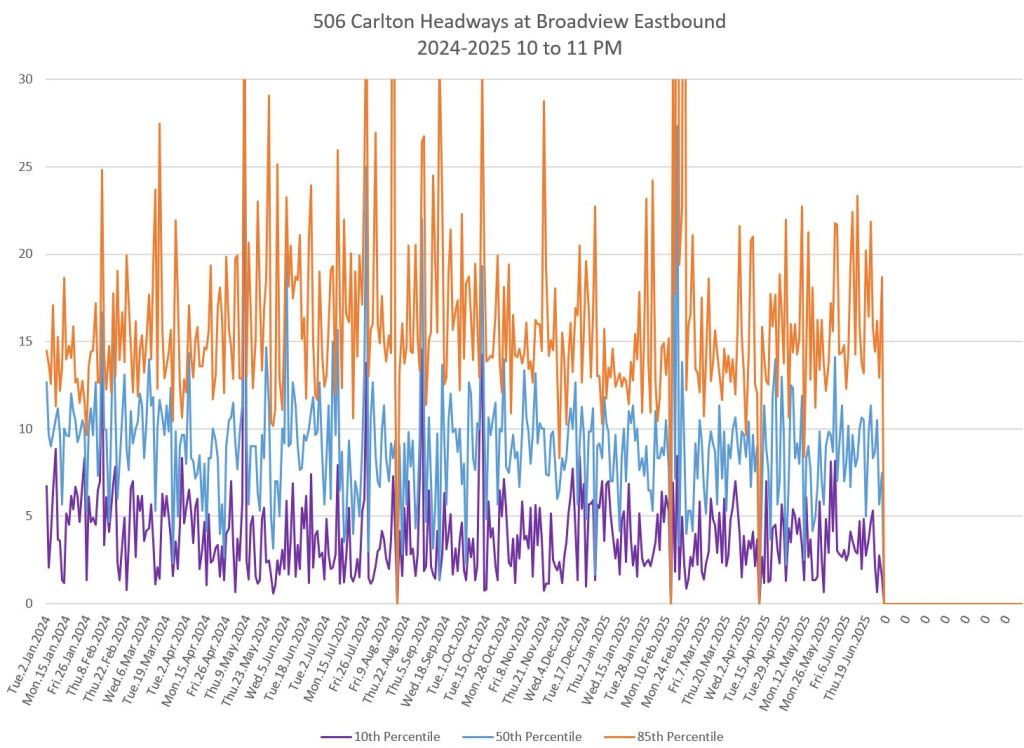
512 St. Clair
- 512 St. Clair Station to Keele (Gunn’s Loop)
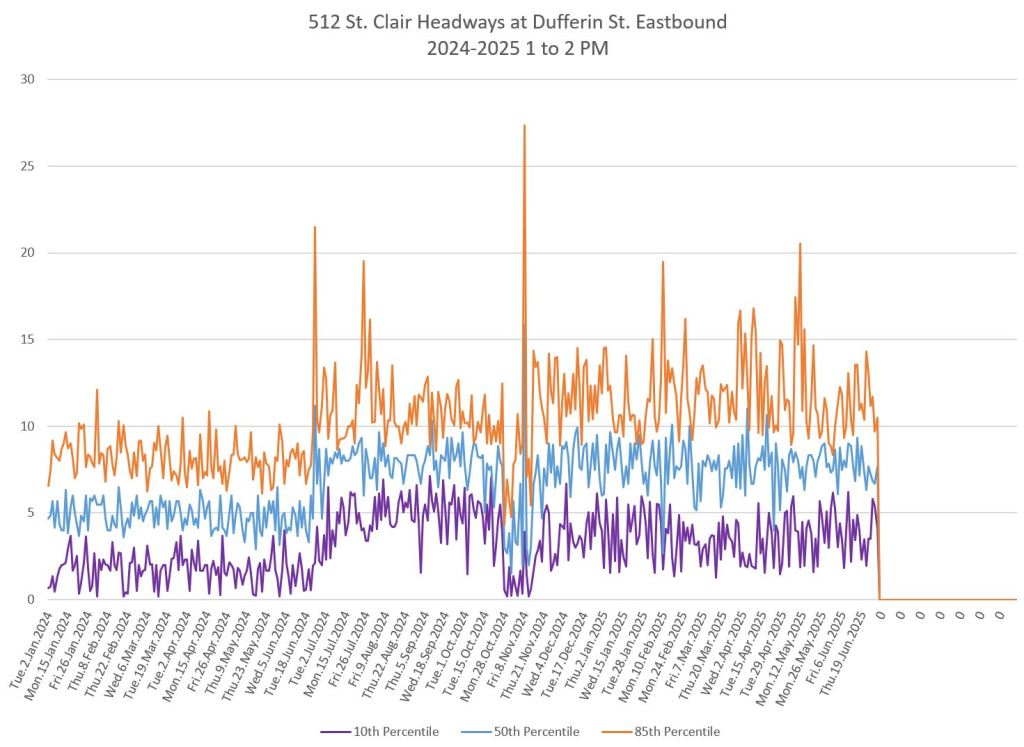
The St. Clair service operated with buses until late June 2024. From October 21 to November 21, buses served the route between St. Clair Station and Oakwood Loop, while streetcars operated from Bathurst Station to Gunn’s Loop (Keele Street). Bus service was generally much more frequent than the streetcars to compensate for vehicle size.
Streetcar service, in spite of a dedicated right-of-way, can be quite erratic with wide gaps. There is little indication of headway management at terminals or mid-route. It is no surprise that some riders prefer bus operations even with limited use of the right-of-way because it was frequent and much less disorganized.
| Effective | AM Peak | Midday | PM Peak | Early Eve | Late Eve |
|---|---|---|---|---|---|
| 5-Sep-23 (Bus) | 3′ | 5′ | 3’30” | 6′ | 10′ |
| 24-June-24 | 8′ | 8′ | 8′ | 8′ | 10′ |
The screenlines on 512 St. Clair are at:
- Westbound: Yonge, Bathurst and Dufferin
- Eastbound: Keele, Dufferin and Tweedsmuir
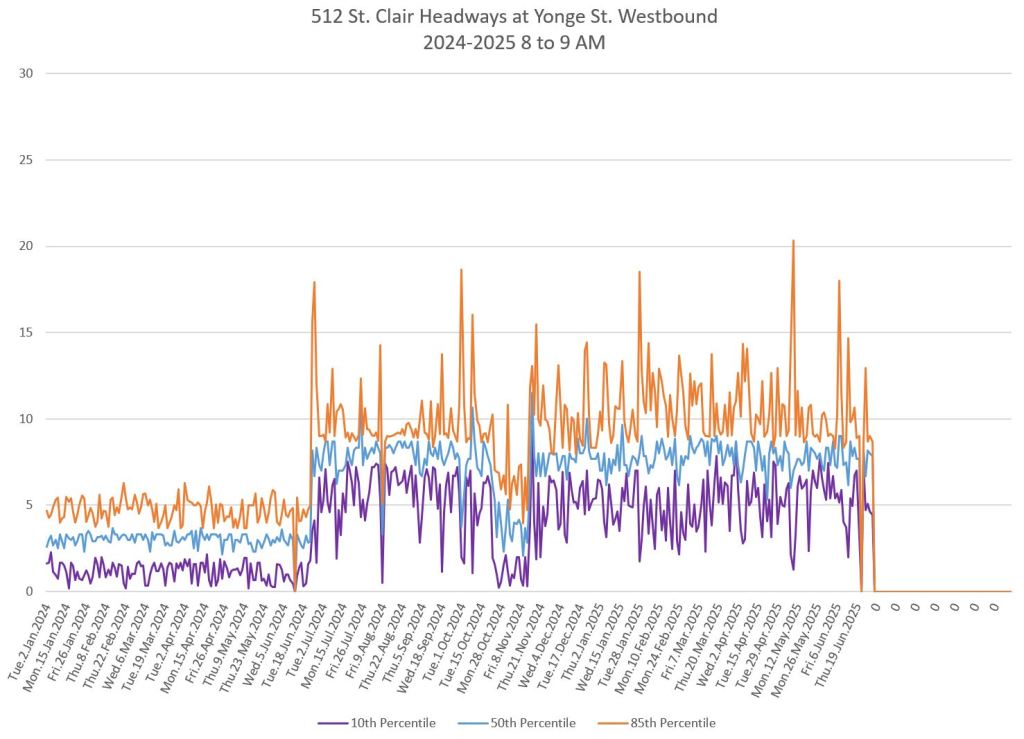
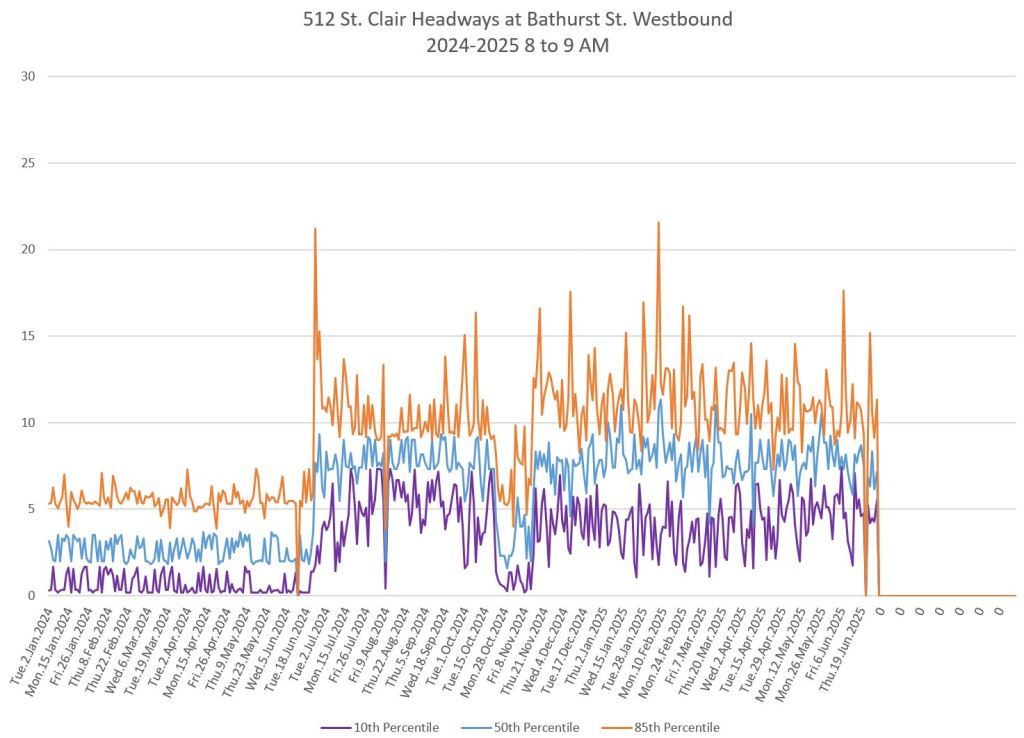
AM Peak Westbound
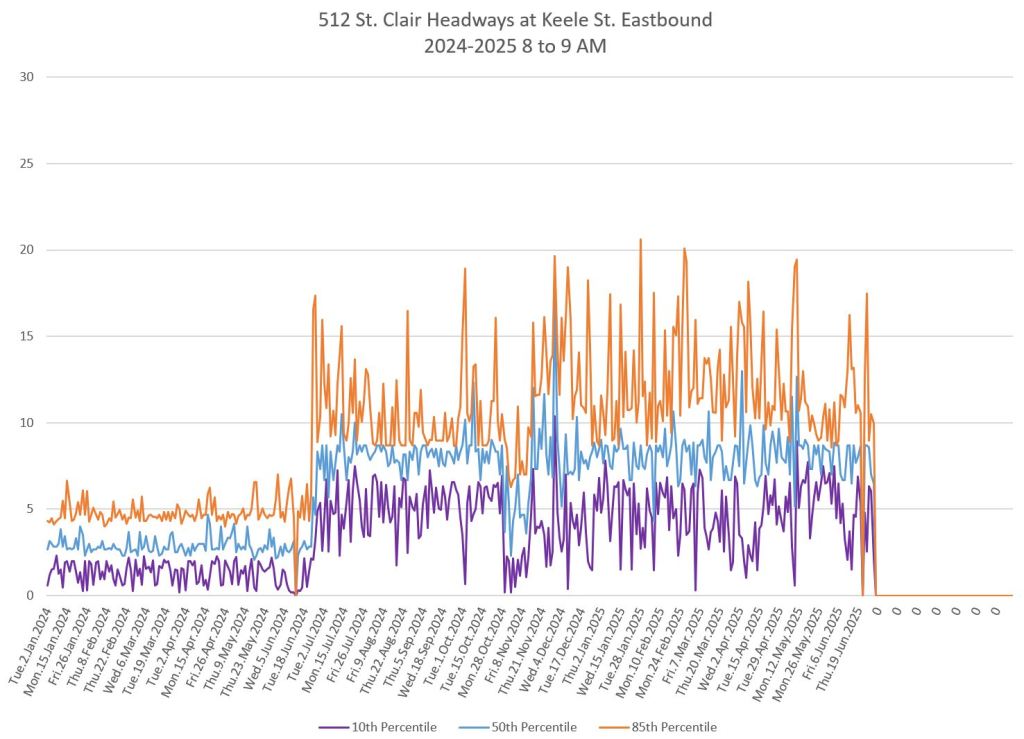
The AM Peak shows the effect of buses on a close scheduled headway with the 10th-85th percentile range from near zero to 5-7 minutes depending on location until late June 2024. Streetcar service kept to a roughly 5 minute band in mid-2024, but this begins to widen out from late fall 2024 onward.
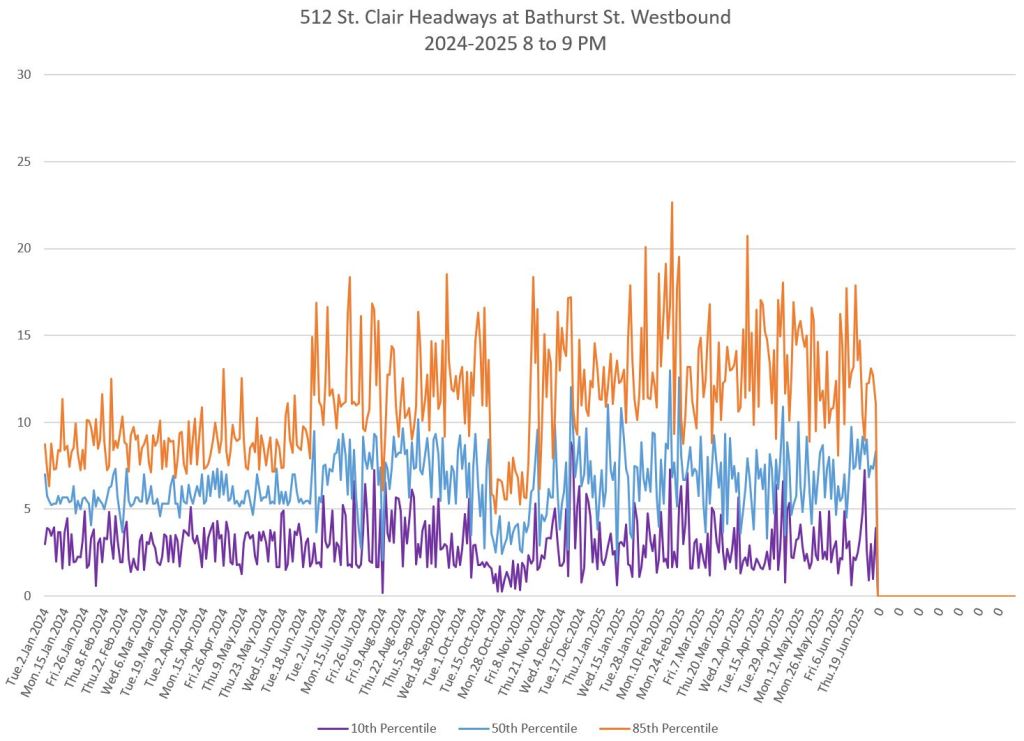
Bathurst Station is a point where westbound headways can be regulated without blocking eastbound service thanks to a passing siding in the loop. Nonetheless, the headway range at Bathurst is wider than at Yonge and wider still at Dufferin.

Midday Westbound
Midday service shows the same pattern as the AM peak.


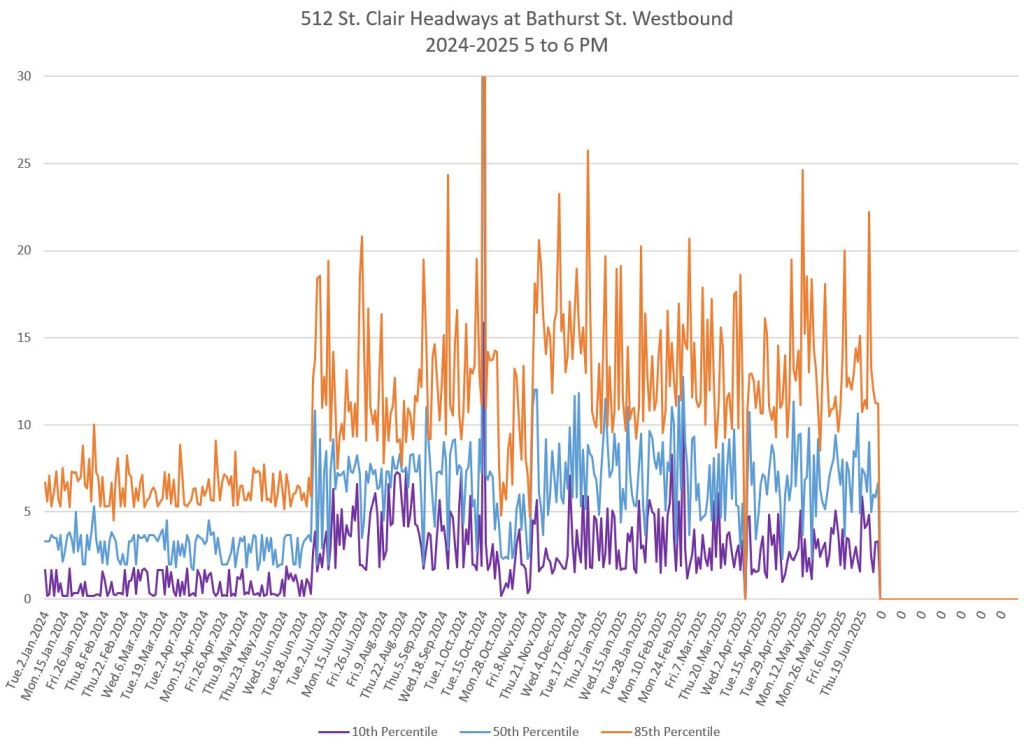
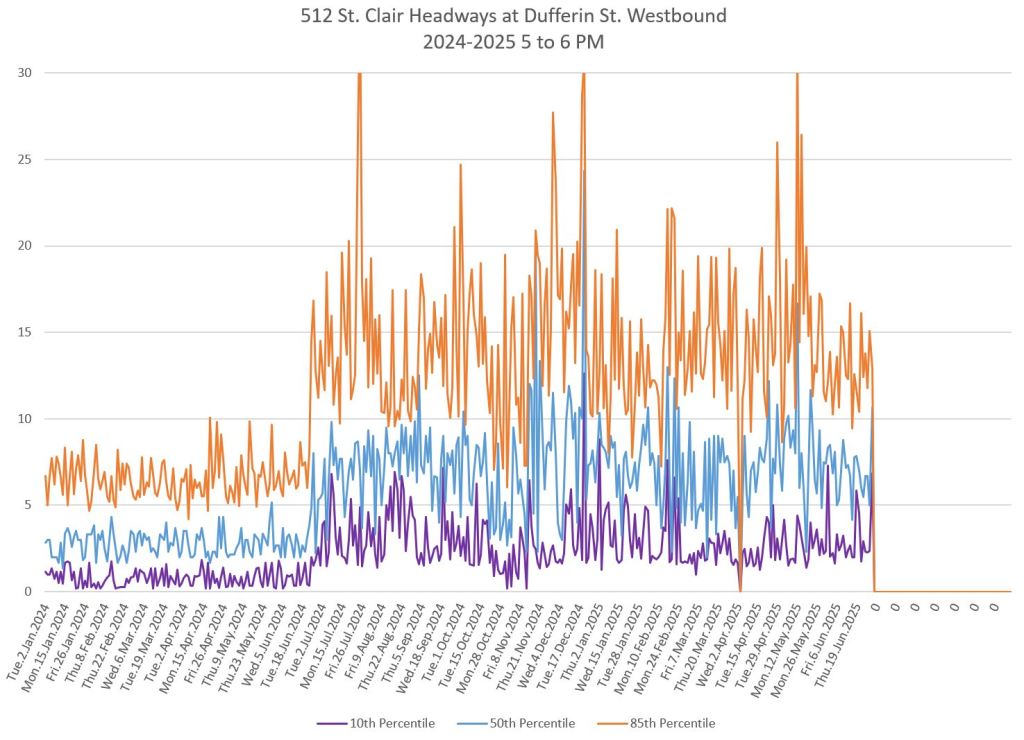
PM Peak Westbound
PM Peak service is markedly less disciplined than in the AM with streetcars leaving Yonge Street over a wider range of headways. This worsens at Bathurst and at Dufferin.

Early Evening Westbound
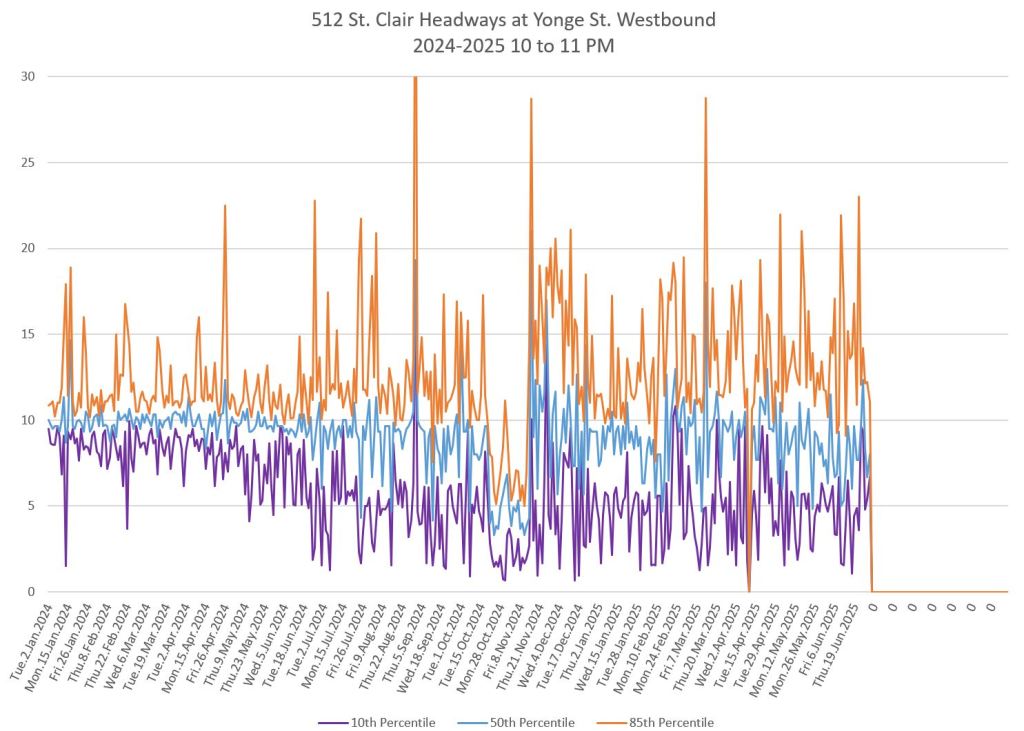
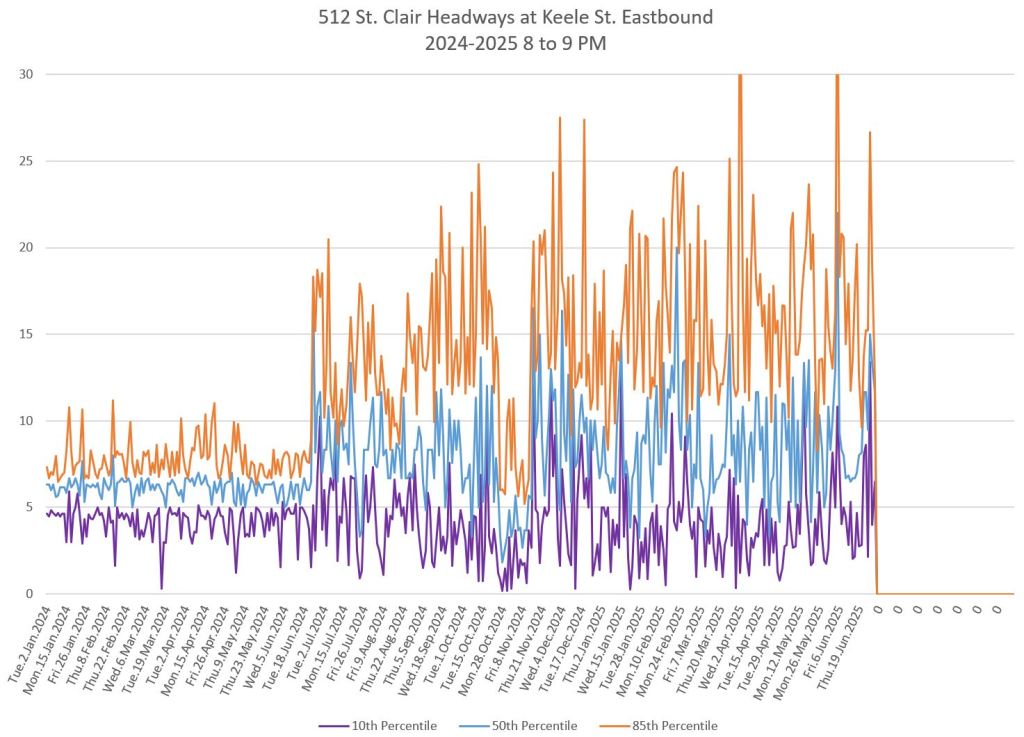
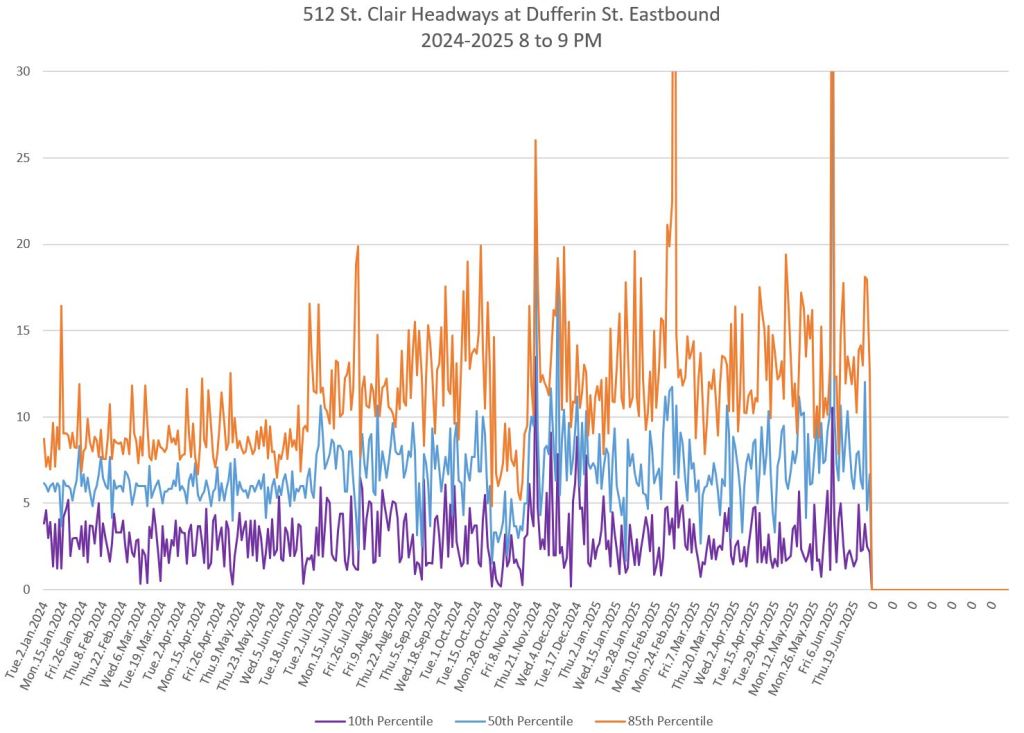
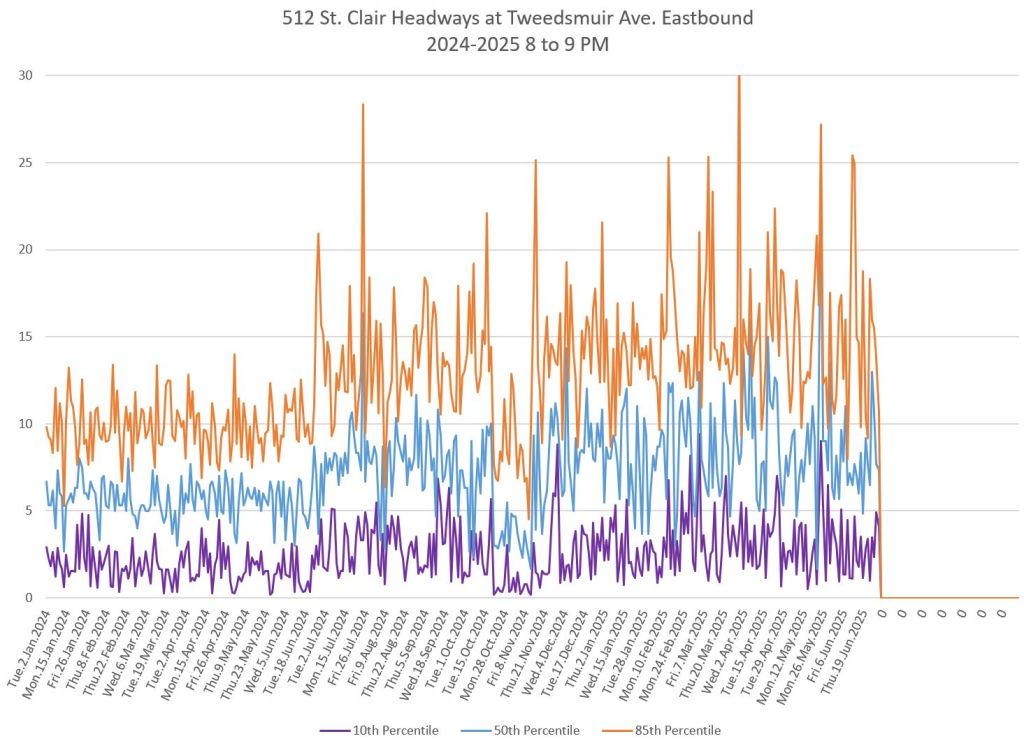
Evening service shows a pattern seen on other routes where there is some recovery from PM Peak conditions, but the range of headways, even at the Yonge Street terminus, remains wide and this worsens as cars travel west. The 10th percentile values are low enough that bunching will occur especially from Bathurst westward.


Late Evening Westbound


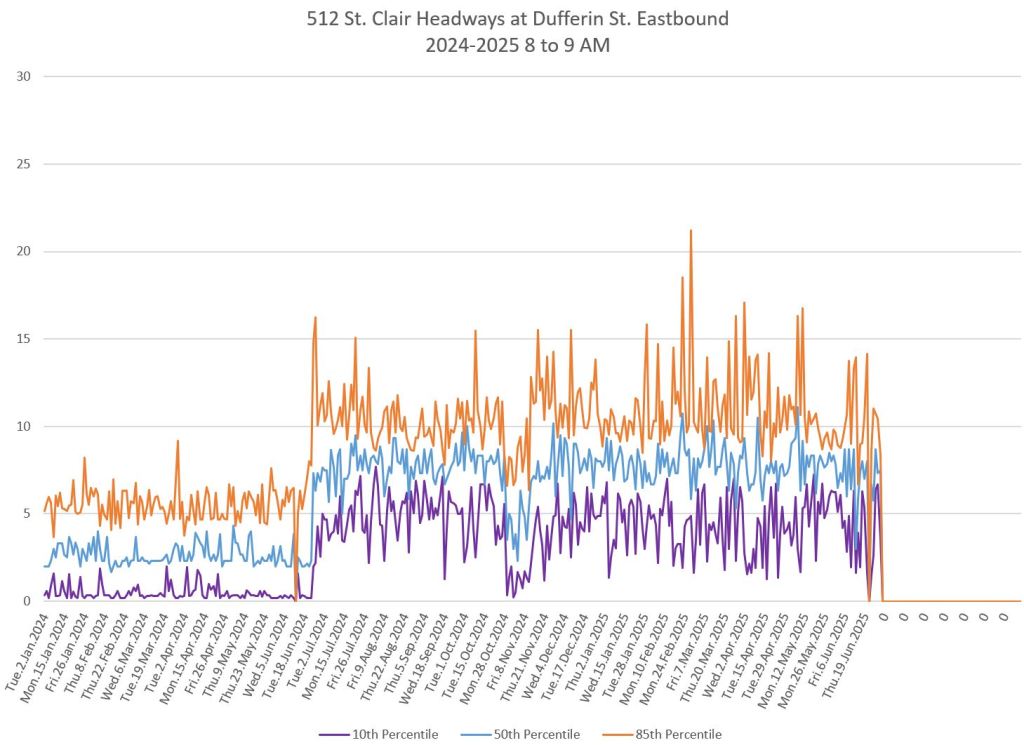
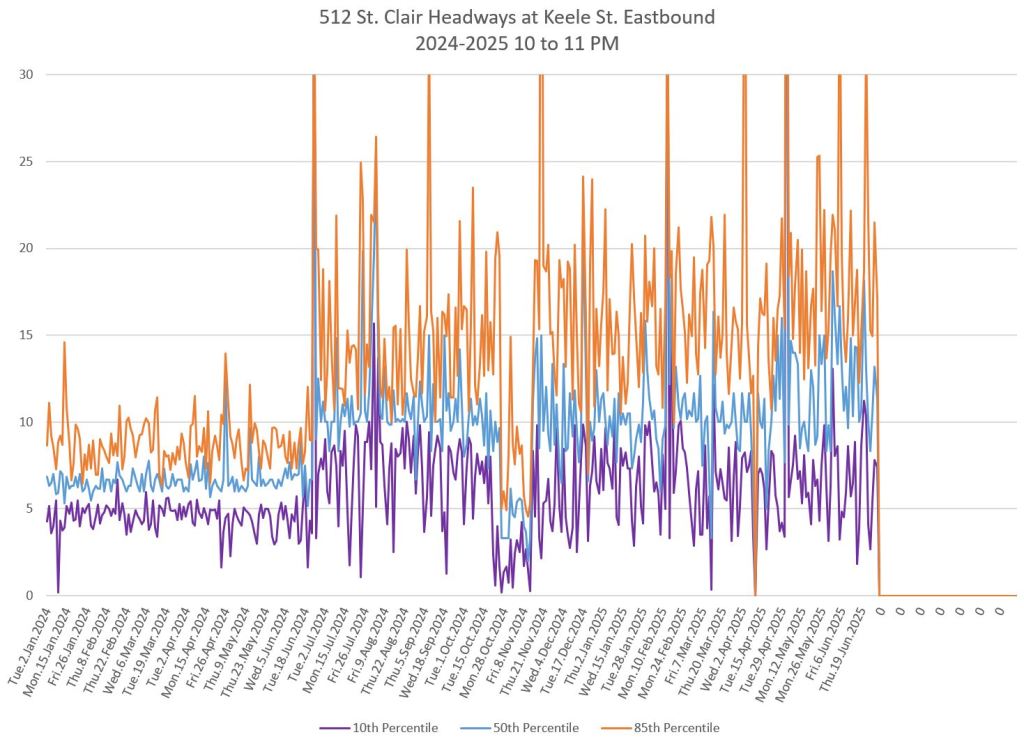
Eastbound service can be held for spacing at St. Clair West Station, but only if a westbound car does not appear wanting to pass onto its platform. Headway ranges at Tweedsmuir (the eastern portal of the station) have a wider range than at Dufferin through the day, and the low 10th percentile values shows that bunching persists on the eastern leg of the route well into the evening.
The peak values at Keele are higher than at Dufferin, stretching even to 30 minutes, thanks to short turns at Earlscourt Loop (Lansdowne).
AM Peak Eastbound

Midday Eastbound


PM Peak Eastbound


Early Evening Eastbound
Late Evening Eastbound


 Steve Munro
Does anything every change? No matter how bad the service is, they report that it’s fine. You report that it’s not. Then nothing changes. Quite the system we have here!
LikeLiked by 1 person
We’ve talked about it before. I stand by my belief that the only way forward is automated solutions – ie gates and lights either at end points or along the route…alternatively on vehicle info system should give a normal, slow or pause status (along with short turn and some other edge case fixes)…humans can’t process enough information in realtime (especially when working in the field) to be able to maintain service for long periods of time…if you don’t believe me…go stand on the corner and refresh next bus and every time a bus comes by figure out what you would do…then imagine doing that every day for months, in the winter etc.
On top of automated solutions there needs to be an agreement with the union on repercussions for explicitly violating automation on a regular basis, and for getting explicit permission to run in bunches etc.
All that said, the ultimate solution would make most of that information public, and easy to understand…ie this vehicle is short turning, to eliminate a gap of 8 minutes, and only has 7 customers on board who will be delayed 3 minutes…approved by Dave at transit control at 3:43pm, 78% chance of success…successfully performed at 3:46pm…
LikeLike
These mid-route supervisors need to be added to the night bus routes especially the Bloor-Danforth and Yonge St ones.
LikeLike
Mr. Munro, I am glad you consistently monitor the TTC’s meetings and reports, and do hold their feet to the fire.
LikeLike
Steve: This is a sad admission considering the years of articles I have written on service analysis showing what could be done with the hope that the TTC would develop internal tools to perform similar tasks. Sadly, however, I have been told by some at TTC they have what they need, and, in effect that I should run along and not bother them.
Well if they have what they need, then that’s great and you cannot force them to buy your services. Try another transit agency, there are thousands in this world and you might find one that is interested in hiring you as a consultant. Try doing some analysis for Metrolinx and show them what you are capable of and who knows if you might get lucky and be hired as a consultant. Olivia Chow (currently on an international trade mission to Ireland and Britain) had plans to hire you as a highly paid transit csar until you publicly endorsed the then “front runner” Josh Matlow who finished last. John Tory has also decided to run for mayor again next year, may be he will purchase your services that Olivia Chow wouldn’t after you publicly endorsed her rival.
Steve: Your warped view of history is on full display here. I am not looking for a job as a consultant. Indeed, working for the City or TTC would compromise my ability to criticize transit policy. This blog would die along with my ability to advise many pols, media, planners and community activists on transit issues. I certainly would not work for Metrolinx for whom the operative words are “keep your mouth shut”.
Olivia Chow never had plans to hire me as anything, let alone a “transit tsar”. I endorsed Matlow because I believed him to be the better candidate. But after the election, we’re all on the same side, and I talk to both of them from time to time. John Tory and I were also on speaking terms, but his politics and priorities don’t align well with mine, and it’s inconceivable that I would work for a new Tory administration.
LikeLike
Steve: I have been told by some at TTC they have what they need, and, in effect that I should run along and not bother them.
You do excellent analysis but I am not sure what the problem is here. Whatever criticisms and suggestions you have about the TTC, you put them publicly on your blog and you insist that senior officials from the TTC read your blog. What then is the problem? Your concerns are being heard by senior TTC officials according to your own claims and so I fail to see what the problem is here or why you should be upset.
Steve: It’s not a question of *my* concerns, but that issues of service quality are raised in many quarters. TTC management chooses to ignore a lot of this and use bogus stats to show service is acceptable. The only way to counter this is to publish the details and embarrass the crap out of them. This also has implications for budgeting and service planning because the deficit in service quantity and quality is greater than we have been led to believe. We cannot “fix” the TTC if we won’t be honest about how it actually operates.
If you think management is doing a great job and is transparent, just look at the reports on the SRT derailment and other reviews of maintenance practices, work fleet condition, for starters.
LikeLike
Surprised that people don’t understand the “run along” anecdote.
It was pretty obvious to me that you were pointing out that those TTC folks don’t see anything wrong even though they don’t appear to have much in the way of proper analysis abilities.
The 506 (and 505) PM westbound service regularly burns me on my return commute.
My local stops are all west of Lansdowne… generally I just take the 505 from Dundas West, but occasionally I wish to stop for errands elsewhere on Dundas or College.
My intention is usually to take the 505/506 home from wherever that may be, but most of the time I end up having to walk home… sometimes from Bathurst! If I do manage to catch a car it usually short turns and Lansdowne anyways. No winning!
Needless to say I usually decide against doing those College/Dundas errands.
LikeLike