
Updated April 24, 2025 at 11:30 pm: TTC responses to my questions have been added at the end of the article. One questions remains outstanding.
Back in 2018, the City of Toronto bought the lands southwest of Kipling Station formerly known as the CP’s Obico Yard. This land was to be used for a new Maintenance and Storage Facility for Line 2 trains in anticipation of:
- Space at Greenwood being reallocated to serve the Downtown Relief Line,
- Greenwood’s layout being inappropriate for permanently coupled six-car trains,
- The planned increase in the Line 2 fleet to accommodate both extension and increased service.
The existing Line 2 fleet comprised 372 T-1 subway cars dating from 1995-2001, and they will reach the end of their 30-year design life starting this year. The cars are in married pairs that can be easily uncoupled from their trains. Greenwood’s layout is based on short maintenance bays, not on six-car trains. (When Greenwood was designed, operation of four-car trains was common.) Back in 2018, the expected new trains for Line 2 would be similar to the TRs on Line 1 running in permanent six-car sets.
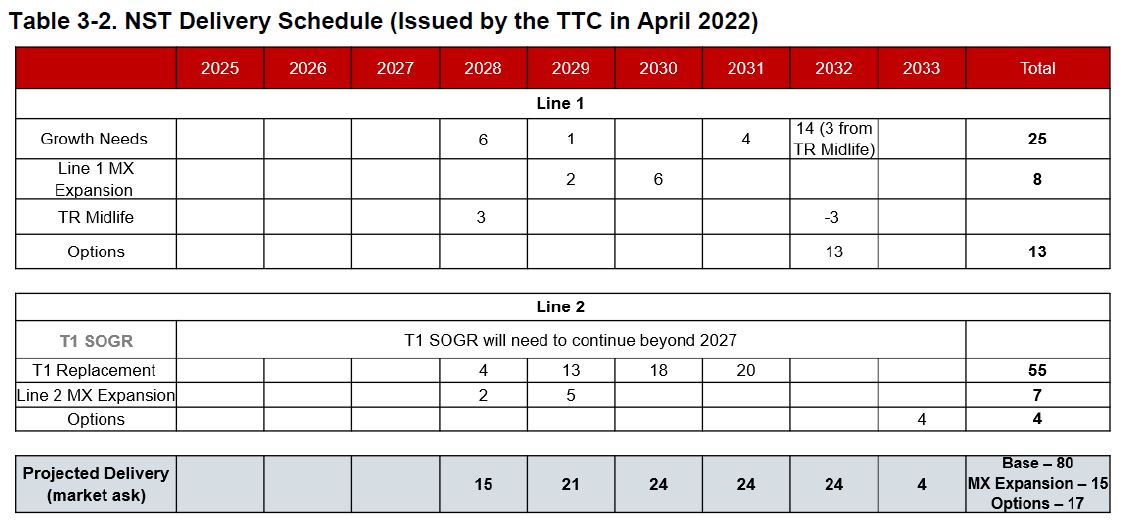
The original plan was to buy 62 New Subway Trains (NSTs) to replace the T-1 fleet. This would give enough trains to operate Line 2 through to Scarborough, albeit likely with a short turn during peak periods at Kennedy Station. The NST order has been scaled back to 55 trains (the number required for the existing Kennedy-Kipling line) with extras to be purchased as part of the Scarborough and Yonge North subway projects.
The NST design has changed to retain the style of the 6-car TRs with open gangways, but the cars will come in married pairs. Each end of the train will have a pair with one cab plus hostler controls on the “blind” end of the pair. The middle pair will have hostler controls at both ends. This will allow the 6-car sets to be broken up for movement of individual pairs in yards and shops. (See: TTC Requests Proposals for New Line 2 Trains and Signalling)
The Ontario Line replaced the Relief Line, and will have its own fleet and MSF at Thorncliffe Park eliminating Greenwood as its home base.
These factors led to a rethink of Greenwood Shops and the need for a new yard west of Kipling Station.
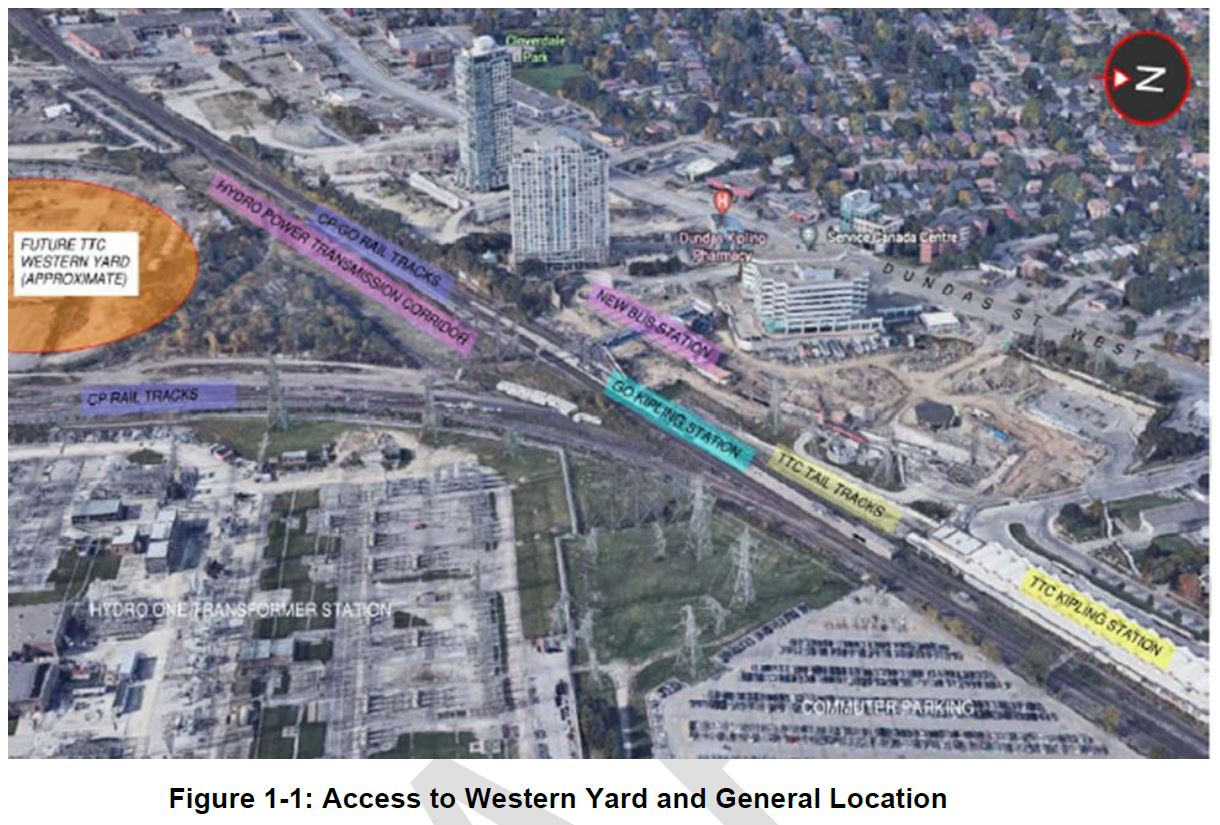
In 2022, the City bought property east of the Western Yard lands at 780 Kipling as a site for their next bus garage, although current plans will not require it immediately. The two properties are adjacent, but are separated by the link between the Metrolinx Lakeshore West corridor to the CPKC Milton line at Kipling Station.
TTC proposes to use this site not just for a garage, but to consolidate other operations that are now in leased space around the city.
The map below shows the two sites. The Milton corridor is at the upper left, and Kipling Station is out of frame at the upper right.

There are two RFPs (Requests for Proposals) on the street for consulting services:
- The Master Plan for the Kipling Industrial Lands
- Consultant services for design of the proposed Western Yard
The Master Plan work entails looking at the various possible uses for the site and how they would be accommodated.
The Western Yard RFP includes two documents from the Line 2 Capacity Enhancement Program as reference information. Both were prepared by HDR and Gannett Fleming.
- Greenwood Yard Workflow and Processes Analysis, Final Report, June 13, 2023
- Western Yard Concept of Operations & Maintenance Report, Draft, January 24, 2025
The Need For Another Yard
Although it may seem like the distant past, only six years ago the subway system was bulging with passengers, and planning focused on how to accommodate more riders. This led to proposals including new trains, automatic train control and a general increase in capacity of both Lines 1 and 2. The services now operating on Lines 1 and 2 are not yet back to pre-covid levels.
| Line 1 Time Period | Trains (Headway) January 2020 | Trains (Headway) April 2025 | Capacity Difference |
|---|---|---|---|
| AM Peak | 65 (2’21”) | 56 (2’52”) | -22% |
| M-F Midday | 42 (3’49”) | 35 (4’34”) | -20% |
| PM Peak | 65 (2’36”) | 54 (2’59”) | -15% |
| M-F Early Eve | 46 (3’30”) | 38 (4’11”) | -20% |
| M-F Late Eve | 32 (5′) | 26 (6′) | -20% |
| Sat Afternoon | 42 (3’41”) | 34 (4’34”) | -24% |
| Sat Early Eve | 30 (5′) | 30 (5′) | Nil |
| Sun Afternoon | 35 (4’20”) | 34 (4’34”) | -5% |
| Sun Early Eve | 30 (5′) | 25 (6′) | -20% |
| Line 2 Time Period | Trains (Headway) January 2020 | Trains (Headway) April 2025 | Capacity Difference |
|---|---|---|---|
| AM Peak | 46 (2’21”) | 42 (2’38”) | -12% |
| M-F Midday | 33 (3’20”) | 30 (4’04”) | -22% |
| PM Peak | 43 (2’31”) | 34 (3’23”) | -34% |
| M-F Early Eve | 29 (3’42”) | 25 (4’52”) | -32% |
| M-F Late Eve | 20 (4’52”) | 19 (5’23”) | -11% |
| Sat Afternoon | 26 (4’15”) | 26 (4’15”) | Nil |
| Sat Early Eve | 19 (5’30”) | 19 (5’30”) | Nil |
| Sun Afternoon | 22 (4’52”) | 22 (4’52”) | Nil |
| Sun Early Eve | 20 (4’52”) | 19 (5’30”) | -13% |
TTC expects to be back to the pre-covid peak service in 2030. Line 2 will require 46 trains plus 7 spares (at TTC’s minimum of 15%) for a total of 53, or 9 spares (at 20%) for a total of 55. Spares include both trains ready for deployment as replacements or extra service (ideally 4), as well as those in maintenance programs.
Service more frequent than 140 seconds will not be possible on Line 2 until it fully converts to automatic train control in the early 2030s. The Scarborough extension’s opening date is currently claimed to be 2030, although whether like so many other projects it will come in late is unknown. Extra trains for that extension, and for ATC conversion will be needed starting in 2030.
Thus far, this article has covered basics and readers might ask about the title’s question – will a western yard ever be built?
The Western Yard design RFP incorporates the Greenwood Yard study which speaks of construction of a new yard originally planned for 2034, but now pushed to 2038 or beyond by the TTC. No reason for this is given. No estimate of construction time, and hence availability of the new facility, is given either.
Can Greenwood handle the transitional state between its current role and various steps on the way to complete delivery of the new trains, not to mention a new yard?
Back in 2018, the transition looked relatively straightforward with a planned new yard to provide capacity. Now this is constrained by several factors even allowing for the DRL/OL fleet shift out of Greenwood. There is no provision in the TTC’s 10 Year Capital Plan for construction of a western yard, only for preliminary work such as design.
The issues go beyond space for train storage. They include capacity for ongoing servicing and maintenance, major overhauls, spare parts storage and workforce scheduling. For many years, the TTC had a surplus of space and maintenance capacity, but as the number of active trains grows concurrently with delivery of new trainsets, much more will be expected from staff and facilities.
This situation arose in part because TTC management opted to defer the new yard with no acknowledgement of its critical role as the system grows. Simultaneously, contracts for new trains and ATC conversion also were pushed out into the future. This delayed capital expense, helped to keep taxes down, and left headroom for other projects.
All of this bumps into assumed go-live dates for the Scarborough extension, automatic train control and headways below 140 seconds. The pandemic pushed many dates for transit’s growth into the future thanks to lost riding. However, if events drive demand up faster than the TTC’s projections, they will not be able to handle the pressure. Considering that the City of Toronto often cites transit growth as an essential part of fighting traffic congestion, the City and TTC plans could be out of whack.
The Western and Greenwood Yard Sites
The western yard property lies south of the corridor occupied by TTC, GO and Hydro. Any link to this property will require an over- or underpass between the existing TTC tracks and the yard. Not mentioned in the report is any consideration for a western extension of revenue service, for example to Sherway Gardens, that could affect the design and alignment of this connection.
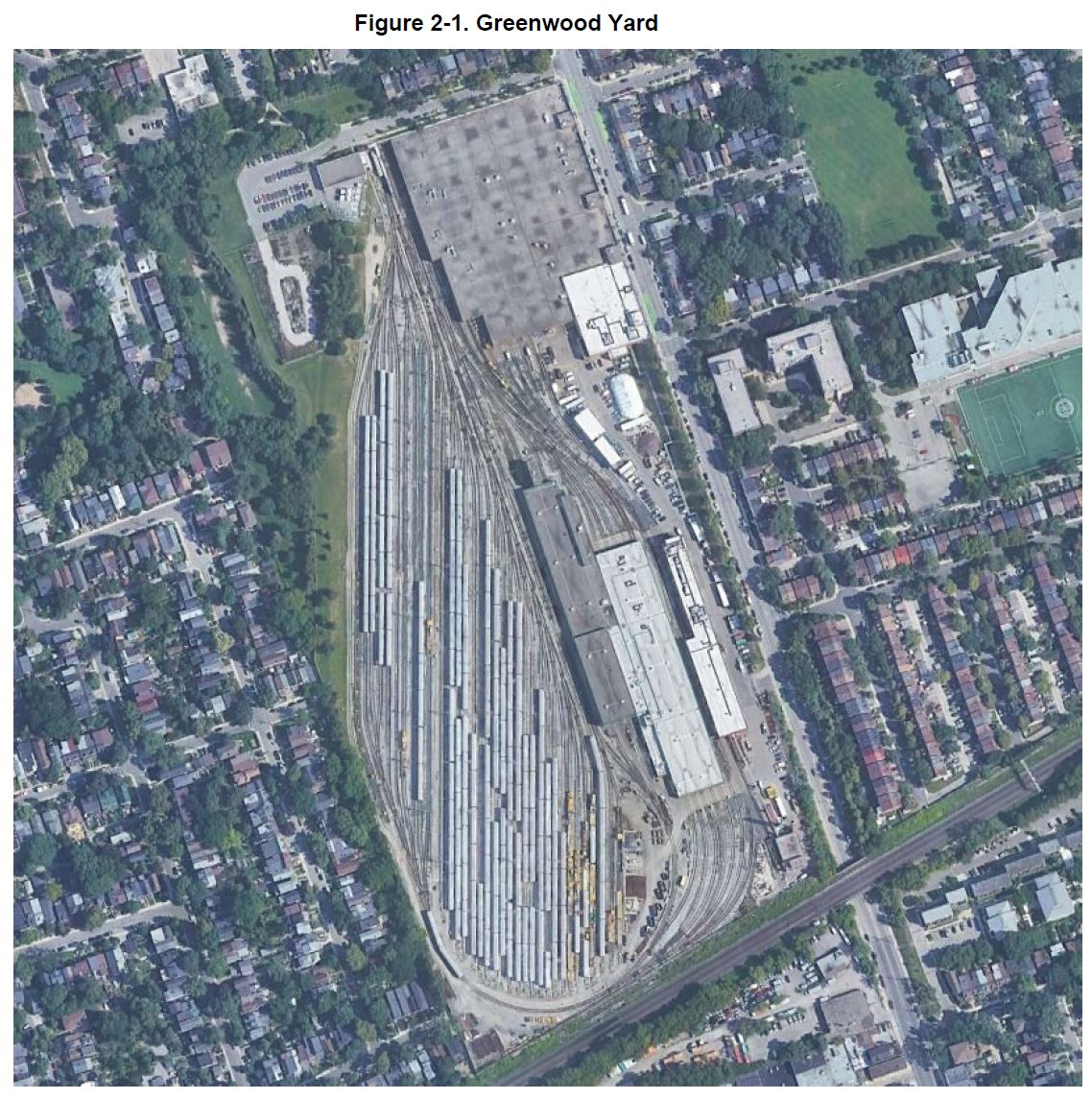
The Greenwood site includes storage for most of the Line 2 fleet as well as buildings both for regular servicing and minor repairs, as well as for major overhauls. It is located on the west side of Greenwood Avenue just north of the Metrolinx Lake Shore East corridor (at the bottom right). The connection to the Line 2 subway is a grade-separated underground wye junction just north of the portal (top, left of centre).
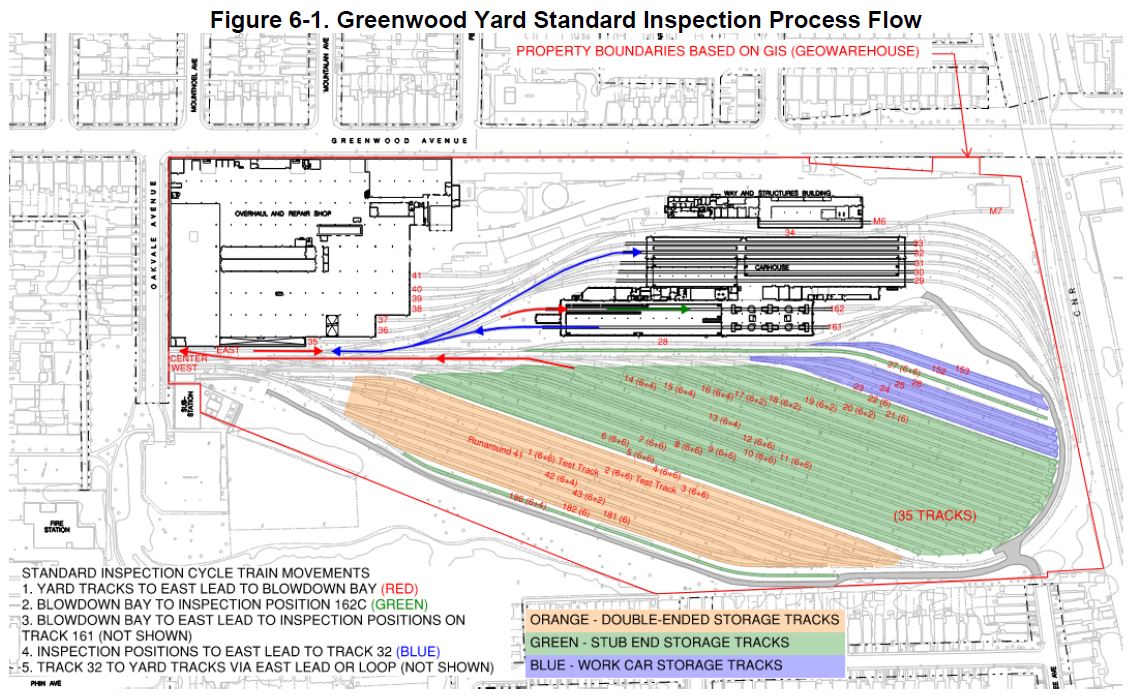
The movement of trains through various parts of Greenwood yard and buildings for routine inspection and cleaning is shown in the diagram below. Note that some of these are roundabout because of geometric limitations on tracks that connect through to the runaround track (orange) and those that are stub-ended (green and mauve). Tracks vary in length, and several of them cannot hold complete 6-car consists.
This design worked when 4-car consists were common, but poses limitations for the now-standard 6-car configuration as trains must be broken apart to maximize use of all tracks. Note that the east track (of three) at the portal does double duty as a reversing area for trains running between the stub end storage tracks and the carhouse and wash tracks
Storage Capacity
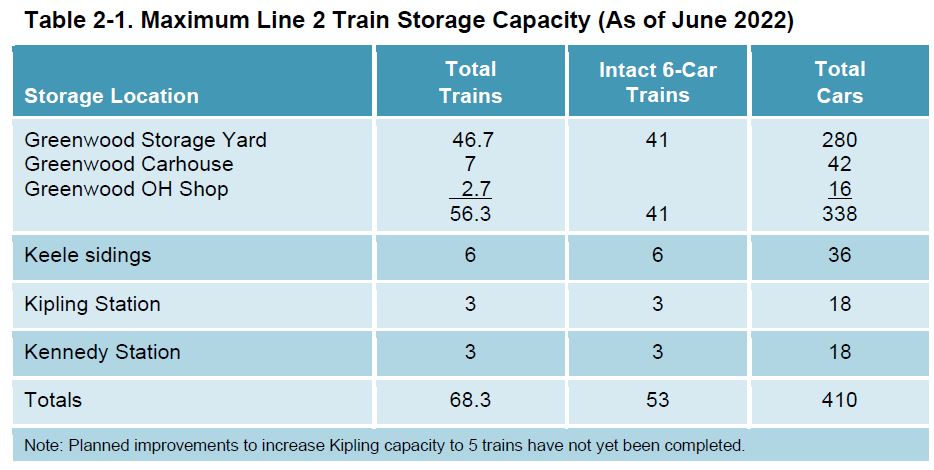
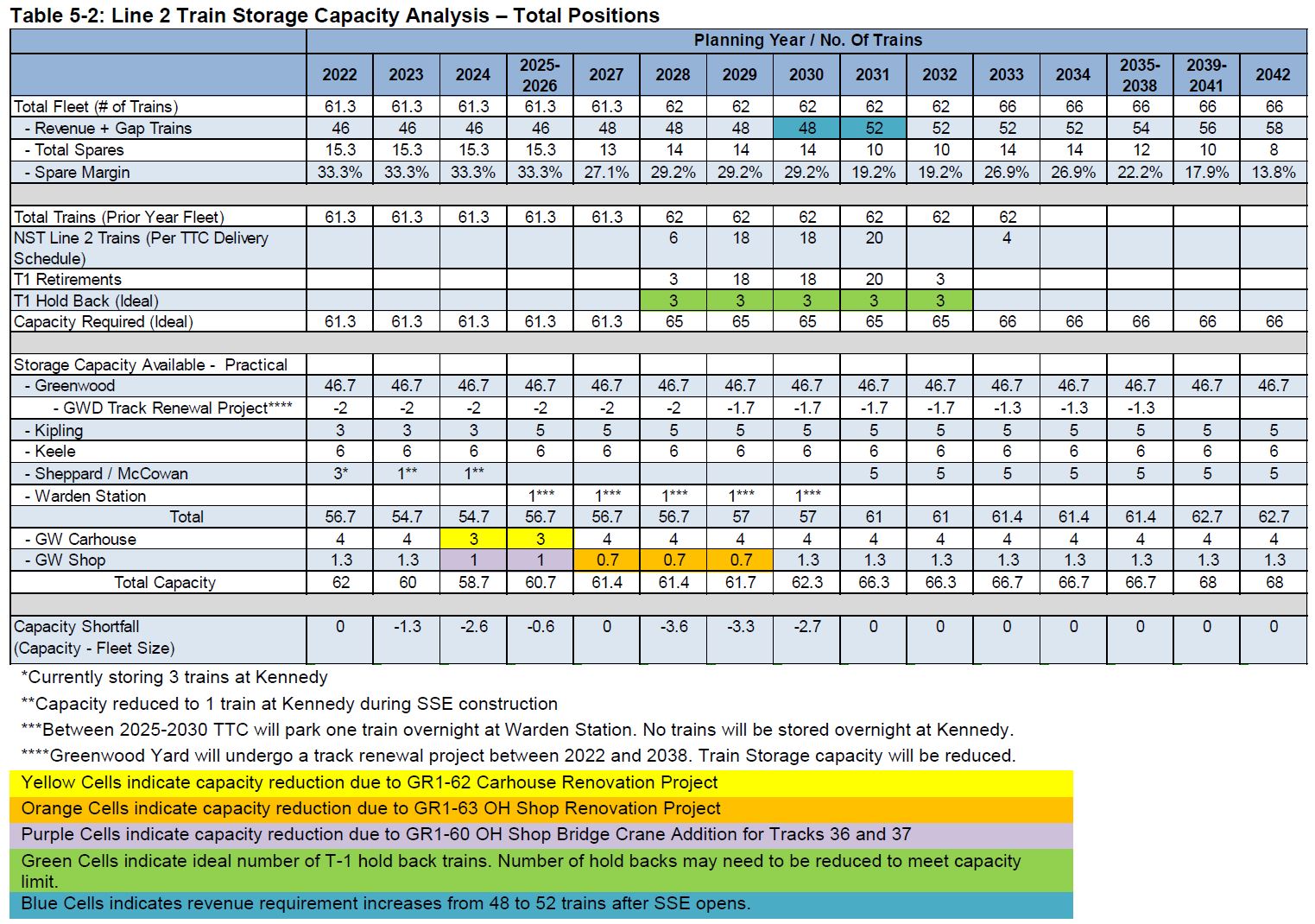
Although Greenwood theoretically has capacity for 56.3 trains, only 41 of these can be stored as intact 6-car sets ready for service. Kipling can hold 3 trains, but expansion to 5 trains is in progress. In practice, the Line 2 trains are stored at various locations to provide flexibility in the daily build-up and shut-down of service, but also to avoid overcrowding Greenwood Yard by depending on capacity for fractional trains.
Additional capacity will be provided as part of the Scarborough extension project, but this will not be available until trains can operate over that line. It is possible that the Scarborough trains will arrive before there is room to store them without overcrowding existing facilities. There is no capacity anywhere for service growth.
The capacity at Greenwood will be constrained until the early 2030s for various reasons:
- A rolling reconstruction of tracks at Greenwood Yard (one track per year) will reduce storage by up to 12 cars (depending on the length of the affected track).
- Renovation and equipment addition in the carhouse and shops.
- Space for T-1 trains retained as a buffer against reliability of the NSTs as they are delivered.
- Addition of two trains to accommodate slow orders at Kennedy Station during SSE construction beginning in 2027.
- Net addition of four trains for Scarborough service in 2031.
- The spare factor for the fleet will run higher than the target 15-20% range.
Not included here is any provision for growth in the work car fleet, at least to the extent that it would be stored at Greenwood rather than Davisville or Wilson.
These events are summarized in the table below. This shows a capacity shortfall until the SSE storage comes online in 2030, but only minimal growth of service beyond the pre-pandemic level. Until 2035, most of the growth in the train count is due to the Scarborough extension, not to more frequent service.
The revenue train requirement assumes a return to pre-pandemic service building up to 46 trains by 2027. (Note that the 2025 changes shown for Lines 1 and 2 have not yet been implemented. Line 4 resumed service with 4 trains in the March 30, 2025 schedule change.)

The planned 2042 service level requires a spare ratio much lower than the TTC’s usual range and this implies that further NST purchases will be required in the late 2030s. There will be no place for such trains without additional storage.
The delivery schedule for new trains is shown below.
Line 2 will eventually convert to automatic train control, but the TTC has not yet decided on a vendor, or whether they will use the same technology as on Line 1. Plans for the Scarborough extension include a rudimentary block signal system by the time it opens with conversion to ATC at a later date. Service on Line 2 cannot operate more frequently than every 140 seconds until ATC is in place and until all of the T-1 trains are retired.
If a different ATC technology is chosen for Line 2 than is in place today on Line 1, interoperation of trains between the two lines will be more difficult, and the TTC will have to support two types of signalling. This affects flexibility for revenue service, locations of major overhauls and testing.
Capacity growth is expected in stages over many years:
- Return to pre-pandemic service: 45 vs 41 trains (April 2025) Kennedy-Kipling (10%)
- Higher capacity of NSTs compared to T-1s (10%)
- Growth trains: 57 vs 51 trains Sheppard-Kipling (12%)
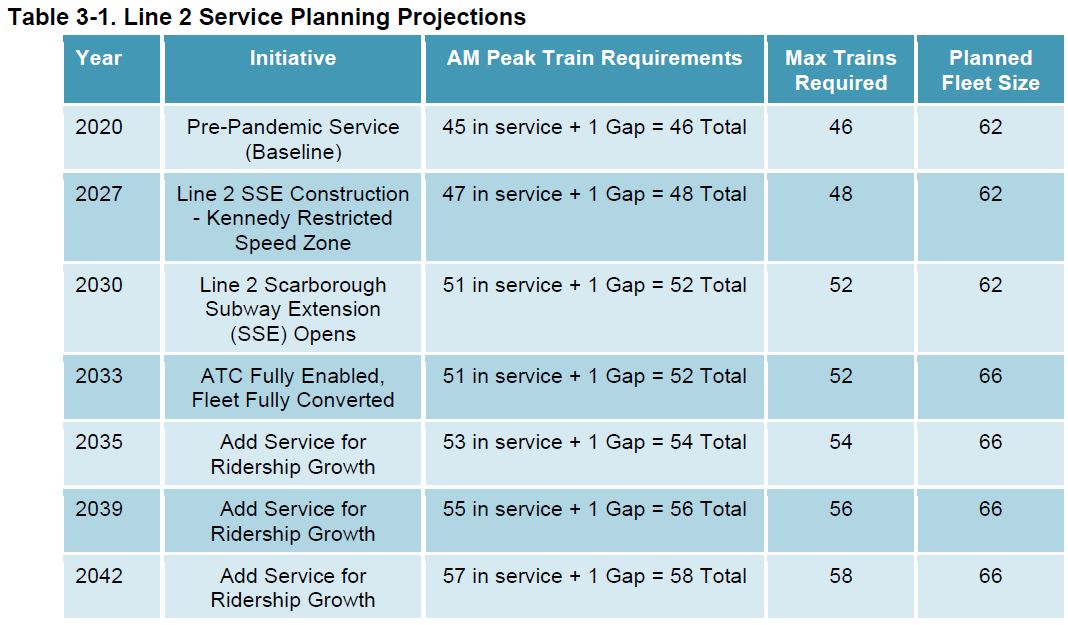
The demand projection for Line 2 shows considerably lower demand than on Line 1 (including the Richmond Hill extension).

Servicing, Maintenance and Overhaul Capacity
The maintenance and overhaul areas at Greenwood are divided into segments two cars long. This allows task-specific equipment to be placed where specific types of work will be done rather than having general purpose bays throughout the buildings. Different tasks require different lengths of time, and therefore the number of pairs per year that can be handled is not the same for each area.
The type of work varies from repetitive inspections and cleaning to minor and major overhauls. The latter do not occur continuously but ramp up and down as each part of the fleet reaches the age where, for example, a mid-life overhaul or major inspection is due. This causes the workload to vary from year to year. This work will continue for the existing fleet, although it will gradually diminish as new trains replace old ones, but the new trains will have their own requirements including test equipment and parts.
The Greenwood study estimates that the maximum fleet that can be supported by the Overhaul Shop is 67 trains assuming a 5-day work week, or 98 assuming a 7-day week. The existing 5-day operation will just accommodate the expected 66 train Line 2 fleet, although there will be little room for growth and a constraint during the co-existence of old and new fleets. The capacity will also be reduced during planned building renovations to support the new fleet.
The report recommends against over-committing the facility’s capacity and especially warns against using areas intended for maintenance work for train storage.
The study also notes that Greenwood could not support the mid-life TR train overhauls (Line 1 fleet), and this work will have to be performed elsewhere.
Another problem at Greenwood is storage space for parts. During the transition from T-1s to the NSTs, parts for both trains will have to be kept on hand. After the conversion, the fleet will be larger and it will be better used (lower spare ratio), thereby requiring more inventory to support maintenance. The report flags inadequate capacity to handle either the transition or the post-conversion period. This will require a change in warehousing including off-site storage.
Western Yard Timing
The Greenwood study is quite clear in that it will be theoretically possible to support a 66-train fleet from that location, plus remote sites along the line, but that several factors could compromise the TTC’s ability to maintain service on Line 2 if projections built into the plan do not work out.
The Western Yard design work will proceed on the assumption of the current timetable, although even that is only sketched out with a staged implementation of storage followed by shop buildings for running inspection and maintenance.
There does not appear to be any plan to accelerate design or construction work if City policies change to push service growth over the next decade.
Questions to the TTC
On April 7, 2025, I posed a series of questions to the TTC.
- Is the start date for construction of a Western Yard constrained by external factors that make it impossible, or is this by a policy decision about the timing of spending and the date by which added capacity will be needed? How did the TTC determine that the yard would not be built until after 2034?
- What is the projected length of construction? In other words, if the start date is 2038, when would the facility be available to store and maintain trains?
- How does this project relate to a possible western subway extension beyond Kipling Station?
Here are their replies:
- With the implementation of mitigation strategies outlined in the report you referenced, it was initially determined that a new yard on line 2 is not required prior to 2034. This was further validated by the referenced draft report and will continue to be assessed as part of the new consulting services scope of work.
- The intent of the current request for consulting services is to re-validate the requirements and determine when a new facility will be needed on Line 2 and how it could be implemented. A high-level schedule will be developed as part of the scope of this work.
- Consideration of and protection for a future western subway extension is included in the planning of Western Yard.
On April 17, I posed a further question:
- GO Transit lists Obico Yard (the Western Yard site) among their Logistics Hubs for their expansion projects. Given that the expansion work will end at some point, is this a temporary arrangement with the land leased or otherwise loaned to GO? It is odd that TTC would be planning for a new yard if the land was a permanent GO facility. Can you clarify?
I await a reply.
 Steve Munro
As a lifelong Kipling station user, extend Line 2 down to Sherway.
LikeLiked by 1 person
Why is everyone so obsessed with Sherway? Isn’t Dundas/Cloverdale a more logical future alignment?
Steve: The western alignment has been one of those immutable lines on the map for decades, and it originally extended into Mississauga. Changes in GO policies and improved service have reduced the political pressure to go that far.
LikeLike
It does not appear that the need for the Western “Obico” Yard is in question. That there are a couple of recent consultants’ reports from HDR and Gannett Fleming plus a couple of RFPs is a good sign that the project has not been forgotten. It should be kept in mind that the lead time to completion could be 10+ years.
It is an interesting debate as to which is a better Line 2 extension, to Sherway Gardens vs. Dundas/Cloverdale? (Chris and L. Wall). Both have pros and cons. Sherway is a major destination, but there is hardly a need to continue to or connect to the Queensway in Mississauga, it is low density. But while Cloverdale Mall is a smallish destination, the connection to Dundas Street in Mississauga is very good.
Steve: The Western Yard project was sidelined at a time when Rick Leary thought that we didn’t need new subway trains and could simply rebuild the old ones for at least another ten years’ life. Also he was not keen on ATC for Line 2, but then changed his mind on both projects. However, the momentum was lost and they didn’t get the same priority for funding as all of the tub thumping Line 1 projects have received. This is only evident when you look back at past budgets and see things like the new trains disappearing for a while, and when they returned, the timelines were stretched into the 2030s.
My concern is that needed work is not listed in the TTC’c capital plans and therefore does not appear as a funding shortfall. Meanwhile there is serious concern that the TTC will not be able to operate the Greenwood facility at completely full capacity.
LikeLike
It makes sense to extend the subway to Cloverdale’s redevelopment and then onto Sherway and north to link to the new crosstown line.
LikeLike
I see a branched extension of Line 2.
1. South to Sherway via the OBiCo Yard and North Queen. There is apparently space being made at Queensway and The West Mall for a station site oriented east-west. This would be adjacent to the west end of Sherway Gardens and the east end of the expanded Trillium Queensway General site, but it would also be next to a Hydro corridor which would prevent the maximization of station access.
2. West to Cloverdale and north to Renforth and/or Pearson. I honestly don’t see this happening in my lifetime but generally, there’s the obvious opportunity to support the West Dundas West and Honeydale/Cloverdale redevelopments, existing density and infill along East Mall and West Mall, the Renforth transit hub, and an eventual link to Pearson.
There’s also an opportunity to feed east-west transit connections between Toronto and Mississauga and north-south express bus links in Etobicoke, with stations at Queensway/Sherway, Dundas/427 (Dundas buses) Burnhamthorpe (Bloor, Burnhamthorpe and Rathburn buses) and Eglinton (Crosstown, East & West Mall, Martin Grove and Highway 27 buses and the Transitway).
Of course this is all transit fantasy but it should also be noted that this part of Etobicoke (really everything from Pearson down to the lake) is heavily polluted due to airport and industrial activity and traffic volumes and congestion.
M
Steve: One thing I didn’t mention in the article is the question of “early works” such as soil remediation at Obico. This could be started any time and would shorten the time for actual construction. It will be needed whatever is done with the site, and the sooner the better.
LikeLike
Both Cloverdale and Sherway will be seeing several developments over the next few years. The Cloverdale development calls for 9 buildings, ranging from 6-41 stories, and 403-1082 units. Sherway’s development (3 phases) calls for 11 buildings between 17-45 stories.
LikeLiked by 1 person
Why does it have to be either Cloverdale or Sherway? The alignment could just follow (roughly) Dundas west of Kipling Station, have a connection with the new yard similar to how Greenwood is connected to main line, and then have a station at Cloverdale and station at Sherway?
LikeLiked by 1 person
The problem with Sherway is that it’s more or less a dead end. Yes The Queesway continues into Mississauga, but it’s low density residential and commercial. And I don’t think anyone is planning to continue towards the (to be redeveloped) Dixie Outlet mall.
If the terminal is to be a good transit hub, then Dundas is a much better choice than The West Mall and The Queensway. (Yes, both are “The”.)
The “easy” alignment to Sherway would I presume follow the railway corridor. There, the problem is that the railway tracks are well to the north of The Queensway, in the land of shipping container yards, big box bathroom stores, and car dealerships.
(Like, if you think that’s a great terminus for a subway, you’d be keen on a subway to the Canadian Tire at Sheppard and McCowan….eh what?)
LikeLike
The better alignment to Sherway is to go through the yard and under (or above) North Queen. There’s also a plan for development of some of the OBiCo yard, and development along North Queen west of Highway 427 down to Queensway.
To my mind the North Queen/Queensway location would probably be better for a subway station, given that there’s far more space for adjacent development there, than at West Mall and Queensway. However, the station needs to be in a place where it wouldn’t be affected by turns.
Sherway doesn’t have to be a dead end, given that the Dixie Mall redevelopment is on the other side of Etobicoke Creek, and Lakeview (which will have a supposed 15,000 units) is just further south. Of course, that’s again transit fantasy but building tall and sprawl means that a development cluster is quite likely to be a good place for transit demand, if the transit connection can be built.
m
Steve: There was a plan for Obico yard, but that was before the City bought it from Dream.
LikeLike
Is Obico still happening? Seems like Metrolinx is using it for GO Transit rail expansion services as a hub of some sorts.
GO Capital Projects Sept 2024
GO Expansion Logistics Hubs
Really do wish that it’s just temporary or small part of the site, that subway yard needs to get built. As nice it is to see the yard living near it, Greenwood can’t handle all. Line 1 gets Davisville, Wilson, and future Richmond Hill yard while Line 2 gets a Greenwood and a small Keele yard?
Steve: As the logistics hubs are intended to support the expansion program, and that should be finished in the current decade, I suspect that this is a temporary arrangement between the City (who owns the land), the TTC and Metrolinx. I have sent a note to the TTC to verify this.
Line 2 will get a small amount of storage at Sheppard McCowan Station when the SSE is finished, but that won’t allow TTC to improve service beyond pre-pandemic 140 second headways.
LikeLike
Has the TTC provided a reply to your questions?
Steve: Yes. I have updated the article.
LikeLike