
Revised at 6:30 pm on February 23, 2025: Additional RSZ charts posted to the Urban Toronto site over the past year were passed on to me by a reader. I have incorporated info from them into the charts below to fill in several blanks in my own data.
For roughly one year, the TTC has published a list of reduced speed zones (RSZ) on the subway system. Many of these are long-lasting and span multiple stations.
In recent discussions of service quality, TTC management speaks of twelve zones as a reasonable number to exist at any time. Things will go out of whack, or otherwise need repair, to be sure, but the number and longevity of RSZs is extremely frustrating for riders.
As with some other performance indices, the one chosen by the TTC only tells part of the story, even if we agree (which I do not) that having 12 RSZs is perfectly acceptable. What this number does not tell is the extent of each slow order (mileage or proportion of the line affected) or duration (days, weeks, months). Indeed, TTC could get the number down to two simply by making all of Lines 1 and 2 an RSZ. That is obviously nonsense, but shows the problem inherent in just counting items in a list.
The charts below show the areas with RSZs for the two major subway lines over the past year. I was not assiduously collecting this information every week, and used the Internet Archive to fill in a few gaps. Where there is a break of more than a week in my snapshots, I have left a blank line in the chart, although the similarity of data before and after the break suggests that the RSZs persisted.
Most striking about these charts is the proportion of Line 1 that has been under an RSZ for the past year. Some problem areas appear and disappear implying that the problem was minor and fixed quickly, but others are permanent.
A common factor among many of the affected areas is that they are in open areas where track sits on ties and ballast. These are subject to shifting and deterioration far more so than track in tunnels that is bolted to the concrete floor, or sitting on concrete ties (except for switches and crossings). This makes repairs more complex compounded by the problems of working in winter. However, these areas have been on the chart since long before the snow, and a real problem for the TTC is whether repairs can even be achieved in weekend shutdowns.
There are many problems with how the TTC reports is own performance, notably that problems are understated or masked by the choice of metric and presentation. A further concern from these charts is whether the TTC will ever dig itself out of the backlog of work they represent.
Reading the charts:
- The colour bands extend from the limits of a slow order as shown on TTC maps or text descriptions.
- The symbols “>” and “<” indicate the affected direction of travel, and “<>” means “both ways”.
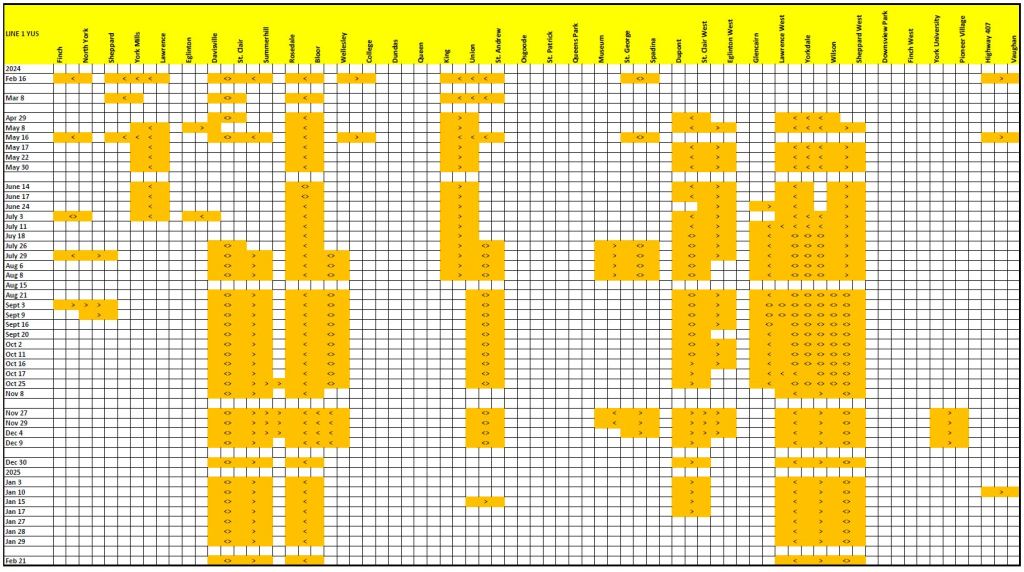

I will update these charts from time to time to show the TTC’s progress, or not, in resolution of chronic subway slow zone problems.
 Steve Munro
Certain sections on line 1 are more or less permanent fixtures on the reduced speed zone list: Bloor to Eglinton and Eglinton West to Sheppard West. Perhaps what the TTC should do is pick 2-3 weeks in the summer where ridership is lowest (my guess would be second half of August) and do a full shutdown. First tackle Bloor to Eglinton and the following year the Spadina portion. I for one am willing to put up with a longer term (non-weekend) shutdown if it guarantees that the slow zones would be fixed permanently.
Could they replace the ties/ballast currently used and use the same track installation method as in the tunnels (concrete base)?
Steve: Many years back, when Andy Byford was CEO, there was talking of shutting down part of the line south of Eglinton to completely replace it on a new foundation rather than ties and ballast. However, to do this would take a large fleet of buses and devotion of Yonge Street to nothing but transit. Basically push all the traffic onto Mt. Pleasant and Avenue Road with added parking restrictions there too, as well as on whatever east-west links were used for the diversion. Council would be apoplectic, and of course it couldn’t be done with Eglinton a construction disaster zone from Line 5.
LikeLike
Steve,
Thank you for your diligence and commitment.
One of the many frustrations with TTC is their reluctance to have meaningful discussion with their shareholder citizens of the city.
Does TTC have a published comprehensive work plan to correct this mess that has come before the board?
Lee Parsons
Steve: No.
LikeLiked by 2 people
I wonder if the third party maintenance contractor will have similar issues with Michael Schabas’ love child the elevated and very much outdoor intermediate capacity Ontario line!
Steve: After the disgustingly insulting comments Metrolinx made about TTC during the early days of the OL plans, I look forward to them falling completely on their butts when they have to actually run something.
LikeLiked by 2 people
I’ve commented on this (sadly telling) topic before, so let me simply say thank you for continuing to highlight it.
LikeLike
You can have that experience today. Just saunter over to GO Transit’s webpage, “Service Related Updates” section, “Schedule Changes” subsection, and read all the notices about “Service Adjustments” wherein they adjust service by not running trains every other weekend and attempt to halfway replace it with buses.
LikeLike
The diagrams are interesting, but they don’t show the actual length of the restricted speed zone, and therefore don’t necessarily show which RSZs have the most travel time impact.
Even if the RSZ is for the entire distance between two stations, slow speed going between Queen and King is going to be much less of a delay than having to maintain the same slow speed between St Clair West and Eglinton West (or Cedardale or whatever Metrolinx is calling it now).
Steve: I thought of adjusting for that but you’ll just have to put up with my not-to-scale graphics.
LikeLike
Any idea what the specific issue is eastbound between Coxwell and Woodbine? I figure it must be some inherent defect if they have been unable to resolve it for an entire year (or maybe just very low on their priority list?).
Steve: I suspect there is a problem at Woodbine Crossover.
LikeLike
The issue between Coxwell and Woodbine is indeed something related to the crossover. (I don’t know what it specifically is, but the slow zone is limited to there.)
On its own, the delay is pretty minor, but during rush hour when the headways are short it can cause a backup because of how the longer block clearance time affects the upstream signals.
LikeLike
Are any of the ongoing Line 1 closures on weekends addressing slowdowns? What’s the issue north of Eglinton West – not anywhere close to the oldest part of the system.
Line 2 appears in much better shape.
Steve: The open cut areas cannot be repaired until the weather improves. This affect the sections from Eglinton to Bloor, and from Eglinton West northward. If you look at the charts in TTC 2025 Subway and Streetcar Infrastructure Projects, you will see that work is planned on the Yonge side of the line in the Spring, and on the Spadina side in the Summer.
LikeLike
Question:
As we trudge through another weekend closure and early night closures. The TTC sings a long song about not having enough time or space to work on tracks.
Could ATC support bi-directional on the same track? For example single train runs NB from Union, to the first crossover and SB train then proceeds to crossover utilizing the NB track to go south.
Assuming power could be turned off on the track that is being worked on.
Just trying to think outside the box- a single train every 10-15 minutes could significantly reduce the city’s lack of surface level planning where buses are packed to the roof with that one automobile that insists on turning left with no left turn allowed.
Steve: The problem is power, as you noted. The only part of the line that is set up for single track operation is the Vaughan extension that was built with ATC in mind. Another issue is that a train every 15 minutes would lead to huge problems with crowd control, and that on a shared platform for running both ways.
Even some of the turnbacks have problems for double track operation. For example, when the original Eglinton-Union section was built, there were manual crossovers at St. Clair (Rosehill), Bloor, College and King. However, suppose the power is cut at Wellesley. This made the track south of Bloor crossover useless because there was only power to the north. Many years ago, when Bloor crossover was electrified, a separate power feed was established for Bloor Station itself, and also for one train length north of the crossover. This allows power to be maintained for turnbacks. I am not sure if this work was ever completed for the other crossovers.
On B-D, there was a similar problem. If power was cut west of the centre track between Broadview and Chester, trains could turn back in that track, but could not use Broadview Station as a terminus. This was particularly annoyingduring the regular work on beam replacements on the viaduct. This was finally changed, and power can be maintained in Broadview Station while it is cut over the bridge.
LikeLike
What is the reason for the proliferation of so many RSZs?
1. Is it a question of the city not giving the TTC enough funding for subway maintenance?
2. Is it because the TTC leadership is incompetent and dont know how to properly allocate resources to subway maintenance?
3. Is it that the TTC is not giving city council a full picture of the problems they are facing?
4. Is it a question of the TTC trying to do what they can within a constrained budget and not lobby for more dollars?
I just don’t get how so many city councillors can look at the state of the subway and so many RSZs and think this is normal. I haven’t read too many of your articles on RSZs but I do know it’s going on for a while. Have they gotten better or at least stopped getting worse under Chow? Any optimism that things will slowly start getting better under her mayorship? I’m really surprised how quiet Chow has been on TTC’s subway problems.
Steve: I think that aspects of 1 through 3 are interrelated. Under Mayor Tory and by extension TTC CEO Leary, the goal was to keep costs down. This affected many areas, not just the state of subway track. Council started to wake up to problems at the TTC with the SRT derailment, compounded by other subway infrastructure issue. The SRT derailment, on July 24, 2023, was only shortly after Mayor Chow took office. The underlying details did not come out until later in the fall, and even then, the TTC did not go out of its way to publicize the documents posting them without notice on a page most people would not check regularly. I happened on them while looking for something else, and when I wrote about them was the first time most people had seen them. TTC was not pleased.
Leary was still CEO having survived a botched attempt at removing him. The 2024 budget was produced by the Leary regime, and it didn’t raise major flags about subway maintenance. Then came, among other things, the problem with leaks from subway work cars. At the same time, areas in need of major repair were accumulating, and the problem got out of control. At times work didn’t happen because the specialized cars needed were not available. This is still a problem, I understand, because of poor co-ordination between work planning and equipment availability.
The TTC had integrity and geometry checks performed on the subway which detected many problems. “Integrity” as I am using it refers to issues with incipient rail fractures from metal fatigue, for example, whereas “geometry” refers to rail that is out pf alignment and/or worn to a point where operation at regular speed is unsafe. Many of these problems cannot be fixed overnight. There are particular problems on areas of open track where the foundation is a typical railway ties-and-ballast system as opposed to in tunnels where track is bolted to the floor of the tunnel. Open track is more subject to shifting as well as drainage problems and accumulation of silt in the ballast. Repairs of these problems cannot be easily done in winter. That said, the slow orders on the Spadina line north of Eglinton West have been in place for a year showing that the work required is not trivial.
I think that Mayor Chow focused her attention on overall City budget issues and the Housing/Homelessness portfolio hoping that her appointees on the TTC Board would look after that organization. Things didn’t quite work out as planned, and TTC is still making excuses about what an acceptable level of slow orders is with warnings of more to come.
All this speaks to a combination of penny-wise, pound-foolish budgets and related political pressure, the TTC’s long standing tendency to hide problems until they cannot be ignored, and a Board that, as a whole, was content to take a hands-off approach to management and their claims. This is changing, but I am not sure it is changing fast enough. In particular, there is little sign that the 2026 budget planning, which will be underway in a few months, will recognize the scale of what has to be done. There was a big push to get funding for the new subway cars, but that doesn’t do anything for infrastructure maintenance and improvement, let alone service quantity and quality.
LikeLike
The February 25th comment refers to slowdowns around Eglinton West Stn. Service is OK in this area, but the on-going super slow zone in this neighbourhood is southbound from Yorkdale to Lawrence West. This one kilometre section now takes 5min20sec instead of the usual two minutes. No announcements here about ‘traveling slowly through a Work Zone’, and the regular customer have become very familiar with this slow operation.
From the chart of planned subway closures, I see no work in this area until July, so we will have to put up with this super slow operation for at three more months.
LikeLike