
This article is a companion to Travel Times on 504 King: Update to January 2025 published here recently.
This is a long article with increasing levels of detail toward the end. Feel free to bail out, or come back later.
Although problems with severe congestion delaying transit downtown were somewhat reduced by the addition of Traffic Wardens by the City of Toronto in 2024, reliability issues continue to affect service along the King route. The situation illustrates a few of the service design and management challenges for this type of route, and shows how simply reducing congestion will not necessarily provide regular service.
504 King is unusual in having four terminals: Dundas West Station and Dufferin Loop in the west, Broadview Station and Distillery Loop in the east. The TTC only measures service reliability at terminals, but the overlapping 504A and 504B services must blend together to provide the advertised quality.
The 504 shares with other streetcar routes a much wider headway than existed before the pandemic. This is due primarily to the change in vehicle size, and only partly to riding levels. With less frequent service, regular spacing is more important because scheduled gaps between vehicles are already wide, and can get much wider. This is compounded by overlapping services on the 504A (Distillery to Dundas West) and 504B (Broadview to Dufferin). Nothing in the service design or line management ensures that these blend evenly, and the design provides very frequent service only on paper.
The table below compares headways on routes that operated with the shorter CLRV streetcars in January 2019 versus the new Flexitys in January 2025.
| Route and Period | January 2019 | January 2025 |
|---|---|---|
| 501 Queen to Humber | ||
| AM Peak | 4’15” | 10’00” |
| Midday | 4’45” | 9’00” |
| PM Peak | 4’50” | 8’30” |
| Early Evening | 4’30” | 10’00” |
| 506 Carlton | ||
| AM Peak | 5’10” | 10’00” |
| Midday | 5’20” | 10’00” |
| PM Peak | 5’40” | 10’00” |
| Early Evening | 7’10” | 10’00” |
The next table compares headways on routes that were already running Flexitys in 2019. (The Distillery District was originally served by 514 Cherry which ran from Distillery Loop to Dufferin Loop. In October 2018, the service design changed to the 504A/B configuration we have today.) 504 King service is less frequent than in 2019, and even less frequent than in November 2017 when the transit mall was implemented and the line was running with the smaller CLRVs.
512 St. Clair saw a substantial drop in service in May 2023 when headways increased from roughly 6 to 8 minutes. Not long after, the route then went through a long, painful period of bus operation during multiple, overlapping TTC and City projects. TTC plans to restore 6 minute or better service in late 2025. (Yes, you are reading that table correctly: peak service now is about half what it was in 2019.
| Route and Period | January 2019 | January 2025 |
|---|---|---|
| 504 King | ||
| AM Peak | 5’15” on each branch | 8’00” on each branch |
| Midday | 7’00” on each branch | 10’00” on each branch |
| PM Peak | 6’00” on each branch | 10’00” on each branch |
| Early Evening | 6’30” on each branch | 10’00” on each branch |
| 512 St. Clair | ||
| AM Peak | 3’45” | 8’00” |
| Midday | 4’45” | 8’00” |
| PM Peak | 4’10” | 8’00” |
| Early Evening | 6’45” | 8’00” |
Other routes were operating with buses in 2019 or 2025, and they are omitted here although their streetcar service is also less frequent now than it once was.
Although the service capacity in the case of 501 Queen and 506 Carlton is roughly the same allowing for the difference in vehicle size, the situation on 504 King and 512 St. Clair shows a marked reduction of capacity. This is an example of how the TTC is most definitely not back to 100% of pre-covid service, no matter how many media events make that claim.
With a wider scheduled headway, gaps will be wider too if either a vehicle is missing (e.g. a short turn) or vehicles are bunched together. When the scheduled service was frequent, some bunching was inevitable because vehicles were already close together. A management style that worked tolerably for frequent service does not work when fewer, more widely-spaced cars serve a route.
In this article, I will review performance of the 504 King route in January 2025, and show comparative data from earlier periods.
Weather
For reference, there was snow on a few days in January, but overall road conditions were good downtown for much of the month. Significant precipitation was recorded by Environment Canada on:
- Fri Jan 10: 4.1cm
- Sat Jan 11: 1.8cm
- Thu Jan 16: 1.1cm
- Sat Jan 18: 3.3cm
- Tue Jan 28: 6.0cm
“On Time” Service Standards
The service standard applicable to the 504 King car at a terminal is:
On-Time Departure
To be considered on-time, a vehicle must leave its origin timepoint between 1 minute early and 5 minutes late. TTC’s goal is to have 90% of all trips depart on-time. [May 2024 Service Standards at p 15]
For headways measured mid-route, a different standard applies.
Service frequency >= 5 minutes and <= 10 minutes
For services that operate between 5 and 10 minutes, passengers do not rely on printed schedules, but expect vehicles to arrive at prescribed headways. Therefore, on-time performance for frequent service is measured by how well actual headways correlate to scheduled headway intervals. Trips are monitored at a location based on arrival time, without regard to whether the trip that arrived was scheduled for that time slot. The vehicle is considered on-time when the headway deviation is less than 50% of the scheduled headway. For example, a service that operates every 6 minutes is deemed on-time if the headway deviation falls between 3 minutes and 9 minutes. TTC’s goal is to have 60% of all trips operated within ±50% of the scheduled headway over the entire service day.
Service frequency < 5 minutes
For services that operate better than 5 minutes, the vehicle is considered on-time when the headway deviation is less than 75% of the scheduled headway. For example a service that operates every 3 minutes is deemed on-time if the headway deviation falls between 0.75 minutes and 5.25 minutes. TTC’s goal is to have 60% of all trips operated within ±75% of the scheduled headway over the entire service day. [May 2024 Service Standards at pp 15-16]
Applying this formula to 504 King yields:
| Period | Scheduled | “On Time” |
|---|---|---|
| AM Peak | ||
| Common Section | 4’00” | 1’00” to 7’00” |
| Branches | 8’00” | 4’00” to 12’00” |
| Midday, PM Peak, Evening | ||
| Common Section | 5’00” | 2’30” to 7’30” |
| Branches | 10’00” | 5’00” to 15’00” |
The range of headways allowed mid-route can substantially exceed the value at terminals, and quite erratic service can be deemed to be “on time”.
Headways at Broadview Station
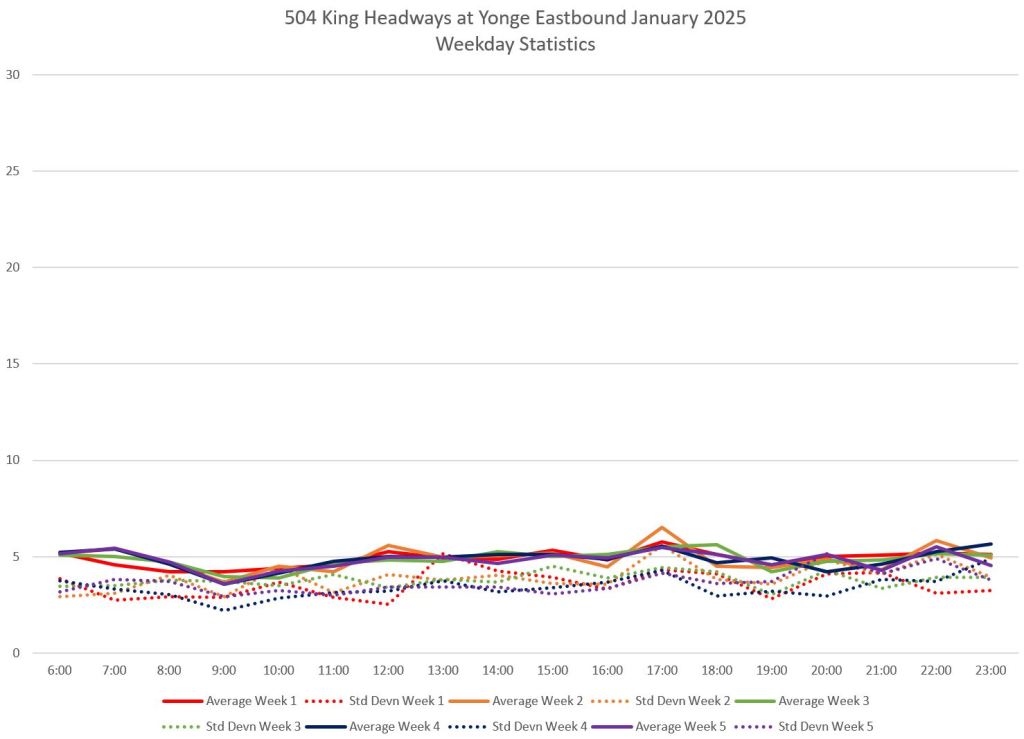
The chart below shows the hourly average headways southbound on Broadview crossing Danforth Avenue. Generally speaking, the values track the scheduled headway but run slightly higher in the afternoon and evening thanks to short turns. Far more troubling are the high standard deviation values (dotted lines) which indicate a wide dispersal of values. With an SD of 5 minutes, a range of 15 minutes will include over half of the data points. This is illustrated in following charts.

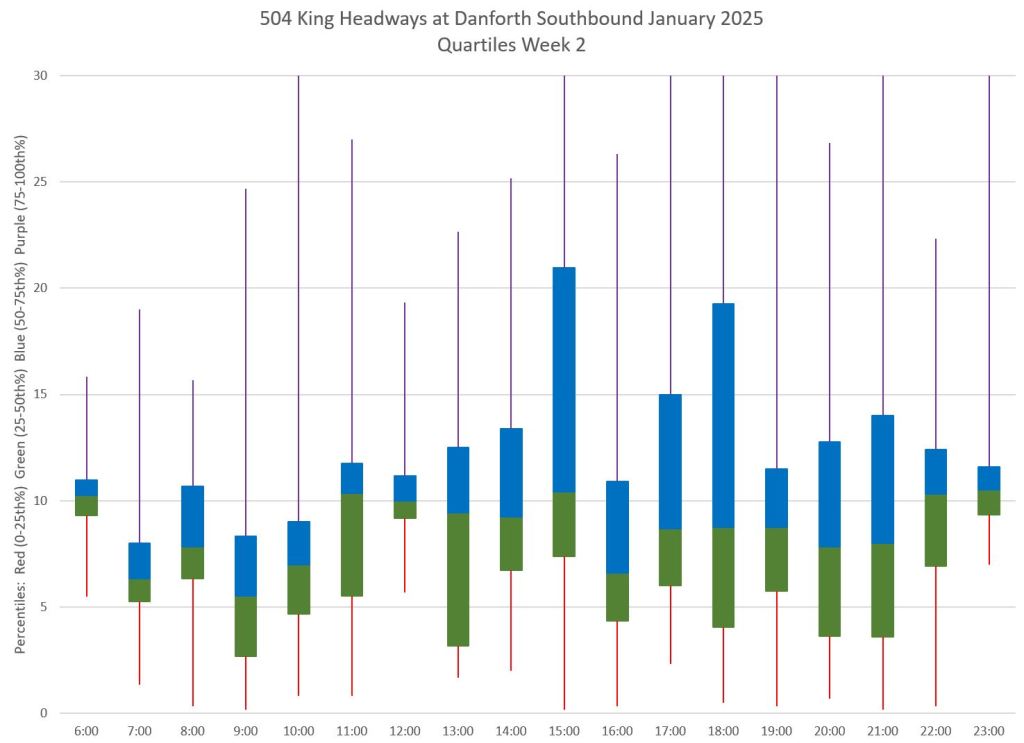
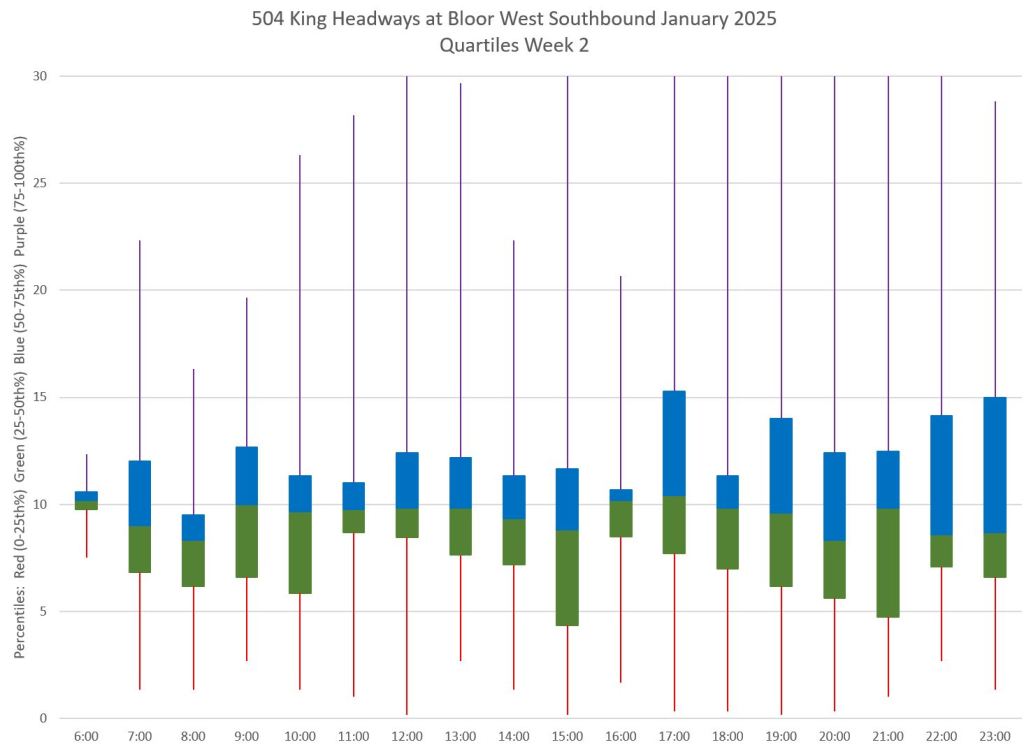
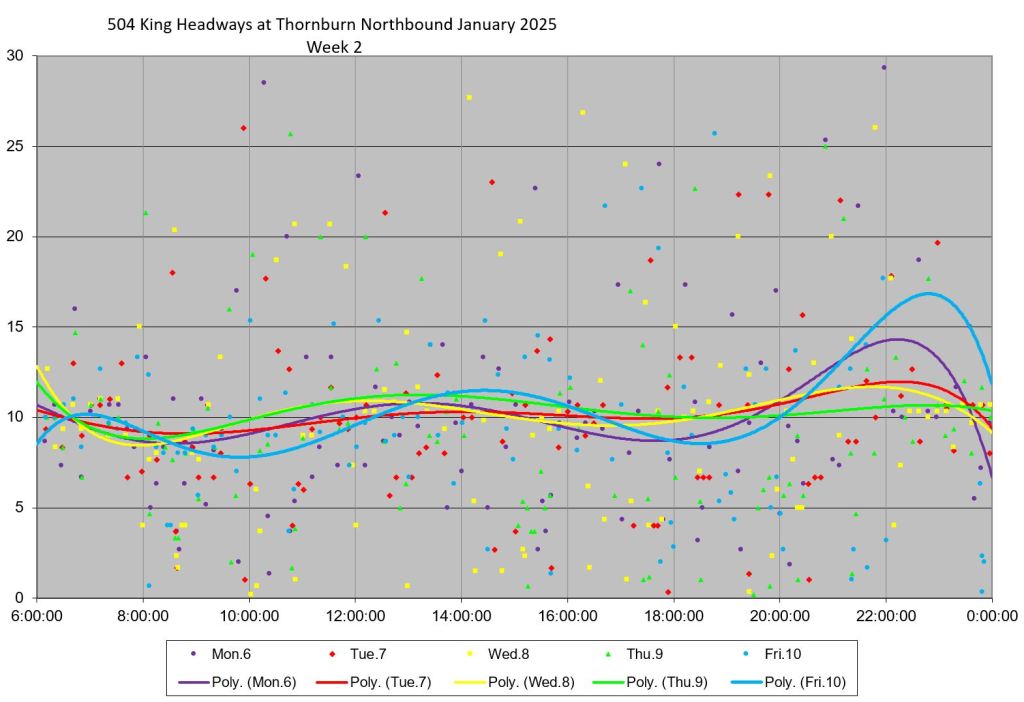
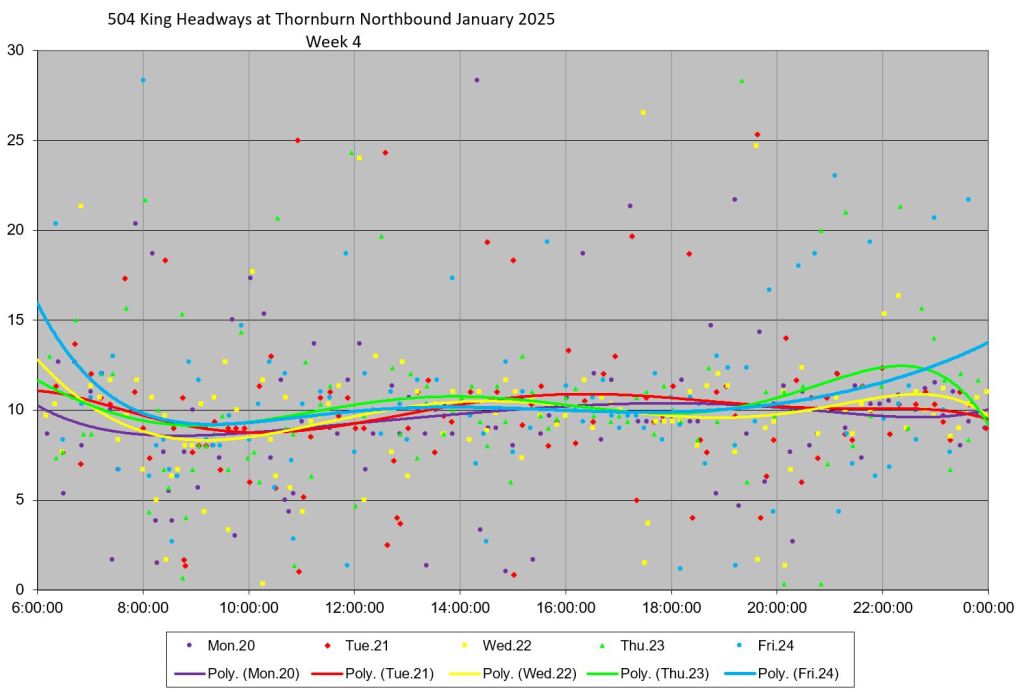
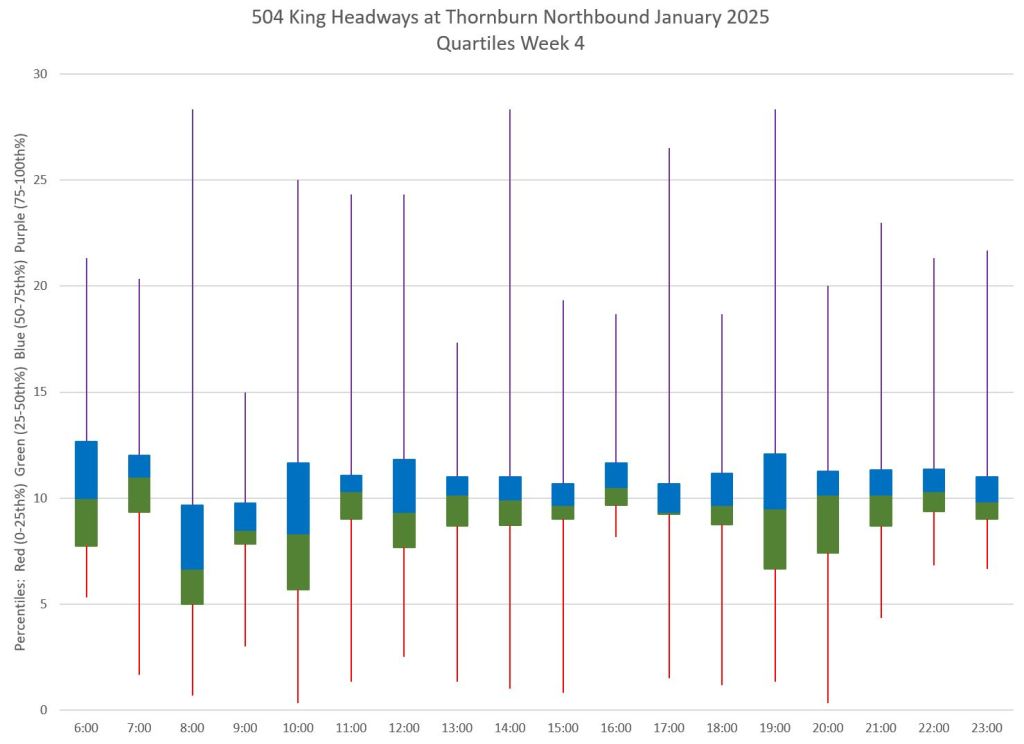
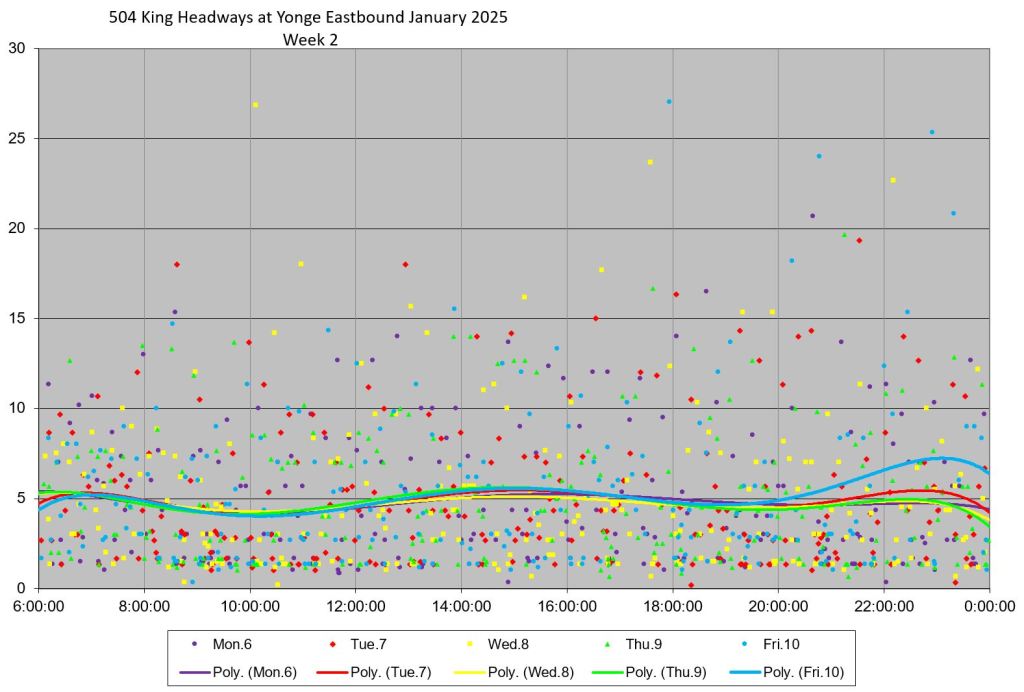
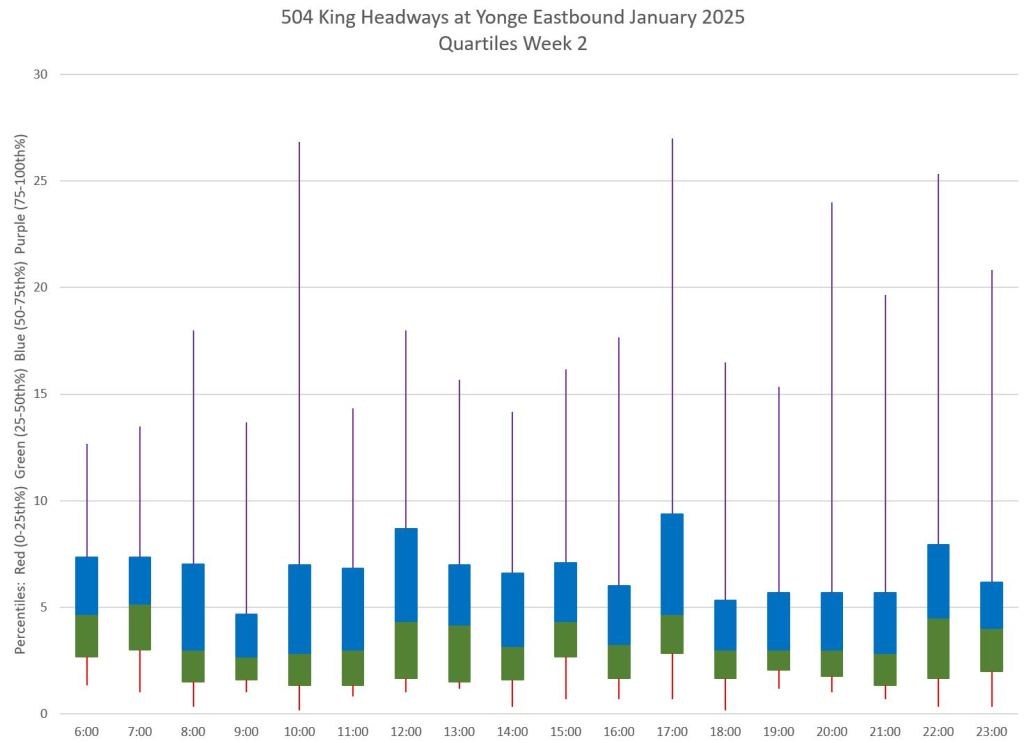
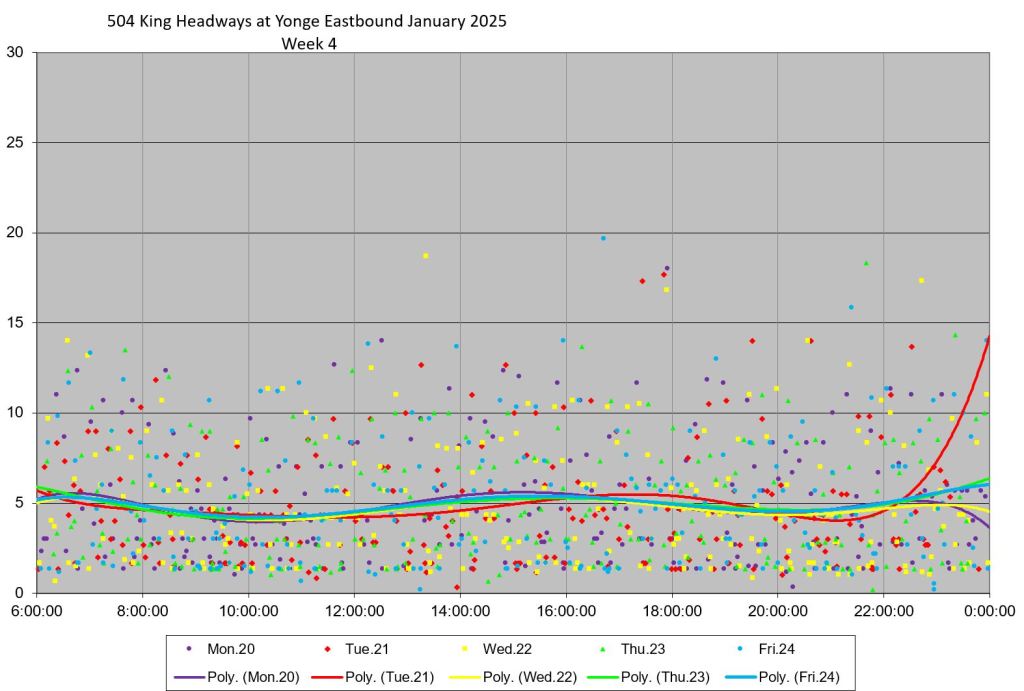
The charts below show detailed headway data (left) and hourly quartiles (right) for weeks 2 and 4. Service was somewhat better behaved in week 4, although still not ideal.
The lines on the detailed headway charts are trend lines, not averages, showing the overall behaviour of the headways for each day through the cloud of data points for the week. On the right, the data are presented as quartiles with the central boxes (blue and green) holding the 2nd and 3rd quartiles (half of the service). The boundary between the boxes is the median (not the average) value, and the tails show the range of the 1st and 4th quartiles (the other half of the service). Simply put, half of the time a rider would experience a headway within the central block, and half of the time a headway below or above that.
From a point of view of affected riders, the longer headways will affect more people because more will accumulate in a wide gap. Vehicles will also be more crowded. The TTC does not yet publish crowding levels for streetcars, but the problem of crowded buses after gaps is easily demonstrated in tracking data as well as daily rider experience.
Where the 4th quartile tails (purple) in the charts hit the 30 minute line, there are actually data points above that level which are not shown. For example, the highest value in week 2 was 52 minutes.



Headways at Distillery Loop
At Distillery Loop, the situation was comparable to that at Broadview & Danforth. Although the average headways mostly follow the scheduled frequencies, the standard deviation values are high indicating a wide range of individual values.
The screenline for these headways is at Mill Street just north of the loop.
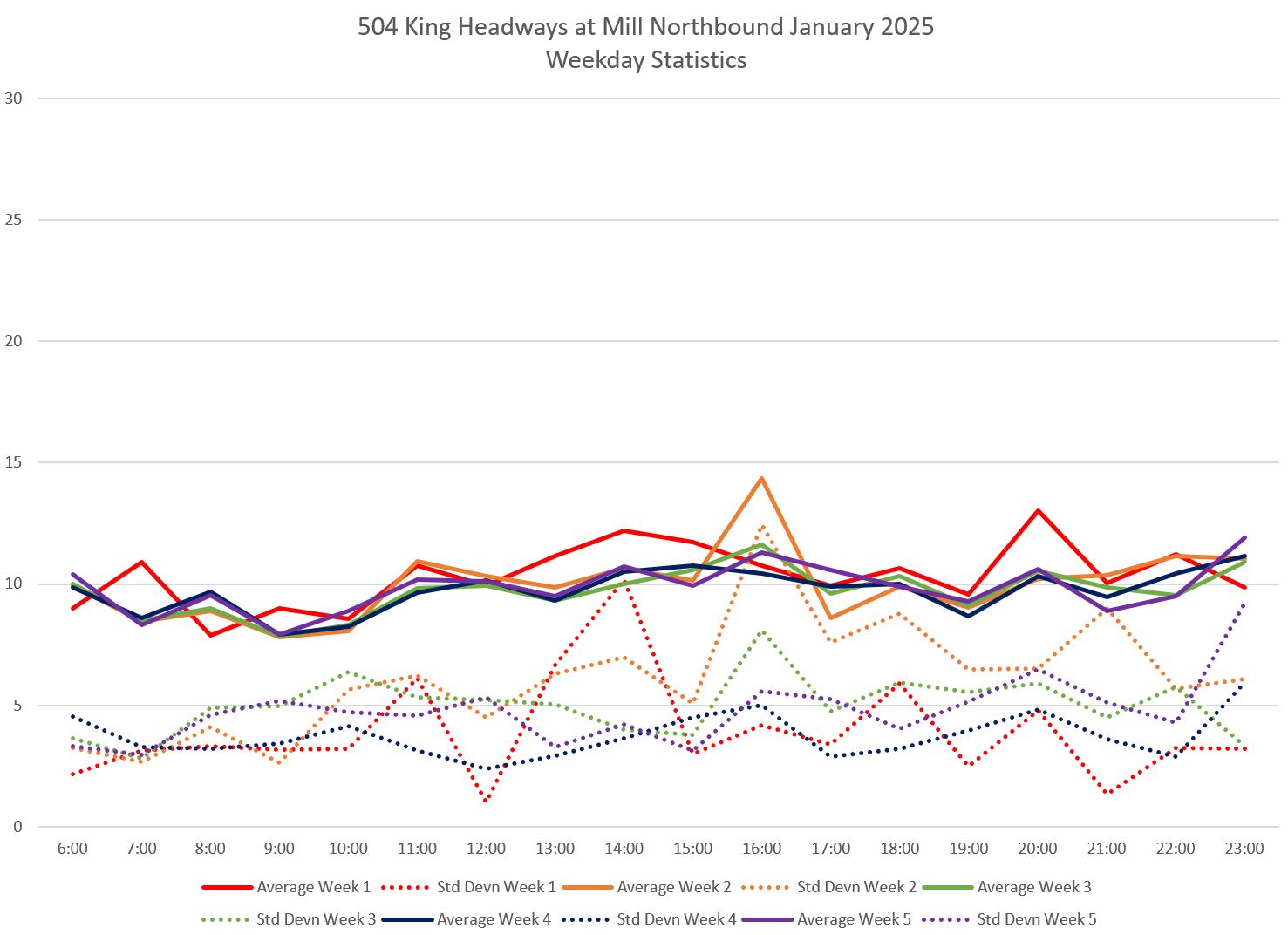
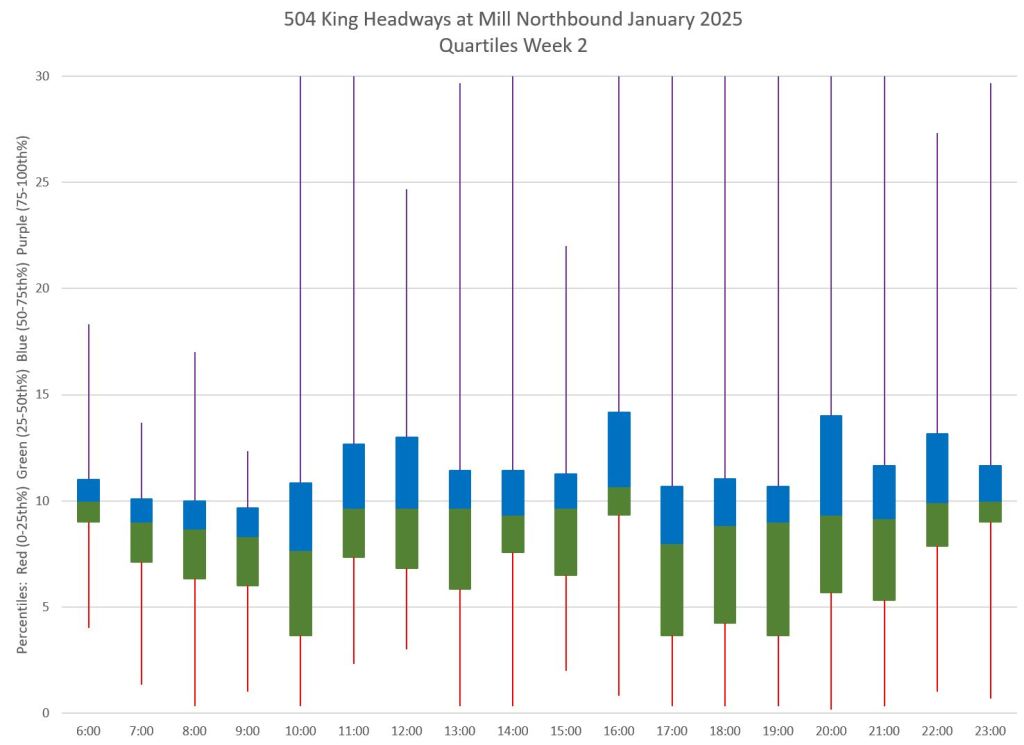
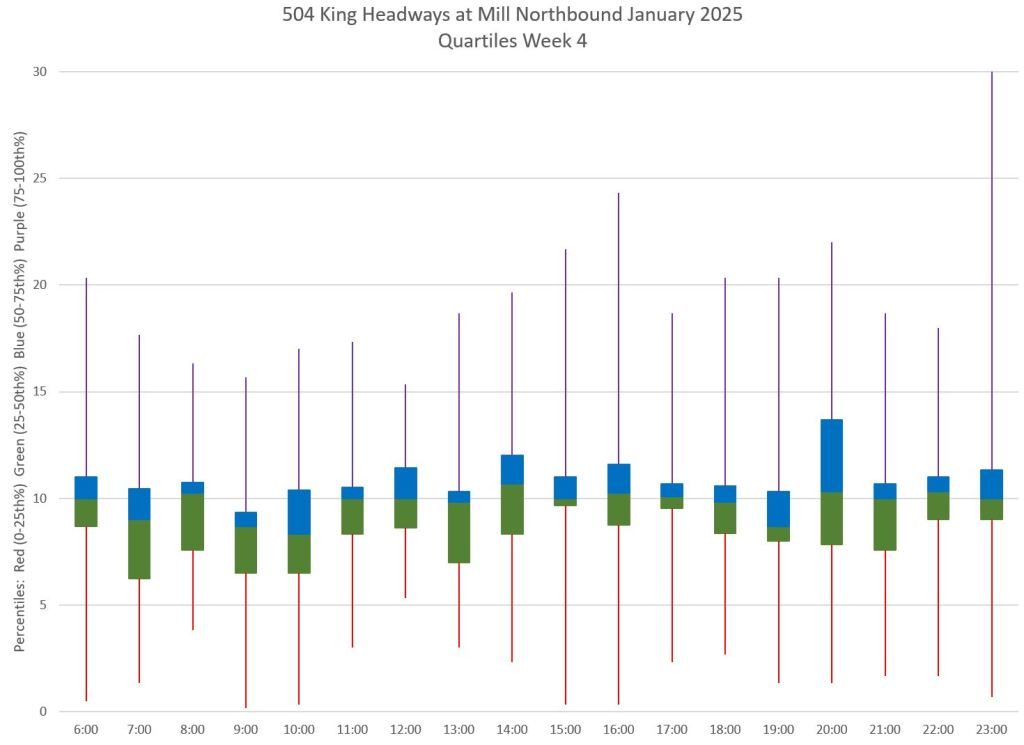
As at Danforth, week 4 is better behaved with fewer wide gaps or bunched cars. The boxes holding the 2nd and 3rd quartiles are smaller, but the other half of the service still extends over a fair range.
The week 2 data include many hours where the 4th quartiles extend beyond the 30 minute line.


Combined Service Westbound at Parliament
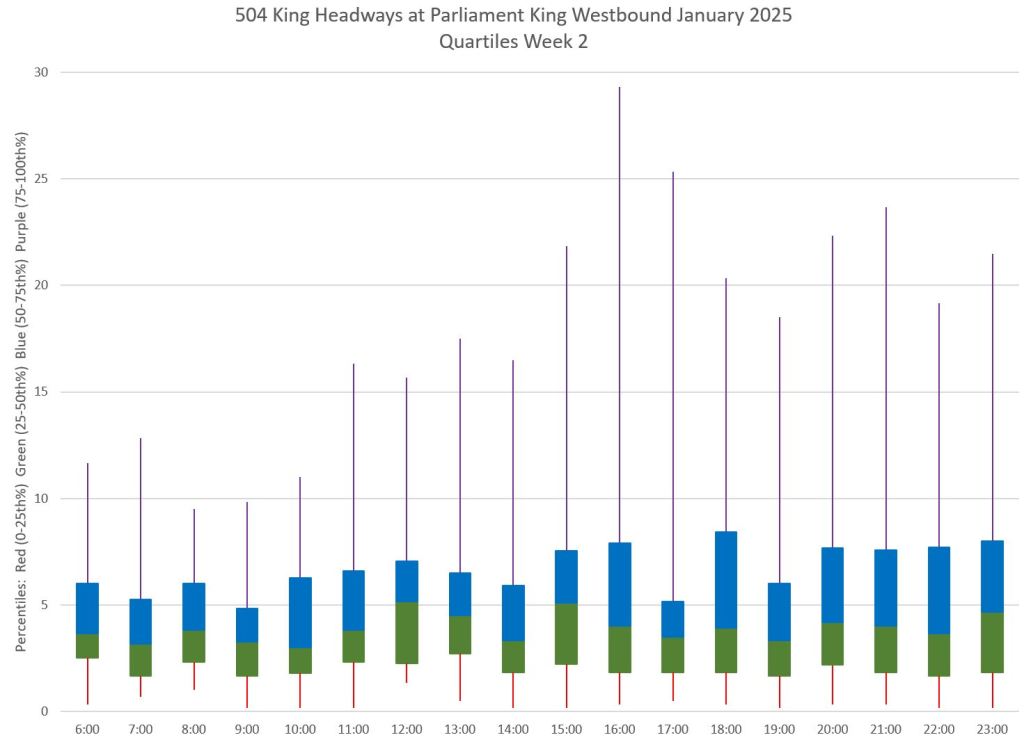
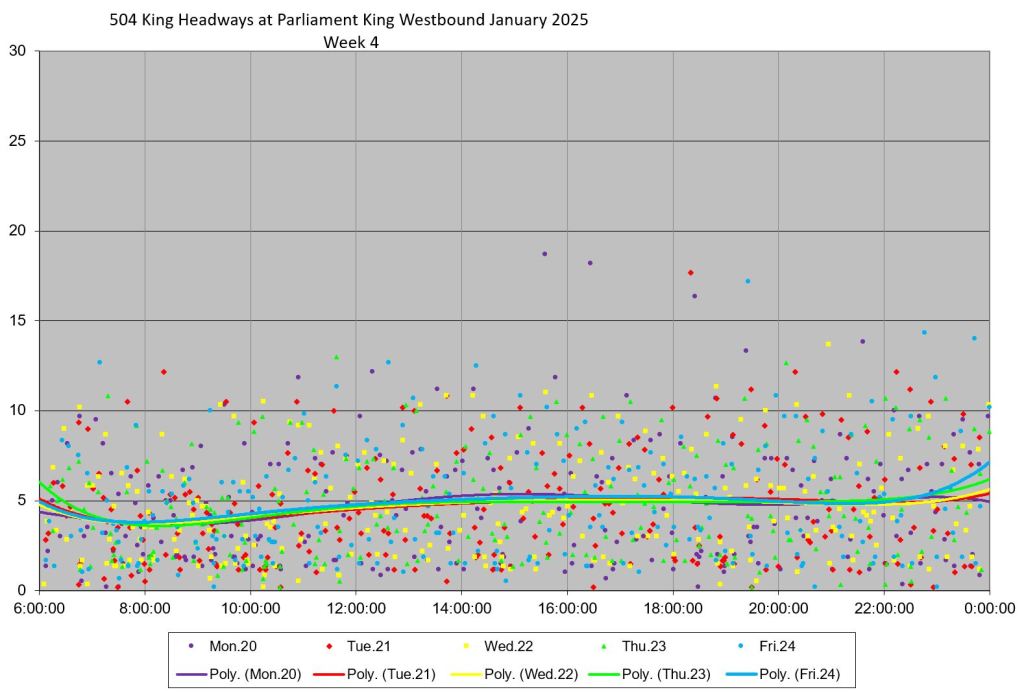
To little surprise, the combination of two erratic services merging at King & Sumach does not produce an even headway. The average headway is close to the scheduled value (4 minutes AM peak, 5 minutes otherwise), but with the standard deviation being close to the average, this indicates a lot of bunching.

The majority of the data points lie in the range of 0-10 minutes, and on a 5 minute headway, the target range is 2.5-7.5 minutes. Therefore, a lot of this service is “on time”, although riders might not agree. This is especially true for riders whose destinations lie beyond the common portion of the route and who face a wider variation in headways for their service. The blending of “A” and “B” cars at Sumach westbound and Dufferin eastbound is not as even as the schedule implies as we will see later in this article.


Combined Service Westbound at Yonge
The service at Yonge is similar to that at Parliament, but slightly more bunched as pairs of cars catch up enroute (the standard deviation lines lie slightly closer to the averages here).
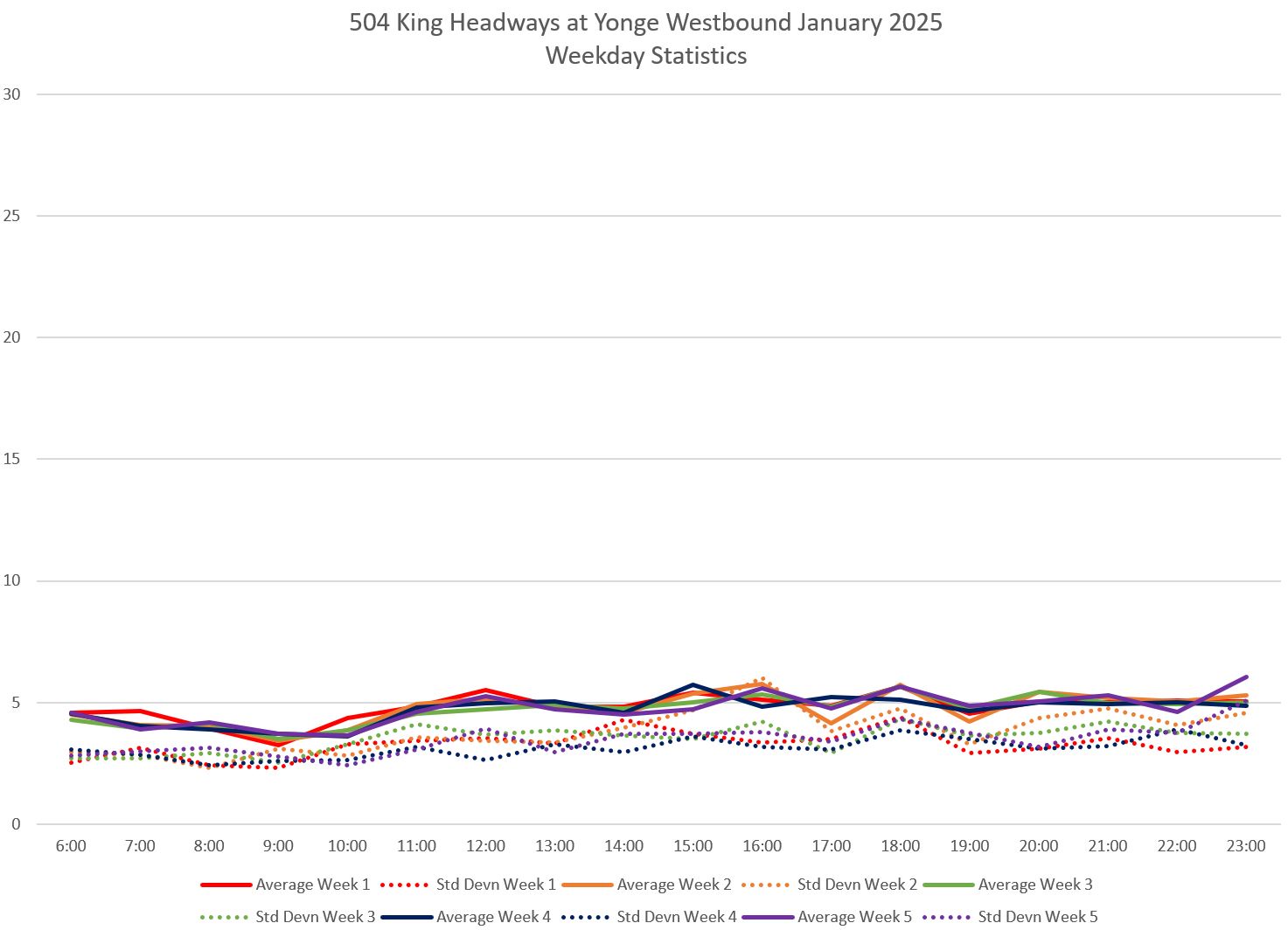
Headways measured at Yonge lie in bands because they are regulated by the traffic signals, and streetcars are often held waiting for the preceding car to move off from the farside stop. With the screenline in the middle of the intersection, cars tend to cross at the beginning of a green phase, not randomly as at Parliament.


Headways at Dundas West Station
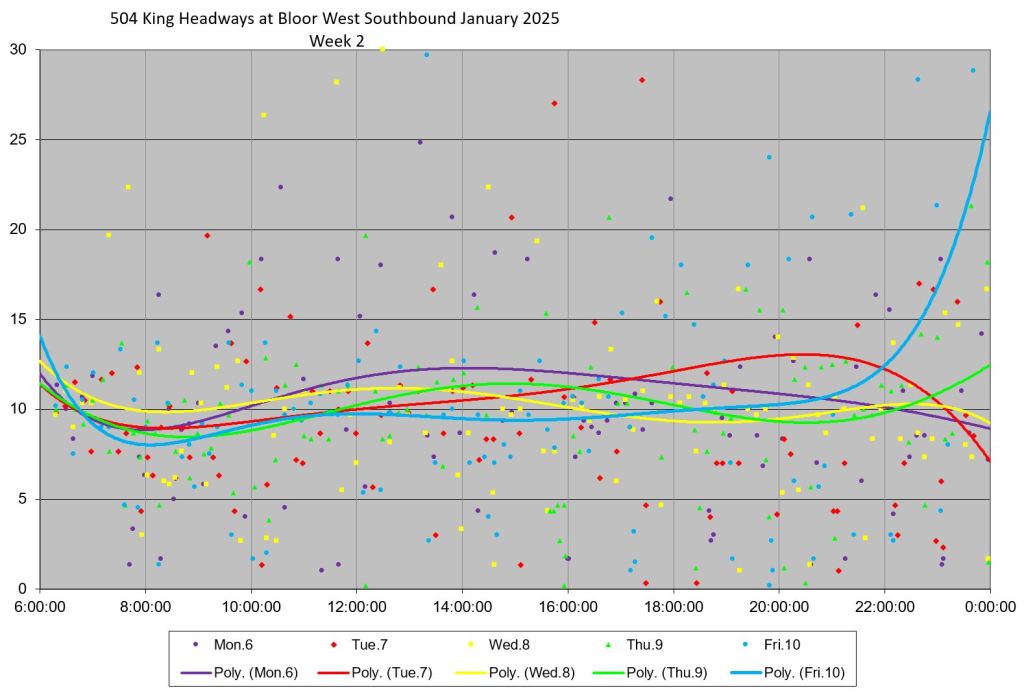
Service at Dundas West Station shows a similar pattern to Broadview Station. Average headways are slightly above the scheduled value thanks to short turns, and the standard deviation in values is quite high showing erratic service particularly in the afternoon and evening.
The screenline here is in the middle of Bloor Street and the charts represent service southbound to Roncesvalles after it is clear of whatever congestion occurs just outside of the loop.

Week 2 includes many hours with headways above 30 minutes.


Headways at Dufferin Loop
Dufferin Loop mirrors Dundas West Station with uneven headways. The screenline is at Thornburn, just north of the loop.

As at other locations, headways above 30 minutes were recorded in week 2.

Combined Service Eastbound at Yonge
(I have omitted charts for combined service east of Dufferin, but they are similar to the charts shown for Parliament Street westbound.)
Service eastbound at Yonge is similar to westbound. The standard deviation value lies close to the average headway indicating a lot of bunched service.
The spread of data points in week 2 is a bit larger than in week 4, but the pattern is similar. Note that the median value (the boundary between the green 2nd quartile and the blue 3rd quartile) often lies below the scheduled 5 minute level. This indicates that short headways are common enough to pull the median below the average.

Service Reliability From a Rider’s Point-of-View
Although the charts above give a picture of the overall performance of the route with the clouds of data points and the statistical breakdown, they do not show service as it is experienced on the ground.
Looking at Individual Days in Detail
The next set of charts shows the service both ways from Yonge Street for individual days, as well as the detailed tracking charts showing vehicle movements.
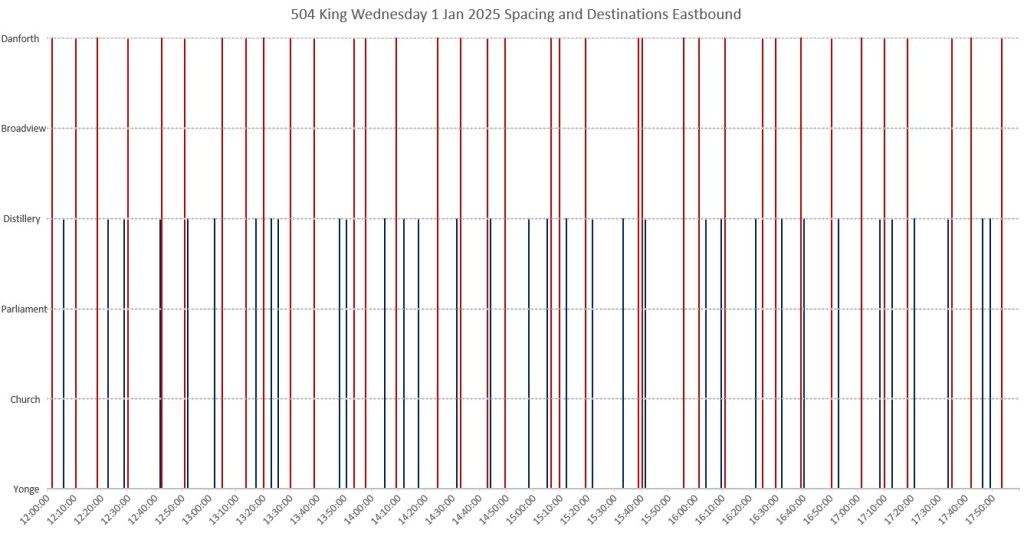
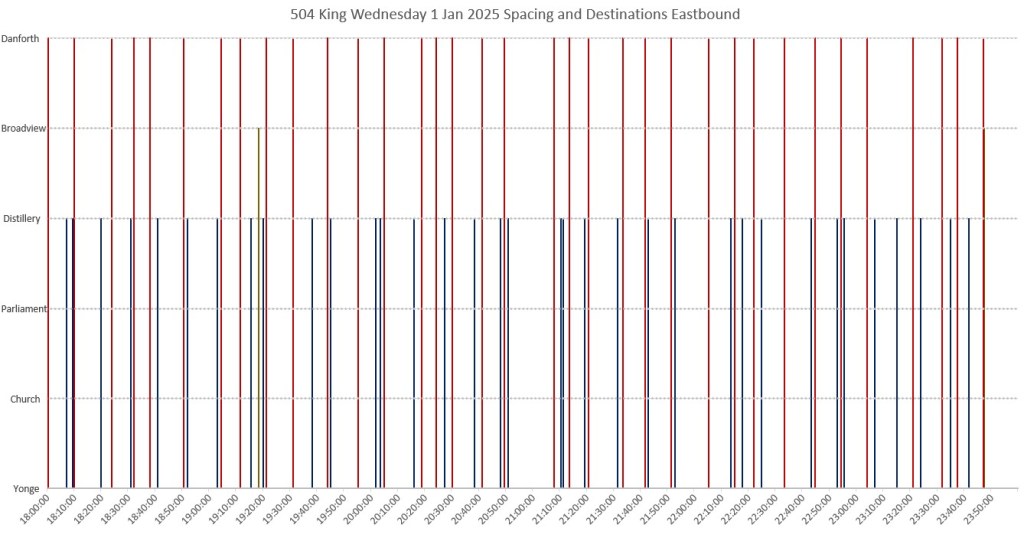
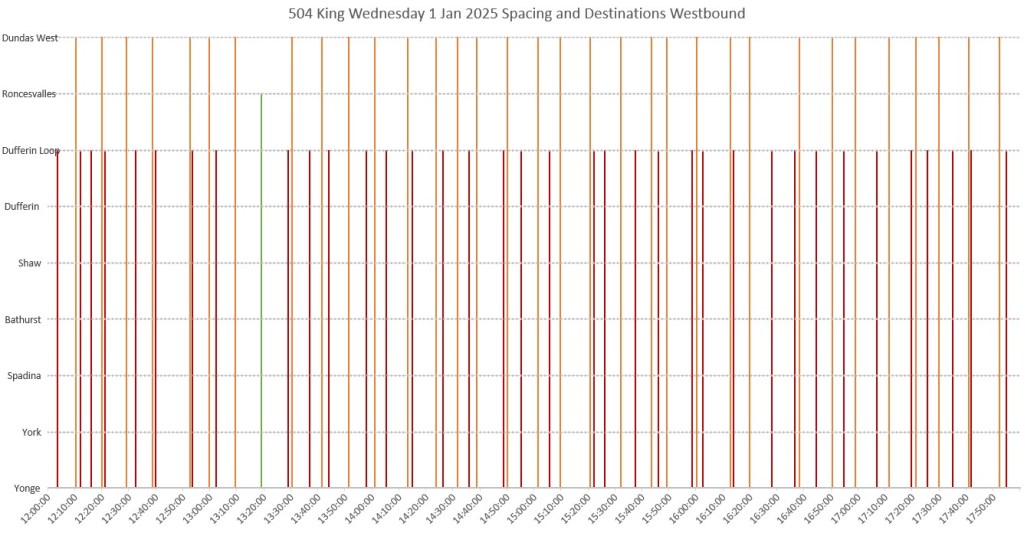
Although there were some severe delays on a few of the days detailed here, the common factor is that even under “normal” circumstances, King cars run in bunches, most commonly with a 504A and 504B following each other over the common section of the route. This occurs even on New Year’s Day when there are modest passenger loads and no competing traffic or roadworks.
This bunching has nothing to do with transit priority schemes, and is simply the result of the two branches running independently and on unregulated headways.
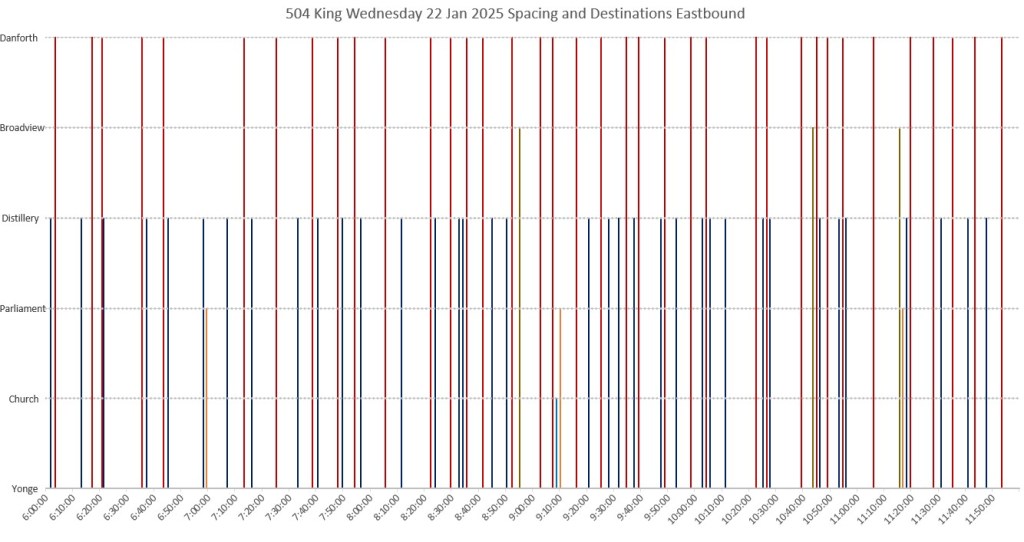
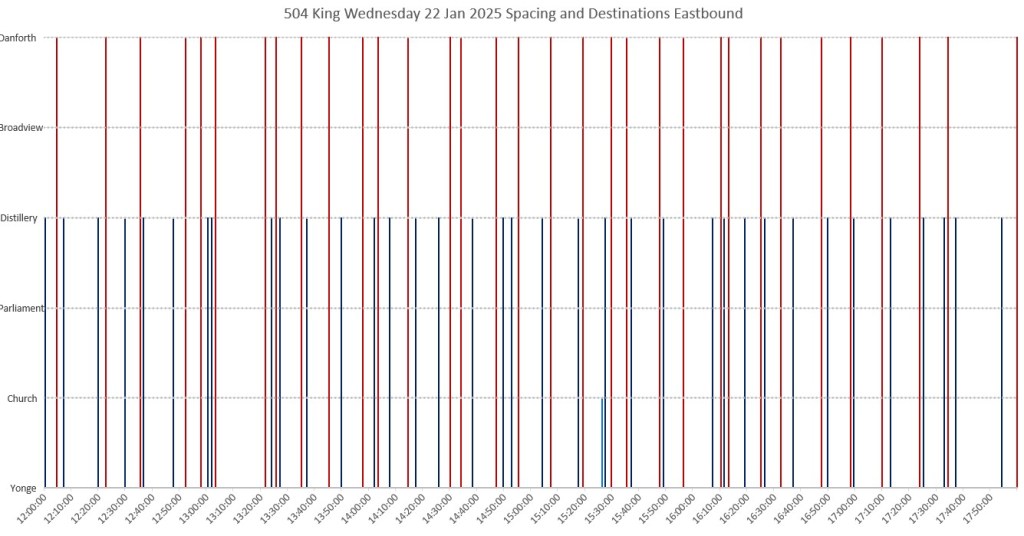
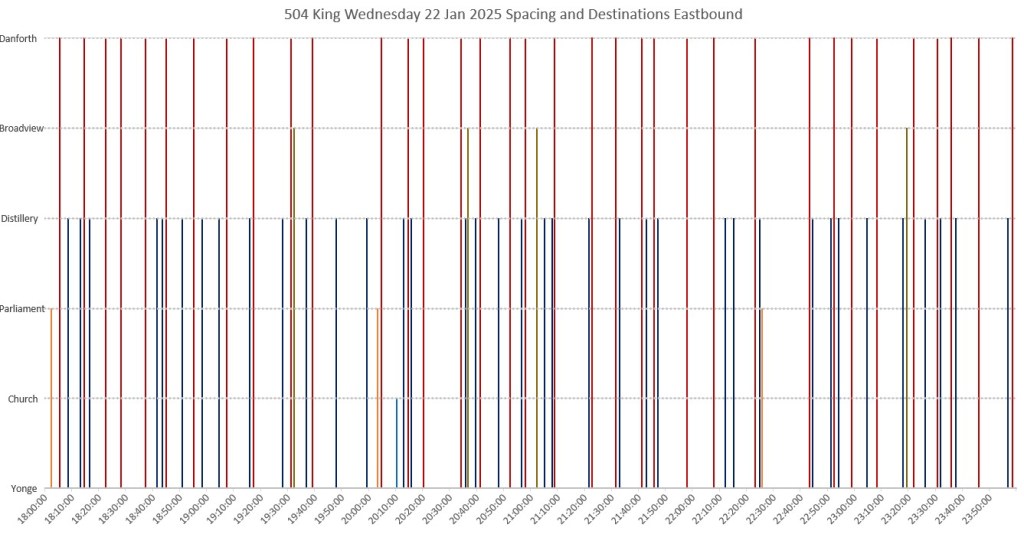
Wednesday, January 22
January 22 was a day with comparatively well-behaved service, and I have included it to show a “normal” day. Other days were not so lucky for various reasons.
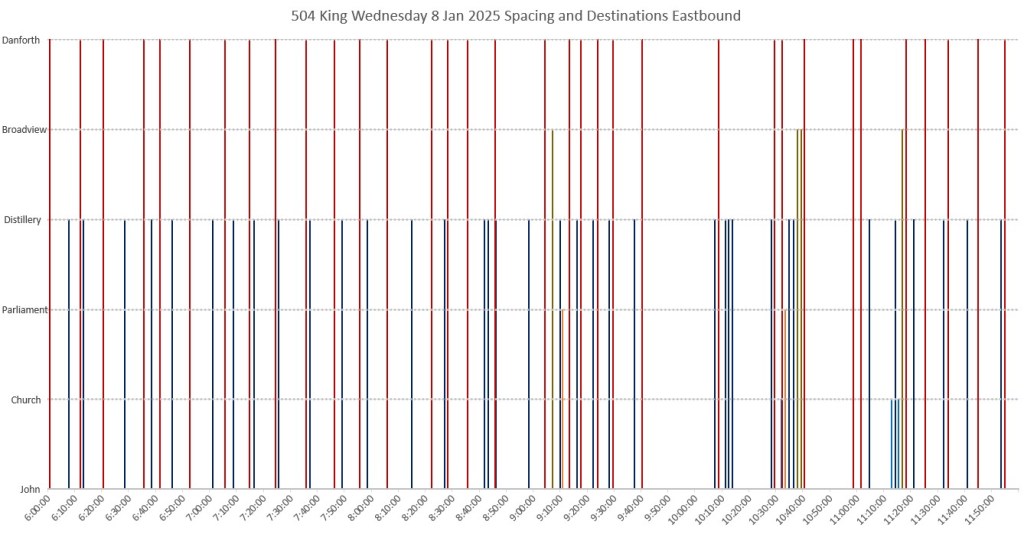
Eastbound
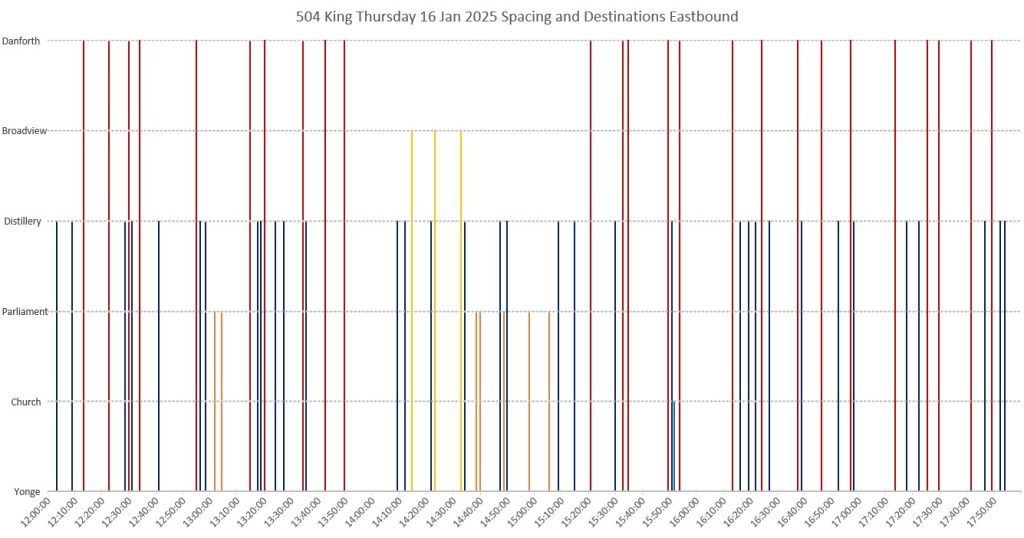
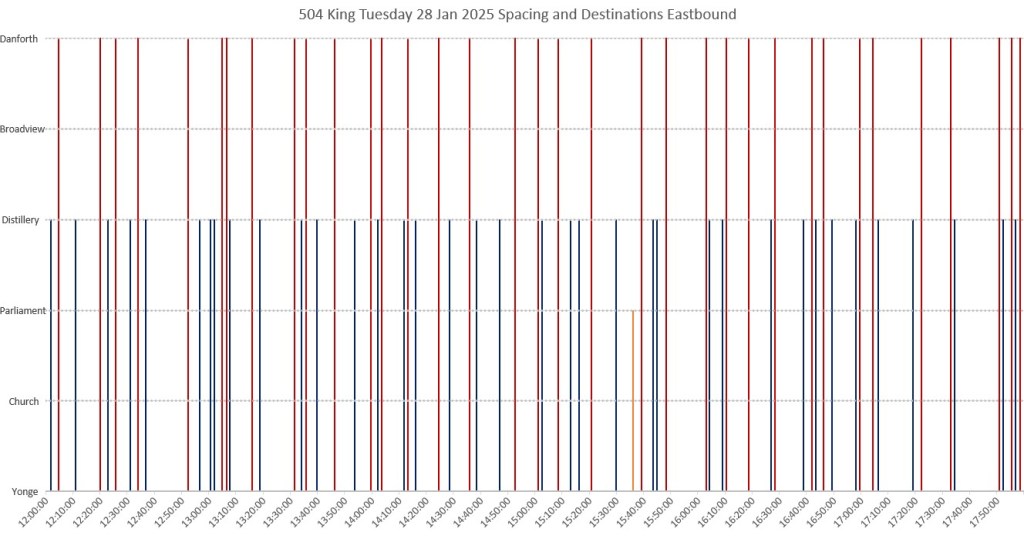
Reading the charts:
- Each column represents one trip leaving Yonge Street eastbound at the time shown on the x-axis.
- The height of the column indicates the eventual destination of the car. These are arranged in increasing distance from Yonge, but they are not to scale.
- The primary destinations are Danforth (504B service) and the Distillery (504A), but some cars leave the route at other locations including:
- Church Street: Likely a short turn
- Parliament Street: Likely a short turn
- Broadview Avenue: A short turn or a car running back to Leslie Barns.
- The horizontal spacing of the bars shows how service does not operate on a regular headway. Note in particular the prevalence of closely-spaced trips to Broadview/Danforth and to the Distillery
Westbound
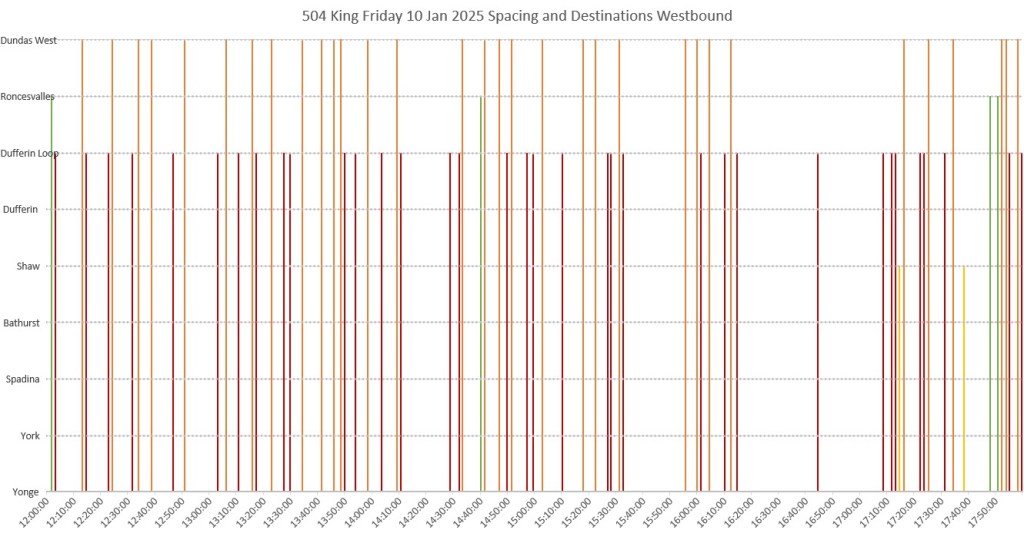
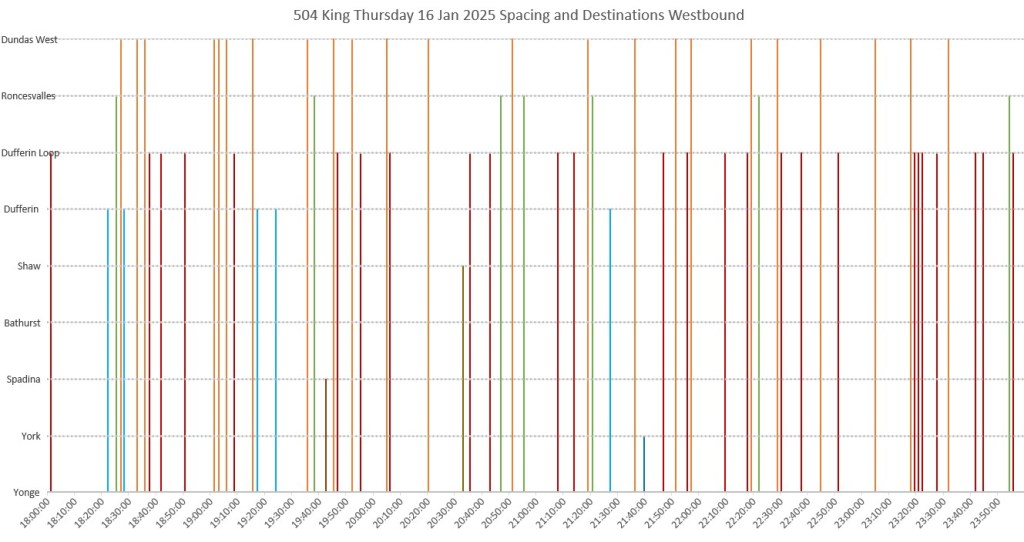
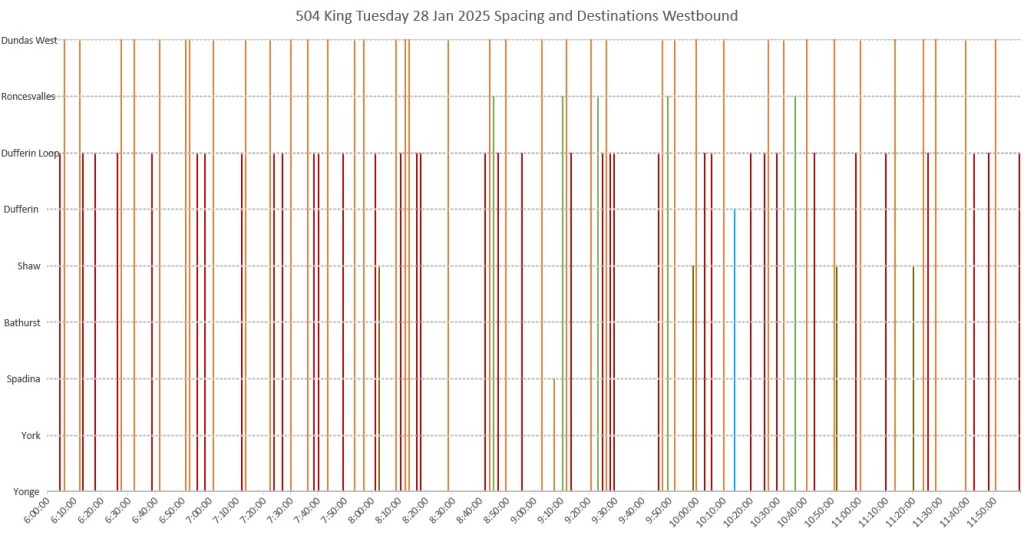
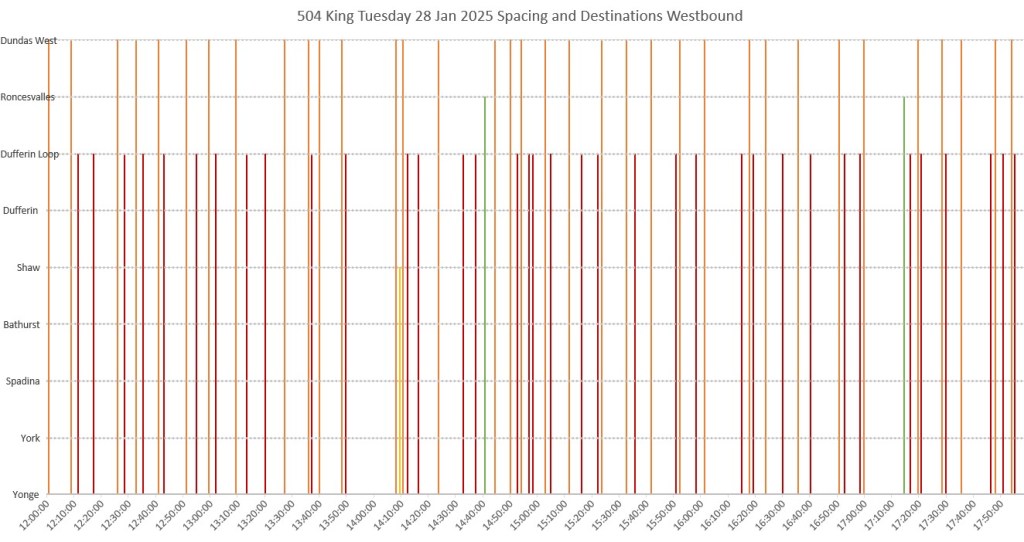
The charts below show comparable data for westbound service from Yonge. As with the eastbound service, note the clustering of columns showing the bunching and gaps between vehicles as well as the larger gaps to specific destinations.
Most cars are bound for Dundas West Station (504A) or Dufferin Loop (504B), but other destinations are possible:
- York Street: A likely short turn via York, Adelaide and Church.
- Spadina: A likely short turn via Charlotte Loop (Spadina, Adelaide, Charlotte).
- Bathurst: A likely short turn south to Fleet Loop or north to Wolseley Loop.
- Shaw: A likely short turn or diversion to Queen.
- Dufferin: A short turn via Dufferin, Queen and Shaw.
- Roncesvalles: A short turn or a carhouse trip.


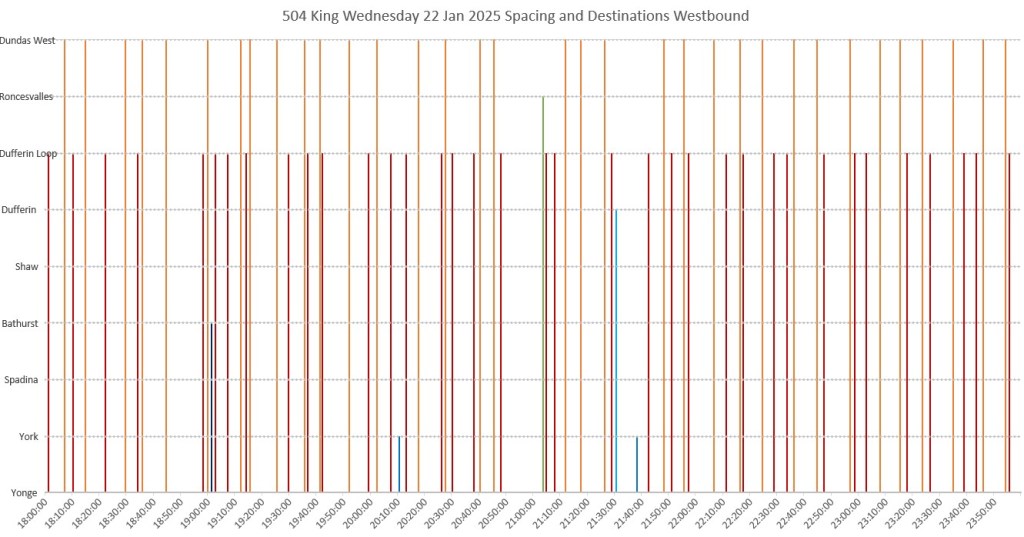
In either direction, riders who are bound for a point before the 504A/B branches split (Sumach to Dufferin) can use almost any car, but they do not generally see the advertised 5-minute headway for the combined service.
Riders bound specifically to one branch must await the correct car, and these do not always arrive reliably every 10 minutes. When cars are bunched, the second (or more) to the same destination is of little benefit. When two cars arrive together, they represent a 20-minute gap in service, well beyond the supposed “10 minute network” of which 504 King is part.
Wednesday, January 8
On January 8, service was disrupted mid-morning, but otherwise there were no significant events. Even so, service was irregular with bunching and gaps through to late evening.
Eastbound


Westbound


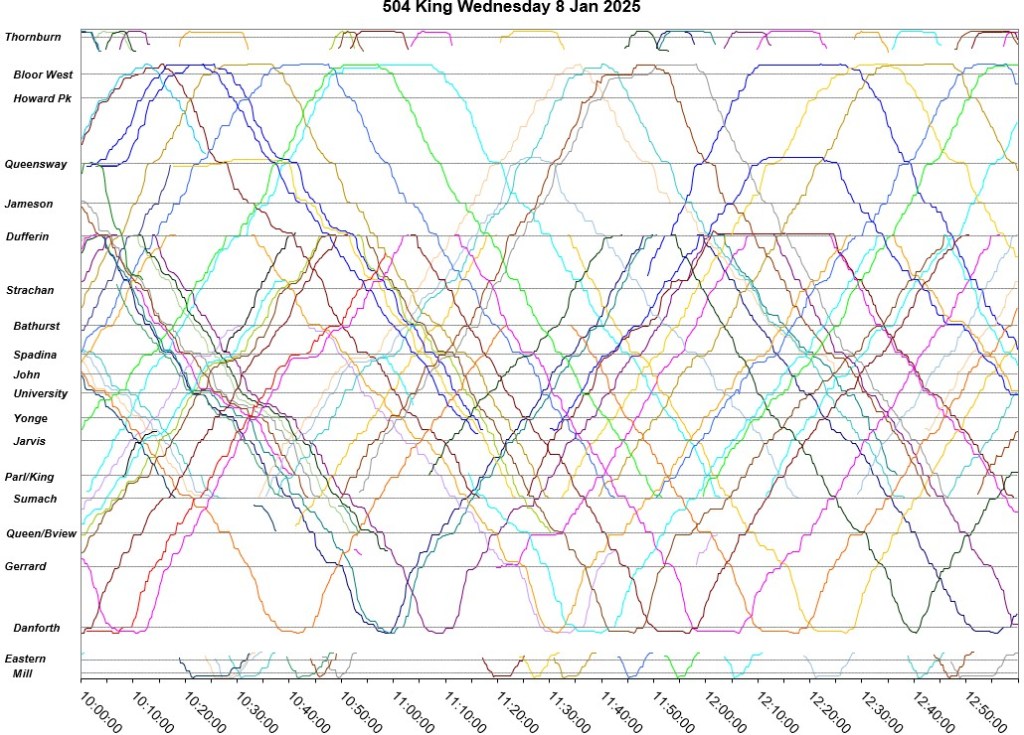
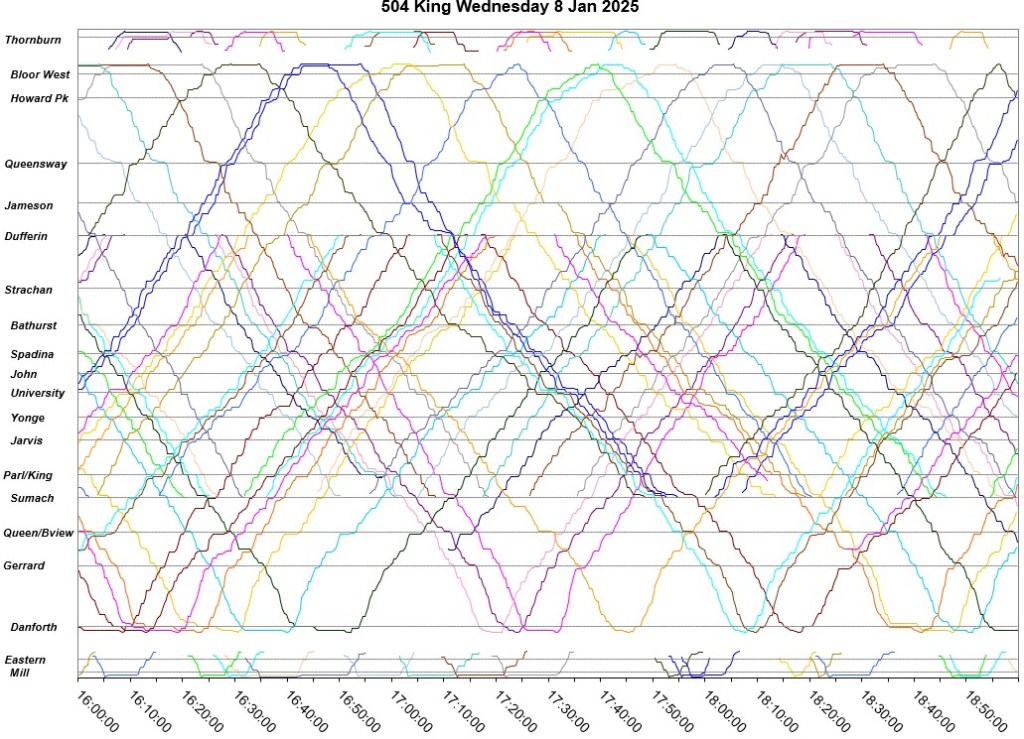
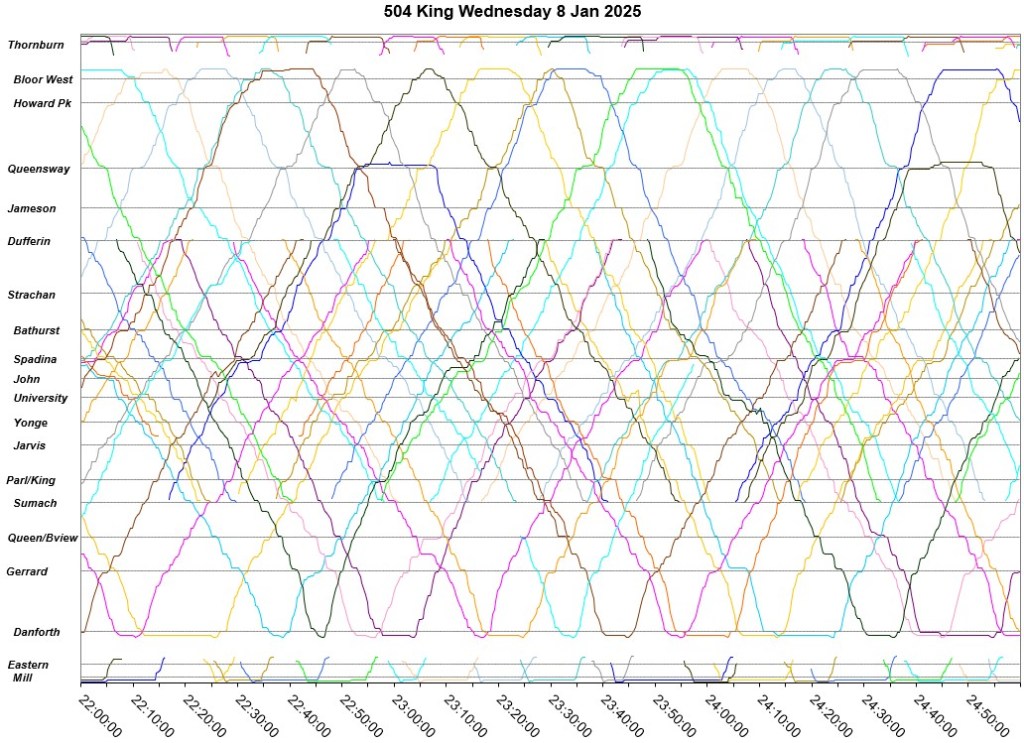
The detailed charts tracking cars on January 8 are below.
Operation of the west end of 504 King was disrupted between roughly 9:30 and 11:00 am by “police activity” according to the alert issued at the time. Some cars were delayed (horizontal lines on the top left chart below) and some diverted via Shaw and Queen Streets. There was a wide gap in service to Dundas West Station.
For the remainder of the day service remained somewhat disorganized with groups of cars running together rather than being evenly spaced. Uneven service persisted into the late evening. There is minor congestion westbound at Spadina during some periods (this is seen on several days), but no pervasive problem that would explain the bunched service.
Of particular concern are groups of cars that stay together even after reaching a terminal where they could have been spaced before departure.
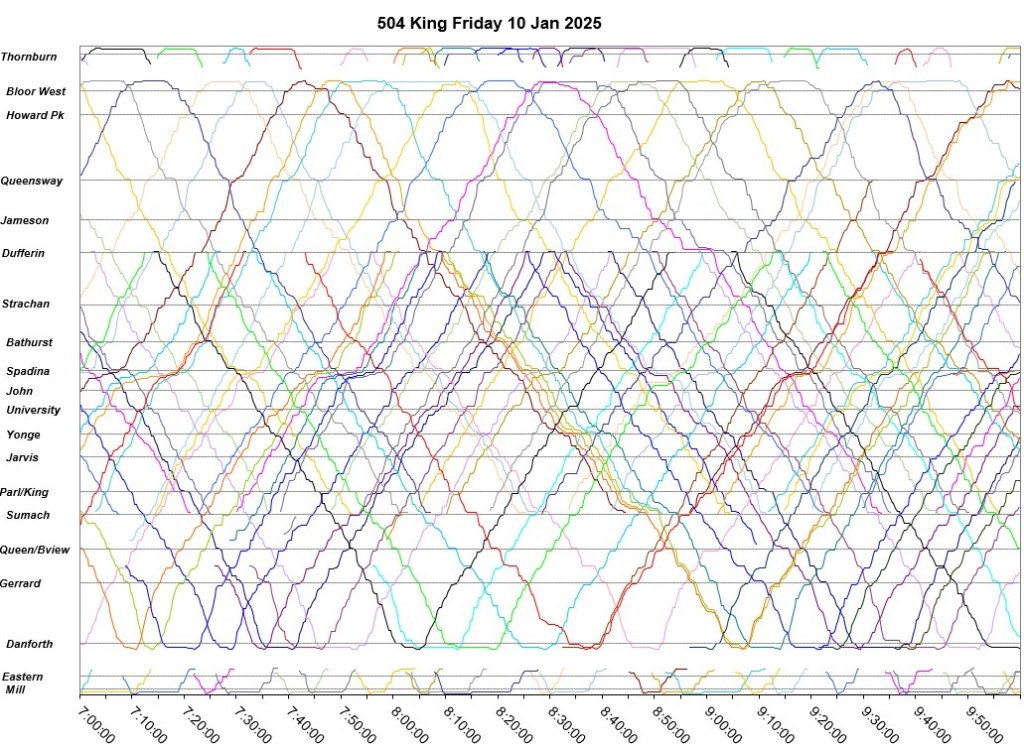
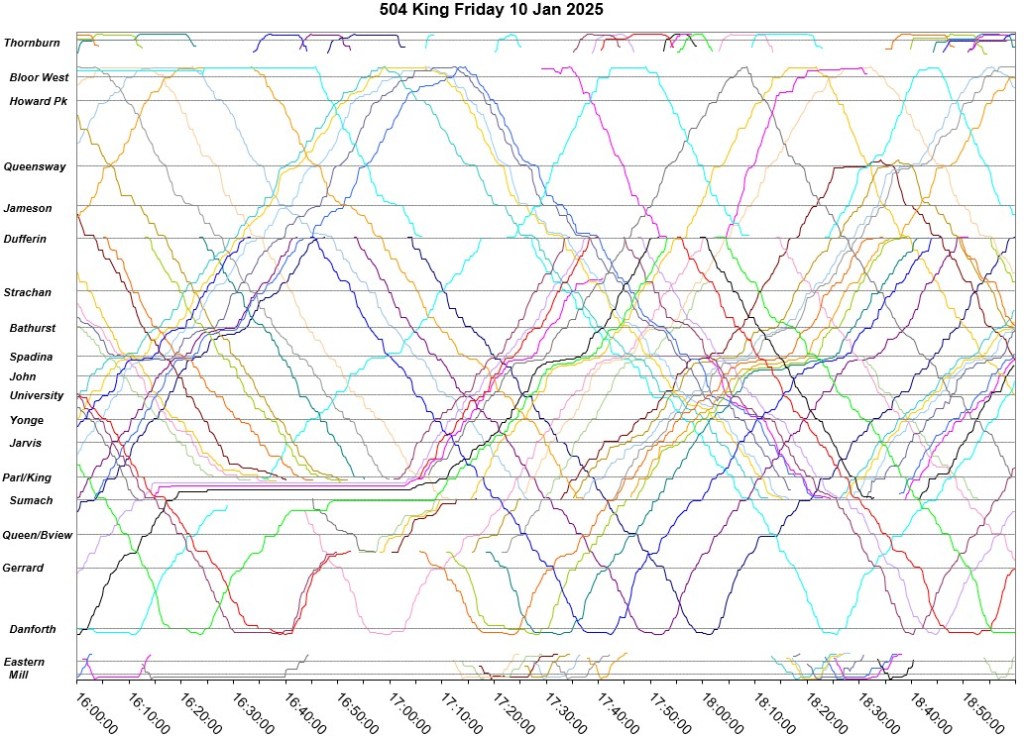
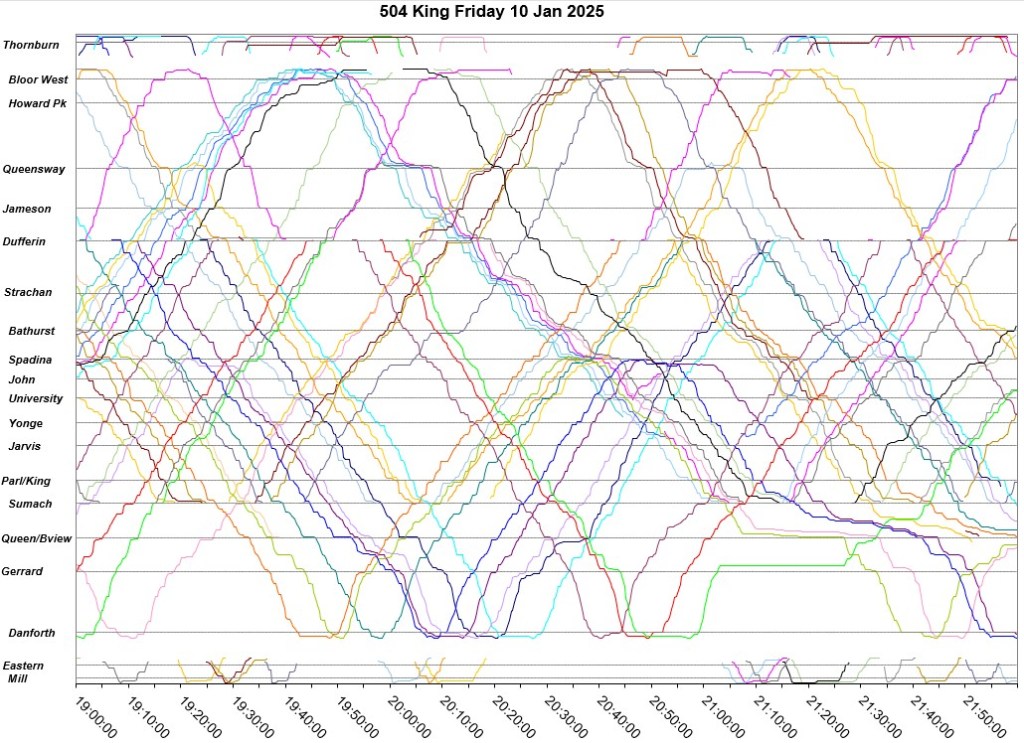
Reading these charts:
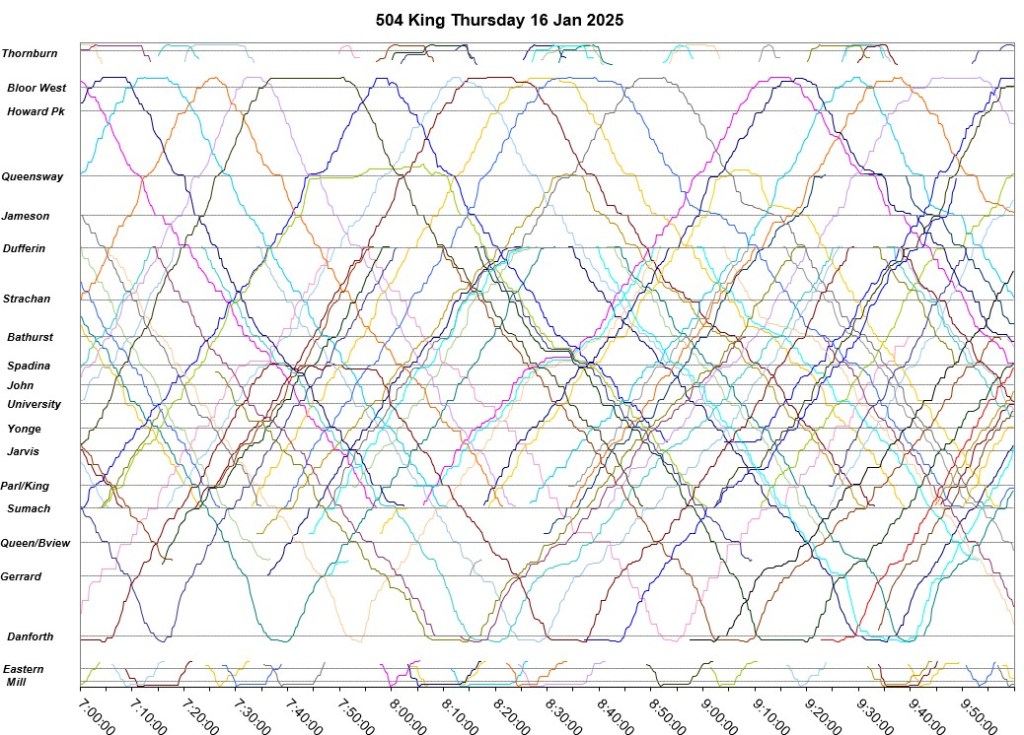
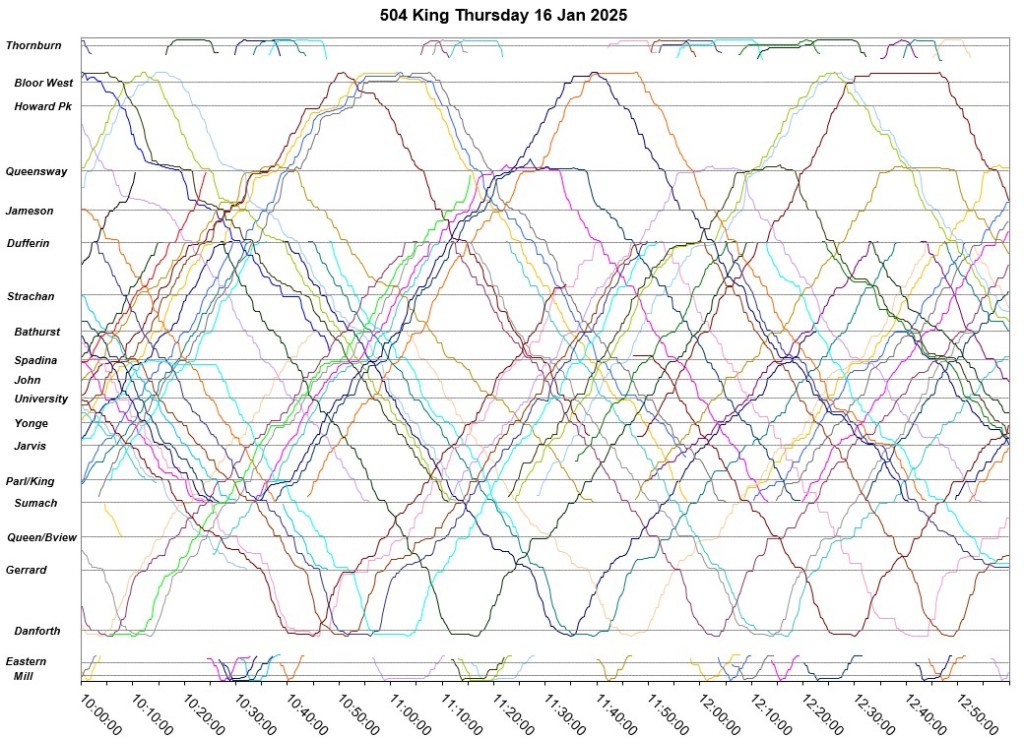
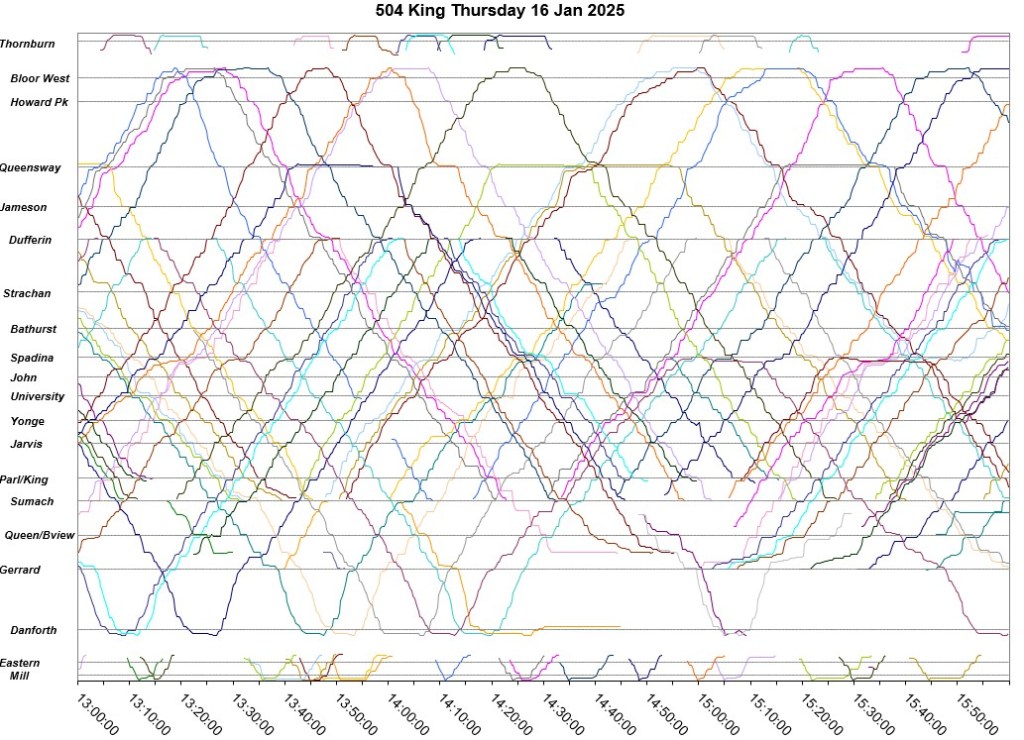
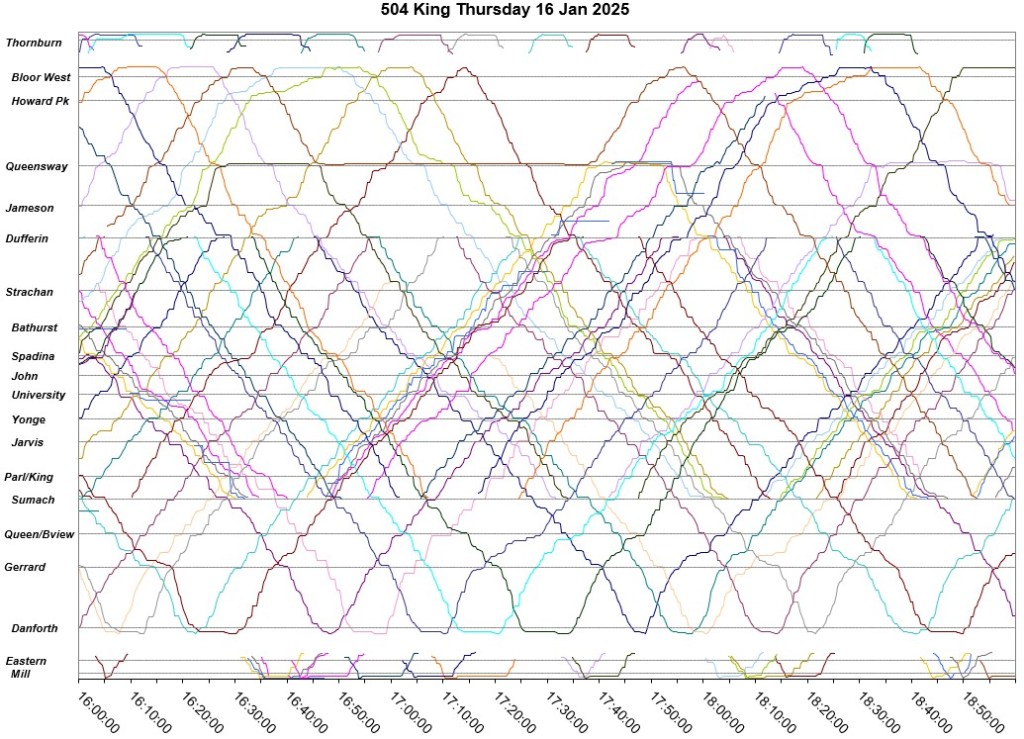
- Each line on the chart represents one streetcar. Distance is measured vertically with the western termini at the top and the eastern termini at the bottom. The Dufferin and Sumach/Cheery segments are broken off on their own.
- Where a line ends westbound at Dufferin, it usually continues in the separate segment at the top of the chart for the trip south to Dufferin Loop. The reverse occurs north/eastbound. This scheme is used for trips to Distillery Loop at the bottom of the charts.
- The duration of terminal layovers is seen in the length of horizontal lines at those locations.
- There is little indication of traffic congestion. This typically shows up as lines that become more horizontal approaching an intersection. Examples are westbound at Spadina and at Bathurst in the afternoon, but there is no pervasive slow-down on the route.



Friday, January 10
January 10 was a snow day with about 4cm beginning after 8pm, and peaking between 9 and 11pm. Service is erratic in the late evening as one would expect, but problems began mid-afternoon. Details are in the notes with the tracking chart.
Eastbound


Westbound


Tracking Chart
- As on other days, delays westbound to Spadina are common. This is sometimes due to a parade of streetcars and a limit on how many can get through the intersection to the farside stop on one signal cycle.
- Service was blocked by a collision between Sumach and Parliament both ways between about 4:15 and 5:00pm. Cars diverted via Parliament and Queen streets.
- The PM peak and early evening saw severe bunching of service, and some very wide gaps. This was compounded by …
- … a lengthy delay westbound near Spadina from roughly 10:30 to 11:20pm. The eAlert described this as “an operational problem” with no further information.
- An hour later, there was another “operational problem” with a car stopped southbound at Broadview and Queen for about one hour starting at 11:30. This blocked service both ways suggesting it was a derailment, not a disabled car.
- The delay logs for January have not yet been published for January, and so it is not yet possible to see if there is more information about these incidents.



Thursday, January 16
There was one major incident on January 16, a collision at about 2:45pm requiring a diversion via Parliament, Gerrard and Broadview. However, service was running in bunches from early in the morning through the midday, and bunching continued into the evening long after the diversion ended.
Eastbound


Westbound


Tracking Charts
These charts show extreme bunching in the mid-morning with parades of over half a dozen cars. The bunching is gradually unravelled with many short turns westbound at Sunnyside in the west, and at Parliament in the east. However, the bunches re-form and persist through the day.


Tuesday, January 28
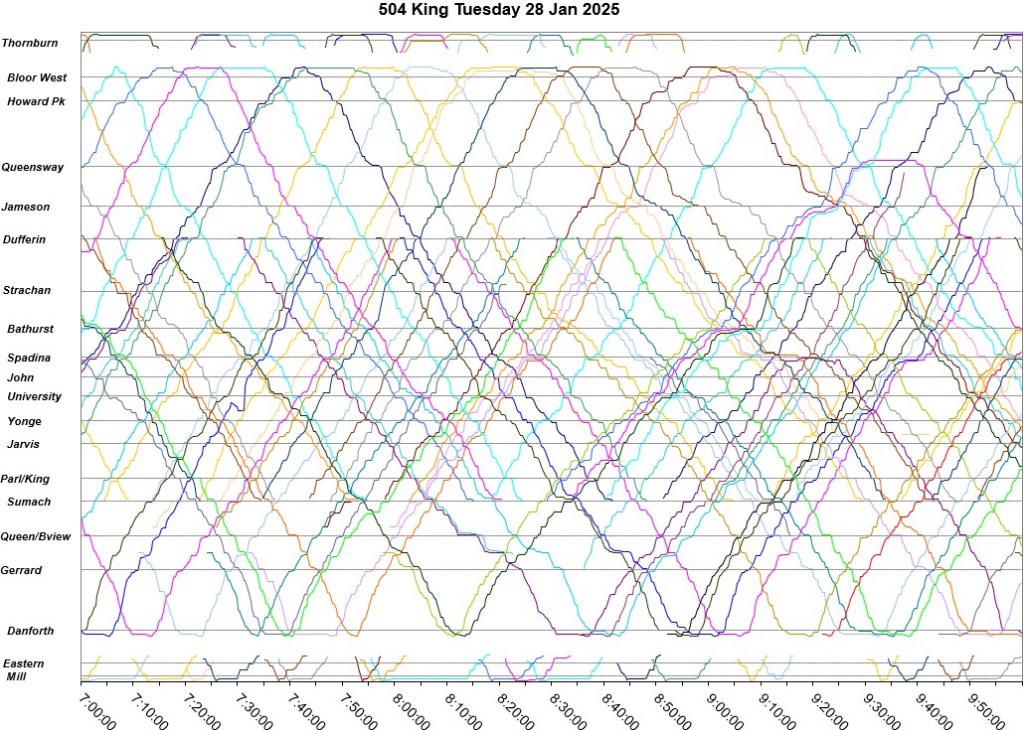
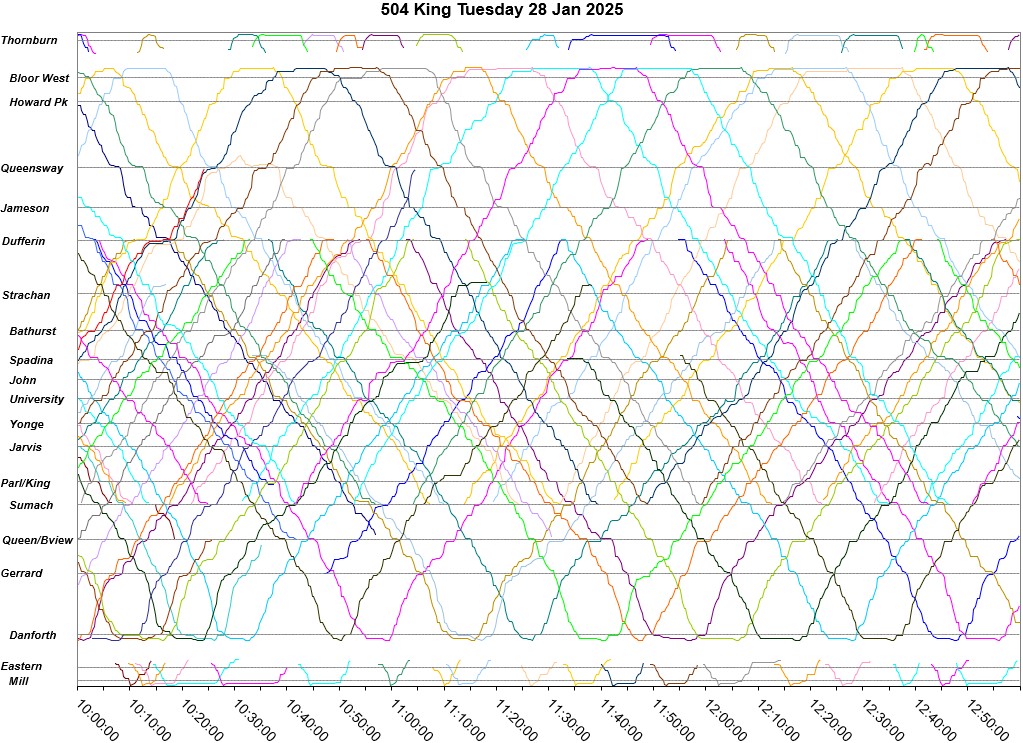
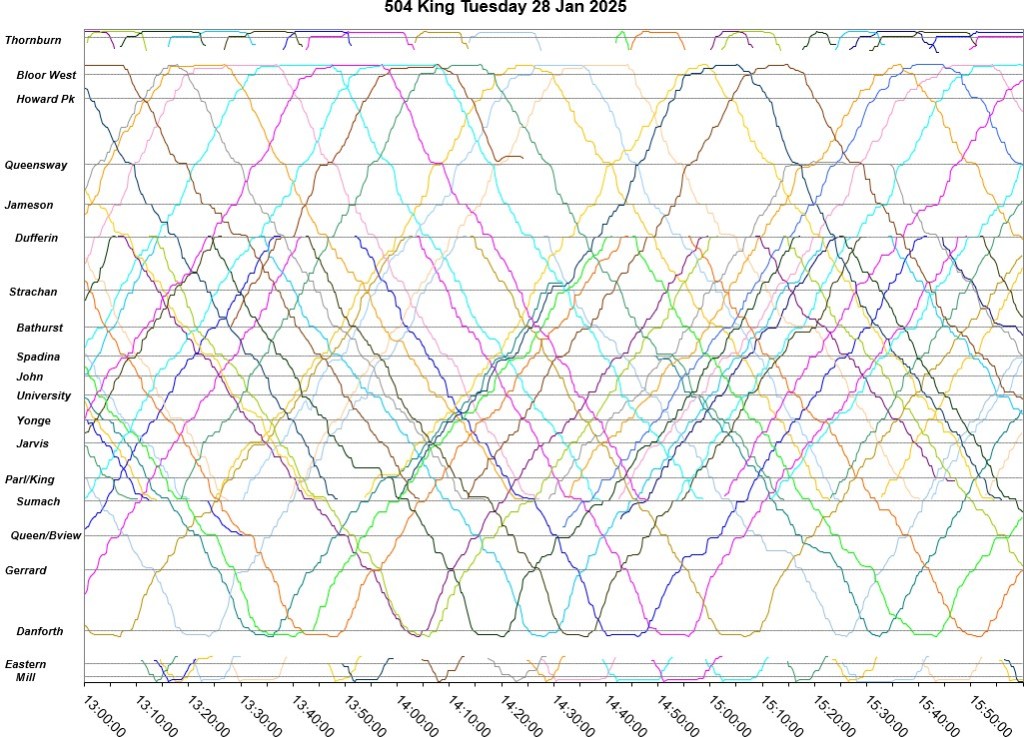
January 28 saw about 6cm of snow which fell after 6pm, peaking by 8-9pm and tapering off in the late evening. No route-specific eAlerts were issued for 504 King. The service is more erratic in the evening, but the daytime service, before the snow, showed the pattern of bunching seen on other days.
Eastbound
Note that there are some very wide gaps in service to Broadview Station after 7pm.


Westbound
Service in the west end shows the same pattern as in the east including wide gaps to the terminal, Dundas West, in the evening.

Tracking Chart
Although evening service was affected by snow and some delays enroute, the major problem is bunching. Short turns produce very wide gaps to the outer ends of the line.


Wednesday, January 1
On New Year’s Day, there are almost no short turns. The weather was uneventful, there was little traffic for streetcars to contend with. The only significant delay was a car held at Dufferin Loop for an extended period at 10:30pm due to “police activity” according to the eAlert. This required westbound cars to loop via Dufferin, Queen and Shaw.
However, the service ran in bunches all day long in both directions with occasional gaps to various terminals. This is an example of laissez-faire service management.
Eastbound

Westbound


Evolution of Headways at Yonge Street
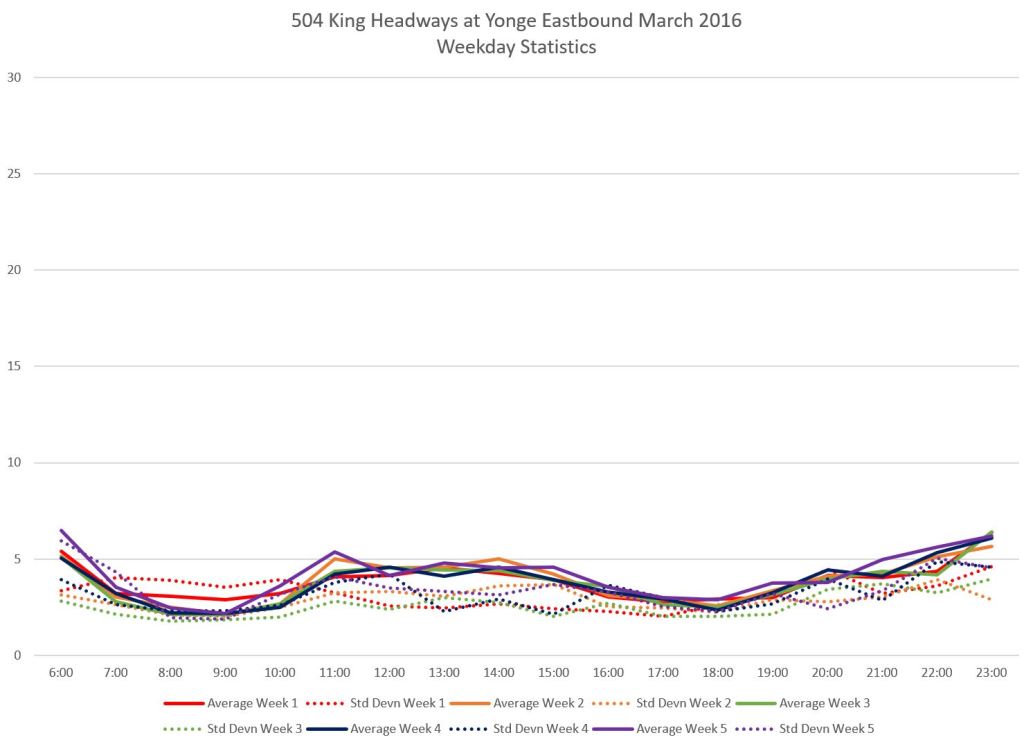
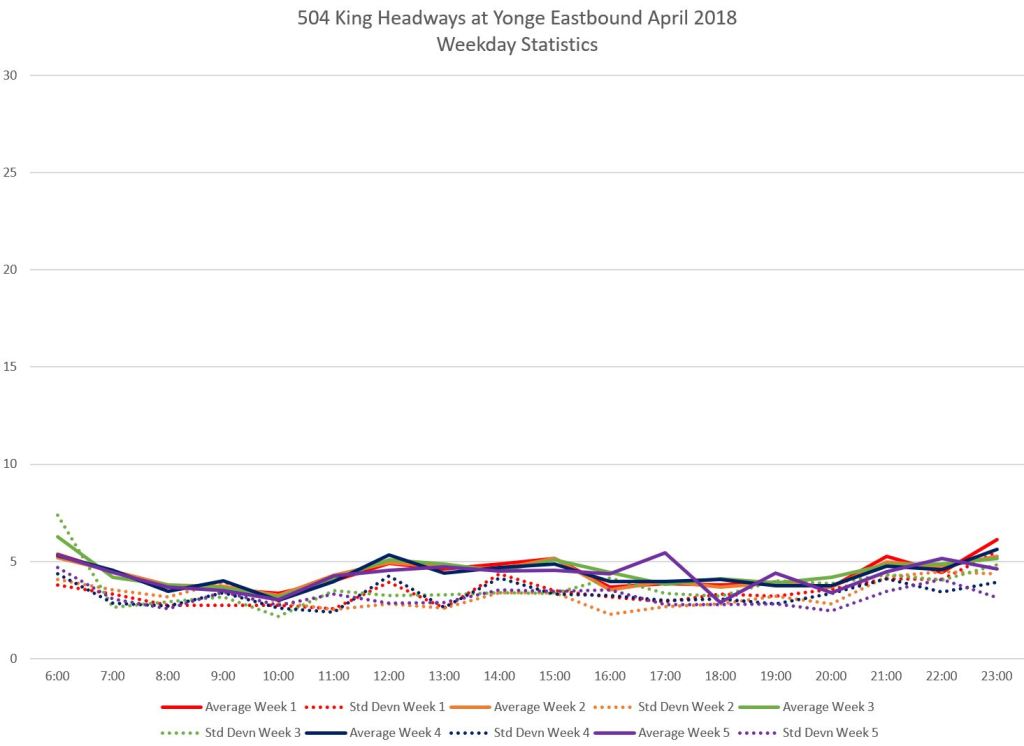
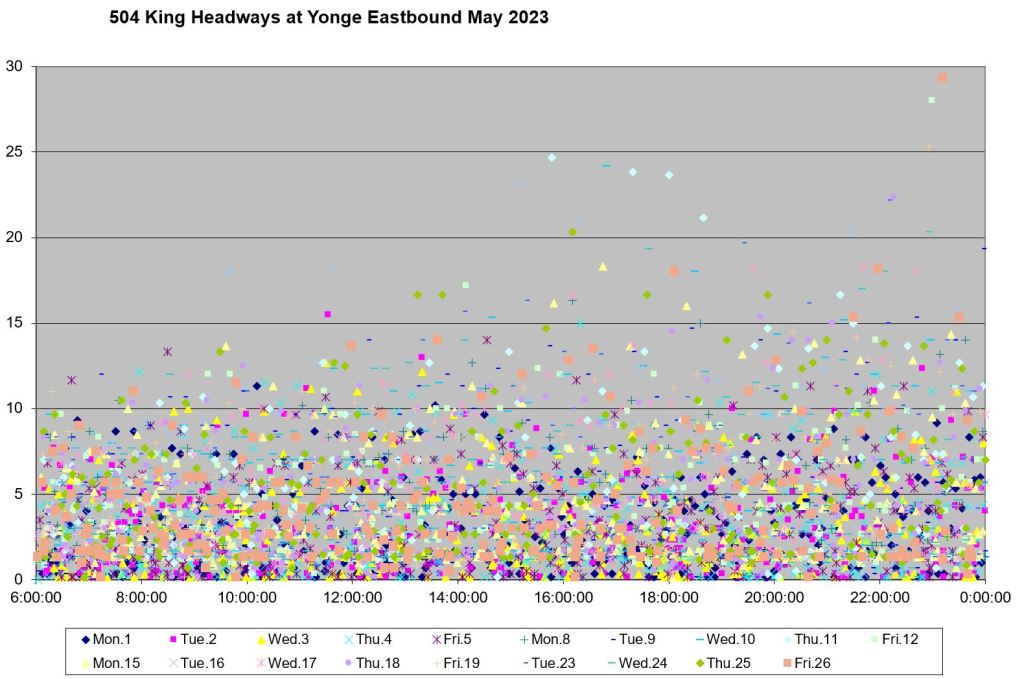
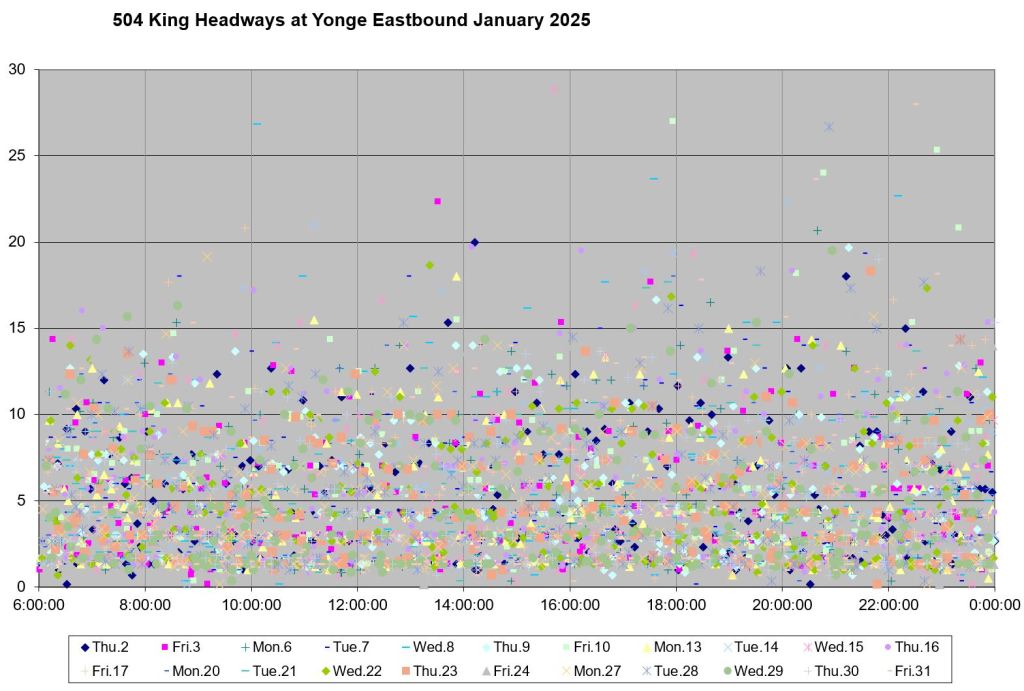
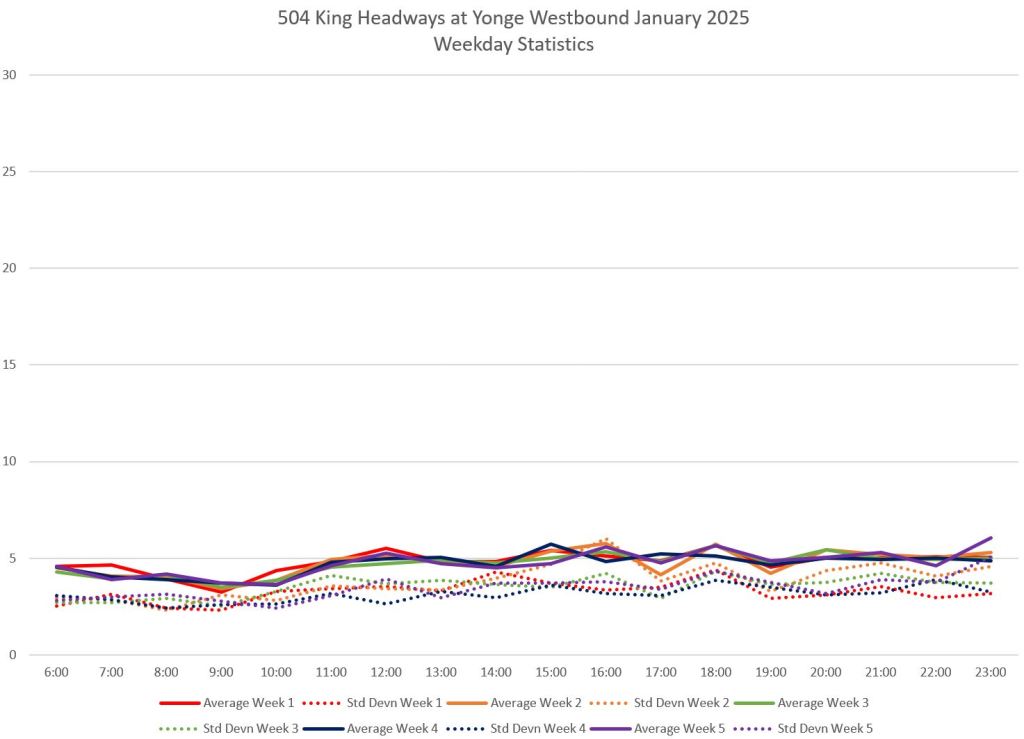
The charts in this section show the raw data for headways at Yonge Street from 2016 to 2025. The data are displayed in two ways:
- The weekly statistics showing average values and standard deviations
- The raw data showing the general shape of the “cloud” of data points
The dates shown are:
- March 2016: Before the installation of the transit lanes. Route 504 operated with CLRVs (the old shorter cars). All service operated from Dundas West to Broadview Station as the Cherry Street service had not yet started.
- April 2018: After the installation of the transit lanes. 514 Cherry cars operated less frequently than 504 King and with new Flexitys. They are not included in the charts here.
- January 2019: Pre-pandemic. Service was the 504A/B combination we know today and it operated with the new Flexity streetcars.
- May 2023: Post-pandemic. Note that in week 1 there was a mix of bus and streetcar service due to construction elsewhere on the route.
- November 2023: This includes the high point in traffic congestion on King caused by the closure of Queen Street for the Ontario Line and the construction work on Adelaide that was not completed until months later. This is just before the arrival of Traffic Wardens to physically manage traffic and improve streetcar speeds.
- January 2025: Current. The headway stats shown here are the same as earlier in this article.
The spread in the data values changes from one date to another reflecting then-current conditions including congestion and reliability of the route in general, the size of vehicles used, and the scheduled frequency of service.
Generally speaking the averages (solid lines on the charts on the left) follow the scheduled headway, although in November 2023 this did not happen because of the downtown congestion. Most trips operate, but not necessarily reliably, giving “good” averages but irregular service. The standard deviations (dotted lines) lie close to the averages reflecting the inevitable bunching of cars when the service is very frequent, but they remain high into 2025. This reflects the bunching shown in other sections of this article.
Overall, these charts show how headway values, even on a busy route like King, have a range of values which, at times, goes well away from the scheduled/advertised headway. Riders experience this scatter and unpredictability even though the performance stats might lie within TTC standards.
Eastbound





Westbound



 Steve Munro
I posted a note about the night of January 10 in an older thread. During the late evening westbound 504 cars were diverting via Parliament because 4519 was disabled in the southbound track at Queen Street for over one hour. Eastbound cars continued to use the normal routing.
The vehicle history on TransSee records a very strange route taken by 4519 in the lead up to the stoppage at Queen. It makes me wonder if it was causing some of the problems on the chart or if it was reacting to an unknown event that might have caused the issues westbound.
I commented that night about how ugly the 506 and 511 tracking charts were. The ragged 504 charts here actually look good in comparison.
Steve: Yes, I should have included that Queen/Broadview incident in my delay list. It was described as “an operational problem”, but given that it blocked service in both directions, not just westbound, I suspect a derailment. The TTC delay logs for January are not posted on the Open Data site yet, and so I cannot cross-check them.
Looking at my tracking chart, 4519 came east from Dundas West Station to Distillery Loop running as a pair with 4518. 4519 then went to Broadview Station, but on its southbound trip stopped at Queen. The blockage caused a gap of over one hour to Broadview Station.
I will add this incident to the list of problems on January 10.
BTW TransSee gets confused when cars take unexpected routes. It did not correctly map the side-trip to Broadview Station, although the Trip Path table for that car does show the route the car took.
LikeLike
It was actually a visual spotting for me. I was passing through the area and from what I could see nothing seemed to be off the rails so to speak. No passengers, no emergency responders, no TTC support vehicles. The TTC normally requires several hours to clear derailments not the hour or so this particular delay lasted. (See yesterday’s derailment on Dundas)
There were a pair of likely short turned 503 cars stuck behind 4519 which caused some gaps in the Kingston Road service.
I only noted the unusual route 4519 took because it had been on the 504A all day and on the eastbound trip it went to Distillery loop and seemed to stop there for some time before leaving but instead of returning westbound it made a trip to Broadview station.
Steve: I think that the Broadview trip was an attempt to fill a gap. That didn’t quite work out.
LikeLike
I’m actually curious about what the “operational problem” with 4519 was on Jan 10 because according to TransSee it went back to the yard after the stop on Broadview but was dispatched again a short time later. It couldn’t have been a major mechanical issue.
Perhaps a relief operator didn’t show up? I have actually sat onboard cars in that exact spot while the operator waited for his replacement to arrive.
Steve: It’s hard to believe they would put a huge gap in the line for a missing operator. They would just run the car in.
LikeLike
I can write the preview of Headway Reliability on 504 King: February 2025 Update:
It’s been a shitshow.
Does it snow in Toronto??? Apparently the mild winters since the January 2022 fiasco made Transportation Services and car drivers forget.
We badly need a dedicated east-west corridor south of Bloor, not shared with cars, with *actual* signal priority and enforcement, not subject to blockages and third-party delays. (Not that TTC isn’t capable of performing first-party delays…)
LikeLiked by 1 person