
The agenda for the January 27 TTC Board meeting contains two reports containing information about infrastructure work planned on the rail networks in 2025.
- Subway and Streetcar State of Good Repair, Expansion and Modernization – 2024 Review and 2025/2026 Forecast
- 2025 Annual Service Plan
The Service Plan details proposed route changes for 2025 and evaluations of some options that were not recommended. I will address this part of the report in a separate article.
The State of Good Repair report addresses the current situation with needed infrastructure maintenance, and contains a detailed calendar of planned work including major projects requiring streetcar diversions. The Service Plan includes some of the proposed route configurations.
Subway Plans
The subway plans are extensive and will see more partial or total service suspensions than in past years. This comes in part from the fact the subway is aging, but also from a recognition that past years have not seen the level of maintenance required to keep the system in good shape. One key item arising from recent major disruptions is the state of the work car fleet. Many specialized vehicles are used for aspects of subway maintenance, and their reliability and availability have not been at the level the TTC needs.
Work planned during subway closures are reliant on work cars to aide in the performance of the scheduled activities. As such, the TTC’s 2025 Operating Budget includes $0.8M to bolster work car maintenance and the 2025-2034 Capital Budget and Plan includes $35.6 million of approved funding for work car overhauls as well as $62.9 million toward work car procurements. These investments, as approved by the TTC Board on January 10, 2025, and before City Council for consideration on February 11, 2025, are required to increase reliability and respond to increased demand for work cars due to higher capital activity. [p. 2 SOGR report]
In a section reflecting on the growing amount of maintenance work, the report observes:
[…] significant investment into these programs is required along with the procurement of suitable work cars through a phased fleet replacement approach and rolling stock transition plan. To ensure the TTC is able to continue delivering on its state-of-good-repair program, while accommodating future growth and expansion projects, the availability of work cars for trackside activities and the time required to maintain the work cars in a state of good repair is inversely proportional, and as such, it is critical that the capacity to provide safe, reliable and available work cars is built into future plans. [p 12 SOGR report]
Many problems with the work car fleet originated with deferral of a renewal and expansion plan proposed in Andy Byford’s era as CEO, but sidelined under Rick Leary.
Closures are expensive because of many factors. These costs are recovered through the capital project budgets and from external parties, notably Metrolinx. They are not part of the regular operating budget.
Subway closure costs are variable and dependent upon the duration and distance of the closure territory, along with the complexity of the work. The cost for each closure is attributed to the incremental costs for buses, advertising, and staffing. This includes Operators, contracted customer service support staff, TTC staff to supervise the closure, paid duty police officers, and parking enforcement officers. The average subway early closure cost is approximately $35,000 per evening and the average full, two-day weekend closure cost is $500,000 per weekend ($250,000 per day). [p. 1 SOGR report]
The detailed list of proposed 2025 closures is organized by date and this shows how some work has been scheduled so that two or three projects can take advantage of one shutdown at a time [pp 17-30 SOGR report]. However, this makes major projects that spread over many weeks more difficult to see along with the dates when specific parts of the network will be closed. The main part of this article includes charts showing the dates and locations of closures.
An important issue raised by the report is the TTC’s ability to perform all required maintenance work in the time available.
On the subway side, a significant increase in production time is required to continue to maintain its assets in a state of good repair. Given the current rate of track asset deterioration, it is expected that the average production time of approximately 92 minutes will need to approximately double to more than 180 minutes to continue to ensure all assets remain in a safe and reliable state. [p 11 SOGR report]
That “92 minutes” refers to the productive work interval between shutdown and startup of subway service, and has been cited recently by management when discussing the Reduced Speed Zones list. That connection is misleading in that major track rehabilitation is done during longer “possessions” of subway lines either through early closing, or weekend shutdowns. Indeed, TTC management have often touted how one weekend’s work is equivalent to many short weekday sessions.
The TTC contemplates options for extending the time to perform maintenance:
- Organizing full weekend closures with significantly larger closures boundaries (i.e. Kennedy to Broadview closure).
- Weekly early access closures commencing at 10 p.m. with larger boundaries.
- Nightly suspension of subway service at midnight across some or all subway lines, rather than 2 a.m.
- Various multi-day or multi-week closures of various points of the subway system. [p 12 SOGR report]
An important question here is how much of the SOGR list’s size is due to growth and aging of the network, and how much from deferred maintenance? Is the TTC in danger of becoming unmaintainable because the backlog is too long? Are more extensive shutdowns a “new normal”, or can we hope for a time when the project list is shorter?
Closing the subway earlier will have major effects on riders. Toronto is not a city where transit riding evaporates at 7pm. The transit network is vital both for entertainment activities and for the many workers who do not have 9-to-5 commutes. Indeed, the TTC routinely cites the importance of evening and night service for both economic and safety reasons.
Streetcar Plans
The report acknowledges that streetcar infrastructure is falling out of good repair:
Given the City’s challenges, certain TTC work has been deferred over the past several years. As the assets continue to age and are subjected to the daily service demands, a long-term execution strategy, post-2026, is required. This situation is further compounded by the ongoing Gardiner Expressway construction work and the Ontario Line expansion that limits TTC’s ability to replace its deteriorating assets on parallel routes (i.e. King, Queen, and Dundas). In the coming years, the prognosis is that TTC will need to expand its current state-of-good-repair work to meet the growing service demands at the forecasted asset deterioration rate. [p 12 SOGR report]
Again, the question is whether the system can sustain an increased level of SOGR work without having many major routes out of service simultaneously. The main part of this article looks at the proposed work and the related diversions, where they are known.
One project that will end, eventually, is the reconstruction of the overhead power distribution system for full pantograph compatibility. Some of this work is co-ordinated with shutdowns for track, road and utility repairs, but some projects are scheduled on their own. Work is not necessarily undertaken when scheduled, and riders have suffered from service replacements and diversions while nothing appears to be happening.
Across both the subway and streetcar systems, Toronto now sees the effect of reduced maintenance and past year budgets that claimed to be adequate but concealed a slow decline. This has happened in other cities, but the TTC always fancied itself immune to such problems.
The report warns of changes needed in 2026 and beyond, but does not explore the details. The TTC Board and the riding public deserve a full airing of this situation together with a recovery plan.
Subway Major Projects
The detailed project list covers many pages in the report, and does not give a consolidated overview. The charts below show each line through the year of when and where closures will occur.
Note that the bars show the endpoints of each shutdown. For example, a bar running from St. George to Broadview indicates there will be no service between these points.
For details, see the full report.
Legend:
- EA = Early Access. On weekdays, the shutdown will begin in the late evening
- LO = Late Opening. Sunday morning Prince Edward Viaduct beam replacement
- SD = Single Day shutdown
- FW = Full Weekend shutdown
- SLO = Single Line Operation
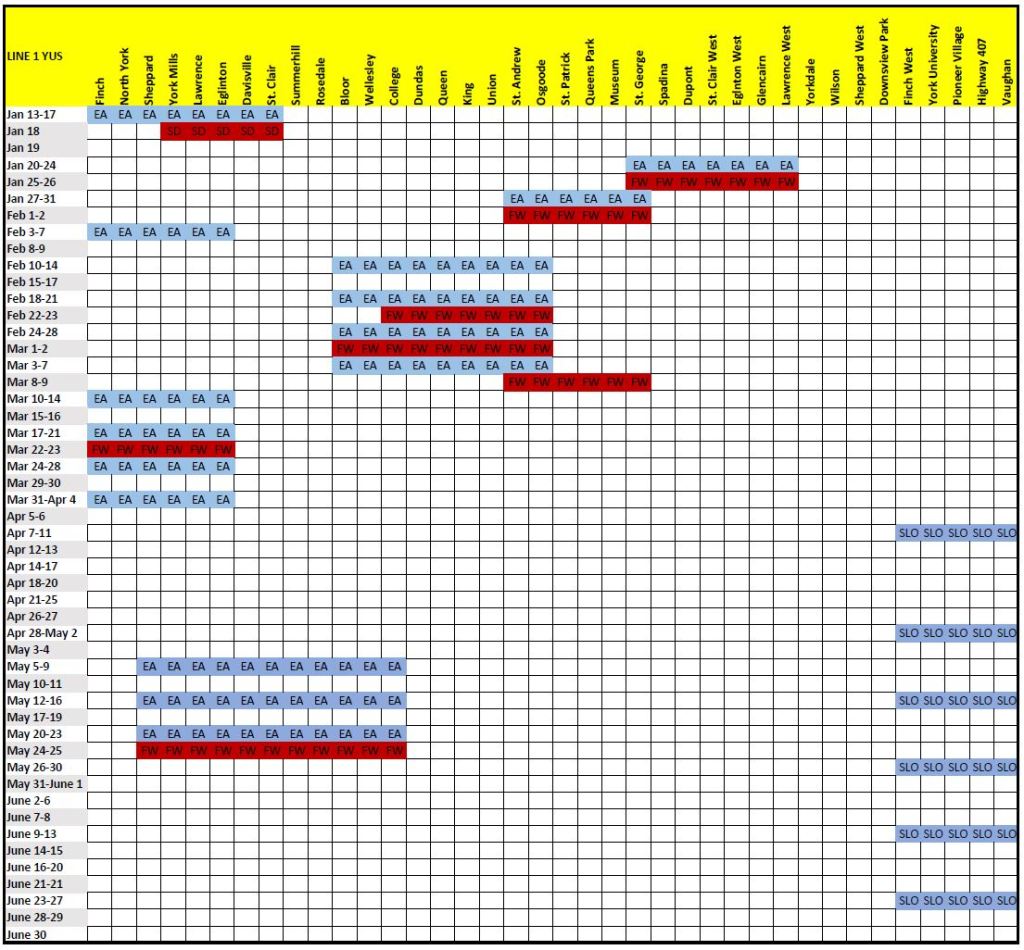


Major works include:
- Track maintenance at Finch, York Mills, Davisville Yard, Kipling Station, Islington Station, and on open cut areas of both lines
- Track reinsulation
- Traction power feeder replacement
- Infrastructure for Rogers extended phone service
- Asbestos removal
- Preparatory work for Automatic Train Control on Line 2
- Signal testing on Line 2 between Kipling and Jane
- Pump replacements
- Leak remediation on the Vaughan extension
- Beam replacements on the Prince Edward Viaduct
- Work at Kennedy Station related to the Scarborough Subway Extension
- Replacement of finishes at University Line stations
One odd scheduling choice caught my eye with closing of Line 1 downtown on two heavy shopping weekends before Christmas. The entire schedule is often revised as the year goes on, and the version here should be used as a general guide to planned work, not as a definitive calendar.
Streetcar Major Projects
The SOGR report includes a table of planned work on the streetcar system ordered by date [pp 31-39]. The table and discussion below groups related items together. For the major works, multiple items are grouped together including work by the City, primarily for water main replacements and upgrades.
The duration of these projects reflects the bundling of other work. A typical intersection replacement can be accomplished in a month from excavation and removal, foundation rebuild (if needed), track installation and concrete curing. However, when other work such as water main replacements and overhead reconstruction are added, the project lasts much longer.
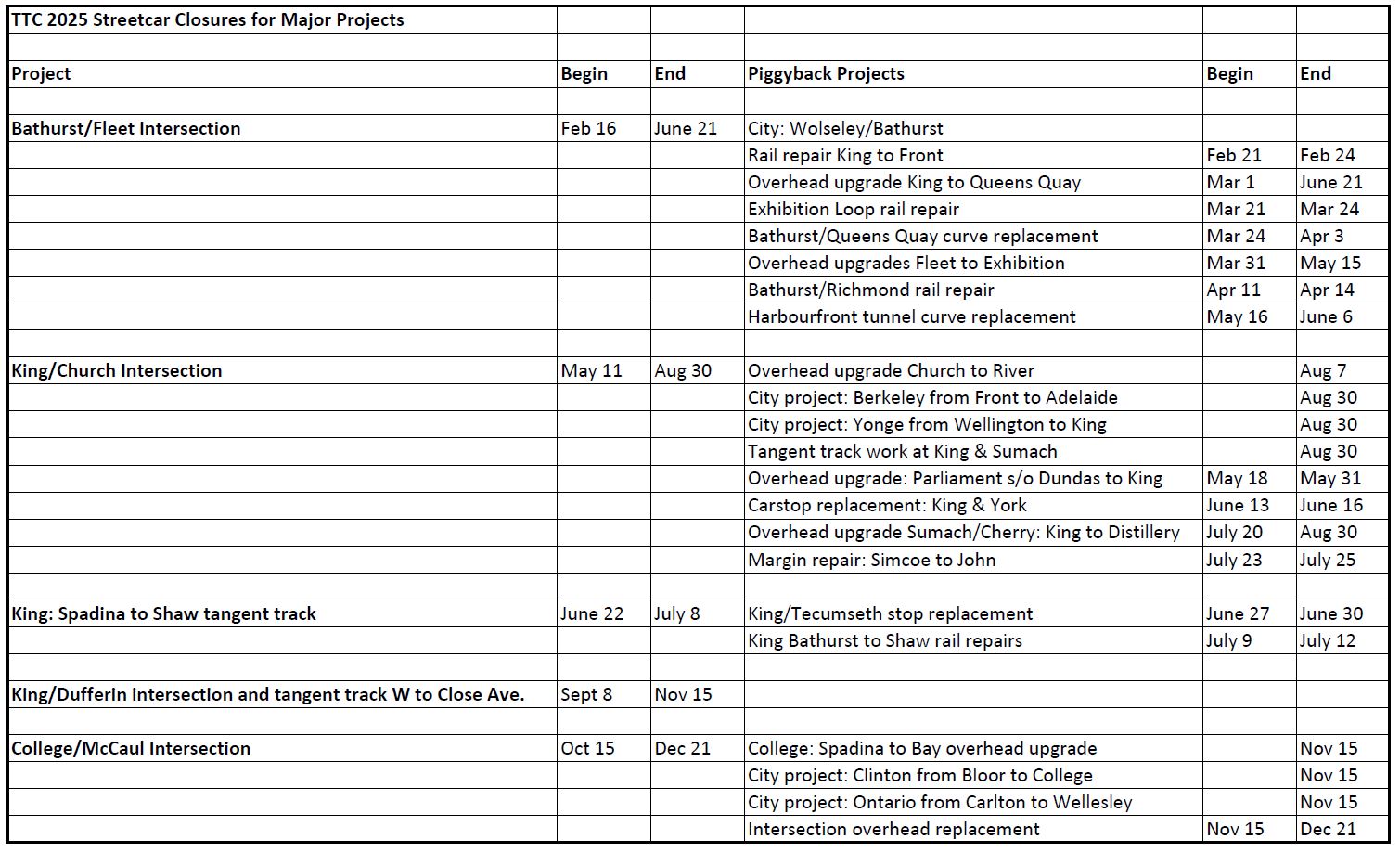
Bathurst/Fleet/Lakeshore Intersection
This project includes track and water main replacements as well as changes to the streetscape. I await drawings from the City of Toronto showing what this will involve.
- In Phase 1 running to mid-March, an aging water main will be replaced.
- In Phase 2 from mid-March to mid-April, track on the north side of the intersection will be replaced along with streetscape improvements.
- In Phase 3 from mid-April to June, track on the south side of the intersection will be replaced.
The TTC has not yet announced replacement service plans.
King/Church Intersection
Track at the King/Church intersection has been due for replacement for several years, and it is in bad shape today with numerous patches. Deferral of this work is not an option.
However, Queen Street is closed at Yonge for Ontario Line work, and taking King out of service at the same time will be challenging for transit, transit riders and motorists.
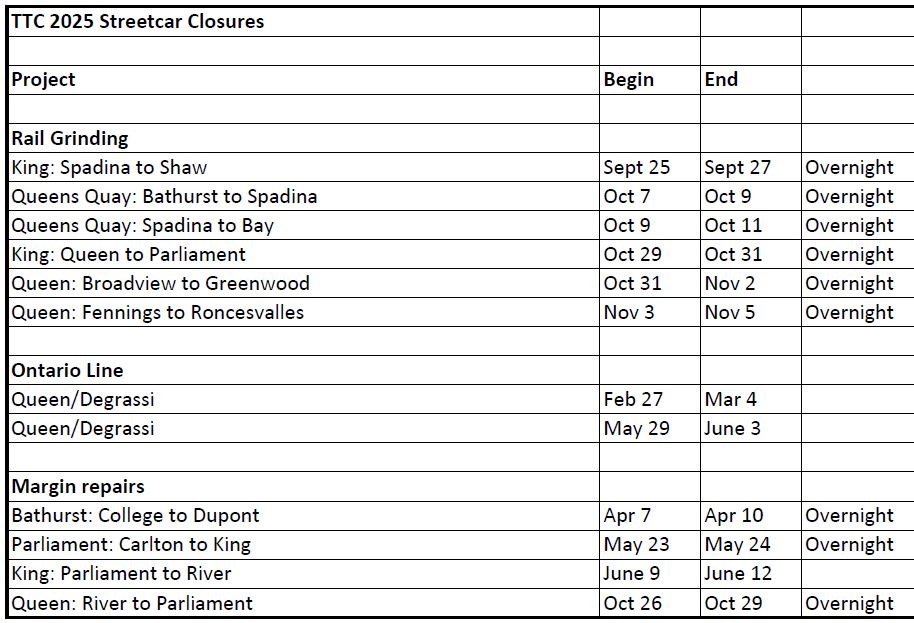
The planned diversion is shown below.
- 501 Queen is not affected and will continue on its Richmond/Adelaide diversion.
- 503 Kingston Road will revert, effectively, to the old 502 Downtowner route and terminate at McCaul Loop via Richmond/Adelaide.
- 504 King and 508 Lake Shore will diver both ways via Queen and Spadina using the Richmond/Adelaide diversion. The King car will not run east on Adelaide from Spadina even though this is physically possible, and the route has been used already for some ad hoc diversions since the track opened.
- A 504 King shuttle bus will operate from Broadview/Gerrard to an as-yet unspecified point on King West bypassing the King/Church construction via Jarvis, Wellington/Front and Yonge Streets.
- Depending on budget headroom, there may or may not be a supplementary service to the Distillery District where riders will otherwise have to make do with the erratic 121 Esplanade-River and the seasonal 202 Cherry Beach buses.
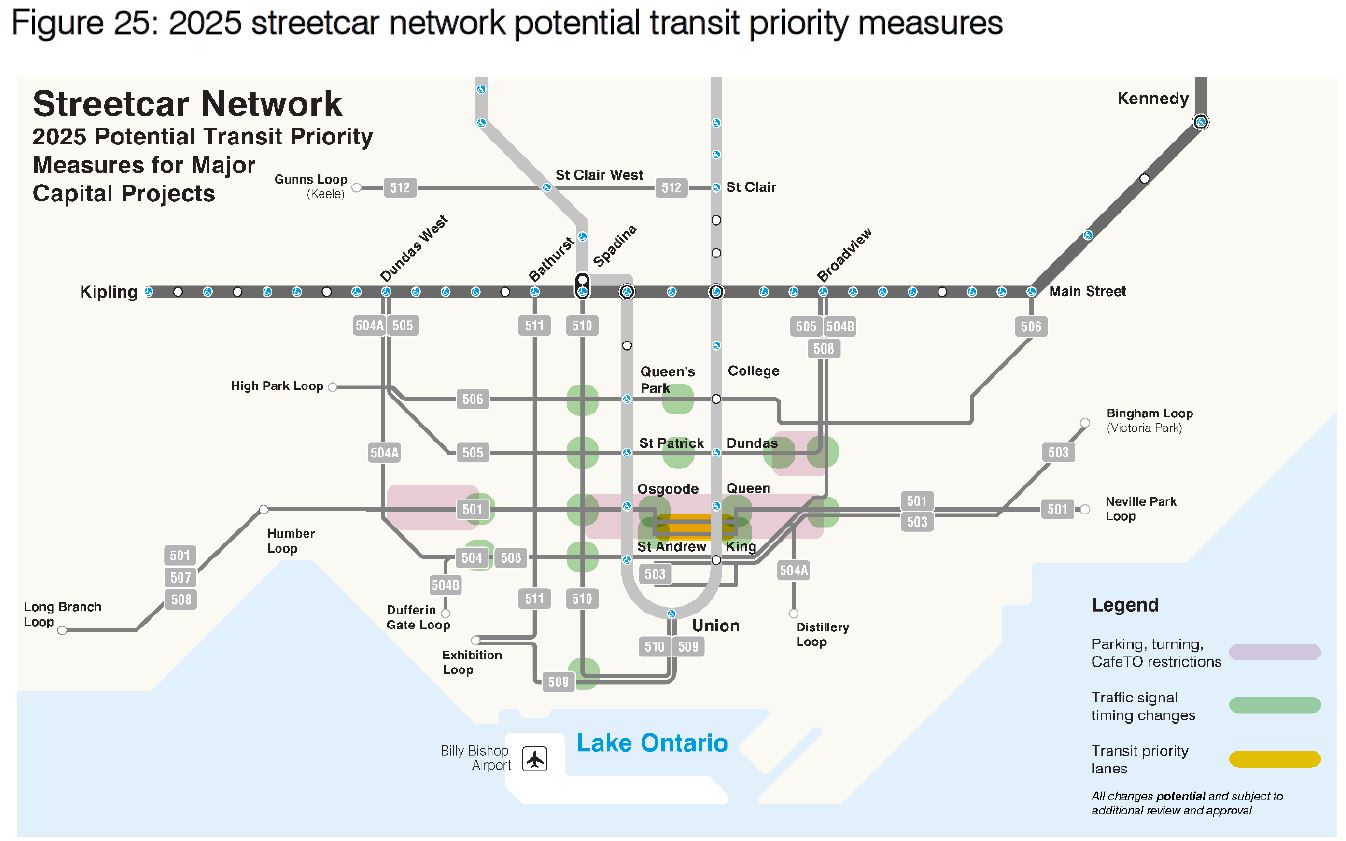
The TTC hopes to obtain transit priority improvements including signalling changes, transit-only lanes, and parking restrictions. It will be interesting to see just how much of this actually occurs, or conversely just how bad service disruptions will be before anything changes. (Further details are at the end of the article.)
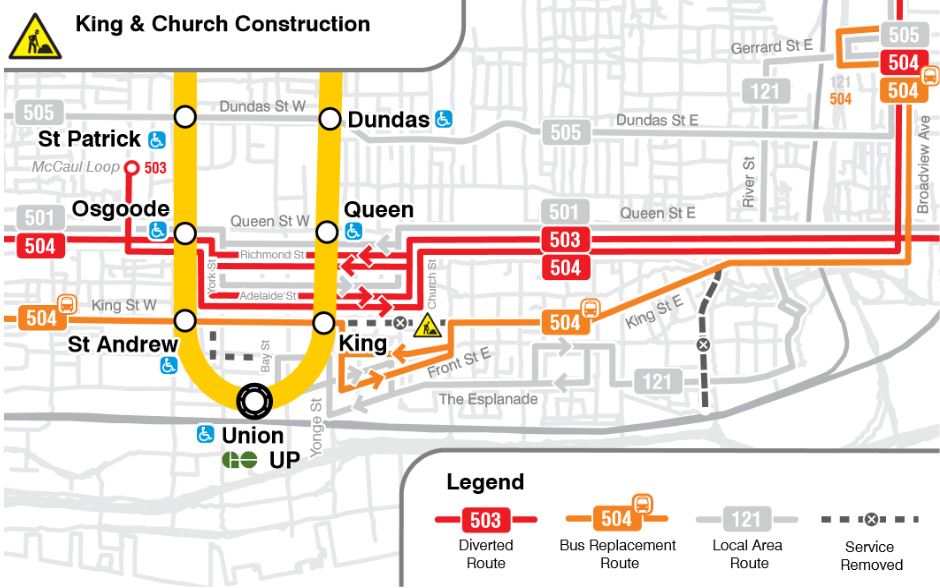
King: Spadina to Shaw
Track repairs are planned along King from Spadina to Shaw. There are no additional details.
King/Dufferin Intersection and West to Close Avenue
Although the intersection at Dufferin was supposed to be rebuilt in 2024, this was dropped from the project because the track castings has not arrived. This work has now been bundled with previous planned track replacement west from Dufferin to Close Avenue.
As a matter of historical interest, this was the first major intersection to be installed with vibration padding around the castings to reduce noise and improve intersection life. However, it predates the era when such track was pre-assembled and welded off-site for faster and more robust installation.
Diversion plans have not been announced, but this work will affect 504/508 services on King as well as 29/929 services on Dufferin.
College/McCaul Intersection
Track at the College/McCaul intersection will be replaced and overhead upgraded between Spadina and Bay. 506 Carlton cars will divert via Dundas, and service will be improved on 94 Wellesley.
This diversion plan does not align with other City projects at Clinton and Ontario streets that would require a more extensive diversion if they conflict with the streetcar tracks.

Minor Streetcar Projects
Other planned work on the streetcar network will affect service and trigger diversions or bus replacements over the year. No details have been announced.

Transit Priority Measures
The TTC has a substantial list of possible transit priority measures they hope to see, but which are subject to City approval. This will test the City’s commitment to putting transit first downtown.
After a preliminary review of potential transit priority measures to aid the throughput of streetcar service on corridors with additional service diverted to them, as well as at intersections with additional or new turning movements, the following changes will be proposed (with support from partners at City of Toronto Transportation Services). All are subject to further review, consultation, refinement and Council approval where applicable.
- King-Church
- Dedicated streetcar lanes on Richmond Street and Adelaide Street, between York Street and Church Street
- CaféTO patios – removed for the duration of the diversion between Spadina Avenue and Broadview Avenue on Queen Street West and East.
- Parking restrictions on Queen Street – no stopping from 7:00 a.m. to 7:00 p.m., seven days a week, between Spadina Avenue and Broadview Avenue
- Turning restrictions on Queen Street – extended and additional restrictions at key locations to 7:00 a.m. to 7:00 p.m. , seven days a week, between Spadina Avenue and Broadview Avenue
- Traffic signal timing and phasing adjustments, subject to further analysis to confirm applicability and feasibility – Queen Street East and Church Street, Richmond/Adelaide Street and Church Street, Richmond/Adelaide Street and York Street, Queen Street West and Spadina Avenue, King Street West and Spadina Avenue.
- College-McCaul
- Traffic signal timing and phasing adjustments, subject to further analysis to confirm applicability and feasibility – College Street and Bay Street, Dundas Street and Bay Street, Dundas Street and Spadina Avenue, College Street and Spadina Avenue
- Other projects not included in the scope of the 2025 ASP but for which transit priority measures will be enacted where applicable and feasible:
- Bathurst-Fleet, watermain and trackwork
- Queen East, Davies to Broadview, watermain (2025) trackwork (2026)
- King-Dufferin trackwork (project inclusion in 2025 construction program subject to City approval)
- Trackwork on various sections of King Street (project inclusion in 2025 construction program subject to City approval)
 Steve Munro
It’s great to see that we’re starting to talk about SOGRs more publically; I found that the austerity measures that Leary & Tory had exacerbated the mess we are in today.
Just a quick question, but does the streetcar planned SOGR work include remedies for the bad switch signaling that causes the Stop & Go policy?
Steve: There has been a line item in the budget for updating the switch controllers for some time, but the work is proceeding slowly. Whether we will see the end of stop&go operation is another matter.
As for the Line 2 prep work for ATC, have they mentioned specifically what they plan to do to prepare for the project?
Steve: No.
Thanks for the article, Steve. I hope you’re doing well during these frigid weeks.
Steve: I have been staying indoors a lot!
LikeLike
At one time there were plans (or aspirations?) to move the tracks on Bathurst between Fort York Blvd to Lake Shore/Fleet to the west side of the street. Is this still in the plan?
Steve: I think that idea is dead, but I am waiting to see the plans for the proposed work to be sure.
LikeLike
Maybe I missed something, but it appears that there are no plans to make any of the King Street priority infrastructure permanent. Specifically, I’m thinking of the extended “platforms” that go onto the street at major intersections such as King/Yonge. Am I mistaken?
Steve: That work will be a City project, not on the TTC’s budget. It has been delayed for various reasons including covid, and also that it was supposed to occur as part of a track renewal project that has been deferred. The City does plan to build more platforms on King this year.
LikeLike
I’m glad all this stuff is planned. I’m also aware of the massive expenditures to add to the fabulous transit system in Toronto as well as aware that Toronto is growing rapidly but Ontario Tax dollars seems go to TTC and little to the terrible transit systems in other expanding cities. The city I live in you cannot go many places around the city on our buses. The routes are limited and don’t run much in the evenings either. Maybe the transit tax dollars should be divided up per person per city?
Steve: I should point out that the vast majority of works listed here will be paid for by Toronto tax dollars with minor assistance from the provincial and federal governments. Transit tax dollars from the gas tax are divided in part by population and part by ridership.
LikeLiked by 1 person
When the Eglinton line is going to be open? Please no more delays.
Steve: Ask that nice Mr. Ford when he come knocking on you door for votes. This is not a TTC issue.
LikeLiked by 1 person
I have been to many countries on 5 different continents and the TTC service is by far the worst that I have ever used. The TTC streetcars are by far the slowest in the world as multiple studies have shown and even when these streetcars are provided their own reserved lanes. If TTC wants better service, then it must do away with these streetcars once and for all.
Steve: Amusing that you complain about TTC streetcars being slowest in the world, but the list of cities with faster systems is very long. The problems lie in poor service management and a lack of priority for transit generally in traffic. What you really seem to want is no streetcars, and at least you could be honest about that.
LikeLiked by 1 person
The proposed early weeknight subway closures beginning at 10:00 pm are going to present real problems for people attending events downtown. Most sporting events, theatres, concerts, etc. end between 10:00 and 11:00 pm. and forcing homebound people onto shuttle buses is not going to be a popular move.
LikeLike
The funny thing is the schedule sees a grand total of one week before the King/Church and King/Dufferin projects, so if there’s any delay to the former, the 504 will only run on King between Shaw and Spadina.
Although that’s still more than the distance the 506 runs on Carlton Street!
It sure would have been nice to have built two-way track on York between Adelaide and King…
LikeLike
Is the King/Church intersection really going to take over 3 months? Some of the other piggyback projects like the King/Sumach tangent track, Distillery loop overhead, Queen/DVP joint replacement I wonder why they weren’t done during recent shutdowns. Will they fix the bad joint on the trailing switch out at Broadview? Probably not!
Steve: Definitely there could be more overlap, but my guess is that they would quickly run into timing problems because of segments running late, especially where City work on water mains is concerned.
I also look at the carstop replacements along Gerrard and wonder why the repairs between Broadview and Coxwell couldn’t be done on the same weekend instead of over multiple. Is it just a matter of crew shortages?
Steve: Crew and equipment. How many extra workers and sets of machinery is it worth to attempt them all in one go?
LikeLike
When they did carstop replacements on Queen east several years ago I recall multiple sites going simultaneously. The less disruption the better.
LikeLike
I live near Jane & Weston, a block from Emmett Avenue. Noticed a “73” bus stop on the north side of Emmett Avenue at Verona Avenue and on the north side of Emmett Avenue at York Humber High School.
Except, for the moment, only the 32D Jane & Emmett bus runs clockwise with stops on the south side of Emmett Avenue at York Humber High School and on the south side of Emmett Avenue at Verona Avenue. No “73” buses.
The “73B” bus would be extended from La Rose Avenue to Emmett Avenue and terminating at the Mount Dennis Station, when Line 5 opens. It would replace the 32D Jane & Emmett bus.
Very interesting! Guess there could be an announcement of an announcement of an announcement of an announcement in 2015, concerning Line 5.
Steve: 2015?
LikeLike
Steve, starting on Monday, February 17 – which is a public holiday (Family Day), parts of the 509 Harbourfront and 511 Bathurst routes will operate with shuttle buses, ahead of the start of work on the Bathurst-Fleet-Lakeshore project.
The 511 Bathurst streetcar will run between Bathurst subway station, then along King Street to the Charlotte Street loop (near King and Spadina). The 511B Bathurst shuttle buses will run between the Wolseley loop (Queen and Bathurst) to the Exhibition loop, via Fort York Boulevard.
The 509 Harbourfront streetcar will be turning back at the Queens Quay and Spadina loop. The 509B Harbourfront shuttle buses will run between the Queens Quay and Spadina loop to the Exhibition loop via Bathurst Street and Fort York Boulevard.
The 511B Bathurst and 509B shuttle bus routes will be converging at the Bathurst Street and Fort York Boulevard intersection, then run in tandem to the Exhibition loop.
This arrangement will be in effect for several weeks so that watermain replacement, track work, overhead work, and streetscape enhancement work is being done.
Steve: The description of this project and map of the modified route is on the TTC website. Although that post gives Monday as the effective date, the schedule change is on Sunday. I have not yet received the service memo with details of the February-March board period.
LikeLike
Steve, although the 509 Harbourfront streetcar, which runs between the Queens Quay & Spadina loop and the Union subway station loop will be temporarily suspended effective March 30th, the 509B Harbourfront shuttle buses will run between the Queens Quay & Spadina and Exhibition loop, via Fort York Blvd.
This shuttle bus operation, 509B Harbourfront, which began on Family Day long weekend, is in effect until Saturday, June 21. There’s also shuttle bus operation at the south end of the Bathurst route, the 511B Bathurst running between Queen. Street and Bathurst Street to the Exhibition loop, via Fort York Blvd, in effect until Saturday, June 21.
This is to accommodate the current Bathurst-Fleet-Lakeshore TTC track construction project.
LikeLike