
On December 9, 2024, the TTC issued Requests for Proposals for two major contracts affecting the future of Line 2 Bloor-Danforth: one for new trains, and the other for a new signalling system.
Although the documents for these RFPs total over 2,700 pages with detailed specifications for cars and signals, round one of the process is intended to establish the basic capabilities of would-be suppliers to actually handle the contract without getting into the nitty-gritty. Following rounds will get into the technical details and negotiations.
The RFP process for round one closes on January 28, 2025 (trains) and on January 27 (signals). Contract awards will occur in 2026.
Major points:
- The two projects/contracts are linked because implementation of Automatic Train Control on Line 2 requires a new fleet. ATC installation can run concurrently with new train deliveries, but the benefits of ATC operation are not possible until the existing Line 2 fleet of T-1 trains is replaced.
- As a separate project, the T-1s will be overhauled to keep them running into the 2030s, although they will be retired as new trains are delivered.
- The new trains RFP includes provision for additional equipment including trains needed for extensions of Lines 1 and 2, and for improved service on Line 1. The timing of train deliveries for Line 2 could bump into requirements for Line 1 trains thereby delaying the Line 2 cutover to ATC. Additional trains for Line 1 also trigger the need for a new carhouse which is not yet a funded project.
- Growth in capacity of Lines 1 and 2 beyond 2019 levels could be constrained by the availability of fleet and infrastructure. This has already shown up in the planned completion of the ATC cutover on Line 2 in 2035. This date conflicts with TTC projections of demand growth.
- Although the RFP for new trains is theoretically open to all bidders, both the provincial and federal governments have made statements about how this will guarantee work for Thunder Bay. Bidders might well ask if any firm but Alstom actually should bother participating. Options within the RFP include future replacement of the Line 1 TR fleet which, based on a 30-year lifespan, would stretch from 2039 to 2047.
- The Line 2 ATC RFP is also an open bid, and it explicitly states that if a different vendor from Line 1 (Alstom) is chosen there will be Line 1 and 2 trains with different vendors’ ATC gear. The trains will not be able to interoperate between the lines except in manual (“emergency”) mode at restricted speed.
- Work cars need dual capability and the TTC intends to equip them with gear that can work with either the Line 1 or 2 system. What this might entail both for physical space on the cars, operating procedures and complexity is not discussed.
- If train frequencies are improved beyond 2019 levels (less than 140 seconds), there will be capacity issues at terminals and turnbacks. The ATC RFP includes a performance requirement for faster turnarounds (as low as a 100 second headway) but it is not clear whether this is possible with existing track geometry.
- The Scarborough Subway will be built with conventional block signals, and will be retrofitted with ATC in a later, as yet unfunded, project. It is not yet clear whether full service will operate during peak periods on the SSE during peak periods, and the ATC RFP provides for turnback operations in a tail track east of Kennedy Station.
- Funding for future stages beyond 70 cars (55 for Line 2, plus 15 for the Scarborough and Yonge North extensions) is not guaranteed.
New Trains
The T-1 fleet serving Line 2 dates from 1995-2001, and the earliest cars will celebrate their 30th birthday in 2025. This was their design life, although with some TLC they can be kept in operation longer. Indeed, with their replacements not arriving in the near future, they will have to last longer. TTC has already planned an overhaul to keep the T-1s in service, and these plans are complicated by parallel requirements for more trains on Line 1, an as-yet unfunded project.
The T-1 fleet comprises 61 trains built to run as married pairs, but in practice operated as 6-car sets on Line 2. Earlier in their lives, some of these cars ran as 4-car sets on Line 4 Sheppard, and at one point in the development of the Scarborough Subway scheme, the intent was to operate the full T-1 fleet out to STC likely with half of the service short-turning at Kennedy via a tail track to be built east of the station.
Pre-pandemic service on Line 2 required 46 trains at peak plus 9 spares (20%) for a total of 55 trains. That is the size of the base order for new trains. Equipment for the SSE will be bought separately with Metrolinx footing the bill.
A September 2024 report on Line 2 modernization claims that the reduction from 61 to 55 trains is possible because the new trains have a higher capacity (1,100 vs 1,000), but this sounds like a convenient fiction to get around the higher projected cost of new trains, and the shift of the cost for SSE trains to Metrolinx.
The new trains will have capacity for 1,100 passengers per train. The existing T1 fleet has capacity for 1,000 passengers per train. As a result, 55 trains are required to replace the existing 61 T1 trains. [Footnote 1, p. 10]
Until all 55 trains arrive, Line 2 would need to operate a mix of T1 fleet and new trains. This constrains any improvement in frequency beyond that possible with the existing signal system. (See the section on Automatic Train Control for a further discussion of possible service levels on Line 2.)
Like their predecessors, the new trains will have both a high and standard rate, with the speed after 60 seconds of acceleration being about 65 kph (40mph) for standard rate, and 83 kph (52 mph) for high rate.
Standard or “low” rate was provided on TTC trains when newer “H” and “M” class trains intermingled with the original heaver and slower “G” trains. High rate has not been used in normal operation for decades. It was discontinued due to hunting problem (side to side car sway that can become quite violent) at high speed on a much earlier generation of trains (the H-1s). The TTC never returned to high rate even after the problem trains were retired. High rate would likely require improved track maintenance, and it also affects the capacity of power supply for frequent service.
The primary benefits of high rate are on hills and on sections with wide station spacing, something that is more common today than in decades past. For example, the travel time from Eglinton to Finch is about two minutes faster in high rate than standard rate. The trade-off is a faster trip and smaller fleet requirements versus wear-and-tear and higher power requirements.
Although the New Trains RFP includes specs for both standard and high rate, the ATC RFP includes only standard rate.
The trains are intended to operate in 4- and 6-car sets, but configured as pairs that could run independently for maintenance work at Greenwood Shops which is not set up to handle 6-car sets like the TRs on Line 1.

Although only the “A” cars have cabs, both the “B” and “C” cars will include hostler controls so that A+B and B+C pairs can operate independently for yard movements.
The “A” cars will have unmotored trucks on the cab end of the cars to prevent problems with distance measurement for automatic train control due to spin/slide on slippery rail. All trucks on “B” and “C” cars will be motored. This means that a 6-car train will have 10 motored trucks, and a 4-car train will have 6.
The seating arrangement will be similar to the existing TR trains with a mix of perimeter and transverse seats, as well as areas with flip-up seats for accessibility.
Door controls will be designed for both two-person operation (driver plus guard) or one-person operation. The ATC RFP states that once Line 2 is running in ATC mode, a shift to one-person operation is expected.
The CBTC system on Line 2 will be designed to support OPTO as well as two-person operation (operator plus guard). It is expected that when the Line 2 CBTC system is fully operational, OPTO will be the primary type of operation.
The design life of the new trains will be 35 years, up 5 years from the current fleet.
Service Levels and Deliveries of New Trains
The TTC’s 5-Year Service plan calls for Line 2 service to return to the 2019 level in 2027.
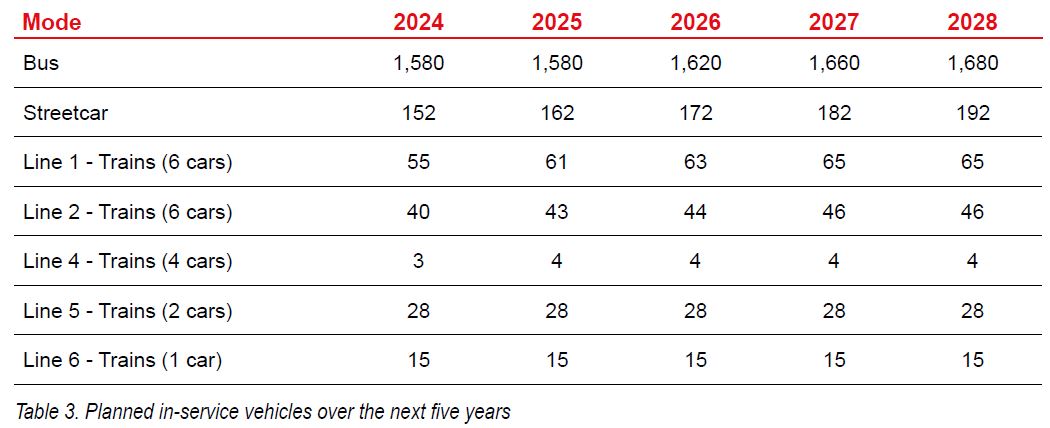
On a related note, despite claims that service in general is back to “normal”, the TTC’s own plans show that Lines 1 and 2 will run with fewer trains than the 2019 peak schedules of 65 and 46 trains respectively until 2027. Improving service beyond that level will not be possible until there are larger fleets for both lines.
The delivery plan for the base order is based on weeks from the “Notice to Proceed” with the contract. [From RFP General Conditions section 54.1 and Appendix G Schedule of Milestones and Schedule of Delivery Milestone Number B.] The middle column below translates the elapsed time in months to a delivery date assuming contract award in early 2026.
| Months after NTP | Assume NTP in Q1 2026 | Event |
|---|---|---|
| 40 | Q2 2029 | Availability of first train at Wilson Carhouse for testing and commissioning. |
| 42 | Q3 2029 | Availability of second train at Wilson Carhouse for testing and commissioning. |
| 52 | Q2 2030 | Availability of Group 1 trains – 1st through 10th |
| 60 | Q1 2031 | Availability of Group 2 trains – 11th through 20th |
| 66 | Q3 2031 | Availability of Group 3 trains – 21st through 30th |
| 72 | Q1 2032 | Availability of Group 4 trains – 31st through 40th |
| 77 | Q3 2032 | Availability of Group 5 trains – 41st through 50th |
| 81 | Q4 2032 | Availability of Group 6 trains – 51st through 60th |
| 85 | Q1 2033 | Availability of Group 7 trains – 61st through 70th |
This schedule goes beyond the base 55 train requirement, but puts the delivery of the last of the base trains over six years after award (roughly month 79). According to a report on Line 2 Modernization, the contract award will be in 1Q2026. That pushes supply of the base 55 trains out to 2030 through mid-2032, and the 15 extra trains into 2033.
The full 70 trains including the Metrolinx add-ons for SSE and YSNE would not be available until 2033, a date that does not align with other planned changes including opening of two extensions. There is also of the timing of service improvements beyond the base level on Lines 1 and 2 which cannot occur until even more cars are delivered. The RFP cites optional requirements beyond the 70 trains in the base plus Metrolinx add-ons.
- [From RFP Section 3.10.1 Options]
- 25 trains for Line 1 ridership growth
- 5 trains for Line 1 headway improvement
- 8 trains for the North Yonge extension at maturity (i.e. beyond opening day requirements)
- 4 trains for the Scarborough extension at maturity
- 108 trains for replacement of the Line 1/4 TR fleet, future expansion and ridership growth
The TR trains now serving Lines 1 and 4 were built between 2009 and 2017, and their replacement cycle will not start until the late 2030s. Assuming that a successful vendor is in line to supply all of these trains, they would be Toronto’s car builder for the next two decades.
This Line 2 Modernization report [at p. 15] shows the following schedule which makes clear that the T-1 replacement process will be sidelined so that some new trains can go to the extension projects.
- Q4 2024: Procurement for new subway trains and ATC commences.
- Q1 2026: Contract Award for the new subway trains.
- 2030 to 2035: Delivery of the 55 trains and 15 trains for expansion [SSE+YNSE].
- 2034/35: Last T1 Train retired from Line 2, enabling phased cutover to ATC.
The report includes a projection of fleet requirements. For planning purposes, the SSE is assumed to open in 2030, and the YNSE in 2032. Note that the 2032 service level of 25.5 trains/hour is the same as the 2019 service level on Line 2. The extra trains are due to the extension, not to improved service.
By 2041, Line 2 requires a total fleet of 66 new subway trains, and Line 1 a total fleet of 122 trains, inclusive of the existing 76 Toronto Rocket (TR) Subway Trains. The new train RFP is being established to enable options for the TTC to secure required growth trains for Line 1 needed in the immediate term, and additional trains in the future to fully meet 2041 service requirements, as outlined below:
Line 2:
- By 2032: 62 higher-capacity trains are required. Of this total, 55 new trains are to replace the existing 61 T1 trains to deliver 25.5 trains per hour (141-second headway) at the AM peak point. Seven trains are required for the opening day service on the Scarborough Subway Extension.
- Beyond 2032: Four additional trains are required on Line 2 to deliver 30 trains per hour (120-second headway) at the AM peak point. ATC on Line 2 is also required to enable an improved headway to be achieved.
Line 1:
- Beyond 2032:13 additional trains would be required to increase Line 1 capacity system-wide and deliver 36 trains per hour (100-second headway) at AM peak point.
- By 2032: 25 additional trains are required to increase Line 1 capacity to deliver 34.3 trains per hour (105-second headway) at the AM peak point. Eight trains are also required for Yonge North Subway Extension opening day service.

It is clear that the delivery rate will have to increase if the extra trains needed for 2032 on Line 1 are to be delivered by 2032 as they are not included in the milestones, and funding for them is not yet secured. Unless the rate increases, it is conceivable that some of the new Line 2 trains would have to be diverted to Line 1 leaving the T-1 retirement even further in the future. In theory, the 55 new trains could be available in 2032 if all of them went to Line 2.
A potential shortfall in system capacity versus demand was discussed in a November 2023 report (see The Challenge of Funding Subway Renewal). Scenario 1 at the time (preferred) assumed a full funding commitment by Q1 2024. That train has left the station, and we are now closer to Scenario 2 which assumed funding by Q1 2025 and a Notice to Proceed in Q3 2026. The key issue here is the number of trains based on future demand. Somewhere in the mix there is also a requirement for another maintenance facility to hold the expanding fleet, but this project is unfunded and in the vague future beyond 2030.
There is a conflict between the assumed date when more capacity is required between the RFP for trains and the RFP for signals. In the signalling RFP:
3.3 OPERATING HEADWAYS
Operating headways are currently constrained by the limits of the existing fixed block signalling system. The “moving block” CBTC system will permit lower headways and corresponding increases in the number of trains per hour that can be operated on the line. The recovery headway on the CBTC re-signalled Line 2 will be 90 seconds. For service planning purposes, a minimum operating headway of 100 seconds is to be
assumed during peak periods. This is the ultimate target for the capacity required in 2055 (37,700 pphpd during the AM peak). [Emphasis added]
There is a severe problem with TTC capital project planning on an integrated basis when funding pleas only address fragments of the total plan. Repeated delays going back before 2020 in recognition of the full scope and needs for growth left Toronto in a position that it cannot aggressively build subway demand even if this were Council policy. That is the price of years of low tax increases, focus on a few key megaprojects, poor advice from management, and a TTC Board that didn’t concern itself with details.
Implementation Staging for ATC/CBTC
The RFP for Automatic Train Control (ATC, also known as Communications Based Train Control or CBTC) includes a breakdown of the stages of implementation based on months from contract award. The installation work will be undertaken progressively across Line 2, but activation for revenue service will take place at a later date. The dates shown in parentheses below assume an award in Q2 2026 as shown in the RFP.
| Segment | Testing & Commissioning (months after NOA) | Cutover (months after NOA) |
|---|---|---|
| 1: Kennedy to Main | 70 (Q1 2032) | 108 (Q1 2035) |
| 2: Main to Donlands including Greenwood Wye and Hostler Platforms | 78 (Q4 2032) | 113 (Q3 2035) |
| 3: Donlands to Yonge | 87 (Q2 2033) | 117 (Q4 2035) |
| 4: Yonge to Bathurst | 96 (Q1 2034) | 121 (Q1 2036) |
| 5: Bathurst to High Park | 105 (Q4 2034) | 125 (Q2 2036) |
| 6: High Park to Kipling | 114 (Q3 2035) | 129 (Q4 2036) |
The 2035 date matches to the presumed availability of a completely new Line 2 fleet. Note that the cutover would not finish until late 2036 meaning that no service or capacity improvement on Line 2 beyond the current 140 second level will be possible until 2037. This directly conflicts with the earlier timeframe for added capacity on Line 2 shown in Table 4 above.
Automatic Train Control and the New Fleet
Rather than treating the Line 2 signalling upgrade as an extension of the existing system, the TTC has called an entirely new RFP and contemplates a situation where different systems will exist on Lines 1 and 2. This imposes operational constraints, and the RFP explicitly states that trains will not be equipped (nor by implication will the TR fleet be retrofitted) to permit operation between the lines on a common signalling technology (“Cross-Line Operation” or “CTO” below). Co-existence of multiple systems is possible, but it adds to the complexity. Moreover, TTC has explicitly stated that provision for CTO will only be added to the work car fleet, not to the revenue service trains. This means that trains will be manufactured for a specific line with its ATC technology.
From the ATC RFP:
2.6.1 Revenue Fleet
Line 2 will operate using the New Subway Train (NST) fleet.
The TR fleet used on Line 1 will not be equipped with the Line 2 train-borne CBTC system. If TR trains enter Line 2, they will be treated as NCT trains [Non-Communicating Train]. Line 4 TR trains will not be equipped with Line 2 train-borne equipment. If Line 4 trains enter Line 2, they will be treated as NCT trains.
2.6.1.3 Legacy (T1) Fleet
The T1 fleet is composed of 370 cars, typically arranged in consists of six or four cars (three or two married pairs). The T1 fleet is currently in use in Line 2 exclusively.
There is no plan to equip the T1 fleet with the new Line 2 CBTC system. The T1 cars will be progressively removed from service as the new NST cars are introduced. The new CBTC system will not be put in operation before there are enough NST trains available to provide full revenue service. In other words, there will be no mixed-mode operation involving T1 and NST trains under the new CBTC system.
This section continues with a description of operations where a train is outside its ATC territory.
Emergency Manual Mode (Non ATC Mode) – Emergency Manual (EM) Mode the CBTC equipment is bypassed. This mode is restricted to degraded and emergency operating scenarios as described in Sections 8 and 9 respectively. In Emergency Manual train speed is restricted to 25 km/h by train-borne equipment external to the train-borne CBTC equipment. This mode is designed for use in CBTC territory, as a last resort. For most degraded scenarios in CBTC territory, RMF will be the primary operating mode.
When a Line 2 CBTC-equipped train operates outside of Line 2 CBTC territory, the train must transition to EM Mode. This will apply to SSE, Line 1, Line 4 and sections of Line 2 during cutover. When a Line 2 CBTC-equipped train operates outside of the Line 2 CBTC territory in EM mode, the train will be permitted to travel at line speed. The 25km/h restriction is disabled when the rolling stock detects a special entry/exit tag at the migration boundary.
This is a rolling stock, not a CBTC, function.
The limits on trains operating in “foreign” territory is further explained here:
4.2.5 Train Cross-Line Operation
Line 2 will operate with 55 NST trains with an option for another 11 NST trains. Only Line 2 NST fleet of trains will be able to operate and service stations in ATO and CABS modes. If a Line 1 TR enters Line 2, it will be treated as an unequipped train. Similarly, a Line 2 NST entering Line 1 will be treated as an unequipped train as well. When an unequipped trains enters Line 1 or Line 2, the secondary detection devices (SDD) will track these trains.
The non-revenue fleet will be equipped with the Line 1 and Line 2 train-borne CBTC systems to allow seamless CABS operation of the work trains on both lines. Work trains are typically not allocated to a specific subway line.
The work train fleet will be equipped for both Line 1 and 2 operation.
WORK CARS (Maintenance Fleet):
- 3.11.1 The CBTC System shall be capable of supporting the Work Car fleet to operate on Line 2 with Automatic Train Protection (ATP).
- 3.11.2 Work Car fleet shall operate in CABS modes, in any direction of travel, on Line 2 under the CBTC System and self-initialize, automatically detect and establish location as they enter Line 2 without requiring manual input or procedures.
- 3.11.3 Work Cars shall be classified as either fixed-length or variable:
- 3.11.3.1 Fixed-length Work Cars are self-propelled (electric or diesel) train consist that operate in a pre-defined consist/configuration.
- 3.11.3.2 Variable-length Work Cars are a train consist that includes a locomotive coupled to a combination of trailers. A worst-case train definition shall be created for these Work Cars to allow for operational flexibility.
- 3.11.4 Crossline Train Operations (CTO) shall be defined as Train operation on Line 1 and Line 2 in ATC modes.
- 3.11.4.1 Crossline Train Operations (CTO) is only required for Work Cars equipped with Line 1 ATC system.
- 3.11.4.1.1 There is no minimum requirement for CTO on the NSTs.
- 3.11.4.2 CABS mode of operation on Line 1 and Line 2 shall be required for Work Cars equipped with the Line 1 ATC system.
- 3.11.4.3 The ATP solution, allowing for Work Cars to operate on Line 1 and Line 2 in CABS mode shall not require any hardware or software modifications to the Line 1 ATC system.
- 3.11.5 Train-Borne CBTC equipment to conform within existing space constraints of Work Cars with no alterations to existing Work Car characteristics.
Operational Simulation
As part of the ATC project, the vendor must conduct a simulation of operations to establish that planned service frequencies can be achieved.
2.1.13 The Contractor shall submit for TTC’s review and acceptance, Performance Simulation Report (CDRL) demonstrating the following:
- The System can operate at the specified Design Headway;
- The System can operate at 135 seconds operating headway and carry 27300 pphpd with 52 trains;
- The System can operate at 100 seconds operating headway and carry 37700 pphpd with 67 trains;
- The performance of the turnback at Kipling station;
- The performance of the turnback at Kennedy station;
- The performance of run-outs at Greenwood Yard and Keele (Vincent) siding;
- The performance of run-ins at Greenwood Yard and Keele (Vincent) siding; and
- The System is capable of a Round Trip Travel Time
Turnback performance is not simply a question of the signal system’s design, but of track geometry and operating procedures.
Crossover lengths and the sharpness of turnouts dictate operating speed and the time required to move between a terminal platform and the approach/departure point at a crossover. There is a very strong chance that an approaching train will enter the crossover from a full stop awaiting clearance, not as an approach at speed.
Very short headways require minimal time between inbound and outbound moves at terminals, and in turn that a train be ready to depart the moment a route is clear. This implies that a crew is already on board with the door’s closed in anticipation of departure. Whether the TTC adopts this practice remains to be seen based on whatever minimum headway the new signalling system and trains can achieve.
I believe that the TTC has never conducted a simulation of very short headway operation using a segment of the existing Line 1 to verify if this is actually practical.
Platform Edge Doors
Provision will be made in the ATC system for future PED installation, but they are not part of the contract.
2.5.1 Platform Edge Doors (PEDs)
None of the Line 2 stations is currently fitted with Platform Edge Doors. In the future, TTC may install PEDs in all or a subset of the Line 2 stations. To ensure the safety of the public, and TTC employees and contractors, the opening and closing of train and platform doors must be coordinated. The CBTC system will support train operations on stations fitted with PEDs. While PEDs may not be fitted on Line 2 station platforms at the time the CBTC system is put in service, the CBTC system will be designed to support the operation of PEDs if and when they are installed along the line.
West End Yard
Before the Ontario Line replaced the TTC’s Downtown Relief Line, plans called for a new yard west of Kipling Station which would both support a new fleet of trains and free up space at Greenwood to host the DRL fleet. With the OL having its own yard at Thorncliffe Park, the timing of a new western yard was pushed back.
2.10.2 West End Yard
TTC recently acquired land occupied by the former CPR Obico Yard near Kipling Station with the intention of turning it into a subway yard for Line 2. A West End Yard on Line 2 would serve two main purposes:
- It would free up space at Greenwood Yard; and
- It would allow service to be balanced between the east and west ends of the line.
Plans for the West End Yard are in development. In any case, the yard will not be open until at least the mid-2030s, after the Line 2 CBTC system is cut over. For this reason, the West End Yard interface and operations are not part of the scope of this Concept of Operations.
Scarborough Subway Extension
The SSE will be built with a conventional block signalling system with the intent of a future project to convert it to ATC. This effectively limits the service level east of Kennedy Station to the headway block signals can support.
6.4 SCARBOROUGH SUBWAY EXTENSION
While the Scarborough Subway Extension will be a continuation of Line 2 allowing uninterrupted travel from Kipling to Sheppard Avenue East, it will feature a conventional fixed block system independent from the CBTC system that will be deployed on the rest of Line 2. Both signal systems will work independently from each other, with only the necessary interfaces at the boundary between SSE and the rest of Line 2 (interlocking at Kennedy station).
All trains will need to migrate between the SSE signal system and the Line 2 CBTC system. The migration boundary at Kennedy station separating SSE and the CBTC territory on Line 2 will remain indefinitely even after the deployment of the Line 2 CBTC system is completed.
Note: The Line 2 ATS will eventually interface with both signal systems, providing a unified supervision system to the Transit Control staff. While some CBTC functions will not be available for trains travelling in SSE (e.g. CBTC Work Zones), the ATS will for example track all the trains and it will be able to route them, regardless of the location of the trains. The Line 2 ATS will provide all the required functionality to enable mainline service operations across all of Line 2, including the SSE.
Note: There will be a transitory period prior to the Line 2 ATS taking over SSE territory. Temporarily SSE will be under the supervision of the legacy Line 2 CSS. The new Line 2 ATS will interface with the legacy CSS to allow train and schedule transfers between the two systems for the duration of this transitory period.
Westbound trains will transition to ATC as they approach Kennedy Station, while eastbound trains will make the changeover at the Kennedy Station platform.
6.4.1 Westbound Trains
Trains operating from Sheppard Avenue East to Kipling will travel through SSE under the protection of the SSE fixed block system. Train Operators will drive the train according to wayside signals, wayside markers and applicable rulebooks, in EM mode. Speed restrictions will be enforced by the SSE signal system (grade timing) and the train-borne non-CBTC Speed Control System. On arrival to Kennedy station, a wayside signal and a train stop will prevent the train from continuing onto CBTC territory until the train is “CBTC ready” (i.e. until it is recognized by the CBTC system and it is capable of receiving CBTC movement authorities) and the Train Operator selects a valid ATC mode. Once the train has a valid CBTC route and the Operator has selected CABS or ATO operating mode, the train stop will be lowered and the train will be able to continue onto the Line 2 CBTC territory, operating in CABS or ATO mode all the way to Kipling station.
[…]
6.4.2 Eastbound Trains
Trains operating from Kipling to Sheppard Avenue East will travel up to Kennedy Station controlled by the Line 2 CTBC system. The trains will be operated in CABS or ATO mode and will be brought to a stop at the eastern end of the Kennedy Station platform. The train’s movement authority will end at the migration boundary. On arrival to Kennedy station, a wayside signal and a trip stop will prevent the train from continuing onto SSE until the train receives a routing from the SSE signal system. Once the train has a valid route and the Train Operator has selected EM operating mode, the train stop will be lowered and the train will be able to continue towards Lawrence Avenue East Station.
[…]
Note: The service pattern has not been finalized yet but some trains may turn back at Kennedy station as part of Line 2’s regular service (not all trains will continue to the Sheppard Avenue East terminal). These services will be run fully under Line 2 CBTC system’s control. SSE’s signal system will not prevent trains from doing the turn back move at Kennedy, but it will otherwise not be involved in the operation of these services.
 Steve Munro
How about the 7/25 NST’s for line 1 what is the plan for the signal systems these trains will use?
Steve: They will be equipped with Line 1 ATC gear.
LikeLike
Thank you for the detailed analysis. How is the Scarborough Extension construction going? Will it be completed by 2030 as planned? Or are we likely to see long delays like with York extension and pretty much with every other major transit project in the last two decades.
Steve: I suspect it will be late, although Metrolinx has not sued their P3 partner on this job, yet.
LikeLike
Correction: CBTC stands for Communications-Based Train Control, not Computer-Based Train Control.
Steve: Thanks. Fixed.
LikeLike
Guessing the “talk” about using longer trains is no longer being looked at. They may have thought of using some sort of small cars inserted in the trains to have them overshoot the platform, except for the doors which would open on both ends of the subway platforms. Guess they think the Ontario Line 3 may relieve some of the crowding problems for Line 1.
Steve: The idea was for a short 7th car in the middle of the train. However, the timing for this does not work now that the train and signals contracts for Line 2 have been delayed, and there is no headroom to do a gradual transition to longer trains on Line 1>
LikeLike
Taking bets on how long it will be until we have an incident based on “different signalling system confusion”….the good old – maintenance person replaced the sensor with one from the other system…situation…
LikeLike
Different ATC systems on Line 1 v.s. Line 2? I would have used the same strategy if I were writing these RFPs myself, just to get a more competitive bid from Alstom. This way, the TTC has other options for awarding the contract, and Alstom knows it.
In the end, if they do indeed award the contract to Alstom, they can have the same ATC system on Lines 1 and 2 (up to Kennedy) and everyone can breathe a sigh of relief. Or, if they need to award it to a different company, then it will still be a working system, albeit a bit wonky. It’s already rather wonky with a fixed-block signal system pre-installed on the SSE part of Line 2, so we will only double the wonkiness factor. :-S
Pre-installing a fixed-block system on the SSE — this is turning into a strange trend in Toronto. It is reminiscent of the TYSSE on Line 1, which was contractually planned with fixed-block before the TTC’s ATC adventure began, and had to be retrofitted with ATC right after it was completed. This all must be a great boon for anyone who needs extra electrical cables from the trash bin.
LikeLike
Sounds like signaling and interoperability clusterfucks in the making.
Hopefully the new CEO instills some commonsense.
LikeLike
Thanks for the exhaustive (and somewhat exhausting!) analysis. It is clear that, like the new streetcar project, this one will make other projects essential too. The new streetcars were bought with no apparent thought for the new overhead they needed or the new barns and equipment they required. I can predict that as the arrival of the new trains gets closer we will learn of other new (but essential) things we must buy or build before they can actually do what they are designed to do.
LikeLike
Line 2 and Line 4 having different ATC standards might have implications for the province’s intended extension of the latter from the DVP to the SSE. Maybe Doug can tell TTC that sole sourcing the signalling side will be acceptable?
Steve: Line 4 does not have ATC, although the trains are equipped with it for operation over Line 1 trackage to Davisville. If Lines 4 and 2 were ever through-routed in the distant future, and allowing for the SSE alignment making no provision for this, continuing Line 2 ATC “around the corner” would not be an issue.
LikeLike
The TTC used to keep vehicles well past their service life. I remember attending high school in the early 2000’s and riding the and old GMC Fishbowl on the 22 Coxwell. And than riding all manner of H series and the odd M. So why than did the TTC not bite the bullet and retrofit some T1’s to use ATC since it is possible. Just seems that it would take some pressure off of them.
Steve: It’s not simply a case of retrofitting. The control systems on the T1s are based on a very simple manual controller with only a handful of positions, whereas ATC controls trains in fine increments. The systems are completely incompatible.
LikeLike
The specified acceleration rate and speed seems low, low enough to be a noticeable hindrance, is that the case or will the actual performance be good?
Steve: TTC has been running at the lower of the two performance specs for decades. There is no change in the new car speed profiles.
LikeLike
There should be no reason to delay the T1 replacement even further by diverting some of the first 55 trains for the SSE/YNSE *unless* the extensions are somehow completed and opened *before* all 55 trains are in service by 2032/2033, which is probably safe to say won’t happen (especially the YNSE, which barely even started construction, and especially with the completion of the new line 3 being a prerequisite).
Steve: The problem will be that if the Line 1 trains will use a different ATC system from Line 2, the decision has to be made in the production line which line each train is going to. I expect some political fallout when Line 2 riders find that once again they are having to wait for the “more important” York Region extension to get its trains.
LikeLike
The idea of making line 2 ATC (and trains) incompatible with line 1 sounds incredibly poorly thought out and shortsighted on their part, like a solution in search of a problem. Why not just implement the same system for the entire network, eliminating any problems with interoperability? Is the line 1 system that bad (in light of the recent service shutdowns), that they’re confident a different system would be the better choice for line 2? Lastly, even if some of the new trains will be equipped with line 1 ATC, they could still be driven manually on line 2 before conversion to ATC, allowing the retirement of the legacy cars, and then be transferred to line 1 once additional trains are delivered to line 2.
Steve: I understand that recent signal problems on Line 1 are not a technology issue, but await an “official” story about what happened. The Alstom Urbalis system used on Line 1 is active in many cities.
As for the timing of use of new trains, the issue is that the timing of additional trains on Line 1 could delay completion of the Line 2 retirements and hence the ATC conversion.
LikeLike
At first glance, it seems excessive that 20% of subway cars are spares:
Is that reasonable?
Steve: The spare factor is high because historically that’s the number of trains the TTC was using. Some of their future plans use a lower spare ratio, but this requires dependability both in manufacture and in ongoing maintenance.
Btw, Steve, just a few minutes ago I saw you on the CBC 6pm news, talking about TTC subways and their go-slow orders, and the lack of maintenance in the recent past.
Steve: We actually shot that interview yesterday. I have not seen what they used because it’s not up online yet. In case you’re wondering, it was shot in front of Tiff, and I was enroute to see “Vengeance Most Fowl”, the new Wallace & Gromit flick, for a second time. Just to prove I do other things than transit 😉
The article and video are posted on the CBC’s website.
LikeLike
Hope the TTC chooses the Metropolis trains
LikeLike