
A reader commented in another post that he had a very long wait this morning (Sunday, December 22, 2024) for the 320 Yonge night bus around 6am. I had a look at the tracking data on Darwin O’Connor’s TransSee website to see what was happening. What I found was not pretty, not by a long shot.
320 Yonge is one of many all-night routes that riders depend on for transportation at a difficult time of the day, but the way the TTC operates this and other 3xx routes in the Blue Night network is a testament to how badly riders are treated at off hours.
I plan a detailed review of overnight service in January, but this will give a taste of what is going on.
Here are the tracking charts showing vehicle spacing and crowding on 320 Yonge for the past four Sundays. Each line represents a bus moving north and south from Steeles at the top to Queens Quay at the bottom. The horizontal spacing shows the gap in service, and the thickness of the dot shows the crowding level. The really fat dots show a bus at 90% or more of its maximum load.
Service between 5 and 6am is scheduled to be thin, but sometimes it can totally vanish as it did northbound on December 1st and 15th, and almost completely for over an hour on the 22nd. There are wide gaps at other times on some dates. For example, a wide gap southbound from Steeles at about 2:30am travels south and echoes back and forth on the line until nearly 6am.
Remember the usual tropes to explain poor service such as traffic congestion, bike lanes and the occasional plague of frogs that are cited to explain bad service. Oh yes, we mustn’t forget how streetcars cannot run reliably in mixed traffic, but, oh dear, the last streetcar ran on Yonge Street 70 years ago.
There is only a minor sign of traffic congestion in the period from 2-3am northhbound. This is a common issue and should be provided for in the schedules. Instead, it generally creates clumps of buses than run together to Steeles and back again southbound.


This is down to bad service regulation in the off hours, something already visible for evening and weekend services in many of my previous article. Overnight bus and streetcar routes have the worst reliability in the system, but they are not important enough for the TTC to care about them.
Another factor evident in these charts is that the buses have inadequate recovery time with which to recover from any delays or simply to give operators a break. This is shown by the immediate turnaround of buses at terminals (top and bottom of charts) with very little dwell time (shown by horizontal lines indicating a stopped bus).
In the Five Year Service Plan, the TTC talks of future Night Service improvements, assuming that they are funded. Here is a table showing possible changes:
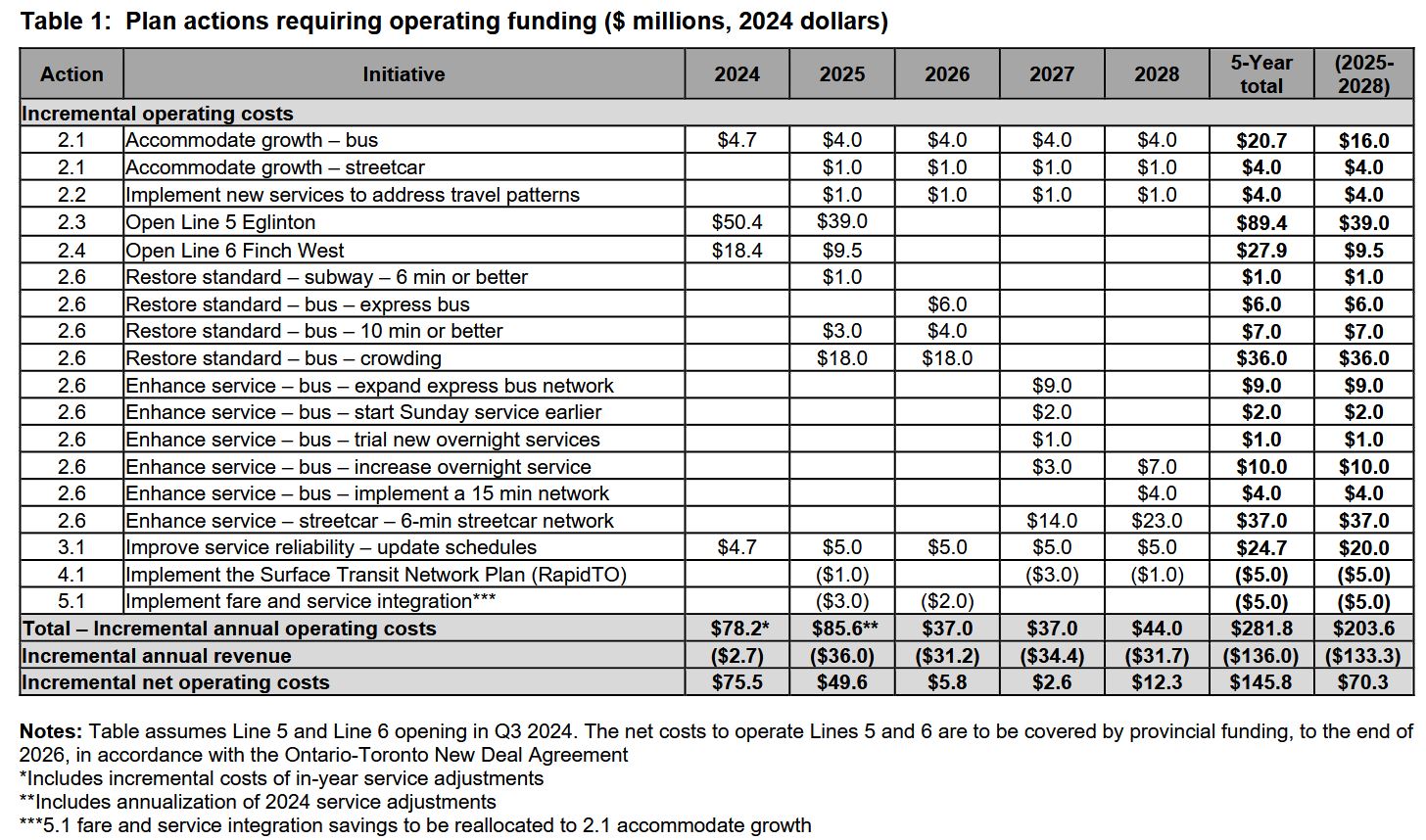
Nothing is even proposed for night service improvements until 2027, and based on typical budget cycles, that really means fall 2027, not New Year’s Day.
The problem shown in the tracking charts above is very much one of poor line management, scheduling and wasted resources. It is almost impossible to tell whether, if buses were evenly spaced, any more would actually be needed, except during that 5-6am hour when service is thin on the ground, at best.
The TTC operates under difficult circumstances, but too many problems are “own goals” all the way from service adequacy and management through infrastructure and fleet maintenance.
Biblical plagues are not responsible for poor service, although the TTC would love to have a supernatural excuse. In the new year, we will see what the TTC proposes for 2025 and whether this will really make a difference for riders.
 Steve Munro
TTC should increase the service between 5 and 6AM, by using drivers who then work other routes after 6AM. But presumably the crew rules don’t allow drivers to be assigned to more than one route per shift?
Michael Schabas
Steve: Many crews are partly on one route, part on another. This happens either because of interlining, or because of two-piece crews that are on different routes. It is common for some late runs to become night cars/buses, and conversely for some early morning service to begin as a night car/bus and then switch later. The problem is not crewing, but how much the TTC wants to spend on service. As an experienced transit pro you should know this stuff.
LikeLike
Took at least one or more 3xx bus a week for more than 15 years. It can be absolutely hit or miss. At least with apps these days I can track and know, back in the day it was just hope and wait.
There is no traffic, there are few reasons a schedule should not be easy to do and maintain at night.
As you say, it’s an obvious own goal.
LikeLiked by 1 person
I’d really like to know how much those staff at stations like King make, to tell you to keep left on the stairs.
Also as a person of limited mobility these days the accessibility of that station is terrible. No elevators, the escalator on the Nb platform is still under service. Since over a year ago.
Keep up the good work Steve!
Steve: Many thanks!
I avoid King Station for some trips specifically because of the issue with limited vertical circulation beyond stairs. The southbound escalator rebuild took forever, and that really shifted a lot of my travel. Elevators are under construction, but they will not be at the north end of the station, rather to the Commerce Court exit which is a poor connection to the King car. That work will not finish until late 2026.
There are plans for expansion at the north end, but the station is constrained by surrounding buildings.
LikeLiked by 1 person
King Station. Steve said
Though this is true, I think the main constraint is lack of $$$ and lack of civic will. Two adjacent buildings are planning major changes; 55 Yonge at south corner of Colborne (a totally new building) and 69 Yonge at King/Yonge (a major reconstruction). In neither case has the City insisted on a direct subway connection – or offered to pay some or all of the cost. The same lack of thought for customers was evident a few years ago when 1 King West was ‘topped’.
LikeLiked by 1 person
The dreadful blue lines. I don’t currently take them but I recall a few times when they would stop running before the subway was open fully. The only thing I liked was spotting them from a great distance away.
LikeLike
It’s the “Ryerson” SLC and CIBC Square experience all over again. I anticipate the result here being the same.
LikeLike
That southbound gap on the 22nd is over an hour and a half… and if you were waiting anywhere north of Finch, it would’ve been nearly two and a half hours!!
My local route runs with 3 buses in the morning. There were a couple of times last month where I only saw 2 on Nextbus, but when I arrive at my stop I saw the phantom third bus (one of those new e-buses) running “under the radar”.
What is the likelihood that there might be runs that made it into service but for some reason aren’t showing up in the data? Maybe one of those northbound buses didn’t actually go out of service starting around 4 AM but there was some sort of malfunction, or there was some other sort of underlying cause?
It just seems too far fetched that there could be a 2.5h gap southbound from Steeles and no one would notice or do anything about it… like release that bus that was laying over at Steeles for more than an hour.
Steve: There are some extra buses running that don’t show up in the tracking data that TransSee uses, but do appear in the data I will get from the TTC in January. It will be interesting to see what differences there are. Also, December 22 was the date new schedules went into effect, and this can screw up the public tracking information. However, that period from 5-6am has rather thin service on previous Sundays when that explanation does not apply.
LikeLike
HI Steve
Not really on topic, but I did want to wish you, and yours, a very Merry Christmas and a Happy New Year. People really appreciate your comments and insights on transit. Please keep fighting the good fight.
LikeLiked by 1 person
Hi Steve.
As an operator who drives the 320, I’ll tell you the real truth on this route.
This route needs police patrols at all times doing checkpoints by removing the problematic riders.
To go from Steeles and Yonge to Yonge and Queens Quay takes an hour. Service planning is aware of problems on this route but refuses to address this. They give operators about 50 minutes each way and this does [not] give us an opportunity to use the bathroom to get up and stretch our legs.
We’ve been calling for articulated buses on this route for years as this route gets busy on early weekday mornings 4-6am and Sundays between 5-8am to no avail.
Steve: I have inserted a “not” in your comment as I suspect that’s what you intended to say. Thanks for the feedback.
LikeLiked by 2 people
Serious question, with ATC fully implemented on line 1. Why do we even have a 320? Wasn’t the idea that we would run all night service on line 1 using a single track? Thinking on this now, and how the dynamics of the city have shifted in the years since this was discussed. Toronto has become a more violent, and unruly city. With a never ending homeless problem. So i doubt this would ever work anyways. New York has a major crime problem on their subways during the day.
Steve: The biggest impediment to single track operation is that most of Line 1’s power supply is not divided with separate cutoffs for the northbound and southbound rails. This means that if there is a power cut for maintenance work, it affects both the northbound and southbound directions. There are a few other issues such as the location of section gaps. Basically, if you’re going to operate single track, you have to design (or redesign) the system for that purpose.
LikeLike