
A reader commented in another post that he had a very long wait this morning (Sunday, December 22, 2024) for the 320 Yonge night bus around 6am. I had a look at the tracking data on Darwin O’Connor’s TransSee website to see what was happening. What I found was not pretty, not by a long shot.
320 Yonge is one of many all-night routes that riders depend on for transportation at a difficult time of the day, but the way the TTC operates this and other 3xx routes in the Blue Night network is a testament to how badly riders are treated at off hours.
I plan a detailed review of overnight service in January, but this will give a taste of what is going on.
Here are the tracking charts showing vehicle spacing and crowding on 320 Yonge for the past four Sundays. Each line represents a bus moving north and south from Steeles at the top to Queens Quay at the bottom. The horizontal spacing shows the gap in service, and the thickness of the dot shows the crowding level. The really fat dots show a bus at 90% or more of its maximum load.
Service between 5 and 6am is scheduled to be thin, but sometimes it can totally vanish as it did northbound on December 1st and 15th, and almost completely for over an hour on the 22nd. There are wide gaps at other times on some dates. For example, a wide gap southbound from Steeles at about 2:30am travels south and echoes back and forth on the line until nearly 6am.
Remember the usual tropes to explain poor service such as traffic congestion, bike lanes and the occasional plague of frogs that are cited to explain bad service. Oh yes, we mustn’t forget how streetcars cannot run reliably in mixed traffic, but, oh dear, the last streetcar ran on Yonge Street 70 years ago.
There is only a minor sign of traffic congestion in the period from 2-3am northhbound. This is a common issue and should be provided for in the schedules. Instead, it generally creates clumps of buses than run together to Steeles and back again southbound.


This is down to bad service regulation in the off hours, something already visible for evening and weekend services in many of my previous article. Overnight bus and streetcar routes have the worst reliability in the system, but they are not important enough for the TTC to care about them.
Another factor evident in these charts is that the buses have inadequate recovery time with which to recover from any delays or simply to give operators a break. This is shown by the immediate turnaround of buses at terminals (top and bottom of charts) with very little dwell time (shown by horizontal lines indicating a stopped bus).
In the Five Year Service Plan, the TTC talks of future Night Service improvements, assuming that they are funded. Here is a table showing possible changes:
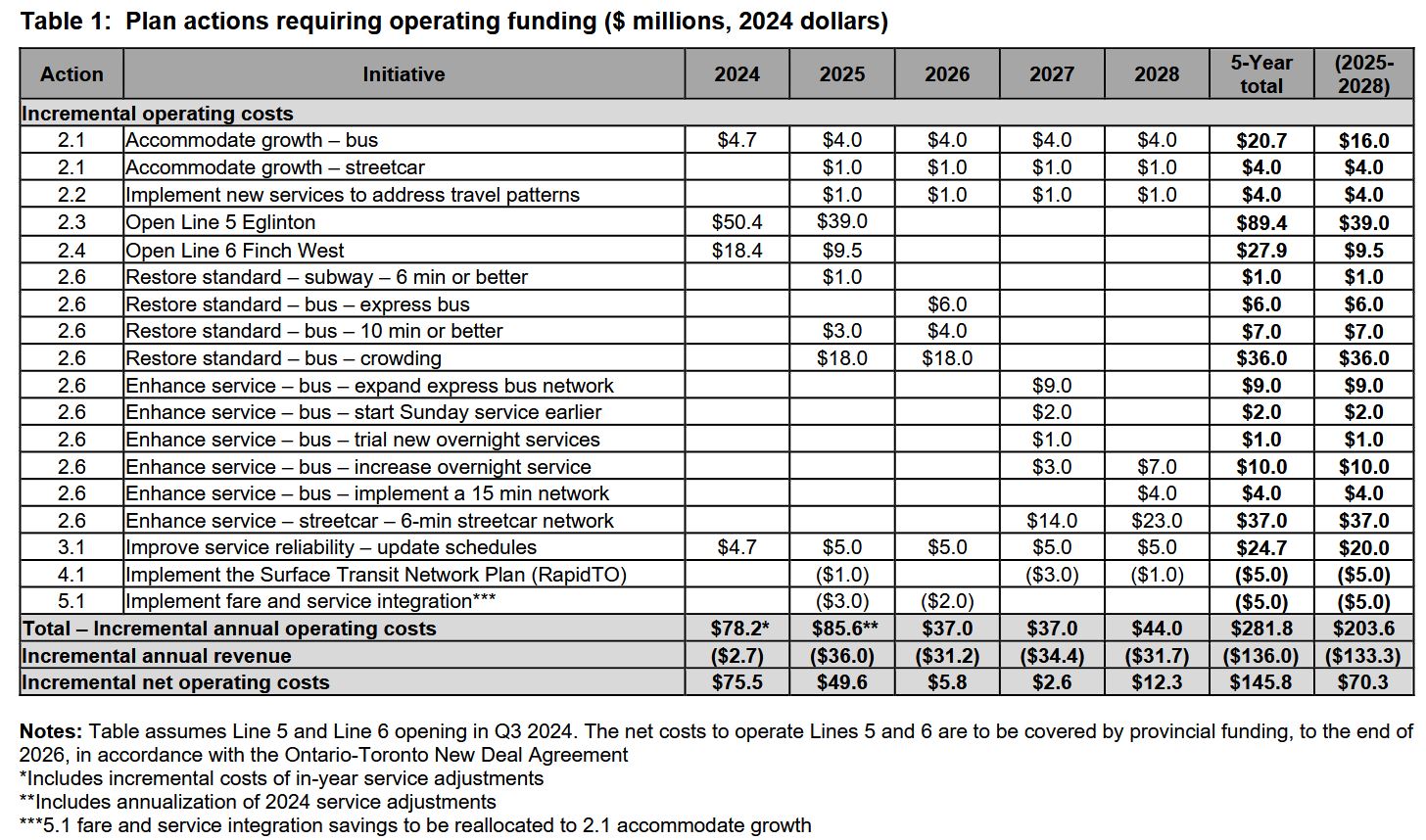
Nothing is even proposed for night service improvements until 2027, and based on typical budget cycles, that really means fall 2027, not New Year’s Day.
The problem shown in the tracking charts above is very much one of poor line management, scheduling and wasted resources. It is almost impossible to tell whether, if buses were evenly spaced, any more would actually be needed, except during that 5-6am hour when service is thin on the ground, at best.
The TTC operates under difficult circumstances, but too many problems are “own goals” all the way from service adequacy and management through infrastructure and fleet maintenance.
Biblical plagues are not responsible for poor service, although the TTC would love to have a supernatural excuse. In the new year, we will see what the TTC proposes for 2025 and whether this will really make a difference for riders.
 Steve Munro