
Updated Mar. 20/24 at 11:15 pm: The URL in the link below to the Fare Compliance Strategy has been corrected.
Updated Mar. 21/24 at 2:45 pm: A section about children’s Presto cards has been added at the end of this article.
On March 19, 2024, the TTC’s Audit & Risk Management Committee considered a presentation from their Internal Audit group and management’s response regarding an updated Fare Evasion study conducted from April to October 2023. See:
The fieldwork was conducted on weekdays and weekends between 6:30am and 1:00am with a total of 25,730 observations. The intent was to update findings from the 2018 and 2019 studies to post-pandemic conditions. One addition to the scope was a review of underpayment of cash fares. Two items remained outside of the scope: illegal entry to stations via bus loops, and fare evasion on Wheel-Trans and night services.
The Committee is small with only three members, of whom only its chair, Councillor Dianne Saxe and citizen board member Julie Osborne were present. They both had time to ask many questions, and it was clear that the report’s findings took them very much by surprise.
The headline number is an estimate that fare evasion costs the TTC $123.8 million annually, and that 11.9% of riders (on a weighted basis across the three modes) do not pay. This is about double the rate found in 2019. A further $17.1 million is lost to underpaid cash fares.
Lurking behind this entire discussion is the question of Special Constables and Fare Inspectors. The higher the purported loss, the greater the political pressure to regain the missing revenue through enforcement. I will not impute a motive behind the audit study, but observe that finding $140.9 million “under the cushions” every year will get Council’s attention. Whether enhanced enforcement will lead to productive staffing decisions and a real increase in revenue is quite another matter.
The Audit Report
The 2023 study used the same methodology as its 2019 predecessor so that results would be directly comparable. One added component, underpayment of cash fares, was also studied, but was reported separately from complete evasion of payment.
The breakdown by mode is shown below. Although the evasion rates for subway stations and buses are lower than on streetcars, there are more passengers on these modes and so the dollar value of losses is higher.

Although the dollar value of losses in the 2019 study do not appear in the chart above, they were reported in the verbal presentation. When both the evasion rate and the dollar values are presented together, there is an intriguing comparison. The rate of streetcar fare evasion has gone up substantially more (86%) than the value of the lost revenue (31%). This difference presumably arises from the lower streetcar ridership in 2023 compared to 2019. It is only the bus network, where we know ridership is more or less back to normal, where the ratios of fare evasion rate and revenue losses are roughly equal.
Although much of the fare inspection efforts focus on streetcar routes with high evasion rates, the growth of evasion at stations and on buses is higher, and the revenue loss on buses tops the chart.
(Note that “Stations” is a stand-in for “Subway”, but would also include evasion of surface mode fares by walking into a bus or streetcar loop without paying.)
| Streetcar | Stations | Bus | |
| Fare Evasion Rate | |||
| 2024 | 29.6% | 6.3% | 12.9% |
| 2019 | 15.9% | 2.4% | 6.3% |
| Ratio | 1.86 | 2.63 | 2.05 |
| Revenue Loss | |||
| 2024 | $30.2M | $26.5M | $67.1M |
| 2019 | $23.0M | $12.9M | $33.4M |
| Ratio | 1.31 | 2.05 | 2.01 |
The presentation contains videos illustrating riders avoiding fare payment in various ways. Although there are links within the PDF, it is easier to view them through the YouTube video of the meeting.
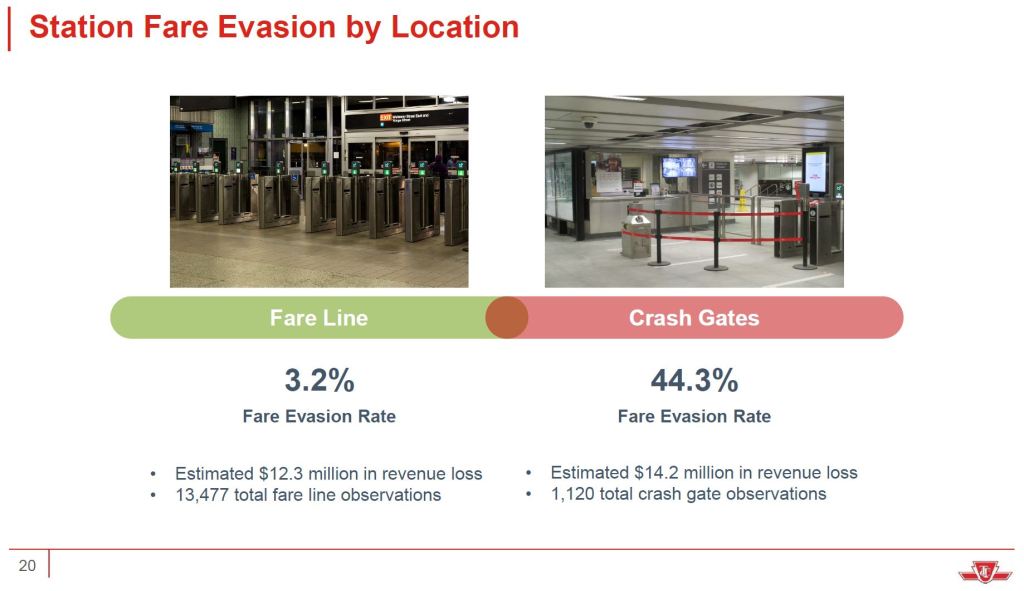
The rate of evasion varies by location and, to no surprise, it is higher where entrances are un- or under-supervised. (No, the TTC is not adopting left side running. The vehicles below are flipped around to put “door 1” on the left side of each frame.)


All-door boarding has been in place on at least part of the streetcar network since the now-retired ALRVs were introduced in 1983. It is simply not practical to load everyone through a single door on large vehicles. With the move to the even-longer Flexitys, any attempt to shift to front door boarding would grind the streetcar system to an utter halt.
On the bus network, articulated vehicles have a similar problem, and even regular-sized buses will sometimes load by all doors for speed. The degree to which TTC uses staff at busy stops to check fares has varied over the years.
In the subway, an unintended consequence of “station modernization” and redeployment of Collectors as roving agents brought unsupervised entry lines (aka “crash gates” after the typical setup for handling crowds) where riders are on their honour to pay. Not mentioned in the presentation was the change of former automatic entrances with high-gate turnstiles to conventional fare lines.
Because riders still pay with cash, tokens and tickets (to the degree these are still in circulation), they need some place to deposit them. Fare boxes at Collectors’ booths have been modified by removal of the trap because an unattended box can fill up.
During the discussion, the committee learned that the TTC plans to stop accepting “legacy media” when Lines 5 and 6 open because there is no provision for them on the vehicles, unlike the TTC’s own streetcars. Riders will pay their fare via machines at surface stops or in the underground stations.
Children’s Presto cards continue to be a problem, although less so now that they have a distinct sound and display on card readers. Usage of these cards dropped 84% midway through 2021 when this was changed, but the remaining cards are used almost entirely (19 out of 20 taps) by people evading fare payment, not by children.
Fare evasion varies by time of day, especially on streetcar routes. One important point about the chart below is that although the rate is higher in the evening on streetcars, the dollar loss in the peak period across all modes is higher because there are more riders.
Elimination of late evening all door boarding to reduce evasion would bring several problems:
- Passengers expect that all doors are available.
- Entry would continue through doors opened by leaving passengers.
- The front entrance of streetcars is a single door, and this would greatly constrain boarding rates.

As for cash fares, there is a major problem for riders whose Presto cards have run out of funds that reloads are difficult in areas remote from subway stations or not served by a Shopper’s Drug Mart which is the only third party payment location. This particularly affects users of the Fair Pass with its discounted rates because there is no equivalent cash fare.
Another problem is underpayment of fares by riders who throw a handful of coins into the farebox on a bus or in a station. The TTC is considering the installation of registering fareboxes that would issue a fare receipt for cash, but this still does not address the lack of support for anything but Presto, Debit and Credit cards on Metrolinx vehicles. Not discussed is the cost of such a retrofit and ongoing maintenance versus the potential revenue gain.
Underpayment of cash fares now costs the TTC $17.1 million per year bringing the total losses to $140.9 million per year.

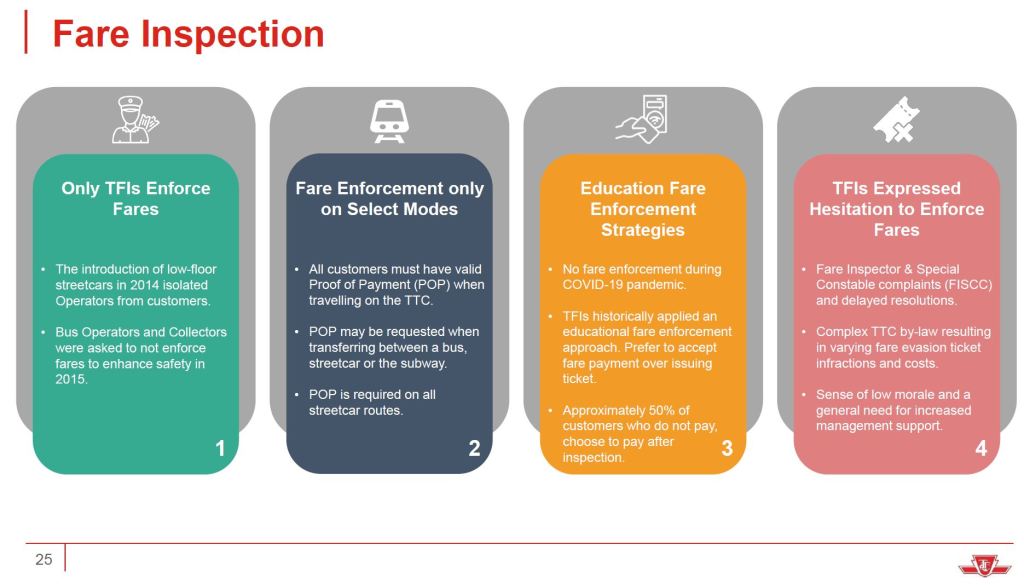
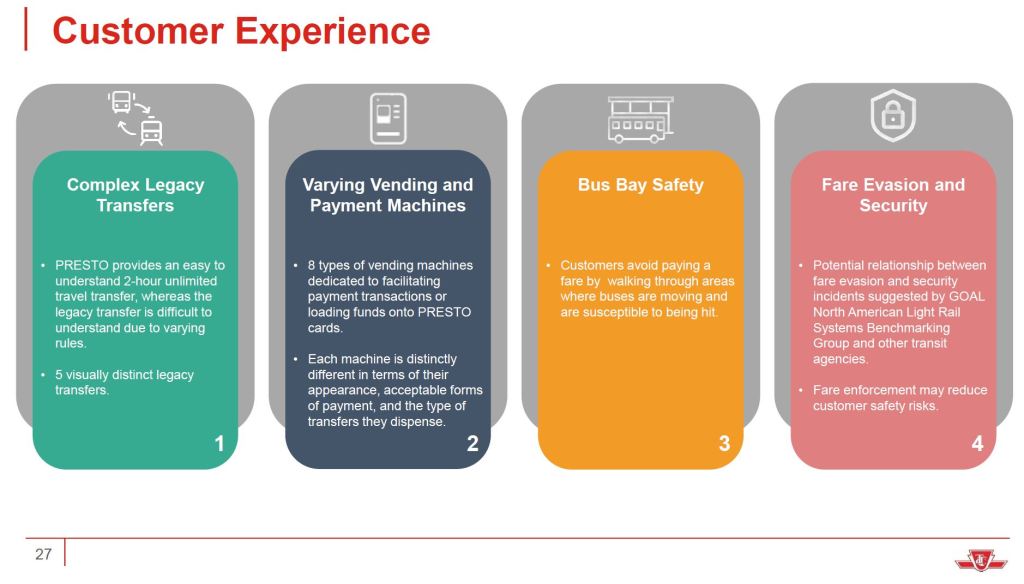
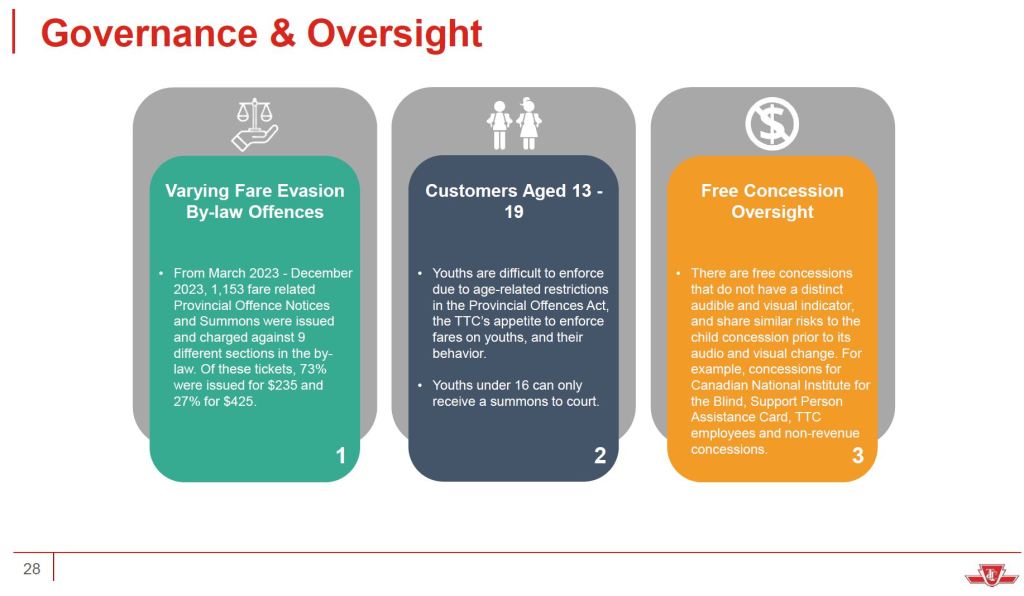
The audit findings included a summary of factors that collectively add to the problems of fare enforcement. Some of these are historical, some political, and some due to technology limitations of Presto that are still not fully resolved. The panels below show a variety of issues and inconsistencies that have either been missed or glossed over with changes in fare collection over past years. Some of these are a direct result of TTC Board decisions and directives that depended on whether the issue of the day was revenue loss, employee safety or social benefits.

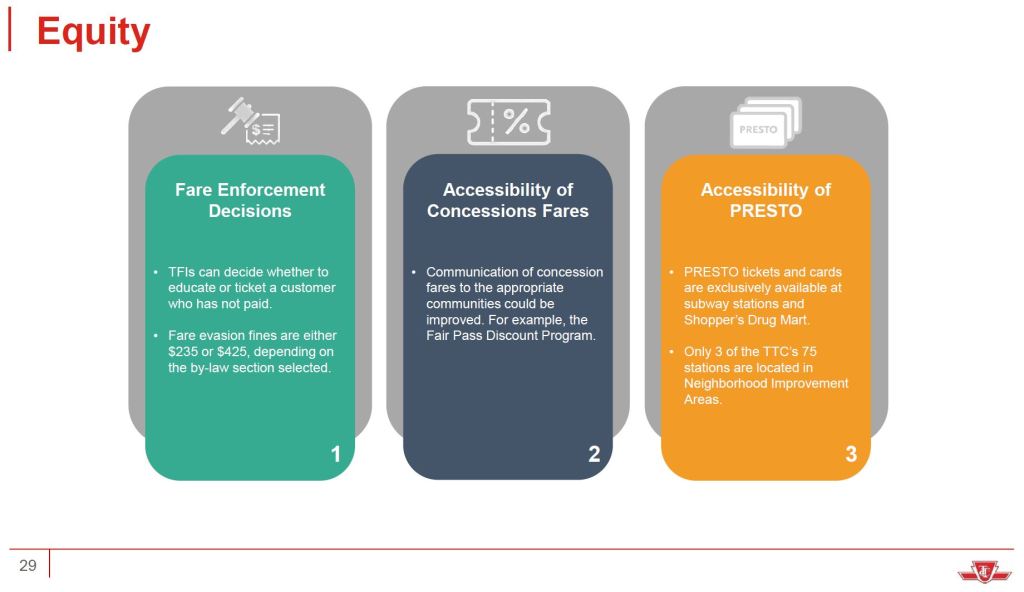
The TTC is supposed to have a Fare Policy Study update in the works, but it has been inactive for two years. Changes, when they occur, are not informed by an overview of fare options and political agreement on a preferred path including the challenge of funding. Annual fare freezes simply paper over the problem by punting discussion to future budgets. The recent regional fare scheme implemented by Ontario is a boon to some TTC riders, but does not address the basic question of which groups should receive discounts.
Management’s Response
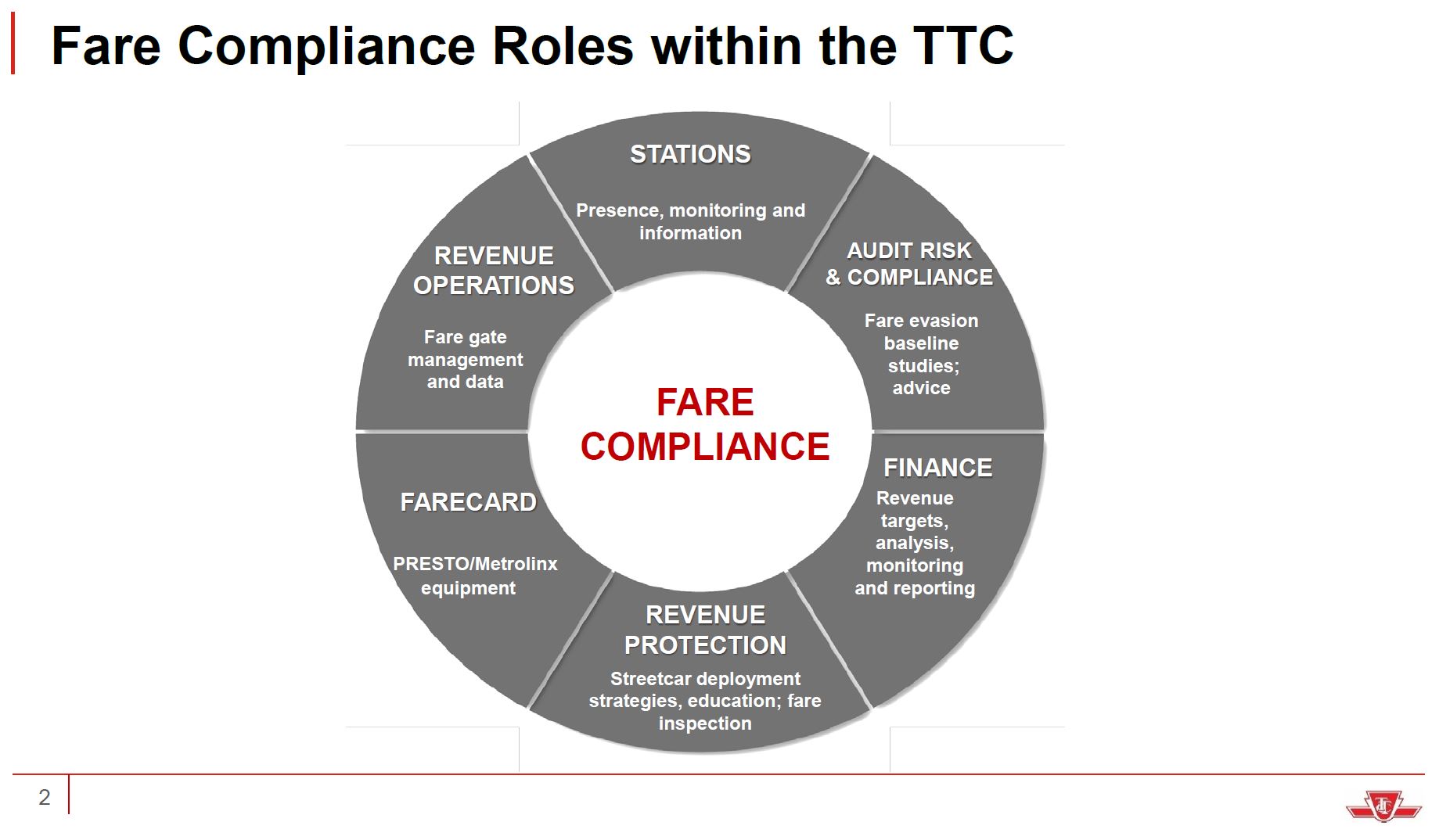
The management presentation began with a chart showing the divided responsibilities for fare controls within the TTC. It is not clear whether there is a single point of responsibility for co-ordinating these efforts.
One oddity here is that “streetcar deployment strategies” is listed under “Revenue Protection”. This might have made sense when there were three different vehicle types with varying degrees of evasion, but now that we have only one car type, this does not make sense.
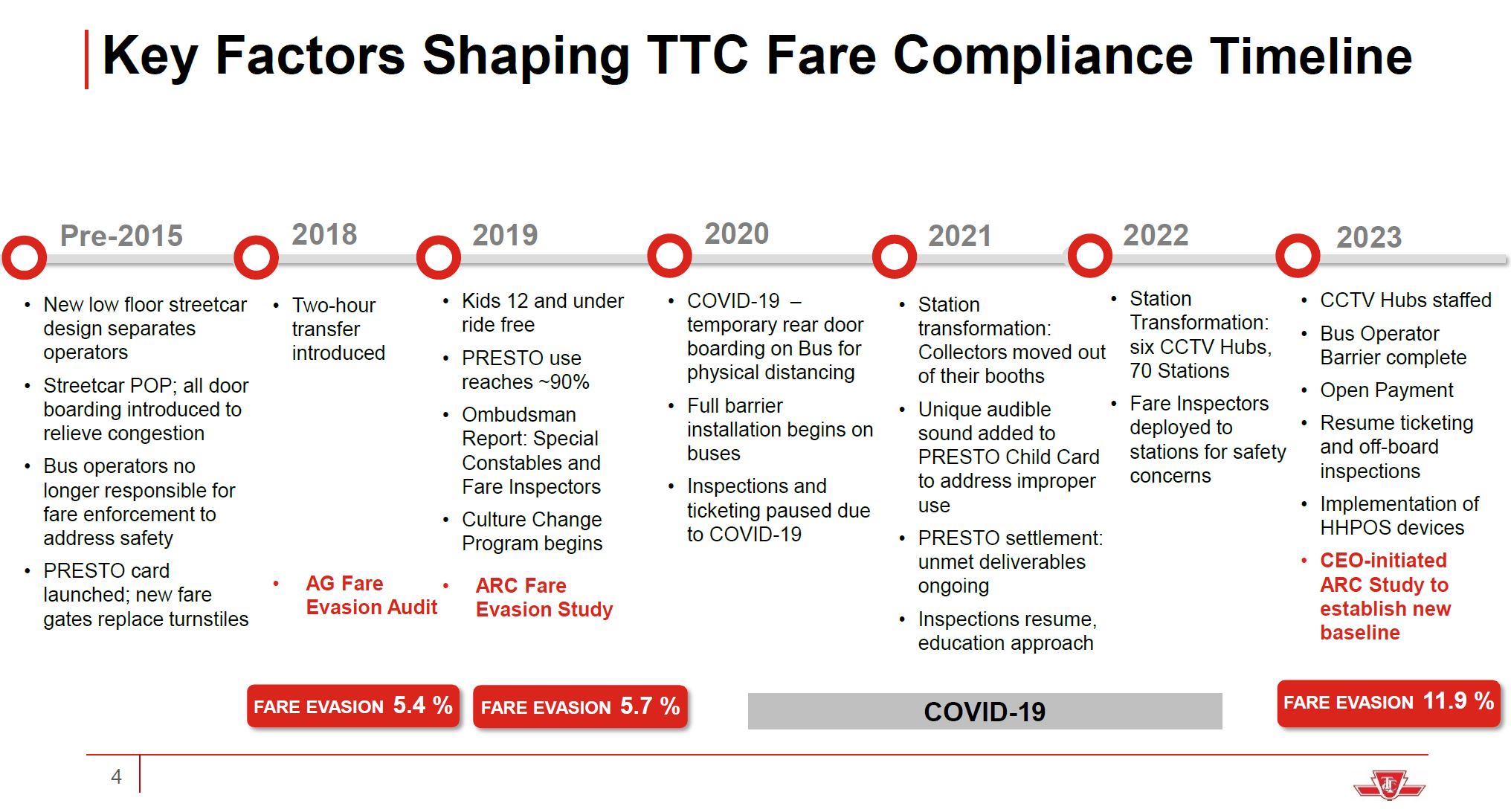
The chart below gives an overview of the changing context for fare collection on the TTC and competing policy demands.
Many issues are not new, but what was once treated almost as a cost of doing business can no longer be ignored. Many transit agencies report increased fare evasion in recent years, and this is not just a “Toronto problem”.
As for the political level, Board member attitudes past and present that range from deep concern for rider welfare to a zero-tolerance policy. In turn, this affects the perceived role of TTC staff in ensuring payment. Some policy changes have dealt with then-current concerns, although this may have created inconsistencies in expectations and inspection practices.
The volume of inspection activity varied substantially over time even pre-pandemic and is still not back to early 2019 levels. The “Taps over Tickets” policy focused on getting people to pay if possible in the hope that their behaviour would improve even without inspectors present. Automated collection of stats is quite recent.

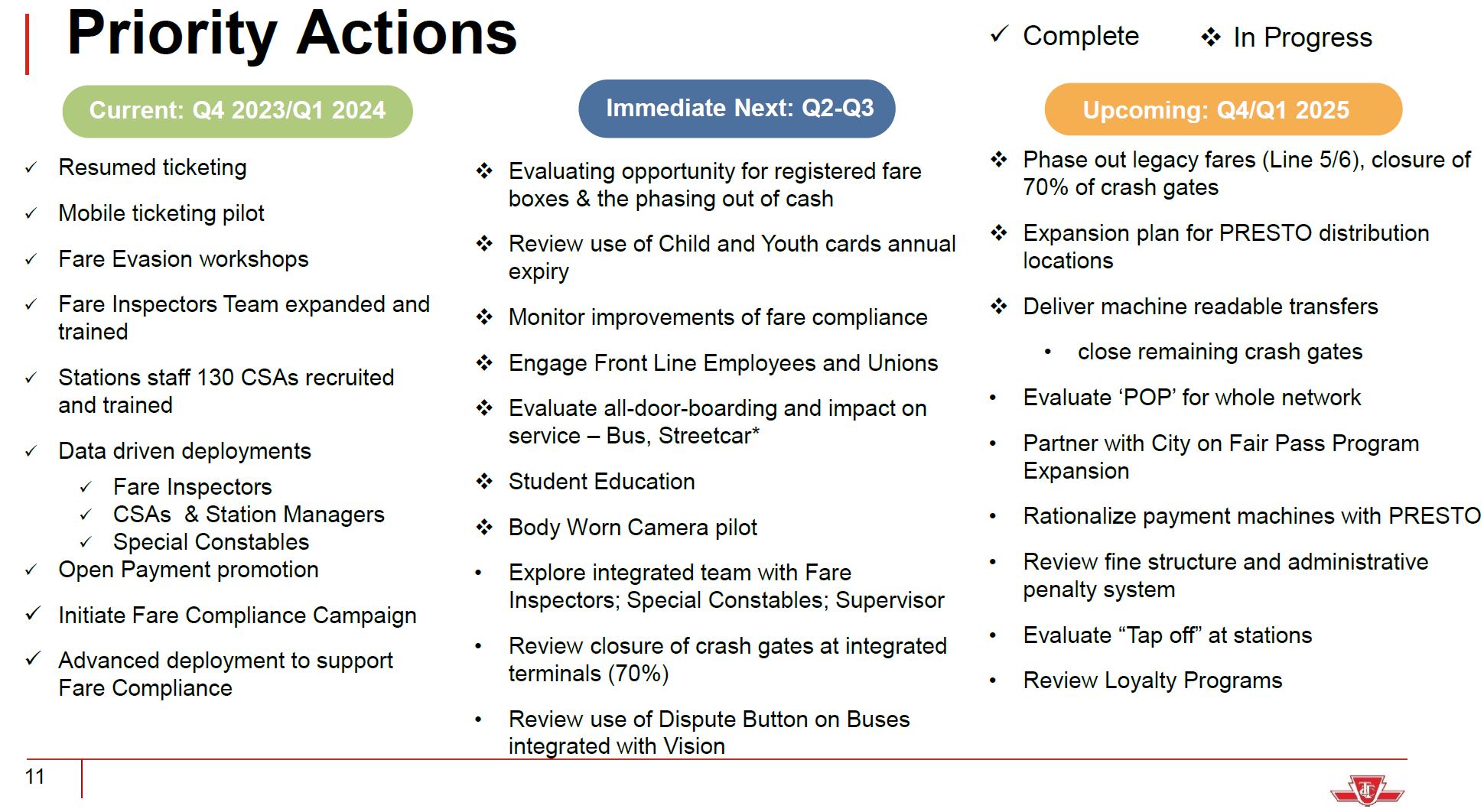
The list below shows many recent, current and planned actions. Some changes, if implemented, will address the physical difficulty of paying by Presto by those who are so inclined (e.g. greater access to Presto reload functions). Some of these will close existing fare collection gaps such as crash gates, but the single largest gap – surface vehicle entry – will remain.
Many past changes address station safety and rider comfort moving through the system, and fare enforcement is only a side-effect of a more visible staff presence. At one time, the aim was to reduce staffing through change in the Collector’s role, but now the the need for visible staff presence has brought staffing numbers back up. However, many of the new staff do not handle fare inspection, nor are they in any position to challenge evaders.
An underlying issue is the assumption that it is even physically possible to inspect fares given increased crowding and the difficulty of moving through vehicles to reach all passengers. This is especially true for buses which have not been a priority as the focus was on streetcars and the effect of all-door boarding.
Management now plans to deploy fare inspectors to known problem locations on the bus network including use of Supervisors to monitor fare payment at rear doors at busy stops. This is a very expensive way to ensure payment.
Cmmr Osborne asked how many tickets the TTC actually issues today, and management answered about 100 per week. That number provoked debate considering that there are about 100 Fare Inspectors. One ticket each per week does not align with the claimed level of fare evasion and the number of inspections carried out, even allowing for riders who tapped when challenged. The number is expected to increase, but there is no target or quota. The option to tap is being withdrawn and tickets will be issued in most cases.
Management hopes to include a financial target for added revenue in the 2025 budget. How the marginal revenue will actually be identified is another matter. Tweaking ridership and revenue estimates is a long-standing practice at TTC in getting budget numbers to come out.
A shift to Proof of Payment on the bus network requires that any rider get a fare receipt/transfer. The variety of “transfer” formats works against fully automated entry through turnstiles. With the two-hour transfer only applying to Presto fares, the rules for a “valid” fare receipt depend on how riders pay.
Since the introduction of Open Payment, the TTC has seen a reduction in cash fares. How much of this is a net revenue gain, and how much simply a change in how riders pay, was not discussed. Also, a rider with no funds on their Presto card might tap a credit/debt card as an alternative. There are no current stats on how these shifts have affected total revenue or evasion rates.
Management hopes to see an expansion of the third party Presto network by Metrolinx later this year, and this should assist riders who do not have auto-load on their cards to prevent running out of funds.
Cllr Saxe asked about the proportion of revenue loss that comes from student fare evasion. Management could not answer this question because this has was not part of the audit. Saxe wondered whether the estimated cost of free fares for students, which she has proposed, was overstated given the degree of fare evasion in this group already. This misses the larger concern about non-payment generally across the system, and we cannot “fix” evasion simply by giving more people free rides.
On the issue of discretionary fare enforcement and ticketing, management stressed that in some cases such as people in distress the Fare Inspector’s role is to do a wellness check and call for assistance, not to write a ticket. In some cases, someone might be new to the city and unfamiliar with the system. This is an example of how a “no exceptions” policy can run headlong into the need for different approaches with some riders.
Changes in deployments of Fare Inspectors will include 4-person teams to sweep through streetcars in both directions, as well as new work schedules to cover periods and areas where high evasion rates occur.
Through the Q&A session between the Committee and management, there was a general feeling that not enough change was happening soon enough, and that the Board has no way of evaluating how well various actions achieve reduced fare evasion.
The original report recommendations were that it be received for information and forwarded to the full Board.
Cllr Saxe moved and the Committee voted to:
Replace the staff recommendations with the following:
The Audit and Risk Management Committee directs the CEO to propose a faster and more thorough action plan to address the problems identified in the 2023 Fare Evasion Study and present it to the TTC Board for approval in May 2024.
Presto will be invited to the TTC Board meeting when this report is considered to comment on the work planned for their system.
Addendum: Children’s Presto Cards
Children’s Presto cards were created to address a problem that does not yet exist.
- The TTC plans to move all Collectors out of their booths and close the “crash gate” fare line that allows free entry to stations. When this happens, all riders will need a Presto-readable ticket/card to activate the fare gates and enter stations.
- Children have ridden for free ever since Mayor Tory brought in that policy in 2015. On surface vehicles, this is not an issue because they simply board without tapping. At station entrances, however, they will need a Presto card. Thus Children’s cards were born. But …
- The crash gate lines are still open in stations, and so children really don’t need a card, yet.
- When these cards were introduced, Metrolinx, in its infinite wisdom, did not provide a distinct display and sound on their readers so that someone monitoring entry to stations would know that a child’s card was used. Most child card usage was actually by adults.
- When the Presto reader displays were fixed to identify child cards, usage of these cards dropped by 84%. However, the vast majority, 94%, of people using these cards were still adults. (See charts below.)
- When the TTC closes off the barrier-free station entrances, there will be a big jump in the need for Children’s Presto cards and the number in circulation. Furthermore, if TTC moves to requiring proof of payment on all surface vehicles, this will trigger the need for all children to tap on to buses and streetcars. This does not appear to have been factored into TTC enforcement plans.

 Steve Munro
Most of the time I just walk now since I can depend on my legs far more than I can the TTC. I pay most of the time, but things have been so broken and unreliable that for every time I get screwed, I don’t pay the next time.
Steve: In all of the discussion, the self-justification for evasion because of poor service was not mentioned. I too am frustrated by the frequency of service disruptions, although these are not all the TTC’s fault.
LikeLike
I’m surprised the streetcar fare evasion rate is so low. I regularly ride the King streetcar, and typically 3 out of 4 between Jarvis and Yonge walk on without paying. In the past 2 years, only once have I seen fare inspectors on this route.
LikeLike
One thing I notice quite frequently is people who tap their PRESTO card only for it to be declined due to insufficient funds.
Rather than argue, the operator ignores it and lets them ride.
In other cases, people try to pay cash only to claim they do not have enough money and again.. the operator lets them on.
Years ago when my father was an Operator in the 90s, he had had stories of repeat offenders trying to get on his bus. He would park his bus until they paid a full fare or got off.
Usually, the person would get off either voluntarily or by threats from other passengers but in the event they did not an inspector was called.
Presumably it is either a Union or Management directive but operators are choosing to ignore fare evasion rather than deal with it.
When I was in Budapest, Hungary this past June, it was not uncommon to see fare inspectors at the exit points of Subway Stations or on Streetcars.
In Budapest, they take a no nonsense approach to fare evasion. If you are caught you are issued a fine that is immediately payable on the spot.
They enforce the same policy for tourist and locals alike without exception.
More on their fare evasion fines here.
Personally, I would love to see a system where each vehicle is a new fare. This would eliminate questions about fares being paid if someone walks in off the street into a subway station or onto a parked bus.
We need to do more. Ignoring the issue and pretending it will go away does not solve anything.
Steve: The TTC network is built around transfers between routes. A new fare for each change of vehicle would discourage a lot of travel. That said, if a fresh tap were required to board vehicles in “paid” areas, that would have the same effect. The only problem is that people have been transferring in paid areas for 70 years.
Forcing people to pay on pain of holding a bus full of riders hostage simply is not on. One big issue for operators, and not just “the union”, is the problem of violence by riders. This is the reason for increasing barriers between ops and passengers. It is TTC policy that operators not engage with passengers.
I remember a crusty old operator on the 59 North Yonge bus who had a standard way of dealing with people who said “but I only have a $20 bill” (a huge amount of money in those days). He had a Crown Royal bag with $20 in small change, mostly dimes, nickels and pennies and would happily exchange it for that $20. In those days the fare north of Steeles was 10 cents per zone.
LikeLiked by 1 person
The things I take from this are:
50% choose not to pay when confronted by fare enforcement – this seems to indicate that for at least 50% of the 130m$ we can count it as social assistance of some sort or other…and that there is likely add on effects of enforcing against these folks in a more aggressive manner (ie they likely can’t pay the fine anyways), as well as increased social issues – ie can’t get to a shelter, or a job, or a safe injection location…that we would end up paying for in other ways…
Steve: I think it is incorrect to assume that those who refuse to pay cannot afford to pay.
We can’t enforce against anyone 16 and younger and it’s risky to enforce against anyone 18 and younger…they know it, we know it…so let’s just eliminate them from the stats…either by removing them from the stats, or by removing them from the fare system…ie let’s just make it free for them…simplifies a lot of things, removes risk, focuses us on things we can control and change.
8 types of payment machines? Someone needs to audit that…
Presto could likely eliminate a lot of the non-payment on busy vehicles by just adding a “pay now” button in their app…and a quick refill button with Apple Pay…especially useful now that we have cell phone on the subway…
LikeLiked by 1 person
Hi Steve,
From what I see on my TransLink trips the situation here is similar, although even on the 99 and R4 I see most people boarding at all doors tapping on. Fare evasion varies hugely by route. Buses through downtown are worse than crosstown and suburban lines.
I retired almost fourteen years ago, and on the 7 Dunbar/Nanaimo my usual passenger count was 400 boardings, and 40 were unpaid fares. The worst looking person boarding sometimes paid in full, while the guy with expensive clothes would not.
When I started in 1969 fare evasion was so rare that months would go by without an issue. Some drivers called for a supervisor or the police. Often the reason was genuine – we always let young kids on who ran out of money. I was a passenger once and the driver stopped the service for several minutes when someone refused to pay – 25 cents. A passenger ran up, put in a quarter and told the driver to get moving! This was fifty years ago.
[In other news:]
My latest video
Steve: Oh look! Electric buses. With poles! And well-maintained overhead.
Angus.
LikeLiked by 1 person
I will limit my comments to a few items above.
LikeLike
The paucity of tickets being issued really makes me wonder how valid a fare evasion study conducted by watching cameras after the fact really is.
Maybe people aren’t tapping on the streetcar because they have in fact paid, whether as a 2-hour transfer or a monthly pass.
100 tickets would be issued by boarding three streetcars at rush hour if the proportions claimed are even close to correct.
LikeLiked by 2 people
Wow.
LikeLiked by 1 person
The cost doesn’t really factor into this. If someone from up high demands it then it will be paid for come hell or high water. Such was the situation was with the new fare gates. If no one in charge cares then nothing will be done. Such is the situation with the streetcar switching system.
LikeLike
Steve, I come down from Richmond Hill five or six times a year to the city usually for medical. A few months ago, I was at Eglinton station bus terminal waiting for the Avenue Road bus. During that period, I saw 5 people walk in off Duplex and head for the subway. I live near the Richmond Hill terminal at Highway 7 and Yonge. They have fare enforcement officers there all the time. They work in teams of twos. They carry mobile to check if someone has not paid their fare (sort of reminds me when the driver used to stop at the zone 1/2 boundary on the route to check the fares/transfer).
I can remember using the old scholars tickets when I was in high school. They were valid from 6AM to 4:30PM (remember). I had a football game one afternoon. Ran out of the school at 4:28PM. Streetcar came at 4:32PM. Deposited My ticket. Driver told me I needed another ticket or cash equivalent because it was after 4:30. I had no ticket or cash. It was the only time that I had to go begging on a crowded streetcar. A nice woman gave the cash. Oh how the times have changed.
Steve: The TTC weeps about fare evasion, but the deployment of inspectors leaves something to be desired.
LikeLiked by 1 person
A new evasion behaviour I’ve seen regularly on the streetcar is people taking advantage of open payment’s longer latency to flash their debit card quickly in front of the presto reader without pausing long enough for it to transact.
I don’t know who they think they’re fooling as the reader obviously doesn’t make a sound, but I guess it gives them the mental alibi for when the inspector comes by – “oh I thought I paid”.
Steve: Yes, I have seen this, but felt that people just assumed either a misread, or whatever. For any kind of contactless system to work it must be fast, fast, fast. The “Presto” brand name is a misnomer.
LikeLike
One thing I see frequently on buses is how much more comfortable people are fare evading on crowded vehicles, and those are much more common these days.
Steve: I have seen people on crowded streetcars try to reach a fare machine and give up because of crowding.
LikeLiked by 1 person
These numbers are so delusional. The amounts are much, much greater than this. TTC is kidding themselves and the public with these flat out lies.
Steve: I doubt that the numbers and “much, much” greater and if anything they could be an overestimate based on sampling in areas where one is likely to find evaders. I have to get the full report to see the geographic and temporal distribution of the inspections.
LikeLike
LOL levy other forms of revenue (p parking, highway tolls) and just make the TTC free already! honestly how much are inspectors even eating up in the budget and still not really accounting for the loss. ALSO! we get harassed by them even as paying customers.. analyzing our Presto history ? what even is that?
IF YOURE PAYING HST I EXPECT THAT INVOLUNTARY INVESTMENT TO METROLINX TO YIELD SERVICE LOL
(if we didnt have winters i would be cycling year round… cuts about 1/3 of the commute time downtown…)
this post is terrifying – especially the priority actions.
LikeLike
If the TTC won`t respect the system neither will the public. The decline marches on.
LikeLike
So wait… Is this study based on actual checks of people onboard transit vehicles, or looking at video from cameras?
Because not tapping because you have a transfer or a pass makes the latter… less than accurate.
Yes I know the signs say you should always tap, but let’s be real. You wouldn’t get a ticket if checked (because you have paid!!!) so it’s not fare evasion. And there’s many reasons not to tap if you’ve paid, from slow machines to crowded vehicles to just plain laziness in getting the card out.
(Yes I am aware of the edge case of tapping when you board a vehicle shortly before the 2 hour transfer expires, and being checked after the window expired. And yes, *I* tap every time, but not everyone is a goody two shoes, and that’s fine.)
Steve: The audits were carried out by staff in plain clothes observing riders. I hope to get the full report with specifics about the methodology. However, I agree that it is possible that someone could board without tapping for legitimate reasons.
LikeLiked by 1 person
I don’t think they are checking fares properly on streetcars. I haven’t seen them do it recently but they really need a team of inspectors to sweep all doors, not 2 of them slowly staring at one end while everyone taps.
With such a high rate of evasion and the level of violence these days, I would say it is appropriate for them to carry weapons now but they should be required to use body cameras to justified any interactions.
Steve: They are starting to roll out body cameras, but do not yet have enough so that every fare inspector has one.
LikeLike
TTC really needs to get rid of cash fare and the cash box. Most people who pay cash are not paying the exact fare. With the cash box gone the TTC can close that free gate inside stations. I have traveled on the best systems in the world and no where is there a free wide open gate that anyone can just walk through.
If you eliminate the cash box you can also eliminate paper transfers. Seriously why does TTC have these still. I have seen people get caught with 6 month old bus transfers. theses people will just pull out a piece of paper and casually walk on a bus or into the subway station.
Since I am mentioning transfers, why did TTC think it was a good idea to have people take a subway transfer as they please. TTC employees should be the one issuing those not those red machines. I have seen many people not pay and than just grab a transfer.
If you travel to Paris, London, Tokyo, Hong Kong or any major transit system there is no cash box. If you want to ride the system you have to buy a ticket or use a card. TTC is 3 decades behind. If in small towns in Japan they expect you to purchase a paper ticket. They don’t let you drop what money you have in a box.
Finally children should not be riding for free. It is ridiculous that every other customer is subsidizing elementary children to ride for free. The best systems still expect children to pay (except London) so why are we letting them ride for free. TTC is creating a generation of entitled privilege riders.
Finally TTC should switch from a one flat fare system to a fare by distance system. This one flat fare system is a joke.
Steve: The reason cash fares still exist is that Metrolinx’ fare machines were designed for a commuter environment with higher fares and the assumption that people would not pay a single cash fare, but would pay via a stored value card. There are machines on streetcars that can issue fare receipts, but the original plan to put these on street was never implemented. The credit card readers on these machines never worked and they were removed years ago.
That said, the incompetence of Metrolinx design was not the only factor, and TTC was reluctant to eliminate cash and tickets. They stuck with their standard fareboxes for a long time, and it was only with the latest generation of streetcars that the farebox was removed. This left us with a hybrid system.
They expect Metrolinx to come up with a new generation of fare machine that can handle cash fares in 2025. Several parts of the original Presto contract were not delivered by Metrolinx to this day, and their ever-friendly CEO Phil Verster quite arrogantly refused to make good on the contract. In turn that left TTC with a half-baked system.
The subway transfer dispensers go back to the original subway system when it was impractical for staff to issue transfers. Remember that most riders enter using turnstiles, and transfer machines were not built into them.
As for children riding free, that was a political decision by former Mayor Tory who needed to be seen to “do something”. It was pitched as a way of lowering costs for poorer families although obviously it benefitted anyone with kids who used transit.
We have to part company on fare by distance as the implications of such a system greatly complicate fare collection and inspection, and would penalize those who must travel long distances within the city. Zone fares were eliminated 50 years ago, and they are not coming back.
LikeLike
11.9% is astonishingly high… It’s never going to be zero (TfL is at 3.9%) but still.
I wonder if the TTC uses Presto data to work out where hotspots of fare evasion are located, allowing targeted enforcement – rather than a blanket approach. I also wonder if the TTC has spoken to other agencies (both in Canada and internationally) about their approaches?
Steve: TTC compares Presto data with Automatic Passenger Counter data, as well as simple reports from operators of areas of high fare evasion. They claim that they are deploying fare inspectors to problem areas, although the move to bus routes is more recent. Yes, they do speak to other agencies. This was mentioned in the presentation.
LikeLike
I’ve seen people getting into the station at Eglinton through the bus driveway every time I’ve been there waiting for a bus. Yesterday I counted thirty people.
LikeLiked by 1 person
Do they do any stats on people paying MORE than their own fare as I have on multiple occasions because I didn’t have change. Y’all don’t care then.
Or when your fare inspectors immediately start to threaten people (as I once was) because they FORGET to check for a metro pass on the presto card when that was a thing? Literally get yelled at and accused before I had to remind them I have a bus pass and then they don’t even apologize just make up excuses.
TTC is trash. They do not give a single care about anyone on the TTC. Had a subway conductor close doors ON ME literally injuring my arm. Opened and closed it 3 times in a row like it was a game. Or when I literally watched someone that was disabled get the same treatment with the doors and the subway conductor yelling at them to move away from the doors…as they tried to get off the train that the conductor was opening and closing the door at the same stop multiple times. But then when their coworkers are there, they doors stay open while they chat it up.
LikeLike
Steve: This comment was left by “Leslie” under another thread. I have moved it here.
May I suggest that that age for children’s fare be lowered to age 6 years old again far to many teenagers and adults claim to be 12 years old!
Also there should be police parked by the bus entrances to the stations for the people who feel they can walk in and out of the stations!
Steve: The whole purpose of free children’s rides was as an aid to poorer families whose school-age children use the TTC. A six-year cutoff would be contrary to that purpose.
As for people using bus entrances, at many stations the bus platform is right at the sidewalk line and there is no danger in using that route out of the station, not to mention a considerable time saving. It is people entering without paying who are a problem. A police presence would be a very expensive way to deal with this problem when the TTC already has its own security staff.
A related issue is that inspecting fares on vehicles is a lot more comfortable than standing out on a bus roadway to discourage people from walking into stations. Moreover, there would be few or no tickets issued if the effect was simply to redirect riders to a proper entrance. Management would not get their gold star.
LikeLike
I feel that students over 13 should show school 🆔, for proper fare, as it use to be many years ago. Also should have inspectors on all buses, especially at the back or another TTC/bus employee, for managing fare, and over crowded buses. Unfortunately there is not enough room on this platform for me to give 100 other ways which can improve for both the driver’s and passengers. Like one really important one, driver you see the bus is full so, put drop only no pick ups. Instead of gaming everyone on and then saying I can’t go because you’re not behind the yellow line. Oh that is one that gets me all the time.(once to many).
Steve: A number of policy changes over the past decade have aimed at reducing staff counts, and this affects the ability to handle fare inspection or monitor rear door loading. Now the TTC has discovered they have a problem and are staffing up again.
LikeLiked by 1 person
The last time I saw them do an onboard sweep (sometime this winter) it was a team of four, no idea if that was real or a training mission. I would agree that one inspector per door is the way to go, you could possibly get away with two during less crowded times.
The most common enforcement I’ve seen is at Spadina, Bathurst, and Union, where there are a couple of inspectors waiting as you exit the streetcar, blocking your path to the street or the subway until you go through their screen.
When I lived in Germany I thought their method of fare enforcement was ideal. I rode daily, and reckon I saw an inspector every 3-4 weeks. It was common enough to be a threat, I had a pass so I didn’t worry about penalties, and the system generally relied on all-door boarding with POP so boarding and alighting were quite efficient. Inspections were quick and at least on my routes rarely seemed to bear fruit. The relative frequency of inspections seemed to drive compliance.
LikeLike
This past Tuesday early afternoon, I was returning from errands with 20 minutes to spare within the two hour window, going from Osgoode station to Wellesley station, where I would be transferring to the bus. (Wellesley is the only subway station south of Bloor/Danforth with a bus loop that I can think of). However, there was a “security incident” at Wellesley, and the trains were turning back south at College station. A TTC guide at College was informing people that the incident was to clear within 5 minutes and normal service to Wellesley was to resume. However, those 5 minutes stretched into 20+ minutes, and my two hour window had expired. But, I had taken a transfer at the red machine at Osgoode station. So, I finally gave up waiting and went upstairs to catch a streetcar, knowing that I was legitimately entitled to a free transfer, and that I had a receipt for it. I was joined by many others. Again & again, ALL the escalators in every subway station were going down, not up, and I could not make it all the way up to the top of the stairs at College, nearly passing out due to my heart condition and stiff painful legs! So much for accessibility. There ought to be a law about escalator direction.
Canadians, particularly in Ontario, suffer from “Not Invented Here” syndrome (NIH). In Ontario public transit is almost the most expensive in the world, only London England costs more. In contrast, most transit in Estonia is free. Elsewhere, that I have witnessed, local rides are just pennies, and commuter trains only a few euros. I wonder what percentage of a TTC or GO fare is to pay for fare collection? Presto readers, transfers (paper, ink & dispensers), collection & handling of legacy tickets & cash, gates, enforcement, repairs & maintenance, computer systems, accounting, etc.? How about the social good? How about commuters’ choices of car vs. transit and how much do extra roadways cost the taxpayer and the environment? Highway 413 built in the Greenbelt?
A few more examples of NIH: the non-standard Ontario Line, Eglinton-Crosstown LRT, and proposed non-trolley electrified buses.
LikeLike
Fares should be able to be validated by an inspector anywhere on the network, including subways, buses and the coming LRTs. WIth our system so integrated at stations, if one can get through the streetcar portion of their journey, the rest of the system is theirs for the taking. Even the vague possibility of having your fare checked on other parts of the system would somewhat reduce non-compliance and also help with riff raff.
LikeLike
I actually feel that the fare evasion ratio is greater than they care to admit –I go through Sheppard Yonge station every afternoon, and with a 8-10 minute wait see 20+ persons walk in off the street every day. If/when the Special Constables decide to stop these persons, they screw it up by parking their vehicle right out front where they are announcing that you gonna get checked;. I asked why they didn’t park in the employee area on the west side out of view – no one ever thought of it. And they wonder why there were no fish in the pond to catch. Wile E. Coyote has nothing on these people.
Additionally – once the bus platform reconstruction starts, the buses will apparently load/offload on Sheppard in front of the bus bays, and a path will be left to walk into the station. Once that genie is out of the bottle it will be impossible to put back in.
LikeLike
Fare enforcement and constables are not given the tools to do their job properly. They are told to simply “educate” the public and not to give tickets as it’s “bad customer service” On top of this you have the entitled generation who do not believe they should pay for transit.
LikeLike
Instead of letting all children ride for free the government/school board should give these children preloaded presto cards with enough money for one semester. I don’t see why affluent children should be allowed to ride for free.
I have seen white males in their 30’s claiming to be 12 and just walking into stations because there is a free gate that anyone can walk through. TTC needs to close that gate.
Payment on TTC should only be Presto (card, ticket) or credit/debit card. People who want to pay cash should be forced to buy a ticket like on other transit systems.
LikeLike
The TTC needs to have 1-3 fare inspectors per bus route in the city, with special focus put on school routes and arterials.
Would require only 100-300 more inspectors. One could ride inbound and another could ride outbound.
While it won’t be enough to supervise every vehicle, the chance of a fare inspector being on any bus could spook people into paying.
Also, we need to stop subsidizing and allowing middle/high school hooligan trash on for free. They’re one of the worst behaved groups on the system that pile on like animals at the stops they’re waiting at, and scream, fight, and launch fireworks on buses. I’d rather have a homeless guy on my bus before a group of these barbarians.
They can walk for all that matters.
Steve: At an annual cost of over $100K per inspector, including benefits, 300 more would set us back at least $30 million. Whether we would recoup at least that much revenue is hard to say.
LikeLike
If this was intended to be a temporary measure at some point, it’s become de facto permanent now, and it’s usually not the operator’s decision. At nearly all transfer points and other busy stops, there’ll be at least someone getting off through the back door, and once the door’s opened, it’s trivial for riders to be able to start streaming in. Maybe some riders are doing it because they want to get in faster or because it looks like there’s more space in the back. But plenty do it to avoid the operator’s gaze when they don’t tap. (But feeling no shame in the gaze of all the other riders that paid their fares.)
Something needs to be done to counteract the change in culture that it’s suddenly now OK to nonchalantly walk into a bus/streetcar or through the bus terminal without paying. How far it’s gone since the days when operators would challenge your transfer.
LikeLike
Did you know that fare invasion happens on Wheel-Trans, where operators drive one person from one end of the city to the other end of the city (to race track for instance), and the customer is a no fare?
Steve: Yes. WT is mentioned in the Audit report as one of the areas that they did not review.
LikeLike
Can someone educate me on how the fare enforcement actually works? For example, if fare inspectors corner someone who legitimately should have paid a fare, but has no proof (no Presto card, no transfer, whatever), and claims not to have any ID on them, how do they issue / enforce a ticket?
In the past two years of 3-5x/week commuting on the 29, 512, and Line 2 I’ve never seen a fare enforcement officer, so I genuinely don’t know.
LikeLike
People think it is the poor that evade fair. Actually it is the rich that evade fare. Go to Lawrence station secondary entrance and watch all the affluent rich white people evade fare. Summerhill, Rosedale, Finch, Sheppard, Bayview.
LikeLike
Most of the people who don’t pay choose not to because a lack of enforcement.
LikeLike
Do you know why tokens and senior tickets are still valid for use? Is the TTC selling them to charities? Several years ago at a public meeting about Presto, representatives from a few charities, who buy fares in bulk for their clients, complained about being stuck with surplus Presto tickets after their 90-day expiry.
Steve: Yes, this is a Presto stupidity. It sounds as if they have not worked out a process to buy back expired tickets. BTW the reason for the expiry is that a list of valid tickets is downloaded to every reader in the network, and they don’t have enough memory to keep the whole list.
LikeLike
Reading this article has me immediately think that the answer is to remove fare collection, make the system free, and collect through taxes instead (including visitor/hospitality taxes to include our visitors.) Much more reliable revenue that way, and eliminates all the dickering with these crazy systems.
Steve: The problem is that the total fare revenue is over $1 billion and is equivalent to at least a 25% property tax increase (1% generates about $40 million).
LikeLike
The TTC has made numerous policy choices over the years, that simply make fare evasion higher. The failure of having operators enforce it is just wrong. They could eliminate 75% of this, simply by changing the policy that buses don’t move until those boarding pay – which other agencies do.
And putting a staff-person at every fare line – which you do see in other places.
Streetcars are a challenge – but with so little checking, then what message does it send.
Even then though, the rates are higher I’d have thought.
The bizarre and vehement opposition to free child fares seem odd, given the almost trivial revenue they collected from this age group, when there were child fares; it’s hard to imagine the cost was much lower than the revenue! And it would be a lot lower, if those child fares were proportional to distance travelled!
One wonders, when it simply becomes easier to eliminate fares entirely.
Steve: As I have said before, fare revenue brings in over $1 billion, and that would have to be replaced from other sources. The avoided cost of enforcement probably would be small given that there is an increasing need for security or at least some visible staff presence in stations.
LikeLike
Not arguing that evasion rates are not higher than we would want to see them, but I really wonder how they think that they’re getting an accurate count from visual audits. Some of the things that are relatively common (not tapping onto a streetcar, walking into a station through the bus loop) could be evasion, but could also be convenience by someone who does in fact have a valid fare, be it a transfer or a pass.
LikeLike
Anyone going to call out Koroush for his blatant and open racism. He seems to think someone’s skin colour has any importance in any of this.
Steve: His point is that there is an assumption among many that fare evasion is practiced mainly by poorer people who are more likely to be people of colour. In fact, there is lots of fare evasion by people who present as middle class whites, but nobody ever talks about them as if they are all deadbeats.
LikeLike