
An ongoing issue with TTC service levels is that TTC claims about crowding do not always appear to align with rider experiences.
The TTC Board’s February 22 agenda includes a report about proposed free transit for Middle and Secondary School students, particularly for group field trips.
See: A Step Towards Free Transit for Middle and High School Students
Among the issues raised by the report is the ability of the transit system to handle the additional loads, and the need to co-ordinate planned outings with the TTC for provision of extra service. There is a map showing existing “hot spots” where mid-day routes are over capacity.
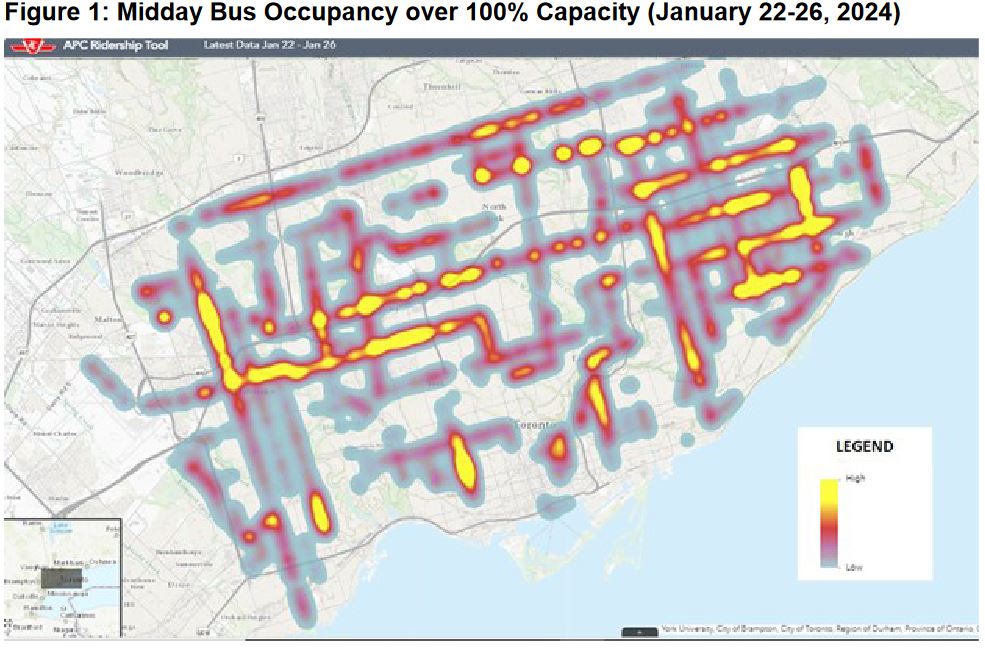
Many bus routes have this problem, but none of the streetcar routes.
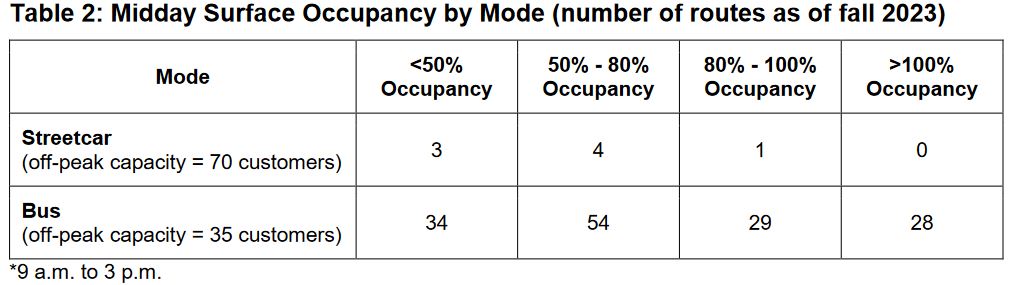
A related issue is the degree to which crowding varies by day-of-week and the danger that Monday-Friday averages could mask problems with midweek demand levels.
Of particular note here is that the off-peak capacity shown is 35 per bus, not the higher value introduced with the 2023 budget that is close to a standing load. The heat map shows us where current operations exceed the 2023 standard, i.e. those over 100% occupancy vs a bus capacity of 35. Note that these are six-hour averages and individual bus loads will vary.
This also shows the scale of service changes required to reinstate the pre-2023 standard.
Here are the official Service Standard crowding levels and those implemented in the 2023 Operating Budget. The TTC Board has never formally change the Service Standards, and management plans to work back to the existing standards from the 2023 levels as part of future service and budget planning.
| Service Standards Peak | 2023 Peak | Service Standards Off-Peak | 2023 Off-Peak | |
|---|---|---|---|---|
| Bus | 50 | 50 | 35 | 45 |
| Streetcar | 130 | 130 | 70 | 90 |
The TTC produces a lot of charts in their monthly CEO’s report, but crowding maps like this one showing actual conditions only appear to support analyses of specific issues. They should be a standard part of the CEO’s Report so that there is an up-to-date indication of service capacity versus demand for all time periods.
 Steve Munro