
At its meeting of January of January 25, 2024, the TTC Board received an update on the status of a busway in the former SRT corridor.
- Scarborough Rapid Transit (SRT) Line 3 Bus Replacement and Busway Status Update
- Scarborough Rapid Transit (SRT) Line 3 Bus Replacement and Busway Status Update – Supplementary Report
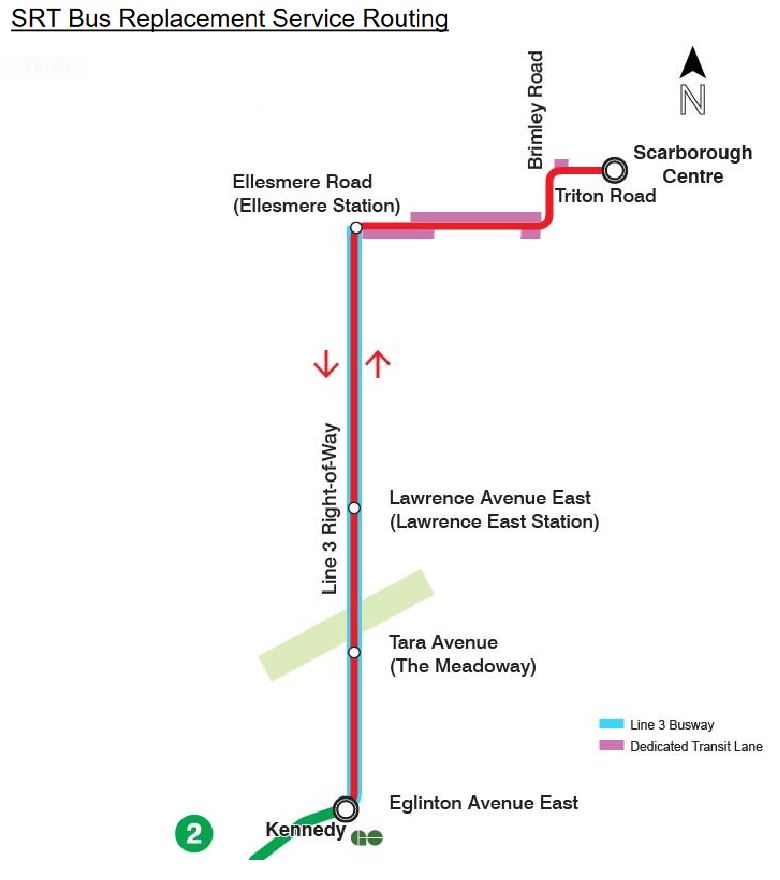
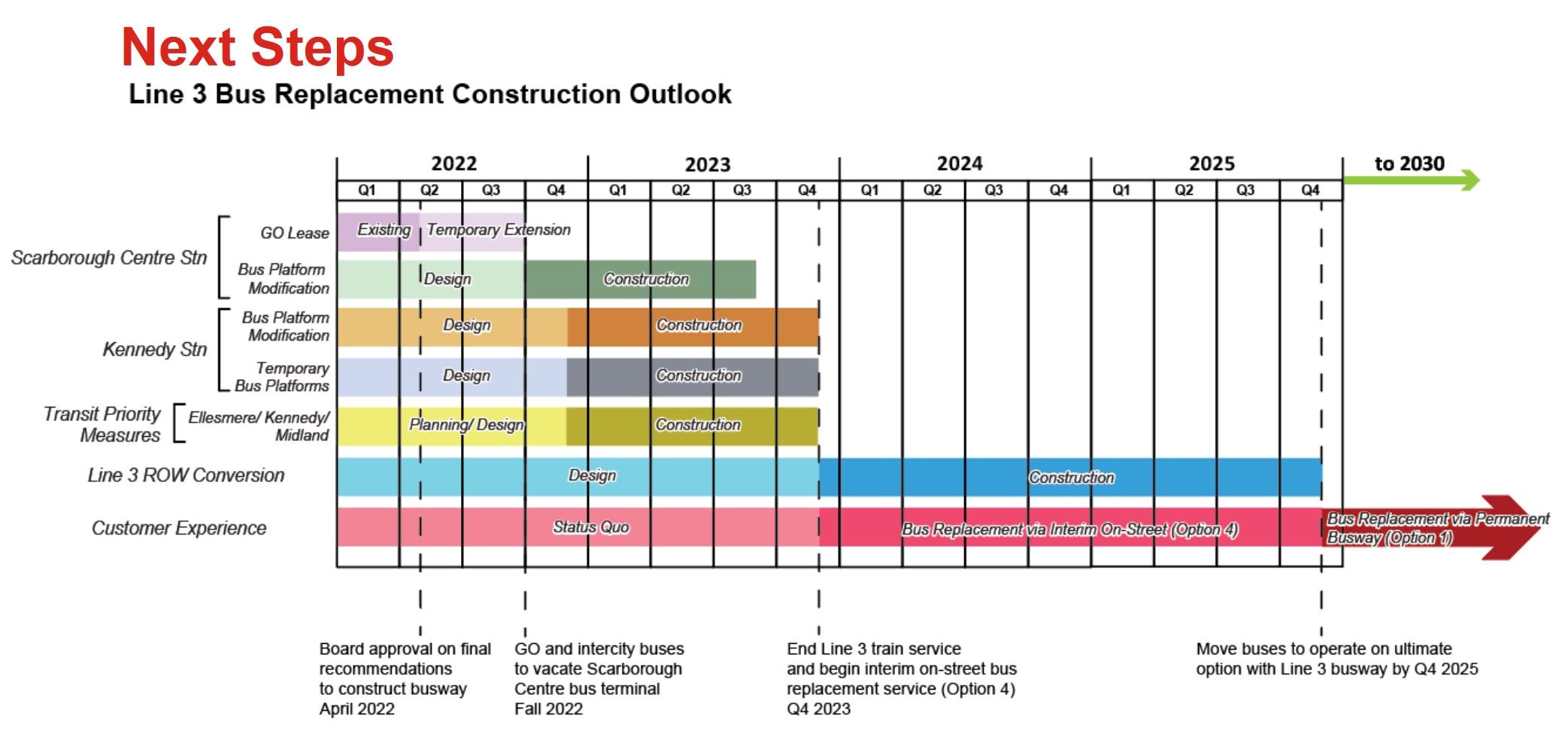
The news was not good. For various reasons, the opening date for this facility has slipped to 2Q2027. This is quite a change from the original plan for construction through 2024 and 2025 with a year-end opening, roughly 18 months sooner than the updated projection. Here was the plan back in April 2022 when the project was approved by the Board. At the time, the assumed shutdown date for the SRT was mid-November 2023.
The Board’s discussion was unusually heated, and much criticism fell on TTC Management for an unplanned delay required to conduct a Transit Project Assessment (aka TPAP) even though the corridor is not changing use. The problem lies with planned acquisition of new lands to provide station and corridor access, and they are subject to a review including for cultural/archeological purposes. (Detailed station plans appear later in this article.)
Construction will also require a barrier between the busway and the adjacent GO line because Metrolinx wants to protect from buses accidentally coming onto their corridor. This adds cost, but should not substantially affect the construction schedule.
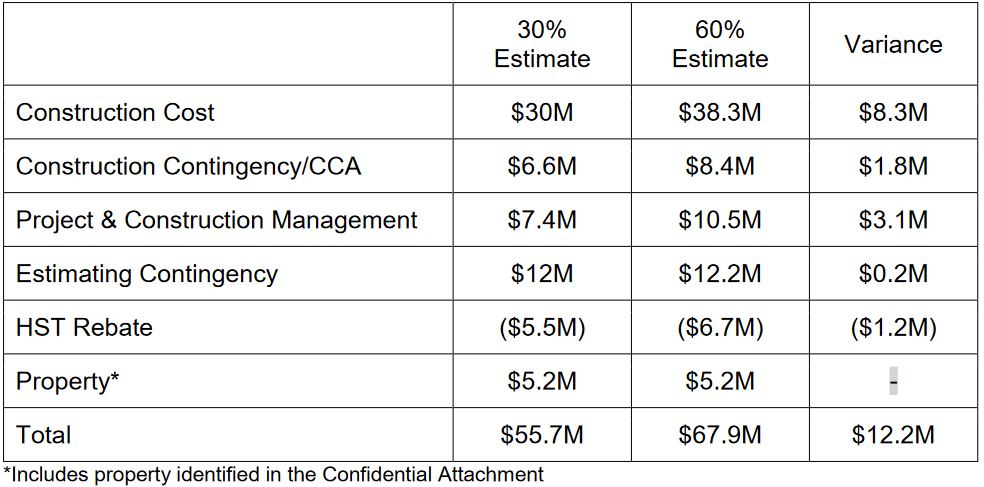
Total cost is now forecast at $67.9 million, up $12.2 million from the earlier estimate of $55.7 million which is part of the TTC’s 2024 Capital Budget. Of this, $4.3 million is due to the Metrolinx barrier, and $4 million goes for a grab-bag of items that appear to have been omitted in the original estimate. This increase is compounded by other cost lines which are calculated as a percentage of the base.
A far more important source of delay was the foot dragging by Council and the former Mayor about funding the design work which should have been finished by now, but sits at the 60% stage. Essentially Council sat on its hands crying out for Provincial money as part of the subway extension project, and the busway just sat waiting for aid that never arrived from Queen’s Park.
There has certainly been no sense of urgency to get design finished and construction underway as quickly as possible.
The delay, cost increase and a sense that travel time savings might be less than expected have combined to raise the question “why do it at all”. This can be a self-fulfilling prophecy if those responsible for the project, including the politicians, really did not have their hearts in the idea. There is no quicker way to sandbag a project than to deny critical funding, watch the price rise and the due date vanish into the misty future.
While awaiting a formal funding approval, the TTC will redirect $15.2 million from other capital projects to pay for enabling works and property acquisition. This can proceed in parallel with the remaining detailed design and TPAP.
Travel Time Savings
Travel time savings with the busway were once thought to be about 10 minutes, and this number has been commonly used by busway advocates. According to the TTC report, the saving is more on the order of 7 minutes, although the exclusive right-of-way will shave more from trips that might otherwise be snarled in traffic.
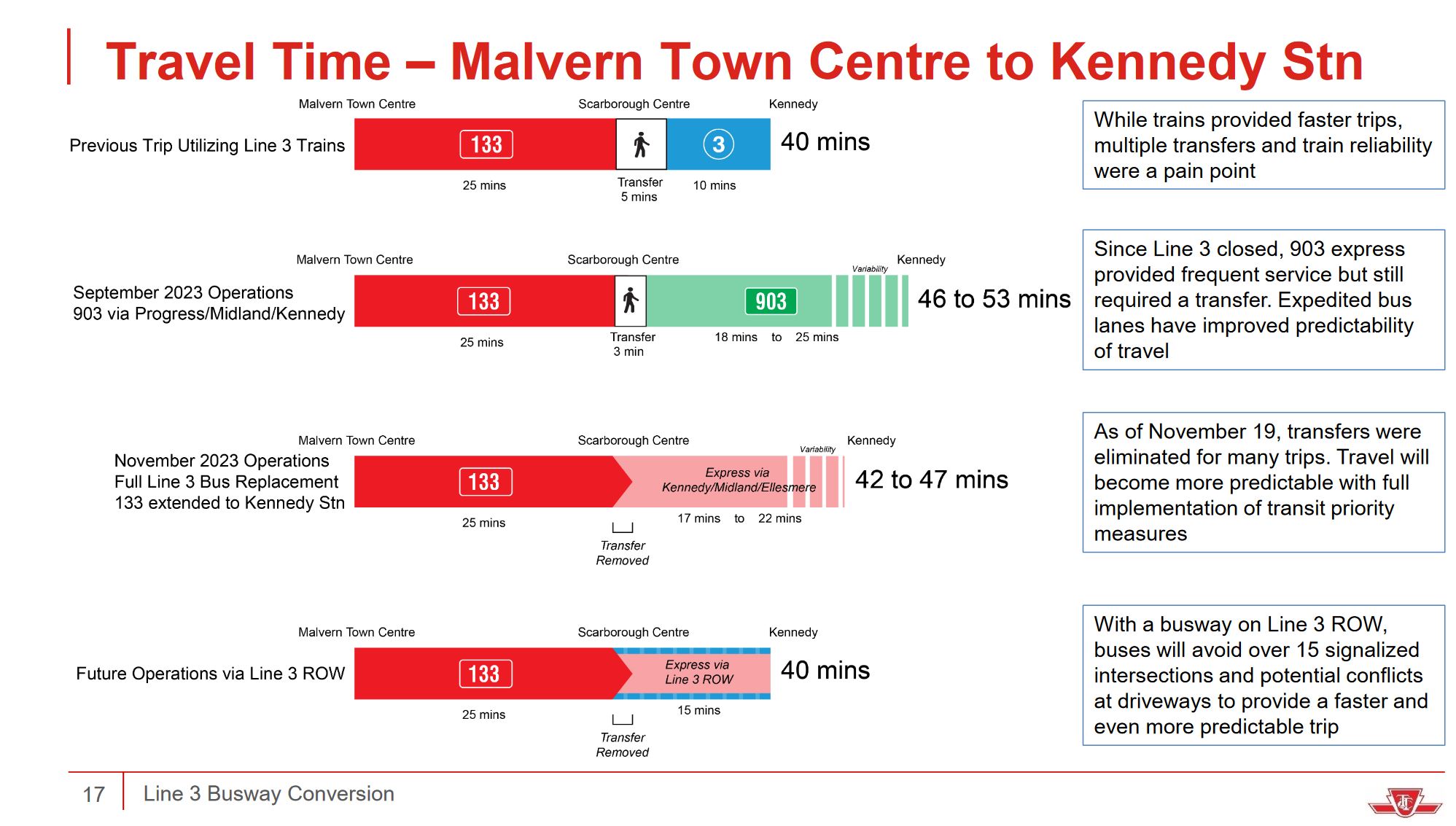
The implementation of red lanes on Midland southbound and Kennedy northbound has already brought travel times down. Indeed, the time spent between Kennedy Station and Ellesmere via either route is barely 10 minutes as shown in recent data for the 903 Kennedy-STC express bus. See Analysis of 903 STC Express: September-December 2023. Note that only this segment from Ellesmere southward would change with busway implementation, and travel conditions between the busway and STC would be the same as today.
Although some time will be saved by the shorter trip to the busway than to Kennedy Road, it is hard to imagine a very large saving relative to current travel times. The question is whether the speed of current trips via the red lanes can be maintained especially as subway construction at and east of Kennedy Station ramps up. Also, we have yet to see traffic behaviour under severe weather conditions thanks to our mild winter.
This is a classic conundrum for transit priority schemes where the “saving” under current conditions might be small, but the improvement against future travel times and provision of reliable journeys is yet to be seen.
A Business Case?
During the Board meeting, Chair Jamaal Myers wondered about a business case for the busway and whether there might be an alternative. These are two red flags to anyone hoping to see the project move swiftly.
When we talk of business cases, this inevitably brings us to the black arts by which projects of dubious merit are sanitized by showing that they are somehow worth the investment. Metrolinx is a master of this, and sadly it appears to be creeping into the TTC.
In brief, there are three main contributors to the “value” of any project:
- The money spend on it represents economic activity. It does not really matter whether this is worthwhile in some other sense, simply that spending occurs. By extension, the more expensive the project, the better.
- Two types of time saving generate notional savings because (a) riders get a faster trip and (b) motorists suffer less congestion. The value of an hour saved now sits at $20, but this is not real money, only the supposed value of our rides and drives being shorter. You cannot spend the $20, nor can you borrow against future savings.
A challenge for the busway is that unlike some transit megaprojects, it has a finite life. The later it opens, the less time remains to reap any benefits, real or otherwise.
But let’s play along, for a moment.
- The TTC estimates that “more than 118,000” weekly customers are projected to use the busway. It is not clear whether these are one-way or two-way trips. For the sake of argument, assume one-way.
- The service currently operates with 48 buses/hour in the AM peak and 40/hour in the PM peak among various routes using the corridor.
- At 50 per bus this translates to 2,400 and 2,000 passengers per hour respectively.
- The weekly number translates to about 20,000 per day (counting weekends as one day), and so the 118,000 number is plausible for the actual service level. If anything, it might be low.
- If each of the trips saves 7 minutes (the TTC estimate), that is 13,767 hours per week, or about 700,000 hours per year. At $20/hour, that’s a whopping $14 million a year. If only we could spend it, funding would not be an issue.
That’s not all! According to a UofT MobilityHub study each dollar invested in transit brings a $7 return. Included in this is the notional value of time above. This means that a $68 million busway is “really” worth almost half a billion dollars in economic effects. There is a lovely bridge right outside of my window (complete with subway line!) I will happily sell you if you believe that analysis.
If some other scheme is on the table, it too will have to be designed for integration with existing infrastructure and scaled for the projected demand. This is not going to happen in the timeframe available, and moreover, a TPAP cannot start until we actually know what is proposed.
Station Plans
The drawings below show how the existing corridor and stations will be adapted for the busway.
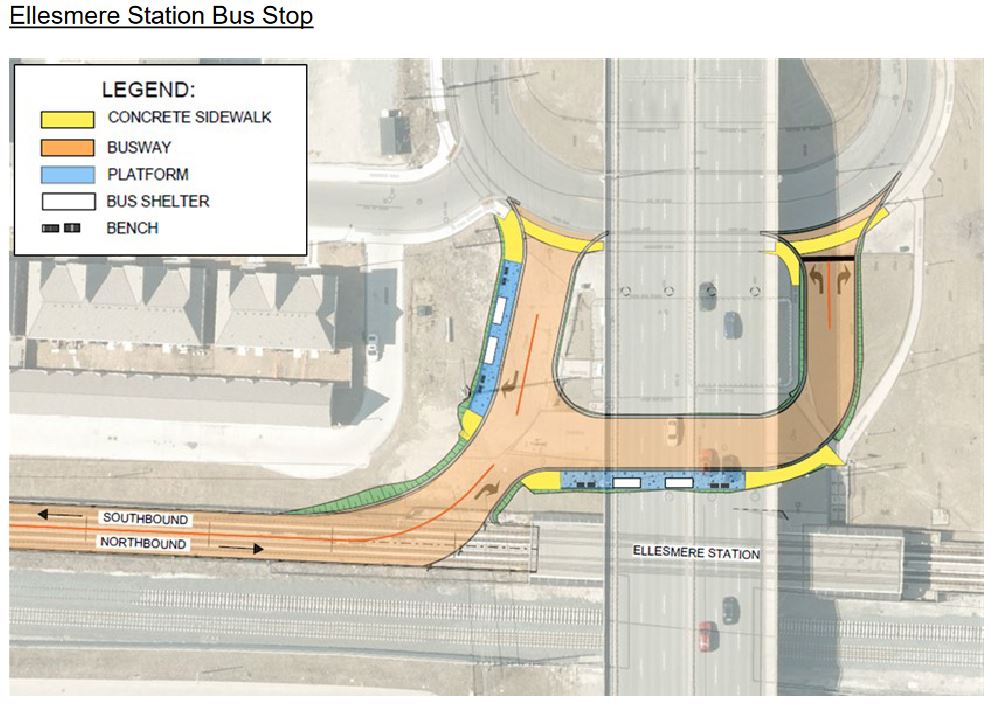
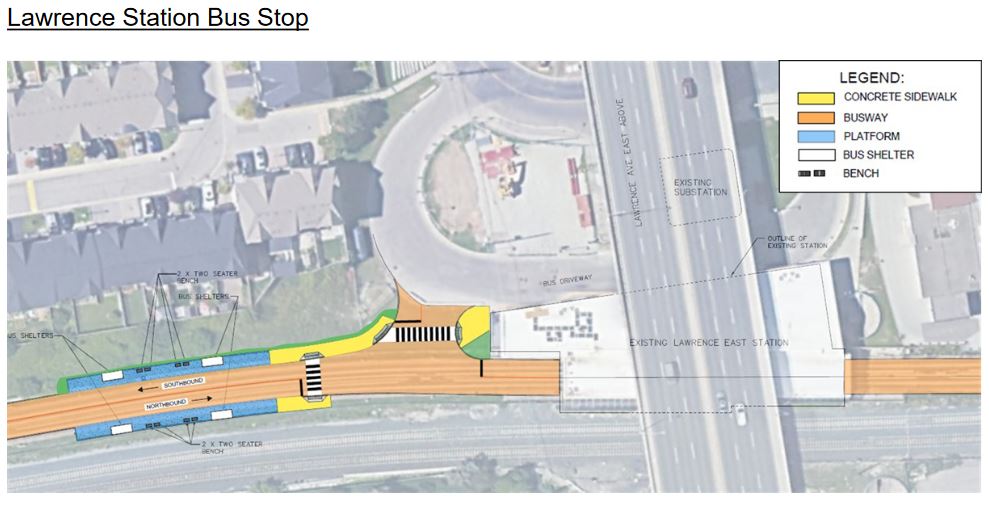
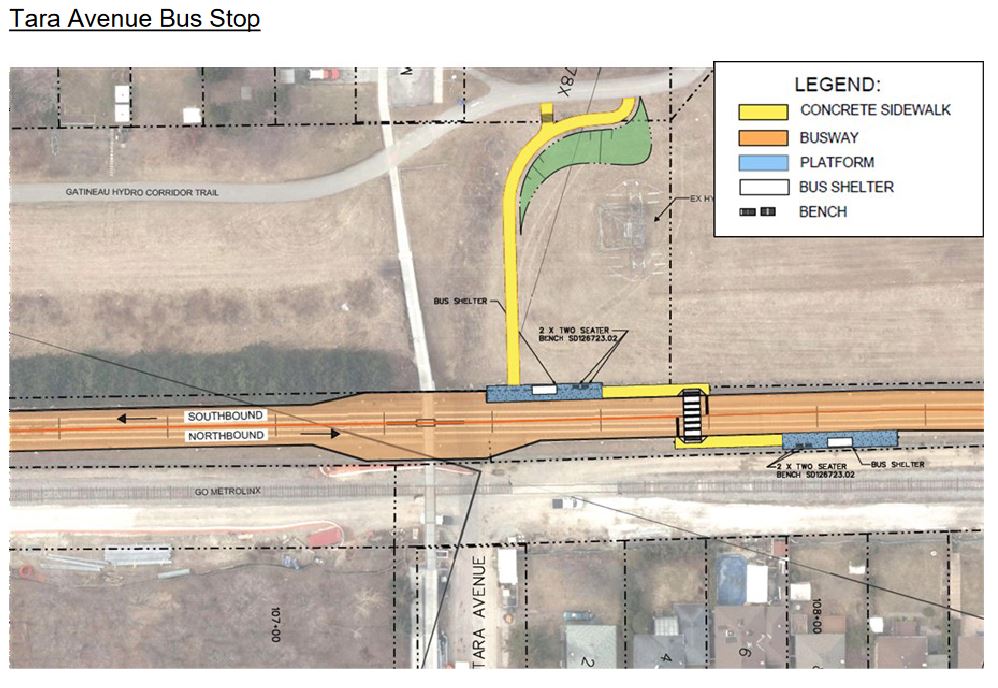
 Steve Munro
It’s a complete boondoggle from start to finish(?) if it ever is finished. I say forget it and work to improve the routes you have. Not worth the money.
LikeLike
The anti-transit, pro-automobile lobbyists have other sabotage components in their arsenal inventory to stop it.
LikeLike
Can some one please explain why we could not remove the station roofs, adjust the platform heights and dig out the Uxbridge sub. tunnel and run the Crosstown line up the already standard gauge track?
Oops, sorry that would make sense.
Steve: Like the subway station, Kennedy Station on Line 5 Crosstown faces east, not north, and through running from Line 5 onto former Line 3 is not as simple as it looks. Moreover, the lateral clearance needed for the Crosstown cars is greater than for the SRT cars. This affects track spacing, not just station roofs and platforms. North and east of Ellesmere is really messy because we would need a new tunnel under the GO line. Also, the power supply system would have to be totally replaced as the SRT uses a completely different feed from anything else on the TTC or the new Metrolinx lines. These are all issues with converting the SRT to an LRT line even before the Crosstown (which was originally to be through routed as an SRT replacement) came along.
LikeLike
Instead of passing away money on this garbage, useless waste of space. Why don’t they invest that money in the WFELRT. Where the need for transit will be even more critical but yet conspicuously absent from any discussion with the TTC or city.
Steve: For starters, the WELRT’s projected cost is much, much higher than the Scarborough busway.
LikeLiked by 1 person
What a waste of time and money, spend this money on getting the WFELRT built. Something that will actually have some longevity and usefulness. It seems the TTC and city want to ignore that massive devlopment entirely. Perhaps the magic pixi fairys will teleport the areas residents to their destinations. Ugh… Why do we even bother, does anyone actually like Scarborough anyway? Let them walk/s
Steve: Lots of people like Scarborough, even people who don’t live there. The problem with “let them walk” is that it hurts thousands of transit users in Scarborough who need more and better service. Meanwhile the unprincipled politicians who sold them on the subway project sit fat and happy in their limos and SUVs.
LikeLiked by 1 person
If they can’t even tear down and re use the former stations as bus platforms, its no wonder the busway is dead in the water. Just look at the Lawrence station platforms, it would be a long walk between the North/South and East/West platforms.
LikeLiked by 1 person
Why is Chow sleeping on this? Not a word from her since the report came out.
Shameful.
Steve: Chow is expected to announce her position as part of her budget proposal on February 1.
LikeLike
Would a bus not be able to be retrofitted into Lawrence East and Ellesmere RT stations which is why they have to build new platforms?
Steve: There are a few problems with reusing the RT stations notably that they are not accessible. Also, at Ellesmere, the buses would have to enter the right-of-way north of the station where the ramp down to the tunnel under GO Transit is today. If the right-of-way were built up to the existing platform height, I doubt that buses would fit through the structure.
LikeLike
I fully support the busway project, but there is a concern about its completion timeline and whether it would be implemented too late to address the current transportation challenges. The extensive time and cost involved in what seems simple enough as removing tracks and reconfiguring the space for buses is perplexing. Additionally, considering that Detroit is purchasing equipment and around 5 train sets, the price of $1 million seems relatively low unless it accurately reflects the value of the trains? Or Toronto is doing them a soils? Initially, I was expecting that the purchase of the trains would contribute a more substantial amount towards funding the busway, perhaps covering at least 1/5 of the total cost. The “original” cost that was reported not this absurd new amount.
LikeLiked by 1 person
I believe this is a useful project. We don’t know when exactly the subway extension gets completed, but we know than nearly every big transit project takes longer than scheduled these days. Every month of the subway delay is a month when the busway continues to bring benefits to the riders.
If the cost is an issue, then perhaps they could save a bit by dropping the Ellesmere and Tara Avenue stations. Then they will need less money for the bus platforms.
Connection to the Ellesmere buses can be made at one of the existing stops along the Ellesmere Road, where the “busway” buses will run anyway en route to STC. The Tara Avenue station did not exist on the SRT, and no equivalent will exist when the subway opens. At that time, the local riders will have to go back to using the regular Kennedy and Midland buses. Perhaps the Tara station is nice to have on the busway, but it is not essential if the whole project is in doubt because of the cost.
LikeLike
The voters of Scarborough voted for Rob Ford and anti-Transit City councillors. If they hadn’t, we’d have an SRT replacement up and running (assuming Metrostinx wasn’t allowed anywhere near it) and possibly even be working on expansion further into Scarborough. The voters of Scarborough have exactly the transit they “deserve”, to use a word they love. Instead, the rest of the city is going to pay even more for their foolishness.
LikeLiked by 1 person
This proposed busway will not be required once subway in operation to Town Centre in few years. Just not worth the cost. TTC just pissing money away again.
LikeLiked by 1 person
Scarborough won’t get the busway. Supposedly it will be done by 2027 while the subway extension to Scarborough Town Centre will be completed by 2030. Make it make sense! Fat chance buddy! Scarborough gets screwed again!
LikeLike
Once the subway is completed, the busway could be repurposed for the 943 Kennedy Express, between Eglinton and Ellesmere.
Unless there is a desire to use the space for a linear park / bike path, or adding mainline tracks for the Stouffville GO trains.
Steve: The question, though is whether the current riders of the 943 north of Ellesmere would prefer another route to Kennedy Station such as the GO train itself, or if there even will still be a 943 in its current configuration rather than a route feeding into Agincourt Station. As for more tracks in the GO corridor, every so often there is talk of HSR using this as the exit from downtown, but I hold less hope for ever seeing that built than I do for the Waterfront East LRT. Lots of work for consultants, but actual service, no.
LikeLike
I think we should be spending money on projects that we KNOW have long term value. If there was a way to do some minor 1 year construction then it’s a no-brainer, but now that this will barely open before the SSE it’s time to move on and divert the funding to the Eglinton East LRT (which really needs to be renamed to Line 7 Scarborough).
Steve: The total cost of the proposed busway is a drop in the bucket for the Eglinton East project. It is disheartening that the construction timeline has been stretched out, and we have yet to learn whether the work could be phased to bring part of the roadway into service earlier than 2027. Also, of course, there is no guarantee that the SSE will actually open when predicted. To say the busway would “barely open before the SSE” is an exaggeration. Frankly this argument (and you are not alone in advancing it) sounds more like a call to abandon the project by minimizing its potential benefit.
LikeLike
“The best time to plant a tree was 20 years ago; the second best time is now.”
Once again, former Toronto City politicians – a mayor, Councillors (some of whom are still on the present council) and a sitting Premier – have proven that they don’t give a subway rat’s patootie about “transit” in this city. Greenbacks for the Gardiner? No problem: pyl-on with the payments! Cash for the cops? Break open the piggy bank! Sink in some silver for preliminary and follow-up transit design – knowing the RT has been on its last legs for a decade and they’re out of baling wire and binder twine – or fare relief? 《Crickets》”Ummm, well, … (‘Please, sir, may I have some more?’) … we’re *hoping* the Province will pitch in for this very important funding issue….
Hey, Scarborough: Premier Doug’s brother Robbie gave you a subway – someday – that’s why all Torontonians have a 1.5% “special levy” on the annual tax bills (not that Scarborough shouldn’t have higher-level transit, although that silly Kathleen Wynne-funded LRT would be running now and all current flustered post-RT discussions would be moot.
Olivia Chow has said that she has inherited the budget and transit issues and they must be addressed. Meanwhile, several Conservative-leaning folks (including current councillors) have called it “making excuses” and blame her for this “unprecented” proposed budget increase.
So, Guys:
1. Why did YOU previously agree with, and to ONLY a tax increase at the rate of inflation (and not, say +1% each year – relatively painless in retrospect, hmm)?
2. Why do YOU discount transit as an afterthought when countless constituents depend on it daily? Too scared? Don’t use it yourself so it doesn’t matter?
Olivia, at least, has more balls than the lot of you, including Dougie. And she’s decided that planting trees now is better than 20 years from now, even if Scarberians may not eat the fruit off those trees for another decade.
LikeLike
If they want to save money, remove that useless Tara stop.
LikeLike
How about a bikeway? At least as a temporary stand-in before the temporary busway is complete, if not as an alternative to the busway altogether. I see on google maps that currently there is a bike route from Kennedy north along the SRT corridor to where it’s intersected by the ‘meadoway’, but no further. Could it be easily extended further toward Ellesmere, as the busway would? Or even perhaps along the elevated portion of the SRT to the Town Centre?
Steve: The problem with a temporary facility is that it would have to close when construction of the busway begins. As for the elevated section, it would have to be modified as a road, not a railway, including safety features and access points (similar considerations to converting it to a linear park). This is not a zero cost idea. I am waiting for Mayor Chow’s budget announcement later today (Feb. 1) to see if there is funding for the busway project to break the logjam of using the province as an excuse for inaction.
LikeLike
Interesting. In that case, what about a permanent bikeway on the non-elevated sections of the SRT, as an alternative to the busway? It could still reach the Town Centre via a bike lane on Ellsemere or Progress rd…
Steve: Certainly, but the busway project is going ahead. Olivia Chow has just announced that she will fund it in her budget proposal. The bikeway won’t fit while the buses are there, and a non-trivial amount of construction would be needed to convert the existing corridor for bikes.
LikeLike
I rode a bus south down Kennedy to Kennedy Station recently in the middle of the day, and it was packed and slow. The red lane buses going north on Kennedy were sparsely filled and moving well. The TTC really should have just put bus lanes on both sides of both Kennedy and Midland instead of having the weird loop thing. Much of the red lanes were blocked off due to construction of new telephone poles though, but the new telephone poles seemed to be largely in the same place as the old ones, which is a loss because if they were spaced further out, maybe the road could be widened in the future to accommodate more uses like bike lanes or more bus lanes.
Can the SRT infrastructure really not be reused for anything? Can’t they borrow a small diesel train from Ottawa or the UP Express and just run a token service between Ellesmere and Eglinton?
Steve: A “small diesel train” or the UP Express cars would have a few problems. First, they are wider than SRT cars and won’t fit on the right of way especially through stations. Second they are heavier and I’m not sure that the SRT tracks are up for that. Even if so, the power supply system would have to be removed for clearance. Then there is the absence of any maintenance facility, and the problem that there could only be one train shuttling back and forth unless crossovers were installed. Most of the demand on the SRT was between Kennedy and STC with trips to Lawrence East a distant second. There is and was very little demand at Ellesmere – about 1,000 per day in 2022, and just under 2,000 pre-pandemic. That’s not worth a major overhaul to fit in a “token” service.
LikeLike
It seems that all the land along the SRT has already been built upon. So why would a TPAP be required? Why would the TTC require any additional land?
Steve: The land for access to the stations is not part of the existing SRT property. Also the corridor needs to be widened in spots because buses need more clearance. That said, with a bit of foresight this could have been dealt with long ago.
LikeLike