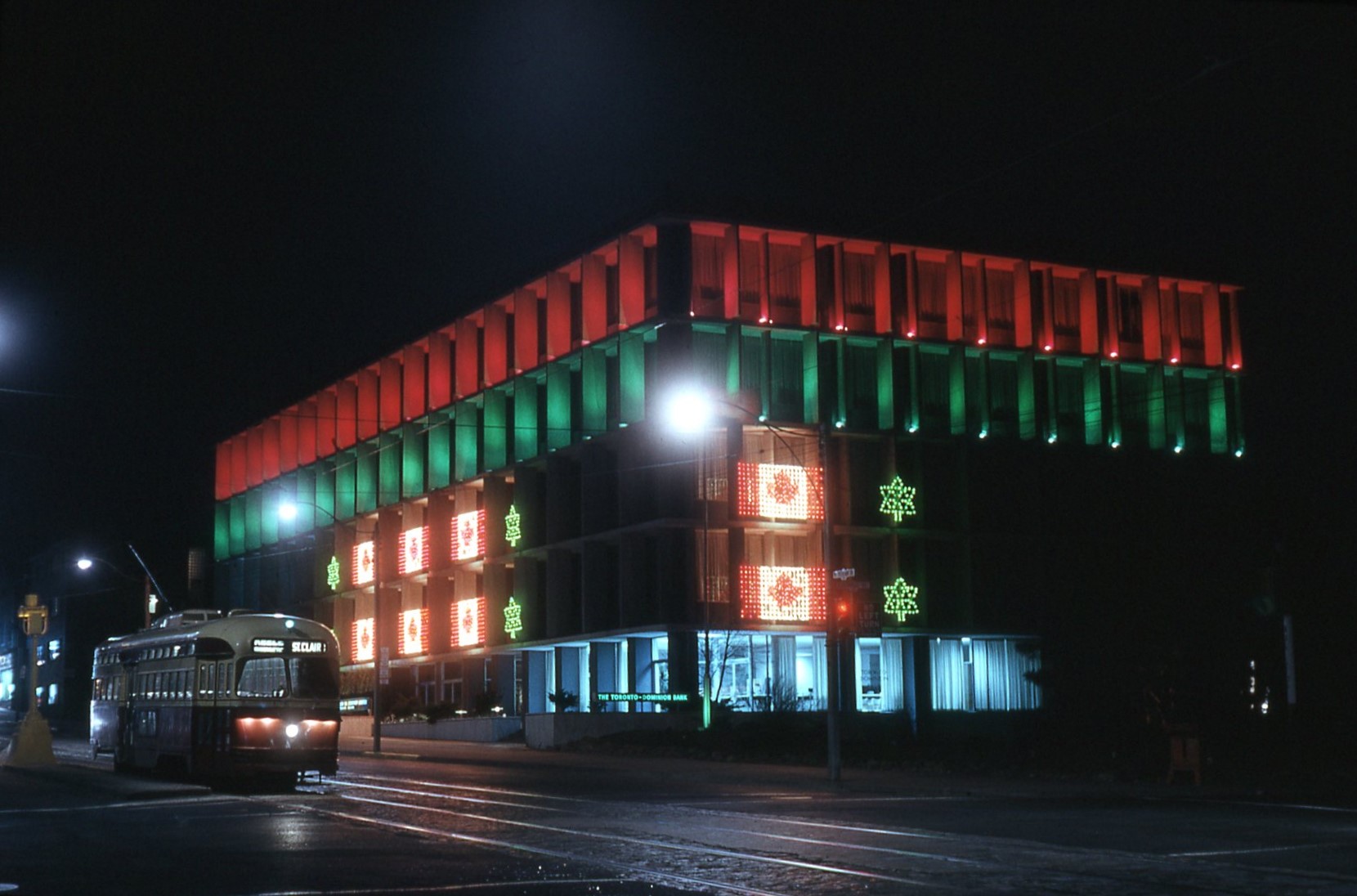
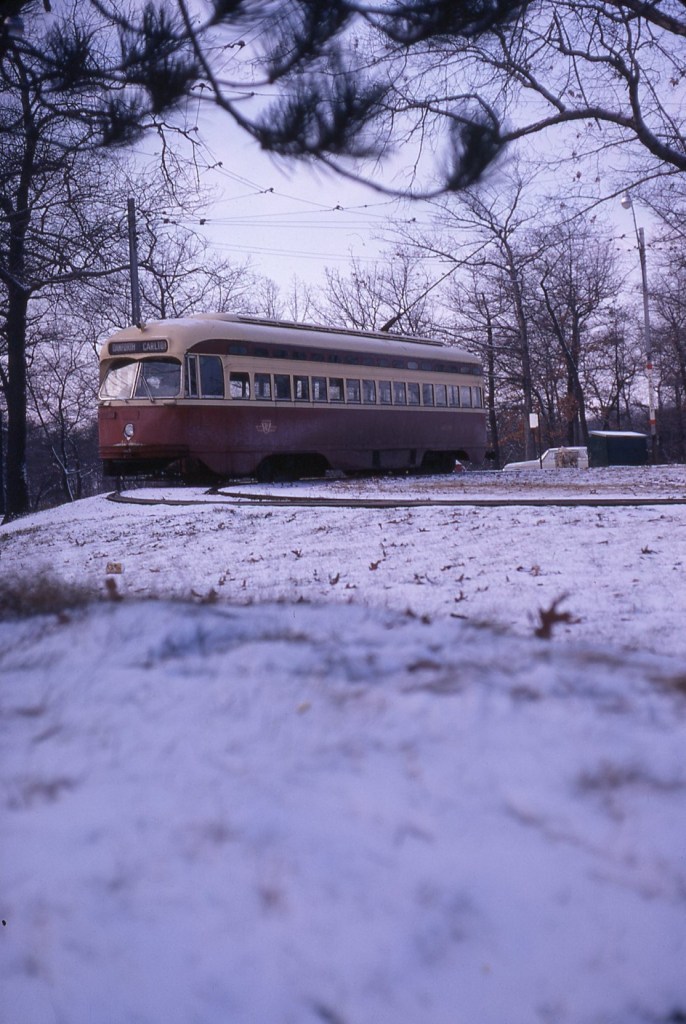
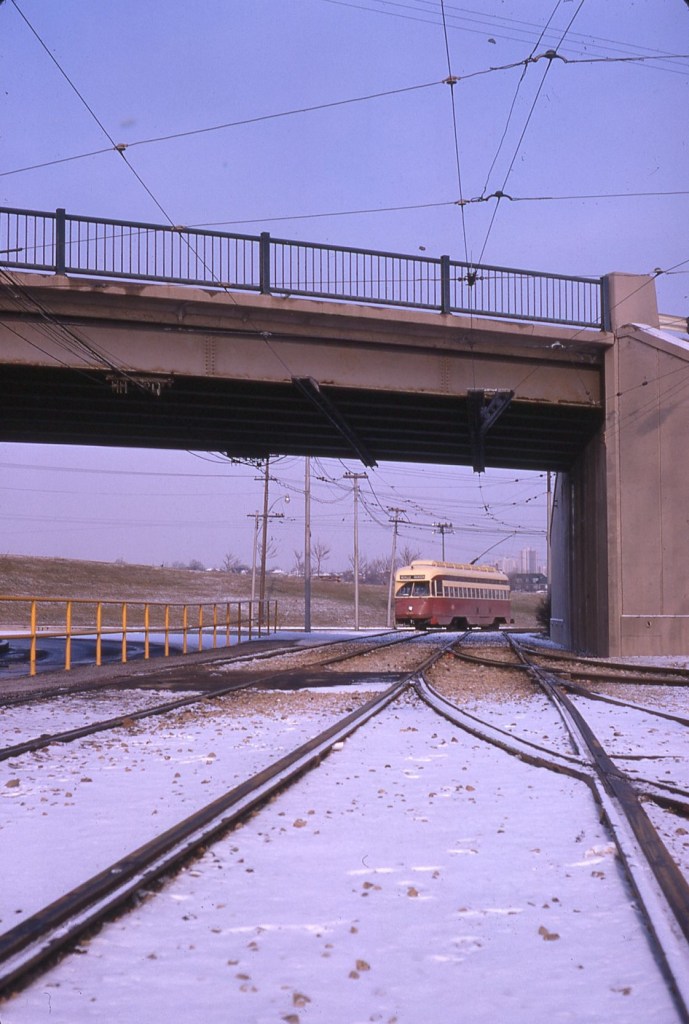
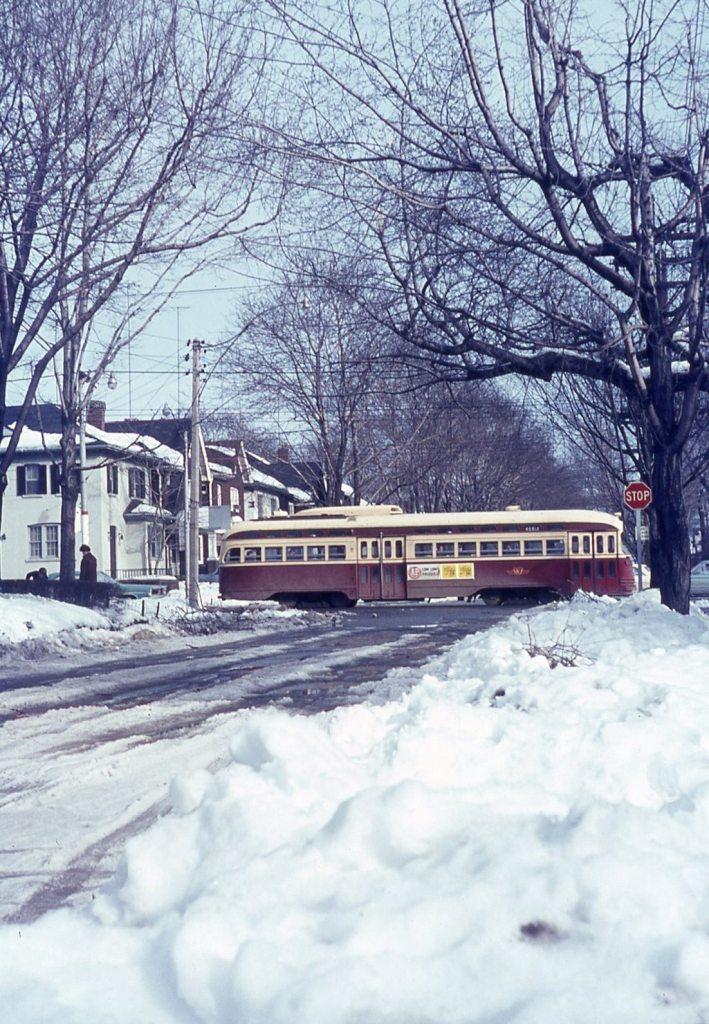
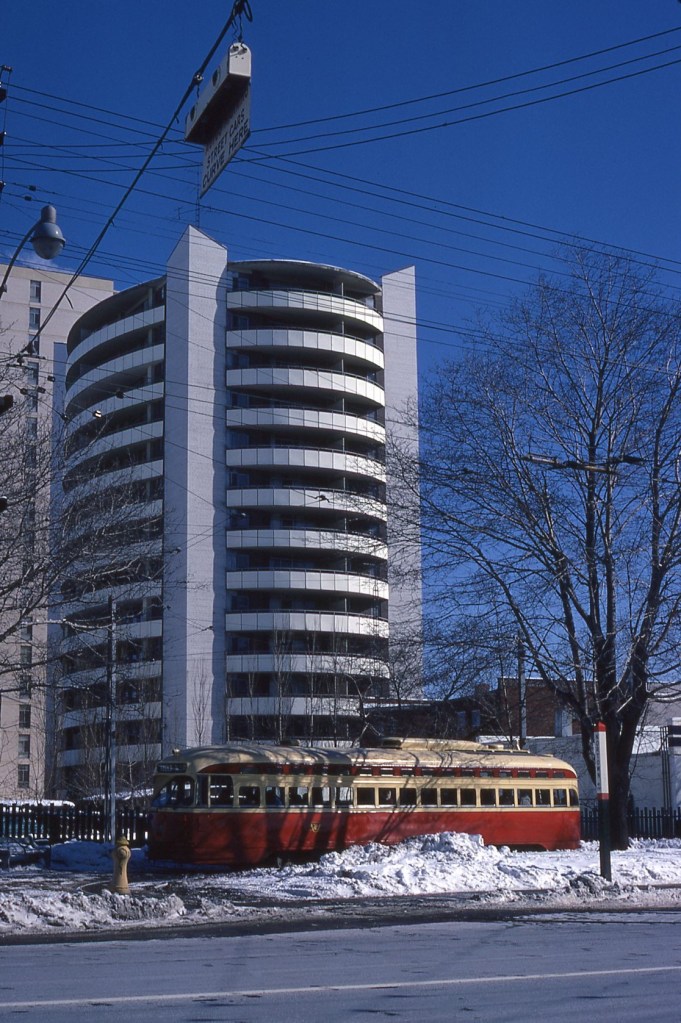
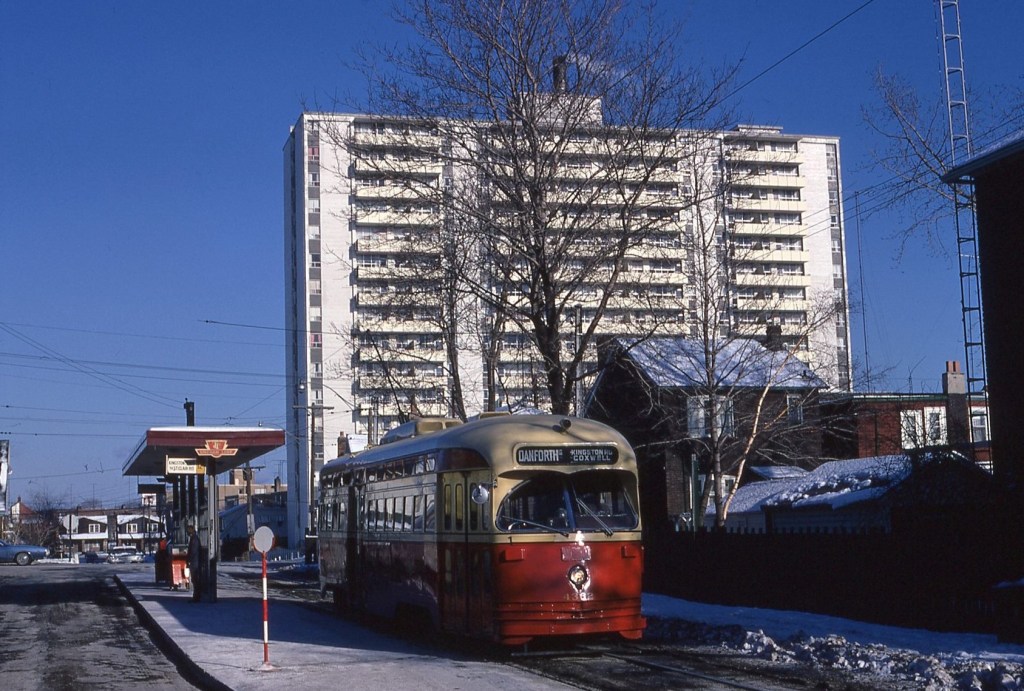
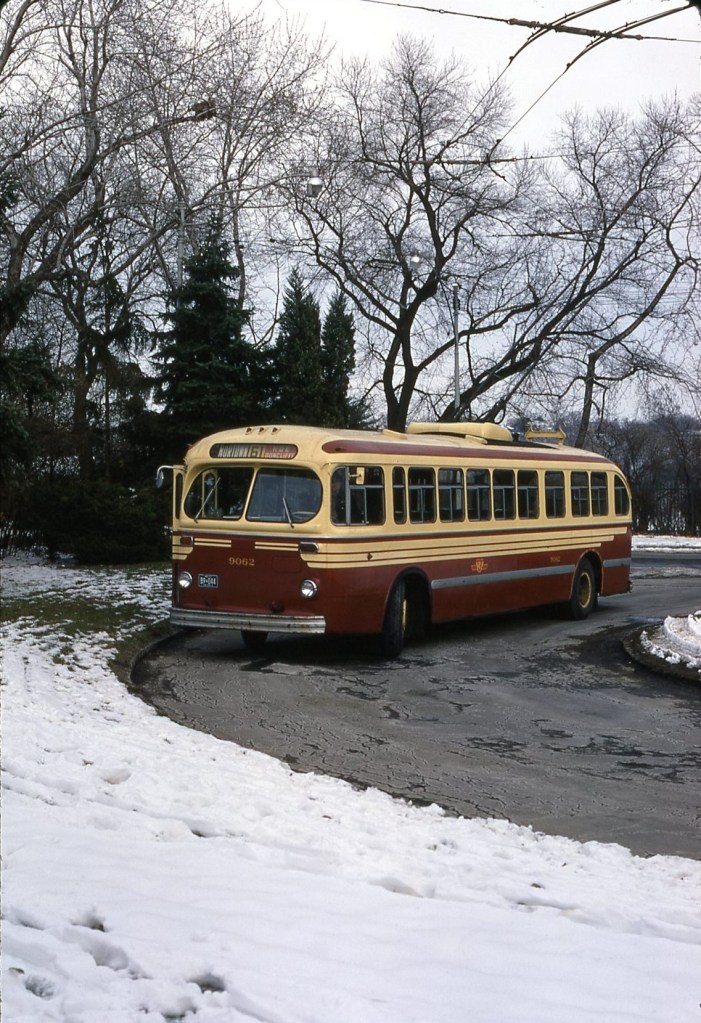
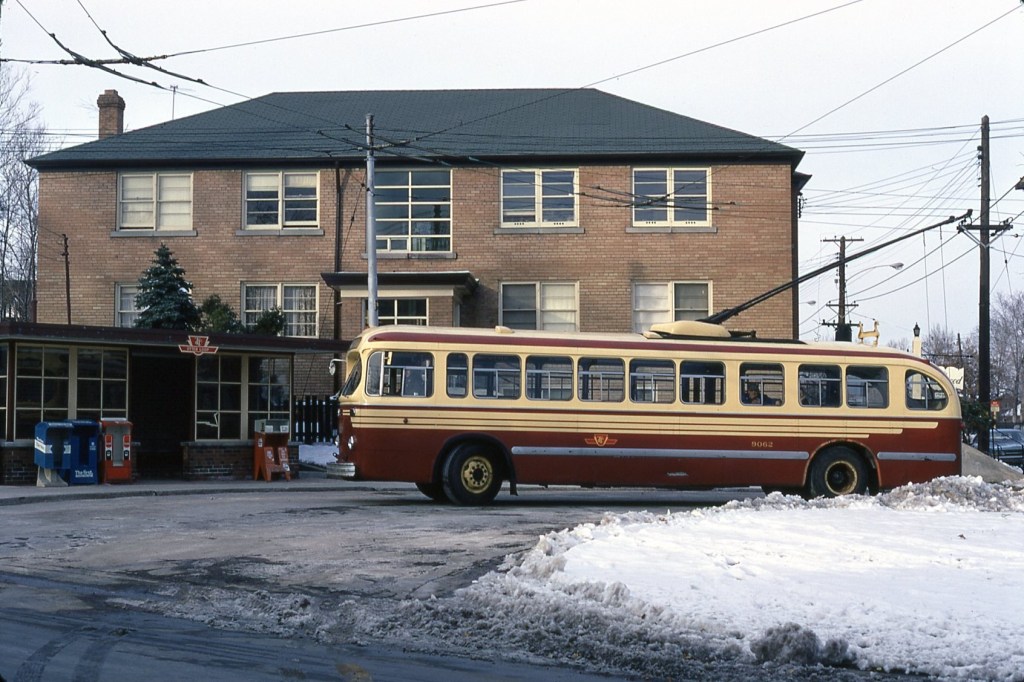
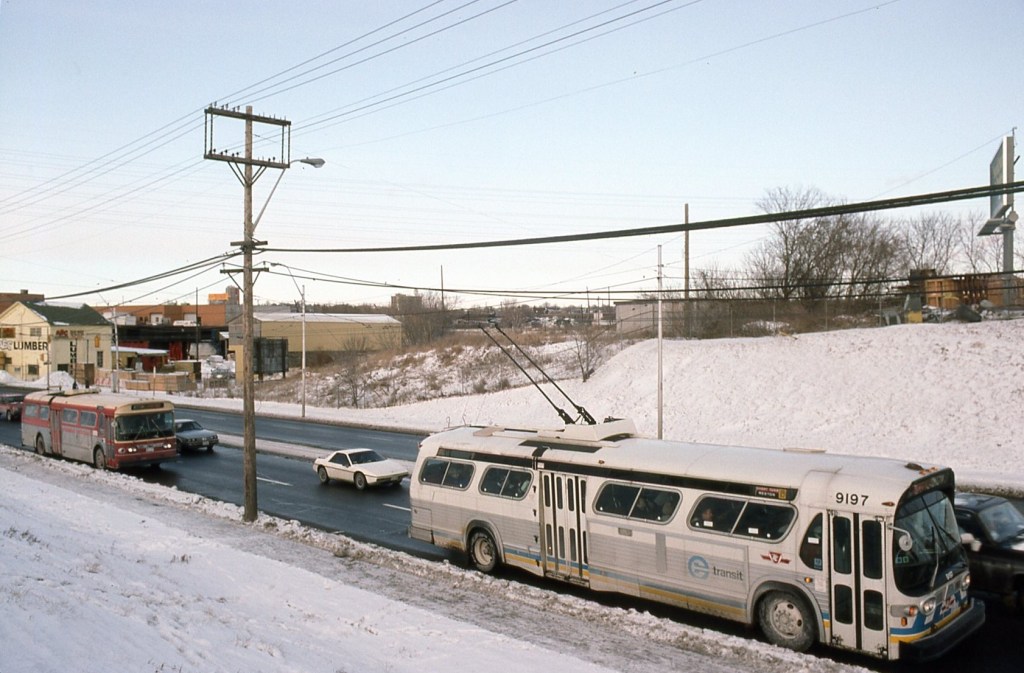
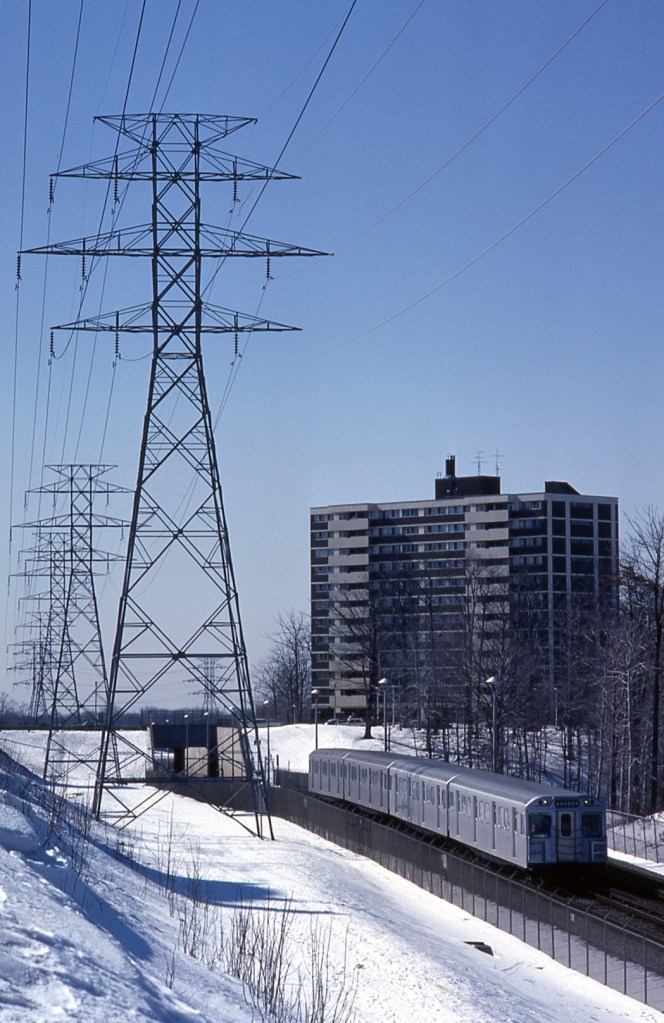
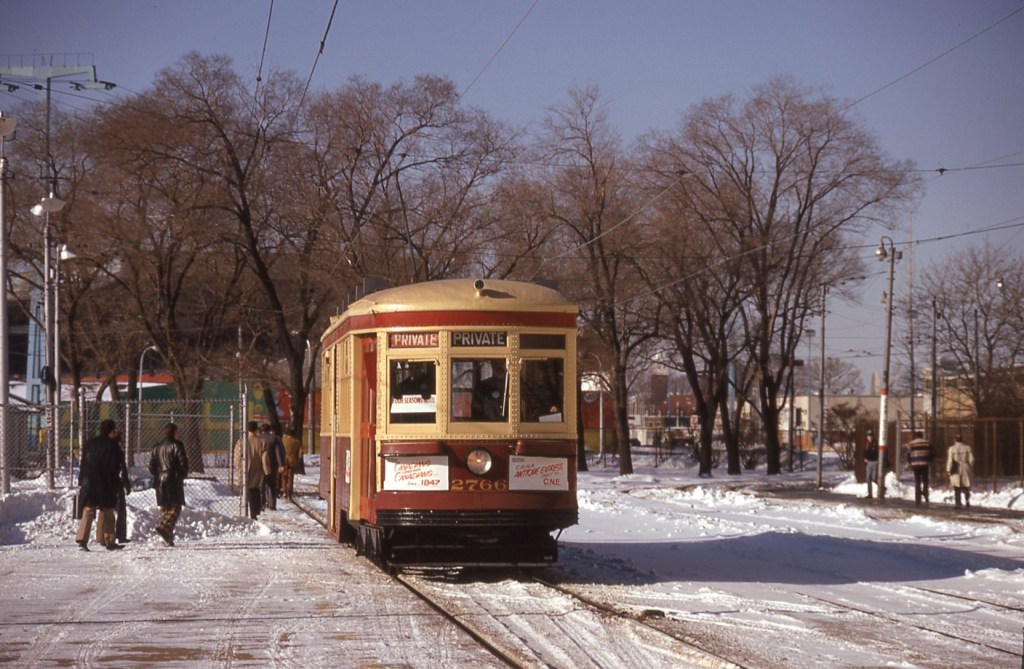
Mount Pleasant & Davisville 1967.12.234696 High Park Loop 1967.12.294673 Humber Loop 1967.12.294550 Mt. Pleasant & Heath 1968.014362 Mt. Pleasant Loop 1972.02.204362 Bingham Loop 1972.02.209062 Doncliffe Loop 1971.12.059062 Otter Loop 1971.12.05Weston Rd. N of St. Clair 1992.01West of Warden Stn. 1972.03.26Exhibition Loop 1974.02.11
Thx for the photos. Happy Holidays, Steve! Maggi (from the old SJS)
PS Do you have any pix of the Ossington trolley bus? I mentioned taking it regularly ‘back in the day’ to a friend who lives near there; I don’t think she believed me!
Thanks for the pictures of old PCC streetcars, a subway train, and a trolley bus.
Speaking of trolley buses, I definitely remember the trolley buses. The furthest northwest, and the closest to home (we lived near Albion and Islington at the time) was the intersection of Albion, Wilson, and Weston. The “89 Weston” trolley buses travelled on Weston Road / Keele Street between Albion-Wilson-Weston and the Keele subway station. The trolley bus overhead electrical wires remained intact a few years after the trolley buses were retired.
Thanks Steve for the images and your messages through the year. You are making a big difference “moving” our public transit forward into the 21st century.
Happy Holidays Steve!
It warms the heart to see all of these loops.
Looking at that 4-car subway train on the B-D line, I wonder which year they switched to 6-car?
I also think it was remarkably forward-looking to plan on a “wide” subway car layout even back when they were only running shorter trains.
Steve: The width of Toronto cars goes back to the original Yonge line and the “G” cars. The difference with the “H” cars is that they are longer, and a bit less space is lost to inter-car gaps. I cannot remember the exact date when short trains were discontinued, but basically the idea of shortening trains in the evenings became unworkable due to the complexity of breaking trains relatively far from Greenwood and dead heading cars back to the yard from the terminal. Also, as the line grew in length, the cycle time for every train to be shortened made the whole idea counterproductive. Short trains on weekends also required a lot of work at the yard to re-make six-car trains into four-car sets, and then change back again for weekdays. It was a very labour intensive process.
Subway Picture Ice Story.
It was a blizzard that was followed by freezing rain and high wind. The fellow I was working with and I had to go between Victoria Park and Warden to clear snow and ice away from the signal trip arms because the signals weren’t working properly. The snow was deep and blowing. Something fell next to me and I turned around to tell my helper to stop fooling around; throwing snow balls. But he wasn’t throwing snow balls. We both looked up and we were alarmed at the ice that was coming off of the high voltage wires like long spears. The ice spears were 1 to 2 inches around 6 to 8 feet long and coming down like deadly missiles. We ran to Warden station as fast as we could go with ice spears crashing all around us.
Nice to see snow on the ground and blue sky in these great old photos. I’ll take that over the grey drizzle we’ve had for the past week.
In the Comments here, there was mention of evening cut-offs to reduce Subway train length by two cars each weeknight. According to my notes this practice ended at the start of the September 1986 Board Period. With this new schedule, Late Evening service on the Yonge line was reduced by 3 trains and headway was widened from 4min40sec to 5min21sec. On the Bloor line, 2 trains were removed and headway was widened from 4min57sec to 5min32sec. The use of full-length trains on Saturdays and Sunday may also have begun at this time.
I’d like to ask the historians reading this Blog about the start of Subway service in 1954. I believe 6 car G-trains was the norm. Were there any periods during the week when 4 cars trains or even 2 car trains were routinely operated?
Steve: According to the April 1954 Scheduled Service Summary, the AM peak service operated every 2’30” on a 40 minute round trip making 16 trains. The total cars in service is listed as 86, but I think this must be a typo and 96 cars would be used, hence 6-car trains. (86 is not a multiple of either 4 or 6.) I don’t have the weekend service for that period.
In December 1956, the Saturday service was every 3 minutes, 12 trains and 72 cars (6-car trains). On Sundays every 5 minutes, 7 trains and 28 cars for Sundays, hence 4-car trains.
I have certainly seen pictures of four-car G trains on Yonge. Whether that was normal at some points, I don’t know.
Some of the things that are rarely, if ever, photographed are the stopping point signs found under platforms. (Are they still there? These days there is no railfan seat left, what with TRs and T1s with barriers blocking off access.) You had black signs with white numbers, showing where M/H trains should stop (4 or 6), and yellow signs with black numbers for G trains (6 or 8, as I recall).
A few photos of historic stopping point signs could tell us a lot. For example, the yellow/black G train signs persisted on Bloor-Danforth long, long after the integrated service was done. I think they were even found on the 1968 extensions.
The location of “brakes on here” signs was also interesting. In the days of high-rate operation, they were well before the station, I would estimate one to two car lengths. Once high-rate was canned, around 1980, the start-to-stop signs migrated to under the platforms within the stations themselves.
At least, the above is what I recall. Naturally, I stand to be corrected.
Steve: The black and white signs were for the G trains, the yellow ones for the M/H trains. I have a photo of a four-car G train in Rosedale Station, but the black and white 6 and 8 car braking markers are clearly visible.
The canning of High Rate operation has an interesting history. The H1 trucks had a bad hunting problem at higher speeds, and so they switched to Low Rate “until the H1s were all retired”. Years later, when this was about to happen and I suggested that they size the next train order accordingly, there was something close to panic in TTC management who had already negotiated a one-for-one replacement. Whether we will ever see faster operation, possibly when Line 2 gets ATC, I don’t know. Faster trains were one of the selling points of ATC for Line 1, but I have seen no sign of this so far. Strange for an organization that is always claiming to worry about costs.
I’m a couple of weeks late writing in but that’s a nice holiday gallery you’ve put together. I’m hazarding a guess that the pictures of 4362 in Mt. Pleasant loop and then Bingham loop on the same day were a fan trip?
9062 was signed for Roe before you left Doncliffe but didn’t made it there on that trip.
It’s been a long time since I’ve gone on a photo expedition like some of those in your pictures. Every time it crosses my mind, I think about it but there isn’t very much transit wise I’m interested in taking pictures of anymore and then the cost of slide film and processing now is absolutely breath-taking sticker shock. Maybe one of these days I’ll pick up a DSLR and get with the times.

 Steve Munro
Thx for the photos. Happy Holidays, Steve! Maggi (from the old SJS)
PS Do you have any pix of the Ossington trolley bus? I mentioned taking it regularly ‘back in the day’ to a friend who lives near there; I don’t think she believed me!
Steve: You’re welcome! You will find some pix of the Ossington TB in another article I posted some time ago: A Brand New Electric Bus for the TTC: 9020 on Charter April 20, 1969
LikeLike
Dear Steve:
Thanks for the pictures of old PCC streetcars, a subway train, and a trolley bus.
Speaking of trolley buses, I definitely remember the trolley buses. The furthest northwest, and the closest to home (we lived near Albion and Islington at the time) was the intersection of Albion, Wilson, and Weston. The “89 Weston” trolley buses travelled on Weston Road / Keele Street between Albion-Wilson-Weston and the Keele subway station. The trolley bus overhead electrical wires remained intact a few years after the trolley buses were retired.
LikeLike
Thanks Steve for the images and your messages through the year. You are making a big difference “moving” our public transit forward into the 21st century.
Steve: You’re very welcome!
LikeLike
Thanks Steve! Was that Weston Road trolley bus a one off, and, if so, did it originate with the TTC or Grey Coach?
Steve: The Weston TB was a conversion from the Weston streetcar, which in turn was a shortened version of the original radial line to Woodbridge.
LikeLike
I grew up just blocks south of Doncliffe Loop, at Wanless. Merry Christmas Steve.
LikeLike
Gorgeous photos! Thank you
LikeLike
Happy Holidays Steve!
It warms the heart to see all of these loops.
Looking at that 4-car subway train on the B-D line, I wonder which year they switched to 6-car?
I also think it was remarkably forward-looking to plan on a “wide” subway car layout even back when they were only running shorter trains.
Steve: The width of Toronto cars goes back to the original Yonge line and the “G” cars. The difference with the “H” cars is that they are longer, and a bit less space is lost to inter-car gaps. I cannot remember the exact date when short trains were discontinued, but basically the idea of shortening trains in the evenings became unworkable due to the complexity of breaking trains relatively far from Greenwood and dead heading cars back to the yard from the terminal. Also, as the line grew in length, the cycle time for every train to be shortened made the whole idea counterproductive. Short trains on weekends also required a lot of work at the yard to re-make six-car trains into four-car sets, and then change back again for weekdays. It was a very labour intensive process.
LikeLike
Steve, I was referring to the colour of that Trolley bus.
Steve: I wondered about that “Gray Coach” remark. GCL had nothing to do with the lease of TBs from Edmonton.
LikeLike
Subway Picture Ice Story.
It was a blizzard that was followed by freezing rain and high wind. The fellow I was working with and I had to go between Victoria Park and Warden to clear snow and ice away from the signal trip arms because the signals weren’t working properly. The snow was deep and blowing. Something fell next to me and I turned around to tell my helper to stop fooling around; throwing snow balls. But he wasn’t throwing snow balls. We both looked up and we were alarmed at the ice that was coming off of the high voltage wires like long spears. The ice spears were 1 to 2 inches around 6 to 8 feet long and coming down like deadly missiles. We ran to Warden station as fast as we could go with ice spears crashing all around us.
LikeLike
Nice to see snow on the ground and blue sky in these great old photos. I’ll take that over the grey drizzle we’ve had for the past week.
In the Comments here, there was mention of evening cut-offs to reduce Subway train length by two cars each weeknight. According to my notes this practice ended at the start of the September 1986 Board Period. With this new schedule, Late Evening service on the Yonge line was reduced by 3 trains and headway was widened from 4min40sec to 5min21sec. On the Bloor line, 2 trains were removed and headway was widened from 4min57sec to 5min32sec. The use of full-length trains on Saturdays and Sunday may also have begun at this time.
I’d like to ask the historians reading this Blog about the start of Subway service in 1954. I believe 6 car G-trains was the norm. Were there any periods during the week when 4 cars trains or even 2 car trains were routinely operated?
Steve: According to the April 1954 Scheduled Service Summary, the AM peak service operated every 2’30” on a 40 minute round trip making 16 trains. The total cars in service is listed as 86, but I think this must be a typo and 96 cars would be used, hence 6-car trains. (86 is not a multiple of either 4 or 6.) I don’t have the weekend service for that period.
In December 1956, the Saturday service was every 3 minutes, 12 trains and 72 cars (6-car trains). On Sundays every 5 minutes, 7 trains and 28 cars for Sundays, hence 4-car trains.
LikeLike
I have certainly seen pictures of four-car G trains on Yonge. Whether that was normal at some points, I don’t know.
Some of the things that are rarely, if ever, photographed are the stopping point signs found under platforms. (Are they still there? These days there is no railfan seat left, what with TRs and T1s with barriers blocking off access.) You had black signs with white numbers, showing where M/H trains should stop (4 or 6), and yellow signs with black numbers for G trains (6 or 8, as I recall).
A few photos of historic stopping point signs could tell us a lot. For example, the yellow/black G train signs persisted on Bloor-Danforth long, long after the integrated service was done. I think they were even found on the 1968 extensions.
The location of “brakes on here” signs was also interesting. In the days of high-rate operation, they were well before the station, I would estimate one to two car lengths. Once high-rate was canned, around 1980, the start-to-stop signs migrated to under the platforms within the stations themselves.
At least, the above is what I recall. Naturally, I stand to be corrected.
Steve: The black and white signs were for the G trains, the yellow ones for the M/H trains. I have a photo of a four-car G train in Rosedale Station, but the black and white 6 and 8 car braking markers are clearly visible.
The canning of High Rate operation has an interesting history. The H1 trucks had a bad hunting problem at higher speeds, and so they switched to Low Rate “until the H1s were all retired”. Years later, when this was about to happen and I suggested that they size the next train order accordingly, there was something close to panic in TTC management who had already negotiated a one-for-one replacement. Whether we will ever see faster operation, possibly when Line 2 gets ATC, I don’t know. Faster trains were one of the selling points of ATC for Line 1, but I have seen no sign of this so far. Strange for an organization that is always claiming to worry about costs.
LikeLike
I’m a couple of weeks late writing in but that’s a nice holiday gallery you’ve put together. I’m hazarding a guess that the pictures of 4362 in Mt. Pleasant loop and then Bingham loop on the same day were a fan trip?
9062 was signed for Roe before you left Doncliffe but didn’t made it there on that trip.
It’s been a long time since I’ve gone on a photo expedition like some of those in your pictures. Every time it crosses my mind, I think about it but there isn’t very much transit wise I’m interested in taking pictures of anymore and then the cost of slide film and processing now is absolutely breath-taking sticker shock. Maybe one of these days I’ll pick up a DSLR and get with the times.
LikeLike