
In the first article in this set, I reviewed the TTC’s Operating Budget for 2024. Now, I turn to the Capital Budget and Plan for the year 2024, the 10-year period out to 2033, and the 15-year period to 2038. Reports cited here include:
- Staff Recommended 2024 TTC Conventional and Wheel-Trans Operating Budgets and 2024-2033 Capital Budget and Plan
- TTC’s 2024-2038 Capital Investment Plan: A Review of Unfunded Capital Needs
- TTC 15-Year Capital Investment Plan, Real Estate Investment Plan Update and 2023 – 2032 Capital Budget & Plan
- TTC 15-Year Capital Investment Plan, Real Estate Investment Plan and 2022 – 2031 Capital Budget & Plan
Capital budgets and plans exist in three formats, each with its own purpose:
- The annual Capital Budget sets out spending for the coming year. For multi-year projects, only current year spending is included, plus any carry-overs from incomplete work in the previous year.
- The ten year Capital Plan shows spending planned for the coming decade, and this feeds into a comparable plan at the City of Toronto. Only items for which funding can be reasonably expected are included, and this tends to make the plan lighter on the back end. In past years, some items have been carried “below the line” as unfunded, but desirable, usually major rapid transit projects.
- The fifteen year Capital Investment Plan shows everything (or almost) that the TTC foresees as capital requirements in coming years. Over the years, it was quite evident that many, many items were not being reported even in the “below the line” portion of the Capital Plan.
The Capital Investment Plan (CIP) gave City politicians and managers a severe case of indigestion when it was first published in 2019 because the total involved, well over $30 billion, was more than three times the size of ten year Capital Plans normally presented by the TTC. This addressed a long-standing problem where capital requests would appear out of thin air because they had never been approved as part of the Capital Plan, and TTC long-range requirements were very different from the numbers usually cited.
Transparency is a double-edged sword because any new scheme will usually show up in the CIP complete with a cost. In the 2024 version, the effect is particularly substantial with a jump to a total of almost $48 billion. Later in the article, I will review the CIP’s evolution over recent years to show the origin of this increase.
A major problem with the various budgets is that they are huge, and the TTC Board has an aversion to long, complex reports. Moreover, there is no Budget Subcommittee of the Board to develop some expertise on the matter, and even when one existed, it met rarely, if ever.
The current Capital Budget was always of most concern because it was usually presented just before it had to be rolled up into the City’s budget, and there was no scope for tinkering. As long as enough money was found somewhere, the immediate financial crisis would pass, and long-range planning would be left for another day. That day rarely came, but it suited the former regime at City Hall not to have the TTC’s or City’s financial peril exposed to much scrutiny. Now that Toronto’s gaping budget hole is out in full view, we can see just how badly the city and transit system have been served by years of pretending our needs were “affordable”.
The 2024 Capital Budget and Ten Year Plan
The Capital Budget and Ten Year Plan includes only items for which funding is reasonably likely. To say that the projects within the plan have the Board’s and Council’s blessing at a granular level would misrepresent how the budget works. Many lines in it actually contain multiple sub-projects, but this detail is no longer published in the agenda. I doubt that the Board has access to this either.
Therefore, what the Board, and eventually Council, approves is the broad spending authorization across major areas of the system. Some large projects, such as the Easier Access Program to make subway stations accessible, do show up as part of overall schedules, and when contracts for major works are approved by the Board. It really should not be their job to get down into the minutiae of the budget, but to set overall policy for what the budget will achieve. This requires a reasonable understanding of how the TTC works and where it spends its resources.
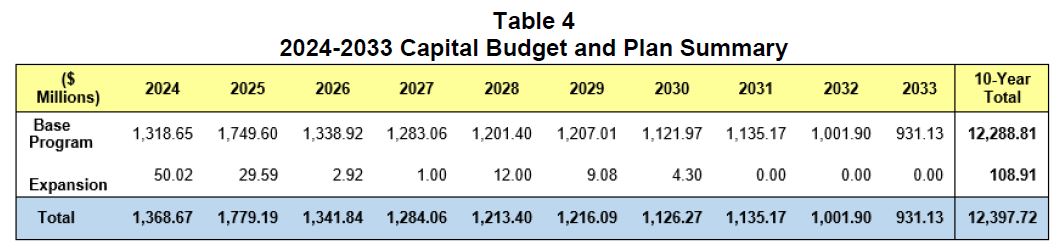
Central to this plan is the available funding. The summary shows that capital spending will decline over the decade to under $1 billion in 2033 after a high of $1.78 billion in 2025. This is a direct result of declining revenue in future years.
Note that “expansion” is a very small part of the budget, and over half of this is from close-out costs for the Spadina subway extension to Vaughan. The remainder relates to design work for the SRT busway, Waterfront LRT and Eglinton East LRTs. There is no money allocated for actual construction because this budget only includes funded projects.
Here is a chart of monies the TTC expects to receive from various sources. Note that almost 11% of the total is funded from Development Charges. There are two issues with the amounts shown. First, the City is not certain that Ontario will allow it to actually collect this revenue, or alternately “make the City whole” with offsetting Provincial subsidies. Second, the amounts from 2029 onward are much lower because the DC levies are recalibrated every five years, and until (or if) the next round occurs, the TTC does not have this revenue stream.
Both the regular Provincial and Federal subsidies come from gas tax, but part of the Provincial amount goes to the Operating budget. That is why the Federal amounts are higher in this table.
The total raised here is barely $12.4 billion over ten years when the 15-year need is over $40 billion. Funding and TTC capital needs are badly out of whack.

The City Building Fund was lauded when John Tory created it, but its intent was to finance specific projects, not as an ongoing revenue stream. As those projects mature, the CBF account dries up as the table above shows.
The distribution of this spending is shown in the charts below. Readers should be wary of the labels here. “Service Improvement” does not mean more buses and streetcars, but rather is substantially made of subway projects such as the Bloor-Yonge expansion and Automatic Train Control. [Note that a small amount of the total shown above goes to Rapid Transit projects, and the remaining $12,289 million forms the “base” plan.]
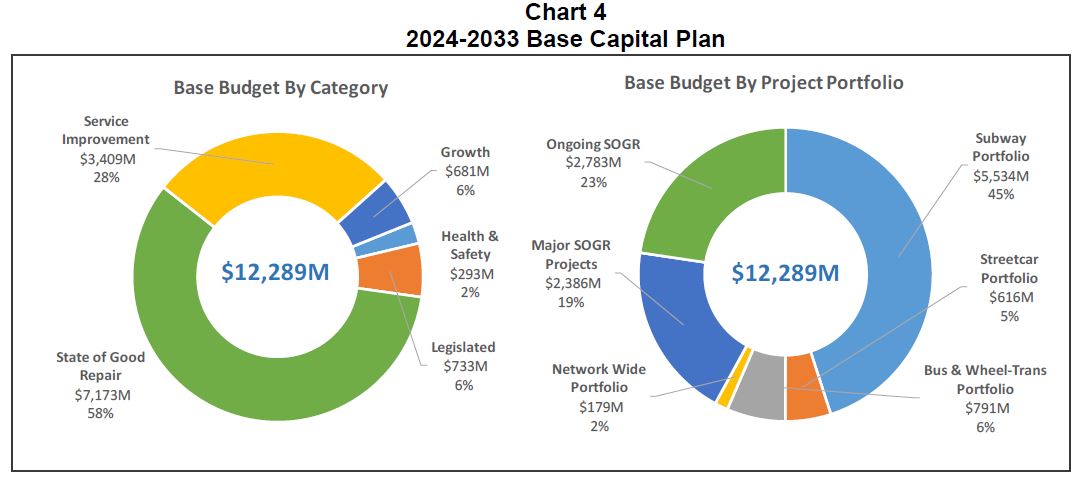
These charts are quite different looking only at the 2024 plans where the relative size of categories and portfolios represents the timing of spending in this year rather than over the decade.

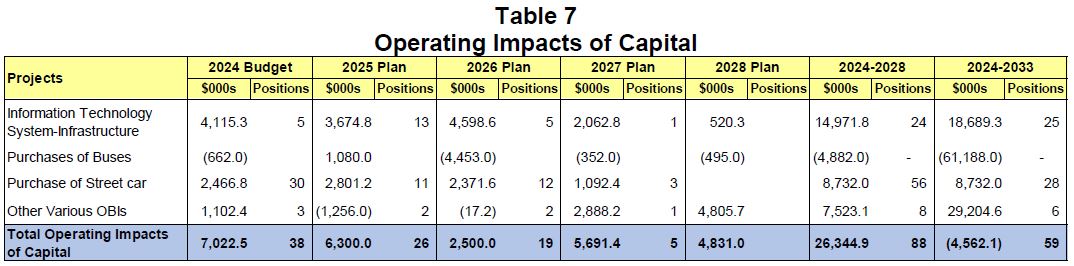
An important part of capital planning is to recognize that when there is a change in scope or tchnology, there will be future costs or savings. These are projected in the table below.
A key part of this is the assumed saving from lower operating cost of electric buses. If this does not materialize, then future Operating Budgets will have to find offsetting savings.
Particularly ironic is the recognition that a growing streetcar fleet will require more workers to maintain, but there is no plan in the Operating budget to fund more service.
The Fifteen Year Capital Investment Plan
The report on the Capital Investment Plan and unmet funding needs is a long read. The report and the plan itself attempts to group related items in “portfolios” to show how individual items are related. For a novice reader, one can get lost in the details and give up. We are not all hardened budget nerds.
A good place to start is to scroll down to Appendix A on page 43. This starts with two pie charts, but the following pages list the major categories within the Capital Plan and explain what they are for. The section for subways starts off with big ticket items such as new cars and maintenance facilities, but also lists many areas of ongoing maintenance, “state of good repair” (SOGR), without which the system will gradually fall apart. In a worst case situation, parts of the network would have to be closed.
Each item is broken down in a funded and unfunded portion. In most cases, this split is arbitrary except for a shared cost project like new subway cars. Management shuffles funding allocations back and forth to keep the most important work in the “funded” column. The obvious problem with this shell game is that some work simply cannot be deferred, and the proportion of pending work that is critical grows.
The TTC has a big problem with unfunded SOGR because higher profile work grabs the available money. In the CIP, management notes that $500 million worth of work has been reallocated without explaining which projects were the beneficiaries, and which work has been deferred. This shows how the Capital Budget is a zero-sum game where any new cost must be offset with a saving elsewhere.
[The budget] Reprioritizes $500 million in approved funding to address critical priorities and fully fund cost escalations for projects, while staying within the existing funding projections;
Source: TTC 2024 Budget Report at p. 3
A further challenge in the 2024-2038 CIP is that the TTC has reorganized the categorization and breakdown of capital projects making comparisons with past years more challenging than usual. To assist readers, I have consolidated the 2022, 2023 and 2024 versions of the CIP into one table.
The table below summarizes the three plans as they appeared in 2022 through 2024. Note that the portfolio called “Other Infrastructure” in 2022 and 2023, was broken into “Facility Maintenance” and “Network Wide Assets” in the 2024 plan.
| Portfolio | 2022-2036 ($m) | 2023-2037 ($m) | 2024-2038 ($m) |
|---|---|---|---|
| Subways | $25,400.0 | $25,343.0 | $27,613.0 |
| Buses | $6,300.0 | $6,948.0 | $8,705.2 |
| TransformTO | $5,339.8 | ||
| Streetcars | $2,230.0 | $2,277.0 | $2,307.4 |
| Facility Maintenance | $2,415.1 | ||
| Network Wide Assets | $1,474.8 | ||
| Other Infrastructure | $3,300.0 | $3,478.0 | |
| Grand Total | $37,230.0 | $38,046.0 | $47,855.3 |
Over half of the increase is the addition of TransformTO, a proposal to substantially increase the size of the bus fleet, add garages and operate more service. The proposal is buried in the Technical Analysis, Appendix C, page 88 to the City’s Net Zero Strategy. It is not clear that Council has actually endorsed this plan beyond asking the TTC to look at how surface service might be improved.
Increased bus lanes and service frequency
Convert one lane of traffic to exclusive bus lanes on all arterials.
Increase service frequency on all transit routes: bus by 70%, streetcar by 50%, subway off-peak service increased to every 3 mins.
The CIP only partly replies to this request. The Plan contains no estimation of associated streetcar and subway costs, nor of the operating cost of such a large increase in service.
Other large increases from 2022 to 2024 include:
- Higher subway car costs up from $2.32 to $3.22 billion
- A substantial increase from $1.35 to $4.1 billion in the cost of Platform Edge Doors
- Increase from $3.53 to $4.7 billion in the cost of Zero Emission buses
- Inclusion of $1 billion for charging stations in 2024 that was not included in 2022-23
Notable by their absence except in small provisions for design are the Waterfront and Eglinton East LRT lines. These are supposed to be built and open within the 15 year plan’s window, but their construction cost is nowhere to be seen. When and if the projects come forward, they will place added pressure on funding. If the TTC can show Platform Doors and a hypothetical increase in the bus fleet even though neither of these has been approved, they should show the cost of rapid transit lines that have been in planning for years.
The State of Good Repair Backlog
The SOGR backlog is particularly troubling. There is a clear analogy everyone sees in the state of Toronto’s road network where maintenance has been deferred while most spending goes to the Gardiner rebuild project. A similar fate faces the TTC if they do not get funding for the unglamourous business of keeping vehicles and infrastructure in good condition.
The growth in this backlog is driven more by a deficit in vehicle overhaul and procurement than by other parts of the system, notably infrastructure, but both are important. The escalation in unit costs and the pursuit of fleet expansion crowds out spending on existing parts of the system.


The SOGR backlog problem was hidden in pre-2019 budgets because only funded projects got into the tables. Unfunded projects simply disappeared even though they might have been key to system operations. This made the City’s future capital needs appear to be manageable when in fact transit represented a growing crisis, even without the pandemic effects.
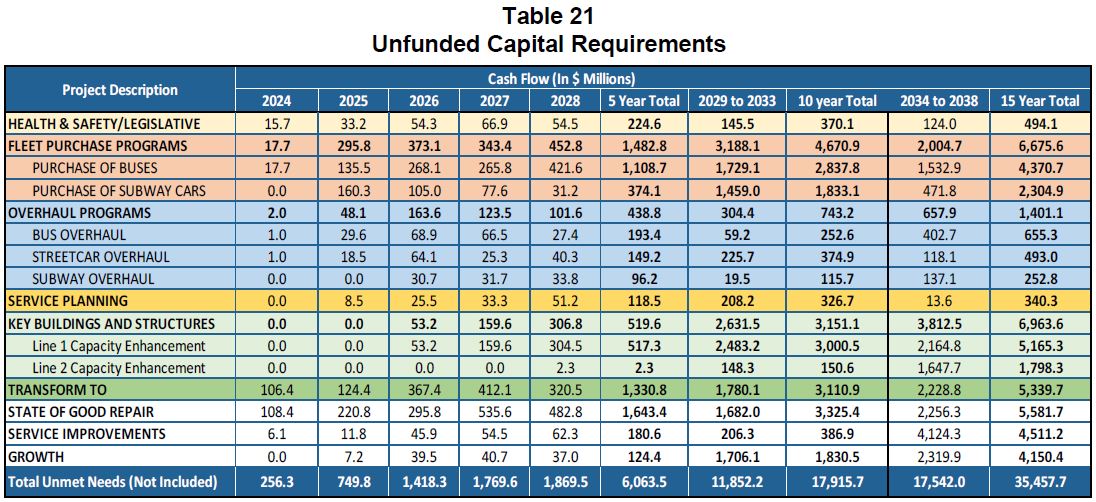
Overall, the “unmet needs” are summarized below. This chart should be read with care as it includes some large projects like Platform Doors and expansion of the bus fleet that are now only proposals. Moreover, it does not include some rapid transit projects that reasonably would be expected to at least begin during this period.
The Board’s Role
The TTC Board has never met to discuss overall spending priorities and how much of this unmet need is a top priority “must have”, and what parts take lower precedence. Some of these will still be critical, just not quite as critical as the first group. Some of these will be “nice to haves” if only someone would pay for them.
The Board’s job is to provide policy direction with the advice of management, but ultimately it is the Board who rules. For its part, Council has an important role because so much of the TTC Operating and Capital Budgets come from City revenues.
Too little time is spent understanding the TTC’s overall needs at a detailed level where hard choices must be made. Budgets should not be discussed at one meeting and then left to management for a big reveal around Christmas each year. Toronto talks of attracting riders back to transit, of building transit ridership, of the economic value of transit to the City and Region. These will be difficult decisions, and informed debate is hard to come by.
There are Service Plans and Corporate Plans, but too much of them are conservative, “steady as she goes” documents with little aspiration beyond modest growth. The Board and Council should demand options for real improvement and engage the debate about what the future of our transit system could be, should be.
 Steve Munro
Steve: Convert one lane of traffic to exclusive bus lanes on all arterials.
Something like this should be subject to a referendum. Or we can use the same undemocratic way as with pushing streetcar only roads down our throats: launch a 10 years long “pilot” project and then quietly make it permanent.
Steve: As I said, this is not a Council approved policy yet, and I dare say there would be a huge battle to get it approved. The authors of the Net Zero report were incredibly naive, although their premise was to say “this is what you need to do to achieve your NZ goals”.
As for King Street, you know perfectly well it went through (at least) three rounds of consultation (during which the original proposal was watered down), but was approved by Council under a Tory administration.
LikeLiked by 1 person
Ooooh, when do we get a referendum on road widenings or new roads or new freeways (maybe on the two the province is planning through farmlands) or the Gardiner rebuild or the proposed new natural gas electricity generating plants or development in floodplains or…?
Or maybe let’s have a referendum if we agree to amalgamation? Oh wait we did and PC politicians ignored that one.
LikeLiked by 2 people
ZERO likes and only one comment and that too from a troll? This blog has got some good useful important information but your low readership/ridership is due to the key technology decisions that you made. You are not on YouTube, you are not on Instagram, you are not on Facebook, you are not on TikTok, you are not on Google Play, you are not on the Apple app store, you are not on Huawei’s Harmony OS app store. You are not anywhere other than the World Wide Web. Just look at Reece Martin. People call him Steve Munro of YouTube and he runs the RMTransit YouTube channel with almost 300,000 subscribers and close to 50 millions views across all of his content in 11 years. But your blog is almost 18 years old and you will probably need hundreds of thousands of years before you reach 50 millions views. You need to expand the reach of your blog by making use of all of the different platforms out there, you need to put yourself out there my man. I want to see you making TikTok videos and I want to see you on Google Play. If you don’t listen, then I am afraid that this blog will just die out.
Steve: First off, I don’t want a gazillion likes and views from material that is more eye candy than detailed analysis. RM is not always right, and there have been cases where he has just made up stuff about Toronto without doing basic research about the history. That set off quite a Twitter war between his acolytes and mine some years ago. I’m not writing a travelogue, but providing detailed analysis of transit and political policy that is not going to be of interest to hundreds of thousands of readers.
You seem to dislike that I don’t spend my time churning out videos. Tough. Go watch his stuff, if that’s what you get off on, and leave my blog for readers who want in depth analysis.
For the record, I have had over 1 million views so far in 2023, and there has been a continuous rise over several years. Die out? I don’t think so.
And, yes, the blog will be 18 in January.
LikeLiked by 3 people
Steve,
Your blog’s value to us is not expressed in likes.
Thank you, as always. Happy blog-birthday soon!
Steve grins quietly, with thanks!
LikeLiked by 2 people
Whatever one thinks of RM [and HE certainly seems to be sold on himself]; there is no question, as Steve ‘suggests’ that each of them provides a much different service. I do enjoy some of RM’s histories, but Steve has been ‘here’ for more than 60 years, with his eyes wide open through the whole trip. Munro; there is no substitute!
LikeLike
Reece Martin runs a very different service than Steve does. RM does 30,000 foot overviews of different systems with very little in depth analysis. I watch his videos to see different systems but I afraid that people who get “special access” to different properties will start drinking their special koolaid. None of them have the time, or patience, to do a detailed investigation into the underlying facts. I watch RM, and Geoff Marshall, to get visual overviews. I read Steve to get the unadulterated facts.
Fair notice: I have known Steve for over 60 years.
Steve: I might also add that nobody who asks hard questions on the record has a prayer of getting an interview with the likes of Phil Verster. Tame “reporters” get access.
LikeLiked by 1 person
Do you know if the intersection of Queen and University will have to be shut down sometimes to accommodate work for the new Ontario Line station? How about Queen and Spadina? If yes, then do you know when?
Steve: Metrolinx claims not, but I don’t really believe them. Their favourite trick is to say that their P3 partner has “discovered” the need for work that will produce more interference than planned. At Osgoode, they are supposed to access everything from the University side of the site, and at Spadina from the two corners. The stations are very deep and the tunnels will be bored. They can mine outward from the station access shafts (aka “keyholes”) rather than doing a cut-and-cover project such as Yonge-Eglinton.
LikeLike
Is the budget item for Platform Edge Doors (PEDs) only referring to how much it would cost to install them to the current ttc subway stations or does it also include future stations on the eglinton and finch west lrt?
Steve: Only the current stations. The new lines are Metrolinx projects (Eglinton, Finch, Scarborough, Ontario, North Yonge) and where platform doors are present they will be in Metrolinx’ budget, not the TTC’s.
If they’re only referring to the current subway stations (70 according to wikipedia), this means that it will cost the TTC $58.5M per subway station…which is just absurd.
According to this article, it cost Paris 3.7M euros to install PEDs on their subway stations for one of their lines. According to this article, which pedestrianobservations refers to, it took them 10 years from 2013-2023 so this is very recent. If they can do it for so cheap, then there’s no reason we can’t either.
Could this simply be a tactic from the TTC to either not do the project or are they inflating the costs to extract more money from the city to spend it things other than PEDs?
Steve: This depends on the style of doors to be used and the structural mods required to support them. I note that the photo of the partially complete work at Gare du Nord shows almost full height doors with only a few supports tieing what I assume is a standard frame into the ceiling of the station. Photos from other stations on Google show the space to the ceiling filled in, and so this could be a temporary configuration.
I am not sure why TTC’s costs have climbed so much in recent budgets, and suspect that design creep might be responsible. However, until we see an explicit description of the work planned it is hard to tell. TTC has not published the “Blue Books” with project details since pre-pandemic times, and the ones for 2024 are on my shopping list.
As for spending the money elsewhere, that tactic won’t fly because they will almost certainly look for joint funding with other governments, and cannot shift that money to other projects because they are audited.
LikeLike
Two thoughts:
In my career as a software development manager, sorting work into “must do”, “should do” and “nice to do” buckets was Project Management 101. It’s a bit disturbing to hear this seems beyond the TTC Board’s skill set. I’ve long thought the composition of the TTC Board is a problem (specifically there is a notable lack of domain expertise) so perhaps this is just an example of that it does really matter who is on a board.
I’ve been reading Steve’s blog for many years, and I think it’s an incredibly valuable transit resource. Measuring the worth of everything by the number of YT subscribers or social media followers is just silly. Please keep the great work up Steve! 🙂
Steve: Many thanks. I can remember several occasions in the past where the Board (this goes back a way) asked management to prioritize projects, but this never really happened. To be fair, the Board gave little guidance on what it considered to be “top priority” as a class, and so management was left with no guidance other than covering their butts against political fallout. I can imagine that a focus on state of good repair taking absolute precedence over new lines would go over like a lead balloon. And we all know what happened to former Chief General Manager Gary Webster when he told Council that we did not need a subway extension in Scarborough.
LikeLike
As a Gen-X who runs a blog in a different industry, let me chime in. I was born in the pre-Internet era and I’m also deaf, which makes me dislike creating videos with my difficult-to-understand voice.
I straddle the generations of the older handwriting/typewriter generation and the youtuber/tiktok generation and have an understanding and respect of both ends of the spectrum. Take it easy on Steve.
Both Steve and RMTransit are fantastic for different audiences, and I’m the overlap Venn diagram that appreciates both RMTransit and Steve Munro for what they are.
Also, Steve Munro is now currently being saved by the Internet Archives’ Wayback Machine (retroactively) which keeps a permanent record of a lot of valuable content for the last 18 years. As important material for future archivists, it won’t fade away.
Steve: Over the years I have been a resource for and occasional commentator on mainstream media in various forms including TV interview and panels, radio, print and more recently Podcasts. The striking part about TV in particular is that there is always a hunger for visuals, and these take up far more time usually than the idea they might illustrate. They also constrain the type of topics to those where a moving image might be available. There is a lot more overhead in creating a video report, and they tend to be shorter than with other media. I cannot imagine covering issues I write about in detail in a video beyond production of a “teaser” to drive traffic to the site, and my time can be better spent covering the details for an interested audience.
LikeLike
Reece Martin is a clown drawing lines on a map with his crayons. He pretends to expertise on transit systems around the world when he can’t even get Toronto right. His solution is always to just build more subways, don’t worry about funding or if they’re called for. It’s obvious to me that Steve has years of experience in the TTC (and GTA) transit, both the technology and the organizations. He understands the politics involved and does the hard work of digging up and crunching the numbers both on performance and how to pay for it all. I’ve learned a lot from Steve. All I learned from Reece is how to unsubscribe to a YouTube channel.
LikeLike