
At its November 22, 2023 meeting, the TTC Board will consider a report New Subway Train Procurement and Implications for Line 2 Modernization and Future Growth which goes into considerable detail on several related capital projects related to renewal of both Line 1 Yonge-University-Spadina and Line 2 Bloor-Danforth.
The TTC is in a very difficult position for capital planning because for many years it understated the size of the capital backlog and also tended to treat related projects, or even components of the same project, as separate items. This led to low-balled estimates of total costs and, in some cases, piecemeal execution of projects. Now that we see “all in” costs, the problems facing the system are perceived more seriously, but just at a point when new money to invest in existing subways is hard to find.
Although the TTC called for proposals for a replacement of the Line 2 fleet of T1 trains, with add-on provisions for system expansion, this was cancelled in June 2023 due to lack of funding commitments from either the Provincial or Federal governments.
The report proposes three scenarios depending on when new trains and facilities would be delivered and built at total costs ranging from $8.5 to $10 billion including inflation. Very little of this has committed funding.
This is not just a question of buying new trains, but of building, or renewing, many facilities:
- Greenwood Carhouse dates back to the opening of the BD subway and needs to be modernized and rebuilt to handle a new fleet.
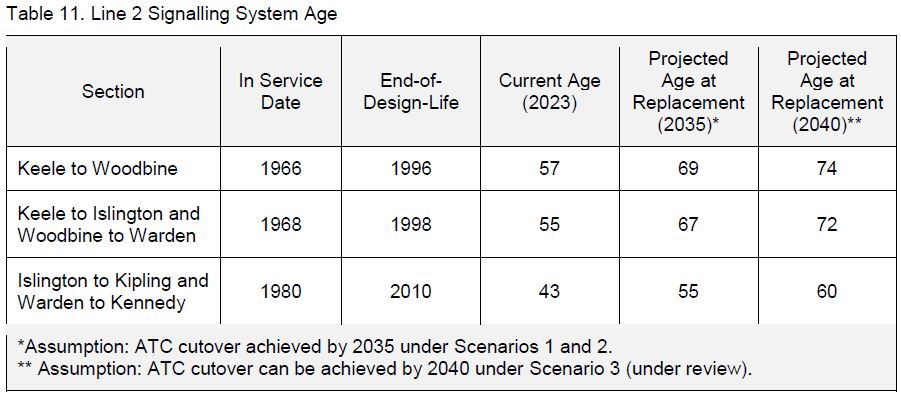
- The signal system on Line 2 dates to the 1960s and must be replaced both to maintain reliability, improve operations and provide for service growth.
- Additional trains for both Lines 1 and 2 will require more storage including a major new maintenance facility for Line 1.
The funding sought by this report does not include companion upgrades that have been flagged in the overall capital plan:
- Running more frequent service requires more traction power on top of state of good repair work needed for both subway lines’ power systems.
- More service means more passengers, and some key stations cannot handle additional demand between the platform and street without additional circulation capacity.
Moreover, there are major projects beyond subway fleet renewal that are either partly or totally unfunded even at the City level, never mind its partners:
- Ongoing replacement of the bus fleet including electrification
- Any provision for service growth to improve transit coverage and encourage a shift to transit riding especially in areas where it is not competitive with auto
- LRT lines in the waterfront or Eglinton East
- Platform screen doors to prevent access to track level
Even if the fleet and signal renewal for Line 2 finds much-needed financial support, this is only the beginning of the TTC’s search for capital, and I have not even mentioned the need for ongoing state of good repair.
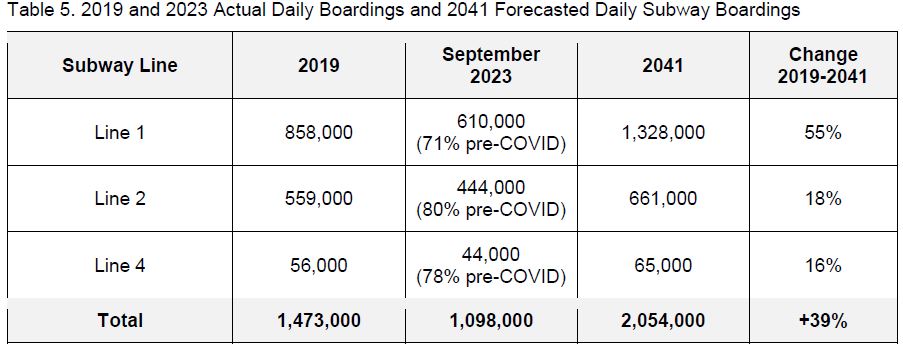
In the short term, the TTC has been “saved” from a capacity crisis by the covid pandemic and the loss of subway riding. Only a few years ago, the concern was not empty trains, but platforms full of riders who could not move. Although the subway is not back at full demand, recovery is well underway. Here are historical figures and projections for the future from the report.
2041 might sound a long way off, but in the scheme of subway fleet planning, it is fairly near given both the lead time to buy new trains and their 30-year design life. What we plan for today will affect the system for decades to come.
This forecast will be updated with results from the current Transportation Tomorrow Survey and other planning work to provide an outlook to 2051.
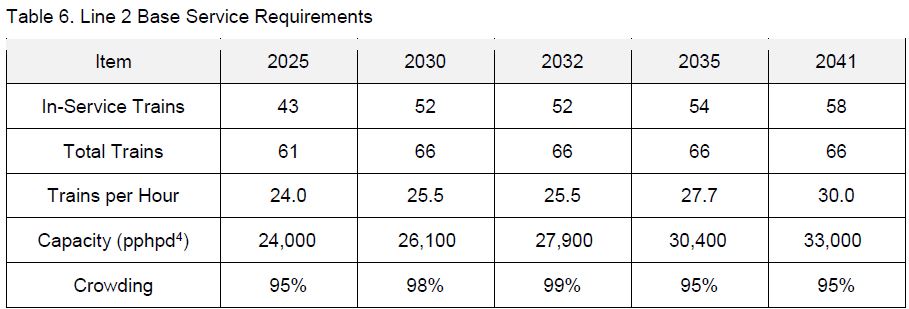
These projections translate to service requirements on the two lines. Note that this is likely based on the historical ratio of peak to all day demand. Although work-from-home may shift some riding away from peaks especially on Mondays and Fridays, this would still leave the midweek days facing crowding. It would be dangerous to make plans for lesser demand as a short-term cost saving measure.
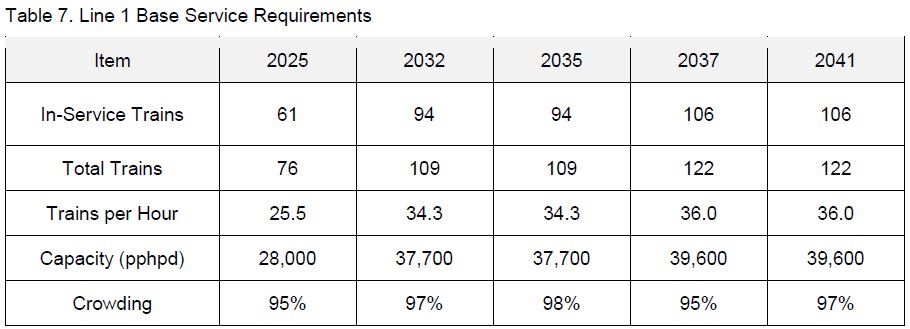
Line 1 has already been converted to Automatic Train Control (ATC) with moving block signalling that can handle more trains/hour. Note that the projected Line 1 service is at 36 trains/hour, or every 100 seconds. This will be challenging to sustain especially at busy stations and terminals.
The current signal system on Line 2 cannot support headways below about 140 seconds, the pre-pandemic peak service level on that route. This is equivalent to 25.7 trains/hour which gets us only to the 2032 projected requirement.
This translates into the following requirements for a larger fleet.
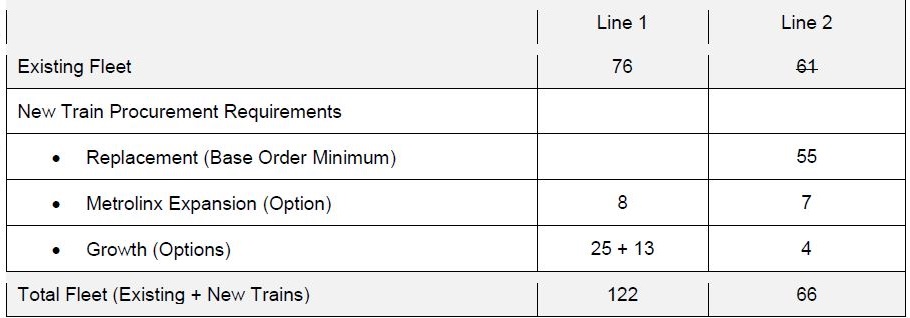
The 55-train replacement for Line 2 where there are now 61 trains is based on the capacity with new trains (similar to those now on Line 1) with about 10% more room than the old ones. This finally addresses the excess of T1 trains in the fleet ever since the TTC decided to run Lines 1 and 4 entirely with new “TR” trains and ATC, and relegated the T1 fleet to Line 2.
The Metrolinx options are for the Richmond Hill and Scarborough extensions. Growth trains are to permit the operation of more frequent service than the existing fleet can support.
Note that Line 4 Sheppard is not included here as it has a dedicated set of six 4-car trains that can handle projected growth on that line. Depending on the extension of Line 4, a future procurement of trains and storage facilities could be required.
In the remainder of this article, I will describe the scenarios and implications of choices the TTC, Council and its funding partners will make in the near future.
Recommendations
The report recommends that:
- The TTC prioritize funding in the capital budget for:
- New subway cars and related projects with a cost of $3.2 billion as the City’s share.
- A 30-year state of good repair overhaul of the T1 fleet.
- Risk mitigation activities for Line 2 related to fleet and signal system life extension.
- Subject to confirmation of funding, the CEO issue an RFP for new trains needed on the existing Line 2 with options for extensions and demand growth on the system.
This will have effects not just for subway planning but for other TTC capital project funding and timing.
The Three Scenarios
Although the TTC once favoured life extension of the T1 fleet and Line 2 signal system, this was a change from the plan under former CEO Andy Byford. They have now returned to viewing immediate replacement as preferable and most cost effective. It is a case of spending now to avoid spending more later, and suffering through the effects of less reliable infrastructure in the meantime.
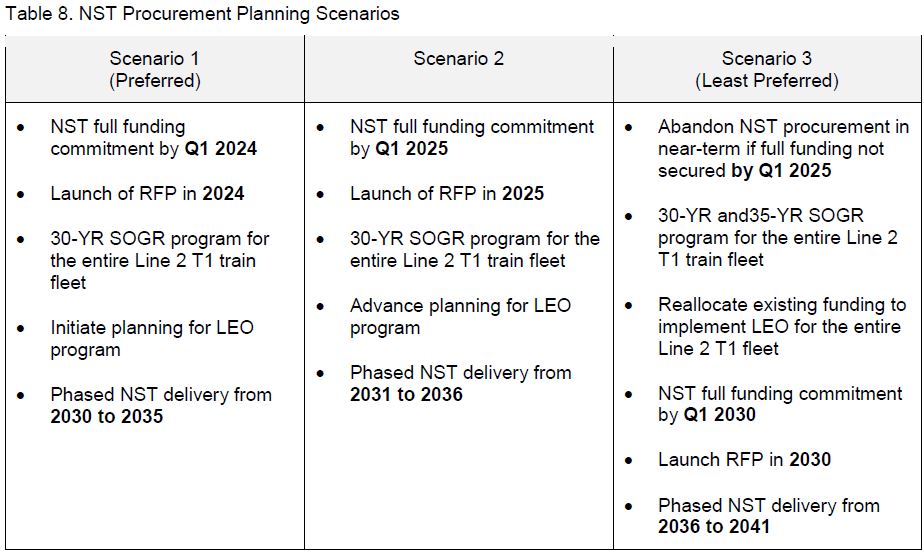
In the preferred scenario, the TTC would have funding in place for new subway trains (NST) by Q1 of 2024, less than half a year away. Because of lead times for procurement, delivery of trains would not even begin until 2030 and would run to 2035 (2033 for the Line 2 replacement, followed by expansion and growth trains). A life extension of the T1 fleet will be required to get them to a 35-year age. I really must wonder why it will take over a decade to get a new fleet, and to what extent this is artificially drawn out.
This is the minimum that dithering about new train purchases has cost us thanks to bad decisions both by TTC management and by their political masters. Future capacity will be threatened even in this most optimistic scenario.
The second scenario pushes the plan back one year to allow more time for funding to materialize.
The third option assumes that the existing trains would have to be overhauled twice – once for the 30-35 year interval, and once for 35-40. New trains would not be delivered until the late 2030s limiting the system to the existing fleet’s capacity for much of the next two decades.
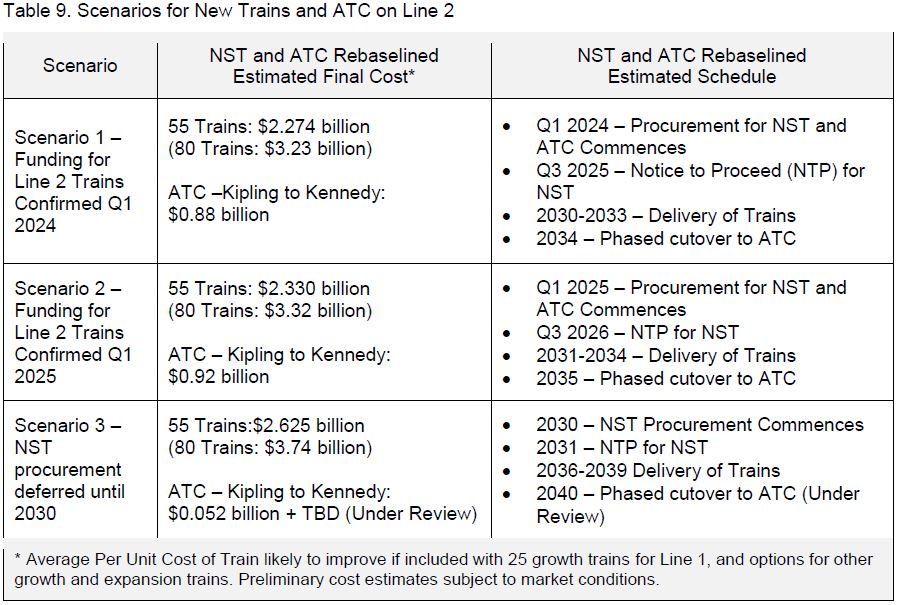
The spending required and timing are shown below for Line 2 where the need is critical. Note that there is no mention of ATC for the Scarborough extension which Metrolinx currently plans to build with conventional signals. With the delivery of new trains now pushed well beyond the SSE’s opening date, there will be a future ATC project for that extension.
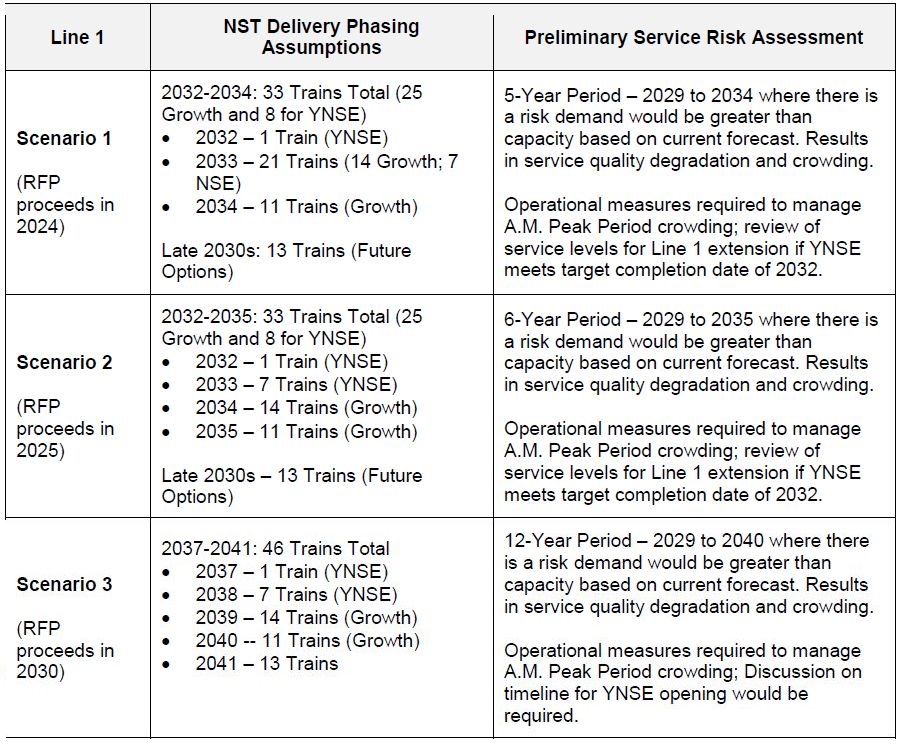
The table below shows the situation for Line 1. Because it must wait for Line 2 deliveries before getting additional cars, there is a danger that there will not be enough trains to operate Line 1 especially after the Richmond Hill extension opens in the preferred Scenario 1. The situation is even worse for Scenarios 2 and 3.
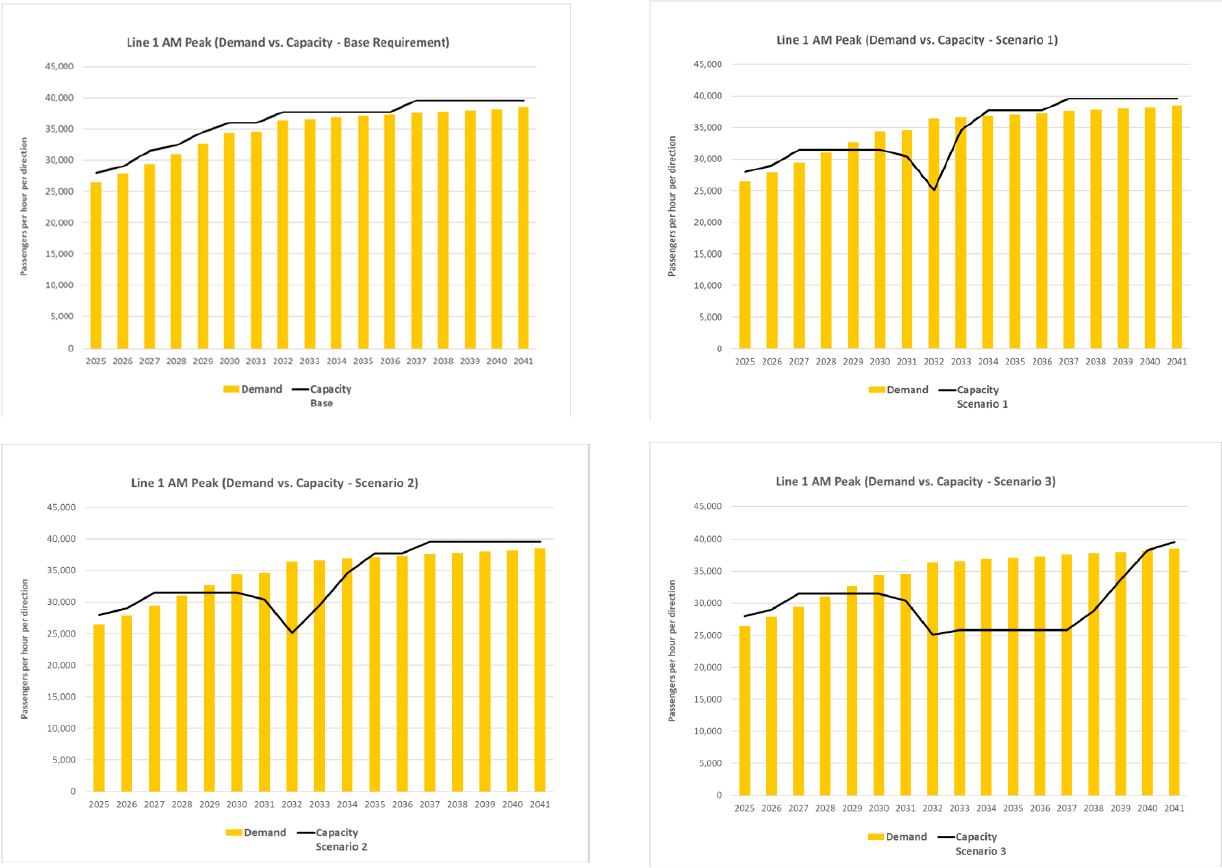
The capacity shortfalls are illustrated in the charts below.

Maintenance & Storage Facilities
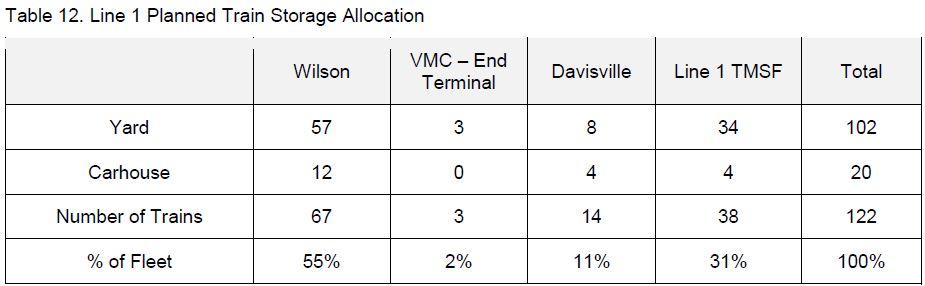
Today, Line 1 trains are stored and maintained primarily at Wilson Yard with a small number at Davisville and a few planned to be stored on line at Vaughan Station. The projected fleet cannot accommodated at Wilson both due to physical size, but more importantly because it is impractical to load service entirely from one end of a very long (Vaughan to Richmond Hill) line.
A new storage and maintenance facility is needed as part of the Richmond Hill extension, but this is not yet in Metrolinx plans (and hence not part of provincial spending commitments).
Something that is not clear in the table below is where the Line 4 trains will go, not to mention the fleet of work equipment that is partly stabled at Davisville.
Greenwood Yard dates back to the 1960s, and will be renovated and adapted to service the new subway trains on Line 2. It will be supplemented by space at Kipling, Keele and the future Sheppard/McCowan terminal. Originally, Greenwood was to be repurposed as the Relief Line’s yard and become only a secondary location for Line 2 trains. A new facility would be built west of Kipling Station on lands of the former CP Obico Yard which the City has bought for transit use.
With the change from the Relief Line to the Ontario Line which has its own facility at Thorncliffe Park, the Kipling/Obico yard is unlikely to be built until there is a westward extension of Line 2 to Sherway. This is not in any of the current plans.
Life Extension vs Replacement of Equipment
No matter which scenario is chosen, the TTC must extend the life of existing trains and signals. To that end, they will conduct studies to see what is feasible. The report does not discuss the implications if the life extension proves to be impractical.
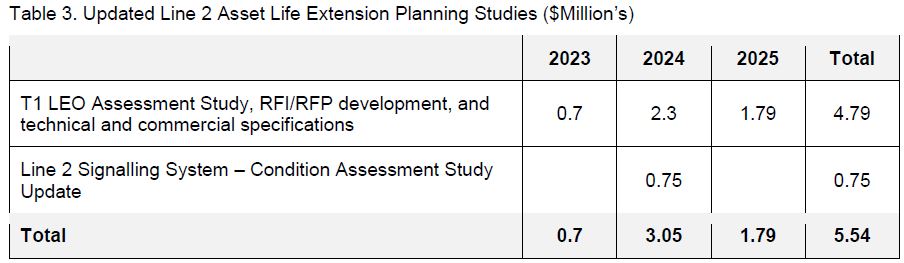
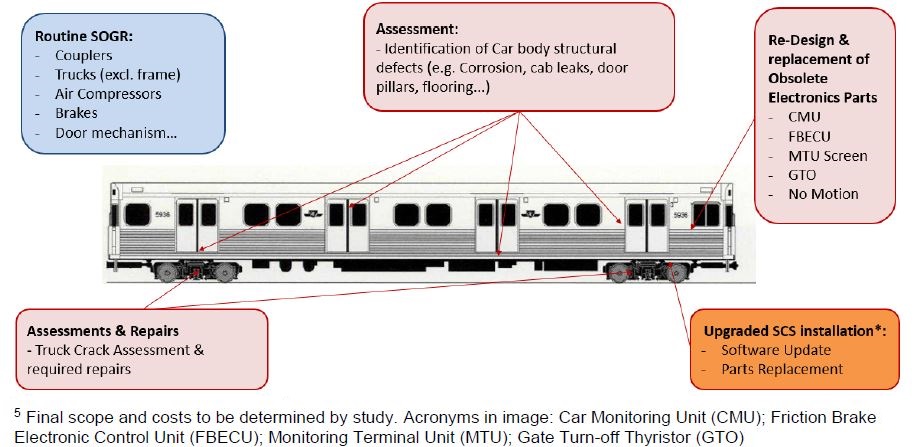
The T1 fleet on Line 2 was delivered between 1996 and 2001, and trains will reach their 30-year lives over a comparable period starting in 2026.

The expected scope of work is shown below.
The signal system dates back to the opening of the Bloor-Danforth subway and its extensions, and is already well past its design life. Replacement is overdue, and service quality will be affected by the reliability (or not) of the aging system just as on Line 1 where the oldest signals dated back to the early 1950s before the line converted to ATC (Automatic Train Control).
The project on Line 1 was disorganized because it was procured in small chunks to avoid political sticker shock on an end-to-end project for the line. That decision led to design compromises and equipment compatibility problems that were unscrambled during Andy Byford’s era as CEO. Line 2 must not proceed on a similar basis, but must be implemented as one project with one technology, preferably one that is compatible with the Line 1 system to avoid interoperability issues for the fleet.
Cost Estimates and Funding
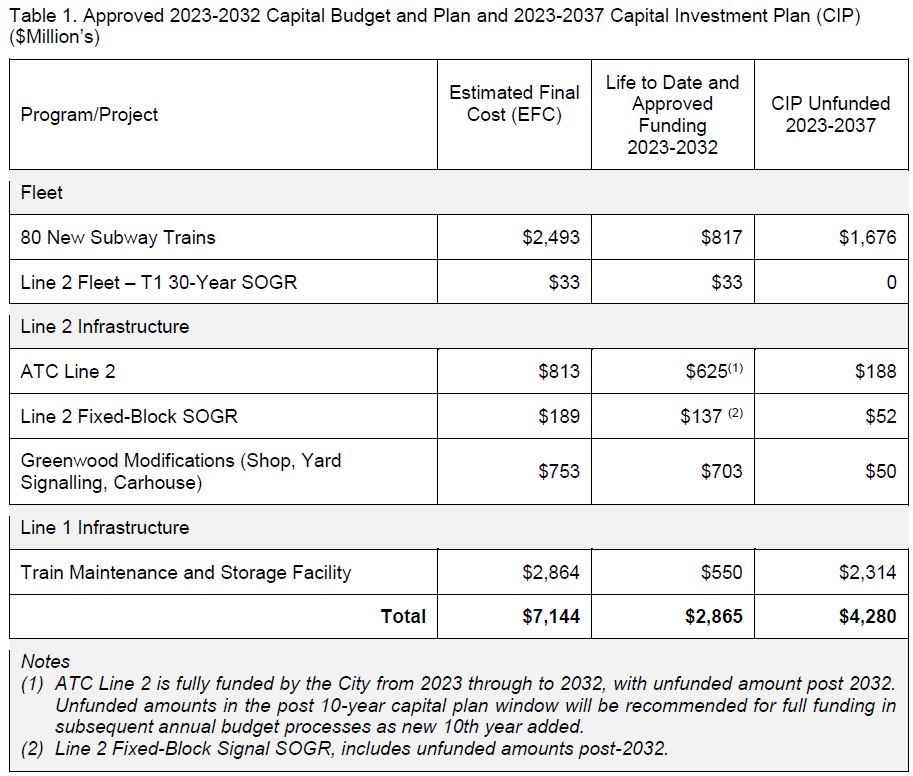
The current version of the capital plans in Table 1 below shows an estimated cost of $7.1 billion of which $4.3 billion is unfunded.
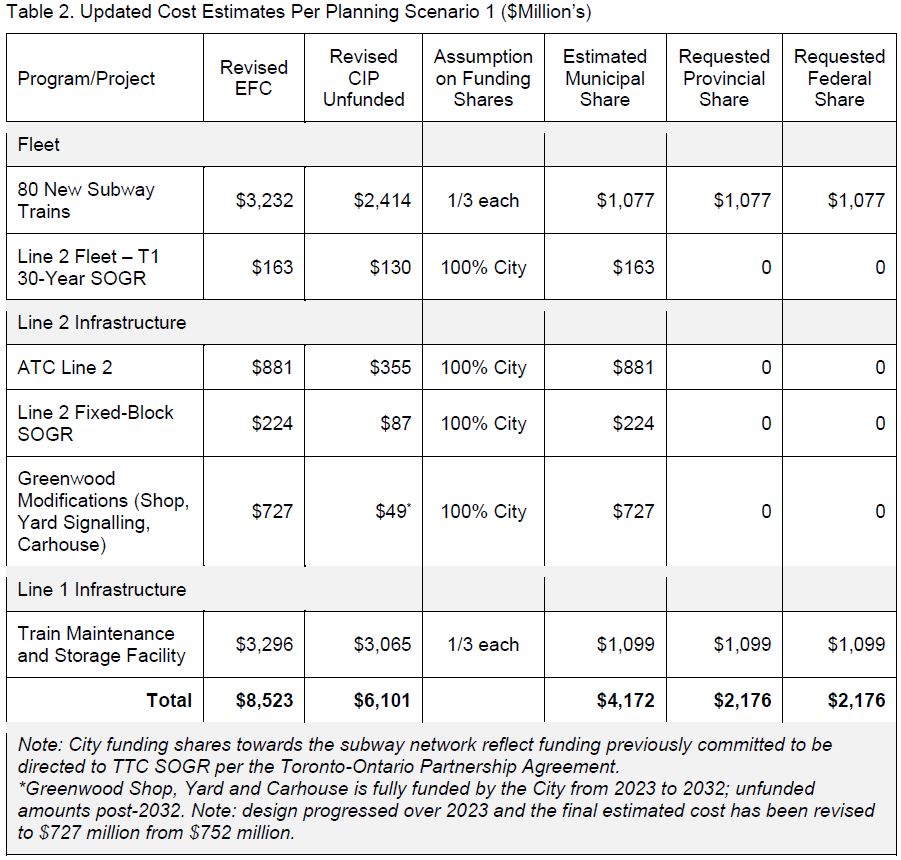
In scenario 1, the estimated cost is up to $8.5 billion, and the proposed cost sharing allocations are shown in Table 2 below.
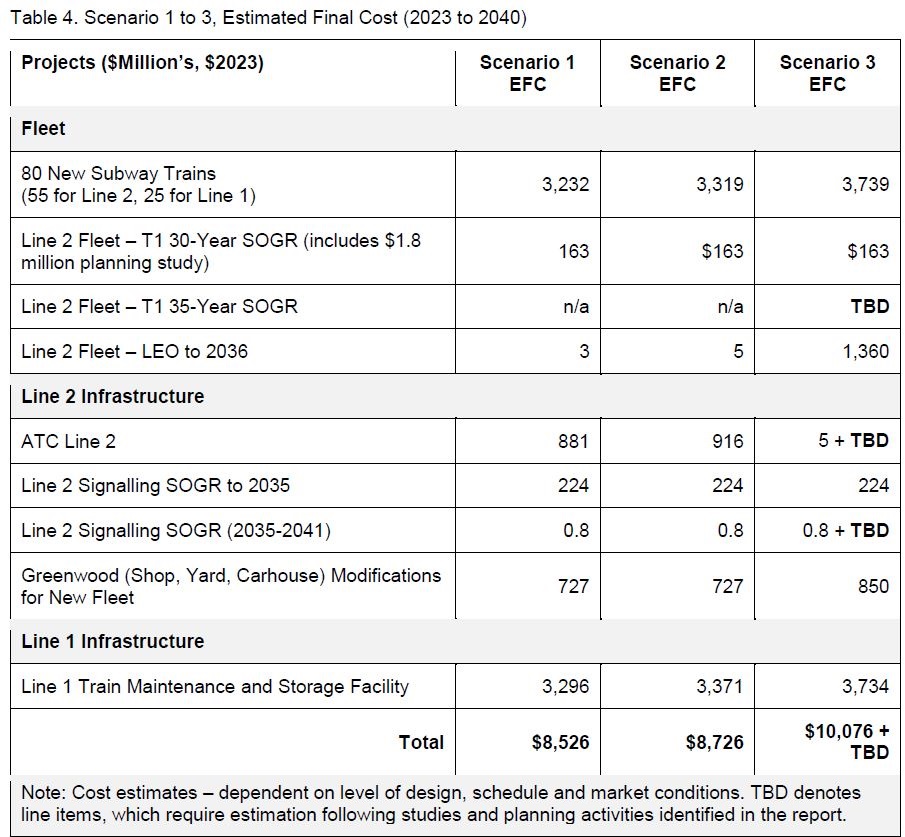
The cost estimates for the three scenarios are shown below. Note that these do not include any side-effects such as system reliability and maintenance cost growth due to old trains and infrastructure, nor to the implications of crowding for overall system operations.
Summary
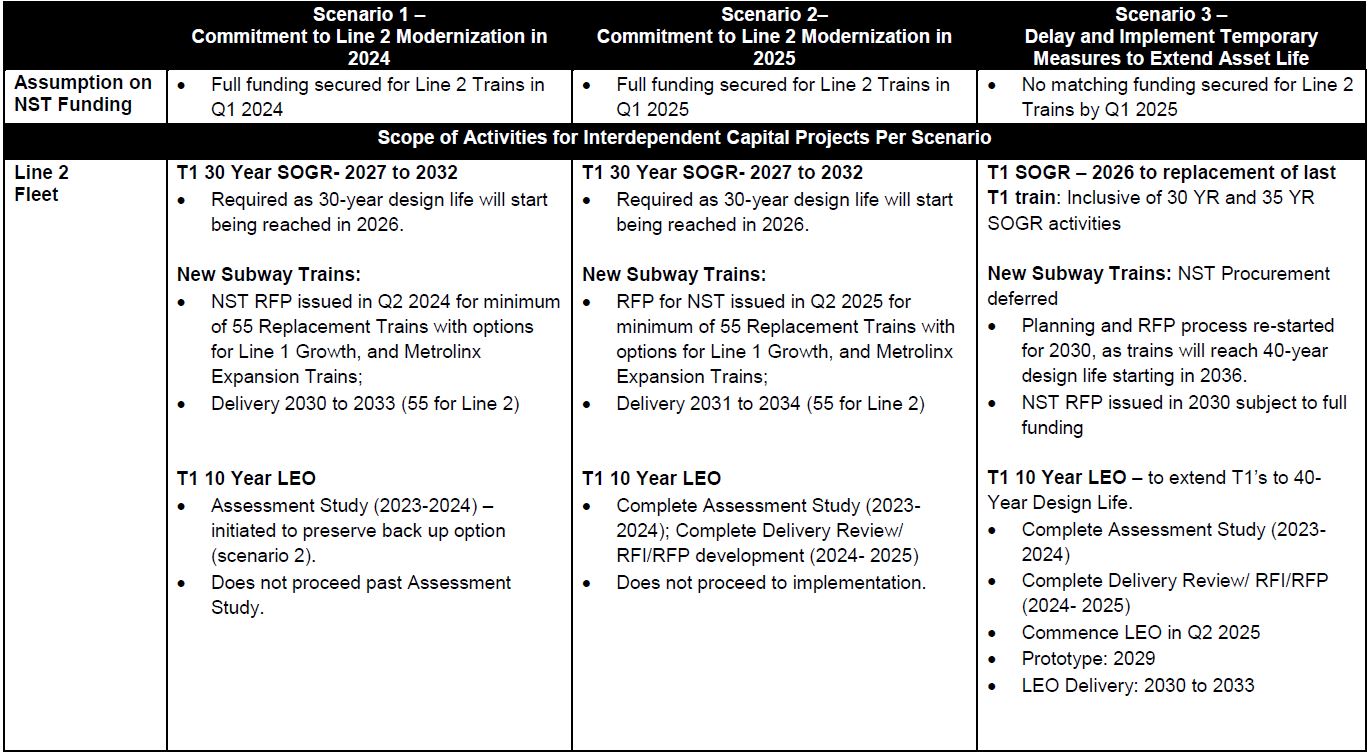
The table below summarizes the many issues in this plan.
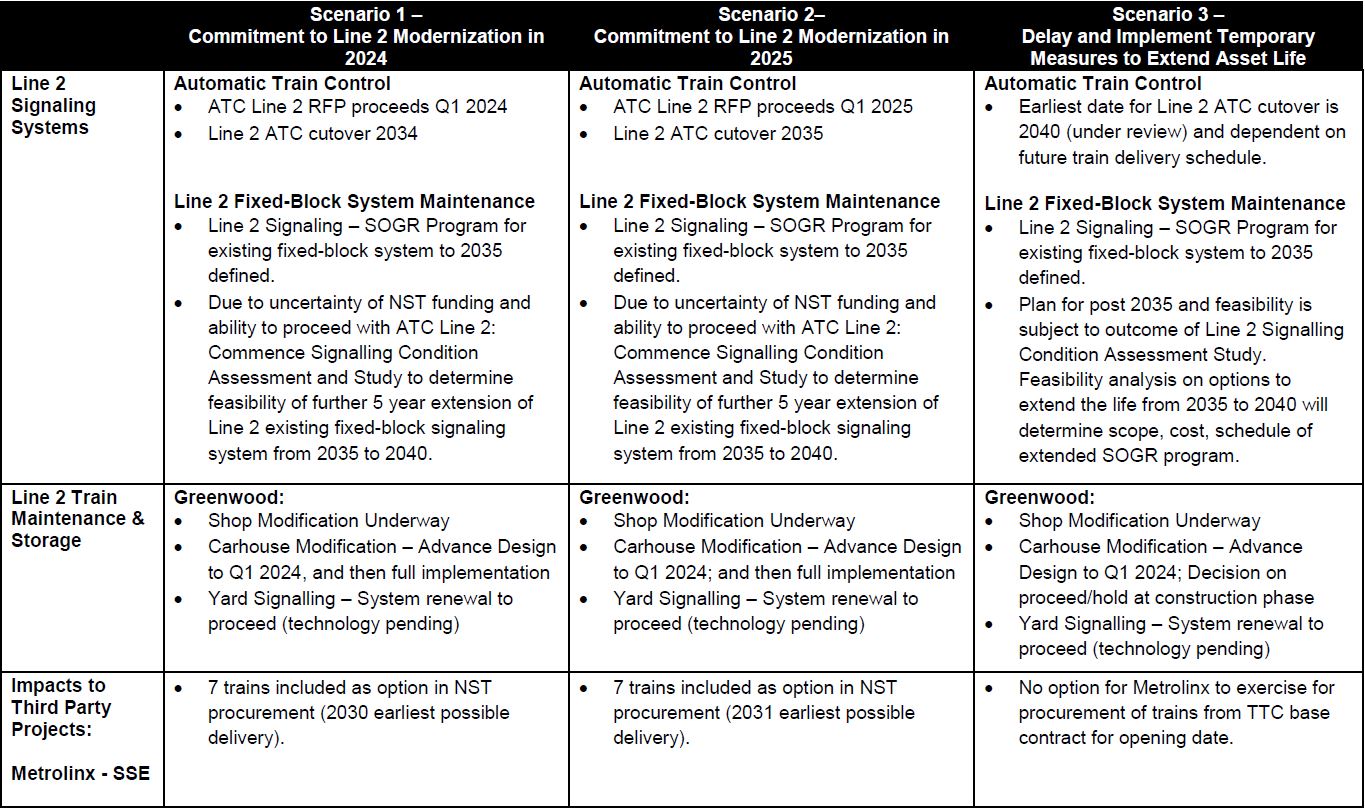
 Steve Munro
At some point York region too needs to step in with capital and operational expenses for the Line 1 extensions. Yes, that would also mean revenue sharing but York region shouldn’t be getting a free ride. I say this as a York region resident. They can contribute by getting land for a yard near Richmond Hill Centre, paying to buy the growth trains and hiring staff to run and maintain those.
LikeLiked by 1 person
The trains on Line 2, Bloor-Danforth, are gradually reaching the end of their lifeline, and will eventually need to be replaced. The trains on Line 1, Yonge-University-Spadina, entered service in 2011, from Bombardier (now Alstom) factory; the trains are named the Toronto Rocket.
What may likely happen is that when the second ‘generation’ of Toronto Rocket trains arrive, they will run on Line 1, and the first ‘generation’ Toronto Rocket trains shift over to Line 2. The old trains will eventually be retired, and join the Hawker-Siddeley trains retired a decade ago.
Steve: That scenario was likely when the TTC planned to build a new yard at Kipling that could handle the six-car unit TR trains, but with that plan now on ice, and the need to maintain trains at Greenwood, that’s where the new fleet will go. The specs for the new trains allow them to operate in individual two-car units which Greenwood shops can handle.
LikeLike
I also wonder why the 6-year lead time from getting funding to having the first (prototype?) train delivered, but glad to see the delivery schedule of the first 55 compacted into 3 years rather than 6. But what reasons could they possibly have to want to draw it out even longer?
Of course, scenario 3 fails to address the possibility of the same “lack of funding” nonsense happening in the 2030s, when they would need to restart procurement at a higher cost.
LikeLike
We’re very lucky that Steve has the time/expertise to lay out just how deep the problems are with the subway spines, and their capacities, thank you. But if we’re in such a deep mess, surely a massive part of the solution is to forgo, and thus stop! Suspect Subway Extensions, like the Richmond Hill excess, but including Scarborough, which include the federal level supports because they were too eager to buy votes and look the other way. The Ontario Line I also think should be paused, for a reset of both Metrolinx (to report to the full Legislature) and OL project options, including triage surface-oriented Relief in the Don Valley, including the DVP, that wouldn’t be a $1Bill//km, (and what extras aren’t included in that OL price tag?)
(Costs per km are a bit of a sour point for some of us; good work by RCCAO and Stephen Wickens is here.
Squeezing the billions in these suspect large capital projects would be wise if we could get the redirection of funds towards renewing all of what is needed.
Heck, pausing all of the big projects until Eglinton is opened would be a fair deal for the taxpayers, though we likely need a public inquiry on it all.
Also, computers aren’t necessarily going away, so the work from home is also not disappearing to favour traditional to-core/office trips.
Can the TTC Commission begin to reset this large mess?
LikeLike
Already there are noises that the city of TO does not have the funds to operate lines 5 and 6. I suspect that slowing or stopping service on line 2 due to SOGR of the cars or the signals would be enough to loosen some purse strings.
Having said that, putting money into the EELRT and being able to use it as a cheaper alternative to line 2, if it had to be shutdown, or operate on a lower frequency would be a nice option.
As for the timeline on the purchase of new rolling stock, part of the delay has to involve the redesign of the cars to suit good old Greenwood. The line 1 car sets are designed and built to operate as single units, and are maintained as a single unit. They are not designed to be broken apart. To create two car “modular” sets for maintenance will require some new design. Sticking to the original design would probably offer significant time savings in production, even if some systems got upgraded.
Which leads to the abandonment of Obico yard. I would bet money (taxpayer money of course) that building a new MSF there would be cheaper than trying to overhaul Greenwood while trying to run operations at the same time. The potential for delays and cost overruns would be enormous.
Steve: The redesign for two-car sets was already included in the RFP that was cancelled. They don’t have to do this design again. I do agree that trying to reno Greenwood while it is active will be “challenging”, but they seem to be avoiding the high cost of Obico Yard, and possibly because they may be eyeing some of that property for a bus garage.
LikeLike
If we are going to order new trains for Line 2, then they should run on LINE TWO. Historically whenever new trains are ordered for Line 2, they actually go to Line 1 which serves the rich Downtown area while Scarborough gets the old garbage from Line 1 which no longer works well and frequently breaks down. Why Scarborough always gets the “short end” of the stick?
Steve: You may not have noticed, but (a) Scarborough only contains part of Line 2 which is primarily in the old City of Toronto who also suffers from hand-me-down cars, and (b) I already explained that the Line 1 cars cannot be shifted to Line 2 because Greenwood Shops cannot handle them. This would have been possible if the new yard and shops at Kipling/Obico were built, but not at Greenwood. And so this argument is a red herring.
LikeLike