
This is the final article in a series reviewing the effects of diversions around various construction and road repair project downtown during the month of October 2023, and especially the period from October 18 to 25.
Previous articles are:
In the third installment, I look at the effect of the route changes and congestion on the quality of service on affected major routes: 501 Queen, 503 Kingston Road and 504 King.
Service was badly disrupted not just downtown, but on other parts of these routes which already suffered from erratic headways (the interval between vehicles) in “normal” TTC operations. A major problem with TTC service quality reporting is that it does not consider the fine-grained detail, and yet that is the level at which riders experience the system.
“Congestion” is something the City talks about in the abstract, but does not really address especially in acknowledging that some roads are full.
There are many detailed charts in this article, more than I would usually publish. They show how the view of data changes as one moves down from broad averages to specifics, and how seriously unreliable service was on routes affected by the sinkhole diversion even without that extra layer of problems.
Equally importantly, these charts show that problems are not occasional, but a chronic feature of TTC operations.
Data here goes only to the end of October, although the effects of the diversion carried over into early November. Even after service returned to “normal”, regular congestion effects remained on parts of King Street showing the underlying issue that was compounded by the diversion and its delays. I will turn to that in early December when I have all of November’s data.
501 Queen
Effective October 8, streetcar service resumed on the east end of 501 Queen between Neville Loop and downtown via Queen, Church, Wellington and York, returning via King and Church to Queen.
The west end of the route continued to operate with streetcars from McCaul Loop, and with buses between Wolseley Loop at Bathurst & Queen and Gerrard & Broadview.
Service on the York-Neville portion of the route was scheduled for a 10 minute headway at all hours. This was not reliably achieved. Even when most of the service reached Neville, the actual spacing between cars inbound varied considerably even before the sinkhole problem downtown. This is evident in the high values of standard deviations of headways, as well as in the scatter of individual headways on the weekly and daily plots.
The streetcar service east from York & King was suspended at times during this period with cars turning back to avoid the congestion downtown. Riders had no notice of this change when it occurred, and officially the 501 Queen cars continued to operate to York Street.
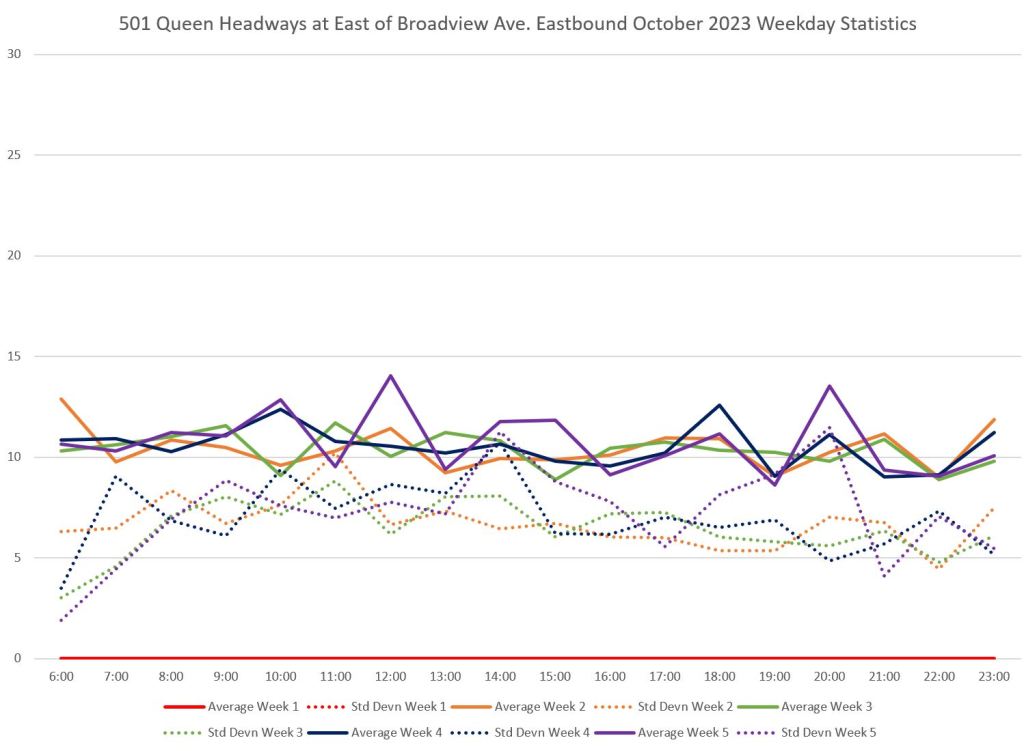
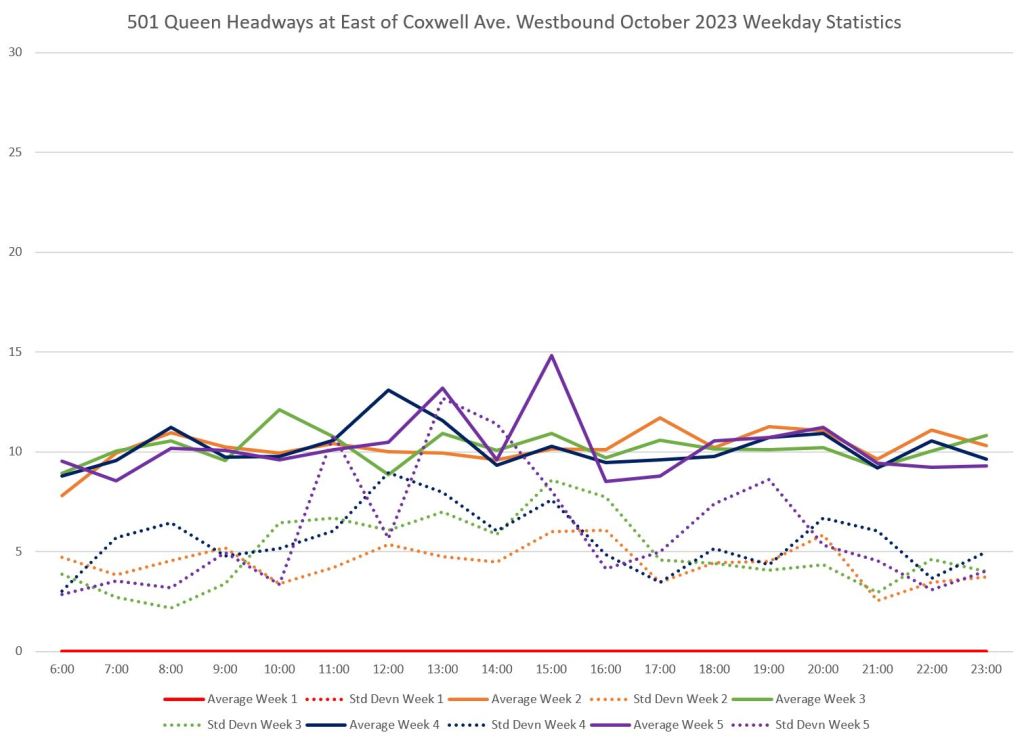
Here are the charts showing average headways eastbound from York Street and westbound west of Neville Loop at Silver Birch. Week 1 operated with buses which are not shown here. Week 2 plus about half of Week 3 operated normally without congestion delays from the sinkhole diversions. Weeks 4 and 5 cover the diversion period.
Note that even during the pre-diversion period, the standard deviation of headways leaving Neville Loop sits at 5 minutes or higher indicating that there is poor control (if any) of the spacing of departures there. The average headway during the midday rises both because the service is stretched out thanks to delays downtown, and not all of it reaches Neville Loop.
Also shown here are the headways eastbound at Broadview and westbound at Coxwell. These values are much better behaved and show the degree to which service was short turned before it reached the downtown loop (either at Church westbound, or via King to Distillery Loop), and eastbound (at Woodbine Loop). Riders attempting to travel between the western and eastern ends of the line had to deal with service shown in the top pair of charts although service in the middle of the route was fairly regular.


Week 2
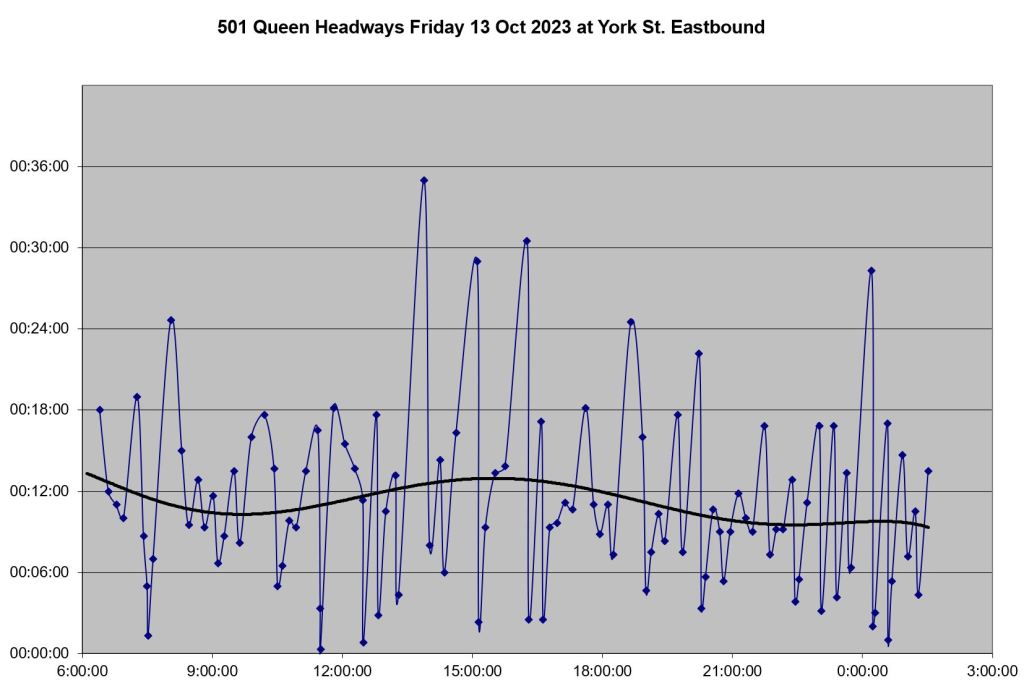
This period is pre-diversion and shows the quality of service operated without the added problems of extra congestion downtown. In both directions, long gaps are followed by pairs or triplets of cars.





Week 3
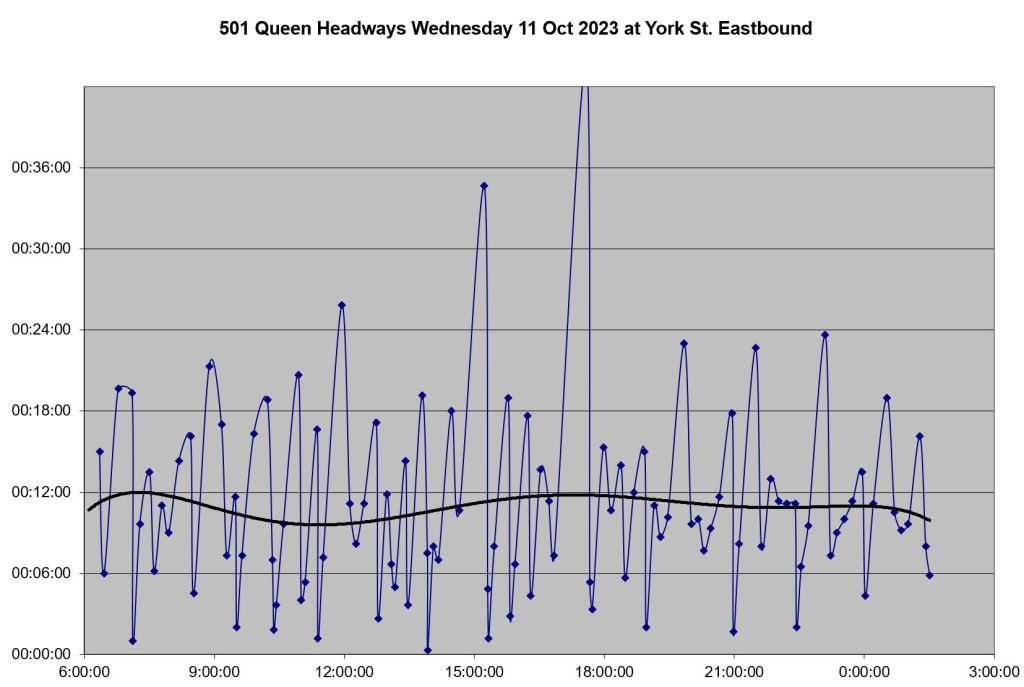
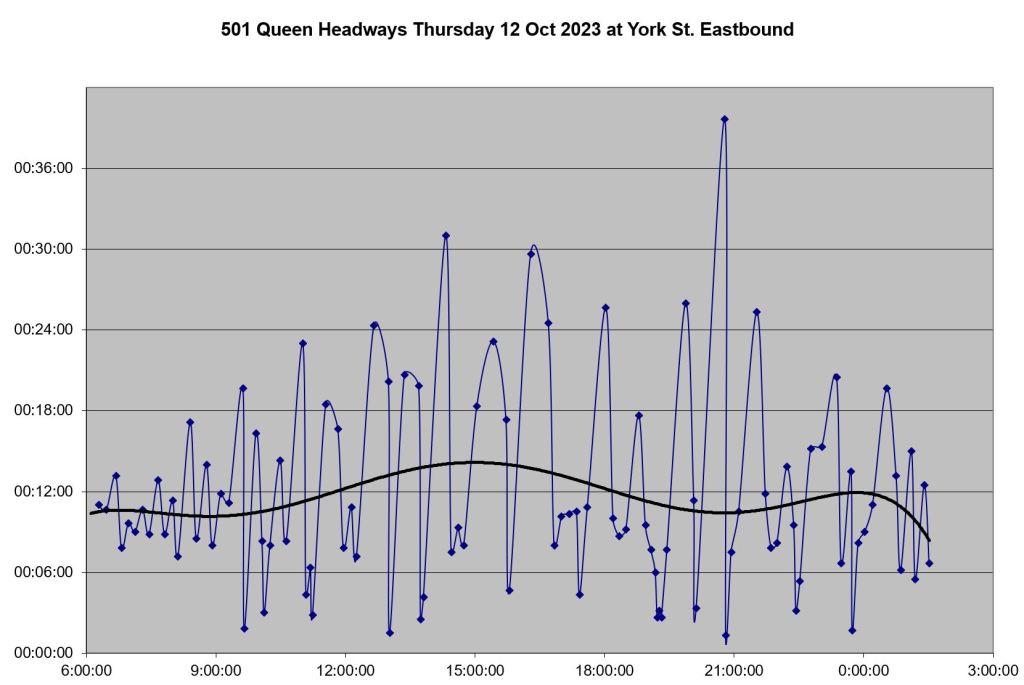
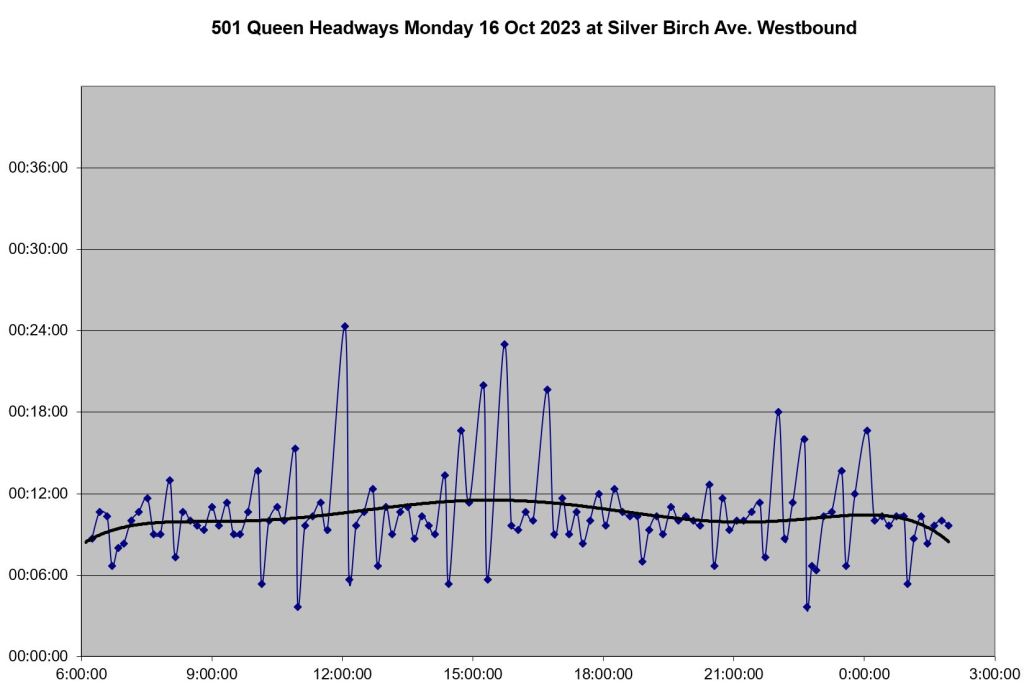
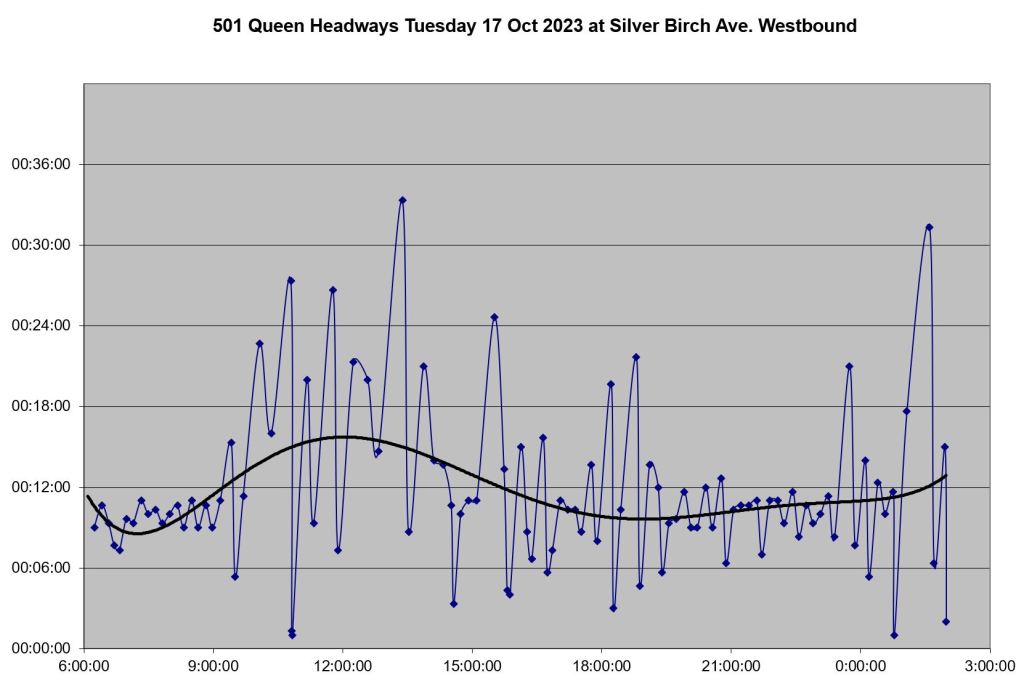
In Week 3, the diversion and associated delays to all services began on Wednesday. Service on Monday and Tuesday was not exactly regular, and it worsened later in the week, especially from Neville. Note that the gap in data on Thursday, October 19 is due to missing tracking data in the TTC’s Vision system.
Friday, October 20 was a special case with all service after about 3pm diverting to Distillery Loop via King Street.





Week 4
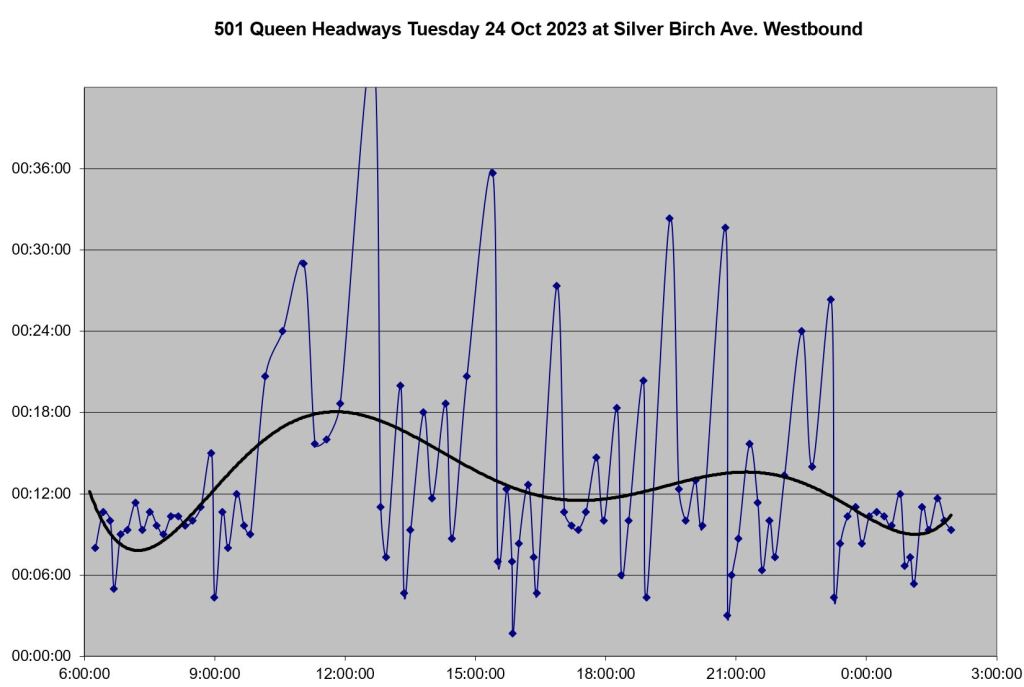
Week 4 was strongly affected by diversion-related delays. The daily charts show two separate occasions where all service diverted to Distillery Loop and there were no trips outbound from downtown. Even when service ran end-to-end there were some very wide gaps.
By late in the week, the diversion operated only during the daytime, and so congestion-related delays downtown fell in the evening. Notwithstanding this improvement, service from Neville remained quite erratic.




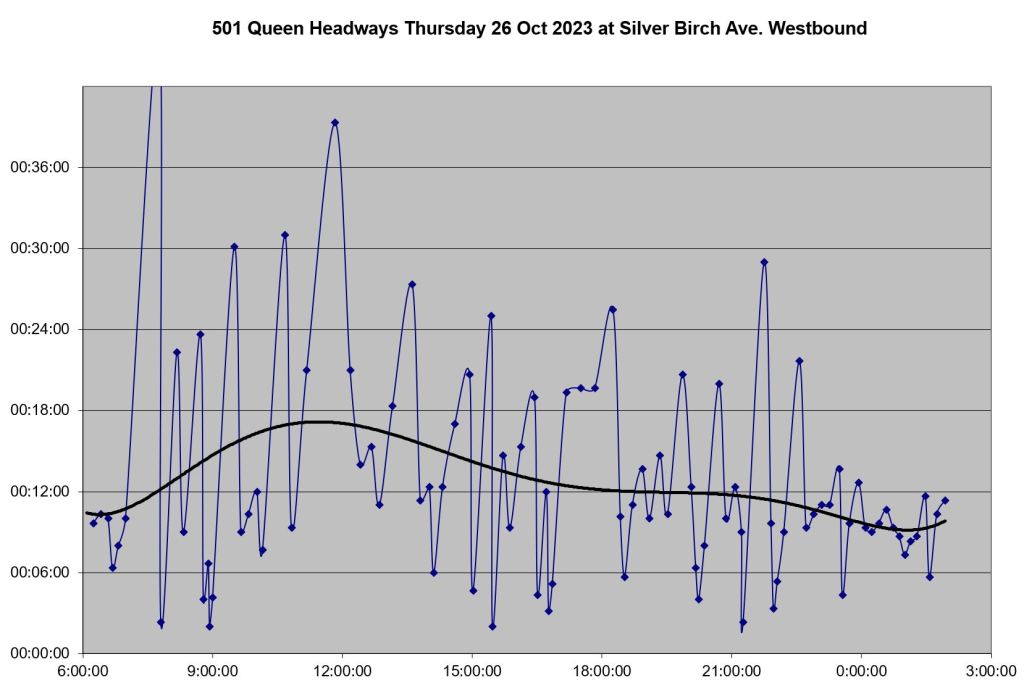


Week 5
Week 5 continues the pattern seen with diversions during the daytime and normal service in the evening in Week 4.


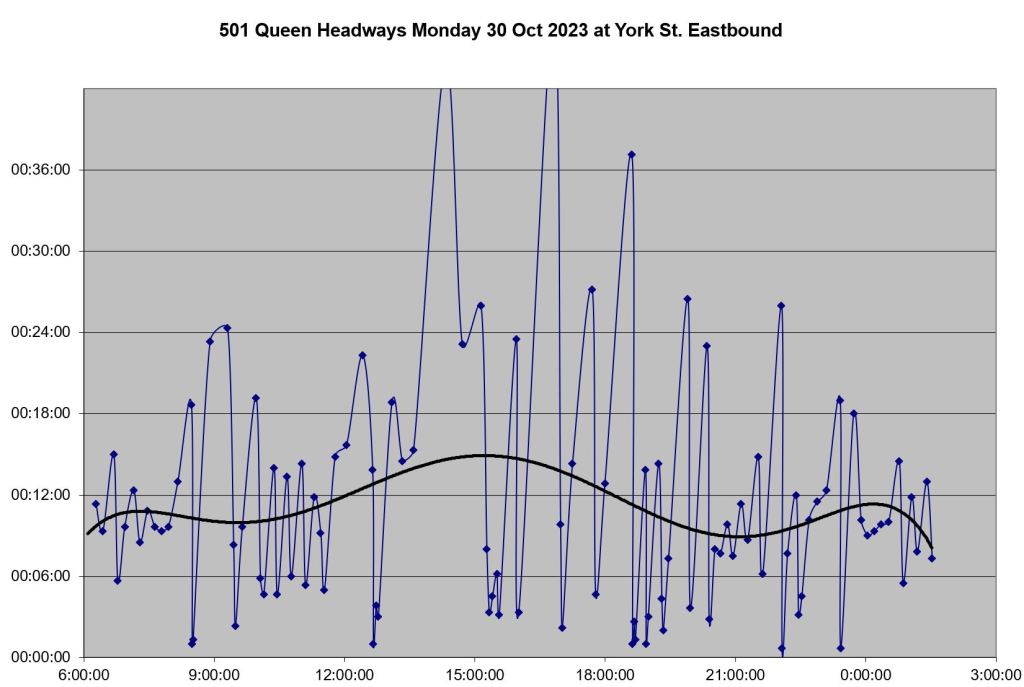


Weekend of Oct 21-22
The weekend after the diversion began, the Saturday service was extremely erratic with wide gaps and bunches in the outbound service from Yonge Street. The mid-morning gaps for inbound service from Neville were caused by a service blockage that forced cars to short turn at Woodbine Loop.
The situation on Sunday, especially in the Beach, was much better. The large gap in outbound service from Yonge at about 6pm was caused by a service blockage at Parliament that forced all cars to divert to Distillery Loop.


503 Kingston Road
The 503 Kingston Road car operated with buses until October 7, and with streetcars thereafter. The normal route ran from Bingham Loop on Kingston Road at Victoria Park to University (for buses) or to Spadina (for streetcars) via Kingston Road, Queen and King. During the diversion, streetcars operated via Queen and Church to bypass the sinkhole east of Jarvis on King.
The charts below show the service eastbound from Peter and westbound from Bingham on a weekly and hourly basis. These are followed by charts showing the service eastbound at Yonge and westbound at Coxwell. The considerable difference in average headways on the lower pair of charts shows the degree of short-turning that occurred to try to maintain service, albeit at the expense of the outer parts of the route. (The westbound short turn was via Church, Wellington and York to King; eastbound at Woodbine Loop.) Note that the scheduled headway is every 10 minutes. This is achieved, more or less in Weeks 1 and 2, to a lesser extent in Week 3 (see note below). Weeks 4 and 5 with the diversion in place did not fare as well especially eastbound from downtown.
Note that in Week 3, the diversion did not begin until the afternoon of Wednesday, October 18, and tracking data are missing for part of Thursday, October 19 at midday. This means that the service disruption in Week 3 (green) is understated on a five-day average basis compared to Weeks 4 and 5 (blue and purple).

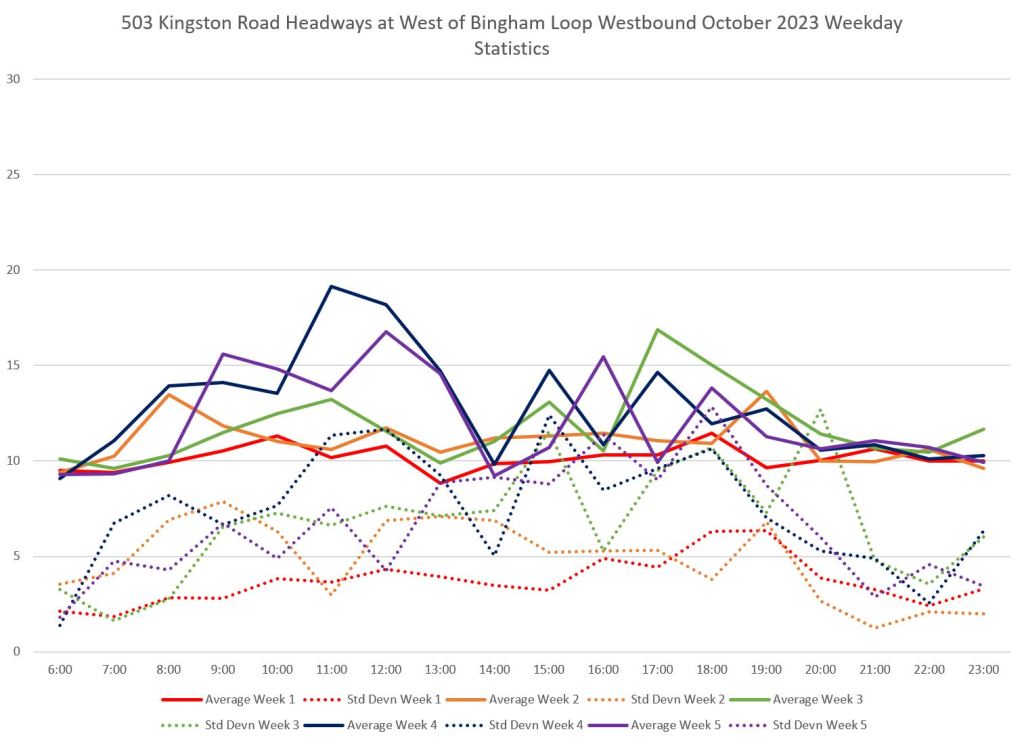

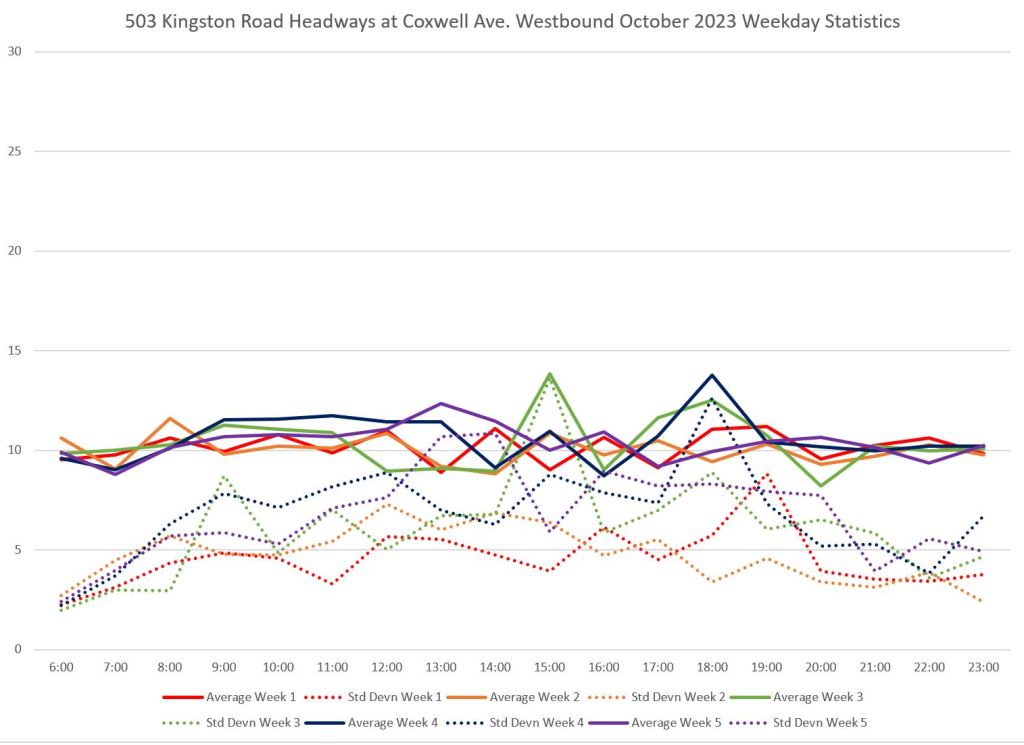
I will not show every week in October for 503 Kingston Road because the general sense of how service behaves has been shown in the 501 data above. However, I will give the details for Week 2 (pre-diversion) and Week 4 (diversion in effect) for contrast.
For eastbound service, Yonge Street data are shown to pick up the short turns from York Street and include service outbound from the core area as seen by a would-be rider.
Week 2
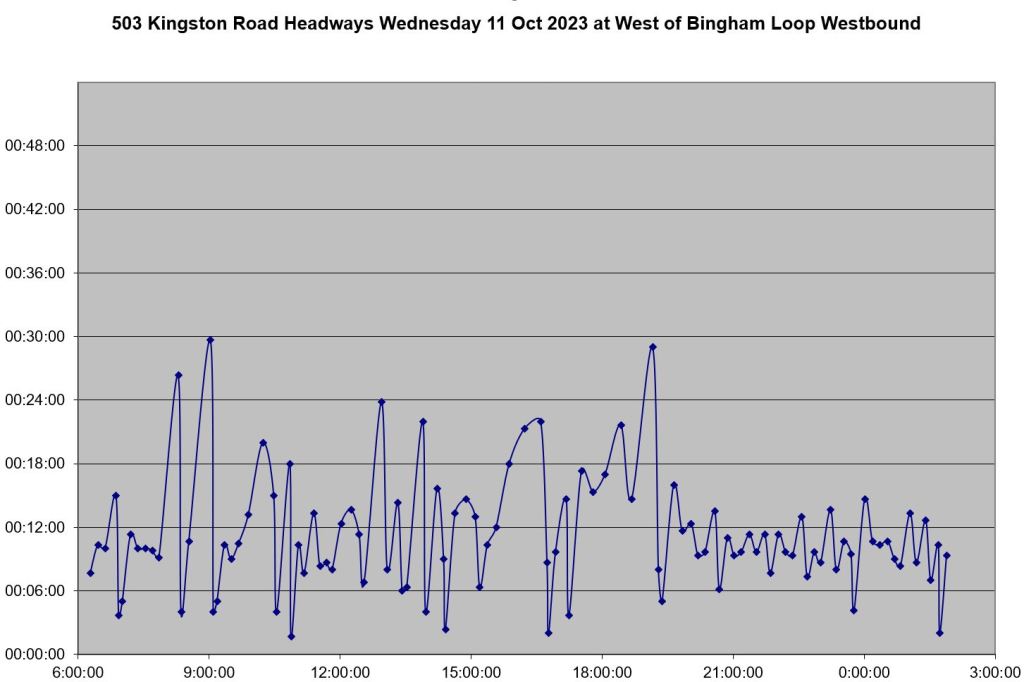
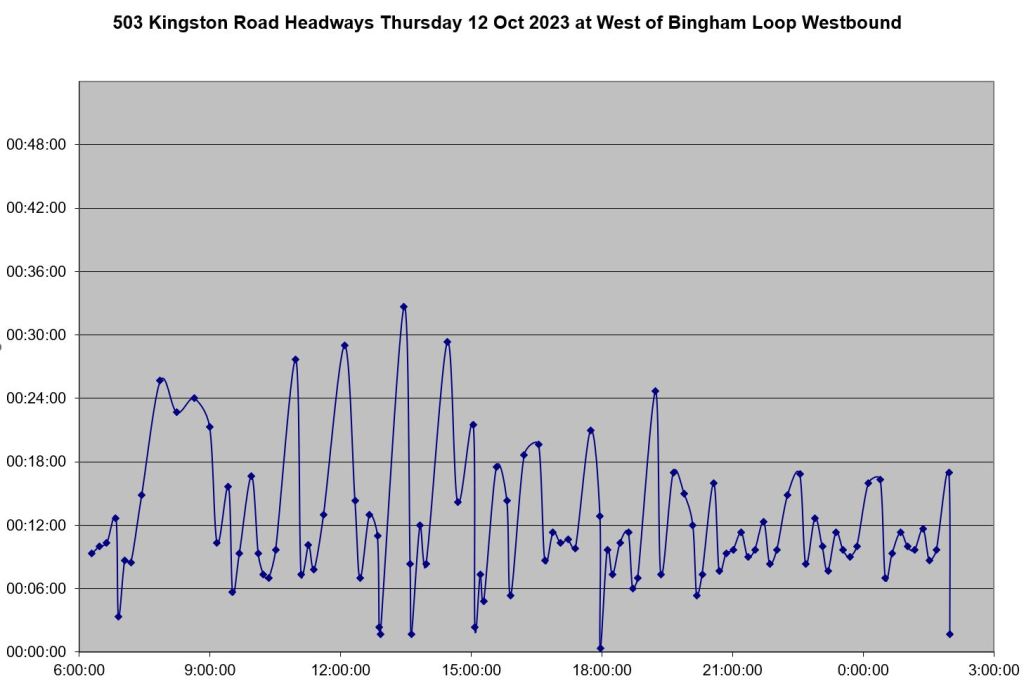
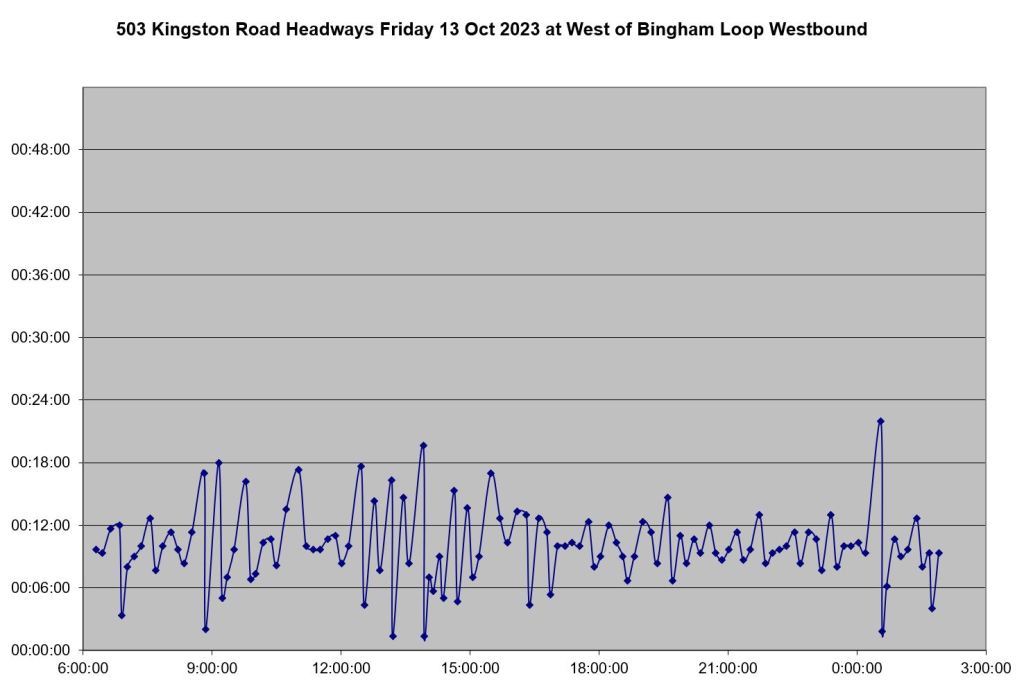
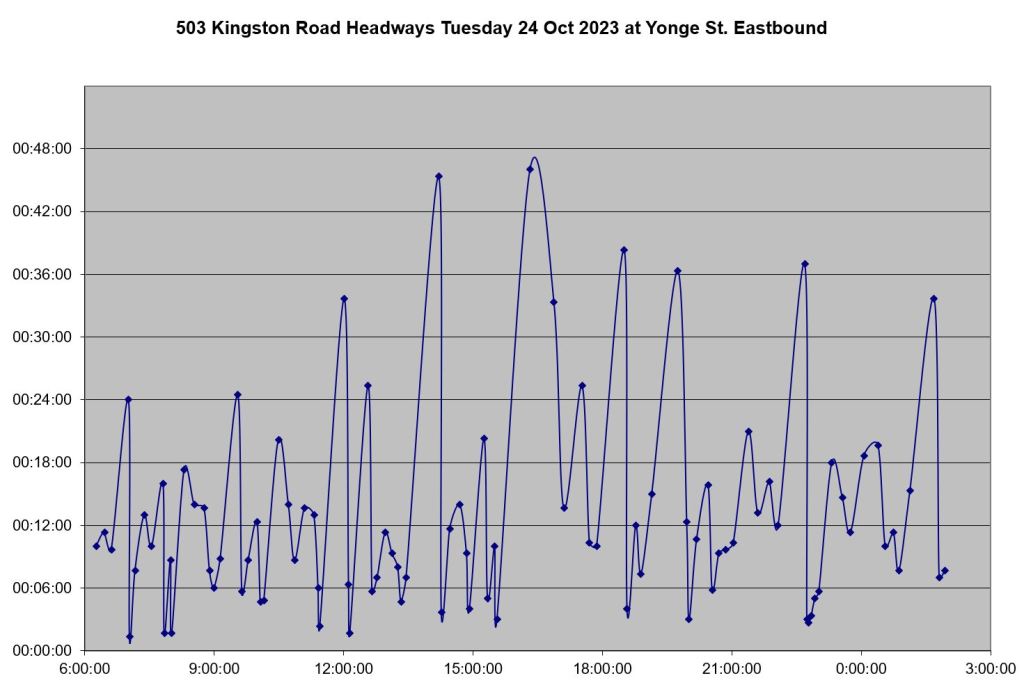
Week 2 precedes the sinkhole diversion and shows “normal” service on the 503 Kingston Road car. Note the wide scatter of headways both at Yonge eastbound and at Bingham Loop westbound. The latter is particularly bad considering that this is the terminus.
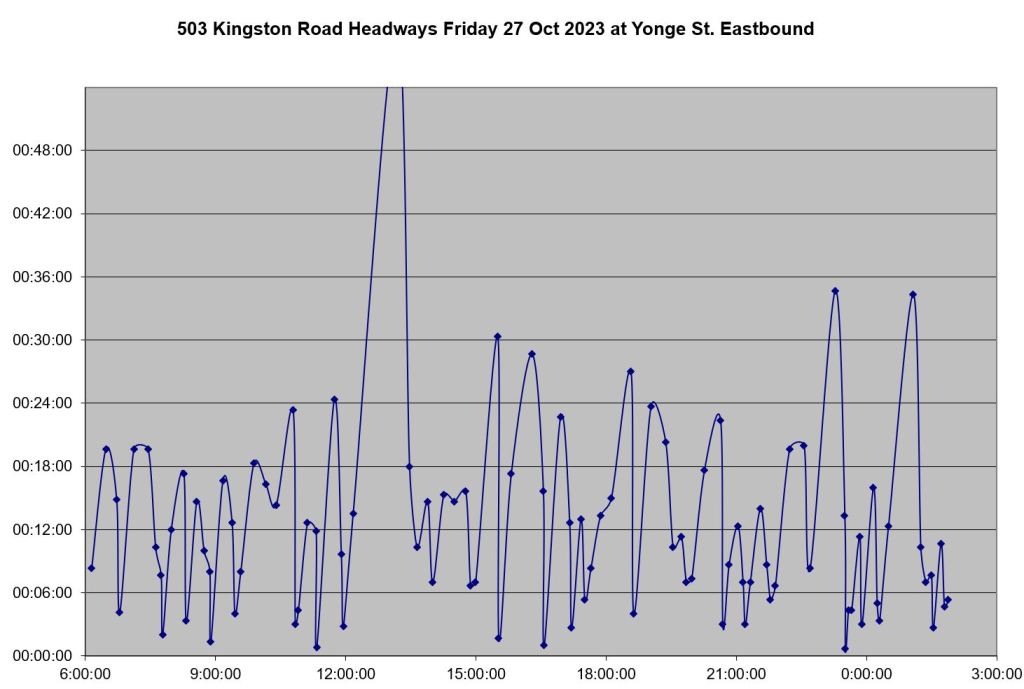
The daily charts show a characteristic pattern where a long headway will be followed by one or more short ones indicating that a parade is operating. The pattern is less severe on Friday, October 13 possibly due to the work-from-home effect on traffic overall, but there are still cases where cars are running close together.




Week 4
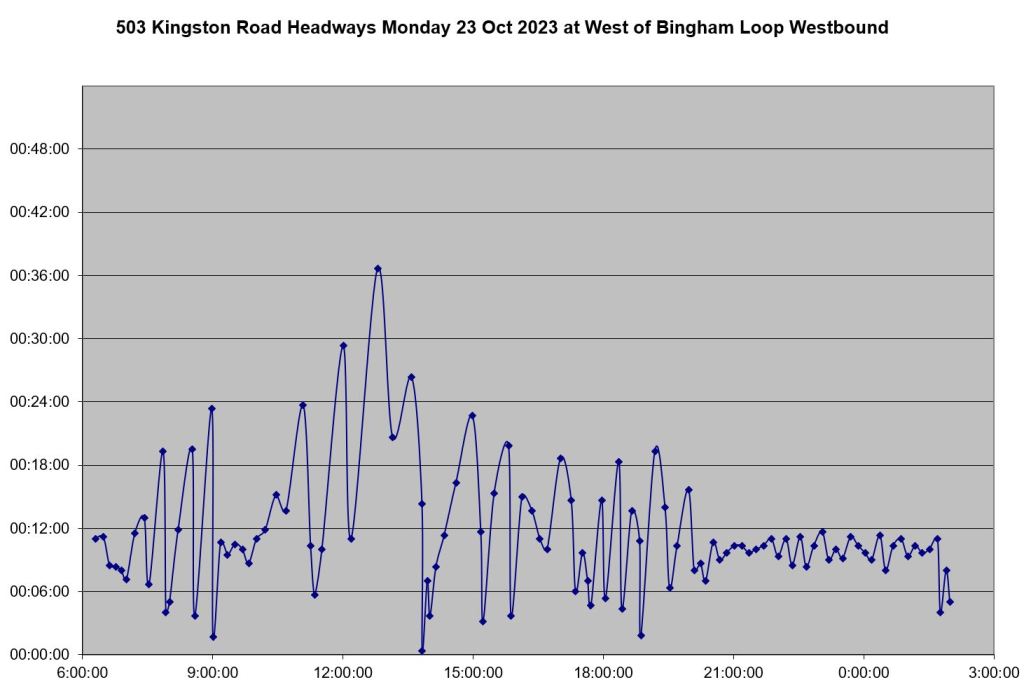
Week 4 was in the middle of the diversion period, and the average headways exceeded the scheduled level quite substantially at times. Gaps of over half an hour were common.





504 King
The 504 King car operated with streetcars west from Distillery Loop with alternate service terminating at Roncesvalles and at Dundas West Station. During the sinkhole diversion, all cars short turned via Church, Richmond, Victoria and Adelaide with layovers on Adelaide.
In spite of the route being shortened, and streetcars laying over on Adelaide, service was erratic during the sinkhole period, especially on the outer part of the line.
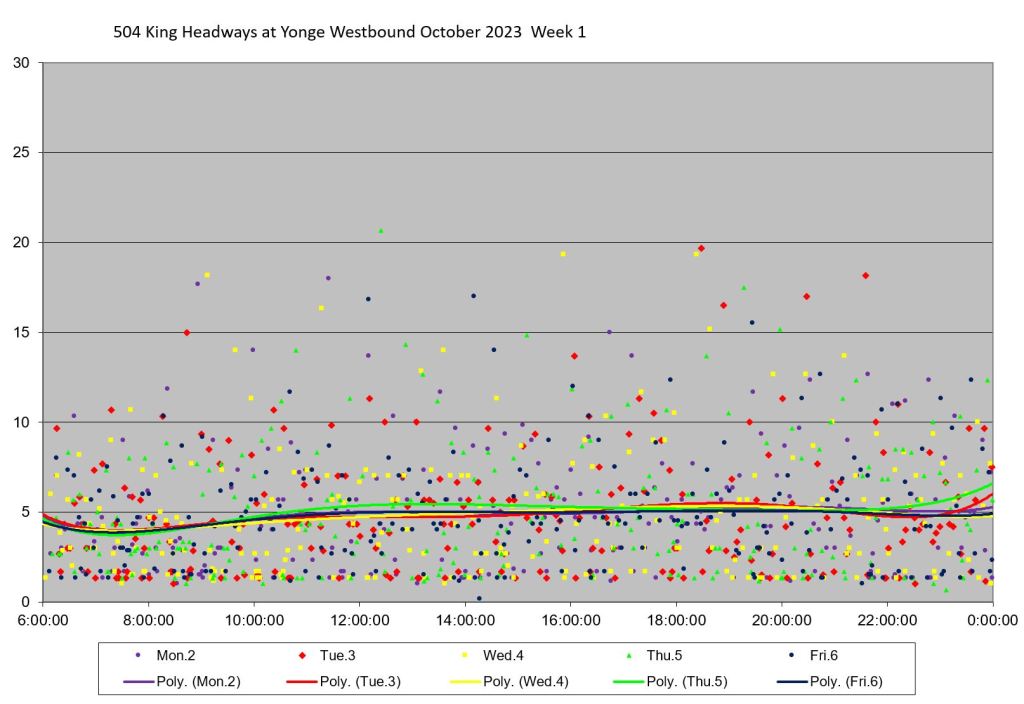
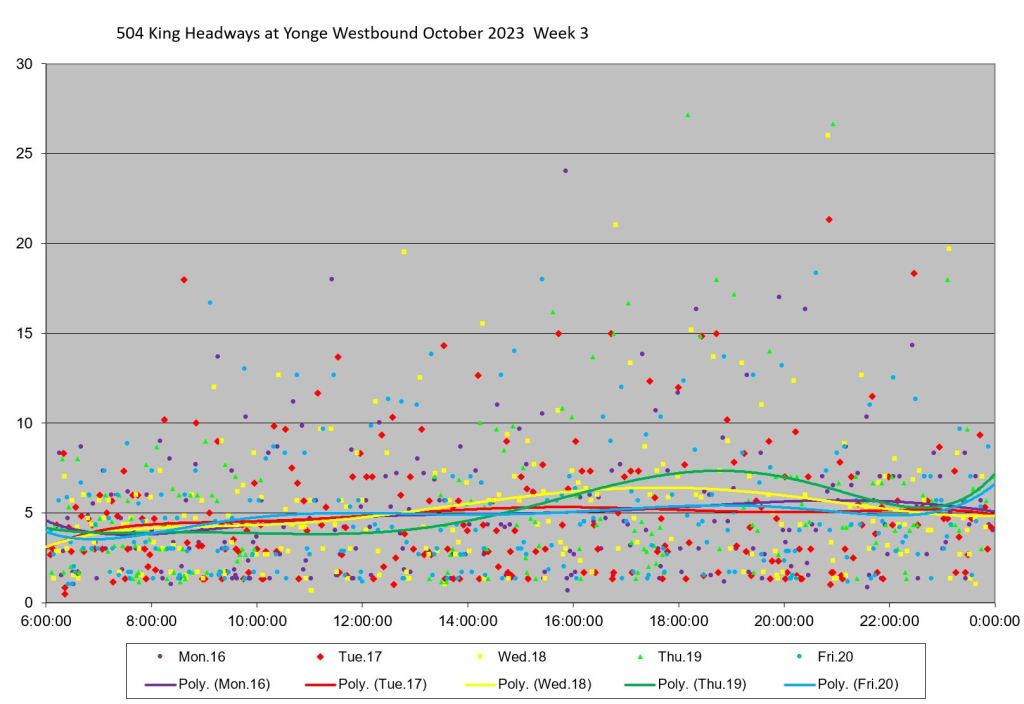
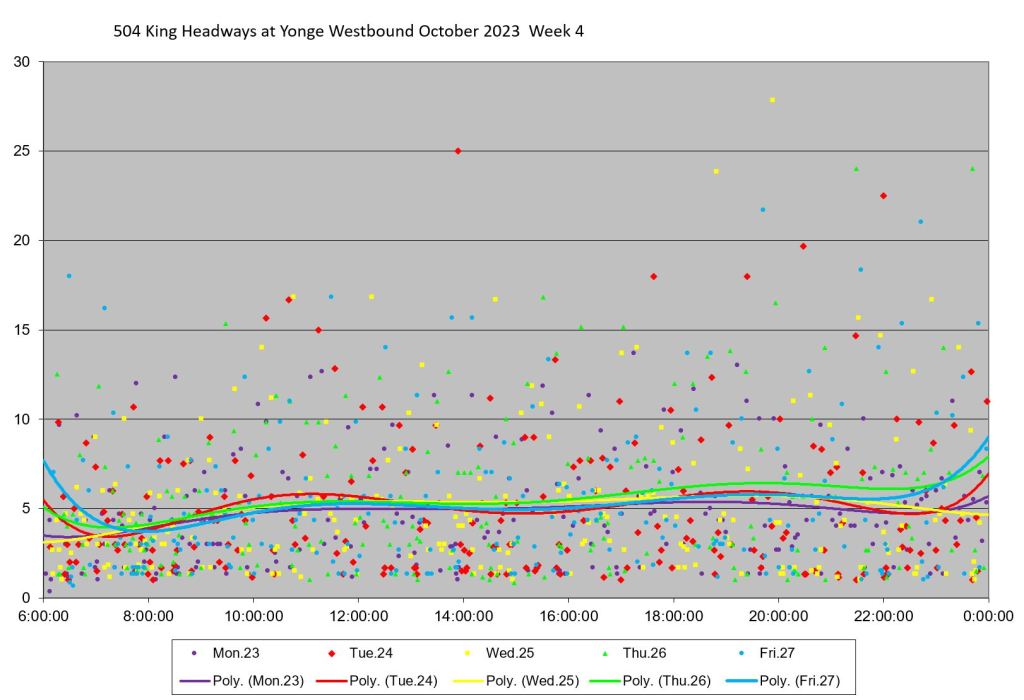
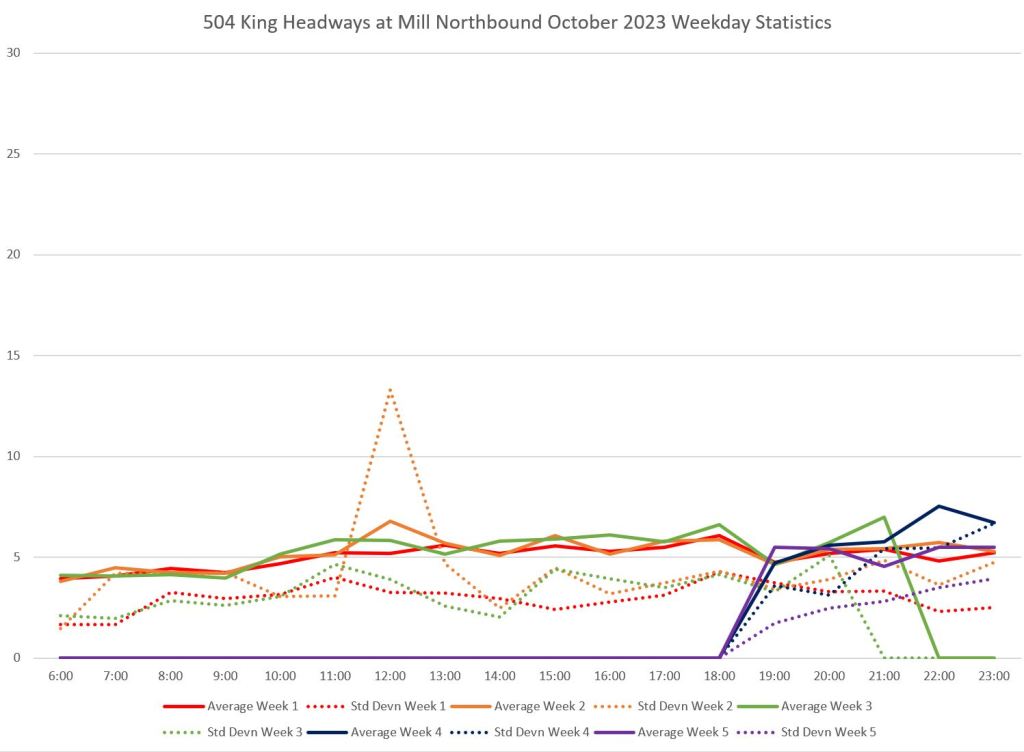
Here are the weekly headway stats and the week-by-week breakdown for Yonge and King westbound. The scheduled frequency is every 4 minutes in the AM peak, every 5 minutes otherwise. The average values generally follow the scheduled values, but the standard deviations (dotted on the first chart) are very high especially considering that for the period of the diversion, this is close to the “end of the line” where regular departures of cars should be possible.
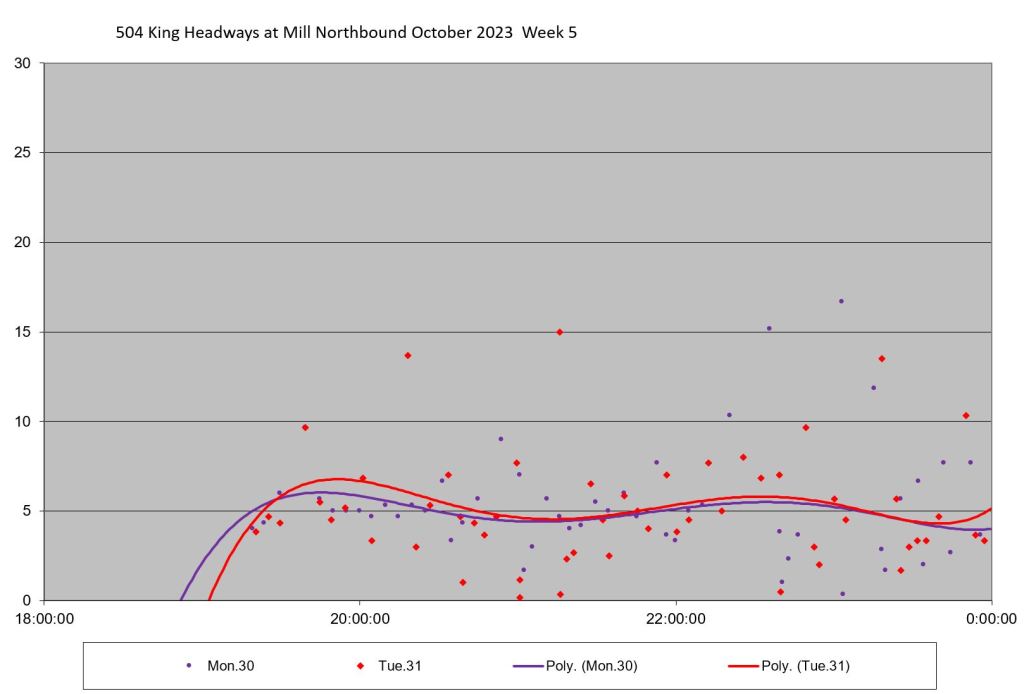
The week by week details show the scatter of actual values. Even though all of the scheduled cars operated (as shown by the average headway values) their spacing varied substantially, The horizontal banding of headway values is caused by the fact that service is marshaled into a fixed spacing that is a multiple of the traffic signal cycle time.



The situation at Dundas West Station is quite different. The average headways do not always sit at the scheduled values (8′ in the AM peak, 10′ otherwise) indicating that much service did not reach the terminal even before the sinkhole diversion and short turn operation downtown began. Headways are scattered over a wide range and the SD values are very high at times.
(Note that these charts do not include the shuttle buses running on Roncesvalles to provide accessibility while we wait for the reconstructed stops to be certified as “ok” for streetcar ramp operation. Those buses were assigned from a pool of extras and they were not reliably tracked in the TTC data.)


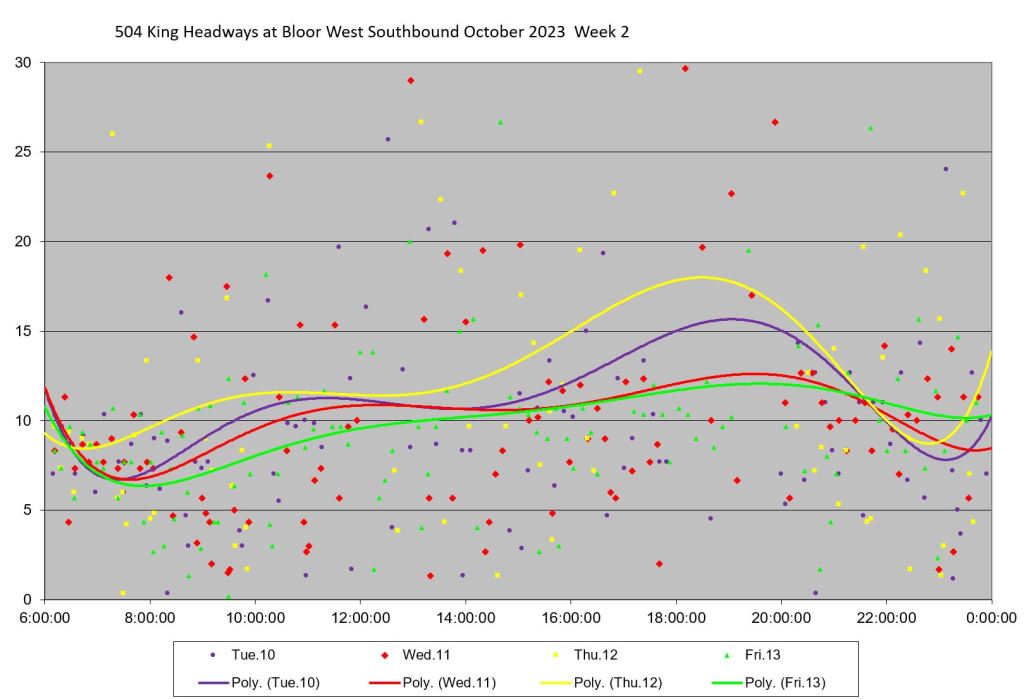
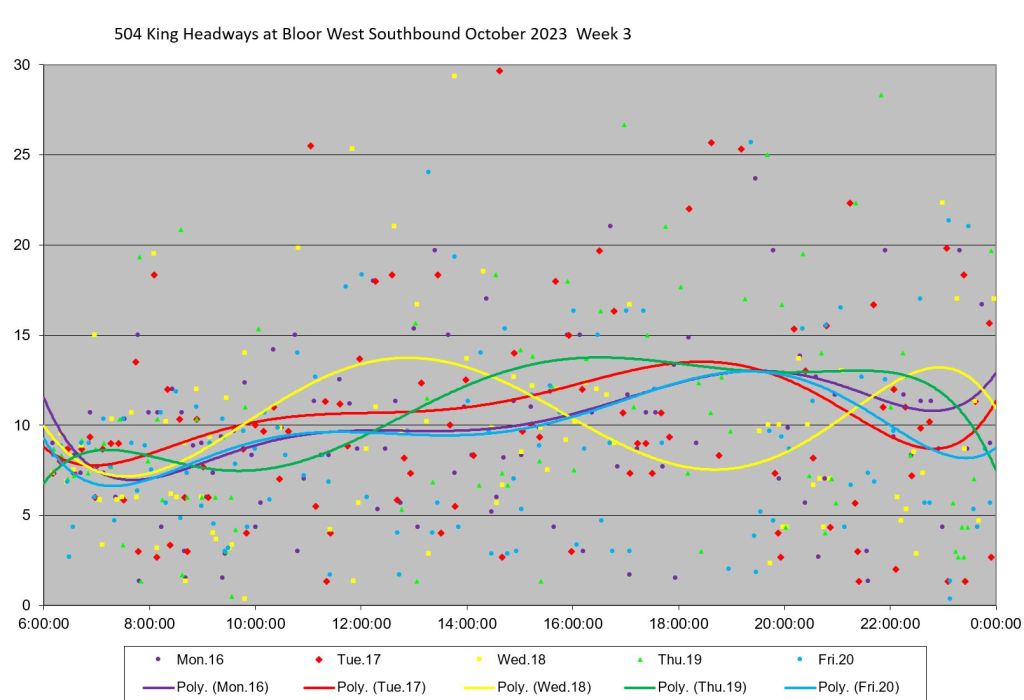


The situation at Queen Street is very different. Although headways are still scattered, the average stays close to the scheduled value rising only slightly during the period when downtown congestion from the diversion would affect service. This indicates that most of the scheduled service reached Roncesvalles & Queen, but that short turns of the Dundas West cars produced more erratic service from that point north.
Note that the SD values sit just below the averages in the first chart indicating that bunching is common. From personal observation and from the stats, the “blend” of the Dundas West and Roncesvalles services is very poor, and pairs often leave eastbound together.


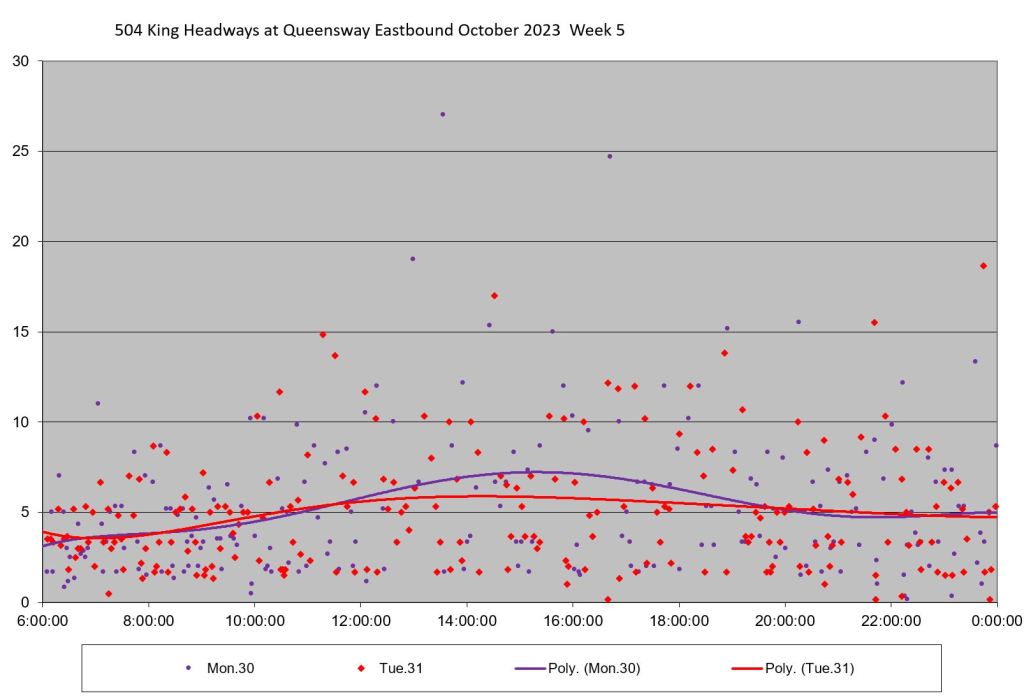
Over at Distillery Loop, the east end of the 504 streetcar route during construction on Broadview, streetcar service during the diversion period was limited, and the bus shuttles were not reliably tracked. I include headway charts for this location (streetcar only) to show the typical scatter of headway values even when there was no diversion to disrupt the service.
Note that in Weeks 4 and 5 I only show the evening period when streetcar service resumed after 7pm.
As on the west end of the route, the average headways lie roughly at the scheduled value showing that all service operated, but the individual headways are scattered showing the inconsistency of service leaving the terminus.


If you have come this far, thanks for reading. The King Street sinkhole was an event that showed how close to, if not beyond, the tipping point for downtown road capacity we already are. This will be a severe problem for many years as major construction projects remove parts of the road network from service. Meanwhile, transit service will suffer the compounded effects of congestion and indifferent management of service reliability.
This is not a recipe for ridership recovery.
 Steve Munro
Fun fact! Remember how earlier this year the tracks at KQQR were done, but there was no streetcar service on Roncesvalles and buses were stopping at random poles for a few months while TTC/contractors were rebuilding those platforms? It turns out that the rebuilt platforms were actually not done well, and workers are currently breaking up the topmost curb concrete on at least a few of them (Garden northbound and Marion southbound I saw for sure) and will have to redo them *again*.
Steve: Yes, Sanscon has a lot to answer for in cock ups and delays to projects around the city.
LikeLike
Now the police are getting in on the act! “Outrage after Toronto police ticket King Street streetcar at rush hour”.
I wrote to the TTC Chair (Councillor Myers) suggesting he may want to talk to Ann Morgan, his colleague the Chair of the Toronto Police Services Board. If the police have suddenly found time to enforce traffic rules they might want to look at the thousands of motorists (mostly sitting alone in their SUVs) who block streetcars!
Steve: The TPS never ceases to amaze in their insensitivity to the type of “enforcement” that is really needed. It’s almost as if they don’t want to do this, but will fight to the death to prevent anyone else from taking “their” job.
LikeLike