
At the TTC Board meeting on June 12, 2023, key reports presented the current and future challenges our transit system faces:
- Sustaining a Reliable Transit System to Keep Toronto Moving: Outlook 2024 and Beyond
- Financial and Major Projects Update for the Period Ended April 29, 2023
- Draft Consolidated Financial Statements of Toronto Transit Commission for Year Ended December 31, 2022
This article reviews the Major Projects Update and more generally the TTC’s Capital Program and funding shortfall. In future articles, I will turn to the Operating Budget, subsidies and the changing environment for transit in 2024 and beyond.
A related report from a past meeting presents the entire Capital Plan, not just the “major projects”, and I have consolidated information from it to provide a complete view.
TTC Capital Plans are presented with three separate timelines:
- The current year,
- A ten year window, and
- Fifteen years and beyond.
The fifteen year view is comparatively recent, but it was a vital addition to the transit outlook. Until this version was introduced, a growing list of needed projects simply did not exist in the published TTC plans nor, more importantly, in the minds of Councillors and financial planners at all three levels of government. Magically, the ten year view always managed to fit within money the City had available from its own revenues or provincial and federal commitments.
That fifteen year view was a huge shock to the City, but it was no secret to anyone who looked through the budget and found gaping holes. This situation was a financial convenience to make future City capital needs appear smaller than they actually were. Funding problems were “fixed” year after year by failing to acknowledge key projects, or by pushing them beyond the City’s ten year capital planning window.
Doug Ford arrived on the scene with his subway plans and billions in provincial spending, but much of this was for projects that were not already part of the City’s plans, or at least not at the scale the City contemplated. The province gave the impression of taking a load off of Toronto, but much of the planned provincial spending was never in Toronto’s plans to start with.
Then came the pandemic and severe doubts about the sustainability of the City’s spending.
For his part, former Mayor Tory’s SmartTrack brand was still on the books, even if it was a shadow of its original plan. Despite going over budget, it lives on as five new GO stations thanks to an infusion of $226 million by the provincial government.
At the TTC, CEO Rick Leary was initially distrustful of Automatic Train Control and the new Line 2 fleet it would require. For a time, the projects to resignal the Bloor-Danforth line, buy a new fleet and build a carhouse at Kipling were put on hold. The TTC would make do through another decade with “life extended” trains which would be at least 40 years old by their retirement. Leary has since changed his tune, but this brought the cost of ATC, new trains and, possibly, the carhouse back onto the table.
The situation is complicated by the Scarborough Subway Extension which would require more trains to provide full peak service to Sheppard than the existing fleet. Half of the peak service would short turn at Kennedy to fit the service within the existing Line 2 fleet.
The already-expensive extension does not include ATC signalling because Metrolinx does not know whether the TTC will have an ATC-capable fleet by the opening date. Only the construction delays due to Ford’s intervention in the project give the TTC enough time, and then only barely, to bring Line 2 up to modern standards.
Another related issue is the emerging demand for Platform Edge Doors (PEDs) for which ATC is a pre-requisite. Without new trains and signals, there will be no PEDs on Line 2.
Toronto is in the unhappy position that we are building miles of tunnels, but may not have trains to run in them when they are finished. The self-contained Ontario Line has a fleet, and the Crosstown has its LRVs, but the subway extensions and planned service improvements are another matter. Moreover, if the Line 2 fleet’s life is pushed out to 40 years, there is no guarantee it will provide reliable service.
Award of the contract for new subway cars has already been delayed into 2024 and costs rise thanks to inflation while we await a funding decision. The Major Projects Report notes that:
- Delays in securing the required funding for the procurement of new trains will result in declining reliability, longer wait times between trains, increased crowding, and higher maintenance costs. The TTC is actively engaged with its Federal and Provincial partners.
- The operation of new trains is interdependent with the planned resignalling on Line 2 (ATC). All T1 trains on Line 2 need to be replaced with new subway trains to operationalize ATC on Line 2. As a result, any delay in the funding decision for the procurement of the new trains will have an impact on the ATC requirements as well as the cost and schedule for both projects.
- Recent increases in escalation will potentially result in an increase in overall cost. The TTC will continue to monitor producer’s price indices, update escalation projections and identify potential offsets to the greatest extent possible.
- Award Contract in 2024, subject to partner funding. Should the partner funding be delayed or not available, the TTC will commence planning for the T1 Life Extension Overhaul (LEO) program to ensure service continuity.
Meanwhile, on Line 1 Yonge-University, the fleet is in its youth, but more trains are needed to increase service and to provide for the Richmond Hill extension. A new maintenance facility will be required to hold the larger fleet, and it will most likely be built north of the new extension. There has been no word on whether York Region will contribute to any of the cost their subway extension will add to the TTC’s budget woes.
The Major Projects Report notes:
This program includes the accommodation of train storage and maintenance requirements, and other infrastructure enhancements, to expand capacity and improve circulation on Line 1, reduce overcrowding, increase the frequency of trains and reduce travel times, which will result in improved customer service.
[…]
Train Maintenance and Storage Facility (TMSF), which includes:
- Storage for 34 trains, including a test track, and access track to the site;
- Carhouse with five Bays for Preventative and Corrective Maintenance to support daily service;
- Operations and Infrastructure (O&I) facility to support maintenance activities (small shop building, outdoor and indoor storage tracks for work cars, material storage, and staging area);
- Ancillary facilities (Traction Power Substation (TPSS), Hostler platform).
More service adds to the electrical draw and in turn that will trigger upgrades to the subway’s power distribution system.
Without going into the many details, this illustrates how subway planning is not simply a question of drawing lines on a map and cutting ribbons when the tunnel boring machines arrive.
Subway Project List
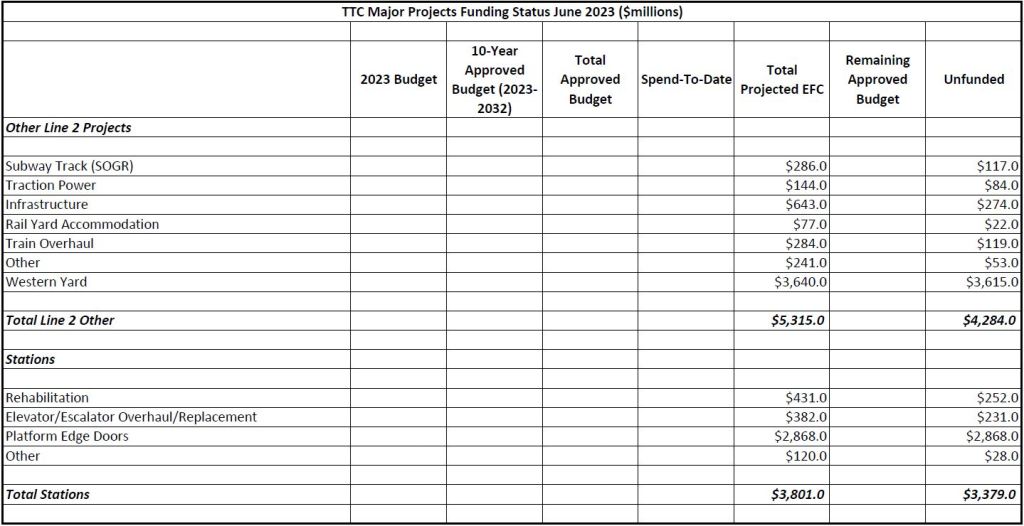
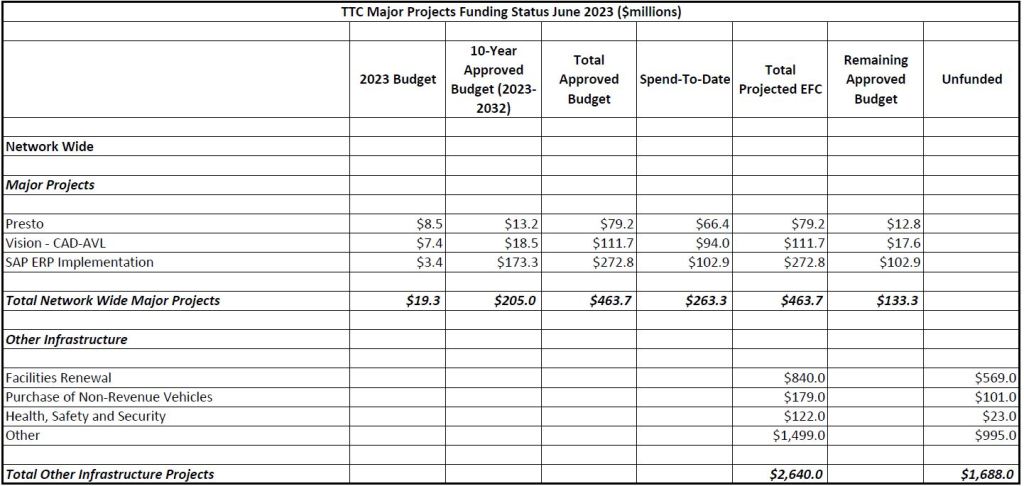
The table below shows all of the subway projects divided into two groups.
- Major Projects: These items are tracked in the Major Projects section of the quarterly financial update.
- 2023 Budget: Expected spending in 2023
- 10-Year Approved Budget: Spending for which funding exists over the coming decade. Note that the annual average will be much higher than the 2023 level as these projects ramp up.
- Total Approved Budget: This includes spending outside of the current 10-Year window.
- Spend-To-Date: Past years spending.
- Total Projected EFC (Estimated Final Cost): This includes spending beyond the 10-Year window.
- Remaining Approved Budget: The approved budget less past years spending.
- Unfunded: Additional funding required to complete the project.
- Other Projects: These items are in the long range plan, but are not in the Major Projects list. Values here do not include inflation up to mid-2023 because they come from a January report.
- A few large projects are not yet funded and approved.
- Most of the items are ongoing state of good repair projects (SOGR). They are funded from the Capital budget because they have long-term value (e.g. overhaul of trains or escalators) rather than being day-to-day repairs that are charged to the Operating budget.
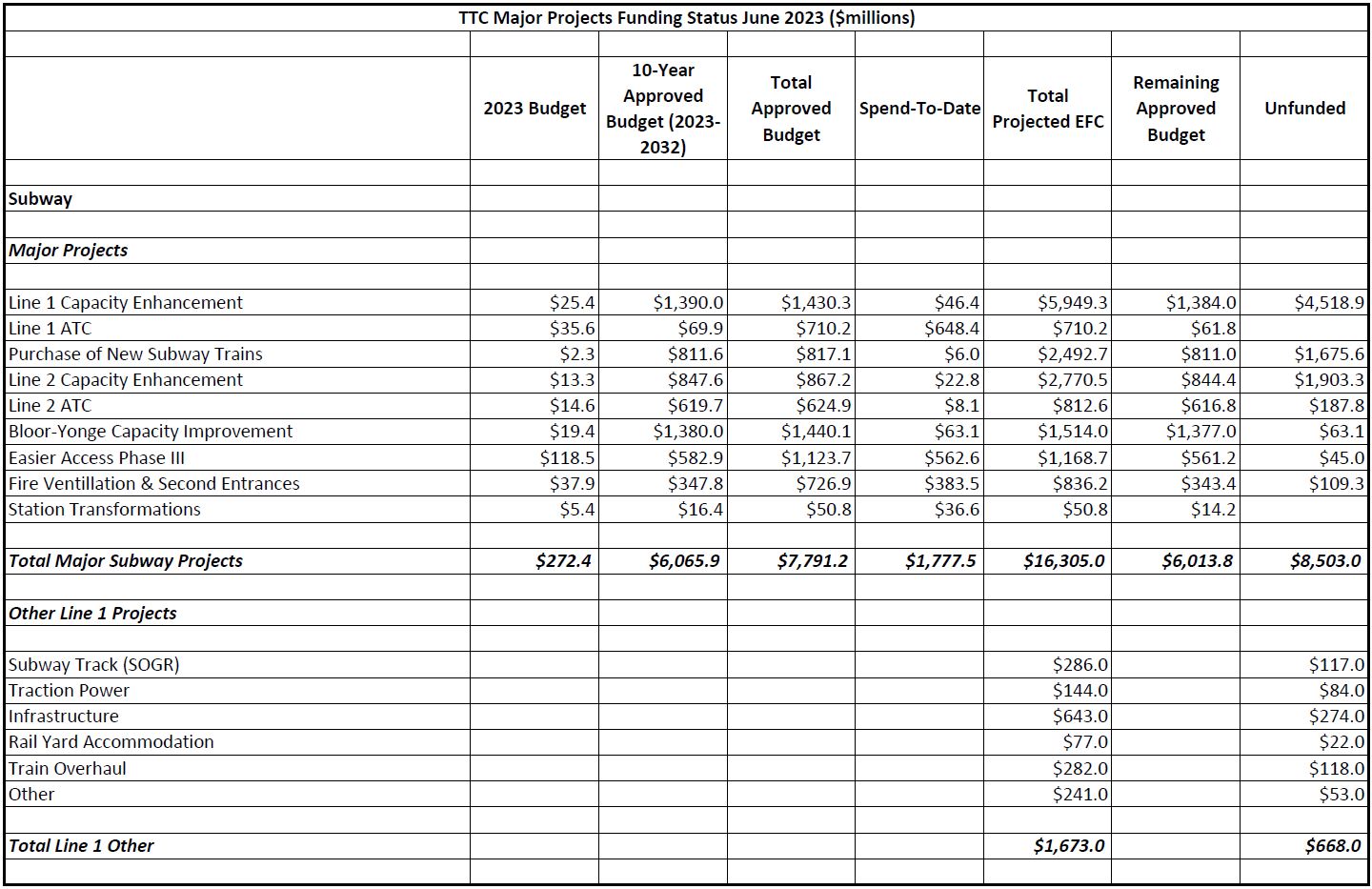
The Capacity Enhancement projects include many items:
- Station modifications: There has been much focus on Bloor-Yonge as the main interchange point, but if subway capacity and ridership go up, so will the need for capacity to move passengers to and from platforms at other busy stations.
- Electrical power upgrades, fire ventilation and other infrastructure improvements.
- A new maintenance and storage facility for the Yonge North extension (note that this is not included in the provincial project funding).
- Upgrades to Greenwood Shops.
Easier Access Phase III will complete the retrofit of elevators and other accessibility features throughout the system.
Most of the SOGR projects have no end date because they cover cyclical maintenance that repeats year-over-year. The EFC shows the projected cost over the next 10 years, and every year this value is adjusted to drop the year just completed and add a new one at the end. Spending is granular in the sense that work does not require a large up-front commitment in the same way as purchase of a new fleet or building of new facilities. However, trimming spending in these lines risks creation of a repair backlog and declining asset reliability.
The two big projects in the “other” category are the proposed new yard west of Kipling Station ($3.615 billion) and platform edge doors ($2.868 billion). They are responsible for the lion’s share of unfunded “other projects”.
Notable by their absence are proposed LRT projects in Scarborough (Eglinton/Morningside/Malvern/Sheppard) and in the Waterfront. They will bring funding needs beyond those shown above.
Streetcar Projects
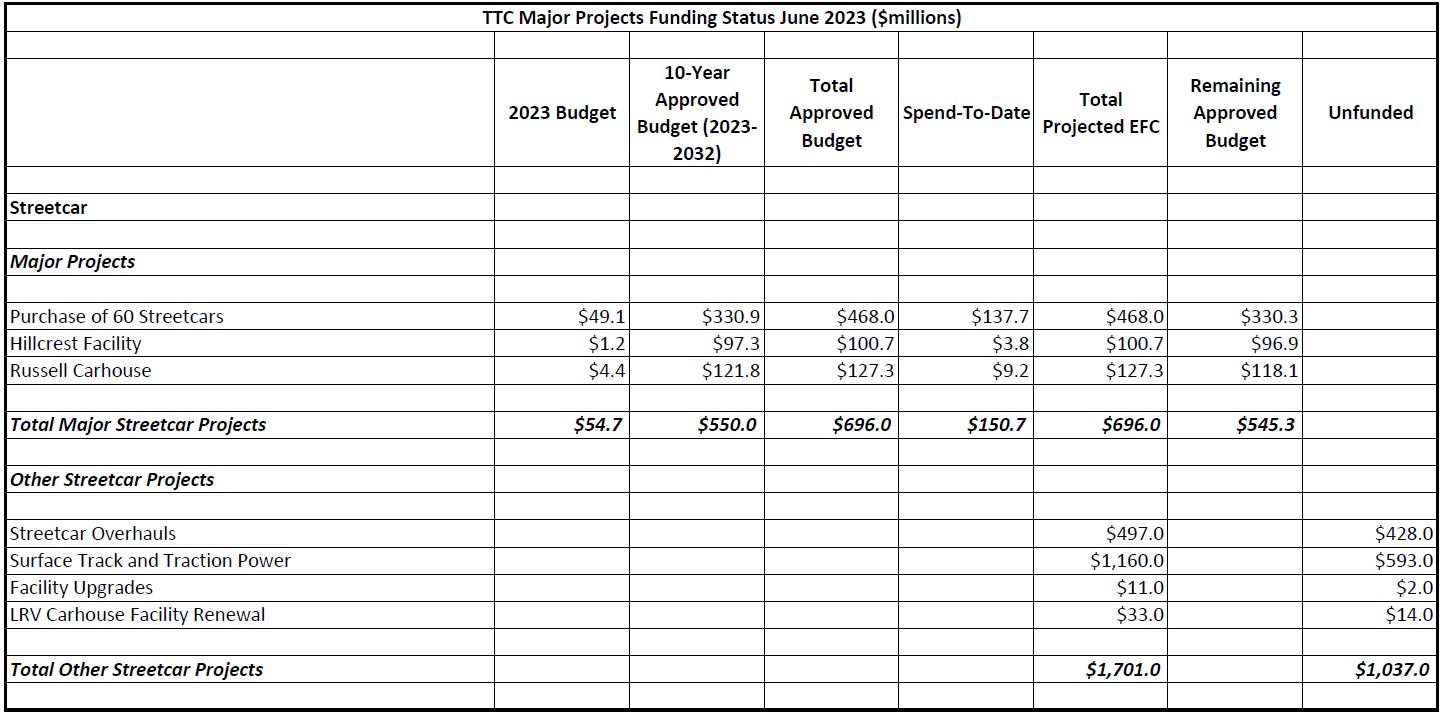
The breakdown here is on the same basis as the subway projects table above, but the list is much shorter. The only major projects are the purchase of 60 more streetcars (for which delivery begins in 2023) and the modifications at Hillcrest and Russell to provide updated storage and maintenance for the new fleet.
The Surface Track and Traction Power project includes continuing work to upgrade the overhead and power distribution system for pantograph operation and additional power demands of anticipated service levels.
Bus and Wheel-Trans Projects
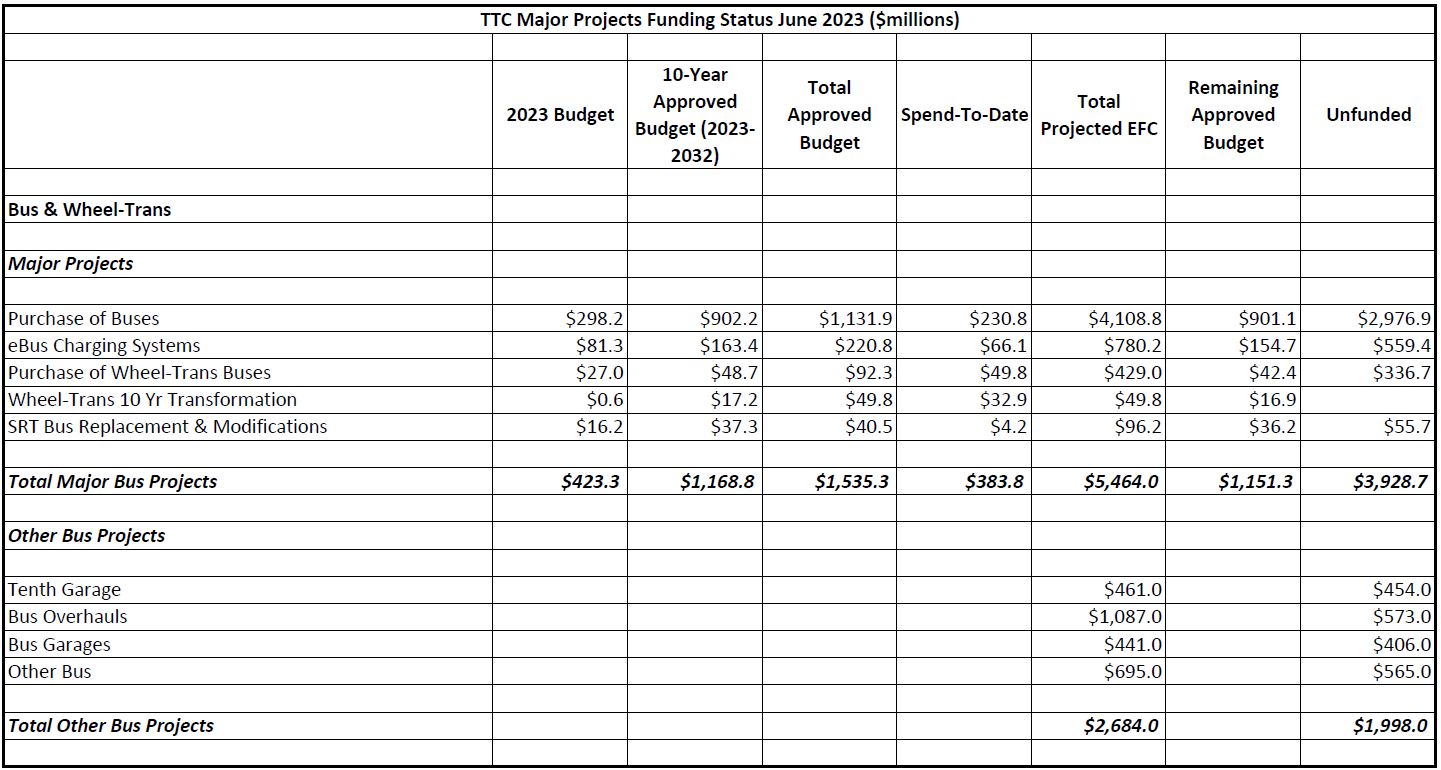
The largest cost by far in this group is the purchase of new buses and the installation of charging infrastructure for the migration to an all-electric fleet.
Current approved bus purchases include 336 hybrid-electric buses (delivery now in progress) and 340 electric buses (contracts recently awarded following the announcement of federal subsidy). However, the funding only takes the project out to 2025, and a further 1,840 electric buses are planned for 2026 to 2035. These are not yet funded and it is not clear whether special subsidies for electric vehicles and infrastructure will be available in the long term.
The outstanding SRT Bus Replacement cost is for the conversion of the existing right-of-way to a bus roadway.
The tenth bus garage is planned for the west end of the city near Kipling Station, but current service projections push the requirement to build it off by almost a decade. This could be affected by unexpected demand on the bus network or by a City decision to accelerate the growth of bus service.
Bus network ridership recovery is running well ahead of the system average, and work-from-home has a much lower effect on bus requirements than on the rail modes serving downtown. Partly offsetting this is the larger than industry average spare ratio the TTC has maintained for several years giving a cushion against growth. However, with the increasing cost of new buses (including the garage space they occupy), and the anticipated better reliability of a younger fleet (the TTC has been shifting to a 12-year replacement cycle to avoid costs and reliability problems of older buses), the need and justification for a large spare ratio should decline.
Other Projects
Although there are “major” projects in this list, they are tiny compared to the mode-specific items above.
The Presto project covers costs that the TTC bears directly (e.g. new fare gates) as opposed to those paid for by Metrolinx.
Vision is the TTC’s vehicle tracking system. Major outstanding work here includes a system to automatically dispatch vehicles from yards using GPS data to locate and assign vehicles as they enter service.
SAP ERP is a suite of IT systems providing financial, project management and other functions. Implementation is still in progress for some functions which remain on mainframe systems or are manually based.
The “other” category includes almost $1.5 billion covering miscellaneous shop equipment, infrastructure work, and service planning (transit priority facilities).
It’s Not Sexy But It’s Necessary
The challenge in funding ongoing maintenance, fleet renewal and capacity upgrades is that much of the work is unseen, and few of the big ticket projects lend themselves to repeated announcements and ribbon cutting. A great deal of this work has been funded by the City as both the provincial and federal governments focus on higher profile spending, and even some of that may not be permanent.
At the provincial level there is a Premier who thinks he is the master builder of transit systems, and who commits billions to projects that will bring political rewards while short-changing basic service and state of good repair needs. At the federal level, there the problem of country-wide spending that looks big, but does not come up to Toronto’s needs, and the possibility of “commitment” that might not be sustained for the duration of a capital program (e.g. electrification).
The combination of uncertain funding from our “partners” and Toronto’s inability to go it alone on transit funding makes for a cloudy future. This is the unseen part of a transit death spiral. Lack of service on the street is obvious through long waits and crowded vehicles, but a decline in maintenance and renewal creates a backlog that is not quickly repaired by hiring more drivers and running more buses.
 Steve Munro
Steve – As you note, many of these subway projects are not independent but are highly inter-related, such as new trains, ATC, platform edge doors, new maintenance facilities, line extensions, and line capacity improvements (including track and station upgrades and upgrades to the traction power systems to accommodate the shorter headways enabled by ATC, etc. This is why many major transit agencies around the world have move away from funding and implementing individual projects to implementing comprehensive, and highly visible, line upgrade programs, where the individual projects are managed and funded as a single integrated program.
One interesting question with respect to ATC is will the Line 2 ATC be the same, or different, to the Line 1 ATC, and if the latter, how will interoperability between Line 1 and Line 2 be managed?
Steve: Back when Andy Byford was CEO, there was a comprehensive Line 2 program that for some reason never saw the light of day. Rick Leary canned it when he took over, and initially wanted to rehab the T1s.
For reasons passing understanding, the TTC is actually entertaining having a separate bidder for Line 2 rather than continuing with Alstom. There are systems with trains that can operate on more than one signalling technology, but this would almost certainly require a retrofit of the TR trains that have Alstom equipment on them now.
The Major Projects Report shows next steps including:
TTC cocked up its signalling program years ago with multiple vendors on the Line 1 ATC project until Byford cleaned house. They seem to be headed in the same direction again.
It would not surprise me one bit if some “lobbying” was involved here.
LikeLike
On what grounds could York Region possibly avoid their share [which would be close to 100%, I would think], of the costs of the Yonge extension, north of Steeles? They have been begging for this, for decades.
Steve: The capital cost is all on the Province, but we have no idea yet what the operating arrangements will be.
LikeLike
Turn the tunnels into a continuous loop of small, attached cars that operate in a similar way to the Disney transportation rides. That can be on track or pneumatic tires.
Cheap, convenient, easy to convert.
Steve: I will assume that this is satire. Either that or you are Musk in disguise.
LikeLike
With the extra 60 LRVs coming in later this year, I would have thought Hillcrest had a facility ready for delivery or at least the extra capacity required. I haven’t kept up with this project. But surprised it hasn’t been finished yet. I know it will still be a few years away, but where else would they hold an extra 60 streetcars if Hillcrest isn’t completed.
Steve: Only 25 of the 60 cars will be stabled at Hillcrest. The rest will go mainly to Leslie. Russell is tight for space right now, but track reconstruction in front of the carhouse is underway. A building extension to the west somewhat like what was done on the east side of Roncesvalles is still to come. Delivery of the cars stretches out to 2026.
With all these new lines coming on board within the next few years, is it necessary to be planning for an increase in bus capacity. If anything we would need less buses? Finch west, and Eglinton LRT should reduce buses significantly.
Steve: Actually, they only postpone the need for more bus storage. Kipling Garage is tentatively in the early 30s. What will really be of interest in fleet and garage planning will be the reliability of the electric fleet and whether the TTC will finally get its chronic problem of a high spare ratio under control. That’s good for over 100 buses that could be added to service without expanding the fleet or garage space.
I doubt Rick Leary will have that much control in weather the T1’s are rebuilt or replaced. He’s only getting away with it now, because the lines and extension are not near completion. Hypothetically, let’s say the lines were to open within 2-3 years, I’m sure Rick Leary would have no choice but to plan a replacement.
Steve: The problem is that the lead time to replace the T1s is about 6 years at best, and this is also entangled with the Line 2 ATC project. The time for a decision is now, not when we have nearly finished tunnels and an aging, less reliable T1 fleet.
And while we’re talking about Rick Leary, I wonder what Olivia Chow’s take is on Rick Leary. Will she be able to trace [?] him, using the strong mayor’s power. Even the board members? I’d like to see, if she wins, how she goes about it.
And the only other projects that I’d like to see the current status on is surplus land that TTC owns. Danforth, Lansdowne, Eglinton, etc. I’m sure they all play a role on TTC projects, even something for TTC to reconsider to help with their operations.
Steve: There are already development plans for Eglinton and Danforth. Lansdowne had problems with underground pollution from former industrial activity, and I am not sure when it will be developed, but certainly not for a garage.
LikeLike
The old GE lands between Dupont and Davenport have been redeveloped, and I’m sure they were horribly contaminated–I know that CGE used PCBs in their fluorescent ballasts back in the day, and I would suppose any big transformers they produced would be full of the stuff. Amongst other “we didn’t know they were carcinogenic!” chemicals and processes early-mid 20th century industry might have used.
It would be interesting to find out why Lansdowne carhouse/garage has so much worse contamination than the GE site–or if there are other factors discouraging redevelopment.
Steve: The contamination actually flowed onto the Lansdowne property from an adjacent site. I don’t know if the legal responsibility for cleanup has been sorted out yet.
LikeLike
Roughly when in 2024 is the contract award deadline expected to be now (early, mid, or late 2024)?
Steve: The report does not specify this, but sooner would be better than later. Maybe they are hoping for some left over money from the feds or province at the end of their fiscal year next winter.
LikeLike